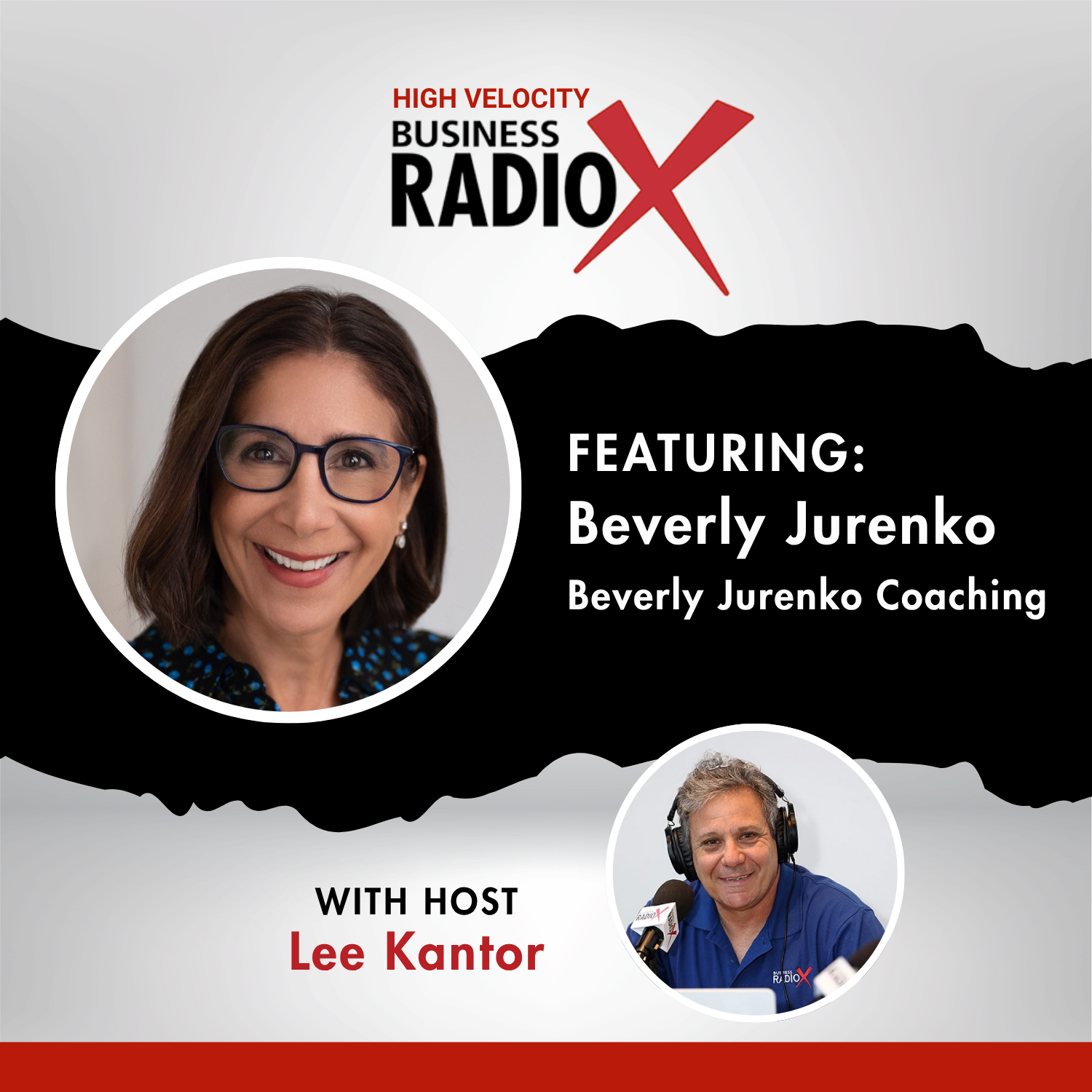

In this episode of High Velocity Radio, Lee Kantor interviews Beverly Jurenko, executive and leadership coach at Beverly Jurenko Coaching, about the importance of self-awareness, personal values, and finding balance in leadership and life. Beverly shares how her background in competitive figure skating, investment banking, and private equity shaped her journey into coaching. She discusses how leaders can navigate career transitions, manage difficult conversations, and build executive presence by staying grounded in their values. Through tools like the Enneagram, Beverly helps individuals understand their motivations, strengthen relationships, and make decisions that lead to greater confidence, clarity, and fulfillment.

 Beverly Jurenko coaches CEOs, founders, and senior executives through moments that define their leadership – navigating high-stakes transitions, scaling organizations, and meeting the challenges that test and shape who they are as leaders.
She brings clarity and perspective when the demands are greatest, helping her clients uncover what may be holding them back, lead with greater confidence and connection, and maximize their impact while continuing to grow.
What sets her apart is a rare combination of global operating experience, financial and strategic expertise, and deep developmental coaching. Prior to becoming a coach, she held senior leadership roles in private equity, angel investing, and the energy sector. She served as Vice President at BancBoston Capital, a private equity firm, and as Director at Enron and Anadarko Petroleum.
She began her career with the Prudential Investment Corporation, where she worked in private placements and investment banking, with significant experience in mergers and acquisitions in cross-border transactions as she has worked in Brussels, London, Buenos Aires, New York, Houston, and Northern Virginia.
Her coaching integrates strategic thinking with deep personal development. She holds a BA in Economics and Russian/East European Studies from Yale University, and an MBA from Harvard Business School. A credentialed coach through the International Coaching Federation and an advanced Enneagram practitioner, she draws on evidence based frameworks for leadership development and team dynamics bringing the same rigor to leadership development that she applied throughout her executive career.
In addition to her coaching practice, she contributes to leadership development and economic growth in her community. Her commitment to service reflects her broader purpose: supporting leaders whose growth creates meaningful impact for their organizations and communities.
A serial expat, mother, and wife, she brings lived experience navigating significant transitions, multicultural environments, and competing leadership demands. These experiences inform her grounded, thoughtful, coaching style and her ability to connect deeply with leaders facing pivotal moments in their careers.
Connect with Beverly on LinkedIn.
What You’ll Learn In This Episode
- Recognizing the warning signs of being out of alignment with personal values and priorities.
- Developing self-awareness to navigate challenges with greater calm and clarity.
- Using the Enneagram to understand personal motivations, recognize differences, and strengthen relationships.
- Making career and leadership decisions based on individual values, desires, and long-term fulfillment.
- Building executive presence through intentional communication, emotional steadiness, and self-confidence.
- Navigating difficult conversations, managing conflict, and establishing healthy boundaries.
- Embracing imperfection and trusting the coaching process to support personal and professional growth.
 This transcript is machine transcribed by Sonix.
TRANSCRIPT
Intro: Broadcasting live from the Business RadioX Studios in Atlanta, Georgia. It’s time for High Velocity Radio.
Lee Kantor: Lee Kantor here another episode of High Velocity Radio and this is going to be a good one. But before we get started, it’s important to recognize our sponsor, Business RadioX. If you’re a coach or a consultant who is tired of selling and ready to lead by serving, set up a call with Stone Payton at brookstone.com to learn how to give local leaders a voice and become a recognized authority in your market. Today on the show, we have executive and leadership coach with Beverly Jurenko Coaching, Beverly Jurenko. Welcome.
Beverly Jurenko: Hey, Lee. Thank you so much for inviting me to be on your show. I’m really excited to be here.
Lee Kantor: Well, I’m excited to learn about your practice. Tell us about your practice, how you serving folks?
Beverly Jurenko: Thank you. Well, I help executives find their center so they can lead from who they really are and bring into that what aligns with their values, so they can move forward with a sense of calm and self control. Most clients find me when they or their company is going through a period of transition, and the executives have usually tried talking to their family, talking to their peers, being tough and pushing through it. But it doesn’t really stick. Often when you’re talking to your friends and family and your employees and your team, they have ideas of what you should do because they have an agenda mixed up with what you do, and part of the value of bringing in a coach who’s trained and in the right mindset for the practice is that you get to you get support to see who you really are, what you want out of this. What obstacles you have and how you want to move forward. So it’s really my clients who deserve all the credit in this process as they find themselves in their center.
Lee Kantor: So now you’ve used the word center a couple times. How are you defining that?
Beverly Jurenko: Well, center is a concept that I take inspiration from because it comes from consciousness, ontology, the essence of who you really are as a being. So my initial coach training was through a company called the Academy for Coaching Excellence based in California. That was ontology based, that looked a lot into who you really are at your core, and what are your standards of integrity and what do you want in the course of your life? We all have hearts, desires, and things that we work on. And if we take inventory of that, we find that as things happen to us, we can, instead of reacting and responding, instead of reacting to other people and quickly taking an action, we can respond from a place of meaning, of purpose. That brings us a sense of calm, even if the conversation and the circumstances can be very difficult.
Lee Kantor: So what are some signs or signals in your life that may be telling you that you haven’t found your center yet, that you’re a little kind of out of kilter?
Beverly Jurenko: Oh, what a great question. So I like to think of your life as a river and you’re in a boat, a little boat, maybe a canoe. Maybe you’re punting, going down this windy river, through valleys and past mountains. And when you’re in alignment with who you really are, things feel right. Everything feels in balance. But there are going to be some days where the water gets a little choppy, and you get out and you stand on the side and you feel kind of uncomfortable. You may not know exactly what’s wrong, but if you notice you’re feeling uncomfortable, it’s a good time to take notice of what’s going on and what’s happening for you. That could be the first or what I call level one indication that you’re out of alignment alignment, and you want to take notice of that because that kind of feels like I’m not sleeping well, I’m not eating right. Maybe I’m overindulging in some things. I was impatient with my spouse or my dog or my kids. Like, you know, you’re not being your best, right? We all have days like that. It’s perfectly normal. But you want to take notice that there’s something wrong because if you don’t take notice, you can get farther from the river and take steps away where you fall into even more destructive behaviors like, um, blaming other people, feeling angry all the time, starting to develop a mindset where you think people are out to get you or the world is against you, or nothing is ever going to work out. It’s, it’s, it’s just no use to pursue it. Um, that’s where you really want to, uh, get back to who you are because there might be something that you need to do and you’re not addressing. There might be some difficult conversation you need to have, and you’re avoiding it because you’re, you’re worried about the outcome. Or it could be you’re just suppressing some need or want of your own. And that has an effect on how we show up. So for me, my coaching practice is all about self-awareness.
Lee Kantor: Now, don’t most individuals who are maybe out of balance get there slowly, like very incrementally? Like it isn’t like one day, oh, I’m in the middle of the river and everything’s great. And then the next minute, oh, I’m on the shore. Like, how did that happen? Like, it’s just you kind of slowly ease to the shore and maybe you didn’t notice you were easing to the shore because it was happening in such small steps.
Beverly Jurenko: I think generally that’s true. And that’s why I mentioned that when you start feeling uncomfortable and have these little signs like not sleeping well and not not doing the normal things you do for yourself and self-care. Um, it’s good to take a few moments and, and, and take a look at what’s going on.
Lee Kantor: Now, but do you find that people have that level of self awareness to notice that stuff at that level? I think that at least in my circle, the people have gotten to a place they’re not happy with. It just happened in such a way that it seemed like it was meant to happen that way, like they did. They didn’t kind of pay attention to the warning signs along the way.
Beverly Jurenko: Mhm. Well, um. I, I, I would say that we are not trained in our society to do that kind of self work. It’s a deliberate process of looking at who you are and what you want to remind yourself of what’s happening through, um, being attentive to yourself, um, spending a couple of moments on your own where you’re not working, you’re just letting your mind go blank. See what’s coming up for you and where the trouble spots are. You’re right. It’s not something that comes naturally to us in our society, especially among executives and people in the business world, because we have so much to do. We’re being hit by a million things a minute. The to do list is never done. So we’re constantly focused on ticking things off and achieving things and getting to the next thing. And what we don’t realize is that a little bit of slowness can bring quickness later on. We refresh and increase our efficiency when we take the time to look inside and get some clarity on what’s going on.
Lee Kantor: Can you talk a little bit about your backstory? Um, maybe share the path that got you to where you are now, helping folks in the way that you are.
Beverly Jurenko: Yeah. Thank you so much for the question. So, um, I was a competitive figure skater growing up. Um, and then, um, took that discipline to work where I spent many years dedicating myself to my career, working as hard as I can, achieving, achieving, achieving. Um, and, uh, got an MBA from Harvard, an undergraduate degree from Yale. I don’t come from a family with privilege. So this was earned and, um, largely a result of the achievement and dedication I had to figure skating. It’s been a part of my life continuously, and I am now engaging in the sport as an official or a skating judge for competitions and test sessions at skating rinks in my region. So that that dedication taught me how to achieve, which I did in the workplace. I worked in energy investment banking, private equity, uh, in Europe, Latin America, worked on some projects in Russia and Trinidad. I’ve been so fortunate to have these amazing opportunities to do things. But at a certain point in my life, I took a look at myself and I realized I asked myself the question, if. If, if I am doing so much and other people don’t, why are they happy? And I’m not. And that was a really hard question and a turning point in my life where I believe that I began the journey of looking at what is important to me, finding meaning in things and remembering to take into account the the motivations, the needs and wants of other people in addition to purely performance. So, um, in 2020, I started the journey into coaching. I never thought I would be a coach, I’ve always been a business person working on transactions, commercial development, project development. And what I’ve found is that there is so much meaning in being side by side with somebody working with them as they shift their perspective and see a new way forward.
Lee Kantor: Well, that explains why balance is important to you. Uh, it’s it was kind of drilled into you at birth almost as soon as you hit the ice.
Beverly Jurenko: Well, um, yeah, this ideas of center. Uh, I don’t know if you or your listeners, listeners are familiar with the mechanics of the inner ear, but we have this, um, uh, system called the vestibular ocular system that works in our inner ear that keeps us in balance. And it’s like fluids and tubes and crystals and a whole bunch of stuff that’s really interesting if you, if you like biology, um, but there are only two, maybe three kinds of endeavors that prevent you from getting, um, dizzy when you spin fighter pilots is one thing you can do that can suppress your vestibular ocular inhibition. Figure skaters also suppress that bodily function. And figure skaters don’t get dizzy when they spin. It’s not something that’s come naturally that comes naturally to us. It’s something that we develop through practice. So this idea that you don’t have to take what you’re given, you can work with it and adapt is something that I really love because I believe that just as figure skaters can train themselves not to get dizzy when they spin, when we are hit with a cacophony of life, we can train ourselves to keep our center, stay within who we are so that we can design the best way forward that brings true value and calm and peace to the world and to ourselves.
Lee Kantor: Now, in your work and your learning about how to do that, how to help people do that, are there tools or kind of methodology you lean on to help people kind of find the center.
Beverly Jurenko: One thing I had pursued in the last couple of years is the study and practice of the Enneagram. Have you heard of the Enneagram?
Lee Kantor: I have, I heard it on a podcast by Amy Poehler. She is a super fan of that.
Beverly Jurenko: So, uh, a couple of years ago, I started, um, training and have gained certifications in as an Enneagram practitioner for individuals and for teams. The Enneagram is a personality assessment tool that looks at who you are based on your motivations, not your behaviors. And it looks at motivations in three core areas, your, your body or your action center, your feeling or your heart center and your thinking or your brain center. And it says that of these nine types, we all have some of the nine where we have one leading type in the action center, one leading type in the feeling and one leading type in the thinking. And they work together to inform how we navigate the world in a very, very positive way. I found, um, I think there are many personality assessment tools that are, that are interesting and useful, but sometimes you’re in a room with people and you take this personality assessment and they say, okay, everybody who was this go in that corner of the room and everybody who’s this, go in the other corner of the room, and then you’re looking over at the people in the other corner and you’re like, yep.
Beverly Jurenko: Now I know why I was never comfortable with that person. Like there, there are just words in some of the typing that we react to because we have biases. And one of them would be introvert and extrovert. None of us is all the time an introvert or all the time an extrovert. We’re all a little bit of both, but yet we have these pictures of people who are introvert and extrovert, and that can bring up something positive or negative for people. So what the Enneagram is, does is looks at these these types and says that we’re some of everything, some of the types are adaptive, peacemaker, considerate helper, competitive achiever, intense, creative, loyal, skeptic, enthusiastic, visionary. And it gives us ways that we can stretch and grow where we are weak, so we can see and understand others in a new way that helps us build alliances and, and just, just a general general opportunities to grow and more comfort with people who are coming from truly a different set of fears and motivations than we intrinsically have.
Lee Kantor: It sounds kind of more actionable rather than kind of labile.
Beverly Jurenko: Yes, exactly. That’s that’s what I love it when you are with a group of people and everybody gets into a circle and stands on their Enneagram type, and you talk about how you see the world. It is such a beautiful exercise because you realize what people really want and what their fears are, rather than just boxing them into a corner.
Lee Kantor: Yeah. And that’s really what we want. We just want to be more effective in communicating and dealing with people like, you know, giving them a color or a name is not really that important. It’s how do I best kind of get the most out of them and them get the most out of me?
Beverly Jurenko: Well, we are all complex human beings, and each one of us has a unique profile that is as beautiful as every other. So what Enneagram is says that we need each other because all of the nine types, when you put them together, comprises what we need as human beings.
Lee Kantor: And it gives us kind of common language.
Beverly Jurenko: Yeah. Common language. And you mentioned that we all want to communicate better. I’ll go. I’ll go even deeper than that. I’ll say what each of us wants is to be seen.
Lee Kantor: Now, in your work, is there something that has happened that is typically that trigger or that launching point into a relationship with you? Is there kind of, um, an event that happens or something in their life That happens with a client that turns them into somebody that’s like, oh, let me call Beverly.
Beverly Jurenko: Some of my clients have have said that they are learning about their Enneagram has been the most or one of the most transformative experiences they’ve had in working with me.
Lee Kantor: Well, I would imagine that that once you start working together, that tool is a useful way to serve them. But is there what happens before they have you as the coach? Is there something happening in their life? Did they, you know, try to get promoted and didn’t get it or something? Was there kind of a triggering moment that’s like, I better find a coach and not only a coach, I better find Beverly.
Beverly Jurenko: Yes. Um, clients tend to reach out and find me when they’re going through some sort of transition. It could be that their company is going through change of control Or their family circumstances are changing. Or they’re asking myself, should I stay or should I go? I didn’t get that promotion I wanted, or I want this promotion, or I want to change my my job function, but I’m not sure or I don’t know how to go about it or I don’t know what I really want. Um, so there are many ways for being in transition to show up, but typically clients come to me when they’re in some type of a transition.
Lee Kantor: Now, how do you help the person who is dealing with kind of two choices that both are valid? Like, for example, should I quit my job? Should I start my own business? Like you went through that? Um, I’m sure in your practice you were working somewhere and then you started your own thing that both of those are things that, um, you, you could do. So how do you help a person kind of decide something that has kind of two paths that both are fine answers, but maybe one would be the right thing for them at this time.
Beverly Jurenko: I trust that my client has what it takes to see their own way forward. So I am never going to tell people what they should do.
Lee Kantor: Right? You’re going to help them kind of choose the right path. But what are some of the ways that you help them weigh that? Um, what seems like kind of a, a fork in the road? How do you help them weigh up the right way to choose for themselves?
Beverly Jurenko: The first thing we do is go back to basics. We look at who you are at your core and what your values are. The next thing we do is take inventory of what you want and what are your heart’s desires, and where have you achieved a lot, and where is there unfinished business together that maps of vision and a blueprint for the things that are going to be important to you. From that, we can screen the opportunities across the work that you’ve done so that you can see where are you gaining? Where are you losing? What is going to bring you more peace and fulfillment in the long term? And at the end of the day, it’s for you to choose, not for me to choose. But when you are acting in alignment with yourself, you know it. I feel like I feel like it’s almost like catching a wave. And when you feel that wave, it’s going to be normal for your mind to activate and tell you, don’t do it. It’s dangerous. Come up with more reasons why you can’t take the decision. You have to do more analysis. You have to get another certification. You have to wait for another conversation to happen. Your brain is always going to put up obstacles to you moving forward because it’s trying to keep you safe. But this is where the ontological aspect comes into it. You have to know that no matter what you do, all is well. You are living your unique life and whatever decision you make is going to build to the circumstances and the characteristics and the experiences and all the things that fill the chalice of your life and make it unique. So no matter what you choose, you are going to win. Just trust that all is well.
Lee Kantor: Now, when you were younger and you were learning how to spin without getting dizzy for the first time, I’m sure there was those same kind of emotions being felt right. Fear. Is this possible? I don’t know. You’re telling me I won’t get dizzy, but it seems like I would get dizzy. You know, intellectually, I have to kind of have faith and believe what you’re saying is true. But when you started spinning and didn’t get dizzy, that feeling of exhilaration must have been unbelievable. Like that moment when you were doing it must have just really kind of left an imprint. And it sounds like that’s what you’re trying to help your clients capture.
Beverly Jurenko: So, um, I started skating when I was four and a half years old, so I don’t remember. I don’t actually remember learning how to spin. Um, but in the journey of coaching. I can say that over six years I have gone from. A feeling of utter terror in the first hours of working with my clients because I was so worried that I might say the wrong thing, not be providing value, create harm in some way, even if it’s just wasting other someone else’s time. I have a strong desire to bring value for other people and be a person of value. And so the last thing I want to do is, is, is not do that, particularly when they’re trusting me to be their coach. So letting go of that fear and trusting that just, just as my clients are not perfect, I’m not perfect. We are, we are working on this together, and I have the training and the skills and the experience now to bring the best of myself, to help my clients be the best of themselves. So letting go of that fear and realizing that I am an imperfect human being, just like everybody else, has been tremendously freeing and centering. So it’s kind of like, it’s kind of like disabling that vestibular ocular system that is creating dizziness and making me fall to a place where it’s like, yeah, I’m, I’m spinning, I’m, I’m spinning around, but I, I have my center, I’m doing my best and it’s going to be okay.
Lee Kantor: Now, is there a story you can share that maybe illustrates what it’s like to work with you? Don’t name the individual, but maybe share the challenge they came to you with and how you were able to help them get to a new level.
Beverly Jurenko: One this relates very much to centering, but one. One, one aspect of leadership development that I work on with, um, a number of clients is on building executive presence and executive presence is centering its gravitas, communication, the way you present yourself from how you look, which is very superficial in a small part of it. But as human beings, we take the visual cues. So it’s important to, to, to address that. Um, but really to finding a way to play your own tune as a leader. Often, you know, we spend the first 35 years of our lives learning how to do things. Leadership is not about doing things. Leadership is about And the more you know yourself and the more you have center, the more you can be a person that leads and others feel comfortable following. So, um, I work with my clients on supporting them to slow down and figure out how to best respond to things when they go wrong, or people are calling and being demanding, or board members are being unreasonable, or CEOs are losing their cool because the numbers aren’t coming in. We work on slowing down so that, um, my clients are fully comfortable having hard conversations, saying no, setting up boundaries. Dealing with conflict and other people getting upset without it impacting their sense of well-being. And that is true. Centering when others can’t impact you because they are stressed and you stay within yourself and are deliberate and intentional in your response. That is executive presence and leadership.
Lee Kantor: Now, in your work, do you, um, is it primarily kind of one on one coaching or do you work with organizations like you mentioned, a background in, um, uh, private equity and banking, things like that? Do you work with kind of mergers and acquisitions when two groups are getting together? Um.
Beverly Jurenko: The majority of my, my work is one on one supporting individuals. I do work with teams also from time to time, I mentioned Enneagram, um, where we bring a leadership team together of say, you know, ten executives in a company. And we do a, a, an Enneagram, um, look at their team dynamics and present opportunities for them to set new, um, new goals and intentions on how they want to work together as a team. So, but most of my work is individual. Um, some people are hired by corporations, paid by the company to work with people on development. And I think that work is really valuable from the company standpoint. It does mean that the, the company who is paying for your services might have an idea of what they want the individual to do. And for me, I’m very individual centered. I want to do what the I want to support what the individual wants, which sometimes might be leaving or doing something different than what the company wants. So for this reason, I’m, I’m, I’m largely my, my, my comfort, my comfort space. My sweet spot is largely working with individuals.
Lee Kantor: And if somebody wants to learn more, have a more substantive conversation. What’s the website? What’s the best way to connect?
Beverly Jurenko: Best way to connect is through my website. It’s www.beverlycoaching.com because I’m Beverly and I offer coaching, so why not beverlycoaching.com?
Lee Kantor: That’s perfect and good for me.
Beverly Jurenko: On LinkedIn. There aren’t very many Beverly Jurenko out there.
Lee Kantor: Yeah, uh good stuff. Well, Beverly, thank you so much for sharing your story today. You’re doing such important work and we appreciate you.
Beverly Jurenko: Thank you, I appreciate you.
Lee Kantor: All right. This Lee Kantor we’ll see you all next time on High Velocity Radio.