Business RadioX ®

  • Home
  • Business RadioX ® Communities
    • Southeast
      • Alabama
        • Birmingham
      • Florida
        • Orlando
        • Pensacola
        • South Florida
        • Tampa
        • Tallahassee
      • Georgia
        • Atlanta
        • Cherokee
        • Forsyth
        • Greater Perimeter
        • Gwinnett
        • North Fulton
        • North Georgia
        • Northeast Georgia
        • Rome
        • Savannah
      • Louisiana
        • New Orleans
      • North Carolina
        • Charlotte
        • Raleigh
      • Tennessee
        • Chattanooga
        • Nashville
      • Virginia
        • Richmond
    • South Central
      • Arkansas
        • Northwest Arkansas
    • Midwest
      • Illinois
        • Chicago
      • Michigan
        • Detroit
      • Minnesota
        • Minneapolis St. Paul
      • Missouri
        • St. Louis
      • Ohio
        • Cleveland
        • Columbus
        • Dayton
    • Southwest
      • Arizona
        • Phoenix
        • Tucson
        • Valley
      • Texas
        • Austin
        • Dallas
        • Houston
    • West
      • California
        • Bay Area
        • LA
        • Pasadena
      • Colorado
        • Denver
      • Hawaii
        • Oahu
  • FAQs
  • About Us
    • Our Mission
    • Our Audience
    • Why It Works
    • What People Are Saying
    • BRX in the News
  • Resources
    • BRX Pro Tips
    • B2B Marketing: The 4Rs
    • High Velocity Selling Habits
    • Why Most B2B Media Strategies Fail
    • 9 Reasons To Sponsor A Business RadioX ® Show
  • Partner With Us
  • Veteran Business RadioX ®

Decision Vision Episode 150: Should I Pivot? – An Interview with Jocelyn Brady, Brain Coach

January 6, 2022 by John Ray

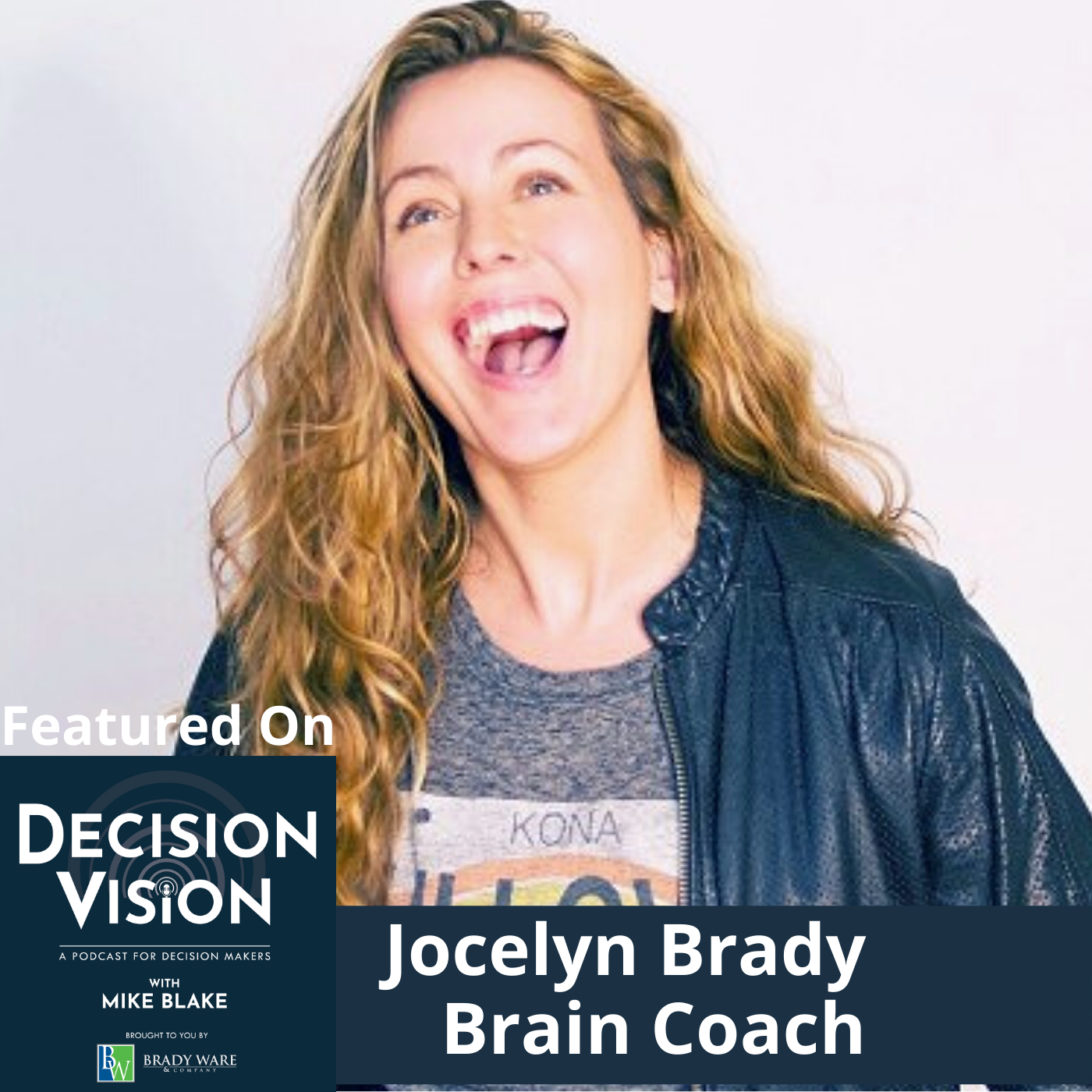
Jocelyn Brady
Decision Vision
Decision Vision Episode 150: Should I Pivot? - An Interview with Jocelyn Brady, Brain Coach
Loading
00:00 /
RSS Feed
Share
Link
Embed

Download file

Jocelyn Brady

Decision Vision Episode 150:  Should I Pivot? – An Interview with Jocelyn Brady, Brain Coach

When Jocelyn Brady began to be bored and even resented the projects she was working on in her business, she recognized an itch she needed to investigate. Then came the pandemic, which caused its own disruption, and Jocelyn pivoted away from writing and content creation to working as a Brain Coach. In this conversation with host Mike Blake, Jocelyn describes what it is like to have a successful company and yet be unfulfilled, the impact of Covid on her trajectory, her mixed feelings about the word “coach,” and much more. Decision Vision is presented by Brady Ware & Company.

Jocelyn Brady, Brain Coach, Speaker & Chief Play Scientist

Jocelyn Brady, Brain Coach, Speaker & Chief Play Scientist

Jocelyn Brady is a writer, speaker, and professional brain jostler who thrives at the intersection of comedy, storytelling and unraveling the mysteries of the human brain. When she’s not being the Bill Nye of the brain (as the creator and host of her series Tiny Tips, the Internet’s favorite way to Brain), Jocelyn applies her certified Brain Coaching chops to help creative visionaries tap their brains’ greatest potential.

In her past life—as an award-winning copywriter, Creative Director, and agency CEO—Jocelyn led narrative strategy and international storytelling training for some of the world’s biggest brands. She also produced and co-hosted Party Time, a standup comedy and storytelling show featuring talent who went on to write or perform for Conan, Colbert, and Comedy Central. All while managing to keep her two cats and houseplants alive.

Jocelyn’s first book, tentatively titled Your Brain is a Magical Asshat, is slated for publication next year.

Website | LinkedIn | Twitter | Tiny Tips Series

Mike Blake, Brady Ware & Company

Mike Blake, Host of the “Decision Vision” podcast series

Michael Blake is the host of the Decision Vision podcast series and a Director of Brady Ware & Company. Mike specializes in the valuation of intellectual property-driven firms, such as software firms, aerospace firms, and professional services firms, most frequently in the capacity as a transaction advisor, helping clients obtain great outcomes from complex transaction opportunities. He is also a specialist in the appraisal of intellectual properties as stand-alone assets, such as software, trade secrets, and patents.

Mike has been a full-time business appraiser for 13 years with public accounting firms, boutique business appraisal firms, and an owner of his own firm. Prior to that, he spent 8 years in venture capital and investment banking, including transactions in the U.S., Israel, Russia, Ukraine, and Belarus.

LinkedIn | Facebook | Twitter | Instagram

Brady Ware & Company

Brady Ware & Company is a regional full-service accounting and advisory firm which helps businesses and entrepreneurs make visions a reality. Brady Ware services clients nationally from its offices in Alpharetta, GA; Columbus and Dayton, OH; and Richmond, IN. The firm is growth-minded, committed to the regions in which they operate, and most importantly, they make significant investments in their people and service offerings to meet the changing financial needs of those they are privileged to serve. The firm is dedicated to providing results that make a difference for its clients.

Decision Vision Podcast Series

Decision Vision is a podcast covering topics and issues facing small business owners and connecting them with solutions from leading experts. This series is presented by Brady Ware & Company. If you are a decision-maker for a small business, we’d love to hear from you. Contact us at decisionvision@bradyware.com and make sure to listen to every Thursday to the Decision Vision podcast.

Past episodes of Decision Vision can be found at decisionvisionpodcast.com. Decision Vision is produced and broadcast by the North Fulton studio of Business RadioX®.

Connect with Brady Ware & Company:

Website | LinkedIn | Facebook | Twitter | Instagram

TRANSCRIPT

Intro: [00:00:02] Welcome to Decision Vision, a podcast series focusing on critical business decisions. Brought to you by Brady Ware & Company. Brady Ware is a regional full-service accounting and advisory firm that helps businesses and entrepreneurs make visions a reality.

Mike Blake: [00:00:22] Welcome to Decision Vision, a podcast giving you, the listener, clear vision to make great decisions. In each episode, we discuss the process of decision making on a different topic from the business owners’ or executives’ perspective. We aren’t necessarily telling you what to do, but we can put you in a position to make an informed decision on your own and understand when you might need help along the way.

Mike Blake: [00:00:42] My name is Mike Blake, and I’m your host for today’s program. I’m a director at Brady Ware & Company, a full-service accounting firm based in Dayton, Ohio, with offices in Dayton; Columbus, Ohio; Richmond, Indiana; and Alpharetta, Georgia. My practice specializes in providing fact-based strategic and risk management advice to clients that are buying, selling, or growing the value of companies and their intellectual property. Brady Ware is sponsoring this podcast, which is being recorded in Atlanta per social distancing protocols.

Mike Blake: [00:01:08] If you would like to engage with me on social media with my Chart of the Day and other content, I’m on LinkedIn as myself and @unblakeable on Facebook, Twitter, Clubhouse, and Instagram. I also recently launched a new LinkedIn Group called A Group That Doesn’t Suck, so please join that as well if you would like to engage. If you like this podcast, please subscribe on your favorite podcast aggregator, and please consider leaving a review of the podcast as well.

Mike Blake: [00:01:32] Today’s topic is, Should I pivot? And we’ve done this topic before, probably about a-year-and-a-half ago. But as you know, if you’ve been a long time listener, I don’t mind revisiting a topic every once in a while, because certain topics, I think, just lend themselves well to different angles, different approaches. And something like a pivot, also, in my experience is a deeply personal experience. And so, everybody is going to come to a pivot, is going to experience a pivot, is going to engage with it, embrace it or not in their own unique way. And so, it’s one of those kind of evergreen topics that I don’t think we’ll ever get to a point where nobody ever pivots anymore.

Mike Blake: [00:02:17] And, also, frankly, from a very practical perspective, now that we’re recording podcast 140 something or whatever, like 148, I guess, or 149, the reality is that most people don’t go back and listen to a lot of the back catalog. We’re not Led Zeppelin. People aren’t going back to the initial records and trying to find the original recording. So, if you’re like most people and you’re relatively new to the podcast, statistically speaking, this will be a topic that we actually haven’t covered before. And if you want to hear more about it, then you can go back into the deep tracks in the archives somewhere around the double digit episodes. So, I hope you’re going to find this topic and this conversation as engaging as I anticipate that it will be.

Mike Blake: [00:03:02] You know, pivots are interesting because there are some very famous ones I don’t think people necessarily realized. Cornelius Vanderbilt – yes, that Vanderbilt family – initially started out with steamships. He actually started out with river barges around the island of Manhattan, and they are basically providing cut rate ferry service across the Hudson and East Rivers. And in doing so, got a lot of people killed because they used rickety boats. But that’s how they charge less for what they did. They eventually did pivot into steamships, which presumably were safer. I don’t know. I don’t have any data on that. And then, eventually railroads.

Mike Blake: [00:03:45] William Wrigley, whom you may know from Wrigley’s Gum – I don’t chew gum because it rip out all my dental work. But for those of you who do have good teeth, you may know of Wrigley – they originally were a baking powder company. Twitter, of all things, launched as a podcast directory. Yelp began as an automated email service. And YouTube, believe it or not, was once a dating site. So, we have Tinder now and we have all the others, but YouTube actually was not the YouTube that we know of today.

Mike Blake: [00:04:13] And, you know, I find it also an interesting topic because I find myself at odds intellectually with the investment community on one particular topic, and that is, Should you bet the jockey or the horse? And what that means to those of you who aren’t necessarily speaking Silicon Valley, it means that do you place the bet on the management of a startup or do you place your bet on the basic idea of the startup? And most investors will tell you that they bet the jockey, they bet the management team, over the actual idea figuring that a management team will actually figure it out.

Mike Blake: [00:04:55] The data – and this is empirically studied. This is actually a fairly old study, but still very good. It was published in the Journal of Finance back in 2011 – called it Do You Bet the Jockey or the Horse? And the empirical study determined that, in fact, the companies that generated the most value in their IPOs were the ones that had kept the fundamental idea, more or less start to finish, but actually had switched management teams.

Mike Blake: [00:05:21] And the reason behind that, I think, is that – again, probably torching this analogy beyond where it needs to go – if you have a slow horse, the best jockey in the world is not going to win the race of the slow horse. They may prevent you from coming in last. They may prevent you from having the horse fall over, break its leg, and you have to shoot it right down the track. But even a great management team can’t take a slow horse and win the Kentucky Derby. However, if you have the fastest horse, an average jockey might win that race because you actually have the fastest horse.

Mike Blake: [00:05:54] So, I think that there’s something to that. So, finding the right idea, finding the right business model, this highlights how important that is. Because if you don’t have the right business, you don’t have the right model – and the data says this. It’s not just Mike Blake talking into a microphone on the internet – the data suggests that there’s only so far a mediocre business concept will take you.

Mike Blake: [00:06:20] And I don’t care if you’re going to have the best management team in the world, and you can dig up Jack Welch and Steve Jobs and everybody else that you might have idolized, Warren Buffett, you’re only going to take that so far. And I guess that’s why I find pivots so interesting, because a pivot is truly an existential decision. I think it is one of the most important decisions that are made in business and probably one that is not as appreciated as much as it should be.

Mike Blake: [00:06:49] So, fortunately, coming on to join us somebody who is either sort of at the later stages or fresh off a pivot, she’ll tell us exactly where she is on it. But joining us is Jocelyn Brady, who is the Creative Brain Jostler and Brainutainer. She is a writer, speaker, and professional brain jostler who thrives at the intersection of comedy storytelling and unraveling the mysteries of the human brain. When she’s not being the Bill Nye of the brain as the creator and a host of her series, Tiny Tips, The Internet’s Favorite Way to Brain, Jocelyn applies her certified brain coaching chops to help creative visionaries tap their brain’s greatest potential.

Mike Blake: [00:07:30] In her past life as an award-winning copywriter, creative director and agency CEO, Jocelyn led narrative strategy and international storytelling training for some of the world’s biggest brands. She also produced and co-hosted Party Time, a stand-up comedy and storytelling show featuring talent who went on to write or perform for Conan O’Brien, Stephen Colbert, and Comedy Central. All while managing to keep her two cats and houseplants alive. And I have seen at least one of the cats and one of the plants, so we do have proof of life for at least one of each. Jocelyn Brady, welcome to the program.

Jocelyn Brady: [00:08:03] Thank you so much.

Mike Blake: [00:08:05] Oh, and before you jump in, I forgot to mention and this is really important, because you’re doing something that I’m struggling to do myself. Jocelyn’s first book tentatively titled, Your Brain is a Magical Ass Hat, is slated for publication next year. Jocelyn, again, welcome to the program and congratulations on writing a book. I’m struggling to do that, but it’s hard to do that in crayon.

Jocelyn Brady: [00:08:28] Oh, man. It’s hard to even think about or talk about writing a book, let alone actually doing it. But, yeah, I highly recommend joining other people coaching program or other people who are doing it. Just like getting some of that accountability, that’s the biggest thing is just creating that structure. Stick with it.

Mike Blake: [00:08:48] So, we have you here to talk about pivots. And as I like to do on the show, just in case somebody was listening who really doesn’t know what a pivot is, when you hear the term pivot, what does that mean to you?

Jocelyn Brady: [00:09:01] I imagine the basketball move like, “Okay. We were going to go this way and now we go this way.” I know nothing about basketball, but people do pivot.

Mike Blake: [00:09:11] They’re doing great. Yeah.

Jocelyn Brady: [00:09:14] Yeah. It’s just changing course, right? Deciding to move in a new direction, and it could be sudden.

Mike Blake: [00:09:20] So, what did your company originally set out to do?

Jocelyn Brady: [00:09:24] Well, when I started in 2008, all I wanted to do was make a living writing. And, you know, it was literally starting with can I earn enough to eat a sandwich today? And then, it started just growing really quickly. I didn’t have any business experiences in my 20s. I didn’t have a plan. I just thought, “I’m good at writing. I’ll figure it out.” And I got into copywriting. And one thing led to another. More clients were coming my way. I accidentally had more work than I could handle, so I hired a team.

Jocelyn Brady: [00:10:02] So, a team of writers and that grew into, not just content development or copywriting, but also then developing the brand voices and narrative strategy. And overseeing their most important projects, like what is the CEO saying in their annual meeting to shareholders? Or, what are you putting in your video scripts? And even overseeing a Super Bowl ad for a big company. And so, we were developing that tone of voice and then training the teams on how to be better storytellers. And like I said, it didn’t really set out with any grand plan or dream or vision. It was just, I just want to make a living writing.

Mike Blake: [00:10:42] And sandwiches. You wanted sandwiches.

Jocelyn Brady: [00:10:45] I wanted sandwiches to feed myself, I guess.

Mike Blake: [00:10:48] Yeah. And your cats wanted kibbles or Fancy Feast, whatever you feed them. We feed our children, it seems to keep them happy. So, you started this thing and it sounds like it was pretty successful. If anything, maybe so successful that in itself provided a challenge. What were some signs that things in this company weren’t meeting your expectations?

Jocelyn Brady: [00:11:15] I started to get bored. I started to almost resent the projects that were coming in. And I knew that’s not a good place to be. You don’t want to resent work coming in or pass that along to the clients themselves. It’s just a horrible way to approach something and to work with people. So, I think it was just the itch, like it’s not fulfilling. And a lot of times when you start something, you grow up or you excel, and you become now a manager of people, and you’re doing less of the thing that you started doing.

Jocelyn Brady: [00:11:53] It’s like a story as old as time in any company or large corporations, especially. You’re really good at a skill and then you get promoted and you’re like, “Wait a minute. Now, I’m just doing completely different things.” Making sure the business is functioning, and that we have good cash flow, and are the people doing their jobs, and how do we manage when people are out or leave or get vengeful or nobody’s gotten vegetable. You got to prepare for all the scenarios. So, I think that was the main thing is just feeling misaligned with what I was doing.

Mike Blake: [00:12:28] You know, it’s interesting you bring that up, because I think that one of the most underappreciated differentiators of a Bill Gates, of a Sarah Blakely, of a Steve Jobs, and Mark Zuckerberg is that, in addition to all the things that people know they brought to the table, their innovation, their energy, their messaging, and so forth, their vision, but also the skillset and the desire to run and thrive in a startup as well as in a Fortune 100 company. That is not easy to do because you’re not just scaling a person, you have to scale yourself.

Mike Blake: [00:13:15] And not to go all self-help guru here because I’m not it, but not many people can make that journey or want to make that journey. Because, when you’re running Apple, it’s not the same thing as writing code, and being in there, and designing the products and everything. Which I suspect was probably the case with Steve Wozniak why he sort of took a less prominent ride. I don’t know, Stevie. I call him Stevie. He calls me who the hell are you? But I suspect that’s kind of what happened, you know, listening to his interviews, reading what he writes, he would not have had any fun and probably not a lot of success running that kind of company.

Mike Blake: [00:13:54] And it sounds like a little bit of that may apply to you, too, that you started to get far away from what you were doing because of the way the company is growing and somebody had to run it.

Jocelyn Brady: [00:14:03] Yeah. Yeah. And I mean, there’s still things that I did love. So, the more I was doing the workshops, I realized that I really loved interacting with people, coming up with ideas on the fly, helping people pull out the creative ideas, and just that live interaction. And you never know really what’s going to happen.

Jocelyn Brady: [00:14:29] And I still love writing, obviously. I’m working on a book and I’m also working on a really big network project. But I take those few and far between because now I realize, if I’m working on a project or I’m outsourcing my writing skills, I have to absolutely love this project. That became very clear. And on the other side of that is, I love spending my time just working directly with people and things where you’re not sitting alone banging your head against the wall going, “Oh, help. Just be here writing.” So, even when we had a pretty significant team, everybody was working remotely. We rarely got together, so it can be lonely even as part of a team.

Mike Blake: [00:15:11] I would argue sometimes it’s lonelier, because, to me, one of the biggest challenges of leadership is to sort of get out there and put a smile on your face when it’s the last thing that you want to do. And when you’re responsible for the care and feeding of a team that has entrusted you to become the platform of their careers and, in some cases, their life satisfaction, that is a very lonely place to be.

Jocelyn Brady: [00:15:41] Yeah. And it could be really scary. And it’s really helpful to connect with other entrepreneurs and people running businesses because you just simply can’t relate to what it’s like, to feel responsible for, not just yourself, but all the other people who are looking up to you like, “What’s happening next?”

Jocelyn Brady: [00:16:03] And let alone – I’m sure we’ll get more into this – COVID, as for many of us, was like, “Oh, everybody is going to hell.” And that’s when all my big contracts vanished. So, the ones I didn’t want were no longer a problem. But it was terrifying because I now had to let my team go. I had to tell them, you know, “There’s no more work. And I would love to keep you around, but I can’t pay you.”

Mike Blake: [00:16:33] I’ve never had to let a whole team go, but I have let people go in my career. But I got to imagine that conversation or series of conversations – I don’t know whether you did it in a group or you did it individually. I’m sure you didn’t do it like that button CEO did it over Zoom and calling people thieves on the way out. I’m sure you didn’t do it that way – that’s got to be the hardest conversation, one of the top five you’ll ever have in your life.

Jocelyn Brady: [00:17:07] Yeah. It’s like a divorce, right? It’s just not working out between us. There’s a lot of emotion. And I got to say, with my longtime assistant, she was five or six years this one, and I absolutely loved her and I knew that she wanted to get more into filmmaking. She’d been doing, but she really wanted to move to L.A. and try it for real. And I really wanted for her to do that. So, when this came around, I think for both of us, it was like the best breakup I could ever imagine because it was sad and we were really emotional, but also really glad for each other. She decided to go to L.A.

Jocelyn Brady: [00:17:52] She just got a role – I think I’m allowed to talk about it now – Haley Joel Osment is in it, James Franco – wait. Sorry. The other Franco directed it, Alison Brie. So, anyway, I couldn’t imagine a better outcome. And I think when you have people’s best interest in mind and you’ll be as vulnerable as you can and say what’s really happening, that’s really, really scary and can be really hard to do. And I think it takes a lot of practice. I don’t think a lot of us are well-versed or trained to do that.

Jocelyn Brady: [00:18:27] Especially in a business setting, there’s this idea you need to be professional and you can’t say emotional things. But, to me, that is crucial and really important for human development, relationships, behavior, all of it.

Mike Blake: [00:18:45] Yeah. And I think it’s rapidly becoming best practices too. You know, the world has changed, obviously. It’s an open question to what extent we’ll go back to in 2019. It’s not going to be 100 percent, I think we all know that.

Mike Blake: [00:19:02] So, your pivot story, it sounds like that COVID accelerated a pivot that might have happened anyway because you really weren’t loving what you were doing. Is that fair?

Jocelyn Brady: [00:19:13] Yeah. Exactly. It had been on my mind for a year and I’d been talking to my team about making transitions. And, yeah, that came along and I was like, “Well, I guess decision made. You’re doing it now.”

Mike Blake: [00:19:28] So, COVID happens. You let your team go. What do you do the next day?

Jocelyn Brady: [00:19:38] Cry a lot, you know, mixed feelings. I was really excited about a new direction, but also terrified. And it’s so difficult to have built something up and then it’s completely gone, in a sense, where it’s starting over. It’s just me again. I have nothing. I have enough to sort of buy a few months, thankfully. But other than that, it’s like, “What am I doing?”

Jocelyn Brady: [00:20:10] And that’s not entirely true, because I did have the four years prior or 2016 or 2017, I got certified as a brain coach. But it’s something I sort of kept secret, because as someone who works with words, I couldn’t wrap my head around how to love the word coach. I hated it. I hate the word coach. The baggage I feel it comes with, it seems so phony. I just had all these unhealthy attachments to the meaning of the word, the meaning I was making.

Jocelyn Brady: [00:20:37] And at the same time, I was still doing it, still coaching people in private for four years. It was just now I got to, “If you really want to be doing this, own it. If you really want to be speaking, tell people you are a speaker. Go out there and speak. Go do the thing. You’ve got nothing to lose now. You got everything to gain.” Because, otherwise, we’ll just be moving with the cats into the crawl space and hope the new landlord doesn’t know or the owner doesn’t know.

Mike Blake: [00:21:10] So, I’m going to ask you sort of a semi-unfair question, but I feel like I want to ask it anyway. COVID gave you kind of the jolt, if you will, sort of forced the pivot on you. Do you think if the pandemic hadn’t happened, you would have made a pivot like this anyway?

Jocelyn Brady: [00:21:29] I’d like to think so. I think eventually I would have. Definitely, I do know that once I decide I’m doing something with full conviction, I’ll do it. But I definitely think it would have taken me longer. I would have had feelings about not wanting to let my team go. And so, if they don’t want to come with me on the new ride, then that would have been the end of that anyway. So, yeah, it’s always hard to say. And you never know what you’re like until really confronted with the situation.

Mike Blake: [00:22:07] That’s true. That’s entirely fair. So, I have to get back to something because I do think it’s a polarizing word, and that is the word coach. And I’d love to hear your perspective on it. My view of the word has changed over the years, but I don’t want to suck all the air out of the room. Tell me why you have such a negative relationship with that word.

Jocelyn Brady: [00:22:36] I think I did not have a lot of exposure to coaches or to good coaches in business, life coaching, whatever the case. Not counting basketball coaches, which, as we’ve established, I know nothing about. But when it comes to that mindset, and direction, achieving goals and that sort of thing – I don’t necessarily want to badmouth some of the big hitters that we see. But it’s easy. It’s easy to shoot arrows at the people standing out in front – I just did not like what I saw. I did not like this feeling that you have to look a certain way, you have to look kind of polished and perfect, and you have to come across it’s always positive and optimistic. And there’s a ton of value in that.

Jocelyn Brady: [00:23:25] But let’s get real. Sometimes life sucks and that’s okay. Let’s deal with the full spectrum of the human experience. And it just felt like there’s a lot of charade out there, and a veneer, and just not authentic sales driven behavior at the expense, a lot of the time, of people’s real mental health that can be damaged in the process.

Mike Blake: [00:23:55] I think there’s something to that. So, we’re segueing into kind of the different part of the conversation, which is fine. But I think in fairness, when I first started running across coaches – I’m a little bit older than you are – I started running across coaches about 15,20 years ago. I didn’t find very many of them to be particularly impressive. I didn’t find many of them to be people like saying, “Oh. Well, this person is worth paying 200 bucks an hour instead of the people who I do respect and are giving me lots of awesome advice for free.” I didn’t see a lot of that.

Mike Blake: [00:24:32] And I do think that there still remain coaches that, you know, sort of come from the school of those who can’t do teach. And we’ve actually had a podcast and I had my professional coach on, and we went through some of that – and maybe I’ll revisit that topic as well. But I don’t think that you’re being unfair. I mean, coaching is largely unregulated. The certifications are very disparate. You know, what does one mean versus another? How meaningful are they at all, et cetera? And, candidly, the quality of coaches is quite variable.

Mike Blake: [00:25:15] So, I don’t think you’re necessarily painting them with a broad brush. I think just the reality of life is that, if you see a pattern over and over and over again, that’s going to be the pattern that is associated with you. At some point stereotypes do come from someplace. They weren’t just made up. They occurred because enough people observed enough behaviors that they start to become an easy way to characterize people rightly or wrongly.

Jocelyn Brady: [00:25:46] Yeah. And I think we haven’t seen or been exposed to it’s like a self-fulfilling prophecy to you think it’s going to be a certain way. And then, you just start seeing it that way and you start looking for those types of people. And that’s kind of all we saw. Like white bread coaches, it’s just sort of the same message. One might be a foot taller than the other. That’s about the only difference. They all just seemed the same.

Jocelyn Brady: [00:26:15] The big discussion that’s been coming up in the last year plus – it’s been coming up a lot longer than that – who are we representing? Who are we putting out there? The diversity and thinking backgrounds, ethnicity, behaviors, we need to see more of that. And I do see that happening, and maybe it’s because I got more into it so I started looking at who else was out there who didn’t have the huge reach and the number one spot on YouTube, et cetera.

Mike Blake: [00:26:46] And I think the numbers also support it. Putting coaching aside for a second, we both know everybody listening to this knows about the great resignation, the great job hop, whatever you want to call it. And I think money is a big, big part of that. Let’s be real, money matters. More money, you have more sandwiches you can buy, and better sandwiches like wheat bread.

Mike Blake: [00:27:16] But this is also sort of the great reckoning with authenticity. You know, being in an organization where you just don’t fit and you try to make yourself fit because you feel like you have to. And I’ve been through that scenario. It is wearing. It is draining. It beats on you constantly. And, now, that people have an opportunity where labor has leverage for the first time in our economy in a very, very long time, you’re seeing just people vote with their feet.

Mike Blake: [00:27:48] My job, for example, as an employer is not so much to give people jobs. It never was. But as much as it is to provide solutions for my clients, it’s also to provide the right platform for my people to thrive, ultimately, maybe with us, maybe someplace else. They’re not going to retire with me, statistically speaking. I know that and they know that, and that’s okay.

Mike Blake: [00:28:14] But I do think that authenticity piece is real. And I think coaching is becoming more respected because, I think, coaches are now embracing and understanding for that need for authenticity. It’s no longer about turning yourself into the template that the market wants. But, rather, understanding what your own template is and bending the rest of the world around to your will.

Jocelyn Brady: [00:28:43] Yeah. Putting yourself out. It’s the whole light attracts light thing. Just put who you really are out there and then you will attract the type of people that you will probably work well with. If you’re putting out some phony shit, it’s not going to be fruitful for anybody. It’s probably a lot more damaging.

Jocelyn Brady: [00:29:07] You know something? It really drove me nuts, too, when I was doing a lot of these storytelling workshops in particular. I would see how people in office settings where it seemed there’s so much fear-based leadership, because if the leaders themselves aren’t courageous enough to put themselves out there and to be vulnerable and to say what’s really on their minds, you have to have some filtering and compassionate communication skills are good in this.

Jocelyn Brady: [00:29:40] I was just hearing about – what is it? – radical candor and sort of some people hating on it. I was like, “Yeah.” There’s a line to walk or balance. But be you. And if you’re not happy, you need to find a way to express that. And if that can’t be resolved, you need to get out because it’s just going to cause everyone to suffer.

Mike Blake: [00:30:04] And because of that – and believe it or not, audience, this actually does relate to the actual topic – this is actually what we’re seeing is a great pivot. Lots of people are pivoting their lives because they’ve been forced to reckon with things in their lives, personal or professional or both. There’s nothing like being in lockdown with your family for a while to find out if you actually like them or not. I mean, that will send a very clear signal as to what your relationship really looks like.

Mike Blake: [00:30:36] So, I’m curious – I think you have a really interesting answer for this. No pressure – when you decide that you’re going to pivot or the pivot happened, what was the hardest thing for you to leave behind?

Jocelyn Brady: [00:30:52] The first thing that pops in my head is money. Just going ahead, a regular –

Mike Blake: [00:30:57] Money is a thing.

Jocelyn Brady: [00:30:58] The least interesting answer I can think of. It’s knowing I have reliable income. So, I empathize a lot with people who are afraid to leave a job because that’s all you know and that’s what you need. You’ve got to pay the bills. So, that’s one thing. And I think it’s also a form of your identity in a story you had about yourself and what you’re doing in the world, and what you mean to people, what you bring, what kind of value you have. And now you’re at the reckoning, you’re at ground zero, and you have to decide what of those things are still true and what do you want to be true.

Mike Blake: [00:31:37] When you pivoted, did you have any kind of template? Was there somebody that you knew that had done something similar? Or was there an example of a company, individual, or organization that made a successful pivot that made you think, “Okay. There are lessons I can take from this thing.” Or, maybe mentors that helped you along the way?

Jocelyn Brady: [00:31:58] So, when I was first getting up the nerve to put myself out there as brain coach speaker, I found a coach who was previously a copywriter and transitioned, made the pivot to become a creative director. And I thought she’s going to understand what it’s like, not just making a transition, but also we have very similar backgrounds, and to just understand this world. So, working with her was instrumental in just having that empathy and also a really good coach. So, that gave me even more confidence of like, “Okay. I found a good coach and it’s continuing to change my perception.” Also, now I’m putting myself out there, so this is working.

Jocelyn Brady: [00:32:52] Her name is Hilary Weiss. She comes to mind immediately. And then, as far as what I was doing exactly, I felt like it was a bit nebulous. Jeff Chrysler is one of my favorite humans. He is a writer. He started as a lawyer and then he decided to become a stand-up comedian. And then, he got into behavioral science. And he now works in a company, quite a big one that I’m losing the name of – J.P. Morgan. And so, people like that who didn’t follow a linear path. Because it’s very difficult if you don’t have a blueprint. You’ve got to make it up as you go. And it’s just nice to see other people who’ve done that.

Mike Blake: [00:33:41] Now, I asked you earlier about what you had to let go in order to pivot. I wanted to ask the flip side of that, what did you take with you? What was valuable that you made sure from your previous experience you’re going to take with you to that next journey?

Jocelyn Brady: [00:33:58] On the very tactical, level writing skills. Everybody needs them. Storytelling and writing skills, because no matter what you do, no matter where you go, you’re going to have to learn how to communicate it and tell a good story. And so, that is lifelong. And it’s always going to be a part of what I do and who I am. And I think the courage to step out into unknown places.

Jocelyn Brady: [00:34:31] I grew up on an active volcano. When I was seven, my house burned down. We were homeless. And so, I think from an early age, after my parents split, this is a very early age of learning resilience or rebuilding and having a perspective that things can disappear. Nothing will last forever. But you will be okay or you’ll be dead. And maybe you’re still okay when you’re dead. But you will figure it out.

Jocelyn Brady: [00:35:02] I love that quote by Oscar Wilde, it’s like, “All of us are in the gutter, it’s just some of us are looking up at the stars.” And I think that it’s like you still have somewhere to go and keep going in that direction. There’s no rush or race or anything. And it’s important to kind of watch your step sometimes. But I love that notion of just keep looking up at the stars.

Mike Blake: [00:35:28] So, I know my listeners are going to kill me if I don’t ask this question. Where was this volcano that you grew up on?

Jocelyn Brady: [00:35:36] Oh, yeah. The Big Island of Hawai’i. And I haven’t been back since 2018. There was another eruption that displaced my dad again, so he moved to Maui to a town called Haiku, which is great because he’s been writing haiku for longer than I’ve been alive. Yeah, that’s my upbringing.

Mike Blake: [00:35:56] Okay. Interesting. We sort of forget that Hawai’i basically is a chain of volcanoes.

Jocelyn Brady: [00:36:03] Yeah. There’s five on the Big Island alone. And then, you know, I just read they discovered a new one they hadn’t known about before further up in the atoll. I forgot, it’s like three quarters of the size of the Big Island. That’s one volcano. It’s the most massive volcano they’ve ever discovered on Earth. It’s long dead, but they’ve just found it under the sea.

Mike Blake: [00:36:25] I was going to ask, it’s probably not above water. It must still be below sea level then.

Jocelyn Brady: [00:36:28] It’s an ancient fossil volcano.

Mike Blake: [00:36:35] I mean, do you consider yourself having pivoted or are you still in the process of doing that?

Jocelyn Brady: [00:36:45] That’s a great question. I think my answer is yes. Because I think there’s a part of me that wanted to erase and eliminate everything that came before. And it’s like I’m never touching words or writing or doing outsourcing. And then, this project came along. It’s actually currently writing about a women’s sports team. I don’t want to say too much. So, I said yes to it because I couldn’t not say no. It was too cool. It was too exciting. And I knew I would do a good job at it.

Jocelyn Brady: [00:37:25] So, while I said I’m never taking on another writing project, this came in. I think you’re always in motion. So, the pivot could be kind of like you go back over here for a bit. And you look over here and it’s a new direction, but there’s some things that I’ll still take with me.

Mike Blake: [00:37:46] Are there new skills that you’ve had to learn maybe that you weren’t expecting or maybe you didn’t expect to have to study so much in order to make this pivot to where you’re going now?

Jocelyn Brady: [00:37:56] Oh, man. Marketing yourself. I used to just be the person telling other people what to do. And, now, I’m going to put my own face out there. I think you may have found me from the Tiny Tips video. I think that might have been something on LinkedIn. So, I started figuring it out. Like, “All right. Well, no one’s going to know what you do if you don’t tell them. Hello? So, put yourself out there.” And that’s been a learning curve.

Jocelyn Brady: [00:38:25] And, really, it’s more time consuming than I thought it might be. Let alone, as you know, creating a podcast or video, and just the editing, and the production. And there’s a lot more involved than I think you might imagine at first. It’s not just make this cool little thing and put it out there. No. Being more strategic and thoughtful about the kinds of stuff I’m putting out there and when.

Jocelyn Brady: [00:38:48] So, I’m actually working on a full content plan, which it’s just hilarious to me that I did not do that for myself, but I spent, like, 13 years doing that or helping other people do that. So, I think it’s applying stuff that you might know, but now you have to do it to yourself if you’re in that position of marketing yourself.

Mike Blake: [00:39:07] We’re talking with Jocelyn Brady, Creative Brain Jostler and Brainutainer. And the topic is, Should I pivot? You know, that’s really interesting. I think a lot of us, as we kind of move along in life in our professional lives, particularly if we ever strike out on our own, we do confront the fact that we’re going to find out if everything we’ve been telling other people to do actually works.

Mike Blake: [00:39:39] I have my own single shingle for about three years or so. And that was the narrative I basically told people, “How is it?” And what we’re going to find out, if any of the advice I’ve been giving people the last ten years or so is any good at all, right? And, fortunately, it turned out that it was reasonable. But to be perfectly candid, it was a little disconcerting to sort of confront that because I did sort of internalize, rightly or wrongly, this is not just about me, but this is actually about how I have held myself out as an adviser to other people and still doing that.

Mike Blake: [00:40:18] And if I can’t even make a go of a sole practitioner, then I’m really going to have to take a step back and reevaluate myself. Probably go get a PhD and Old Norse or something and just make a living out of reading Viking sagas or something. That was sort of the fallback plan B. My wife was happy I didn’t go there. So, I can totally see how it’s jarring when, all of a sudden, you’re looking around, “Who am I going to tell to do this? Oh, nobody. It’s me.”

Jocelyn Brady: [00:40:48] Yeah. Yeah. “Oh, God. Is my advice to myself good? Can I live up to my own standards?”

Mike Blake: [00:40:58] So, where is the business? How would you characterize the business now? Tell our listeners about exactly kind of what you do and why you love it. And has it been a good move for you since you did it?

Jocelyn Brady: [00:41:15] Yeah. So, I started with just stepping into one-on-one brain coaching, and putting myself out there for that and seeing how I could make that work. And it worked. And it’s not that I couldn’t believe it, it was just like, “Wow. Fast.” And the reason I love that is – what I like to say is – helping you create what you most want before you die. No big deal. So that, to me, I couldn’t think of anything cooler than helping people create that thing, whatever it is to them.

Jocelyn Brady: [00:41:51] Some people, it’s one person always wanted to start an art gallery, and she did that. One person who wanted to write a children’s book, and she did that. Another person wanted to quit his job, make a pivot into a totally new career and make six figures, so he did that. And it spans the gamut from really personal, sometimes it’s more nebulous. Like, “I just want to have more fun in my life and have a better relationship with my kids, because my business is going really well.” And then, it’s the flip side of, “I’m just starting my business and I want to figure it out and make it work.” That is extremely fulfilling.

Jocelyn Brady: [00:42:32] And then, in the next year, I’m going harder on really speaking in workshops. So, back to doing some more workshops again – I love them – around storytelling, but also around perspective and communication skills and play creativity.

Jocelyn Brady: [00:42:52] And I picked up some speaking gigs this year. I got to speak at the 3 Percent Conference, and – oh, man – it’s so much fun. Basically, it’s a show up and talk story, and sometimes interactive, sometimes more interactive than others. And it’s like going out and being a stand-up comedian without having to put on all the work. Or you don’t have to go to the open mics every single night and no one expects you to be funny. It’s great.

Jocelyn Brady: [00:43:19] As you read in my intro, I absolutely love stand-up comedians. I hosted them. I never did it myself, but they have the most amazing work ethic and are just incredible students and minds. And so, I feel if I can tap some of that in some of the work that I do that I’m also really fulfilled with that.

Mike Blake: [00:43:42] You could do stand-up comedy, I think.

Jocelyn Brady: [00:43:45] You know, I was thinking about if open mics are a regular thing for a while, I might go check them out. I think it’s really good to put in the reps and to feel. A friend of mine actually just challenged me last week. He said, “I will go do another stand-up set if you do it.” And I was like, “Okay. I’m ready to go flail around.”

Mike Blake: [00:44:09] Jocelyn, we’re sort of running out of time here. I want to be respectful of your time. There are probably topics that we might have covered that our listeners wish we would have done so, but didn’t. Or maybe they would have liked us to go deeper on something that we did talk about. If somebody wants to follow up with you for more information, can they do so? And if so, what’s the best way to do that?

Jocelyn Brady: [00:44:31] Yeah. jocelynbrady.com. jocelthem, J-O-C-E-L-T-H-E-M, like them, not you, not us, on Instagram and YouTube. Also, what else do I got for you? LinkedIn, Jocelyn Brady.

Mike Blake: [00:44:48] Well, that’s going to wrap it up for today’s program. I’d like to thank Jocelyn Brady so much for sharing her expertise with us.

Mike Blake: [00:44:54] We’ll be exploring a new topic each week, so please tune in so that when you’re faced with your next business decision, you have clear vision when making it. If you enjoy these podcasts, please consider leaving a review with your favorite podcast aggregator. It helps people find us that we can help them. If you would like to engage with me on social media with my Chart of the Day and other content, I’m on LinkedIn as myself and @unblakeable on Facebook, Twitter, Clubhouse, and Instagram. Also, check out my new LinkedIn Group called A Group That Doesn’t Suck. Once again, this is Mike Blake. Our sponsor is Brady Ware & Company. And this has been the Decision Vision podcast.


Tagged With: Brady Ware & Company, Brain Coach, career pivot, career strategy, coaching industry, Decision Vision, Jocelyn Brady, Mike Blake, pivoting your business, Scribe Story Studios, storytelling

Decision Vision Episode 69: How Should I Choose a Second Act Career? – An Interview with Jim Deupree, ChapterTwo®

June 11, 2020 by John Ray

how should I choose a second act
Decision Vision
Decision Vision Episode 69: How Should I Choose a Second Act Career? - An Interview with Jim Deupree, ChapterTwo®
Loading
00:00 /
RSS Feed
Share
Link
Embed

Download file

how should I choose a second act

Decision Vision Episode 69: How Should I Choose a Second Act Career? – An Interview with Jim Deupree, ChapterTwo®

What’s involved in a career pivot? How do I distinguish a mid-life crisis from the legitimate need to pursue a second act? Jim Deupree of ChapterTwo® joins “Decision Vision” to discuss these questions and much more with host Mike Blake. “Decision Vision” is presented by Brady Ware & Company.

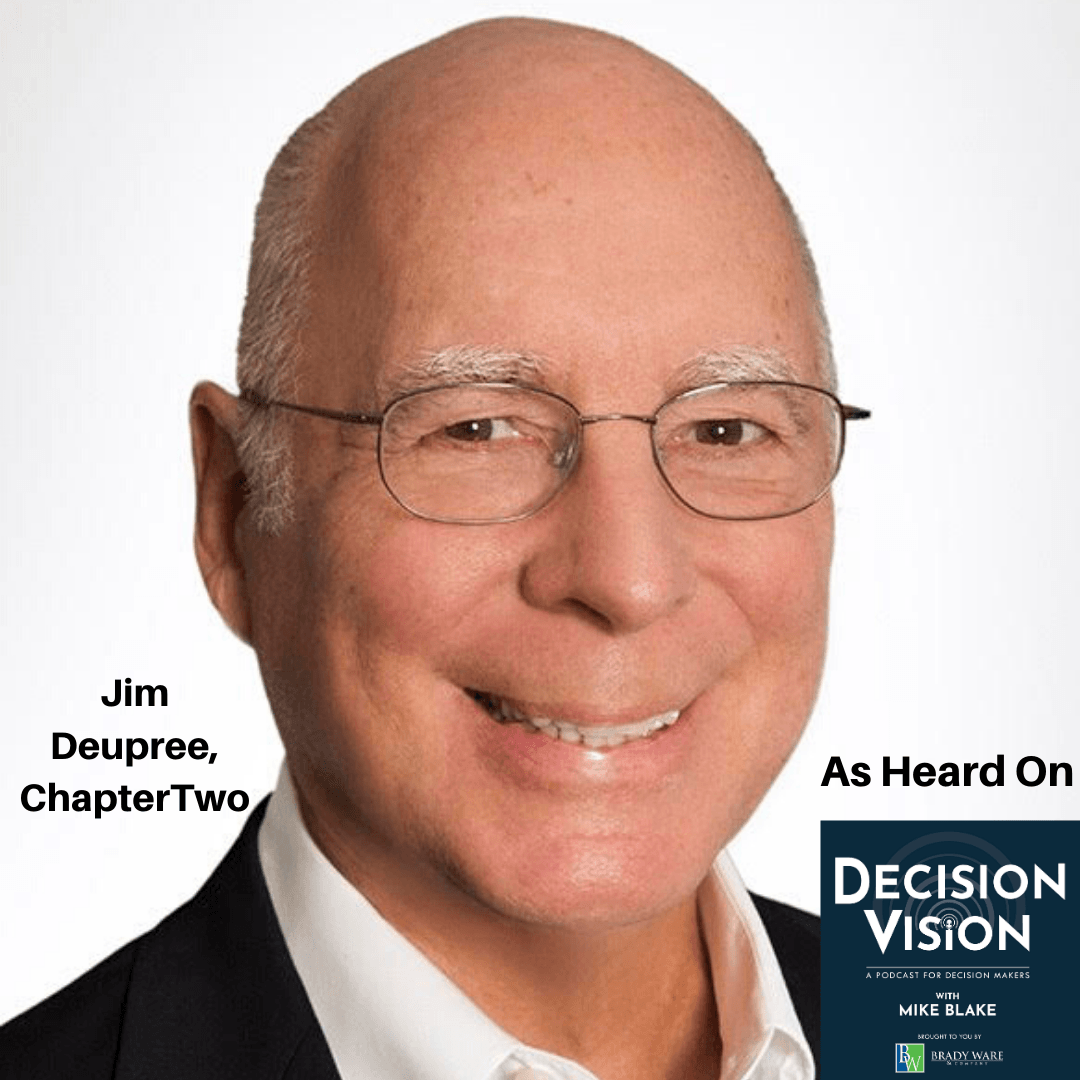
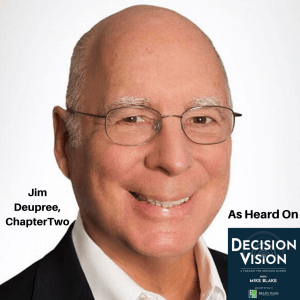
Jim Deupree, ChapterTwo®

Jim Deupree is the Founder and CEO of ChapterTwo®.

Jim began his career as an automotive engineer, then pivoted to IBM when he discovered the role and power of computers. Two years in, he asked IBM to switch his career from development to sales, and three years later he was at IBM HQ. Soon he did something he now realizes was pretty unique:  he decided that he would only accept roles he knew he would enjoy. So he turned down promotions at numerous stages until roles he wanted became available, and it served him well. He truly enjoyed his entire career there, and it led him to a diversity of experiences most of his peers did not achieve.

His IBM career featured a number of intrepreneurial leadership roles and concluded voluntarily when he wanted to gain experience with smaller companies and after authoring two strategy books for banks. First he became SVP of a local management consulting firm, then an entrepreneur. He founded a company with a new business model, taking it through all of the steps including raising equity under SEC regulations. Launching a second company followed. While running that company he volunteered to help C-Suite executives in transition sort out defining and getting their next role – as part of a major outplacement company with a center dedicated to CXO executives. After 18 months they asked him to stop his other activities and run the Center.

Beginning in his twenties he have served on non-profit boards helping the community every place he has lived, ranging from the arts to homeless to protecting homeowner rights to leadership and governance. He has also served on five for-profit boards, and been active in the National Association of Corporate Directors, where I served as President of the Atlanta Chapter and as a Founding Director of the Carolinas Chapter. Current roles include the local and national boards of CEO Netweavers and Board Chair – Strategic Leadership Forum, Carolinas.

Six years ago, Jim founded ChapterTwo as his third start-up, based on realizing the shortcomings of the outplacement model for senior executives and their advice about how much they would have valued charting their career before ending up in transition.

For more information on ChapterTwo, go to their website.

Michael Blake, Brady Ware & Company

Mike Blake, Host of the “Decision Vision” podcast series

Michael Blake is Host of the “Decision Vision” podcast series and a Director of Brady Ware & Company. Mike specializes in the valuation of intellectual property-driven firms, such as software firms, aerospace firms and professional services firms, most frequently in the capacity as a transaction advisor, helping clients obtain great outcomes from complex transaction opportunities. He is also a specialist in the appraisal of intellectual properties as stand-alone assets, such as software, trade secrets, and patents.

Mike has been a full-time business appraiser for 13 years with public accounting firms, boutique business appraisal firms, and an owner of his own firm. Prior to that, he spent 8 years in venture capital and investment banking, including transactions in the U.S., Israel, Russia, Ukraine, and Belarus.

Brady Ware & Company

Brady Ware & Company is a regional full-service accounting and advisory firm which helps businesses and entrepreneurs make visions a reality. Brady Ware services clients nationally from its offices in Alpharetta, GA; Columbus and Dayton, OH; and Richmond, IN. The firm is growth minded, committed to the regions in which they operate, and most importantly, they make significant investments in their people and service offerings to meet the changing financial needs of those they are privileged to serve. The firm is dedicated to providing results that make a difference for its clients.

Decision Vision Podcast Series

“Decision Vision” is a podcast covering topics and issues facing small business owners and connecting them with solutions from leading experts. This series is presented by Brady Ware & Company. If you are a decision maker for a small business, we’d love to hear from you. Contact us at decisionvision@bradyware.com and make sure to listen to every Thursday to the “Decision Vision” podcast. Past episodes of “Decision Vision” can be found here. “Decision Vision” is produced and broadcast by the North Fulton studio of Business RadioX®.

Visit Brady Ware & Company on social media:

LinkedIn:  https://www.linkedin.com/company/brady-ware/

Facebook: https://www.facebook.com/bradywareCPAs/

Twitter: https://twitter.com/BradyWare

Instagram: https://www.instagram.com/bradywarecompany/

Show Transcript

Intro: Welcome to Decision Vision, a podcast series focusing on critical business decisions. Brought to you by Brady Ware & Company. Brady Ware is a regional service accounting advisory that helps businesses and entrepreneurs make vision a reality.

Mike Blake: And welcome to Decision Vision, a podcast giving you, the listener, clear vision to make great decisions. In each episode, we discuss the process of decision making on a different topic from the business owner’s or executive’s respective. We aren’t necessarily telling you what to do, but we can put you in a position to make an informed decision on your own and understand when you might need help along the way.

Mike Blake: My name is Mike Blake, and I’m your host for today’s program. I’m a Director at Brady Ware & Company, a full service accounting firm based in Dayton, Ohio, with offices in Dayton; Columbus, Ohio; Richmond, Indiana, and Alpharetta, Georgia. Brady Ware is sponsoring this podcast, which is being recorded in Atlanta, per social distancing protocols. If you like this podcast, please subscribe and your favorite podcast aggregator, and please consider leaving a review of the podcast as well.

Mike Blake: So, today, we’re going to discuss, should I be thinking about my second act? And I think about this question a lot, maybe more often than I have been. Last Saturday, I’m recording this on May 8th, but last Saturday, I had the audacity to record my 50th trip around the sun. And so, I’m sort of in second act thinking territory as well, perhaps, because I planned to live for a very, very, very long time. I’m sort of greedy that way.

Mike Blake: But I’m also heavily involved in business transitions, whether it’s somebody who’s selling a business, or somebody is buying a business as their so-called second act, or whether it’s a succession planning. And we’ve had discussions about most or all of those topics. We’ve had a discussion on succession planning and how you hand the business after the next generation. We’ve had a discussion on how you go about selling your business, and how you figure out the timing, and what are some of the mechanics in doing that.

Mike Blake: But before you get to any of those phases, the business owner or the executive has to reach a point where they decide that some kind of change is desirable and necessary. And the funny thing about this is 10, 12, 15 years ago, we just knew that everybody by now, maybe before now, was going to have to sell their businesses. They’re just going to be too damn old. They weren’t going to want to be in the businesses anymore. They’re going to want to play golf, spend time with their grandchildren, do anything other than businesses. So, people like me, we were rubbing our hands and licking our chops because we thought they’re just a bunch of businesses that we’re going gonna come on the market.

Mike Blake: And then, a funny thing happened. A lot of people decided to hang on to their businesses, started to hang on to their careers. And I think there are a lot of reasons for that. One, I think that the ’08-’09 recession raised enough wealth and, frankly, just put the fear of God into enough people that they decided they’re going to hang around and generate some more value, some more income for a few years before they move on to that second thing or even entertain the risk of moving on to something different, even if that was going to be income producing.

Mike Blake: And also, what we’ve figured out – and, again, haven’t just turned 50. I appreciate this more than I ever did – is that 65 ain’t all that old anymore, especially if you’ve not been working a manual labor job. If you’ve taken care of yourself and if you’re blessed with reasonably good genes, you can be viable and vibrant well into your 70s. And there are business owners who would hang onto their business even into their 80s. And so, this demographic brick wall that we thought was going to happen really has not. Sure, there’s been an uptick in sales and transfers but has not been this rush to the door of millions of people feeling like they had to sell their businesses because there was a countdown that was going on.

Mike Blake: Well, here we are, a decade after the Great Recession, and we now find ourselves in the COVID whatever the heck this thing is. I don’t know. I speak eight languages. I don’t know a word in any of them that properly describes this. But at any rate, we’re in this thing. And I think this is now prompting people to think more about that second that. We’re seeing such dislocation. My own personal view is that we are not going to go back to what the world was like in February. I think that’s gone. I think people are increasingly realizing that, and they’re expressing various stages of grief in doing so. And that means a certain jobs are going away, certain industries are going away, certain needs are going away. And in their wake, jobs, industries, and needs are being created, and they’re being defined in real time.

Mike Blake: And if there’s ever a time when thinking about your second act because maybe that job is going away, maybe that company is going away, or maybe you just sort of see the writing on the wall, maybe it’s not going away today but you see in 10 years, it’s just not going to be the same thing, and it’s just not going to be as rewarding for you to do it anymore. You may be thinking about about some sort of second act or second career, as it’s often referred to.

Mike Blake: And as it happens, in my network, I know one of the best in the business at helping people figure out this the second act thesis. I have friends who have worked with him and have gone through the program. I’ve been honored to have, at times, been a mentor in the program, which is really interesting because at the time, I was half the age of a lot of the people that he was serving. But he’s really the expert on this. And we’re gonna have a great conversation with my friend Jim Deupree, who is founder of ChapterTwo.

Mike Blake: He founded ChapterTwo 12 years ago to help senior executives proactively set their compass for a career path going forward that is both significant and satisfying. All of his clients are selected in part for commitment to the pay-it-forward approach. And that’s really important. His clientele is somebody that is is not just sort of, “I got mine,” but it’s somebody that is, “I got to give back.” And Jim, he just brings this breadth of experience. You look at his resume, it’s like he’s lived three lifetimes. He’s been an entrepreneur, has raised millions of dollars of capital. He’s been an angel investor, which I did not know. So, a lot to talk about that at some point offline.

Mike Blake: He’s been a blue chip company executive holding executive positions in companies you may have heard of, such as IBM, Ford Motor Company, Coca-Cola Company, and across a range of industries and functions, including manufacturing, financial services, consulting and so forth. He served as President of the Atlanta chapter of the National Association of Corporate Directors, which is a very exclusive group, and was a founding board member of the New Carolina Chapter, and he was recognized as a board.

Mike Blake: And this is where I know Jim primarily, he co-founded and served as president of an organization called CEO Net Weavers and continues to serve on their operating committee. And CEO Net Weavers, I can’t believe they let me in, but it is a fantastic organization where it’s a group of service-minded current and former executives who want to take their knowledge, their networks, and give back to the next generation of professionals, business owners, entrepreneurs to help them be successful and help position them to turn around and give back to the next generation that is coming back behind them.

Mike Blake: He’s adjunct faculty at Kennesaw State University, which is a a fantastic school on the outskirts of Atlanta and teaches their executive MBA classes. And I did not know this last point, which was he is the author of two strategy books for banks regarding effective use of the internet. And I actually do bank valuation on occasion. So, I need to read those books. So, I’m going to ask him for autograph copies. But, Jim, thanks so much for coming on the program.

Jim Deupree: You’re welcome. It’s a delight to be here. And I’m a big fan of Mike Blake for all he does to help people too, by the way.

Mike Blake: So, thank you for that. So, let’s jump into it. A lot of people know what a second act is, may understand instinctively what a chapter two is, but not everybody does. So, in your mind, what is it and why do people need help figuring it out?

Jim Deupree: Okay. Well, to me, it’s a pivot. So, going up to the next level in an organization, moving from director to vice president or whatever it is, is not a second act, or moving to another position, similar or maybe higher position in the same industry. The second act is really deciding that for whatever reason, I want to move on from what I’ve been doing and go to something that’s substantially different industry, major different kind of a role. Maybe it’s leaving corporate America, buying a business, becoming an entrepreneur, or moving from an operating role in a consulting or moving to join the board of directors.

Mike Blake: So, what are some signs that act one either is ending or should be ended? How do you know or what should start your thinking that maybe that’s the kind of transition you need to really start thinking about?

Jim Deupree: I think it’s a couple of things, Mike. 70% of people in corporate America say that they are not fully engaged in their job. That’s a stunning number; yet, it’s been repeated in many different surveys. And a third of those are meaningfully disengaged. So, to them, either they don’t like their leaders, and they’re turned off by their leaders, or the role has become mechanical or rote. It’s, “I can do it in my sleep. It’s not inspiring. I’m not really building anything. I’m just maintaining status quo.” So, when that happens, it’s not fun. You don’t skip into the building to go to work. You just kind of drag yourself in.

Jim Deupree: The other one is industries are changing, as you mentioned, in your opening. I mean, a lot is going on, and every industry is changing in many ways. But sometimes, the industry is not as appealing as it was when you started. Or, sometimes, the mission is not as appealing. So, those two things are really the keys. And I call it the voice in your head. The people I work with will admit that they had a voice in their head a year or two before they really acted on that voice that was telling them it’s time to start thinking differently.

Mike Blake: So, there’s a question I want to sneak in here and sort of go off the script because I think it’s important. When I think about second act, I tend to vision somebody that looks like me or maybe is a little bit older than I am, somebody that’s had a longish chapter one. And then, they’re ready to sort of cast aside. But then, it occurred to me that that may not necessarily be true. In fact, I know for a fact that one of your clients is a dear friend of mine is about five years younger than I am. And I know somebody who I think effectively did a chapter two right out of college or right out of, as it turned out, law school. You can have a chapter two pretty early, can’t you?

Jim Deupree: You sure can. It’s interesting. So, the biggest single group by age group of our clients are people in their 50s. And they are generally saying, “I really want to lay the pathway to say that I can continue to be relevant and enjoy the things I’m doing. Not necessarily trying to reach higher levels at that point, but I just want to make sure that this plays out in a way that’s enjoyable to me and to the degree possible that I have control over how long I do it, how long I’m in this role versus I find myself being ejected or as the British say, made redundant.”

Jim Deupree: The 40s are saying, “I really want to decide if I want to go for the brass ring. The tremendous sacrifices that are required to go for the top jobs. And so, I want an independent view of what my probability of success is based on getting to know me really well, and then that journey looks like versus not going for the top rating, maybe giving up some calm, but having a better balance of life.”

Jim Deupree: And people I work with in their 30s are saying, “What I’d really like to do is define this, so that I can have a time with my family now, and then I can accelerate my career in five years. So, how do I lay that out?”

Jim Deupree: And you mentioned the ones out of college, Mike. And it’s interesting because in my mind, everybody who go into a top tier MBA school should go through a process like this because, in general, they either leave to go to investment banking, or consulting, or in rare occasion, to some corporation. They don’t fully understand the hundred-hour weeks that those things involve and the travel. And they haven’t thought through what they would like to be doing in 10 years. So, if they did think through and say, “Well, I may want to still do that at the start because it’s a great foundation, but in 10 years, I want to own my own business, or in eight years, I want to own my own business.” They would probably develop a different network even in MBA school, and they would probably take some different courses.

Jim Deupree: So, in the last group are the people in their 60s, and they’re really saying, “I want to lay this out in a way that says that I’m shifting from the title, and then I come to things that are more significant to me personally and to my family.”

Mike Blake: Yeah. And sort of a corollary to that too, I think … well, let me ask you this. I suspect that one of the psychological hurdles that you have to overcome is the notion of sunk cost, right? I suspect that one area of resistance to taking on the second chapter is while I have a lot invested in chapter one, how do I just sort of let that go? Now, the accountant training in me, I’m not an accountant, but the accountant training and he says, while rationally, I ought to think of that as a sunk cost.

Mike Blake: And I have a friend, I mentioned, who did an early chapter two. He actually happened with my RA in college. And now, we’re back together here in Atlanta. He went to law school, worked in law school for a year, and then decided that he hated it and went into technology, right? And that was kind of tough. But the same time, he’d already spent that money. So, it wasn’t like he was going to get it back necessarily by going back and being a miserable attorney. Does that ever enter into the mindset of some of your clients? And if so, how do you kind of break that down?

Jim Deupree: It really doesn’t. I mean, personally, I’m a big believer in, “We are where we are. Now, how do we move ahead.” And people, what they’re looking for is more significance and more satisfaction. And if they weren’t getting it, then you got to walk away from that cause. I mean, one of the questions, I think, Mike, is, there a need for a second-act period? And I looked at a couple of numbers. So, 50% of college students changed their major during college. And whatever they thought they were going to do, then they go change it. Maybe a funny analogy, but the divorce rate, the odds of staying married to the same person are probably 40%. And as you pointed out, we’re all going to work for 50 years or more in today’s world. So, it would be very natural to say, “I don’t want to spend 50 years of my life doing the same thing, particularly if it’s not making me happy.”

Mike Blake: Now, let me take the flip side. Are there signs where … and it sounds like it is a rarity, but the natural question is for some people, maybe one act actually isn’t enough, right? Are there signs where maybe your state … let me ask the question differently. How do we distinguish the need for a second act from a garden variety mid-life crisis?

Jim Deupree: That’s a good question. So, to me, there are two reasons why you don’t need a second act. The first is you’re just really enjoying what you’re doing. Yeah. So, if you’re really enjoying it, then why go to something else? And the second is you’re building a business for your family, you’re building a legacy, and you feel really good about that, and you feel good, and it’s relevant, and it’s substantial to you. So, if those two things are present, then there’s no reason to think about a second act. A third thing that keeps people thinking about one is being risk averse. That’s not the right reason, but it certainly happens a lot.

Mike Blake: And in fact, I imagine, perversely, the riskier thing is staying in the thing that you don’t find fulfilling.

Jim Deupree: Correct. And it’s riskier for your health, as well as your finances.

Mike Blake: So, you deal with people that are considering and implementing the second act that come from a variety of backgrounds, that are entrepreneurs, business owners, family business owners, executives in large companies, small companies. Are there common threads to all of them, or does the background of the individual tend to shape what the trajectory of the second act looks like, or do people just sort of come to you and help them and say, “Hey, here’s my life. It’s a whiteboard,” and then you’re going to help erase it, so they get a fresh mental start?

Jim Deupree: It’s more the latter. I mean, what’s common across all of those is people, in their own minds, people that would appear enormously successful on their resume do not necessarily share that personal view. And even more frequently is it’s been great to be the CEO of a company that makes catalytic mufflers, but that’s not exactly the legacy that I’d like to leave. I’d like to take my resources and my talent and do something before I step down that I feel is really good for poor people and for humanity, and not necessarily for free. There are a lot of ways to contribute, but I want to pivot to where, to me, it’s more meaningful. So, that’s the biggest driver.

Mike Blake: So, implicit in a second act means you’re not already retired. Let’s put the financial piece aside for a minute because I think that’s a different kind of conversation. But assuming the financial wherewithal is there, and people sort of make a choice between a second act versus retirement, what do you think are sort of the markers that suggests that a person is going to be more happy having an active second act versus going off and playing golf, or fishing, or playing bridge, or painting, or whatever it is you’re doing as a retired person, or is that even a choice? Maybe I’m even positing a false choice.

Jim Deupree: No, it is a choice, and it’s interesting. It’s a conversation I have frequently. I haven’t met many people that want to go play golf five days a week, by the way, because, again, I’m blessed with working with people that are very intelligent and very accomplished. But the real marker would be two things. One is people who are good leaders. People who are good leaders still want to go build things or help things. They they can’t get enough satisfaction out of just being active. And obviously, people that still are healthy and have high energy. And you also have to think about the impact on your spouse. If you’re going to suddenly be at home all the time, and you haven’t been for the whole first years of your marriage, what’s that going to do to things at home? So, from that point of view, I think that’s the big driver, the people that just say, “I want to keep doing something.”

Jim Deupree: Now, what they don’t necessarily want to do is another job, and they don’t want to get sucked into a lot of travel or those pieces. So, for those folks, we talk about what we call a portfolio approach. It’s do two or three things that you enjoy and that are meaningful. And then, as time marches on, then you drop one of those. And now, you’re down to two. You’re shifting your balance. And then, ultimately, you may drop the second one. And so, it’s a way of saying, “I know I can still stay relevant as long as I want and be engaged; and yet, we can still have time to travel.

Jim Deupree: We have a thing, Mike. We talk about the 85/85/85 plan for people who are in that space. So, the first 85 is work. There’s 240 days in a year. So, it’s probably actually 245 days. So, the first 85 is work. So, you’re doing stuff that you would call work just at a diminished rate of intensity. The second 85 is intellectual stimulation. So, it’s going to conferences, it’s reading things, it’s learning things, it’s participating in discussions, so that you’re still keeping your intellectual juices flowing. And then, the third one is recreation and travel. So, more time with your spouse. And people really respond well to that notion. And most the people I work with have a lot of trouble containing the first part to 85. They want to keep expanding that to where it’s almost back to where it had been before.

Mike Blake: And so, in your role, I’m giving all of that extra self-promotion, but that’s okay because I think it’s important, because it sounds like you have that scope creep, if you will, in your chapter two. Do you or do people sort of have somebody else that tries to help keep tabs on them and say, “Hey, look, I thought you wanted a chapter two but you’re starting to look chapter one as of late”? Do you sort of help them manage that and help them develop the habits of being a chapter-two person?

Jim Deupree: Yes. And our business model is pretty unique. I think Mike mentioned that all of our clients are pay-it-forward. They’re wired to help other people. It’s part of our screening. So, we just have it, when you come chapter-two client, you become part of our family. And I look forward to and reach out to engage on both the personal and career basis and stay in touch. And no one has ever abused that. If anything, people are too careful about wanting to take advantage of that. But it’s been a wonderful part of what we do.

Mike Blake: So, we talked about second chapters but is that necessarily the upper bound? A lot of us are going to live to being 90 to 100. And particularly, if we have some medical advances, we’ll so mostly have our marbles when that happens. Are third and fourth chapters potentially on the table, in your view?

Jim Deupree: Well, this is either my sixth or seventh.

Mike Blake: Okay.

Jim Deupree: So, they definitely are. And I think I would say three would be a norm. I mean, the idea of a lifetime job has kind of gone away. The tenure in roles is reducing constantly. The time we spend in roles and the opportunities to make a change. So, if the average isn’t three or four already or within five years, I’ll be surprised.

Mike Blake: And what are the first steps of that transition look like? Is it just simply you to tell whoever you’re working for or with that I quit, you throw in the towel, or is there something that kind of happens that leads up to that, that begins that transition?

Jim Deupree: It’s definitely the latter. And so, before I started chapter two, I spent five years leading an outplacement center for C-Suite executives. And most of them had been completely surprised that all of a sudden, they’re no longer there. I mean, this wasn’t a client, but I knew one guy who foresee a six-month severance. So, for six months, he went out, and got all dressed up, and drove to a Starbucks, and just spent the day there, so he didn’t have to tell his wife he lost his job. It’s very-.

Mike Blake: Really?

Jim Deupree: Yeah.

Mike Blake: I always see that on TV. I never knew people actually did that in real life.

Jim Deupree: Well, in this case, he did. And it’s very traumatic to end up in an unplanned transition. Your family is upset. We’re gonna have to move. What’s going to happen to our country club status? And then, again, I get to work with people that it’s not about keeping the roof over their head, at least, short term, but it’s so disruptive. So, all of our work is now focused on planning ahead. It’s the voice in your head is speaking. And the time to start thinking about that is while you’re still in the role. And you start by saying you want to set your compass for what would you really love to do, what would what would give you joy. And it’s not just the job, the title. It’s the culture, it’s the nature of the business, it’s the meaningfulness of it, all of those points. So, you go through and define a handful of options. And typically, there are options a person hasn’t thought of.

Jim Deupree: The next step is, then, to say, “Let’s go talk to been-there-done-that people, other pay-it-forward people,” and they will have a completely candid conversation, “This is what we like, this is what we didn’t like, this is what surprised us.” So, then, you take those options off the table one at a time until you’re down to one or two. And the third step is, then, you say, “Now, I’m going to adjust my link, and I’m going to think about the kind of network I want to lead to that next role. So, I’m going to build a campaign. And then, I’m going to wait. I’m going to wait till the right opportunity comes along. And that may either mean the right job or it could mean I get a chance to exit in a financially profitable way for my company.” But all that time, you can actually enjoy the job you’re in more because, now, you know it’s not forever, and you have a plan B in your pocket, and you’re just ready to activate it whenever the right time comes.

Mike Blake: So, in case of transition, break glass kind of thing.

Jim Deupree: Right.

Mike Blake: And that scenario you bring up, I think, is so poignant because … and again, myself having just turned 50, one of the things I thought to myself is, “Well, I better kind of like the job I have because once you once you hit that 5O, getting that next job becomes a lot harder, and requires a lot more thought and a lot more preparation.” I mean, age discrimination is real, right? And so, I think, if you’re going to make a transition, obviously you can do it, you help your clients do it, but part of the reason also they need you is because it is, I think, all the more challenging, and you have to be more creative and, in a way, kind of create your own role rather than wait for somebody to give it to you. Is that fair?

Jim Deupree: A couple points on that, Mike. I think the age discrimination is not as real as many people feel.

Mike Blake: Okay.

Jim Deupree: I will tell you, if you’re a CMO or chief marketing officer, it’s real because there is a perception that you just are out of touch with the way that the 20 and 30-year-olds are communicating and acting. But we have a big glut of middle management in our country because of the past recession, and there is a lot of places where I called the silver savvy group is really needed and respected. But sometimes, it’s entrepreneurial companies. I’ve got a client who is a CFO for two or three startups, and she played a role not only of CFO but, pardon the expression, kind of a den mother role, and it was very much appreciated.

Jim Deupree: So, the second point is that people busy in careers did not understand how to play the game in finding a new role. It changes all the time. It’s changed dramatically. And even in the last three years, the role of search firms has dramatically changed and pivoting. And so, if people try to do this on their own, they end up saying, “Well, I think I should try this, but I’m not sure. So, I’ll wait till tomorrow. Then, I’ll wait till tomorrow.” And they keep procrastinating on taking the necessary steps. If somebody that they trust and has done it a hundred times says, “This is what you ought to do next,” then they go do it.

Mike Blake: So, when I think and I just reflect on the mentoring that I’ve had the privilege to do with some of your clients, I tend to think of people that are, at least, walking into chapter two, they’re thinking of a new career or sitting on a nonprofit board. Are those the most common options or what are some other alternatives if maybe those two things don’t necessarily appeal to you? What are some of the other items on the chapter two menu?

Jim Deupree: The most common one is probably advisory work. So, I’ll give you one example. One of my clients had had three chapters already. So, first chapter was in medical device field. Absolutely loved it. He was actually in the heart area. He loved being in the operating room. Then, didn’t want to move the family. So, second chapter was in financial services and wealth management. And the third chapter was in a big real estate investment trust. And now, it’s time. And so, as we went through this work, the first chapter was really the one that they loved the most of all the things they done. Going back at a lower level wasn’t gonna make a lot of sense. So, first of all, we had to build a bridge for 15-20 years later, how do you reenter? What are your credentials? And it led to finding the right people as sponsors and a series of advisory sort of board roles that have been really rewarding, lucrative hard work but a lot of fun as well. So, that’s the most common.

Jim Deupree: Nonprofit organizations, because most of our people are very active leaders, the pace is too slow. So, they like it for the giving back. They don’t like it for the pace. And actually, board seats are not a real common outcome, part, because they’re very hard to come by. And also, though, people who are used to making decisions are not always good on a board because, now, you need to voice your opinion, you need to respect the opinion of others, and you need to be ready for a collective judgment, not the one you feel is right.

Mike Blake: Yeah. I mean, that’s a great point. And we need to have an episode on boards too, but you’re right. Having having to share and share a lot, if you’re used to and frankly have been successful being in the driver’s seat, that’s gonna be a very difficult mental transition for some.

Jim Deupree: It is.

Mike Blake: Give me … well, I’m not really a war story, I guess a success story. What is one of the more creative second acts you can recall, or third, or fourth acts you can recall somebody creating?

Jim Deupree: Yeah, I love that question. So, I had a client who had been a serial CEO, been CEO two or three times, happened to end up with a very nice payday and said, “I just love hot air balloons. So, I’m going to become a hot air balloon pilot.” So, he bought a hot air balloon. He went out to Phoenix to go through the FAA school, got certified to fly himself and his family, really enjoyed that, decided he was going to take it the next step and get certified as a commercial pilot. And so, he did that. He was based in Florida. And he did that for a couple of years.

Jim Deupree: And then, ultimately, discovered that the life of a commercial hot air balloon pilot is you wake up at 3:00 in the morning, you collaborate with the other pilots, and decide where the right takeoff spots and landing spots are, so you can arrange all the equipment. You call your clients at 4:00 to tell them where to meet you at 5:00. And you go up in the balloon, and you serve them some champagne at sunrise, and then you can pack up the balloon, and you do the same thing the next day. Maybe you do it again at sunset. So, he had a blast doing it. And then, ultimately, after three years returned to a CEO role.

Jim Deupree: I’d like to make that point. I would love to see in our society people just at your age, people in their 50s, take a gap year. We take it as college students, but way too many people end up work, work, work, work until they’re too frail to travel the way they would like, and you don’t have as much energy around all the pieces. So, we could ever figure out in society how to say it’s perfectly okay to take a gap year in your 50s for one or two years, and then return highly energized. I think it’d be wonderful.

Mike Blake: Interesting you bring that up. So, that balloon story, first of all, it hadn’t occurred to me there’s a commercial pilot rating for hot air balloons. But it makes sense, right? You’re not getting me in a hot air balloon anyway, but if you were, I’d rather it not be the second flight that person ever has taken. So, I learned something there. But interestingly, that did wind up in effectively being, I guess, a three-year sabbatical before he returned to his conventional career. And hours aside, odd hours aside, I’m sure is very rejuvenating for him.

Jim Deupree: Absolutely.

Mike Blake: And he probably has about the best photo album you can imagine.

Jim Deupree: I’m sure that’s true too and lots of [indiscernible].

Mike Blake: So, what is the process? I know you go through a pretty detailed and lengthy process on how you figure out what that next act – I’m going to call it next act from now – on should look like? Can you tell me a little bit about that and why those steps of that process are so important?

Jim Deupree: Sure. It’s really three steps. So, step one is discernment. It’s what would you really like to do, what culture would you enjoy, are you better suited to a small company or a large company, all of those kind of factors. And we do that through a series of assessments that we put together. I use a term that … again, I get to work with very bright people. They know things about themselves, but if I use the television vernacular, they don’t have the dots connected as high definition pixels. So, the picture is not clear. They’re just data points.

Jim Deupree: And so, through that process … and we end up spending three hours with an industrial psychologist that I’ve used and we’ve done this hundreds of times together now, and it’s very revealing process. And now, we typically say, “These are the three or five options that you should focus on.” Usually, half of those are ones they’ve never thought of or never occurred to them. We also say, “These are the things you should avoid,” because when people start thinking about a transition, they want to look at everything. It’s like a big market, and I want to go down every aisle. And it’s a mistake to chase rainbows, and you confuse your friends and you say, “Well, I was talking about with this. But now, I’m talking about this.” So, it’s important to say, what should you avoid and what should you focus on? So, that’s the step one.

Jim Deupree: And ,then once we get that defined, it’s these conversations I mentioned earlier with been-there-done-that people. And you say, “I know I could do that, but that’s not exciting to me as the second one on the list. So, I’m going to drop that went off the list.”

Jim Deupree: The third part is how do you get yourself in the market? And that means that the opportunities, the ones you want are going to find you and they’re gonna find you through the way you represent yourself on LinkedIn, they’re gonna find you through the leadership story that goes to your friends and colleagues. they’re going to find you through what you say when you get a chance to talk to people face to face. And one of the things we’ve learned is the more crisp you are, the faster things happen.

Jim Deupree: People that say, “This is what I want,” don’t get very far. It has to be, “This is how I can help this organization grow and succeed.” And then, people that say, “I can do anything,” are not credible. So, it’s a whole process to say, “This is your message and this is where you play it and how to play it.” And then, it’s just working with them. We end up with some amazing stories with people about once they get in that stage, and sometimes things happen, they need to stay for a while longer or all kinds of things, but we end up being an advisor through the process of exploring and even negotiating roles as well.

Mike Blake: So, we’re talking with Jim Deupree of ChapterTwo. So, I’m going to sneak in. I’m going to sneak in some free consulting for myself or asking for a friend because I have you on the podcast. Have any of your clients ever gone into academia as a next chapter?

Jim Deupree: Yes.

Mike Blake: That’s something I’ve thought about because, one, I look the part, but I wonder how many people kind of think, “I really wish I could have studied X when I was in college,” and you sort of go back. And sometimes, going to college too, when you just don’t give an F what anybody thinks about you, that can also be very liberating, I would imagine.

Jim Deupree: Yeah, Mike. And so, a few years ago, more than a few, probably 15-20 years ago now, I actually explored pivoting from when I was at IBM into teaching business school. And I met with the dean of a business school, a noted business school, and he said, “You’re not going to be happy.” He said, “First of all, the best executives are not necessarily the best teachers. So, we would need to figure out if you are really a good teacher. But secondly, you’re not going to be happy because in academia, there is a pecking order. And if you don’t have a PhD, you don’t have a voice at the table. You may sit there and listen, but you don’t get to say, ‘This is how I think we should do it.’ And then you get no vote. And so, unless you’re willing to take the time out to go do that, just keep that in mind.”

Jim Deupree: Now, since then, as you mentioned, I teach MBA students at Kennesaw, and I teach ethics. And I have complete freedom for how I construct that course and teach it. But many of the courses now are highly scripted. 80% of what you teach has to be from the book, basically. And so, you don’t have the degree or freedom to go build something that you think. So, it’s a good gig. It pays best for people that have a CPA because there is a real shortage. Pay’s worst for people that want to be an English teacher. It’s nice summer vacations. It can be a platform for consulting, but it’s the driven people that are most of my clients, a very few of my selected that. A couple have but very few.

Mike Blake: So, we’re running out of time, and we want to be respectful of your time. I know you got to get back to doing what you’re doing. But the last thing I want to ask specifically is why is an outside perspective so helpful? I mean, everybody that you’re dealing with – I know because I’ve met them – they’re intelligent, they’re focused, I would even say largely self-aware people. Why do they need help figuring out something like this? Why do they need an outside party, a third person, an advisor to help figure this out?

Jim Deupree: So, everybody needs somebody to bounce their thoughts off of. And what I’ve learned is friends don’t work for this discussion. They won’t tell you what you need to hear because they’re afraid of hurting your feelings. And sometimes, they have their own bias about, “Well, if you got into this, then there’s a way that that would actually help me too.”

Jim Deupree: The second thing that happens, if you talk to three lawyers, you’re gonna get three different opinions. And if you talk to three friends, you’re going to get three different opinions. So, you say, ‘All right, I’m going to have a hundred cups of coffee over the next year. And with my friends, I’m going to figure this out.” At the end of the year, you have 50 different opinions, and they don’t jibe together. And generally friends don’t … this is not your specialty, it’s not their specialty. So, how this whole process works has a big impact on the really realism of the things you may consider.

Jim Deupree: So, I just have learned that people waste a lot of time and got nowhere without this kind of help. Now, obviously, some people figured it out, and some have done it brilliantly on their own. Some have been lucky. It’s not for everybody, but for those that sincerely want to say, “I really want to get the best next act in my career,” I believe that that this kind of advice and process is immensely helpful and makes things work faster.

Mike Blake: And that sounds a lot like what I advise people when they’re trying to get advice in their startup. Your friends will cheer you on because frankly, they don’t have any skin in the game. The skin in the game is to spare your feelings, basically. And that’s often where the worst advice comes from. And I’ll bet you, there are a lot of similarities there. So, I think I understand that. Jim, this has been a great conversation. We’re running out of time, but I’m sure there’s lots of other questions we could have covered and should have covered. If somebody is going to want to contact you and learn more, how can they do that?

Jim Deupree: The best way is through our website, which is www.chaptertwo.net. And it’s T-W-O, not the number two, and there’s no hyphens or anything. There is the “contact us.” You can get directed to me through that. Also, there’s some pretty useful information there. So, chaptertwo.net.

Mike Blake: Well, thanks again. That’s going to wrap it up for today’s program. I’d like to thank Jim Deupree of ChapterTwo so much for joining us and sharing his expertise with us. We’ll be exploring a new topic each week, so please to announce that when you’re faced with their next executive decision, you have clear vision when making it. If you enjoy this podcast, please consider leaving a review with your favorite podcasts aggregator. It helps people find us, so we can help them. Once again, this is Mike Blake. Our sponsor is Brady Ware & Company. And this has been the Decision Vision Podcast.

Tagged With: Brady Ware, Brady Ware & Company, career pivot, chapter two career, ChapterTwo, Jim Deupree, Michael Blake, mid-life crisis, Mike Blake, second act career

Business RadioX ® Network


Our Most Recent Episode

CONNECT WITH US

  • Email
  • Facebook
  • LinkedIn
  • Twitter
  • YouTube

Our Mission

We help local business leaders get the word out about the important work they’re doing to serve their market, their community, and their profession.

We support and celebrate business by sharing positive business stories that traditional media ignores. Some media leans left. Some media leans right. We lean business.

Sponsor a Show

Build Relationships and Grow Your Business. Click here for more details.

Partner With Us

Discover More Here

Terms and Conditions
Privacy Policy

Connect with us

Want to keep up with the latest in pro-business news across the network? Follow us on social media for the latest stories!
  • Email
  • Facebook
  • Google+
  • LinkedIn
  • Twitter
  • YouTube

Business RadioX® Headquarters
1000 Abernathy Rd. NE
Building 400, Suite L-10
Sandy Springs, GA 30328

© 2025 Business RadioX ® · Rainmaker Platform

BRXStudioCoversLA

Wait! Don’t Miss an Episode of LA Business Radio

BRXStudioCoversDENVER

Wait! Don’t Miss an Episode of Denver Business Radio

BRXStudioCoversPENSACOLA

Wait! Don’t Miss an Episode of Pensacola Business Radio

BRXStudioCoversBIRMINGHAM

Wait! Don’t Miss an Episode of Birmingham Business Radio

BRXStudioCoversTALLAHASSEE

Wait! Don’t Miss an Episode of Tallahassee Business Radio

BRXStudioCoversRALEIGH

Wait! Don’t Miss an Episode of Raleigh Business Radio

BRXStudioCoversRICHMONDNoWhite

Wait! Don’t Miss an Episode of Richmond Business Radio

BRXStudioCoversNASHVILLENoWhite

Wait! Don’t Miss an Episode of Nashville Business Radio

BRXStudioCoversDETROIT

Wait! Don’t Miss an Episode of Detroit Business Radio

BRXStudioCoversSTLOUIS

Wait! Don’t Miss an Episode of St. Louis Business Radio

BRXStudioCoversCOLUMBUS-small

Wait! Don’t Miss an Episode of Columbus Business Radio

Coachthecoach-08-08

Wait! Don’t Miss an Episode of Coach the Coach

BRXStudioCoversBAYAREA

Wait! Don’t Miss an Episode of Bay Area Business Radio

BRXStudioCoversCHICAGO

Wait! Don’t Miss an Episode of Chicago Business Radio

Wait! Don’t Miss an Episode of Atlanta Business Radio