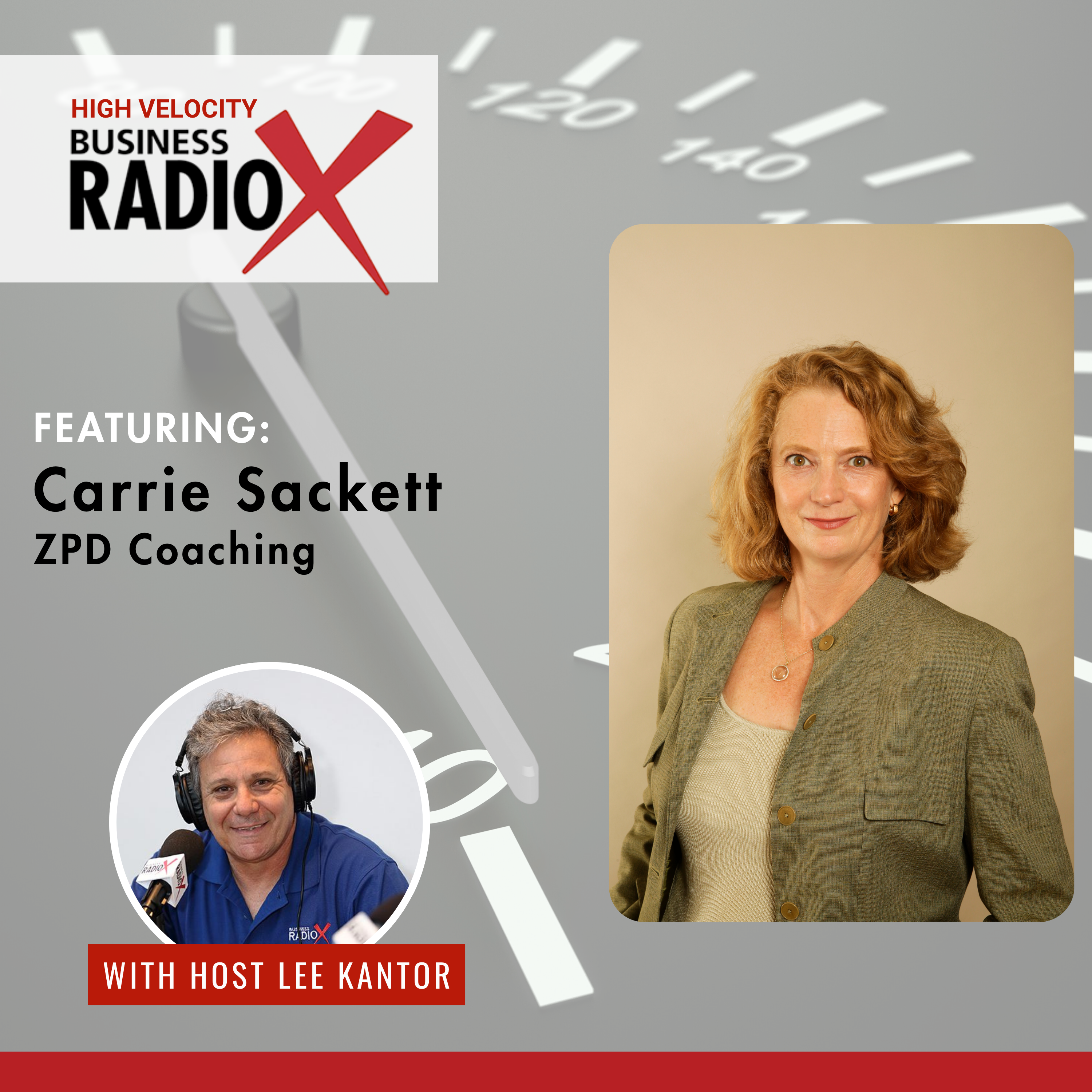

In this episode of High Velocity Radio, Lee Kantor speaks with Carrie Sackett, America’s “loneliness coach” from ZPD Coaching. Carrie explains that loneliness is a growing social epidemic, affecting people across all demographics—even those who appear successful. She emphasizes that loneliness isn’t just an individual problem but a relational one, rooted in how people connect (or fail to connect) with others. Her work focuses on building “social intelligence,” a skill set that strengthens authentic connection, emotional awareness, and a sense of belonging.
 Carrie Sackett, MS, PCC is America’s loneliness coach and founder of ZPD Coaching. She helps people build up their social intelligence muscles and break out of the inner mental loops which keeps them stuck and lonely–in life and in their relationships and careers.
Carrie has been practicing a boldly transformative approach to emotional wellness and personal growth for over 25 years—in the coaches’ chair as well as in corporate world as a Fortune 500 global change leader and award-winning employee engagement professional.
She is an internationally published author, speaker and coach. Carrie trains coaches, therapists and business leaders in the breakthrough tools of social intelligence. Her articles appear in leading coaching magazines. And she regularly introduces next generation tools for social intelligence on podcasts.
Connect with Carrie on LinkedIn.
What You’ll Learn In This Episode
- Why loneliness is a growing social issue—and not just an individual problem.
- How “social intelligence” helps build deeper, more authentic human connections.
- The hidden ways loneliness shows up across different life stages and careers.
- Why traditional advice (like “just join a club”) often fails to solve loneliness.
- The gap between recognizing loneliness in others and actually talking about it.
- How hyper-individualism and remote work contribute to modern isolation.
- Practical tools like having a “loneliness buddy” to stay connected.
- Why vulnerability and reaching out to others are essential for emotional growth.
- How asking for real-time feedback improves relationships and self-awareness.
- The role of human connection in overcoming imposter syndrome and self-doubt.
 This transcript is machine transcribed by Sonix.
TRANSCRIPT
Intro: Broadcasting live from the Business RadioX Studios in Atlanta, Georgia. It’s time for High Velocity Radio.
Lee Kantor: Lee Kantor here. Another episode of High Velocity Radio in. This is gonna be a good one. Today we have America’s Loneliness coach with us, she is also with ZPD coaching. Her name is Carrie Sackett. Welcome.
Carrie Sackett: Hi, Lee. It’s great to be here. Thanks for having me.
Lee Kantor: Well, I am excited to learn what you’re up to. Tell us about your practice. How are you serving folks?
Carrie Sackett: Sure. I am America’s loneliness coach. I help people build up their, let’s call it social intelligence, which means building up our muscles for connection, feeling seen and heard, building community and one place. There are a lot of places that people are lonely these days. People are lonely by demographic young people and older people. People are lonely as solopreneurs, as stay at home parents. People are lonely at the top. So the top of their careers, they’re at the. They’re doing. They’re achieving everything they want to achieve. And it can feel lonely up there at the top. So that’s a little bit of what I do and how I and who I work with.
Lee Kantor: Now, do you mind sharing a little bit about your backstory and how you became America’s loneliness coach? What what about that drew you to pursue that?
Carrie Sackett: Sure. I was finishing writing my book and where I, I talk a lot and focus on emotional growth. So social intelligence is really it’s, you know, there’s a lot of intelligences out there. They focus on what’s happening inside of you or what you think is happening inside of someone else. But the the social intelligence is a relational emotional toolkit for what’s happening between you and others. So I was finishing up my book, and all these articles and research papers were coming out on loneliness. It’s a crisis if 1 in 3 people are experiencing loneliness at least once a week, I would call that a social epidemic, you know? But the prescriptions to people are things like, hey, you individual, you can fix your loneliness. If you join a club or talk to a stranger or take a pill. And I have nothing, you know, I have nothing against talking to strangers. I’m a New Yorker. I love talking to strangers. I love doing things I’m passionate about with others. But those prescriptions are based on the assumption that it’s something wrong inside of us that we have to fix. And loneliness. If it’s a social issue, then we have to address it socially. It is something that is happening between people who are feeling lonely and people who aren’t feeling lonely or and all the gradations in between. That’s where loneliness is happening. So that’s what I help people do as I work with them, is to build up their capacity to be in the moment with others, and to connect in ways that are more authentic and more, um, um, ways where we feel a sense of belonging. We have to create that with others.
Lee Kantor: So how did they determine that there was this epidemic of loneliness? Are they asking people, are you lonely or are they asking you to tell people what you’re doing? And then they’re kind of determining, oh, you are lonely.
Carrie Sackett: That is such a great question. And you’re pointing to the the methodological piece, which is so important. So the surveys I’ve seen, they go out to individuals and they say, how often do you feel lonely? So, so people self-select how often they feel lonely. And then all those numbers come back. They tabulate them and they come up with the statistics. Those questions are based on a framework of isolated individuals. It’s the assumption is that all of us in this world walk around as isolated individuals in our little bubbles in a square box around us where we. I have to manage my emotions myself, and if I don’t, then I’m dysregulated and I have to, uh, be this certain kind of person in the world. And if I’m not, I need to go get self help so I can, uh, be that better person. What that miss is, is that we are a social species. We grow and develop with others. It doesn’t only happen inside of ourselves. So say your question again, because I think I’m. Then I’ll hit the punch line for. Oh yes, I know what it is. So in those surveys, what if we asked the question, do you know someone who you think is lonely? So already that’s a relational question because it’s it’s, uh, looking out into the world.
Carrie Sackett: So. And then you follow that up with, do you know they’re lonely because they told you so? And you’re going to find a gap there. Whenever I give talks and I ask people to raise their hand in the room, usually everyone raises their hand. Yes, I think I, I’m pretty sure I know someone who’s lonely, who’s someone who’s in my life. And then you ask them, do you know it because they told you so? And then maybe, you know, between 20 and 30% of the hands go up. So there’s a huge gap. What’s come up with some prescriptions for closing that gap between the gap of all of us walk around every day knowing people who are lonely, including possibly ourselves. And then the way we relate to those people we think are lonely is we don’t even we don’t include it in the conversation or the relationship. That’s a gap that we could do something about. That’s what I focus on.
Lee Kantor: So now, are people coming up to you and saying, Carrie, I’m lonely. Help me be less lonely. Like, is that your coach? Like, is that what you do most of the time?
Carrie Sackett: That is a big part of what I do. Yes.
Lee Kantor: So so these individuals are are kind of self-aware enough to understand that they are lonely. And then they feel that they can’t fix that on their own. So they need an expert to help guide them to a better solution than they currently have.
Carrie Sackett: Yes. The only caveat I would add to your question is expert. I’ll put in in. Um, yes, I do happen to be an expert. The main part about that is that, um, I’m somebody else. We do not have to figure ourselves out by ourselves. That is what’s keeping us from growing. That’s what keeps us stuck. We we can figure ourselves out with others. And that’s way more transformational and way more sustainable.
Lee Kantor: And that’s where this umbrella of social intelligence comes in.
Carrie Sackett: Yep. So people get to practice.
Lee Kantor: So let’s go through, let’s go through, um, just for the listeners understanding of, okay, how first, I guess define how social intelligence works. And did you coin that phrase? Or is that a, is that a terminology that’s out there?
Carrie Sackett: Um, it’s both, uh, a couple of hotshots wrote books on social intelligence, maybe 20, 25 years ago. And, the market didn’t buy it. And and that tells you something about our culture. We’re a very individualistic culture. We’d rather look inside of ourselves to fix ourselves. Social intelligence is an invitation to look outward. That’s more uncomfortable. There’s more uncertainty there. Um, I, I, I created this term out of my work and then discovered the attempts to bring this into the world 25 years ago. There is so much more uncertainty in the world now that, um, I think it’s, it’s a relevant term again, how in the world could we possibly go through all the uncertainty, uh, in our, in the big world, in our cities and states, in our institutions, um, by ourselves? No wonder we’re lonely.
Lee Kantor: Is that an American? Is that an American cultural, uh, issue? Because other cultures, um, are not as maverick like as we are, I think.
Carrie Sackett: Yes, it’s for sure. It’s a more Anglo culture. Like the UK has a minister of loneliness, actually, and they, they’ve implemented a whole systemic program in their country. Um, I, yes, the cultures that are more, uh, founded in rugged individualism are the cultures that have higher loneliness issues nowadays. Uh, Western culture has expanded around the world and Western forms of life. There’s less community based living. So loneliness is on the rise everywhere. Uh, and the West has its particular version of this, and I am not the only person saying that rugged individualism has. We’ve kind of reached a limit. It’s been very good for us as a country, and now we’re kind of stuck. David Brooks, who’s at Yale now, he’s a former New York Times op ed contributor. He’s talked about hyper individualism. The leading business consultants like Adam Grant has talked about it as well, that the unit to look at inside of a company is the team, not the individual. So there’s more growing awareness that we have to be doing something new in this moment. And I’m proposing that these activities involved in social intelligence, building up our relational awareness, the ways that we impact and are impacted on by each other, our Uh, emotional growth, our capacity to hold an emotion and also choose what we’re doing in that moment. Those are two muscles that we need to keep exercising in order to combat loneliness, and to create that sense of community and belonging that we all crave.
Lee Kantor: Now, do you think that some of this work from home, um, all, all of these delivery vehicles where you can have everything sent to your house, all of this, uh, ecosystem we’ve created around being self-sufficient on my own terms is kind of hurting us in this area in order to become more socially intelligent.
Carrie Sackett: Yeah.
Lee Kantor: But is, is the genie out of the bottle? Like, is this like.
Carrie Sackett: I could tell you, um, you know, uh, I have a client who just moved to a new city, and she has a new job, and she works from home and she’s so lonely. She’s struggling to build her life in a new city where she doesn’t know people because we we are we no longer have as much of those institutional pillars through which to connect with people and make friends.
Lee Kantor: Right. So as an individual, what do you do to combat that? You obviously have to be proactive and you can’t just wait, you know, for someone to say, hey, come out. Hey, Carrie, come over. Like you can’t sit in your house and wait. You have to take some action, right?
Carrie Sackett: You have to take action. And you, while you’re. It’s. It’s. If it were only as simple as cognitively knowing to take action, then the crisis would be gone. Because we, you know, people know what you people kind of know what you’re. I mean, we all know we’re not supposed to eat ultra processed food or, you know, and we still do it. So it can’t be only knowing that’s going to get us out of this. So that’s where the relational muscles come in and the emotional muscles. So when I work with people, I, we, I ask them if they have someone in their life, they could do a pre ask with, hey, is there. And when I, when I give talks at universities, the kids absolutely love this tool. Is there someone in your life that you can ask now if you can reach out to them when you’re feeling lonely? And then and then you can decide how you do that. Maybe it’s just maybe it’s a six minute phone call. Maybe it’s a text message. Maybe it’s an emoji sent so that you’re not feeling alone with being alone.
Lee Kantor: So people, you think that an average person kind of clocks the way they’re feeling as they’re labeling it as I’m feeling lonely.
Carrie Sackett: Not only people feel despair. I mean, we have a we have a lot of words for feeling miserable nowadays.
Lee Kantor: Right? But so are we using lonely as kind of that umbrella for I’m feeling sad or despair or whatever the other emotion that maybe is tangentially connected to loneliness or could be construed as loneliness.
Carrie Sackett: Probably. Um, Language is a language and emotions is a very challenging. It’s very challenging for us to put language to our emotions. There’s no somebody lonely as somebody else’s despairing. So I’m not sure, um, what what’s important to you in asking that?
Lee Kantor: Well, I’m just trying to understand. I’m trying to look at it through the, the individual, like your, your friend, uh, or your client that’s in a new city and they’re maybe they’re overwhelmed. Maybe, uh, they don’t know a lot of people there yet. And maybe they’re not plugged into any type of community or activity that would bring about more people around them. Are, are they self-aware enough to go, oh, what I’m feeling really is His loneliness. I’m not overwhelmed. I’m not frustrated, or I’m not regretting that I made this move. It’s actually loneliness, what I’m feeling. And in order to if I can’t articulate it and define what I’m feeling, it’s hard to correct it.
Carrie Sackett: Yes, yes, of course we can feel more than one thing at the same time. But in this case, yes, this woman was absolutely aware she was lonely. A stranger turned to her, um, on the, uh and said, you know, I really, um, just said something to her out of the blue, just unprompted. It was a compliment. And my client went back, this is how she got this is how she realized, oh my God, I’ve got it. I need help on this. She went back to the person who gave her the compliment in tears to say, thank you so much. I haven’t talked to anybody all day. I am so lonely.
Lee Kantor: But is that an unusual instance or are are lonely people feeling on the brink of tears all the time?
Carrie Sackett: Well, some people I. Some people feel lonely in their marriages. Some people feel lonely because their kids aren’t going to have kids and they won’t be grandparents. Some people feel lonely because they have a chronic illness, and they can’t do everything that everybody else does. There’s so many kinds of lonely.
Lee Kantor: Now, when you’re working with your clients, is there any low hanging fruit? Are there anything they can be doing an activity or an exercise that can at least start them in the right direction? Or is this something that.
Carrie Sackett: They can have? Loneliness, buddy. See, I’m. I want to make loneliness more ordinary. I wish we could go get our coffee in the morning and say to the barista, good morning. I’m feeling lonely today. Can I have a double latte? Wouldn’t that be? Wouldn’t it be? We could if we could have there be less shame around loneliness and more ordinariness around it. So one way to be ordinary about it is to get a loneliness buddy. Get a buddy. You don’t have to call them a loneliness buddy. Have a buddy at free. Ask them. Hey, the next time I’m feeling lonely, can I reach out to you? That’s a that’s a low risk ask because it’s not the moment when you’re feeling really lonely. It’s before the moment. And what you’re doing is you’re you’re supporting yourself to not be alone when you’re feeling alone. Another one, this came up in one of the groups that I run. We discovered that this person, she. She had a loneliness buddy. You know, someone like an accountability buddy. Yes. I’m going to go to this club meeting. Yes. I’m going to go out and talk to somebody while I’m at the supermarket or whatever it is. What we discovered is that moment, the moment when you’re at home and you’re supposed to be out doing the thing you should be doing to be less lonely and you don’t feel like it. We discovered, oh, that’s the moment to reach out to your buddy, have reach out to someone so they could tell you, oh, come on, get out of the house. Sometimes we can’t do that by ourselves. We need others to help us break out of this.
Lee Kantor: Now are you do you feel that, like with the advent now of AI and these conversations people are having with AI that that’s displacing some of this, like they think they’re addressing it, but they’re actually having interactions with non humans.
Carrie Sackett: I think there’s some there’s absolutely some value and AI cannot replace. Actual human interaction. Ai cannot replace that. The nervousness that we feel when we reach out to our buddy and say, I, I, um, I don’t want to get out of the house. Will you help me? When we do that with another human, there’s more vulnerability, there’s more. And there’s, and there’s more risk of actually being supported by another human, someone who says, okay, I’ll tell you what you I’ll tell you. You’re telling me you want me to tell you to get out of the house. Okay, get out of the house. That’s not easy to do. That takes vulnerability and letting people impact on you and letting yourself impact on others. Ai cannot replace that otherwise. Ai, you can stay more in your head in social intelligence. It’s more what’s happening between you and other humans.
Lee Kantor: And when you’re working with somebody regarding social intelligence, is it helping them be more socially intelligent and or helping them interact better and be more socially intelligent with others, whether it’s an individual in a relationship or a community? Yeah.
Carrie Sackett: Yeah. Like have you ever Have you ever wondered what a colleague thinks of you in a particular moment, or what your spouse thinks of you, and then you decide in your head what they’re thinking, and then you operate from that conclusion forever after. We do that all the time. Have you ever walked into a meeting unsure of where you are? Uh, you know, you walk into a room and you’re not sure what room you’re in. You know, that’s like when you go to a new country, you land there, but you know, you don’t quite know where you are. There’s different cultures. It’s different people. They speak differently. They move differently. They feel differently. Social intelligence, those tools. When we build up those relational muscles, we’re able to. We have the capacity to ask the room the the meeting your colleagues at the meeting? How is what I’m saying landing with you all? We can actually ask other people those questions. How am I impacting on you? Are you open to hearing how you’re impacting on me? That’s what gives us a more grounded sense of where we are. And again, with all of the uncertainty in our world and in our workplaces, having the capacity to ask those kinds of questions, having the the strength to ask those kinds of questions is and, and still be standing with whatever people say back to us, that’s more important now than ever.
Lee Kantor: And I would imagine if you get good at this, then your relationship will become deeper. You’ll have more and more meaningful relationships. Yes, you’ll be a more vital member of your community. Like the ramifications of getting good at this? Really, the impact is real.
Carrie Sackett: The impact is real. Absolutely. More success business wise, more intimacy in your life. More capacity to lead uncomfortable and difficult conversations. More capacity to be curious about others. That’s part of building that connection. Absolutely. All all of that.
Lee Kantor: Now, when you’re working with a client, can you share a story? Maybe obviously don’t name them, but maybe share the challenge they came to you with and how maybe some of the actions or some of the, the words of wisdom you shared to help them get to a new level?
Carrie Sackett: Yes. Um, So I recently was working with, um, a young man with, well, imposter syndrome just got promoted, didn’t feel like he, you know, fits in, deserves the role. Always feels like an outsider. Um, what we worked on together, we brought, we brought that into the coaching space. So I would ask him. Are you curious? Are you curious about how I’m experiencing you right now? And, and then he would sort of sheepishly, sheepishly say, uh, okay. Yeah. And then I would say, okay, well, why don’t you ask me? He said, what do you mean, ask you? Well, why don’t you ask me? Why don’t you try try out this line of asking me, hey, Carrie, how are you experiencing me right now? And then he would say the line. And then I asked him, okay, how was it to say that? He said, that was terrifying. I said, well, how was it to be terrified with me? And he said, oh, I guess it wasn’t that bad. And I said, all right, now I’ll answer your question on how I’m experiencing you right now. And isn’t it great that you got you got to practice asking me this question and you go, that’s like a look at how we build our relational muscles.
Carrie Sackett: And so then I gave him my experience of him, which was way better than his experience of himself. So then it was like, okay, so what do we do with that? What do we make of that? I see you differently than you see you. So what we’re loosening up in this work is the way that each of us, we all do it, myself included. We hang on to. We hang on to stuff. We’re certain that what we see from where we stand is the truth. But the the reality is we’re a social species. We grow and develop with others. Other people stand in different places than me, and those other perspectives can be helpful and valuable and bounce us out of our heads. I’m not saying other people are always right and you should never listen to your intuition. I’m not saying anything like that. But if we could see life as an ongoing process where we’re exercising our muscles with others, then we can see more possibilities for ourselves by inviting in how others see and experience us.
Lee Kantor: And that’s where it sounds like having a coach like yourself is extremely valuable, because I think that, as you mentioned earlier, we’re just out of practice or maybe we never learned how to do this. Um, and we need some outside person, you know, fresh eyes on this to give us some tools to help us kind of navigate this in a way that’s going to help us, you know, make the impact that I’m sure most of us are trying to, um, you know, be able to do in their life and their career.
Carrie Sackett: Yes, I really, I love what you’re saying. And that’s the, that’s kind of the ordinariness I was talking about earlier. Yeah, we all, we all can do it.
Lee Kantor: Right. And it’s nothing like you were saying. It’s nothing to feel shame about. This is just as a as a society. We’re just kind of out of practice. And especially through the pandemic, we were all forced to isolate and go into hibernation for a period. And now we’re back out there and some of us have lost maybe some of those skills that we had before.
Carrie Sackett: Yeah. Yes. And we’re in this culture where you’re supposed to know even before something happens, you’re supposed to know. And so now we have all these people who are waiting. I work with, you know, people all the time. Their their general posture is, well, I can’t go out in the world until I fix myself. And what we you know, even what that story is that I just told you is actually you can you can go out into the world messy and you’re practicing with me building up these muscles so you can navigate the messiness, navigate the uncertainty. We don’t have to wait to live our lives until we have it all together.
Lee Kantor: Yeah. And we have to give ourselves the grace that we typically give others.
Carrie Sackett: Yes, absolutely. We are way harder on ourselves. Yes. Than other people are.
Lee Kantor: So if somebody wanted to learn more, get a hold of your books or get a hold of you. What is the website? What is the best way to connect?
Carrie Sackett: Sure, my website is ZPD coaching Zeta Peter David coaching the ZPD is actually a scientific term called the Zone of Proximal Development. The. The theory is we. We need others to help us grow and develop the same way. When we were babies and we couldn’t become a speaker unless we had people around us who were more developed and who who encouraged us and cheered us on to become speakers. They didn’t throw the grammar book at us and tell us to come back when we get it right. So that’s the that’s the name of my company. Zpd coaching on my website. You can schedule a time to speak with me. That’s really what I recommend with this is to do a 20 minute free consultation with me. And we’ll talk and we’ll get to know each other and figure out a path forward. I do want to add, I also I do a lot of work with couples and families as well.
Lee Kantor: Yeah, that’s critical there as well. Yeah. Well, thank you so much for sharing your story today, Carrie. You’re doing such important work and we appreciate you.
Carrie Sackett: Thank you Lee.
Lee Kantor: All right. This is Lee Kantor. We’ll see you all next time on High Velocity Radio.















