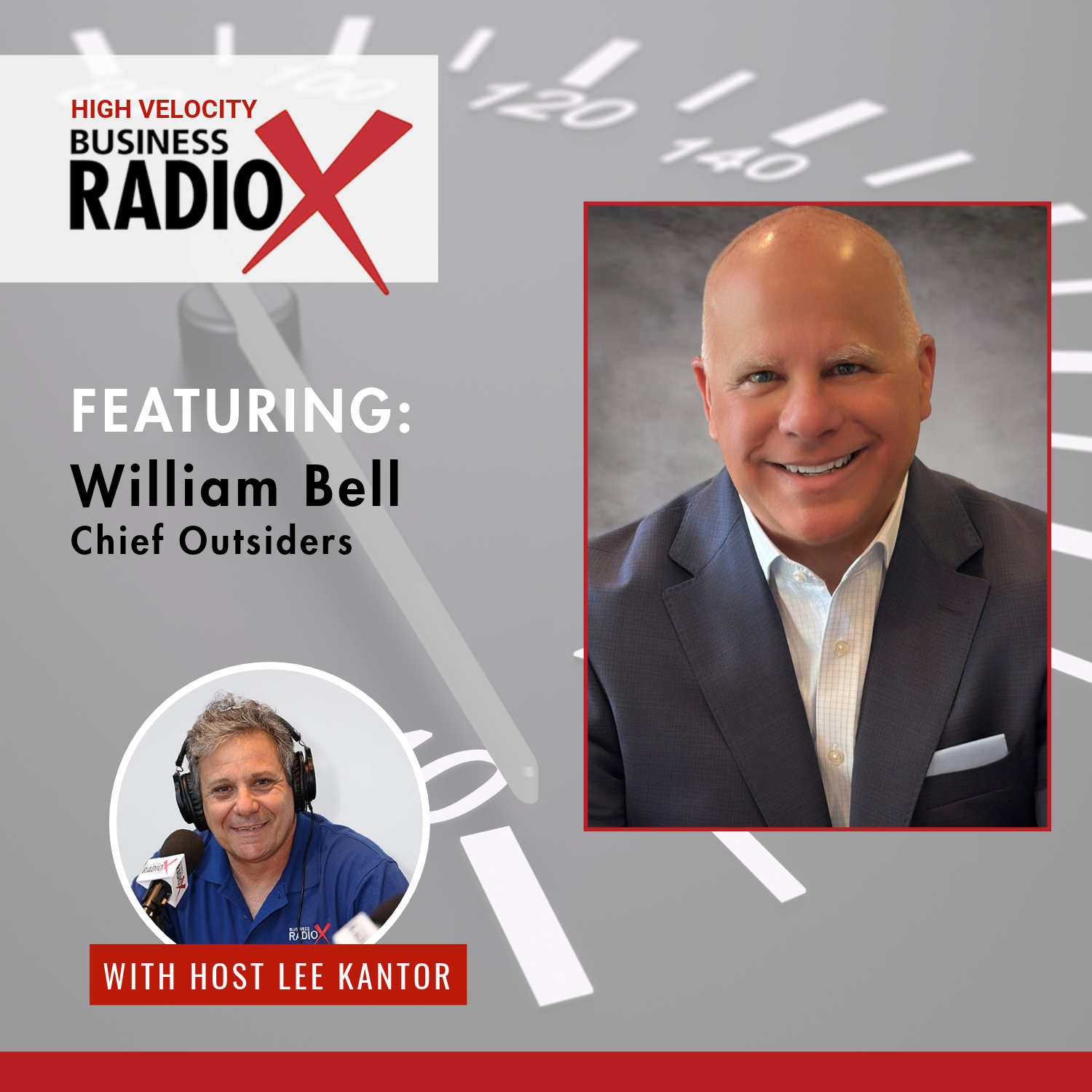

In this episode of High Velocity Radio, Lee Kantor interviews William Bell, Chief Revenue Officer at Chief Outsiders, about helping middle-market companies overcome growth challenges and build scalable business operations. Drawing from his extensive experience as a CEO in industrial manufacturing and automation, William shares how fractional executives help businesses identify problems, strengthen sales strategies, and improve revenue performance. He highlights the importance of reducing founder dependency, establishing structured sales processes, improving pipeline management, and building recurring revenue streams to support long-term growth.

 William Bell is a battle-tested global CEO and Fractional Chief Revenue Officer with more than forty years of experience in automotive and industrial markets. He has built and restored market share in industrial capital equipment and discrete manufacturing, and he works with middle-market CEOs to drive revenue growth, higher operating margins, and recurring revenue.
He pairs strategic vision with hands-on execution and stays with a client until the strategy delivers results. He is a business development and commercial executive with more than forty years of experience in automotive and industrial markets, including metrology systems, CNC machine tools, industrial automation and robotics, and industrial IoT services.
He has operated across North and South America, Eastern and Western Europe, India, Southeast Asia, and China. He has led P&L responsibility, private equity relationships, turnarounds, and cross-cultural leadership teams, and he describes his approach as operator first, advisor second: his clients work with someone who has sat in their seat.
His leadership record includes serving as Vice President of Sales at Carl Zeiss IMT from 1999 to 2003, where he grew a metrology startup from $4 million to more than $85 million by building a sales and service dealer network. He then served as President and CEO of Schenck RoTec Corp. from 2003 to 2005, growing sales from $19 million to $50 million in 24 months and raising gross margin from 9 percent to 24 percent.
From 2005 to 2013, he led Dürr Ecoclean, first as North American CEO and then as Global CEO, growing the business by roughly 70 percent over eight years and restructuring nine subsidiaries within one year. He also served on the Dürr AG Senior Executive Group. From 2014 to 2019, he was North American CEO of Leadec Corporation, where revenue grew more than 80 percent over five years, and profitability improved significantly.
Today, he is a Partner and Fractional CRO with Chief Outsiders, where he provides senior revenue leadership without the cost of a full-time executive. He embeds in client businesses to build the commercial infrastructure that sustains growth, including business development and sales growth, territory design, pipeline discipline, sales process, CRM governance, organic growth strategy, M&A growth planning, business transformation, executive coaching for founders and CEOs, and leadership and organization development.
He also serves as a Senior Advisor to Dunes Point Capital. He works with mid-market manufacturers and industrial companies with $50 million to $500 million in revenue, across family-owned, corporate, and private-equity ownership, and he reports that he has delivered more than $1 billion in cumulative revenue growth over his career.
Clients praise his ability to build sales organizations and new markets. Dürr AG CEO Ralf Dieter credits him with driving sales growth through innovative strategic initiatives and expansion into new markets, and Gottstein Corporation owner and CEO Ken Gottstein says that when his business needed to reach the next level, he turned to Bill.
He holds a Bachelor of Arts from the University of Pittsburgh, completed the Executive Education Program at the Michigan Ross School of Business, and holds a Six Sigma Green Belt from Villanova University.
Connect with William on LinkedIn.
What You’ll Learn In This Episode
- Understanding how fractional executives help middle-market companies overcome growth challenges
- Recognizing the risks of excessive founder dependency as businesses scale
- Building scalable organizational structures through effective delegation and leadership development
- Establishing standardized sales processes and stage gates to improve sales performance
- Strengthening pipeline management through proper qualification and accountability
- Identifying warning signs such as stagnant revenue, declining margins, and inconsistent sales conversions
- Developing recurring revenue strategies to create more predictable cash flow
- Improving business performance through focused problem-solving and strategic execution.
 This transcript is machine transcribed by Sonix.
TRANSCRIPT
Intro: Broadcasting live from the Business RadioX Studios in Atlanta, Georgia. It’s time for High Velocity Radio.
Lee Kantor: Lee Kantor here another episode of High Velocity Radio and this is gonna be a good one. But before we get started, it’s important to recognize our sponsor, Business RadioX. If you’re a coach or a consultant who is tired of selling and ready to lead by serving, set up a call with Stone Payton at book Stone Payton dot com to learn how to give local leaders a voice and become a recognized authority in your market. Today on this show, we have Chief Revenue Officer with Chief Outsiders, William Bell. Welcome, Bill.
William Bell: Hello. How are you?
Lee Kantor: I am doing well. I am so excited to learn what you’re up to. But before we go too far into things, tell us about Chief Outsiders. How are you Hey, folks.
William Bell: Yes. Chief outsiders is a fractional consulting firm. We have about 130 fractional consultants. I say the majority of them are chief marketing officers as well as chief sales officers, chief revenue officers. One of our, let’s say, unique things is that all the members or all the consultants are required to have worked at a at a company in the C-suite. So, you know, we’re bringing executives that are high level executives that can, uh, help, uh, solve any growth challenge that you have mostly middle market companies who are ideal client profile is.
Lee Kantor: So what’s your backstory? Um, how’d you get involved in what you’re doing right now?
William Bell: Well, I spent the majority of my career in the automotive industry. I was CEO of multiple different companies, primarily in the industrial automation business, automotive assembly lines, engine assembly lines. Transmission assembly lines. Biggest part of my career. I worked for a company called dir. Dir AG is a very large German engineering firm, and I was the global CEO of the powertrain division, multiple different avenues. As along my career. But the ended up at Chief Outsiders because I was really interested in helping to help middle market companies develop growth strategies.
Lee Kantor: So what is it like when you enter into an organization as a fractional officer? What is the how quickly do you have to get up to speed in order to, you know, create some new momentum for them?
William Bell: Yeah. I mean, you have to get up to speed very quickly. It’s kind of a unique situation because you’re coming in to normally fix a growth strategy problem. So you have to really have to dig deep and find out what the issues are and try and develop a strategy as quickly as possible. Um, you know, people aren’t, aren’t willing to pay for you to learn their business. They expect you to learn your, their business in your own time and come, come to their business and look to make an impact quickly.
Lee Kantor: So was that a big transition for you? I mean, you’ve worked in leadership in several organizations, but this seems like you have to it’s almost like going from being a doctor to being an emergency room doctor.
William Bell: Well, a little bit, um, a little bit different for me, but not not so much because, uh, throughout my whole career, I’ve kind of the, let’s say the fix it man for dirt. Uh, AG so every time they had a, a division that was struggling, uh, normally I got tapped on the shoulder to go in and try and fix the problem. So I have a lot of experience in, you know, entering into a business that I need to learn very quickly and also figure out what the problem is very quickly and execute a solution. Develop a strategy and then execute that strategy fairly quickly. Because, um, you know, at the, in the corporate world, they were expecting results quick. And in the consulting world, clients are expecting results quick as well.
Lee Kantor: And then how is quick defined? Are we talking about quarters a year? Like what is what’s the expectation typically.
William Bell: Well with the in the consulting practice, they’re looking for you to, to develop a strategy probably within, uh, 2 or 3 months and then start to execute that strategy. And, you know, they’re looking for, uh, noticeable results within, uh, a 9 to 12 month period and the corporate world. Okay. It’s, it’s more like 18 months. Um, but it’s, you know, fairly, you know, Fairly short timelines.
Lee Kantor: So what, um, what have you learned that transfers to this kind of work that allows you to kind of assess the situation and make the needed changes quickly?
William Bell: Yeah. I mean, the biggest thing is that you need to, um, you know, jump in quickly. I like to, to do a lot of interviews of the people, uh, because typically the solutions are within the minds of the people that are already working there. Um, so I do a lot of talking to the people that are there trying to figure out what the problem is quickly. Um, and, you know, a lot of the, the clients that I work with, the pattern kind of repeats itself. So I do a lot of work for, um, companies that are founder led. And so there’s a lot of consistency in what the typical problem is. And you know, the typical problem with a founder led company is significant dependency on the founder. And so you have to figure out how to separate him from the daily work and get the other people to do the daily work and solve the problems. Um, so it’s, it kind of kind of the, the problem repeats itself and, and I can recognize what the problem is fairly quickly once I get in the door.
Lee Kantor: So it sounds like you’re part therapist too. If you can help a founder be less controlling and micromanaging.
William Bell: Yeah. And they don’t do it because, um, they don’t do it because they just want to micromanage. It’s just that’s how their business grew. You know, their, their business grew with, um, normally the, the founder identifying customers and building relationships with customer and then building a, you know, normally gets this first big deal and then has to figure out how to execute on that. So, um, it’s not that they’re trying to be controlling, it’s just their whole career has been, you know, developing this, this foundation that they’ve built.
Lee Kantor: Right. And it’s also, they don’t want to, the stakes are high. So they don’t want to risk messing up when they know they could do it. And it’s just, that’s part of the growth, right? That a leader has to be able to let go and delegate and manage people. That’s a different stage of the growth of the organization.
William Bell: Yeah, exactly. Exactly. You know, and I see it normally, uh, it depends on the business, the type of business, but I normally see these founder dependent companies, you know, they can grow to about, I don’t know, 30, 40 million in revenue and they can handle the founder can handle most of that business by himself. But once you get above 40 million into the 50 and above, Um, you really have to change the structure. You need to, you know, develop an organization that can scale. And so, you know, that’s one of the key things that you need to let’s have the discussion with the founders, get him to understand there’s only so far he can go without developing a scalable business model. Um, and that’s really one of the keys.
Lee Kantor: So now do they have the self-awareness to say, hey, I might be the bottleneck. Let me call Bill and his team? Or is this something like the boards going, hey, you’re the bottleneck. I gotta get somebody in here to help fix this.
William Bell: It’s a little bit of both. You know, I get called in, you know, I’d say 50% of the time from the board who says, hey, you know, we need to figure out a scalable structure here and a system to build this business. And, and the founder maybe doesn’t want to hand that off. A lot of times I also work with private equity firms who have just bought this founder led company and they need to build a structure. But, um, there’s, there’s founders that I deal with as well who, um, you know, they’re, they’re self cognizant that they’ve got a problem and they need to fix it and they’ve been flat, their business has been flat for a couple of years. They grew and then sat flat and the margins are, are eroding and the competition is getting stronger. And they realize they need someone that can help them, that that has done it before. And so I, I get called in by those companies as well.
Lee Kantor: So is that some of the signs or signals that maybe, uh, it might be a good idea to call you is that if things have plateaued or the margins are eroding, are those some of the, the, um, kind of yellow flags on the play that are saying, hey, it might be time for a change here.
William Bell: Yeah. That’s one of the typical flags is the, the, the Revenue has been flat for a couple years, or the margins are deteriorating, or they’re seeing more competition, which makes them have to reduce their prices, or they’ve got a pipeline that’s a huge pipeline, but they can’t seem to close anything. Um, those are the typical yellow flags that they, you know, either the board sees or, you know, some of the founders, they’re smart enough to see this as well and, and say, okay, we need some help.
Lee Kantor: So do you mind sharing some advice? Like, let’s take that last one. You said that say the pipeline is full and then they’re having trouble closing. What’s kind of your go to moves when dealing with that as the problem?
William Bell: One of the biggest problems I see all the time, like almost 95% of the time is when I come in, I find out they’ve got a pipeline, but they’ve got no sales process. They have no structure. Every salesperson sells differently. They sell through a different process. Um, so there’s really no, no way to manage the pipeline to see what’s really moving and what is not moving and what’s getting stalled and is not getting stalled because everyone’s doing it exactly different. Um, so if you put in a standardized process with stage gates, you know, normally it’s an 8 or 9 step process where they have to accomplish something in the first stage gate, which is typically get confirmation that the customer is going to buy, has money to buy, has a problem, they can solve those types of things. Then they can move to stage gate two where they’re, you know, doing a lot of further discovery with the customer to understand what exactly the problem is and what needs to be solved for the customer and how much money they have to spend. And, you know, you get past that stage gate, then, you know, the next stage gate is providing a proposal.
William Bell: So, you know, if you’ve got all these stage gates and everyone’s doing it the exact same way, I kind of, I kind of, um, relate it to a manufacturing process. When you think about a process where you want to create or manufacture something consistently over and over and over with good quality, like you’d want to do with an engine block or a transmission, then you have to have a very specific process, step by step by step or otherwise, you’re going to get to the end of the process, and you’re going to have ten different engines and ten different quality levels. And one takes, you know, ten times longer to build than the other. So it’s the same thing. If you’ve got a standardized process that really is one of the main keys that I and I see it, especially on a founder dependent company, I see this almost every time where the founder, uh, is leading the sales and, and they’re just doing it through customer relationships, not through a process.
Lee Kantor: And then is that one of the things that you help the client with? Like, that’s why you go through that interview process. So you can see, okay, who’s the rock star? And let’s build the process maybe around their process, at least use that as kind of the jumping off point.
William Bell: Yeah. Normally and normally, um, I don’t look at who’s the rock star, uh, because some rock stars are just good at selling and they don’t really need a process. Um, it’s more looking at how, how long is the sales cycle? Is it a six month cycle, nine month cycle, 12 month cycle. If it, the longer the sales cycle, the more defined you have to have the sales process because, you know, Lord knows you don’t want to go through nine months of selling to a customer and find out that they didn’t do the first stage gate, which was verify that the customer has money. And, you know, the biggest waste of sales time is selling on a project that you’re never going to get an order for. So, you know, in the very first stage gate, you need to define what’s the problem. Can we solve it? Do they have money? Is it budgeted? Am I talking to the decision maker? Are there other people that are going to be involved in the decision? What’s the what’s the buying process? All these things have to be discovered first before you go into actual selling.
Lee Kantor: I mean, that sounds like such common sense. And you really find that that that’s and people are really not doing the first thing.
William Bell: Yeah, yeah. It’s it’s, uh, you would think, you would think that, uh, you know, that would be the case, but no, uh, Most companies that I get involved with don’t have a sales process. Or if they do have a sales process, it’s very weak and it’s not defined and everyone goes about it in a different way. Um, but the only way you can manage a sales pipeline is by having a strong sales process. And the only way that you can manage how much revenue you’re going to generate so that you know how much cash flow you need to execute on the business is you got to have a, you know, pipeline management because that’s what drives your forecast.
Lee Kantor: Right? And then it’s just kind of, it’s amazing to me that that companies would rather waste nine months of time thinking they have a sale rather than just finding out upfront if these people are even, you know, can afford it or want it.
William Bell: The yeah, well, different salespeople have different levels of quality. Um, and the good salespeople know that they have to do that type of discovery work. But in every company, I would say 50% of the people, uh, they, they just jump in and start selling to the customer and they don’t do the discovery work.
Lee Kantor: Is that just like, like lack of training or like, I mean, like bad choices of hiring? Like, how does that even happen?
William Bell: Uh, it’s all of the above bad, bad choices of hiring. Um, and I’m actually certified, uh, to do OMG assessments, which is an objective managed group assessment, which actually assesses the candidate to determine whether they understand all the things that are needed to be an effective salesperson. Because, you know, one of the things that happens in recruiting for salespeople is every salesperson is really good at selling themselves. Many of them are horrible at selling products, but you can’t define that because they sell themselves and you’re like, okay, this guy must be a great sales guy. Whereas if you do an OMG assessment, you can actually find out, you know, is the person really a good salesperson or just a really good salesperson selling one product just happens to be themselves. So that’s the first problem. Um, the second problem is, yeah, poor hiring, poor training, um, you know, a lot of different things that, and it sounds.
Lee Kantor: Like lack of accountability. Like they’re not, you know, asking, hey, did you clear the first stage? You know, like, yeah, did you check the box that we got this information so we can move to the second stage? Like no one’s holding them accountable.
William Bell: Yeah. Because, you know, a, a founder normally is a good salesperson. He’s, you know, he’s, he’s figured it out and he’s growing his business or at least grew it to a certain point. So he just makes the natural assumption that the salesperson, when they sat in front of the customer, asked all these questions. Um, they don’t, they don’t assume that that, uh, that a salesperson would be that, let’s say, not have that common sense to do that. Um, so, and that’s a lot of times what you’ll find is you start looking at their pipeline and you say, okay, you got these, got, you got ten opportunities here that say there are 90% chance of becoming an order. But they’ve been sitting in this pipeline now for four months. And your typical sales cycle is only two months. So why are they sitting there for two months? Let’s let’s do some diagnostics on these, you know, and you sit down with the sales guy and you say, okay, are you talking to the right person? Do they have money? Is it budgeted? And you’ll find out 90% of the time, a lot of those questions have been asked. They’re just making the assumption or they’re just selling because they think they can sell features and benefits, and the customer will say, oh, great, I’d love your product. I’d like to buy it. Doesn’t work that way.
Lee Kantor: And I would imagine if you get this right, you can impact the revenue pretty quickly if you can tighten this up.
William Bell: Yes. Yeah. I mean, the first thing is you’re going to do is dramatically increase sales productivity because, uh, probably 60% of the projects that end their pipeline haven’t been, haven’t been pressure tested to find out whether all these things are correct. So you can probably clean up 60% of your pipeline with bad projects that have no chance of ever selling and quit. Quit spending your time on them and focus on the ones that you actually have the possibility of getting an order.
Lee Kantor: Now, how is it different when you work with private equity firms and there’s been a merger or acquisition that you guys come in and help in that regard. Is it is there some time you have to spend on culture fit and things like that, or, or you just are working kind of the systems that we’re talking about.
William Bell: Um, you have to do a little bit of culture fit, you know, but, but all the members of Chief outsiders, like I said, are former C-suite people. So they understand, you know, how they need to fit in, in, in an organization. They’re used to doing this. You know, I, I do probably 7 or 8 engagements a year. So I, you know, I’m, I’m dealing with 7 or 8 different companies a year. And I have to go in there and establish myself, build credibility, understand their culture, um, and, and learn to, you know, operate in someone else’s house. But like I said, most of us have all been C-suite, so we know how to do that. Um, once you establish credibility, which you can do fairly quickly. Um, then you can just get to work on solving the, solving the problems.
Lee Kantor: So is there a story you can share that might illustrate what it’s like to work with you? Um, is there, you know, don’t name the organization, but maybe the challenge that they came to you with and how you were able to help them get to a new level.
William Bell: Yeah. I’ll give you a great story. Um, a client of mine, um, or let me, let me say, uh, a client that a long time ago with my private equity firm, uh, we were looking to purchase. We went in to look at them and decided it was not the right acquisition. And the reason was it was too heavily, uh, founder led. So the founder had too much control over the business and hadn’t really delegated that control to the rest of the people in the organization. Second problem was that they had a very tight customer concentration. 30% of their business came from one customer. Um, and they didn’t have a recurring revenue strategy in that it was a project business. Um, that was very lumpy because project business is typically that way and you need to have a recurring revenue strategy like aftermarket services and support to really flatten out that, that, um, that order curve, if you will. Um, so we, we told the client that, or we told the customer we weren’t going to make the acquisition, weren’t interested in it. He called me back and said, hey, can you sit down and explain to me why you made that decision? So I had that conversation with them and we kind of got to be good friends, or at least, uh, talked to each other on a regular basis. And about four years later he calls me and says, I need your help. I said, okay, you know, we’re not going to buy your company, but I can help you.
William Bell: What do you need? He said, I’m about ready to go bankrupt. Um, and I said, why? And he said, because I didn’t do any of the things that you told me. I kept driving the business myself. Didn’t hand it off to anybody. I kept the same customer that owns 30% of my pipeline and haven’t built a recurring revenue strategy. And you’re right. It almost drove me into the ground. But I believe if you come in and help me, we can we can solve that problem. So, you know, I’m I’m with the customer right now. Um, I’m working with him right now. And we’re doing a lot of unique things that he never thought of, like sell and lease back his buildings so that he can get cash flow, um, I’m building a sales group that actually can sell, not just have him do all the work, figuring out how to grow his customer base so that he’s not dependent on that wagon customer and, um, doing some partnerships with other companies that do recurring revenue strategies for preventive and predictive maintenance of the automation systems that he sells. So, um, you know, it’s, it’s, uh, a great story. I love working with him. He’s really, um, really wants to solve the problem. And that’s, that’s the perfect customer when they want to just figure out how to solve the problem with you. It’s always a great story.
Lee Kantor: It sounds like this work is so rewarding for you going from, you know, being, uh, a leader of one organization, but now getting to touch so many, it must be a lot of fun to be able to switch gears and really make so much impact in so many different places.
William Bell: Yeah, it’s actually it’s a blast. You know, I’m 68 years old and my wife keeps saying, why are you doing this? Why don’t you just retire and relax and have fun? And I’m like.
Lee Kantor: This is fun.
William Bell: The reason I’m doing this is because this is like the first job I’ve ever had that I really love. Because every day I walk in and I’m solving someone’s problem and I’m not dealing with political issues or, you know, uh, employee issues, nothing. I’m just coming in identifying problems, helping fix those problems and making the customer happy. And that’s like, that’s all you, I mean, it’s a wonderful job, I love it.
Lee Kantor: Yeah. I mean, that’s what I think people don’t realize in business that you get so much, uh, it’s so rewarding to be able to make that kind of an impact. And then that the ripples that are coming from each one of those organizations spread out through those communities. I mean, it’s, it’s just really an amazing thing you’re doing. And it. And it must you sleep well at night, I’m sure. Well.
William Bell: I’m old, so I don’t sleep well at night. But I’m up at 4:00, and I’m probably working till 7:00, and. And again my wife keeps asking me, when are you going to quit? And I’m like, I don’t know. I don’t, I can’t see myself ever quitting because I’m having too much fun right now.
Lee Kantor: Are you still focused primarily in manufacturing? Is that kind of your sweet spot that you stay in?
William Bell: Yeah. My sweet spot is industrial manufacturing, you know, and if you want to get really specialized, I like to do industrial automation. Uh, that’s my experience, my background. I know that business quite well. Uh, but I also, um, ran a company that did industrial services. So I understand, um, the industrial service business as well. So, um, you know, but, but really what I do, you can apply this to pretty much any mid-market company. Um, it’s just, you know, I, I limit myself a little bit because I know those specific markets so well.
Lee Kantor: So if somebody wants to learn more, have a more substantive conversation, what is the best way to connect? Is there a website or LinkedIn? What’s the best way to find you?
William Bell: Yeah. Chief Outsiders has a website, www.chiefoutsiders.com. I’m on that website. Or if you want to reach me directly, it’s wbell@outsiders.com.
Lee Kantor: Good stuff. Well, William, thank you so much for sharing your story today. You’re doing such important work and we appreciate you.
William Bell: Yep. Great. Glad talking to you.
Lee Kantor: All right, this is Lee Kantor. We’ll see you all next time on High Velocity Radio.