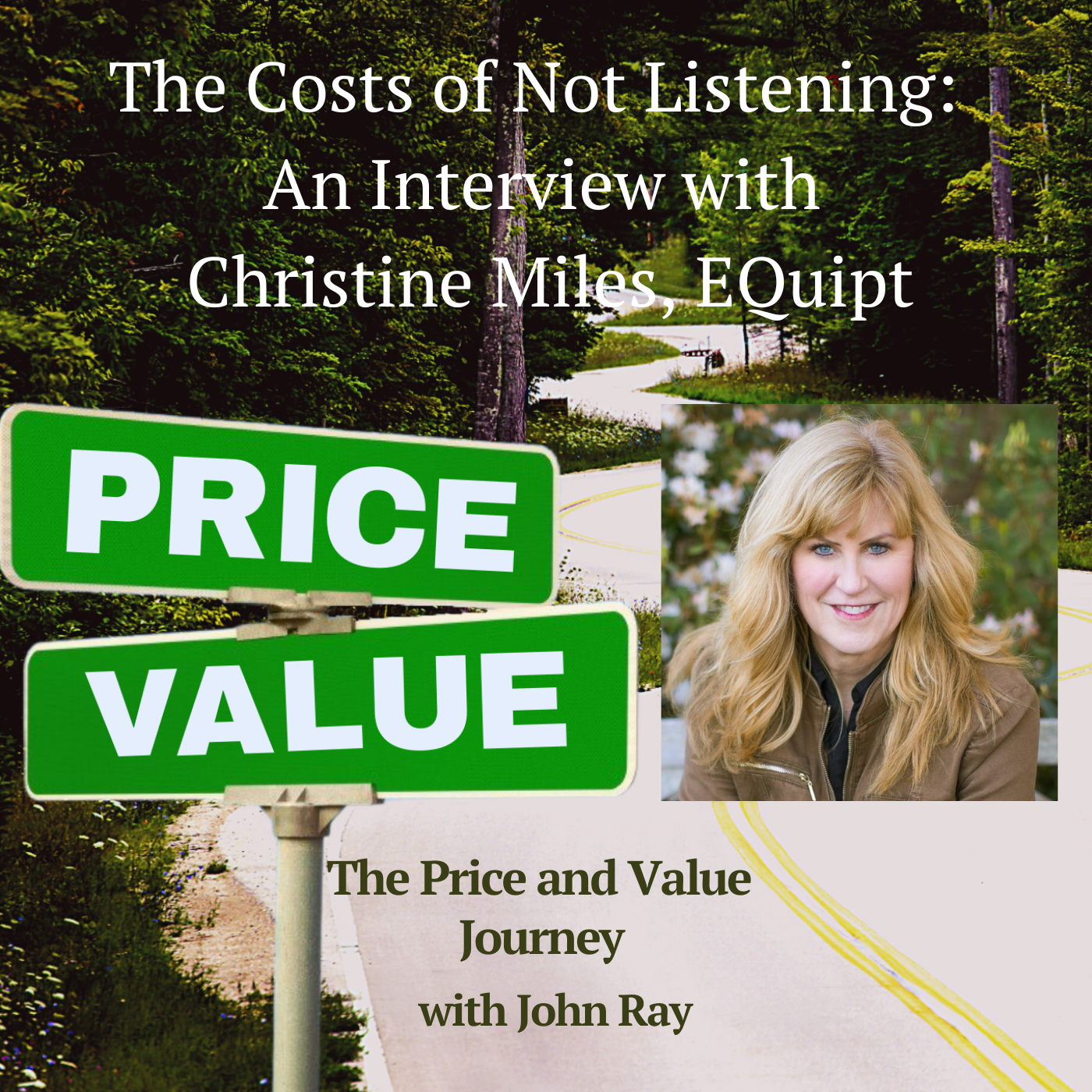

The Costs of Not Listening: An Interview with Christine Miles, EQuipt
Christine Miles, author of What Is It Costing You Not to Listen? joined host John Ray to discuss the art and skill of listening. Christine described why she’s so passionate about listening, why listening must be learned, why professional services providers don’t actually listen, and the role of curiosity. Christine and John also discussed the six most powerful questions that get results, the steps on what she calls The Listening Path™, how to effectively use silence, and much more.
The Price and Value Journey is presented by John Ray and produced by the North Fulton studio of Business RadioX®.
EQuipt
EQuipt is a training and consulting company that helps organizations grow sales, develop people, and create cultures of understanding. The Listening Path™ is a transformational system on listening to understand, that has been taught at various Fortune 100 corporations, universities, law firms, and privately-held companies nationwide.
The Listening Path™ will help you Strengthen customer relationships, Increase in-person and virtual communication effectiveness, Reduce costs, Gain trust, Increase collaboration, Fuel productivity, Optimize client solutions, Develop a culture of empathy, Promote psychological safety, Shorten sales cycles, and Improve prospecting and sales efforts.
Website |LinkedIn | Facebook | Instagram | Twitter
Christine Miles, Founder and CEO, EQuipt

Christine Miles is an author, professional keynote speaker, consultant, executive coach, thought leader, and entrepreneur. She is the Founder and CEO of EQuipt, a training and consulting company that helps leadership teams grow sales, develop people, and create cultures of understanding. She developed The Listening Path™, a transformational workshop on listening to understand, which has been taught at various Fortune 100 corporations, universities, law firms, and privately held companies.
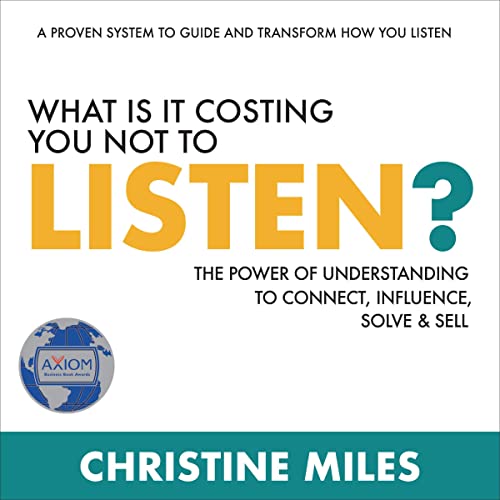
She is the author of What Is It Costing You Not to Listen?
What Is It Costing You Not to Listen? will encourage you to examine how you are listening. You’ll discover that not only are many of the problems in your life due to not listening effectively, but listening helps to solve most problems. Christine Miles is a longtime expert in educating individuals and organizations on how to listen in ways that transform how they lead, sell, influence, and succeed in every aspect of life. Following the steps of her breakthrough Listening Path™ will provide you with a critical key to your success – understanding.
Through Christine’s game-changing approach to listening, you will learn to:
• Hear what is said and not said
• Identify your listening persona and realize when it is unhelpful
• Soothe your subconscious so you can listen differently
• Listen with intent to gather others’ stories
• Replace interfering direct questions with just six questions
• Mini-reflect to speed up the listening process without getting lost
• Affirm to create alignment, break down walls, and solve problems
In business, listening is good for the bottom line. It creates trust between coworkers so they can solve problems better, get things done, manage conflict, stay engaged, and empower one another. In personal relationships, listening is an act of love that communicates to people they are important to you.
TRANSCRIPT
John Ray: [00:00:00] And hello again, I’m John Ray on the Price and Value Journey. And I’m delighted to welcome Christine Miles. Christine is an expert on the thing that us, professional services providers, probably have the biggest problem with, it’s listening.
John Ray: [00:00:20] Christine is an author. She’s a professional keynote speaker, consultant, executive coach, thought leader, entrepreneur. She’s done it all. She’s the founder and CEO of EQuipt. And through her company, she helps leadership teams, individuals – we’ll get into her precise work – gross sales, develop their people, all through helping improve their listening skills.
John Ray: [00:00:49] And, Christine, you’re already amazing. I’m just putting that out there because I’ve already, you know, gotten familiar with your work, which is why I wanted you to be on the Price and Value Journey. So, thank you for joining us.
Christine Miles: [00:01:04] Well, it’s my absolute pleasure. I’ll try to meet those very kind words.
John Ray: [00:01:10] Well, for way of introduction, what did I miss that people need to know about you and your work?
Christine Miles: [00:01:19] Yes. So, the work we do, the foundation of the house is really how to listen in – what we call – a transformational way. So, really listen to understand and to discover the meaning of the message, the insight in the conversation. And that is the foundation of the house. There’s a lot of aspects of communication we touch.
Christine Miles: [00:01:40] Listening really teaches you more than you think. It tells you a lot about how to tell versus how to understand. And it also builds what we call your emotional skills. So, when you learn to listen in a different way, you learn to listen to yourself, you learn to listen to others. And that’s the foundation of emotional intelligence, which is, you know, self-awareness and other awareness. And we know that that’s really what makes great companies great. That’s what makes good people really great at what they do or that is that EQ difference.
Christine Miles: [00:02:12] I always say, we’re throwing a ball and you’re chasing it to get in shape rather than just telling you to go for a run. So, there’s a lot of things that it elevates when you learn to listen differently.
John Ray: [00:02:23] One of the things that I find interesting about this topic, and every time I post about it like on LinkedIn or wherever, I get all these comments about, “Yeah. You’re so right, John. And, yeah, we’ve got to listen and so forth.” And we all agree that we’ve got to listen better. And then, here comes the person that’s got the cliche about two ears and one mouth and blah, blah, blah. So, talk about why. I mean, to me, this is lip service in a way, right?
Christine Miles: [00:02:57] It’s frustrating to me as well. But I try to remind myself it’s nobody’s fault and here’s why. Because we’re told to listen from a young age and we are very rarely taught. So, we do equate hearing with listening rather than listening, as you said in your intro, is a skill. It is in fact a skill. So, it’s not like walking where you just have your legs and then, without any problems, you learn to walk. You don’t learn to listen just because you have two ears. It is something that needs to be developed.
Christine Miles: [00:03:31] And so, the problem is nobody knows how really. The majority of us don’t know how. We don’t know what good looks like. We don’t know how to do it. Because we’ve been winging it and we think we’re better than we are sometimes. Or if we’re not as good as we think we should be, we don’t really know how to fix it.
John Ray: [00:03:48] Yeah. No, that makes sense. And it seems to me – and you’re the expert, so this is a question – we’re taught to have the answers, right? The kid in class, it’s like, “Oh. I’ve got the answer,” you know, with their hands raised. So, we’re taught to project, we’re taught to speak up, we’re castigated for not speaking up. And we’re never really taught listening.
Christine Miles: [00:04:21] And then, take that into business life, what do we tell employees? “Don’t come to their manager with problems. Come to them with solutions.” And I say, “No. Come to me with the root cause of the problem so that we can figure out the best solution.” But we’re expecting people to just have the right answers. And then, we’re solving a lot of problems that aren’t really the problem and wasting a lot of time and resources. And it does start very young.
Christine Miles: [00:04:47] It’s funny, we were at a school a few weeks ago piloting something, and I asked the teachers do they teach listening. And this is a private school in the Philadelphia area. They’re very well known and recognized. And the teachers try to teach it. And they said what happens is the kids, when the teacher asks a question, everybody raises their hand. And let’s just say little Johnny is the one that’s answering, all the other kids their hands are still up. And they go, “No, put your hands down while Johnny’s talking.” And I’m thinking, This is just 40 years later in a meeting where everybody wants to just talk, just waiting their turn.
Christine Miles: [00:05:22] So, while it’s the right idea, again, it’s behaviorally-based rather than brain-based. Because listening is really happening or not happening in our brains. And the brain is the greatest enemy of listening. So, unless we learn how to manage our subconscious brain that is in overdrive and telling us to do everything but listen, we’re just white knuckling our way through it. We’re waiting our turn, but we’re not really certain how to change it. And that leads us to wanting to provide answers to solve problems, because that’s what we’re trained to do. And then, it interferes with the most important part, which is let me understand before I try to solve.
John Ray: [00:06:03] I want to dig into that a little more, but before we do, I don’t want to get too far away from your work without asking you why you’re so passionate about this particular topic. You know, I’ve heard some of this story before, but I think it’s important for our listeners to hear it in full.
Christine Miles: [00:06:24] Well, I appreciate that. So, we all have a reason why we do what we do. We don’t always know what that reason is. My reason came to me pretty early in life because I learned to listen differently. I can remember as early as five when I had moments of, like, paying attention to things that were different. A big part of that was my mother. She had mental health issues that she came by very honestly. She had lost her mother from childbirth. Her mother died from childbirth. So, she was set up for a lot of pain.
Christine Miles: [00:06:58] And what I saw was a woman who was very warm and loving and charismatic. She lit up the room. But underneath the surface was this real dark pain that most people didn’t see. So, I learned to see that what’s happening on the surface isn’t happening below the surface. And that was part of my role in the family, is to understand that, attend to that. I mean, while there was burden in that, trust me, the therapist and I still talk about it. There was also a great gift, which was I learned to listen differently and understand things that most people didn’t understand at a very young age.
Christine Miles: [00:07:33] And that was obvious to me. It became more and more obvious over the years, but as early as high school. And anything I was succeeding in, it wasn’t because of my natural talents and abilities, whether that was on the athletic field or academically or anything I did in my career, it was because, fundamentally, I was able to listen in a different and more compelling way.
Christine Miles: [00:07:54] And then, as I studied psychology and I went into my career, I also saw that not listening was why families were failing, relationships were failing, businesses were failing, teams were failing, projects were failing. The very thing that made me succeed is often the threat to why things weren’t working.
Christine Miles: [00:08:12] And so, what I’ve done over the course of my career is try to help others learn to understand, and listen, and solve problems through understanding versus throwing resources at it or throwing more telling at it. And that’s evolved to really creating a common language and provide people the tools that calm that brain down – what I was taught as a kid, basically – and deconstruct it so that it could be replicated more simply and easily.
John Ray: [00:08:43] So, let’s get back to that. You mentioned the subconscious and how just the way we’re wired really holds us back when it comes to listening.
Christine Miles: [00:08:57] The subconscious brain is a super power. It’s emotional. We know now from the neuroscience that that’s how people buy. They buy emotionally. We know this as service consultants. We go in and they buy us before they buy what we do. That’s an emotional decision, which is also why listening is so, so very important when you go in as a professional services company.
Christine Miles: [00:09:24] But it’s also that, you know, our own brains are emotional, and so we want to make the sale. So, we go into a prospect, and what are we thinking about? We’re thinking about what do I need to say. How do I need to convince them. What do I have to offer them. And our emotional brains are in overdrive. We’re thinking about what we’re going to say, how we’re going to respond, how we’re going to advise them, all of the things that are the opposite of listening. And so, that’s one of the problems.
Christine Miles: [00:09:51] The second is, the more knowledge and experience you have, the more likely you are to not listen. Because you’ve seen the problem so many times, you know what the solution is and you build a solution to solve that problem. So, we tend to go in and start selling way too soon and problem solving way too soon.
John Ray: [00:10:09] Yeah. And we think we’re being helpful because we’re bringing our experience and knowledge to the table. That’s what clients want after all, right? And that’s not all they want, though. They want to be heard.
Christine Miles: [00:10:22] Well, sometimes the person rushing to the solve is the prospect. I told a story about this in my book. In 2007, I started my own executive coaching practice and I was in denial that I’d been in sales my entire career at this point. So, I’m out on my first sales call. It’s a pretty big meeting. And I’m sitting with the CEO and he says, “I want training for my executive team.” Well, I was in the training business for many years at this point, and I’m thinking, “Training for what?” Like, I had no idea what he wanted.
Christine Miles: [00:10:54] And so, I kept going, “Take me back. Tell me more.” And trying to lasso him back. And he’s like, “Well, can you just put a proposal together for me? And here’s a marketing packet that somebody else gave me.” And I was thinking, “Oh, crap. I don’t have this marketing packet. This is my first sales call.” And I just was like, “I don’t have that. Is that helpful to you?” He goes, “Well, not particularly.” And I go, “Okay.” But I had to keep lassoing him back because he wanted the solution, he wanted the answer.
Christine Miles: [00:11:23] So, sometimes it’s us and sometimes it’s them. And it’s a sales trap. I made a very big sale that day. And I still work with that CEO now at a second company that he started. And so, part of it was because I didn’t know what he needed. And my naivety even more so slowed me down to slow him down. And I really uncovered what the real need was rather than just throwing what he wanted me to throw at it, which is was right in my wheelhouse, but it wasn’t going to be helpful. So, it’s a big trap both what we do and what the prospect does. So, we have to be really careful and slow down to listen differently.
John Ray: [00:12:02] So, let’s talk about how we do that. You talk about the listening path. It’s on the wall behind you. I could see it. And what you mean by that are tools. You have to have tools in the tool kit, as it were. Right?
Christine Miles: [00:12:18] That’s right. So, the problem and the name of my book is called, What Is It Costing You Not To Listen? Because you can’t solve a problem you don’t know you have. And so, as we talked about, we’re set up not to know how to listen and know what good listening looks like. So, sometimes we have to first analyze what’s it costing us? How did we lost the sales? What’s happening to our relationship?
Christine Miles: [00:12:41] The solution is the listening path, and that’s the path to understanding. And the metaphor is you wouldn’t go hiking in the woods for three weeks backpacking without any tools or supplies in your backpack. And yet that’s exactly how we go into conversations. We go in unprepared to really know how to understand. And so, we provide those tools to keep you on the main path. Because when you’re listening, you’re always listening to a story. When you’re going in to talk to a client or a prospect, they’re telling you a story.
Christine Miles: [00:13:12] Here’s the problem. People are terrible storytellers. We are wired to listen to stories, to learn from stories. But we’re not wired to be great storytellers. There’s a few that have stood out in history that have made their mark, Lincoln being an example of that. But most of us really are terrible at it. So, because of being bad storytellers, we disorient the listener right off the bat. And if the listener doesn’t know where they are in the story, they’re going to struggle to figure out where to take the client, the prospect, or partner.
Christine Miles: [00:13:46] So, that’s part of what the tools do. They help you understand where you are in the story, how to stay on the main path, and how to be the guide to get the person to where you need them to go.
John Ray: [00:13:58] Now, you talk a lot about identifying your listening persona. Is that part of the listening path and part of success on that path?
Christine Miles: [00:14:10] It is. And so, one of the things – and I think this will resonate with you – is that we’re taught about listening is it’s really important to be curious and to ask really good questions. So, I have a team of executive coaches that are certified, and one of the things they go through is they go through how to ask really good questions when they’re trained. And the problem is, when you have to think of really good questions, what are you doing? You’re thinking rather than listening. And when you’re asking questions, that shapes the story because my questions are going to shape the story you tell.
Christine Miles: [00:14:46] So, there’s two listening personas when you’re on this listening path. One is The Curious Detective and one is The Defense Attorney. And think about it. Defense attorneys put people on the witness stand. They ask questions to shape the story that they need the person to tell to make their case.
Christine Miles: [00:15:03] Now, let’s take that into sales. You go in with your prospects or clients, you have an idea about how to help them. You go in and ask them very specific questions. And what are you doing? You’re shaping the story that they might tell you rather than getting the story, curiously letting it unfold so that you can drive value and uncover the real problems so that you can answer things that nobody else is answering. So, questions can force you into that defense attorney rather than the curious detective.
Christine Miles: [00:15:36] And one of the tools on the listening path is what we call the compass, which are the six most powerful questions. And, initially, when we teach people how to listen transformationally, these are the only questions you’re allowed to ask. Take all other questions off the table. And these six alone get you further than any specific diagnostic questions on the path.
John Ray: [00:16:00] Okay, So, you set it up here. Let’s talk about the six questions. I’m just going to say my personal favorite on there that I use is Tell me more.
Christine Miles: [00:16:11] You use that already? Yeah. So, tell me more.
John Ray: [00:16:15] Tell me more. Yeah.
Christine Miles: [00:16:16] Why does that work for you? Tell me more.
John Ray: [00:16:20] It works particularly when I don’t know what’s been said. And I don’t know, like, where that’s coming from, how to define what we’re talking about. I don’t want to say I don’t understand because I don’t want to crush somebody across the table from me. But that’s one that I use quite frequently.
Christine Miles: [00:16:46] And do they tell you more?
John Ray: [00:16:47] Oh, absolutely. Absolutely.
Christine Miles: [00:16:49] Isn’t that amazing. Tell me more begets they tell you more.
John Ray: [00:16:52] It always works. Yeah.
Christine Miles: [00:16:54] It always works. And so, I’ll run through the list so we can talk about any one of them if you like. So, I’m glad you’re already using that. And I’m not surprised you’re also doing a radio show. So, these are the most powerful questions journalists, interviewers, and therapists use, by the way, hostage negotiators.
Christine Miles: [00:17:13] So, it’s take me back to the beginning, tell me more, how does that make you feel, then what happened or what happened next, hm – which is the non-verbal prompt of tell me more, or it sounds like you feel. So, there’s two feeling questions and four situational questions all open-ended. You can use them as often as you like and in anywhere you like. And if you only use those questions when you’re talking with someone, you will not shape the story and more of the story will come out than you’ve ever gotten before.
Christine Miles: [00:17:47] Because you just said it, when I say tell me more, I don’t even have to admit that I don’t understand. They just tell me more and then more opens up and I get more of the story. See, ignorance is bliss. Whenever I’m confused or whenever I’m not clear, then I know I’m in the right space because that means they’re not being a good storyteller. And I better lens back to figure out what’s going on.
John Ray: [00:18:13] Yeah. And that takes some humility to get in that posture, right? I mean, because you can write these six questions down, you can memorize them, so forth – six responses, I mean. You can memorize them, what have you, but then you get in the heat of the moment and it goes out the window unless you’ve got the right mindset.
Christine Miles: [00:18:48] So, a couple things. It’s counter to all the training we’ve had because what we’re trained to do from a young age, not just in business, we are trained to show up and be smart, show that we’re smart, and questions are a way to show that we’re smart and that we know what we’re talking about and what we’re doing. So, it’s counterintuitive. So, it’s a bad habit, if you will.
Christine Miles: [00:19:14] And so, we have to unwind that. And the way you unwind that is first you have to have the right tool and then you have to have the right practice. So, several years ago now, we were doing a sales kickoff and the head of the organization got up to introduce us.
Christine Miles: [00:19:30] And he said he just heard a Navy SEAL speaking – because it was at a large company offsite. And the Navy SEAL said, “Look, most people think they’re going to rise to the level that they need to in a crisis based on adrenaline and all the things that are going off. You know, we’re going to lift the car off of somebody. We’re going to be the hero. When, in fact, what we rise to is the level of competence and training that we have in crisis.”
Christine Miles: [00:19:55] That’s why we practice as athletes. That’s why we practice whatever we’re doing, because you need to be able to do it under pressure. So, that’s why when you use these questions in real life all the time, then when you’re in that sales meeting or that client meeting, it’s more natural. You’ve already unwound kind of what you’ve been doing all these years.
Christine Miles: [00:20:17] We have people that take those questions, plop them down, we have mouse pads. They just set them down at the meeting to remind them. It also helps relax the brain. You don’t need to think about how you’re going to respond. You don’t need to worry about what you’re going to say next because the questions are a sedative for your subconscious so that that tool does the work for you.
John Ray: [00:20:39] I love that point. And I love the metaphor you use with it, that it’s a sedative. Because your subconscious is in overdrive and you don’t even necessarily know it. And you need to go ahead and inject that overdriven subconscious with a sedative, and you’ve given us the tools to do that.
Christine Miles: [00:21:05] Yeah. And the other thing is, if we take it back to the path metaphor, so you’re on the Appalachian Trail and you’re hiking and there’s a main path, but there’s also a lot of little side routes. And conversations are exactly that. There’s the main path and then there’s all these little side trails. What happens with very specific questions is we go off into the woods and we get lost often because we’re deep into an area we don’t need to be.
Christine Miles: [00:21:33] What those six questions do is they get you back to the main path, to the story. Because people, when you give them the room become a storyteller. This is how you become the guide as the listener. When you guide them on the main path, they’ll stay on the main path. If you take them down a side trail near a ravine, they’re going to fall off if they follow you.
Christine Miles: [00:21:57] So, the questions calm the brain and keep you on the main path to getting that story. And, really, once you get that, you know how to help them in a more compelling way than just giving them a solution. You drive value for your customers.
John Ray: [00:22:14] That’s a magic word for me, is value. My ears perk up when I hear that word, as it does for our listeners. But talk a little bit, if you will, about the reflecting. You talk about many reflections to speed up the listening process, and that concept is a little confusing to me, so talk about that.
Christine Miles: [00:22:50] Well, first of all, let me take a step back. So, great listening is about proficiency, how well you do it, and efficiency. So, I believe in both. People think I’m very patient. Don’t mistake my understanding for patience. I want to get things done really quickly. I want you to feel good about getting things done quickly. And I know how to help get that story out of you faster so we can get there more quickly.
Christine Miles: [00:23:20] It is a slow down to speed up, though. So, I learned this in sports. I chased any ball that would let me chase it. But field hockey was my sport of choice. And one of the things I learned is that if you could run down the field of speed – I was a defender and everybody was faster than me, everybody – I knew how to cut off the angle. Based on your pace, I could figure it out. If you took a pullback, if you took a little hitch step and then sped up again, I was done. I was done because I couldn’t change pace that way. Part of being in a conversation is you need to know how to change pace. When do I need to pull the ball back a little bit so then I could speed up again.
Christine Miles: [00:24:02] And when you do that, again, it changes the dynamics of the conversation. So, you’re getting into this reflecting tool. So, there’s six main tools on the listing path. And the first five are kind of the science and the sixth one is the art.
Christine Miles: [00:24:19] So, we talked about the compass as one of the tools. And really the map to the story is the main tool. Where am I in the woods? Where am I in the conversation? What’s the path to the story? That’s one of the tools.
Christine Miles: [00:24:33] And then, there’s something called the flashlight. And the flashlight is really when you’re hearing the story, once you think you’ve gotten it, how are you shining a light on what was said and highlighting what you heard. That’s what we call the flashlight. That’s a powerful thing. Tell me the story you just told me. I’m going to tell you the story you just told me, that’s the flashlight. Does that make sense?
John Ray: [00:24:56] Yeah. Yeah.
Christine Miles: [00:24:57] So, I’ll say the most powerful story you can tell someone is their own. There is nothing like a client or prospect talking to you for 30 minutes and you go, “Hold on. Before we go any further, let me make sure I understand.” And then, I tell you the story you just told me at a high level in 30 to 90 seconds. You’re going to feel like I really was paying attention. And you’re going to go, “Well, that’s right but that’s not quite right. Nope, you got me here but not here.” And there’s a different dialogue that opens up as a result of taking out that flashlight.
John Ray: [00:25:32] And this gets at where you talk about affirming to create alignment, break down walls, et cetera.
Christine Miles: [00:25:43] That’s right. So, the flashlight highlights the story. To affirm it, you have to make sure you didn’t contaminate the story. So, these two tools work hand in hand all the time. And by the way, these are the most underutilized tools. We tend to listen and say, “Yeah. I understand.” And when somebody says I understand to me, I never feel less understood.
John Ray: [00:26:10] In a way sometimes that can be insulting, too, right?
Christine Miles: [00:26:15] I don’t know what you understand. My question is really, “Tell me more. What do you understand? I want to hear this.” Because the words I understand do not convey understanding. Understanding is, “You know, John, what I hear is important to you and your listeners is how do you drive value in the sale? How do you make sure that your customers really feel listened to, understood, so that your solutions or your listener solutions can really be the game changing and you can make a big difference for your clients. Do I get you? Do I understand?” Probably closer, right?
Christine Miles: [00:26:50] So, we call that the water filter where affirming means let me make sure I didn’t contaminate your story by what’s going off in my brain. So, once I use that flashlight, shine a light on the story, I’m going to ask you and I’ll use these very specific words. I’m going to say, “Do I get you?” That’s a prompt to say do I get you and your story, not just the story, not just your situation, but do I get you as well as your situation.
John Ray: [00:27:25] Wow. I love that. That is powerful. And that’s a good segue, I’ve got a few specific situations maybe we can talk about that services providers run into. And one of those is when you’re trying to have a value conversation, how do you know when it’s time to pivot? You’re doing the best you can in trying to understand where that client sees value, both tangible and intangible value, how do you know when it’s time to pivot?
Christine Miles: [00:28:10] So, this is when you know it’s time to pivot. We call that earning the right. Have I earned the right to start to tell you what I think to sell you my solution? What happens is we tend to go forward right away. We come in offering the solution. Maybe our prospect or client says, “Tell me the solution.”
Christine Miles: [00:28:30] Here’s what always happened to me, I started my career, I have a background in psychology as a therapist. I was a home-based family therapist at 22. So, I went into people’s houses at 22, knocking on their doors saying, “I’m Christine. I’ll be your family therapist.” They pretty much had that look on their face, so it was terrifying. Fortunately, I was mentored and trained through a world renowned facility. I ultimately got certified.
John Ray: [00:28:58] But you were also brave, though. I mean, so you had courage to do that.
Christine Miles: [00:29:05] I did. I did. It’s really how I wanted to make a difference at the time. Here’s what’s fascinating, is that, I was the youngest person on my team. Most people were in their 30s – which seemed old at the time – and they had social work and experience. But I stood out more because I didn’t know anything and I went in and listened. And they said I had this uncanny ability to join – they called it joining – with the families. And all I did was go in and do the very things that I’m talking to you about.
Christine Miles: [00:29:40] That’s how I built credibility. I wasn’t going in and saying I know your situation. I was going in and saying tell me about your situation, tell me about your kids, tell me what’s going on, let me understand you. The therapist taught me how to do exactly what you’re talking about, which is how do you shift it then from understanding to telling? And that’s about earning the right. Most people go in and just start telling versus earning that right first.
Christine Miles: [00:30:08] So, the pivot happens after you use the flashlight in the water filter. So, you highlight. You shine a light on the story. You say, “Do I get you?” And one of three things is going to happen in that conversation. Your client is going to say, “Yeah. You get me.” Or they’re going to say, “You get me,” and they’re going to start telling you more.” Or they’re going to say, “Yes. You absolutely get me.”
Christine Miles: [00:30:34] So, the first one is what we call in the sales world an urban dictionary, where the client says yes but they really mean no. That happens all the time. Your spouses do that to you. Your friends do that to you. Your colleagues do that to you. You’re walking down the hall and you say, “Hey, how are you doing today, John?” And you’re like, “I’m great.” You just got the urban dictionary often because people aren’t always doing great. They’re going, “I’m not so great. I just had a fight with my wife or something’s going on.” But we don’t share that.
Christine Miles: [00:31:07] In our sales conversations, that happens all the time. We ask somebody, “Did I get you?” And they don’t tell you the truth. So, you got to watch for that. “You know what? I don’t know. That doesn’t sound like I really got you. Tell me more.” And once we’re certain and people will then go, “Well, as a matter of fact, what you missed was blah, blah, blah, blah, blah.” So, we have to challenge that moment where we hear the, “Yeah. I get you.”
Christine Miles: [00:31:38] Once we’ve affirmed and really solidly confirmed that we’ve affirmed right, then we can start to tell. Then, we can start to say, “You know what? Now that I really understand, let me tell you what I think. Is that okay?” And then, they’re ready to listen in a different way because you’ve already understood them.
John Ray: [00:32:00] Got it. Yeah. That’s very helpful. But you mentioned a live situation that fits this particular question, which is the client that wants to rush to what your solution is, and you’re trying to slow them down, you’re trying to use the tools that you teach. How do you slow down that freight train?
Christine Miles: [00:32:33] Well, you have to have an awareness, first of all. This is also what the tools do, when you know where you are in the story, you know where you need to go. So, there’s four milestones on the map, the path to understanding, there’s the beginning. It’s just like a movie. So, picture a movie now. There’s the beginning of the movie, there’s the struggle, there’s the tipping point, and there’s the new beginning or the ending.
Christine Miles: [00:33:01] So, as salespeople, as providers who want to be helpful, by the way, I believe most people go in because they want to be helpful. Yeah, we need to make money, but we want to help and make a difference. I might start at the tipping point, “I already know what your solution is. Let me tell you how to get you to the end or new beginning of your story.” Or our customer or prospect can do that, “I need help. I’m at a tipping point. Tell me what you would do if you were me. And take me to the new beginning.”
Christine Miles: [00:33:29] The way to do that is one of those compass questions is it’s click bait. I have help. I need a problem. If you don’t understand what the problem is and you haven’t spent some time, it is click bait.
Christine Miles: [00:33:40] You just went into a rabbit hole on your phone of all the things you shouldn’t be looking at because you clicked where the customer is, rather than saying, “Hold on a second. Let’s slow down. Take me back to where this started.” That’s where the compass gets you back to the beginning of the story, take me back.
Christine Miles: [00:33:58] And I’ll tell you again where I really profoundly learned this. So, being a therapist so young, by the time I was 28, I had a pretty decent amount of experience. Even though I was doing organizational work at the time, I always saw clients. And so, I say, “How do you want me to help?” And they go, “Well, I want you to help me solve this,” or my marriage, or this or that. And I go, “Okay, how would you like me to help? Well, just tell me what I should do. Tell me this.”
Christine Miles: [00:34:22] And debris on the wall, lots of experience and go, “Okay. Well, this is what I think you should do.” You know what they would do?
John Ray: [00:34:30] Tell me.
Christine Miles: [00:34:32] They’d argue. “I can’t do that. I can’t leave my husband. I can’t do that. I can’t this.” People don’t like to be told what to do even if they’re the ones telling you to tell them. It’s a sales trap. It’s a sales trap. So, even if you think you understand them at that moment, even if you think you know the answer, don’t fall for it. Don’t click bait.
Christine Miles: [00:34:57] Take a step back. Slow them down. Because getting giving them a no is how you also get them to yes. And if you force them to slow down, you’re forcing them to take a hitch step so that they can get down the field faster. We need to be the guide. When they say we need to control the conversation, kind of control it by talking rather than insisting that others talk so that we can listen and understand before we move forward to the new beginning.
John Ray: [00:35:27] So, let’s say we’ve got a situation where we’ve allowed a prospective client to become a client and we think there’s something hidden. This happens, like, all the time, right? Because just like you said, people don’t want to fess up. But those things that they don’t want to talk about may be the most important part of the engagement because you’ve got to understand those to be able to really solve their problems. So, how do you have that conversation after the fact?
Christine Miles: [00:36:11] So, there’s two things here. So, the first is – and I believe this is a big part of this problem – is that most times when we’re selling, we don’t ask people about their feelings. We do not ask, “How does that make you feel?” Because in business, we think that’s an intrusive question. When, in fact, it’s one of the most powerful things we can find out is how people are feeling. I’m undaunted by asking somebody how they feel because I started to do it when I was five. So, I’ve never not asked a CEO, a chairman of the board in any situation how they feel. It’s just part of my nomenclature. It needs to become part of ours. If you do that earlier, you won’t be in that situation as often. I can promise you that.
Christine Miles: [00:37:02] And there’s two questions on the compass, How does that make you feel and It sounds like you felt. So, we have to get over ourselves and realize we need to ask about the feelings. That will unlock a lot of what you’re talking about so you don’t find as many surprises.
Christine Miles: [00:37:16] The second thing is, let’s just say it happens anyway because there’s shame and there’s embarrassment sometimes with what’s going on. And we have to feel comfortable to talk about that. So, it’s never too late to go back. And I’ll give you another therapy story from back in the day that makes the sales point.
Christine Miles: [00:37:36] So, when I stopped working as a therapist fulltime, I went into the world of employee assistance programming and I was running the organizational development side of the business. As I said, I was always seeing clients, more the high profile ones. And I had a buyer from a home shopping network that we worked with that was in a pretty big job. We had eight sessions. So, they put her with me, you know, eight sessions to try to help her.
Christine Miles: [00:38:02] So, she came in and said, “I’m having marital problems. My husband’s laying on the couch. He doesn’t want to come in. I’m frustrated. I’m not happy.” And I said, “Well, your husband doesn’t come in. We can still work on the marriage even if you’re here.” And, boom, we went off. So, now, I’m already engaged with her as a client.
Christine Miles: [00:38:17] Guess what she told me on session four? On session four, she says to me, “I have something to tell you, Christine, that I didn’t tell you yet.” “Oh, okay. Well, have at it.” She said, “Well, I’m having an affair with our neighbor who’s our best friend. Like, we do everything together. My husband’s best friend and my best friend. And the husband and I are having an affair.”
Christine Miles: [00:38:42] I got four sessions in on eight sessions and went, “Oh, no.” [Inaudible]. No judgment. But that would have really been helpful for me to know in session one, right? Whose fault was that? It was mine because I didn’t dig enough what else is happening, take me back, tell me more. I went forward too much. I started solving too much.
Christine Miles: [00:39:03] But at that moment I just said, “All right. Take me back. Let’s go back. How did that start? Where did that begin? How is that impacting your marriage?” And then, we started over on the path because I missed a big part of the beginning of the movie. So, I had to go back to the beginning to understand how that was impacting, why that happened. So, it’s never too late to go back, but it’s important that we go back once we hear that.
John Ray: [00:39:30] Yeah. I love that. One final thing, just something that’s really tactical. How do you feel about the use of silence? So, for example, someone says, “That’s too expensive.” And you’re silent. And silence abhors a vacuum, or whatever that saying is. So, is that the way to respond? Or should we say tell me more? How do you feel about silence, I guess?
Christine Miles: [00:40:10] Well, again, my sales training was [inaudible] based on how I was trained as a therapist at 22. Because eventually I worked in-patient and we worked via one way mirrors. So, sometimes I had 20 people behind a mirror and a lead therapist calling in and saying, “You have to say this to the family.” Or in a very compelling story, one time they made me sit on my hands for an entire session because the family wasn’t talking. And I had to sit there and learn how to be silent until they started talking. And it’s powerful. There’s a quote that the CIA says, “Silence sucks the truth out.”
John Ray: [00:40:44] Oh, I like that.
Christine Miles: [00:40:46] Silence is a very powerful tool. It’s also a listening inhibitor. Because people are afraid of it. It’s uncomfortable. We tend to fill the space. So, it takes some practice to get good at knowing how and when to be silent. So, it takes a comfort level. So, it won’t be the most natural thing for those who aren’t comfortable with it. But if you can practice your way to success, that’s a very powerful tool as far as listening. Even when you’re not asking a bomb question like that, sometimes it’s just you stop talking and I don’t feel the need to ask you another. I just wait and then you’ll start talking more.
Christine Miles: [00:41:24] So, I feel it’s a very important tool. I also feel interrupting is a very important tool. It’s very important to be able to interrupt people. Most people don’t think that means you’re being a good listener, but it is one of the most powerful things you can do as a listener. The only way and only reason you’re allowed to understand is – pardon me – interrupt is to understand and not to tell.
Christine Miles: [00:41:49] So, John, I could interrupt you and say, “Hold on. Hold on. Let me make sure I get you.” And then, slow you down and interrupt for that because I think you’re getting lost deep in the woods. But if I interrupt to just start talking, totally different matter. Silence and interrupting are very, very important. If you’re not comfortable with silence, the tell me more, take me back, how does that make you feel are going to get you there as well.
John Ray: [00:42:19] Wow. This has been powerful. Christine Miles, you’re terrific. And thank you so much for the work you do and how you’re sharing it with the world. I want to make sure that we shoutout properly where folks can find you. Certainly, your book – which is one of my favorite book titles in a long time – What Is It Costing You Not To Listen? If that’s not a compelling title, I don’t know what is. But give everyone directions on how they can learn more about you and your work.
Christine Miles: [00:43:00] Sure. I appreciate the comment on the book title because I went against a lot of advice to title it that. Because, again, most people want to title it The Solution. And I’m like, “You can’t solve a problem you don’t know you have.” So, the book can be found on all the major outlets, Amazon. And in any form that you want it because I’ve learned people want their book the way they want it, audio, Kindle, hardback, softback.
Christine Miles: [00:43:27] They can find me @cmileslistens. My contact information is also in the book, by the way, and that includes my cell phone. And they can find us on EQuipt, that’s E-Q-U-I-P as in Paul-T as in Tom, -people.com.
John Ray: [00:43:43] Terrific. Christine Miles, thank you again for coming on. I appreciate you. And I know our listeners are going to just love this. So, thank you.
Christine Miles: [00:43:52] My pleasure. Thank you.
John Ray: [00:43:54] Absolutely. Hey, folks, just as we wrap it up, if you want to know more about this podcast series, you want to see the show archive, of course, you can go to your favorite podcast app, Price Value Journey would be the search term to be able to find this series on your favorite app. You can also go to pricevaluejourney.com and find the show archive there, a link to the show archive there.
John Ray: [00:44:20] You can also find information on my book that’s going to be released later this year called The Price and Value Journey – imagine that – The Price and Value –
Christine Miles: [00:44:30] Congratulations.
John Ray: [00:44:30] Yeah. The Price And Value Journey: Raising Your Confidence, Your Value, and Your Prices Using the Generosity Mindset Method. If you want to know more and get updates as they happen on that book and when it’s coming, you can sign up there.
John Ray: [00:44:48] So, for my guest, Christine Miles, I’m John Ray. Thank you again for joining us on The Price and Value Journey.
About The Price and Value Journey
The title of this show describes the journey all professional services providers are on: building a services practice by seeking to convince the world of the value we offer, helping clients achieve the outcomes they desire, and trying to do all that at pricing which reflects the value we deliver.
If you feel like you’re working too hard for too little money in your solo or small firm practice, this show is for you. Even if you’re reasonably happy with your practice, you’ll hear ways to improve both your bottom line as well as the mindset you bring to your business.
The show is produced by the North Fulton studio of Business RadioX® and can be found on all the major podcast apps. The complete show archive is here.
John Ray, Host of The Price and Value Journey

John Ray is the host of The Price and Value Journey.
John owns Ray Business Advisors, a business advisory practice. John’s services include advising solopreneur and small professional services firms on their pricing. John is passionate about the power of pricing for business owners, as changing pricing is the fastest way to change the profitability of a business. His clients are professionals who are selling their “grey matter,” such as attorneys, CPAs, accountants and bookkeepers, consultants, marketing professionals, and other professional services practitioners.
In his other business, John is a Studio Owner, Producer, and Show Host with Business RadioX®, and works with business owners who want to do their own podcast. As a veteran B2B services provider, John’s special sauce is coaching B2B professionals to use a podcast to build relationships in a non-salesy way which translate into revenue.
John is the host of North Fulton Business Radio, Minneapolis-St. Paul Business Radio, Alpharetta Tech Talk, and Business Leaders Radio. house shows which feature a wide range of business leaders and companies. John has hosted and/or produced over 1,700 podcast episodes.
Coming in 2023: A New Book!
John’s working on a book that will be released in 2023: The Price and Value Journey: Raise Your Confidence, Your Value, and Your Prices Using The Generosity Mindset. The book covers topics like value and adopting a mindset of value, pricing your services more effectively, proposals, and essential elements of growing your business. For more information or to sign up to receive updates on the book release, go to pricevaluejourney.com.