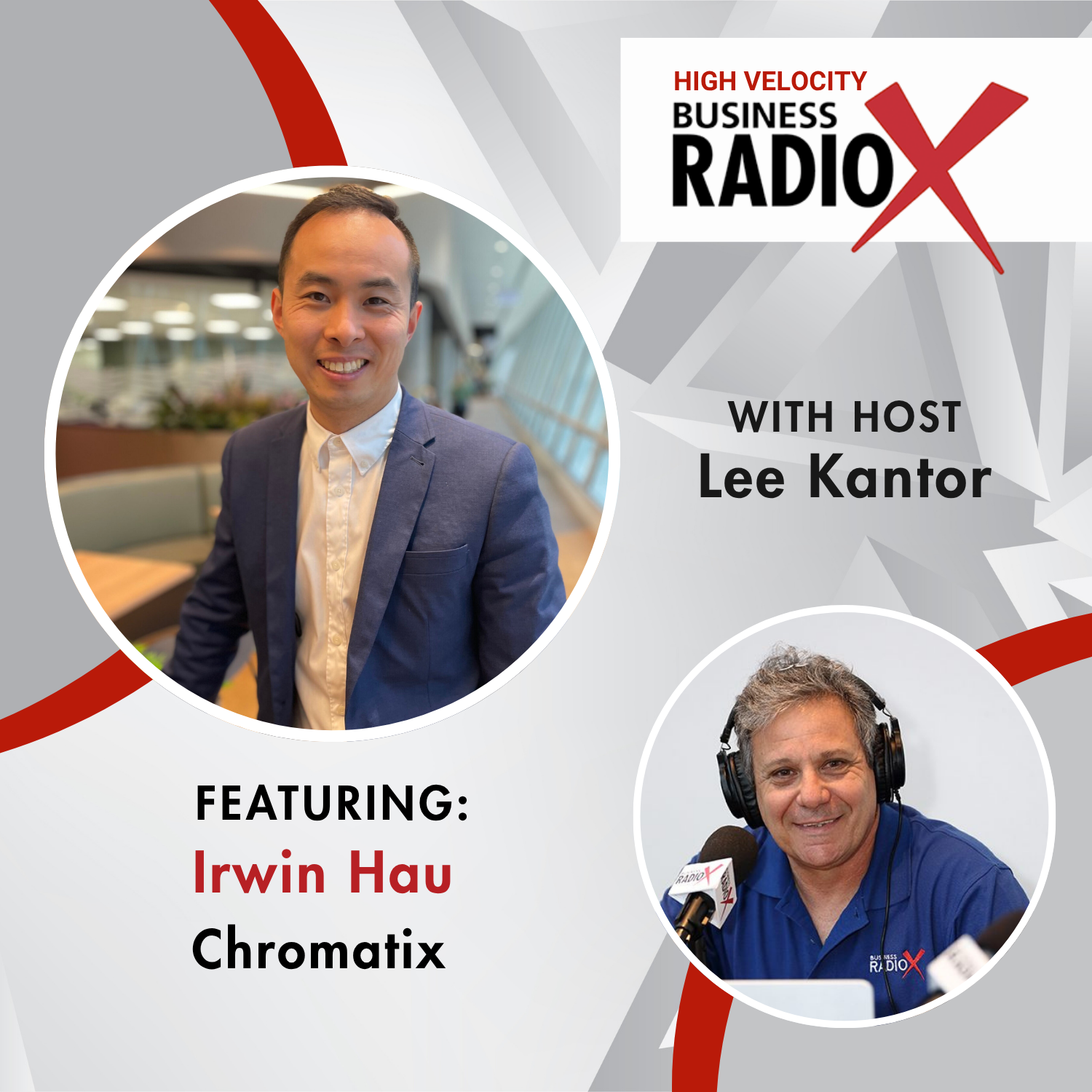

In this episode of High Velocity Radio, Lee Kantor interviews Irwin Hau, Founder of Chromatix and Conversion Cow, about the critical role trust plays in website performance and business growth. Irwin shares insights from analyzing over 60,000 websites, explaining how businesses can improve conversions by clearly communicating who they are, what they do, why customers should choose them, and how to take action. He also discusses the impact of AI on digital marketing, the importance of authority signals, and how Conversion Cow helps businesses turn website visitors into qualified leads.

 Irwin Hau is an Australian entrepreneur, digital strategist, and investor, best known as the founder of Chromatix, an award winning conversion design agency, and ConversionCow, a SaaS platform built to turn websites into powerful sales machines.
Over the past 16 years, Irwin has analyzed more than 60,000 websites and discovered a common issue. Many websites are designed for aesthetics rather than persuasion and credibility.
This led him to develop the Trust and Authority Design Framework, which combines behavioral psychology, conversion strategy, and UX design to intentionally build confidence into the website experience.
Most web designers focus on colors, images, and layout. He focuses on how people think, how trust is built online, and what signals influence buying decisions. When websites are designed around human psychology, engagement improves, leads increase, and marketing performs far better.
After seeing the same challenges repeated across thousands of businesses, he launched ConversionCow, a SaaS platform designed to amplify website performance using dynamic messaging, trust signals, and behavioral triggers.
Outside business, Irwin is a father of two daughters, a youth mentor, and has spent more than two decades performing card illusion. His fascination with psychology, persuasion, and human behavior shapes how he approaches marketing and business.
His mission is simple. Help businesses build websites that create trust, establish authority, and turn visitors into customers.
Connect with Irwin on LinkedIn and follow Chromatix on Facebook and X.
What You’ll Learn In This Episode
- Trust and authority are the foundation of high-converting websites.
- AI and search engines rely on credible online signals to determine authority.
- Effective websites answer four key questions: who you are, what you do, why customers should choose you, and how to get in touch.
- Testimonials, case studies, awards, and reviews significantly increase credibility and conversions.
- Website traffic and conversion optimization must work together to generate results.
- B2B websites require stronger trust-building elements due to longer sales cycles and higher-value transactions.
- Clear messaging reduces buyer uncertainty and increases engagement.
- Conversion-focused tools can help businesses maximize the value of their existing website traffic.
 This transcript is machine transcribed by Sonix.
TRANSCRIPT
Intro: Broadcasting live from the Business RadioX Studios in Atlanta, Georgia. It’s time for High Velocity Radio.
Lee Kantor: Lee Kantor here another episode of High Velocity Radio and this is gonna be a good one. Today on the show, we have the Founder of Chromatix and ConversionCow, Irwin Hau, welcome.
Irwin Hau: Thank you. Lee, how are you going? How’s things?
Lee Kantor: Things are well. I am so excited to learn what you’re up to. Tell us about Chromatix and ConversionCow. How are you serving folks?
Irwin Hau: Yeah, no, it’s, uh, helping people, uh, change their websites, uh, one one website at a time. And, uh, yeah, it’s all about building trust and authority on websites because your website has one purpose to sell trust, give trust. It’s not just about your service. It’s about helping people to just understand who you are, what you do, why they should choose you, and just how to get in touch. Simple as that.
Lee Kantor: So what’s your backstory? How’d you get involved in this line of work?
Irwin Hau: Yeah for sure. So I used to work for the two top ad agencies here in Melbourne, Australia. I don’t know if you can tell by my accent. And having worked for the man, I thought I’d be the man and start my own agency. I’d love to say that I was brave enough to jump out and do my own thing, but I actually got made redundant during the GFC. It was a tough time for everyone, but I thought I’d actually start something of my own because of that. And from one thing to another I thought I’d do my own thing. And then 17 years on, I’m still here and still doing what I love best and stuff. So making websites that make your phone ring. So that’s it. Easy peasy.
Lee Kantor: So how have you seen kind of the impact of AI on websites or I mean, some people are even saying websites are not as important as they once were.
Irwin Hau: Yeah, no, it’s really funny. Ai, I don’t know if you’ve thought about this, but where does AI get its information? It’s actually taking. And just to break it in really simple terms of what our observation is, is AI is reading the internet, scouring, guess what? Websites like there’s no tomorrow to build. It’s obviously it’s databases to build its thoughts and then to summarize it then to you really quickly. So in some ways, AI is going to take over, but in some ways websites are even more important, especially in the areas of trust, because that’s how AI in a top level is finding its data. It’s finding what’s trustworthy, what’s real about you, summarizing it and giving the best results. Similar to Google, but almost like one level above now as well with with the SEO and all. So yeah.
Lee Kantor: But a lot of companies, because of, um, maybe some of the changes in how they used to be found. It’s becoming more and more challenging to be found by kind of a random person based on a search term, or even typing their name into an AI to ask for the best. Whatever the they are. How does your solution kind of help them get around that or maybe solve that challenge for them?
Irwin Hau: Yeah. At the end of the day, I’ve been focusing on web design for 17 plus years, actually, not just in my agency, but outside. And we realized that to rank in SEO, to rank in AI and to win customers, they all have the one thread that goes through the whole lot. Having a clear message of who you are and showing trust signals to show you are the number one authority in what you do. And when these all come together. So when you have a website that is trustworthy and authoritative with a clear message of the problem that you solve and you also have out there, not just on your website, but out there in on the big world wide web information that shows that you are trustworthy, that you are authoritative and is clear about your own message. So we talk about SEO, digital PR, we’re also talking about backlinks. We are even being on podcasts or winning awards. All these things add to the story of you, and we just want to make sure that everything sings and works together. And when you do that, that’s when you start ranking in AI as well. And so it’s all about trust and clarity. Simple as that.
Lee Kantor: So if you were giving advice to somebody listening right now, what are some of the baby steps or some of the, the low hanging fruit? Uh, that’s actionable right now for somebody if they want, uh, more traffic.
Irwin Hau: Yeah. For sure. Well, remember, there’s two parts to the marketing game. There’s getting traffic to your website and then making sure you can get people off your website and onto your telephone. And again, maybe because we do with a lot of lead generation businesses or service based businesses, this is how we break things down. So if you want to be found, it’s really simple. Number one, create content on your site that is helpful. Um, and that is meaningful and insightful. And make sure that you have public fame. So do your digital PR to make sure that if AI is scouring you or Google’s algorithm, that you can be found. So that’s on the traffic side, really the SEO side of things. Get you backlinks in the usual, but on your website, you can spend all your money and time getting traffic to your website. But if you can’t get a phone call, an email, get someone to fill in a form. Uh, we’re just talking to a plumber recently. And they were going, oh, and I’ve spent so much money on marketing all this traffic, but no one’s calling me. Well, that’s where we need to really hone down on the basics of trust and authority to get people ringing. And I’m happy to share a bit of a framework with you as well, if that helps as well, on what you can do, uh, with your website. Do you want me to go through that? Would that help?
Lee Kantor: Well, okay, so now what? So from what I’m understanding is this is a two part challenge. The first part is to get people to trust you. And the second part is to get them to take some sort of action.
Irwin Hau: Um, absolutely.
Lee Kantor: So, so the trust part, uh, if I’m saying this correctly, is built upon a variety of things. Some of them are kind of third party, um, validation, whether it’s an award or you were mentioned in a, in a variety of media places. And then ultimately though, you want someone to call you or to take some action to buy whatever it is you’re selling, or at least inquire about whatever it is you’re selling.
Irwin Hau: Yeah. Well, the two parts are actually it’s cleared using maybe the words traffic. So marketing. So that would be SEO AdWords social media. So how to get people to you. And then once and if you think about it all marketing that you do digitally usually pushes to a website. The websites like the, the main hub where everything comes in and goes into, it’s like a little bucket. So you’ve got the traffic that goes to the website and the website then has to turn, I guess that that awareness at the very top into an action, uh, which is usually a phone call, an email, uh, or some sort of, you know, fill in the booking form, that sort of thing. And to, to help encourage people through that process, like a pipe, there needs to be trust and authority and clear messaging that that engages with the customer that then forces people down that pipe and to the very end where hopefully you get a phone call or an email. So trust is really the ingredients in this pipe of traffic and conversion.
Lee Kantor: So and that’s kind of the, that’s a must have. Some of the other things are nice to haves, but trust is a must have.
Irwin Hau: So trust is the biggest thing, I think at the I mean, if you look at human psychology, we want to make the best choice. But best is subjective. What we’re really fearful of is making a mistake. Uh, you know, uh, finding a risky, uh, you know, decision or making a risky choice. And so our job is to reduce that barrier of fear and encourage people. And the only way to do that is to actually get people to know us, like us, and ultimately trust us. And that’s really sales basics. If you think about it rightly, it’s really people have no idea who you are, and we need to get it from a state of I don’t know who you are, what you do, to a sense of, ah, clarity and real confidence, which then that will then hopefully do something and take action until we can break that barrier. We will always be stuck in this, which ultimately makes people go to your competitors. They’ll go, leave your website, and they’ll find someone else to solve the same problem.
Lee Kantor: So are there kind of some do’s and don’ts when it comes to getting that conversion you want on on the website, or are there some things you’ve learned over the years that are maybe some things that you should always do, and then some things you should never do?
Irwin Hau: Yeah, absolutely. Well, I’ve personally analyzed 60 plus thousand or 60,000 plus websites, which, uh, definitely need a bit of a more of a hobby, perhaps. But having looked at that many websites, I’ve found four key things that are very common. And if anyone’s listening right now, I’d love for you to even open up a browser, put up your website, or even pull out your phone to have a look at your website, because there are four key things, um, that we find that people, um, miss, but if you get these four down, it actually makes your, your website work. And so what does that mean? Work is you have more of a chance of someone giving you a call or at least engaging with you through your form or whatever your call to action is. The four things are who are you? What do you do? Why should I choose you? And how do I get in touch with you? So repeating again, who are you? What do you do? Why choose you and how to get in touch with you? They’re the four basics, not just of websites, but it’s actually the same thing you ask on a first date. If you think about it, think about the best first date you’ve ever went on. You asked the question, who are you and what do you do? Uh, you got them to unpack. You know, the indirect. Why should I choose you? This is you having that discussion where you’re showing your proof of what the claims that you’ve made.
Irwin Hau: And at the end, of course, you have to get that phone number for that second date. And so if you look at your website, are you clear with who you are and what you do in a very short and succinct line, not drips and drabs of words all over a homepage, but in just one clear fell swoop. Bang. This is what we’re all about. But the biggest ones we find that are missing is the why choose us, that trust and that credibility piece. And so some basics. People miss testimonials, awards, accreditations, case studies, logos of past or present clients, maybe a couple of Google reviews or if that little banner that says how many Google reviews or, or maybe like little Trustpilot, um, uh, widget, we need to stack that proof to really show that you’re not just making claims about your business, but you’ve actually done real things to get real results. And then ultimately that call to action at the end, if you forget to ask for the phone number at the end of that date, you’ve just wasted your time. You want to make sure that you have some sort of clear phone number, email form, whatever it is, at the end of the website, um, that, that website journey that is to ensure that you actually get that, um, last step in for things. Who are you? What do you do? Why choose you and how to get in touch?
Lee Kantor: Now, have you, uh, do you have kind of a best fit client that, uh, you really like to work with and you do good work for? Is there kind of an ideal client profile for your work?
Irwin Hau: Yeah. No, we, we, we tend to attract a lot of manufacturing, industrial, uh, what, what the client said to me was that we’re very unsexy. And, and I said, what’s unsexy mean? They said, well, like building a house. Think about when if you’re constructing a house or a commercial property, you’ve got plaster, concrete, steel. These aren’t sexy products. We’re not here selling, you know, beautiful cars or, you know, nice iPhones. Pretty unsexy. They’re the ones we seem to have the best results for because they’re usually the hard ones. Because like, like we said, the products aren’t glamorous, but we realize it’s more about selling trust than just beauty. And when you can combine the two together, you can actually really make a website sink. So yeah.
Lee Kantor: So then is your work a more B2B than B2C or are these like, absolutely.
Irwin Hau: Is that. Yeah. And I think you’ve hit on the head there. Yeah. B2b seems to be the, the not just the flavor of the year, but just something that was really just specialized in and just really understanding the buying psychology of businesses and how they interact and how they transact as well.
Lee Kantor: And you found after reviewing so many websites that there’s a different way of going about your business if you’re B2B versus B2C.
Irwin Hau: Yeah. We, we find with B2B because the transactions in our heart are bigger and therefore the sales cycle takes longer. Um, we’re not here adding Nike shoes to an e-commerce cart and away we go. And, and if you know, say you bought the wrong shoes, the worst thing you’ve done is lost $200 or something like that. We find that with B2B, these are big projects or big products that the sales cycle isn’t just a couple of clicks and we’re done and add your credit card. These are big transactions that require a lot more thought, uh, a lot more impactful. And therefore the trust factors are through the roof because with small items, the risk is low, the loss is low. But when you’re big, you want to risk it for the biscuit and do the right thing. Hey, uh, it does take more effort and more work. So yeah, very different.
Lee Kantor: Now, is there a story you can share that maybe illustrates how you work with a client? Uh, you don’t have to name the name of the organization, but maybe share what the challenge was when they came to you and how you were able to help them get to a new level.
Irwin Hau: Yeah. For sure. Um, we had one actually. I can share one story. Um, how we got introduced was actually a client of ours who came to us and they were absolutely distraught. And I said, what’s wrong? They said, we just lost a huge tender as a seven figure tender. And, um, and I’ll keep names out of this, but, uh, they were, they were so disappointed. And we said, what happened? And he said, well, we just submitted a tender to a client and we were up against our main competitor. That’s what he said. And, and the problem was that the managing director, who looked at both tenders, couldn’t work out who the better option was, who the better choice was. And so, uh, what is the managing director do? He did what everyone would do. Number one, you ask around and you say, hey, you know, ask a friend, you know, word of mouth referral. Do you know this company? Clearly these are two new companies. And so he did what every natural person would do was jump on a website, do a Google search. And unfortunately for this particular client, they lost the pitch because the website didn’t look as confident or as credible. And so that really helped us on this journey on, on really pulling out the best bits about who they were and what they did.
Irwin Hau: And we found that, um, they were a little bit too vague about their messaging on what value they provided. They didn’t show confidence, both emotionally or rationally, uh, in how they laid things out, um, in their messaging, but also the type of imagery they were giving off. You know, they didn’t seem or, or seem as credible, as big as they said they were on paper. And then we just stepped them through and analyzed not just the existing website. We analyzed their competitors. And then we produced a piece that really helped to tick those, uh, credibility trust factors, which then kind of gave them then a website that they were then proud of and were able to then go out and do more tenders with. And actually, at the end of the day, increase their chances of at least getting a seat at the table, um, in a pitch or a tender. So yeah, so that’s generally what we do. We do a bit of an audit with people. We analyze just what’s missing. And it’s not just analyzing look and feel, look and feel is, uh, can be subjective. We look at more human psychology behavior bits on just what builds trust and what builds confidence. So yeah.
Lee Kantor: Now you mentioned that Chromatics is an agency. What is conversion cow?
Irwin Hau: Yeah. No for sure. Great question. And so when we created our agency Chromatics, um, we were getting a lot of leads coming to our website. Unfortunately, our phone wasn’t ringing. Like I said, we were doing the traffic part really well, but we weren’t doing the conversion part well for ourselves. And so we decided to, you know, trial a whole heap of different conversion techniques. And we came up with a pop out idea. Um, where this little pop out is, it’s almost like a summary of your whole business on a single page, and it juts its little head out and changes dynamic changes depending on how you interact with the website. We created this tool for our website, and we noticed through data that we were actually getting more inquiries because of it. And so we decided to test on a few client websites and it worked for them. And we tested it, uh, um, over 32 different websites and thought, I think we’ve hit on something that works. And so we decided to productize it and that product is now conversion cow. And why conversion cow? Someone was talking to me. Cow being milked cheese beef cow. Um, you want to beef up websites and milk your website for more leads and stuff? So that’s our little tagline. It’s a simple tool that you can just put on any website built by anyone, and it just helps to improve your, uh, increase, increase your chances of getting, um, more website engagement. So yeah.
Lee Kantor: So this becomes kind of like the conversion tool that gets you that phone call or the email or the form fill out that you’re searching for.
Irwin Hau: Correct. So our tool answers the four questions I mentioned before, because if I need to know who are you? What do you do? Why should I choose you? How to get in touch with you all in the one spot. I mean, the best way to put it is if. If books have blurbs and movies have trailers, then websites have what? To help you understand it really quickly. And there’s, there’s no answer to that. So if I want to understand a book, I’ll just quickly read the blurb and just three seconds. Yep. I get what the book’s about. Or I watch the trailer to understand the full two hour movie, but in just a couple of seconds, websites, unfortunately, don’t really have that kind of summary page or that executive summary. And so we decided to make Conversion Cow to be that dynamic summary depending on which page you go on on a website. So yeah.
Lee Kantor: And then, uh, is this something that you, a person could do it themselves to implement or do they need to use your agency to, uh, effectively deploy it?
Irwin Hau: Yeah. So conversion cow, uh, you can actually go to the website and actually sign up and install it yourself, or you can do it through our agency and we have our managed plans where we can actually help you set it up because obviously we have experience on knowing what works and what doesn’t. And so we love to inject not just a bit of setup time, but a bit of strategy as well, just to give you the best chance on, um, yeah, making sure that your website gets the most engagement, uh, that it can. Given that we spend so much money on traffic. Um, and the final thought there was the people who are already on your website already know you and hopefully they’re falling in love with you. We just need them to get them to do something else. We’re just spending money on marketing, wasting dollars when no one’s calling. What’s the point then? So. Yeah. Mm.
Lee Kantor: And then so is that kind of a SaaS product. It’s like a monthly. You just pay every month.
Irwin Hau: Yeah. So. So conversion cow is a SaaS product. Uh, we believe that conversion takes time. And so that’s why we charge annually. Um, and so yeah, so it’s just paid per year and we have what we call a calculator, a COW calculator, um, where you can actually see is it worth getting conversion cow. And funny enough, it answers the same things we said before. It does a little calculation where you can input how much traffic you have, what’s, I guess, the dollar value of your product. But also, what if we increase the conversion percentage? What’s your chances on your ROI. And so it’s a really simple calculator. You can just put in and we’re very upfront about it. Where we actually discourage people to use the software. If, number one, you don’t have much traffic going to your website, or maybe your product’s not worth in terms of the dollar value, the lifetime value of the customer isn’t much, or if the conversion chances are low. And so that’s something we encourage people to test out prior to signing up.
Lee Kantor: So and then, um, what have you found? Like how quickly does someone, you know, see a different kind of result when they deploy this?
Irwin Hau: Yeah, absolutely. I mean, we’ve got different case studies of success stories of how we even had one agency, actually, uh, marketing agency, uh, wasn’t sure if this worked or not. Within two weeks they closed, uh, 10K worth of dollars, which is, uh, definitely more, a lot more than what our software costs. Um, but we find number one, if you have no traffic or low traffic, we actually encourage you to do marketing first. So SEO, AdWords socials, you’ve got to drive people to that website, get that traffic up. And we find that if you’re averaging, um, a good, you know, 5 to 1000 people per month coming to your website, again, simply just check your Google Analytics. Then as long as the dollar value checks out for your product, you have a higher chance of getting someone to call you. So yeah, again, it’s just a simple numbers game. No one can guarantee marketing, no one can guarantee sales, but you can guarantee that you give yourself the best chance by yeah, playing the basics of sales and marketing, of telling people who you are, what you do, why they should choose you, and how to get in touch. That’s it.
Lee Kantor: But as little as a thousand visitors a month is enough to test this.
Irwin Hau: Yeah. So as long as it’s got a minimum of, we’ll call it a thousand and that your product is one of value of high value. So we had one florist come on, come to us. And we said, you know what? Truth be told, based on the numbers that you do and also that your product, the numbers are too low. But we also had a caravan company say, well, our products like 15,000 for like a caravan, if we sell one, we’ve essentially paid off your, your software for more than a couple of years. And so it really comes down to the product and also how much traffic. And that combination in the calculator, um, is a really good test to see if it’s worth it or not. So yeah.
Lee Kantor: So what do you need more of? How can we help you?
Irwin Hau: Yeah. So I guess for anyone who’s listening, um, couple of things, uh, love for you to audit yourself, uh, to, to help to see how trustworthy is your website and do you answer the four basics of who you are, what you do. Why choose you? How to get in touch. And if you need a hand or you’d like an audit or would love to, um, just check out conversion count. I’d love to, you know, be in touch and have a chat with anyone. Uh, feel free to check out Chromatiques or conversion cow um.com directly. And yeah, that’s it. Mm.
Lee Kantor: And you’re based in Australia, but you do work all over the world, right?
Irwin Hau: Absolutely. So we are in Melbourne, Australia. Um, but we do have, uh, clients both locally and internationally. Uh, after 17 years. So. Yeah.
Lee Kantor: Well, Irwin, thank you so much for sharing your story today. You’re doing such important work and we appreciate you.
Irwin Hau: Thank you Lee. Thanks for having me on as well. Cheers.
Lee Kantor: All right. This is Lee Kantor. We’ll see you all next time on High Velocity Radio.















