Business RadioX ®

  • Home
  • Business RadioX ® Communities
    • Southeast
      • Alabama
        • Birmingham
      • Florida
        • Orlando
        • Pensacola
        • South Florida
        • Tampa
        • Tallahassee
      • Georgia
        • Atlanta
        • Cherokee
        • Forsyth
        • Greater Perimeter
        • Gwinnett
        • North Fulton
        • North Georgia
        • Northeast Georgia
        • Rome
        • Savannah
      • Louisiana
        • New Orleans
      • North Carolina
        • Charlotte
        • Raleigh
      • Tennessee
        • Chattanooga
        • Nashville
      • Virginia
        • Richmond
    • South Central
      • Arkansas
        • Northwest Arkansas
    • Midwest
      • Illinois
        • Chicago
      • Michigan
        • Detroit
      • Minnesota
        • Minneapolis St. Paul
      • Missouri
        • St. Louis
      • Ohio
        • Cleveland
        • Columbus
        • Dayton
    • Southwest
      • Arizona
        • Phoenix
        • Tucson
        • Valley
      • Texas
        • Austin
        • Dallas
        • Houston
    • West
      • California
        • Bay Area
        • LA
        • Pasadena
      • Colorado
        • Denver
      • Hawaii
        • Oahu
  • FAQs
  • About Us
    • Our Mission
    • Our Audience
    • Why It Works
    • What People Are Saying
    • BRX in the News
  • Resources
    • BRX Pro Tips
    • B2B Marketing: The 4Rs
    • High Velocity Selling Habits
    • Why Most B2B Media Strategies Fail
    • 9 Reasons To Sponsor A Business RadioX ® Show
  • Partner With Us
  • Veteran Business RadioX ®

Selling Your Business, with Cliff Bishop, Brady Ware Capital

February 21, 2022 by John Ray

Brady Ware Capital
Inspiring Women PodCast with Betty Collins
Selling Your Business, with Cliff Bishop, Brady Ware Capital
Loading
00:00 /
RSS Feed
Share
Link
Embed

Download file

Brady Ware Capital

Selling Your Business, with Cliff Bishop, Brady Ware Capital (Inspiring Women, Episode 42)

If you’re a business owner considering selling your business, this episode of Inspiring Women is for you. Cliff Bishop of Brady Ware Capital joined host Betty Collins to discuss the environment for selling a business, understanding what your business is worth, the toughest part of selling a business, and much more. Inspiring Women is presented by Brady Ware & Company.

Betty’s Show Notes

We’ve been starting this year with optimism.

My guest in my last episode was Randy Gerber from Gerber Clarity and we discussed first-generation wealth and wealth transfer.

In this episode, I speak with Cliff Bishop of Brady Ware Capital. Cliff is a good friend and colleague of mine. We talk about how he and Brady Ware Capital help business owners and entrepreneurs understand, increase, and unlock the value of their businesses. Cliff talks about how we can help you buy a business, sell a business, raise capital, understand the value of your business, and more. Is this a good time to sell your business?

2021 was an exceptional year. We see all the fundamentals being really strong for 2022. There’s just a lot of capital in the market looking for good companies. So the answer is yes!

What are the most important factors that drive the valuation of a business?

There are a lot of things that are going to drive the ultimate valuation, but a couple of things jump out. One is growth, and the second thing, no matter what the industry, is predictability and recurring or consistent revenue.

What is the toughest part of the selling process that you’ve experienced with business owners?

I think without a doubt, it’s the due diligence process. Just because it’s a very good time to be selling right now and there’s a lot of money out there, it’s not easy money.

What options does an owner have when they’re considering the sale and transaction of their business?

I think most business owners, there are a lot of business owners that envision that when they sell the business, they’re going to call her biggest competitor and they’re going to take over. And that the owner is going to clear out their desk and ride into the sunset. And that rarely happens.

Cliff goes on to talk about what a business owner is not supposed to do when selling their business. They make mistakes. What are those things that they fall into that can be avoided? And finally, what does a business owner need to do to prepare? And what’s the timeline?

This is THE podcast that advances women toward economic, social, and political achievement. Hosted by Betty Collins, CPA, and Director at Brady Ware and Company. Betty also serves as the Committee Chair for Empowering Women, and Director of the Brady Ware Women Initiative. Each episode is presented by Brady Ware and Company, committed to empowering women to go their distance in the workplace and at home.

For more information, go to the Resources page at Brady Ware and Company.

Remember to follow this podcast on Apple Podcasts and Google Podcasts.  And forward our podcast along to other Inspiring Women in your life.

TRANSCRIPT

[00:00:00] Betty Collins
I am so glad that you are joining us today. We’ve been starting this year with some, some different people and that are kind of really in an optimistic mode, and one of those was Randy Gerber with Gerber Financial and and he’s a guy who who loves the marketplace. I mean, he is optimistic for twenty twenty two, even though we all still kind of live on the edge because of twenty and twenty one, right? I mean, we all think maybe we could go back to two thousand nineteen, but that’s not what we’re going to do. Instead, we’re going to head into twenty two, and he was really optimistic. So I encourage you to listen to that podcast. It was about a lot of times that first generation business is who he really works with. But I have a guest today that works with not just first generation, second and third and the whole point of owning a business in for Betty Collins. As a shareholder of Brady, we’re and Schoenfeld is one day I’ll sell it right. One day I have stock and I can and I can pass it on to somebody instead of working for someone all my life. And so today I want to introduce you to someone who helps businesses do that when they get to that point of selling and or wanting to sell or wanting to buy or wanting financing to go all those things. So I’m with today the president of Brady, where capital who of course, is related to Brady, where in Schoenfeld and I’m going to let him talk a little bit. It’s Cliff Bishop. He has a great team around him. I would tell you to go to his website. He will direct you there to see his team of seasoned people on selling businesses, and we’re going to find out if twenty twenty two is a good time to buy and sell. He’s going to go into that. So Cliff, welcome today and just tell us a little bit about you and Brady. We’re capital.

[00:01:44] Cliff Bishop
Sure, Betty, thanks for having me. It’s good to join you on this. Brady, where capital? Just a quick overview is related to Brady. We’re in Schoenfeld, but we focus exclusively on transactions, mostly helping sellers sell part of a business. We also do some financing growth capital, and we work with some companies on growth strategies, helping them acquire other businesses. But there’s a group of seven of us. We have over one hundred and fifty years of experience with that group. And what we’ve really found over the years is that a successful transaction is not defined just by the dollar amount, which is always important and we focus on that. But it’s also the other things, including personal goals, the legacy of the business, protecting employees and things like that. So in addition to being financial people, we’re also consultants and psychologists sometimes and really enjoy working with entrepreneurs and business owners to to find out what works best for them.

[00:02:41] Betty Collins
Yes, and I’ve done several transactions with Cliff. We’ve worked through that. And when he says we’re sometimes counselors, they are always counselors. It’s a big deal to sell your business or to buy one. And so that’s where Brady, where capital gets you through this process.

[00:03:00] Betty Collins
So what I really want to know, though, and my audience wants to know and the whole world wants to know really is, is this a good time to sell your business?

[00:03:10] Cliff Bishop
Yes, I think it is. And of course, it depends on the specific business. But twenty twenty one was an exceptional year. We see all the fundamentals being really strong for twenty twenty two. Quite simply, very. There’s just a lot of capital in the market looking for good companies. Public companies have record amounts of cash. Many private companies have have high levels of cash due to good operations, but also to funds that they receive from the PPP program. Private equity groups have almost a trillion dollars invested money that they’re looking to put to work. And all of these companies, you know, if you’re going to grow right now, it’s kind of hard to do it organically. They’re looking to acquisitions as a main component of that growth strategy. So you’ve got all this money out there looking for for businesses and ways to put it to work.

Absolutely. I know as an accountant, as a CPA who looks at financials all day long, the balance sheets are solid. And so it’s obviously a great time to sell that really good balance sheet. But but when you have a good balance sheet, it’s a good time to buy as well. And it’s not just let’s talk beyond the balance sheet.

[00:04:21] Betty Collins
I mean, what are the most important factors that that drive the valuation of a business?

[00:04:26] Cliff Bishop
Yeah, that’s that’s a good question, Betty. And there’s a lot of things that are going to drive that the ultimate valuation, but a couple of things jump out. One is growth, and it’s not always just historical growth. So buyer is typically looking to double the size of a business in a three to five year period. They’re going to put a good value on it, so they’re going to look at the historical growth for the business. But more importantly, they’re going to look at what is the potential to grow once they acquire it. Many of our clients to the point in their business where they haven’t focused on growth recently. They built a very strong business, it’s very profitable, accomplishes all the goals that they have, and to kind of restart it and invest more money and time and effort. They don’t always do that. But what’s really important and we work with entrepreneurs to do this is to lay out a growth strategy for the people that might be acquiring it. So for instance, if you can say, Hey, this is where we are now, we could expand geographically or we could expand our product line or we could add more salespeople. Those are the things that you really need to do to to get the answers from potential buyers and maximize your valuation.

[00:05:35] Cliff Bishop
The second thing that we see that no matter what the industry that is really important is the predictability and our recurring or consistent revenue. So tech companies usually have very high multiples because their technology, but it’s really because most of their clients are sending sending payments in monthly or annually. And it’s the same clients month after month, year after year, so that more predictable and recurring revenue you have with with a large customer base is going to drive valuations. There’s there’s other things that go into it, but I think those two are the key things that some people don’t always focus on.

[00:06:13] Betty Collins
Yeah, they also don’t. What I find is they don’t focus on the team. You know, everyone thinks I’m selling my goodwill or, hey, I can make money. But the team that’s in place is also usually pretty huge. When you’re when you’re buying and selling it, it definitely if you have that team that you’ve developed that you can be the business owner and not be there because this team is so good right now, will they stay with the new buyer? There’s always a question, but but at the same time, that team is a crucial thing to be building.
When you’re looking at when I sell one day, I really want a good group that is there with me and that could stay on without me. And people kind of overlook that, you know, sometimes.

[00:06:59] Cliff Bishop
But I’m going to it down to that because I think that’s a that’s a great point is building a team is extremely important because most of the the owners that are selling want to either exit the business or at least reduce their involvement in it. And most of the buyers don’t have a lot of people on the bench that are going to parachute in and run the business. They want to supplement what’s already there with with that management team. So you know the perfect scenarios where the owner has kind of worked his or herself out of out of their job?

[00:07:28] Betty Collins
Right. So, you know, I would say to business owners, a lot of times you want to they want to be the smartest one in the room. They want to be the guy, they want to be the gal. They are it, they are it. But man, if you’re looking at the value of your business, it’s also really not just you, it’s the value of you not being there. It’s the value of that team that you could sell and be in place, and it makes that buyer so much easier to come in, right? So but but you know, we’re making it sound so easy that you just do these things and it all happens.

[00:08:02] Betty Collins
What is the toughest part of the selling process that you’ve experienced with business owners?

[00:08:08] Cliff Bishop
Yeah, I think I think without a doubt, it’s a whole due diligence process, so it’s a very good time to be selling right now and there’s a lot of money out there. It’s not easy money. And what we’ve seen over the last five years or less is that no matter what the size of the deal, the amount of due diligence now is more like it used to be if a public company was selling. So the buyer is going to bring in outside accountants, they’re going to bring in business strategies, they’re going to do background checks. Sometimes they bring in psychologists to say, Hey, do testing on employees and everything. It’s just a company that’s open to new ideas and things like that. So it’s really a gauntlet, and it’s for two reasons. I mean, the buyer really wants to know those things. But the second reason is they also use due diligence to try and beat price down. Sure. So being organized and due diligence, having all the numbers together, making sure that we have the experience to know what the due diligence looks like. And if you well prepared in your aggressive in that, you can usually usually get through it unscathed. But it is a process and every business owner we work with said, Wow, when we get done, they say, you told me that it was going to be tough, but I had no idea what you meant. Yeah.

I mean, this is these are people coming in and scrutinize everything you’ve ever done and built as a business, and now it’s being completely scrutinized. You know, and on top of that, as you and I have done some deals together and I’ve been part of merger and acquisition, one of the things that is really tough in the selling aspect is just as much as they want to go. They don’t know that they can’t go. Letting go and wanting to keep staying is also one of those things. That’s where the counseling comes in, right? That’s where you really play a role. So it’s not all just numbers and easy stuff in Evita. There’s so much to it. But, you know, in today’s market where there is a lot of capital and there’s a lot of options and there’s there’s buyers who are still very, Hey, let’s keep this going. There sellers who want to maybe get out, but they still like being in the game. You know, what are options?

[00:10:21] Betty Collins
What options does an owner have when they’re considering the sales and transaction of the business?

[00:10:28] Cliff Bishop
Well, Betty, this this is a fun part for me because I think most business owners, there are a lot of business owners and vision that when they sell the business, they’re going to call her biggest competitor and they’re going to take over and that the owner is going to clear out your desk and ride into the sunset. And that rarely happens. There’s all kinds of options that that that don’t require you to just just leave. Now, some people, if they want to exit, we can do that. But most of them, and probably over half the deals we’ve worked on in the last couple of years involve selling maybe 80 percent of the company, retaining 20 percent or some something in that range, and then focusing on helping the new owner grow the company. But they can get rid of a lot of the things that maybe weren’t so much fun. So all the air can be turned over so they don’t have to worry about employee problems or hiring or when there’s disputes on the floor. They may not have to deal with the banking or the insurance or regulatory environment, type things. So we’ve seen the entrepreneurs be able to focus on what they really like, which might be new business development. Product development might be focusing on trade shows and developing a bigger network.

[00:11:40] Cliff Bishop
And then they also have the capital of their new partners. So they’re not doing out with their own money. They’re not signing any bank notes or anything like that, right? They’re using somebody else’s money to really grow the business. And we’ve had, you know, I would say not all entrepreneurs are good employees, so it doesn’t always work. But many, many people that we’ve dealt with have really become reinvigorated and said, Boy, I thought I wanted to retire and get the heck out of this business where I’m having a lot of fun now and doing the things I like and I still have my identity with the business. Right. So that’s that’s one option. And then there’s other other options other than than selling completely. There’s transitioning of other family members, and we can help put together that financial roadmap for that. There’s management buyouts, which, you know a lot of times honestly sound good, but it’s hard to come up with the money for the management, but we work on that. And then there’s also the ESOP options. So really counseling the owners, and it’s really fun. The first time we go in and meet with somebody and say, Hey, do you want to sell? Let’s consider all these options and figure out what’s best for you and your business and your family.

[00:12:47] Betty Collins
Well, I can tell you that it isn’t just one. How do I say this? It isn’t just one size fits all. There are so many different ways you can do and sell and stay and leave and and you guys do some great stuff and get creative. And I’ve been part of those times where that happens and then everybody wins in the end. Now you’ve really talked about what you should do, what you’re not supposed to do, but what.

[00:13:15] Betty Collins
Let’s talk about what you’re not supposed to do or what are some of the typical business owners? They make mistakes when it comes to selling their business. What are those things that they fall into that can be avoided?

[00:13:28] Cliff Bishop
Yeah, another good question. I think I think the biggest thing is focusing only on price versus the whole. All the things that go into deal. And as I said earlier, price is always important and I don’t want to diminish that. But it’s not the only thing, and we try and encourage the seller to understand what’s going to make you live happily ever after. Is it just the money? No, probably not. It’s it’s a lifestyle. It’s other things that go along with that. But when you when you start negotiating a deal, a lot of owners focus only on the price. And if they don’t have somebody like us involved or their attorney involved, they miss some of the key deals. Key deal points. I’m sorry, you know, some money all going to be up front. It’s going to be paid over time. What types of guarantees is the seller going to have to give to the people coming in to buy I. One of the buyers that we got to know pretty well has already said all that your seller name, the price, whatever they want, as long as I get to make the terms. So, you know, they want $10 million fine, you give me 20 years to pay him that we got a deal. So the point is the mistake that people make is to is to not look at the the all the terms that go into the deal. And then I think that the second thing would be what what you referenced earlier would be not building, not building out a full team, you know, saying, Hey, I’m going to do everything, I’m going to run the sales, I’m going to have all the relationships, I’m going to run the operations. And it’s really the opposite thing that you need to do is counterintuitive. You need to work yourself out of those things to build value. But those mistakes are pretty typical because, you know, entrepreneurs are wired that way. Type A personalities aggressive, which are all good things, but they need to be tempered a little bit in a process.

Right? Right. You know, one of the things when I deal with clients, when they kind of are getting to this point and they start talking about it and I’m a CPA, I’m not a broker, I’m not a consultant. But the one thing I say to them is, would you buy you? And you’ve got to really take that question to heart and look and go, Would you buy you? And a lot of times they’re go, No, that’s why I want to sell. So don’t you know, if you’re just going to focus on price, you’re going to focus on what you get. You have to also say, would I buy me and fix those things that would make it differently? That would make you want to buy you? Not always an easy conversation because they have to. They have to really be honest and open with themselves and look in the mirror. But sometimes they don’t want to. They don’t want to face that. And my mom always said it’s as the sale price is what someone’s willing to pay at the end of the day, you know. And so when you’re too focused on price and you’re too focused on what am I going to get now, you could really lose especially a lifetime of hard work.

[00:16:18] Betty Collins
So you don’t want to be in those mistakes making those things just my common sense approach. Cliff, I’m not sad. You know, I’m not a big broker like this of President of Brady recapitalise. But you know, a lot of times people don’t want to. They want to sell, but they want to sell like, Oh, right now, let’s just get this done. I’m tired. Instead of going, I probably should have prepared for this moment because it’s kind of like you’re almost resigning to. I’m going to retire. And now I’m older, I’m I’m giving up. But really, it is. You’re preparing to sell a business to be the most successful sale of your, of your time, of your, of your lifetime work, or even maybe a second third generation. So to effectively sell something and really get that optimization for you, your family, whatever it is.

[00:17:15] Betty Collins
What is it that the business owner needs to do to prepare? And the second question on that is what? What’s the what’s the kind of the timeline? Is it one year, six months, two days, five years? You know, those are something that I think my audience needs to hear you talk about now.

[00:17:33] Cliff Bishop
That’s exactly right. You hit it on the head. I mean, I think the high level comment would be that you really want to start the process when you still have gas left in the tank where there’s still enthusiasm for the business. I’ll call it a runway where the owner doesn’t say, I have to be out of here 90 days or, you know, there’s health problems that necessitate them leaving. So the enthusiasm shows in the in the process. So if somebody waits too long, that becomes clear. And like you said, it seems like a fire sale and take this thing off my hands and let me go to the beach. We’ve done those transactions, but that’s not profitable. The biggest, excuse me. The biggest thing that can be done is to build a good team, which we’ve already hit on, but also built out the financial statements. And this goes back to also what we talk about the due diligence. You have no idea the depth and how deep people are going to dig on the financial statements. For instance, almost every buyer is going to ask not just what your top and bottom line is, but where where are you making your money? So give me revenue and gross profit by product. Let us see revenue and gross profit by customer. So if you’re a company may have a customer, that’s 50 percent of revenue the buyer wants to know is that 50 percent of gross profit, or 20 percent or 80 percent? And you know, most most businesses don’t have a handle on that.

[00:18:58] Cliff Bishop
So now they can get it fairly easily. So if they put together a team and work with their CPA and and other people, they can get those numbers, I think, and then also building the same thing on a legal side, making sure that everything’s in order with their attorney and all the records and things like that. So the timing can can be different. We met with some companies that are ready to go. You meet with them and say, Wow, your numbers are great, you have a good command of your business. You put together a good M&A type team. You know, we could get going in the next three months. There’s others we work three, four or five years with where the timing’s just not right. We can help them find the right people to come in and work on their numbers, put systems in place. And honestly, it’s usually not rocket science, it’s just a commitment to focus on that. The process itself, Betty, I mean, once a company is ready to go, it can go quicker than what most think. You know, from. We had one engagement letter that we signed in August of this past year and we closed at December thirty first. Most processes don’t take from the time they were to engage and really get going would take six to six to eight months.

[00:20:12] Betty Collins
Well, you know, one of the things I when I talk to business owners in twenty one was one of those years. I’m sure that you was a banner year. It was a huge year for people buying and selling mostly. There was a lot of fear. There’s a lot of unknown, right? What I tell people when you’re going to make decisions, especially like, Hey, I think I’m just going to sell because this legislation is going to get passed or there’s just there’s indicators out there in the market that tell you to not need your react, you know? And so I tell them, I get it that that the stock market was thirty seven thousand and now it’s thirty six and it’s going to thirty five something that’s not what you make your entire decision on your consumer price index, your interest rates, what is government in keeping a tax does play a role of how is that going to affect my buy or my sell when you’re making a decision of a lifetime business or hard work and you took the risk. There are so many factors that come into play before you just go make a decision that it’s time, you know, and I can’t emphasize that enough. And in talking with you over the years and certainly with Randy, it’s a great Randy Gerber.

It’s a great time to sell. Almost always, you know, I mean, you have those years, but there’s still a lot of good indicators out there and you’ve got to pay attention to those as well. When you’re making that, I’m ready now to make this decision, especially when you took the risk. You should get the reward and not make impulsive decisions. And that’s why I really wanted to have Randy Gerber and Brady worked capital on my podcast, talking about the good side. Talking about the optimism. Keeping that alive. One of the reasons I’m a business owner and I’m a CPA and I do what I do is because when the marketplace in this country works, the world works. And when employers can have employees, that means they’re there provision for households that form our communities. So it all plays a role and there’s all kinds of things you should be looking at as you’re making these decisions. So I know if you have questions and follow up and would like to get to know Cliff Bishop and Brady, we’re a little bit more.

[00:22:31] Betty Collins
Cliff, can you kind of direct us to the website as to where they can find you in your email?

[00:22:37] Cliff Bishop
Sure. The website is WW W Brady, Ware capital? And there’s also a link from the from the main Brady Ware site my email is. See Bishop Brady. Let’s see, I help at Brady. And my direct number is nine, three seven nine one three two five three eight, and I know if you want to contact that he she’ll be gracious enough to put us in contact as well. So really enjoy talking to entrepreneurs and look, even if you’re not ready to sell the business, you just want to talk about potential valuations and what’s going on in the market. We really enjoy those conversations. We have spent a time and we’ll love to talk to you. I personally enjoy hearing the stories that entrepreneurs have about how they’ve built their business and what they want to accomplish. So I really hope we get some, make some contacts and can help people make some good decisions.

[00:23:35] Betty Collins
Great. Cliff, again, thank you so much for taking time today, for joining my audience and everybody, you know, keep moving forward. Keep keep your optimism out there and grow. That business is the one thing that you control every day, right? For the most part, so buying and selling is something you need to be thinking about. And as an entrepreneur and I know that Brady Ware Capital can get you there. Have a great day.

Automated transcription by Sonix www.sonix.ai
Tagged With: Brady Ware Capital, buying a business, Cliff Bishop, raise capital, selling a business, value of your business

Decision Vision Episode 86: Should I Sell my Business During the Covid-19 Pandemic? – An Interview with Cliff Bishop, Brady Ware Capital

October 8, 2020 by John Ray

Brady Ware Capital
Decision Vision
Decision Vision Episode 86: Should I Sell my Business During the Covid-19 Pandemic? - An Interview with Cliff Bishop, Brady Ware Capital
Loading
00:00 /
RSS Feed
Share
Link
Embed

Download file

Brady Ware Capital

Decision Vision Episode 86: Should I Sell my Business During the Covid-19 Pandemic? – An Interview with Cliff Bishop, Brady Ware Capital

Cliff Bishop of Brady Ware Capital joins host Mike Blake to discuss the pros and cons of selling a company in today’s business climate, how attractive targets for buyers have changed, due diligence issues sellers should be aware of, and much more. “Decision Vision” is  presented by Brady Ware & Company.

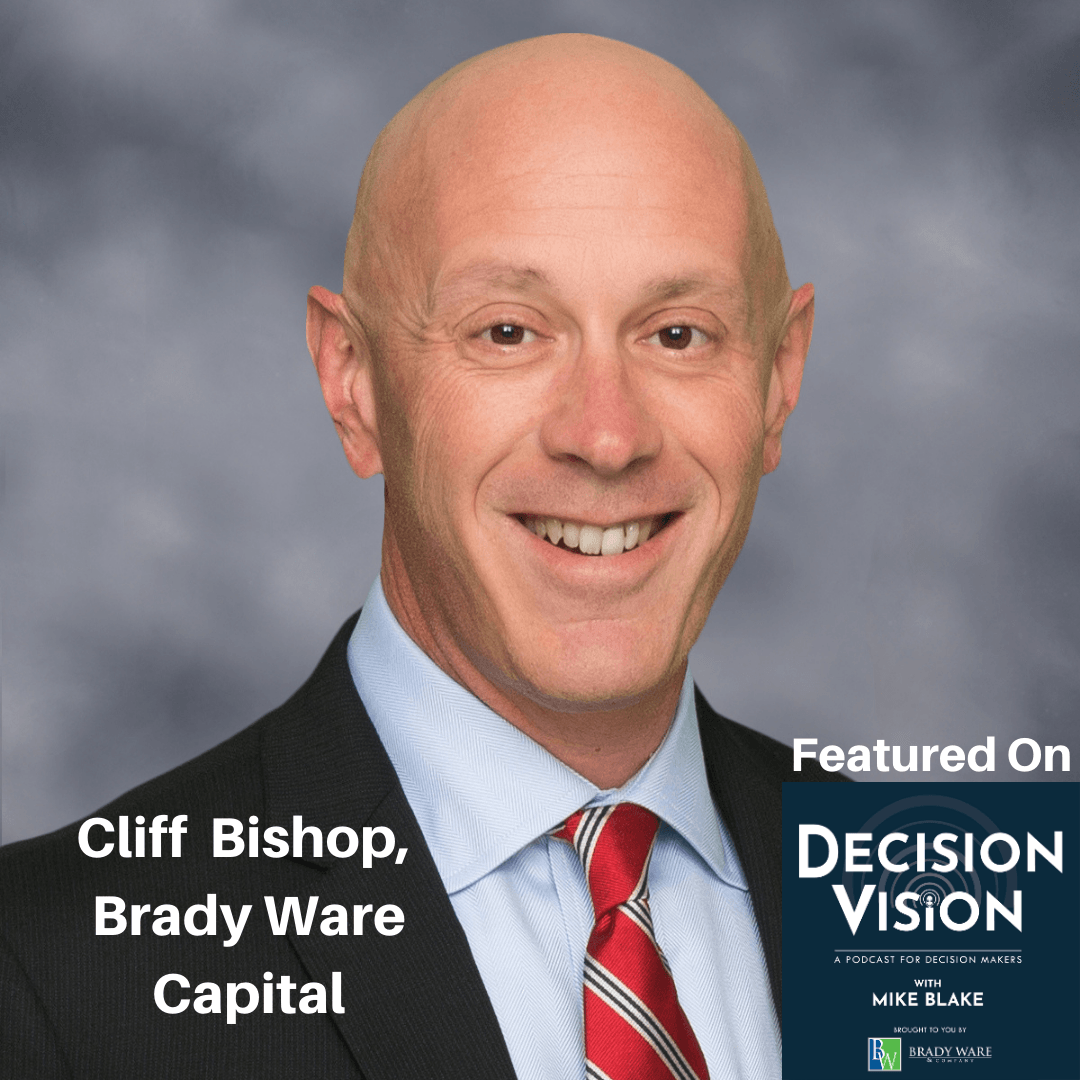
Cliff Bishop, President, Brady Ware Capital

Cliff Bishop joined Brady Ware’s Mergers & Acquisition’s team in 2004 and is President of Brady Ware Capital. Cliff has more than 20 years of experience working with middle-market companies. Formerly a Senior Vice President in commercial banking with a large regional bank, Cliff provides creative solutions relating to mergers, acquisitions, and capital raising projects. Cliff’s creativity combined with his extensive experience in structuring, negotiating, and executing transactions equates to exceptional results for Brady Ware clients.

Cliff earned his undergraduate degree in finance from Indiana University and his MBA from the University of Dayton. He also holds the Series 7 and 24 securities registrations. Cliff was chosen as one of Dayton’s “Forty Under 40” business leader award recipients and is a graduate of Leadership Dayton.

Cliff is an active volunteer/board member with the YMCA of Metropolitan Dayton and currently serves as the Chair of its Board of Directors. He has also been a volunteer for Big Brothers/Big Sisters of the Miami Valley and Junior Achievement in the Dayton Public Schools.

For more on Brady Ware Capital, visit their website.

Michael Blake, Brady Ware & Company

Mike Blake, Host of the “Decision Vision” podcast series

Michael Blake is Host of the “Decision Vision” podcast series and a Director of Brady Ware & Company. Mike specializes in the valuation of intellectual property-driven firms, such as software firms, aerospace firms and professional services firms, most frequently in the capacity as a transaction advisor, helping clients obtain great outcomes from complex transaction opportunities. He is also a specialist in the appraisal of intellectual properties as stand-alone assets, such as software, trade secrets, and patents.

Mike has been a full-time business appraiser for 13 years with public accounting firms, boutique business appraisal firms, and an owner of his own firm. Prior to that, he spent 8 years in venture capital and investment banking, including transactions in the U.S., Israel, Russia, Ukraine, and Belarus.

Brady Ware & Company

Brady Ware & Company is a regional full-service accounting and advisory firm which helps businesses and entrepreneurs make visions a reality. Brady Ware services clients nationally from its offices in Alpharetta, GA; Columbus and Dayton, OH; and Richmond, IN. The firm is growth minded, committed to the regions in which they operate, and most importantly, they make significant investments in their people and service offerings to meet the changing financial needs of those they are privileged to serve. The firm is dedicated to providing results that make a difference for its clients.

Decision Vision Podcast Series

“Decision Vision” is a podcast covering topics and issues facing small business owners and connecting them with solutions from leading experts. This series is presented by Brady Ware & Company. If you are a decision maker for a small business, we’d love to hear from you. Contact us at decisionvision@bradyware.com and make sure to listen to every Thursday to the “Decision Vision” podcast.

Past episodes of “Decision Vision” can be found at decisionvisionpodcast.com. “Decision Vision” is produced and broadcast by the North Fulton studio of Business RadioX®.

Visit Brady Ware & Company on social media:

LinkedIn:  https://www.linkedin.com/company/brady-ware/

Facebook: https://www.facebook.com/bradywareCPAs/

Twitter: https://twitter.com/BradyWare

Instagram: https://www.instagram.com/bradywarecompany/

Show Transcript

Intro: [00:00:04] Welcome to Decision Vision, a podcast series focusing on critical business decisions. Brought to you by Brady Ware & Company. Brady Ware is a regional full service accounting and advisory firm that helps businesses and entrepreneurs make visions a reality.

Mike Blake: [00:00:24] Welcome to Decision Vision, a podcast giving you, the listener, clear vision to make great decisions. In each episode, we discuss the process of decision making on a different topic from the business owner’s or executive’s perspective. We aren’t necessarily telling you what to do, but we can put you in a position to make an informed decision on your own and understand when you might need help along the way.

Mike Blake: [00:00:43] My name is Mike Blake and I’m your host for today’s program. I’m a director at Brady Ware & Company, a full service accounting firm based in Dayton, Ohio, with offices in Dayton, Columbus, Ohio, Richmond, Indiana, and Alpharetta, Georgia. Brady Ware is sponsoring this podcast, which is being recorded in Atlanta for social distancing protocols. If you like this podcast, please subscribe on your favorite podcast aggregator and please consider leaving a review of the podcast as well.

Mike Blake: [00:01:08] So, today’s topic is, should I try to sell my business during the COVID epidemic? And we did a show fairly early on in the series, probably back in April of — year, which would be 2019, relatively speaking, with Roger Furrer of Brady Ware Capital. And we talked about, you know, should I hire somebody to help me sell my business? And I thought that was a useful conversation. Given the download metrics, it seems like a lot of you felt that that was a useful conversation as well.

Mike Blake: [00:01:45] And I wanted to return to the topic of of selling your business in a more specific way. And as most of you know, who have been longtime listeners or consistent listeners, we’ve done a series of COVID specific tactical podcasts. And they’re a little bit different than the normal fare we have in the Decision Vision podcast. But we felt that it was necessary to acknowledge that the world was changing, continues to change, and will have changed in many material ways that will necessitate a different decision making process and offer different decision making inputs into some very important decisions that have to be made.

Mike Blake: [00:02:34] And there are fewer decisions that are more important than selling your business. For most people who are business owners, the business is their primary, perhaps, even their sole source of wealth. And so, clearly, you have to get that right because it has an impact on your financial future and, perhaps, even the financial future of ongoing generations. And it’s also, frankly, a decision that is very hard to reverse. Once you sell a business, generally speaking, it’s no givesies backsies. And if you don’t like the deal that you’ve got a year after the fact, generally speaking, that’s kind of tough. I guess there are some ways you can kind of clause something back. But those are very hard. They’re very expensive. And those have very uncertain outcomes.

Mike Blake: [00:03:29] And as somebody who is in the business of appraising businesses and also does transaction advisory, but not in the way Brady Ware Capital does, because I don’t actually go out and market a business. I just advise people on kind of how to position a business for sale and advise them on how to select representation and so forth. But I used to do what they do, but I hated it, so I stopped doing it. I like the role that I’m in much better as a referee more than an advocate.

Mike Blake: [00:04:04] But the question comes up now that, is it worthwhile to try to sell my business? It’s a reasonable position to take to think that with all this uncertainty, perhaps, are cautious that they’re much more choosy or that prices are depressed because, maybe, everybody wants to sell their business, right? You may want to sell your business because you’re planning to sell — whatever age was your target age. And then, this virus had the audacity to show up and mess up your plans. It could be that, you know, you just don’t see kind of what the path forward is and the way that you want to pursue it.

Mike Blake: [00:04:51] I think it’s perfectly reasonable to kind of look at this environment and say, “Look, man, I didn’t sign up for this. I like running a business but when I did so, I really didn’t count on having to manage through a period of global once in a century pandemic, massive social upheaval, and murder hornets. Really, it’s not what I signed up for.” But maybe somebody else wants to sign up for it and you’re going to sell the business. Or maybe, you know, you just don’t know what to do and you’re not sure you’re the person to kind of lead your business through that and have the resources to absorb what may be very slow revenues coming in, particularly, if you’re in the hospitality industry and you kind of want to get what you can and get out. Or there may be other reasons as well.

Mike Blake: [00:05:43] But the point is that, I think there’s likely an assumption out there that you just can’t sell a business. But I think we’re going to learn that life is going on. It’s adapting for sure. But, you know, commerce does go on in this country. You know, even with lockdowns, commerce does go on. Capital needs to be deployed, wants to generate a return. But you may have to temper your expectations and you may have to approach this differently.

Mike Blake: [00:06:15] So, anyway, I hope I’ve convinced you that this is a worthwhile topic and you’ll keep listening through the end. Because I do think this is going to be a very interesting conversation and it’s going to give you a lot of great information as you think about whether trying to sell your business at this particular point in time is a worthwhile exercise to pursue.

Mike Blake: [00:06:34] And joining us to help talk us through this is my colleague and friend, Cliff Bishop, who is president of Brady Ware Capital, the boutique investment banking arm of Brady Ware & Company. Brady Ware Capital’s mergers and acquisitions specialists help business owners and entrepreneurs understand, increase, and unlock the value of their businesses. Business owners often find that managing the complexities of transactions and overwhelming experience. You need an advocate who has your best interests in mind to evaluate the opportunity to find the right partner, structure, and close the deal. Brady Ware’s business brokers are here to ease the challenges and allow you to continue running your business — throughout the transaction. And as we learned with Roger, selling your business on your own, you can do it but it’s hard. There’s a reason investment bankers make the fees they do. It’s not because we’re all just nice guys.

Mike Blake: [00:07:28] Cliff has more than 20 years of experience working with middle market companies. Formerly a senior vice-president in commercial banking with a large regional bank, Cliff provides creative solutions relating to mergers, acquisitions, and capital raising projects. Cliff’s creativity combined with his extensive experience in structuring, negotiating, and executing transactions equates to exceptional results for Brady Ware clients.

Mike Blake: [00:07:50] Cliff earned his undergraduate degree in finance from Indiana University. His MBA from the University of Dayton – go Flyers. He holds the Series 7 and 24 securities registrations. Cliff was chosen as one of Dayton’s 40 under 40 Business Leader Award recipients and is a graduate of Leadership Dayton. Cliff is an active volunteer board member with the YMCA of Metropolitan Dayton and currently serves as a chair of its board of directors. I did not know that. He has also been a volunteer for Big Brothers Big Sisters of the Miami Valley. And junior achievement in the Dayton Public Schools. Cliff, welcome to the program.

Cliff Bishop: [00:08:26] — Mike. Thank you for having me. I look forward to our conversation.

Mike Blake: [00:08:30] So, you heard the intro and we’ve talked about this online. But let’s sort of dive right in. Talk about, you know, from where you sit as somebody who does transactions day to day is really sort of in it. You know, how are valuations for business acquisitions – maybe generally, how are conditions for business acquisitions changed or have they changed due to the pandemic?

Cliff Bishop: [00:08:57] Well, Mike, it’s a question that we get all the time recently. And we spent a lot of time talking to people about it. I would say, big picture, it depends. But more specifically, I think surprisingly, valuations have held up very, very well. And I think there’s a couple of things driving that. There’s actually more capital out there than there is good deals. So, simple supply and demand. There’s a trillion dollars of private equity money out there looking to find a home to find good businesses. Public companies have record amounts of capital cash on their balance sheet. And it’s just not as many good companies now out there going to market.

Cliff Bishop: [00:09:36] So, we’re pleasantly surprised on valuations. We closed one transaction in the middle of the onset of the pandemic in March, early April at a strong multiple. And we just attended virtually a private equity conference earlier this week. We talked to 40 different private equity groups who all confirmed, “We’re ready and open for business. We want to find good fundamentally sound companies.” So, deal flow is good and we’re very optimistic about valuations.

Mike Blake: [00:10:11] I’m seeing something similar. We’ve been doing research to kind of just track multiples because we thought that multiples might be coming down a bit. And so far, estate and gifting clients, this is a great time to make transfers to trust. And you can burn less of your lifetime exemption. Or if you’re already above that, to incur less gift tax. But we’re actually finding out that valuations are holding up as well.

Mike Blake: [00:10:38] And I think I agree with you that, you know, there’s just capital out there and the capital is sitting on the sidelines. And the the weird thing about capital, the way the way that works – I know you know this, but for the benefit of our audience – is that, you know, a lot of that capital is sort of earmarked for acquisitions. Because the way mandates work for private equity firms and so forth, you can’t easily say, “Well, we’re just going to switch and dump it into tech stocks or real estate or alpaca farms or something like that.” It’s having to chase acquisitions, isn’t it?

Cliff Bishop: [00:11:21] Absolutely. And its organic growth is even more challenging now than it was before. So, growth is what drives all values of businesses. So, if you’re going to pursue that strategy, you probably need to be in the acquisition mode.

Mike Blake: [00:11:37] A question that, I think, must come up a lot is certainly one that I think about a lot and I do encounter sometimes is, if you’re going to sell a business in this environment, do you have to be nearly perfect in order to be saleable? Do you have to be basically work free in order to stand a chance of being sold?

Cliff Bishop: [00:11:58] No. Absolutely not. And if there was a near perfect company that we sold, it would be the first one. Every company, without exception, has some issues that need to be addressed or could be addressed or less than perfect. That’s the nature of business and buyers understand that. So, we think the key is to be self-reflective and understand what those are going into the process. And if we can work with a business owner, you know, three, six months, a year before they go to market, we can address most of those issues. And we’re used to working with them. Buyers understand that there’s going to be issues. But we can always find a way to get over those hurdles.

Cliff Bishop: [00:12:41] One thing that’s very dangerous, though, is to ignore them and wait until the end of a transaction. And a couple of weeks before a potential closing, a buyer uncovers something that they weren’t aware of. And that’s going to do one of two things. Either end the transaction because of a lack of trust or it’s going to have a very detrimental effect on the valuation.

Cliff Bishop: [00:13:02] But we enjoy working with companies that have some challenges. We think that we can be creative and help them address those and have had some very successful transactions with companies who, quite frankly, when they talk to us, said, “Well, we’re nowhere close to being ready.”

Mike Blake: [00:13:19] You know, one thing I’ve observed over the years is, investors will and buyers can accept bad news if you’re transparent about it. But they really don’t like bad news that is surprising and late. That makes it ten times more damaging to the transaction than the bad news otherwise normally would be, right?

Cliff Bishop: [00:13:42] Yeah. Absolutely. I guess it’s a little bit like buying a house. If you tell someone there’s a small leak in the roof that needs to be fixed or you go and fix it beforehand, that’s okay. If you tell them everything is okay and they walk through the day after a rain and there’s puddles in the house, they’re probably going to move on to the next house.

Mike Blake: [00:14:00] So, let’s settle here on this topic for a minute, because I think there’s a lot of valuable stuff to get into. And that is, you know, I know you like to and are good at helping businesses kind of take a self-inventory and figure out, you know, what are those leaky holes in the roof, so to speak, and how do you patch them up? So, you know, what are the most common things that businesses ought to be looking at doing in terms of sprucing up their own business for acquisition that can reasonably address in a short term timeframe?

Cliff Bishop: [00:14:40] Great question. I wish more people would ask that – more business owners. But a couple of things. I think number one is the accounting records. And it doesn’t just mean you have good audited statements or tax returns or something like that. I would say it’s more of the management information reporting. So, for example, most buyers are going to ask a company, “Can you break down your gross profit by customer? Can you break down your gross profit by line of business or product?” And things like that. Things that may not relate directly to the bottom line income or being correct or incorrect, but it’s how you get to that bottom line income.

Cliff Bishop: [00:15:20] So, for example, if somebody has a customer that’s a 30 percent concentration of their total revenue, the buyer wants to know what does that result in 50 percent of the total profit. Or, is it a low margin business that even if they went away, it won’t have much effect? I would say over 50 percent of the companies that we deal with can’t answer that kind of bellwether question, gross profit by customer product. But it’s something that can be, maybe not easily, but it can certainly be addressed.

Mike Blake: [00:15:52] You know, interestingly, in my world, one of the questions I always ask is, what are your key performance indicators? And, you know, a lot of companies don’t really have one. At least they don’t have them explicitly. The business owner, I think, internalizes them. But they don’t really have a process for recording and tracking them over time. And along those lines, that is something in terms of management information, that’s something that’s a hanging fruit that you ought to be able to adapt or update yourself or with relatively little cost, bring in outsourced CFO control or something, and have — kind of track that.

Mike Blake: [00:16:35] And I agree with you, that’s the kind of thing that can really generate a high ROI. Because it also helps the buyer understand the gears and cogs of how the business works, too, doesn’t it?

Cliff Bishop: [00:16:49] Absolutely. And it helps them identify risk. So, buyers are looking for two things, the growth opportunities, they want to understand that, and they also want to understand the risk, you know, what could go wrong with the deal. So, that’s one way to help them understand it. And it’s really revealing sometimes to the business owner when we dig into that. And even if we don’t get the perfect number, we can, at least, directionally help them understand where it is. And they’ll say, “Wow. I had no idea that I was doing all that work for that one customer and not making any money.” It changes the way they view their own business. To be clear, not everyone we work with ends up selling the business right now. They may be looking a year or two years out. And in the interim, they say, “Well, gosh, I can do these couple of things to really make a much better result.”

Cliff Bishop: [00:17:40] And, Mike, the second topic you asked, where are the things that can be addressed? The one thing that we really see sometimes being ignored is the second level management team. So, if you’re the owner and selling the business and you want to exit the business, then it’s really imperative that we have a good second level team. Because if you’re going to leave the business and you have all the customer relationships, all the supplier relationships, you handle HR and everything else. But yet we tell a seller this person is going to walk away 90 days after closing. That doesn’t make people very confident. But if we can present a solid management team where there’s three, or four, or five people who handle all the day to day operations, and know the business, and know the customers, and almost make the selling shareholder irrelevant, that’s a much better story to tell than the former.

Mike Blake: [00:18:40] So, I’d like to drill down with that if I can, because I think that’s a very important observation. How do you set it up so that you can ensure or, at least, strongly encourage the continuity of that management level, that second tier, or the bench part of the management? And assume for the moment maybe nothing’s been done yet in terms of noncompete agreements or anything like that. As a business owner, what would the to-do list look like to kind of tick off that risk item?

Cliff Bishop: [00:19:18] Yeah. I think it’s basically bringing the rest of the management team under the tent, so to speak. You know, one of the challenges we have is a lot of owners say at the beginning, “I want to keep this quiet. I don’t want anyone to know.” So, at that point, we make it an economic exercise, Mike. It’s like, “Okay. We can do that.” But if you take that approach, we think, for instance, your business is going to be worth $8 million. I’m picking a number, obviously. If we can bring in that second level management team and show the continuity and the growth, your business might be worth $12 million. So, you can do some things. You can have your employees sign nondisclosure agreements, put some incentives out there for them to get the transaction closed.

Cliff Bishop: [00:20:02] Surprisingly, most business owners think as soon as employees find out there’s going to be a transaction, that they’re going to put their resumes out and leave. Surprisingly, it sometimes energizes that second level management because they’re saying, “Wow. This is my opportunity to shine. I can step up. I can be the main person. I’m going to have more resources.” So, it can really be empowering to them. And just by including them in conversations, we see a lot of energy injected into the process most of the time.

Mike Blake: [00:20:34] Now, what about more concrete steps? Putting things in like noncompete agreements and/or stay bonuses or change of control bonus programs or something? Have you seen those? Are those also tools that you can do to manage that risk on behalf of the buyer?

Cliff Bishop: [00:20:54] Absolutely. And it’s very important because almost every business we deal with is heavily dependent on a handful of people or even less, whether that be the [inaudible] owner or the day to day manager, minority shareholder. So, to be able to tie those people up and know that the continuity is going to be there is extremely important. The noncompete, as you mentioned, Mike, I think that’s something that is not addressed very often by business owners. In my opinion, that should be in place whether you’re selling the business or not, because there’s such a heavy, heavy reliance on key people on a privately owned business.

Mike Blake: [00:21:30] Yeah. And the problem is, once you reveal that you’re going to sell, the employee then, all of a sudden, has a lot of leverage. So, you know, the longer you wait to do that, the more expensive getting somebody to sign those agreements is going to be. So, getting out in front of that today or yesterday is most likely going to be the easiest path for you as opposed to, “Hey, I want to sell my business. Would you please sign this agreement that’s going to commit you to work for the business so that I can get rich?” You know, they’re going to want their piece of that as well.

Cliff Bishop: [00:22:06] No question. And sometimes that can be done, as you said earlier, in conjunction with year-end bonus, maybe some incentive plans that get put in place, the stay bonuses that you talked about. All very good tools. Are good, quite frankly, though, for the owner and the employee. It’s not a one way street if you do it right. And we’ve also seen, you know, there’s a big reluctance for an owner to bring other people under the tent, as I said. But if they present it to employees, “Hey. Not that I’m selling the business and leaving, but we’ve grown this business together as far as we can. I’ve decided that to take it to the next level, we need to bring in outside capital. And I’m going to go explore options to bring in partners who could provide money and expertise to help us grow this business quicker and farther than I could do it on my own.” That’s a heck of a lot better story than saying I just put the business up for sale and who knows what’s going to happen.

Cliff Bishop: [00:23:02] So, that message is really important. And quite honestly, it’s a true story. I mean, the buyer coming in is typically going to put more resources than they’re going to hire more people. It’s probably – in this concert, it’s not probably. It is a misconception that buyers are going to come in and cut cost. And the vast majority of situations are coming in and adding employees. They’re adding equipment, they’re adding infrastructure, I.T. capabilities. It’s a net-net positive for the employees that stay most of the time. Not always, but most of the time.

Mike Blake: [00:23:37] So, let’s switch gears here. What kind of businesses are relatively attractive, generally? And when I say type of business, I guess, maybe I’m thinking about both a minimum size profile as well as the nature of the industry or the nature of the business itself. And is that profile at all changing because of the impact of the pandemic?

Cliff Bishop: [00:24:02] Another great question. And, again, I’m going to start by saying it depends. I’m going to get into a little bit more detail. I think what we’ve learned and it hasn’t changed with the pandemic is the biggest thing that drives value – well, two things, growth and repeatability. So, I think most business owners are probably trained to look at their financials by their banker who is always looking in the rearview mirror. What did you do last year? Did you meet your covenants? All the banker cares about, did you make the minimum amount of money possible and to pay the debt back?

Cliff Bishop: [00:24:36] A buyer is taking a totally different approach. They’re going to look at the history as kind of a starting point, but they care about what the business is going to be worth three, five, seven years out. So, if it’s doing 20 million in revenue, their question is, what can we do to make this a $50 million revenue business over time, even if they have to invest more money. So, that’s by far the most important thing that’s going to get a higher multiple.

Cliff Bishop: [00:25:00] Mike, the second is the predictability and repeatability. So, if a company has consistent earnings and grows 5, 10, 15 percent a year every year, that’s easier to put a value on than if they make $4 million dollars one year, two the next, and six, and then five, and three. And it’s project related and bumps all around. Consistent earnings, consistent customers. For instance, a security type company where clients are sending in a check every month, month after month after month. And you can go back five years and see it’s the same customer base. That company is going to be worth a lot more than a construction company who builds a hospital this year and has to go find a big school to build next year. And it’s not a repeat customer. So, again, I can’t stress enough, growth and repeatability and consistency is what people are looking for.

Mike Blake: [00:25:59] So, you touched on something of the start of this conversation. I want to go back and address it explicitly. And that’s about liquidity in the markets. Most of us remember the last big recession, it wasn’t that long ago. It’s about a little bit over a decade ago. You know, the banks and financing sources really just sort of seized up. Like, throwing sand inside of a machine, basically. I think it’s tempting to make an assumption that that’s the case this time around. But you tell me, is it the same where it’s hard to find liquidity, find acquisitions? Or, are capital sources or liquidity providers, are they still on the hunt for deals?

Cliff Bishop: [00:26:42] Yeah. It’s totally different from 2008 and other situations before that. The capital is abundant. We’re, as I said at the beginning, pleasantly surprised. Very surprised in some cases. The liquidity in the market, both from the private sector and what the government has put in, the PPP loans, things like that, it causes the market not [inaudible]. We have seen senior banks, the commercial banks have become a little bit more conservative. They’ve been busy with PPP loans. They’re always going to be more cautious. So, they’re not being quite as aggressive on acquisition related loans. But others are stepping up to fill the gaps. The mezzanine lenders, which without getting in a lot of details, are the private groups that will put money in that’s kind of between the senior data and the equity. That capital is flowing very strong. We talked to five or six of those just last week that confirmed that’s the case.

Cliff Bishop: [00:27:41] And then, buyers are willing to put more equity in that deal, Mike, than they used to. Because they have all the liquidity, the funds that have been raised, they need to put that money to work. If they think they can double the size of the business, it doesn’t bother them to put in an extra 10 or 15 percent of equity to fill that gap that the senior debt used to have. So, you know, very strong driver of the market. And I know I’m not a stock market guy, but I think that’s what we’ve seen in the stock market, too. People don’t have anywhere else to put their money.

Mike Blake: [00:28:15] So, I’m sure a question you get asked all the time, and certainly I do very frequently, is, say, somebody does make a decision that, “Yeah. I’d like to sell my business. Let’s go.” How long does that process take? And are you finding that that time frame is different from what it was pre-pandemic?

Cliff Bishop: [00:28:36] Yeah. It depends on how organized a company is, to start with. I mean, we’ve been involved in situations where, maybe, one company has approached a client and said, “We want to put a deal together.” That can be done in 90 days or less. I would say, typically, from the time that we start talking to somebody to get a transaction done, it’s six months to a year. But it’s driven by how prepared they are, those items I talked about earlier. If their accounting and everything is in good shape and they’re ready to go, we can move pretty quickly. I would say the timing for a deal has maybe extended 30 days from what it was before the pandemic. But not a lot.

Cliff Bishop: [00:29:20] I think we’ve talked – and I’m sure Roger did in your conversation earlier – due diligence is stringent. It’s brutal. There’s a lot of buyers, valuations are good, but you better be ready because the due diligence is unrelenting. They’re going to bring in outside accounting firms, outside I.T. firms, environmental. It’s not unusual for private equity to bring in a firm to do psychological profiles on the management team. I mean, it is a tough process. And part of that is a game where, one, they want to make sure that they’re buying the company they think they’re buying. But, two, they’re trying to drive down the price. And if they can come in and find those those holes in the roof, they’ll do it. Again, we’re going to prepare and make sure that’s not the case. But it is a tough process. And I’m coming from a biased position that I’d hate to navigate that without some help.

Mike Blake: [00:30:20] You know, you mentioned the types of due diligence action. That brings actually brings up a question I’d like to kind of run by you. I’m seeing more buyers now also retain cyber due diligence specialists, because data security, it’s become important, it’s become expensive. And, you know, not a lot of companies have probably paid as much attention to it as they need to. Are you seeing the same thing? Is that also a big deal, especially if you’re selling a company where people are working from home?

Cliff Bishop: [00:30:56] You know, Mike, we haven’t seen that a lot in the lower or middle market. Some people touch on it. I’m surprised that it hasn’t become more prevalent because – I agree with you – it’s really important. I think people are starting to ask the question more and more, though, with people working from home and the safety and security of the data.

Mike Blake: [00:31:16] So, let me ask this just sort of generally, I think there’s a psychology that, at least, some potential seller where they say, “You know what? One of the reasons I’m selling is because there’s this pandemic, I don’t want to deal with it.” So, if I don’t want the business, why would anybody else, right? Why would anybody want to buy in a pandemic? And I appreciate this is a little bit repetitive of what we’ve talked about, but I think it’s worth kind of driving that point home. Can you explain kind of the mentality of how buyers are generally looking at the pandemic, maybe because they feel like it’s a temporary phenomenon or a risk that can be managed or some other perspective. But when you get inside the head of the typical buyer that you work with, how do they view the pandemic generally in the context of acquisitions?

Cliff Bishop: [00:32:12] Yeah. Okay. And if I can, I’m going to touch on something else that you mentioned as a lead in there, the mentality of the seller as well. We are seeing a lot of sellers that kind of say, “I’m tired of this now.” Or maybe the opposite. Maybe they’ve been away from the office a little bit, working remotely, and say, “You know, I like this. It’s time for me to move on if I can get the value for my business.” And I think it’s so important as a seller – I think there’s a lot of business owners listening to this – it’s not all about dollars and cents. There’s a lot of emotion and personal preference in this.

Cliff Bishop: [00:32:48] So, you might ask Mike and I, “When should I sell my business?” We can’t answer that. We can educate you on some of the facts, but it’s a very personal decision. When is it time to walk away? We have some owners that are 80 years old that it’s their life. They’re never going to sell and I would tell them they shouldn’t, because they come in every day. It keeps them vibrant. It’s what they like to do. There’s others that are 45 that say, “I view this as just like buying a stock. If you can give me the right number, I’m going to sell it.”

Cliff Bishop: [00:33:15] I have a passion about that though. As a seller, you need to think about your life after selling. But, honestly, most people when they sell are going to have enough money to live happily ever after if we do our jobs right, which we will. But from a lifestyle and day to day “what am I going to do?” That’s really important.

Cliff Bishop: [00:33:36] Sorry to take a detour there. But the buyers are looking for what platform is there? What are the fundamentals of the business? And is there a good platform there that we can take and we can grow it? So, they’re looking at that second level management team. They’re looking at customers. They’re looking at what’s there when the owner leaves. So, I don’t think the pandemic itself hasn’t affected the mentality of buyers. It makes them a little bit more critical. I’m looking and digging into the business and saying, what’s the long term effect of the pandemic going to be on this business? If they’re looking to buy a hotel, they may look at that differently than they did six months ago because the question is, “Is business travel ever going to come back to where it did?” But somebody that’s manufacturing parts for cars, you know, cars are going to be manufactured next year and the year after and ten years after. They’re going to dig in a little bit deeper to see what those levels may be. But still, the mentality is that there’s pretty critical businesses out there that are going to be steady.

Mike Blake: [00:34:46] So, let’s switch gears here to something else. You know, in my world, of course, I’m a business appraiser, so I’m in the business of trying to help clients understand the value of either what they’ve got or what they’d like to acquire. And, you know, an often overlooked and, I think, frequently underappreciated element of any transaction is the terms of that transaction. And in fact, a dear friend of mine years ago taught me that you can sell at almost any valuation you want as long as you’re willing to completely roll over on the terms. The terms are important. They’re not as sexy as the headline number but they can offset or outweigh any value advantage you may think that you’re getting. And one of the most important terms that you see, particularly in the sale of a small closely held business, is that earnout provision.

Mike Blake: [00:35:42] And so, that’s a long winded preamble to the short question, which is this, how prevalent are earnouts generally and how have earnouts changed, if at all, due to the pandemic conditions out there?

Cliff Bishop: [00:36:00] That’s a great question, because earnouts usually get discussed in those deals that we’re involved in. I’ll tell you, we’re pushed back very hard against that. We want to make sure that the cash upfront is sufficient to meet all the goals of our seller. Earnouts are tough. We’ve certainly seen some that work well, but it’s tough. It’s slanted to the buyer because they’re going to be the one keeping score. So, we really work hard to minimize that. That being said, they’re inevitable on some deals.

Cliff Bishop: [00:36:29] And, Mike, the thing that’s going to almost always result in an earnout are a couple of things. One, being a high customer concentration. So, if a company has 70 percent of their revenue to one customer, the buyer, and probably rightly so, is going to say, “Hey, if I come in there and that relationship goes away completely or starts to decline, I can’t make that up quick enough to get the value out of the business.” So, what we’re going to do in that situation now is try and structure that on an earnout based on revenue. As we say, we like to have earnouts based on the numbers higher up in the income statement versus the EBITDA down at the bottom of the income statement, because a lot of funny things can go into that to calculate it once the transaction happens.

Cliff Bishop: [00:37:20] The second thing would be back to the topic we talked about earlier, Mike, would be the predictability. If a buyer is looking at a business that seems to jump around year after year, they’re going to want to put more into the earnout.

Mike Blake: [00:37:38] You know, and you mentioned the customer concentration. I think that when our team performs business appraisals – putting startups aside because start ups are different animals – if it’s an established operating business, I think that the biggest source or the biggest driver behind a risk adjustment to value is customer concentration. And, unfortunately, customer concentration is not something that’s easy to change in the short term. The best you can do maybe is to convince the buyer that wants – if it’s an existing buyer that’s synergistic, then maybe the customer concentration issue isn’t as big a deal because it’s in a larger portfolio. But, yeah, that customer concentration issue is big.

Mike Blake: [00:38:27] There are several takeaways that people should be taking out of this conversation. But one, generally, even if you’re not going to sell your business today, is, if you have a customer concentration issue – and I’m curious, Cliff, I’ll ask you to define that if you can. I define that as, I think, customer concentration starts to become an issue when you have one customer that accounts for at least ten percent of annual revenue or more. And then, it goes up from there. You need to be thinking a lot about how do you reduce your reliance on that one customer? Because, you know, over time, that can de-risk the business significantly and get you a lot of value.

Mike Blake: [00:39:10] So, Cliff, actually, I’d love to get your perspective, if you can. I didn’t prepare you for this question and it may be entirely unfair. But sort of gut feeling, at what point in your mind does customer concentration start to become an issue? Do you generally agree with me or do you have a different sort of trigger point?

Cliff Bishop: [00:39:31] Yeah. I think it depends on the whole makeup of the customers. But I’d say, probably, 15, 20 percent really gets on somebody’s radar. That depends. You know, if there’s a 30 percent concentration, but the other 70 percent is from 20 customers, then that’s not as big of a deal. If there’s 30 percent and the remaining is only another seven or eight, that’s going to be a bigger issue. But I’ll say, it’s very typical. Most businesses started out supporting one customer and you’re not going to say no to a customer. So, we would never recommend, “Hey, turn business away from this customer to reduce reliance on them.” Hopefully, you can go grow the rest of the business to make it a lower number. But it’s a tough issue.

Cliff Bishop: [00:40:17] I will say and, I guess, follow up the last question I think you’d ask about specifically the pandemic and if that’s changed things, I think earnouts are a little bit more prevalent now just because earnings are a little bit less predictable. It goes back to that issue of predictability. If the company has performed consistently throughout the pandemic, then our position would be it doesn’t warrant an earnout and we’re going to push pretty hard to structure a deal that doesn’t have an earnout or minimizes it, certainly.

Cliff Bishop: [00:40:49] And, again, I think this is really important from my perspective and experience and seeing how earnouts work out. If an earnout can be structured as icing on the cake, then we can usually accept that, and we can move ahead, and we can protect it, and do a pretty good job of getting most of the earnouts. If you’re relying on that earnout, as I say, live happily ever after and that if I don’t get this earnout, I don’t have enough money to live the way I want to live. Then, I won’t do the deal. Because you’re going to bring in more stress to yourself. You’re not going to be able to control it. And you’re really in a position of weakness at that point.

Cliff Bishop: [00:41:23] Now, most of the time, we can stretch [inaudible] that there’s enough cash up front and protections going forward. But, Mike, as an advisor and I’ve advised people to walk away from deals, even though it means the deal not happening and the fee not happening. You know, if the earnout is too much and you know you’re relying on it, you got to take a hard look at it.

Mike Blake: [00:41:48] That’s a good point, because, you know, there is a certain point after which if there’s so much of a backend earnout, then you’re not really selling a business so much as you are taking a job with a heavy bonus component. And if that’s your goal, fine. But it’s important to understand what you’re actually doing. Some earnout can be so heavy that it’s really taking a job disguised as a business sale. And that may not necessarily be what you —

Cliff Bishop: [00:42:26] We’re talking with Cliff Bishop of Brady Ware Capital on the Decision Vision podcast about, should I try to sell my business during the COVID epidemic? And we just have time for a couple more questions before we got to let you get out of here and help some more clients. But one question I want to make sure we get to before we get out of here – it’s a technical question – is, have you seen any change on behalf of buyers in terms of their preference of asset purchases versus stock purchases? Has the pandemic changed kind of how they view their preferences in that regard? Or is that still purely tax driven?

Cliff Bishop: [00:43:12] I would say it’s very tax and risks driven. We haven’t seen a change specific to the pandemic. I would say, informally, you know, over the last three or four years, it’s probably about 50 percent stock and 50 percent asset. That our sellers, typically, want to do stock and it can be for tax reasons. But I’ll be honest, if it’s structured the right way, there’s not always as much difference between stock and asset as a seller may think.

Cliff Bishop: [00:43:43] Back to your point about structure, we can do an asset sale and still get them a lot of the tax treatments by purchase price allocation and things like that. So, again, that’s why it’s really important to understand those things going into a transaction. Because if we’re proactive on telling potential buyers, “This is how we expect it to be structured and this is how you need to make your offer,” then we’re more likely to get that result than if we just throw it out there and hope for the best.

Mike Blake: [00:44:15] So, Cliff, we are — time, but, as usual, I haven’t gotten close through all the questions that I’d like to ask and probably that our listeners have. If somebody wants to follow up with you and ask questions about potentially selling their business during the pandemic, what’s the best way for them to contact you?

Cliff Bishop: [00:44:33] Yeah. Thanks, Mike. I love to talk to people. I really enjoy talking to business owners on this topic, whether they’re ready to sell tomorrow or next year or five years from now. It’s a conversation that can really set the stage for a successful transaction. But I enjoy doing it. So, I encourage any of you listening, I’m happy to talk to you formally or informally. I would say we’re pretty good at being able to tell you what’s going to happen before it happens. And some of these topics we’ve had valuations, what earnouts might be, what some of the challenges you might have in your business, how we can do those things. But feel free to reach out to us, either be me or some of our other team who have expertise in different industries. You can reach me by email, it’s on our website. It’s cbishop, C-B-I-S-H-O-P, @bradyware.com. And my direct phone number is 937-913-2538. But sincerely, feel free to reach out to us and I’d love to talk to you.

Mike Blake: [00:45:39] Great. Thank you, Cliff. That’s going to wrap it up for today’s program. I’d like to thank Cliff Bishop so much for joining us and sharing his expertise with us. We’ll be exploring a new topic each week, so please tune in so that when you’re faced with your next executive decision, you have clear vision when making it. If you enjoy these podcasts — aggregator. It helps people find us that we can help them. Once again, this is Mike Blake. Our sponsor is Brady Ware & Company. And this has been the Decision Vision podcast.

Tagged With: Brady Ware & Company, Brady Ware Capital, Cliff Bishop, Mike Blake, selling a business

Business RadioX ® Network


Our Most Recent Episode

CONNECT WITH US

  • Email
  • Facebook
  • LinkedIn
  • Twitter
  • YouTube

Our Mission

We help local business leaders get the word out about the important work they’re doing to serve their market, their community, and their profession.

We support and celebrate business by sharing positive business stories that traditional media ignores. Some media leans left. Some media leans right. We lean business.

Sponsor a Show

Build Relationships and Grow Your Business. Click here for more details.

Partner With Us

Discover More Here

Terms and Conditions
Privacy Policy

Connect with us

Want to keep up with the latest in pro-business news across the network? Follow us on social media for the latest stories!
  • Email
  • Facebook
  • Google+
  • LinkedIn
  • Twitter
  • YouTube

Business RadioX® Headquarters
1000 Abernathy Rd. NE
Building 400, Suite L-10
Sandy Springs, GA 30328

© 2025 Business RadioX ® · Rainmaker Platform

BRXStudioCoversLA

Wait! Don’t Miss an Episode of LA Business Radio

BRXStudioCoversDENVER

Wait! Don’t Miss an Episode of Denver Business Radio

BRXStudioCoversPENSACOLA

Wait! Don’t Miss an Episode of Pensacola Business Radio

BRXStudioCoversBIRMINGHAM

Wait! Don’t Miss an Episode of Birmingham Business Radio

BRXStudioCoversTALLAHASSEE

Wait! Don’t Miss an Episode of Tallahassee Business Radio

BRXStudioCoversRALEIGH

Wait! Don’t Miss an Episode of Raleigh Business Radio

BRXStudioCoversRICHMONDNoWhite

Wait! Don’t Miss an Episode of Richmond Business Radio

BRXStudioCoversNASHVILLENoWhite

Wait! Don’t Miss an Episode of Nashville Business Radio

BRXStudioCoversDETROIT

Wait! Don’t Miss an Episode of Detroit Business Radio

BRXStudioCoversSTLOUIS

Wait! Don’t Miss an Episode of St. Louis Business Radio

BRXStudioCoversCOLUMBUS-small

Wait! Don’t Miss an Episode of Columbus Business Radio

Coachthecoach-08-08

Wait! Don’t Miss an Episode of Coach the Coach

BRXStudioCoversBAYAREA

Wait! Don’t Miss an Episode of Bay Area Business Radio

BRXStudioCoversCHICAGO

Wait! Don’t Miss an Episode of Chicago Business Radio

Wait! Don’t Miss an Episode of Atlanta Business Radio