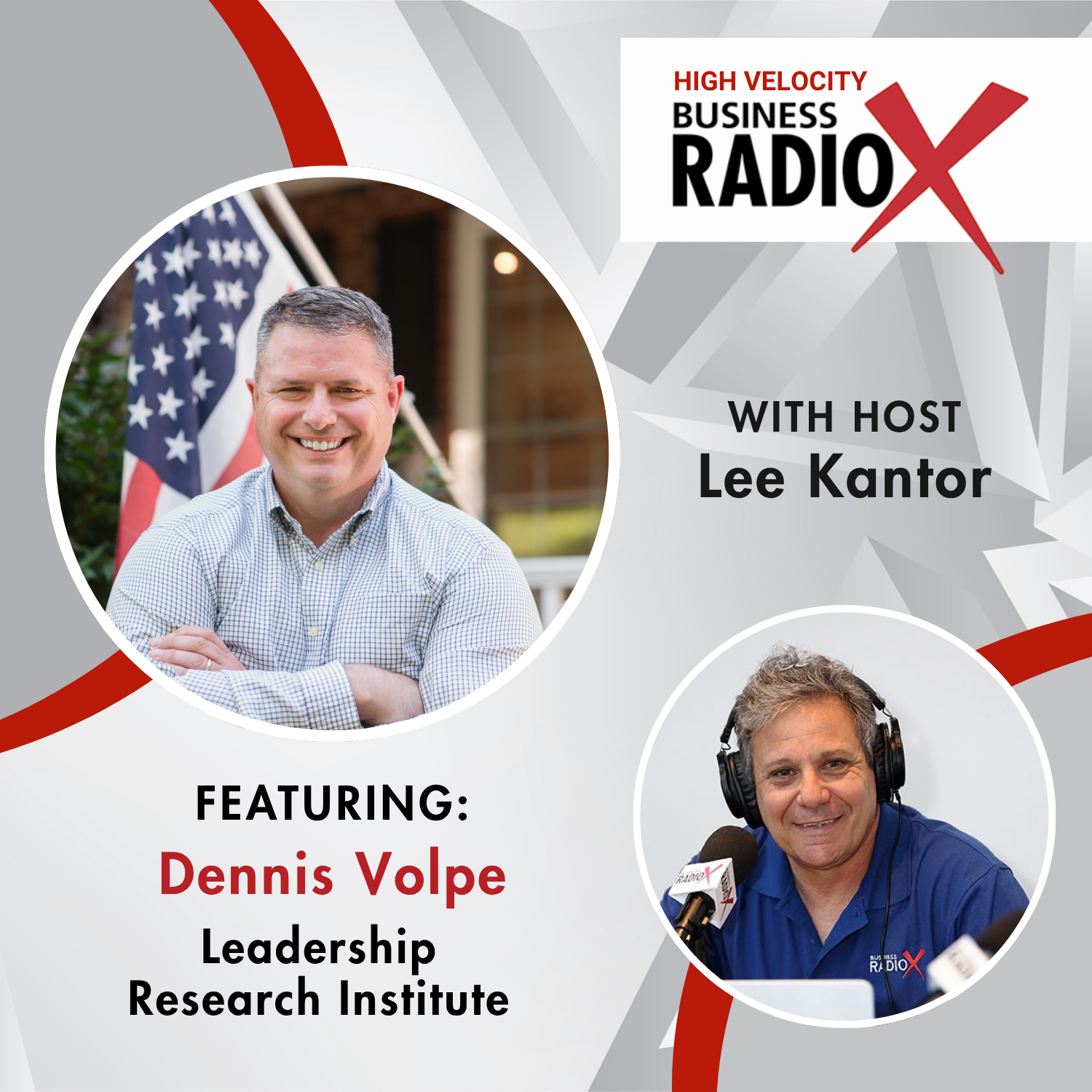

In this episode of High Velocity Radio, Lee Kantor interviews Dennis Volpe, Partner at Leadership Research Institute (LRI), about the foundations of effective leadership and organizational performance. Drawing from his experience as a retired military officer, leadership educator, and executive coach, Dennis shares how leaders can create the conditions for success by focusing on clarity, alignment, accountability, and trust. The conversation explores the difference between endurance and resilience, the importance of self-awareness and emotional intelligence, and how coaching helps leaders and teams navigate challenges, improve performance, and achieve sustainable growth.
 Dennis Volpe is a Partner with the Leadership Research Institute specializing in Executive Performance, Personal Leadership, Team Effectiveness, and Small Business Coaching.
He is an International Coaching Federation (ICF) Professional Certified Coach (PCC) and an Association of Corporate Executive Coaches (ACEC) Master Corporate Executive Coach (MCEC).
He achieved his coaching certification through the Columbia University Executive Coaching Program and is also a Gallup Certified Strengths Coach. He partners with leaders and teams to get them refocused so they can direct their energy and attention on what really matters to accelerate and elevate their performance and get to their definition of success faster.
During the past few years, he has worked extensively with Emerging and High Potential Leaders and teams with Fortune 500 companies as well as small business Founder/CEOs. His clients are in consulting, aerospace and aviation, manufacturing, high tech, financial services, real estate, services, logistics, governmental and non-profit organizations.
His understanding of leadership comes from over twenty years of operational experience as a career Naval Officer to include Command at Sea; multiple overseas deployments; an operational planner tour in Afghanistan; a Director of Future Operations tour for U.S. Naval Forces Southern Command; and several years as an instructor and rugby coach at the United States Naval Academy.
He is a graduate of the United States Naval Academy. He earned his Masters of Science in Leadership Development from the Naval Postgraduate School and his Masters of Art in National Security and Strategic Studies from the Naval War College. He is also a graduate of the University of Notre Dame Mendoza School of Business Executive Leadership Course.
He is the founder of the Severn River Leadership Group which is committed to veteran-owned or veteran-led small business success and has invested over $1M in small business ventures and investment funds.
He is a Limited Partner in the Veteran Fund which is focused on “Advancing America through Venture Capitalism” and the Academy Fund where “Capital Meets Character.”
He is an outdoor enthusiast, a small business and entrepreneurial investor, a passionate Rugby and Lacrosse fan, a mindfulness practitioner, a Traeger grill guy, a veteran mentor, and a recreational triathlete. Dennis and his wife, Amanda, live in Milton, Georgia with their dog, Koa.
Connect with Dennis on LinkedIn.
What You’ll Learn In This Episode
- Creating organizational success through the alignment of strategy, execution, and culture.
- Developing leadership as a learnable skill through resilience, curiosity, and emotional intelligence.
- Identifying the root causes of performance challenges through clarity, alignment, structure, and trust.
- Recognizing the difference between endurance and resilience when navigating change.
- Leveraging self-awareness to become a more effective and impactful leader.
- Building trust through reliability, credibility, and strong relationships.
- Using coaching to improve team performance and organizational effectiveness.
- Applying strengths-based leadership to maximize individual and team potential.
- Conducting difficult conversations that drive accountability and growth.
- Creating the conditions that help teams perform consistently and achieve long-term success.
 This transcript is machine transcribed by Sonix.
TRANSCRIPT
Intro: Broadcasting live from the Business RadioX Studios in Atlanta, Georgia. It’s time for High Velocity Radio.
Lee Kantor: Lee Kantor here another episode of High Velocity Radio and this is going to be a good one. But before we get started, it’s important to recognize our sponsor, Stone Payton Managing Partner with Business RadioX. If you’re a business coach who’s tired of being a best kept secret, set up a call with Stone at bookstonephone.com to unlock your perpetual prospect pipeline. Today on the show, we have Dennis Volpe, partner with Leadership Research Institute. Welcome.
Dennis Volpe: Lee. Thanks for having me. Excited to chat with you today and thank you for making the time.
Lee Kantor: Well, I’m excited to learn what you’re up to. Tell us about Leadership Research Institute. How are you serving folks?
Dennis Volpe: Well, the, uh, the Leadership Research Institute has been around for a while. We’ve been around since since 1980, but I’ve been a part of LRI, for about ten years now. And really, you know, our mission is to transform leaders so they can transform the world. I actually look at it slightly different. I like to say I work with leaders to transform them so they can transform their world. And how do we do that? Really, it’s about bridging the gap across strategy, execution, and culture.
Lee Kantor: So what’s your backstory? How’d you get involved in this line of work?
Dennis Volpe: My backstory is I spent some time in the military, so I’m a retired military officer and, uh, had the opportunity to do a lot of, of stuff, um, Um, from everything from teaching leadership, uh, at the Naval Academy to being a career ship driver, having, uh, command of a guided missile frigate to serving with the army in Afghanistan. And, you know, ultimately getting into the Leadership Research Institute after I retired. So it’s really a function, Lee of. Three decades observing leaders in action and being able to see, you know, the patterns, uh, that exist. And, you know, what are the, you know, the conditions that leaders and teams create for them to be? I like to say predictably reliable, right? So they can produce the results that mattered to them and their organizations.
Lee Kantor: Now, in your kind of career thus far, Have you. It sounds like you’ve been drawn to the idea of leadership is something that can be taught, and people can be trained to become better leaders. But was there a moment that that kind of became clear to you that there is a path that with the right coach or the right leader, that an individual can kind of level up and take on a role of leadership and be that change agent that they desire to be, that this is something that can be taught. It isn’t just something that some people are leaders and some people aren’t.
Dennis Volpe: Uh, Lee 100 110%. Uh, I believe that leadership, um, is a verb. Um, I, and when we think about leadership itself, leadership, uh, is all about the actions that a leader takes. And when we think about, um, you know, can it be taught? Yes. Um, now are there certain traits that, uh, that are helpful? Sure. Um, resilience being one of them. Uh, because leadership, uh, is a contact sport. And when we think about success and we think about challenge and we think about, um, you know, what makes leaders good at what they do? Uh, part of it is that resilience piece, uh, part of it is emotional intelligence. And part of it is curiosity. And when you think about those three things, all, each of them can be taught in their own way.
Lee Kantor: Now when you’re working with your clients, what, what is kind of the pain that’s happening where they even think to hire you or your or your firm, like what is going on organizationally that they need fresh eyes on this very often.
Dennis Volpe: It depends. And I know that sounds like the standard consultant or coach answer, but it’s normally one of four things. Uh, and over the past kind of ten years, they’ve jumped into, you know, one of four buckets. One, it’s a clarity thing, right? Is it, is it a vision? Is it a mission or is it a values issue? Um, or then it’s an alignment piece. Uh, is what’s going on relative to do we have this? Are we creating the momentum that, that we need to get to where we want to go? And is, is there a problem or an issue in, in the realm of how are we? How have we defined success? Right? What are the operational priorities and expectations? And so when we think about clarity, it’s it’s a focus issue. Uh, when we think about alignment, it’s, it’s like a directed energy or momentum issue. And then sometimes it’s a structural issue. Um, and very often that, that normally appears around accountability. So structure. And again, that depends on the organization, uh, whether it’s, you know, the two brothers of a, of a real estate company, uh, in Ohio to, you know, an aerospace manufacturer, the structure that’s required is different. Um, but what every organization needs is predictability, accountability, and support. And then finally, it’s trust. Sometimes there’s a trust problem. And whether that’s at the individual level, the team level or the organizational level.
Lee Kantor: Now how are, um, they’re coming to you for a variety of reasons. How like, what is it that happening in their organization where they notice that something’s amiss? Like, are there kind of symptoms or signals that this is something that has to be taken care of today rather than this is something that is kind of been bugging me, but we’ll get to it when we get to it.
Dennis Volpe: Uh, very often, Lee, it’s, it’s both of those things. Um, but very often, um, it’s, you know what? We are a bunch of really good people doing really good things, but you know what? We’re not having the results that we want or. We’re putting in a lot of effort, but we’re not gaining the traction that we want. Or I’m putting in a lot of effort and. It seems a lot harder than it needs to be. And it’s about, you know, identifying the conditions that are required both at the at the leader level, but also at the team level. Right. Because when you when you think about it, you know, what’s leadership all about. You know, leaders create conditions and leaders create conditions for team members to execute, for teams to perform and ultimately organizations to succeed. So very often there’s, there’s friction. Um, there’s a lack of focus, there’s a lack of momentum, or things just seem to be harder than they need to be.
Lee Kantor: Now, when that’s the case, how do you help your clients kind of determine if because you mentioned resilience as an important component here, and how do you know that resilience is needed or just we have to change direction because change might be what’s needed, not just try harder. Um, you know, like if you’re chopping a tree at some point, you’re like, wow, this is taking a long time to chop this tree. And then you’re like, oh, this isn’t a tree. It’s a steel pole. Like we’re never going to get there. Like, how do you know when it’s time to change? Uh, or just keep, you know, kind of powering through?
Dennis Volpe: Well, I, again, I believe that Lee, that change is a fact. Um, transition is, is the choice that we make at the individual level, at the team level and the organization level based on the change that we experience. And so when we when we look at that and we experience that very often, or at least what I have seen, Lee, is that there’s confusion between endurance and resilience. Resilience is actually a kind of endurance 2.0. Uh, because we need endurance, right? We need to be able to keep chopping at that tree. Resilience is exactly what you described. It’s saying, well, how come this isn’t working? And then we realized that we’re actually trying to solve the wrong problem. So first it’s about awareness and then it’s about ownership and, and the action required to transition from where we are to where we want to go. And then ultimately adaptation and, um, understanding the difference between endurance and resilience has been a very, very interesting journey for, for a lot of leaders and teams.
Lee Kantor: Now when you’re working with them, what’s kind of your go to first move? Is there kind of some structure in how you attack, uh, one of your engagements, or do you have a methodology around it, or is it first you do some listening or discovery, and then you kind of see where we’re at and then you can make recommendations.
Dennis Volpe: Lee, can I answer that question with or those questions with with. Yes. Uh, we, we do all of that. Um, the first step is to be curious, uh, and ask the questions that matter and really listen for, for the, the answers, not only listen for the answers that are said, but also listen for the answers that are not said. And I think one of the big differences between the Leadership Research Institute and some of some of the other coaching organizations that are out there is we don’t have any off the shelf stuff. Everything we do is based on what our clients need. Now, for me personally, I went through the Columbia Executive coaching program. So I do have a coaching methodology that that I utilize. And it’s three basic strategic questions. You know, what’s up in terms of, you know, what’s the context, what matters in terms of the content and then what’s next in terms of conduct? Um, because ultimately with coaching, performance has to happen. And I’m also a Gallup strengths coach. So that’s also a starting point. Looking at the individual strengths of. Team members and the team in general to identify, you know, what are our natural ways of doing things thinking, feeling and doing and leveraging those things. Um, and I’m also a six working genius coach. So I look at, you know, the three stages of work, what that looks like, where the genius is, where the frustration is, where the competencies are, put that all together. And we have an assessment that that we use called cast, which looks at those four buckets we talked about earlier, you know, the clarity, the alignment, the structure and team to identify what’s working, where we need to put some energy and effort. And you know what, what we need to do to make a difference at the team level and the organizational level.
Lee Kantor: Now in your work, do you have kind of a sweet spot or an industry that you work in more, more times than not? Or is this something that’s pretty industry agnostic?
Dennis Volpe: It’s pretty industry agnostic. But for me, I really enjoy working at the operational level. Um, and the small and medium business level, the, those general managers, those operation managers who are the ones that are rolling up their sleeves and doing the work. Um, and you know, those small business owners and medium sized business owners, uh, and, you know, as a retired military officer and a veteran, I look for opportunities to work with veteran owned or veteran led organizations because there’s a shared sense of mission, a shared sense of purpose, and, and there’s shared expectations.
Lee Kantor: Now, is there any advice you could give? Kind of maybe the aspiring leader, um, out there that maybe hasn’t had a chance to actually lead a team but sees that in their future? Or there are some do’s and don’ts for that up and coming leader that you can recommend them doing.
Dennis Volpe: I hearken back to my time as a midshipman, um, at the Naval Academy, uh, which was a long time ago, um, arguably 34 years ago. And, you know, we had a framework that we got introduced when we were freshmen, when we were plebes, you know, in Bancroft Hall. And, uh, there was three things. Know yourself, know your people, and know your job. And while those three things sound really simple, when you actually take a step back. There’s a lot to that simple framework, you know. Self-awareness, you know, emotional intelligence, uh, is, is a huge topic area. Um, but being able to look at yourself, look at your team and look at your job. Because when you do all that, you know, the one thing that makes really good teams and organizations work is trust. And when you think about trust and you think about the components of trust, trust is all about reliability, credibility, and relationships. So do you do you know your stuff? Do you do what you say and do you care about people? And if you do those three things right, if you you’re going to make a difference, you’re going to make a positive difference.
Lee Kantor: Now, is there a story you can share that maybe illustrates how you work with an organization. Um, you obviously don’t have to name the name of the organization, but maybe share the challenge they came to you with and how you were able to help them get to a new level.
Dennis Volpe: Sure. Um, I get, I have a, a team that I’ve been working with, um, for several years now and they’re in the logistics solution space. And they came to me, uh, because they were working on their really their strategic plan and, um. They wanted to, uh, develop, you know, their three year plan. And, you know, part of that was getting the senior leadership team together, um, identifying, you know, what was working, what wasn’t working, but also taking a step back to say who’s in the room. And what are their strengths and what are our team strengths and how do we leverage that? So where did we start? We started at that strengths perspective, both at the individual team member level, but also at the organizational level and then identified, you know, what, what’s the vision, what’s the mission and what are the values of the organization, right? Because those values, those organizational values are what ought to guide their decision making. And, you know, they, they had, I call it the bag, right? They had, you know, the big, hairy, audacious goal of increasing their top line revenue by 30%. And they did it. Uh, and, but there was growing pains and everything else around, you know, did we have the right team members on the bus? And did we have the right team members on the bus and were they in the right seat? Uh, so some people had to be asked to get off the bus and some, some seats had to be moved.
Dennis Volpe: You know, some seats had to be moved around. Uh, so difficult conversations had to happen. Uh, but what that looked like was meeting on a regular basis with the CEO. Um, and having those conversations about what was working, what wasn’t working, what needed to change. And then working with the senior leadership team, uh, on a, on a quarterly basis, uh, to identify those same things and, you know, course correct as, as required. And, um, over time. There was opportunities to take advantage of, uh, and there was also changes that needed to be made both, uh, from an operational perspective, some of the work that they were doing, but also some of the people that were on the team and who needed to be a part of the team. So ultimately, they had challenges, they had successes, they had some failures. And you know what? They’re a very, very resilient team, uh, because they have the candid conversations that need to happen. They make commitments to each other. Um, they communicate the good, the bad, the ugly. Uh, and they also have developed a sense of community that matters for them. And you know what? They’ve incorporated coaching, um, both externally and internally to, to make their team and their organization better.
Lee Kantor: Now in your work, are you finding that more organizations are more comfortable leaning into coaching and not only coaching for the highest level of the organization, but also, uh, further down? Are you seeing it becoming more and more just kind of part of what successful organizations another tool for them to be successful?
Dennis Volpe: It is absolutely a tool for successful organizations. And, um, do I see successful organizations doing more of it? I do. And I’ve seen that not only at the small business level, but also, you know, at the corporate level and the teams that are really engaged in the work that they do. Leverage coaching, whether it’s internal or external.
Lee Kantor: So what do you need more of? How can we help you and your firm?
Dennis Volpe: Uh, for me, I am actually new to the greater Atlanta area and, uh, I’m looking for opportunities to work with veteran led or veteran owned small to medium sized businesses in the Atlanta area to support elevating and accelerating the performance of their leaders and teams so they can get to their definition of success faster.
Lee Kantor: And then so being part of this firm, this is a national or global firm that you’re part of and, and you’re working in and around the Atlanta area right now.
Dennis Volpe: Correct. Yeah. We’re we’re an international firm, but as a partner, Lee, um, I have my own portfolio, my own book of business. Uh, and I look to leverage my, my team, uh, in the organizations that we resonate with. And, um, you know, looking for those small to medium sized businesses that could benefit from bridging that gap across strategy, execution and culture. Uh, is really what, uh, what matters to me.
Lee Kantor: Now, if somebody wants to learn more, connect with you, um, or the team, what’s the website? What’s the best way to connect?
Dennis Volpe: The best way to connect with me, uh, is on LinkedIn and our website is www.lri.com.
Lee Kantor: And then on LinkedIn, uh, just your name DENNIS VOLPE.
Dennis Volpe: Yes, sir.
Lee Kantor: Good stuff. Well, Dennis, thank you so much for sharing your story today. You’re doing such important work and we appreciate you.
Dennis Volpe: Thanks, Lee. I appreciate you making the time for me.
Lee Kantor: All right. This is Lee Kantor. We’ll see you all next time on High Velocity Radio.















