Business RadioX ®

  • Home
  • Business RadioX ® Communities
    • Southeast
      • Alabama
        • Birmingham
      • Florida
        • Orlando
        • Pensacola
        • South Florida
        • Tampa
        • Tallahassee
      • Georgia
        • Atlanta
        • Cherokee
        • Forsyth
        • Greater Perimeter
        • Gwinnett
        • North Fulton
        • North Georgia
        • Northeast Georgia
        • Rome
        • Savannah
      • Louisiana
        • New Orleans
      • North Carolina
        • Charlotte
        • Raleigh
      • Tennessee
        • Chattanooga
        • Nashville
      • Virginia
        • Richmond
    • South Central
      • Arkansas
        • Northwest Arkansas
    • Midwest
      • Illinois
        • Chicago
      • Michigan
        • Detroit
      • Minnesota
        • Minneapolis St. Paul
      • Missouri
        • St. Louis
      • Ohio
        • Cleveland
        • Columbus
        • Dayton
    • Southwest
      • Arizona
        • Phoenix
        • Tucson
        • Valley
      • Texas
        • Austin
        • Dallas
        • Houston
    • West
      • California
        • Bay Area
        • LA
        • Pasadena
      • Colorado
        • Denver
      • Hawaii
        • Oahu
  • FAQs
  • About Us
    • Our Mission
    • Our Audience
    • Why It Works
    • What People Are Saying
    • BRX in the News
  • Resources
    • BRX Pro Tips
    • B2B Marketing: The 4Rs
    • High Velocity Selling Habits
    • Why Most B2B Media Strategies Fail
    • 9 Reasons To Sponsor A Business RadioX ® Show
  • Partner With Us
  • Veteran Business RadioX ®

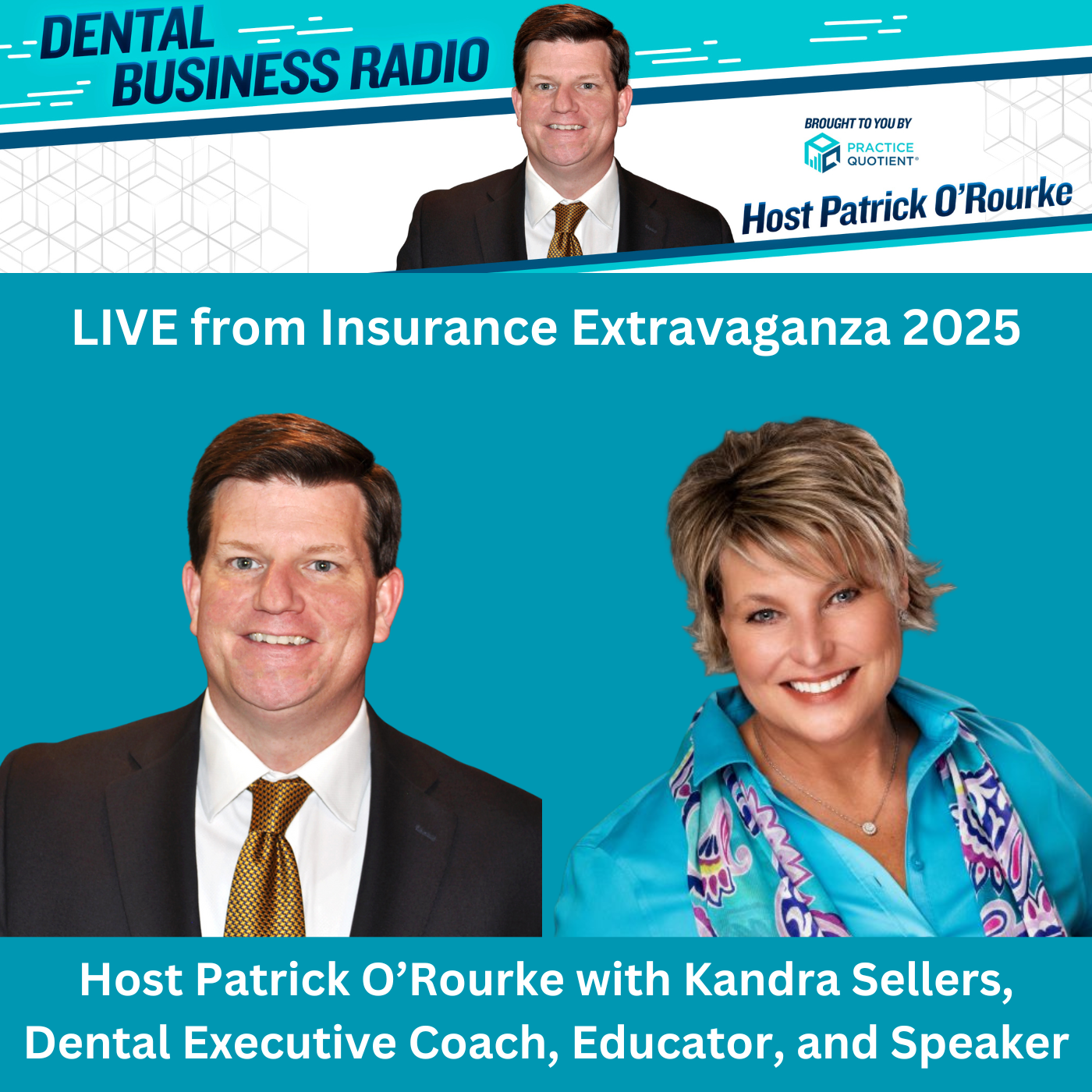
Live from Insurance Extravaganza 2025: Kandra Sellers, Pristine Interprofessional Academy and Tandem In-Practice Solutions

May 5, 2025 by John Ray

Live from Insurance Extravaganza 2025: Kandra Sellers, Pristine Interprofessional Academy and Tandem In-Practice Solutions, on Dental Business Radio with host Patrick O'Rourke
Dental Business Radio
Live from Insurance Extravaganza 2025: Kandra Sellers, Pristine Interprofessional Academy and Tandem In-Practice Solutions
Loading
00:00 /
RSS Feed
Share
Link
Embed

Download file

Live from Insurance Extravaganza 2025: Kandra Sellers, Pristine Interprofessional Academy and Tandem In-Practice Solutions, on Dental Business Radio with host Patrick O'Rourke

Live from Insurance Extravaganza 2025: Kandra Sellers, Pristine Interprofessional Academy and Tandem In-Practice Solutions (Dental Business Radio, Episode 59)

In this episode of Dental Business Radio, host Patrick O’Rourke broadcasts live from the 6th Annual Insurance Extravaganza. Special guest Kandra Sellers, a speaker at the event, discusses the integration of medical billing in dental practices. She explains various dental procedures that can be billed to medical insurance, the potential for higher reimbursements compared to dental insurance, and the importance of medical necessity. Sellers also highlights the challenges dental providers face when implementing medical billing and offers her support services to help practices navigate the process. 

Dental Business Radio is underwritten and presented by Practice Quotient: PPO Negotiations & Analysis and produced by John Ray and the North Fulton affiliate of Business RadioX®.

Kandra Sellers
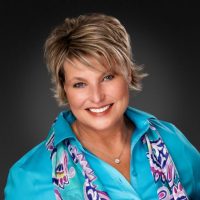
Kandra Sellers

Kandra Sellers, RDH, BA, is the owner and founder of Pristine Interprofessional Academy and Tandem In-Practice Solutions (T.I.P.S.), two organizations at the forefront of dental-medical collaboration and medical billing education. With over 25 years of experience in the dental industry, Kandra has held diverse roles as a dental hygienist, executive coach, educator, and speaker.

Kandra is widely recognized as a passionate and highly effective coach, helping dental practices elevate their standard of care and increase revenue by implementing advanced hygiene protocols and successful medical billing strategies. Through Pristine Interprofessional Academy, she has created programs that emphasize the oral-systemic link and provide hands-on coaching for both doctors and team members, ensuring practices are equipped to deliver optimal patient care and navigate the complexities of medical billing.

At T.I.P.S., Kandra leads a team dedicated to guiding dental practices through every step of the medical billing process, from documentation and pre-authorization to claim submission and appeals. Her approach focuses on integrity, ethics, and transparency, aiming to unite oral-systemic professionals and transform how dental and medical practices align for improved patient outcomes.

Kandra is also a sought-after speaker, motivator, and author, known for her ability to inspire teams and foster growth. Outside her professional pursuits, she enjoys traveling, spending time with her family, and advocating for children on the autism spectrum alongside her husband, John.

LinkedIn | Pristine Interprofessional Academy | Tandem In-Practice Solutions (T.I.P.S.)

Topics Discussed in this Episode

00:00 Introduction and Welcome to Dental Business Radio
00:20 Live from the Insurance Extravaganza with Kandra Sellers
01:06 Introduction to Medical Billing
01:20 Medical Billing Examples and Reimbursements
04:37 Network and Out-of-Network Providers
05:15 Understanding Blue Cross and Other Insurers
08:44 Challenges and Implementation of Medical Billing
14:36 Contact Information and Conclusion

About Dental Business Radio
Patrick O'Rourke
Patrick O’Rourke, Host of Dental Business Radio

Dental Business Radio covers the business side of dentistry. Host Patrick O’Rourke and his guests cover industry trends, insights, success stories, and more in this wide-ranging show. The show’s guests include successful doctors across the spectrum of dental practice providers, as well as trusted advisors and noted industry participants.

Dental Business Radio is underwritten and presented by Practice Quotient and produced by John Ray and North Fulton Business Radio, LLC, an affiliate of Business RadioX®. The show can be found on all the major podcast apps and a complete show archive is here.

Practice Quotient

Practice QuotientPractice Quotient is the sponsor of Dental Business Radio. Practice Quotient, Inc. serves as a bridge between the payor and provider communities. Their clients include general dentists and dental specialty practices across the nation of all sizes, from completely fee-for-service-only to active network participation with every dental plan possible. They work with independent practices, emerging multi-practice entities, and various large ownership entities in the dental space. Their PPO negotiations and analysis projects evaluate the merits of the various in-network participation contract options specific to your practice’s patient acquisition strategy. There is no one-size-fits-all solution.

Connect with Practice Quotient

Website | LinkedIn | Facebook | X (Twitter)
Tagged With: Dental Business Radio, dental industry, dental insurance, dental practices, dentists, Kandra Sellers, medical billing, Patrick O'Rourke, PPO Negotiations & Analysis, Practice Quotient

Cybersecurity Essentials for Dental Practices, with Katie Fox and Teresa Pichay, California Dental Association

December 5, 2024 by John Ray

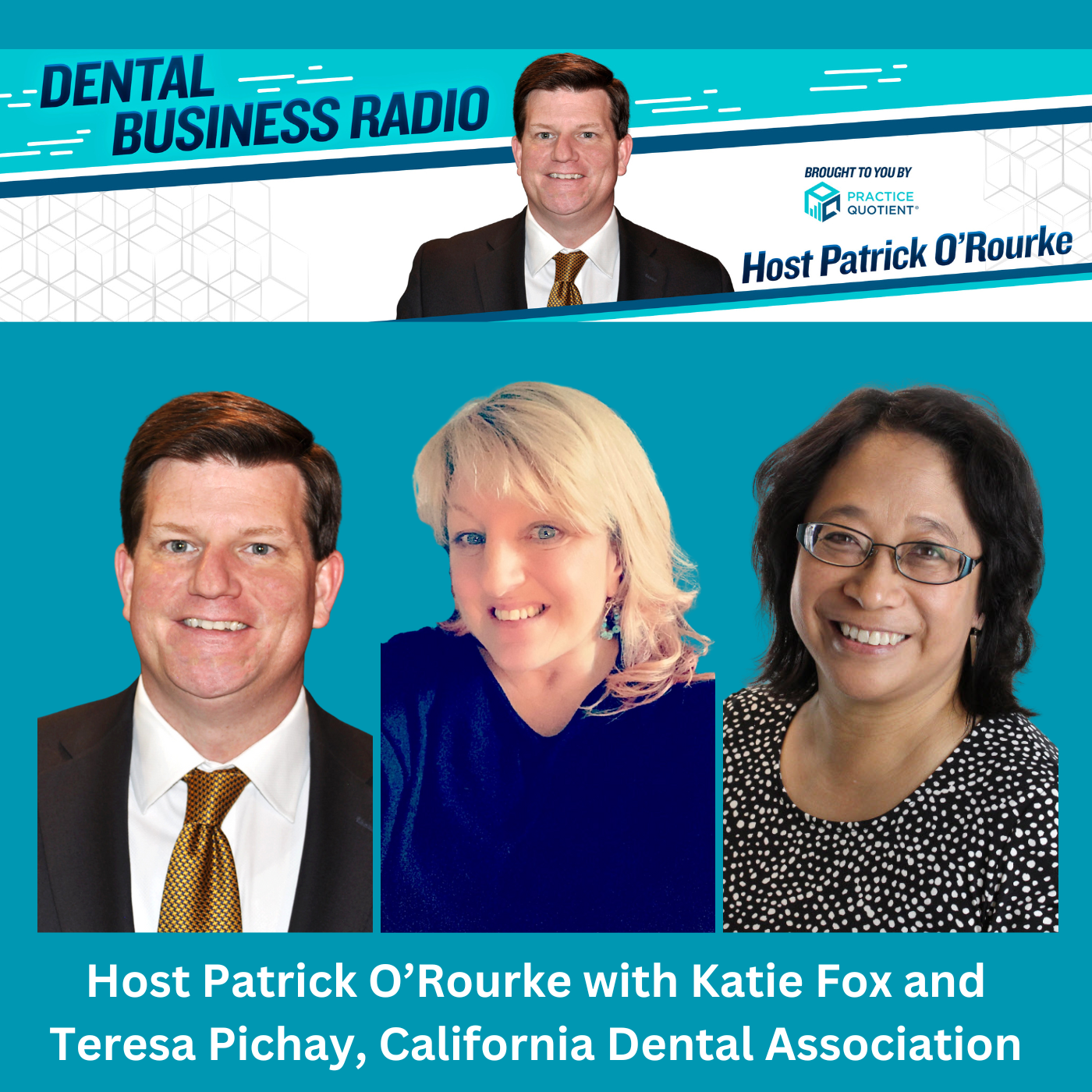
Cybersecurity Essentials for Dental Practices, with Katie Fox and Teresa Pichay, California Dental Association, appearing on Dental Business Radio with host Patrick O'Rourke
Dental Business Radio
Cybersecurity Essentials for Dental Practices, with Katie Fox and Teresa Pichay, California Dental Association
Loading
00:00 /
RSS Feed
Share
Link
Embed

Download file

Cybersecurity Essentials for Dental Practices, with Katie Fox and Teresa Pichay, California Dental Association, appearing on Dental Business Radio with host Patrick O'Rourke

Cybersecurity Essentials for Dental Practices, with Katie Fox and Teresa Pichay, California Dental Association (Dental Business Radio, Episode 55)

In this episode of Dental Business Radio, host Patrick O’Rourke discusses the critical topic of cybersecurity for dental practices with guests Katie Fox, cybersecurity engineer, and Teresa Pichay, senior regulatory compliance analyst for the California Dental Association (CDA). The conversation covers the importance of conducting a HIPAA-required risk analysis, employee training to prevent phishing attacks, and practical tips like using encryption and multi-factor authentication. They also explore the potential consequences of data breaches, the importance of proactive IT measures, and resources available for dental practitioners to enhance cybersecurity. The episode underscores the need for dental practitioners to balance patient care with robust cybersecurity measures to protect patient information and business integrity.

Dental Business Radio is underwritten and presented by Practice Quotient: PPO Negotiations & Analysis and produced by John Ray and the North Fulton affiliate of Business RadioX®.

Katie Fox

Katie Fox, California Dental Association
Katie Fox

Katie Fox is a cybersecurity professional with nearly 20 years of experience helping organizations of all shapes and sizes protect both their computer systems and the people who rely on them. As a security engineer at the California Dental Association, she works to keep sensitive data secure, minimize risks and ensure compliance with industry standards. Katie loves breaking down complex cybersecurity concepts into easy, actionable steps, helping organizations feel confident in their defenses. She’s excited to share her expertise on cybercrime trends and practical ways to keep your business secure and your people protected.

LinkedIn

Teresa Pichay

Teresa Pichay, California Dental Association
Teresa Pichay

Teresa Pichay, CHPC, is a senior regulatory compliance analyst for the California Dental Association. She specializes in regulatory compliance, including information verification, documentation strategies and referral to legal references. She has worked with CDA members for more than 26 years in the areas of occupational and environmental safety and health, HIPAA, the California Dental Practice Act and other business regulations.

LinkedIn

California Dental Association

The California Dental Association represents organized dentistry in the state of California.

Founded in 1870, CDA is committed to the success of our members in service to their patients and the public. CDA also contributes to the oral health of Californians through various comprehensive programs and advocacy.

CDA’s membership consists of more than 27,000 dentists, making it the largest constituent of the American Dental Association.

Website | LinkedIn | Instagram | Facebook | YouTube

Topics Discussed in this Episode

00:00 Introduction and Sponsor Acknowledgment
01:20 Meet the Cybersecurity Experts
02:03 The Importance of Cybersecurity for Dental Practices
04:49 Risk Analysis and HIPAA Compliance
09:28 Encryption and Multi-Factor Authentication
16:22 Handling Data Breaches and Patient Notifications
27:21 Exploring Password Management
27:30 Understanding the Dark Web
29:07 Dark Web and Its Implications
31:14 HIPAA Compliance Essentials
34:49 Choosing the Right IT Support
39:59 Employee Training and Cybersecurity
44:12 Final Thoughts and Shoutouts

About Dental Business Radio

Patrick O'Rourke
Patrick O’Rourke, Host of “Dental Business Radio”

Dental Business Radio covers the business side of dentistry. Host Patrick O’Rourke and his guests cover industry trends, insights, success stories, and more in this wide-ranging show. The show’s guests include successful doctors across the spectrum of dental practice providers, as well as trusted advisors and noted industry participants.

Dental Business Radio is underwritten and presented by Practice Quotient and produced by the North Fulton studio of Business RadioX®. The show can be found on all the major podcast apps and a complete show archive is here.

Practice Quotient

Practice QuotientPractice Quotient is the sponsor of Dental Business Radio. Practice Quotient, Inc. serves as a bridge between the payor and provider communities. Their clients include general dentists and dental specialty practices across the nation of all sizes, from completely fee-for-service-only to active network participation with every dental plan possible. They work with independent practices, emerging multi-practice entities, and various large ownership entities in the dental space. Their PPO negotiations and analysis projects evaluate the merits of the various in-network participation contract options specific to your practice’s patient acquisition strategy. There is no one-size-fits-all solution.

Connect with Practice Quotient

Website | LinkedIn | Facebook | X (Twitter)

Tagged With: California Dental Association, cybersecurity, cybersecurity training, Dental Business Radio, dental practices, dentistry, dentists, Katie Fox, Patrick O'Rourke, PPO Negotiations & Analysis, Practice Quotient, Teresa Pichay

Air Purification in Dentistry, with Dr. Nick Kavouklis, Surgically Clean Air®

July 29, 2024 by John Ray

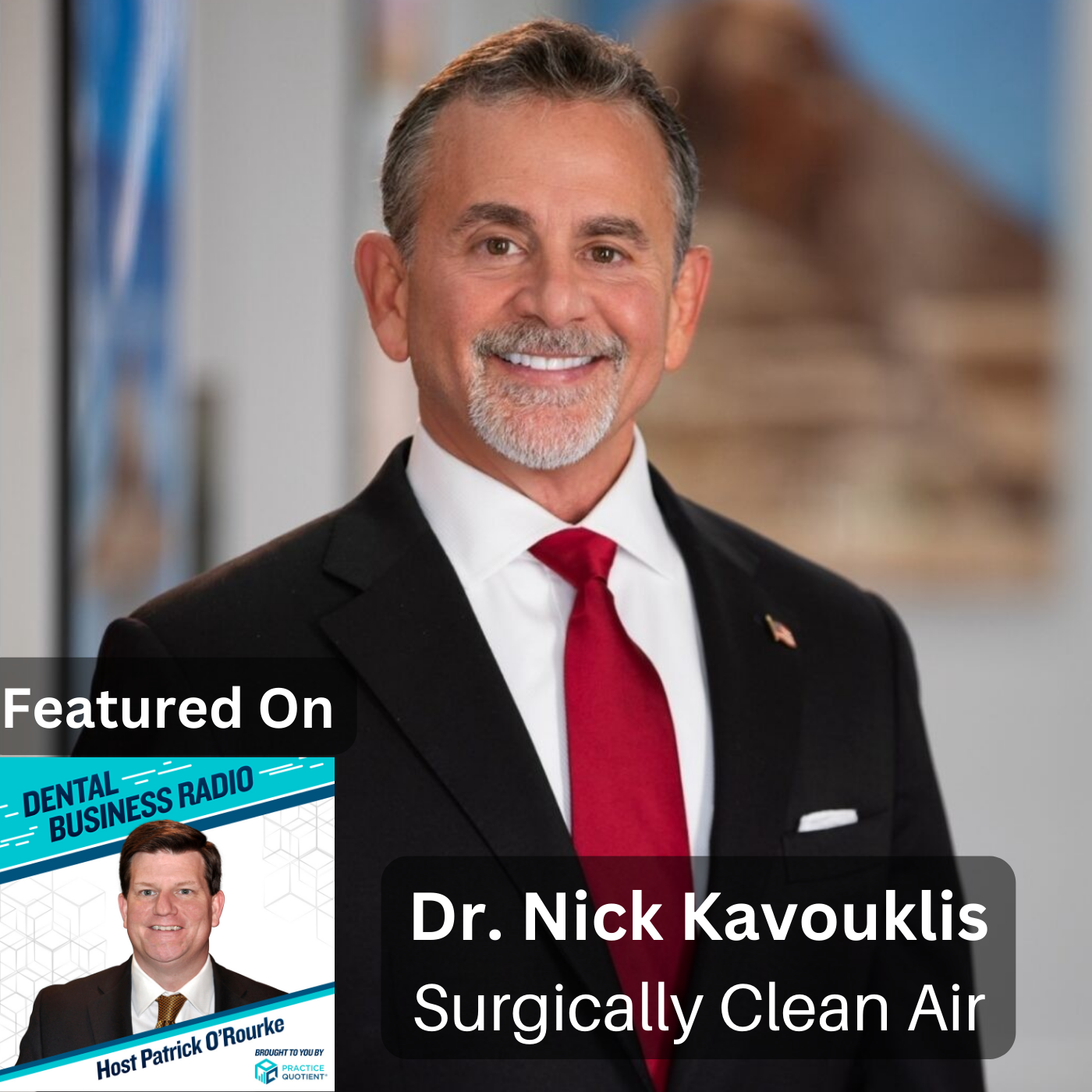
Dr. Nick Kavouklis Surgically Clean Air, on Dental Business Radio, with host Patrick O'Rourke
Dental Business Radio
Air Purification in Dentistry, with Dr. Nick Kavouklis, Surgically Clean Air®
Loading
00:00 /
RSS Feed
Share
Link
Embed

Download file

Dr. Nick Kavouklis Surgically Clean Air, on Dental Business Radio, with host Patrick O'Rourke

Air Purification in Dentistry, with Dr. Nick Kavouklis, Surgically Clean Air® (Dental Business Radio, Episode 51)

In this episode of Dental Business Radio, host Patrick O’Rourke talks with Dr. Nick Kavouklis, a dentist and serial entrepreneur turned air purification innovator. Broadcasting live from Tampa, Dr. Nick explains his latest venture into commercial-grade air purification systems specifically designed for dental office environments. Highlighting the importance of air quality, he discusses the benefits of these systems for both patient and staff safety and their potential to attract top-tier hygienists. The conversation also delves into the technical aspects of air filtration and its critical role in indoor air quality improvement, particularly for dental offices. Dr. Nick shares his journey from using particle counters to validate the effectiveness of his systems to acquiring the company producing these purification units. The episode offers commentary and resources for listeners to integrate these advanced air purification systems into their practices.

Dental Business Radio is underwritten and presented by Practice Quotient: PPO Negotiations & Analysis and produced by John Ray and the North Fulton studio of Business RadioX®.

Dr. Nick Kavouklis, CEO, Surgically Clean Air®

Dr. Nick L. Kavouklis is also a dedicated dentist and entrepreneur based in Tampa, Florida. He also established Dr. Nick’s White & Healthy Dentistry in 2010. Dr. Nick is committed to providing high-quality dental care, offering a wide range of services including preventive, restorative, aesthetic, and cosmetic dentistry. He has advanced training in various procedures, is certified in Oral Sedation and Invisalign, and has completed courses at LVI to enhance his skills in cosmetic dentistry.

Beyond his clinical practice, Dr. Kavouklis has made significant contributions to the dental and healthcare industries through various entrepreneurial ventures. He founded Argus Dental & Vision, Inc. in 2007, where he serves as CEO and President, administering dental and vision plans for over 600,000 policyholders. Previously, he was the President and CEO of Argus Legal, Dental Power and Argus Medical from 2001 to 2013, and he served as the Dental Director for the Physicians Health Care Plan, overseeing a network of dentists for a 250,000-member Medicaid Health Maintenance Organization.

Patients appreciate Dr. Kavouklis for his compassionate, patient-centered approach, and he is known for his ability to ease dental anxiety and handle complex cases. His commitment to continuous improvement and innovation in dental care makes him a respected figure in both clinical practice and healthcare entrepreneurship.

LinkedIn

Surgically Clean Air®

Surgically Clean Air specializes in advanced air purification solutions designed to enhance indoor air quality across various industries. Their medical-grade air purification systems, such as the Jade 2.0 and ONYXsca, utilize robust filtering technologies to eliminate airborne contaminants like pollen, dust, and viruses, thereby protecting professionals and improving the air we breathe.

The company initially focused on the dental market, providing air purification units that have significantly improved air quality in dental practices. Many dental offices report a noticeable reduction in dust and airborne particles, enhancing both patient and staff comfort and safety. In addition to dental offices, their products are widely used in healthcare facilities to maintain sterile environments, which is crucial for patient care and recovery.

Educational institutions also benefit from Surgically Clean Air’s systems, as schools and universities utilize these air purifiers to create safer learning environments. By reducing airborne contaminants, these institutions help protect students and staff from illnesses while improving overall air quality. Commercial offices have adopted Surgically Clean Air’s portable air purifiers to ensure a healthier workplace, addressing concerns about indoor air quality and contributing to a safer, more productive work environment.

The company’s offerings extend to residential spaces as well, providing clean air solutions for families. Their air purifiers are particularly beneficial for individuals with allergies or respiratory conditions, ensuring a healthier living space.

Surgically Clean Air’s products feature multiple stages of filtration, capturing over 99.9% of airborne particles. Constructed with premium materials and equipped with visual sensors for real-time air quality monitoring, their systems exemplify the company’s commitment to promoting health and sustainability. Through comprehensive air management solutions, Surgically Clean Air aims to foster healthier environments across a broad spectrum of applications, ensuring the well-being of users in various settings.

Website | LinkedIn | Facebook | Instagram

Topics Discussed in this Episode

00:00 Introduction and Welcome
00:42 Meet Dr. Nick Kavouklis
01:36 Dr. Nick’s Entrepreneurial Journey
04:12 The Importance of Air Purification in Dental Offices
06:22 Surgically Clean Air: Features and Benefits
10:43 Real-World Applications and Testimonials
12:55 How to Get Surgically Clean Air for Your Office
26:01 Closing Remarks

About Dental Business Radio

Patrick O’Rourke, Founder and CEO of Practice Quotient and Host of Dental Business Radio

Patrick O’Rourke, the host of Dental Business Radio, covers the business side of dentistry. O’Rourke and his guests discuss industry trends, insights, success stories, and more in this wide-ranging show. The show’s guests include successful doctors across the spectrum of dental practice providers, as well as trusted advisors and noted industry participants.

Dental Business Radio is underwritten and presented by Practice Quotient and produced by the North Fulton studio of Business RadioX®. The show can be found on all the major podcast apps, and a complete show archive is here.

Practice Quotient

Dental Business Radio is sponsored by Patrick O’Rourke, Founder & CEO of Practice Quotient. Practice Quotient, Inc. serves as a bridge between the payor and provider communities. Their clients include general dentists and dental specialty practices across the nation of all sizes, from completely fee-for-service-only to active network participation with every dental plan possible. They work with independent practices, emerging multi-practice entities, and various large ownership entities in the dental space. Their PPO negotiations and analysis projects evaluate the merits of the various in-network participation contract options specific to your practice’s patient acquisition strategy. There is no one-size-fits-all solution.

Connect with Patrick O’Rourke and Practice Quotient

Practice Quotient Website | LinkedIn | Facebook | Patrick’s Website | Patrick’s Twitter | Patrick’s Instagram

Tagged With: air purification, Dental Business Radio, dental practices, Dr. Nick Kavouklis, Indoor Air Quality, Patrick O'Rourke, PPO Negotiations & Analysis, Practice Quotient, Surgically Clean Air

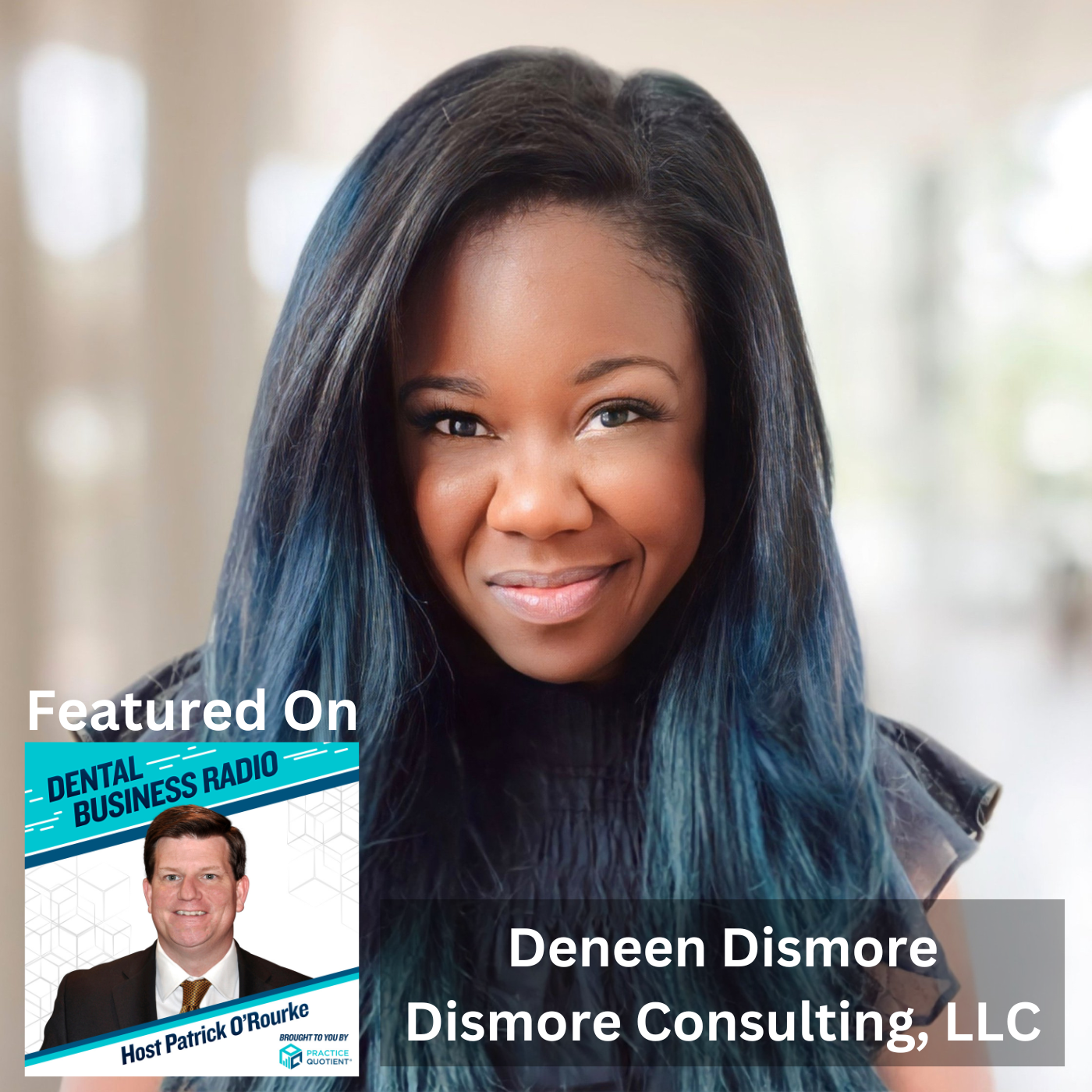
Dental Patient Acquisition, with Deneen Dismore, Dismore Consulting, LLC

December 15, 2023 by John Ray

Deneen Dismore
Dental Business Radio
Dental Patient Acquisition, with Deneen Dismore, Dismore Consulting, LLC
Loading
00:00 /
RSS Feed
Share
Link
Embed

Download file

Deneen Dismore

Dental Patient Acquisition, with Deneen Dismore, Dismore Consulting, LLC (Dental Business Radio, Episode 49)

In this episode, host Patrick O’Rourke discusses dental business strategies with guest Deneen Dismore, a new patient acquisition specialist. Deneen highlights the importance of understanding and expressing your unique selling proposition to attract the right patient demographic. She suggests focusing on building personal emotional connections with patients to drive business growth, and she emphasizes the crucial role of retention strategies in dental practices. Deneen shares how tailored welcome bags and patient relationships can generate referrals. Both Patrick and Deneen suggest hiring marketing directors for business growth and discuss the value of tracking and accountability in dental businesses.

Dental Business Radio is underwritten and presented by Practice Quotient: PPO Negotiations & Analysis and produced by the North Fulton studio of Business RadioX®.

Deneen Dismore, Dismore Consulting, LLC

Deneen Dismore
Deneen Dismore

Deneen Dismore is the outgoing CEO and Founder of Dismore Consulting and serves the dental community as a New Patient Acquisition Specialist. Born and raised in Long Island, New York, she’s no stranger to working in fast-paced environments that desire business growth.

While Deneen started her career in dentistry as the Marketing Director of two practices in Manhattan, she found her entrepreneurial calling after two career milestones. She was thrilled after nearly doubling the number of new patients in one practice. Then, Deneen led the marketing initiatives of another practice featured on Inc. 5000’s list of America’s fastest-growing companies.

While her career has led her to the hair, fitness and nutrition, and legal industries, her authority and passion remain in dentistry. And she’s served as a mentor and consultant for many other dental professionals and practice owners over the last 12 years.

Deneen is an unapologetic Harry Potter fan, a shameless self-development junkie, a huge fan of HGTV, and a self-described “outgoing introvert.” She is the proud mother of a one-year-old boy, Matthew, so staying active is a must! You can catch her working out at home, taking neighborhood walks with her son, or enjoying the occasional spin class.

Website | LinkedIn | Instagram | Facebook

Questions and Topics in this Interview:

00:03 Introduction and Sponsor Acknowledgement
01:01 Guest Introduction: Deneen Dismore
01:23 Deneen’s Background and Journey to Dental Business
02:37 Understanding the Role of a New Patient Acquisition Specialist
04:44 Deneen’s Personal Journey into the Dental Business
08:51 The Importance of Knowing Your Unique Selling Proposition
14:35 The Role of Retention in Dental Practice Growth
19:50 Comparing Marketing Strategies for Small and Large Practices
23:19 The Impact of PPOs on Dental Practices
23:49 Understanding Dental Insurance Perceptions
24:25 Creating Client Personas for Better Communication
25:51 Building Trust and Value with Patients
26:23 The iPhone Analogy: Value Over Cost
28:18 Addressing the PPO Dentist Perception
30:36 The Importance of Referrals in Dental Practice
38:16 The Power of Patient Gift Bags
40:48 Closing Remarks and Contact Information

About Dental Business Radio

Patrick O’Rourke, Host of “Dental Business Radio”

Patrick O’Rourke is the host of Dental Business Radio covers the business side of dentistry. O’Rourke and his guests cover industry trends, insights, success stories, and more in this wide-ranging show. The show’s guests include successful doctors across the spectrum of dental practice providers, as well as trusted advisors and noted industry participants.

Dental Business Radio is underwritten and presented by Practice Quotient and produced by the North Fulton studio of Business RadioX®. The show can be found on all the major podcast apps, and a complete show archive is here.

Practice Quotient

Dental Business Radio is sponsored by Patrick O’Rourke, Founder & CEO, Practice Quotient. Practice Quotient, Inc. serves as a bridge between the payor and provider communities. Their clients include general dentists and dental specialty practices across the nation of all sizes, from completely fee-for-service-only to active network participation with every dental plan possible. They work with independent practices, emerging multi-practice entities, and various large ownership entities in the dental space. Their PPO negotiations and analysis projects evaluate the merits of the various in-network participation contract options specific to your practice’s patient acquisition strategy. There is no one-size-fits-all solution.

Connect with Patrick O’Rourke and Practice Quotient

Practice Quotient Website | LinkedIn | Facebook | Patrick’s Website | Patrick’s Twitter | Patrick’s Instagram


Tagged With: Deneen Dismore, Dental Business Radio, dental insurance contracts, dental marketing, dental patients, dental practice management, dental practices, new patient acquisition, patient acquisition strategy, Patrick O'Rourke, PPO, PPO Negotiations & Analysis, Practice Quotient

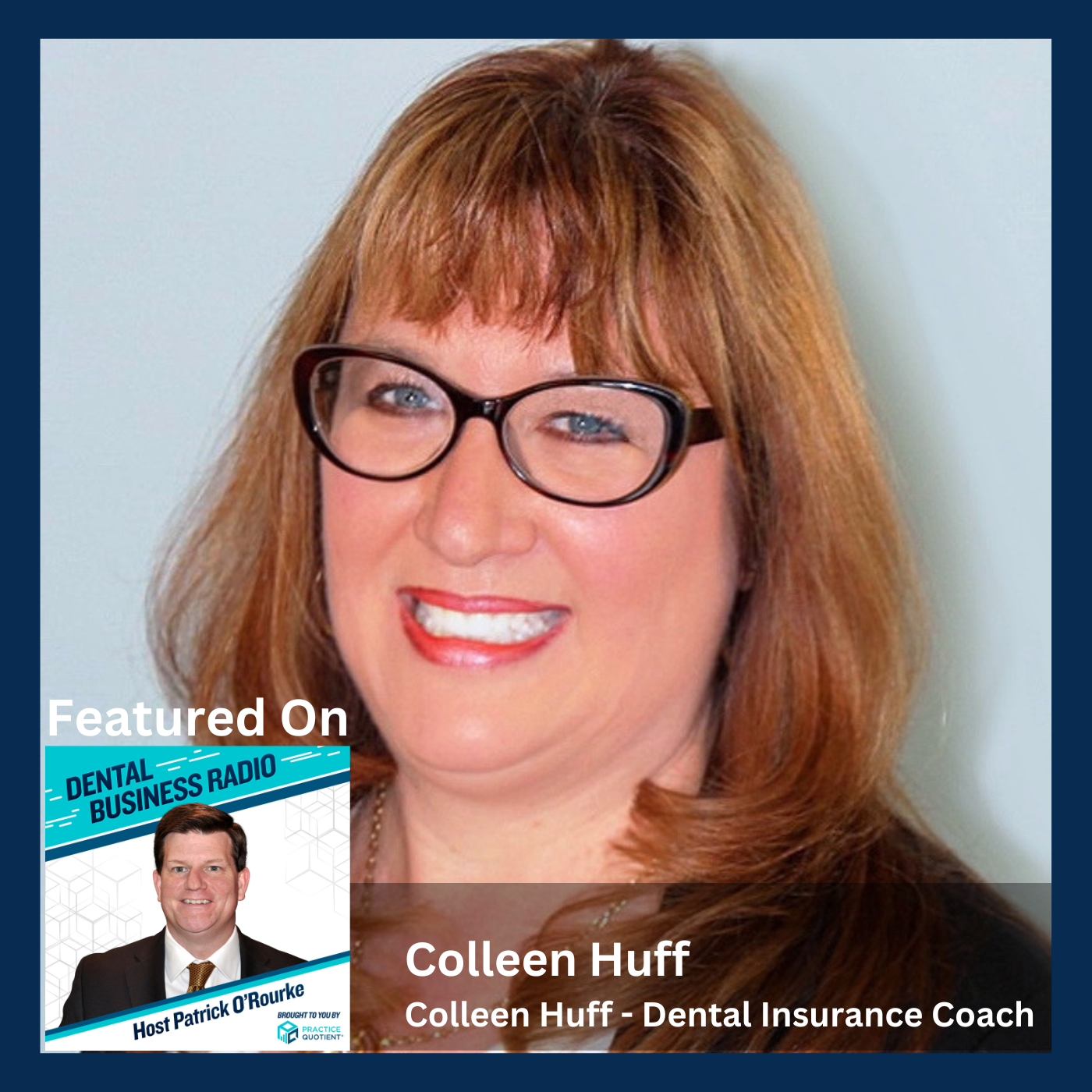
Colleen Huff, Dental Insurance Coach

October 24, 2023 by John Ray

Colleen Huff
Dental Business Radio
Colleen Huff, Dental Insurance Coach
Loading
00:00 /
RSS Feed
Share
Link
Embed

Download file

Colleen Huff

Colleen Huff, Dental Insurance Coach (Dental Business Radio, Episode 48)

Highly regarded dental insurance coach Colleen Huff joined host Patrick O’Rourke to discuss the complexities of dental insurance and the strategies necessary for practices to effectively manage it.  They talked about the importance of understanding insurance benefits, the trend of practices going out of network, and the role of outsourcing insurance-related tasks. Colleen noted the need for accurate insurance breakdowns, the importance of having checks and balances in place to prevent errors or embezzlement, and much more.

Dental Business Radio is underwritten and presented by Practice Quotient: PPO Negotiations & Analysis and produced by the North Fulton studio of Business RadioX®.

Colleen Huff, FAADOM, President and Owner, Colleen Huff – Dental Insurance Coach

Colleen Huff, FAADOM, President and Owner, Colleen Huff – Dental Insurance Coach

Colleen Huff, FAADOM, has been in the dental field for 28+ years. Starting as a dental customer service representative, she has worked in and managed dental offices during this time. Her experiences span managing multi-location practices to growing a practice from the ground up. Colleen began full-time speaking and consulting in 2021.

She helps dental practices around the country improve their Dental Insurance knowledge and administrative systems, as well as traveling the country speaking at national conventions as well as local AADOM Chapters on a variety of Dental Insurance topics. You can find her Insurance Mastery course at Front Office Rock.

She is the founder of the Buffalo/WNY AADOM Chapter, as well as an active Ambassador and Fellow class of 2015. For her leadership, she was named one of the TOP 25 Women in Dentistry, 2017 by Dental Products Reports. Colleen is a proud member of NADP (National Association of Dental Plans), DCC-Dental Consultants Connection, SCN- Speakers Consultant Network, AADOM- American Association of Dental Office Management as well as ASCA- AADOM Speaker/Consultant Alliance and DEW-Dental Entrepreneur Woman along with being licensed to speak on dental codes through the ADA.

Website | LinkedIn | Facebook

About Dental Business Radio

Patrick O’Rourke, Host of “Dental Business Radio”

Patrick O’Rourke is the host of Dental Business Radio covers the business side of dentistry. O’Rourke and his guests cover industry trends, insights, success stories, and more in this wide-ranging show. The show’s guests include successful doctors across the spectrum of dental practice providers, as well as trusted advisors and noted industry participants.

Dental Business Radio is underwritten and presented by Practice Quotient and produced by the North Fulton studio of Business RadioX®. The show can be found on all the major podcast apps, and a complete show archive is here.

Practice Quotient

Dental Business Radio is sponsored by Patrick O’Rourke, Founder & CEO, Practice Quotient. Practice Quotient, Inc. serves as a bridge between the payor and provider communities. Their clients include general dentists and dental specialty practices across the nation of all sizes, from completely fee-for-service-only to active network participation with every dental plan possible. They work with independent practices, emerging multi-practice entities, and various large ownership entities in the dental space. Their PPO negotiations and analysis projects evaluate the merits of the various in-network participation contract options specific to your Practice’s patient acquisition strategy. There is no one-size-fits-all solution.

Connect with Patrick O’Rourke and Practice Quotient

Practice Quotient Website | LinkedIn | Facebook | Patrick’s Website | Patrick’s Twitter | Patrick’s Instagram

Tagged With: Colleen Huff, Colleen Huff Dental Insurance Coach, Dental Business Radio, dental insurance, dental insurance coach, dental practices, Patrick O'Rourke, PPO Negotiations & Analysis, Practice Quotient

Best Practices for Employee Offer Letters

December 2, 2022 by John Ray

Best Practices for Employee Offer Letters
Advisory Insights Podcast
Best Practices for Employee Offer Letters
Loading
00:00 /
RSS Feed
Share
Link
Embed

Download file

Best Practices for Employee Offer Letters

Best Practices for Employee Offer Letters (Advisory Insights Podcast, Episode 20)

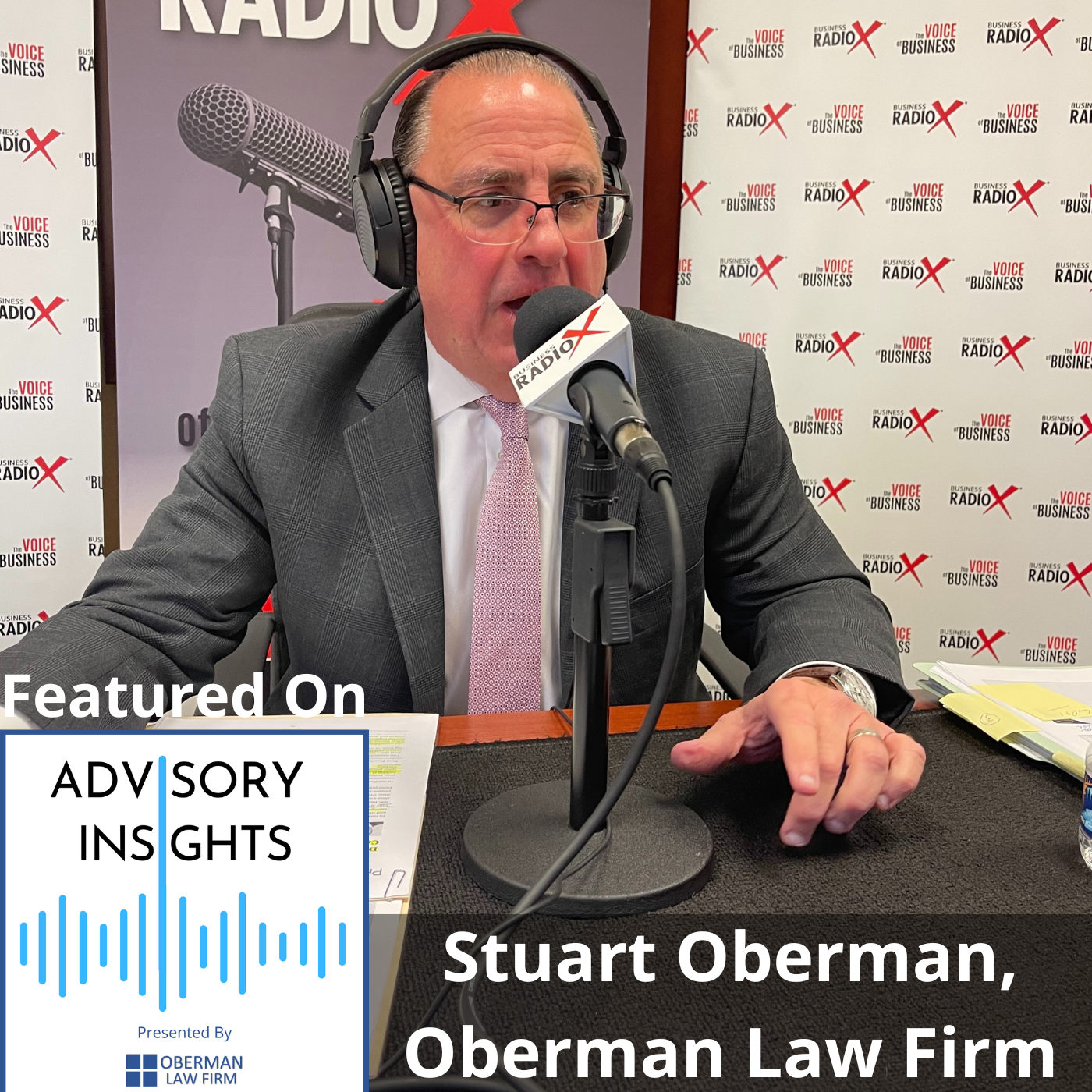
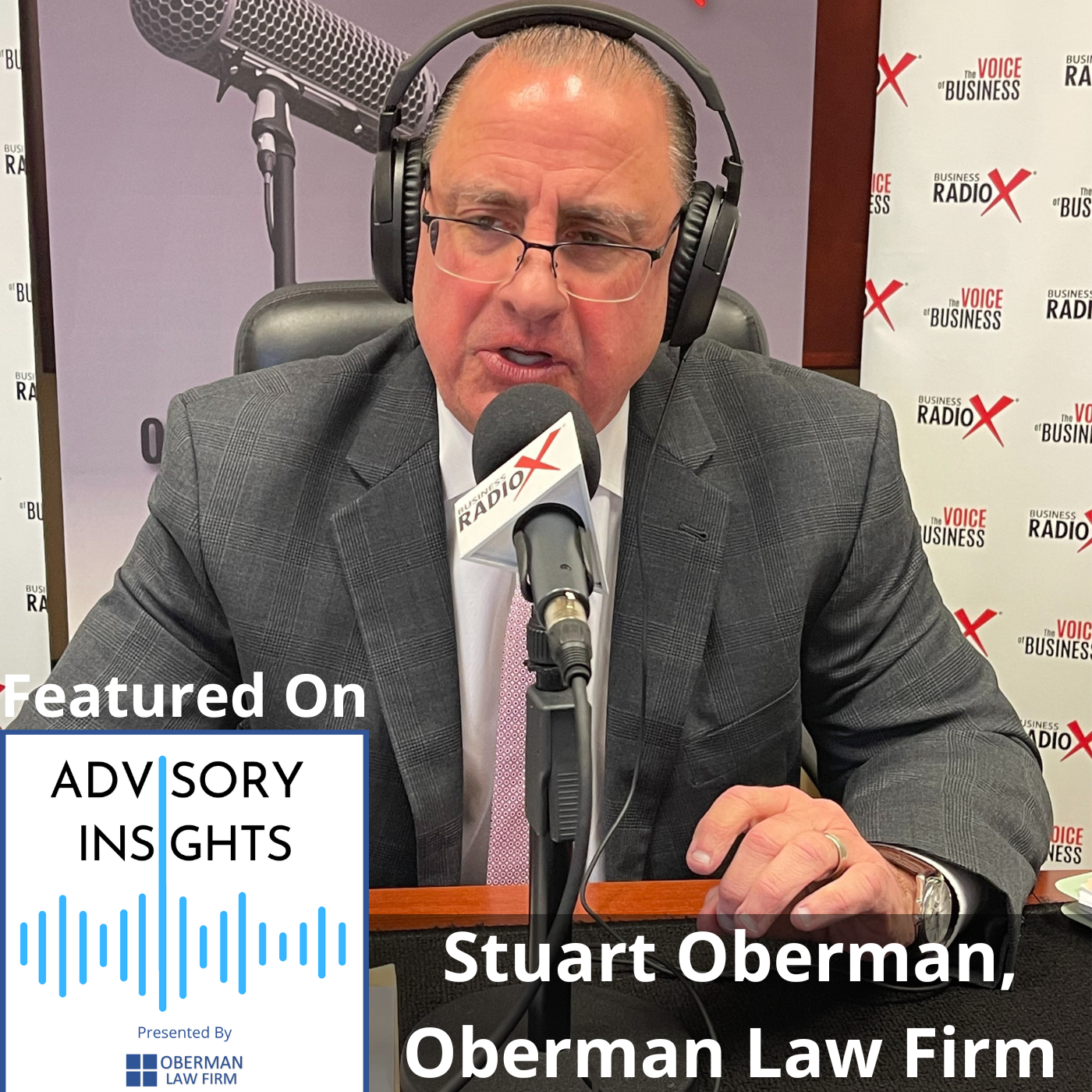
On this episode of Advisory Insights, Stuart Oberman of Oberman Law Firm discusses why offer letters for employees are so vital and best practices for offer letters. He emphasizes that offer letters can make or break a company, and advises employers to document salary, benefits, performance reviews, and special conditions in their offer letters.

Advisory Insights is presented by Oberman Law Firm and produced by the North Fulton studio of Business RadioX®. The series can be found on all the major podcast apps. You can find the complete show archive here.

TRANSCRIPT

Intro: [00:00:01] Broadcasting from the studios of Business RadioX, it’s time for Advisory Insights. Brought to you by Oberman Law Firm, serving clients nationwide with tailored service and exceptional results. Now, here’s your host.

Stuart Oberman: [00:00:20] Welcome everyone to Advisory Insights, Stuart Oberman. Folks, we’re going to drill it down today. So, in the Great Resignation, in the Great Boomerang, in the great process of I’m going to hang around for the job for a while and see what it does, I’m gonna lay low, assuming that you had an interview that was squeaky clean – as we mentioned on some other podcasts – assume that you did everything correct, you loved your candidate, now you’re going to offer them the job. This is where it gets sort of tricky.

Stuart Oberman: [00:00:53] We’re going to take you through the topic for today, Best practices for employee offer letters. You’re probably thinking, “Well, I really don’t even offer my employees an offer letter.” That’s a big mistake. Every employee that you hire should have some type of offer letter. I don’t care what the industry you’re in, your employees need an offer letter.

Stuart Oberman: [00:01:19] Now, we’ve seen some disastrous offer letters. We’ve seen some good ones. I would walk through some basics. I mean, our offer letters that we offer our employees at the firm, obviously, are very long. Some may be very short. But I want to walk through some basics.

Stuart Oberman: [00:01:36] So, first and foremost, the key is that employee offer letters should never, ever, ever be considered an employee contract. If you have any doubt whether or not your offer letter is an employee contract, I would urge you to call your local council, whoever your general counsel is for the business. Ask them, “Does this have employment contract language in it? Am I going to get burned?” I want all language that creates an employment contract out. I want all that language out. At no time should your offer letters ever, ever, ever have language in there regarding employment contract.

Stuart Oberman: [00:02:23] Now, I want to walk through some basics. You know, for every job, there are so many variables for an employment contract. I get that, but I want an offer letter. What’s the guidelines? What are you doing upfront? What are the obligations of you? What are the obligations of your employee without even entering into an employment contract? There’s millions and millions of people that have jobs that don’t have contracts, but they should have offer letters which outlines certain things.

Stuart Oberman: [00:02:53] I want to know what your start date is, that should be in an offer letter. When you start, do you start two weeks? Is it tentative? Is it depending on whether or not your candidate has to get fired, laid off from the other job, or quit?

Stuart Oberman: [00:03:10] Contingencies – first and foremost, you’ve got to be careful with this one – are you requiring that employee to pass a drug test? Now, why do I say that? Because states are starting to limit drug tests.

Stuart Oberman: [00:03:24] Now, in our previous podcast, we talked about employees and employers that are dealing with the marijuana issue. That’s a huge topic right now. Are employers working around the marijuana issue? Some of them want to test for it, some of them want to go into panels. Drug tests, but you got to be careful. So, people in this podcast are listening not only in different countries but different parts of the region in the States, what does your local state say, what does the federal law say about drug tests?

Stuart Oberman: [00:03:57] Next, background test screening. We’re seeing a lot of pushback on this issue. You’ve got to make sure you understand what your Local and State Law is for this. Job title, “Well, I don’t really have a job title. We just come to work.” That’s not going to work in today’s world. They need a job title. What’s their title? And then, does it correspond with the employee manual? So, I have a job title, but I have no job description. So, really, the title is worthless because you’ve got no description as to what that guideline is. How are you tracking your employees and what their protocols are? Job titles, job descriptions in that employee manual.

Stuart Oberman: [00:04:39] I would tell you, the podcasts we’re doing and articles that we write as a firm, we can’t stress enough employee manuals. And it’s going to vary from industry, but if you don’t have an employee manual, folks, you’ve got to get one. Because, otherwise, you’re going to lose a lot of governmental arguments that relate to employment law and those kind of things.

Stuart Oberman: [00:05:00] So, salary, how are you paid? Are you exempt, non-exempt? Here’s a new one, are your salary non-exempt? Are you hourly non-exempt? How are you categorized? You need to know that. Is what you’re categorizing legal? What are your benefits? Health insurance, paid vacation. What does your employee manual say? PTO, leave. Folks, you’ve got to put your benefits down, 401(k)s matching, simple IRAs matching. What’s the protocols? What do you need to put in there?

Stuart Oberman: [00:05:40] Now, what we see a lot of times missing is performance reviews. How often are you going to do performance reviews once a year, once a quarter, every six months? Now, when a candidate starts, do you have a 90 day review period? Hopefully, the answer to that is, “Yes, I do.” If not, get one.

Stuart Oberman: [00:06:05] Now, the biggest question, employment at will. Every person you hire should be at will. Depending on the state, it will depend on how they define at will. But every, every, every offer letter needs to say at will.

Stuart Oberman: [00:06:21] Next, special conditions, two very hot topics on the local, state, and national level, non-competes. Folks, we’re seeing a lot and a lot of pushback on these areas. We’re starting to see some trends regarding how much you make as an employee. Do you even apply to that non-compete? If you make over 100,000 or 120, you know, what profession are you in? Do you have restrictions on your non-competes? You’ve got to look at that, folks, especially if you are a cross-border company where you may have 20 employees that work in 20 different states.

Stuart Oberman: [00:07:00] You know, sometimes I’ll ask the question to our employers, what states are your employees in and what states do you need guidance on? And their answer is, it’s easier to tell you what states we’re not in than the states that we are in. So, again, what are we looking at? Non-solicitation, I don’t care what your title is or what your job description is if you’re an employee, folks, your employees need non-solicitation. If they leave, they’re taking their stuff, they’re taking their list, they’re taking their confidential information, they’re taking your letterhead, they’re taking everything they’re using because they’re going to the next level, they’re going to the next company, and they’re going to utilize whatever they learned from you or Skyped from you or lifted from you, whatever you want to call the term.

Stuart Oberman: [00:07:50] Folks, I tell you, that’s a quick podcast but it is so very important that, one, you interview your candidate in the proper way, and we’ve discussed that on previous podcasts. Two, that you know exactly what you can do as far as drug tests and background tests. Do you even allow those? Once you get past that step, I want you to do offer letters. Again, if you don’t have an offer letter that you need council to review, get one. I cannot stress that enough. You’ve got to have guidelines for your employees. Salary, benefits, performance reviews, special conditions, folks, they’re all critical. Sometimes they will make or break a company depending on who’s coming and who’s going.

Stuart Oberman: [00:08:39] Folks, that is all for today’s podcast. Offer letters, you got to have them, folks. You got to have them. Stuart Oberman, Advisory Insights. Thank you so much for joining us today. If you have any questions, please feel free to give us a call, Oberman Law Firm, 770-886-2400 or email me, stuart – that’s S-T-U-A-R-T – @obermanlaw.com. Folks, thanks so much. Thanks for listening. Have a fantastic day.

Outro: [00:09:10] Thank you for joining us on Advisory Insights. This show is brought to you by Oberman Law Firm, a business-centric law firm representing local, regional, and national clients in a wide range of practice areas, including health care, mergers and acquisitions, corporate transactions, and regulatory compliance.

About Advisory Insights Podcast

Presented by Oberman Law Firm, Advisory Insights Podcast covers legal, business, HR, and other topics of vital concern to healthcare practices and other business owners. This show series can be found here as well as on all the major podcast apps.

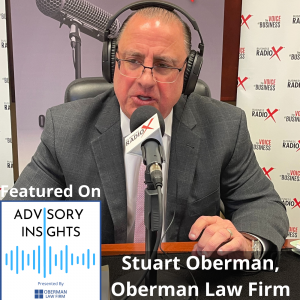
Stuart Oberman, Oberman Law Firm

Oberman Law Firm

Stuart Oberman is the founder and President of Oberman Law Firm. Mr. Oberman graduated from Urbana University and received his law degree from John Marshall Law School. Mr. Oberman has been practicing law for over 25 years, and before going into private practice, Mr. Oberman was in-house counsel for a Fortune 500 Company. Mr. Oberman is widely regarded as the go-to attorney in the area of Dental Law, which includes DSO formation, corporate business structures, mergers and acquisitions, regulatory compliance, advertising regulations, HIPAA, Compliance, and employment law regulations that affect dental practices.

In addition, Mr. Oberman’s expertise in the healthcare industry includes advising clients in the complex regulatory landscape as it relates to telehealth and telemedicine, including compliance of corporate structures, third-party reimbursement, contract negotiations, technology, health care fraud, and abuse law (Anti-Kickback Statute and the State Law), professional liability risk management, federal and state regulations.

As the long-term care industry evolves, Mr. Oberman has the knowledge and experience to guide clients in the long-term care sector with respect to corporate and regulatory matters, assisted living facilities, continuing care retirement communities (CCRCs). In addition, Mr. Oberman’s practice also focuses on health care facility acquisitions and other changes of ownership, as well as related licensure and Medicare/Medicaid certification matters, CCRC registrations, long-term care/skilled nursing facility management, operating agreements, assisted living licensure matters, and health care joint ventures.

In addition to his expertise in the health care industry, Mr. Oberman has a nationwide practice that focuses on all facets of contractual disputes, including corporate governance, fiduciary duty, trade secrets, unfair competition, covenants not to compete, trademark and copyright infringement, fraud, and deceptive trade practices, and other business-related matters. Mr. Oberman also represents clients throughout the United States in a wide range of practice areas, including mergers & acquisitions, partnership agreements, commercial real estate, entity formation, employment law, commercial leasing, intellectual property, and HIPAA/OSHA compliance.

Mr. Oberman is a national lecturer and has published articles in the U.S. and Canada.

LinkedIn

Oberman Law Firm

Oberman Law Firm has a long history of civic service, noted national, regional, and local clients, and stands among the Southeast’s eminent and fast-growing full-service law firms. Oberman Law Firm’s areas of practice include Business Planning, Commercial & Technology Transactions, Corporate, Employment & Labor, Estate Planning, Health Care, Intellectual Property, Litigation, Privacy & Data Security, and Real Estate.

By meeting their client’s goals and becoming a trusted partner and advocate for our clients, their attorneys are recognized as legal go-getters who provide value-added service. Their attorneys understand that in a rapidly changing legal market, clients have new expectations, constantly evolving choices, and operate in an environment of heightened reputational and commercial risk.

Oberman Law Firm’s strength is its ability to solve complex legal problems by collaborating across borders and practice areas.

Connect with Oberman Law Firm:

Company website | LinkedIn | Twitter

Tagged With: Advisory Insights, Advisory Insights Podcast, dental practices, employment law, Oberman Law, Oberman Law Firm, offer letter, Stuart Oberman

Should You Be Paying Employees for Travel Time?

November 25, 2022 by John Ray

Should You Pay Employees for Travel Time?
Advisory Insights Podcast
Should You Be Paying Employees for Travel Time?
Loading
00:00 /
RSS Feed
Share
Link
Embed

Download file

Should You Pay Employees for Travel Time?

Should You Be Paying Employees for Travel Time? (Advisory Insights Podcast, Episode 19)

On this episode of Advisory Insights, Stuart Oberman of the Oberman Law Firm discusses the topic of employee travel time, particularly the 1947 Portal-to-Portal Act and how it addresses job to job travel. He advises employers to have a clear policy in place to avoid costly mistakes, and urges them to keep track of travel-related expenses and policy changes.

Advisory Insights is presented by Oberman Law Firm and produced by the North Fulton studio of Business RadioX®. The series can be found on all the major podcast apps. You can find the complete show archive here.

TRANSCRIPT

Intro: [00:00:02] Broadcasting from the studios of Business RadioX, it’s time for Advisory Insights. Brought to you by Oberman Law Firm, serving clients nationwide with tailored service and exceptional results. Now, here’s your host.

Stuart Oberman: [00:00:20] Welcome everyone to Advisory Insights. Stuart Oberman here. All right, folks, we’re going to drill down on some things that is a topic that, really, we didn’t see much during COVID. But now as everything is starting opening up, we’re going to talk about employees that travel. Today’s topic, Do employers have to pay for employee travel or commute time?

Stuart Oberman: [00:00:43] You’re probably thinking to yourself, “No, I do not.” But the question is you’re probably wrong, depending on your business. And two, do you even have a policy for that? And are you even paying overtime? So, I want to hit a couple of topics going down this particular road that I want everyone to take a look at, because at some point your employees do something somewhere for you, whether they’re traveling from their home, whether they’re going to their office. A lot of our clients go on conventions, how are you paying? How are you paying? Travel, no travel, gas, no gas, overtime, no overtime. So, these are things I want to look at.

Stuart Oberman: [00:01:21] First, I want to take a look at whether an employer has to pay its non-exempt employees overtime. Are they even eligible? That’s your first question. So then, we want to look in today’s podcast looking at work related travel. That will include time spent getting to and from office or job sites. What if you’re a construction company and you have people driving from the office to the job site? What about from home to the job site? What about from job site-home? Do you even have a regulation for that? Are they driving company vehicles? These are things you have to ask.

Stuart Oberman: [00:02:10] So, I want to look at really two fundamental principles. One, actually performing work related tasks regardless, regardless of the day of the week, the time, or location. How is it being paid? Do you have employees that work on Saturdays at their home, Sundays at home, after hours, they’re coming home? How are you paying that? How are you verifying that?

Stuart Oberman: [00:02:33] Principle number two, the cornerstone of all this discussion is the 1947 Portal-to-Portal Act and its amendments to the Fair Labor Standards Act. Folks, that will put you to sleep if you read that. But essentially what it is, it’s employees spending time commuting from their home to the workplace, where do they begin the workday, and how do they end? Are they being paid for it going back home?

Stuart Oberman: [00:03:08] So, for those of you that never heard of the Portal-to-Portal Act and how it is related to the Fair Labor Standards Act, which governs what your employees do and what you pay every day, if you say I have no idea, I would advise you strongly to call someone who knows what that is.

Stuart Oberman: [00:03:31] Now, a couple topics. Do you have a policy for midday travel? Under federal regulations that’s considered all in a day’s work rule. You’re going to go down a road on that one. We’re not even going to go down there today because we’re going to go down for hours on that one.

Stuart Oberman: [00:03:52] So, what is it? It’s travel to the job site to job site during the workday. If you have a person that’s going job to job, site to site traveling salesman, construction foreman, whatever it is, do you have a regulatory item that you’re looking at and what are you guided by?

Stuart Oberman: [00:04:11] Next, I want you to look at multiple worksites. So, what if an employee reports to different sites each morning? Does that render the home to work commute not normal or ordinary? That’s a question you’ve got to ask yourself. And is that time spent on the road – big word – compensable overtime? Are you paying for that? How are you paying for it or why aren’t you paying for it? Are you even tracking that employee’s time?

Stuart Oberman: [00:04:47] Another hot topic, pre-commute activities. We have a lot and a lot of people that do work at their home before they even leave. I know I do. I know I do. My day starts at 5:30, and I’m doing work before I leave the house for the office. So, what if an employee brings some work home at night and then goes to the office, are they working at night? Are they working during the day? How are you tracking that? That is what we call a pre-commute activity. Do you have a regulatory item of review for that?

Stuart Oberman: [00:05:24] The next topic I want you to take a look at – these are all things I want you to understand that, again, are much too detailed for this podcast, but at least you know the topic and what it relates to and how it relates to what you do – same day travel to another city.

Stuart Oberman: [00:05:42] I’m located in Atlanta. Suppose I go to Chattanooga. You know, or I’ve got a company that’s in South Atlanta and they travel to Nashville for the day? That’s what we call special one day assignments. Do you have a policy in place for that or do you even track that? Because I will guarantee you, your employees that leave, folks, they’re tracking that. And you better be aware they are tracking it because otherwise they’re going to track it for you, which is never a good day.

Stuart Oberman: [00:06:14] So, let’s take a look at, also, do you have a policy in place for travel involving an overnight stay? Do you even have overtime travel expenses outlined? Are you paying overtime? How are you paying your people that travel? You know, again, through the COVID, everyone was locked down, no travel. And now, folks, it is wide open. If you look at the papers, you listen to the news, travel, it explodes. The airlines can’t keep up with it. Hotels are doing real well, You know, rush hour traffic going to and from on holidays, I mean, it’s amazing. So, how do you have overnight travel? How do you handle that?

Stuart Oberman: [00:06:58] Also, travel from a hotel to a worksite or worksite to hotel. Again, where are your salespeople going? Are they spending the night? How are they spending the night with their time? Are they working on their laptop when they’re at the hotel? How are you tracking that? You better believe they’re tracking that. Are they working at the hotel before they leave? That can be overtime. How are you tracking your job site issues? Is that going to be O.T.?

Stuart Oberman: [00:07:27] Now, question, what if driving is part of the job? You know, the FLSA, it outlines an employee who drives a bus, a car, automobile, boat, plane as part of their job. Do you have anything in place that outlines that, “Hey, we’re not paying you overtime, Mr. Employee or Ms. Employee, because it’s outlined here we’re not doing that.”

Stuart Oberman: [00:07:54] Now, the wonderful world of COVID, remote, flexible, agile – the keyword of today – agile work conditions. What if you have an employee that’s hoteling working remote, flexible hours? A agile working arrangement where they come into some particular place two or three times a week. Or what about two or three times a month? What’s the regulatory matter? Are you requiring them to come into the office? Are you requiring them to come into their location, whether it’s remote, not remote?

Stuart Oberman: [00:08:35] Now, I want to ask you this question, so do you have or do you even know the consequences of compensable travel time? Are you tracking those? Do you know when you must pay the employees? Do you have a process in place to track the time? First and foremost, how are you tracking time? “Well, my employees have logs.” I will tell you, employers are not keeping track of their logs.

Stuart Oberman: [00:09:02] I would venture to say that if you have an employee company car and you say,”Hey, Mr. Employee, Ms. Employee. I want you to produce your logs. I want to see how up to date they are.” I’m going to go out on a limb, I’m going to say at least 80 to 90 percent are not even up to date maybe in a day or two, some even months. So, I think you got to have a process in place of how much you’re paying them. Are they overtime hours? Are they not overtime hours? And what’s the threshold? Do your hours start at 42 hours O.T.? Do your hours start at 46 O.T.?

Stuart Oberman: [00:09:40] Next question is, how are you paying for travel? How much is compensable travel? Folks, you got people on the road and you got guys going to job, to job, to job, to job. You’ve got to ask yourself all these topics we went through today, how am I paying these people? And then, does paying for travel make it hours worked? How are you calculating these things?

Stuart Oberman: [00:10:06] So, employees often wonder, you know, what’s hours worked considered? Do I even have a definition of hours worked? Chances are probably not. I would venture to say that all the topics we listed today, 90 percent that have employees that travel have no guidelines whatsoever regarding this. I’ll go out on a limb and I’ll say 70 to 80 percent don’t even have a policy employee manual. Without a manual, you got no regulatory guidance on these things. So, you’re going to lose. You’re going to lose.

Stuart Oberman: [00:10:37] I want you to keep track of these things. I want you to listen on the topics. If you don’t have an agenda, if you don’t have a bullet point items that you’re looking at, I urge you to find counsel that understands this. Make sure your H.R. people are trained.

Stuart Oberman: [00:10:55] Folks, that’s going to conclude today’s podcast, Advisory Insights, Stuart Oberman. If you need to reach us, please feel free to call at 770-886-2400 or email stuart, S-T-U-A-R-T, @obermanlaw.com. Folks, thanks a lot. Have a fantastic day and we’ll look forward to more podcasts.

Outro: [00:11:19] Thank you for joining us on Advisory Insights. This show is brought to you by Oberman Law Firm, a business-centric law firm representing local, regional, and national clients in a wide range of practice areas, including health care, mergers and acquisitions, corporate transactions, and regulatory compliance.

About Advisory Insights Podcast

Presented by Oberman Law Firm, Advisory Insights Podcast covers legal, business, HR, and other topics of vital concern to healthcare practices and other business owners. This show series can be found here as well as on all the major podcast apps.

Stuart Oberman, Oberman Law Firm

Oberman Law Firm

Stuart Oberman is the founder and President of Oberman Law Firm. Mr. Oberman graduated from Urbana University and received his law degree from John Marshall Law School. Mr. Oberman has been practicing law for over 25 years, and before going into private practice, Mr. Oberman was in-house counsel for a Fortune 500 Company. Mr. Oberman is widely regarded as the go-to attorney in the area of Dental Law, which includes DSO formation, corporate business structures, mergers and acquisitions, regulatory compliance, advertising regulations, HIPAA, Compliance, and employment law regulations that affect dental practices.

In addition, Mr. Oberman’s expertise in the healthcare industry includes advising clients in the complex regulatory landscape as it relates to telehealth and telemedicine, including compliance of corporate structures, third-party reimbursement, contract negotiations, technology, health care fraud, and abuse law (Anti-Kickback Statute and the State Law), professional liability risk management, federal and state regulations.

As the long-term care industry evolves, Mr. Oberman has the knowledge and experience to guide clients in the long-term care sector with respect to corporate and regulatory matters, assisted living facilities, continuing care retirement communities (CCRCs). In addition, Mr. Oberman’s practice also focuses on health care facility acquisitions and other changes of ownership, as well as related licensure and Medicare/Medicaid certification matters, CCRC registrations, long-term care/skilled nursing facility management, operating agreements, assisted living licensure matters, and health care joint ventures.

In addition to his expertise in the health care industry, Mr. Oberman has a nationwide practice that focuses on all facets of contractual disputes, including corporate governance, fiduciary duty, trade secrets, unfair competition, covenants not to compete, trademark and copyright infringement, fraud, and deceptive trade practices, and other business-related matters. Mr. Oberman also represents clients throughout the United States in a wide range of practice areas, including mergers & acquisitions, partnership agreements, commercial real estate, entity formation, employment law, commercial leasing, intellectual property, and HIPAA/OSHA compliance.

Mr. Oberman is a national lecturer and has published articles in the U.S. and Canada.

LinkedIn

Oberman Law Firm

Oberman Law Firm has a long history of civic service, noted national, regional, and local clients, and stands among the Southeast’s eminent and fast-growing full-service law firms. Oberman Law Firm’s areas of practice include Business Planning, Commercial & Technology Transactions, Corporate, Employment & Labor, Estate Planning, Health Care, Intellectual Property, Litigation, Privacy & Data Security, and Real Estate.

By meeting their client’s goals and becoming a trusted partner and advocate for our clients, their attorneys are recognized as legal go-getters who provide value-added service. Their attorneys understand that in a rapidly changing legal market, clients have new expectations, constantly evolving choices, and operate in an environment of heightened reputational and commercial risk.

Oberman Law Firm’s strength is its ability to solve complex legal problems by collaborating across borders and practice areas.

Connect with Oberman Law Firm:

Company website | LinkedIn | Twitter

Tagged With: Advisory Insights, Advisory Insights Podcast, dental practices, employee travel time, employment law, Oberman Law, Oberman Law Firm, Stuart Oberman, Travel Time

What Every Partnership Needs to Know

October 7, 2022 by John Ray

What Every Partnership Needs to Know, Grace Tillman, Oberman Law Firm
Advisory Insights Podcast
What Every Partnership Needs to Know
Loading
00:00 /
RSS Feed
Share
Link
Embed

Download file

What Every Partnership Needs to Know, Grace Tillman, Oberman Law Firm

What Every Partnership Needs to Know (Advisory Insights Podcast, Episode 12)

On this episode of Advisory Insights, Grace Tillman of Oberman Law Firm talked with Stuart Oberman about some of the key provisions that should be included in an operating agreement for a partnership, such as buy-sell provisions, redemption provisions, and dissolution provisions. Speaking from the experience of working with many other partnerships which have gone sour, the insights Grace offers in this episode could save you costly legal battles down the road.

Advisory Insights is presented by Oberman Law Firm and produced by the North Fulton studio of Business RadioX®. The series can be found on all the major podcast apps. You can find the complete show archive here.

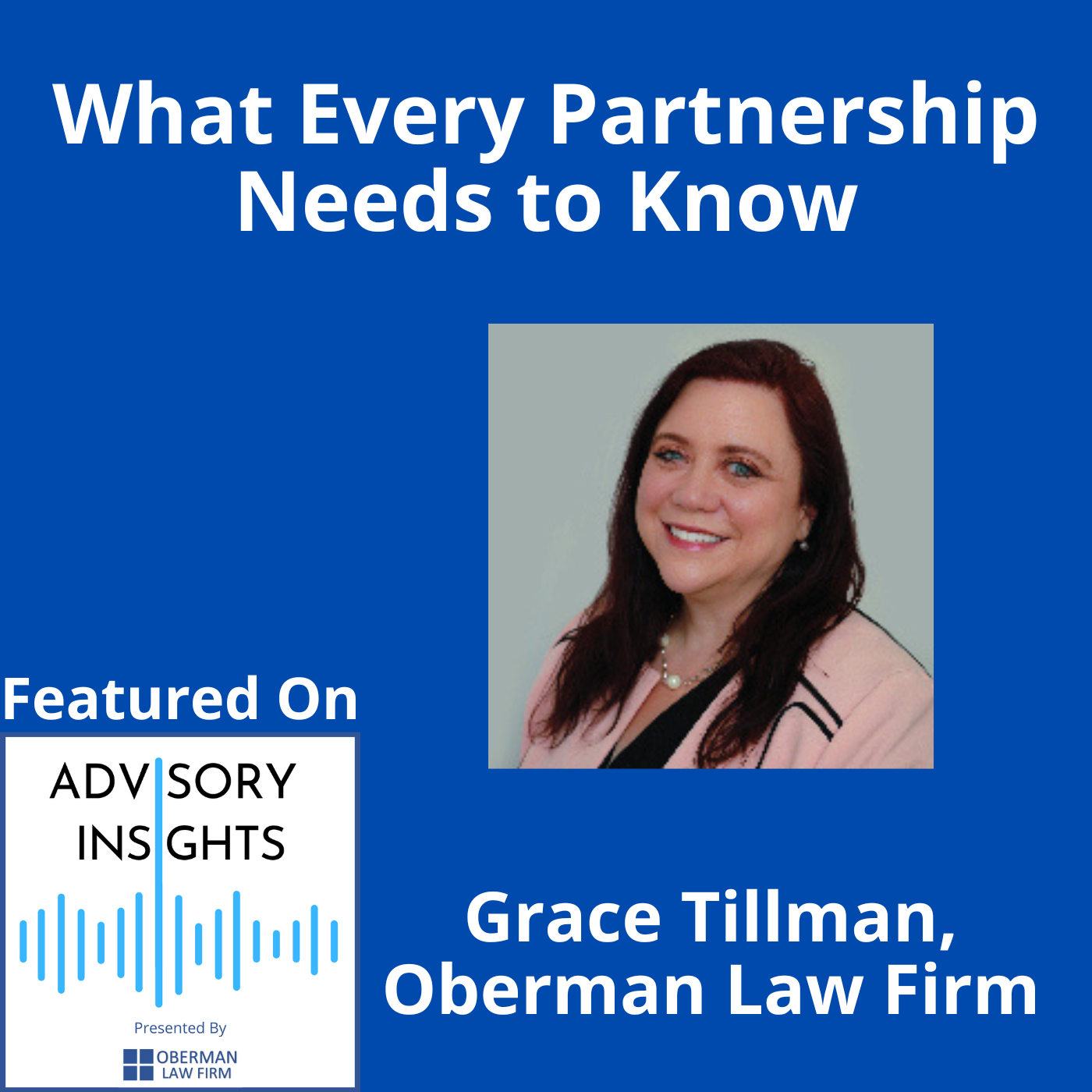
Grace M. Tillman, Senior Corporate and Litigation Counsel, Oberman Law Firm

Grace Tillman
Grace Tillman, Senior Corporate and Litigation Counsel, Oberman Law Firm

Grace M. Tillman is Senior Corporate Counsel with Oberman Law Firm. For nearly 25 years, Ms. Tillman has represented small to large corporate clients in a wide variety of practice areas such as commercial litigation, real estate, health care, mergers & acquisitions, governmental compliance, and employment law.

Ms. Tillman provides guidance to clients regarding simple to complex labor and employment law matters, including the complexities of non-compete and non-solicitation agreements. In addition, Ms. Tillman also provides expert guidance on complex HR (Human Resources) issues, including specific employment matters involving the Americans with Disabilities Act (ADA); Family and Medical Leave Act (FMLA); the Age Discrimination in Employment Act (ADEA); and, the National Labor Relations Board (NLRB).

In the area of health care, which continues to evolve at the speed of light, Ms. Tillman’s experience includes oversight of hospital regulations, HIPAA Compliance, fraud and abuse, Medicare and/or Medicaid regulations, Anti-Kickback Statute, Stark Law, Telemedicine, state and federal insurance audits, and licensing board requirements.

Ms. Tillman has extensive litigation experience in federal, state, and appellate courts, as well as before administrative boards.

Ms. Tillman received her undergraduate degree in Business Management from Kennesaw State University, and Doctor of Jurisprudence from the University of Georgia School of Law. In addition, Ms. Tillman is licensed to practice law in Georgia and Tennessee.

LinkedIn

TRANSCRIPT

Intro: [00:00:01] Broadcasting from the studios of Business RadioX, it’s time for Advisory Insights. Brought to you by Oberman Law Firm, serving clients nationwide with tailored service and exceptional results. Now, here’s your host.

Stuart Oberman: [00:00:20] Welcome everyone to Advisory Insights. My name is Stuart Oberman of Oberman Law Firm. We have a fantastic guest with us today who’s going to cover some bombshell topics for those that are in a partnership. Grace Tillman, nice to see you today. How are you?

Grace Tillman: [00:00:38] Hi. Thank you for having me. I’m doing very well.

Stuart Oberman: [00:00:40] For those that don’t know Grace, Grace is our senior counsel at the firm, handles a lot of litigation, handles a lot of federal compliance issues, and loves and adores operating agreements, partnership agreements, everything that makes up a partnership.

Stuart Oberman: [00:01:02] Now, what we’ve got to take a look at is – Grace, you and I say this all the time – it is easy to get into a marriage, it is very difficult to get out. So, again, we could spend so much time on this one topic, but I want you to cover where are partnerships? You know, the buy-sell provisions, redemption provisions, dissolutions, majority of decisions. Who’s making that decisions? What’s the structure of this? And I know you solve a lot of problems in this area.

Stuart Oberman: [00:01:40] So, I want you to talk about some operating agreements, which is sort of like the constitution, if you will, in partnership agreements. But tell us really what’s going on, on some of these things, some of these things you’re running into and some of the problems. I know we could talk all day on this, but I want you to hit on a couple of things that really you’re running into all the time and what our listeners need to know.

Grace Tillman: [00:02:04] Sure. Sure. An operating agreement mostly are used with limited liability companies. They also can be used for partnerships. And while they’re not required, whenever there are two or more members in an LLC, like you said, like for a partnership, it is strongly recommended that you actually have an operating agreement which lays out what the member’s expectations are about what’s going to happen running and operating the LLC or partnership.

Grace Tillman: [00:02:32] But one of the most overlooked items that actually should be in every operating agreement is your exit strategy. I mean, of course nobody goes into a business, much like nobody goes into a marriage, thinking that it’s going to fail. Unfortunately, that does not always happen and people don’t always get along forever and ever, and then the company is passed on to their children.

Grace Tillman: [00:02:56] So, we need to have set in advance, while everybody is still friendly, it’s nice to set out what’s going to happen if the members no longer agree. What happens if one of the partners wants to retire? What happens if somebody dies or becomes disabled? So, these are all very important things to consider when entering into a partnership.

Grace Tillman: [00:03:23] So, some of the things that we see and we wish we would see because, oftentimes, like you said, they come to us because they don’t have a provision and people say, “Well, what do I do now?” And now we need to craft this on the backend when people aren’t in agreement or friendly and it winds up costing – I can’t even tell you how much more money to do it on the back side – because if everybody’s friendly, we can say, “Oh, yeah. It’s fair. Let’s split it this way.”

Grace Tillman: [00:03:49] But when you’re mad at somebody, it’s like a divorce and people are fighting over the dishes. Nobody wants the dishes. They just don’t want the other person to have the dishes. And so, that’s what we find out here.

Grace Tillman: [00:04:02] So, here are some provisions we like to see, some are optional, you can have maybe one or more. But a buy-sell provision, which you mentioned, buy-sell provisions are kind of like if you have two kids, they both want the cookie, and you’re asking them to split it. Somebody’s going to split it very evenly so that both people get an even share. What happens is one of the parties offers to either buy the interest of the other member in the company or sell their interest in the company for the same price.

Grace Tillman: [00:04:34] So, the offering party sets the price, says to the party that they’re trying to buy out, “Here, I would like to buy your interest for this amount.” Now, they’re going to give you a very fair and equitable amount because whatever they offered to buy your interest for, they also have to sell their interest at the same price. If the person who receives the offer says, “No, I don’t want to sell, but I would like to buy you out,” that becomes the set price. So, again, like I said, it becomes a very fair and equitable price because you’re not going to offer to buy somebody else out for $10 a share if you then had to sell your shares for $10. So, you will find generally that helps.

Grace Tillman: [00:05:20] And the problem is maybe sometimes people don’t want to buy or sell. So, now, we have some other options that are available. And one is a mandatory redemption by the company at a fair market value upon the occurrence of certain events. Fair market value is determined generally by the parties in advance. How they calculate that, it would be a predetermined valuation or formula such as an appraisal. And usually this is upon the occurrence of a specific event. Let’s say somebody wants to retire or they passed away or they become permanently disabled. We have a mandatory redemption in those situations at a set value.

Grace Tillman: [00:06:01] And the mandatory redemption, generally, is intended to maximize the value of the selling party, but also to preserve any interests that the company may have. And everybody is looking out for the best interests of both parties in this situation.

Grace Tillman: [00:06:18] Another mandatory redemption event could be upon the occurrence of other events. This time it’s a mandatory redemption at a reduced value. Now, this is usually used in a case where one of the members or a partner has engaged in some type of negative behavior, if you will, that could damage or has damaged the company, the partnership, or the other members of the company or partnership.

Stuart Oberman: [00:06:44] That never happens.

Grace Tillman: [00:06:45] It does happen. Things like this could be if you’re in a business that requires you to be licensed. Well, you’ve lost your license, you’ve done something, it might be some type of negligence, or it could be just some type of administrative error. But you’ve lost your license and now you can’t practice in whatever field that might be. It could be dentistry, medicine, the law practice, engineer, there’s lots of things. Don’t pay those bar dues and see what happens [inaudible].

Grace Tillman: [00:07:16] Other things that could be, maybe one of the members got arrested or indicted or convicted of a crime, and now you don’t want to be associated with them. Or maybe they have materially violated the terms of your partnership or operating agreement. They could have committed fraud or embezzlement. Well, in this instance, the company has a mandatory or a right to purchase the interest of this defaulting member, if you will, at a reduced value. And you can set those reduced values, it might be 75 to 50 percent of the appraised value or it could be the value determined by a specific formula.

Grace Tillman: [00:07:54] Oftentimes, we’ll see these, “We’re going to buy you back, but we’re giving you nothing for goodwill because you did your best to damage it.” So, you don’t get anything for that. You’re going to get a value of assets only.

Grace Tillman: [00:08:05] Another option, there could be mandatory dissolution of the company where everybody gets liquidated. We’re at loggerheads. We’re the complete stalemate. We can’t agree with one another. Fine. Business is over. You don’t want to agree with me. You don’t want to work with me. Then, we’re both packing up our toys and we’re going home.

Stuart Oberman: [00:08:22] I got a question for you on the cases that you work on. You mentioned fraud, so percentage-wise – and it’s maybe a little bit hard to do – but the cases that you and I work on, you work on and the office works on, how many do you think involve fraud when, basically, one partner wants to get out of the marriage, if you will.

Grace Tillman: [00:08:50] It’s actually more than you would think. But to answer the question, in true lawyer fashion I’m coming back with a question, well, how do you define fraud? Because some people, it’s intentional fraud. Other people, it’s unintentional fraud. “Oh, wait. We weren’t supposed to be doing this. I didn’t know I wasn’t allowed to be running my mortgage through the business. Wait.” But it can be a higher percentage than you think. And, again, sometimes it’s minor fraud, something little. Other times it’s a big deal. It can be something that potentially, again, if you’re in a licensed business, could put your license at risk what your partner is doing, especially if the fraud involves your client.

Stuart Oberman: [00:09:36] Well, it’s funny. A lot of businesses as a whole, like embezzlement, that’s a little bit different than what we’re talking about. But embezzlement is about 60 percent of all businesses. I’m just thinking out loud here, that may be another topic that we cover on what to do if you suspect your partner is defrauding you. That’s a whole internal investigation.

Grace Tillman: [00:10:05] It is something that is totally different, and it is absolutely a problem.

Stuart Oberman: [00:10:08] We may look at that down the road. But I’m sorry, I got off track. I’m sorry to interrupt you.

Grace Tillman: [00:10:15] No, no, no. And, again, I think that’s very important. I think it’s worthwhile exploring because I think that our clients, our listeners, everybody would benefit from that knowledge because it happens, like I said, much more often than you think it does.

Grace Tillman: [00:10:28] So, we were talking about mandatory dissolution or sale of a company in the event that the members of the partners reach a stalemate. Again, it’s set out in advance. If we’ve reached a point where we cannot agree anymore, and this is a situation, honestly, when you reach it, you don’t want to be in business with this other person anymore because you’re just fighting.

Grace Tillman: [00:10:51] It’s like the point in the marriage where all you do is fight and everybody knows it’s over. And that’s where you are, and you’re saying, “We need to call an end to it. I’m not going to continue the business without you. You’re not continuing the business without me.” And there could be any number of reasons why that may happen, but we’re done and we’re either going to sell or liquidate.

Stuart Oberman: [00:11:14] Now, you mentioned something going on. I keep going back because you’ve said so much information. I’m trying to absorb it all. I’m thinking from what our clients would say, but you mentioned something along these lines of what we call a put call option as far as sale goes.

Grace Tillman: [00:11:34] Right. That was the first one, kind of like the buy-sell. Say, I’m either going to buy you out or you’re going to buy me out. But either way, one of us is leaving at the end of this deal.

Stuart Oberman: [00:11:43] So, how many of those put call options do you see? I know the ones that I’ve looked at they’re pretty nasty.

Grace Tillman: [00:11:53] A lot of times they are, and they’re usually a whole lot nastier if they’re not equal partners and they’re drafted in a way that gives the majority partner maybe a little more push. Because somebody’s got to come up with a whole lot of money, cash at closing to buy out a partner, that becomes harder to do. But they can be nasty.

Grace Tillman: [00:12:19] Again, if they’re drafted in advance when everybody is still friends or they think the business is going to be continuing for a longer period of time, they’re not. But my recommendation is they should be in every operating agreement, whether you exercise the option or not, I think that you should have, if not that exit strategy, you need to have something. And you need to have something that addresses what happens when the parties, maybe, reach deadlock or stalemate.

Grace Tillman: [00:12:48] And first step maybe isn’t selling. There’s lots of other options that you and your attorney can work and come up with creative options, things that range from mediation to arbitration, and who do we select, do we defer to a third party, can we go to an expert and get an opinion if we disagree. There’s a whole lot of things you can put into an operating or membership agreement or partnership agreement short of shutting everything down, buying one party out. But, again, we’re just talking exit strategy. So, we’ve reached the point where we’re done and the parties aren’t going to continue anymore in this business.

Grace Tillman: [00:13:28] Kind of sort of the last one I want to touch on – and I know we don’t have a tremendous amount of time to talk about all of them because I could go on for hours.

Stuart Oberman: [00:13:35] This is a week long seminar. Are you kidding me?

Grace Tillman: [00:13:37] It could be. It could be. And I have actually spent daylong seminars just talking about operating agreements. So, the last one would be if there is a majority member or partner where one party is disproportionately greater invested in the business, a lot of times we’ll see in an operating agreement or partnership agreement where that member, that majority member, has a right to buy out the minority member if they can’t agree anymore. It’s like, “We’re not going to be in business anymore, but here it is.”

Grace Tillman: [00:14:09] And the formula is established in advance so that the minority member actually enters into the partnership or limited liability company knowing what their payment is on the backend. It’s not that the majority member can squeeze them out and say, “I am going to pay you $0.10 per membership unit that you own.” No. It’s going to be some version of a more equitable, fair market value for the minority member’s interests. And, again, it would be before the minority member entered into the business. They would know what they were getting when they were coming out, if the parties couldn’t agree.

Grace Tillman: [00:14:45] I know we talked about this briefly, and I know I really kind of flew through a bunch of these, but if there’s not an exit strategy in place – which I see a lot – and the members can agree on how to terminate or wrap up their business or what to do, you can be looking at a very costly legal battle for both parties.

Grace Tillman: [00:15:10] And when I talk about a costly legal battle, I’m not just talking about the financial cost because there is a whole bunch of work that goes into creating a business, and a lot of that comes with an emotional component. And when you’re watching that be unsuccessful or dismantled, there’s a cost to that that a lot of people don’t realize. And you don’t want to be in a position where you no longer wish to be associated professionally with someone and you’re forced to still be there.

Stuart Oberman: [00:15:44] Wow. That’s amazing information. Well, I want to mention one other thing, is that, how in tuned you are into the employment side and partnership agreements. And I know we come to the end of our podcast for this particular topic, but you have another podcast that you’ll be doing for the firm regarding EEOC, which I can’t wait to share with our business partners, we have local, national, and some global clients. But you’re also speaking on October 27th for SHRM-Atlanta. So, that’s going to be a great event.

Stuart Oberman: [00:16:30] Again, it’s a great honor because you’ve been in the forefront of what’s going on as far as employment law goes. And I know you did an enormous job during COVID-19, keeping everyone informed by the hour, including us at the firm.

Stuart Oberman: [00:16:43] But in closing, is there anything you want to add on that 10,000 foot view of getting into a marriage and getting out?

Grace Tillman: [00:16:55] Well, it’s much like a pre-nup. If you enter into an agreement or into a business relationship or a romantic relationship, and everybody knows what happens if things go south, you are going to save money, you are going to save time, you are going to save aggravation. And best of all, you have some certainty. You’re not wandering around lost wondering what happens now. You know what happens.

Stuart Oberman: [00:17:21] Perfect. I agree. Grace, thank you so much for joining us today. I can’t wait to hear your subsequent podcast on EEOC’s investigations.

Stuart Oberman: [00:17:32] Ladies and gentlemen, thank you for joining us. If you want to reach Grace Tillman, please feel free to email her at grace, G-R-A-C-E, @obermanlaw.com Phone number 770-886-2400. Thank you again, Grace. It was great having you. Ladies and gentlemen, thanks. Have a fantastic day. And we look forward to our next podcast. Thank you.

Outro: [00:17:56] Thank you for joining us on Advisory Insights. This show is brought to you by Oberman Law Firm, a business-centric law firm representing local, regional, and national clients in a wide range of practice areas, including health care, mergers and acquisitions, corporate transactions, and regulatory compliance.


About Advisory Insights Podcast

Presented by Oberman Law Firm, Advisory Insights Podcast covers legal, business, HR, and other topics of vital concern to healthcare practices and other business owners. This show series can be found here as well as on all the major podcast apps.

Stuart Oberman, Oberman Law Firm

Stuart Oberman
Stuart Oberman, Founder, Oberman Law Firm

Stuart Oberman is the founder and President of Oberman Law Firm. Mr. Oberman graduated from Urbana University and received his law degree from John Marshall Law School. Mr. Oberman has been practicing law for over 25 years, and before going into private practice, Mr. Oberman was in-house counsel for a Fortune 500 Company. Mr. Oberman is widely regarded as the go-to attorney in the area of Dental Law, which includes DSO formation, corporate business structures, mergers and acquisitions, regulatory compliance, advertising regulations, HIPAA, Compliance, and employment law regulations that affect dental practices.

In addition, Mr. Oberman’s expertise in the healthcare industry includes advising clients in the complex regulatory landscape as it relates to telehealth and telemedicine, including compliance of corporate structures, third-party reimbursement, contract negotiations, technology, health care fraud, and abuse law (Anti-Kickback Statute and the State Law), professional liability risk management, federal and state regulations.

As the long-term care industry evolves, Mr. Oberman has the knowledge and experience to guide clients in the long-term care sector with respect to corporate and regulatory matters, assisted living facilities, continuing care retirement communities (CCRCs). In addition, Mr. Oberman’s practice also focuses on health care facility acquisitions and other changes of ownership, as well as related licensure and Medicare/Medicaid certification matters, CCRC registrations, long-term care/skilled nursing facility management, operating agreements, assisted living licensure matters, and health care joint ventures.

In addition to his expertise in the health care industry, Mr. Oberman has a nationwide practice that focuses on all facets of contractual disputes, including corporate governance, fiduciary duty, trade secrets, unfair competition, covenants not to compete, trademark and copyright infringement, fraud, and deceptive trade practices, and other business-related matters. Mr. Oberman also represents clients throughout the United States in a wide range of practice areas, including mergers & acquisitions, partnership agreements, commercial real estate, entity formation, employment law, commercial leasing, intellectual property, and HIPAA/OSHA compliance.

Mr. Oberman is a national lecturer and has published articles in the U.S. and Canada.

LinkedIn

Oberman Law Firm

Oberman Law Firm has a long history of civic service, noted national, regional, and local clients, and stands among the Southeast’s eminent and fast-growing full-service law firms. Oberman Law Firm’s areas of practice include Business Planning, Commercial & Technology Transactions, Corporate, Employment & Labor, Estate Planning, Health Care, Intellectual Property, Litigation, Privacy & Data Security, and Real Estate.

By meeting their client’s goals and becoming a trusted partner and advocate for our clients, their attorneys are recognized as legal go-getters who provide value-added service. Their attorneys understand that in a rapidly changing legal market, clients have new expectations, constantly evolving choices, and operate in an environment of heightened reputational and commercial risk.

Oberman Law Firm’s strength is its ability to solve complex legal problems by collaborating across borders and practice areas.

Connect with Oberman Law Firm:

Company website | LinkedIn | Twitter

Tagged With: dental practices, dissolving a partnership, Grace Tillman, Oberman Law, Oberman Law Firm, operating agreements, Partnership, Stuart Oberman

Tax Consequences of a Practice Sale

September 30, 2022 by John Ray

Advisory Insights Podcast
Tax Consequences of a Practice Sale
Loading
00:00 /
RSS Feed
Share
Link
Embed

Download file

Tax Consequences of a Practice Sale

Tax Consequences of a Practice Sale (Advisory Insights Podcast, Episode 11)

On this episode of Advisory Insights, Stuart Oberman talked with Danielle McBride, Partner at Oberman Law Firm, on corporate sales transactions. She emphasized the importance of involving a CPA early in the transaction to ensure that the proper documentation is in place to avoid double taxation.

Advisory Insights is presented by Oberman Law Firm and produced by the North Fulton studio of Business RadioX®. The series can be found on all the major podcast apps. You can find the complete show archive here.

Danielle McBride, Partner, Oberman Law Firm

Danielle McBride
Danielle McBride, Partner, Oberman Law Firm

Danielle McBride has been practicing law for over 21 years, and her primary focus is representing healthcare clients on a local, regional, and national basis. Ms. McBride regularly consults with clients regarding simple to complex healthcare transitions, including mergers and acquisitions, employment law, governmental compliance, tax strategies, practice valuations, DSO formation and structures, employee compensation, associate and partnership contracts, joint ventures, and partnership buy-in/buy-outs.

In addition, Ms. McBride brings a wealth of knowledge and experience preparing practice valuations for clients, as well as formulating simple to complex tax strategies, and entity formations.

Ms. McBride holds a Bachelor of Arts in Sociology/Criminology from The Ohio State University, a Juris Doctor (J.D.) from Ohio Northern University Pettit College of Law, and a Master of Laws (LL.M.) in Taxation from Case Western Reserve University.

LinkedIn

TRANSCRIPT

Intro: [00:00:01] Broadcasting from the studios of Business RadioX, it’s time for Advisory Insights. Brought to you by Oberman Law Firm, serving clients nationwide with tailored service and exceptional results. Now, here’s your host.

Stuart Oberman: [00:00:19] Welcome everyone to Advisory Insights. This is Stuart Oberman, Oberman Law Firm. Well, we have a fantastic guest with us today on our podcast, Danielle McBride, who is a partner in Oberman Law Firm, and who does an enormous amount of health care transactions on a national basis.

Stuart Oberman: [00:00:40] For those who are not familiar with our firm, we are very, very health care centered. Last year, we did 135 transactions, and I believe the number was, maybe, about 350 million was total of the transactions. So, through this craze that we’re in, mergers and acquisitions, the tax consequences are so under viewed that they got to get out in the forefront of these issues.

Stuart Oberman: [00:01:14] And Danielle McBride, who does a fabulous job with the firm, and who is our resident tax guru, if you will, and has a master’s in tax is really going to walk us through some things. And I got some questions along the way that she’ll answer, hopefully. And this is such an ongoing topic. We can talk about tax consequences for a day and not even cover everything on a merger and acquisition. So, Danielle, welcome to the show again.

Danielle McBride: [00:01:44] Thanks, Stuart. Good to be here and happy to put some information out there so our buyers and sellers can be a little more educated on these topics.

Stuart Oberman: [00:01:51] Yeah, it’s amazing. It is amazing how many questions you receive and we all receive on these deals and how uninformed some advisors are. And I want you to touch on that later on during the podcast. But, you know, I want to talk about some of the things you run into on the sales tax side, you’ve got goodwill, you’ve got personal versus corporate, you’ve got C versus S corporations, you’ve got reporting issues. I know, again, it’s a long, long, long conversation we can have on this. And I know you’ll drill it down to the basics, which will not cover all the details. So, tell us, I want to know what you’re running into on some of these sales.

Danielle McBride: [00:02:39] Sure. So, you know, basic tax consequences, I think a lot of that information is out there. You’ve got a sale of tangible assets, a sale of goodwill, capital gain on goodwill, tax treatment is ordinary income on the sale of tangible assets. But it gets much more complicated and there can be a lot more detail involved depending on the type of entity that someone has.

Danielle McBride: [00:03:03] So, if your seller is, say, a C Corporation versus an S Corporation or an LLC, a C Corporation has an entity level tax. It’s not a pass through entity, which means that there is a tax on the sale of any assets from the corporation first. And then, you’ve got your shareholders receiving distributions of the balance of that. And so, there could be a goodwill double taxation issue if your corporation owns the goodwill and sells it. So, that’s where personal goodwill is kind of a key component.

Danielle McBride: [00:03:42] And most important in these C Corporation sales, and we still have a lot of older C Corporations that are out there in the health care world, so you want to make sure that you’re looking at that. Not only C Corporations but S Corporations. If a C Corporation elected S Corporation status, they have a five year window during which they still get treated if they sell assets like they’re a C Corporation. They call it a built-in gains tax.

Danielle McBride: [00:04:14] So, you’ve got to be aware if you’re a C Corporation or a C that elected S status and you haven’t met your five year built-in gains tax window, personal goodwill in those cases is just key because you’re going to avoid a double taxation issue if you set up the transaction properly using personal goodwill instead of having the corporation own and sell all of the assets.

Stuart Oberman: [00:04:39] That’s a good point.

Danielle McBride: [00:04:39] So, it could be a huge tax difference here. And so, that’s something you got to talk to your advisors about, make sure that it’s being structured properly, make sure your contracts have those things specifically listed in it, and the sellers are listed as both personal seller selling personal goodwill and corporations selling the assets.

Danielle McBride: [00:05:03] And then, that even goes down to payments as well. Make sure if you’re getting personal goodwill and it’s a key component in this C Corporation or what we call sort of a non-ripe S Corporation. You know, the payment and all of the documentation needs to track in order to protect that personal goodwill concept and keep you from paying twice on the goodwill.

Stuart Oberman: [00:05:28] A non-write election corporation?

Danielle McBride: [00:05:32] Non-ripe.

Stuart Oberman: [00:05:33] Ripe. Okay.

Danielle McBride: [00:05:34] We call it a non-ripe S election when you’ve elected S Corporation status and you have that five year building gains tax window that you have to meet.

Stuart Oberman: [00:05:44] You just mentioned a couple of things. Do you write in cases where the CPAs, one, don’t understand transactions, or, two, they don’t get involved early enough?

Danielle McBride: [00:05:57] Yeah, absolutely. And the latter is what I see most often. The clients are hesitant to get their accountants involved early in the transaction, and I think that’s one of the biggest mistakes that I see made is not involving that CPA. And there are lots of good CPAs out there that understand and work in these dental transactions. And they just need to be looped in and they need to help talk about personal versus corporate goodwill. If there are tax attributes that the corporation could use some things allocated to corporate goodwill versus personal goodwill, because they’ve got corporate tax attributes to use up.

Danielle McBride: [00:06:44] I mean, the CPA is in a position to know these things, and they’re also the first line of defense if a transaction gets audited. So, they need to be involved from the beginning. And everybody needs to be on the same page. So, I always say, practice transitions, practice sales, business sales, they’re a team sport. And you need to have all your team players on the field when you’re trying to work through these things.

Stuart Oberman: [00:07:12] I don’t know, some transactions are a blood sport. I don’t know about a team sport.

Danielle McBride: [00:07:18] That’s when we get the corporate transactions involved and it gets more complicated because –

Stuart Oberman: [00:07:22] And I know you run into this, when everyone is ready to quit the deal, I mean, everyone’s like, “I’m done with this. I can’t do this anymore. I’m sick of this. I’m done. We’re about one day away from finalizing the deal, aren’t we?” It’s just gets to that stage.

Stuart Oberman: [00:07:37] Now, you also mentioned a couple of things. You mentioned, you know, at the end of the transaction, there’s got to be a true up of allocations that have to be reported to the IRS. How important is that and what form is that?

Danielle McBride: [00:07:51] That is very important, and it’s often overlooked, and most clients don’t understand this, and don’t know anything about it as well. It’s a Form 8594. So, in a sale transaction, you have to report the transaction to the IRS. That gets done on a Form 8594. That should be prepared by the accountants. Another reason accountants need looped into this, because they’re the ones that ultimately prepare that Form 8594 to submit to the IRS.

Danielle McBride: [00:08:21] So, in the documents, it’s important to have the price allocation spelled out so that the accountants can properly report this, because it’s the same as if you accidentally forget to report that you got a 1099 or a W-2 from an employer, you’re going to wind up audited because the IRS gets reporting from both sides of a transaction. So, if you don’t submit an 8594 or you submit one that’s different than the other party, it’s going to flag you for an audit.

Stuart Oberman: [00:08:54] Now, I got one question that we’ve run into on occasion. What happens if the buyer wants to set a floating sales price that is spread out through the years where, let’s say, they say if you hit this target, this is a sale price. And that may go on for two or three years. How complex is that and how problematic is that for the seller who doesn’t know what in the world to do with this taxes?

Danielle McBride: [00:09:21] Yeah. So, that is also a reason to have your accountant involved because there are certain ways that you can report that. And that may get reported as an installment sale. And those numbers, you don’t want to report it on that initial tax form that goes in because you may or may not receive those amounts. Those amounts could be treated as an installment sale, and you don’t get taxed until you actually receive the funds.

Stuart Oberman: [00:09:45] Oh, wow. Okay. So, that sounds like another podcast. I mean, it truly is amazing. You know, in this brief, brief segment that you’ve touched on, you’ve touched on corporate goodwill, personal versus corporate, C versus S Corporation, reporting 8594, and you’ve touched on installment sales. I mean, it is truly amazing what has to be done on a tax side from a sale, whether it is a small sale or $44 million sale, which we’ve handled on a transaction.

Stuart Oberman: [00:10:27] I say we could talk seven days on topics. But in closing, is there anything you’d want to add advice that we can give our listeners on what they want to do before they start getting into the meat of this transaction or a transaction?

Danielle McBride: [00:10:49] Well, make sure you reach out to your advisors. If you’ve got letters of intent, make sure you show those to your advisors and go through those. Make sure you’re thinking about the structure and the tax allocations. And make sure you understand the terms of the deal, you know, things like personal versus corporate goodwill. Another thing we didn’t even touch on that I see as a big issue is accounts receivable and how that’s going to be handled.

Stuart Oberman: [00:11:17] There’s another podcast. You’re making a career out of this.

Danielle McBride: [00:11:20] Yeah. You’re going to keep me on this.

Stuart Oberman: [00:11:24] We’re going to have the Danielle McBride show here in a minute. They’re going to give me the hook. You’ve already teed up seven episodes here. It’s like a version of a Game of Thrones, geez. Well, again, it is amazing and you’ve done an amazing job since joining the firm. We’re so happy to have you. You bring so much gravitas to the table. Again, we’re definitely going to have you back on this show.

Stuart Oberman: [00:11:53] So, in parting, if you need to reach Danielle, please feel free to email her at danielle, D-A-N-I-E-L-L-E, @obermannlaw.com. The phone number 770-886-2400. Folks, it’s been an absolute pleasure and we hope that you’ve at least taken away one golden nugget of this. And if so, we’ll consider this podcast an absolute success. Danielle, thank you again. I know you’ve got a convention to go to. And we appreciate your time. Thanks a lot. Ladies and gentlemen, thanks and have a fantastic day.

Outro: [00:12:30] Thank you for joining us on Advisory Insights. This show is brought to you by Oberman Law Firm, a business-centric law firm representing local, regional, and national clients in a wide range of practice areas, including health care, mergers and acquisitions, corporate transactions, and regulatory compliance.

About Advisory Insights Podcast

Presented by Oberman Law Firm, Advisory Insights Podcast covers legal, business, HR, and other topics of vital concern to healthcare practices and other business owners. This show series can be found here as well as on all the major podcast apps.

Stuart Oberman, Oberman Law Firm

Oberman Law Firm

Stuart Oberman, Founder, Oberman Law Firm

Stuart Oberman is the founder and President of Oberman Law Firm. Mr. Oberman graduated from Urbana University and received his law degree from John Marshall Law School. Mr. Oberman has been practicing law for over 25 years, and before going into private practice, Mr. Oberman was in-house counsel for a Fortune 500 Company. Mr. Oberman is widely regarded as the go-to attorney in the area of Dental Law, which includes DSO formation, corporate business structures, mergers and acquisitions, regulatory compliance, advertising regulations, HIPAA, Compliance, and employment law regulations that affect dental practices.

In addition, Mr. Oberman’s expertise in the healthcare industry includes advising clients in the complex regulatory landscape as it relates to telehealth and telemedicine, including compliance of corporate structures, third-party reimbursement, contract negotiations, technology, health care fraud, and abuse law (Anti-Kickback Statute and the State Law), professional liability risk management, federal and state regulations.

As the long-term care industry evolves, Mr. Oberman has the knowledge and experience to guide clients in the long-term care sector with respect to corporate and regulatory matters, assisted living facilities, continuing care retirement communities (CCRCs). In addition, Mr. Oberman’s practice also focuses on health care facility acquisitions and other changes of ownership, as well as related licensure and Medicare/Medicaid certification matters, CCRC registrations, long-term care/skilled nursing facility management, operating agreements, assisted living licensure matters, and health care joint ventures.

In addition to his expertise in the health care industry, Mr. Oberman has a nationwide practice that focuses on all facets of contractual disputes, including corporate governance, fiduciary duty, trade secrets, unfair competition, covenants not to compete, trademark and copyright infringement, fraud, and deceptive trade practices, and other business-related matters. Mr. Oberman also represents clients throughout the United States in a wide range of practice areas, including mergers & acquisitions, partnership agreements, commercial real estate, entity formation, employment law, commercial leasing, intellectual property, and HIPAA/OSHA compliance.

Mr. Oberman is a national lecturer and has published articles in the U.S. and Canada.

LinkedIn

Oberman Law Firm

Oberman Law Firm has a long history of civic service, noted national, regional, and local clients, and stands among the Southeast’s eminent and fast-growing full-service law firms. Oberman Law Firm’s areas of practice include Business Planning, Commercial & Technology Transactions, Corporate, Employment & Labor, Estate Planning, Health Care, Intellectual Property, Litigation, Privacy & Data Security, and Real Estate.

By meeting their client’s goals and becoming a trusted partner and advocate for our clients, their attorneys are recognized as legal go-getters who provide value-added service. Their attorneys understand that in a rapidly changing legal market, clients have new expectations, constantly evolving choices, and operate in an environment of heightened reputational and commercial risk.

Oberman Law Firm’s strength is its ability to solve complex legal problems by collaborating across borders and practice areas.

Connect with Oberman Law Firm:

Company website | LinkedIn | Twitter

Tagged With: Advisory Insights, Advisory Insights Podcast, dental practices, employees, Oberman Law, Oberman Law Firm, Practice Sale, Stuart Oberman, Tax Consequences, Taxes

  • 1
  • 2
  • 3
  • 4
  • Next Page »

Business RadioX ® Network


Our Most Recent Episode

CONNECT WITH US

  • Email
  • Facebook
  • LinkedIn
  • Twitter
  • YouTube

Our Mission

We help local business leaders get the word out about the important work they’re doing to serve their market, their community, and their profession.

We support and celebrate business by sharing positive business stories that traditional media ignores. Some media leans left. Some media leans right. We lean business.

Sponsor a Show

Build Relationships and Grow Your Business. Click here for more details.

Partner With Us

Discover More Here

Terms and Conditions
Privacy Policy

Connect with us

Want to keep up with the latest in pro-business news across the network? Follow us on social media for the latest stories!
  • Email
  • Facebook
  • Google+
  • LinkedIn
  • Twitter
  • YouTube

Business RadioX® Headquarters
1000 Abernathy Rd. NE
Building 400, Suite L-10
Sandy Springs, GA 30328

© 2025 Business RadioX ® · Rainmaker Platform

BRXStudioCoversLA

Wait! Don’t Miss an Episode of LA Business Radio

BRXStudioCoversDENVER

Wait! Don’t Miss an Episode of Denver Business Radio

BRXStudioCoversPENSACOLA

Wait! Don’t Miss an Episode of Pensacola Business Radio

BRXStudioCoversBIRMINGHAM

Wait! Don’t Miss an Episode of Birmingham Business Radio

BRXStudioCoversTALLAHASSEE

Wait! Don’t Miss an Episode of Tallahassee Business Radio

BRXStudioCoversRALEIGH

Wait! Don’t Miss an Episode of Raleigh Business Radio

BRXStudioCoversRICHMONDNoWhite

Wait! Don’t Miss an Episode of Richmond Business Radio

BRXStudioCoversNASHVILLENoWhite

Wait! Don’t Miss an Episode of Nashville Business Radio

BRXStudioCoversDETROIT

Wait! Don’t Miss an Episode of Detroit Business Radio

BRXStudioCoversSTLOUIS

Wait! Don’t Miss an Episode of St. Louis Business Radio

BRXStudioCoversCOLUMBUS-small

Wait! Don’t Miss an Episode of Columbus Business Radio

Coachthecoach-08-08

Wait! Don’t Miss an Episode of Coach the Coach

BRXStudioCoversBAYAREA

Wait! Don’t Miss an Episode of Bay Area Business Radio

BRXStudioCoversCHICAGO

Wait! Don’t Miss an Episode of Chicago Business Radio

Wait! Don’t Miss an Episode of Atlanta Business Radio