
Business RadioX ®

  • Home
  • Business RadioX ® Communities
    • Southeast
      • Alabama
        • Birmingham
      • Florida
        • Orlando
        • Pensacola
        • South Florida
        • Tampa
        • Tallahassee
      • Georgia
        • Atlanta
        • Cherokee
        • Forsyth
        • Greater Perimeter
        • Gwinnett
        • North Fulton
        • North Georgia
        • Northeast Georgia
        • Rome
        • Savannah
      • Louisiana
        • New Orleans
      • North Carolina
        • Charlotte
        • Raleigh
      • Tennessee
        • Chattanooga
        • Nashville
      • Virginia
        • Richmond
    • South Central
      • Arkansas
        • Northwest Arkansas
    • Midwest
      • Illinois
        • Chicago
      • Michigan
        • Detroit
      • Minnesota
        • Minneapolis St. Paul
      • Missouri
        • St. Louis
      • Ohio
        • Cleveland
        • Columbus
        • Dayton
    • Southwest
      • Arizona
        • Phoenix
        • Tucson
        • Valley
      • Texas
        • Austin
        • Dallas
        • Houston
    • West
      • California
        • Bay Area
        • LA
        • Pasadena
      • Colorado
        • Denver
      • Hawaii
        • Oahu
  • FAQs
  • About Us
    • Our Mission
    • Our Audience
    • Why It Works
    • What People Are Saying
    • BRX in the News
  • Resources
    • BRX Pro Tips
    • B2B Marketing: The 4Rs
    • High Velocity Selling Habits
    • Why Most B2B Media Strategies Fail
    • 9 Reasons To Sponsor A Business RadioX ® Show
  • Partner With Us
  • Veteran Business RadioX ®

Tax Implications of a Practice Sale

September 23, 2022 by John Ray

Tax Implications of a Practice Sale
Advisory Insights Podcast
Tax Implications of a Practice Sale
Loading
00:00 /
RSS Feed
Share
Link
Embed

Download file

Tax Implications of a Practice Sale

Tax Implications of a Practice Sale (Advisory Insights Podcast, Episode 10)

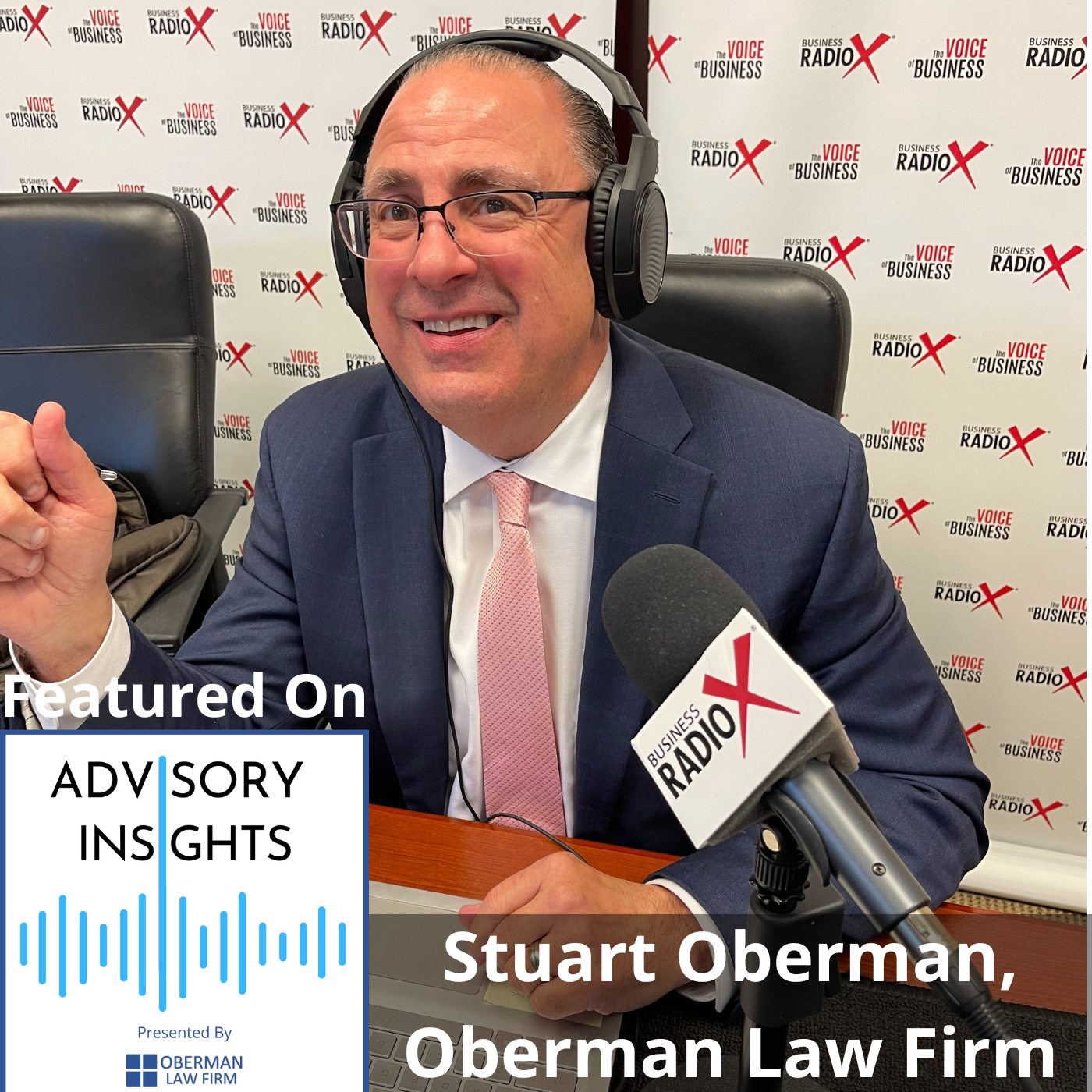
On this episode of Advisory Insights, Stuart Oberman talked with Danielle McBride and Lauren Mansour, both Partners at Oberman Law Firm, on the tax implications of a practice sale. They covered letters of intent and what key provisions should be in them, common tax pitfalls, different classes of shares common with DSO acquirors, how to limit the tax consequences of Class C shares, and more.

Advisory Insights is presented by Oberman Law Firm and produced by the North Fulton studio of Business RadioX®. The series can be found on all the major podcast apps. You can find the complete show archive here.

Danielle McBride, Partner, Oberman Law Firm

Danielle McBride
Danielle McBride, Partner, Oberman Law Firm

Danielle McBride has been practicing law for over 21 years, and her primary focus is representing healthcare clients on a local, regional, and national basis. Ms. McBride regularly consults with clients regarding simple to complex healthcare transitions, including mergers and acquisitions, employment law, governmental compliance, tax strategies, practice valuations, DSO formation and structures, employee compensation, associate and partnership contracts, joint ventures, and partnership buy-in/buy-outs.

In addition, Ms. McBride brings a wealth of knowledge and experience preparing practice valuations for clients, as well as formulating simple to complex tax strategies, and entity formations.

Ms. McBride holds a Bachelor of Arts in Sociology/Criminology from The Ohio State University, a Juris Doctor (J.D.) from Ohio Northern University Pettit College of Law, and a Master of Laws (LL.M.) in Taxation from Case Western Reserve University.

LinkedIn

Lauren Mansour, Partner, Oberman Law Firm

Lauren Mansour, Partner, Oberman Law Firm

Lauren A. Mansour, Esq.’s practice is devoted to the representation of health care providers in various corporate and regulatory compliance matters. Lauren handles transactional matters for her clients, representing healthcare providers in joint ventures, mergers, and acquisitions. Ms. Mansour regularly counsels her clients on a range of compliance and regulatory matters, including anti-kickback and stark issues, fraud and abuse laws, state corporate practice of medicine doctrines, and state licensure laws.

Ms. Mansour’s expertise in the health care industry includes compliance of corporate structures, third-party reimbursement, contract negotiations, partnership agreements, commercial leasing, technology, health care fraud and abuse, professional liability risk management, federal and state regulations. Ms. Mansour has experience representing startups, seasoned professionals, and dental service organizations, and enjoys advising clients at every stage of practice ownership.

A graduate of the University of Georgia School of Law, Ms. Mansour joined Oberman Law Firm in 2010 and is licensed to practice law in Georgia and South Carolina.

LinkedIn

TRANSCRIPT

 Intro: [00:00:01] Broadcasting from the studios of Business RadioX, it’s time for Advisory Insights. Brought to you by Oberman Law Firm, serving clients nationwide with tailored service and exceptional results. Now, here’s your host.

Stuart Oberman: [00:00:20] Hello everyone and welcome to Advisory Insights Podcast. Well, today, we’ve got two special guests with us. There is a lot going on in the health care field for the mergers and acquisitions, whether it’s dental, vets, eye, it is all over the place. So, I got two of our great, great partners at the Oberman Law Firm today, and I want to introduce them, Lauren Mansour and Danielle McBride. Both of them do a tremendous job on mergers and acquisitions.

Stuart Oberman: [00:00:51] And I want to talk to Lauren a little bit first. And the key thing is letters of intent. I know if you’re an attorney, you do transactions, you always get, it seems, a signed letter of intent before you really, really have a chance to drill down on it. So, Lauren’s going to talk a little bit about letters of intent. And then, Danielle is going to talk about tax items that are really, really critical in a health care transition, whether it’s a private equity company or it is a private sale.

Stuart Oberman: [00:01:25] So, let’s start off, Lauren, tell you what, I want you to take me through some steps that our listeners need to know regarding LOIs. I mean, we’ve got stuff on holdbacks, real estate matters. I want you to drill down a little bit. Before I start, last year we did as a firm about 135 transactions totaling about 350 million. So, we’ve seen a lot of stuff come under the bridge, if you will, last year. And I think we saw a lot of things we don’t want to see happen again. So, Lauren, tell you what, talk to the audience, tell me a little bit about letters of intent, what you run into and your problems. And, hopefully, our listeners can pick up a couple of pointers.

Lauren Mansour: [00:02:12] Of course, happy to jump into this topic. So, a letter of intent kind of varies. Sometimes we see letters of intent that are a paragraph long, maybe half-a-page max, and sometimes they’re ten pages. And so, there’s definitely a lot of variance depending on the transaction.

Lauren Mansour: [00:02:31] I would say I was speaking with a buyer yesterday, even for just a simpler doctor to doctor transaction, I think it’s important to have a little bit more than half-of-a-page because you do want to flash out certain important concepts and just make sure that you and the seller or you and the buyer are on the same page, and you’re not both spending money on attorneys and bankers and CPAs, and spending time going through this process of negotiating a transaction, and you are never really on the same page to begin with.

Lauren Mansour: [00:03:08] So, I think that we don’t necessarily have to spend a whole lot of time on the letter of intent. But I think it’s important to make sure certain key items like, obviously, the purchase price, possibly even purchase price allocations, what does any post sale employment look like for the seller restrictive covenants, can we agree on those at the LOI stage, is there any real estate involved, and have terms been agreed upon. And if so, let’s include that.

Lauren Mansour: [00:03:39] For a buyer, it’s very important to have exclusivity language in the letter of intent, because you do want to make sure. Again, you’re kind of investing your time and money into the process and you want to make sure that the seller is not continuing to speak with other interested parties. And then, you also want to make sure there’s language that is clear that this document is not binding. I think most letters of intent will say that. But we have had clients in the past sign an LOI before we reviewed, and it was binding. And when they decided after diligence they wanted to walk away, they were facing legal action.

Lauren Mansour: [00:04:20] So, some important tips, I think that in larger transactions, so when our clients are selling, especially to a large group, these letters of intent can be very complex. And I was just looking at one the other day for a client that’s selling a group of practices, and she was looking at restrictive covenants that were not just around her practices, but statewide for any practice that the buyer group owned in any state, that entire state was wiped out for her.

Lauren Mansour: [00:04:56] And so, I think it’s important to kind of go through and make sure that you’re comfortable and you’re aware of the terms kind of before you move forward. Because with sellers, and if they’re talking with big group practices, you’re often courting several buyers. And so, if you can kind of flash out a lot of these concepts and make sure that you understand them, it’s more than just the purchase price. There’s now holdbacks and earnouts and equity involved.

Lauren Mansour: [00:05:31] And so, what do these holdbacks look like? So, sometimes we’ll have a very large transaction and it will briefly mention a holdback or the earnout, and what does that mean? Or the equity won’t be clearly spelled out, and so we have to ask questions. And it’s my opinion, better on the frontend to say, are there going to be any ties to any of this? Is the equity subject to forfeiture if employment terminates before a certain period? Or the earnout, what is it tied to? Do we have to just be employed or do we have to have certain collection levels that we have?

Stuart Oberman: [00:06:08] Can you explain, so you just hit really on a couple of points. One, have you seen a request on a national non-compete? Two, take our listeners through the process of what exactly is an earnout and a holdback.

Lauren Mansour: [00:06:26] I don’t know that I’ve seen a national non-compete. These are usually groups that are in several states that they’ll kind of limit to a region, but it definitely can be several states, and a lot of times it’s tied to equity. So, if you invest with the buyer group, they’ll tie you to think, “Okay. You need to be loyal to this group. Right now you’re invested with us, and so now, because of the equity, you have to not compete with us, not only around your practices, but around any practices we own. We don’t want you to work there.”

Lauren Mansour: [00:07:02] And so, sometimes there’s circles around every practice they own and sometimes there’s just statewide restrictions. If we own in this state, you cannot operate there. Which is sometimes not problematic when our clients are looking to retire. But other times it is, our clients are younger, they still want to work, there’s never any guarantees. And I think we have to look at things from the worst case scenario, just planning it. And so, it can be problematic.

Lauren Mansour: [00:07:32] With respect to your question on holdbacks or earnouts, in some occasions, a purchase price, let’s say, 80 percent of the purchase price is paid at closing, maybe there’s 20 percent that’s paid in an earnout. And that could be part of a purchase agreement or it could be part of an employment agreement.

Lauren Mansour: [00:07:53] But the earnout means, let’s say, it’s 100,000 a year for three years. And each year, in order to get $100,000, your practice has to continue to collect a certain level or it has to grow by a certain percent. And so, in order to get your 100,000 for the first year, your practice has to be at a certain collection level. And if it’s not, you do not receive that amount. Sometimes those earnouts are only tied to continued employment. So, as long as you’re working there, you would receive it. And we will try to negotiate things like, “Okay. Well, what if there’s death or disability? Would we get it in those events?” But that’s what the earnout looks like.

Lauren Mansour: [00:08:35] And then, holdbacks are similar. Sometimes holdbacks are just based on operating liability expenses to make sure that the seller didn’t leave anything unpaid that the buyer has to pay for. Other times they’re longer term holdbacks, they’re tied to either employment or some revenue metric, and you would receive that amount as long as the goal is met.

Stuart Oberman: [00:09:01] So, you mentioned a couple of things. One, invest in a group, is that where, let’s say, we’re talking about $100,000 deal, doctors will take $200 and invest that back into the private equity company?

Lauren Mansour: [00:09:21] Correct.

Stuart Oberman: [00:09:21] Let’s put that on $1,000,000 scale. So, the doctors are going to take $800,000 to put it in their pocket, and they are percentage. And the equity companies want to have the investment back into groups that are doctors putting in, essentially, $200,000 back into their pockets, if you will, whether it’s what? A or C shares you’re seeing, A or B share stock?

Lauren Mansour: [00:09:51] Right. So, there’s a portion of the purchase price that instead of you receiving that in cash at closing, you will invest it in an entity. And a lot of times with these groups, it may not be the actual buying entity. It may be a group that they formed where all of the doctors are investing into that specific entity. There’ll be an operating agreement. You’re governed by the terms of the existing agreements in place. There’s never any guarantees. Sometimes there’s discussion on the frontend.

Lauren Mansour: [00:10:22] I’ve actually seen it a couple of times recently and spoke with some of my colleagues about how it was actually in writing from a buyer that they expected it to be X amount. But, usually, they may tell you how much you may receive on a return or what they’re expecting. But, again, never any guarantee. The buyers will usually give you some timeframe that they are expecting to roll, so it may be, “We’re expecting within the next year or in two years. That’s when we’re going to do our equity event and you’ll be able to see some of this investment back.” But it’s generally variable, economy and what’s going on in terms of what the buyer pool will look like.

Stuart Oberman: [00:11:04] I mean, just great information. So, literally in 15 minutes, you’ve hit on some amazing topics, purchase price, holdbacks, earnouts, length of terms of employment contracts, real estate, restrictive covenants, equity earnouts, real estate exclusivity binding. I mean, this is a seven day conversation that we’re putting in to, like, 15 minutes. So, you did an enormous, enormous job outlining everything. Is there anything else you want to add that may be of importance to buyers or sellers on any kind of transaction regarding an LOI until we jump into our tax side of the sale?

Lauren Mansour: [00:11:49] I mean, I just think overall, regardless if you’re the buyer and you’re looking at terminating employment, maybe even before you sign a purchase agreement, which I think you need to be cautious about, I think it’s very important for a buyer to have a LOI that’s clearly spelled out so that you know both parties are on the same page with respect to most of the major terms.

Lauren Mansour: [00:12:11] And then, a seller, especially with these very complex group LOIs, I think it’s also important, one, just to understand everything and sometimes to flash things out a little more fully than they even are in that group. LOI, just because, again, I feel like at times you have more negotiation power at the LOI stage. So, once you’ve signed something, if you didn’t understand it or we think, “Oh, this isn’t really market, let’s see if we can change it,” it sometimes becomes more difficult.

Lauren Mansour: [00:12:41] And so, I think it’s a good idea to have that letter of intent reviewed and to fully negotiate it at that stage while the buyer is basically courting you versus after you’ve already signed. So, I think that would be my advice is definitely to pay attention, not to disregard the LOI and to make sure that you’re comfortable with all of the terms.

Stuart Oberman: [00:13:01] Yeah. That’s just great information. Like I said, this is a seven day conversation and we’re trying to boil it down into a relatively short period of time, if you will. Lauren, thank you very much on that.

Stuart Oberman: [00:13:12] And now I want to jump over to Danielle McBride, who does an enormous amount of transactions as does Lauren on a national basis. And Danielle is our resident tax attorney, also extraordinaire, she’s got a master’s in tax. And I know that this could be a 75 day conversation on tax, but there’s so many things that can really go sideways regarding tax issues in a merger and acquisition. And, Danielle, I want you to touch on a few of those sort of landmines, if you will.

Stuart Oberman: [00:13:49] And then, Lauren said to two things. I want to know the tax consequences on earnout and what that looks like. And, again, I know there’s so much information you can provide. But I want you to to discuss some of the tax issues that you run into through your training and experience. And you’ve been on both sides of the fence. You also done state planning for tax issues. So, you’ve got a well-versed bullpen, if you will. So, Danielle, take it away. I want to hear some things that our listeners want to hear about.

Danielle McBride: [00:14:27] Sure. I would just start off by saying I completely agree with Lauren, though, about consulting with your advisors on the letter of intent on some of these concepts, because if you don’t get them flashed out, you don’t understand them. And then, especially with a corporate sale, it becomes sometimes impossible to negotiate off of those things that are in the letter of intent with them.

Danielle McBride: [00:14:51] So, I do agree with her. It’s really important to look. Just because people tell you letters of intent are nonbinding, don’t skip that step in having it reviewed by your advisor because it makes the our job a lot more difficult and it could really change some of the tax consequences for you.

Danielle McBride: [00:15:10] So, as far as tax implications, there’s sort of some basic tax implications on these deals, whether it’s a private party or a corporate sale. You know, it gets more complex when you’ve got the corporate sales and the DSOs that are buying these, and you’ve got the rollover equity, and earnouts, and holdbacks, and those sorts of things. So, your basic tax consequences, you’re got a sale of assets, tangible assets, your fixed assets, and you’ve got your goodwill.

Danielle McBride: [00:15:43] The goodwill can be a big deal and there can be some tax traps there as far as is this professional personal goodwill, is it corporate owned goodwill, and how is that allocated. You know, there can also sometimes be some negotiation as to how much is allocated on the side of the goodwill versus the tangible assets. And there are a few differences between those tax implications and whether buyers and sellers, whether it’s private party or a corporate sale, how much are you going to allocate to either transaction.

Danielle McBride: [00:16:23] So, the complexity comes from the corporate sales and when you’ve got these holdbacks and rollover equity. So, a private party is pretty much going to pay you cash at closing. So, you’re going to have your tangible assets and your goodwill allocation. You’re going to have a portion that’s taxed at ordinary rates. You’re going to have a portion that’s taxed at capital gains rates. Usually, the bulk of that is capital gains for your goodwill allocation.

Danielle McBride: [00:16:48] But on a corporate deal, you’re not getting all cash at closing. You’re usually getting maybe 70 to 80 percent as cash at closing. And the rest is in these earnouts, holdbacks, and rollover equity, like Lauren mentioned.

Danielle McBride: [00:17:02] So, that rollover equity piece, earnouts, and holdbacks, those are usually taxed. They’re usually tied to compensation, performance triggers, and things like that. They’re paid over time. And a lot of times those are paid as compensation, and you get taxed at compensation rates, at ordinary income rates for those.

Danielle McBride: [00:17:22] Your rollover equity, though, you can get tax deferral on that rollover equity. So, you’re investing in a parent company or a holding company that one of these corporate buyers has. And so, you’re contributing assets in exchange for goodwill often. And so, you’re getting a tax deferral on this rollover equity under Section 721. And you don’t recognize any tax on that until you sell it later, until that company has what they call a liquidity event, or they bring in a new private equity buyer, or they sell the entire company.

Danielle McBride: [00:18:09] Some of these are scaling up and then they sell the entire business to someone new. That’s when you would wind up with your taxable event and recognize capital gains tax, usually, because your contribution of assets is typically goodwill contribute in exchange for that rollover equity.

Stuart Oberman: [00:18:32] I have one question for you. So, on the capital gains side, you mentioned 721. Now, you’ve got another podcast coming up where we’re actually going to touch even more on 721s, which are critical to the tax consequences. But one thing I want to know is, is investment in shares – our clients get letters of intent and it’s A shares, C shares – what is the difference on the tax consequences, if any, on those particular A shares or B shares or C shares?

Lauren Mansour: [00:19:07] Sure. Well, in most cases with a seller, they’re receiving A or B shares, typically it’s B shares. The A shares will be held by the members who created the entity. Those owners, the directors, the managers of that business, they may hold the A shares, which may mean that they have more authority, more management power. That’s usually the big difference between class A, class B shares. Class A shares can sometimes have a preferred return where money is paid out to those Class A shareholders first before the Class B shareholders, which are usually all your doctors.

Danielle McBride: [00:19:43] You can also have Class C shares where you don’t have a typical equity, but maybe you have an associate. Seller has an associate who they want to keep on board. Buyer wants them to stay on board so they offer some Class C shares that are really a profits interest in the business. And those can be subject to vesting requirements, and continued employment, hitting performance triggers, things like that, and they won’t get a return on those until they hit the four years that they have to work with them.

Danielle McBride: [00:20:21] So, those Class C shares, usually, they don’t share in the existing value of the practice. It’s usually just a go forward thing. So, once those shares vest, they will have a piece of the pie in any growth in the business, not in the existing value of the business, and those can get complicated.

Danielle McBride: [00:20:46] And, now, there’s something called an 83B Election that can come in, so you’re not getting taxed, so you can limit your tax consequences and get a substantial portion of this growth in capital gains versus ordinary income tax like compensation on these amounts. It can get very complicated.

Stuart Oberman: [00:21:06] 83B sounds like another podcast.

Danielle McBride: [00:21:09] Yes.

Stuart Oberman: [00:21:09] I think you just teed yourself up to another at bat here. I got you. I got you. Well, you know, the funny thing, I’m listening to you talking all this information, and it’s amazing to me how many -and I hate to say this – CPAs and financial advisors don’t understand this when they get into these transactions. And then, it becomes very complex when someone like you understands the absolute tax side of this has a financial adviser on the other side and doesn’t explain or can’t explain to the seller why it is so beneficial, yet risky to a certain extent, in the long run.

Stuart Oberman: [00:21:53] So, I’m sitting here listening to all this and these are the questions that our CPAs are asking us – they’re asking you, they’re not asking me.

Danielle McBride: [00:22:05] Yeah. Yeah. Definitely. They’re asking me in.

Stuart Oberman: [00:22:08] They ask me these questions, I’m getting you on speed dial, so we’re good with that. We’re good with that.

Danielle McBride: [00:22:12] Yeah. Yeah.

Stuart Oberman: [00:22:13] I tell you, like I say, we got another podcast coming up with you and I know we’re going to cover 721 and 83Bs. But, Danielle, thank you so much for this information. I think the information that you gave was just enough to let our clients know, our listeners know, or maybe they’re not even doing business with us but, yet, they’re going to get their financial advisors, their CPAs, and their lawyers involved. But, Danielle, extraordinary job. I look forward to our next podcast. And I know Lauren’s going to have some further input later on down the road on some of these podcasts.

Stuart Oberman: [00:22:54] But, folks, we are about to conclude the Advisory Insights podcast. My name has been Stuart Oberman, Oberman Law Firm. So, if you want to reach out to Lauren, please feel free to email Lauren at lauren, L-A-U-R-E-N, @obermanlaw.com. And danielle, D-A-N-I-E-L-L-E, @obermannlaw.com. A phone number for the firm is 770-886-2400.

Stuart Oberman: [00:23:23] Folks, thanks so much for listening in. Danielle, Lauren, thank you so much for your time. And I know it’s invaluable, invaluable information. Ladies and gentlemen, thanks a lot. Have a fantastic day.

Outro: [00:23:37] Thank you for joining us on Advisory Insights. This show is brought to you by Oberman Law Firm, a business-centric law firm representing local, regional, and national clients in a wide range of practice areas, including health care, mergers and acquisitions, corporate transactions, and regulatory compliance.


About Advisory Insights Podcast

Presented by Oberman Law Firm, Advisory Insights Podcast covers legal, business, HR, and other topics of vital concern to healthcare practices and other business owners. This show series can be found here as well as on all the major podcast apps.

Stuart Oberman, Oberman Law Firm

Oberman Law Firm

Stuart Oberman, Founder, Oberman Law Firm

Stuart Oberman is the founder and President of Oberman Law Firm. Mr. Oberman graduated from Urbana University and received his law degree from John Marshall Law School. Mr. Oberman has been practicing law for over 25 years, and before going into private practice, Mr. Oberman was in-house counsel for a Fortune 500 Company. Mr. Oberman is widely regarded as the go-to attorney in the area of Dental Law, which includes DSO formation, corporate business structures, mergers and acquisitions, regulatory compliance, advertising regulations, HIPAA, Compliance, and employment law regulations that affect dental practices.

In addition, Mr. Oberman’s expertise in the healthcare industry includes advising clients in the complex regulatory landscape as it relates to telehealth and telemedicine, including compliance of corporate structures, third-party reimbursement, contract negotiations, technology, health care fraud, and abuse law (Anti-Kickback Statute and the State Law), professional liability risk management, federal and state regulations.

As the long-term care industry evolves, Mr. Oberman has the knowledge and experience to guide clients in the long-term care sector with respect to corporate and regulatory matters, assisted living facilities, continuing care retirement communities (CCRCs). In addition, Mr. Oberman’s practice also focuses on health care facility acquisitions and other changes of ownership, as well as related licensure and Medicare/Medicaid certification matters, CCRC registrations, long-term care/skilled nursing facility management, operating agreements, assisted living licensure matters, and health care joint ventures.

In addition to his expertise in the health care industry, Mr. Oberman has a nationwide practice that focuses on all facets of contractual disputes, including corporate governance, fiduciary duty, trade secrets, unfair competition, covenants not to compete, trademark and copyright infringement, fraud, and deceptive trade practices, and other business-related matters. Mr. Oberman also represents clients throughout the United States in a wide range of practice areas, including mergers & acquisitions, partnership agreements, commercial real estate, entity formation, employment law, commercial leasing, intellectual property, and HIPAA/OSHA compliance.

Mr. Oberman is a national lecturer and has published articles in the U.S. and Canada.

LinkedIn

Oberman Law Firm

Oberman Law Firm has a long history of civic service, noted national, regional, and local clients, and stands among the Southeast’s eminent and fast-growing full-service law firms. Oberman Law Firm’s areas of practice include Business Planning, Commercial & Technology Transactions, Corporate, Employment & Labor, Estate Planning, Health Care, Intellectual Property, Litigation, Privacy & Data Security, and Real Estate.

By meeting their client’s goals and becoming a trusted partner and advocate for our clients, their attorneys are recognized as legal go-getters who provide value-added service. Their attorneys understand that in a rapidly changing legal market, clients have new expectations, constantly evolving choices, and operate in an environment of heightened reputational and commercial risk.

Oberman Law Firm’s strength is its ability to solve complex legal problems by collaborating across borders and practice areas.

Connect with Oberman Law Firm:

Company website | LinkedIn | Twitter
Tagged With: Advisory Insights, Advisory Insights Podcast, dental practices, employees, Oberman Law, Oberman Law Firm, Practice Sale, Stuart Oberman, Tax Implications, Taxes

Overview of Pregnancy Accommodations

September 16, 2022 by John Ray

Overview of Pregnancy Accommodations
Advisory Insights Podcast
Overview of Pregnancy Accommodations
Loading
00:00 /
RSS Feed
Share
Link
Embed

Download file

Overview of Pregnancy Accommodations

Overview of Pregnancy Accommodations (Advisory Insights Podcast, Episode 9)

Are you an employer who needs to accommodate a pregnant employee? Then this episode of Advisory Insights is for you! Stuart Oberman from Oberman Law Firm shared relevant laws, such as the Pregnancy Discrimination Act, the Family Medical Leave Act, and the Americans with Disabilities Act. Stuart also discussed EEOC guidelines on how to treat employees who are temporarily unable to perform their duties due to pregnancy or other medical conditions, and he shared a reminder that employers cannot discriminate against an employee who is pregnant.

Advisory Insights is presented by Oberman Law Firm and produced by the North Fulton studio of Business RadioX®. The series can be found on all the major podcast apps. You can find the complete show archive here.

TRANSCRIPT

Intro: [00:00:01] Broadcasting from the studios of Business RadioX, it’s time for Advisory Insights. Brought to you by Oberman Law Firm, serving clients nationwide with tailored service and exceptional results. Now, here’s your host.

Stuart Oberman: [00:00:20] And welcome everyone. Stuart Oberman here. Welcome to Advisory Insights. I want to talk about an issue that we run into a lot of questions on, whether it is through our webinars, whether through our podcasts, whether it’s through our speaking, or just on our clients on a national basis. So, for those that have listened before, we have clients in about 35 to 40 states and we represent small, medium, large global companies, small company startups.

Stuart Oberman: [00:00:54] And there’s a resounding question of this particular topic, which is regarding pregnancy accommodations. “What do I do? How do I handle this? I’ve got a great employee. I want to make sure that I’m doing this right. I respect them. I want to make every accommodation possible, but I don’t know what to do.”

Stuart Oberman: [00:01:17] Well, let me give you a little bit of background here and some information. Keep in mind that every situation is different. Every employment situation is different, whether you are in a business environment, whether you are working remote, whether you are working in a health care office, one of our dental offices, one of our veterinary offices for our clients. So, every situation is different. I’ll give you a little bit of 10,000 foot view. And then, again, at the end, if you have any questions, we’ll relay how to get a hold of us.

Stuart Oberman: [00:01:57] So, you know, what do you do when you have an employee that is pregnant? And we frequently get this from H.R. professionals, how do we handle accommodation requests? Well, first and foremost, they are covered depending on the circumstances. For employees that are pregnant, there is a Federal Law, the Pregnancy Discrimination Act, you’ve got the Family Medical Leave Act, and American with Disabilities Act.

Stuart Oberman: [00:02:26] So, first and foremost, when you get those questions, you have to go immediately and review those particular laws, again, the Pregnancy Discrimination Act, the Family Medical Leave Act, and Americans with Disabilities Act. That’s your starting point.

Stuart Oberman: [00:02:42] If you don’t know the answer right off hand, right off the bat, I would urge you, urge you, urge you get advice on counsel because you’re potentially playing with fire. And one area we need to take a look at is there’s been a lot of guidance from the EEOC, and they’ve come up with a whole diatribe of different things you can do and and how you treat employees who are temporarily unable to perform the functions while they’re pregnant or medical conditions. So, you got some guidance from the EEOC.

Stuart Oberman: [00:03:17] But let me give you this bullet point, the silver bullet, bottom line, bottom line is, employers, you cannot discriminate against an employee who is pregnant, period, bottom line. So, you have to take a look at if an employee meets the Family Medical Leave requirements eligibility. There are some cases where that particular employee may very well be entitled to 12 weeks of unpaid leave in a 12 month period, whether it’s full or part-time.

Stuart Oberman: [00:03:50] So, the one particular note is the Family Medical Leave Act does not require you as an employer to provide an employee with light duty work. So, again, you have to look at the circumstances. You have to look at the accommodations. You have to look at the job description. What is that employee doing?

Stuart Oberman: [00:04:14] So, one thing that we also want to take a look at under the ADA, American with Disabilities Act, is that the employee must have or, in some cases, regarded as having a physical or mental impairment that substantially limits one or more of the “life activities”. So, that is so broad that I would urge you not to self-interpret that, but take a look at the facts and circumstances and make sure that you are under proper guidance.

Stuart Oberman: [00:04:52] And I would document everything. If you have an employee who is pregnant and needs – I’ll use the words – special assistance, accommodations, curtailments, please have, please, please have a written procedure for this, a written request for the accommodation.

Stuart Oberman: [00:05:14] Now, I will tell you that there are some cases, not every employee is going to apply under state or federal local law. So, if you say, “Well, look. I don’t have to do anything. I don’t have any disregard for the federal, state, or local law. I’m not under any compliance. I’m going to do what I want.” Yes, that is true to a certain extent. But you’ve got to take a look at the whole picture. Is it a good employee? Do you want them back? Are you going to discharge them? Are you having trouble with that employee period even before they became pregnant and expecting? So, now you got a whole nother set of issues to document. I would always say that no matter what the employee is doing, the condition, skill level, you’ve got to document everything.

Stuart Oberman: [00:06:08] So, again, if the employee does not fall within the guidelines under state, federal, local law, and he may not, you, as employer, have the determination as to what extent you want to accommodate that employee. But I would urge you to seek guidance on that.

Stuart Oberman: [00:06:24] Now, remember, if you have an employee who’s expecting, it is not necessary that they use the word “accommodation we’re making a request to you.” They could say “I need” or “I want help with” or “I desire” or “because of my pregnancy, I can’t do this”. Just because they say, “You know what? you didn’t use the word accommodation.” It doesn’t matter. There’s different ways to ask for assistance on different things and you’ve got to be cognizant of that.

Stuart Oberman: [00:06:59] So, encourage your employees to be interactive with their expectations on you. Determine what they need, how they need it, what they need it, is it going to cost you a fortune or is it going to cost you a little for that accommodation, that request, that desire from the employee.

Stuart Oberman: [00:07:15] So, again, document it, put it in writing, have that request up to date, and always review everything you do on a daily basis, especially with employees that are asking for reasonable accommodations.

Stuart Oberman: [00:07:31] Folks, it’s a very, very complex question. I know we’re only covering this topic in a couple of minutes. I could speak probably three hours on this particular topic. But, again, top of mind, if you have these matters, look at them, address them, be smart what you do, seek counsel and guidance. Do not just fly off the handle and say no as soon as the request comes in.

Stuart Oberman: [00:07:55] So, folks, thank you for joining Advisory Insights. Stuart Oberman here as your host. If you want to get a hold of us, please give us a call, 770-886-2400 or email me at stuart, S-T-U-A-R-T, @obermanlaw.com. Folks, thank you for joining us. Hopefully, you took one or two things away from this particular topic. And we’ll look forward to seeing you on other podcasts of Advisory Insights. Have a great day.

Outro: [00:08:22] Thank you for joining us on Advisory Insights. This show is brought to you by Oberman Law Firm, a business-centric law firm representing local, regional, and national clients in a wide range of practice areas, including health care, mergers and acquisitions, corporate transactions, and regulatory compliance.


About Advisory Insights Podcast

Presented by Oberman Law Firm, Advisory Insights Podcast covers legal, business, HR, and other topics of vital concern to healthcare practices and other business owners. This show series can be found here as well as on all the major podcast apps.

Stuart Oberman, Oberman Law Firm

Oberman Law Firm
Stuart Oberman, Founder, Oberman Law Firm

Stuart Oberman is the founder and President of Oberman Law Firm. Mr. Oberman graduated from Urbana University and received his law degree from John Marshall Law School. Mr. Oberman has been practicing law for over 25 years, and before going into private practice, Mr. Oberman was in-house counsel for a Fortune 500 Company. Mr. Oberman is widely regarded as the go-to attorney in the area of Dental Law, which includes DSO formation, corporate business structures, mergers and acquisitions, regulatory compliance, advertising regulations, HIPAA, Compliance, and employment law regulations that affect dental practices.

In addition, Mr. Oberman’s expertise in the healthcare industry includes advising clients in the complex regulatory landscape as it relates to telehealth and telemedicine, including compliance of corporate structures, third-party reimbursement, contract negotiations, technology, health care fraud, and abuse law (Anti-Kickback Statute and the State Law), professional liability risk management, federal and state regulations.

As the long-term care industry evolves, Mr. Oberman has the knowledge and experience to guide clients in the long-term care sector with respect to corporate and regulatory matters, assisted living facilities, continuing care retirement communities (CCRCs). In addition, Mr. Oberman’s practice also focuses on health care facility acquisitions and other changes of ownership, as well as related licensure and Medicare/Medicaid certification matters, CCRC registrations, long-term care/skilled nursing facility management, operating agreements, assisted living licensure matters, and health care joint ventures.

In addition to his expertise in the health care industry, Mr. Oberman has a nationwide practice that focuses on all facets of contractual disputes, including corporate governance, fiduciary duty, trade secrets, unfair competition, covenants not to compete, trademark and copyright infringement, fraud, and deceptive trade practices, and other business-related matters. Mr. Oberman also represents clients throughout the United States in a wide range of practice areas, including mergers & acquisitions, partnership agreements, commercial real estate, entity formation, employment law, commercial leasing, intellectual property, and HIPAA/OSHA compliance.

Mr. Oberman is a national lecturer and has published articles in the U.S. and Canada.

LinkedIn

Oberman Law Firm

Oberman Law Firm has a long history of civic service, noted national, regional, and local clients, and stands among the Southeast’s eminent and fast-growing full-service law firms. Oberman Law Firm’s areas of practice include Business Planning, Commercial & Technology Transactions, Corporate, Employment & Labor, Estate Planning, Health Care, Intellectual Property, Litigation, Privacy & Data Security, and Real Estate.

By meeting their client’s goals and becoming a trusted partner and advocate for our clients, their attorneys are recognized as legal go-getters who provide value-added service. Their attorneys understand that in a rapidly changing legal market, clients have new expectations, constantly evolving choices, and operate in an environment of heightened reputational and commercial risk.

Oberman Law Firm’s strength is its ability to solve complex legal problems by collaborating across borders and practice areas.

Connect with Oberman Law Firm:

Company website | LinkedIn | Twitter
Tagged With: Advisory Insights, Advisory Insights Podcast, dental practices, employees, Oberman Law, Oberman Law Firm, pregnancy accommodations, Stuart Oberman

HR Audit Checklist

September 9, 2022 by John Ray

HR Audit Checklist
Advisory Insights Podcast
HR Audit Checklist
Loading
00:00 /
RSS Feed
Share
Link
Embed

Download file

HR Audit ChecklistHR Audit Checklist (Advisory Insights Podcast, Episode 8)

Oberman Law’s Stuart Oberman discussed the importance of compliance with wage and hour laws on this episode of Advisory Insights. Stuart offered an HR audit checklist which included six key areas of focus for businesses, including classification of employees, documentation and maintenance of personnel files, and recordkeeping requirements for new and existing hires.

Advisory Insights is presented by Oberman Law Firm and produced by the North Fulton studio of Business RadioX®. The series can be found on all the major podcast apps. You can find the complete show archive here.


About Advisory Insights Podcast

Presented by Oberman Law Firm, Advisory Insights Podcast covers legal, business, HR, and other topics of vital concern to healthcare practices and other business owners. This show series can be found here as well as on all the major podcast apps.

Stuart Oberman, Oberman Law Firm

Oberman Law Firm
Stuart Oberman, Founder, Oberman Law Firm

Stuart Oberman is the founder and President of Oberman Law Firm. Mr. Oberman graduated from Urbana University and received his law degree from John Marshall Law School. Mr. Oberman has been practicing law for over 25 years, and before going into private practice, Mr. Oberman was in-house counsel for a Fortune 500 Company. Mr. Oberman is widely regarded as the go-to attorney in the area of Dental Law, which includes DSO formation, corporate business structures, mergers and acquisitions, regulatory compliance, advertising regulations, HIPAA, Compliance, and employment law regulations that affect dental practices.

In addition, Mr. Oberman’s expertise in the healthcare industry includes advising clients in the complex regulatory landscape as it relates to telehealth and telemedicine, including compliance of corporate structures, third-party reimbursement, contract negotiations, technology, health care fraud, and abuse law (Anti-Kickback Statute and the State Law), professional liability risk management, federal and state regulations.

As the long-term care industry evolves, Mr. Oberman has the knowledge and experience to guide clients in the long-term care sector with respect to corporate and regulatory matters, assisted living facilities, continuing care retirement communities (CCRCs). In addition, Mr. Oberman’s practice also focuses on health care facility acquisitions and other changes of ownership, as well as related licensure and Medicare/Medicaid certification matters, CCRC registrations, long-term care/skilled nursing facility management, operating agreements, assisted living licensure matters, and health care joint ventures.

In addition to his expertise in the health care industry, Mr. Oberman has a nationwide practice that focuses on all facets of contractual disputes, including corporate governance, fiduciary duty, trade secrets, unfair competition, covenants not to compete, trademark and copyright infringement, fraud, and deceptive trade practices, and other business-related matters. Mr. Oberman also represents clients throughout the United States in a wide range of practice areas, including mergers & acquisitions, partnership agreements, commercial real estate, entity formation, employment law, commercial leasing, intellectual property, and HIPAA/OSHA compliance.

Mr. Oberman is a national lecturer and has published articles in the U.S. and Canada.

LinkedIn

Oberman Law Firm

Oberman Law Firm has a long history of civic service, noted national, regional, and local clients, and stands among the Southeast’s eminent and fast-growing full-service law firms. Oberman Law Firm’s areas of practice include Business Planning, Commercial & Technology Transactions, Corporate, Employment & Labor, Estate Planning, Health Care, Intellectual Property, Litigation, Privacy & Data Security, and Real Estate.

By meeting their client’s goals and becoming a trusted partner and advocate for our clients, their attorneys are recognized as legal go-getters who provide value-added service. Their attorneys understand that in a rapidly changing legal market, clients have new expectations, constantly evolving choices, and operate in an environment of heightened reputational and commercial risk.

Oberman Law Firm’s strength is its ability to solve complex legal problems by collaborating across borders and practice areas.

Connect with Oberman Law Firm:

Company website | LinkedIn | Twitter
Tagged With: dental practices, employees, HR audit, Oberman Law, Oberman Law Firm, Stuart Oberman, wage and hour laws

Plan Ahead! HR National Legislative Update

September 2, 2022 by John Ray

Plan Ahead! HR National Legislative Update
Advisory Insights Podcast
Plan Ahead! HR National Legislative Update
Loading
00:00 /
RSS Feed
Share
Link
Embed

Download file

Plan Ahead! HR National Legislative Update

Plan Ahead! HR National Legislative Update (Advisory Insights Podcast, Episode 7)

Massachusetts is about to become the 18th state in the country to ban discrimination based on hairstyle. It’s just one example of how laws and regulations affecting the workplace can start in one or two states and spread across the country. Stuart Oberman offers an HR national legislative update in this episode of Advisory Insights, and cautions employers to stay alert and plan for changes which might otherwise trip them up.

Advisory Insights is presented by Oberman Law Firm and produced by the North Fulton studio of Business RadioX®. The series can be found on all the major podcast apps. You can find the complete show archive here.


About Advisory Insights Podcast

Presented by Oberman Law Firm, Advisory Insights Podcast covers legal, business, HR, and other topics of vital concern to healthcare practices and other business owners. This show series can be found here as well as on all the major podcast apps.

Stuart Oberman, Oberman Law Firm

Oberman Law Firm
Stuart Oberman, Founder, Oberman Law Firm

Stuart Oberman is the founder and President of Oberman Law Firm. Mr. Oberman graduated from Urbana University and received his law degree from John Marshall Law School. Mr. Oberman has been practicing law for over 25 years, and before going into private practice, Mr. Oberman was in-house counsel for a Fortune 500 Company. Mr. Oberman is widely regarded as the go-to attorney in the area of Dental Law, which includes DSO formation, corporate business structures, mergers and acquisitions, regulatory compliance, advertising regulations, HIPAA, Compliance, and employment law regulations that affect dental practices.

In addition, Mr. Oberman’s expertise in the healthcare industry includes advising clients in the complex regulatory landscape as it relates to telehealth and telemedicine, including compliance of corporate structures, third-party reimbursement, contract negotiations, technology, health care fraud, and abuse law (Anti-Kickback Statute and the State Law), professional liability risk management, federal and state regulations.

As the long-term care industry evolves, Mr. Oberman has the knowledge and experience to guide clients in the long-term care sector with respect to corporate and regulatory matters, assisted living facilities, continuing care retirement communities (CCRCs). In addition, Mr. Oberman’s practice also focuses on health care facility acquisitions and other changes of ownership, as well as related licensure and Medicare/Medicaid certification matters, CCRC registrations, long-term care/skilled nursing facility management, operating agreements, assisted living licensure matters, and health care joint ventures.

In addition to his expertise in the health care industry, Mr. Oberman has a nationwide practice that focuses on all facets of contractual disputes, including corporate governance, fiduciary duty, trade secrets, unfair competition, covenants not to compete, trademark and copyright infringement, fraud, and deceptive trade practices, and other business-related matters. Mr. Oberman also represents clients throughout the United States in a wide range of practice areas, including mergers & acquisitions, partnership agreements, commercial real estate, entity formation, employment law, commercial leasing, intellectual property, and HIPAA/OSHA compliance.

Mr. Oberman is a national lecturer and has published articles in the U.S. and Canada.

LinkedIn

Oberman Law Firm

Oberman Law Firm has a long history of civic service, noted national, regional, and local clients, and stands among the Southeast’s eminent and fast-growing full-service law firms. Oberman Law Firm’s areas of practice include Business Planning, Commercial & Technology Transactions, Corporate, Employment & Labor, Estate Planning, Health Care, Intellectual Property, Litigation, Privacy & Data Security, and Real Estate.

By meeting their client’s goals and becoming a trusted partner and advocate for our clients, their attorneys are recognized as legal go-getters who provide value-added service. Their attorneys understand that in a rapidly changing legal market, clients have new expectations, constantly evolving choices, and operate in an environment of heightened reputational and commercial risk.

Oberman Law Firm’s strength is its ability to solve complex legal problems by collaborating across borders and practice areas.

Connect with Oberman Law Firm:

Company website | LinkedIn | Twitter


Tagged With: dental practices, discrimination, discrimination law, HR, HR Law, legislative update, non-compete agreement, Oberman Law, Oberman Law Firm, Stuart Oberman

Employee Marijuana Usage

August 26, 2022 by John Ray

Employee Marijuana Usage
Advisory Insights Podcast
Employee Marijuana Usage
Loading
00:00 /
RSS Feed
Share
Link
Embed

Download file

Employee Marijuana UsageEmployee Marijuana Usage (Advisory Insights Podcast, Episode 6)

If you’re an employer, this episode of Advisory Insights is a must listen. Stuart discussed the topic of employee marijuana usage and the challenges employers face in complying with state and local laws. He discussed the legality of drug testing in the workplace considering the legalization of marijuana in some states, and advised employers to review their policies and procedures to ensure compliance with the law.

Advisory Insights is presented by Oberman Law Firm and produced by the North Fulton studio of Business RadioX®. The series can be found on all the major podcast apps. You can find the complete show archive here.


About Advisory Insights Podcast

Presented by Oberman Law Firm, Advisory Insights Podcast covers legal, business, HR, and other topics of vital concern to healthcare practices and other business owners. This show series can be found here as well as on all the major podcast apps.

Stuart Oberman, Oberman Law Firm

Oberman Law Firm
Stuart Oberman, Founder, Oberman Law Firm

Stuart Oberman is the founder and President of Oberman Law Firm. Mr. Oberman graduated from Urbana University and received his law degree from John Marshall Law School. Mr. Oberman has been practicing law for over 25 years, and before going into private practice, Mr. Oberman was in-house counsel for a Fortune 500 Company. Mr. Oberman is widely regarded as the go-to attorney in the area of Dental Law, which includes DSO formation, corporate business structures, mergers and acquisitions, regulatory compliance, advertising regulations, HIPAA, Compliance, and employment law regulations that affect dental practices.

In addition, Mr. Oberman’s expertise in the healthcare industry includes advising clients in the complex regulatory landscape as it relates to telehealth and telemedicine, including compliance of corporate structures, third-party reimbursement, contract negotiations, technology, health care fraud, and abuse law (Anti-Kickback Statute and the State Law), professional liability risk management, federal and state regulations.

As the long-term care industry evolves, Mr. Oberman has the knowledge and experience to guide clients in the long-term care sector with respect to corporate and regulatory matters, assisted living facilities, continuing care retirement communities (CCRCs). In addition, Mr. Oberman’s practice also focuses on health care facility acquisitions and other changes of ownership, as well as related licensure and Medicare/Medicaid certification matters, CCRC registrations, long-term care/skilled nursing facility management, operating agreements, assisted living licensure matters, and health care joint ventures.

In addition to his expertise in the health care industry, Mr. Oberman has a nationwide practice that focuses on all facets of contractual disputes, including corporate governance, fiduciary duty, trade secrets, unfair competition, covenants not to compete, trademark and copyright infringement, fraud, and deceptive trade practices, and other business-related matters. Mr. Oberman also represents clients throughout the United States in a wide range of practice areas, including mergers & acquisitions, partnership agreements, commercial real estate, entity formation, employment law, commercial leasing, intellectual property, and HIPAA/OSHA compliance.

Mr. Oberman is a national lecturer and has published articles in the U.S. and Canada.

LinkedIn

Oberman Law Firm

Oberman Law Firm has a long history of civic service, noted national, regional, and local clients, and stands among the Southeast’s eminent and fast-growing full-service law firms. Oberman Law Firm’s areas of practice include Business Planning, Commercial & Technology Transactions, Corporate, Employment & Labor, Estate Planning, Health Care, Intellectual Property, Litigation, Privacy & Data Security, and Real Estate.

By meeting their client’s goals and becoming a trusted partner and advocate for our clients, their attorneys are recognized as legal go-getters who provide value-added service. Their attorneys understand that in a rapidly changing legal market, clients have new expectations, constantly evolving choices, and operate in an environment of heightened reputational and commercial risk.

Oberman Law Firm’s strength is its ability to solve complex legal problems by collaborating across borders and practice areas.

Connect with Oberman Law Firm:

Company website | LinkedIn | Twitter


Tagged With: dental practices, employee marijuana usage, Marijuana, Oberman Law, Oberman Law Firm, recreational marijuana use, Stuart Oberman

Dental Law Radio Rebrands and Relaunches as Advisory Insights Podcast

August 1, 2022 by John Ray

Dental Law Radio Rebrands and Relaunches as the Advisory Insights Podcast
Dental Law Radio
Dental Law Radio Rebrands and Relaunches as Advisory Insights Podcast
Loading
00:00 /
RSS Feed
Share
Link
Embed

Download file

Dental Law Radio Rebrands and Relaunches as the Advisory Insights Podcast

Dental Law Radio Rebrands and Relaunches as Advisory Insights Podcast (Dental Law Radio, Episode 32)

Over the past year, Oberman Law Firm has grown significantly, adding attorneys with various areas of expertise which extend well beyond the firm’s highly regarded and well-known work with dental practices. Consequently, the firm is rebranding and relaunching Dental Law Radio as Advisory Insights Podcast. Advisory Insights will cover the same legal, business, HR, and other topics addressed in Dental Law Radio, and will do so aimed at other healthcare practices and business owners as well.

Advisory Insights is underwritten and presented by Oberman Law Firm and produced by the North Fulton studio of Business RadioX®. The show series can be found here as well as on all the major podcast apps.


Stuart Oberman, Oberman Law Firm

Oberman Law Firm
Stuart Oberman, host of “Dental Law Radio”

Stuart Oberman is the founder and President of Oberman Law Firm. Mr. Oberman graduated from Urbana University and received his law degree from John Marshall Law School. Mr. Oberman has been practicing law for over 25 years, and before going into private practice, Mr. Oberman was in-house counsel for a Fortune 500 Company. Mr. Oberman is widely regarded as the go-to attorney in the area of Dental Law, which includes DSO formation, corporate business structures, mergers and acquisitions, regulatory compliance, advertising regulations, HIPAA, Compliance, and employment law regulations that affect dental practices.

In addition, Mr. Oberman’s expertise in the health care industry includes advising clients in the complex regulatory landscape as it relates to telehealth and telemedicine, including compliance of corporate structures, third-party reimbursement, contract negotiations, technology, health care fraud and abuse law (Anti-Kickback Statute and the State Law), professional liability risk management, federal and state regulations.

As the long-term care industry evolves, Mr. Oberman has the knowledge and experience to guide clients in the long-term care sector with respect to corporate and regulatory matters, assisted living facilities, continuing care retirement communities (CCRCs). In addition, Mr. Oberman’s practice also focuses on health care facility acquisitions and other changes of ownership, as well as related licensure and Medicare/Medicaid certification matters, CCRC registrations, long-term care/skilled nursing facility management, operating agreements, assisted living licensure matters, and health care joint ventures.

In addition to his expertise in the health care industry, Mr. Oberman has a nationwide practice that focuses on all facets of contractual disputes, including corporate governance, fiduciary duty, trade secrets, unfair competition, covenants not to compete, trademark and copyright infringement, fraud, and deceptive trade practices, and other business-related matters. Mr. Oberman also represents clients throughout the United States in a wide range of practice areas, including mergers & acquisitions, partnership agreements, commercial real estate, entity formation, employment law, commercial leasing, intellectual property, and HIPAA/OSHA compliance.

Mr. Oberman is a national lecturer and has published articles in the U.S. and Canada.

LinkedIn

Oberman Law Firm

Oberman Law Firm has a long history of civic service, noted national, regional, and local clients, and stands among the Southeast’s eminent and fast-growing full-service law firms. Oberman Law Firm’s areas of practice include Business Planning, Commercial & Technology Transactions, Corporate, Employment & Labor, Estate Planning, Health Care, Intellectual Property, Litigation, Privacy & Data Security, and Real Estate.

By meeting their client’s goals and becoming a trusted partner and advocate for our clients, their attorneys are recognized as legal go-getters who provide value-added service. Their attorneys understand that in a rapidly changing legal market, clients have new expectations, constantly evolving choices, and operate in an environment of heightened reputational and commercial risk.

Oberman Law Firm’s strength is its ability to solve complex legal problems by collaborating across borders and practice areas.

Connect with Oberman Law Firm:

Company website | LinkedIn | Twitter
 

Tagged With: Advisory Insights, Advisory Insights Podcast, dental, Dental Law Radio, dental practices, healthcare practices, HR, Oberman Law Firm, Stuart Oberman

William Barrett, Mandelbaum Barrett

May 20, 2022 by John Ray

William S. Barrett
Dental Business Radio
William Barrett, Mandelbaum Barrett
Loading
00:00 /
RSS Feed
Share
Link
Embed

Download file

William S. Barrett

William Barrett, Mandelbaum Barrett (Dental Business Radio, Episode 30)

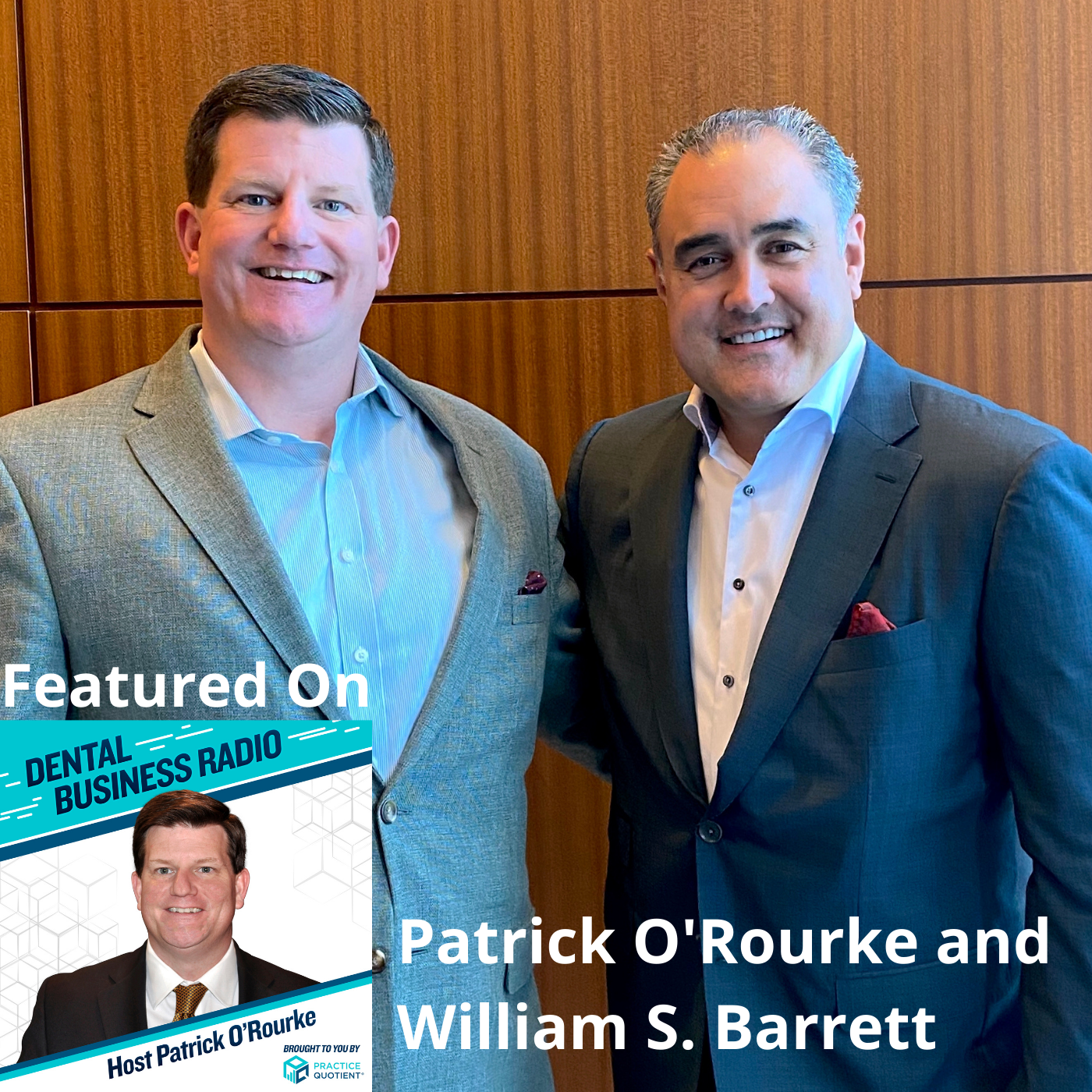
William Barrett, CEO of Mandelbaum Barrett and author of The DSO Decision: Winning Answers from Every Angle, was Patrick O’Rourke’s guest on this edition of Dental Business Radio. He covered considerations for practice owners who are considering selling their practice to a DSO or creating a DSO themselves. Bill and Patrick also discussed getting proper legal counsel, misclassification of independent contractors, practice brokers, partnerships, and much more.

Dental Business Radio is underwritten and presented by Practice Quotient: PPO Negotiations & Analysis and produced by the North Fulton studio of Business RadioX®.

William Barrett, Chief Executive Officer, Mandelbaum Barrett

William Barrett is the Chief Executive Officer of Mandelbaum Barrett. He has over 20 years of experience representing a wide range of businesses with a unique specialty in mergers and acquisitions. He provides strategic advice to companies of all sizes from formation to dissolution and every stage in between. He is known for the personal attention that he gives his clients and the energy he brings to every deal. Bill has a reputation as a deal maker who knows how to be creative and get things done.

Bill often serves the role as outside general corporate counsel to his clients and advises them on issues concerning contracts, employment law compliance, developing policies, executive compensation programs and agreements, as well as business succession and related tax planning. His representative clients include commercial organizations and entrepreneurs in the areas of manufacturing, industry, service, banking, finance, insurance, construction, real estate development, as well as healthcare professionals of varying disciplines and organizations. Throughout his career, Bill has successfully managed the purchase or sale of hundreds of businesses, professional practices, and facilities.

In the healthcare space, Bill is well recognized nationally as a transactional lawyer in dental and medical practice transitions, practice sales and purchases, associate buy-ins, start-ups, and the structuring of dental services organizations (DSOs) and management services organizations (MSOs). Bill represents clients throughout the country and is well versed in the specific rules and regulations that govern the healthcare industry.

William S. Barrett (Bill) is the author of Pain-Free Dental Deals: An Entrepreneurial Dentist’s Guide to Buying, Selling and Merging Practices and The DSO Decision: Winning Answers from Every Angle. He has authored many articles addressing the legal and business needs of licensed professionals and facilities. He regularly speaks on a wide variety of topics to professional tradeshows, associations, study groups, societies, as well as students and residents at dental and medical schools across the country. In 2018, Bill appeared on Howard Farran’s well-regarded show Dentaltown to talk about practice transitions. Hear what he and Howard spoke about here.

LinkedIn

Mandelbaum Barrett

Since its founding in 1930, Mandelbaum Barrett has been committed to providing its clients with the highest level of personal, hands-on attention to their legal needs. They take a proactive approach in representing our clients; from the board room to the courtroom. Mandelbaum Barrett attorneys are zealous advocates, treating their clients’ concerns as though they were for their own family.
They take the time to get to know their clients. The better they know them, the better they can anticipate their needs and potential legal issues before they arise. That’s why they invest the time to learn about clients’ industries and competitors. That’s also why they provide informative seminars on various business, economic, and legal topics. They are in this together as their client’s partner for success.
Their business clients are diverse and include organizations of all sizes in various industries with national and international interests, such as banks, governmental entities, real estate developers, public and private institutions, biotech companies, manufacturers, health care providers and facilities, as well as individuals and families. Clients say they choose Mandelbaum Barrett because an experienced attorney is both effective and efficient.
Company website | LinkedIn


About Dental Business Radio

Patrick O'Rourke
Patrick O’Rourke, Host of “Dental Business Radio”

Dental Business Radio covers the business side of dentistry. Host Patrick O’Rourke and his guests cover industry trends, insights, success stories, and more in this wide-ranging show. The show’s guests include successful doctors across the spectrum of dental practice providers, as well as trusted advisors and noted industry participants. Dental Business Radio is underwritten and presented by Practice Quotient and produced by the North Fulton studio of Business RadioX®. The show can be found on all the major podcast apps and a complete show archive is here.


Practice Quotient

Dental Business Radio is sponsored by Practice Quotient. Practice Quotient, Inc. serves as a bridge between the payor and provider communities. Their clients include general dentist and dental specialty practices across the nation of all sizes, from completely fee-for-service-only to active network participation with every dental plan possible. They work with independent practices, emerging multi-practice entities, and various large ownership entities in the dental space. Their PPO negotiations and analysis projects evaluate the merits of the various in-network participation contract options specific to your Practice’s patient acquisition strategy. There is no one-size-fits-all solution.

Connect with Practice Quotient

Website | LinkedIn | Facebook | Twitter

Tagged With: Dental Business Radio, dental practices, Mandelbaum Barrett, Pain-Free Dental Deals, Patrick O'Rourke, PPO Negotiations & Analysis, Practice Quotient, selling a dental practice, The DSO Decision, William Barrett, William S. Barrett

Trevor Maurer and Zach Burger, OMS360

March 3, 2022 by John Ray

OMS360
Dental Business Radio
Trevor Maurer and Zach Burger, OMS360
Loading
00:00 /
RSS Feed
Share
Link
Embed

Download file

OMS360

Trevor Maurer and Zach Burger, OMS360 (Dental Business Radio, Episode 28)

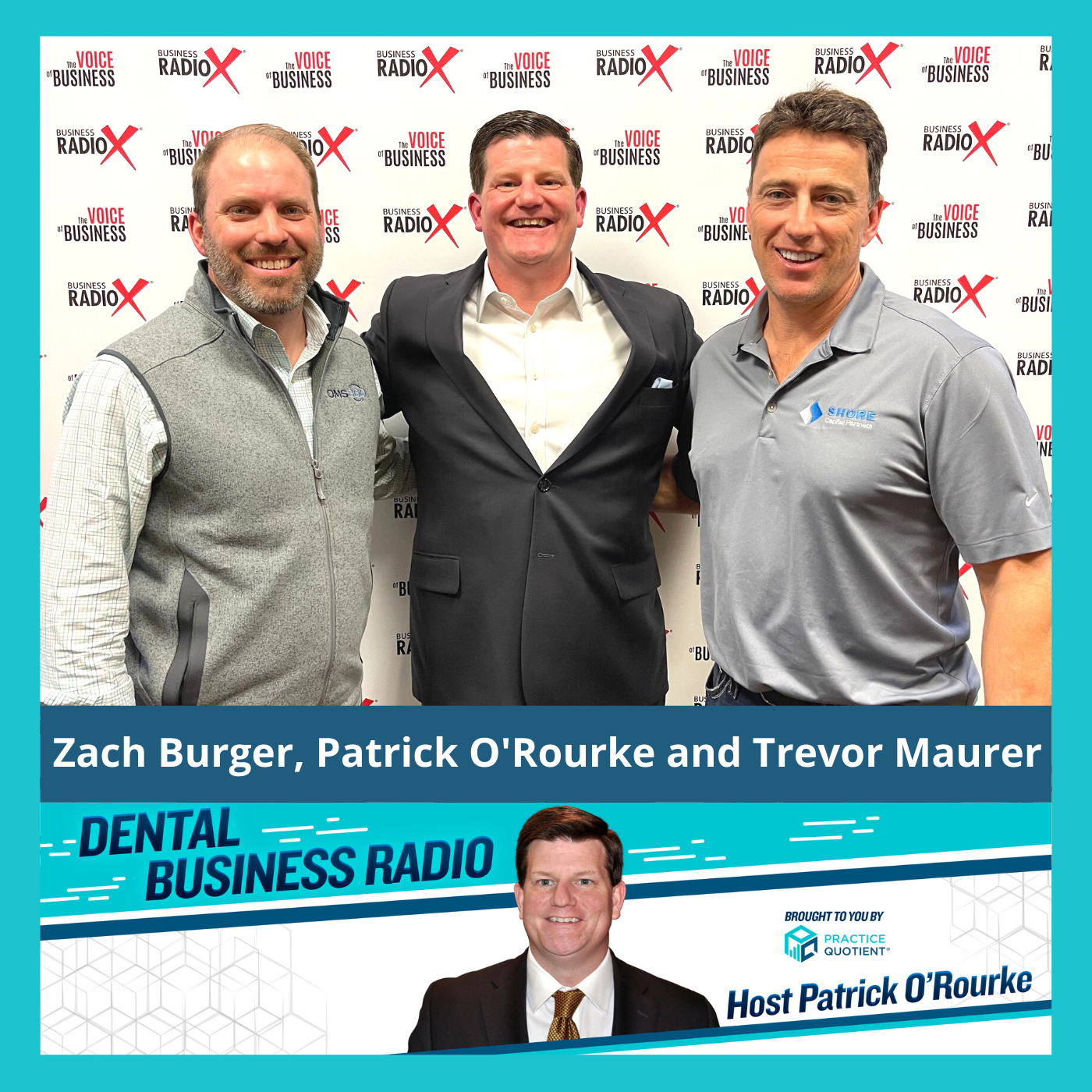
The headaches of managing an oral surgery practice are so severe that about 80% of dental school students surveyed do not want to own their own practice when they graduate. The HR function alone causes fits for oral surgeons who are not trained in managing a business. OMS360 CEO Trevor Maurer and Chief Development Officer Zach Burger joined host Patrick O’Rourke to share how their company provides corporate-quality support to their practitioners while maintaining the small business feel. Dental Business Radio is underwritten and presented by Practice Quotient: PPO Negotiations & Analysis and produced by the North Fulton studio of Business RadioX®.

OMS360

OMS360 brings strategic resources to Oral Maxillofacial Surgery practices. Working with you, they elevate your practice through an empowering partnership. Their team will help you grow revenue, profitability, and enjoyment of your practice without the stress of doing it on your own. It is their mission to get you back to the things that you originally loved about the profession.

Company website | LinkedIn

Trevor Maurer, CEO, OMS360

Trevor Maurer, CEO, OMS360

Trevor Maurer serves as CEO of Shore Capital’s oral surgery platform investment, and as a Board Member for Southern Orthodontic Partners, Shore Capital’s network of orthodontists and management support services.

Most recently Mr. Maurer served as President and CEO of Smile Source, where he led the growth of the company from 32 locations to over 750 independently operated franchise dental practices. Previously Mr. Maurer was CEO of Eyeweb, a digital imaging software and hardware company, and held various Sales and Marketing leadership roles at Procter & Gamble and Ciba Vision, a Novartis company. At Ciba Vision, Mr. Maurer served as North American Executive Director of Sales, where he reorganized growth markets and launched a new sales force of over 100 representatives.

Mr. Mauer received his degree in Commerce (Accounting) from the University of Saskatchewan.

LinkedIn

Zach Burger, Chief Development Officer, OMS360

Zach Burger, Chief Development Officer, OMS360

Zach Burger is Chief Development Officer with OMS360. He has over ten years experience in development.

Previously, Mr. Burger was with Surgical Care Affiliates as Vice President of Development.

Mr. Burger has a degree from the University of Alabama and a Master’s from Auburn University.

LinkedIn

About Dental Business Radio

Patrick O'Rourke
Patrick O’Rourke, Host of “Dental Business Radio”

Dental Business Radio covers the business side of dentistry. Host Patrick O’Rourke and his guests cover industry trends, insights, success stories, and more in this wide-ranging show. The show’s guests include successful doctors across the spectrum of dental practice providers, as well as trusted advisors and noted industry participants. Dental Business Radio is underwritten and presented by Practice Quotient and produced by the North Fulton studio of Business RadioX®. The show can be found on all the major podcast apps and a complete show archive is here.


Practice Quotient

Dental Business Radio is sponsored by Practice Quotient. Practice Quotient, Inc. serves as a bridge between the payor and provider communities. Their clients include general dentist and dental specialty practices across the nation of all sizes, from completely fee-for-service-only to active network participation with every dental plan possible. They work with independent practices, emerging multi-practice entities, and various large ownership entities in the dental space. Their PPO negotiations and analysis projects evaluate the merits of the various in-network participation contract options specific to your Practice’s patient acquisition strategy. There is no one-size-fits-all solution.

Connect with Practice Quotient

Website | LinkedIn | Facebook | Twitter

Tagged With: dental business, Dental Business Radio, dental practices, Oral Maxillofacial Surgery, Oral Maxillofacial Surgery practices, oral surgeons, Patrick O'Rourke, PPO Negotiations & Analysis, Practice Quotient, Trevor Maurer, Zach Burger

Five Considerations When Planning to Sell Your Practice, with Danielle McBride, Oberman Law Firm

January 21, 2022 by John Ray

Selling a Practice
Dental Law Radio
Five Considerations When Planning to Sell Your Practice, with Danielle McBride, Oberman Law Firm
Loading
00:00 /
RSS Feed
Share
Link
Embed

Download file

Sell a Practice

Five Considerations When Planning to Sell Your Practice, with Danielle McBride, Oberman Law Firm (Dental Law Radio, Episode 31)

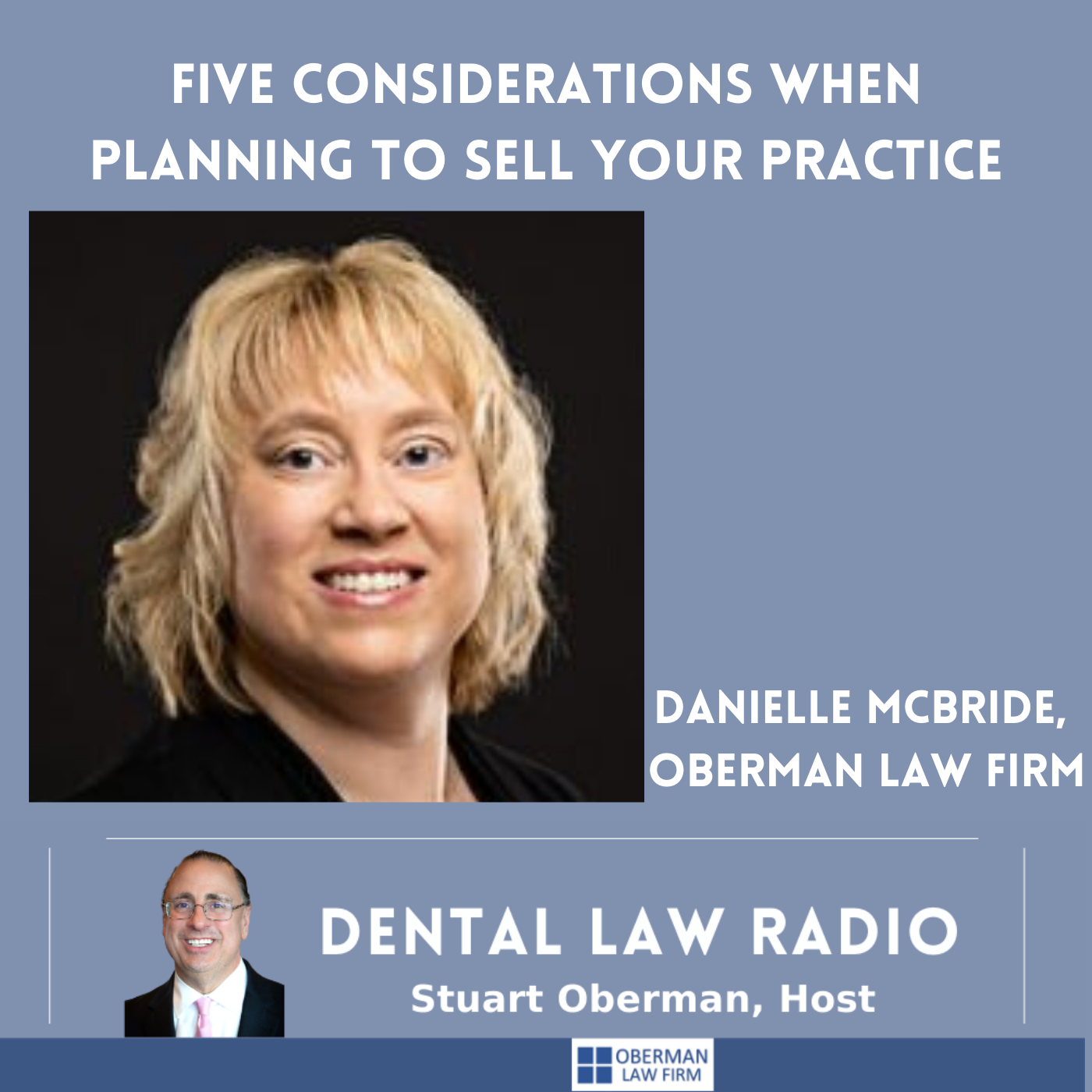
Whether your exit plans are near term or down the road, this episode of Dental Law Radio is must listening. Danielle McBride joined host Stuart Oberman to discuss major considerations for any dental practice owner who plans to sell. Preparing for the due diligence a buyer will conduct is particularly vital. Danielle also discussed expenses which negatively impact profitability and therefore valuation, the lease, staffing, patient credits, and much more. Dental Law Radio is underwritten and presented by Oberman Law Firm and produced by the North Fulton studio of Business RadioX®.

Danielle McBride, Partner, Oberman Law Firm

Danielle McBride
Danielle McBride, Partner, Oberman Law Firm

Danielle McBride has been practicing law for over 21 years, and her primary focus is representing healthcare clients on a local, regional, and national basis. Ms. McBride regularly consults with clients regarding simple to complex healthcare transitions, including mergers and acquisitions, employment law, governmental compliance, tax strategies, practice valuations, DSO formation and structures, employee compensation, associate and partnership contracts, joint ventures, and partnership buy-in/buy-outs.

In addition, Ms. McBride brings a wealth of knowledge and experience preparing practice valuations for clients, as well as formulating simple to complex tax strategies, and entity formations.

Ms. McBride holds a Bachelor of Arts in Sociology/Criminology from The Ohio State University, a Juris Doctor (J.D.) from Ohio Northern University Pettit College of Law, and a Master of Laws (LL.M.) in Taxation from Case Western Reserve University.

LinkedIn

TRANSCRIPT

Intro: [00:00:02] Broadcasting from the Business RadioX studios in Atlanta, it’s time for Dental Law Radio. Dental Law Radio is brought to you by Oberman Law Firm, a leading dental-centric law firm serving dental clients on a local, regional and national basis. Now, here’s your host Stuart Oberman.

Stuart Oberman: [00:00:26] Welcome, ladies and gentlemen, to Dental Law Radio. Unbelievable guest speaker today, unbelievable on the podcast, Danielle McBride, partner in Oberman Law Firm. And little brief background, Danielle’s been practicing for about 21 years. Specialty market is dental law, mergers, acquisitions, tax, compliance. And we’re going to drill down on a couple of things today. I know that Danielle has probably done a couple of hundred transactions, if not thousands, in her illustrious career. And I know she’s going to have a lot of insight into this.

Stuart Oberman: [00:01:00] But I get this question, what do I need to consider when preparing for sale? So, what I want to do is Danielle, I want to leverage some of your experience here and expertise, and I want to run through about five things to consider when preparing your practice, we’re talking to a dentist for sale. So, let’s run through a couple of things. It’s sort of reoccurring theme – our doctors get into trouble, they’re not prepared. Number one, give me a number one. What’s the number one issue we see in preparing for practice sales that are sometimes problematic?

Danielle McBride: [00:01:41] Sure. So, number one is the due diligence in getting that in order. And that means understanding the business and your numbers, cash flow or profitability for the practice, what you sometimes hear in DSO languages, EBITA. And that’s the key to practice valuation and practice transition. You need to know your numbers, your discretionary expenses, those add backs in the practice. You need to take a look at your biggest expenses like staff, supplies, laboratory expenses. Knowing fee increases. What’s your fee schedule? We get questions for fee schedule, and when’s the last time you increased fees on things? And that’s a key thing right now with inflation.

Danielle McBride: [00:02:33] You want to also make sure that you’re not letting those fee increases lapse and not doing something from year to year as well to kind of keep up with things. Marketing, website, social media stuff, patient numbers, active patients, new patients, PPOs and referring doctors if you’re a specialist. All of those are due diligence items that are going to be requested by buyers, whether they’re private parties, individual dentist buyers, or whether they’re DSO transactions. And the DSO transactions, they’re much heavier on the due diligence. They will ask for every piece of paper you could possibly come up with in this transaction.

Stuart Oberman: [00:03:13] Plus.

Danielle McBride: [00:03:14] So, you know. So, getting those things in order ahead is key.

Stuart Oberman: [00:03:20] I got a question. So, profitability and EBITDAs. So, look, our doctors run a lot of stuff through their practice that they shouldn’t, and they get into trouble and it affects their numbers. What are some of the things that you see? Before we jump to number two, what are some of the things that you see doctors running through practices that they really need to clean up to get their numbers in order?

Danielle McBride: [00:03:46] Sure. A lot of it is things like running office expenses and personal expenses through the practice. And so, it’s easy to see.

Stuart Oberman: [00:03:56] That never happens.

Danielle McBride: [00:03:57] Yeah, yeah, never happens. They don’t go to Home Depot and buy toilet paper and paper towels for the office and home. So, a lot of times, they’re running things like that through the practice, and they don’t separate the receipts out. And so, it’s getting lumped into categories like office expenses or promotional expenses, things like sponsoring some of your kids’ events, and you write it off through practice promotion. That’s greedy when a buyer-

Stuart Oberman: [00:04:24] Pay your children, right? How do they pay their children?

Danielle McBride: [00:04:25] What’s that?

Stuart Oberman: [00:04:25] How do they pay their children?

Danielle McBride: [00:04:29] A lot of them pay their children. Put your kids on the payroll. You should be putting them on the payroll as soon as they’re old enough, maybe six or seven years old. Have them reaching the lower filing cabinets or modeling for the website, have them mow the lawn for the practice, and get them IRA contributions.

Stuart Oberman: [00:04:49] That’s good. Wow.

Danielle McBride: [00:04:50] Yeah. So, kids on the payroll. There’s a lot of spouses on the payroll too. And sometimes, they’re paid. Sometimes, they’re underpaid. Sometimes, they’re overpaid. And those are things that go into profitability on the practice as well and you don’t necessarily. Those are the easy things to see. The harder things are when they’re running all this stuff through office expense, and they’re like, “Yeah, yeah, $50,000 of it is just me running personal expenses through.” Well, that’s hard for a buyer to accept that. Okay, well, the profitability is really $100,000 higher than what’s showing up when I’m looking at your typical add backs. Your practice promotion expense – auto, car, meals, travel, continuing ed, staff or family on the payroll, those sort of things, those are all pretty easy to see. It’s the other things that really need cleaned up sometimes because it’s going to be hard to explain to that buyer unless you start showing them all your credit card statements.

Stuart Oberman: [00:05:55] I know you made a best friend out of all of the underpaid spouse managers.

Danielle McBride: [00:06:01] Yeah.

Stuart Oberman: [00:06:02] You just became an absolute cult hero, I can tell you that. Well, that’s good. That’s definitely good stuff that affects the profitability. And we also have seen some audits from state and federal on expenditures that are never good like that. So, give me a number two. Give me a number two on things to consider.

Danielle McBride: [00:06:24] Number two-

Stuart Oberman: [00:06:24] Yeah.

Danielle McBride: [00:06:25] … is the lease. Everyone always forgets about the lease and waits till the last minute. So, if you’re preparing for a transaction, get your lease out. Look at what the terms are, find out if you’ve got to get consent from your landlord to sell, find out what happens if you have a personal guarantee on that lease. If you’re going to assign the lease, if it’s a third-party landlord, make sure that you’ve got under control your lease. You want to make sure that you know what the terms are. If you’re up for a renewal and you’re thinking about selling your practice, there are lots of things that you could try to work into that lease with the landlord to try and prepare for a practice sale. Perhaps even getting something into the lease saying that you don’t need their consent to sell to transition the lease to that buyer if you’re selling your practice. I’ve run across lots of leases over my years with third-party landlords and it can be a real headache. And that is the single biggest reason I get a transaction delayed is that, “Oh my god, we don’t have the lease assignment from the third-party landlord.”

Stuart Oberman: [00:07:40] Now, are you seeing — we’re seeing this a little bit coming west to east? Are you seeing that if – which a landlord does not have to do – end the lease early, that they want a percentage of the sale to do that. We’re seeing some interesting numbers coming through that.

Danielle McBride: [00:08:01] Yeah, I’ve seen some. It has been more of a West Coast issue that I’ve seen this in. Midwest and Northeast, I haven’t seen a lot of that with a percentage of the sales. In New York, I have had a few transactions where we’ve had to try and buy the landlord, and essentially pay them something in order to get a seller out of a lease. But I had a transaction like that.

Stuart Oberman: [00:08:24] That’s called legal bribery.

Danielle McBride: [00:08:25] Yeah. Yeah, it is. The New York leases, they’re a lot of fun, let me tell you.

Stuart Oberman: [00:08:33] Wow! I mean, what usually starts in the West comes East. So, I think we’ll be seeing that eventually. But well, number three. That was a great number two. We had cash flow number one, and lease number two. And what are we looking at, maybe the third issue?

Danielle McBride: [00:08:50] Number three is staffing, goodwill transition, patient retention issues. So, you want to be able to transition the practice well. And some of the key things are not just the doctor transitioning to the new doctor, but also staffing and patient retention. And so, a lot of times, the goodwill transition is a key component. And sometimes, that’s where you see negotiations kind of get a little stuck from time to time. Is it the buyer wants to make sure that the seller and the staff are going to contribute to the transition, and make sure that the patients can be retained, that there’s going to be an introductory letter, or a letter to referral sources if it’s a specialty practice? Introductions maybe with the top 5-10 referral sources. Making sure that the staff is going to stay in the transaction, and that you’re not going to lose, and have a bunch of staff turnover right at the transition date. And now, you’re trying to retain patients, but you’ve got all new faces in there.

Stuart Oberman: [00:09:58] What about associate issues?

Danielle McBride: [00:10:01] Associate issues as well. That’s another key thing in staffing is that if you’ve got an employment agreement or you have associates working in the practice, and you didn’t have an employment agreement with them, and there are no restrictive covenants, your buyers are going to be coming in, and they’re going to be asking for those associates to sign contracts. And if you didn’t have one before, you’ve got nothing to actually assign, which means a new negotiation with that associate and potentially with the buyer. And if they’re a key producer in the practice, especially in these big DSO transactions, they’re offering this money for the transaction based on key production numbers. And if you’ve got an associate that is not going to stay with the practice or that you can’t enforce a covenant not to compete for in order to prevent them from competing with the buyer, then you’re going to have some things you’re going to have to negotiate, and it could really create some problems.

Stuart Oberman: [00:10:57] Now, question for you, when you do your practice evaluations, and you do a great job on that, does the associate not staying affect the value of the practice when you’re asked to evaluate what that practice is worth?

Danielle McBride: [00:11:14] Sometimes. It depends on the circumstances.

Stuart Oberman: [00:11:17] That’s a great legal answer.

Danielle McBride: [00:11:19] Yeah.

Stuart Oberman: [00:11:21] That’s a typical answer, “Well, it depends.”

Danielle McBride: [00:11:23] It really depends on facts and circumstances.

Stuart Oberman: [00:11:24] Yeah.

Danielle McBride: [00:11:24] Yeah. And the key is going to be whether or not the practice can find a replacement and associate easily, or whether or not the practice owner or the other doctors working in the practice are able to pick up that profitability, or to pick up that production from that doctor who’s not going to stay.

Stuart Oberman: [00:11:40] Staff, staff, staff. Wow! Let’s look at the number four. Give me the number four.

Danielle McBride: [00:11:48] Number four, equipment, assets and curb appeal. And a little bit of this is about allocations as well. You’ve got goodwill, and you’ve got tangible assets in the practice. And so, one of the things, if you’re thinking about putting your practice on the market, there are some practices out there that maybe they haven’t updated with newer equipment, or they’ve thought about refreshing their waiting room, or adding a CERAC machine, or adding a major piece of equipment, and they haven’t done it yet.

Stuart Oberman: [00:12:21] Pick it up at 179 deduction, right?

Danielle McBride: [00:12:24] Yeah, you can get the 179 deduction, so you can buy it and you can write it off all in the same year. And in part, it’s a seller problem; in part, it’s a buyer problem. And so, there’s a little bit of a fine line you walk between whether or not you go ahead and make some of those improvements to make the practice more attractive to a buyer, or you say, “I don’t want to invest in a lot of super new technology and go into debt just to be able to make the practice. I’ll take that into account when I value the practice. I’m going to look at what the equipment is and how much it’s valued there. If the practice is not – say they don’t have electronic records, everything still on paper in boxes, and computer systems haven’t been upgraded, there are some minimum requirements for computer systems to be upgraded that most buyers are going to ask.

Danielle McBride: [00:13:21] And so, those are things that are going to go into negotiating the ultimate purchase price that a buyer is going to be willing to pay. Now, some of it, it’s a seller’s problem. Some of it, it’s a buyer’s problem. If you want to be super fancy and buy all the latest and greatest technology, buyer, go ahead. That doesn’t mean I don’t have a practice that’s fully capable of supporting you working in it, and you can make whatever changes you want to make on your dime, but there are some things that a seller might want to do just to make things a little more attractive for a buyer.

Stuart Oberman: [00:13:53] And then, it’s — yeah. I mean, we had Dr. Richard Madow on a couple of episodes ago. He had a good talk about doctors buying equipment and profitability and doesn’t need that. And that was interesting analogy, and how that just compared to what you said regarding [crosstalk].

Danielle McBride: [00:14:18] Sure. Don’t go into debt to make it-.

Stuart Oberman: [00:14:19] Yeah.

Danielle McBride: [00:14:19] Don’t go into debt to make it appealable-

Stuart Oberman: [00:14:21] That’s a good-

Danielle McBride: [00:14:21] … or attractive to a buyer, but there are some things that you could do, especially if you’re looking at a year or two out from a practice sale and making a few revisions here or there. You can write these things off, 179, depreciation, deductions, bonus depreciation, et cetera, so.

Stuart Oberman: [00:14:40] Yeah, I mean, that is practical, practical advice, which a lot of times, I think doctors are missing from the advisor standpoint. Let’s talk about the last, number five. And this get a little sticky in the contract areas also. It’s, you know-

Danielle McBride: [00:15:01] Yes.

Stuart Oberman: [00:15:01] This is where, sort of, the rubber hits the road. And talk about number five on some of these.

Danielle McBride: [00:15:08] So, number five is my accounts receivable, prepaid accounts, patient credits and treatment in progress.

Stuart Oberman: [00:15:17] Yeah.

Danielle McBride: [00:15:17] Now, there is no one size fits all on any of those. And often, they wait until the last minute to look at these, “Oh, I’ll get you this. Oh, I’ll get you this report. Oh, I’ll look and see,” or they run the report, and they don’t pay attention to it.

Stuart Oberman: [00:15:33] Famous last words.

Danielle McBride: [00:15:35] Yeah. I mean, patient credits, in particular, your accounts receivable aging, you may have things that are sitting on the report if you haven’t cleaned up your collections, if you haven’t cleaned up your patient credits, those are all things that can go into the ultimate purchase price if someone’s going to purchase your accounts receivable and take over the practice. And then, your prepaid accounts. And it can vary based on specialty. Obviously, in orthodontic practices, you’ve got long-term contracts with payments that may have been paid in full, contracts paid in full at the start of treatment but you’ve got a buyer that’s doing — say, you had a bunch of patients pay right before the closing, you got all the money, but the buyer is going to get — seller got all the money, but buyer’s now going to have to do all of the work to finish those patients.

Danielle McBride: [00:16:27] And so, there, oftentimes, has to be some sort of adjustment to price or proration on prepaid contracts. And there can be other specialties as well or even general practices that maybe do some particular restorative type work or something that will have treatment in progress and prepaid treatment that is long-term patient treatment planning, where you’ve got courses of treatment that lasts for multiple appointments over a longer period of time, with maybe episodes of healing required in between, and you’ve got someone who’s got a $10,000 case that’s being paid on a monthly basis because that’s the arrangement they entered into with the doctor there, and their treatment is maybe a quarter of the way done, you’ve got to actually think about those things. And oftentimes, we add exhibits to the contract that will list patient credits, patient refunds having to be made prior to closing, prepaid cases being prorated between buyer and seller.

Stuart Oberman: [00:17:36] Do you have to do-

Danielle McBride: [00:17:36] Thinking of progress list being done.

Stuart Oberman: [00:17:38] Do you have to give special consideration in contracts when you have that seller who’s leaving, and and you’ve got open cases, or what happens if you got a hundred patients come back from faulty work-

Danielle McBride: [00:17:53] Right.

Stuart Oberman: [00:17:53] … what happens with that?

Danielle McBride: [00:17:57] Right. And that’s where we have provisions in our contracts that usually deal with what happens if there’s defective work or rework, and can the buyer — as a seller, you don’t want the buyer to just say, “Well, I have to redo all of this work. And now, you owe me this money,” and it goes on indefinitely. There are time limitations that should be put in their requirements. There are parameters that should be set. And this is all based on the facts and circumstances of the practice. You may have some practices where this isn’t a problem because you don’t have patients that are not paying when they receive their treatment.

Stuart Oberman: [00:18:31] Danielle, great stuff about the patient credits. One thing in redos, one thing I want to do is I want you elaborate a little bit more on the contract side as far as what happens when you’ve got a doctor that maybe is selling sticking around for a year or two. I mean, you mentioned earlier about limits in contracts and redos. Elaborate just a little bit more on that contract provision, what should be on there to limit the seller’s liabilities going forward?

Danielle McBride: [00:19:03] Sure. I mean, the seller should limit the liability going forward based on some parameters for patients. You can’t just have patients who have not been seen in the practice for the last year coming in to have rework done or having the buyer not consult you about rework before they agree to retreat a patient and then charge you for the fee to redo the work on that patient. Sometimes, I see caps or limits set.

Danielle McBride: [00:19:34] I mean, generally speaking, accounts receivable, patient credits, they all should be reviewed and wrapped up in your records. Your accounts receivable and credit should be cleaned up prior to a sale. You want to make sure that you don’t have long outstanding credits there. Maybe there are patients that you don’t even have in the practice any longer. A lot of practices are in the habit of not cleaning those up on an annual basis. So, clean those patient credits up because you’re going to have to pay them off. Generally, a buyer will ask for them to be paid off prior to closing. The DSOs, also, take that into account when they’re factoring in expenses to be paid and credits if they’re going to be assumed. You don’t want to be giving the buyer money that’s never going to come in.

Stuart Oberman: [00:20:26] Yeah. Well, it’s interesting, for 50 DSOs, you’ll have 50 ways of calculating all of this. That’s amazing.

Danielle McBride: [00:20:32] Yes.

Stuart Oberman: [00:20:33] Well, that is five great things to consider when you’re preparing your practice for sale. And all these are, obviously, a moving target. As the transition takes place, I mean, these are just moving targets and just constant adjustments. Well. Danielle, amazing, amazing stuff as always. Just, again, five topics that our doctors just have to consider on any transaction.

Stuart Oberman: [00:21:00] Also, honestly, this can be applied to any business listeners also on what they’re looking at, whether it’s just AR or cash flows, profitability. So, really, everything you’ve talked about today and in previous podcasts, I mean, any business owner really could use. So, amazing stuff.

Stuart Oberman: [00:21:19] Well, great job, Danielle. Thank you very much. And as always, amazing knowledge. And we really enjoyed having you on the podcast today. And I know our listeners did, so. Well, with that, we will call it a day as s we say. If you have any questions, please feel free to give us a call, 770-886-2400. Danielle, how do they get in touch with you if they want to send you an email or request some information?

Danielle McBride: [00:21:47] They can send me an email. They can call the corporate number. They can also send me an email at danielle@obermanlaw.com.

Stuart Oberman: [00:21:55] Good, good. Yeah, number’s 770-886-2400. My name is Stuart Oberman. It is Stuart@obermanlaw.com. Thank you for listening, and we appreciate it, and have a fantastic day.


About Dental Law Radio

Hosted by Stuart Oberman, a nationally recognized authority in dental law, Dental Law Radio covers legal, business, and other operating issues and topics of vital concern to dentists and dental practice owners. The show is produced by the North Fulton studio of Business RadioX® and can be found on all the major podcast apps. The complete show archive is here.

Stuart Oberman, Oberman Law Firm

Stuart Oberman
Stuart Oberman, host of “Dental Law Radio”

Stuart Oberman is the founder and President of Oberman Law Firm. Mr. Oberman graduated from Urbana University and received his law degree from John Marshall Law School. Mr. Oberman has been practicing law for over 25 years, and before going into private practice, Mr. Oberman was in-house counsel for a Fortune 500 Company. Mr. Oberman is widely regarded as the go-to attorney in the area of Dental Law, which includes DSO formation, corporate business structures, mergers and acquisitions, regulatory compliance, advertising regulations, HIPAA, Compliance, and employment law regulations that affect dental practices.

In addition, Mr. Oberman’s expertise in the health care industry includes advising clients in the complex regulatory landscape as it relates to telehealth and telemedicine, including compliance of corporate structures, third-party reimbursement, contract negotiations, technology, health care fraud and abuse law (Anti-Kickback Statute and the State Law), professional liability risk management, federal and state regulations.

As the long-term care industry evolves, Mr. Oberman has the knowledge and experience to guide clients in the long-term care sector with respect to corporate and regulatory matters, assisted living facilities, continuing care retirement communities (CCRCs). In addition, Mr. Oberman’s practice also focuses on health care facility acquisitions and other changes of ownership, as well as related licensure and Medicare/Medicaid certification matters, CCRC registrations, long-term care/skilled nursing facility management, operating agreements, assisted living licensure matters, and health care joint ventures.

In addition to his expertise in the health care industry, Mr. Oberman has a nationwide practice that focuses on all facets of contractual disputes, including corporate governance, fiduciary duty, trade secrets, unfair competition, covenants not to compete, trademark and copyright infringement, fraud, and deceptive trade practices, and other business-related matters. Mr. Oberman also represents clients throughout the United States in a wide range of practice areas, including mergers & acquisitions, partnership agreements, commercial real estate, entity formation, employment law, commercial leasing, intellectual property, and HIPAA/OSHA compliance.

Mr. Oberman is a national lecturer and has published articles in the U.S. and Canada.

LinkedIn

Oberman Law Firm

Oberman Law Firm has a long history of civic service, noted national, regional, and local clients, and stands among the Southeast’s eminent and fast-growing full-service law firms. Oberman Law Firm’s areas of practice include Business Planning, Commercial & Technology Transactions, Corporate, Employment & Labor, Estate Planning, Health Care, Intellectual Property, Litigation, Privacy & Data Security, and Real Estate.

By meeting their client’s goals and becoming a trusted partner and advocate for our clients, their attorneys are recognized as legal go-getters who provide value-added service. Their attorneys understand that in a rapidly changing legal market, clients have new expectations, constantly evolving choices, and operate in an environment of heightened reputational and commercial risk.

Oberman Law Firm’s strength is its ability to solve complex legal problems by collaborating across borders and practice areas.

Connect with Oberman Law Firm:

Company website | LinkedIn | Twitter
Tagged With: Danielle McBride, Dental Practice, dental practices, DSO, Oberman Law Firm, selling a dental practice, Selling a Practice, Stuart Oberman

  • « Previous Page
  • 1
  • 2
  • 3
  • 4
  • Next Page »

Business RadioX ® Network


Our Most Recent Episode

CONNECT WITH US

  • Email
  • Facebook
  • LinkedIn
  • Twitter

  • YouTube

Our Mission

We help local business leaders get the word out about the important work they’re doing to serve their market, their community, and their profession.

We support and celebrate business by sharing positive business stories that traditional media ignores. Some media leans left. Some media leans right. We lean business.

Sponsor a Show

Build Relationships and Grow Your Business. Click here for more details.

Partner With Us

Discover More Here

Terms and Conditions
Privacy Policy

Connect with us

Want to keep up with the latest in pro-business news across the network? Follow us on social media for the latest stories!
  • Email
  • Facebook
  • Google+
  • LinkedIn
  • Twitter

  • YouTube

Business RadioX® Headquarters
1000 Abernathy Rd. NE
Building 400, Suite L-10
Sandy Springs, GA 30328

© 2025 Business RadioX ® · Rainmaker Platform

BRXStudioCoversLA

Wait! Don’t Miss an Episode of LA Business Radio

BRXStudioCoversDENVER

Wait! Don’t Miss an Episode of Denver Business Radio

BRXStudioCoversPENSACOLA

Wait! Don’t Miss an Episode of Pensacola Business Radio

BRXStudioCoversBIRMINGHAM

Wait! Don’t Miss an Episode of Birmingham Business Radio

BRXStudioCoversTALLAHASSEE

Wait! Don’t Miss an Episode of Tallahassee Business Radio

BRXStudioCoversRALEIGH

Wait! Don’t Miss an Episode of Raleigh Business Radio

BRXStudioCoversRICHMONDNoWhite

Wait! Don’t Miss an Episode of Richmond Business Radio

BRXStudioCoversNASHVILLENoWhite

Wait! Don’t Miss an Episode of Nashville Business Radio

BRXStudioCoversDETROIT

Wait! Don’t Miss an Episode of Detroit Business Radio

BRXStudioCoversSTLOUIS

Wait! Don’t Miss an Episode of St. Louis Business Radio

BRXStudioCoversCOLUMBUS-small

Wait! Don’t Miss an Episode of Columbus Business Radio

Coachthecoach-08-08

Wait! Don’t Miss an Episode of Coach the Coach

BRXStudioCoversBAYAREA

Wait! Don’t Miss an Episode of Bay Area Business Radio

BRXStudioCoversCHICAGO

Wait! Don’t Miss an Episode of Chicago Business Radio

Wait! Don’t Miss an Episode of Atlanta Business Radio