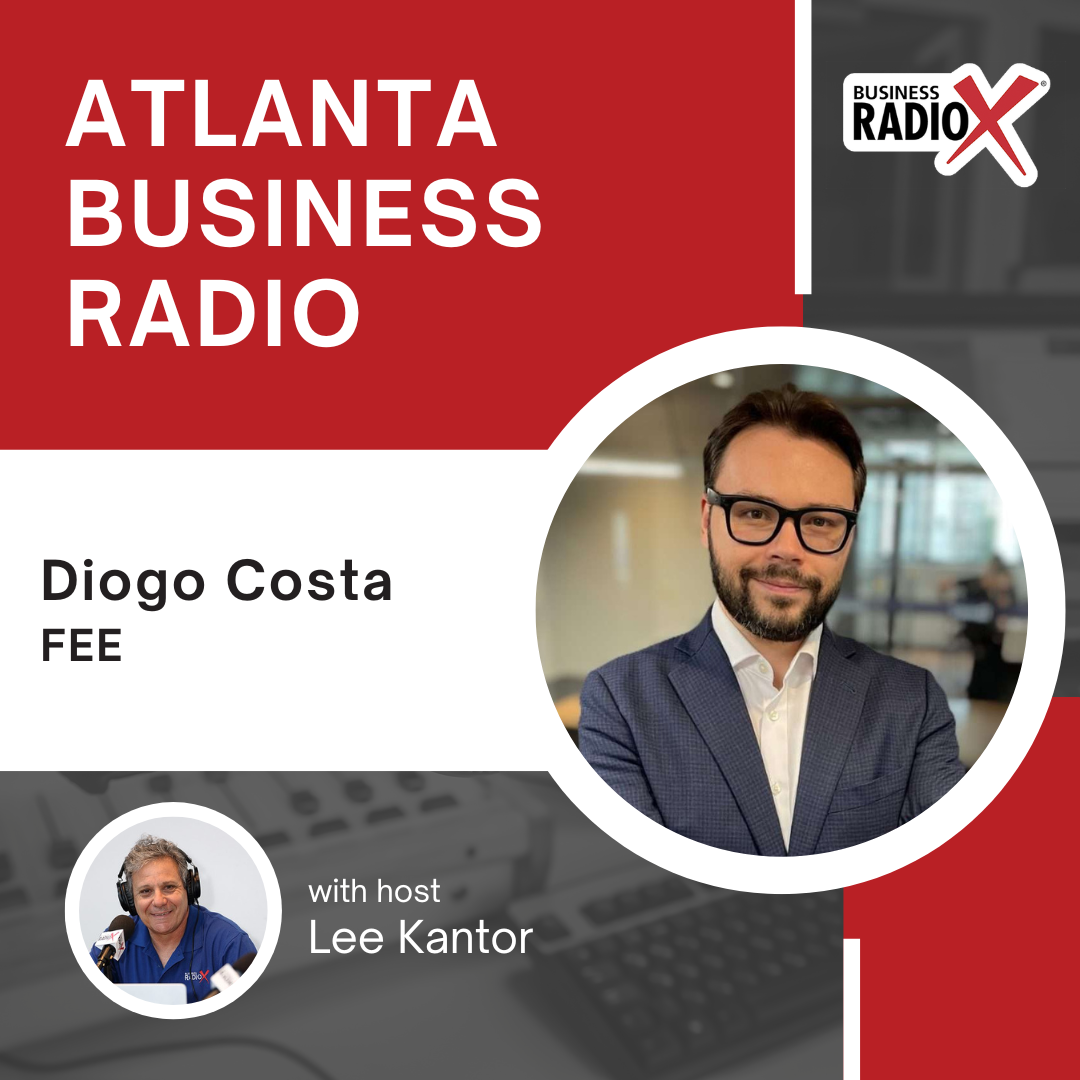

 In this episode of Atlanta Business Radio, Lee Kantor interviews Diogo Costa, President of the Foundation for Economic Education (FEE), about the importance of understanding economics as a way of understanding human choices, scarcity, entrepreneurship, and economic growth. Diogo discusses the factors that help countries prosper, including sound money, trade, property rights, entrepreneurship, and innovation. He also explores America’s affordability challenges, the impact of inflation and housing shortages, and how removing unnecessary barriers can encourage greater supply, productivity, and opportunity.

 Diogo Costa is the President of the Foundation for Economic Education (FEE). He holds a bachelor’s degree in Law from the Catholic University of Petrópolis and a master’s degree in Political Science from Columbia University.
He has been a researcher at the Cato Institute and the Atlas Network in Washington, a professor of political science at Ibmec in Belo Horizonte (Brazil), and developed Ordem Livre during his time at Cato and Atlas. He was also a co-founder of Livres and the executive director of Indigo.
During his postgraduate studies at King’s College London, he was an Adam Smith Fellow, a Humane Studies Fellow, and a John Blundell Scholar. He served as the President of Brazil’s National School of Public Administration and was the Executive Director of the Instituto Millenium.
His articles have appeared in various publications, such as Forbes, Newsweek, and The Wall Street Journal.
Connect with Diogo on LinkedIn, Facebook and X.
What You’ll Learn In This Episode
- Understanding economics as the study of human choice under scarcity
- The connection between economic freedom and prosperity
- How inflation affects purchasing power, savings, and long-term planning
- The role of entrepreneurship and creative destruction in economic growth
- How housing shortages contribute to higher rents and affordability challenges
- The importance of productivity, innovation, and expanding supply
- Recognizing prices as signals of scarcity and incentives for entrepreneurs
- Understanding the unintended consequences of price controls and excessive restrictions
- Making economic concepts more accessible through education and community engagement
- FEE’s efforts to strengthen economic education among students and educators
 This transcript is machine transcribed by Sonix.
TRANSCRIPT
Intro: Broadcasting live from the Business RadioX Studio in Atlanta, Georgia. It’s time for Atlanta Business Radio, brought to you by My Global Presence. The award winning Atlanta public relations agency that elevates brands and non-profits through authentic storytelling and national media campaigns. Find them at my global presence.com. Now, here’s your host.
Lee Kantor: Lee Kantor here, another episode of Atlanta Business Radio. And this is gonna be a good one. But before we get started, it’s important to recognize our sponsor, my Global Presence. If you want global visibility and meaningful impact, go to my global presence.com. Today on Atlanta Business Radio, we have the president of the Foundation for Economic Education, Diogo Costa. Welcome.
Diogo Costa: Thank you so much, Lee. Pleasure to be here.
Lee Kantor: Well, I am so excited to learn what you’re up to. Tell us about the Foundation for Economic Education.
Diogo Costa: Well, the Foundation for Economic Education is turning 80 years old this year. It was founded in 1946 by a businessman named Leonard Reed. He wanted to have an institution that was able to teach economics to the next generation. Of course, the next generation is always changing, so we have to change as well. And for the past 80 years, he has been running seminars, publications, and more recently we brought also all these new kinds of economic programing. So now fee runs Economics Olympiad in the US and the Americas. That’s a very exciting opportunity for high school students who want to be challenged and to better understand economics and economics, not just as finance economics, not just as the business of The Wall Street Journal, but economics as a way of seeing the world of understanding, you know, the opportunity costs of of life, of understanding how the modern economy works, how some countries grow rich and others don’t. So this is like we have a broad understanding of economics. We have seminars for college students. We have hackathons for those who are more Stem oriented. So we have a whole line of of programing from videos and publications all the way to in-person programing.
Lee Kantor: So now why don’t we just kind of start at the beginning in terms of educating our listeners about when you say economics, that can mean a lot of different things to a lot of different people. And can you share maybe your perspective of what economics is to you and maybe what it could be for individuals. What should they know about it? When you hear the words, oh, we’re talking about the economy or we’re talking about economics, uh, give us some of the basics.
Diogo Costa: Sure. So economics is about understanding human choice under scarcity, right? So we have infinite ambitions, infinite desires. You know, if you give someone if you know someone is in the middle of the desert and they have nothing and you give them some water, they’ll say, that’s all I want some water. But then they will tell you, uh, can also have a sandwich. Uh, what about some air conditioning here? Right? We our desires keep going, but our resources are finite. So economics is how do we make choices to, first of all, allocate those resources so they can better satisfy our wants, our needs, our dreams, our ambitions. But also how do we create more? Right. Economics is also about entrepreneurship. How do we, you know, create more technology? How do we make more with less? Um, so economics is also about how economies grow, right? So how do we create more riches for us? And the beautiful history of, of economics is to think that humanity, only a couple hundred years ago was living in an average of, uh, about $3 a day. And today, in a country like the US, it’s approaching $100 a day. So there is a lot of growth that happened in the past 200 years. And that story, what we call the great enrichment, is the main story of modern economics. How countries grew rich, how economies, you know, went from basic, you know, starvation or basic survival to prosperity to us talking, you know, in air conditioning rooms over, over Zoom and, and then answering the questions, what comes next? How do we keep innovating? How do we keep progress moving forward? How do we solve the big problems, diseases, poverty, ignorance? And how do we, you know, offer a better life for those who are yet to come?
Lee Kantor: Now is economics. Um, the thinking behind economics, is it a science in the sense that you can study something and then, you know, something works and then it can be replicated? Or is, is it kind of economics, more art and science?
Diogo Costa: I would say it’s, it’s a science since it’s a, you know, organized body of knowledge that can bring you from theory, from some, uh, general points so you can understand very concrete phenomena, right? So you have like very specific questions, questions that Americans are asking today. Like, why is my rent so high? Um, right. Or what should I prepare to be a productive member for my society, you know, ten years from now. So that all brings you to the big questions and the great, uh, uh, uh, uh, uh, uh, frameworks of, of economics. So it is a science because it has that body of knowledge, well organized. And we have theories, we have models. Um, but it’s very applicable to, to our life. But I would say it’s a science, but it’s a human science. And that’s our way of the free way, the foundation for economic education way of seeing economics. We don’t think economics is just, you know, a blackboard full of, of graphics. You know, that can be important too. But economics is also about how human beings deal with, with one another. And because we are, you know, uh, free people, we make our choices. And those choices sometimes, uh, are not perfectly predictable in the model, right? We sometimes just decide to do things differently, sometimes our are changing, tastes and preferences change. So we have to understand that economics is a human. Science is not an exact science like the physics, you know, the physical world.
Lee Kantor: Now, um, when it comes, why are certain countries economies, uh, better for the population than others? So what if everybody has kind of a, the understanding of the basics of this? Shouldn’t every, every country kind of be doing okay?
Diogo Costa: Yes. And that’s, that’s the question that brought me to Fi. You know, I come from Brazil. Um, Brazil is not as rich as the United States. And when I was just, you know, nine, ten years old, Brazil was under two big policies. One was inflation or even inflationism Like Brazilian economy was moved by government printing money, which meant that prices were changing all the time. The other one was protectionism. Brazil was very close because we wanted to make sure that we were building everything in house, so to speak, um and very against imports. So when I came to the US and I saw the prosperity in American cities, and then I went back home to Brazil, that was a question that stayed with me. And then I started to realize the difference between these two countries. So as I said, one of them was, was just inflation. And inflation for me meant that, um, as a young boy, I high inflation, Brazil was over 1,000% a year. Hyperinflation, uh, prices were changing literally every day. So I wanted to go to the grocery store near our home. My mom would give me a $1,000 bill, uh, of our current secretary and I would run to the store, and when I got there, I had to see where the price tag was. It was always this gentleman and his, you know, his job was changing the prices every day because I had to outrun him so I could get a product before he got to it and change the price.
Diogo Costa: And maybe my $1,000 bill wouldn’t be able to afford, like, a bag of chips. Um, and when I came back home, one, we had a four bedroom home and one of our rooms was turned into a pantry because my parents would do the same with their paychecks. They would get their paychecks, they would run and spend as much as they could. Because today, you know, tomorrow and next week, your paycheck will be worth much less. So just by doing that, which is having government printing money and debasing the value of money, that is one way to keep your country poor. You cannot do a proper planning, right? You cannot save your money like American Brazilian families to this day, they have a hard problem saving money, which means that you don’t have enough credit to for investment, for for business to actually borrow that money and invest in new business. So policies like inflation, like protectionism, which means that you don’t benefit from the gains of trade with the rest of the world, like Brazil wanted to produce everything from computers to cars to agriculture. And we were not doing anything well. So we were spending much more resources to build, you know, just like software than if we could just import that software and use that software to improve our agriculture, for instance, which would what happened in the 90s and then the 2000, we use all the technology to actually improve what Brazil was being good at.
Diogo Costa: So countries that are able to specialize and do what they do best, and then they trade with other countries, and they have this amazing machine that we call a port, right? One way that I start to understand ports is that port is like this beautiful machine that in my home country, Brazil, we would put oranges and shrimp and soy, and on the other side would come out cars and cell phones and computer chips. Right. Because we are sending that to Asia and we’re bringing from Asia, uh, things that we wanted and that were not as good as at making them. So I started to understand that what makes countries rich are basically, can you have make sure that your government actually allows for people to save, to work, to open business, to run business, to consume, and they’re not messing too much into their lives. And they allow people also to, you know, to trade with others. So there is a, an extremely interesting, uh, ranking called, uh, the, uh, Economic Freedom of the world, uh, index. And they measure some of these pillars that, uh, allow countries to grow richer sound money, which is, you know, you don’t have inflation or money actually is stable enough for you to plan around it.
Diogo Costa: Uh, openness to trade, which means I can buy what is cheaper and then I can produce what I do best, but also property rights, right? Whatever I invest, I know that I can keep that. And I know that that would not be spoliated either from by the government or also by, by my neighbors, by, by others. Right? I have security in what I’m producing and what I’m doing with my life. Um, also the possibility that I can open a business that my contracts will be, uh, respected, right? So I can have predictability and I can plan around it. Um, and that allows for which I would call the killer app of modern economies, which is creative destruction. Entrepreneurs who are not only allocating resources but are creating new things. And right now, that’s the world we live in when we look around us. Right? So today, Moderna, uh, just published results of phase three mRNA vaccines against cancer. Um, that’s, you know, that made, uh, the Moderna stock jump by over 120%. That is creative destruction, right? You are creating something new. Maybe some treatments will become obsolete because of that, but you are adding value to people’s lives so that more and more is how countries grow rich.
Lee Kantor: Now, why do you think, uh, here in America, which I think you said is one of the most affluent, um, nations. Why do so many people here Feel this kind of affordability crisis. Why are they. Um, uh, I don’t want to say afraid, but maybe it’s they’re not appreciating the, the necessary element that you described of creative destruction where that there must be, um, kind of a sweeping out of what is less efficient, uh, to bring in something that is more efficient, even though that obviously that’s going to have a negative impact on, like you described in that example on the firms that are doing something that maybe was the best solution prior to this new, uh, mRNA vaccine. So how do you kind of manage the expectations of your population so that they don’t, um, kind of feel so negatively about the affordability of things while they’re going through that type of transition?
Diogo Costa: That’s, that’s a great question, right? Because it seems very paradoxical. So we live in this society, the most affluent society maybe the world has ever seen. And at the same time, people struggle to buy groceries, to pay rent, to pay for gas. Um, one way to see this is that there are, I would say, three main elements to thinking about affordability. One is what I was just talking about, inflation. Inflation means that because of either some. Pli shocks or because of monetary policy, uh, the price levels keep rising. Um, and that you can think of price levels as this, uh, treadmill that you’re running on. And if it keeps going faster, even if you are going. Faster, you’re still in the same place. Or maybe you’re falling behind. So make sure that inflation is under control. And right now inflation, although it’s coming down, if you look at year over year, uh, results, PCI, the, uh, consumer prices are now at. Uh, lower than the target. Inflation has been running above that for 65 months. Um, and, you know, that brings with it a lot of prices up since 2021, the prices have been up 28%. That’s almost a third, uh, price of groceries are up 30% since 2020. So one problem is definitely we need to make sure that inflation is under control. A lot of that is a Federal Reserve job. A lot of that’s domestic policies, some of that are supply shocks like Covid was a supply shock.
Diogo Costa: Uh, the price of oil is a supply shock. Tariffs are shocks. Some of these shocks are, you know, a policy made. Some of them are outside of, of, of the realm of what policy can can do. But that is one element. The second one is productivity. So if you go back to that treadmill example, you want to be running faster. And that means that you want to be producing more value and capturing more of the value that you are producing these days. That means that you want to make sure that, you know, workers have education, technology, capital, all these things on their side so they can be competing against, of course, the world, but also against the past, right? So they can become more productive, create more. And as we when we look at wages, we see that in the past year, wages in the US have been slightly trailing inflation. So that speed of the runner on the treadmill, if that’s the median American worker, uh, he or she is falling just a little bit behind inflation. Barely keeping up with inflation. So I think that’s the second problem. How do we make sure that Americans are more productive. But then the third element, and I think right now is one that we should look with a lot of attention, is scarcity.
Diogo Costa: Are we creating bottlenecks, restrictions that are preventing Americans from building more, building more companies, building more homes, building more childcare facilities, um, growing more food, right. Are we creating unnecessary bottlenecks? And I think the answer is yes. And I think that’s one of the areas where we should pay a lot of attention. Let’s think about housing, for instance. Right? So, uh, at fee, we have now, uh, an affordability competition called million dollar question.org. If you go there, one of the sections is called why is my rent so high? And you can type any city, any zip code, as long as you’re within one of the top metropolitan areas of the US. It will tell you how many homes are lacking in your city. In Atlanta, we are short roughly 180,000 homes. Uh, and Atlanta is doing quite well compared to other cities in America. But we still should be building more homes. So rents can be can go down and the cost of living can be more affordable. But so, um, in, in Atlanta are what we call the scarcity premium, which is if we had enough homes, what would, uh, rent goes down to our scarcity premium is at 13%. So rents could be 13% cheaper if we had more abundance of homes. But in some cities like New York, it’s 25%. In San Francisco, it’s 43%. So it’s like you’re paying almost half of your rent to to the scarcity premium, right? And the same if we think about, uh, um, you know, open more, more business in America that we should be able to make that easier for people to open business, to hire, to create jobs, we should be making it easier for people to buy food, which is so basic.
Diogo Costa: But, you know, Americans import a lot of the things we eat. If you go, you know, I don’t know, I’m at my office. There is a Trader Joe’s not far from here. If you go to the shelves, you’re going to and you look at the products, those products are coming from everywhere from Europe, from Asia, from Latin America. We want to make sure that we are not taxing those products, uh, unnecessarily. And we want to make sure, of course, that, uh, people are able to open more business. So one kind of business that I was just, uh, talking to another friend is like child care facilities, right? We should make it easier for people to, you know, open spots for working families to leave their, uh, infants and young children, but we make this just a little bit harder because if you grow about above a certain number, like 6 or 8 children, uh, we add a lot of restrictions and then you need to have like an industrial kitchen or a more complex bathroom or, um, more outdoor space than sometimes many homes have.
Diogo Costa: So if we want to have more childcare facilities, for instance, it would be great to have more residential childcare. That’s what other states are leaning in because they have also a lot of costs. California was one example. Oregon is another one. Georgia could be another example of this. If policy changes so it can allow more childcare, more childcare businesses to be open in homes and community spaces. Uh, I though commercial units and churches, right? We need to make sure that we allow more entrepreneurship in America. America was built Entrepreneurship and we put restrictions on entrepreneurship will be making life more expensive. And this for us is so important for us at the Foundation for Economic Education, because usually when people see prices and they see prices going up, the, you know, immediate reaction is, let’s control those prices, right? Let’s put a law, let’s make sure that the price of my rent is, is frozen or goes down. Let’s make sure that maybe the, the local government’s going to run a grocery store with a 30% discount. But the price itself, the price is not the enemy. The price is a signal. The price is telling you that there’s scarcity, right? If the rent is too high, the price is telling you we need more homes. If, um, the price of food is too high, we need more food coming to our country or being produced here.
Diogo Costa: Uh, but the price is also an incentive, right? The price tells us in the economy that if you’re able to add more apartment units to this city, you’re going to get a premium from that. Like the scarcity premium we just discussed, that is also kind of an award. It’s an incentive. So we have to allow prices to also do their work, which is to signal to us where scarcity is and to allow Americans to tackle scarcity by increasing the supply of what people need the most. Um, so this for us is very important, right? Because now a lot of the affordability discussion, which is very important, right? The million dollar question that I just mentioned, it’s, it’s a, it’s a prize that our foundation is giving for those who engage with us in this discussion. Go to $1 million question.org, answer questions. You can win $1 million. Um, and so we believe it’s the great conversation that we’re having, but this conversation should move away from how do you they control prices. Uh, that’s like, you know, changing, trying to win a game by changing the, the, the, the scoreboard and how they tackle the reason why prices are high. How do we make sure that, um, we are building more? How do we make sure that we are innovating more, hiring more and that supply is growing.
Lee Kantor: Now in your work, are you trying to primarily educate individuals, um, and citizens in order for them to more fully understand that, uh, there are some unintended consequences when you do something that seems on the surface might be a solution, but there are kind of ramifications of this down the road that maybe has historically been shown to happen. So this isn’t a new thing. We’ve had price control over the years in our country and in other countries, and it seems to end in the same manner. So this isn’t a new experiment. This is an experiment. We’ve we’ve kind of know how it’s going to end. Down the road, but is your mission to try to educate individuals so they can be more informed so that when they’re voting, they’re going to make maybe different choices? Or is your constituent, the government or the policy makers who are implementing some of these regulations that you’d like to see maybe change?
Diogo Costa: Excellent question. Many of our friends are doing the latter, right? They are trying to, you know, knock on congressmen doors, uh, or legislatures and try to change how they do policy. We are trying to educate people. We are working upstream from that. Right? We are trying to, uh, give people the economic lenses to modern life. And that means, as you said, seeing things that are unseen. So our, uh, foundation, The the year that we were founded in 1946. One of the first papers was published by two economists who would become Nobel Prize winners. But at the end they were young economist Milton Friedman and George Stigler, and they were talking about, uh, rent control at the time. And they were showing exactly what you meant, the unintended consequences and the unintended consequences for the city of New York at the time of controlling rents, making sure that rents could not go up. Was that, uh, sorry. Uh, in San Francisco, uh, at the time, was that one, um, you send a signal to, to builders that if they build more homes, they’re not going to be able to extract the profit from, from those homes. So you reduce the incentive to increase the housing supply. Second, you tell people also that if they need to renovate their homes, to rent their homes, it’s not worth it. Or sometimes it’s not even worth to, you know, move to another home so you can rent yours because the incentives just isn’t there. But there are also all sorts of other kinds of of bad incentives. One of them is that if you don’t discriminate on price, which means, you know, I’m going to rent to the highest bidder.
Diogo Costa: People discriminate on other things. And what happened in the American cities was that people were discriminating against us single parent households or discriminating by by racial or religious reasons. Right. Because you’re not going for the highest bidders. Everyone’s going to pay you the same price. So people use their preferences in different ways. So that’s part of what we show, right? That the consequences of the unintended consequences of bad economic decisions is fair. Very often unseen. Right. You’re not seeing all that discrimination. Um you’re not seeing all the homes that are not being built. You’re not seeing the people who are not moving to our city. That could reduce the cost of living because they are offering their services to you, because they never move there. Right. So all of that unseen, uh, consequence of, of bad economic decisions is what organizations like ours wants to make visible to people. Right. And this is, is, you know, part of, of the affordability conversation. Uh, the cities where the economic opportunities are, they make it so impossible to, to build that people simply cannot move there. So if you are a hairdresser or a driver, maybe you’ll be making more money if you move to San Francisco. But San Francisco has a 43% scarcity premium. So they are outpricing everyone out of San Francisco. So people cannot just move there to, to make a better living like they used to do in the past. So as that’s, uh, spot on way of describing our work, we try to make visible the economic consequences that are mostly unseen to, uh, to Americans, especially young Americans.
Lee Kantor: So what do you need more of? How can we help you?
Diogo Costa: Well, we need more. Um, well, we want more people to engage in conversation with us. So if they, if they visit, uh, fee.org, if they follow us on, on social media, Instagram, YouTube, Facebook, uh, com, uh, if they take part of our, um, conversation with the million dollar question. Org. Um, it’s a very short ten question quiz and, uh, we’re going to be selecting one of the one person who completes the quiz to come to Atlanta and be part of, uh, of a game show. And one of the, those participants are going to go home with $1 million. That’s another way to, to, to take part of it with us. And if you want to write to us because, you know, maybe you want to help us, uh, produce content or you want to support us financially, um, you can, you can write to us if you write to president@fee.org. That’s my email. Uh, I’d love to hear from your listeners, Lee.
Lee Kantor: And, um, when it comes to the work that you’re doing, do you have partnerships with educational institutions? Are you trying to build what you’re, um, talking about into curriculums or is this kind of individual by individual?
Diogo Costa: Oh, we have many partners. We have many partners. Um, we have teachers who are our partners and we work with them. We provide lesson plans to them. So yes, we are trying to, um, you know, improve the economic education by improving the curriculum of, of high school students. We work with universities as well. Some universities are our partners in hosting our events. Uh, just this past month, we we held our summer campus, which brought together 150, uh, college students to three different seminars at the University of Maryland. Um, and that was also a great experience for them to, you know, America is also is certainly 150. And you can talk about the economic experiment that America has been for this 250 years, very close to the capital. And, you know, talk about what are the consequences of the Declaration of Independence. Um, so we partnered with universities, uh, to, we do seminars, we do hackathons. Um, those are competitions, team based competitions, usually more technological. We ask students sometimes to use AI to create application prototypes to teach economics, things like that. And we are also partnering with universities to do that. And we also partnered with education organizations around our Economics Olympiad. Um, more and more we want to open economics clubs in high schools. So if there are teachers listening to this and they want to reach out, we’d love to, you know, offer material and help prepare your students for this, uh, which I think is an amazing competition. Um, it’s, there is a school level, a school round, and then we have a national round. So the top 100 Americans come together for the, the national round. And then we have an international round held in ancient Olympia in Greece. My team just came back from Greece, uh, this weekend, and the national delegation of the US won second place silver medal. That was, uh, the second time the US is being part of the Economics Olympiad. And we’re very happy to have brought the silver medal this time. Hopefully the gold medal next time. But these are um a lot of this is done in partnership with educators, with teachers and with, uh, institutions.
Lee Kantor: So one more time, if somebody wants to connect with you or somebody on your team and learn more. It’s fee.org.
Diogo Costa: fee.org, that’s our website. If you want to write to me directly president@fee.org.
Lee Kantor: Good stuff. Well, um, thank you so much for sharing your story today. You’re doing such important work and we appreciate you.
Diogo Costa: Lee, this was a great pleasure. Thank you so much for the thoughtful questions. I really enjoyed my time here.
Lee Kantor: All right. This is Lee Kantor. We’ll see you all next time on Atlanta Business Radio.















