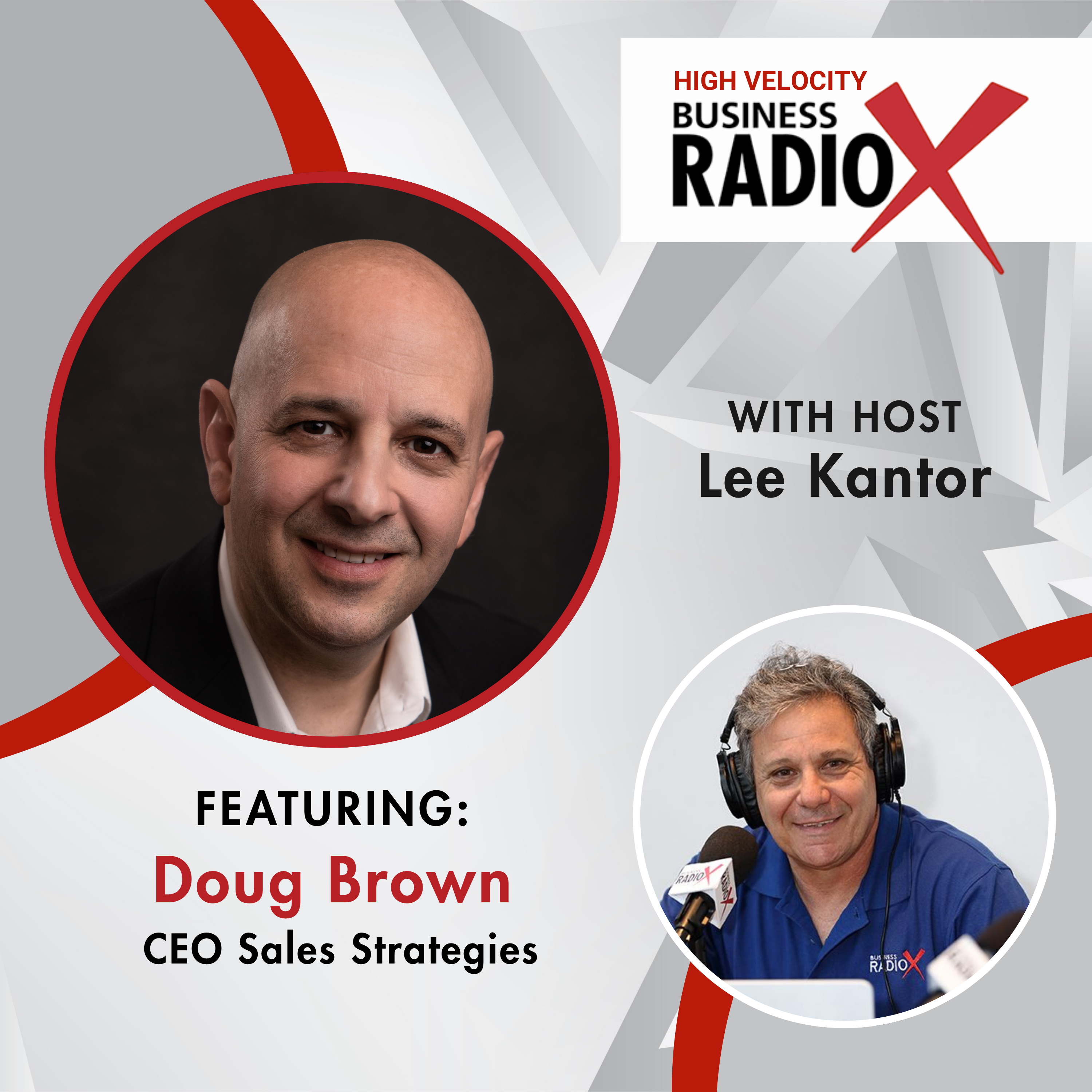

In this episode of High Velocity Radio, Lee speak with Doug Brown, founder of CEO Sales Strategies. He shares how he helps businesses uncover hidden revenue and profit already inside their operations by identifying inefficiencies, missed follow-ups, underpricing, and untapped sales opportunities. He explains that many founders are too focused on working in the business instead of on it, which leads to money being left on the table. Through real examples, he highlights how simple changes—like improving processes, targeting ideal customers, and reviewing expenses—can dramatically increase profitability. Brown also emphasizes the growing role of AI as a tool for insight, the importance of preparing early for business exits, and how fixing financial issues can create meaningful personal and life-changing impact beyond just revenue growth.

 Doug C. Brown is a revenue growth advisor with over 30 years of experience helping founder-led companies uncover hidden profit, improve margins, and capture cash already inside the business.
Over his career, he has generated more than $1 billion in revenue, delivered a $17 million turnaround at Intuit, produced $14 million in one year for Tony Robbins’ Business Breakthroughs International, and helped companies grow from $3.5 million to successful exits at 5x revenue.
He has worked with Fortune 500 brands, national companies, and more than 200 founder-led businesses across industries including manufacturing, healthcare, technology, and professional services. He is also the host of the CEO Sales Strategies Podcast, ranked in the top 2.5% globally, where he shares insights on revenue growth, profit improvement, and business scalability.
Connect with Doug on LinkedIn, Facebook and X.
What You’ll Learn In This Episode
- How to identify hidden revenue and profit already inside your business.
- Common ways companies lose money, including poor follow-up, underpricing, and missed upsells.
- Why founders often miss opportunities by working in the business instead of on it.
- Practical ways to increase margins and revenue without adding new customers.
- How small operational fixes can lead to significant financial gains.
- The importance of understanding your ideal customer and targeting the right buyers.
- How reviewing expenses can instantly improve profitability.
- The role of AI in uncovering patterns, optimizing decisions, and avoiding costly mistakes.
- Why preparing early is critical for a successful business exit and higher valuation.
- How improving business performance can reduce stress and create positive personal impact.
 This transcript is machine transcribed by Sonix.
TRANSCRIPT
Intro: Broadcasting live from the Business RadioX Studios in Atlanta, Georgia. It’s time for High Velocity Radio.
Lee Kantor: Lee Kantor here another episode of High Velocity Radio and this is going to be a good one. Today on the show, we have the founder of CEO Sales Strategies, Doug Brown. Welcome.
Doug Brown: Hey, Lee, thanks for having me on here. Very grateful.
Lee Kantor: Well, I’m excited to learn what you’re up to. Tell us about CEO Sales Strategies. How are you helping folks?
Doug Brown: Well, what we do is we find hidden revenue and hidden margins for companies. So that’s money that they’ve already spent but never made it to their bank accounts.
Lee Kantor: So what’s your backstory? How’d you get involved in this line of work?
Doug Brown: Well, I got involved in this line of work actually, starting with my dad’s business when I was a kid. I noticed things like, we had, uh, way too much inventory at the end of the year, and we would pay taxes on that. And so I was asking my dad and the family members like, why do we want to carry all this? Why don’t we carry half of this and pay half the tax? Right? And so when we did, we lowered the tax rate and not the rate, but the actual taxes. And we had more money back in the, in the, in the, in the, you know, in our pocket, so to speak. But then I was looking through his business and I was finding things like proposals, never followed up on Under-pricing that was happening, you know, risk factors within the business that if we eliminated them, we could go out expenses, but we could also go after the revenue side of the business. And when you improve both of those, you get a very wide margin, makes your business far more profitable when you’re having more operating cash. Plus, if you ever want to go sell it, it boosts the exit value and the valuation of the company.
Lee Kantor: So you were always drawn to kind of the operational side of business.
Doug Brown: You know, I was always drawn to the sales side of the business, but I kind of got pulled into this side of the business just because of of the nature of who I am. I, I look at things and I spot patterns, I look at numbers, metrics, math, and I spot patterns, and then I question what the patterns really are. And it gives us a true story. And, you know, then we can apply an optimization process to that story. So for example, if I have a sales, this happened just the other day. We look through somebody’s, you know, business, heating and air conditioning company, and we look through the business and within 30 minutes we found $42,000 in profit. And it was just from asking questions about when they got on site, what are they doing? And then, you know, we could offer more profitable jobs. We could offer some add ons, we could offer, uh, different things that they, they had, they just were never doing it. And so, you know, right then and there, you know, we, we did. And, uh, well, I should say we did that part a month ago. And then this month they reported that they actually have, uh, doubled their revenue from the previous April of last year to this year. Uh, we just had that conversation two days ago.
Lee Kantor: So when you’re working with, um, the, I guess you talked to the leader, the CEO or the founder, is that who you typically.
Doug Brown: Yeah. Typically that’s who we work with. Um, we work with the, the founder or the, the CEO of the company. Um, the person who really looks at the, you know, the, the bottom line and the up and the top line together. Right. Because business is easy. It’s money in. Money out equals some result. And so usually founders and CEOs are responsible for that result. And that’s why we talk with them.
Lee Kantor: But do you find that in most especially founder led businesses, the founder is busy working on the business and they don’t they’re not kind of keeping track of every hole there might be in their funnel or pipeline.
Doug Brown: Yeah. I mean, so essentially they’re working in the business and that’s part of the reason they’re not focused on that. Right? So what I do is I get them working on the business in that capacity. So it’s, it’s amazing the amounts of money sometimes Lee, that I find. I mean, I’ve literally found millions and millions of dollars in companies that were just sitting there just sitting in the business. And then we were able to move it to the bank account. And here’s the cool part. When founders and owners realize this, CEOs realize this, that money was never going to go into the bank account. So essentially that money is just profit moving into the bank account.
Lee Kantor: Now, when you’re working, how much time do you spend in kind of discovery in terms of just getting the lay of the land?
Doug Brown: Yeah. So it depends on the size of the company. Um, but you know, traditionally it takes about, I usually can start finding stuff within within 2 to 3 hours. Um, significant stuff. Uh, I, uh, I’ve been doing some trades companies lately and I just found this is kind of, you know, for a smaller company, they had $772,000 in revenue. And within three hours we found $226,000 in profit. They weren’t collecting.
Lee Kantor: So when you say not collecting, is it that it was there and they just didn’t bill it? Or was it potentially there if they asked for an upsell or something like that?
Doug Brown: So it was in all of the above. Uh, it was there. They hadn’t collected some, some was, they had their process and they weren’t asking for, uh, you know, extending the sale or increasing the transactional value of the process. Like they weren’t asking, for example, if you went in and found, uh, like they got called in for a leak in the wall, right? They, uh, I mean, that’s a pretty significant thing when, when, you know, the basement starts flooding and the walls are all, you know, I mean, you got to worry about mold and all this stuff as a homeowner or as a, you know, commercial building owner, but, uh, they have this really cool process. There’s just an automatic shut off valve. I mean, it’s a shut off process. So if, if anywhere in the building a leak is detected, it will shut the water off immediately in that zone. And so it’s $3,000. And so for example, you know, we looked up how many people were actually buying that when they offered it. And then it was like, well, why don’t we offer it to everybody? So there were 75 people a year they weren’t offering it to. And so, you know, at if you just run some quick numbers, it’s 75 people at, you know, 15% taking that, that’s 11 people. Now, it doesn’t sound like a lot, but you know, it’s 3000 bucks. So there’s $34,000 just sitting there, uh, at, you know, a super high profit in that case. So the profit on that thing would be somewhere around 70 to 75%.
Lee Kantor: Now, is most of your work in the trades or do you do like, um, consultants or coaches or people like that?
Doug Brown: Uh, you know, it depends on the company. I’ve worked in 353 industries at this point. So anything from the trades business to recruiting companies to manufacturers to, um, medical companies to sales driven companies, done a lot for like training companies as well. Um, you know, some of the larger training companies. Um, but, you know, every business has something sitting there And the natural occurrence of finding out what’s sitting there then reveals what could be additional potential growth. So we uncover one thing and it’s like, oh geez. Well, that could lead to this amount of business if we wanted it to, you know, implement that, that new thing that we just found. So the old thing that’s sitting there, uh, almost always leads to something new in an increased value. Um, you know, I, I can give an example. Chet Holmes and Tony Robbins owned a company. Uh, most people will know Tony Robbins. Chet Holmes used to, he wrote a book called The Ultimate Sales Machine. And, uh, when I was looking through their business, I found a 15% refund rate that was happening. And I identified that. And we were able to clear that refund rate within 24 hours. And we dropped it from over 15% down to 1%. Now, if you think about this, that in itself is a win. But they’re driving 2000 leads a week through this program at this point. So those 300 people that were clear that were were refunding are now buying new products and services. But we were able to identify in that group a product that there was underperforming in their company that was selling $86,000 a year. And when we retrenched that tool, and we put not a lot of money into doing that, we went from $86,000 in sales that year to $8.2 million in sales that year on that new initiative.
Lee Kantor: So when you’re saying finding money, it’s not necessarily, oh, we were mislabeling this thing in the, in my books. Like you’re actually helping them in, in all aspects of their business, find opportunities. Maybe they’re not leveraging, or it might be even coming up with new offerings that might help them make more money down the road.
Doug Brown: Yeah yeah, yeah. I mean, it could be, you know, so it’s exactly that. So the first question we ask them is do you want to grow your revenue or do you want to grow your margins or do you want to grow both. Right. So whatever they want to achieve, then we work the plan to achieve that. And then we start looking for things. And we do this diagnostic process as we’re going through, it just starts uncovering things. And every business is dysfunctional to some level. I mean, I’ve worked with companies like Intuit and Procter and Gamble and, you know, enterprise Rent-A-Car, all of them have some level of, oh, wow, we could find some money here, but every small business has this as a similar level in that size capacity of that business where they’re leaving money on the table. You know, I mean, I just did one, uh, where we found, uh, the merchants were just, uh, taking advantage of them on the credit card side and we were able to go back and reclaim tens of thousands of dollars. They had to not change any credit card company whatsoever. They stay with the same credit card company, but they were able to get, you know, 40 I think it was $46,000 back, if I remember correctly. Um, somewhere in that area on just from the merchant, because the merchant was overcharging them, they had the tax rates wrong. They had different things. So it can be something like that. Or it could be like, hey, your company’s not asking for referrals whatsoever. And what’s the cost of a referral? Zero. Um, and how many referrals could we get a year? We figure that out. And then we put a referral program, active referral program in. Their sales team starts asking, everybody in the company starts asking and they’re magically picking up sales all over the place. So there’s all kinds of things that happen. We’ve identified 21 areas, and in each of those areas, this 5 or 6 subsets of the area. So there’s literally well over 100 ways of doing this.
Lee Kantor: Now, how do you recommend companies, especially smaller companies, leverage AI and automation? Is that something that’s now evolved to a must have rather than a nice to have.
Doug Brown: You know, every it depends on the business, right? So, um, but in most cases, AI is a tool and it’s a tool that is going and has been and will continue to reshape how we’re doing business. So my recommendation to everybody is learn AI, you know, because AI is going to have some functionality into it that, um, absolutely will be helpful in any business. But, you know, we mentioned the trades business earlier, uh, AI is really not penetrating the trades business in a deep way at this point because, you know, it’s not going to go out and turn a wrench, right? Not yet. Um, but what AI will do is it will help identify some buying patterns of your, you know, ideal right fit buyer. So in that capacity, you should be able to understand that because then you can figure out, okay, how many people am I selling to every single year who are profitable or not profitable? Um, I just, uh, was talking to another company and, you know, they, they were spending a tremendous amount of money on marketing and I ran some numbers for them and used AI to actually do it initially. And then we dug into it. And long story short, they were losing money on every client.
Doug Brown: They thought they were making a few hundred dollars on every client. Turns out they were losing $860 on every single client because they didn’t figure in all of the numbers. And that sounds like a huge disparity. But I mean, you think about it, you sell 50 clients a month and you’re losing $900 a client that’s 45 grand a month that you’re basically losing in that business. Now, that was easy enough to start to adjust because we just started adjusting the marketing spend and how the marketing allocation went away. You know, in certain categories, they didn’t need that. They weren’t looking at the marketing across the board. They were just looking at, hey, we’re closing sales. So it can be all kinds of things that are over the map. Lee and I know that it doesn’t sound like, well, give me the whole process, but that is the whole process. Like we look through the whole company from every single stage of the client journey, and we find these things and then we, uh, bring them forth to the owner and say, hey, do you want to fix them? Or, you know, or are you good with, with this?
Lee Kantor: And then so your deliverable is at first a list of all the opportunities. And second, if they want to have you help them fix it, then you can help them fix it.
Doug Brown: Yes. Yeah. So we build a growth map right out of the front, front end, you know, and the growth map shows them all of the things that They can do in order to improve their margins or improve their revenue. And then if they want us to help them, we’ll build them a growth plan, which is like, hey, here’s what we’re going to do over the next 12 to 24 months, depending on the size company. And this is where we can get you from point A to point B to point C to point D, and we just lay it all out for them. Um, and you know, they can still take that map and do it on their own or we, you know, most of the time people want us to help them at that point. Um, but, you know, again, it’s a very straightforward process. The hardest part. See, here’s the thing that happens. Lee companies have all kinds of data and stuff, but they don’t have any real visibility to the data that gives them the, um, the ability to actually make decisions on this level. So like they might be looking like at their CRM data, but they’re not looking at the financial and the CRM and the marketing and customer service data. All, all collectively. And that’s where they can’t see it. So we’ve developed our own in-house process to be able to show them that. And they can, you know, we can see where it started in marketing and where it’s breaking down, let’s say, in operations. And so we fixed the problem in operations, and all of a sudden more money is pushing through. And then we teach customer service on how to actually sell, not just answer questions. And so now we’ve created an internal sales team within customer service, which can be highly profitable for companies. So it just depends on what company needs what.
Lee Kantor: Now when you’re working with your clients, is this something that, um, like what’s the signal of when this is the appropriate time? Like I know every today is the appropriate time, but is it if I was going to exit in five years, should I be having this conversation with you in order to just kind of get my business in the best shape so that when I do exit, I get the most for it? Or is there something that. Hey, I’m just starting. Maybe I should foundationally put everything in place so that I’ll have a better than even chance of making it.
Doug Brown: Yeah. So again, it depends on the goal. So if you’re just starting, like I just talked to a CEO, he’s like, no, I don’t want to do this. We’ve only been in business a year and we’ll handle it for now. And then when, when we get dysfunctional, we’ll call you. Right. And so my response was, why do we want to get dysfunctional?
Lee Kantor: Like, why don’t you skip that step?
Doug Brown: It’s like, why do we want to bleed out a few million dollars over the next three years or whatever? Figuring this out when we can figure this out now and maybe put $10 million in the business, put the systems, put the processes in, and all of this stuff, because he doesn’t have the data, he can’t see it. And so it’s one of those situations that when is the right time? Um, we don’t know until we run the diagnostic, but I can tell you normally within a conversation and just running a very small percentage of the diagnostic, like on a call within 20 minutes or so, I can tell them if there’s money there or not. And so it just depends. Now, the guy who wants the exit or the gal who wants to exit in five years, they need to get their stuff in order earlier than later. Because here’s the thing about exit. Most of the time people think they’re going to be able to sell their company, but a lot of times they can’t. And so why not build the company into the most profitable asset now and then? It makes it far more attractive for the exit down the line. Right? But it doesn’t mean that they can still sell the company like I had. I had a telecommunications company. We sold it three times. Funding fell through for the buyers all three times.
Doug Brown: We ended up keeping that thing till the end. Um and so it’s, it doesn’t, you know, a lot of companies, uh, want to sell. I, I have a friend who, uh, eventually sold their company for $2 billion and they wanted to sell within a year of the first conversation. It was 11 years later that that company sold. So if they’re planning on trying to exit the business, there’s multiple ways of exiting a business. Um, there’s a great story. There’s a company around me called Sullivan Tire. They exited the business, but they sold it to all the employees. So there’s different ways of doing it. But if you’re going to sell to a, a P company or an investor company or another person looking at your company, the more you have your stuff in order and the higher your EBITDA is, generally that’s what they go off of EBITDA being operating cash flow. The higher that is, the more you get for evaluation and the more you get for a multiple on your company in most cases, especially if you have the systems processes in place. So yeah, if you’re an owner and you want to sell. Don’t wait till a year before or two years before you really want to start. Now, if you’re a year before, start now, but you know, if you can start earlier.
Lee Kantor: So is there any low hanging fruit for a listener right now that they could start poking around on where they can fix some of this themselves?
Doug Brown: Yeah. There is. Um, you know, there’s the, the, the, the easy one is, you know, just do a review of your expenses. That’s, that’s a very clean one. Right. Um, you know, my wife and I do this every single year, just even for our home. And we reduced our expenses this year by $6,700, if I remember correctly. What was that on Oversubscriptions? You know, um, you know, streaming channels, we weren’t using, uh, auto insurance that we could readjust, uh, you know, uh, truck insurance, uh, you know, uh, telecommunications, electricity, all, all kinds of things you can look at right on the expense. So that’s, that’s a quick one. Um, you know, a lot of companies don’t want to look at expense, but here’s what I, I tell them is like for every $1,000 you save, if your company’s at 13% EBITDA for every $1,000 you save, it’s like selling $7,600 in product. So if you as a company owner can knock your bills down by $10,000, it’s equivalent to selling $76,000. If you can knock it down by 100,000, that’s equivalent to selling three quarters of $1 million. So which one do you want to do? So on the sales side, the easiest thing to start doing is look at every little section that’s going on in your company sales process and ask this question, are we creating more sales at this point? Are we creating more relationships at this point? Are we increasing what they’re buying, how often they’re buying, and how many people we’re extending the relationship through at each stage of that process? If they just asked that question, they’ll get the answers.
Doug Brown: You know, are we following up with people? Are we dropping the ball? Follow up is an easy one to fix because the majority of companies are not very good at it. Are we selling to the ideal right fit buyer? Harvard University and Wharton School of Business did a study recently that was backed up, I think, by Marketo and HubSpot, um, which said that 97% of people selling today do not, in part or in full, know their ideal right fit economic buyer. What that means is we don’t really know who we’re really selling to, who buys the quickest, the most, the best. And so we’re creating all these marketing messages around stuff that’s not even hitting the target. And so those are a couple of things that they could do right out.
Lee Kantor: So how do you help them identify their ideal fit client if if nine out of ten are missing.
Doug Brown: Yeah. Believe it or not, it’s not that hard. So we have a whole process for it that we run through. And we do use AI for that process as well because it speeds up the process. In the old days, this would take us three weeks to figure it out. Um, but if somebody wants to like really start to figure it out quickly, look at all your clients, ask the question, who the best clients that you, you know, spend the most with you are not your hassle clients. If you have data like this, right? Made the decision quickly. They’re, they’re a joy to work with. And then look at all the common threads. Why did they buy? If you don’t know, call them up and ask them why didn’t they buy? Call them up and ask them. Start looking for overlapping patterns. That’ll start to reveal some of the stuff. But you know, with AI and with things today, you can research a lot deeper. But in the old days, that’s how we started out. We started out surveying all the all the clients that bought didn’t buy. Asking questions, looking for overlapping patterns. And then it will reveal itself. And by the way, you only need like 3 to 5 data points and it’ll give you your ideal right fit buyer.
Lee Kantor: So how often do you use your system on your own company?
Doug Brown: Uh, once or twice a year.
Lee Kantor: So this is something that once a company understands how this works, it’s not a set it and forget it. This is something you have to revisit on a regular rhythm.
Doug Brown: Depend. Well, you know all companies. Yes. To answer your question, you should because things change. So, you know, it doesn’t have to be the pandemic that changes your business, right? You might be growing as you’re growing. And let’s say you don’t have your numbers anchored. Your numbers can, you know, outstrip you pretty quickly. A company working, uh, they installed, uh, utility poles. They, they grew from 3 million to 17 million in 16 months, pretty fast growth. When I talked with them, they were like, we’re close to being out of business. And I said, why? And they said, I don’t know. And I looked at their books. They had $11 million uncollected, over 180 days on their books. And when I asked them why, they said, we don’t know. And I said, who’s paying attention to this? And they said, it’s a friend of my daughter’s. We hired her because she seemed to have experience. And within 45 days, not even it was like 42 days. We had collected all $11 million. There were clients literally saying, hey, we had the check sitting here, but no one contacted us with the information to get get pay you or we wanted to do direct deposit. Et cetera. Et cetera. Et cetera. So, you know, the company’s super healthy within, you know, 40, 45 within six weeks. So it could be something as silly as that. Or it could be something that, you know, people never even thought existed in the company. Um, you know, or people know in the company they’re afraid to tell. Right. So, uh, I worked with a company, they were doing, uh, 48 million a year and they had, uh, two of their sales team members going through the company, terrorizing people, literally threatening them. If they didn’t do this, they were going to come after them. Et cetera. Et cetera. Et cetera. Ceo didn’t even know about it. And once we remove those two people and put a sale system in, the company grew from 48 million to 110 million in the next two years. People became way more productive. So sometimes it’s people issues, sometimes it’s not.
Lee Kantor: So is there a story you can share maybe the most rewarding for you in all the years you’ve been doing this? Is there. Don’t name the name of the company or maybe name the challenge that they had and how you were able to help them get to a new level that meant the most to you?
Doug Brown: Yeah. This one might make me cry a little bit, though. Like, seriously. Like, um, so I was working with a financial company. It was owned by two brothers and the, uh, and they had a partner, two brothers and a, in a partner. And, uh, I was talking with this gentleman and he was just like, so pushing back like, so hard on this thing. And normally on that type of thing, it’s like, well, this isn’t the client that I can really help, right? I mean, they’re just not open. They’re not they’re not coachable, they’re, you know, that type of thing. But something told me, stay with this guy. It was like a little inner voice in my head. And I stayed with him. And finally at the end, he goes, okay, you’ve convinced me. And he said, I’ll do it. And I said, I don’t want to convince you. I want you to be buying into this because this requires commitment on your end as much as on our end, like as we work a lot on performance, right? So we actually make our money when the company does better versus saying, hey, we want this huge consulting fee up front or whatever. And so he bought in and we helped him. Uh, and I told him, I said, I need a minimum of 60 days commitment. And then you, you know, you guys can be on your own if you want. And so we worked on that thing for 60 days and we started turning the company in the right direction. And he said, at the end of 60 days, he goes. You know, I think we can take this now.
Doug Brown: And I said, fine. And, you know, we sort of like friendly emailed back and forth over the next year. So this is like 14 months after the first time I started. And I was at a live event and I felt these arms come around the back of me and like, give me a bear hug and just literally lifted me off the ground. And, uh, and then I heard his voice and he was laughing and I knew who it was. And he said, how you doing? And I said, well, if you put me down, I’ll tell you. When he put me down, another set of arms came around me, um, not as strong. And then one on my leg, two little arms and then two little arms on my other leg. And, uh, they all were giving me a hug and I, and he, he came around the front of me and he said, hey, there’s something I never told you. And I said, what? He goes, uh, my wife and kids, we were doing so bad as you knew, Because when I was pushing back like that, he said, I was a. My wife and I were talking about getting a divorce, and I had moved out of the house and I was estranged from my children. There they are holding on to your legs. And, um, he said in, my brother and I were damn close to, uh, with the partner declaring bankruptcy. And he said, we just didn’t have the money or the this or that. And he said, he said, I really, really did not like you during our conversation whatsoever.
Doug Brown: He said, I frankly can use the H word, the hate word. I hated our conversation. But he said, if it wasn’t for that conversation and you working with us for the next 60 days, we turned our company around in. Four months later, I was back with my wife, back at home with the kids. Things got a lot better. And, you know, we have more than doubled the business in the last 14 months since you disengaged with us. And he said, you know, I want to thank you and thank God that God sent you to me. That was super impactful. In fact, I left the room and started breaking down, crying a little bit. Right? Because what people don’t, at least for me, it’s not about the money anymore. You know, I own the house, I own the cars. I own all that stuff. You know, I had that early on in my life because I worked really hard. But it’s the impact. Like the family didn’t break up. Now the family’s together, the kids grow up more healthy, they go on and they start families. So it’s that ripple effect that goes through life. And to me, what we do is exactly that we can help people go from a high, you know, stress state and lower their stress states because usually it’s around money that causes the stress states in the business. And usually the money is just sitting there, you know, for years, sometimes sometimes longer. And it’s just not moving from point A to point B. So in his case, you know, he’s still doing well today.
Lee Kantor: Yeah. And it’s it’s not for lack of desire or lack of a good idea or a good company. It just they don’t know where the holes in the swing are. And they need fresh eyes to look at it and go, hey, look over here. Look over there. You know, I’m sure a lot of the times these people want to work hard and are hard workers. They just don’t know what to work hard on. If people want to learn more, what’s a website.
Doug Brown: W w w dot CEO sales strategies.com? Or they can send me an email at Doug at CEO sales strategies.com.
Lee Kantor: All right, man, thank you so much for sharing your story. You’re doing important work and we appreciate you.