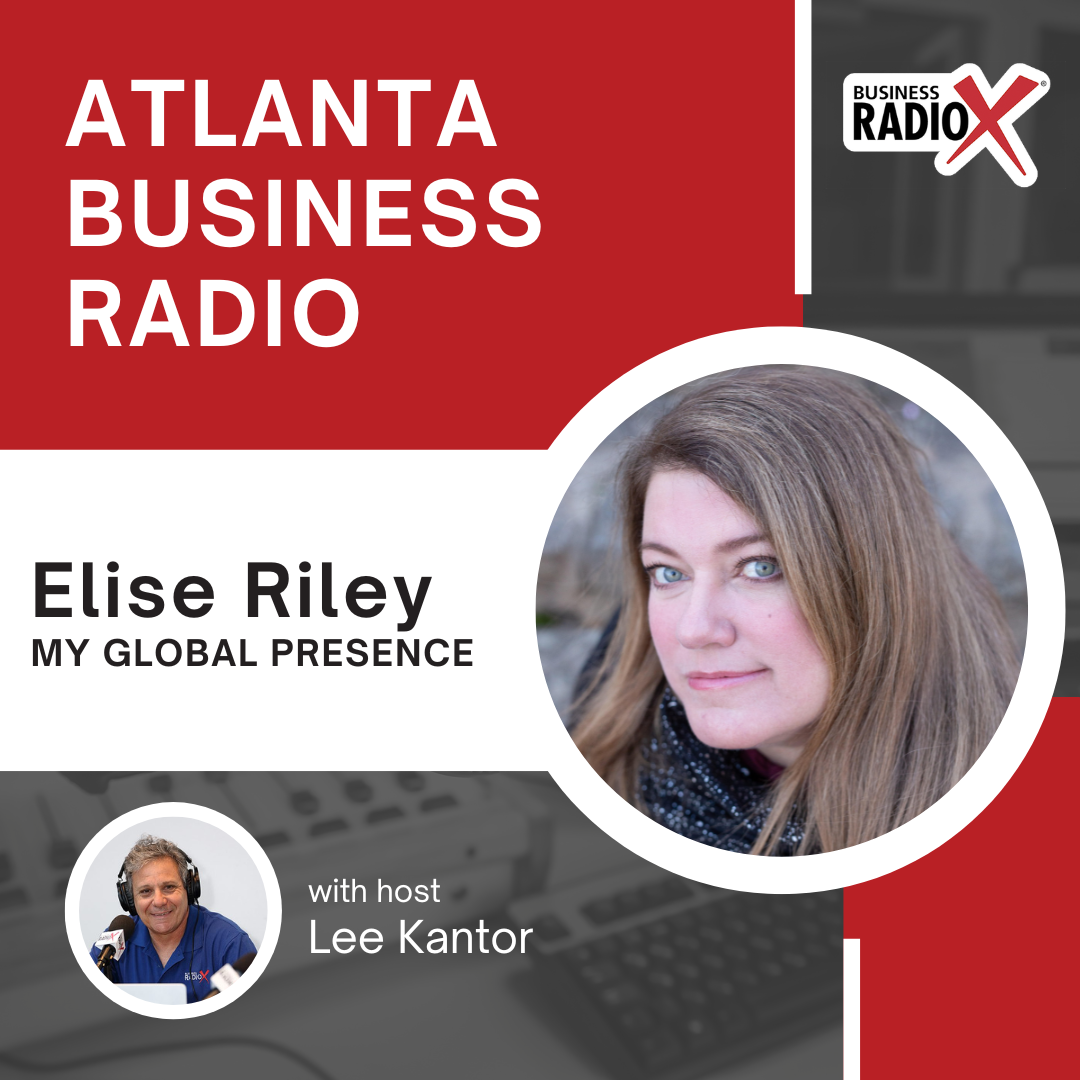


In this episode of Atlanta Business Radio, Lee Kantor interviews Elise Riley, CEO and Founder of My Global Presence, about the power of storytelling in building brands, creating meaningful connections, and driving successful PR and marketing campaigns. Drawing from her extensive experience in entertainment marketing and public relations, Elise shares how businesses, authors, and filmmakers can uncover their unique stories, connect with the right audiences, and stand out in an increasingly crowded media landscape. She also discusses emerging entertainment trends, influencer marketing, brand partnerships, and the growing role of short-form vertical content, emphasizing why authentic storytelling and the human touch remain essential in effective communication.
 Elise Riley began her career in entertainment marketing at Warner Bros. Pictures, where she worked on international campaigns for films like Harry Potter, Ocean’s Eleven, The Matrix, and Training Day.
From there, she moved into marketing roles at The Weather Channel, where she focused on driving digital engagement and app subscriptions, and later at Cartoon Network and Adult Swim, where she managed brand partnerships during a period of rapid growth
Today, she is the Founder and CEO of My Global Presence, an award-winning PR and marketing agency based in Atlanta. She specializes in helping brands, filmmakers, authors, and organizations tell meaningful stories that not only generate visibility but also create genuine connections and drive results
At the core of her work is a belief that storytelling, when done right, has the power to elevate brands, build trust, and create a lasting impact.
Connect with Elise on LinkedIn.
What You’ll Learn In This Episode
- The importance of authentic storytelling in building a memorable brand.
- Strategies for uncovering a business’s unique story and connecting with audiences.
- The role of PR, social media, and influencer marketing in increasing brand visibility.
- The importance of integrating marketing into film production and distribution from the beginning.
- Opportunities for filmmakers through brand partnerships, sponsorships, and investor outreach.
- Emerging trends in vertical video content and mobile-first entertainment.
 This transcript is machine transcribed by Sonix.
TRANSCRIPT
Intro: Broadcasting live from the Business RadioX Studio in Atlanta, Georgia. It’s time for Atlanta Business Radio, brought to you by My Global Presence, the award winning Atlanta public relations agency that elevates brands and nonprofits through authentic storytelling and national media campaigns. Find them at myglobalpresence.com. Now, here’s your host.
Lee Kantor: Lee Kantor hear another episode of Atlanta Business Radio. And this is going to be a good one. But before we get started, it’s important to recognize our sponsor, KSU’s Executive MBA program. Without them, we couldn’t be sharing these important stories. Today on the show, we have the CEO and founder with My Global Presence, Elise Riley, welcome.
Elise Riley: Thank you so much. I’m so excited to be here.
Lee Kantor: Well, I am excited to learn what you got to tell us about my global presence, how you serving folks?
Elise Riley: So we’ve been around for five years. It’s an award winning, Atlanta based PR and marketing agency specializing in entertainment, publishing, nonprofit and lifestyle brands. For more than 25 years, I built a built and led strategic campaigns that elevate brands, amplify storytelling, and drive real results. I began my career early on in entertainment marketing at Warner Brothers Pictures, where I worked on global campaigns for films including Harry Potter, Ocean’s 11, The Matrix, and Training Day. From there, I moved into key marketing roles at The Weather Channel and Cartoon Network Adult Swim, where I helped drive digital growth and strategic partnerships. Over the years, I’ve had the opportunity to work across a wide range of industries from travel and healthcare to retail and consumer brands, and I’m always focusing on crafting compelling narratives that connect through my global presence. I lead a team known for securing national media coverage and building campaigns that are both strategic and impactful.
Lee Kantor: So when did you kind of fall in love with storytelling and, you know, and kind of weaving it into the world of business?
Elise Riley: I love cinema and I used to watch movies all the time, especially older movies with my grandparents. And I like to read a lot of books. And with that, you know, I did have a really good, strong basis of storytelling. And I learned early on the importance of having that skill set in order to really, you know, capture audiences, you know, anywhere from, you know, talking to friends to, you know, marketing your next big thing. It’s really important to have a really good, strong, solid basis of storytelling.
Lee Kantor: Now when you’re working with your clients, is that something that they do? They do it themselves in terms of, have they been doing these kind of just social media, like telling people about themselves? And they got frustrated because they weren’t getting the results. Or were they hiring other PR people and then not getting the results and then they come to you. Like how do they normally get to you? What’s the path?
Elise Riley: I would say it’s a combination of both. You know, definitely working with other companies that weren’t necessarily getting it right. You know, when you delve deep into what makes somebody tick or a service or a product, you know, really gauging, you know, why people would want to, you know, interact with, you know, your service. If you’re, you know, even, you know, cleaning houses, for example, anywhere from cleaning houses to, you know, building a brand, you know, healthcare, pharmaceutical, there’s always something that can connect people to the underlying story. Like why would this, you know, drug or service, you know, matter to me and my family. You know, why is it impactful to tell, you know, a story about, you know, all time or all, you know, or some other disease, you know, how does that all tie into the overall big picture? And that’s what we do. We do a lot of social media, you know, gaining followers. Um, we were just talking about influencers and how that’s, you know, a very big industry nowadays. Um, especially, you know, with the monetization of it. We help our clients, um, build that brand and communicate where the customer is. You can no longer, you know, just buy an ad in commercials to hit that customer. You need to really talk to them where they’re at, which is social media. And, you know, also, you know, driving impactful campaigns.
Lee Kantor: Now in your work with, um, I guess you work with some authors, right? That’s part of.
Elise Riley: Yes. Love authors. Yep.
Lee Kantor: So are you helping them kind of market their book or are you helping them market their business that they wrote the book for?
Elise Riley: Uh, it could be both, actually. Um, we do have authors that have written books about coaching, for example. And so when you have a book like that, you definitely delve deep into the person you know behind it, the author, and then also the service that they’re providing and what really differentiates them from other coaches. And we help, you know, build the momentum and, you know, make sure that that everything is communicated appropriately across all the different channels, marketing channels.
Lee Kantor: So when you’re working with somebody who has a, so like everybody, there’s lots of people that call themselves coaches. Um, I’m sure the authors that you’re working with, the experts you’re working with, they have a unique lens on some aspect of coaching that makes them different and special. Right?
Elise Riley: That’s correct. Well, and you can find that, right. A lot of people don’t when they come to us.
Lee Kantor: Oh, they might not have that fully baked like they.
Elise Riley: Exactly, exactly. And that’s right. And they might say, hey, you know, I’ve been successful in coaching and I just wrote this book and I really want it to hit well, you know, with the audience and capture, you know, potentially new audience members or people who, you know, might not know about my business, but, you know, they might not have a full understanding of what their background and story is. And so we help them with that.
Lee Kantor: So. Okay, so let’s, let’s play a game of where we pretend that we’re going to do this for one of your clients. Like, so what are some of the questions you would ask, uh, a client who’s an author, like, just like you described? I’m a coach. I’ve been doing this for a while, but maybe I don’t have kind of the story that resonates or the story that can really take me to a new level yet. So how do you kind of, um, kind of get that out of them? Because I’m sure a lot of these people, they know so much, but they, it’s just in their head and they’ve never kind of articulated it. And they need a facilitator to help them ask the right question to get it out.
Elise Riley: That’s right. And you’re exactly right. It’s it’s different what they have on paper and what is on their bios versus what drives them and what’s their passion. And so we really delve deep into what got you into this in the first place, you know, is it the love of helping people? Is it the love of, you know, um, just making sure that people are elevated with what they’re doing currently in their careers. Um, so we ask those deep questions to really understand who they are and what drove them there and learn more about their background in order to make people really care.
Lee Kantor: So you want to get to the why. And sometimes by getting to the why they’re really, really doing this, you have to kind of ask them why a bunch of times, because at first try might be too superficial, and they’re not kind of getting to the heart of things.
Elise Riley: That’s right. That’s exactly right. Yep. And then in the entertainment industry too, we work with a lot of independent filmmakers and also big budget, um, filmmakers too as well. We’ve worked with, you know, studios even nowadays with the big blockbuster movies and, you know, even talking about those stories, you really have to delve deep into why should I care? You know, is this another car movie or is this a movie about somebody who, you know, was really passionate about cars and drove it cross country and, you know, had an amazing story behind that. And, you know, or is this a story about, you know, a mother and daughter, you know, not necessarily getting along? Or is this a passionate story about a mother and daughter? And, you know, there are many layered relationships. So we really break it down. Um, you know, at Warner Brothers Pictures, we had the flexibility of getting a script early on before anything was shot. And so our marketing team would sit around and say, okay, what is this really about? How are we going to market this? You know, what can make this go viral and how can we make this very passionate. Um, you know, amongst the audience what’s going to really drive this home so that people want to see it, you know, beyond just seeing the trailer.
Lee Kantor: So how are, how is the entertainment industry, um, marketing differently maybe now compared to 20 years ago when you began, uh, in terms of there’s so much content being put out there on so many different platforms and so many different ways. And it’s all happening, you know, every day like there used to be, oh, on Fridays, the movies come out and then there’d be ten movies that came out. And now it just seems like every day there’s releases of content somewhere.
Elise Riley: That’s right. Well, we get make sure that we look at the niche. Right. And so right now I’m working on a project that, um, has to do with horses and, um, understanding that this horse was abused and it also, this woman finds this horse who has also been abused. And to kind of tie in like the storytelling, why, you know, did they find each other? You know, why are they connected? And, and, you know, what are the similarities? Um, and so we’re going to, you know, horse lovers, not only to horse lovers, but also to, you know, women who might not be in relationships that they want to be in anymore. You know, we’re targeting also, you know, the major entertainment, you know, publications as well, because it does have a big name star. So there’s different, you know, many different layers, but you’re meeting the people where they are, who’s going to be your audience and who’s going to actually sit in the theaters and watch the film.
Lee Kantor: Now, are you finding that, uh, there’s more and more creators who are actually becoming the producers? Like there was a time where the actors were the actors and the producers were the producers, but now it seems like the actors get passionate about something, and then they start figuring out how to make that project happen.
Elise Riley: Yeah, I’m definitely seeing that more and more. And also, we had a conversation before. The influencers are really, um, becoming more powerful in the entertainment space, not only by bringing following in an audience already, but also with monetizing, you know, their social media. And so when I was at the Toronto International Film Festival, for example, one of the films that was being shown was fully funded by a gentleman who made $1 million on TikTok alone. So he keeps funding his passion that way. Um, you know, he did a lot of comedy shorts, um, you know, to help fund it. So it’s definitely a different landscape and everybody, um, it’s more accessible to everybody because you do, um, have on your phone a full studio you can shoot. And it was at the Oscars, there was a film that was shot on an iPhone. Um, so it’s very accessible to everybody. Uh, but we just need to make sure that once you have that film, that you market it appropriately because it is so many people are watching so many different things. It’s not, you know, you can’t just hit them on just the major networks, um, and advertise there. There are certain things that you can do to make it creative and, you know, go back to guerilla marketing to really target your audience.
Lee Kantor: Right. Marketing can’t just be something you think about at the last minute. Like you better be thinking about this from day one. Um, because you better be working to get the word out all through this because like you said, any. It used to be expensive to make a movie. Now anybody can do it on their phone. So there’s lots of content you’re competing with. I mean, there’s lots of channels that the content can go on. And that’s not even counting like YouTube, you know, where that’s the second biggest, um, place where people look for content. So it’s, it’s nuts. Um, the fact that it’s kind of flipped where distribution is a lot easier in a lot of ways, but standing out and being found is a lot more difficult because there’s so much competition.
Elise Riley: That’s right. You’re absolutely right. And it’s also interesting too, because we’re finding a lot of our indie filmmakers don’t even have the line item budget for marketing. And if you see a lot of the films that are, you know, successful. Do you have marketing in their budget? And, you know, it’s, it’s a way to distribute and get it in front of people that normally wouldn’t go. Like you just can’t make a product and say, my movie is about, you know, horses. And I think this is going to do well because I have this producer and I have all these creatives behind it. Well, people have to really care about it. And it goes back to that storytelling originally that we talked about, like, why are people going to care? Why are they going to be passionate about it? Why is this movie, you know, so important to your, your target audience? And we really help with that.
Lee Kantor: Right. And you have to do that. Like you can’t just build it and they hope they come. Like it’s not gonna, they’re not going to come. There’s plenty of famous people who are, are attached to projects that just bomb because nobody even knows exist. Like it’s just not enough that, oh, I got, you know, an A-list person to back it or be in it. That’s not enough. You have to go out of your way to market and get the word out. Or else people, they’re just bombarded with content. Like you can’t just assume they’re going to find your thing.
Elise Riley: That’s right. Lee. And, you know, oftentimes it isn’t. It’s unfortunately an afterthought. Yep. You’re you’re right though.
Lee Kantor: So what’s your recommendation when it comes to like, you don’t want it to be an afterthought? Like, like what should, what do you think a budget should be? And what’s a reasonable expectation? Uh, when it comes to marketing one of these type of, um, projects.
Elise Riley: It really depends on the distribution strategy. We’re seeing filmmakers who are actually going to theaters and asking them to show the film. So they might be filmed and shown in different cities like LA and New York or Atlanta, the major cities. And so you would really hone in locally in terms of getting press and, um, you know, building buzz around that. Or if they want to do film festivals, um, you know, it’s not half the battle is just getting into film festivals, but if you don’t have an audience that shows up to watch your film, not only are you’re not going to get, you know, an encore presentation, but distributors or other important people that are sitting in the audience might not care because, you know, why should they if you’re not even filling out, you know, the seats. So we help strategize with that too as well. Or if you’re just into distribution, you know, we meet the distributors where they are and make sure that we build a marketing campaign and do PR around that. And then also early on, we should not forget to investors. It’s so important, um, for you to raise money for the film. And a lot of times, you know, it’s getting harder and harder nowadays so we can target investors to help fund your film.
Lee Kantor: Now, are you finding that investors are looking for projects to fund, or is that something that’s like, you got to really be looking under every rock.
Elise Riley: You have to be looking under every rock. But it’s interesting. The industry is changing and they’re merging with brands, which is really a great way to fund films. Um, I met somebody I went to, um, recently, there was a huge marketing summit in LA actually two weeks ago, and it had all the studio heads and everyone came together and there was some activation brand activations. And I met one woman who had her film fully funded by a big brand. Um, she went to them and, and came up with a really creative idea to, you know, um, intertwine them into the entire, uh, movie production. And they said, this is great. I want to fund fully fund your film. So you never know unless you’re doing that sort of outreach that, you know, there’s money in those brands or there’s money in other, you know, family offices or there’s money, you know, in New York, you might be in Atlanta and not realize that there there might be somebody who has a fund that’s just specific for phone and we can help with that.
Lee Kantor: Yeah, I think that that’s a great opportunity is to partner with brands, but you have to I mean, I know a lot of creatives are weird about partnering with businesses and brands in that regard, but I think that there’s a real opportunity if you have a good, uh, project you’re working on and to figure out ways you can elegantly weave the brand in. I don’t think there’s any shame in that. I think if it makes sense, like if you’re forcing it in and it feels clumsy or inelegant, that’s one thing. But I mean, I’m watching a show on Netflix called Running Point and they partner with State Farm and they partner with Sephora and they, they’re part of the show. Like the State Farm guy was in the, in the stadium for one of the games. And they go, oh, there’s the State Farm. Like they, they did it in a way that didn’t feel like, oh, that’s a awkward thing. It seemed like part of the show.
Elise Riley: Right, exactly. Yeah. And I mean, we’re finding that more and more, um, you know, happening. And then another interesting, uh, trend slash a way that is something that’s happening to the studios is that, you know, we’re talking about verticals now and the studios are now starting to get into it. We just talked about social media. Tiktok is very much partnering, um, with a lot of other companies to do verticals. And that’s where you shoot on, you know, made for cell phones. And right now there’s a lot of, you know.
Lee Kantor: Like it’s popular in Asia, in Asia. It’s super popular.
Elise Riley: Yes. But, but listen to this. This is interesting. So yes, Asia is actually sending the scripts and hiring our crew here in the United States. But the two biggest audiences of that content are in Europe and America, the United States. So we’re watching it. We’re the ones who are. And it’s $11 billion business right now.
Lee Kantor: And is it that you have to because they really like one show could be like 100 episodes, right?
Elise Riley: That’s correct. That’s correct.
Lee Kantor: And then are they paying like a small amount per episode? Or is it something that there’s ads in there? Like how is it being monetized?
Elise Riley: So currently it’s being monetized. I mean, you could have like a hundred K, uh, and film something and have that that’s kind of, they do have like a lot of quick turnaround, you know, lower budget. Um, but on set, you know, you could have 12 to 16 hour days. Somebody recently told me that they went through 16 pages of script. So, um, it’s definitely a little bit of a churn and burn. But I think once people try to figure out how to, you know, take the monetization and all that money going to China and creating their own apps here, which a lot of studios are starting to get into, then we can start to, you know, really, uh, pay those people. Well, you know, the unions aren’t involved yet. The unions are very much involved in in studios and acting now to protect people. So it’ll be interesting to watch. It’s a it’s a landscape that is ever changing right now.
Lee Kantor: And you’re saying that it’s happening here in Atlanta. People are filming those.
Elise Riley: Yes, yes. There are so many companies that film those here, and a lot of my clients will reach out to me that are part of it. Or, you know, we might represent an actor that’s part of it. So, um, we have a good understanding of that. And there’s a lot of people who are creating apps, um, they want to, you know, make sure that they have their own, uh, studio system basically, and take, take it away from some of the foreign, you know, countries, um, in terms of them, you know, taking the money and just having those same crew, uh, you know, build a, you know, basically an app for, you know, horror, let’s say, because they’re not even tapping into horror or, you know, for comics or, you know, a comedian, uh, you know, app, you know, so that everyone can, you know, go there and tell jokes and really, you know, curtail more to the US audience. I mean, if you’ve seen some of the scripts that, um, they’re very much written for, um, foreign foreign audiences.
Lee Kantor: And then are they, what are they primarily like soap opera, like rom com? Yes.
Elise Riley: Yes. They’re primarily soap opera. And it’s funny because you have to shoot very like the lighting is different. You have to shoot very bright because a lot of people are watching it on their cell phones. But what’s interesting is that people expect young people to go back to where we are, right? So they think, oh, when they grow up, they’re absolutely going to start watching stuff on television. But they’re not. They grew up on the cell phone. If you look around at restaurants and other activities, what are parents doing? They’re giving their kids their cell phones. So this is how they grew up. This is what they’re used to. And this is the new phase of what’s going to be happening in entertainment, right?
Lee Kantor: And you better figure out a way to entertain people with the cell phone. So figure it out.
Elise Riley: That’s right.
Elise Riley: That’s right. And you know, there’s a lot of stuff happening in, you know, um, the other foreign countries that have shock value and, you know, it’s, it’s not really appropriate for kids. And I think that’s another reason why it’s important for the US to get involved. Because I feel like, you know, the content, um, doesn’t necessarily stick with some of the younger audience. And so we need to figure out a way to build it, but also, you know, be respectful because there are some shock values because they want you to, to pay. So you might see an episode and they want to leave you wanting more and to pay more.
Lee Kantor: And then how long is an episode typically?
Elise Riley: Yeah. That depends actually. Um, yeah, that depends on, you know, who’s putting it out there. There’s a lot of different ones. I don’t want to like name the brands.
Lee Kantor: Right. But are they like a minute and two minute episodes or like, what’s the length?
Elise Riley: Yeah.
Elise Riley: Yeah. I mean, just yeah, I mean, some of them could be short, some of them could be longer. I’ve seen both versions and it’s just the hook. And that’s what leaves you wanting more.
Lee Kantor: Right. You have to have some cliffhanger that gets you to go, well, I gotta see what happens next.
Elise Riley: That’s right. Correct.
Lee Kantor: And they all end with that kind of a what? Well, I gotta keep watching because I want to see what happens next.
Elise Riley: Yeah, but I definitely have some ideas around that because, you know, when we talked about brands earlier and partnering with them, you know, how there’s not a lot of, you know, branding or commercial, uh, space that is being taken up by like some of the US companies. Like how interesting would it be to not only ask for more money in the app, but also, you know, do some advertising or some other.
Elise Riley: Right.
Lee Kantor: Product placement within it?
Elise Riley: Yes.
Lee Kantor: Right.
Elise Riley: Exactly.
Lee Kantor: And if you do it in a way that’s respectful that they it’s not there. You’re, they’re going to protect their brand. Like that’s their fear is that their brand is used in a way that embarrasses them. And nobody wants that. They’re not going to pay and you’re not going to be happy.
Elise Riley: That’s right. That’s right. Yeah. And um. Yep. Yeah. And it’s, it’s, it’s very interesting. I know that the studios are looking into this. And so you’ll start to see that the development of AI is another whole nother topic that we could discuss to a lot of people are watching for that. Um, a lot of people are using it, you know, the actors. And then sometimes for the background, they’ll just, you know, repurpose with AI, right? Because it’s a lot cheaper to film that way.
Elise Riley: And I’m sure, I’m.
Lee Kantor: Sure they’re using AI for the scripts, I guarantee you that.
Elise Riley: Well.
Elise Riley: So the Oscars just said that they will not allow that. Um, and so I thought that was interesting. They put their foot down on that. So they’re making sure that um, what is still being told and again, it’s the storytelling, right? Like AI cannot get storytelling. Um, you know, even with PR people are like, why do I need to write, you know, a press release and I can do it, you know, on ChatGPT, well, it doesn’t even understand AP style, first of all, and it doesn’t have a soul. Um, you know, and it doesn’t ask the right questions in order to get to the bottom of storytelling, which we discussed earlier in your program. You know, you really, really need to have that human touch in order to, you know, have everybody who, you know, um, have everybody interested in your, your story, right?
Lee Kantor: You can’t, you can’t take the humanity out of creativity. Like it just.
Elise Riley: Right.
Lee Kantor: We’re not there yet. Maybe it’ll happen. It isn’t there today.
Elise Riley: That’s right. And that’s why PR is so important to PR today is really about credibility. Anyone can run an ad, anyone can post on social. But when a trusted outlet, podcast, or platform tells your story, you know it carries a different level of weight, you know.
Elise Riley: Than anything. Absolutely.
Lee Kantor: When it’s humans talking to humans, people trust it more. It’s just common sense.
Elise Riley: That’s right.
Lee Kantor: Now, what’s a story you can share about maybe a client that don’t name the client, but maybe name the challenge that they had when they came to you and how you were able to help them get to a new level.
Elise Riley: Um, Yeah, I actually would love to to name this client, but I know I can’t.
Elise Riley: But I mean, I don’t.
Lee Kantor: Care if you do. I’m just saying you don’t have to.
Elise Riley: Yeah. No, no, no. Well, there’s this new film festival locally here and they came to us and I love what they’re doing because they’re really bridging. Um, they’re having authors there and it’s, um, one of the locations is at a bookstore. So it’s an interesting twist on, you know, doing, you know, films, a film festival because not only showing films, but you’re also highlighting authors and, you know, screenplays and, you know, telling the story. And so they needed, uh, for us to really put it out there and to, you know, bring on sponsorships, you know, PR can help drive that and also to build awareness. And so we’ve really had a good time with that because it’s just a perfect marriage of storytelling. And the authors are really excited to get their books and, you know, be a part of the film festival. The, you know, directors and producers are excited because, you know, they’re they’re understanding that storytelling is so important to their films. Um, so it’s a really exciting project that we’re working on and that film festival is actually going to happen here in June.
Lee Kantor: So it sounds like you do a lot of work with film festivals around the country.
Elise Riley: Yes. I love film festivals. I’m really passionate. About. And so I think it’s a really great. Yeah.
Lee Kantor: Yeah. It’s one of those things where, like you said, just just getting into film festival is a big honor and that’s a big deal. But you can’t. That’s just table stakes. Now you better fill that room.
Elise Riley: That’s right. Yep. Better fill the room. And then also, you know, take advantage of other creatives in the space. One thing that I’ve come to learn, um, especially with, you know, entertainment and a lot of the projects that I work on is that collaboration is key. And so when you’re in a room filled of other directors or writers, it’s not necessarily, um, you know, you should take advantage and really make those connections because they’re in the same boat as you and you never know. You could partner up on a project, for instance, or they might know somebody that you’ve been trying to connect with. And I do find that film festivals really help, um, you know, in that experience, like, you know, being great connectors.
Lee Kantor: Yeah. So if somebody wants to learn more, have a more substantive conversation with you or somebody on the team, what’s the website? What’s the best way to connect?
Elise Riley: Sure. Our website is myglobalpresence.com. And you can also email me at Elise, ELISE@myglobalpresence.com.
Lee Kantor: Well, Elise, thank you so much for sharing your story today. You’re doing such important work and we appreciate you.
Elise Riley: Thank you so much, Lee. I appreciate it and I appreciate the conversation. Thank you so much.
Lee Kantor: All right. This is Lee Kantor. We’ll see you all next time on Atlanta Business Radio.