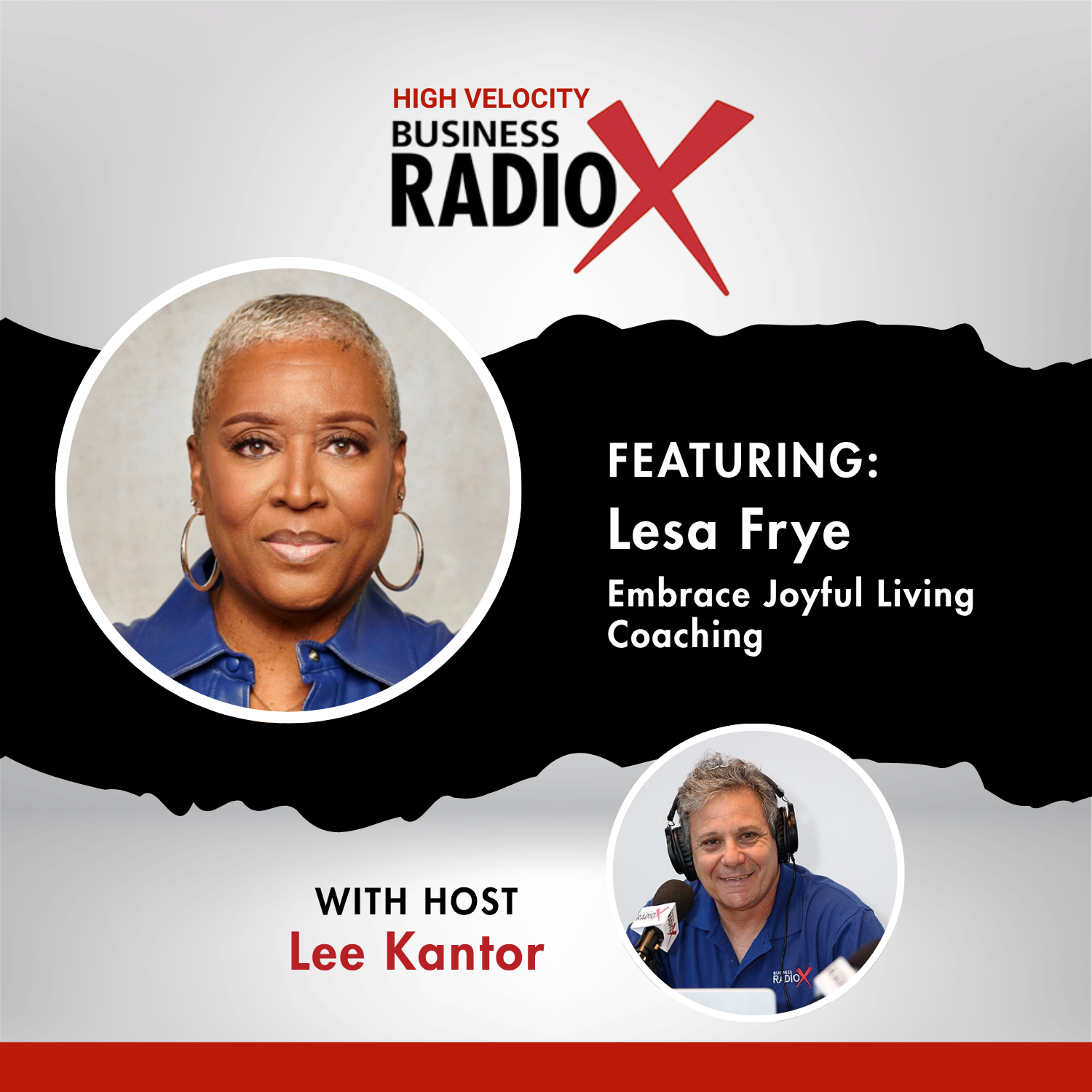

In this episode of High Velocity Radio, Lee Kantor interviews Lesa Frye, certified life and business coach and founder of Embrace Joyful Living Coaching. Lesa shares her journey from a successful 35-year real estate career to coaching experienced women in real estate who feel overwhelmed, overworked, and on the verge of burnout. The conversation explores the importance of mindset, boundaries, self-care, and sustainable business growth, along with practical strategies for creating a profitable business that supports both professional success and a more balanced, fulfilling life.
 Lesa Frye is a Certified Life and Business Coach, and the founder and CEO of Embrace Joyful Living Coaching, LLC. With over three decades of entrepreneurial experience, she now devotes her work to helping purpose-driven women in real estate escape overwhelm and prioritize themselves so they can build profitable, peaceful businesses that honor their values, protect their energy, and support the lives they truly desire.
Through her signature 1:1 coaching program, Success Without Sacrifice™, Lesa empowers women to implement her transformative A.L.L. Framework: Align with your Inner CEO, Learn to create balance and boundaries in your business and life, and Leverage with systems and support.
Before launching her coaching practice, she built an award-winning career in real estate. After leaving corporate America to be more present with her children, she took a leap of faith and became a full-time Realtor. She sold 41 homes in her first year and went on to become a consistent six-figure earner and top-producing agent for over 30 years. Her deep understanding of service, leadership, and personal development informs everything she teaches her clients today.
Her coaching journey began with what she describes as a “God whisper”- a divine calling to help women rise above overwhelm and create success on their own terms. She holds certifications in Life and Health Coaching from the Health Coach Institute and advanced training in the Transformational Coaching Method. Since 2020, she’s been on a mission to help women redefine what success looks like, and feel deeply fulfilled as they build it.
A proud wife, mother, and grandmother, she has been married to her high school sweetheart for 39 years. Together they have two grown daughters, a son-in-law, and two wonderful grandchildren who light up her world.
When she’s not coaching clients, you’ll find her spending time with family and friends, boating or relaxing by the water, dancing, reading, and living the joyful life she teaches others to create.
Connect with Lesa on LinkedIn and Facebook.
What You’ll Learn In This Episode
- Aligning business goals with personal values and priorities
- Building a sustainable real estate business without constant hustle
- The role of coaching in overcoming limiting beliefs and blind spots
- Creating work-life balance through systems, support, and intentional planning
- Strategies for strengthening client relationships and generating referrals
- Practical mindset exercises, including gratitude and goal-focused thinking
- Moving from reactive work habits to purposeful business growth
- Developing confidence and resilience during challenging market conditions
- Creating a business that supports your life, energy, and well-being
- The power of self-awareness and personal growth in long-term success
 This transcript is machine transcribed by Sonix.
TRANSCRIPT
Intro: Broadcasting live from the Business RadioX Studios in Atlanta, Georgia. It’s time for High Velocity Radio.
Lee Kantor: Lee Kantor here another episode of High Velocity Radio and this is going to be a good one. Today on the show, we have certified Life and Business coach with Embrace Joyful Living Coaching, Lesa Frye. Welcome.
Lesa Frye: Thank you. Thank you so much. Excited to be here.
Lee Kantor: Well, I’m excited to learn about your practice. Tell us a little bit about Embrace Joyful Living Coaching. How are you serving folks?
Lesa Frye: So I work with experienced women in real estate who are feeling overwhelmed and overworked. And what I do is help them create profitable, sustainable businesses without the burnout.
Lee Kantor: I would imagine that a lot of folks in real estate, whether they’re veterans or new, are feeling a similar pressure.
Lesa Frye: Yeah, it’s kind of the way the industry is structured.
Lee Kantor: So tell us a little bit about your backstory. How’d you get involved in this line of work?
Lesa Frye: Well, let’s see if I go all the way back. I started in corporate America and I had reached the ceiling there. And at the time, my children, my girls were two and six. And I asked myself the question. Well, a couple of questions. One was, where could I control my income because I had reached the ceiling in this particular position, where or how can I control my schedule because I want it to be more present for my children. And then the third question was, what do I enjoy doing? And real estate was my answer at that time, because when I was younger, I used to ride around with my parents every Sunday to visit open houses. We had no intention of moving. They just like to go look at houses and I enjoyed going with them. So real estate, that seat was. That seed was planted relatively early. So I went ahead and I got my real estate license. I worked as a dual career agent, meaning I kept the full time job and worked real estate part time. I did that for about a year and a half, and then took the leap of faith and became a full time realtor, a full time entrepreneur, and I set an extremely high goal for myself to earn the top award in the company. And at that time, it was called The Centurion, and it meant that you earned 150 000 gross closed commissions.
Lesa Frye: So I set out to achieve that goal. I worked very hard. I feel like I worked 24 over seven. If a client called me on a Sunday and I had already worked six days. I was there, I was like, let’s go. Um, and so I did. I achieved the goal. My very first year in real estate, I sold 41 homes. So that tells you how long ago this was, right? Because it took 41 homes to, to earn that income. Now it probably takes three. So anyway, I achieved that goal and I took a step back and I realized that I had missed an entire year of my family’s life. And that was not my definition of success. And so I made a change. Um, I decided to set some boundaries to make sure that I was aligned with what, what’s most important to me. And so I worked, I’ve been a licensed realtor for over for 35 years actually. And I would say about 2014 when I lost my father in law to cancer. Um, I took a step back and my thought was, life is too short not to be doing work that you fully enjoy. And I loved real estate, but I found that it was not being as fulfilling.
Lesa Frye: And I also felt like I was called to do something else. And so literally, I was praying for clarity in the middle of the night. And what was told to me was to become a coach. And so that’s how I got started with coaching. I started out by getting my health coaching certification and the company that I got that through also offered a life coaching certification. And so I got that certification as well. And what I realized was that it wasn’t the physical health that I actually wanted to help people with. It was the mental side of things, the life coaching side. And so I started coaching with the brokerage that I was affiliated with at the time. I became their productivity coach and helped agents get their their businesses off the ground. And I did that for about a year and a half and realized that I didn’t just want to show agents the strategy piece, you know, how to attract clients, how to write a contract, all of that. I actually wanted to help them with the mindset piece because any business is really 80% mindset and 20% strategy. And so in August of 2020, I launched my own coaching business, Embrace Joyful Living Coaching. So that is a long way around telling you how I got here.
Lee Kantor: Now, when you were, um, kind of in your corporate and in the beginnings of your real estate career, Were you ever given the opportunity to work with a coach, or did you think, oh, maybe I should work with a coach? Like, had you ever been coached prior to you saying maybe I should become a coach?
Lesa Frye: Absolutely. So in my real estate business, yes, I had a business coach. Shucks. Probably from year two on. So I’ve always had a coach myself. So I am a firm believer in coaching and the benefit that it provides.
Lee Kantor: Now at the time, was that unusual or was that kind of standard practice? Because I know in real estate they do a lot of work pairing people up, shadowing, mentoring, you know, working with the person above you so you can kind of get the lay of the land. Is that just part of the DNA of real estate?
Lesa Frye: Well, coaching. So again, we’re talking 35 years ago and coaching was not as popular as it is now. And even the mentoring that you find now in real estate wasn’t happening when I started in real estate. It was basically, here’s your desk, here’s the phone. Good luck. So, um, so things have evolved, things have changed. But I learned early on that, you know, in order to be successful, you need support. You need someone who is non-biased, non-judgmental, and can see the blind spots that you’re not seeing.
Lee Kantor: And what is the kind of the challenge that your current clients are facing where they’re like, you know what? Maybe I should, uh, talk with Lisa. Like, is there something happening in their life? Is there some signal or trigger that says, hey, maybe it’s time for me to explore coach?
Lesa Frye: Yeah. So for, for my clients, because again, I’m speaking with experienced women in real estate. So everything looks great on paper. They’re, they’re closing deals. They’re meeting, you know, income guidelines. Most of them are six figures or more. Um, but it’s, they’re working very hard. They’re available all the time. They don’t, it’s like they’re making the money, they’re having the results, but they don’t have the time to enjoy it. So for them, the signal is I’m burning out. Like I’m working all the time. I’m making great money, but I don’t have the time. Like I’m, I’m, I don’t have time to be with my family. Uh, I’m not prioritizing myself and my own self-care and taking care of myself. It’s like if they make the list at all, they’re the last person on the list. They’re prioritizing everyone else’s needs ahead of their own. And so it’s just a realization that they don’t want to keep working the way they are at the pace that they are. And so that’s what signals them to reach out to me.
Lee Kantor: And then when they do that, is that something that. Um, what are those kind of early conversations? Are that onboarding look like? Are you asking them some questions? Are you asking them, you know, what kind of future do they would they like to have? Like, how do you transition them from this kind of hustle grind that seems like they’re on to one of okay, pausing and then realizing that you have some more control maybe than you think you do.
Lesa Frye: Mhm. So my, um, when clients initially reach out to me, I offer what I call a complimentary business diagnostic conversation. And during that conversation, it’s one hour where I’m asking a series of questions and basically what I’m trying to do or what I’m not trying to do. What I am doing is taking a look at where are you currently, what’s what’s draining you, what’s causing your burnout. So we look at that and then I’m looking at or asking the questions around in an ideal world, like where do you want to be? What do you want to have happen? And so I’m helping them to bridge that gap between where they are and where they want to go. And so we create a plan within that business diagnostic conversation. And then if they actually want help with implementing the plan, that’s where my coaching program comes in. And it’s a 90 day business reset where the framework that I’m utilizing is, I call it my all framework. Um, it’s aligned with your inner CEO. Learn to create business. Learn to create balance and boundaries in your business. And then the second L is leverage with systems and support.
Lee Kantor: Now do you find that even seasoned, um, real estate, uh, people don’t really have a picture. A clear picture of what the end looks like or what they’re aiming at. Like they’re just kind of they get in this hamster wheel and it’s just kind of a grind and they just keep going. They don’t they don’t know there could be a finish line or a way, something that they’re truly, you know, like a North Star they’re aiming at.
Lesa Frye: Yes, I do find that. And, and so that’s where the first piece comes into play. It’s looking at and deciding what is it that you actually want, you know, what do you what do you want your life and your business to look like? And yeah, part of it is, and how long do you actually want to work? Like, what is your desire?
Lee Kantor: Now, isn’t that is that sometimes kind of an eye opening question where this is something like their in their head? They’re like, maybe I should have thought of this before and now you’re making me answer. And now I hadn’t really thought about it. Like, this could be kind of a real pivotal moment for them.
Lesa Frye: Yeah, absolutely. And what I find interesting with, um, you know, with my clients is they’re so used to working all the time that if they even had a break, they don’t even know what they would do with that time. Like they haven’t even thought about what could I be doing? You know, what is it that I really want to do when I’m not working? So that in itself is, is a whole, a process.
Lee Kantor: And, and when you’re working with somebody like that who hasn’t thought about the end or how the story ends or how how they can transition to, you know, a different type of lifestyle, um, that becomes, I mean, to me now you’re almost in a, in, you’re bridging into therapy almost because this is really a lot of their early, you know, form formative beliefs are coming into play at this point, right? Like this is a, um, this is kind of tricky at this point because now these are big kind of questions you’re asking that people probably hadn’t invested a lot of time thinking about, and you’re really bringing it to the surface. I mean, it takes a skilled professional to, uh, kind of navigate this.
Lesa Frye: Yeah, absolutely. Absolutely. Um, but the difference between coaching and therapy is therapy is focused on what happened in the past and helping you to, to work through that. Whereas coaching is let’s move you forward. What, what is it that you want to create now? Now that we’ve worked through, you know, all the things in the limiting beliefs and all of that, where is it that you want to go? And so that’s what the focus of coaching is. So yes, I’m also trained in the transformational coaching method. Which means, yes, I can help people to process, you know, some of the things that happened in early, early childhood, um, some of the limiting beliefs that were formed there and help them to break through those and to release those.
Lee Kantor: So now what are, um, once they start working with you, what are some signs that it’s working? Like what does it feel like? When do they start feeling like when this kind of feeling of burnout starts dissipating?
Lesa Frye: Mhm. So what they’re experiencing is they stop feeling like success requires constant hustle, um, and being available. And they actually are creating a business that supports their life, their energy, their peace and their priorities. Um, they actually, some of the other signs are they stop overcommitting stop, um, reacting to everyone else’s urgency. And really they create more personal time without the guilt because that’s the key. Um, they attract more aligned clients, they’re clarifying their messaging, they’re going deeper with their clients, meaning in real estate, sometimes it’s okay, I helped you buy this house. I helped you sell this house. Let me go on to the next client. And then some realtors never stay connected to their past clients. What I’m focused on is let’s go deeper instead of wider. You know, once you’ve formed that relationship with a client, keep that relationship, nurture that relationship, build the relationship with your past clients and sphere so that you don’t constantly have to be quote unquote, chasing business. You’ve built a team of advocates who already know, like, and trust you and they’ll send you referrals. And a referred client is a lot easier to work with than someone cold.
Lee Kantor: So you’re you’re kind of coaching them. I guess this is where your experience of having worked so many years in the industry comes into play. The strategies and tactics you are recommending are, you know, kind of proven by you’ve been there, done that. This isn’t just somebody that is a coach that’s saying, hey, try this, like without any kind of knowledge about the industry.
Lesa Frye: Correct? Yes. I’ve been in the industry myself, like I said, for 35 years, and I can speak to that dual career agent because I’ve done that. I can speak to that full time agent because yes, I’ve done that as well for many years. And yeah, I’ve been in the trenches. I’m still in the trenches with them. So I can definitely relate. It’s not theory, you know, it’s tested. I’ve lived it myself.
Lee Kantor: Now, is there a story you can share? Don’t name their name, but maybe, um, one of your clients that you were able to help. Maybe what the challenge was they came to you with and how you were able to help them get to a new level.
Lesa Frye: Yes. So, um, I have a client who, and here’s, here’s the thing. And this is kind of a common thread amongst a lot of my clients. They are high achieving women. And as high achieving women, we tend to be very hard on ourselves. Um, and we have extremely high expectations for ourselves. So this particular client, um, came to me, she was very successful. And then the market had tanked. And so she had lost momentum, lost production, and she was very down about it and her confidence had been hit. And so in working together, um, She overcame. I don’t want to call it. She called it depression. I don’t know if it was depression, but she she came out of her depression. She started accepting and loving herself and forgiving herself and has worked through it and has rebuilt her business back to the level where she was before. So, and it’s just the what I worked with most with her was not the strategy piece because she’s been in the business for a while. It’s the it was the mindset piece. It was, what are the thoughts that she’s thinking about herself? What are the thoughts that she’s thinking about her business? Because our thoughts. Create a certain feeling in our body. And from those feelings, we take a certain action or we don’t take action. And then those actions are creating our results. And so it all starts with what are you thinking? Because your thoughts are creating your results now.
Lee Kantor: Is there any advice you can give our listeners right now? Is there something actionable that they could take to kind of work on that mindset piece on their own?
Lesa Frye: Yeah. So there are a couple of tools that that I share with my clients. And one is gratitude. And what I have my clients do on a daily basis is write down five things that you are grateful for that are happening right now. And then also journal five things that you want to call in that you’re going to go ahead and be grateful for now. So that’s a daily exercise. Another one is what’s a goal that you want to achieve. So for instance, I have a client whose goal is I want to create $20,000 every month. Okay, great. Write that down. Every day I create $20,000 every month, and then ask yourself questions as to why that can work. Like a couple of questions are why does this matter? And then list out ten reasons why it matters. Another question why will this work? List out ten reasons why it will work. And what you’re doing is redirecting your brain to come up with why it will work. Because our brains automatically go to what’s not working, what’s wrong, etc. so that intentional thought creation is a very good exercise for the mindset piece, and I’m not going to take credit for that. My coach, Stacy Bowman, taught me that process. So I certainly share it with my clients as well.
Lee Kantor: So for folks out there who want to learn more and maybe get on your calendar, is there a website? What’s the best way to connect?
Lesa Frye: Yes, absolutely. My website is lesafrye.com, that’s lesafrye.com.
Lee Kantor: Well, Lisa, thank you and I. Oh, go ahead. I’m sorry.
Lesa Frye: I was going to say, I also have, um, a podcast. That podcast is the balanced business woman. And you can find it on Apple, Spotify, wherever you listen to your podcasts.
Lee Kantor: Good stuff. Well, congratulations on all the success and the momentum. Um, thank you so much for sharing your story today. You’re doing such important work and we appreciate you.
Lesa Frye: Thank you so much for having me.
Lee Kantor: All right. This is Lee Kantor. We’ll see you all next time on High Velocity Radio.















