Business RadioX ®

  • Home
  • Business RadioX ® Communities
    • Southeast
      • Alabama
        • Birmingham
      • Florida
        • Orlando
        • Pensacola
        • South Florida
        • Tampa
        • Tallahassee
      • Georgia
        • Atlanta
        • Cherokee
        • Forsyth
        • Greater Perimeter
        • Gwinnett
        • North Fulton
        • North Georgia
        • Northeast Georgia
        • Rome
        • Savannah
      • Louisiana
        • New Orleans
      • North Carolina
        • Charlotte
        • Raleigh
      • Tennessee
        • Chattanooga
        • Nashville
      • Virginia
        • Richmond
    • South Central
      • Arkansas
        • Northwest Arkansas
    • Midwest
      • Illinois
        • Chicago
      • Michigan
        • Detroit
      • Minnesota
        • Minneapolis St. Paul
      • Missouri
        • St. Louis
      • Ohio
        • Cleveland
        • Columbus
        • Dayton
    • Southwest
      • Arizona
        • Phoenix
        • Tucson
        • Valley
      • Texas
        • Austin
        • Dallas
        • Houston
    • West
      • California
        • Bay Area
        • LA
        • Pasadena
      • Colorado
        • Denver
      • Hawaii
        • Oahu
  • FAQs
  • About Us
    • Our Mission
    • Our Audience
    • Why It Works
    • What People Are Saying
    • BRX in the News
  • Resources
    • BRX Pro Tips
    • B2B Marketing: The 4Rs
    • High Velocity Selling Habits
    • Why Most B2B Media Strategies Fail
    • 9 Reasons To Sponsor A Business RadioX ® Show
  • Partner With Us
  • Veteran Business RadioX ®

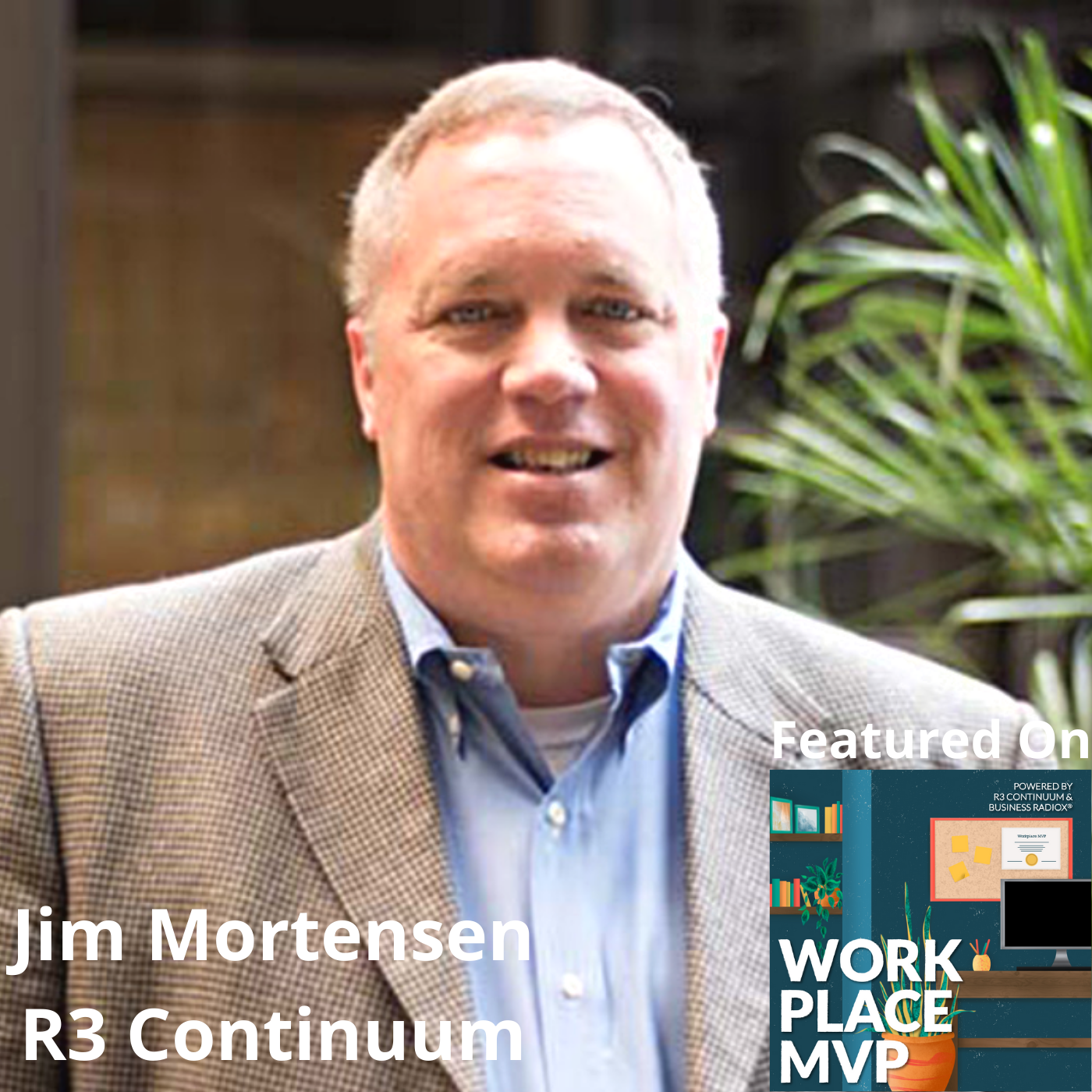
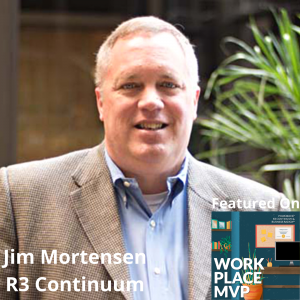
Workplace MVP: Jim Mortensen, R3 Continuum

September 30, 2021 by John Ray

Jim Mortensen
Minneapolis St. Paul Studio
Workplace MVP: Jim Mortensen, R3 Continuum
Loading
00:00 /
RSS Feed
Share
Link
Embed

Download file

Jim Mortensen

Workplace MVP:  Jim Mortensen, R3 Continuum

Noting not only parallels but lessons to be learned, Jim Mortensen, President of R3 Continuum, reflected on his experience of the September 11th terrorist attacks and the current pandemic. He and host Jamie Gassmann discussed how business culture was impacted by 9/11, the actions leaders can take during traumatic events, how what was learned after 9/11 helped him better address the leadership challenges of the pandemic, and much more. Workplace MVP is underwritten and presented by R3 Continuum and produced by the Minneapolis-St.Paul Studio of Business RadioX®.

Jim Mortensen, President, R3 Continuum
Jim Mortensen, President, R3 Continuum

Jim Mortensen is President of R3 Continuum (R3c), a global leader in behavioral health and security solutions to cultivate and protect workplace wellbeing in a complex and often dangerous world. R3c’s continuum of tailored support services includes crisis prevention, preparedness & response, specialized consulting, evaluations, employee outreach, training, protective services, and more.

Jim is responsible for all facets of the business, including Sales, Marketing, Quality, Clinical Behavioral and Medical Services, Business Development, HR, and Client Services.

Prior to joining R3c in 2013, Jim was a vice president at Benesyst where he was responsible for Client Relationships, Product Development and Operations. Jim has an extensive background in the Health Care and Financial Services industries, including time spent at Ameriprise and UnitedHealth Group. He has a passion for leading growing organizations to provide outstanding service.

In addition to his experience in product development and operations, Jim has an MBA in Finance and is both a Certified Public Accountant (inactive) and a Certified Internal Auditor.

LinkedIn

R3 Continuum

R3 Continuum is a global leader in workplace behavioral health and security solutions. R3c helps ensure the psychological and physical safety of organizations and their people in today’s ever-changing and often unpredictable world. Through their continuum of tailored solutions, including evaluations, crisis response, executive optimization, protective services, and more, they help organizations maintain and cultivate a workplace of wellbeing so that their people can thrive. Learn more about R3c at www.r3c.com.

Company website | LinkedIn | Facebook | Twitter

About Workplace MVP

Every day, around the world, organizations of all sizes face disruptive events and situations. Within those workplaces are everyday heroes in human resources, risk management, security, business continuity, and the C-suite. They don’t call themselves heroes though. On the contrary, they simply show up every day, laboring for the well-being of employees in their care, readying the workplace for and planning responses to disruption. This show, Workplace MVP, confers on these heroes the designation they deserve, Workplace MVP (Most Valuable Professionals), and gives them the forum to tell their story. As you hear their experiences, you will learn first-hand, real life approaches to readying the workplace, responses to crisis situations, and overcoming challenges of disruption. Visit our show archive here.

Workplace MVP Host Jamie Gassmann
In addition to serving as the host to the Workplace MVP podcast, Jamie Gassmann is the Director of Marketing at R3 Continuum (R3c). Collectively, she has more than fourteen years of marketing experience. Across her tenure, she has experience working in and with various industries including banking, real estate, retail, crisis management, insurance, business continuity, and more. She holds a Bachelor of Science Degree in Mass Communications with special interest in Advertising and Public Relations and a Master of Business Administration from Paseka School of Business, Minnesota State University.

TRANSCRIPT

Intro: [00:00:04] Broadcasting from the Business RadioX Studios, it’s time for Workplace MVP. Workplace MVP is brought to you by R3 Continuum, a global leader in workplace behavioral health and security solutions. Now, here’s your host, Jamie Gassmann.

Jamie Gassmann: [00:00:25] Hi, everyone. Your host, Jamie Gassmann, here and welcome to this special edition of Workplace MVP. Over this last month, as we have all, at some point, reflected as a nation on the events of 9/11, it is common for most of us to recall where we were and what we were doing when we first heard the news of the attacks. I know I vividly remember where I was. And I have had conversations with many others over the last 20 years that have had the same types of recollection.

Jamie Gassmann: [00:00:53] Looking back on September 11th, 2001 and jumping forward to now, 2021, and the world we live in today with the COVID-19 pandemic, and hearing how employers are increasing and focusing efforts on providing mental health support for their employees, it leaves me wondering, how did employers respond and support employees in the immediate moments, days, weeks, and now years following the events of 9/11? How did the attacks change how business leaders react and respond to disruption in their workplace, particularly as it relates to supporting the well-being of their employees?

Jamie Gassmann: [00:01:30] Well, with us today to share his experience and key learnings as a business leader during 9/11 is Workplace MVP Jim Mortensen, who is the President for our show sponsor, R3 Continuum. Welcome to the show, Jim.

Jim Mortensen: [00:01:44] Thanks, Jamie. Glad to be here.

Jamie Gassmann: [00:01:47] So, let’s start out with you walking our listeners through your career journey and how you came to be the president at R3 Continuum.

Jim Mortensen: [00:01:55] Okay. Well, sometimes I talk about my career as kind of a testament to transferable skills. So, my educational background is in accounting and finance. And that’s usually where I would start in a company because it’s the most obvious kind of skill that people can grab onto. But what I would do was, I was in finance and then I went into project management, product development, client service.

Jim Mortensen: [00:02:30] And what I found was the reality is, is that, product development, client service, and finance have to work together all the time. But they really don’t know what the other one is talking about. And since I had been in all three, I kind of coalesce and get people unified in the goals that they were going for.

Jim Mortensen: [00:02:54] So, frequently, product development, people go to client service and say, “Here’s what we want to do.” And client service rolls their eyes and says, “You have no idea what you’re asking.” I’d throw some client service in ops terms out there just to say, “Yeah. I know exactly what I’m doing to you. So, let’s figure out how to to make this work.” And with that, I worked in various large companies like American Express and UnitedHealth Group.

Jim Mortensen: [00:03:24] But I, also, through all of that, would look for kind of the small entrepreneurial groups within those large companies, because what I really love to do is go into an area that is either really falling down and/or is experiencing explosive growth. And what I would consistently see happen is, when you’re going from that kind of small boutique into a mainline business, the volumes are crushing you. And they have largely succeeded and thrived almost through a lack of process. They’re very hands-on. They adjust to everything that’s going. And the challenge is, when the volumes get that high, if you don’t change how you’re doing it, you won’t continue.

Jim Mortensen: [00:04:15] So, I really love going in there and talking about we’re going to preserve the core, but to preserve that core and remain client focused and nimble, we have to change how we do that. And that’s incredible both from a tactical standpoint and from a culture standpoint. It’s a very challenging time, and I found that I just really love that kind of approach.

Jim Mortensen: [00:04:44] Well, after being in big companies, I then moved into small to midsized companies. And really, when you’re leading in that kind of an organization, the whole company is kind of a boutique entrepreneurial group and they need people who can move across processes. So, it really was a good fit for me, and that’s how I transitioned into smaller companies.

Jim Mortensen: [00:05:09] And then, when I heard about R3 and what they did, it was just such a core, in Simon Sinek’s “why”, it just really fit for me. So, I just have a passion for what R3 does.

Jamie Gassmann: [00:05:24] Great. And it fits well within our description of our show today in talking about 9/11 and where you were at, you know, career-wise during that timeframe, because R3 was a big responder to 9/11 in terms of the psychological first aid for employees and other victims.

Jim Mortensen: [00:05:42] Sure.

Jamie Gassmann: [00:05:42] So, let’s kind of dive into that a little bit and talk about, you know, on the day of 9/11 – and I know you’ve mentioned American Express – you’re working at American Express Financial Advisors. Can you share with us what was your role at that time? Where were you officed? How many employees did you have? You know, where were they located? And kind of just share a background on that.

Jim Mortensen: [00:06:03] Sure. Sure. As you said, I was at American Express Financial Advisors, and I was, at that time, leveraging my finance background. I was in charge of forecasting and budgeting for that company, which I think at that time was about 700 million a year in revenue. And I had just recently taken over that job. I had just recently gotten a new boss, who, ironically, was commuting from Toronto at the time. And I had about five employees. We were all based in the IDS Center in Downtown Minneapolis.

Jim Mortensen: [00:06:40] I was driving to work when I heard on the radio that the plane had crashed into the World Trade Center. And I think, like a lot of us, I was kind of in shock. And I remember on the drive, they were reporting about the first one hitting and I thought, “What a horrible accident.” And then, the second one hit, and we kind of all realized this isn’t just a random accident. So, I think I spent most of that day kind of in shock.

Jamie Gassmann: [00:07:11] And you heard about it driving to work and knowing the towers were the largest towers, I believe, in the country. The IDS is one of the largest towers in Minneapolis, so were there any feelings that you were feeling as you continue to your commute in? Or any thoughts that ran through your mind?

Jim Mortensen: [00:07:32] Yeah. And, in fact, we sent everybody home by about noon, in part because, to your point, the IDS Tower was one of the tallest towers in the Midwest, so we felt like we could be a target. I mean, it’s kind of like the early days of COVID, nobody really knew what was going on. And I think, also, a lot of us – I had two elementary school aged kids and my wife was at work in the schools – I think we all just wanted to be home and close to our families at that time. So, it’s a combination of that and a real concern about the security that our whole company just shut down and sent people home.

Jamie Gassmann: [00:08:23] Interesting. So, you know, with the employees – I know you mentioned that you shut it down and everybody went home to be with their families – what were some of the communications that were going out to your employees at the time? As a leader, what were some of the things that you were asked to do from the organization?

Jim Mortensen: [00:08:45] Sure. Well, at least in the early days, I think, we made a call that’s probably not correct, but was fairly common then, is that, there was one response for the people in New York, where our headquarters were, and a very different response for the rest of the country. So, the CEO of American Express, I think, got really good press for how he handled 9/11, because he was out there and talking and communicating with employees and creating new spots for people to work. Because the American Express Tower actually was connected via tunnels to the World Trade Center, and they used the same heating and HVAC systems.

Jim Mortensen: [00:09:42] So, actually, for a while there, we assumed everything in the American Express Tower may have been incinerated by the heat coming through. But, actually, when the towers came down, it tore off the external skin of the American Express Tower. That’s how close they were to the World Trade Center. So, there was a lot of focus on trying to find all our employees.

Jim Mortensen: [00:10:06] I remember being in conference calls in the days after that. And you’d just be waiting for everybody to check in and wondering are they all still alive. And it was really kind of a weird scenario. You know, it’s not, “Gee. Is this person late to the meeting?” It’s “Is this person still alive?” We were quite fortunate, I think the only American Express employees who were killed that day was a group of five to seven people in our travel company who actually worked onsite for one of the companies in the tower.

Jamie Gassmann: [00:10:47] Interesting. So, with your employees here in the Minneapolis area, you know, what was the feeling like when you returned to the office and knowing that there were employees that were in the tower and that there were employees that were close to the vicinity of the towers? You know, what were some of the feelings that were going through that work environment? And how did you show support to them and how did you navigate that?

Jim Mortensen: [00:11:16] Yeah. There was a lot of confusion. And, again, where I think we fell down as there wasn’t a lot of communication to the non-headquarters people, so we found out about it in drips and drabs. And, again, while I think the company did an amazing job of working with the people directly impacted, I think back at that time, it took a long time before people realized this really impacted employees across the country. And even if they did realize it, I think back in that time, there wasn’t a lot of understanding of how you help and support employees during that time.

Jim Mortensen: [00:12:03] I mean, I remember for weeks, my boss, whose family was still in Toronto – if you remember, you couldn’t fly – he’s stuck in the U.S. And I started to think, from his family’s standpoint, their dad is working in a foreign country that’s been attacked. And, finally, after a few weeks, he rented a car and drove home just to go see his family. And I just think we all just really didn’t understand completely how to deal with that. So, again, we did a great job with the people we knew were directly impacted and a lesser job, frankly, for the people who were indirectly impacted.

Jamie Gassmann: [00:12:48] Yeah. Did the organization, let’s say, like fast forward to some of the anniversaries passed in the first year or even maybe in the immediate? I know you kind of mentioned that there’s a lot of support that was provided kind of in that New York area and that concentration of employees that were more directly impacted. Did they eventually kind of catch on to some of the support that might have been needed? And if they did, how did that look and feel as they kind of progressed in their learning of everything?

Jim Mortensen: [00:13:21] Yeah. I think what they did a lot of is, as they started to recover the tower – and the tower for months afterwards was actually used as a staging area for the fire and police, et cetera – American Express had abandoned the tower and put people out to remote offices and such. So, as they started to regain the tower, they did a lot of work with people around, “Will you feel comfortable coming back to work in Downtown New York and within sight of where the World Trade Center was?” And I think they had a real understanding of that’s going to be traumatic for people. And some people desperately want that in order to recover their normal. And some people don’t want that reminder.

Jim Mortensen: [00:14:17] And, again, I see a lot of parallels to today. If you think about it, I mean, we’re having the same dialogues today, do people feel safe coming back to the office. And people love working from home, but they miss their coworkers. And I think that’s some of the same impacts we’re seeing today. I just think we’re a lot more aware of mental health issues and aware of why the employer should care and be engaged in that. As opposed to, “Well, that’s really a personal issue. We shouldn’t be involved.” Does that make sense?

Jamie Gassmann: [00:14:55] It does. Yeah. And it’s interesting, I’ve heard in some of the other interviews and kind of stories I’ve heard from the 9/11 during this anniversary timeframe where they’ve mentioned that that was really kind of the turning point for the mental health focus in workplaces. That that really was kind of where employers realized there was another part to business continuity that wasn’t just systems and operations. That it was really, you know, your people. And it sounds like you saw very much something similar within the Ameriprise that they did have to make that shift over to looking at their people.

Jim Mortensen: [00:15:31] Well, some of my experience was impacted by the fact that I was in finance and in charge of budgeting and forecasting. And what happened on 9/11 had some pretty severe impacts on Ameriprise from a financial standpoint. As I recall, every one percent movement in the market impacted our bottom line by a million dollars a year. So, I spent a horrendous amount of time post-9/11 focused on reforecasting the company over and over and over again.

Jim Mortensen: [00:16:10] And at that time, particularly in that area, it wasn’t, “How are you dealing with what just happened?” It’s, “Work lots of hours and figure out how we keep the company going.” And that’s not bad people. That’s just the way things were back then. It’s like, “Okay. Well, that happened. Now, what’s our revenue going to be next month?” That’s kind of the approach.

Jamie Gassmann: [00:16:42] Yeah. It sounds similar to our interview with Col. Williams talking about his experience in the Pentagon during 9/11 and having to go back on a plane that following Monday back at it to work. So, very much during that timeframe, it sounds like it was very similar amongst other industries as well.

Jim Mortensen: [00:17:01] Yeah. And there was nothing intentional or negative about it. It’s just kind of the culture back then and the lack of understanding of how it’s impacting. And I guess in some ways, it’s also a way some people do recover well. I think it helped me to not focus on that and instead focus on work. That’s a certain approach of maintaining my normal. It was to bury back into work again.

Jamie Gassmann: [00:17:30] Yeah. Absolutely. So, we’re going to take a moment and hear from our sponsor. So, Workplace MVP is sponsored by R3 Continuum. R3 Continuum is a global leader in providing expert, reliable, responsive, and tailored behavioral health, crisis, and violent solutions to promote workplace wellbeing and performance in the face of an ever changing and often unpredictable world. Learn more about how R3 Continuum can tailor a solution for your organization’s unique challenges by visiting r3c.com today.

Jamie Gassmann: [00:18:02] So, now, looking at you as a leader during 9/11, in your perspective looking back on that, what would be some of the changes or impacts that you had in your leadership style or how you lead or view leadership today?

Jim Mortensen: [00:18:18] It’s a great question. I think one of the things I’ve really learned, both from 9/11 and also, frankly, from working where I work now is, in periods of stress, whether it be work stress or, certainly, even more so non-work trauma, it’s really important for leaders to be visible. I think like all of us, there are times during events like that, or even death of a coworker, or something we’ve had that happen here, all of us, as individuals, get struck with the, “I don’t know what to say. What’s the right thing to say right now?” And a fairly natural reaction to not knowing what to say is to say nothing.

Jim Mortensen: [00:19:13] And leaders, in particular, to go hide in your office and say nothing is the worst thing you can do. You’ve got to be out. You’ve got to be visible. And in certain events like 9/11, like the death of a coworker, leaders have to understand that that’s a time not to put your leader face on. It’s a time people want to see you as a human being. So, it’s okay to cry, or to show emotion, or to link with people that way. That’s what people are looking to their leaders for how to handle this situation, and they want to know that their leader cares.

Jim Mortensen: [00:19:57] And I think that’s part of what I really learned from 9/11, is, those kind of events require leaders to step out, step into it, and just be visible, and be human, and deal with you have to help people understand, meet, and, frankly, accept that this is a highly emotional time. It’s a very disruptive time. And we have to work through that before we can be productive again.

Jim Mortensen: [00:20:36] And then, the other thing that I’ve really learned through it all is, people have different ways of dealing with it. So, a question I’ve gotten from employees as well, how do we help someone so during this? And the answer is, “Well, you ask them what they’re needing. And then, you believe what they tell you.” So, the idea that you’ve got to go through grief a certain way is really kind of old school. Most people are not in denial. They’re just working through it in their own way. So, you ask them what they need and you believe them when they tell you what they’re needing. Did that kind of get out what you’re wanting to know?

Jamie Gassmann: [00:21:20] Yes. Absolutely. And I think what’s interesting about that is, really, what you’re sharing is, is that a leader has to demonstrate, just similar to any other cultural type nuance within an organization, whether it be “I really want a positive atmosphere”, well, the leader has to demonstrate that. And when you’re going through crisis or a traumatic event, like 9/11, it’s really no different. You showing them it’s okay to have that emotion, it’s okay to feel that way, I think probably provides just a sense of comfort in itself to those employees in knowing they can handle it and kind of work through it the way that is best for them.

Jim Mortensen: [00:21:59] Yeah. Before people can be productive, they have to feel both physically and psychologically safe. So, in R3, during the pandemic, the commitment has been, as long as there are not performance issues, we will not require you to be on work at the office unless and until you feel physically and psychologically safe being here.

Jim Mortensen: [00:22:26] Now, we’re in a unique position where we can do that. Not every company can. But the point is, ignoring the physical and psychological safety will not get people productive faster. It will slow it down. So, you got to start there before you can get the business going again.

Jamie Gassmann: [00:22:47] Yeah. It’s kind of like when you think of the great resignation that a lot of organizations are facing. Some of that is a reflection of that employee looking at their work life and going, “Yeah. It doesn’t really fit me anymore.” But you make a valid point that by being able to meet that employee where it’s comfortable for them and it feels safe for them, both physically and psychologically, you’re able to create that atmosphere that helps them to know this is a good place for you. You know, it probably helps with that movement.

Jamie Gassmann: [00:23:18] So, from your perspective – you know, you talked a lot about kind of culturally and just how work was back during the 9/11 timeframe – thinking about it now – obviously, it’s been 20 years we’ve got, I believe, two new generations to the workforce in that timeframe – what do you think has changed in terms of an employee’s expectation of leadership when events of this magnitude and that level of disruption happen in a workplace?

Jim Mortensen: [00:23:52] Another great question. I think even beyond big events, the whole view of what companies should deal with and what’s appropriate to deal with at work has shifted dramatically, both through the generations and through time. So, kind of I’m a late boomer and lots of things that are discussed every day in the workplace, it’s not that those aren’t topics that are important to general society. It’s that those topics have nothing to do with the business so they’re not issues for the business to take on. Well, I even realized how out of date that sounds when I say it. I mean, it’s kind of the same as the ledger paper I used to foot and cross foot because we didn’t have Excel at that time.

Jim Mortensen: [00:25:00] So, there’s been quite an evolution about what topics companies can and should be addressing. And employees expect their employers to address these issues. And some of that is, you know, “What are my behavioral health needs? I’m feeling burned out. I’m stressed out.” And they expect their employer to help with that.

Jim Mortensen: [00:25:26] And I think the flip side, if you want to be a pure what’s the return on investment of doing this? I think that has shown to be a false idea that ignoring that is because it has no impact on the business. It has a huge impact on the business, both in terms of short term productivity and, frankly, in terms of retention of employees. Employees want to know they’re cared about. Employees want to know that their company is doing things that are helpful and productive in society.

Jim Mortensen: [00:26:07] And to the extent employers do that, they garner more than just somebody working for a paycheck. And they get their passion and their commitment and their retention. And so, I think the whole shift, certainly, 9/11 started some of that. But there’s a lot of things going on that have made a dramatic shift during my career of what is expected of companies.

Jamie Gassmann: [00:26:38] Yeah. And so, with that, kind of keeping on to some of that same vein, if you were to provide some type of piece of guidance to our listeners for how they could effectively lead when an incident occurs, whether it’s a massive event like 9/11 or even smaller scale incidents can have a similar impact on a workplace when there’s, maybe, a death of an employee or coworker that was well-liked or loved – even sometimes customers, I’ve heard, can have a big impact on those work environments – if you were going to give guidance to a leader that’s listening right now on what they can do to have that impact on an employee, what would you leave them with?

Jim Mortensen: [00:27:25] Well, obviously, the business we’re in is helping employers and leaders with that. So, getting a counselor to come onsite and help employees with that, I think, is incredibly helpful. We went through it at one point where one of our employees was killed in a car accident on the weekend. I’m fortunate enough that I could pick up the phone and call one of our employees who’s probably the global expert in these kinds of things and have him guide me through it. And we brought a counselor onsite, and a lot of what it is, is just gathering people up and meeting them where they’re at.

Jim Mortensen: [00:28:10] And I remember the meetings we had, and some of it was really sad, and some of it was really funny as we would recall fun stories about the person, and a lot of it is – they call it – normalizing your reaction, just kind of meeting people where they are and letting them process.

Jim Mortensen: [00:28:27] So, I think what you don’t want to do is force people to pretend things are normal before they’re ready to. So, again, I think it’s being very in place, be out there, talk to your people. It’s a lot tougher right now with people working remote. And we see a lot of articles about how do you find out how people are doing when they’re all remote. It’s toughed right now. But just because it’s tougher doesn’t mean it’s not needed.

Jamie Gassmann: [00:29:01] Yeah. So, how have some of the employers that R3 has worked with, you know, handled this mass shift to remote and still being able to provide that support? What are some of the approaches that maybe R3 has built into their programming or their service delivery that has helped to make sure that employers can still reach them where they’re at?

Jim Mortensen: [00:29:25] Well, one of the things we’ve developed is an ability to do – we call it – onsite response. Typically, when something happens in the workplace, we will send a counselor onsite to talk with the employees. That’s not so effective if the people aren’t onsite. So, in hospitals, we’re still going in and working with the people in the emergency departments, in the ICU.

Jim Mortensen: [00:29:50] But if it’s an office where everybody’s remote, what we’ve developed then is an ability to do that through Zoom calls and things like that, so that we can still help the people process and help them process with their coworkers through the same vehicles that they use for other meetings. And, in that way, the fact that they’re not all in one spot doesn’t prevent the ability to reach out.

Jim Mortensen: [00:30:18] We’ve also, for a long time, for companies that have very few people onsite, so retailers who only have a couple of people onsite during a robbery, going onsite isn’t viable for them. We have an ability to to do that telephonically. So, we just use the technology tools we have in order to continue to provide the service. We believe onsite and in person is always the best response, but it isn’t the only response. And while the other responses may not be as effective, it’s better than not doing it. So, you try to reach people in the best way that you can.

Jamie Gassmann: [00:31:04] Fantastic. So, in looking at your career and you look at kind of over your career journey, if you had to choose one thing or accomplishment that you’re most proud of, what would you choose?

Jim Mortensen: [00:31:21] I think the thing I’m most proud of is the way we dealt with last year. Last year was, by far, the most challenging time for any company and any set of leaders. And if you think back to the start of COVID how rapidly things were changing. I remember mid-one week, people raising, “Are we going to send people home and work remote?” And I wondered why people were overreacting so much. And by Monday of the next week, we had 100 percent of our people at home. And I felt like we were too slow to react. And it was just things were changing that rapidly.

Jim Mortensen: [00:32:13] And the thing I’m proud of is that the company was able to react and respond that quickly. And through the weeks and months following, we went through a period that was the busiest we’ve ever had. And then, probably six months of the business being very, very slow. And we didn’t do layoffs. We managed to just tough it out and get through that. And we kept finding out what do people need and getting support to them.

Jim Mortensen: [00:32:48] We reached out to families and asked what their kids needed. And we had days where one person would just take over and do Zoom calls with a bunch of kids and do crafts to take some of the pressure off of working parents. We had food delivered. We had counselors available. Just all the different things the company was able to bring to the table to help our employees while our employees were providing critical support to the infrastructure of our country. So, that’s what I’m proudest of is what we were able to do during that time.

Jamie Gassmann: [00:33:31] Yeah. Fabulous. Like, you were delivering on what you promised to your customers, to your employees, which is very honorable in terms of a lot of companies offer a lot of services, but sometimes don’t always return it back to those employees delivering it. So, that’s fantastic. So, if our listeners wanted to get a hold of you, how can they do that?

Jim Mortensen: [00:33:54] Well, I’m on LinkedIn. My email address is jim.mortensen@r3c.com. And you can look at our website. I’m happy to talk to anybody about what they’re facing and what their needs are.

Jamie Gassmann: [00:34:13] Well, thank you so much for being on the show with us today, Jim, and letting us celebrate you, and for sharing your stories and great advice with our listeners. We appreciate you and I know for sure that the organization does as well and as does your staff. So, thank you so much for being a part of our show.

Jamie Gassmann: [00:34:31] And we also want to thank our show sponsor, R3 Continuum, for supporting the Workplace MVP podcast. And to our listeners, thank you for tuning in. If you’ve not already done so, make sure to subscribe so you get our most recent episodes and other resources. You can also follow our show on LinkedIn, Facebook, and Twitter at Workplace MVP. And if you are a workplace MVP or know someone who is, we want to know. Email us at info@workplace-mvp.com. Thank you all for joining us and have a great rest of your day.
 

Tagged With: 9/11, crisis communications, crisis leadership, employee behavioral health, Jamie Gassmann, Jim Mortensen, Leadership, leading business during pandemic, pandemic, R3 Continuum, stress in a pandemic, Workplace MVP, workplace wellness

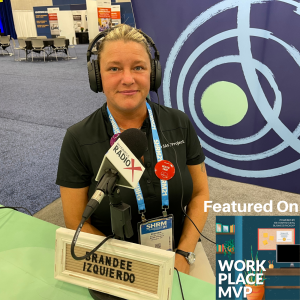
Workplace MVP LIVE from SHRM 2021: Brandee Izquierdo, SAFE Project

September 16, 2021 by John Ray

Brandee Izquierdo SAFE Project
Minneapolis St. Paul Studio
Workplace MVP LIVE from SHRM 2021: Brandee Izquierdo, SAFE Project
Loading
00:00 /
RSS Feed
Share
Link
Embed

Download file

Brandee Izquierdo SAFE Project

Workplace MVP LIVE from SHRM 2021:  Brandee Izquierdo, SAFE Project

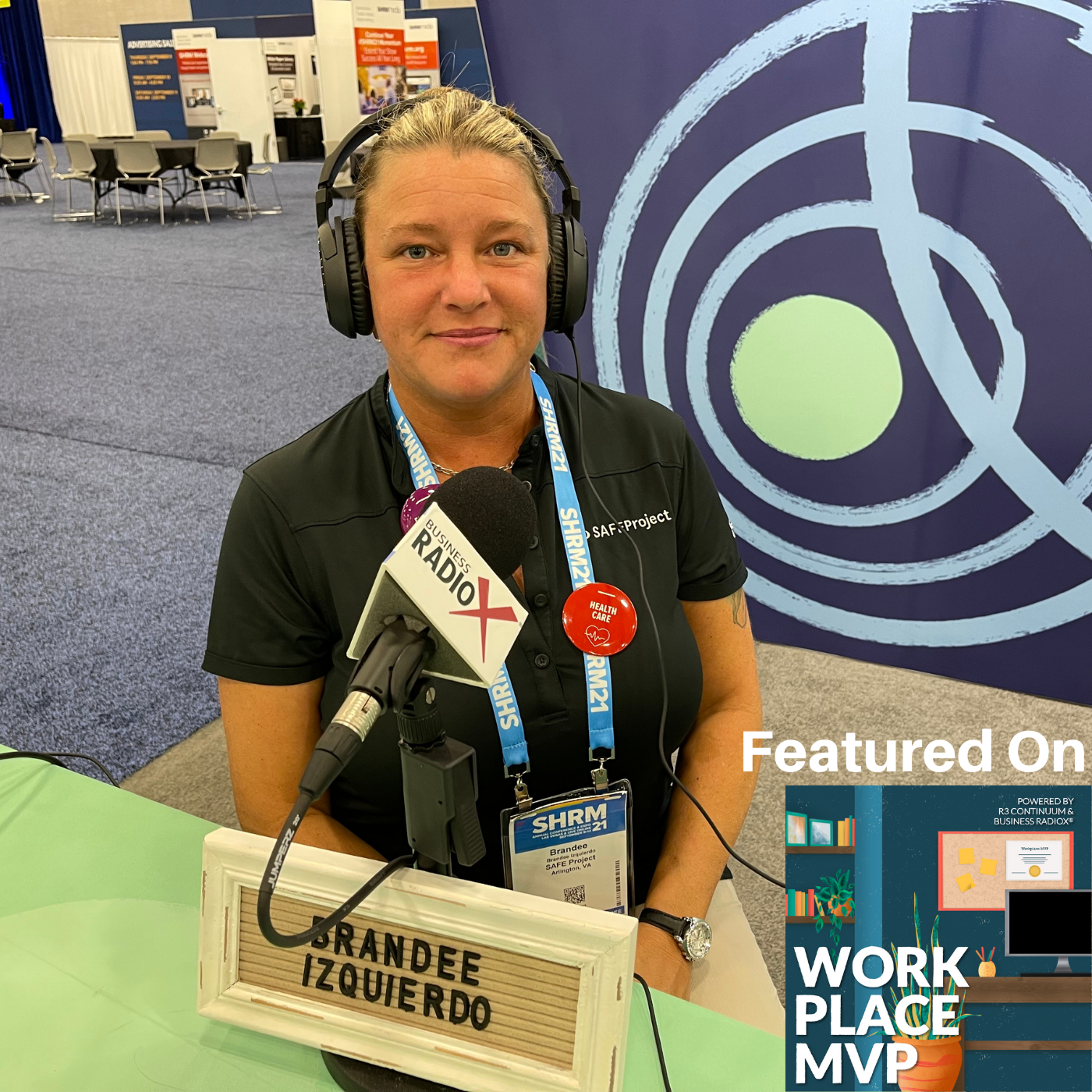
About 10 years ago, Brandee Izquierdo was sitting in a jail cell, struggling with a substance abuse disorder. Brandee joined Workplace MVP host Jamie Gassmann to talk about her long-term recovery, her work at SAFE Project, addiction in the workplace, and how her organization battles the U.S. addiction epidemic.  Workplace MVP is underwritten and presented by R3 Continuum and produced by the Minneapolis-St.Paul Studio of Business RadioX®.

This show was originally broadcast live from the 2021 SHRM Annual Conference held at the Las Vegas Convention Center in Las Vegas, Nevada.

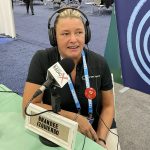
Brandee Izquierdo, Executive Director, SAFE Project

Brandee Izquierdo SAFE Project
Brandee Izquierdo, Executive Director, SAFE Project

Brandee Izquierdo’s drive and determination are built on making an impact within behavioral health, promoting long-term recovery, and ensuring communities are educated and have the tools necessary to combat the addiction epidemic. Before leading the SAFE Project team, Brandee worked for Faces & Voices of Recovery as the Director of Advocacy and Outreach. In addition, she served as the Associate Director of Special Populations with Behavioral Health System Baltimore and as the Director of Consumer Affairs for the state of Maryland’s Behavioral Health Administration. In these leadership roles, Brandee has led advocacy efforts to expand access to behavioral health services and recovery support services while providing technical assistance both nationally and internationally, empowering others within the recovery movement. Her ability to build relationships and bridge gaps within behavioral health, community services, and criminal justice have been a catalyst for global peer expansion.

As a subject matter expert with Center for Social Innovation, Policy Research Associates, SAMHSA, and the International Certification and Reciprocity Consortium (IC&RC), Brandee has made vast contributions within behavioral health and within the recovery movement around public policy, outreach, and workforce development. Additionally, Brandee has made a significant impact within the judicial system, advocating for access to treatment and recovery and is the principal investigator of Maryland’s integrated-Forensic Peer Recovery Specialist curriculum.

Brandee’s passion for service work and knowledge of recovery support services extends beyond behavioral health. With a master’s degree in Public Administration and a bachelor’s degree in Government and Public Policy, Brandee is currently working on her Doctorate in Public Administration with a specialization in Administration Justice.

SAFE Project

SAFE Project was founded in November 2017 by Admiral James and Mary Winnefeld, following the loss of their 19-year old son Jonathan to an accidental opioid overdose. Read more about Jonathan Winnefeld.

The Winnefelds immediately channeled their grief into action, hoping to save more families from the pain of loss. Whether it was seeking treatment, getting answers, or understanding the nature of the disease – they knew there needed to be a different solution to help other families facing the same journey with substance use disorder.

They swiftly built our SAFE Project team of experts who strive for meaningful action through our programs, and lead efforts that are unifying, non-partisan and evidence-based. SAFE seeks meaningful metrics that strengthen our interdependent six lines of operation, and ultimately aim to achieve SAFE Communities, SAFE Campuses, SAFE Workplaces and SAFE Veterans across the nation.

About Workplace MVP

Every day, around the world, organizations of all sizes face disruptive events and situations. Within those workplaces are everyday heroes in human resources, risk management, security, business continuity, and the C-suite. They don’t call themselves heroes though. On the contrary, they simply show up every day, laboring for the well-being of employees in their care, readying the workplace for and planning responses to disruption. This show, Workplace MVP, confers on these heroes the designation they deserve, Workplace MVP (Most Valuable Professionals), and gives them the forum to tell their story. As you hear their experiences, you will learn first-hand, real life approaches to readying the workplace, responses to crisis situations, and overcoming challenges of disruption. Visit our show archive here.

Workplace MVP Host Jamie Gassmann

Jamie Gassmann, Host, “Workplace MVP”

In addition to serving as the host to the Workplace MVP podcast, Jamie Gassmann is the Director of Marketing at R3 Continuum (R3c). Collectively, she has more than fourteen years of marketing experience. Across her tenure, she has experience working in and with various industries including banking, real estate, retail, crisis management, insurance, business continuity, and more. She holds a Bachelor of Science Degree in Mass Communications with special interest in Advertising and Public Relations and a Master of Business Administration from Paseka School of Business, Minnesota State University.

R3 Continuum

R3 Continuum is a global leader in workplace behavioral health and security solutions. R3c helps ensure the psychological and physical safety of organizations and their people in today’s ever-changing and often unpredictable world. Through their continuum of tailored solutions, including evaluations, crisis response, executive optimization, protective services, and more, they help organizations maintain and cultivate a workplace of wellbeing so that their people can thrive. Learn more about R3c at www.r3c.com.

Company website | LinkedIn | Facebook | Twitter

TRANSCRIPT

Intro: [00:00:03] Broadcasting live from the SHRM 2021 Conference at the Las Vegas Convention Center, it’s time for Workplace MVP. Brought to you by R3 Continuum, a global leader in workplace behavioral health, crisis, and security solutions. Now, here’s your host.

Jamie Gassman: [00:00:21] Hey, everyone. Jamie Gassman here, your host of Workplace MVP, broadcasting again from our SHRM 2021 Conference in Las Vegas, Nevada. And with me today I have Brandee Izquierdo.

Brandee Izquierdo: [00:00:34] Very good.

Jamie Gassman: [00:00:35] Did I say that right? All right. And, she is the executive director for Safe Project. Welcome to the show.

Brandee Izquierdo: [00:00:40] Thanks, Jamie. I appreciate it.

Jamie Gassman: [00:00:42] So, tell me a little bit about your career journey and how you kind of came to be as part of Safe Project.

Brandee Izquierdo: [00:00:49] Wow. What a journey it’s been. I’d like to first start by saying I am the executive director of Safe Project. However, I’m also a person in long-term recovery. So, my journey has been, needless to say, it’s been very complex and I think right now, especially with this radio station and the behavioral health component of things, the conversation is extremely timely.

Brandee Izquierdo: [00:01:12] I will tell you from my own personal journey and my own personal perspective, I work in the behavioral health field now, but that is not the trajectory of my career or where I thought it was going to be. During my active addiction stages or days, for example, I worked in the corporate world and, you know, what a timely conversation to have because I found myself, you know, really faced with a lot of challenges in terms of mental health and substance use. And quite often in the workplace environment, we don’t have those conversations as candidly as we need to.

Jamie Gassman: [00:01:46] Yeah. Absolutely. So, from your perspective, those conversations, you know, and we can probably get into that. But, like, how does an employer open up those environments? So, from somebody who’s actually gone through that, what would you’ve wanted at that time from your employer?

Brandee Izquierdo: [00:02:02] Yeah. I think safety, safety first, a safe space to actually have those conversations. I think quite often, especially in the world of human resources, there’s a lot of fear around mental health conversation, substance use conversation. We’re afraid of legal issues, maybe overstepping our bounds. If I would have had some of those conversations early in my career when I was in the corporate world, I may have recognized that I had a problem.

Brandee Izquierdo: [00:02:33] You know, we talk about employee retention. We talk about job performance. We talk about all of that from a business standpoint. But we don’t talk about the why. Why are organizations having a hard time retaining employees? Why are organizations having a difficult time, you know, keeping employees or making sure their own time or their performances is up to par? And a lot of times, if you start to ask that why and create that safe space in a workplace environment, you’re more likely for individuals to come out and say, “Hey, I need help.”

Jamie Gassman: [00:03:10] Yeah. You got to make it comfortable for them to be able to – that they’re not going to be penalized or treated differently, right. Because when you talk a lot about stigma with mental health in the workplace, you know, from your perspective, was that some of what held you back, maybe from talking about it was just that fear as an individual?

Brandee Izquierdo: [00:03:28] Absolutely. I mean, even if you take a look at my family dynamic, for example, you know, there was a lot of substance use in my earlier years and my youth years and I didn’t want to be one of those people. And, it wasn’t until, you know, the disease of addiction is very cunning and baffling.

Brandee Izquierdo: [00:03:45] So, we don’t know what’s going to hit us. And, once it does, you’re in those grips and then you become those people and you perpetuate the stigma and the shame, both internally and externally. So, you’re not as free or feel as free or liberated to actually talk about that.

Brandee Izquierdo: [00:04:02] And, I think from an employer standpoint also, you know, quite often we don’t think it’s our problem. You always hear, especially with the addiction epidemic that’s going on now, we’re losing 93 American – 93,000 Americans, over 250 individuals a day, and we deem it as a public health crisis. But it’s more than that. It is definitely more than that. And, I think corporations and businesses need to invest in their people and in their communities, and this is one way to do it.

Jamie Gassman: [00:04:30] Yeah. Well, [inaudible] a corporate or business level, you know, really, that can be sometimes the first places that you see that. I mean, you hear it with, like, schools and children that’s their outlet and that’s usually where people can see that somebody needs help. You know, if an employer is more open to seeing some of that or has education around the signs, they might be able to help them in being able to give an extension to their employee of help and support that maybe they aren’t able to get that outside of the workplace.

Jamie Gassman: [00:04:59] Absolutely. I mean, we look at America and our work habits. You know, for me, for Safe Project, I really try to build a culture of safe space or a judgment-free zone. We’re with individuals in our workplace for more than eight hours a day. If we say that we typically work 40 hours, we’re probably lying. We’re probably working more than that. So, we’re around other individuals in terms of colleagues, professionals, vendors, you know, just to name a few. So, we really need to understand the signs and symptoms of addiction and invest in our employees rather than just doing away with them because, you know, perhaps that’s a liability. We talk a lot of stuff as far as, “Oh, I care about my employees.” But do you really care about your employees? And if you do, start talking the talk and walking the walk.

Jamie Gassman: [00:05:51] Absolutely. So, Safe Project, tell me a little bit about your nonprofit and the work that you do.

Jamie Gassman: [00:05:55] Sure. So, again, as I mentioned, Safe Project was founded by Admiral Winnefeld and his wife, Sandy, who lost their son to an accidental overdose in 2017, actually on a college campus. So, their heart is in the collegiate space, but more importantly the community space as well.

Brandee Izquierdo: [00:06:13] So, we work with different stakeholders whether it be college campuses, communities, safe workplaces, and safe veterans. So, in working with those different stakeholders, we know that we need to create collaborative partnerships to ensure that we are providing the best resources, education, and knowledge around substance use and mental health challenges that we possibly can throughout the nation.

Brandee Izquierdo: [00:06:38] And that’s what we do. We meet communities and our stakeholders where they are and start to move them in the right direction. I kind of call it the Monty Hall approach, kind of old school. You know, let’s pick door one, two, or three. Door number one, for example, may be something as simple as let’s provide some preventive measures. We’re here with Detarra, for example, as one of our partners in drug disposal bags, in-home drug disposal bags. Or, we may want to go a little bit deeper and say, hey, how can we start developing these initiatives in these programs in your workplaces, not only to encompass a holistic wellness approach but also tackle, you know, the stigma associated with addiction and mental health.

Jamie Gassman: [00:07:19] Yeah. And I’ve heard that from some statistics that, you know, with people being home over this last year, substance abuse, addictions are on the rise because they’re doing it at home and there’s nobody to be able to, kind of, catch some of that stuff. Has your work increased, or what kinds of things have you guys put into place in kind of response to that?

Brandee Izquierdo: [00:07:43] Absolutely. It has increased. We are really taking off. We launched our Safe Workplaces initiative not too long ago, probably about six months ago. It’s been in development for a little bit over a year. But when COVID hit, what we’ve realized is that we need to start communicating with individuals because you can’t compartmentalize. It’s not your daily routine where you go to work, you work in an environment, and then you come home. You can really, you know, move back and forth in the substance use arena as far as your use is concerned and hide it very well.

Brandee Izquierdo: [00:08:17] But there are also a lot of different aspects of mental health. You’re dealing with being a mom, perhaps a teacher, trying to keep your kids together, yourself together, and there’s no clear disconnect when it comes to work and your home environment.

Brandee Izquierdo: [00:08:34] So, we’re seeing a lot in terms of mental health on the rise – people – but I’m also seeing some good stuff too. I’m seeing telehealth coming into play. I’m seeing individual organizations and businesses, really, saying, “Hey, how do we maintain the health and well-being of our employees?” But it’s pretty interesting. We can lead quite often with the mental health side of things. People are a little more accepting of that. They’re not as accepting of the substance use side. So, I think we need to really shine some light on that and that it is happening and it affects everyone.

Jamie Gassman: [00:09:08] Yeah. So, we’re here at SHRM, obviously an HR-focused work conference. If you were going to give advice to these H.R. leaders that are here at this conference from your own personal perspective, what would you want to leave them with?

Brandee Izquierdo: [00:09:22] I think I’d want to leave them with invest in your employees, not only from a work performance perspective but also from a well-being perspective. Start having those conversations and start to build a culture that creates judgment-free safe zones. You know, again, we’re saying that we can’t retain employees. We need to start investing in them as people. We don’t stop at the door and drop our bags off when we’re talking about our problems or issues or challenges in our home life. So, we need to start recognizing that and really just invest in our people and kind of get back to old school, you know. Care.

Jamie Gassman: [00:10:03] Yeah. Just care. Awesome. And creating that environment of safety.

Brandee Izquierdo: [00:10:06] Right.

Jamie Gassman: [00:10:07] Very cool. Well, thank you so much for joining us. If somebody wanted to get in touch with you or get more information about Safe Project and the work that you’re doing, how would they go about doing that?

Brandee Izquierdo: [00:10:16] Sure. They can visit us on our website at www.safeproject.us and I’m all about emailing me directly, which is brandee, B-R-A-N-D-E-E, @safeproject.us.

Jamie Gassman: [00:10:29] Wonderful. Well, thanks again, Brandee, for joining us. Thanks for sharing your story. Thank you for providing an opportunity for H.R. leaders to kind of hear another perspective and also kind of be more aware of ways that they can help support their employees that maybe are dealing with some substance abuse. Thanks for joining us.

Brandee Izquierdo: [00:10:45] Thank you so much for having me. I appreciate it.


Tagged With: addiction, addiction epidemic, addiction in the workplace, addiction recovery, behavioral health, Brandee Izquierdo, employee behavioral health, Jamie Gassmann, Las Vegas, long-term recovery, R3 Continuum, SAFE Project, SHRM 2021, SHRM21

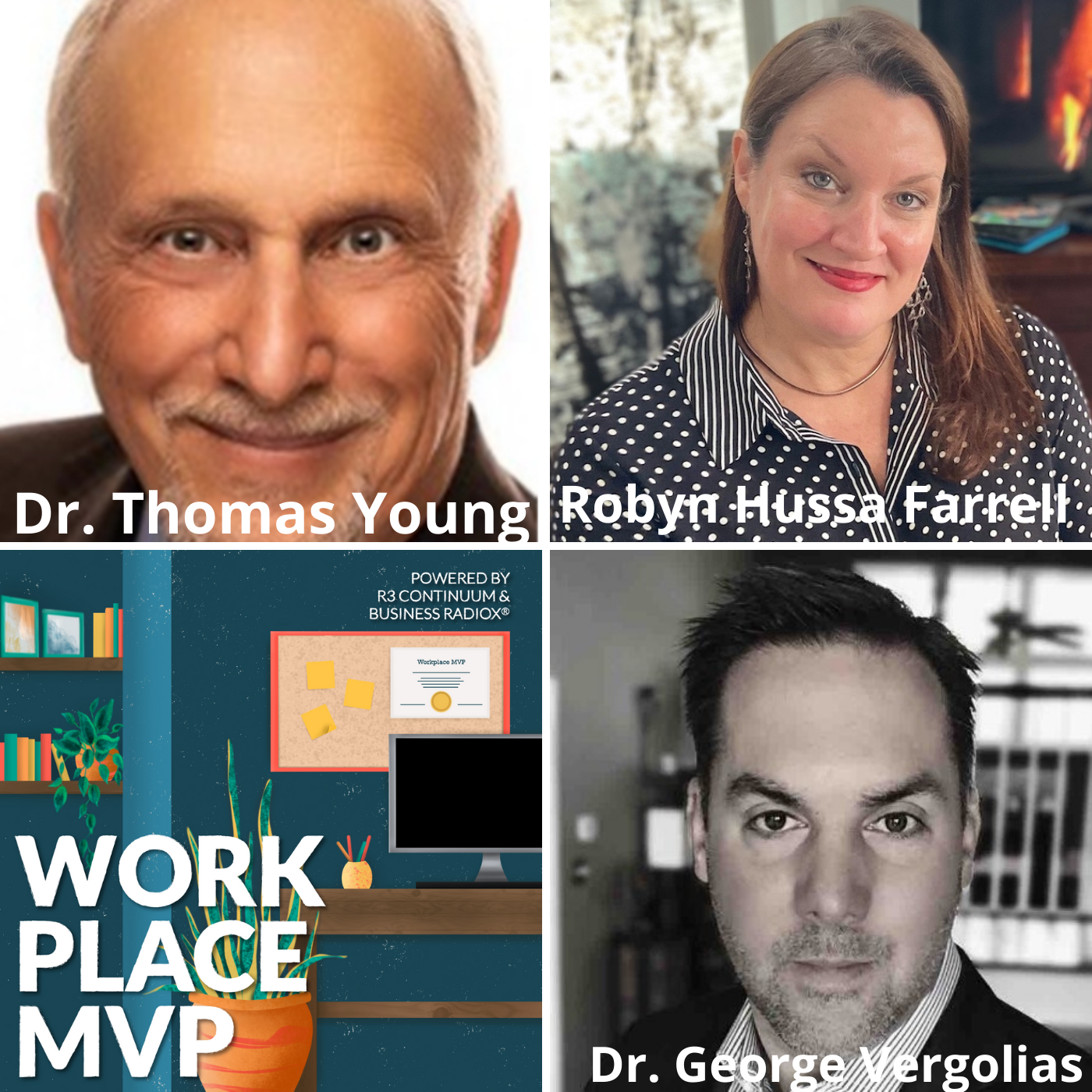
Choosing Resources to Support Employee Behavioral Health, with Dr. Thomas Young, nView, Robyn Hussa Farrell, Sharpen, and Dr. George Vergolias, R3 Continuum

August 12, 2021 by John Ray

Nview
Minneapolis St. Paul Studio
Choosing Resources to Support Employee Behavioral Health, with Dr. Thomas Young, nView, Robyn Hussa Farrell, Sharpen, and Dr. George Vergolias, R3 Continuum
Loading
00:00 /
RSS Feed
Share
Link
Embed

Download file

Nview

Workplace MVP:  Choosing Resources to Support Employee Behavioral Health, with Dr. Thomas Young, nView, Robyn Hussa Farrell, Sharpen, and Dr. George Vergolias, R3 Continuum

With all the newly developed approaches, resources, and tools that employers can access to support employee behavioral health, how does one decide on which to use? It’s a high stakes question which many employers are struggling to solve. Host Jamie Gassmann explores answers with three outstanding professionals:  Dr. Thomas Young of nView, Robyn Hussa Farrell with Sharpen Minds, and Dr. George Vergolias, R3 Continuum. Workplace MVP is underwritten and presented by R3 Continuum and produced by the Minneapolis-St.Paul Studio of Business RadioX®.

nView

nView is a team of doctors, scientists, authors, technologists, parents, families, survivors – passionately focused on mental illness and how it’s perceived, assessed, diagnosed, and treated.  They are activists, advocates, business leaders, and disruptors who are determined to alter a status quo that is failing by any statistical measure.

They are realists who know change is difficult, and also dreamers who understand change is necessary.  They categorically refuse to go quietly into that good night, and they are hopeful for meaningful dialogue and change. They are committed to doing better, being better, driving big changes in the perceptions of and treatments for mental health.

Cited in thousands of FDA-approved studies and clinical trials, nView empowers healthcare professionals, educators and researchers with software solutions that allow them to more accurately and efficiently identify, diagnose, and monitor these individuals who need behavioral health assistance.

They uniquely do this through evidence-based solutions that have been referenced or validated in more than 17,000 studies and used by physicians all over the globe for the past 25+ years.

Thomas R. Young, MD is a board certified family physician with more than 35 years of medical experience. He is recognized as an innovator and thought leader in the fields of Consumer Directed Health Care and Population Healthcare Management.

Company website

Dr. Thomas Young, Chief Medical Officer & Founder, nView

nView
Dr. Thomas Young, Founder and CMO, nView

Dr. Young served for six years as the Medical Director of Idaho Medicaid and has remained active in the formation of medical and mental health policy for the state of Idaho. Dr. Young was also Chief Clinical / Medical Officer of Idaho Medicare QIO Qualis Health.

Previously, Dr. Young served as Executive Vice President and Chief Medical Officer at Connextions Health, a Florida-based healthcare technology company that was acquired by Optum Health, a division of United HealthGroup.

Dr. Young also served as President of Behavioral Imaging Solutions, a technology firm recognized for its application of video imaging for the treatment of children with autism. Most recently, he served as Chief Operating Officer at US Preventive Medicine, a health technology leader in Population Health Management.

He is also a successful entrepreneur. His businesses ventures include Diversified Franchises, LLC which owns a chain of specialty restaurants, a home health business, and Elite Sports Society, a successful sports marketing business where he serves as the business development officer.

LinkedIn

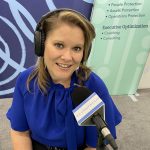
Robyn Hussa Farrell, MFA, E-RYT, Founder and CEO, Sharpen

Robyn Hussa Farrell, MFA, E-RYT, Founder and CEO, Sharpen

Robyn Hussa Farrell, MFA, E-RYT, Founder and Chief Executive Officer for Sharpen, extends knowledge in building large-scale initiatives to listen closely to the stakeholders, individuals with lived experience and clinicians to ensure all voices have been incorporated into prevention of mental illness and substance use disorders. For nearly two decades, Robyn has been building collaborative relationships between state agencies, educational systems, public health, and researchers across the U.S. to increase connectedness and primary prevention for communities.

Hussa’s tiered model for teaching mental health, population health, and prevention in schools has been published in peer-reviewed medical journals. She has built mindfulness-based stress reduction initiatives that incorporate trauma-informed Resilient Schools frameworks in the state of South Carolina. Robyn served as an advisory committee member for Way to Wellville/Rethink Health Community Engagement and Listening Campaign and served as SC Youth Suicide Prevention Spartanburg County coordinator through the SC Department of Mental Health Office of Suicide Prevention. She founded four companies, first an award-winning NYC theatre company, Transport Group, which earned the prestigious Drama Desk award its first 7 years of operation and celebrates its 20th anniversary.  Robyn and her husband Tim met as award-winning artists in NYC almost 30 years ago and have directed over 3,000 films, live events and educational programs through Sharpen and their production company, White Elephant Enterprises.

LinkedIn

Sharpen

Healthy communities are made up of healthy individuals. Sharpen provides a cost-effective and flexible platform that: Provides easy access to research-based, standards-aligned, and award-winning content for mental wellness, enhances, extends, and expands the reach of therapists or counselors. connects and coordinates local and regional community resources, provides data to improve resource utilization, and builds individual, family, and community capacity, competence, and confidence to navigate successfully in these uncertain times and in the future.

IMPACT:
– 15 years research
– Suicide prevention focus
– Trauma-informed
– Self-guided CBT available 24 hours a day
– Evidence-based
– Highly customizable
– 200+ experts in 450 modules

Company website| LinkedIn |Facebook | Twitter

Dr. George Vergolias, Vice President and Medical Director, R3 Continuum

Dr. George Vergolias, Medical Director, R3 Continuum

George Vergolias, PsyD, LP is a forensic psychologist and threat management expert serving as Vice President and Medical Director for the R3 Continuum. As part of his role of Vice President and Medical Director of R3 Continuum, he leads their Threat of violence and workplace violence programs. Dr. Vergolias is also the founder and President of TelePsych Supports, a tele-mental health company providing involuntary commitment and crisis risk evaluations for hospitals and emergency departments. He has over 20 years of forensic experience with expertise in the following areas: violence risk and threat management, psychological dynamics of stalking, sexual offending, emotional trauma, civil and involuntary commitment, suicide and self-harm, occupational disability, law enforcement consultation, expert witness testimony, and tele-mental health. Dr. Vergolias has directly assessed or managed over one thousand cases related to elevated risk for violence or self-harm, sexual assault, stalking, and communicated threats. He has consulted with regional, state, and federal law enforcement agencies, including the FBI, Secret Service, and Bureau of Prisons. He has worked for and consulted with Fortune 500 companies, major insurance carriers, government agencies, and large healthcare systems on issues related to work absence management, workplace violence, medical necessity reviews, and expert witness consultation.

LinkedIn

R3 Continuum

R3 Continuum is a global leader in workplace behavioral health and security solutions. R3c helps ensure the psychological and physical safety of organizations and their people in today’s ever-changing and often unpredictable world. Through their continuum of tailored solutions, including evaluations, crisis response, executive optimization, protective services, and more, they help organizations maintain and cultivate a workplace of wellbeing so that their people can thrive. Learn more about R3c at www.r3c.com.

Company website | LinkedIn | Facebook | Twitter

About Workplace MVP

Every day, around the world, organizations of all sizes face disruptive events and situations. Within those workplaces are everyday heroes in human resources, risk management, security, business continuity, and the C-suite. They don’t call themselves heroes though. On the contrary, they simply show up every day, laboring for the well-being of employees in their care, readying the workplace for and planning responses to disruption. This show, Workplace MVP, confers on these heroes the designation they deserve, Workplace MVP (Most Valuable Professionals), and gives them the forum to tell their story. As you hear their experiences, you will learn first-hand, real life approaches to readying the workplace, responses to crisis situations, and overcoming challenges of disruption. Visit our show archive here.

Workplace MVP Host Jamie Gassmann

In addition to serving as the host to the Workplace MVP podcast, Jamie Gassmann is the Director of Marketing at R3 Continuum (R3c). Collectively, she has more than fourteen years of marketing experience. Across her tenure, she has experience working in and with various industries including banking, real estate, retail, crisis management, insurance, business continuity, and more. She holds a Bachelor of Science Degree in Mass Communications with special interest in Advertising and Public Relations and a Master of Business Administration from Paseka School of Business, Minnesota State University.

TRANSCRIPT

Intro: [00:00:04] Broadcasting from the Business RadioX Studios, it’s time for Workplace MVP. Workplace MVP is brought to you by R3 Continuum, a global leader in workplace behavioral health and security solutions. Now, here’s your host, Jamie Gassmann.

Jamie Gassmann: [00:00:24] Hi, everyone. Your host, Jamie Gassmann here, and welcome to this episode of Workplace MVP. Employee behavioral health has been a growing focus for employers over the years. And looking at the last year-and-a-half with the global pandemic, this focus has become even clearer and the need to take action even more prominent. For years, employers have leaned on the support and resources made available through more traditional methods. Now, along with the increasing focus, comes a new set of approaches, resources, and tools that employers can leverage in expanding the support they offer to their employees.

Jamie Gassmann: [00:01:00] Knowing which to choose in offering additional support to employees can be overwhelming. Do I go with the new app? Do I go with the new service, resource? And the list goes on. How can one choose the most effective approach in offering support services for their employees?

Jamie Gassmann: [00:01:17] Well, today, to help shed some light on how employers can approach making a decision on choosing the most appropriate support tools and resources for their employee’s behavioral health are three amazing MVPs: Dr. Tom Young, Chief Medical Officer and Founder of nView; Robyn Hussa Farrell, CEO and Cofounder of SharpenMinds; and Dr. George Vergolias, Medical Director for R3 Continuum. Welcome, everyone, to the show. So, our first workplace MVP is Dr. Tom Young, Chief Medical Officer and Founder of nView. Welcome, Dr. Tom Young.

Tom Young: [00:01:55] Good morning. Glad to be here.

Jamie Gassmann: [00:01:58] So, let’s start off with you telling us a little bit about yourself and your company, nView.

Tom Young: [00:02:04] Sure. Thank you, Jamie. My background is in family medicine. I started out in family medicine many years ago. And have evolved my practice life over the years to behavioral health. The last 20 years, I’ve been in the behavioral health space seeing the need for improved tools and improved methodologies, particularly for primary care doctors. I practiced everywhere, from small rural towns where I was the only doctor for a thousand square miles, to city-based areas, and seeing the need.

Tom Young: [00:02:43] And so, that’s kind of how nView began to evolve, back in early 2016, running across some tools that were out there, but finding a better way to get those in the marketplace, to get those to primary care doctors. But, basically, to help and begin to help in the battle, if you will, that we have in this country and have had for years around mental health issues.

Jamie Gassmann: [00:03:12] So, your company, nView, has won several awards. Talk to me about how you’ve won those awards. What were some of them focused on?

Tom Young: [00:03:21] Yes, we have, and we’ve been very proud of that. We started out our sort of journey, if you will, in the mental health space, in the pure research space. Our tools have been used around the world over the past 25 plus years, particularly in pharmaceutical research trials, large clinical trials, multinational clinical trials. Our tools have become available in about 160 languages. So, from that pure research base, I started looking for more digitally acceptable ways to bring them into the common space, if you will, of health care. So, some of the awards have been just sort of about creativity and changing something that’s very staid and tried and true in the research space, and making it a little bit more usable in the digital health space for providers. Trying to take some of those things and then gradually move them into partnerships with other groups to be able to make them more patient friendly, if you will, more engaging.

Tom Young: [00:04:27] I think one of the keys for us in getting there is really finding a space in the world of behavioral health as it’s evolved to being the key to doing, what I call, opening the door. We’ve become the way you put your hand on the doorknob if you’re a patient, the way to open up something to begin to get some information, whether that’s information about children in your family. So, that’s some of the things that we’ve evolved to and that’s where some of the awards have come from is kind of fun ways to start to look at new ways to do things.

Jamie Gassmann: [00:05:05] And part of that is some of the screening and the assessment tools, you’ve mentioned them already, that your organization offers. Can you share with us a little bit information around what those assessment tools are that you have available and how are they different than other tools that might be out there?

Tom Young: [00:05:23] That’s a great question. Really, I think one of the things about our tools is the ease of use of most of them and the fact that they differ significantly. The big difference is, most screening tools that people are used to, both providers and patients, are tools that really screen for a specific set of symptoms. I’ll give you a tool that helps screen for depression. I’ll give you another tool that helps you screen if you’ve got anxiety. So, the trick is, if you’re the patient, all you have to know is what’s wrong with you and then you can pick the right screening tool, which is sort of a perverse way of getting in the system, if you will.

Tom Young: [00:06:02] So, our tools focus on generally helping people discover what type of disorder they might be involved with. If it’s your child, it’s the ability for a parent to understand is their son or daughter depressed or are they anxious. Are they showing tendencies towards bipolar disease? Do they have ADHD? Some of the things that concern parents. Rather than saying, “Okay. Yes. You have some of the symptoms of depression. Thank you.” So, our tools are based in that world, if you will, of being more specific. Providing the average physician, pediatrician, nurse practitioner, the ability to understand, not just that the patient has symptoms of depression, but that they may well have major depressive disorder or they may well be bipolar, and thereby speeding the process for getting the right diagnosis to people.

Jamie Gassmann: [00:06:59] Great. And so, talking about it from the hospital sense and maybe a practitioner using these tools, how would an employer be able to leverage these assessment tools in helping the overall wellbeing of their organization or their employees?

Tom Young: [00:07:13] Well, I think that’s where the employer uses my term called opening the door. If I’m an employer, what I want to offer my employees is the ability to get information, to get highly validated, quality information, to be able to make their own decisions. If I’m a parent – again, as a good example and I’m concerned about my child – and my employer has offered me some tools that I can go to, I can begin to understand where I need to go. And by offering a simple assessment tool, the employer is saying to the employee in one way, “I care about your mental health. Let’s talk about your mental health. Let’s get this on the table.” We, together, the employer and employee, understand that there are problems.

Tom Young: [00:08:05] So, it’s that door opening kind of technology, if you will. It doesn’t have to make all the diagnoses and do all the treatment. It has to get you started on that mental health journey, if you will, or behavioral health improvement journey. So, that’s, I think, what employers can do.

Jamie Gassmann: [00:08:23] It almost empowers their employee to be a little bit more kind of informed about what they might be feeling. Would that be a correct kind of assessment?

Tom Young: [00:08:33] Absolutely. I think that’s the key element, is, giving them opportunity to become more informed. And one of the terms I use, particularly with families, is that, often, a family will choose a child to be sort of the point person in the family. And so, one of the things I used when I was working actively in the pediatric space was telling parents that, “Well, children are very often explorers into the wonderful world of psychotherapy for their families.”

Tom Young: [00:09:05] So, very often, the first person through the door that brings the family with them is a child. So, employers then are empowering a family. And so, from the employer base, if I can make the family stronger, I have a stronger employee, I have a more valuable employee, I have a more focused employee. So, providing tools not just to the employee themselves, but to the family, I think, are really key items.

Jamie Gassmann: [00:09:35] And looking at society and you’ve mentioned this a couple of times already in some of your responses, there’s a lot of focus on depression and anxiety. But why is it important to screen employees for mental health disorders beyond depression and anxiety?

Tom Young: [00:09:49] Well, there are many other disorders which mimic anxiety and which mimic depression. But a perfect example if somebody is obsessed with a simple tool and says, “Well, you have depression, so let’s treat you for depression.” That’s fine if that’s what you have. But if what you have is bipolar disease, or what you have is PTSD with depressive symptomatology, or if you have some psychotic features to your depression, simple treatment is going to sometimes make it worse. So, the real key is getting a more specific diagnostic nomenclature to the discussion.

Tom Young: [00:10:27] So, if somebody, for example, an adolescent, may appear quite depressed, but the underlying disorder may be an eating disorder. A child or an adult may look anxious, but the underlying disorder may be a specific phobia. An adult may look anxious, but may have underlying OCD, which a certain portion of the population has. So, getting the correct diagnostic understanding at the beginning shortens the process and improves the outcome for the individual patient, as well as for the employer who gets back to their employee in a much more rapid fashion, if you will.

Jamie Gassmann: [00:11:14] Great. And I know we have more questions to kind of focus around this, but for right now, if somebody wanted to connect with you, how would they go about doing that?

Tom Young: [00:11:23] Well, nView has a website, nview.com, N-V-I-E-W.com, you can reach me that way. Through there, we have a phone number, you can call me. When the phone rings, I answer. I’m happy to talk to people. So, either by email or off the website is the phone number, and certainly happy to touch base with people at any point in time.

Jamie Gassmann: [00:11:48] Great. And so, we’ll be bringing you back in for the group conversation later. For right now, I want to move to our next Workplace MVP, who’s returning to our show for a second time, Robyn Hussa Farrell, CEO and Cofounder of SharpenMinds. Welcome back to the show, Robyn.

Robyn Hussa Farrell: [00:12:06] Thank you so much, Jamie. It’s great to be here.

Jamie Gassmann: [00:12:09] So, give our audience a quick refresher on your career journey and kind of some background around how you moved through your career and what led to creating SharpenMinds.

Robyn Hussa Farrell: [00:12:20] Yeah. My career began really bringing a live health education program into schools. So, I was really looking at disordered eating prevention and the comorbidities thereof. And the avenue into reaching a lot of individuals and families was through a high quality arts intervention. So, I looped all the clinicians and the researchers to that program and connected over 4,000 kids appropriately to care. During that process, we surveyed over 80,000 participants over the course of four years. And we kind of came up with 160 most commonly asked questions. So, that also led us to kind of developing the 50 risk factors that we’re seeing in schools.

Robyn Hussa Farrell: [00:13:10] And so, it was through that, a lot of learning, a lot of listening campaigns, that my husband and I picked up a camera and we started seeking out the answers to those questions. Really finding the top scientists around the country. And to date, we have captured over 3,000 videos and over 500 evidence based psycho educational modules that we deploy through Sharpen, which is our turnkey service.

Jamie Gassmann: [00:13:40] Great. And when you were on our show earlier this year, we discussed how things, like stress and anxiety, have been increasingly affecting employees mental health. So, since then, have you seen any major changes in overall employee mental health?

Robyn Hussa Farrell: [00:13:53] Oh, yeah, for sure. So, in fact, we have been doing a lot of listening with CHRO executives and what we know, they’ve said many different things to us that they’re seeing this year. But in particular, one quote that kind of stands out in my mind they’ve said, “If you’re just sending employees to a 1-800 number, that’s like Russian Roulette.” So, they’ve been requesting a lot of nonclinical on demand services. They’ve been telling us that employees need to be able to talk to someone immediately, and in a safe and identified environment. They’re desperate to learn how to normalize the conversation around mental health and decrease that stigma, like Dr. Young was just talking about. So, I think there’s a lot of worry in some that’s happening at the employee level and at the employer level. And we’re excited, actually, that we have all this research and data to be able to support them.

Jamie Gassmann: [00:14:53] And from your perspective, you know, I know you’ve kind of mentioned that they’re starting to look for more options to support those employees, but have you seen changes in how employers are responding to the growing need for behavioral health support?

Robyn Hussa Farrell: [00:15:12] Yeah, Jamie. So, I think what they’re finding, there’s a couple of things going on, and Dr. Young addressed it earlier. Number one, that traditional EAP model, they’re noticing that really isn’t working. It’s not enough. We know we need a comprehensive solution. They need more supplemental customizable services that sort of help with that destigmatization piece and normalizing the conversation around mental health.

Robyn Hussa Farrell: [00:15:39] I think, also, from what I’ve heard in the listening campaigns that CHROs really feel like they’re starting at the ground level having to figure out the mental health space. And so, what I always say is, there are so many experts who’ve been navigating this space for decades and established those best practices, like Dr. Vergolias and Dr. Young and the companies that they have founded, that it’s really essential that, I think, those employers and employer groups really start connecting with those best practice frameworks.

Jamie Gassmann: [00:16:15] And so, there’s many different ways to support the behavioral health of employees, from traditional methods to more nontraditional or even alternative approaches. In your opinion, how would you say they compare for an employer looking at all of these different approaches? What are the comparatives?

Robyn Hussa Farrell: [00:16:34] Yeah. So, what we know is the EAP service, I don’t think it was really designed as an ongoing feature. It was really kind of a supplement to the traditional health insurance model. So, I don’t think it was intended to have utilization on this large of a scale, which, of course, we’ve seen increase with COVID. Fewer than five percent of employees actually engage with their EAP service. What we learned through our listening campaigns is, often, employees don’t even know it exists or they don’t know what it is so why would I ever call it. So, I think that H.R. executives are finding that they are having to be that mental health navigator in the moment, either of a crisis or, like Dr. Young was talking about, when a family member is in crisis. And so, we just need to enhance the system pretty much all together.

Robyn Hussa Farrell: [00:17:25] And so, from my perspective, what is needed is ongoing mental health literacy training, the social emotional skills development, and the ongoing sort of resiliency builders, they meet every employee, every employer, but also every family member where they are. And it kind of helps normalize that conversation around mental health.

Jamie Gassmann: [00:17:47] So, can an employer have one versus the other? Or is there true power in more of a comprehensive, multifaceted offering to employees?

Robyn Hussa Farrell: [00:17:59] Yeah. I’m biased, obviously, because I offer a comprehensive solution with partners like nView and R3C. And so, why I say that is specifically because there are experts, specialists, and researchers who’ve been finding these outcomes over the course of four decades. What we want to do is plug in to those experts and make it a seamless one stop sort of experience. And so, that is what’s required right now. It’s fabulous to have a mindfulness app. It’s fabulous to just take a screening. It’s fabulous to have evidence-based crisis intervention or postvention. What you want is the whole wheel of support so that at any step along the way, you can identify someone who’s struggling, get them connected to care, help them in between visits, and keep that wheel going.

Jamie Gassmann: [00:18:56] Like, a full continuum of supports. Wonderful. If someone wanted to connect with you, how can they go about doing that?

Robyn Hussa Farrell: [00:19:04] Yeah. We’re sharpenminds.com. You can learn more all about our services and reach out to us directly there.

Jamie Gassmann: [00:19:10] Great. And so, moving to our next Workplace MVP, it’s another returning MVP to our show, is our guest, Dr. George Vergolias, Medical Director for our show sponsor, R3 Continuum. Good to have you back to the show, George.

George Vergolias: [00:19:26] Great to be here, Jamie. My pleasure.

Jamie Gassmann: [00:19:28] So, let’s start off with you giving our listeners a refresher on your career journey.

George Vergolias: [00:19:34] Certainly. So, I actually began in engineering in college, believe it or not. And then, went into philosophy and then realized I wouldn’t have a job other than working as a teacher. That led me into psychology. And then, I kind of pursued the ranks of clinical psychology and just kind of fell into a postdoc in forensic psychology. I won’t bore you with all the details there, but really just fell in love with it and fell in love with it after my doctoral degree. That’s when I kind of found my love for forensic work is after I got a concentration in neuropsychology. So, there’s hope for people that are in their doctoral programs and still don’t know what they want to be when they grow up. So, that’s good news for folks out there.

George Vergolias: [00:20:16] Early career, I did a lot of court based testimony, diminished capacity, not guilty, by reason of insanity. I did a lot of threat assessments for child and family services, the Department of Corrections, and so on. And that kind of led into kind of a general expertise in violence and violence risk assessment. And then, along the way, this was around just a year or two after Columbine, so I’m dating myself here. And what happened around that time is, if you were in forensic psychology and ever dealt with violence risk at all, you suddenly were the expert on school violence because there really wasn’t an expertise back then. And you just had to learn it quickly and dive in because there wasn’t anyone to fill that gap.

George Vergolias: [00:21:00] I happened to be working at a juvenile detention center and we did see a lot of would be school threateners and a lot of would be school shooters come through the system over a number of years. And so, I developed a proficiency and a specialty in that. And then, naturally, what happened a few years later is, local corporations – I live in Raleigh, North Carolina. We have a big kind of East Coast technology hub at Research Triangle Park – began to reach out to me and say, “Hey, we’ve got a guy or a woman -” usually, overwhelmingly men, but occasionally a woman “- who’s making a threat. And we don’t know what to do. And someone said to call you.”

George Vergolias: [00:21:36] And that kind of led me into the corporate space of understanding workplace violence and the impact of workplace culture and management and other variables that contribute to both effective workplace violence as well as, what we tend to hear about more often, predatory or targeted workplace violence. And I’ve been in that space now for 17 plus years.

George Vergolias: [00:22:00] In addition to that, I’ve continued to maintain a private practice going on 19 years now, where I have a group of doctors that work exclusively in emergency departments. And we do crisis evaluations and involuntary commitment evaluations that we deal with people at their most vulnerable coming into the emergency departments. And we try to figure out, do they need to be in the hospital? Can they be safely diverted home or to community resources?

George Vergolias: [00:22:26] So, those kind of bookended kind of my career in a way that provided me a really sound clinical basis around, not only the threat space and behaviors of concern, but the flip side of that – and this is relevant to what Tom and Robyn are talking about – resilience. Because what we know is people that are resilient and have high levels of emotional intelligence and are functioning well are almost immune – I’m never going to say it fully, 100 percent. I never say that in my field – but they’re almost fully immune to going on a shooting spree. The Dalai Lama is not going to go on a shooting spree. Why? Because he’s managing his emotional relationship life in a way that that is not a viable solution to his problems, among many other, more prosocial, proactive, appropriate ways of managing.

George Vergolias: [00:23:19] So, that led me into also needing to understand the world of resilience and the world of more adaptive functioning as a buffer to violence risk. And then, I joined R3 about ten years ago. And in that time, we have expanded our Disrupted Event Management program. We’ve expanded our Fitness for Duty program. I developed a specialized Fitness for Duty evaluation called the Fitness for Duty with the Violence Screen, which identifies people that are struggling at work with hostility and anger management issues. And that has kind of brought me to today.

Jamie Gassmann: [00:23:54] Great. And so, from the work that R3 Continuum does, and you mentioned a few of the different service outlets that they provide, I mean, you obviously see all varieties of workplace impact from either a death of a coworker, workplace violence, pandemic stress. Based on the cases that you’ve seen and worked, what is the common impact on employees that you’re seeing from the challenges and stressors faced over the last year-and-a-half?

George Vergolias: [00:24:22] Yeah. It’s a great question, Jamie. There’s a lot of individual variables, to be sure. But we’re clearly seeing patterns. And the patterns are consistent with what the data is coming out of CDC, Department of Health, Johns Hopkins, among other places. Clearly, we’re seeing an uptick in anxiety. We know that during the pandemic, anxiety has been up fourfold. We also know depression, depressive symptoms, has been up roughly threefold.

George Vergolias: [00:24:47] We are seeing an uptick in suicidal ideation. But, interestingly, we’re not necessarily seeing an uptick in suicide attempts. That’s kind of an interesting dynamic that I still think, across the field, we’re unpacking a little bit and trying to understand that. Typically, a suicidal ideation goes up, attempts go up. So, it’s kind of an interesting variable that we’re seeing there.

George Vergolias: [00:25:06] Stress in general is also going up. All of that, I think, is expected given the nature of the pandemic, how disruptive it has been in all of our lives. But there’s been this kind of bimodal or opposite effect I’ve seen where people are simultaneously – well, it’s changing a bit now. But you go back a year ago, many people, many workers were simultaneously disconnected and reconnected at the same time.

George Vergolias: [00:25:36] The disconnection was all the ancillary, more superficial, but still very meaningful connections we had in our day-to-day life. Bumping into that person at Starbucks every morning. Going to your kid’s little league and talking with the other parents. Bumping into people at the grocery store that you would actually stop and talk to you or give a hug to. Coworkers in the office, stopping at the water cooler, having a lunch at the breakroom, going out to lunch.

George Vergolias: [00:26:04] All of those things came to a pretty abrupt stop in early 2020. And we lost that immediately. And I think for most people, including myself, who’s been doing this almost all my adult life, I grossly underestimated the positive impact those small connections make. I call those emotional strokes. Those small emotional strokes every day when they’re ripped away from us.

Intro: [00:26:28] At the same time, for many of us – not all of us – what it did is, it forced us to go very, very local. So, after a couple of months of struggling in the soup, in the thickness of it, what started happening – at least in my neighborhood, and I heard this about others – as people started having fire pits, and they started getting together in the driveways, and they started reconnecting with neighbors in a way that the manic lifestyle previous to the pandemic just didn’t allow us to do. And so, it was kind of this weird thing of disconnecting with something that’s very powerful. But also for many – not all of us – reconnecting.

George Vergolias: [00:27:06] What we have found at R3, both internally and externally, with many workers is perhaps one of the hardest hit groups, were those groups that were typically younger, unmarried, and living in apartments. They didn’t have the neighborhoods necessarily where they could go to someone’s driveway and bring lawn chairs and socially distance. They were literally just stuck in their apartment and they didn’t necessarily have that kind of engagement. So, we saw it across the age span, but we tended to see that really negatively impacting those younger groups, the 20s and young 30s, a little more intensively. But I would say those were some of the big trends that we saw in our work and even internally amongst our own employees.

Jamie Gassmann: [00:27:53] So, for an employer, when they’re looking at supporting their employee mental health, particularly since there is so many different individual variables that can impact it, what is one thing that you would say they need to make sure they’re considering that someone might be missing right now as they’re looking at different programs or ways to support their employees?

George Vergolias: [00:28:14] So, there’s a lot of talk, Robyn made a great point, about understanding and awareness. There’s a lot of talk about communication. And these are the ones that are kind of out there. The one I don’t hear as much that I would pick – if you’re going to force me to be on an island, Jamie, and pick one, which is a great question. It really makes me think – I would say this, model strength in vulnerability. Everybody this last year has fallen.

George Vergolias: [00:28:41] And, again, get off social media, because, again, what we tend to do with social media is reviewing other people’s highlight reels when we have our behind the scenes reel that we’re comparing our behind the scenes reel to their highlight reel.

George Vergolias: [00:28:52] But model strength and vulnerability, as a leader do that as well. It doesn’t mean we break down totally. It doesn’t mean we lose control. But it does two things. It gives our people – I’m going to use that more generally term here – permission to feel whatever they need to feel during this process. And as we go into the upswing of the Delta variant and how they’re talking about a possible Lambda variant down the road, this continues to be a valid thing. But it gives people the permission, if you will, the validation to say, “Yeah. You can stumble. You could fall down. That’s okay.” Because we’re all going to do that at different times.

George Vergolias: [00:29:31] But what it also does by modeling that you have done that as a leader and then you’ve gotten back up, it also models what resilience is about. Resilience is about never faltering. Resilience is about when you falter, you’re able to work through that, learn from it, and grow better from it.

George Vergolias: [00:29:48] I always think of the image of a lobster. I saw a talk years ago where a rabbi was talking about how does a lobster grow. And a lobster grows by constantly pushing against its shell until it literally breaks out of its shell. And then, it grows bigger and it forms a new shell. And then, it grows bigger and breaks out of that shell. When you look at resilience through the lifespan – by the way, breaking of the shell isn’t easy. It’s a tough process. It’s painful. But when we do that through the life span, we’re not always getting better on a linear trajectory. But over the aggregate, we’re constantly improving and getting stronger in terms of our sense of emotional functioning and resilience. I would say model that in a way that gives your employees a sense of hope and motivation.

Jamie Gassmann: [00:30:35] So, are there support tools, or resources, or approaches aside from showing that vulnerability that they can use to help support their employees as they’re showing that vulnerability? Maybe it’s, “I use this service too.” Can they promote it? What are some approaches that they can use that help their employees to get that support that they need?

George Vergolias: [00:31:00] Sure. And I’m going to start with something that’s going to sound tremendously self-serving, but I mean it authentically, and that is, you need to understand the problem. If you don’t understand what’s going on with your people, you’re going to be just throwing things at the wall and some might stick, but many won’t. So, you need to screen the problem and understand the nature of it. And that’s where Tom and his group with nView are instrumental in terms of the kinds of surveys, and questionnaires, and tools that they have available to help understand that.

George Vergolias: [00:31:30] From there, you also need resources that can help deepen awareness, educate people, and guide them in the right direction towards either whatever self-help structures they need. Or, in some cases, if they need guidance to more formal clinical services. And, again, that’s where Robyn and SharpenMinds comes in. So, I know that sounds very self-serving, but again, we wouldn’t be partnering with these groups if we didn’t have that kind of fully-round full support that we all provide together in a way that enhances all that we’re bringing to the table.

George Vergolias: [00:32:02] In addition, I would say you need clear communication strategies. So, people feel able to come forward with the concerns that they have, but also feel able to give feedback to leadership about what’s working and what isn’t. And then, we all need a sense of humility. And leaders, it’s so hard when you roll out a big program. It’s really hard a year later to look in the mirror and say, “That isn’t working.” r “Parts of it aren’t working.” And we need to reshape it so that it works. And I think that’s where that humility comes in to constantly reassess our tools and redesign what is working and what isn’t working.

George Vergolias: [00:32:40] What I love about, in particular both these groups, SharpenMinds and nView, is – you know the old saying, if all you have is a hammer, every problem is a nail – both of these groups have a full toolbox of solutions that they bring to the table. I also think that – I think we’re going to get to this maybe later – leveraging apps in the right way can be very useful. I’ll leave that as a teaser because I think we might be touching on that later on.

Jamie Gassmann: [00:33:10] Awesome. And so, if somebody wanted to get in touch with you, how could they go about doing that?

George Vergolias: [00:33:15] The best way to reach me is if you go to our website, obviously, www.r3c -that’s the letter R-the number 3-the letter C.com, and you could just search under our profiles and about, George Vergolias, Medical Director. I’m quite easy to find. And both my number and my email are located in there.

Jamie Gassmann: [00:33:38] Perfect. So, now, we’re going to have a word from our sponsor. Workplace MVP is sponsored by R3 Continuum. R3 Continuum is a global leader in providing expert, reliable, responsive, and tailored behavioral health, crisis, and security solutions to promote workplace wellbeing and performance in the face of an ever changing and often unpredictable world. Learn more about how our R3 Continuum can tailor a solution for your organization’s unique challenges by visiting r3c.com today.

Jamie Gassmann: [00:34:10] So, now, we’re going to come to a group discussion and conversation. I have some questions here for our Workplace MVPs. The first one is, why should employers be concerned with the mental health of their employees today? And so, let’s start out with Dr. Young. From your perspective, why should employers be concerned?

Tom Young: [00:34:31] You need to understand your employees. You need to communicate with them. So, I think that’s the first thing. I think we just take the broader picture for just a moment. Healthy emotionally strong individuals also spend less money in the medical space. So, if you think about it from the employer’s standpoint, just a minute and step away from the behavioral health space and, say, talk about cost issues. If you’re self-employed, for example, you’re an employer who pays their own bills, healthy emotionally strong people don’t spend as much money on their health care. Their chronic diseases are not as bad, diabetes, hypertension, heart disease. So, from that standpoint, good mental health is associated with lower cost.

Tom Young: [00:35:23] And then, secondarily, we all know and I think it’s readily apparent, people who are resilient, as George and Robyn have talked about, as I often say to people, “Look, you know, there’s a choice between being happy and being right. Which one do you want?” So, those who choose happy often are more productive, they’re more creative. They’re less likely to be absent. They’re less likely to make mistakes. So, all of those things, I think, are reasons for employers to be involved in, and communicate with, and discuss, and make offerings into the wonderful world of wellbeing, if you will, on a mental health level.

Jamie Gassmann: [00:36:14] Robyn, do you want to add your thoughts around this conversation?

Robyn Hussa Farrell: [00:36:18] Sure. Of course, in addition to what Tom and George have shared, there’s a statistic that, I think as we all know, but the Kaiser Family Foundation found in particular 47 percent of women and 34 percent of men experienced increased anxiety or depression last year working remotely. So, as we’re looking at what could be, again, around the corner here in the pandemic, we want to just be really mindful of all of those resiliency builders that, both, George, Tom, and I have been kind of talking about. And know that the little steps that you take do matter.

Robyn Hussa Farrell: [00:37:00] And there’s been also an incredible impact on women in the workplace and in the workforce to be mindful of, in particular, what the sort of burden on women in the workspace has been like. We also know there’s just been a substantial increase. I know eating disorder treatment has increased almost double last year, the admissions. And we’re seeing that because of things like increased time on social media, lack of kind of that structured environment, irregular sleep schedules. So, all of these things speak to that loss in productivity that Tom was referencing. And it’s all a great reason to begin the conversation if you haven’t already.

Jamie Gassmann: [00:37:50] And, George, how about from your perspective?

George Vergolias: [00:37:54] Yeah. So, there’s two things I would highlight, and they’re not exactly related. I’m going to start by piggybacking off something that Robyn just said because I think it’s a great point. Related partly to the burden on women, but the impact of social media. And that is, as we re-enter the workforce, I think there’s going to be a tendency for leaders to be like, “All right, guys and women, we’re back.” And by the way, as a Chicago native, guys means all inclusive. “All right, guys, we’re back. Let’s make up ground. Everybody work, work, work, productive, productive, productive.” People need socialization. They need some water breaktime. They need that lunchbreak more than ever. They’ve been deprived of it for a-year-and-a-half plus.

George Vergolias: [00:38:38] And those emotional strokes are tremendously life affirming. We spend a third of our life at work, most of us that don’t work remotely. Even when we travel, a third of our life is spent with this cohort of peers. We’re going to need time to re-engage. So, keep that in mind as a leader.

George Vergolias: [00:38:57] So, another thing that I would highlight is, hostility is up. We have clearly seen an increase in incidents of mass attacks, which the FBI defines as four victims or more not including the assailant. What’s really interesting is, historically, for the past 30 years, those mass attacks have almost predominantly been targeted predatory violence, meaning non-emotional. An assailant would be attacking a group in a very cognitive, focused, predatory mindset. Most of the attacks we’ve seen throughout the pandemic, massive shootings, have been emotionally charged attacks, barbecues, parties, family get togethers where there’s an emotional dispute, neighbors, arguments at a grocery store over masks or whatever or vaccines or whatever. It’s a different dynamic than we’ve historically seen.

George Vergolias: [00:39:51] And what it clearly is telling us is, people are more and more on edge in general. We know this from depression and anxiety and stress levels. But they’re also on edge at a level where it’s boiling over more into emotional reactive anger and even violence. And so, I think companies have to be very mindful as they enter back that the role of workplace violence prevention and hostility management is going to be more important than ever. That’s an important thing to keep in mind.

Jamie Gassmann: [00:40:25] Great. And so, looking at mental health issues, the stigma, though, there’s been a lot of work to kind of break down the stigma of mental health, it’s still very real. So, when looking at an employer, what can be done, as Dr. Tom Young has mentioned, as open the door for employees to have a place to begin that journey easily? How can an employer create that comfortable environment where an employee knows what resources they have available to them and can feel comfortable to seek out those resources without that stigma being attached to it? And we’ll go ahead and start with you, Dr. Vergolias.

George Vergolias: [00:41:07] I heard something recently by a colleague that was quite brilliant. It was in response to the Olympics and it was in response to Simone Biles and Naomi Osaka pulling out of the games. And he said, “Wouldn’t it be interesting in a much better world if we were disappointed for them or with them versus in them for pulling out?” And that’s me kind of captured is, as we re-enter and if we want to destigmatize mental health – which I think is continually to be important – we have to change the dialogue from being disappointed in people and conveying messages both overt and covert, and understanding that we could still be disappointed for them.

George Vergolias: [00:41:48] When somebody that’s on a high career trajectory and skyrocketing in their career at a large firm suddenly has a mental health breakdown, and it kind of very well may derail that career trajectory, it’s not like they woke up one day and planned it and wrote out, “Dear Diary. I’m looking forward to my breakdown.” So, we could be disappointed for them and with them. And then, work on getting them the resources that are needed to help them get kind of back on track and reclaim their life. And I think just those subtle rewording kind of changes our orientation to the problem and it becomes less of a stigmatizing issue.

Jamie Gassmann: [00:42:24] How about you, Dr. Young?

Tom Young: [00:42:27] Well, interesting, I was saying the same thing George was, you know, how can we change the discussion, for example, around Simone and those folks. And so, I agree totally with George on that. I think the other thing is, I think, employers, leaders, and organizations need to be more humanized. I think one of the things that happens as we ascend to leadership, we tend to become a little bit less our own selves, our own humanness, if you will.

Tom Young: [00:42:59] And so, I think one of the things that is important is for leaders to understand and be able to voice their own personal struggles, not only with the pandemic, but to be able to own up to, if you will, their emotions, so that their employees understand, “Well, if he can talk about it or she can talk about it, then maybe I can talk about it. Then, maybe I can ask someone about it.” So, I think that process of self-humanization or re-humanizing, depending upon what the process has been, is critical at all stages of employee relationships. People need to understand that you have struggles, you’ve had problems.

Tom Young: [00:43:57] And I think, often, when employers can have those levels of discussions, when they can level the discussion playing field between the individuals in an organization, whether it’s a boss, an employee. But if everybody is on the same level emotional playing field, then good things happen.

Jamie Gassmann: [00:44:26] Robyn, do you have anything you want to add to that?

Robyn Hussa Farrell: [00:44:28] Yeah. I mean, I’m going to keep my talking points a little bit more examples of what I’ve seen deployed. Sharpen offers various components that are supportive to getting this conversation started. It’s kind of our specialty in terms of that pure engagement, that George is talking about, and the real focus on those human stories of not only the struggle piece, but the stories of strength. So, we know it’s extremely protective when we’re listening and hearing stories like Simone Biles and others who are coming out and talking about.

Robyn Hussa Farrell: [00:45:06] And it’s not just mental health disorders or substance use disorders. This is like life has been hard. We are talking real challenges. Like, how do I juggle all this? So, one of the things that I think has been really effective, we’ve seen a lot of employer groups and a lot of our clients leaning into kind of lunch and learns where, again, we have all of these video based stories that are resiliency focused. You can play those afterwards, sort of have a little dialogue, just literally leaning in and getting the conversation started right there in the workplace. People are very interested in that.

Robyn Hussa Farrell: [00:45:47] They’re also very interested, there’s really simple like poster campaigns, daily email, daily prompting that just, again, normalizes this conversation using content that is validated and has a strong evidence base. And then, through these CHRO groups, what we’ve heard – and I’ll tell you, it’s just so simple – they were like, wouldn’t it just be cool if we could have a place where different groups of employees and maybe the manager groups in a safe and identified way could just share with each other, either in text, maybe it’s just through another platform, conversations about, “Hey, how are you guys managing raising three kids and then getting to work on time?” Again, not necessarily about mental health disorders, but just life stress. So, those were some of the examples that we’ve heard, of course, especially in the last year.

Jamie Gassmann: [00:46:41] Great. So, looking at those various resources, apps is a big topic. So, there’s a lot of different consumer apps and business apps that are available to help people assess their own mental health and find a therapist to talk to, either online or in-person. So, how does what nView, Sharpen, and R3 Continuum offer differ from these other apps that are out in the space? And we’ll go ahead and start with you, Robyn, and get your perspective on that.

Robyn Hussa Farrell: [00:47:10] Yeah. So, aside from R3 and nView being, literally, the gold standard, so when you look under the hood of what’s there, the research validity, the number of clinically validated studies – I think Tom, nView, you guys are up to, what, 19,000 now? So, I mean, there’s nothing else like it. So, it’s truly the gold standard. And I think you want to know that when you are putting a mental health screening tool in front of an individual and also those best gold standard crisis response supports and intervention, that George has been discussing, I think, you want to make sure you’re obviously in the best care possible.

Robyn Hussa Farrell: [00:47:53] I think it’s the combination of the three with the high customization, the localization, so it’s really local when you’re talking about where do I go to get care, what kind of sliding scale, other supports are available for the family members that are involved. It’s that level of detail that I think, as a trio, we are laser focused on.

Jamie Gassmann: [00:48:17] Great. How about you, Dr. Tom Young?

Tom Young: [00:48:20] I agree with what Robyn said. I think it really is key. It’s hard for people, and always has been, to make decisions about quality in broad areas like health care. It is difficult. And I think the more straightforward and uncovered we can make that, we can make those statements with whatever we’re offering to people, I think that’s critical because people have a look into our world as much as others.

Tom Young: [00:48:54] And then, I think the other thing is the ability to respond to what they are asking. Here’s my product, respond to it. But that might not be what you’re asking and what your need is. So, helping people find the right spot, there’s sort of one I always use. There’s a old tribe of Apache Indians that used to live in the mountains of New Mexico. And their whole goal in life from a religious standpoint was to find the right spot. And that was the drive, that was the journey of life. And so, I think sometimes we need to help people find the right spot, even if it’s not our spot, it’s their spot.

Tom Young: [00:49:40] And so, I think having broad tools that are all quality allow people to have the right place to find themselves in that tool is the way to go. Not just, “You have to like my tool. You have to like what I’m saying. You have to believe what I’m saying.” But rather, “Here it is. Let us help you find your spot in this tool. Where does it fit for you?”

Jamie Gassmann: [00:50:04] Great. How about you, Dr. Vergolias?

George Vergolias: [00:50:07] Boy, you know, between Robyn and Dr. Young’s response, I don’t have a whole lot to add. Other than, I guess I’ll amplify that slightly by just saying, I remember one of the earliest things I learned in writing forensic reports. I had a mentor – it’s like my second mentor, actually. I wish my first told me this, it would have been better years earlier. But he said, “You know, the problem with your reports, George, is you’re writing for other psychologists. You’re not writing for your audience.” And at the time, my audience were lawyers and judges, and judges don’t think like psychologists.

George Vergolias: [00:50:37] And in this space – and this is what I love both what Dr. Young and Robyn are doing and our own app, R3 resiliency app, which is an app for employers and EAPs that give you a number of tools around stress management and so on – what I love about all of these is that they really are based on evidence-based approaches to these problems. That’s important. You can’t be making this stuff up. There needs to be an evidentiary base. But it’s written in a way that is very accessible. It’s written in a way that laypeople can understand the concepts and then apply them in a way that it quickly gets off psychobabble and gets on to what is the functional impact in your life. How is this going to help your life and help you help make your life better?

Jamie Gassmann: [00:51:24] Great. So, one last question for this group. You know, obviously, there is employers out there considering different resources, different tools. They’re making lots of decisions around how do they put that program together. If you could leave one advice or one thing that they should be considering or looking for when making these decisions for either the employees or supporting just the employment, the health, but also then expanding it to their families. From your experience, what would you advise employers to be thinking and doing as they’re making those important decisions for their employees? I’ll go ahead and start with you, George.

George Vergolias: [00:52:08] Again, these are good questions. It’s hard for me to pick one, but I will. You know, we all know the saying, hope floats, right? I love it. It’s a big saying that we’ve heard. It’s big in the south. But I like to say hope floats, but it don’t swim. Hope is great. And that elevates people. But they need tools. They need direction. And they need support to get from the middle of the river to the bank, if that’s the goal.

George Vergolias: [00:52:38] And related to that, I’ll just say that, one doesn’t drown by falling in the river. They drown by staying submerged in it. And so, if we keep these in mind as kind of our guiding mantra as leaders – I certainly try to, I don’t always succeed – I think we’re going to be in a really good place as we go forward. Because this next year – as we return, whatever that may mean for different organizations – as we return to work, it’s going to be different than what we’ve ever experienced. We’re not just going back to 2019. It’s not going to happen. So, we need to be thinking differently as we go forward.

Jamie Gassmann: [00:53:13] And how about you, Robyn?

Robyn Hussa Farrell: [00:53:15] Well, of course, I would agree with Dr. Vergolias and everything Dr. Young has conveyed thus far. I think I would encourage employers to have some self-compassion. This is big what you’re faced with, especially in the H.R. space. I’ve seen and I’ve heard directly the stress you guys are under. And so, just give yourself a little grace there and to know that there are really smart people who have got you and who can help you put this together. So, I would say don’t think you have to do this all on your own.

Jamie Gassmann: [00:54:01] How about you, Dr. Young?

Tom Young: [00:54:03] Well, I’m going to key on what George said about falling in the river and hope floats, being a guy from the south. I think, as an employer, what you have to understand is when your employee is in the river, what you need to throw them is what they need, which is a life vest, a lifebuoy, if you will. And not just any rock you pick up off the shore. And there’s an old Winnie the Pooh story about when Roo fell in the river. And everybody was standing on the bridge, so Eeyore decided that somebody had to do something. And what seemed like the most important thing at the time was he put his tail in the river so Roo would have something to grab on to.

Tom Young: [00:54:54] And I think there’s a certain truth to that, employers need to know that I’ve got to just be there to throw what I can that’s appropriate. And somebody may have had to tell me, “Here’s a lifebuoy.” But when they’re in that crisis, when they’re in that river, you have to do something. And, often, we need to just help employers understand what the most appropriate thing to do is at that moment. And the moments are always going to be different. They’re never going to be the same. No two people are the same. So, I think the real key for an employer is to be willing and open to themselves to ascertain the right thing to do at the moment and not be stuck in their own belief system.

Jamie Gassmann: [00:55:50] Great. Well, thank you all for letting us celebrate you and for sharing your expertise and advice with our listeners. We appreciate you and I’m sure your organizations and staff do as well. We also want to thank our show sponsor, R3 Continuum, for supporting the Workplace MVP podcast. And to our listeners, thank you for tuning in. If you have not already done so, make sure to subscribe so you get our most recent episodes and other resources. You can also follow our show on LinkedIn, Facebook, and Twitter at Workplace MVP. If you are a workplace MVP or know someone who is, we want to know. Email us at info@workplace-mvp.com. Thank you all for joining us and have a great rest of your day.
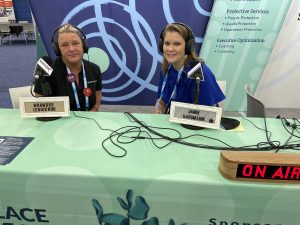
 

Tagged With: behavioral health, dr, Dr. George Vergolias, employee behavioral health, employee mental health, Jamie Gassmann, Nview, R3 Continuum, Robyn Hussa Farrell, Sharpen Minds, Thomas Young, workplace mental health, Workplace MVP

Business RadioX ® Network


Our Most Recent Episode

CONNECT WITH US

  • Email
  • Facebook
  • LinkedIn
  • Twitter
  • YouTube

Our Mission

We help local business leaders get the word out about the important work they’re doing to serve their market, their community, and their profession.

We support and celebrate business by sharing positive business stories that traditional media ignores. Some media leans left. Some media leans right. We lean business.

Sponsor a Show

Build Relationships and Grow Your Business. Click here for more details.

Partner With Us

Discover More Here

Terms and Conditions
Privacy Policy

Connect with us

Want to keep up with the latest in pro-business news across the network? Follow us on social media for the latest stories!
  • Email
  • Facebook
  • Google+
  • LinkedIn
  • Twitter
  • YouTube

Business RadioX® Headquarters
1000 Abernathy Rd. NE
Building 400, Suite L-10
Sandy Springs, GA 30328

© 2025 Business RadioX ® · Rainmaker Platform

BRXStudioCoversLA

Wait! Don’t Miss an Episode of LA Business Radio

BRXStudioCoversDENVER

Wait! Don’t Miss an Episode of Denver Business Radio

BRXStudioCoversPENSACOLA

Wait! Don’t Miss an Episode of Pensacola Business Radio

BRXStudioCoversBIRMINGHAM

Wait! Don’t Miss an Episode of Birmingham Business Radio

BRXStudioCoversTALLAHASSEE

Wait! Don’t Miss an Episode of Tallahassee Business Radio

BRXStudioCoversRALEIGH

Wait! Don’t Miss an Episode of Raleigh Business Radio

BRXStudioCoversRICHMONDNoWhite

Wait! Don’t Miss an Episode of Richmond Business Radio

BRXStudioCoversNASHVILLENoWhite

Wait! Don’t Miss an Episode of Nashville Business Radio

BRXStudioCoversDETROIT

Wait! Don’t Miss an Episode of Detroit Business Radio

BRXStudioCoversSTLOUIS

Wait! Don’t Miss an Episode of St. Louis Business Radio

BRXStudioCoversCOLUMBUS-small

Wait! Don’t Miss an Episode of Columbus Business Radio

Coachthecoach-08-08

Wait! Don’t Miss an Episode of Coach the Coach

BRXStudioCoversBAYAREA

Wait! Don’t Miss an Episode of Bay Area Business Radio

BRXStudioCoversCHICAGO

Wait! Don’t Miss an Episode of Chicago Business Radio

Wait! Don’t Miss an Episode of Atlanta Business Radio