Business RadioX ®

  • Home
  • Business RadioX ® Communities
    • Southeast
      • Alabama
        • Birmingham
      • Florida
        • Orlando
        • Pensacola
        • South Florida
        • Tampa
        • Tallahassee
      • Georgia
        • Atlanta
        • Cherokee
        • Forsyth
        • Greater Perimeter
        • Gwinnett
        • North Fulton
        • North Georgia
        • Northeast Georgia
        • Rome
        • Savannah
      • Louisiana
        • New Orleans
      • North Carolina
        • Charlotte
        • Raleigh
      • Tennessee
        • Chattanooga
        • Nashville
      • Virginia
        • Richmond
    • South Central
      • Arkansas
        • Northwest Arkansas
    • Midwest
      • Illinois
        • Chicago
      • Michigan
        • Detroit
      • Minnesota
        • Minneapolis St. Paul
      • Missouri
        • St. Louis
      • Ohio
        • Cleveland
        • Columbus
        • Dayton
    • Southwest
      • Arizona
        • Phoenix
        • Tucson
        • Valley
      • Texas
        • Austin
        • Dallas
        • Houston
    • West
      • California
        • Bay Area
        • LA
        • Pasadena
      • Colorado
        • Denver
      • Hawaii
        • Oahu
  • FAQs
  • About Us
    • Our Mission
    • Our Audience
    • Why It Works
    • What People Are Saying
    • BRX in the News
  • Resources
    • BRX Pro Tips
    • B2B Marketing: The 4Rs
    • High Velocity Selling Habits
    • Why Most B2B Media Strategies Fail
    • 9 Reasons To Sponsor A Business RadioX ® Show
  • Partner With Us
  • Veteran Business RadioX ®

Making an Impact E36

September 22, 2022 by Karen

Making-an-Impact-feature
Phoenix Business Radio
Making an Impact E36
Loading
00:00 /
RSS Feed
Share
Link
Embed

Download file

Making-an-Impact-E36

Making an Impact E36

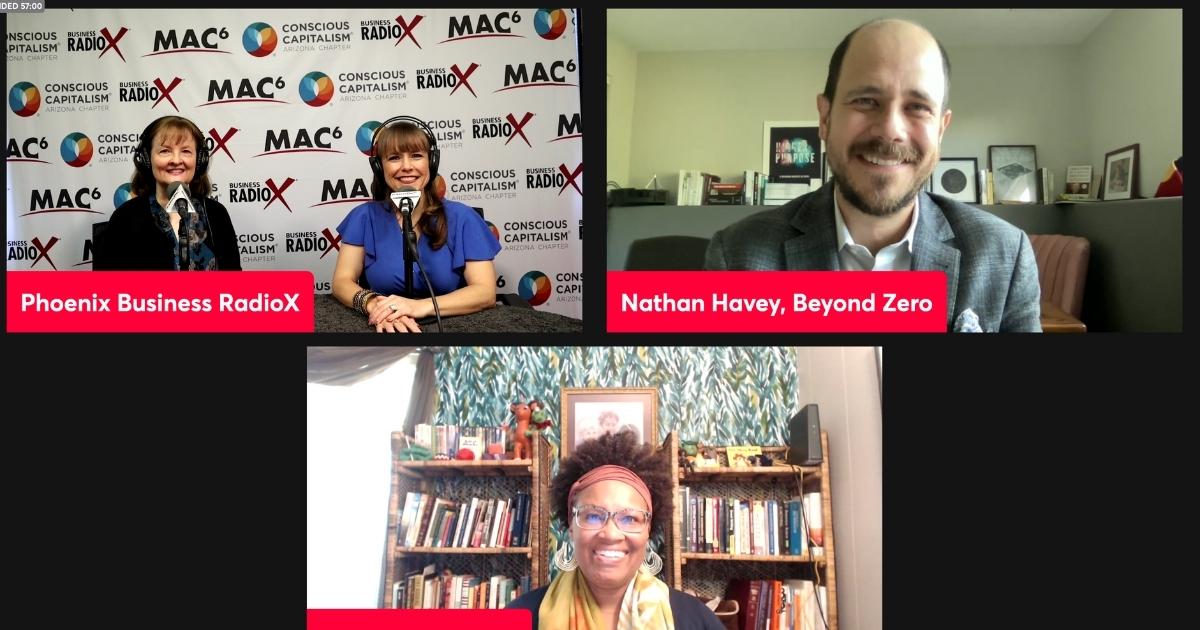
Did you know that businesses and even large corporations can become sustainable and help reverse climate change? The global billion-dollar company, Interface, showed us it’s possible in the film, Beyond Zero.

In this episode of Collaborative Connections Radio Show and Podcast, host Kelly Lorenzen had the opportunity to interview Nathan Havey, writer/director of the Beyond Zero film, Dr. Rhoda Deon, who is helping create the curriculum from the movie, and Diane Janovsky, Chapter President of Conscious Capitalism Arizona.

These amazing guests are making a huge impact on our community and our future. If you would like to know how or learn more about sustainability, eliminating your environmental impact, Conscious Capitalism, or the film Beyond Zero, check out this podcast episode.

You can also learn more at beyondzerofilm.com and ccarizona.org

After a life-changing epiphany, the CEO of a global public company embarks on a high-stakes quest to eliminate all negative environmental impacts by 2020. To succeed, they must overcome deep skepticism, abandon the status quo, and ignite a new industrial revolution. Beyond Zero offers an inspirational roadmap for how business can reverse climate change.
Nathan-Havey-Collaborative-ConnectionsNathan Havey unlocks companies to become the greatest version of themselves.

A believer in the transformative power of stories, Nathan wrote and directed an acclaimed podcast series, “10 Things You Should Know About Stakeholder Capitalism” and an award-winning documentary film, Beyond Zero, which is being used by companies like KKR and UPS to show their teams how business can rise to meet the global challenges we face.

Connect with Nathan on LinkedIn.

Rhoda-Deon-Collaborative-ConnectionsDr. Rhoda Deon is a spiritual life coach and musician with over 30 years of experience in education. She believes joy – not suffering – is the key to changing one’s life.

On a mission to normalize the struggle of being human, Rhoda is obsessed with the intersectionality of art, science, spirituality and human behavior. More specifically, the intersections that instantly remove limiting beliefs, reveal new possibilities and restore autonomy. She is here to remind the weary there is nothing to fight, only choices to be made.

Rhoda is a co-founder of 100 Months to Change – a global coalition of changemakers committed to building a world that works for everyone by 2030. She is also the creator of the Companion Curriculum for the film, Beyond Zero. This set of classroom resources helps students and educators reflect on the movie as well as learn more about conscious business practices.

When she’s not out changing the world, Rhoda enjoys running kitchen experiments, playing fetch with her cat, Prentice, and gravitating towards anything that involves dirt, trees or water.

Connect with Rhoda on Instagram.

CC-Arizona-Logo

Conscious Capitalism Arizona is a nonprofit organization whose purpose, in partnership with Conscious Capitalism Inc., is to build a movement of business leaders improving the practice and perception of capitalism to elevate humanity so that billions of people flourish, leading lives infused with passion, purpose, love and creativity; a world of freedom, harmony, prosperity, and compassion.

They advocate for “Business as a Force for Good” by raising awareness, developing understanding, and supporting the practice of Conscious Capitalism principles in Arizona.
Diane-Janovsky-Collaborative-ConnectionsDiane Janovsky is a consultant and business transformation leader whose purpose is to unleash the power of organizations to do good and to do well.

Through a collaborative but firm style, and with a relentless focus on the alignment of people, process and strategy (purpose, mission, vision and values), she helps organizations improve performance and achieve systemic results including culture change, revenue growth, cost reduction, highly engaged workforce, quality outcomes and superior customer satisfaction.

Diane’s business education began when she was a child and lived behind the “mom and pop” grocery store her parents owned. Through their example, she developed an early appreciation for the importance of people relationships and the value of hard work and a good reputation.

After many years as a professional in the corporate world, Diane returned to her entrepreneurial roots in 2009 and became a business consultant serving the needs of small and mid-size businesses.

Connect with Diane on LinkedIn.

About Collaborative Connections

Kelly Lorenzen started the “Collaborative Connections” show to bring her clients and favorite charities together to meet each other, connect and collaborate in life and business. collaborative-connections-Radio-Show-Podcast-logo1
She hopes to build a stronger community one show at a time.

About Our Sponsor

KLM is a one-stop support shop for small business owners who are starting, growing, or trying to sustain. Our purpose is to foster the growth and prosperity of small businesses in our community.

Entrepreneurs & small business owners come to KLM for support in all areas of business. KLM clients think of us as a concierge, business snuggy, another arm, or duplicate for the business owner; They call us when they need us. Business owners can continue to do what they love while having the support they need when they need it. klm-logo-small
About Your Host

Kelly-Lorenzen-on-Phoenix-Business-RadioXKelly Lorenzen, CEO of KLM, is an award-winning entrepreneur with over 15 years of business-ownership experience. She is also a certified project management professional.

Kelly’s expertise is in business development, customer service, marketing, and sales.

Connect with Kelly on LinkedIn, and follow KLM Consulting on Facebook.
Tagged With: Beyond Zero, Conscious Capitalism Arizona, employee wellness, mindset, motivation, personal growth, Spiritual Life Coach

The R3 Continuum Playbook: How to Talk to Your Employer About Personal Disruption

January 27, 2022 by John Ray

talk to your employer
Minneapolis St. Paul Studio
The R3 Continuum Playbook: How to Talk to Your Employer About Personal Disruption
Loading
00:00 /
RSS Feed
Share
Link
Embed

Download file

talk to your employer

The R3 Continuum Playbook:  How to Talk to Your Employer About Personal Disruption

When confronted with some disruptive circumstance, whether it’s simply being late to work or a more serious situation involving their mental health, employees must answer a few critical questions, including what to tell an employer. In this excerpt from a R3 Continuum webinar, Sarah Hathaway offers some advice on how to talk to your employer about personal disruption.   The R3 Continuum Playbook is presented by R3 Continuum and is produced by the Minneapolis-St.Paul Studio of Business RadioX®. R3 Continuum is the underwriter of Workplace MVP, the show which celebrates heroes in the workplace.

Other R3 Continuum webinars can be found here.

TRANSCRIPT

Intro: [00:00:00] Broadcasting from the Business RadioX Studios, here is your R3 Continuum Playbook. Brought to you by Workplace MVP sponsor, R3 Continuum, a global leader in workplace behavioral health, crisis, and security solutions.

Shane McNally: [00:00:14] Hi, there. My name is Shane McNally, Marketing Specialist for R3 Continuum. We’ve all experienced daily struggles in the workplace. Maybe the printer is jammed, WiFi issues, maybe someone just finished off the last of the coffee, the little things. But what about the greater disruptions that happen outside of the workplace in your personal life? It can be tough to open up to your employer to discuss issues that are happening in your personal life, but it’s something that should not be left unaddressed.

Shane McNally: [00:00:38] Sarah Hathaway, Associate Director of Strategic Solutions at R3 Continuum, offers expert insight into different strategies to approach your employer for support when faced with personal disruption.

Sarah Hathaway: [00:00:49] There are a few things to really think about when you are seeking support from your employer. The first one is, “What do I share? What do I tell my employer?” And depending on your circumstances, the answer to that question may vary. If it’s, “You know what? I got a flat tire and my car is going to be in the shop. And I’m going to need some flexibility today and I’m going to miss a meeting,” or something of that nature, that might be a little bit easier to have that conversation of here’s what’s going on.

Sarah Hathaway: [00:01:24] But if it’s a mental health condition or it’s a compounding of stressors, those are sometimes a little bit more difficult to articulate and they might be harder to figure out, “Where’s the line? What do I tell my employer?”

Sarah Hathaway: [00:01:39] Some factors that you can consider here are, first of all, what do they need to know? What information is necessary for them to understand the gravity of the situation? If I just say, “I have a personal concern and I’m going to need to be out of work for the next two weeks,” that might be a little bit hard for your supervisor to understand. So, it might be necessary to give a little bit more context to what’s going on. Or if it’s, “I’m going to be needing just some understanding. I might be late on a project,” that might be a little bit easier to understand.

Sarah Hathaway: [00:02:19] One of the other things that you’ll want to consider here is what are the potential ramifications of what I may share? It’s not necessary for you to share any medical and mental health diagnoses. And, oftentimes, employees are concerned about potential discrimination or what other ways that can have negative consequences.

Sarah Hathaway: [00:02:39] So, think about that here in what you’re going to share, and we can talk some more when we get to the question and answer about specific ways to manage that. But think about what is necessary for them to understand. Again, that gravity of the situation, and then what are you comfortable sharing, and what are the potential consequences of sharing.

Sarah Hathaway: [00:03:04] The next one is, who do you tell? And, oftentimes, the simplest answer is your direct supervisor. If there’s an impact to your work, let your supervisor know what that will be and what adjustments may need to be made. You may also want to notify human resources if you have any concerns about how this information may be perceived. Or if you’re in need of particular resources or accommodations, human resources may be necessary to notify as well.

Sarah Hathaway: [00:03:37] And then, the third option is your colleagues. Is this something that you want your colleagues to know about? Is there a reason that they should know? Keep those things in mind when planning to have those conversations.

Sarah Hathaway: [00:03:51] And then, third thing is to define what you need. And you’ll look at that in four areas. The first is, do I need problem solving? Do I need to talk with my manager about what are my next steps? What can I do here? Do we need to work together and collaborate to figure out a reasonable solution?

Sarah Hathaway: [00:04:14] Or maybe you don’t need any solution at all. Maybe you’re just looking for understanding of I might be a little bit late here, or I might show up midway through this meeting, or I might need a little bit of adjustment on deadlines. “I just need some understanding here of this is what I’m going through, and I want you to know so that you’re not wondering why I seem a little bit less reliable than usual.”

Sarah Hathaway: [00:04:41] The third is resources. Do you need any resources that your employer offers? That may be an employee assistance program. It could be your health insurance information. It could be other options that your employer offers. So, think about what resources your employer may offer or do you just not know and your manager or HR can help you figure that out.

Sarah Hathaway: [00:05:07] And then, the fourth piece is flexibility. Do you need time off? Do you need adjusted responsibilities at work for a period of time? If you’re requiring some level of flexibility, it’s important to communicate that to your manager.

Sarah Hathaway: [00:05:20] So, think about these four areas when you’re planning on talking with your manager or HR, and what exactly are you looking for from them. Because, oftentimes, when your manager doesn’t necessarily know what you’re looking for and you’re just bringing here what’s going on, they may jump to problem solving when that’s not what you need. And all you need is some understanding of the situation. And so, if you can come with the ask up front, it can be really helpful in determining how to move forward.

Shane McNally: [00:05:48] All right. Hey, I have a question to kind of jump in, in here as well. And it actually came up from that very first slide of what is a sign that somebody might need to reach out for support? Like, when is kind of enough is enough type of thing? Is there something where I should look inside and be like, “You know what? I do need to reach out?” Do you kind of have any thoughts on that?

Sarah Hathaway: [00:06:13] You know, that’s a really great question. I think there are a couple of signals that you might need to reach out. And the first is, if you’re coping with something where you need help, you need support, or maybe you just need a listening ear, somebody to understand what you’re going through. If you’re feeling like you need help, oftentimes, your employer has some type of a resource for that. Again, it may be your manager, maybe HR, or maybe something like that employee assistance program.

Sarah Hathaway: [00:06:42] The other indicators that you may need help is if there’s an impact to your work, if there’s an impact to your performance, or impact to availability or your reliability. Those are indicators that your manager probably needs to know what’s going on so that it isn’t viewed as just strictly a performance issue. If you can communicate at least semi-openly, again, there may be some things that you keep personal, keep to yourself. But if you can communicate at least on some level of what’s going on, that can help them to identify that there’s something else other than just a performance concern.

Sarah Hathaway: [00:07:18] And then, the third thing is, if you’re noticing any specific changes in your emotions, your behaviors, if you think that there may be some potential impact to your mental health, again, this is another opportunity to communicate with your employer about how to get support and resources.

Shane McNally: [00:07:41] It’s extremely important to know how and when to approach an employer about a personal disruption. Well, it can be difficult to do. It’s not impossible. R3 Continuum can help organizations ensure they’re offering the best support and resources available for their employees through our Workplace Behavioral Health Support Services. R3 Continuum offers a proactive support approach and tailors the services to fit the unique challenges of each workplace. Learn more about R3 Continuum services and contact us at www.r3c.com or email us directly at info@r3c.com.


Show Underwriter

R3 Continuum (R3c) is a global leader in workplace behavioral health and security solutions. R3c helps ensure the psychological and physical safety of organizations and their people in today’s ever-changing and often unpredictable world. Through their continuum of tailored solutions, including evaluations, crisis response, executive optimization, protective services, and more, they help organizations maintain and cultivate a workplace of wellbeing so that their people can thrive. Learn more about R3c at www.r3c.com.

R3 Continuum is the underwriter of Workplace MVP, a show which celebrates the everyday heroes–Workplace Most Valuable Professionals–in human resources, risk management, security, business continuity, and the C-suite who resolutely labor for the well-being of employees in their care, readying the workplace for and planning responses to disruption.

Connect with R3 Continuum:  Website | LinkedIn | Facebook | Twitter

Tagged With: employee well-being, employee wellness, employers, mental health, Mental Health Support, personal disruption, R3 Continuum, Sarah Hathaway, Workplace MVP, workplace wellness

The R3 Continuum Playbook: Employee Wellbeing in 2021 and What to Expect in 2022

January 6, 2022 by John Ray

Employee wellbeing
Minneapolis St. Paul Studio
The R3 Continuum Playbook: Employee Wellbeing in 2021 and What to Expect in 2022
Loading
00:00 /
RSS Feed
Share
Link
Embed

Download file

Employee wellbeing

The R3 Continuum Playbook: Employee Wellbeing in 2021 and What to Expect in 2022

In this excerpt from a webinar conducted in December 2021, Dr. George Vergolias, Medical Director at R3 Continuum, covered issues and pain points of employee wellbeing in 2021 and looked ahead at workplace trends to expect in 2022. He discussed the disruptive factor of hybrid work and how it will evolve, the challenges of staffing and labor, the growing disconnect between leadership and employees, the toll of virtual work and how it may impact creativity, and much more. The R3 Continuum Playbook is presented by R3 Continuum and is produced by the Minneapolis-St.Paul Studio of Business RadioX®. R3 Continuum is the underwriter of Workplace MVP, the show which celebrates heroes in the workplace.

Other R3 Continuum webinars can be found here.

TRANSCRIPT

Intro: [00:00:00] Broadcasting from the Business RadioX studios, here is your R3 Continuum Playbook. Brought to you by Workplace MVP sponsor, R3 Continuum, a global leader in workplace behavioral health, crisis and security solutions.

Shane McNally: [00:00:14] Hi, there. My name is Shane McNally, Marketing Specialist for R3 Continuum. As 2022 begins, it’s important to look ahead and recognize the trends that may be seen throughout the year regarding employee wellbeing. This information is provided by Dr. George Vergolias, Medical Director at R3 Continuum. Reflecting on 2021, there has been a shift between different priorities, work environments, mental health and overall wellbeing importance and more. Dr. George Vergolias is going to dive in and offer eight things that he foresees will be trending in 2022. This information is gathered from various reports and trends we’ve seen in years past.

Shane McNally: [00:00:50] Dr. George Vergolias oversees and leads R3C’s clinical risk, threat of violence and workplace violence programs. He’s directly assessed or manage over 1000 cases related to threat of violence or self harm, sexual assault, stalking and communicated threats. He brings over 20 years of experience as a forensic psychologist and certified threat manager to bear in an effort to help leaders, organizations, employees and communities heal, optimize and ultimately thrive during and after disruption. Thank you for being with us, Dr. Vergolias. So, let’s start off today’s webinar by asking a question, what drives human thriving?

Dr. George Vergolias: [00:01:29] Okay. Thank you, Shane, for that warm introduction. And what’s interesting is, so you heard a little bit about my bio, forensic psychologist, I’ve done a ton of threat work, a ton of hostility management work and so on. But a big part of that is also understanding resilience and understanding the flip side of wellbeing because wellbeing, when you are functioning well emotionally, intellectually, when you’re living your best life, you’re really functioning in a way and at a level that is diametrically opposed to being violent.

Dr. George Vergolias: [00:02:03] So, I’ve had to be forced to become an expert in understanding resilience and wellbeing, and what is it that allows people to pull through hard times; whereas, other people decide to go on a violent trajectory? So, my larger role is Medical Director for R3. I oversee all of our services. And a big part of that is understanding the wellbeing and resilience aspect.

Dr. George Vergolias: [00:02:25] And so, back to Shane’s question, what drives human thriving? And what I want to do is I want to talk about one of my favorite stories of all time. And it’s a true story about Margaret Mead. Margaret Mead, arguably one of the best most famous anthropologists, at least in the United States. She was giving a lecture in Oxford 70 some years ago, and a student in the lecture hall had raised – I’m assuming it’s a he but these are her hand. I believe it was a young man, and he asked Margaret Mead, when does she think civilization began? What were the first signs of civilization?

Dr. George Vergolias: [00:03:01] And the students and the other faculty that were there, they expected an answer around something like the first time we carbon dated finding pottery, or weapons, or an arrowhead or some kind of structure that was built, or a vase or some kind of structure that carried water, whatever it would be. Cooking tools, eating tools, whatever it may be. And that’s not what she said at all. She said, “We know civilization began around the time that we were able to backdate, carbon back date, a broken femur bone, a human leg bone that had healed.” And a lot of people in the auditorium looked puzzled.

Dr. George Vergolias: [00:03:41] And she went on to explain that in the animal kingdom, when you break your leg, you’re done. It’s game over. There’s no other animal that sits and stays with you. And if you have a broken leg, it doesn’t naturally heal on itself by the time that you either starve or you die of dehydration or some other predator takes you. But once they found that femur bone that had healed, they knew that somebody, some other creature, arguably another human, had stayed there and protected that person, and brought them sustenance, and kind of nursed them through the healing process till they at least can get up and get moving.

Dr. George Vergolias: [00:04:17] So, the point is that we are best, we are most human and we are at our best when we are assisting and helping one another. And that’s what we’re going to talk about in terms of trends through 2021 and into 2022. But I want that story to anchor us.

Dr. George Vergolias: [00:04:33] So, let’s first look backwards. It’s always a good time to kind of take stock and look back at the past year. What impacted employee wellbeing the most in 2021? And what we saw at the end of 2020, going into 2021, is we saw some trends that did indeed pan out. And one of them was from the Fortune Deloitte 2021 CEO Survey. This was done at the back end of 2020, looking forward into 2021. And what they found is 98% of CEOs reported that mental health was a priority for them going into this current year, 2021.

Dr. George Vergolias: [00:05:10] They also find that the pandemic had significantly accelerated various types of digital transformation, most notably what we’re doing now. Quite often, even though we did webinars through telepresence before, that has markedly accelerated through the pandemic and over this past year as well. And then, the pandemic was fostering information around or formation of new partnerships, new alliances and new creative ways of doing business and working together over remote distances.

Dr. George Vergolias: [00:05:43] And what we saw in this past year is many companies, not all, but many companies made good on those promises, and many CEOs made good on those promises, and we saw an acceleration of that going through the year. And that’s been largely a good thing. There have been a few things that have created some pain points, and I’m going to get at that in just a second.

Dr. George Vergolias: [00:06:06] We saw a few other things. One is that COVID 19, COVID, the epidemic or pandemic, rather, it created tensions, and it tested the limits of the worker-employer relationship. And early on, we saw certain pain points around concerns of safety. Later on, we saw pain points around mask mandates. And then, we saw and are still seeing pain points around vaccination requirements, and we’re seeing different businesses handle that differently. But what that is doing is it really is testing those boundaries of where does an employer’s reach and where does their due diligence then begin in terms of creating safe environments for their workforce?

Dr. George Vergolias: [00:06:54] And from a legal perspective – and again, full disclaimer, I’m not a lawyer, I work a lot in conjunction with the legal world as a forensic psychologist – what we’re seeing is there really isn’t still any court or legal precedent around handling COVID risk as an employer, as well as COVID restrictions. So, all of this is still at play, and I think we’re all still trying to figure out what is that balance. And what makes it even more confusing is that balance is going to be different for different industries and different employers. And in some cases, across the same employer, it might be different at different locations. So, that’s one thing.

Dr. George Vergolias: [00:07:34] The second thing we saw is the adoption of what I’m calling telepresence everything. So, another kind of disclaimer here, for 19 years, I’ve had a private practice that is focused on doing telemedicine for emergency departments in North Carolina. Just the practice I’ve had on the side, it keeps me vibrant, keeps me accessible and it keeps me sharp clinically. I’ve spent the last 10 years trying to get hospitals, and clinicians and outpatient clinics to adopt telepresence and telehealth. COVID changed all that almost overnight in terms of the forced and accelerated adoption of going to telehealth, and both providers and recipients – patients – being those on the receiving side, being open to it and being flexible with it, including boards, changing licensure requirements, payers and insurance, changing their payment requirements to allow this.

Dr. George Vergolias: [00:08:30] And we are not going back. I’m not saying we won’t begin to go back to more clinic-based therapy in some ways, but there is a large swath of the population that has found that telepresence or telehealth has been functional, it has been helpful, it has been effective, and useful and has broken down regional barriers to proper care.

Dr. George Vergolias: [00:08:52] So, we’re seeing that, but we’re also seeing, again, what we’re doing right now, and I imagine if we were in a room and I did a show of hands of how many of us have been on a Microsoft Teams or Zoom call this week for business, almost everybody would raise their hand in terms of being involved in that in the last week or two. So, we’ve seen a huge adoption of that. And I’m going to talk about the pros and cons of that as well.

Dr. George Vergolias: [00:09:15] The other thing that we’ve seen is that wellbeing, although, as I said in the last slide, has been a huge initiative, there are some barriers and pain points in terms of the impact of that. What we’re seeing now based on the Harvard Business Review study that was done just a couple of months back, 89, almost 90% percent of employees are saying that their work/life balance is getting worse – I’ll talk a little bit about that in a minute – 85% are reporting well-being has worsened in general; 56% indicated that their job demands have increased since the onset of the pandemic, and particularly over the past year; and 19% of women – so, we’re seeing some specific population issues – are reporting that they felt their job was at risk. And a lot of this was particularly around many of them being in a position where they can’t stop also being kind of a primary caretaker at home. Whether they’re a single mother or even if they’re in a married relationship, some of those older traditional gender roles, none of that has stopped, while they also have an accelerated adoption of being on conference calls and continuing to have increased productivity.

Dr. George Vergolias: [00:10:24] What’s really interesting is another pain point I’m going to get into. I’m just laying out the metrics. 40% – and this is at a global level – of the workforce is considering a change going in to the back end of 2021 and into 2022. A change in jobs, basically. So, talent acquisition is an issue, and I’ll be talking more about that in a second. So, as a segue, so that’s kind of the landscape that we’re now just emerging out of. 2019 or 2020 had its challenges with the onset of the COVID pandemic. 2021 was okay, we’re getting our legs under us, but still trying to figure out a lot of these issues with all their attendant pain points. Now ,the question is, what does 2022 have in store? So, these are predictions, these are speculations, but they’re based on trends and they’re based on what we kind of know in terms of not only our own experience consulting with those in the C-suite and upper management, but looking at the trends across a number of reports and where the workforce is going around issues of wellbeing and thriving.

Dr. George Vergolias: [00:11:32] So, let’s start with what our leaders concerned about, because I think that’s a good barometer, at least, of understanding that at the top. In the beginning of this past year, many CEOs, many leaders, especially in the Deloitte survey, which is a kind of an industry standard, were talking about this as the year of hope. As we started entering into mid-2021 with the Delta variant beginning — well, not beginning but when it was beginning in the mid part of the year to kind of start raging and a few other supply chains still not back online, there were other pain points going on, they moved to have more bold plans about growth, innovation and digital transformation all based out of necessity. All of that was needed.

Dr. George Vergolias: [00:12:16] Another big key component, there was there was a lot of initiatives around, how do we transform our talent networks? How do we recruit, and develop and train people differently? Good news is over 75% of CEOs still remain bullish on 2022. They still are looking at positive growth, they’re looking at innovation, and they’re really thinking the business community is going to continue to thrive and adapt to the changes ahead. That all is good. That’s a positive message. But we also are seeing is what we saw a year ago, mental health and wellbeing remain prominent as focused areas for leaders and CEOs in particular. So, there’s a lot of focus on that, and there’s a lot of resources and initiative being put in that direction. Again, different companies will differ on this dimension, but as a whole, there’s a big momentum in place that continues to ride us into 2022.

Dr. George Vergolias: [00:13:08] Well, we’re also seeing is D&I issues. Diversity, inclusion, these are rapidly accelerating in focus. In January of 2021, so just a little under a year ago, 94% of CEOs said D&I issues and initiatives was a strategic priority. By June, by midyear, 50% were actually making good on those promises. They were prioritizing those initiatives for inclusion and talent adoption strategy or talent attraction; they were setting clear goals to measure the impact of their D&I initiatives and priorities; and they were communicating those metrics back to their employees in a way that there could be a feedback loop about what is working and what isn’t working. So, again, another positive change that we’re starting to see develop through 2021, and we’re expecting that to continue in 2022.

Dr. George Vergolias: [00:14:08] And by the way, these initiatives are not just for marginalized groups. There’s a large — I don’t want to say majority, but there’s a large swath of people that are not in disenfranchised groups but strongly identifying in an ally shift way with those groups who are supporting those initiatives. And in the end, those are tending. The research is showing those are tending to make more cohesive and innovative work groups across a number of different sectors.

Dr. George Vergolias: [00:14:42] So, now, what I want to do is take those high level metrics. Again, we talked about 2021, talked about 2022, and I want to go in just seven specific trends that I think we can expect going into this new year. Again, these are born out of various data points, various reports, we make reference to these in the slide if you want to go do a deeper dive. And they are a little bit — I mean, these are predictive trends. These are things that we’re looking towards based on where we’ve just come out of, but they wouldn’t be in this presentation if I didn’t feel quite confident that we’re going to see some of these or each of these in some capacity as we navigate forward.

Dr. George Vergolias: [00:15:25] So, the first is that the biggest disruption that we can expect this next year is hybrid work and trying to figure out, what does that mean? What does that mean for us? What we’re seeing – now, this is based off the Microsoft Work Trends report from March, and they did a little bit of a follow-up just recently; I believe it was in November. But what they were saying is 66% of leaders of their company, they’re considering redesigning their office space for hybrid work. Almost three-quarters of employees want flexible remote work options, and over over two-thirds of employees want more in-person work or collaboration post-pandemic. So, what’s interesting — I’m sorry, employers. I mean employees want more in-person work.

Dr. George Vergolias: [00:16:14] So, what do we see here? What we’re seeing is kind of a split in both directions, right? Leaders are definitely responding and trying to create workspaces that can adapt to more remote and hybrid work environments; three-quarters of workers want flexibility to work from home and from the office; and yet, two-thirds are also saying we still want that in-person engagement for collaboration post-pandemic. And again, different companies are going to adopt this at different levels based on their financial tolerance, their risk tolerance and other issues, but this is going to be a disruptive factor as we move forward, and companies are going to have to figure out a plan to navigate that in a way that works for their culture, their industry, and at some level, their bottom line as well. That all has to be factored in.

Dr. George Vergolias: [00:17:05] Second big issue is talent acquisition. This is going to rapidly change. We’ve already seen it, but we’re seeing more. Questions of attracting talent, retaining talent and then developing internal talent will continue to be massively disrupted as we go forward. There’s a quote on your screen there, I’m not going to read the whole thing, but I’m going to highlight a few points, and this comes from the Deloitte — I’m sorry, the Deloitte Insights report from July. What we saw in 2020 is 80% of job losses were among the lowest quarter of wage earners, and many of them were working in the service sector. A new study shows that 100 million global low-wage workers will need to find a different occupation by 2030. That is a massive shift in the job market.

Dr. George Vergolias: [00:17:50] In addition to that, we are continuing to see acceleration of robotic impact in the workforce, which disproportionately affects lower wage or labor-based type occupations or jobs. And we’re seeing that the demand for skilled workers at the same time that this is happening, skilled workers is also growing, with 7 in 10 employers globally saying they’re struggling to find workers. For any of us that are interested in selling a home, buying a home, building a home, or even just trying to get some remodeling done, we know the labor shortage in the skilled labor and construction and remodeling world. So, we’re already seeing that. So, there’s going to be massive impact.

Dr. George Vergolias: [00:18:34] What’s also interesting with this is at the same time that all of these data points are happening out of necessity, you might say, and I’m not saying — what I mean by necessity is the job market is moving, so people or the labor force is moving and evolving, we also have a disproportionate number of white-collar workers. So, people with higher degrees working more white collar jobs, who are just fed up with their current arrangement of working in corporate America. They want to live remotely, they want flexible hours, they want to be their own boss. So, we’re seeing a higher proliferation of people leaving traditional jobs where they have good positions. They’ve been at a firm, a law firm or one of the big four accounting firms for a number of years and moved up, and they’ve just decided — to put it in my terms, they’re kind of done with the rat race, and they just want to get out.

Dr. George Vergolias: [00:19:29] We’re also seeing younger workers from Gen Z and millennials who are developing a whole new — well, not new because these have been around for a while, but they’re developing a deeper sense of what they want out of a job. It’s no longer advancement and a good paying salary. I want to feel rewarded, I want to feel supported, I want to feel like I’m making a difference, I want to be part of a company that’s making a difference in the world. All of these are different things that are occurring that’s forcing us as business leaders and talent acquisition leaders to rethink, how do we attract, retain and develop people in our companies and in our organizations? So, it’s going to be a challenge as we navigate forward.

Dr. George Vergolias: [00:20:17] So, sadly, I talked earlier about a lot of the CEOs talking about it’s the year of hope this past year and remaining bullish on 2020, and wellbeing, and D&Y, initiatives all being part of the priority. And that’s all wonderful news. There’s still a disconnect. Leaders are still generally out of touch. This is also coming from the Microsoft Trends report. It, also, is backed up by some of the findings from the Deloitte Insights report as well. But from the Microsoft report, 61% of leaders are reporting themselves as thriving and accelerating their thriving through 2021 versus only 38% of their employees are reporting that. That is a disconnect.

Dr. George Vergolias: [00:21:01] Now, some of the best organizations are kind of evolving and thriving together from top to bottom, but the norm is that leaders increasingly think that they’re doing well, and thriving and growing; employees are not. And so, there is a disconnect. Unfortunately, I don’t know exactly what that disconnect is. There’s a number of factors that I think are related. The next bullet point captures one of them. We’re exhausted. When I say we, I mean the workforce in general. And it’s masked by high productivity.

Dr. George Vergolias: [00:21:33] So, here’s an interesting finding we’re seeing not only at the beginning of 2021, but growing through the year, and we’re actually expecting this to continue to grow into 2022, and there’s a blessing and a curse here. 85% of employees report the same or higher productivity from the prior year. So, 2021 was just as productive or more productive than 2020, except 53% more feel overworked, and 39% more feel exhausted from the prior year. So, yes, we’re doing more, but we’re paying a high, high toll on employees’ wellbeing.

Dr. George Vergolias: [00:22:13] And when you marry that or abridge that into the talent dilemma, that is a real concern. It’s a real recipe for disaster because if we have a core constituency, you might say, of the workforce that either they’re forced to move on because they’re semi-skilled role is being outsourced or not available or higher skilled workers or more educated workers are just deciding, “I’ve had it with the rat race,” and they’re feeling “I’m more productive than eve, and yet I’m more exhausted, and I’m not doing well, and I’m overworked,” that creates an environment that more people want to leave and more people want to start jumping to other opportunities around them. So, it’s going to be a really interesting year to see how we, as a business community and in roles of leadership and management, and HR, navigate that going forward.

Dr. George Vergolias: [00:23:07] Another consideration is that the digital intensity of our engagement and life balance, there’s been a creep. There’s been an increased impact of that over time. So, a few bullet points there. Microsoft Teams, just the occurrence of the number of teams that the average person sits in – meaning conference call teams or meetings – is up two times than it was a year ago. The average meeting is up 10 minutes longer than it was a year ago. The average user is sending 45% more chats through Microsoft Teams.

Dr. George Vergolias: [00:23:41] And the problem that — well, actually, I’m going to jump ahead real quick because there’s one more visual I want to share with you, and then I’ll get to not my final slide, but a conclusion point there. What we’re also seeing – and again, all of this is from the Microsoft Work Trend report, which is really interesting because they could call all of this anonymized data from MS teams, particularly if your organization opts in for that data sharing.

Dr. George Vergolias: [00:24:07] So, meetings, weekly meeting time has more than doubled for team users and is still rising all through 2020, but also continuing to go into 2021. This trend hasn’t gone away. Again, this study was from March of 2021, but this trend continues. There’s been an increase in the number of emails delivered in February of 2021 versus February of 2020, and there’s indications that this has continued to increase. I already mentioned that 45% more chat is occurring. And this is interesting, the number of people working on office documents is up 66% over the same year.

Dr. George Vergolias: [00:24:46] Now, on the one hand, if we’re all going remote, we would expect some of this to increase. And that all makes some sense because we’re not — I’m going to hop back here. Because we’re not together, we don’t have the ability to go have lunch together downstairs at the little café, or talk in the break room, or even just meet at the watercooler. Those opportunities are not there, so we have to chat more, we have to email more. And all of that makes a little bit of sense organically. Here’s the trouble is what we’re finding is we’re getting huge digital fatigue. It is just draining to feel like we are constantly on.

Dr. George Vergolias: [00:25:25] What’s interesting is there was a study done, and I wish I would have added it to the slide, but I’ll just comment on it real quickly. I believe I saw it in Inc Magazine, but prior to that, I believe it was in Forbes. And what they looked at is, what is the kind of the lit reality of being in meetings in lived time, in-face, or in-person, and being on a screen? Well, the oddity is right now, of this multiple hundred, three or four hundred people watching this right now, I don’t know how many are looking at me right now. So, if I want to stop and take a glass drink of water, and I’m going to do that because I’m thirsty, it’s kind of a bit of an awkward moment, right? It’s a pause, it’s silent. Even if I’m not talking – of course, I’m presenting, so I have to be talking now – I’m not sure who’s looking at me.

Dr. George Vergolias: [00:26:17] But when you’re in a room with people, and you can see that 12 other people or 15 other people are looking at the speaker, you could kind of turn off for a second. And I don’t mean you turn your attention away, but you can relax, you can scratch your nose, you can fix your hairline, you can adjust in your seat, you could quickly check a text if you are afraid your kids are texting you that they got off the bus, whatever the issue is. When we have this platform, there is this kind of subtle paranoia that forms of feeling like we always have to be on, and engaged, and focused. And it’s tremendously draining to have that. And we don’t have that in our normal face-to-face meetings because we get numerous micro breaks when we notice everyone else is focusing on the screen, or this talker, or that talker.

Dr. George Vergolias: [00:27:08] So, again, that — and then, you’re in my home. So, I have to constantly worry about, are people judging my background? Is my office clean? The kids are off right now, they’re going to come in, and I’ve had to warn them not to bother me because I’m giving a presentation right now. This has an emotional and psychological drain, and it’s kind of a cognitive load over time. So, it’s something else we’re going to have to be mindful of as we go forward.

Dr. George Vergolias: [00:27:35] What I’ve heard about and what we’ve implemented at R3 to some good effect is leaders, we’ve encouraged leaders to empower and encourage people to fade their background if they want. We literally have some workers that for any number of reasons, take calls from their bedroom. They don’t want you in their bedroom. Even if you went over to their house for a barbecue, they wouldn’t invite you into their bedroom. And yet you’re in their bedroom during an account meeting or a sales meeting or whatever. So, we encourage them, use the muted background, so no one can see where you are in your home or use one of the other template backgrounds.

Dr. George Vergolias: [00:28:11] We also encourage people, if you need to go off camera for a little bit, go off camera. There’s no judgment there. Everyone may need to do that. If you need to mute, go ahead and do that. Because where we are in our lives, our work life and our personal life, are now a little more blended. And we have to be more mindful about where those boundaries land and empowering people to use those boundaries and set those up, so they can still promote a sense of wellbeing, and no one to emotionally and psychologically turn off. So, we want to keep that in mind as we navigate forward.

Dr. George Vergolias: [00:28:49] Okay. You know what, I lied to you guys, and I didn’t mean to. There’s actually eight trends. So, let me get through those. And then, it might be a good time to pause and see if we have a few other additional questions.

Dr. George Vergolias: [00:29:02] So, trend number six, collaboration and productivity, they might be harmed by shrinking social networks. The jury is a little bit out here, and we’re still trying to figure this out. So, on the one hand, we are more — I’ve already made the case, the data doesn’t lie, we are much more interactive than we’ve ever been. And that has been very, very useful in terms of — well, it’s been out of necessity, but we are communicating. We’re communicating more. We’re using more tools, chat, email, again, telepresence or teleconferencing. And in one way, that has kept us connected, which has been useful because if we didn’t have any of that in 2020 and 2021, that would have been big trouble for business productivity and innovation.

Dr. George Vergolias: [00:29:50] Here’s the problem. Because of that, we are continuing to lack the lived social experience of being in presence with somebody. And I call that magic of innovation that happens when you’re interacting with somebody in a room. I had the pleasure of having a very good friend, still do, who was a really good jazz musician. He’s not famous, but he plays with a lot of famous jazz musicians. I mean, he’s just amazing in terms of his talent. And what’s funny is when COVID started, a lot of jazz musicians, among other artists, had to move into the studio, and they were doing studio work remotely. It was all digitized. The problem with jazz, just like the problem with most good music, there’s an innovative back and forth. There’s a dance, there’s a flow that people get into. And what we are finding is even on the business side, the innovative side, sales, marketing, developing new products, bringing them to the market, all of that has been stifled a bit by that lack of innovative magic of being reasonably in the presence of one another.

Dr. George Vergolias: [00:31:02] So, again, don’t know what the answer is to there. Hopefully, the answer is we get a handle on things. Hopefully, Omicron isn’t — we certainly know it’s more contagious than Delta. Hopefully, it’s not as severe in its symptomatology. And hopefully, we can get a handle on it in a way that maybe we can start getting back into face-to-face interactives. Many of us, maybe all of us have been to virtual conferences in the last year, I can’t speak for everybody, but I can tell you I’ve been to some good ones, and I’ve been to many where it’s not even close to the lived experience of being in-person with somebody. So, these are things that we’re going to have to adapt to.

Dr. George Vergolias: [00:31:42] Now, there’s a paradox here. And the paradox is at the same time that that has increased our interaction but decrease that kind of magical innovation that gone on and on for five minutes about that, there is at the same time what we’re seeing an increase in authentic engagement. And the authentic engagement is if we were in a conference call, some people would be asking me turning to the wrong direction about my boxing gloves. Those are my dad’s boxing gloves. He fought Golden Gloves when he was a young man in Chicago. That would never come up if we were in the office. And then, “Oh, you’re from Chicago,” or “Oh, your dad boxed. Did you learn to box?” These are little moments where we kind of — whether we mean to or not, we let people into our lives and we become a little more engaging. It’s a little more of an authentic interaction. And the paradox is we’re not doing this in person.

Dr. George Vergolias: [00:32:32] So, the time we’ll be able to tell or only time can tell, I should say, of how is that going to play out. On the one hand, there’s something kind of artificial about this digital interaction. On the other hand, over time, you’re getting to see my — I mean, again, if these were regular calls, eventually you’d meet my dog. Shane has heard my dog bark so many times, he probably can recognize the bark. Shane has met my kids – he never would have probably met my kids – because they burst in when they get home from school, even though I tell them not to sometimes. That creates an authentic engagement where our humanness is shown and it comes through.

Dr. George Vergolias: [00:33:13] So, it’s going to be really interesting to see how six and seven bounce off each other as we continue to navigate forward in 2022, particularly around issues of humor, and vulnerability and so on.

Dr. George Vergolias: [00:33:27] All right. Number eight, and you might have already suspected this when I was talking quite a bit about the talent dilemma, but in a suddenly remote hybrid world – and when I say sudden, yes, it evolved over a year, 12 months, 18 months, but if you look at the history of any of our organizations, like go back 20, 30, 50, 60 years, some of us maybe are in organizations that go back a hundred years, you go back and look at the history of modern work since the industrial age began, 18 months is a blip. It is a blip on the map. That is a very rapid change. So, in a suddenly remote hybrid world, the talent pool is going to be global. We’re already seeing that. We already were trending that way, but now that so many of us have adapted to remote hybrid work, we’ve now eliminated that barrier.

Dr. George Vergolias: [00:34:24] Now, some employers, some leaders are saying, “I want people back in the office and I want to hire people that live — I’m in Raleigh, North Carolina, so I want people that live around here, so they can come in the office.” That’s a choice. But what most organizations have, at least, been able to say or prove is that some of what we do can be not outsourced, but it can be off-sourced, it can be off the site, it could be at home, or remote or hybrid. And what that means is, now, when I’m looking for that account manager, or sales exec, or that head clinician, or that clinical program manager, I can now look in California, or Arizona, or New England. I don’t only have to look in Raleigh. So, that expands the talent pool.

Dr. George Vergolias: [00:35:07] But what it also does to the talent, it means their options are expanding as well. So, if they join my group and they find after a year, “I don’t like the fit. I don’t like the mission. I don’t like the support I’m getting. I don’t like the level of development and mentoring I’m getting. I don’t like the company’s approach to D&I and inclusion-based issues or wellbeing, I now can look for a job in California, and Arizona and New England.” So, again, this is a dilemma that we all are going to have to navigate as we continue to move forward.

Dr. George Vergolias: [00:35:41] Okay. All right. This might be a good time to take a quick pause. Shane, are there any questions that came through?

Shane McNally: [00:35:50] Yeah. We have one here that I think was pretty relevant. We had it in one of the first slides. So, with the move to more hybrid and work-from-home situations, do you forecast a rise in domestic violence? And what are companies doing to ensure they meet the duty of care obligations to provide a safe work environment in a remote world?

Dr. George Vergolias: [00:36:10] Wow, that is a great question. And it’s a hard one to absolutely answer, but I’m gonna do my best. And it’s one I kind of know the area of. So, we’ve already seen an uptick in domestic violence already in 2021. I would expect that to be the same, maybe a slight uptick into 2022. And some of these issues can get very complex, but just because for sake of time, I won’t go into all the variables from a risk angle, but it really comes down to when you are in an environment of hostility, where there’s an abuser and a victim, leaving for eight hours a day and separating isn’t a bad thing. The first thing most of us will do when we see a fight brewing, whether it’s at the Thanksgiving table or, unfortunately, if it’s at a Little Little League game, or if you’re a police officer responding to a situation, you separate. Leaving the house every day and going into work is, at least, a forced separation. Now, that’s all at home. That separation isn’t occurring. So, it doesn’t have to be a hotbed, but it increases the risk of flashpoints, of volatile flashpoints that can emerge into violence. So, I do think there’s a significant risk there.

Dr. George Vergolias: [00:37:27] In terms of what are people doing, this is varied significantly, greatly. The best companies are really trying to do a job of reaching out, letting their employees know that they have domestic violence support resources, they’ve got mental health support resources, they have counseling, anonymous counseling resources, they have threat of violence services available to help people navigate a potentially violent or hostile situation. The best ones are doing that.

Dr. George Vergolias: [00:37:57] What they’re also doing is trying to create cultures by which employees feel comfortable coming forward and sharing concerns about another employee, even if it’s anonymous, such that at least we can try to get people delivered or connected rather to the help that they may need. In terms of due diligence or duty, that gets tough now. And again, I think an employment lawyer would be better to ask in terms of where does the employer’s reach end. Yes, you’re working from home now, and yes, there is some kind of responsibility, but to what degree, as your employer, am I responsible for keeping your home environment safe? And at what point am I infringing on your personal life and your personal rights if I go too far with that?

Dr. George Vergolias: [00:38:51] I can say because I deal a lot with domestic violence, I deal a lot of threat of violence, and that intersects with legal and law enforcement, the jury is out on where those boundaries are. Again, this is a very new arena for us in terms of trying to figure out due diligence, duty to warn. And then, the question of how do courts, how does litigation in courts view that? So, it’s a really good question. I would say continue just to monitor how HR groups, security groups and certainly legal groups are talking about this issue, and particularly employment lawyers as we evolve through 2022. 2022, I think, is going to be a seminal year to determine how do we figure out or how do we manage these? And then, what are the courts say about it in terms of our responsibilities as leaders, managers and employers? Great question. Shane, do you want me to continue here, or do you want to do another question? What do you think?

Shane McNally: [00:39:48] Yeah, I think let’s keep it rolling because I think one of the questions may actually be answered in the next coming slides. So, I think let’s keep rolling with it. And if we have some more time, we’ll answer some more at the end.

Dr. George Vergolias: [00:39:59] Perfect. And my goal is to get through these next slides in about eight minutes. I’m not going to do a deep dive because again, all of you are probably from different backgrounds, you might be from different industries, you might have different resources available or not available, different size organizations. So, we’re kind of hitting this with a broad brush stroke.

Dr. George Vergolias: [00:40:18] So, we talked about trends, 2021 and 2022. We talked about eight specific trends, both positive things but also some pain points. So, this is where I get into, okay, what do we do about it? What do we do? How do we support mental health and wellbeing in a way that’s effective and with accessible resources. I’m going to say it again, in this next year, it’s all about people. They are our greatest asset. They certainly should be considered your greatest asset. And the CEOs in the Deloitte study, and even the Microsoft study, have both talked about that. It’s talent in every form. That is the goal. For those of us that remember, I think it was the Bill Clinton, Ross Perot, even before Ross Perot and George H. Bush, the old saying, “It’s taxes, stupid” or “It’s about taxes,” well, my mantra this year is, “It’s about the people, stupid.” Not that people are stupid, but it’s all about the people. It’s about your talent – attracting them, hiring them, developing them, retaining them and so on. It’s key.

Dr. George Vergolias: [00:41:24] One thing we’re all going to have to do better is we’re going to have to expand our toolbox in terms of resources, and we’re going to have to get out of siloed thinking in terms of how we handle problems. Historically, a lot of this has been dumped on HR. Maybe some of it’s been dumped on security if it’s a threat or risk issue. And then, in some cases, it might be dumped on legal if you have a legal team internally or maybe you have an ad hoc external legal team. The problem is, is we need to expand the dilemma. Most companies, if you go back pre-COVID, they basically had a hammer in the toolbox. And if you had a nail, great; they had a hammer. And if you had a screw, they had a hammer. And if you had something else, if you needed to glue something, they had a hammer. We need to expand the toolbox in terms of the resources that we have available to us.

Dr. George Vergolias: [00:42:21] Part of that process is — sorry, I missed. I didn’t forward some of the slides. That’s the CEO slide. That’s a toolbox slide. Now, I’m caught up. I’m sorry about that.

Dr. George Vergolias: [00:42:32] We need to also, I believe, strongly have a conceptual shift from looking at dealing with the behaviors of concern from a perspective of adversarial and contentious to collaborative and supportive. Now, that doesn’t mean there are times that we don’t need to exit somebody from our organization. That happens. But we can do it in a way that we still are trying to maximize a supportive engagement with that person. So, we want to engage people from end to end. A lot of times, people – I do a lot of hostile terminations. I don’t personally, but I help navigate them, I should say. People ask me after the termination, when do you start mitigating a hostile termination? When does it begin? When do you really start doing it?

Dr. George Vergolias: [00:43:20] And I always say, managing a hostile termination begins the day you hire that person. I don’t care if it’s 10 years ago. The day you hire them, the way you want to award them, the way you try to be supportive, and fair and equitable, the way you engage them with respect and dignity, and how you’ve done that, whether it’s three months or three years or 30 years, sets the tone for how you’re going to deal with that when things get ugly at the back end. So, it’s an engagement process end to end. We want to educate people on that process, each step, what resources do we have available, how do we help them. We want to have a general message of support to people all through the process. And we want to align what resources we do have beyond the intervention is a singular event. View it as a process of intervening.

Dr. George Vergolias: [00:44:09] Now, none of this means that if somebody does something egregious at your workplace that they don’t need to be exited. Not at all. Sometimes, people need to be exited. But can we do it in a way that maximizes support, in a way that they can look forward in their life and not look backward with a sense of anger and resentment, and in some cases, vengeance? So, that’s one of the keys.

Dr. George Vergolias: [00:44:30] Again, I talked about the singular event. Get away from that and move it into an engaged process. And that process begins with the first time I sit you down and say, “I’m going to give you an informal, non-official verbal coaching session. That’s where it starts. And I’m doing it because I want to help you get better and I want you to develop. But it’s your choice to develop. Are you going to take the help or not? And then, over time, it could escalate to the point that I have to let you go. But that process is going to be a process. It’s not going to be a singular event.”

Dr. George Vergolias: [00:45:03] Another thing to consider, one of the dilemmas is that all the old behaviors of concern haven’t gone away. Many of these have even exacerbated if you look over the past year or two. Various levels of emotional crisis, we know depression is up threefold. Anxiety is up fourfold. And this is across the general population. Suicide threats, anger, hostility, inclusion, diversity and inclusion issues, violence threats, domestic violence, all of these issues are not — some are growing, some are neutral or the same that they were a couple of years ago, but here’s what’s different, the average worker is more aware of these issues, and they’re more aware of when they’re struggling. That doesn’t mean they’re coming forward. They may not feel safe coming forward, but they’re more aware of that, which means, as leaders, we are kind of beholden to try to do something about these. We can’t put our heads in the sand and just play like it’s an ostrich. So, we have to be aware of what these issues are as much, if not more than ever, and still try to navigate them with all the pain points I’ve also talked about.

Dr. George Vergolias: [00:46:12] So, how do we do this? Well, we move towards a continuum of service support. And there’s a number of key offerings. And what we want to do here is we want to do these, not — I’ll say it better. We don’t want to be siloed in how we handle these. By the way, this is not exhaustive. Human resources, management, meaning just management at all levels, evaluation options. Does somebody need fitness for duty? Do we need to employ pre-employment screens on the front end? Do people need substance abuse support, or counseling, or evaluations? Do people need performance coaching or other types of performance coaching or enhancement? Mentoring? EDP support services, engagement and treatment providers for those individuals that need that, whether temporary or long-term. And obviously, we need to engage legal because there’s risk involved from the business perspective. Vocational services in some cases. Benefit and leave options, which is kind of a wing, if you will, of HR. All of these are key offerings, and it’s important because when all of these are working together, and they’re not siloed, that creates an environment in which the person, the employee, feels engaged, they feel supported. And again, supported doesn’t mean I’m going to stay here forever, but it means we’re maximizing the chance that I can get back to thriving and get my life back in a way that it’s a win/win.

Dr. George Vergolias: [00:47:40] I often will say to my personal team at R3, my ultimate goal as a manager, as a leader is to help you thrive, whatever that may be, bring mentoring, bring guidance, bring support. I do not hit that goal every day. I have stressful days. I have busy days given the nature of my role as medical director that I do not live up to that promise. That’s my goal. But here’s the other part of the goal is I want to maximize that I can do all of that while you’re still with R3. If I can’t, and you go on, and you thrive somewhere else, great, I’m going to be happy for you as a colleague, and a friend, and a professional. But my goal is to try to maximize that internally. And that’s part of that engagement process as we navigate through this.

Dr. George Vergolias: [00:48:29] So, I’m going to talk briefly here about leadership strategies. And then, we’re going to wrap up with probably about 10 minutes worth of questions if we have them. So, as leaders — and by the way, when I say leaders, you could be leader of a three-person team or you could be the CEO of a Fortune 500 company. These apply. These apply to your Little League team, frankly, both on the parents and on the kids. First is champion and behavioral health at the top. If we are not modeling – and when I say modeling behavioral health, I don’t mean I am perfect and I’m living my best life every day. I’m not talking about living in an Instagram kind of visual life, which is often fake. I’m talking about champion support for behavioral health. And as leaders, sometimes, that means even admitting our own vulnerabilities or our own need to pursue our own resources. Now, self-disclosure is something that can be tricky. I’m not saying everyone should do that, but however you need to champion it, please do so as a leader.

Dr. George Vergolias: [00:49:26] Foster open and clear communication. I often say this fear and anxiety level a vacuum, it’s important that we fill that vacuum to understand what is our company’s mission, what is our value towards behavioral health, and how are we going to support people? Engage your employees. Get to know them. Reach out to them. Don’t be distant as best you can. Model strength and vulnerability. How do you do that? Well, bottling strength isn’t just about being strong all the time. The problem, if you’re strong all the time as a leader, you give the impression, even if you don’t mean to, that your workers should be strong all the time. There’s something okay about stumbling because every time we stumble, we have to get back up. And to me, that’s the true modeling of the vulnerability from which strength comes from. It’s that “Yes, I had struggles.”

Dr. George Vergolias: [00:50:15] Someone said to me recently, and I love this quote, “You’re having a bad day. You’re not having a bad life.” So, there’s times that I will tell my folks, “I’m in a really crappy place today, but I’m going to get through it, and this is what I’m doing to get through it.” I am modeling the getting back up; I am not modeling being perfect all the time because none of us are.

Dr. George Vergolias: [00:50:36] Know thyself and assess thyself. Again, this goes for organizations, it goes for teams, and it goes for individuals. Constantly looking at ourselves of how do we better ourselves, how do we improve? Know you’re lane. Now, this is organizationally. So, when outside of your lane, consultant an expert. If you don’t have internal legal, and you get up to a point where you need legal consultation, know who to go to. If you’re dealing with a threat mitigation situation, and you don’t deal with that regularly, reach out. I mean, a huge part of what I do as I sit on threat teams as an external ad hoc member and help them navigate hostility issues at their workplace because they’re not big enough or for many reasons, they don’t have an internal expert. That’s fine. Whatever the issue may be, is know your expertise, shine in that, and then know what are the other things you want to pursue.

Dr. George Vergolias: [00:51:29] And be bold. If you look at the pain points that I talked about this this past hour, and if you look at what those are, and the challenges ahead, and in many ways, I’m going to say organizations have never been through this kind of accelerated revolutionary change, probably since early in the industrial revolution. We have to be bold. We have to be, to come up with solutions that are going to push us through into whatever the next normal is going to be on the back end of this, whether it’s a year, or two, or three years from now.

Dr. George Vergolias: [00:52:10] So, in closing, and then we’ll get to some questions, one of my favorites, Brene Brown, I imagine many of you have seen or know of her, there’s a lot of research and thought leadership on vulnerability, and growth, and intimacy and so on, this quote sums it for me – and I’m adding employees to the mix because I think there’s accountability on all sides here – “Leaders and employees must either invest a reasonable amount of time trying to manage fears and feelings now or squander an unreasonable amount of time trying to manage ineffective and unproductive behavior later.” So, we are going to pay now or later in terms of time, and change, and effort. I think it’s better to do that on the front end and help develop people, especially given the trends that I’ve talked about today and then pain points. Doing that now versus doing that later in a crisis mode and a purely reactive mode.

Dr. George Vergolias: [00:53:06] So, with that, I want to thank you for your time and I want to open it up for questions. For the last — I’ve got about six or seven minutes here.

Shane McNally: [00:53:14] Yeah, yeah, perfect. So, we do have a few minutes. We do have a quite a few questions that have come in as well. So, this is great. Before we hop into the questions, I just want to invite everybody to our next webinar, it’ll be our first one of 2022, and it’ll be on January 18th. This webinar will be taking a look at personal stress, and how it can affect our business life, and figuring out ways to mitigate that disruption. So, that webinar is also pending approval for one PDC credit through that SHRM recertification program we mentioned earlier, and more information is to come on that in the future.

Shane McNally: [00:53:48] So, with the few minutes we have remaining, let’s get started with a few questions, Dr. Vergolias. The first one here, there seems to be a lot of people celebrating remote work, but do you think they are underestimating the negative impact being remote has on their mental health and social health?

Dr. George Vergolias: [00:54:07] That’s a great — that’s an astute question, and I do. I do. I think — let me give you a quick example. I’ve been working remote with R3 for 10 years, and I did fine. And when the pandemic hit, everything changed, and it changed because everyone else was working remote. And when everyone else shifted, what I found is that my day didn’t end cleanly anymore. It’s just kind of evolved. There was never an off. And what’s odd is I should have been a master at this. But the environment, the context shifted, and I needed to shift with it.

Dr. George Vergolias: [00:54:43] So, I do think there’s a lot of people that are either not aware or they’re aware and they’re struggling. One of the biggest things I do is that — so, I’m going to wrap this up in a few minutes. I got about another hour and a half or so. And every day, I change what I’m wearing. I get out of whatever — because whatever I’m wearing to during the day is my work clothes, and I change. And I literally consciously make a transition. I also try not to do a lot of non-business work in this room. This is my work office. Don’t always hit that goal. So, those are the kind of things that I think are important. And I think that’s a really, really astute question. Thank you.

Shane McNally: [00:55:24] Perfect. The next one here, you mentioned that leaders were still looking forward to 2022, but a large margin of employees may not feel that way. How can you tell if your employees are feeling unhappy in their position?

Dr. George Vergolias: [00:55:39] So, two things. One, and this is going to sound really like sophomoric, so excuse me, but ask them. Ask them. Do it in an anonymous way, so they don’t feel threatened. And then, listen to the input. And then, reflect it back, whether it’s a town hall, whether it’s a one-on-one discussion, a team discussion. And whatever leadership you are — I mean, a CEO can’t have discussions with everybody in the company, typically, but whatever level of leadership you might be showing, ask them what those concerns are, really convey you’ve heard them, share them back in a way that conveys you’ve heard them, and then try to come up with some solutions that can attest or, I’m sorry, that can attend to what those needs might be. Start with that. And if you start with that alone, you’re going to be ahead, I think, of 75% of the organizations out there.

Shane McNally: [00:56:37] All right, the next one here. How important is it for employers to have a 24-hour employee assistance program?

Dr. George Vergolias: [00:56:49] You know, I think it’s important to have, at least, access to resources. It really depends on your organizational culture, the size, and to what degree you feel your organization needs that level of support. And I know that is a very murky statement, but this is where the type of intervention and the scope really depends on the kind of organization that you have. What I will say is emotional crises do not happen 9:00 to 5:00. And anyone that’s in HR listening today is probably nodding your head. And they tend to happen at 4:30 on a Friday, but they don’t happen 9:00 to 5:00. And so, if we’re going to model and convey a true sense of support and wellbeing, it’s important, at least, to have available resources.

Dr. George Vergolias: [00:57:42] Now, that doesn’t mean you’re spending $3 million a year for a 24/7, 365 EAP response. It might be that you’re simply letting people know in their given work area, what are the local resources for mental health? Can we engage with those resources in other ways. Can we can we ally in some way, make allies or make connections with them? There’s some creative ways to do this, but I do think it’s important to convey that degree of support.

Shane McNally: [00:58:14] All right. And I think we have time for just one more question here, and this one came in right near the beginning. Other than the healthcare industry, what industry do you think has been hit the hardest over the last two years?

Dr. George Vergolias: [00:58:27] That’s a good question. I’d have to say the service sector industry just because of forced closures, reduction in patrons, just general service. It could be restaurants, it could be bars, it could be food, various types of food, hotels, they’ve just been so impacted. But what’s hard is that there’s a ripple effect. The other flip side is all the people that are stocking shelves and the trucker industry, and those that run trains and work at the port authorities on the supply chain, they’ve had the opposite effect of needing to do triple, quadruple time. So, it’s tough, but there’s been a number of those sectors. Those are the two that come to mind, one with no business, and one with an insane amount of over business, if you will. Amazon, those types of roles.

Shane McNally: [00:59:26] Yeah, absolutely. Well, so that will be the top of the hour for this webinar today. So, as a reminder to everyone, you can find more resources under our resource tab. You’ll be able to find our upcoming webinars, our recent webinars that you can watch on demand, which will shortly include today’s webinar as well.

Shane McNally: [00:59:45] As we’ve heard from Dr. Vergolias, 2022 is going to be a year that we’ll see some changes going forward and the importance of employee wellbeing. R3 Continuum can help to ensure your employee wellbeing program is offering the right level of behavioral health support by tailoring solutions to fit the unique challenges of your workplace. Learn more about R3 Continuum services and contact us at www.r3c.com or email us directly at info@r3c.com.


Show Underwriter

R3 Continuum (R3c) is a global leader in workplace behavioral health and security solutions. R3c helps ensure the psychological and physical safety of organizations and their people in today’s ever-changing and often unpredictable world. Through their continuum of tailored solutions, including evaluations, crisis response, executive optimization, protective services, and more, they help organizations maintain and cultivate a workplace of wellbeing so that their people can thrive. Learn more about R3c at www.r3c.com.

R3 Continuum is the underwriter of Workplace MVP, a show which celebrates the everyday heroes–Workplace Most Valuable Professionals–in human resources, risk management, security, business continuity, and the C-suite who resolutely labor for the well-being of employees in their care, readying the workplace for and planning responses to disruption.

Connect with R3 Continuum:  Website | LinkedIn | Facebook | Twitter

Tagged With: Dr. George Vergolias, employee mental health, employee well-being, employee wellness, hybrid work, labor shortage, R3 Continuum, teleHealth, wellness in the workplace, Workplace MVP

Introduction to “Workplace MVP,” with Host Jamie Gassmann

April 1, 2021 by John Ray

Workplace MVP
Minneapolis St. Paul Studio
Introduction to "Workplace MVP," with Host Jamie Gassmann
Loading
00:00 /
RSS Feed
Share
Link
Embed

Download file

Workplace MVP

Introduction to “Workplace MVP,” with Host Jamie Gassmann

Every day, around the world, organizations of all sizes face disruptive events and situations. Within those workplaces are everyday heroes in human resources, risk management, security, business continuity, and the C-suite. They don’t call themselves heroes though. On the contrary, they simply show up every day, laboring for the well-being of employees in their care, readying the workplace for and planning responses to disruption. This show, “Workplace MVP,” confers on these heroes the designation they deserve, Workplace MVP (Most Valuable Professionals), and gives them the forum to tell their story. As you hear their experiences, you will learn first-hand, real life approaches to readying the workplace, responses to crisis situations, and overcoming challenges of disruption. Join us as they share their stories of hope, courage, and tenacity:  www.workplace-mvp.com.

“Workplace MVP” is underwritten and presented by R3 Continuum and produced by the Minneapolis-St.Paul Studio of Business RadioX®.

TRANSCRIPT

Intro: [00:00:04] Broadcasting from the Business RadioX studios, it’s time for Workplace MVP. Workplace MVP is brought to you by R3 Continuum, a global leader in workplace behavioral health, crisis, and security solutions. Now, here’s your host, Jamie Gassmann.

Jamie Gassmann: [00:00:28] Hello, everyone. And welcome to episode zero of our new show, Workplace MVP. I am your host, Jamie Gassmann, and I’d like to share a story with you. Picture a large retailer in the midst of the COVID-19 pandemic, while other businesses have shut down, this retailer must remain open as it is considered an essential source of food and other household necessities in communities across the United States. Their employees are called upon to work amid rising COVID cases; thereby, increasing their exposure to and potential for catching the virus. Meanwhile, these same employees are dealing with mounting personal stressors, such as kids at home adjusting to distance learning, fear of losing loved ones to the virus, anxiety about bringing COVID home to family members, anxiety about not being able to care for and/or visit elderly relatives, familial job loss and much more.

Jamie Gassmann: [00:01:25] Now, in this case, the company’s HR leaders responded to the crisis and the many workplace challenges it created by intentionally and proactively putting the psychological and physical safety of their employees first. The result, employees felt heard, cared for, safer and appreciated. And in turn, those employees empowered by this support from their company stood on the front lines and served customers while stores remained open. A pandemic may have created extraordinary conditions, which received much more notice, but it’s work like this, which top HR leaders have always done, often in circumstances which don’t get much attention. These leaders hire, train, encourage, protect, advocate for and help create the conditions necessary for employees to succeed in serving customers, fellow employees and the overall company.

Jamie Gassmann: [00:02:24] Doug Conant, former President and CEO of the Campbell Soup Company, notes that the soft stuff, the essential people-focused work, which HR professionals engage in each day, is indeed the hard stuff. So, when in the marketplace, Conant once said, “You must first win in the workplace.” This podcast showcases the impact of those HR, security, risk, continuity and senior leadership professionals who propel their companies to wins in the workplace, so, in turn, their company can win in the marketplace. We call them workplace MVPs, most valuable professionals. Conscientious leaders, who put people first and work to innovatively support their employees in our complex and challenging world. It’s stories like the one I just told you, which we’ll be featuring on Workplace MVP. And they’ll be shared directly with you by the executives, HR professionals, risk managers, security directors, and other organizational leaders who’ve experienced them and had direct accountability and planning for, responding to and leading recovery efforts in the face of crisis and disruption.

Jamie Gassmann: [00:03:35] The reality is that every day, workplaces face disruption, be it the death of an employee or a leader, natural disasters, workplace violence, workplace accidents, robbery, layoffs, pandemic, civil unrest and more. And every day, there are heroic workplace MVPs who respond to those challenges by providing multilevel support and taking proactive steps to prepare for future disruption. Together, we’ll learn lessons, gain inspiration and hope exploring best practices and new approaches.

Jamie Gassmann: [00:04:09] Welcome to Workplace MVP, the source of inspiring stories and best practice approaches to preparing for, responding to and overcoming the challenges of disruption in the workplace. Thank you for joining us and make sure to subscribe, so you see our most recent episodes and supporting resources. If you’re an MVP with a story to share, please email us at workplacemvp@r3c.com. We would love to connect with you.

“Workplace MVP” Host Jamie Gassmann

In addition to serving as the host to the Workplace MVP podcast, Jamie is currently the Director of Marketing at R3 Continuum (R3c). Collectively, she has more than fourteen years of marketing experience. Across her tenure, she has experience working in and with various industries including banking, real estate, retail, crisis management, insurance, business continuity, and more. She holds a Bachelor of Science Degree in Mass Communications with special interest in Advertising and Public Relations and a Master of Business Administration from Paseka School of Business, Minnesota State University.

Show Underwriter

R3 Continuum (R3c) is a global leader in workplace behavioral health and security solutions. R3c helps ensure the psychological and physical safety of organizations and their people in today’s ever-changing and often unpredictable world. Through their continuum of tailored solutions, including evaluations, crisis response, executive optimization, protective services, and more, they help organizations maintain and cultivate a workplace of wellbeing so that their people can thrive. Learn more about R3c at www.r3c.com.

Connect with R3 Continuum:  Website | LinkedIn | Facebook | Twitter

Tagged With: business continuity, C-Suite, employee well-being, employee wellness, Human Resources, Jamie Gassmann, preventing workplace violence, R3 Continuum, Risk Management, stress in the workplace, workplace, workplace mental health, Workplace MVP

Samantha McElhaney, CenterState Bank, and Bruce Petty, Today’s Chaplain

August 13, 2019 by John Ray

North Fulton Business Radio
Samantha McElhaney, CenterState Bank, and Bruce Petty, Today's Chaplain
Loading
00:00 /
RSS Feed
Share
Link
Embed

Download file

John Ray, Samantha McElhaney, Bruce Petty

“North Fulton Business Radio,” Episode 154:  Samantha McElhaney, CenterState Bank, and Bruce Petty, Today’s Chaplain

Two fantastic business leaders, one paying it forward to her banking clients, another serving spiritual and emotional needs in the workplace, on this edition of “North Fulton Business Radio.” Join host John Ray as he speaks with Samantha McElhaney, CenterState Bank, and Bruce Petty, Today’s Chaplain.

Samantha McElhaney, CenterState Bank

Samantha McElhaney

Samantha McElhaney (“Sam”) is a Vice President, Commerical Banking, working in the Metro Atlanta area with CenterState Bank (formerly First Landmark Bank). She refers to herself as a financial advocate and community partner for small business owners. With 25 years of experience in the financial services industry, Sam prides herself on placing her client’s needs first, gaining their trust and becoming a more important part of their overall team.

With over $16 billion in assets, CenterState Bank Corporation (parent of the former First Landmark Bank) provides traditional retail, commercial, mortgage, wealth management and SBA services throughout its Florida, Georgia and Alabama branch network and customer relationships in neighboring states. The Bank also has a national footprint, serving clients coast to coast through its correspondent banking division. For more details, go to https://www.centerstatebank.com/.

Bruce Petty, Today’s Chaplain

Bruce Petty

Today’s Chaplain is a Corporate Chaplain Agency based in Cumming whose mission is to care for a company’s most important asset, their employees. They seek to make a real difference in employee lives, work and relationships. The company was founded by Bruce Petty  in October 2015 and currently serves clients in Forsyth and Gwinnett Counties. Bruce has been serving others for nearly 50 years, first as a Pastor and now a Corporate Chaplain. He graduated high school and went on to surprise his teachers by earning a Bachelors Degree from Lincoln Christian University, a Masters degree from The Graduate School at Kentucky Christian University and his PhD from Louisiana Baptist University. He loves a good double cheeseburger and doing fun activities with his wife Linda. Occasionally he wastes time and money playing golf.

To get in touch with Bruce, call (770) 557-5798. You find out more on Today’s Chaplain on their website.


“North Fulton Business Radio” is broadcast from the North Fulton studio of Business RadioX®, located inside Renasant Bank in Alpharetta. Renasant Bank has humble roots, starting in 1904 as a $100,000 bank in a Lee County, Mississippi, bakery. Since then, Renasant has grown to become one of the Southeast’s strongest financial institutions with approximately $12.9 billion in assets and more than 190 banking, lending, wealth management and financial services offices in Mississippi, Alabama, Tennessee, Georgia and Florida. All of Renasant’s success stems from each of their banker’s commitment to investing in their communities as a way of better understanding the people they serve. At Renasant Bank, they understand you because they work and live alongside you every day.

Tagged With: corporate chaplain, corporate wellness, employee wellness, First Landmark Bank, North Fulton Business Radio, Sam McElhaney, Samantha McElhaney, small business advocate, small business banker atlanta, small business lender, Today's Chaplain

Business RadioX ® Network


Our Most Recent Episode

CONNECT WITH US

  • Email
  • Facebook
  • LinkedIn
  • Twitter
  • YouTube

Our Mission

We help local business leaders get the word out about the important work they’re doing to serve their market, their community, and their profession.

We support and celebrate business by sharing positive business stories that traditional media ignores. Some media leans left. Some media leans right. We lean business.

Sponsor a Show

Build Relationships and Grow Your Business. Click here for more details.

Partner With Us

Discover More Here

Terms and Conditions
Privacy Policy

Connect with us

Want to keep up with the latest in pro-business news across the network? Follow us on social media for the latest stories!
  • Email
  • Facebook
  • Google+
  • LinkedIn
  • Twitter
  • YouTube

Business RadioX® Headquarters
1000 Abernathy Rd. NE
Building 400, Suite L-10
Sandy Springs, GA 30328

© 2025 Business RadioX ® · Rainmaker Platform

BRXStudioCoversLA

Wait! Don’t Miss an Episode of LA Business Radio

BRXStudioCoversDENVER

Wait! Don’t Miss an Episode of Denver Business Radio

BRXStudioCoversPENSACOLA

Wait! Don’t Miss an Episode of Pensacola Business Radio

BRXStudioCoversBIRMINGHAM

Wait! Don’t Miss an Episode of Birmingham Business Radio

BRXStudioCoversTALLAHASSEE

Wait! Don’t Miss an Episode of Tallahassee Business Radio

BRXStudioCoversRALEIGH

Wait! Don’t Miss an Episode of Raleigh Business Radio

BRXStudioCoversRICHMONDNoWhite

Wait! Don’t Miss an Episode of Richmond Business Radio

BRXStudioCoversNASHVILLENoWhite

Wait! Don’t Miss an Episode of Nashville Business Radio

BRXStudioCoversDETROIT

Wait! Don’t Miss an Episode of Detroit Business Radio

BRXStudioCoversSTLOUIS

Wait! Don’t Miss an Episode of St. Louis Business Radio

BRXStudioCoversCOLUMBUS-small

Wait! Don’t Miss an Episode of Columbus Business Radio

Coachthecoach-08-08

Wait! Don’t Miss an Episode of Coach the Coach

BRXStudioCoversBAYAREA

Wait! Don’t Miss an Episode of Bay Area Business Radio

BRXStudioCoversCHICAGO

Wait! Don’t Miss an Episode of Chicago Business Radio

Wait! Don’t Miss an Episode of Atlanta Business Radio