Business RadioX ®

  • Home
  • Business RadioX ® Communities
    • Southeast
      • Alabama
        • Birmingham
      • Florida
        • Orlando
        • Pensacola
        • South Florida
        • Tampa
        • Tallahassee
      • Georgia
        • Atlanta
        • Cherokee
        • Forsyth
        • Greater Perimeter
        • Gwinnett
        • North Fulton
        • North Georgia
        • Northeast Georgia
        • Rome
        • Savannah
      • Louisiana
        • New Orleans
      • North Carolina
        • Charlotte
        • Raleigh
      • Tennessee
        • Chattanooga
        • Nashville
      • Virginia
        • Richmond
    • South Central
      • Arkansas
        • Northwest Arkansas
    • Midwest
      • Illinois
        • Chicago
      • Michigan
        • Detroit
      • Minnesota
        • Minneapolis St. Paul
      • Missouri
        • St. Louis
      • Ohio
        • Cleveland
        • Columbus
        • Dayton
    • Southwest
      • Arizona
        • Phoenix
        • Tucson
        • Valley
      • Texas
        • Austin
        • Dallas
        • Houston
    • West
      • California
        • Bay Area
        • LA
        • Pasadena
      • Colorado
        • Denver
      • Hawaii
        • Oahu
  • FAQs
  • About Us
    • Our Mission
    • Our Audience
    • Why It Works
    • What People Are Saying
    • BRX in the News
  • Resources
    • BRX Pro Tips
    • B2B Marketing: The 4Rs
    • High Velocity Selling Habits
    • Why Most B2B Media Strategies Fail
    • 9 Reasons To Sponsor A Business RadioX ® Show
  • Partner With Us
  • Veteran Business RadioX ®

Does God Care About YOUR Business with Author Ric Grove

September 5, 2024 by John Ray

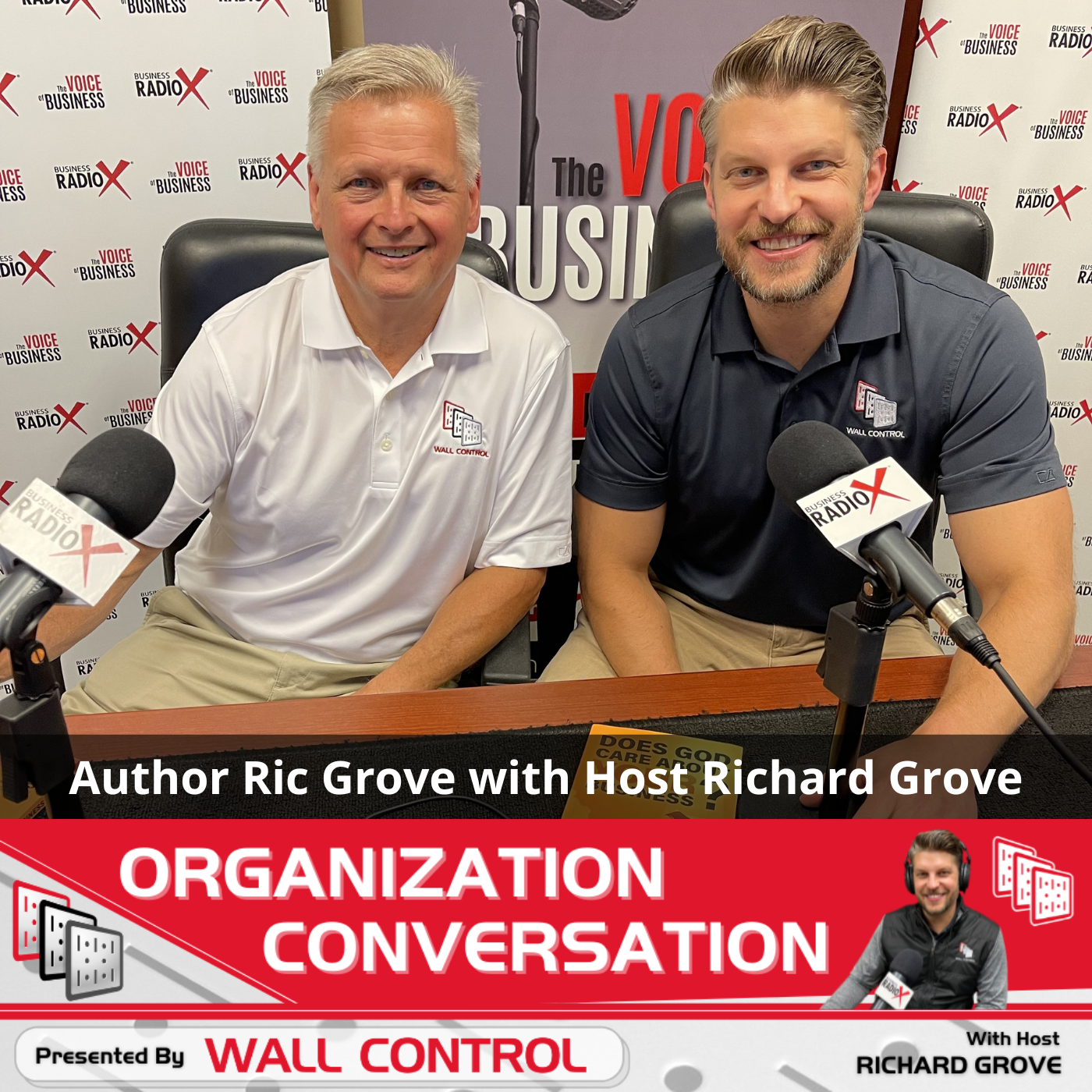
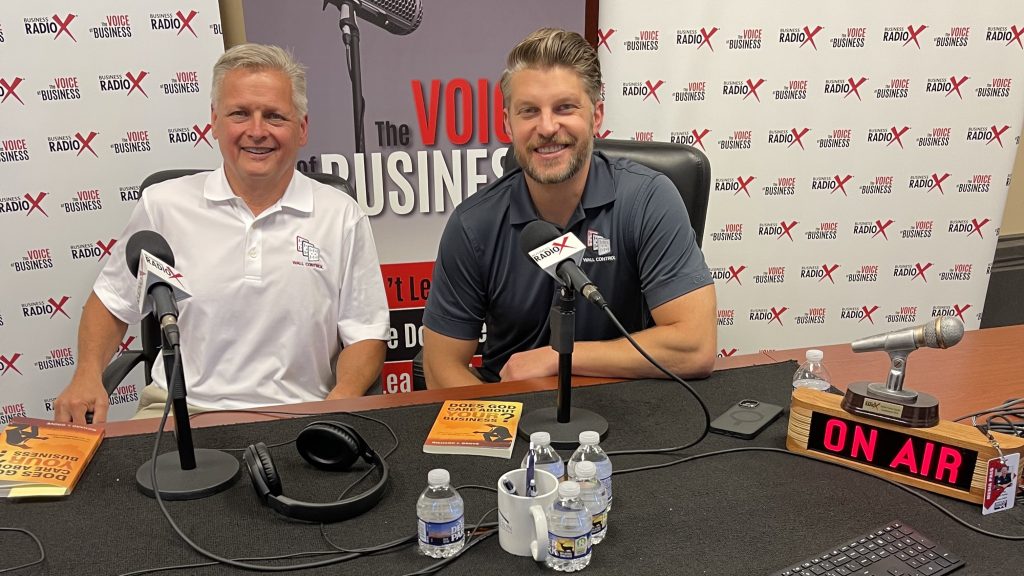
Does God Care About YOUR Business with Author Ric Grove, on the Organization Conversation podcast with host Richard Grove
North Fulton Studio
Does God Care About YOUR Business with Author Ric Grove
Loading
00:00 /
RSS Feed
Share
Link
Embed

Download file

Does God Care About YOUR Business with Author Ric Grove, on the Organization Conversation podcast with host Richard Grove

Does God Care About YOUR Business with Author Ric Grove (Organization Conversation, Episode 61)

In this unique episode of Organization Conversation, host Richard Grove welcomes his father, Ric, to discuss the intersection of business and faith. Ric, who has over 30 years of experience in both business management and Bible study, shares insights from his book Does God Care About YOUR Business? The conversation delves into the significance of maintaining one’s relationship with God while pursuing business success. Drawing from personal anecdotes and scripture, Rick explains how business ambitions should not come at the expense of spiritual commitments. He emphasizes that while God does not micromanage business outcomes, the principles and values upheld during business operations are of utmost importance. The episode offers thought-provoking reflections for anyone grappling with how to integrate their faith into their life as a business owner.

Organization Conversation is sponsored by Wall Control. The show is produced by John Ray and the North Fulton studio of Business RadioX®.

Ric Grove, Dekalb Tool & Die and Author, Does God Care About YOUR Business?
Ric Grove, Author, Does God Care About YOUR Business?

Ric Grove is the CEO of Dekalb Tool & Die and author of the newly-released book, Does God Care About YOUR Business?

Established in 1968, Dekalb Tool & Die, Inc. is the sister company of Wall Control Storage Systems. DeKalb Tool & Die specializes in crafting, repairing, and innovating a diverse array of metalworking tools. Whether it’s progressive dies, transfer dies, draw dies, or single hit tooling, they possess the expertise and resources to meet your needs. From CAD design to timely delivery, they ensure comprehensive tooling service.

Beyond their design and build capabilities, they excel as a competitive source for quality metal stampings. With presses ranging from 60 to 1800 tons and coil feed capability up to 60″ wide, their versatility enables them to produce a wide range of stamped metal parts.

Recognized for exceptional customer service and on-time deliveries, they were recently honored with Blue Bird Corporation’s Global Supplier of the Year award. While they take pride in their state-of-the-art equipment and technologies, it’s their skilled employees who remain their most valuable asset.

They invite you to experience their facility firsthand with a personal tour when you’re in the Atlanta area. As you explore their capabilities on their website, they’re ready to address any inquiries and provide assistance. They eagerly anticipate the opportunity to quote on your tooling and metal stamping needs, offering competitive prices and unwavering honesty in their business transactions.

Dekalb Tool and Die values the chance to introduce you to their company and demonstrate their commitment to excellence.
Website | Instagram

Does God Care about your business, author Ric Grove, on the Organization Coversation Podcast with Richard Grove

About Organization Conversation

Organization Conversation is hosted by Richard Grove and broadcast and produced from the North Fulton studio of Business RadioX®. You can find the full archive of shows by following this link. The show is available on all the major podcast apps, including Apple Podcasts, Spotify, Amazon, iHeart Radio, and others.

Richard Grove, Wall Control
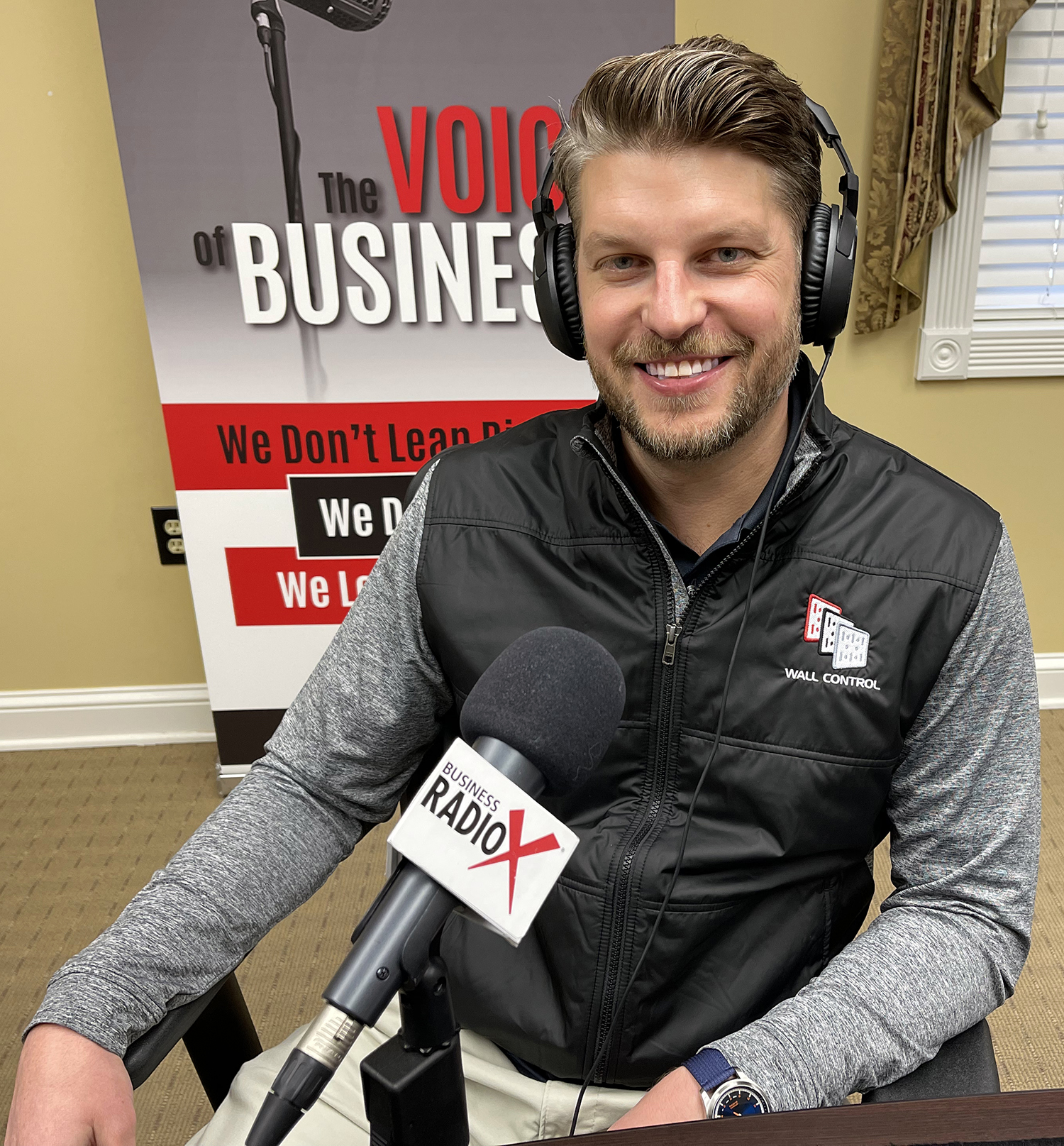
Richard Grove, COO, Wall Control, Small Business Consultant, and Host of Organization Conversation

Richard Grove‘s background is in engineering, but what he enjoys most is brand building through relationships and creative marketing. Richard began his career with the Department of Defense as an engineer on the C-5 Galaxy Engineering Team, based out of Warner Robins. While Richard found this experience both rewarding and fulfilling, he always knew deep down that he wanted to return to the small family business that originally triggered his interest in engineering.

Richard came to work for the family business, Dekalb Tool & Die, in 2008 as a Mechanical Engineer. At the time, Wall Control was little more than a small ‘side hustle’ for Dekalb Tool & Die to try to produce some incremental income. There were no “Wall Control” employees, just a small warehouse with a single tool and die maker that would double as an “order fulfillment associate” on the occasion that the original WallControl.com website, which Richard’s grandmother built, pulled in an order.

In 2008, it became apparent that for the family business to survive, they were going to have to produce their own branded product at scale to ensure jobs remained in-house and for the business to continue to move forward. Richard then turned his attention from tool and die to Wall Control to attempt this necessary pivot, and his story with Wall Control began. Since that time, Richard has led Wall Control to significant growth while navigating two recessions.

Outside of Richard’s work at Wall Control, he enjoys helping other business owners, operators, and entrepreneurs along their own paths to success by offering personal business coaching and advice through his website, ConsultantSmallBusiness.com. Richard has developed an expansive and unique skillset, growing and scaling Wall Control through a multitude of challenges to become the successful brand and company it is today. Richard is happy to share his knowledge and experience with others who are looking to do the same within their own businesses.

Connect with Richard: Instagram | Twitter | LinkedIn | Richard’s Website
Tagged With: Dekalb Tool & Die, faith, faith and business, faith in business, Organization Conversation, Ric Grove, Richard Grove, Wall Control

Decision Vision Episode 88: Should I Mix My Faith With Business? (Part Two) – An Interview with Soumaya Khalifa, Khalifa Consulting, Inc.

October 22, 2020 by John Ray

Khalifa Consulting
Decision Vision
Decision Vision Episode 88: Should I Mix My Faith With Business? (Part Two) - An Interview with Soumaya Khalifa, Khalifa Consulting, Inc.
Loading
00:00 /
RSS Feed
Share
Link
Embed

Download file

Decision Vision Episode 88: Should I Mix My Faith With Business? (Part Two) – An Interview with Soumaya Khalifa, Khalifa Consulting, Inc.

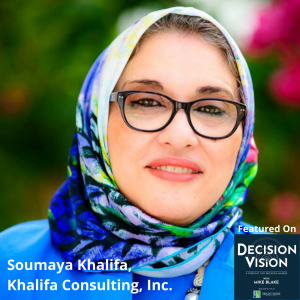
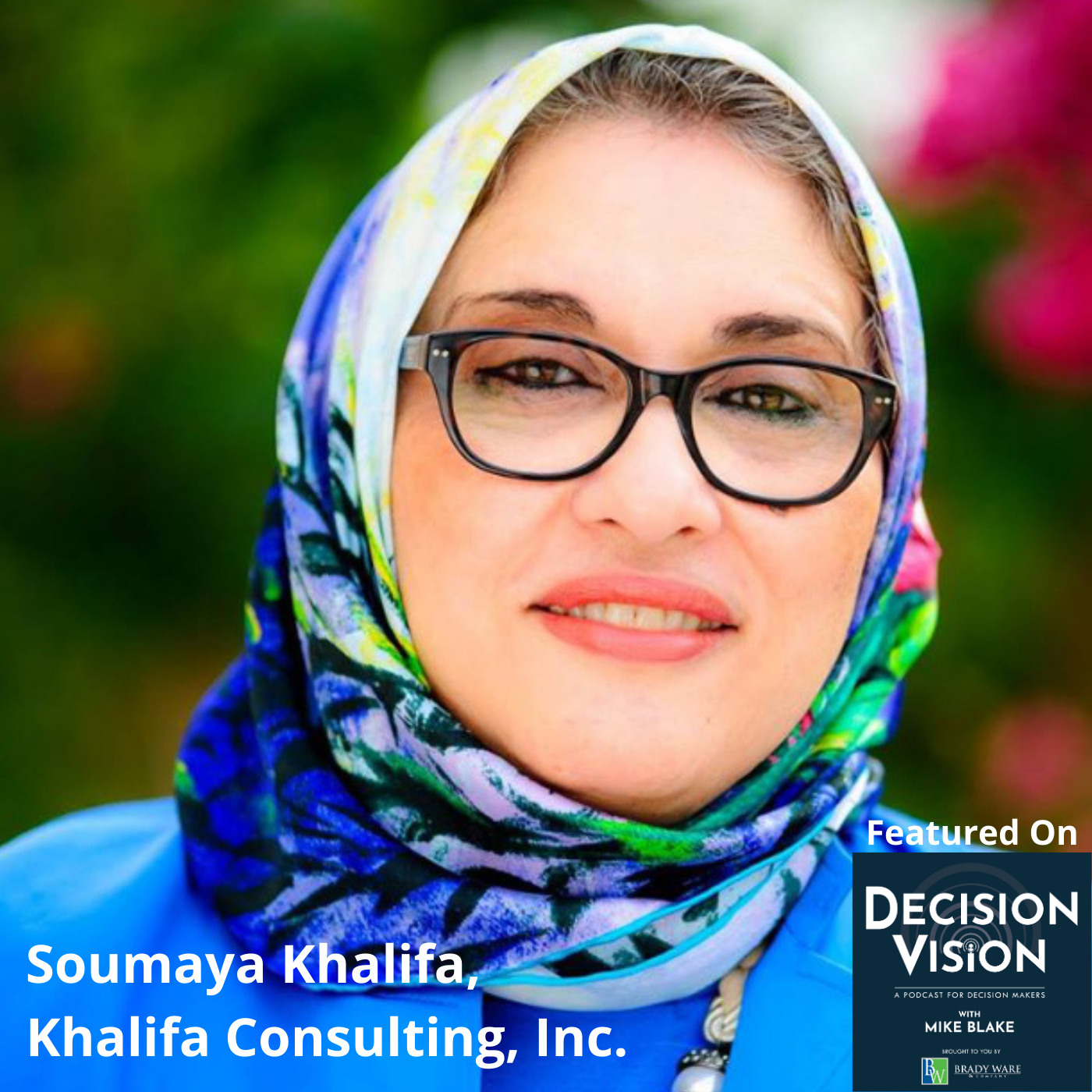
Khalifa Consulting CEO Soumaya Khalifa joins host Mike Blake to discuss how she integrates her Islamic faith with her work and business, as well as her community-building work with the Islamic Speakers Bureau. “Decision Vision” is  presented by Brady Ware & Company.

Soumaya Khalifa, Khalifa Consulting, Inc.

Soumaya Khalifa founded Khalifa Consulting, a strategic intercultural and leadership consulting firm, in 2007. Her career spans more than 25 years in human resources, management, business management and ownership, non-profit and entrepreneurship. Khalifa Consulting specializes in helping executives and organizations succeed when doing business across cultures by providing them the most relevant, practical and up to date cross cultural coaching and training. In addition, Khalifa Consulting offers training and coaching on global virtual teams. Soumaya and team apply this work to a broad range of clients, from large established national and global organizations to startups.

Prior to founding Khalifa Consulting, Soumaya served in several leadership roles in U.S.-based Fortune 100 companies in human resources, leadership development and diversity and inclusion. An alumnus of the University of Houston and Georgia State University, Soumaya is a board member of the Society of Intercultural Education, Training and Research (SIETAR) and the Atlanta Interfaith Broadcasters (AIB). She is also an adjunct professor at Emory University Center for Continuing Education and at the Federal Executive Institute. Soumaya is the author of Diversophy Egypt and has contributed to several publications.

Along with a group of Atlantans, Soumaya launched the Islamic Speakers Bureau (ISB) of Atlanta in August 2001. As the current Executive Director of ISB, she serves the Muslim and wider community by building bridges of understanding, creating interfaith partnerships, developing community leaders, and creating spaces for mutual understating and respect. Under Soumaya’s leadership, the ISB has developed its core programming and launched other key initiatives, including ISB Leadership Institute (ISBLI), 100 Influential Georgia Muslims, and 40 Under 40 Georgia Muslims.  In 2017, Soumaya created a partnership with the Atlanta Mayor’s Office to host the ISB’s first ever Ramadan Iftar hosted at Atlanta’s City Hall and in 2018, the second Atlanta Mayor’s Iftar was attended by over 250 people.

Soumaya has received many awards and recognitions for her work with the ISB, including:

  • 2019 Academy of Women Achievers, YWCA
  • 2018 Arab American High Achiever Award, Alif Institute
  • 2017 City of Atlanta Phoenix Award, presented by Mayor Kasim Reed
  • 2012 FBI’s Community Leadership Award
  • Citizen Diplomat for the U.S. State Department
  • 2012 Invited to the annual White House Iftar hosted by President Barak Obama
  • 2015 Inducted into the College of Ministers and Laity

To learn more on Khalifa Consulting, follow this link.

Michael Blake, Brady Ware & Company

Mike Blake, Host of the “Decision Vision” podcast series

Michael Blake is Host of the “Decision Vision” podcast series and a Director of Brady Ware & Company. Mike specializes in the valuation of intellectual property-driven firms, such as software firms, aerospace firms and professional services firms, most frequently in the capacity as a transaction advisor, helping clients obtain great outcomes from complex transaction opportunities. He is also a specialist in the appraisal of intellectual properties as stand-alone assets, such as software, trade secrets, and patents.

Mike has been a full-time business appraiser for 13 years with public accounting firms, boutique business appraisal firms, and an owner of his own firm. Prior to that, he spent 8 years in venture capital and investment banking, including transactions in the U.S., Israel, Russia, Ukraine, and Belarus.

Brady Ware & Company

Brady Ware & Company is a regional full-service accounting and advisory firm which helps businesses and entrepreneurs make visions a reality. Brady Ware services clients nationally from its offices in Alpharetta, GA; Columbus and Dayton, OH; and Richmond, IN. The firm is growth minded, committed to the regions in which they operate, and most importantly, they make significant investments in their people and service offerings to meet the changing financial needs of those they are privileged to serve. The firm is dedicated to providing results that make a difference for its clients.

Decision Vision Podcast Series

“Decision Vision” is a podcast covering topics and issues facing small business owners and connecting them with solutions from leading experts. This series is presented by Brady Ware & Company. If you are a decision maker for a small business, we’d love to hear from you. Contact us at decisionvision@bradyware.com and make sure to listen to every Thursday to the “Decision Vision” podcast.

Past episodes of “Decision Vision” can be found at decisionvisionpodcast.com. “Decision Vision” is produced and broadcast by the North Fulton studio of Business RadioX®.

Visit Brady Ware & Company on social media:

LinkedIn:  https://www.linkedin.com/company/brady-ware/

Facebook: https://www.facebook.com/bradywareCPAs/

Twitter: https://twitter.com/BradyWare

Instagram: https://www.instagram.com/bradywarecompany/

Show Transcript

Intro: [00:00:01] Welcome to Decision Vision, a podcast series focusing on critical business decisions. Brought to you by Brady Ware & Company. Brady Ware is a regional, full-service accounting and advisory firm that helps businesses and entrepreneurs make visions a reality.

Mike Blake: [00:00:20] And welcome to Decision Vision, a podcast giving you, the listener, clear vision to make great decisions. In each episode, we discuss the process of decision making on a different topic from the business owners’ or executives’ perspective. We aren’t necessarily telling you what to do, but we can put you in a position to make an informed decision on your own and understand when you might need help along the way.

Mike Blake: [00:00:39] My name is Mike Blake, and I’m your host for today’s program. I’m a Director at Brady Ware & Company, a full-service accounting firm based in Dayton, Ohio, with offices in Dayton; Columbus, Ohio; Richmond, Indiana; and Alpharetta, Georgia. Brady Ware are sponsoring this podcast, which is being recorded in Atlanta per social distancing protocols. If you like this podcast, please subscribe on your favorite podcast aggregator and please consider leaving our view of the podcast as well.

Mike Blake: [00:01:04] So, today’s topic is actually a continuation of a prior topic or a previously recorded topic, which is, should I mix my faith with my business? And this will be part two. In part one, we had, I thought, a tremendous discussion with Bill Leonard and Jonathan Minnen, who are from the Christian and Jewish faiths, respectively. And really, I really appreciate it, and I hope you, as listeners, appreciated the fact that they were very open about how they came to approach mixing their faith with their business, how it impacts their business, what that decision process looks like. And I think that we learned a lot.

Mike Blake: [00:01:53] But to be candid, in an ideal world, I wanted to have this be a little bit broader than that because there’s another faith. I mean, you could say there are many faiths that are missing, but I think a faith that was obviously missing – and that was due simply to scheduling constraints – is Islam. And Islam, I think … I’m not going to claim to be particularly knowledgeable about it. I know what I’ve read, I know what I studied in college five million years ago, but that’s about it. But Islam has a different or, certainly, a very identifiable place in American society.

Mike Blake: [00:02:39] And it’s different. I think it’s much more prominent now in the United States than it was, say, 50 years ago or even 30 years ago. And I think that people who practice Islam face different challenges and maybe even different rewards. We’ll find out from our guests. But I think there’s a different relationship with business, in general. I think there’s a different relationship with Islam and mainstream American society than the Jewish and Christian faith have.

Mike Blake: [00:03:08] So, to be perfectly candid, I just felt like this conversation was not complete without getting a view from the Muslim perspective. And I hope you’ll agree that it’s worthwhile. So, we’ve never done a two-parter before. We didn’t necessarily have a cliffhanger or anything, but I do think that this is necessary to have a more comprehensive and complete discussion.

Mike Blake: [00:03:33] So, joining us today is Soumaya Khalifa, who founded Khalifa Consulting, a strategic intercultural and leadership consulting firm back in 2007. Her career spans more than 25 years in human resources management, business management and ownership, nonprofit and entrepreneurship. Khalifa Consulting specializes in helping executives and organizations succeed when doing business across cultures by providing them with the most relevant, practical and up-to-date cross-cultural coaching and training.

Mike Blake: [00:04:07] Along with a group of Atlantans, Soumaya launched the Islamic Speakers Bureau of Atlanta back in August 2001. We’ll talk about that. That’s an interesting date. As the current executive director of ISB, she serves the Muslim and wider community by building bridges of understanding, creating interfaith partnerships, developing community leaders, and creating spaces for mutual understanding and respect. Under Soumaya’s leadership, the ISB has developed its core programming and launched other key initiatives, including ISB Leadership Institute, 100 Influential Georgia Muslims, and 40 under 40 Georgia Muslims.

Mike Blake: [00:04:44] In 2017, Soumaya created a partnership with the Atlanta Mayor’s Office to host ISB’s first ever Ramadan Iftar hosted at Atlanta City Hall. And in 2018, the second Atlanta mayor Iftar was attended by over 250 people. Soumaya has received many awards and recognitions for her work with the ISP, including Academy of Women Achievers of the YWCA, the Arab-American High Achiever Award of the Alif Institute, City of Atlanta Phoenix Award, the FBI’s Community Leadership Award. That’s interesting. We’ll have to get back to that. She’s a citizen diplomat for the US State Department and numerous other recognitions, but you get the idea. She’s highly accomplished and highly recognized for those accomplishments. And we are fortunate. And I am so glad she agreed to come on the podcast. Soumaya, thank you for coming on the program.

Soumaya Khalifa: [00:05:36] Mike, it’s my pleasure and honor. Thank you so much for having me.

Mike Blake: [00:05:40] So, before we get into this, I want to ask because I think this is really important, the FBI’s Community Leadership Award. Tell us about what led to being recognized. I assume it’s the FBI, like what I recognized, Federal Bureau of Investigation, or some other acronym. What led to that?

Soumaya Khalifa: [00:06:03] Yeah. So, that was quite an experience. I got to actually travel to their headquarters and receive the award by then FBI Director Mueller. And it was quite an experience being there, and touring their facility and just seeing what’s there. I was part of their outreach, diversity and inclusion outreach team that we had for several years many years ago. And they recognized the work that the ISB does here in Atlanta in terms of building bridges, and they felt like that was something that is much needed, and they recognized me for the work. So, I was, again, very fortunate and gotten a lot of awards and recognitions that I wouldn’t have dreamt of many years ago. So, again, very lucky and very fortunate.

Mike Blake: [00:06:57] Well, congratulations and thank you for your service to our society. So, I’ve studied Islam about as much as I needed to to graduate from college with a Liberal Arts degree. I know it’s a highly complex religion, but how would you describe your faith? I think you can do a much better job than I ever could.

Soumaya Khalifa: [00:07:22] Yeah. So, it’s not any more complicated than Christianity or Judaism. The three faith traditions are monotheistic religions and they’re Abrahamic traditions. So, there are a lot of similarities between the three. In terms of the essence of Islam in the word itself, it means peace, submission to the will of God, and creating peace in the world. And the person, even Muslims, when they greet each other, they have a covenant that they say to each other, and that is, “May peace be upon you,” which means that you will not get anything from me but peace, whether it’s in interactions, or talking about you, or anything at all, it’s peace.

Soumaya Khalifa: [00:08:09] So, it is a misunderstood religion. It is a religion, unfortunately, that a lot of people associate terrorism with. And I love talking to groups and asking them, “You know what comes to mind when you hear the word “Islam” and “Muslims?” And sometimes, people don’t want to say, and I say, “Hey, how about the T word, does that come to mind? Do you hear it?” And yeah, they do.

Soumaya Khalifa: [00:08:33] So, the two misconceptions about Islam that I hear all the time is that Islam is associated with terrorism, all Muslims are terrorists, and the other one is that all women are oppressed. And I have a lot of fun with the second one because I ask audiences and people, do you think I’m oppressed? And they look at me and they say, “Well.” “So, you should ask my husband.” And we have a little fun with that.

Soumaya Khalifa: [00:08:58] But absolutely, it is. It’s a religion that people don’t know about. And a lot of times, when they hear about it, it is in a very negative sense. There isn’t a face of Islam that is carried throughout our country and our communities that portrays the good that Muslims do. And Muslims, like any other group of people, Christians included, Jews and Hindus and others, there is the good, the bad and the ugly.

Mike Blake: [00:09:28] So, you made an interesting decision and a conscious one, not just to really connect your faith with your business but to build a business, if you will, around your faith. A lot of it is around educating individuals, companies, organizations about Islam, about inclusiveness with people who practice that faith and others. I know it’s not just limited to that, but certainly it is sort of the headline. So, what drew you to that? I mean, you’re a very capable person. You could have done, I’m sure, anything that you wanted. What drew you to make that your mission?

Soumaya Khalifa: [00:10:11] Sure. I just want to make a distinction here. I wear a couple of scarves, if you will. So, I have a nonprofit (versus hats). There’s the nonprofit that I started in 2000 right along with a group of people who wanted to do something about building bridges of understanding because what we saw then, and it’s still happening right now, is that people speak about Islam and Muslims, and they have not a good idea and not a correct idea about Islam and Muslims. They don’t know about our community. So, we wanted to train people within the First Amendment guidelines of teaching and not preaching to be able to speak about Islam and Muslims to have embody they’re my neighbor, they’re my coworker, et cetera, and really building that connection between people.

Soumaya Khalifa: [00:10:57] And so, that is one thing that was started in 2001. And at the time, I was in corporate America doing human resources. So, thinking back about that journey and what I did then, I just can’t even comprehend how I did that while having a full-time job in corporate America. So, that’s one thing that I felt like was necessary to build bridges of understanding. And it wasn’t about promoting the religion. It was just to understand each other and build a stronger community where people don’t fear others. So, that’s one of the things that I do.

Soumaya Khalifa: [00:11:29] The other one is a business, and that is Khalifa consulting. And as you mentioned in the introduction, it’s to help people understand the business they’re getting into, to understand the culture for them to be successful. Khalifa Consulting has many consultants that cover the whole wide world. So, if we have a client that’s going to Germany, we have somebody who can do Germany. China, Russia, what have you, there’s that network of consultants who cover the whole wide world.

Soumaya Khalifa: [00:12:00] Because of my own background, my own cultural background, my own upbringing, I offer the training, and the consulting and the coaching on the Arab world. And as you know, the majority of the Arab world is Muslim. And so, we talk about Islam, and how it impacts their business, and what do they need to be aware. Of anything from gift giving, don’t do pork or alcohol, to the holidays, to how people communicate. And that’s not religion; it’s more culture.

Soumaya Khalifa: [00:12:31] So, those are the two distinctions in terms of the business piece and the nonprofit work. But it’s like you said, both of them are about helping people understand in different circumstances. With the ISB, it’s more about community and community building. And Khalifa Consulting is about the business world and helping individuals, leaders and organizations be successful as they interact with different cultures.

Mike Blake: [00:13:00] So, yeah and understood. There’s a cultural component, religious component. And while they are certainly separate, they frequently are quite closely linked. And so, what I’d be curious to understand from you is this, is that, are there ways in which the way you conduct business is maybe different from what kind of a garden variety, if this can even be said, but a garden variety American business is conducted because of your desire and the importance to you of being true to your faith? Does it manifest itself in the business? Does Islam manifest itself in the business itself? I hope I have asked that question in a way that you understand

Soumaya Khalifa: [00:13:49] Yeah. I think each and every one of us has a moral compass. And the moral compass is the faith tradition that we adhere to. And whether we realize it or not, it kind of helps us navigate through things. For instance, holding true to your word, keeping the individual, valuing the customer, valuing yourself, telling the truth. And I don’t think this is just to Islam, but I think it’s due to many faith tradition, treating people with dignity and respect, not cheating people, et cetera, et cetera.

Soumaya Khalifa: [00:14:30] And again, this is in Islam ,as well, I’m sure, as Christianity, and Judaism, and other faith traditions as well. So, it is my moral compass. It’s probably unconscious, but it’s there. It’s how I’m kind of wired. And again, I believe that that’s not just particular to me, but it’s to everyone else.

Mike Blake: [00:14:54] So, you chose to name your firm Khalifa Consulting. And I think to most people that they may understand that that’s your last name or your family name or not. But it clearly sounds like a name that comes from a region that practices a lot of Islam, at least fairly widely. Was that a conscious decision in the branding? And whether it was or not, have you found that it evokes any kind of maybe preconceptions or stereotypes? Does it help you within the Islamic community? Does it create barriers elsewhere? Talk about kind of how that’s impacted the business. If it has at all?

Soumaya Khalifa: [00:15:43] I love the question. So, I’m going to tell you a story. There was an event in Atlanta and a high-up person in the Gulf State was here to speak about their country and how opportunities are there, et cetera. And I attended, and I walked in, and people saw my name who are not part of that country’s entourage, if you will. And they saw my name, and I was like given the royal treatment. And I was just saying, “What in the world is that?” I was just like not really comprehending what was going on. But they saw my name and they thought I was part of the royal clan for that country. And they just took care of me. And after a while, I realized what happened.

Soumaya Khalifa: [00:16:30] But, yeah, I think the reason that I chose Khalifa Consulting is because when I started out, I was not sure how it was going to go in terms of what my business is going to focus on because I have a wide variety of things that I provide and do, all the way from consulting, coaching, executive coaching, and human resources, and the intercultural world diversity and inclusion. So, I wanted something that kind of was an umbrella name that brought all those things under it. So, that’s the reason. I don’t know whether it was a smart way of doing it or not, but that’s how I started. And because I started that way and I’ve been known in the marketplace as that, I’m just continuing with it. Is there a better name? Maybe, but moving forward with Khalifa Consulting.

Mike Blake: [00:17:23] So, I’m going to ask you a completely off-the-wall question because I’m a language junkie and probably a lot of our listeners will roll their eyes, but that’s okay, it’s my show. And that is, I’m curious-

Soumaya Khalifa: [00:17:35] Go for it.

Mike Blake: [00:17:35] I’m curious if the name Khalifa, is at all related to the term chalice, which implies some sort of of Ducci, or county, or something of that nature.

Soumaya Khalifa: [00:17:47] Yeah. Khalifa means Vice Gerente or the ruler. And so, within the Islamic tradition, the Khalifa is the leader of the group, or the family, or  I’m just really lucky to have that name. I feel like, “Hey, all right, I need to live up to it,” but yeah. Khalifa means a responsible person, right? So, it’s a godsend human beings to be His vice gerente on earth, so human beings could take care of the earth, et cetera. So, it has like a title of of leadership, but it also has a title of true responsibility.

Mike Blake: [00:18:31] Well, good. Thank you for that. So, that’ll be our duo-lingo diversion for the day. So, do you ever run into any kind of conflict? Do you ever have to make any conscious decisions of where your faith starts and ends, where your business starts and ends? Do you find yourself having to make decisions that maybe today, I want to be less obvious or open about my faith, or another day in another situation, I want to be more open about my faith? So, do you ever have to make those kinds of decisions? And if so, what goes into that?

Soumaya Khalifa: [00:19:06] Yeah. I really don’t think about it that way at all. I am who I am. And I struggle with that for a long time, and it was a journey. I was born in Egypt, came to Texas as a teenager. I went to middle school and high school. And throughout my early years, I really struggled with my identity, and I struggled with my Egyptianness, if you will, my Muslimness and my Americanness. And it was like three people in one. And those three people in one did not come out as three people in one told people. I would reveal parts of me that I thought people were comfortable with.

Soumaya Khalifa: [00:19:47] So, until I took that journey of being comfortable with who I was that I said, “Hey, world, here I am,” and this is when I started covering my hair. It was shortly thereafter that I started the Islamic Speakers Bureau. This is when I really embraced who I was. It was not an easy journey. It was much, much easier not to wear a headscarf and to just kind of try to build in and assimilate, but I felt like part of me was being lost. That, besides the nagging of my mom. When are you going to cover your hair, right? When are you going to cover your hair?

Mike Blake: [00:20:24] Parents. Well, parents will always have a big influence on that.

Soumaya Khalifa: [00:20:27] They sure do.

Mike Blake: [00:20:28] So, I’m curious, and if this question is out of bounds, weigh it out, but was there one particular incident that pushed you over and said, “You know what? Yeah, I want to embrace this identity. I’m going to wear the headscarf and let strangers know that I’m a practitioner of Islam”?

Soumaya Khalifa: [00:20:51] Yeah. I think it was more than a journey versus a one incident that happened that kind of got me to do that. I was listening to religious tapes about how women are supposed to do that. And by the way, women who do not cover their hair, who are Muslim, it does not mean they are less religious. It’s just they choose not to. So, it was just that, plus my mom, plus I just felt like, “Hey, I’m not getting any younger, I need to do something about it.” And I did.

Soumaya Khalifa: [00:21:18] And I have to tell you, that was just like the most uncomfortable decision I ever made in my life. I did not know how to put the headscarf on. I remember, at the time I was working, I just finished my MBA, and I was working as an intern for a major company, and one day, I went with my hair. And then, the following Monday, I went in with the head covered, and people did not know what to make of me, and I had to do a lot of explanation. And as that was going on, my scarf fell off because I did not know how to put it on. And it was just like a real ordeal.

Soumaya Khalifa: [00:21:55] And even though it’s a piece of cloth, it’s a lot of psychological getting used to and being able to be comfortable with it. And I wasn’t comfortable with it for a long time. And I felt like people were staring at me and the whole nine yards until I embraced it myself and started shopping for different headscarves. And there was something more to shop for. I got very excited about that. And that’s when I became okay with it.

Mike Blake: [00:22:23] Now, we had a previous conversation. You said something that I think is fascinating and I just did not know is that not all scarves are alike. And the way that one wears it, you can identify somebody’s origin from the Muslim world or how they practice Islam by virtue of how their scarf is is worn, correct?

Soumaya Khalifa: [00:22:46] Yes, yes, yes, absolutely. And even what age category they might be from. It’s fascinating. It’s a fascinating observation just to sit there and kind of look at women’s scarfs, and how they tie them, and what color, what’s the material, et cetera. Now, I’ve discovered something since we talked. I discovered there’s a COVID scarf. And the COVID scarf is a scarf where people could put their masks on while having a scarf on. So, the regular scarf that I used to wear would not allow me to put this really easily. And so, this is now my COVID scarf because it allows us to put on the mask and take it off easily.

Mike Blake: [00:23:26] Well, one adapts, right? So, Islam has been around a long time. So, it’s gone through many adaptations. This is another one of those adaptations, I guess. So, you led off by kind of pointing out the elephant in the room.

Mike Blake: [00:23:44] So, I want to put a bright light on it. And that is it strikes me that having a business that is associated with Islam is different from one that’s associated with Christianity or Judaism, not only because it’s less common and also more concentrated, I think, in certain regions of the country but, of course, America itself has had a troubled, and frankly – and I’m not going to get into the reasons why, but you cannot deny there’s a violent relationship with, say, certain elements of Islam, I guess, for lack of a better term or, at least, conflict with individuals who have decided to brand themselves under the name of Islam in order to accomplish whatever social and political goals that they’re accomplishing. And that’s a little bit different, right? You’re operating in a country that in some cases, recently, has been in a state of war with Islamic countries.

Mike Blake: [00:24:54] And I will say this. I thought George Bush the first did a really good job of trying to make clear that we were at war with states that happen to have governments that claim to espouse Islam, and we are not pursuing war against the Muslim people. It’s a very sort of dancing on the head of a pin there. But I do think he made a good faith effort to try to communicate that. But I mean, it’s got to be different, right?

Mike Blake: [00:25:21] I mean, America right now does not have a military conflict with a Christian-dominated or a Jewish-dominated nation, but America has had that. I think it necessarily creates, I think, certain tensions, certain preconceptions. I think even, unfortunately, among certain people, a starting point of suspicion and hostility. One, I guess, do you agree with that observation? And two, if so, how do you work within that? How do you survive mentally in that kind of environment, because I can only imagine how difficult that must be?

Soumaya Khalifa: [00:26:16] Yeah. In terms of the conflict between the US and Muslim majority countries, that is a debate that people can have. Is it really a conflict, or we talked about weapons of mass destruction in Iraq, and after so many years, we found that there were no weapons of mass destruction? And so, there are a lot of debate going on about about the validity of the conflicts that we are part of and claimed for it to be because of whatever. So, let’s put that aside.

Soumaya Khalifa: [00:26:50] But what I want to say, what’s really here and now that is a very troublesome is the Muslim ban. When we have a Muslim ban, and I walked down the street with the headscarf on, that puts me and my fellow 12 million Muslims, American Muslims, in jeopardy because people are getting a message from the highest office in this land saying Muslims are a danger to our country and our society. So, that is truly something that hits very close to home, and I can talk for a long time about that.

Soumaya Khalifa: [00:27:25] But in terms of the business itself, it’s not about just Islam and Muslims. Khalifa Consulting, it’s about cultural understanding for the whole wide world. And it’s not just me. I have about 10 or 12 colleagues who cover, again, the entire world. But when it comes to the part of the world that I handle, which is the Arab world and the US, people want to come to us because we know how to help them to navigate in that part of the world, in the business world, so they could be successful.

Soumaya Khalifa: [00:27:58] I have worked with so many different organizations, US organizations, that their market in the US is basically shrinking, and the only way for them to expand is to go to emerging markets, what they call emerging markets. And the Arab world with over 300-400 million people, it’s a very opportune place for many of the businesses, whether it is in the car business, or the automotive business, or defense, or food. So, it’s a business decision. It’s not about the faith. It’s not about anything.

Soumaya Khalifa: [00:28:39] We talk about the faith that’s part of them understanding what they’re getting into because you don’t want them to schedule meetings for Friday. Why weren’t the Saudis, or the Egyptians, or, or, or coming to our meetings on Fridays? Because it’s their holidays. It’s their weekly weekend. And so, you don’t do that. And this is just a very simplistic example of seeing people who don’t understand the different ways of communication.

Soumaya Khalifa: [00:29:07] Americans tend to be more direct communicators. When you go to the Arab world, it’s about saving face. It’s to not put anybody in an embarrassment position. So, how do we understand indirect communicators, and how do we bridge that gap between the two cultures to run the business, to get to the bottom line, to add to the bottom line and be successful? So, it’s not all about religion. It’s about being successful in a different culture that is very different for many people to navigate through.

Mike Blake: [00:29:43] Before we recorded our show, I got dressed because we’re doing video. I had originally put on a T-shirt that said “Got bacon,” and my wife said, “Aren’t you doing that interview about Islam today?” I go, “Yeah.” She says, “Are you really sure you want to wear that for this video?” “No. Maybe you’re right. Maybe I’ll do a quick change here.” So-

Soumaya Khalifa: [00:30:10] But there is turkey bacon too. So, there are always options. It’s not all pork. There’s turkey bacon.

Mike Blake: [00:30:16] Oh! I haven’t thought of that. I had a chance to win an argument with my wife and I blew it. Ugh! Okay. Well, at any rate, but-

Soumaya Khalifa: [00:30:16] You should have called me, Mike.

Mike Blake: [00:30:28] Sure, I should have. I should have. So, let me ask this. The thing about … actually, this actually segues to one of the questions I really wanted to make sure I got to. So, bearing what you just described in mind, and to me, it reminds me of maybe a little bit of what it might have been like to be a Russian immigrate here during the height of the Cold War, right? You’re here, but you’re obviously from “the other side.” And I have to imagine that that also had its own challenges. Now, the timeline for Khalifa Consulting was you started it in August of 2001, correct?

Soumaya Khalifa: [00:31:15] That’s the ISB.

Mike Blake: [00:31:16] ISB, sorry. The ISB in 2001.

Soumaya Khalifa: [00:31:18] Yeah, yeah.

Mike Blake: [00:31:18] That’s right. Khalifa was 2007. So, you started that. And then, a month later, the attacks of September 11th, 2001.

Soumaya Khalifa: [00:31:30] Three weeks.

Mike Blake: [00:31:30] And so, I mean, walk through as as somebody who just launched an Islamic commercial venture, and feel free if you want to just comment on being a practitioner of Islam at that time, what’s going through your head? How does your life experience change? What are you thinking about your business?

Soumaya Khalifa: [00:31:57] When you were talking about that, my whole body felt like I was there in September 11th, 2001. It was a nonprofit that I launched. It was into businesses, and non-profit, educational outreach. We had our training on August the 18th, which was approximately three weeks before 9/11 happened. We had just trained people to speak about Islam and Muslims within the First Amendment guidelines. They took their test, and we were getting ready to launch.

Soumaya Khalifa: [00:32:30] When the morning of 9/11, I went to my job, and I was in downtown Atlanta in the high-rise up on a very high floor. I heard the news about what happened in New York and in Washington. And I was scared. I was very scared. I was sad. I was angry. I had no idea what was going on. I was just thinking the people who were killed. Are people like me who went to their work in the morning, and they were waiting to get home to their kids and their family? And guess what? They did not make. And what was the reason for that? And it was a very, very tough day, I had three children at the time. I still have them, Thank God. They were in daycare and what have you. I was very worried about them. I was very worried about my husband.

Soumaya Khalifa: [00:33:28] They were talking about the terrorists were going to hit Atlanta because of CNN. We were very close to CNN. They pulled us all into a conference room to watch what’s going on. And I mean, I’m talking about right now, and just my whole body feels the same way. It was just very, very, very angry, very scared, very just in despair. Why did that happen? How can anybody do this?

Soumaya Khalifa: [00:34:02] And then a few days later, we find out who did it. And I got even angrier because the people not only killed 3000 people for no reason at all, innocent people, but they also hijacked a whole religion at 1.5 billion people. And so, anger. It got even worse because what they did to a religion in people. And we’re still paying the price of the horrendous, stupid act that they did. I can’t tell you how angry I am still. And I hope they get what they deserve in the hereafter because human life is very sacred in Islam, and taking innocent life is just one of the worst ever transgressions in the religion. Nobody could call themselves a Muslim and do that.

Mike Blake: [00:35:10] Yeah. As an observer, you try to put yourself, and as an interviewer, you try to put yourself in the shoes of the person that you’re interviewing. And I can hear in your voice how tremendously upsetting that must have been and continues to be. And like the rest of us as a country, we’ve had to move on, and the Islamic community has had to move on and attempt to build bridges. And in our society, some people have moved on, I would characterize, more successfully than others.

Mike Blake: [00:35:55] And let’s move on beyond that. In spite of that, I’m curious kind of in the wake of that attack, there must have been – I would hope that there was – maybe even a rise of interest in the Islamic Speakers Bureau because I think a lot of us … I grew up in the ’80s and the ’70s. So, when I was a child, I remember the conflict with Iran, the Iranian hostage crisis. I remember that there was a spate of hijacks of American aircraft, but the September 11th attack was, of course, an entirely different animal.

Soumaya Khalifa: [00:36:43] It was in our land.

Mike Blake: [00:36:44] Yeah. And in our land against one of the most important symbols, I think, of American economic strength in many ways, you could say, and at the heart of the country, short of an attack on the White House or Congress or something. I don’t want to belabor, but the point is that I think a lot of us were kind of left why. And some of us seek answers in the why. We want to know who’s responsible, right? Who overlooked opportunities to stop this? And there are many reports, and conspiracy theories and whatnot. I’m not going to discuss those today.

Mike Blake: [00:37:22] But I wonder and I hope that maybe you saw a surge of interest in speakers after the attack as people kind of want to understand, okay, this is horrible, and it’s probably going to lead to worse things down the road because you know the United States is not going to just not respond. You know there’s going to be a significant response. Did you see an increase in interest in people wanting to get your take in some expert opinion as to kind of what’s going on here?

Mike Blake: [00:37:55] Yeah. So, absolutely. When we realized who did it, et cetera, the board of the newly found Islamic Speakers Bureau or ISB, we kind of talked about what do we do? Do we kind of backtrack like we didn’t exist or do we move forward? And the decision was made, fortunately, that we needed to move forward. And we started receiving calls, and emails, and a lot of interest in people wanting to meet a Muslim, wanting to understand better, and wanting to understand their neighbors, et cetera.

Soumaya Khalifa: [00:38:34] And one of the stories that happened right after 9/11 is when an Episcopal pastor in Fayetteville – we used to live in Fayetteville – who reached out. He called. He called the number for the ISB and said, “This is so and so. And I’m driving up to the mountains, but I want to invite a speaker to come on.” And he gave his numbers, but it was so mumbly towards the end, it was a bad connection that the last three numbers didn’t come through. And I remember trying all possible three number combinations until I was finally able to get through to him.

Soumaya Khalifa: [00:39:17] And that friendship has lasted all through the years. He has moved on to different parts of the country, but we still stay in touch and communicate very often. So, there are a lot of silver linings from 9/11, as well as the tragedy, and the heartache, and the sadness that also came out of it. So, absolutely, there was and still is a silver lining from that.

Mike Blake: [00:39:47] So, I’m going to switch gears here. Sometimes, you can see in some face that people can use faith opportunistically in business. And I’ve certainly seen it. I speculate that you’ve seen it, but I don’t know. But I’m curious, so I’m going to ask you that question. Have you seen – and it doesn’t even have to be related to Islam, I guess, but since that was where your expertise lies, I imagine that’s going to be your perspective. Is there a temptation or have you encountered where people have tried to somehow capitalize kind of overtly on presenting a faith because they think it’s going to ingratiate themselves to a particular community, and therefore allow them to address what they think is an attractive market?

Soumaya Khalifa: [00:40:48] Yeah. I don’t believe in that. I don’t.

Mike Blake: [00:40:55] Right, I’m sure you don’t, but I’m sure, but have you seen it.

Soumaya Khalifa: [00:40:59] I’m sure I’ve seen it. I just can’t think of an example right now. But I am of the opinion and of the practice that everybody’s free to believe in whatever they want to believe. All that matters to me is how you treat me and you treat others around you. And pushing anybody’s faith on anybody else, I think that is so disrespectful. I really do. I believe that people are smart enough to think through what’s important to them and how they want to believe or not believe.

Soumaya Khalifa: [00:41:31] In the business that I’m in, whether it’s the non-profit or the consulting, it’s whoever feels that I’m a good fit for them and could provide the services that they need, then let’s let’s talk about it. But I don’t feel like it’s the right thing to use the business or the faith to be opportunistic.

Mike Blake: [00:41:56] Are there-

Soumaya Khalifa: [00:41:56] Did I answer your question?

Mike Blake: [00:41:58] Yeah. No, you did. You did.

Soumaya Khalifa: [00:42:00] Okay.

Mike Blake: [00:42:00] You did because I have seen it. I guess I bring it up because I have overtly seen people, for example, that they’ll go to a Bible study circle. And I know for a fact they do that because they think that that’s a way to generate prospects. And that strikes me as, frankly, repugnant, and repulsive, and immensely disrespectful to the religion.

Mike Blake: [00:42:36] And really, what I’m trying to get at is my hope is that that would be a unique case, but I’m not quite certain that it is. And in some religions and some religious communities, I think that there is a temptation to present a certain faith because they think that’s going to drive the business, but they aren’t necessarily themselves people of faith. And it bothers me. I’ve only seen that really in certain communities. I’m just curious because I have somebody here who’s embedded very much in the Muslim community, if that’s a phenomenon that you’ve ever witnessed.

Soumaya Khalifa, Khalifa Consulting: [00:43:23] Yeah.

Mike Blake: [00:43:24] Basically, it’s a universal temptation.

Soumaya Khalifa, Khalifa Consulting: [00:43:27] Got it. So, for instance, do real estate agents who happened to be Muslim go to a mosque, so they could pass out their card, et cetera? I’m sure that happens all the time. But for my own business, actually, my clients are not within the Muslim community itself, whether it’s the nonprofit or for my consulting. It’s people who are doing business outside the United States or talking about diversity and inclusion, and having Muslims in the workplace, and what are the reasonable accommodations, and how do we do that, and how do we understand them? How do we make sure everyone under our roof as an organization feels comfortable, valued and they belong? So, those are the clients that I’m looking for, people who need my help and find me to be the most competent person to help them get to where they want to go.

Mike Blake: [00:44:20] So, we’re talking to Soumaya Khalifa today of Khalifa Consulting and the Islamic Speakers Bureau. And we’re doing a part two of our podcast on Should I Mix My Faith With My Business? And we’re running out of time, but I do have a couple more questions that I’d like to to squeeze in here. And one is, is there a company that you admire that is Islamic facing – it doesn’t even have to be an American company. But is there a company that you admire that you think really gets it right, that maintains its commitment to its faith, but at the same time, doesn’t shy away from its faith, and at the same time, it’s commercially successful?

Soumaya Khalifa, Khalifa Consulting: [00:45:08] That is a really good question. Locally, here we have Chick-fil-A. And I haven’t been really associated with them on a professional level but their food is great, right? And people love their food. And for me, lemonade, their lemonade is really awesome. But I think diversity and inclusion – and I believe that faith comes under that – is a journey. It’s not that, “Hey, I’ve done this, and this, and this. Now, we are there.” There was never there, right? It’s always trying to get to being better, and better, and better.

Soumaya Khalifa, Khalifa Consulting: [00:45:46] And so, I know there are many, many, many organizations throughout the country that are striving to be the best that they can be, but they will never get there because it’s always changing. The environment is always changing. With the recent Black Lives Matter and many other things that are going on, companies had to pivot. They had to understand where they’re at, where they’re going, and what does the market need, and what do the employees need. And so, it’s a constant, constant journey. I don’t think anybody would say, “I made it and I’m there.”

Mike Blake: [00:46:22] So, this has been a great discussion. I want to thank you so much for being willing to come on and discuss some tough topics and answer, I think, some challenging questions. I’m sure people would like to learn more about you, your business, and maybe even want to ask more about this. I have a feeling we have listeners that practice Islam and are wrestling with this question. Can people contact you for more information? And if so, what’s the best way to do that?

Soumaya Khalifa, Khalifa Consulting: [00:46:52] Absolutely. Would love to hear from the listeners. My email address, soumaya@khalifa.consulting. There is no dot com. So, soumaya@khalifa.consulting. And the phone number is 678-523-5080. And our website is khalifa.consulting. For the Islamic Speakers Bureau, its isbatlanta.org. Again, isbatlanta.org. And again, looking forward to staying connected. Mostly in LinkedIn and Facebook. So, find me whichever way that makes sense to you.

Mike Blake: [00:47:38] Thank you so much. That’s going to wrap it up for today’s program. And I’d like to thank Soumaya Khalifa so much for joining us and sharing her expertise with us. We’ll be exploring a new topic each week. So, please tune in, so that when you’re faced with your next executive decision, you have clear vision when making it. If you enjoy this podcast, please consider leaving a review of your favorite podcast aggregator. It helps people find us that we can help them. Once again, this is Mike Blake. Our sponsor’s Brady Ware & Company. And this has been the Decision Vision Podcast.

Tagged With: Brady Ware, Brady Ware & Company, cross cultural coaching, faith and business, faith in business, Human Resources, Islamic Speakers Bureau, Khalifa Consulting, Mike Blake, Soumaya Khalifa

Decision Vision Episode 87: Should I Mix My Faith With Business? (Part One) – An Interview with Bill Leonard and Jonathan Minnen

October 15, 2020 by John Ray

mix faith with business
Decision Vision
Decision Vision Episode 87: Should I Mix My Faith With Business? (Part One) - An Interview with Bill Leonard and Jonathan Minnen
Loading
00:00 /
RSS Feed
Share
Link
Embed

Download file

Decision Vision Episode 87: Should I Mix My Faith With Business? (Part One) – An Interview with Bill Leonard and Jonathan Minnen

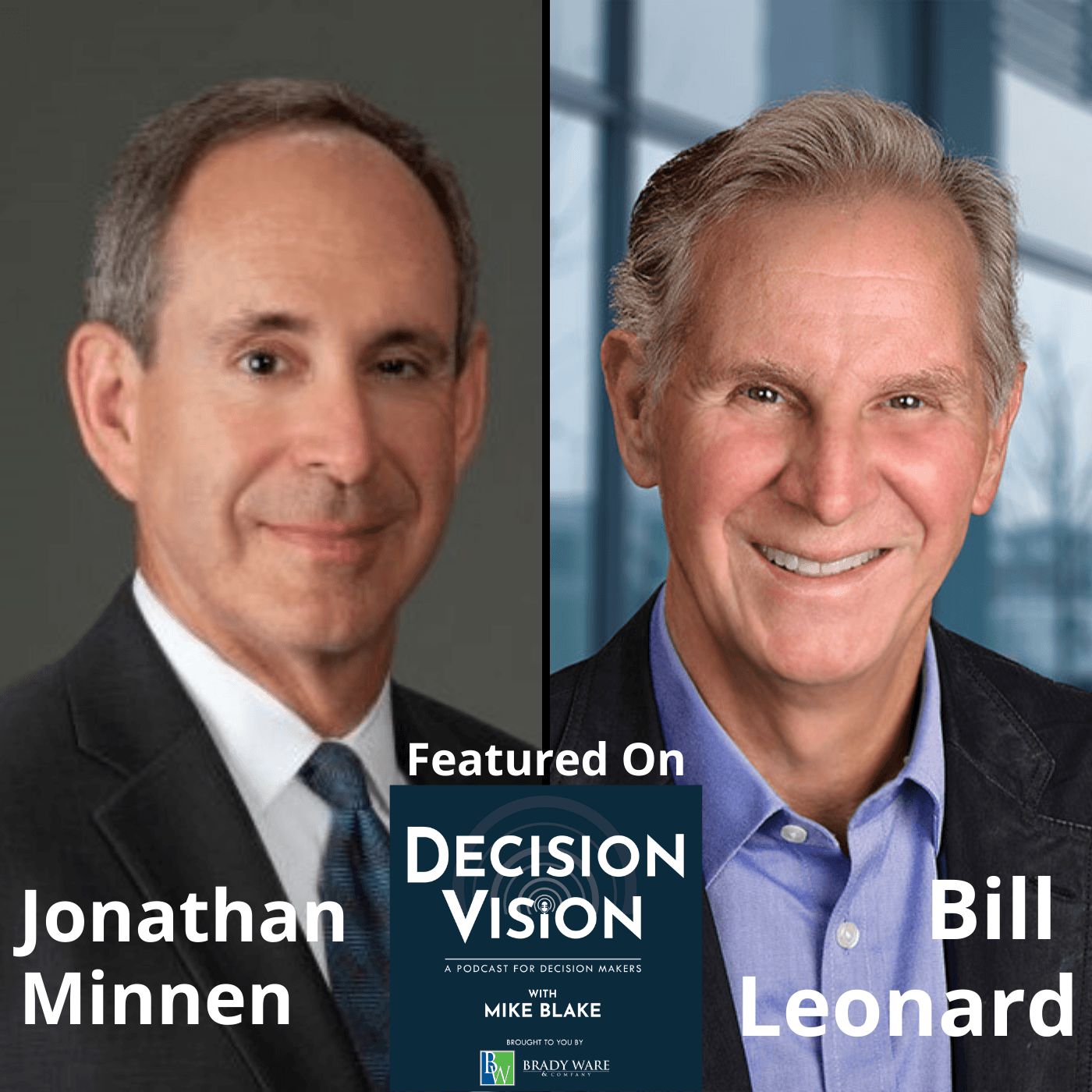
“Mix my faith with business?” Many won’t even touch the question, and others struggle with it. Christian business owner Bill Leonard and Jewish attorney Jonathan Minnen join host Mike Blake to discuss how they integrate their faith with their business work. “Decision Vision” is  presented by Brady Ware & Company.

Bill Leonard, Founder and President of Wm. Leonard & Co

Wm. Leonard & Co is a commercial real estate advisory firm providing services primarily to high growth technology companies in locating office space, negotiating the lease and advising them in the design of their facility to best reflect the culture of the company and align their real estate objectives with their business plan.

Bill Leonard is a native of Atlanta and a Life Member of the Atlanta Commercial Board of Realtor’s Million Dollar Club. In 1975, Bill founded Wm. Leonard & Co. which provides commercial real estate advisory services primarily to tenants in negotiating office leases. He is a former member of the Board of Directors of the Atlanta Commercial Board of Realtors, recipient of the Board’s Exclusive Phoenix Award and the Silver Phoenix Award. He has been active in commercial real estate since 1971 and is dedicated to the development of value-added services and lasting client relationships. A large percentage of his clients are high-growth technology companies.

Bill is actively involved in the Atlanta technology community and has served on the boards of the Technology Executives Roundtable, the Southeastern Software Association and the Tech CEO Forum. In 2000, the Technology Association of Georgia honored Bill by making him the recipient of the Leader of Influence Award for his outstanding service to the area’s technology community. He was selected by the Atlanta Business Chronicle’s “Who’s Who in Technology” in 2002.

In addition, Bill takes a leadership role in the Christian business community. He is the founder of the High Tech Prayer Breakfast; co-founder of the Commercial Real Estate Prayer Breakfast; co-founder of the Fellowship of Companies for Christ International and has served on a number of boards including Ambassadors for Christ International, The Fellowship of Companies for Christ International, Crown Financial Ministries, High Tech Ministries, Camp Highland and Teach Every Nation.

Bill received his B.A. degree in Economics & Business Administration from Furman University. Bill and his wife, Sandy, have been married for 47 years and have two grown children and five grandchildren.

Jonathan Minnen, Partner, Smith, Gambrell & Russell, LLP

Smith, Gambrell & Russell, LLP is a full service, International law firm that advises regional, national, and global businesses on a wide range of legal matters. The firm’s 250 attorneys provide legal counsel in more than 45 specialized practice areas, including corporate transactions, litigation, intellectual property, aviation, banking, real estate, construction, employment law, and employee benefits and executive compensation. Founded in 1893, SGR has offices in Atlanta, Austin, Jacksonville, London, Los Angeles, Miami, Munich, New York, Southampton, and Washington, D.C.

Jonathan Minnen, partner,  has extensive experience in a wide range of U.S. and overseas business transactions, including mergers and acquisitions and ongoing transactional matters across many business sectors. He practices from both the New York City and Atlanta offices of SGR. His client experience includes businesses which range in size from emerging companies to large publicly traded enterprises; both domestic and overseas. These clients have been involved in a variety of industries including both traditional and high-tech manufacturing, healthcare and financial information systems, robotics, medical devices, biomedical polymers, and technologies involving the telecommunications industry. For some of his clients, Mr. Minnen functions as de facto outside general counsel and is responsible for managing those clients’ entire legal portfolio, which involves routinely teaming with other practice groups of the Firm to achieve the client’s objectives.

Michael Blake, Brady Ware & Company

Mike Blake, Host of the “Decision Vision” podcast series

Michael Blake is Host of the “Decision Vision” podcast series and a Director of Brady Ware & Company. Mike specializes in the valuation of intellectual property-driven firms, such as software firms, aerospace firms and professional services firms, most frequently in the capacity as a transaction advisor, helping clients obtain great outcomes from complex transaction opportunities. He is also a specialist in the appraisal of intellectual properties as stand-alone assets, such as software, trade secrets, and patents.

Mike has been a full-time business appraiser for 13 years with public accounting firms, boutique business appraisal firms, and an owner of his own firm. Prior to that, he spent 8 years in venture capital and investment banking, including transactions in the U.S., Israel, Russia, Ukraine, and Belarus.

Brady Ware & Company

Brady Ware & Company is a regional full-service accounting and advisory firm which helps businesses and entrepreneurs make visions a reality. Brady Ware services clients nationally from its offices in Alpharetta, GA; Columbus and Dayton, OH; and Richmond, IN. The firm is growth minded, committed to the regions in which they operate, and most importantly, they make significant investments in their people and service offerings to meet the changing financial needs of those they are privileged to serve. The firm is dedicated to providing results that make a difference for its clients.

Decision Vision Podcast Series

“Decision Vision” is a podcast covering topics and issues facing small business owners and connecting them with solutions from leading experts. This series is presented by Brady Ware & Company. If you are a decision maker for a small business, we’d love to hear from you. Contact us at decisionvision@bradyware.com and make sure to listen to every Thursday to the “Decision Vision” podcast.

Past episodes of “Decision Vision” can be found at decisionvisionpodcast.com. “Decision Vision” is produced and broadcast by the North Fulton studio of Business RadioX®.

Visit Brady Ware & Company on social media:

LinkedIn:  https://www.linkedin.com/company/brady-ware/

Facebook: https://www.facebook.com/bradywareCPAs/

Twitter: https://twitter.com/BradyWare

Instagram: https://www.instagram.com/bradywarecompany/

Show Transcript

Intro: [00:00:00] Welcome to Decision Vision, a podcast series focusing on critical business decisions. Brought to you by Brady Ware & Company. Brady Ware is a regional, full-service accounting and advisory firm that helps businesses and entrepreneurs make vision a reality.

Mike Blake: [00:00:20] And welcome to Decision Vision, a podcast giving you, the listener, clear vision to make great decisions. In each episode, we discuss the process of decision making on a different topic from the business owner’s or executive’s perspective. We aren’t necessarily telling you what to do, but we can put you in a position to make an informed decision on your own and understand when you might need help along the way.

Mike Blake: [00:00:40] My name is Mike Blake, and I’m your host for today’s program. I’m a Director at Brady Ware & Company, a full-service accounting firm based in Dayton, Ohio, with offices in Dayton; Columbus, Ohio; Richmond, Indiana; and Alpharetta, Georgia. Brady Ware is sponsoring this podcast, which is being recorded in Atlanta per social distancing protocols. If you like this podcast, please subscribe and your favorite podcast aggregator and please consider leaving a review of the podcast as well.

Mike Blake: [00:01:07] So, today’s topic is, should I mix my faith with my business? And this can be a very broad topic, to be sure, but I think it is a very relevant topic, and it is a deeply personal and impactful decision that somebody decides to make, whether you decide in the affirmative or the negative to mix faith with business. One of the first things they taught me, at least, as I went out into the marketplace, is you don’t talk politics, you don’t talk religion, and you don’t talk something else. I forget what the third thing is. Knowing me, I probably talk about it all the time.

Mike Blake: [00:01:54] And as a young professional, I made sure to sort of stay away from those things; although, frankly, my best relationships are with people where I can have conversations about those things and we frequently disagree, but we don’t have to declare war over it, but that’s a separate discussion.

Mike Blake: [00:02:12] But there are potentially risks. It is not a decision to be taken lightly because any time that you decide that you’re going to put a stake out there and define yourself in a way that not everybody necessarily agrees with, you are taking a risk, and you’re investing something of yourself and of your business out there. And there can be some very positive results that come from that, but they aren’t necessarily always positive.

Mike Blake: [00:02:46] And the thing that I find of particular interest about this topic is if you do a search for this topic on Google, should I mix my faith with my business, number one, what’s enticing to me is nobody really authoritative touches it. The economist hasn’t covered it, to my knowledge. Harvard Business Review, Wall Street Journal, the big what I consider kind of intellectual journals really haven’t covered this at all, which tells me then that that’s an interesting topic to cover because other places just don’t know how to treat it. And I’m not afraid to take risks on the program.

Mike Blake: [00:03:25] And second, when you do find that information, nine times out of ten – this is not a statistical study, this is all my own personal observation – is they tell you exactly what I just said, “Don’t do it. There’s just not enough upside to justify the downside.” But, you as you go on in life and I’ve accumulated experience in exchange for gray hair and two arthritic ankles, you learn that there are people of faith who are very open about their faith. They’re not shove it down your throat about their faith, but they’re certainly very open about it. That is their identity. They’re their identity and they make that part of the business. And there are people that are happy with the results that have occurred.

Mike Blake: [00:04:18] And so, I think this is an opportunity to kind of present a couple of case studies where I think that has been successful. People have made that decision, taking the plunge, and have accepted both the good and the bad of having made that decision. So, I hope you, as listeners, are going to enjoy the topic as much as I anticipate that we are going to. And again, I think this is the kind of thing you can’t just sort of get everywhere, which makes it a more exciting topic to do.

Mike Blake: [00:04:48] So, to address this topic – and as an aside, this may wind up being a two-part topic. We have a panel of two guests. There’s a third I’ve been working on trying to get, but I wasn’t able to make the schedule work for today, so we may revisit this in a second session, but I’m not going to commit to that because I can’t force the guest to come on. I’m hopeful that we will. So, this may be standalone, maybe second part. you’ll just have to stay tuned and keep downloading these things to find out.

Mike Blake: [00:05:18] So, we do have a panel of sources today. And my first introduction will be of Bill Leonard, who is the founder of WM Leonard & Company. And they are commercial real estate advisory firm providing services to high-growth technology companies and locating office space, negotiating the lease and advising them on the design of their facility to best reflect the culture of the company and align their real estate objectives with their business plan.

Mike Blake: [00:05:42] I’d be remiss also if I didn’t acknowledge that they’re the stalwart supporters of the old Startup Lounge. And you have to sort of be of a certain age to remember Startup Lounge now. And that’s okay. We’re happy to fade into history. But Bill was there when not a lot of other people were. And I can’t express that gratitude frequently enough.

Mike Blake: [00:06:03] Bill is a native of Atlanta and is a life member of the Atlanta Commercial Board of Realtors Million Dollar Club. In 1975, Bill founded WM Leonard & Co., which provides those real estate advisory services primarily to tenants in negotiating office leases. In other words, it’s a tenant representation firm. He’s a former member of the Board of Directors of the Atlanta Commercial Board of Realtors, recipient of the board’s Exclusive Phoenix Award and the Silver Phoenix Award. He has been active in commercial real estate since 1971 and is dedicated to the development of value added services and lasting client relationships. A large percentage of his clients are high-growth technology companies.

Mike Blake: [00:06:40] In addition, Bill takes a leadership role in the Christian business community. He is the founder of the High Tech Prayer Breakfast, which is a big deal. If you don’t know Atlanta, High Tech Prayer Breakfast, I would say, is one of the maybe one of the top three events on the technology professional calendar. And the way that I know that is because they routinely clear 1500 attendees. I’ve been to many of these as guests of Bill and others. And the thing starts at 5:59 a.m. And that is not an easy commitment for people to make, especially for a night owl like myself.

Mike Blake: [00:07:15] Bill is co-founder of the Commercial Real Estate Prayer Breakfast, co-founder of the Fellowship of Companies for Christ International, and has served on a number of boards, including Ambassadors for Christ International, The Fellowship of Companies for Christ International, Crown Financial Ministries, High Tech Ministries, Camp Highland and Teach Every Nation. Bill earned his Bachelor’s Degree in Economics and Business Administration from Furman University. He and his wife Sandy had been married for 47 years and two grown children and five grandchildren.

Mike Blake: [00:07:42] And also on our panel and certainly not least is Jonathan Minnen, a dear friend of mine for, at least, a decade – and I think he’d actually admit to that – who is a partner with Smith, Gambrell & Russell and works out of the Atlanta office. Smith, Gambrell & Russell is a full-service international law firm that advises regional, national and global businesses on a wide range of legal matters. The firm’s 250 attorneys provide legal counsel to more than 45 specialized practice areas, including corporate transactions, litigation, intellectual property, aviation, banking, real estate, construction, employment law, and employee benefits and executive compensation.

Mike Blake: [00:08:19] Jonathan Minnen is a partner with Smith Gambrell and has extensive experience in a wide range of United States and overseas business transactions, including mergers and acquisitions and ongoing transactional matters across many business sectors. He has the bar from both New York and Georgia, and works from both the New York City and Atlanta offices.

Mike Blake: [00:08:43] Jonathan’s client experience includes businesses which range in size from emerging companies to large publicly traded enterprises, both domestic and overseas. These clients have been involved in a variety of industries, including both traditional high-tech manufacturing, healthcare and financial information systems, robotics, medical devices, biomedical polymers and technology involved in the telecommunications industry. For some of his clients, Jonathan functions as de facto outside general counsel and is responsible for managing those clients’ entire legal portfolio, which involves routinely teaming with other practice groups of the firm to achieve the client’s objectives.

Mike Blake: [00:09:18] Jonathan is also on the American Israel Chamber of Commerce, Board of Directors and Executive Committee. And as an aside, the American Israel Chamber of Commerce, Israel, last I checked, is a country of somewhere around seven million people. So, the whole country is roughly the population of the greater Atlanta Metro area. That is an incredible chamber. They punch well above their weight. In fact, I would say, among … And I’m involved with other binational chambers. They are the most effective bar non-binational chamber in the Atlanta area. And we have a lot of competition. There are 28 of them. They’re just a fantastic organization.

Mike Blake: [00:09:54] And Jonathan is also a member of the Attorneys for Family Held Enterprises and the Family Firm Institute, and holds a law degree from Emory University. Bill and Jonathan, thank you so much for coming on the program.

Bill Leonard: [00:10:06] A pleasure.

Jonathan Minnen: [00:10:08] My pleasure. Thank you.

Mike Blake: [00:10:11] So, I want to set some groundwork here because I’d like people to understand their perspectives. This is one question I’m not going to define for you that I think you need to answer it however you think is best answered because I want our listeners to understand that we’re trying to create kind of multiple perspectives because I do think that different faiths experience this decision and I think must approach this decision, have a different environment. So, they must approach that decision in a different way.

Mike Blake: [00:10:42] So, Jonathan, let me start with you. How would you describe your faith? If somebody asked you to describe your faith as I’m doing now, how would you do so?

Jonathan Minnen: [00:10:54] That’s a great question, Mike. And thanks again for having me on the podcast, Judaism is, of course, an ancient faith dating back many thousands of years. It is one of the three main Abrahamic faiths – Judaism, Christianity and all its various forms, as well as Islam. So, all three of these faith systems come from a common root core and have as a central tenet of their faith, monotheism, essentially one supreme being.

Jonathan Minnen: [00:11:30] The way I would differentiate Judaism from some other religions is that Judaism is much more focused on, I would say, personal, that you’re really responsible for your your personal conduct. And I’ll give you a great example. At the time this podcast is being recorded, we are about to approach the holiday season, which are the dual holidays of Rosh Hashanah, which is the Jewish New Year, and 10 days later, Yom Kippur, which is the Jewish day of Atonement.

Jonathan Minnen: [00:12:09] And one of the things that I find so striking, so meaningful during the Yom Kippur service is a passage that roughly translates this way. For the sense that you make against God, the day of atonement atones. However, sins or wrongdoings against your fellow person, the day of atonement is not atone until you make peace – you personally make peace with that person. And I think that passage speaks volumes as to kind of one of the course of Judaism.

Mike Blake: [00:12:53] Thank you for that, Jonathan. So, Bill, let me turn that to you. How would you describe your faith? You’re talking to somebody and that subject comes up, how would you describe it?

Bill Leonard: [00:13:10] Yeah. Mike, again, thank you for allowing me to participate today. I think I would best describe it as John 3:16, “For God so loved the world that He gave his only begotten Son. And whoever believes in him should not perish, but have everlasting life.” God created man to have fellowship with God, but that was broken. That fellowship was broken when man sinned in Genesis 3. And so, since then, man and God has looked for ways to restore and reconcile, I should say, that relationship.

Bill Leonard: [00:13:48] And as a believer, as a Christian, we believe that God sent His Son, Jesus Christ, to pay the ultimate penalty, the ultimate sacrifice for our sins. And it’s up to, not just ours, for anyone to receive that gift of salvation. We believe Jesus died on the cross. He was raised again the third day. He had victory over death. So, the key to us is forgiveness of sins, a different way, and the resurrection.

Mike Blake: [00:14:23] So, Bill and Jonathan, one thing that strikes me, I both certainly recognize and respect you both immensely for being people of faith. And as I said, not everybody is willing to kind of express it as openly as you do and even link it to your professional lives in a meaningful way.

Mike Blake: [00:14:52] And what I like – Bill, let me start with you – is talk about your decision to link your faith to your business. You’re very open about it. It’s not hard to find your connection to your faith, obviously, with the High Tech Prayer Breakfast, High Tech ministries, and all the other things that you’ve done. I have a feeling I’ve only read a fraction of the things you do. The same thing with Jonathan. But come back to the decision to say, “I’ve got this business, and I like it. I think it’s doing pretty well. I like it also to somehow be an expression of my faith.” Talk about that decision, please.

Bill Leonard: [00:15:33] We got to go back a long ways. I grew up in the church, but I rejected the church in early teen years and was away from the church. I was in rebellion. When I surrendered my life to Christ, I was 30 years old, and it was a very radical change in my life. And I think you find people who accept Christ as an adult, and have a contrast in their life, and recognize that particularly time when it happened. Actually you’re maybe a little bit more outspoken about it. I think it’s because you just recognize that forgiveness for the sins committed in the past and the future.

Bill Leonard: [00:16:13] But when I came to Christ, I was very fortunate. The guy that was most instrumental in that decision, was struggling with an issue. He was running a business, I had my business, and he was relatively new Christian himself, but he was trying to find out what the Bible had said anything about running a business. And he kind of pulled me by the collar, and the seven of us began to meet twice a month to see what the Bible had to say about running a business, hiring, firing, paying your bills, how you treat your employees.

Bill Leonard: [00:16:45] And we did this for a couple of years, and we started this organization called the Fellowship Companies for Christ International, whose purpose is to encourage and equip Christian CEOs and business owners to operate their business, to conduct their personal lives in accordance with Christ’s internal objectives.

Bill Leonard: [00:16:59] So, what that did for me is it gave me an opportunity as a new Christian to see that the Bible was relevant to what I was doing on a daily basis. And I really felt like God was calling me 24/7 to live out my faith, not on Sunday, and then go to work on Monday and live a totally different life. So, basically, it allowed me to integrate my faith with my work and my whole life, really.

Bill Leonard: [00:17:26] And so, as far as being a conscious decision, it’s really what gave me purpose in business and purpose in life, for that matter, is integrating my life and my business or my faith in my business. And so, then, it was just a matter of how do you do that? And that was a long process.

Mike Blake: [00:17:47] Right. And we’ll get to those specifics shortly. So, Jonathan, let me turn it over to you. Talk about the decision that you made – whether it was conscious or unconscious, you’ll tell us – that you’re going to to make your faith somehow a part of your business.

Jonathan Minnen: [00:18:10] For me, it was really, I think, somewhat automatic in that it’s just who I am and always have been. I mean, I’ve always identified as a Jewish person. I’m not an Orthodox Jewish person. I would be part of what would be called the Modern Reform Movement in the United States. But it’s just always been part of my identity. I believe that, when I was in business before law, and I grew up in a small town in Kentucky, and then also when I became a lawyer, I’m very much aware that Judaism has been subject to a variety of forms of anti-Semitism for most of our history. And a lot of very anti-Semitic tropes have evolved from that, from the ancient to the modern.

Jonathan Minnen: [00:19:12] And so, I’ve always felt, because it’s pretty obvious if anybody looks at my website or LinkedIn bio, it’s pretty obvious I’m Jewish. I don’t need a beard, and I don’t have to look like the character of a Jewish person with a hat and beard, neither of which I wear to figure out I’m Jewish. And I have always felt that I’m not only speaking for me, I’m also a representative of all of my coreligionists. And so, therefore, I’ve always felt that it was incumbent on me in all of my dealings to act in a very above board and ethical manner as a way to confront these anti-Semitic stereotypes that have been around forever.

Jonathan Minnen: [00:20:07] And to some degree, obviously, they’re still around. But I remember this story from my parents, remember that years ago at Sea Island, the place here, the rule was no blacks, no dogs and no Jews. When they went for their honeymoon in 1951, they went down to St. Petersburg, Florida, and many of the hotels on the beaches had signs that said restricted clientele. It was a code phrase – no blacks and no Jews. So, I felt that the way I conduct myself professionally and personally, I’m not just speaking for myself, I’m also essentially a representative for every other Jewish person out there. So, it kind of just happened and evolved.

Mike Blake: [00:20:56] So, one thing that strikes – and I like both of you to respond to this – about how you describe your respective faiths, and your decisions and how you integrate that into your business life is Bill’s approach – and I’m just going to extrapolate here. Please do correct me if I’m full of it – is it’s an approach to religion that is high profile, if you will, and that glorifying God is a very important and central feature of that practice of faith; whereas Judaism, at least the way you, Jonathan, described it, it’s somewhat more introspective.

Mike Blake: [00:21:46] And neither one is right or wrong, but I think that does inform that when I think of Christian-owned businesses, I think that, frankly, they’re easier to identify because of that tenet; whereas, Jewish-owned businesses, aside from the stereotypical deli and that kind of thing right, they’re not quite as easy to identify. Jonathan, I wouldn’t necessarily identify you as linking your faith to your business, except for the fact you do wear the flag of the State of Israel on your suit lapel. But there are two very different approaches that I think also inform the ways in which you link your faith to your business. Is that a fair observation or am I full of it?

Jonathan Minnen: [00:22:36] Bill, you want to go first?

Bill Leonard: [00:22:36] Yeah, I think, first of all, Christ commanded us to go into all the world and make disciples. So, I’m an evangelical Christian. Someone cared enough about me to reach out to me when I really had a lot of challenges going on in my life and literally changed my life. So, I’m evangelistic. I don’t know many Jewish people who, in a sense, are evangelistic to try to convert somebody to Judaism. And I can’t convert anybody, but I feel compelled to tell everybody about my faith in Christ.

Bill Leonard: [00:23:24] And so, I think maybe that’s part of the reason that you would see Jonathan and myself different in our approach to integrating our faith into our practice because ours, clearly, is evangelistic and that’s the whole purpose of the High Tech Prayer Breakfast, and the Commercial Real Estate Prayer Breakfast in the other prayer breakfast that we have started. And that’s just a part of it. But I mean, that is, on my mind, literally all the time. The people I meet is praying for them and sharing my faith with them at the appropriate time. So, I think that would be very different for me as I see a Jewish person versus an evangelical Christian.

Mike Blake: [00:24:09] Jonathan?

Jonathan Minnen: [00:24:11] Yeah, I would agree with Bill’s assessment because there’s really … I mean, you can always find exceptions, okay. There are always exceptions. There’s a general rule. I would completely agree with Bill, because there’s really not an evangelical component as part of Judaism. And it’s just not really part of the faith system. There is a process if somebody chose to become Jewish by choice, but it’s not an easy process because there’s a lot you take on by being Jewish. And so, it’s not something that should be done lightly if somebody chooses to be Jewish by choice, but we really don’t do much in the way of being evangelical.

Jonathan Minnen: [00:25:07] I do want to point out one thing you said because I think it merits pointing it out. There are a very large number of probably Christians but probably evangelical Christians who are extremely supportive of the State of Israel, the modern State of Israel, and probably would be very happy to wear the same kind of pin that I wear, which is one of these dual flag pins with the American flag and the Israeli flag side by side. And I will speak strictly my own opinion here. Israel would be in a lot of difficulty if she did not have the loving support of the evangelical Christian community. And I think people who think about it a little bit, they have two words in response, which is thank you. And so, I didn’t want that opportunity pass by.

Bill Leonard: [00:26:02] I just want to speak and say that next to the Jewish people, the evangelical Christians are Israel’s best friend because we believe in the Scripture. And the scripture, I mean, Jews are God’s chosen people, no doubt about that. He chose the Jewish people. Why He chose the Jewish people? Why He chose me? We don’t know. But we are big supporters of Israel.

Mike Blake: [00:26:30] So-

Jonathan Minnen: [00:26:31] And this may be.

Mike Blake: [00:26:34] Please go ahead.

Jonathan Minnen: [00:26:36] No. I’d say, Bill – and some time, maybe you and I will have a chance to have a cup of coffee together – something, and this is just again, my own feeling is when some Christians and Jews get together, and they have this rift about Jesus is what I developed in my own feeling is in both Christianity and Judaism, there is the concept of the Messiah. And if we are so blessed in our lifetimes where the Messiah should come before us, Christians would say, essentially, “Welcome back;” Jews might say, “What took you so long?” but at that point, does it really matter anymore? And so, when you get down to the fundamentals, there’s so much more similarity than there is a difference.

Bill Leonard: [00:27:32] I agree. We share the same path.

Jonathan Minnen: [00:27:33] And similarities, yes, to embrace. And even though there’s a little difference in in methodology, at its core, there’s really not much daylight between the two faiths.

Bill Leonard: [00:27:49] I read through the Bible, the Old Testament and the New Testament, every year. And it’s nine months in the Old Testament, and only three months in the New Testament. So, I’ve just graduated from the Old Testament, Jonathan.

Jonathan Minnen: [00:28:05] All right, Mike, back to you.

Mike Blake: [00:28:07] Yeah, thank you. But this is really good stuff and this is fun to listen to. So, question I’d like both of you to answer. Bill, I’ll just toss this to you is, can you talk about … There are probably lots of ways, but we want to limit our time here a little bit. What are the sort of two or three ways, most important ways that you find that your faith manifests itself in your day-to-day business?

Bill Leonard: [00:28:36] Well, I believe that God gave me my business as a platform for ministry, as a tool or a vehicle to reach people for Christ. So, I would hope that … I mean, I have a quiet time every morning and I read through the Bible every year now, and I pray for a lot of people. I try to pray for the people that I am going to see that day or I’m going to talk to that day, and asking God to use me in whatever way He chooses to use me.

Bill Leonard: [00:29:08] So, that would manifest itself in a lot of ways. It might manage to manifest itself in serving. It may manifest itself in sharing my faith. Again, hopefully, it is totally integrated in everything I do. And I think that begins with loving people and how you treat people. It’s followed by doing things with excellence. And I think, Jonathan, I would certainly agree on that that, hey, listen, if you don’t treat people right, if you don’t do your work with excellence, you can forget about the rest of it because you don’t have any basis, you don’t have any foundation to talk to anybody about what you believe.

Mike Blake: [00:29:48] Jonathan, how about you?

Jonathan Minnen: [00:29:52] I would absolutely agree with Bill with your last comment, and that’s what really kind of guides me is that I’m a business lawyer, obviously, as I was introduced so graciously by Mike, but it’s fine to attend to your business. And as a lawyer, my ethical responsibility is to advocate forcefully for my client, but I have always felt it is absolutely a rock solid foundation to do that in an ethical manner, and ethics and all of its manifestations – truth, reliability, honesty. If you make a mistake, you admit it. You don’t try to hide anything. And that’s a big part.

Jonathan Minnen: [00:30:49] The other thing – and this is one of the the differences between faith systems – is that Judaism does not have the same concept of of life after death as Christianity does. And I can tell you from personal experience, having lost my mother last April, it would be very comforting for me right now if Judaism had such a concept, but it does not. It doesn’t deny it; it just doesn’t get into it very much. But what Judaism does focus on is that you are remembered by your deeds. You’re remembered how you acted to fellow people.

Jonathan Minnen: [00:31:31] And so, one of the things is I ask myself, how do I want to be remembered by the people who I touched in my life and in my profession? And I always, whether I carry the day to negotiate or did not, I always want to be remembered as somebody who was honest and ethical in everything I did. I hope that answers the question.

Bill Leonard: [00:32:00] Yeah, there’s a New Testament verse that I think that Jonathan agree with, and that is in Colossians 3:23. It says, “Whatever you do, do your work hardly as for the Lord, rather than for men, knowing that from the Lord, you will receive the reward of your inheritance.” That’s one of the foundational verses that I try to live my life by.

Bill Leonard: [00:32:23] Another one’s an Old Testament verse. It’s Proverbs 231:1 that says, “A good name is to be more desired than great riches.” We all want to make a deal, we all want to make money, et cetera, but it’s it’s hard to develop a good reputation. It’s very easy to lose it.

Mike Blake: [00:32:42] Yeah, boy, it sure is. I mean, I posted a quote of the day on my LinkedIn profile a couple of weeks ago that, “It takes a lifetime to build a reputation and five minutes to destroy it.”

Bill Leonard: [00:32:53] Right. Absolutely.

Mike Blake: [00:33:00] When I thought of the next question, I write these questions, I think and I kinda anticipate what the answers may look like, and I love it when I’m surprised. I almost thought about not asking this question, but I’m going to ask it anyway because I think it’s important to make the answer very clear. And that is, do you draw a line between promoting your faith versus promoting your business? And if so, how do you decide where that line should be? Jonathan, let me start with you on that.

Jonathan Minnen: [00:33:36] Sure. Well, because Judaism doesn’t really have an evangelical component, I don’t promote my faith to others. I try rather, as I mentioned earlier, to be an honorable representative of my faith in all the dealings that I do. And again, this also goes back to the fact that there’s been so much anti-Semitism over the millennia that it offends me deeply when I see a Jewish person not acting in an ethical manner. And people are people. And there are plenty of Jews who don’t act in an ethical manner. It’s not because they’re Jews. It’s because they’re unethical people. But what people remember is that they were Jews. And that really upsets me.

Jonathan Minnen: [00:34:33] And I had a situation, and I can’t get into the details, but it was somebody that I had an association with who was part of the Orthodox community and acted in an unethical manner, and I was absolutely livid because I said, “You have just confirmed all the anti-Semitic tropes that I worked so hard to show are nothing but anti-Semitic tropes. And here you’ve manifested them.” And I was livid. And he didn’t do that because he was Jewish. He did it because he’s an unethical guy. But what do people remember? They remember he was Jewish. So, there’s a responsibility. You’re not just dealing with yourself.

Jonathan Minnen: [00:35:31] And when I first started working with Israeli companies in the United States, I gave a lecture in Israel to a bunch of early-stage companies. And I remember this very well. I said, “When you are conducting business with the US company, you go ahead and negotiate as hard as you want. But when you strike a deal, that is the deal. Your word is the bond.” And I said, “Because if you break that, let me tell you, nobody is going to remember that Solomon broke his word. It’s going to be the Israeli broke his word. And you have now tarnished the reputation of everybody.” So, when you go out in the business world, you’re not just out there yourself, you’re out there as representative.

Mike Blake: [00:36:19] Let me comment on that. I think that’s a really interesting point, and it’s something I’ve never given any thought to. But one of the things that makes the Jewish religion unusual and maybe unique, but at a minimum, unusual is that being Jewish is both a religion, and for the most part, ethnicity. Of course, there are conversions and so forth, but for good or ill, there is an ethnic component and association with it.

Mike Blake: [00:36:51] And I think about that person, and I imagine that as you are, frankly, upgrading him, he’s maybe thinking, “I didn’t ask for this,” right? “I’m just a guy who happened to be Jewish.” He may not may or may not be practicing. “Why am I sort of tasked with representing an entire people?”

Mike Blake: [00:37:18] And I’m not defending the behavior necessarily, but but because of the history, and I think because of the unique sort of ethnic religious silo that occurs, there is sort of whether you like it or not, I guess, you can say there, you are sort of out there, no pun intended, waving a bar representing that people. And what you do does reflect on others who are associated with you in a way to say same myself as a Catholic. If I’m a jerk to somebody, people will say, “Well, Catholics are jerks,” and say, “Blake’s a jerk.” I don’t have that burden that I think, Jonathan, you do.

Jonathan Minnen: [00:38:04] That’s correct. At least, I feel that I do. And you talked about both a religion and ethnicity. You are correct. And I’ll give you an example of that. Mike, I know you’re a science fiction fan. I certainly am. And if we all ran across a wormhole or a temporal rift, to borrow from Star Trek, and I was suddenly transported a thousand years into the past and deposited in Europe. So, we’re now looking at the year … what would that be? 2000 or 1020 at a common area, the A.D. And I walked into a synagogue, okay. I don’t know their street language. They don’t know mine. And I’m now a thousand years into the past. But I can tell you that I know which direction to stand when we pray, and I’m going to be able to pray in a common language with them. I mean, where else can you say that?

Mike Blake: [00:39:19] Yeah, I mean-

Jonathan Minnen: [00:39:19] And I could go through the whole service with them. From beginning to end, we can pray as if there is no difference between this at, all in the same language, doing the same things at the same time.

Mike Blake: [00:39:34] So, Bill, let me get to you on the same question. I think I already know the answer to this, but I don’t want to assume. Is there a line, in your mind, between promoting your faith and promoting your business? And if so, what in your mind does that line look like?

Bill Leonard: [00:39:53] Yeah, there definitely has to be since, again, I’m  evangelical. And I’ll tell you, it was harder, Mike, in the early days as a Christian because there’s a verse in Roman that said, “I’m not ashamed of the Gospel.” And I felt I need it. In other words, I needed to share my faith. I need to tell people who I was. I needed to pray over the food. I didn’t need to be embarrassed about praying over the food, regardless of who I was having lunch with, et cetera. I saw it as an opportunity for evangelism.

Bill Leonard: [00:40:36] It took a while, but I learned. And sometimes, I will ask, “Can I bless the food?” And if I do, it’s a very short prayer because I know the guy on the other side is probably embarrassed to bow his head even for five seconds. But it is a way to bring up my faith. Sometimes, somebody asked you then, “Where do you go to church?” And so, it gives you an opportunity to just talk.

Bill Leonard: [00:41:01] But yeah, clearly, you’ve got to draw a line. You got to draw a line. God didn’t put me here just to irritate people because I want to share my faith, but I’d be sensitive to where they are because it’s not going to do any good anyway. Again, I cannot convert anybody. Only God can do that. And then, really, I just need to be sensitive to where people are, and meet them where they are, and hopefully take them from where they are to one step closer to Christ. Or if they’re not interested, to shut up. It’s not my responsibility. But definitely, there should be a line. Let’s put it that way. I haven’t always gotten it right. I’m not sure I get it right now, but recognize that that’s definitely a challenge.

Mike Blake: [00:41:45] So, if you’re not all about sort of converting people, clearly, you’re not a big Facebook user.

Bill Leonard: [00:41:51] No, I don’t use Facebook. I try to stay away from that, do a little bit of LinkedIn, but I have got five friends on Facebook, and I’d like to really get rid of them just because I don’t want to be on Facebook.

Mike Blake: [00:42:02] Yeah. I don’t blame you. Probably should be renamed Judgebook, but at any rate. So, we walked through some of the decision making processes here. And I’d like to spend the next couple of minutes talking about, first, I want to talk about has there been a noticeable positive effect on your respective businesses? And what I mean is, do you seem to attract more and better clients or maybe better fit is a better word, employees or something else?

Mike Blake: [00:42:45] In other words, can you point to good things that have happened to you commercially because of your choice to align your business with your faith that otherwise might not have happened had you chosen a more secular path? And, Bill, let me let you continue talking about that, if you can.

Bill Leonard: [00:43:06] Well, there’s no [indiscernible]. No doubt about that. You know I’m Charlie Paparelli. Charlie Capparelli came to Christ through High-Tech Ministries. Matt McConnell. Some really radical life change has taken place. And that’s the bottom line for us or for me. That is life change.

Bill Leonard: [00:43:26] And the real value … I mean, I’ll be 74 years old this month. Looking back, do I remember the deals? Yeah, I remember the deals. Do you remember the money? Absolutely. Money’s important. But what’s really important is seeing lives radically changed, not just like Charlie, but his wife, his family, and the impact he’s had throughout the technology community, far more than I’ve had. And so, that’s that’s the real value.

Bill Leonard: [00:43:55] Yeah, I think it does bring people together. I admire Jewish people. I think they’re very loyal to each other. Christians aren’t nearly as loyal, but a lot of my clients are Christians. And I have to be careful that I don’t get stuck in the holy huddle because I really want to get out and build relationships with people who are not believers. But as far as our company goes, everyone here is a believer because we’re a small company. And we’re only four people, Jonathan. We’ve been in business for 45 years. We’ve gone up to seven, back down to four.

Bill Leonard: [00:44:26] So, I mean, it’s important because it’s integral to who we are. And as a company being small, yeah, we’re all believers, and that’s just part of the way we live it. So, if I was larger, if I had 20-40 people, it wouldn’t be that way. But that’s just the way God’s led me in the way I’m wired, so.

Mike Blake: [00:44:47] Jonathan, well, same question to you. Can you identify ways in which your decision to to connect your faith with your business activities has brought some positive impact that you otherwise may not have had had that connection not been made?

Jonathan Minnen: [00:45:07] In my case, because we need to separate being Jewish and building US work for Israeli companies because those are not the same things, okay. In terms of the Jewish aspect, no, I can’t really point to anything that has directly benefited my practice where I only got work because I’m known as Jewish. It would not surprise me, although I don’t know, but it would not surprise me if I have been rejected for that same reason by certain people. I wouldn’t know that because if you’re rejected, you don’t really know. You just don’t get the business. You don’t get the representation.

Jonathan Minnen: [00:46:00] On the Israeli side, because I started 20 years ago to say, “Hey, I’d like to kind of develop a practice niche in doing US work for Israeli companies,” being Jewish, I think, that certainly helped that because the normal model is that you have a company that develops in Israel, so you hire hte Israeli parent company, and as you correctly pointed out, Israel is real tiny in a difficult neighborhood, although I thank the good Lord, it’s gotten a little less difficult recently.

Jonathan Minnen: [00:46:42] Yeah.

Jonathan Minnen: [00:46:42] But I mean, you talk about the population of Israel being like the population of Metro Atlanta, the land area of Israel, the square mile land area of Israel and the land area of San Bernardino County, California is about the same. That’s how tiny it is. So, Israeli companies, when they want to get bigger, look to the United States for expansion. Som they open up subsidiaries here. I am quite sure that the fact that I am Jewish was a point of comfort to Israeli business owners who were looking for US representation because they felt there was some common ground affinity.

Jonathan Minnen: [00:47:27] But I will also tell you that that only gets you in the door. After that, it’s back to what I said before, do you perform and conduct your business in an ethical and proper manner? Because if you don’t, it doesn’t matter whether you’re Jewish or not, you’re going to get fired. So, all that does is maybe help you get yourself in the door. And after that, you have to prove yourself as a competent and ethical individual.

Mike Blake: [00:47:56] We are speaking with Jonathan Minnen and Bill Leonard on the Decision Vision Podcast, talking about linking or mixing business with one’s faith. And we’re coming to the end of our time here, but I want to squeeze in a couple of questions. Jonathan, you touched upon this a little bit already, so I’m going to throw this to Bill instead, and then let you add to it if you want. And, Bill, my question is this. It’s that, have you found that linking your business to your faith has been limiting in any way? Have people, in any way, been turned off, have been intimidated, have been made uneasy that you can discern?

Bill Leonard: [00:48:40] Yeah, absolutely. There are times. Again, we’re visible about our faith. And so, I think that attracts that rejection, yeah. But I’ve been fired because of my faith because they don’t do business with me. That’s fine. But ultimately, I believe it all comes from God. I believe there’s not one deal that we’ve done in 45 years that wasn’t from Him.

Bill Leonard: [00:49:06] There’s a verse that I love that’s actually King David’s prayer after raising the money to build a temple. It says, “Riches and honor come from you alone. You’re the ruler of all mankind. Your hand controls power and might.” And it says, “Your discretion that men are made great and given strength.” That’s the way I look at it, is first of all, I’m to be obedient to Him. And I believe He provides. I believe He’s a very active God. And so, yeah, there have been times, but you know what? The blessings have so far outweighed any negative. I’m not worried about that. Just trying to be more discerning at times when I should keep my mouth shut as far as sharing my faith.

Mike Blake: [00:49:52] Jonathan, you talked about that a little bit. Is there anything you want to add to it?

Jonathan Minnen: [00:49:59] I really like what Bill said. I mean, I’m really right with you. I mean, I am who I am and if somebody has a problem with that, guess what? The sun will rise in the east tomorrow, and they’re welcome to find a different lawyer if my faith bothers them. So, I’m right there with Bill that we’re not going to change who we are at our core just to get the next piece of business. I fully agree with Bill.

Mike Blake: [00:50:28] So, gentlemen, this has been a great conversation. And absent of any kind of constraints, we could easily go on for another hour or so, and I would continue to be on the edge of my seat. But unfortunately, time is limited. I suspect, at least, somebody in our audience is going to have questions about this topic and maybe learning more about your experiences. Can they contact you? And if so, what is the best way for somebody to contact you if they want to pursue this topic further with you?

Bill Leonard: [00:51:02] I’ll go first, it’s WM Leonard & Co. Phone number is 404-252-9700. And my email address is Bill@wmleonard.com. I’m happy to talk about it.

Jonathan Minnen: [00:51:19] And people are welcome to contact. Probably the easiest way is by email, which you can find on the on our website. Our website is sgrlaw.com or you can email me at first initial and last name, jminnen@sgrlaw.com.

Mike Blake: [00:51:39] All right. So, that’s going to wrap it up for today’s program. I’d like to thank Jonathan Minnen and Bill Leonard so much for joining us and sharing their experience, their expertise with us today.

Mike Blake: [00:51:49] And we’ll be exploring a new topic each week. So, please tune in, so that when you’re faced with your next executive decision, you have clear vision when making it. If you enjoy this podcast, please consider leaving a review of your favorite podcast aggregator. That helps people find us, so that we can help them. Once again, this is Mike Blake. Our sponsor is Brady Ware & Company. And this has been the Decision Vision Podcast.

Tagged With: Bill Leonard, Brady Ware, Brady Ware & Company, faith and business, faith in business, Jonathan Minnen, Michael Blake, Mike Blake, Smith Gambrell Russell, Wm. Leonard & Co

Dr. Sinclair Grey

July 30, 2019 by John Ray

North Fulton Business Radio
Dr. Sinclair Grey
Loading
00:00 /
RSS Feed
Share
Link
Embed

Download file

John Ray, Dr. Sinclair Grey

“North Fulton Business Radio,” Episode 151:  Dr. Sinclair Grey, Speaker, Author, and Success Coach

“People will remember you if you help them.” “Closed mouths don’t make money.” Good words like this and much more come from of this interview with Dr. Sinclair Gray, our guest on this edition of “North Fulton Business Radio.” Dr. Grey talks with host John Ray about effective networking, why small business owners should learn effective public speaking, and more.

Dr. Sinclair Grey, Speaker, Author, and Success Coach

Dr. Sinclair Grey

Dr. Sinclair N. Grey III is a speaker, author of six books, and a success coach. His most recent book is The ABC’s of Making Business Networking Work for You.

He is passionate about helping entrepreneurs connect through teaching them networking skills, branding, and marketing. In addition, Dr. Grey speaks to groups about leadership, sales, and how to motivate your team to excel. Dr. Grey currently hosts a weekly business networking group where he either teaches about business practices or he brings in experts in their field to help businesses grow. Dr. Grey wants to see entrepreneurs succeed and with his knowledge along with his vast network on business experts, he is making it happen.

A native of the Washington, DC Metropolitan Area, Dr. Grey graduated with a Bachelor of Arts degree in Criminology from the University of Maryland, College Park, Maryland, in 1991. After receiving his call to preach in 1997, Dr. Grey earned a Master’s of Divinity degree and graduated Cum Laude from the Samuel DeWitt Proctor School of Theology at Virginia Union University, Richmond, Virginia, in 2002. He is a certified NTU Psychotherapist and has received certificates of completion from The Addiction Prevention and Recovery Administration in psychopharmacology and adolescent and addiction issues in addition to serving as a facilitator for a Rites of Passage program geared toward young males. In 2012, Dr. Grey was awarded a doctorate of divinity degree from St. Thomas Christian University in Jacksonville, Florida.

You can find out more at Dr. Grey’s website, https://sinclairgrey.org/, or you can call him directly at 678-516-0779.


“North Fulton Business Radio” is broadcast from the North Fulton studio of Business RadioX®, located inside Renasant Bank in Alpharetta. Renasant Bank has humble roots, starting in 1904 as a $100,000 bank in a Lee County, Mississippi, bakery. Since then, Renasant has grown to become one of the Southeast’s strongest financial institutions with approximately $12.9 billion in assets and more than 190 banking, lending, wealth management and financial services offices in Mississippi, Alabama, Tennessee, Georgia and Florida. All of Renasant’s success stems from each of their banker’s commitment to investing in their communities as a way of better understanding the people they serve. At Renasant Bank, they understand you because they work and live alongside you every day.

Tagged With: Conyers, Dr. Sinclair Grey, faith, faith and business, faith in business, how to network, Master Networker, networker, networking, networking for extroverts, networking for introverts, networking group, Public Speaker, public speaking, public speaking coaching, Sinclair Grey, small business networking, success coach, the art of public speaking

Business RadioX ® Network


Our Most Recent Episode

CONNECT WITH US

  • Email
  • Facebook
  • LinkedIn
  • Twitter
  • YouTube

Our Mission

We help local business leaders get the word out about the important work they’re doing to serve their market, their community, and their profession.

We support and celebrate business by sharing positive business stories that traditional media ignores. Some media leans left. Some media leans right. We lean business.

Sponsor a Show

Build Relationships and Grow Your Business. Click here for more details.

Partner With Us

Discover More Here

Terms and Conditions
Privacy Policy

Connect with us

Want to keep up with the latest in pro-business news across the network? Follow us on social media for the latest stories!
  • Email
  • Facebook
  • Google+
  • LinkedIn
  • Twitter
  • YouTube

Business RadioX® Headquarters
1000 Abernathy Rd. NE
Building 400, Suite L-10
Sandy Springs, GA 30328

© 2025 Business RadioX ® · Rainmaker Platform

BRXStudioCoversLA

Wait! Don’t Miss an Episode of LA Business Radio

BRXStudioCoversDENVER

Wait! Don’t Miss an Episode of Denver Business Radio

BRXStudioCoversPENSACOLA

Wait! Don’t Miss an Episode of Pensacola Business Radio

BRXStudioCoversBIRMINGHAM

Wait! Don’t Miss an Episode of Birmingham Business Radio

BRXStudioCoversTALLAHASSEE

Wait! Don’t Miss an Episode of Tallahassee Business Radio

BRXStudioCoversRALEIGH

Wait! Don’t Miss an Episode of Raleigh Business Radio

BRXStudioCoversRICHMONDNoWhite

Wait! Don’t Miss an Episode of Richmond Business Radio

BRXStudioCoversNASHVILLENoWhite

Wait! Don’t Miss an Episode of Nashville Business Radio

BRXStudioCoversDETROIT

Wait! Don’t Miss an Episode of Detroit Business Radio

BRXStudioCoversSTLOUIS

Wait! Don’t Miss an Episode of St. Louis Business Radio

BRXStudioCoversCOLUMBUS-small

Wait! Don’t Miss an Episode of Columbus Business Radio

Coachthecoach-08-08

Wait! Don’t Miss an Episode of Coach the Coach

BRXStudioCoversBAYAREA

Wait! Don’t Miss an Episode of Bay Area Business Radio

BRXStudioCoversCHICAGO

Wait! Don’t Miss an Episode of Chicago Business Radio

Wait! Don’t Miss an Episode of Atlanta Business Radio