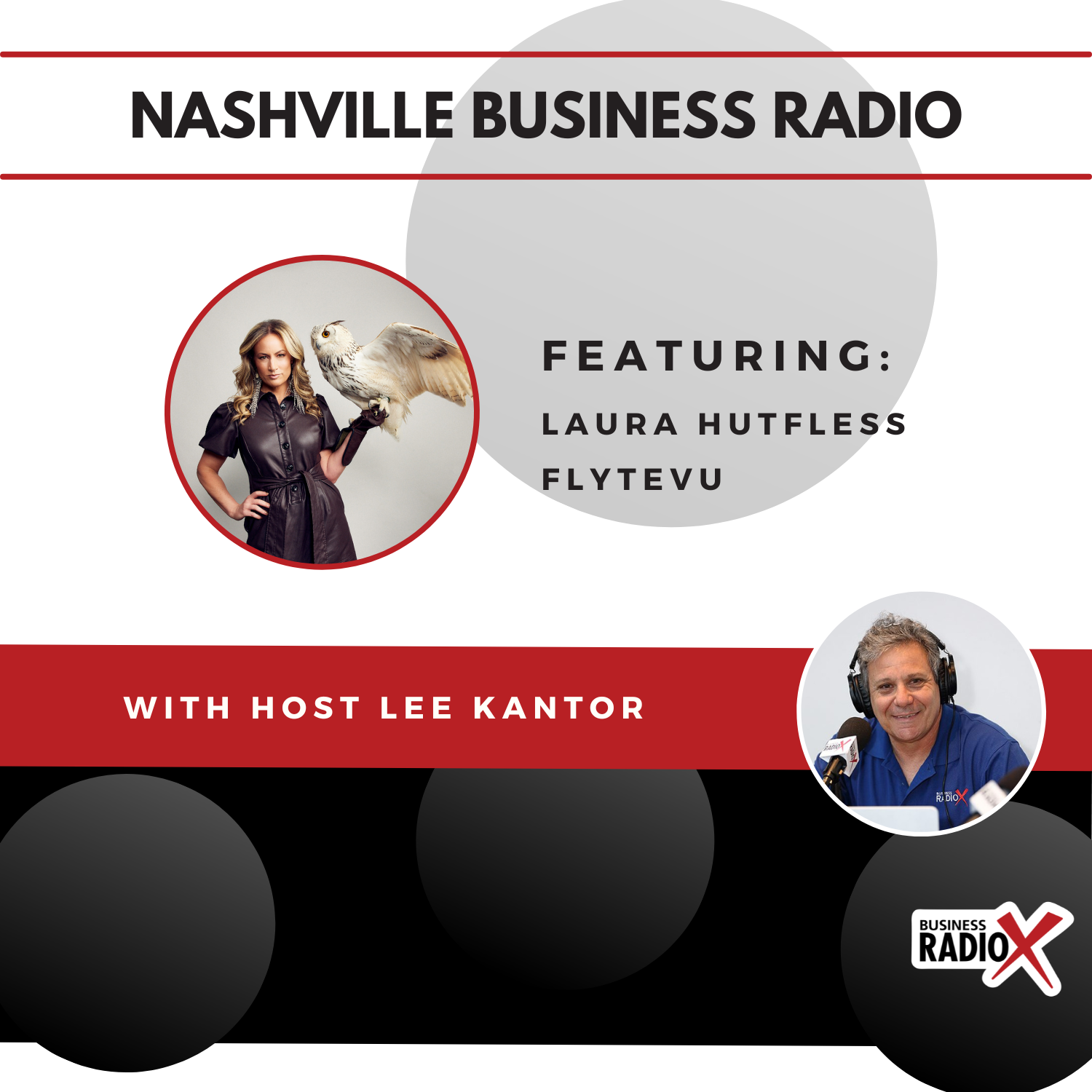

In this episode of Nashville Business Radio, Lee Kantor interviews Laura Hutfless, CEO and founder of FlyteVu, about helping brands connect with consumers through pop culture, purpose, creators, and innovative partnerships. Laura shares how creator marketing has evolved, why engagement matters more than follower count, and how brands can use data, AI, and cultural insights to identify the right opportunities. She also explains why brands need to move beyond playing it safe and take bold, creative swings that capture attention and drive meaningful results.

 Laura Hutfless is the CEO and Co-Founder of FlyteVu, an award-winning creative agency that connects brands to culture in bold, unexpected ways.
After a 15-year career as a talent agent at WME and CAA, she built FlyteVu into a fast-growing, industry-recognized agency known for culture-shifting campaigns honored by the Emmys, GRAMMYs, Cannes Lions, and more.
Under her leadership, FlyteVu has been named to Adweek’s Fastest-Growing Agencies and Chief Marketer’s Top 200 list. Under her leadership, the Company established the FlyteVu Fund, which has contributed over $1.3 million to charitable causes through employee-directed giving
Connect with Laura on LinkedIn.
Episode Highlights
- The evolution of brand partnerships with artists, creators, and influencers.
- Why audience engagement and loyalty matter more than follower count.
- Balancing data and intuition when selecting the right creator for a brand.
- Using AI and cultural intelligence to identify emerging trends and opportunities.
- The importance of authentic alignment between brands, creators, and audiences.
- Why playing it safe can make a campaign irrelevant in a crowded marketplace.
- Turning cultural trends into creative campaigns that generate attention.
- The value of taking calculated risks and making bold creative moves.
- Building campaigns around data, insights, creative ideas, and the right partners.
- How challenger brands can use creativity and risk-taking to compete with market leaders.
- The importance of flexibility and having backup options when executing complex campaigns.
 This transcript is machine transcribed by Sonix
TRANSCRIPT
Intro: Broadcasting live from the Business RadioX Studios in Nashville, Tennessee. It’s time for Nashville Business Radio. Now, here’s your host.
Lee Kantor: Lee Kantor here, another episode of Nashville Business Radio. And this is gonna be a good one. But before we get started, it’s important to recognize our sponsor, Business RadioX. If you’re a business coach or consultant who’s tired of being a best kept secret, set up a call with Stone Payton at bookstonephone.com to unlock your perpetual prospect pipeline. Today on the show, we have the CEO, founder of FlyteVu, Laura Hutfless. Welcome.
Laura Hutfless: Thanks. Happy to be here.
Lee Kantor: Well, I am excited to learn what you’re up to. Tell us about FlyteVu. How are you serving folks?
Laura Hutfless: Yeah, we are a creative and culture agency and we help our clients connect to their consumers via pop culture and purpose. So our clients like to say we bring the sizzle.
Lee Kantor: So what is your backstory? How’d you get involved in this line of work?
Laura Hutfless: Yeah. Well, I came to Nashville hoping to work in the music industry, and that’s where I started. I started working at a talent agency called William Morris, which is one of the largest in the world. Came up the ranks. I started working in sponsorship and endorsement, pairing talent with brands and sponsorship endorsement opportunities, and then went to CAA, which is another large talent agency, and continue to do that work and build that team there. From there, I realized that this was a sector of the industry that was growing very quickly, as brands understood that they needed to align with these, what I call megaphones, these artists who have communities and followings to be relevant. And that was becoming a broader sector of the industry. And so I decided to start my own company called flight. View. But in this case, my clients would be brands and I would help them navigate the space. Finding them the right partners, developing the right creative, and the right channel. Identifying the right channels to amplify that work.
Lee Kantor: So how has the industry changed over the years in terms? Let’s start from the brand standpoint. At one point, brands used to be super conscious. Protect the brand at all costs. We’re very. We’re controlling everything and anything we can when it comes to our brand. And nowadays, it seems like with these kind of partnerships with creators of all different kinds, that the bar is a lot lower when it comes to matchmaking. You know, I know that the brands would love it if each creator was perfectly aligned, but now it seems like they’re casting a wider net. Are you finding that?
Laura Hutfless: Well, if you want to take it even further back when I started my career 20 plus years ago, The talent. This was before influencers, talent, meaning music artists, actors, actresses, uh, wouldn’t align with brands because they considered it selling out.
Lee Kantor: Right back in the day, that was that. That was a real thing. They would not even allow their music to be used. It was very protective from their standpoint.
Laura Hutfless: Yeah. So I just aged myself. Uh, so that that’s where we started. That’s where I started in my career. And really the, the deals we were making then were around, uh, tour sponsorships, bus wraps, signage, uh, you know, uh, more in sports, you know, uh, logo deals, things like that. So that’s where it began. And then I think artists and creators started realizing the power of brands and the marketing value that those brands could bring to those creators. Uh, meaning if I’m a music artist and I’m launching an album and Nike uses my song in their ad. It suddenly exposes my music to a much broader audience. So there was, you know, a few years in my career. Uh, I think creators started realizing brands had value. And so then, you know, the, the, the partnership and negotiation looked a lot different. It started looking like, what value do both parties bring to the table? Um, so apply that to today. And now creators have the following. They have communities, um, they have a megaphone to reach those communities and they have more value. They’ve built an audience. Some of these influencers have built whole media networks, right? They have, they have created value that these brands now need. So the value proposition has shifted over the years. And that has created a unique opportunity for a very innovative deal. Structures varied creative partnerships for the brands that recognize the value that these creators can bring to their business or their products.
Lee Kantor: So now, from your side of the table, you work primarily with brands, not the creators, or you’re the matchmaker between the brand and the creator.
Laura Hutfless: Yeah. My clients are the brands, uh, brands, nonprofits, uh, kind of different entities that are looking to solve a business challenge that could be a perception challenge, a sales challenge. I’m reaching a new, uh, audience. I think a lot of the briefs we get are reaching Gen Z these days. Uh, and so what is the creative solution to that? That often incorporates celebrity influencers, uh, experiential activations, uh, content kind of encompasses all of those components. But our, our real filter is pop culture. My belief is for a brand to be successful and relevant, uh, to audiences, they have to be integrated authentically into culture.
Lee Kantor: Now, do you ever coach creators to help them be more attractive to brands?
Laura Hutfless: Uh, I haven’t, uh, no. I think my days of representing talent and influencers, uh, are over. I think they have great agents and teams that can help them identify that. And in a lot of cases, they sometimes know how to reach audiences better than brands do. And so oftentimes I feel, you know, our clients sometimes look to them for direction on, you know, how to communicate or speak to the audience they’re trying to reach. Um, I think, you know, there’s so many opportunities these days. So I don’t know that any of, you know, successful creators need need a lot of coaching. Sometimes they are the coaches.
Lee Kantor: So how do you kind of, um, choose which is the appropriate creator for a given brand? Like what are some of the, the things that you look for?
Laura Hutfless: Yeah. Uh, I like to say there’s kind of two categories. There’s data and there’s gut. And on the data side, there’s lots of tools that we use to identify the right creator or moment. Um, you know, you can look at their audience, their following, their perception, uh, you know, lots of tools these days. We also have developed our own tool, our own AI tool that helps our clients, uh, quickly identify culture opportunities or moments or creators that align with what they’re trying to accomplish. So we have that tool in-house that allows us to move very quickly. Um, on the other side, there’s gut, right? There could be five, uh, creators and the data says the same thing, or it’s pretty close, or the data says one thing, but you know that, uh, maybe the you’ve worked with the talent before or, you know, the, the team surrounding them, uh, is great to work with. Or you’ve maybe seen how they over deliver in other partnerships. The creative may just make more sense in one case than the other. So that I would kind of all bucket in. There’s just kind of a, a knowing of even, you know, a balance of the data says this, but, but we know this creator is going to over deliver or their work just aligns a creative aligns with the brand. And all of those things have to work. If you choose just based on personal preference and gut, that’s never going to work. And if you choose just on data, that won’t work either. You have to, uh, kind of take both of those into consideration.
Lee Kantor: So it’s not a good idea for brands to just look at kind of, okay, let me just count how many followers they have in the in the different platforms. And then the one with the largest wins.
Laura Hutfless: The worst idea, the worst idea. But you’d think, right, maybe for someone not in the space, that’s maybe what they’re looking at. What they need to look at is engagement rates. I may have 10 million followers, but no one’s engaging with my content. Um, you’re, you know, your ROI is, is not gonna pan out for you very well in that case, uh, or I may have a smaller number of followers, but man, is that community engaged and they will buy every product and they will be loyal. And I would much rather partner with a, uh, influencer or talent with a smaller following who has an engaged audience than a large following that’s not engaged.
Lee Kantor: Now, when you talk about engagement, is that because some people with large followings may be all of those followers aren’t kind of earned followers by their work. They could be bought.
Laura Hutfless: Um, well, you know, the larger following you have probably the lower engagement overall you’ll have. But you can really look at like the quality of the community. And how is that creator or talent engaging with that community? And I’ll give an example, um, because she lives here in Nashville, uh, and we’ve worked with her a lot, but Shawn Johnson is a creator, uh, athlete kind of turned, I would consider a media mogul. Uh, she’s really created quite a brand, uh, for herself and has lots of brand partners. But, you know, every partnership we’ve worked with her on, she delivers, her audience is engaged. Uh, she’s really worked hard to develop that across multiple platforms. Um, you know, if I compare her to Taylor Swift, right. Very large numbers, very different. Uh, but but man, is Shawn connected to her audience and she knows her following. She knows her fan. And, uh, you know, she turns results every single time.
Lee Kantor: It’s interesting because when I first started doing podcasting, many probably longer than you have been doing what you’re doing. But a very long time ago, I noticed when I was having certain guests on, they would have a bigger name and you’d think they were more famous, but the engagement was much less than other people who had just seemed like had an audience that if they said, hey, I’m on this show, then all of a sudden a ton of people would click to see what what they’re doing on the show. And the, the more famous ones didn’t have kind of that level of intimacy with their followers that would take action. They would, you know, maybe they follow them or, or kind of voyeuristic paying attention to them, but they’re not taking action.
Laura Hutfless: Yeah. Here’s a good example in the music space. Uh, you know, there are artists who have millions of followers on social, but they can’t fill a venue. No one’s buying tickets. Uh, then there are other artists who can sell out arenas. Right. But but aren’t played on radio or don’t have as large of a social following. But their fan base is rabid. They’re loyal, they’ll take action. Um, and so that’s, that’s who I would look to if, you know, in, in working with brands, I want to look to audiences that are engaged, that, that creator has built trust with and that the audience will take action.
Lee Kantor: And this is where partnering with an agency like yours is so valuable because it isn’t an obvious thing. You got to go kind of layers deep to find the appropriate match.
Laura Hutfless: Yeah. And, and you’ve got to work with a team that does this every day, thousands of times, you know, a month, a year. Uh, I always equate it to buying a home. Most of us buy a home once every few years, if that. And so we don’t go in thinking we’re experts at buying homes. Uh, and so we engage a broker, uh, in the same way when you’re looking to partner with talent or celebrity, uh, you know, I’m guessing you’re not doing that on a daily basis. Uh, and if you’re not, you should look to hire someone to help you navigate. It’s a, there’s a contract involved. There are a lot of nuances, rights holders, uh, things that can be very problematic if you don’t understand going into the deal. And so that was kind of the, really the spark that built FlyteVu was I was seeing, you know, a decade ago, these brands kind of naively walked into the agency wanting to book a talent. Uh, and I spent a lot of time coaching them, consulting them, cleaning up deals that had been, uh, made incorrectly. Uh, they had left money on the table or didn’t realize they weren’t getting the right correct rights or usage. Uh, and so I realized brands needed, needed agents. They needed someone to help them navigate the space. So, uh, I would say if you don’t do this on the daily, you definitely need someone to, to help.
Lee Kantor: And how often does somebody come to you and go, oh, this is my favorite artist. Let’s get them.
Laura Hutfless: Uh, more often.
Lee Kantor: Than.
Laura Hutfless: You would think. Uh, it’s getting better, actually, over the years. I mean, when we started, that was, you know, very common. Uh, but, you know, as there’s more data available and I think marketing execs are held to, uh, stronger, you know, KPIs and, you know, you have to prove ideas and opportunities with insights. You know, it’s actually, I don’t hear it as much anymore unless it’s coming from a very high level C-suite executive, you know, because their son or daughter likes likes that particular talent. That’s probably the most common.
Lee Kantor: And they. And they want to meet them.
Laura Hutfless: So more well, more often than not, I hear when we maybe pitch ideas or celebrities, I hear, well, I don’t know them. And that is a more frustrating response, uh, because typically, uh, it doesn’t matter. You know, it’s, there’s probably an older executive and we’re trying to reach Gen Z and just because you don’t know this person doesn’t mean millions of people don’t, you know, like.
Lee Kantor: It’s probably a good thing that you don’t know them.
Laura Hutfless: Yes. In fact, most of the talent, and I’ll admit this, most of the talent, my young talent and culture team pitch, I don’t know, but I shouldn’t because I’m not the target. They’re the target. If they know and it’s cool, they’re, you know, 99%, 99.9%, they are going to be right about it. So I learn about talent and, uh, you know, culture shapers through my team. And that’s their jobs. That’s what they’re in every day. And they’re always ahead of the trends. They’re always ahead of the, the curve. And you know, that’s what they’re paid to do.
Lee Kantor: So what advice, uh, other than just hiring you or hiring an expert, would you give a brand that is maybe new to this type of creator or influencer marketing?
Laura Hutfless: Uh, my advice would be to not play it safe. Uh, we, our tagline at flyte view is safe doesn’t fly. Uh, we encourage our clients to, uh, you know, step outside their comfort zone and take some big swings. And the only way to kind of grow is to, you know, step up to the plate and you might, you know, you might hit a grand slam, you might hit a, you know, second, you might get to second base, but you’ll learn every time, um, you play in this space And, uh, it’s really fun. It’s fun to see the results. It’s a great way to connect to audiences. And I just say, step up and swing. Like you’ve got to start somewhere. Um, but, but just don’t, don’t follow what everyone else is doing. It’s a really bad, bad strategy. And I see a lot of brands come to us and they want to dip their toe in, but by dipping your toe in, you’re not making a big enough splash to have an impact. It’s like cannonball in the deep end and you’re going to see an impact. Uh, so I always say, you know, say it doesn’t fly.
Lee Kantor: So what’s an example of dipping your toe in versus taking a big swing?
Laura Hutfless: Okay. A good example is, um, I would say a brand or a client coming to us and, you know, maybe they’ve never played in this space before. And first they just want to do a small deal with a local influencer to see if it, if it works, but no other support around it. Let’s just do a really small deal. Well, like that’s probably going to get lost. You know, in today’s world and culture, like there’s, there’s lots of those types of deals out there. Uh, do something more creative. Like let’s do a stunt, let’s do something that gets a headline, like just the, it’s not necessarily even about budget. It’s about doing something different, uh, that stands out in the world. Um, that isn’t expected. And you see that a lot with brand to brand collabs. That’s very popular right now. Uh, there was a collab once with, um, I believe it was a boxed wine and Cheez-Its and it like came in the same container that was super fun collab. Um, you’ve seen, I believe Kentucky Fried Chicken did like a pickle purse. Like you just see these really cool collabs happening now. And so it’s just what’s unexpected and unique is what’s breaking through.
Lee Kantor: So it’s one of those things where it’s kind of better to just take that big swing. Even if you miss, you’re probably going to get attention rather than just not be even acknowledged.
Laura Hutfless: Yeah. Rather irrelevant is the word.
Lee Kantor: Right? So relevance is maybe that’s the metric that matters more than, uh, anything else. Like if it’s not going to be relevant at the end of it, then why are we doing this?
Laura Hutfless: Do it. Correct. Exactly.
Lee Kantor: So are those hard conversations to have with your clients because a lot of clients are kind of risk averse.
Laura Hutfless: Yeah. It’s not for everybody. We say heights aren’t for everyone. Uh, it’s only for the brands that want to soar. And I think we live in a world where there’s more competition for attention than ever before. And, you know, I don’t believe as a company, you can afford to play it safe. And the same goes for my own agency. I can’t afford to play it safe. I’m always having to think ahead and push the boundaries and and try new things. And some, some, uh, of those ideas have worked and some haven’t. I’m not shy about that. Uh, but the ones that work have, have elevated us, um, as a company and the ones that didn’t people forget about in about 60 days, 60 to 90 days, they’re on to the next thing. So, uh, I think that’s the beauty of the world we live in now. People move on very quickly.
Lee Kantor: Right? So it’s a double edged sword in that regard. It’s harder to stand out, but it’s also you don’t have to, you know, it’s not don’t be precious about this either because just keep moving.
Laura Hutfless: Yep, yep. Some of the best brands we’ve worked with, uh, we’ve worked with a lot of startups. Bumble, uh, was a startup when we started working with them in ClassPass. Um, Lyft was even kind of beginning, uh, when we did work with them. And what I love about them is they’re just willing to take risks. Like they’re up there a challenger brand, meaning they’re up against a market leader. Bumble was up against Tinder. And so they have nothing to lose, right? So they’re just taking big swings. And I love that chapter, uh, of a kind of startup’s life cycle. Uh, I love working with founders in that space and we’ve seen that pay off now. Um, Bumble specifically had $1 billion IPO. Obviously, Lyft is doing well. All of these brands are doing well and I can see it. They had founders who were willing to take big swings out of the gate.
Lee Kantor: So is that kind of the ideal client profile for you? Like probably industry agnostic, but a challenger brand in some form?
Laura Hutfless: Uh, we, we really have kind of two different types of clients. Challenger brands who are willing to take big swings is one, but then we work with big, uh, very well-known large organizations. Uh, we’ve done work with tractor supply enterprise, uh, Amazon. We have Humane world for animals right now. We’re doing a lot of amazing work with, uh, so, you know, big brands, you would recognize fortune 500 companies.
Lee Kantor: So they’re taking the same big swings and it’s the same kind of philosophical, uh, direction you’re taking them on.
Laura Hutfless: Yeah. Those are our ideal clients, uh, folks who want to try something different. They’re looking for a headline. They’re looking for a way to break through. Um, so if you’re out there and you’re that brand, I’d love to hear from you.
Lee Kantor: So what’s, uh, share your story. Maybe one of your smaller firms, the challenger brands that, what problem did they come to you with? And then how did you help them get to a new level? You mentioned several brands, but what was kind of their ask and then what was what did you deliver?
Laura Hutfless: Well, I’ll share our most recent campaign. Um, this isn’t a challenger brand, but it’s a nonprofit. And I would kind of equate it to the same only because at nonprofits, uh, you’re often working with a very large board. Um, you know, they’ve been around for a very long time. Uh, and so kind of taking big swings is, is not common in my experience. And, and so, uh, our client humane world for animals, which you may know them as humane society. They just rebranded, um, last year, which we led for them. Uh, they came to us and, uh, they were looking for a campaign that would encourage people to take small steps, uh, for the good of animals. And one of those small steps is eating less meat. Um, and we did our research and found that there was a big trend of folks talking about beans, kind of encouraging people to eat more beans. There were been influencers, there were being threads on Reddit. And so that’s where we decided to focus. Uh, make a long story short, we came up with the idea of creating a day called Beans Day. And then this is where it gets really fun. We decided to have Kevin Bacon, uh, be our spokesperson for, uh, this day. And he would change his name from Kevin Bacon to Kevin Bean. Uh, we shot a really creative ad very outside the norm for a, uh, animal advocacy group. If you think about animal advocacy, you often think of kind of the. Sarah. Mclaughlin.
Lee Kantor: Commercial animals, you think of animals, the animals.
Laura Hutfless: And they usually show kind of herding animals in captivity. Right? And in this case, no, it’s Kevin Bacon. He’s in a full on bean suit, uh, with beans being shot up in the air behind him as he’s talking about, uh, you know, eating beans and the good it does for animals and changing his name very different than their traditional kind of fundraising content, uh, or, um, imagery or visuals. And so that was a real departure from anything they had done before that campaign delivered a billion impressions in one week. Uh, it was featured on every major media outlet. And then this is kind of a a personal win for me. It was featured on TMZ in a very positive light. Uh, TMZ actually approached Kevin in LAX and asked him about eating beans. And so just like we, we have broken the cultural zeitgeist. We have entered entered that space, uh, for humane. And, uh, the CEO said, you have made us cool. And, uh, that was a big vote of confidence. So again, from a very global large organization that is kind of used to doing things one way to kind of taking big swings and changing that up and trying something new. Uh, that’s where our tagline safe doesn’t fly, uh, comes to life.
Lee Kantor: So is it realistic? Like when something like that happens, it kind of goes mega-viral like that. Um, and then the client’s like, okay, let’s do it again tomorrow. You know, like, how do you manage the expectations of this?
Laura Hutfless: We’re ready. I mean, that’d be amazing. And by the way, there, there are, there’s more coming. Uh, spoiler alert, uh, because typically that happens, you know, they have a big win and they’re like, okay, we got to create it again. Uh, you know, it just takes more creativity. There is something to a sense of timing. Uh, again, we, we built our, that campaign on very real insights and data. And that’s where our AI tool really helps our clients see and understand, you know, beans was a trend. It was on the rise. I have the data to back that up. So I know that when I put a campaign out about beans day and oh, by the way, I’m going to pour gasoline on it with Kevin Bacon, it’s gonna take off. So it isn’t haphazard. It’s not like I’m just coming up with something and hoping it’s going to take off in the world. And I guess that’s where a good agency will advise their clients. It’s we have a tool that helps us understand what are the trends and the insights that we can build from. So when we do put something in the world, we know that there’s already a wave happening and we’re going to ride it.
Lee Kantor: Now, when you say you identify a trend like I guess beans were trending, is it something that’s fleeting that this is here today, gone tomorrow? Or like, how are you defining a trend? Because it takes time to execute on whatever the creative is, get approval, all that, and then get it out there while it’s still a trend.
Laura Hutfless: Yeah. Great question. That’s where I love this tool. So this tool will show us this trend has been trending up for 120 days already. And at the pace and kind of, oh, there’s a big boom that just happened at my house. I don’t know if you heard that. But anyway, we can see that it’s trending up. We can see how long it’s been trending. And based on the the action and kind of social media, uh, and kind of where this tool is scanning, it will tell us how long it thinks it’s going to remain. So we can decide, are we too late to the trend? Are we, uh, early on the trend? Uh, should we play in this or not? Uh, so tools will tell us that so we can decide to act or not.
Lee Kantor: So like for your next campaign for them, it it’s probably not going to be beans again. It’ll be something else that’s trending that’s relevant to their brand, that’s consistent with what they’re trying to accomplish.
Laura Hutfless: Correct. Yeah. Um, you know, that was built on, uh, wanting kind of educating folks on, uh, eating vegan and the benefits associated with that. Uh, the next brief may look different. They may want us to educate folks on, uh, legislation that they’re advocating for. Um, so based on the brief that we get, we’ll go again, we’ll go then look at insights that may inform a creative idea. Uh, but every brief is different. And that’s what makes this job fun. That’s why I love my job is, uh, every day is something new. It’s not the same. Every industry is different. Every client’s different. Therefore every solution’s different. Uh, and so I love the thrill of that.
Lee Kantor: Yeah. And also the objectives change, like you said. And then, but the system is the same like you, you’re not just grabbing, oh, this is hilarious. Let’s run with this. If it isn’t on trend or doesn’t match the outcome they desire, that’s just creativity for Creativity’s. Uh, you know, just for that sake, it’s not really going to move the needle in their business necessarily.
Laura Hutfless: Correct. Uh, all of those, uh, elements have to line up, right? The data, the insights, the idea, the partners and the pieces of the campaign, and then those all have to deliver results. Uh, and that’s what makes a campaign win. But there’s, there’s a lot of factors. I mean, I, the metaphor is putting together a puzzle. Uh, and so you need every piece to fit for it to create a perfect picture. Um, you’re missing some pieces and it’s not whole, so it’s not easy.
Lee Kantor: So in order to take those big swings, is it kind of okay if they’re like hypothetically, say there’s ten pieces of that puzzle or ten pieces of your puzzle in your methodology? Does it have to be ten for ten or else it’s a no? Or how does that work?
Laura Hutfless: So I think in our process, when we put together these ideas and these strategies, we’ll build the idea and strategy. And we kind of have a a recommendation of the partners, the talent, like Kevin, Kevin was our number one choice. Like without Kevin, I don’t know that Beans day would have taken off like it did. Uh, and so, you know, if Kevin said no to that idea, we’d have to start over because the creative was created specifically with him in mind. Um, and so oftentimes if one piece doesn’t fit, it depends on the piece. If it’s the megaphone piece, you’re gonna have to change the idea. Uh, now if it’s a media partner or something, you could probably replace that piece with something that, you know, delivers equivalent value. Uh, so it depends on the pieces, depends what falls out. Uh, and depends if you can replace it and how quickly. Uh, but that’s pretty common. I mean, every campaign we have, something changes. Uh, we’re dealing with people, you know, especially in the talent space. Like people change their mind. They might timing might be off, they might not be available. So we have to constantly be flexible and have option B, C, D, E and F already lined up.
Lee Kantor: So if somebody wants to learn more, have a more substantive conversation with you or somebody on the team, what’s the website? What’s the best way to connect?
Laura Hutfless: Yeah, we have a link on our website. If you go to, uh, flytevu.com, that’s FLYTEVU. Uh, and there’s a link to, to reach us. And, uh, we’d love to learn more about your challenge and how we can help.
Lee Kantor: All right. Well, thank you so much for sharing your story today. You’re doing such important work and we appreciate you.
Laura Hutfless: Yeah. Thanks so much. And I always sign off with never nest.
Lee Kantor: All right. Thank you. This is Lee Kantor. We’ll see you all next time on Nashville Business Radio.















