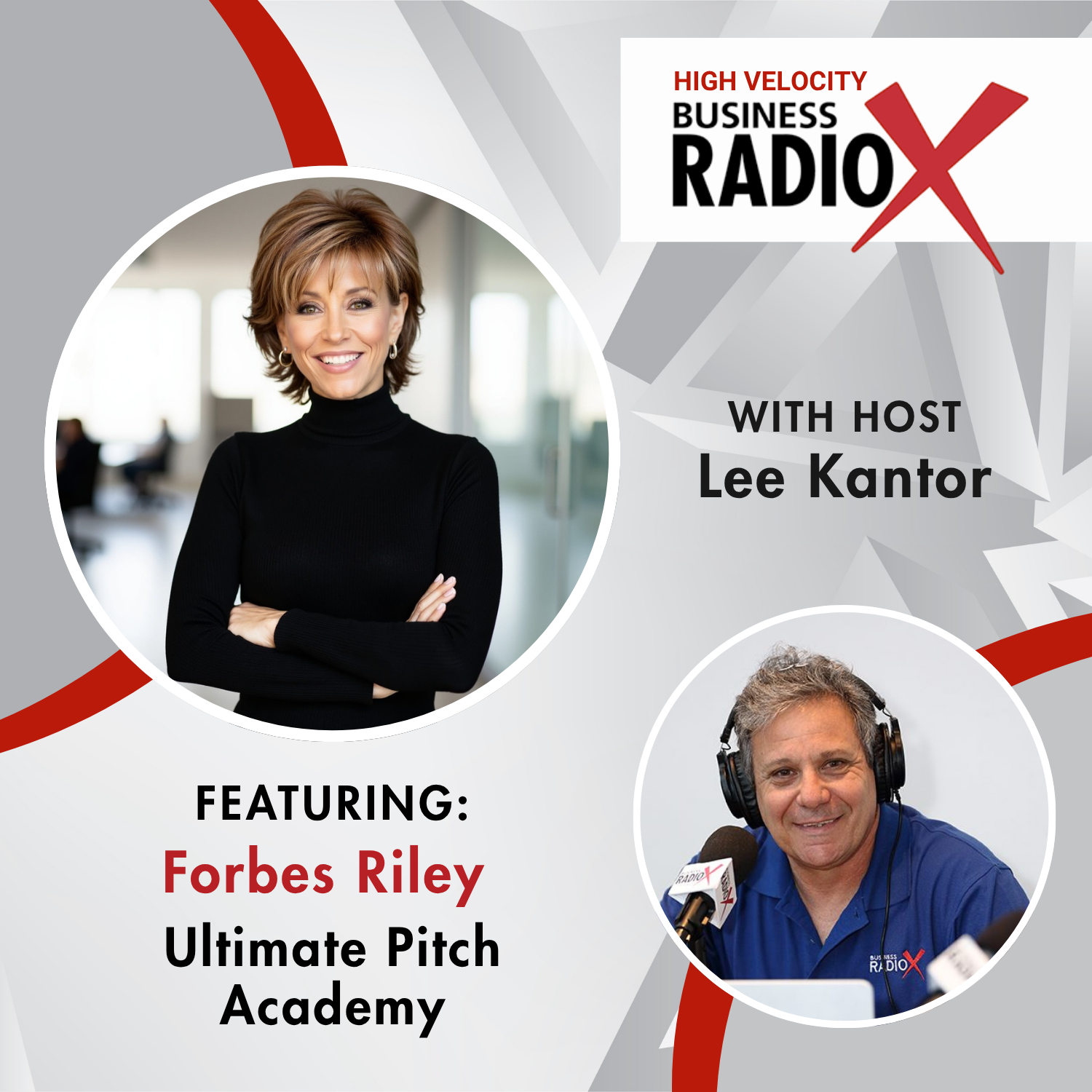

In this episode of High Velocity Radio, Lee interviews Forbes Riley, the “Queen of Pitch” and author of “Pitch Secrets A to Z.” Forbes shares her journey from Broadway actress to pitching expert, having generated over $2.5 billion in product sales. She discusses the difference between sales and pitching, emphasizing relationship-building and storytelling. Forbes highlights how pitching principles apply across platforms like TikTok and Instagram, the importance of testimonials, automation, and practicing pitches before real prospects. She also introduces her book, structured A to Z, and her free weekly Zoom training sessions at pitchsecrets.com.
 Dr. Forbes Riley, widely known as the Queen of Pitch ,is a globally recognized entrepreneur, media personality, and communication strategist who has generated more than $2.5 billion in product sales worldwide.
A 2x TEDx speaker and 3x bestselling author, she has built a multi-million–strong following around one core principle: your success rises and falls on your ability to communicate it. Her strategies aren’t motivational theory, they’re market-tested methodology. A recent media appearance demonstrating her techniques reached 6.2 million views in just 24 hours, underscoring a universal truth: when you master your message, you change your outcomes.
In her upcoming book, Pitch Secrets A to Z, Forbes reveals the communication framework behind her billion-dollar career—offering entrepreneurs, leaders, high-achieving professionals across to stay at home moms, seniors and anyone looking for a side hustle to supplement their income.
With 197 infomercials to her credit and 30+ years of on-air experience as both host and guest expert on QVC and HSN, Forbes mastered the art of real-time persuasion. Diverse and talented with a passion for communication in all forms, she started out as a Broadway actress, appeared in several soap operas, movies and major television hits including FOX’s 24, The Practice, and Boy Meets World.
But her accomplishments don’t start there – she pioneered pitching fitness on cable tv hosting FIT-TV alongside Body by Jake, hosted 2 National Talk shows (Essentials on TLC and Forbes Living on Oxygen) and debuted as host alongside Stuart Scott as the original co-host of ESPN’s X Games.
In true entrepreneurial spirit she launched a fitness empire as the creator of SpinGym®, her patented fitness innovation with over 2 million units sold globally, earning her induction into the National Fitness Hall of Fame, an honorary doctorate in Business and the Presidential Lifetime Achievement Award.
Through her global training platform, the Ultimate Pitch Academy, she mentors thousands of entrepreneurs with her ground breaking techniques, from college to corporations, with her Elevator Pitch 2.0 revolutionizing communication skills. Whether sharing stages with icons like Les Brown, Mel Robbins and Jay Shetty or delivering high-impact television appearances, Forbes brings actionable strategies, bold energy, and practical tools audiences can immediately implement.
Her message is clear: when you sharpen your pitch, you sharpen your life.
Connect with Forbes on LinkedIn, Facebook and X.
What You’ll Learn In This Episode
- Importance of mastering pitching skills for effective communication.
- Differences between sales and pitching, focusing on relationship-building.
- Practical advice for crafting pitches, including the use of testimonials and storytelling.
- Adapting pitching techniques for modern platforms like TikTok and Instagram.
- The significance of understanding audience needs and desires in pitching.
- Leveraging automation in business for efficiency and income generation.
- The role of storytelling in creating compelling pitches and engaging audiences.
- Common mistakes in pitching, such as practicing in front of prospects for the first time.
- The value of physical books in sharing knowledge and creating a legacy.
- Encouragement for individuals to share their ideas and products to avoid being the “best-kept secret.”
 This transcript is machine transcribed by Sonix.
TRANSCRIPT
Intro: Broadcasting live from the Business RadioX Studios in Atlanta, Georgia. It’s time for High Velocity Radio.
Lee Kantor: Lee Kantor here another episode of High Velocity Radio and this is going to be a good one. Today on the show, we have the Queen of pitch, best selling author with Ultimate Pitch Academy, Forbes Riley. Welcome, Forbes.
Forbes Riley: Hey, hey, nice to hear you.
Lee Kantor: Well, I am excited to learn what you’re up to. Tell us about Ultimate Pitch Academy. How you serving folks?
Forbes Riley: Well, I’ll tell you what. When you’ve got an idea or a product or a service and you want to get it out to the world, get it to someone else, you want to get a raise, or maybe you want your kids to clean their room. You want to fall in love with the word pitching. You know, it’s funny because for the last 20 years, most people have said to me, oh, Forbes, pitching is such a sleazy, nasty word. I’m like, no, that’s sales. And by the way, sales makes money. And I think people who go, oh, like that, check their bank account. So I started my life out. I just wanted to be an actress. I loved performing, I’ve done Broadway, I’ve been in lots of your favorite movies and TV shows like 24 and The Practice. And it would have been very happy doing that. Except one day I bumped into an audition that said, sell me this pen. I grew up in a very broke household. My dad spent three years in the hospital. He had a horrible accident, so we didn’t have a whole lot of money. So selling anything was not my favorite thing to do. And when I got off to college, I was very young.
Forbes Riley: I skipped two year high school and my mom used to write me longhand notes in pen, and I realized a pen can reach out and touch somebody’s heart. Well, I said that, and I expected just to leave. And Jake of Body by Jake in the early 90s walked out from behind the camera. He grabbed my face and said, you’re gonna make me a lot of money. I didn’t know what he was talking about. He just started his own cable health network, and he wanted to pitch products. And no one was really doing that at the time. And somehow he was looking for 8 or 9 people. He found me, tapped me to do this, and we ended up selling over 1500 products in five years. He sold the network to Rupert Murdoch for $500 million in 1993, and I went off to host infomercials because all of a sudden I became this pitch queen. It seemed that I could sell and promote anything. Well, I’ve done that to the tune. Lee, get this of $2.5 billion and you’ve seen me on TV late at night for about 20 some odd years. And then I did home shopping. I wrote a book recently because one of the things that I realized is people didn’t know who I was.
Forbes Riley: I was the one standing next to Tony Little, standing next to Ron Popeil. I didn’t stand next to Kim Kardashian. I just gave her her start in TV. But there were so many images of all of these people that I’ve done. And then I know you can see this on your Zoom screen. Your audience can’t, but there’s 197 infomercials here, and when we read the history, it reads something like AB or ab rock or bioform, buns of steel, buns of abs of steel, bye bye, baby Fat Cami secret all the way to Z for zoo books. And so I put in this book the stories of that time, because not many people have his intimate stories as I do, And also some of the secrets for communicating and getting somebody to say yes to you. You know, you pitched me to be on your show. I pitched you that. I was qualified to be here. No money exchange. So it’s not technically sales. It’s definitely a pitching. And I promise you guys listening, if you want to get more yeses in life, mastering this skill is a game changer.
Lee Kantor: So now how do you take the skill that you have and then translate it into the world that we’re in? When there’s TikTok and Instagram, like, do these principles kind of work in any media?
Forbes Riley: Oh, it works in every media. Somebody called me the godmother of TikTok shop, and one of my videos just got 21 million views. How do you do that? Well, there’s a couple of principles. And I suggest if you’re listening to grab a Pen, because these are worth writing down. When you get excited about a product or service or anything you’re doing and you get overly passionate about it, you use the word need. Gosh, you really need this. You need to know what I’m all about. And you need my book. Well, the truth is, nobody ever bought anything they needed. We only buy what we want. So a skilled pitcher will get the other person to want what you have. Have you ever been married?
Lee Kantor: I am married, yes.
Forbes Riley: Good. And you pitched your wife to marry you?
Lee Kantor: Yes, yes I did.
Forbes Riley: And she said yes.
Lee Kantor: Yes.
Forbes Riley: You know, she bought into an entire life with you. You must have had a really good pitch.
Lee Kantor: I’m one for one.
Forbes Riley: There you go. But think about it. You literally pitched her an entire life together. So you somehow in your relationship, managed to see the future. Get her to understand that doing it with you is the right idea. And it became her choice. She was the one who could have said yes or no, even though you asked the question. That really is what happens in business with new products, new ideas. And the cool thing that you just mentioned for Instagram and TikTok is now anybody, you don’t have to be an entrepreneur. You can just be a side hustle, you can be a kid can earn extra money because we’re in a crazy economy. And now if you know how to position a product, know how to message who you are, build a brand for yourself. The world is your oyster.
Lee Kantor: Now, a lot of the listeners of this show are business coaches, people in professional services. How do you do pitching in a way that doesn’t feel transactional and is more relationship driven, or is that even important?
Forbes Riley: Oh no, no, it’s major league important. In fact, that’s the difference between sales and pitching. You know, sales ends when you get the credit card. For me, it’s all about the hours. You want to build rapport with somebody because pitching means that you’ve got a solution to someone else’s problem. So let’s play a game. Give me any product or any service.
Lee Kantor: Um, let’s see business coaching.
Forbes Riley: All right. So a business coach and who am I pitching?
Lee Kantor: You’re pitching a person that would possibly benefit from that service.
Forbes Riley: So what I would do is I would do a little research strategy and leverage. So my research would be before I even talk to that person, I might want to know a little bit about them. Do they want to grow? They want to scale. They want to scale back. They want to sell their company. They want to hire people. What am I pitching them to? But say, hey, you know what? I’m a great business coach and I can make your company exponential. The first thing I would want to do is make an assumption about them. Where are they at this moment? And I would look and see how can I fill in the gap. I would then not sell my services. I wouldn’t tell them how wonderful I am. And I’m this and I’m that. I would find the gap and do what I call a question flip. So let’s say that they’re a small shop and they really want to go online for the first time. Say, hey, you know what? I know that being online can be scary and overwhelming. What if I told you I’ve got a very unique system that can make it so painless, and you reach such a broader audience than you could ever reach? In fact, if we do a video of you, we call this one to many. Now you’re not selling 1 to 1 because when you do that and the guy doesn’t want what you’re buying, you wasted an hour. But if you’re online and you’ve got an audience of 100. Odds are you’re going to close five of them. So I’m telling you now that we could probably five x your business in the same amount of time you’re out there trying to find customers. Would that be interesting to you?
Lee Kantor: Yes.
Forbes Riley: Bingo. That’s all you do is get a yes. And once you get a yes, then you move to that next level. Don’t overtalk we call it throwing up on people. And by the way, for all my business coaches and owners, and one of the things is you should be doing is networking. And I created a whole elevator pitch for this because I used to be kind of shy and insecure about talking to people. Ironically, now I’m not. But when people ask you, what do you do? Lee? What do you tell them?
Lee Kantor: I help business people get the word out.
Forbes Riley: Cool. Now, what if you shifted it? Can I give you a little coaching?
Lee Kantor: Sure.
Forbes Riley: Where did you come from that you’re qualified to do that?
Lee Kantor: Um, I have a degree in advertising, and.
Forbes Riley: Okay, you have advertising. You obviously love it. What’s a big success story? What’s a company that you’ve had some credibility for?
Lee Kantor: Um, I’ve. Let’s see. I’ve helped, uh, associations grow their membership. Um, how much by how much? Um, I don’t, I don’t know the exact number.
Forbes Riley: Well, so here’s an interesting thing, guys. When you’re formulating your pitch, these little nuggets help if I’m if I’m generic, I don’t close the deal very well. So if you just say I help associations grow, I’m like, okay, good for you. But if you say, you know, over the last three years, I’ve helped two associations grow by more than 200%. They not only increase their revenue, but their membership grew to such a point that they had to open a new chapter. Well, that makes you so much more interesting, doesn’t it?
Lee Kantor: Right.
Forbes Riley: And so when you say to somebody rather than just, hey, I help businesses, as someone who is so passionate about the world of business, I now focus on entrepreneurs just like you to scale your business. And I’ll tell you, I’ve got some incredible statistics I’d love to share with you.
Lee Kantor: So how would you frame the association I was talking with? Um, we help them capture 169 testimonials in one year from their members.
Forbes Riley: And what did that do for their bottom line.
Lee Kantor: That helped keep their members sticky? So I don’t have the exact, uh, numbers from their point of view. So that’s an important component is to to ask your clients for that specific information.
Forbes Riley: It’s one of the best things. Well, it’s ironic that you got 169 testimonials for them. Now we need to get some testimonials for you. And one of the things, you know, coming from the world of infomercials, you guys all remember seeing them on TV. There was a formula. And that’s what we do at the Academy. We truly teach you this eight step formula. One of those is to get those testimonials, because there’s different kinds of testimonials, but it lends instant credibility. When a third party likes you. I mean, think about what is reviews done for Amazon. You go there not because Amazon tells you how wonderful the product is, but you want to read what everyone else is saying about it. So every customer that you get, every business should really think about how do I get written testimonials? How do I get video testimonials? Make it a part of your business practice.
Lee Kantor: So that’s kind of table stakes in today’s world.
Forbes Riley: Oh, absolutely. And now that you’ve got videos and phone, I mean, literally you walk around with a cell phone all the time. Somebody says, hey, I love that. You go, great. You know, when you start a sentence says, hey, the reason I love Lee’s work is boom. Hey, the reason I love Lee’s work is he took us from here to here. And again, the more specific and intentional you can make them, the more impactful they are to the other person listening when you want future business.
Lee Kantor: So now you have a layer of testimonials. What is in your kind of, um, regular cadence of communication to the public at large? Or do you not do kind of general content? You it’s more specific.
Forbes Riley: Well, I’m not quite sure how I, how that goes. I’m, you know, there’s something you and I said earlier is that the world is rapidly changing. I’m going to share with you as a business owner, I used to work for QVC. I spent over 45 years working for QVC and HSN. Hsn just closed its doors. They had over 700 acres here in Tampa, Florida. That 50 year old business got bought out. Their stock died, and QVC about three weeks ago filed for bankruptcy. Now, you got to be kidding me. These are billion dollar enterprises who did not see the world of of phone shopping coming. They missed it and I remember being on campus with them a decade ago. They also missed how quick the internet was going to come and take away just their television. You got to see what’s going on. So an interesting thing just happened to me. I’m a little bit of a slow adapter. I loved Facebook, and then I saw Instagram and it seemed like kids were dancing and I, I didn’t do it very often. And now I’ve leaned into it and I have 310,000 followers who, by the way, I monetize a lot.
Forbes Riley: And then TikTok was like, oh my gosh, really? I’m 66 years old. At some point, you gotta, I gotta, I gotta go eat. I don’t have time for all this. Well, the funny thing was this young TikToker came up to me. He’s called the school of Hard knocks and he runs up to rich people. So billionaires and millionaires and ask them, how do you get rich? Well, he did that to me at the Vinoy Hotel down in Tampa, Florida, and I was a little shocking. We did this exchange and I laughed li I didn’t think anything of it. I’m now at 21 million views on that single video. Another 18 million over on Instagram. And now I’m getting recognized everywhere I go because. By the way, I knew what I wanted to say because I practiced pitching all the time. So when he accosted me, it was not a I know what I talk about, I know how to make my points, but that one video has changed my life. It’s been fascinating.
Lee Kantor: So I mean, that was kind of just serendipity, right?
Forbes Riley: It was. And what it did though, was it reminded me because I gained about 200,000 followers in the last month on Instagram. Now, if you understand new technology, you no longer have to say to people, hey, go visit my website, what you do, and you want to learn the lingo. Guys, here’s the crazy thing about business. It’s moving so fast. If you do not jump on the ship, it will just leave without you. And it doesn’t care that you’re left behind. You’ll get scraps. You can still run your business, but if you’re smart enough to get on board, all kind of magical things happen. So I’ve taken those and you literally say, hey guys, at the end of a video, if you like what you see, make sure you comment the word pitch below automatically. This is so phenomenal. That person and their DMs will get a message from going, hey, so excited that you reached out. Hey, I’ve got a free class. And this is true every Sunday that I’ve been doing for the last six years. I go live at 5:00 on Zoom. It doesn’t cost you anything. You go to Pitch Secrets training.com and you can listen to me hang out, talk for about an hour and a half. And then I work with as many people as I have time for to flip pitches completely for free, because that’s a bit of my give back. Well, all of a sudden my audience went from a couple of hundred people to now a couple of thousand people because I leaned in to to Instagram and I also leaned into LinkedIn.
Lee Kantor: Now, how do you leverage leverage automation in your processes?
Forbes Riley: Okay. Automation is everything. In fact, I co-own a company with my kids called GSD. It stands for Get Shit Done. And I got to be very honest with all my listeners out there. One of the reasons this 66 year old chick is successful is because I’ve got 23 year old twins who are relentless. One owns a company. She made her first million and 17. My son’s got 500 clients and he’s still managing college. What does that mean? That means it’s mom. You got to keep up with this. You got to keep up with this. If they weren’t always in my ear. I might not be as active as I am. But it is totally changed. It’s a game changer. So so automation. So GST stands for get shit Done because my daughter said mom, she calls us. She calls us older folks seasoned. She’s like, you seasoned people. She thought she thought, mom, I thought you were the only one who didn’t understand the internet. Turns out it’s a generational thing and I can change that. So her mission statement is that she helps men and women 40 to 80 years old get online and leverage this new technology. And now that Claude has come out, oh my gosh, Claude, bots can do everything for you. Why would you want to handwrite messages when you can now send it out to 200 people on your mailing list? I didn’t know this. You know, years ago, I created a fitness product called Spin Gym. I did $1 million a day of spin gyms. It was a very successful product to a point you don’t know about it.
Forbes Riley: So it didn’t hit the mouse market. But we did really, really well. And so my kids are like, mom, you now can send everything automated. You never have to touch anything. Wouldn’t that just change your life and allow you to go to the beach and take a day off? So you got to lean into this. I will say though, be careful. One of the reasons my kids are so committed to helping me is that prior to them, I got screwed over two times. There’s a lot of people out there who will tell you they can do things happily, take your money and walk away. Make sure that you find a reputable company, but please don’t miss the automated boat. It will help you with your emails and your marketing and. And all of a sudden you can have a life and generate income. I’m going to leave you something else. My younger generation. I want to be a billionaire. No you don’t. Billionaires work really hard. I think there’s three ways to become a billionaire, Li, and I’d love to see if you agree. One, you can be born, one, you can marry one and or you can inherit it. Or you can sell a company. If you’re working for somebody else, your odds are you’re not going to get that. But you know what? I know some very unhappy billionaires. I would set beautiful goals. I would attain them. I’d build your confidence, your clarity. And at the end of the day, I think the thing that’s missing in business for most people is you got to find your own happiness.
Lee Kantor: Now, uh, for a lot of the folks listening, um, some of the things that they’re struggling with is they’d like to attain the, the wealth that you’re describing, but they feel like they’re good at what they do, but maybe they’re not good at communicating the story behind it. How do you help, um, a new or an aspiring entrepreneur to develop the story, to create the why that gets people excited to work with them.
Forbes Riley: And that is what I teach. That is what I love and that’s what I live for. I’m going to tell everybody out there, we were not I was not taught this in college, but you should create a continuing ed fund. And what do I mean by that? If you’re a lawyer, you’re a doctor or massage therapist. You have to get continuing education credits in life, no one requires you. In fact, I remember when I left school going, I never needed to do that again. Well, that’s not true. You want to create a fund that you should be in a mastermind. You should be able to pay for a mentor. You should be able to afford to go to certain classes because there are skill sets that you don’t have. Pitching is a skill set. Understanding how to do a discovery and a question flip is a technique I use all the time. It’s learnable. Understanding how to make assumptions so that you don’t ask silly questions is a skill set. Understanding how to close people is a skill set, and telling your story is probably the most important thing. I just did my. I just finished two Ted talks and I just got booked for my third one on July 4th at a Kentucky farm and celebrating the 250th anniversary of our amazing country. And it’s because I learned how to tell stories. And if you don’t, if you’re not good at that, if you’re at a party or dinner and people go and they’re like, when you tell a story, take a class, get skilled at it. Stories have a beginning, middle and end. And the most important part is an entrepreneur. Every story has a point, and every point you want to make should have a story.
Lee Kantor: So what are kind of the basics when it comes to crafting your story?
Forbes Riley: Remember that somebody listening to this, why are you telling this to them? Is it just because you want to talk? And most people never admit it. If they’re just talkers, they just talk. If you want to move your needle ahead, you should always be thinking, what can you do for them? Why are they listening to this story? What journey are you taking them on and what is the point of it? Why are we talking here? You know, we’re having a great conversation here, Lee, but it’s not about either one of us. You are very aware of your audience. You keep asking questions that you’ve heard them ask you. And so you’re filtering that into me. My intention being here, it could be just to sell a book, but it’s not. In fact, I’m going to share one more thing about this book before I go. At the end of almost all the chapters is what’s called an Easter egg. It’s a beautifully decorated QR code. And I created a world, a whole community online for free. Let me say that I’m not charging for these things. And by the way, sometimes free is overlooked, is as not valuable. But there are 26 letters in the alphabet. There’s 26 beautiful videos that go along with it. They just talk about other aspects because a and let me ask you a question. What do you think A would be in my book? What letter. What word?
Lee Kantor: Um. Let’s see. Pitching book. The letter A would be for address.
Forbes Riley: Right. And you would think that. But see I’m much more of a holistic entrepreneur. A is for attitude. I got to tell you, if you’re not a who, you are the one pitching. And when you forget that pitching is not a business skill, it’s a life skill. And when you walk into a room or a boardroom or a meeting or a lunch and you got a crappy attitude, or you’re not fun to work with, people will stop working with you. And I learned that from a very amazing Academy Award winning TV director. That was one of my one of my acting coaches at attitude monitors talent. At the end of the day, nobody really cares how talented you are if you’re not fun to be around. They only tolerate you for so long. B what do you think B is?
Lee Kantor: Um. If A is added to then B would be bandwidth.
Forbes Riley: See again, you’re very business oriented and yes, bandwidth is very important, but in mine it’s belief. Because again, if you are the pitcher and you don’t come across that you believe in what you’re doing, you believe in yourself, you believe in your product and your company and your team, the other person doesn’t get to work with you. And then I get to C, and C is closing and D is demonstrating. I’ve got a lot of business principles in here. I’ve got some fun ones you might not even have ever heard of. N is called neurolinguistic programing. That is how your brain talks to your mouth. Because my skill is all about getting you to communicate effectively, understanding when pauses are understanding how to make a point, and then in negotiation, how to stop talking. My other favorite one is O. An O stands for Open Door Lee. Has anyone ever pitched you in an uncomfortable way? Like they just got a network marketing product? They won’t stop talking at you.
Lee Kantor: Yeah. Of course.
Forbes Riley: Right. And that feels kind of weird and awkward. Right? And they didn’t make a sale. And sometimes they’re like, hey, I don’t want to talk to you anymore because you won’t stop pitching me. Understanding how to jump rope with another human being. When are they ready to talk about business? When are they ready to talk about food? And just because you’ve got an agenda doesn’t mean the other person cares or and wants that. So I have an exercise in there about how to understand when that moment is right to keep talking, or when you’re telling a story, when their eyes glaze over. It’s the time to go. Oh, and in conclusion. Da da da boom. So those skills, I think need to be practiced. See, I don’t think people realize pitching is a skill that you can practice. The problem with most people, especially my network marketers, my new people in the world. No one teaches them how to do this. They just say, go out there and talk about the product. Make a list of your ten friends and family and and hawk them. Nobody likes that. I have unbelievable success stories, mega millionaires in the network marketing space because we reframed. They no longer work for that company. They’re a health and wellness expert. They become a health and wellness expert. They love that brand. We tweak their social media because the company they work with sells a vitamin. But if you do it wrong, it’s like, hi, I just signed up with a network marketing company. I’ve got a really great vitamin. You should try it. That’s a terrible pitch. But if accidentally. You know what? I’ve been dealing with migraines for the last ten years. I started taking this supplement, and all of a sudden, I am pain free. I know your wife suffers from this. You want to be okay? If we had a quick conversation about what I’ve discovered and you go, yeah, of course. Getting a yes is the ultimate win in a pitch.
Lee Kantor: So what’s the, um, what? Where’s the danger? What are some of the mistakes that people make that you see.
Forbes Riley: That the first time that they go to practice their pitch is in front of a prospect? Most people don’t think, oh, I should practice my pitch. Well, who are you going to talk to? This is where having a mastermind, a community that you can lean into or a mentor is really important. I do think that pitching an idea or something you care about is a lot like being the coffee in your own cup. You cannot see what’s written on the outside of the cup. So unless you test drive this, unless you see how the pitch itself lands, you know you see this all the time on Shark Tank. They always practice those first 30s. Hey, sharks. Here’s. Uh, they end that. Then the sharks start asking questions and you watch some of their faces just completely fall apart. They don’t have all the right answers about their own company. What’s the manufacturing cost? What are the sales numbers? What did you generate? What did you gross? What did you net? And it’s because they don’t practice that part. They don’t realize that they’re going to be asked those questions, which seems crazy to me. And so in our world, we even set up a thing called pitch pods, where you go into a virtual room with three other people and for 45 minutes, twice a, twice a week, you get to practice this so other skilled people can go, oh, that’s, that’s springboard story that you did that, that went on so long, I forgot what you were selling or you didn’t give me features and benefits. Here’s another product, another concept. Features versus benefits. You know the difference. Yes.
Lee Kantor: Yes.
Forbes Riley: Well, features tell and benefits sell. Here’s what most people get wrong. Hey, I’ve got a I’ve got a new book here and we’ll do three features. The feature is it’s in full color. It’s it’s got nice paper and it’s written by Forbes Riley. Okay. That’s nice. What’s the benefit of those? You want to make a sale, do what I call two plus two feature benefit. Hey, guys, I’ve got a new book here. It’s in full color. That’s the feature. The benefit is it reads like a magazine and you love flipping through magazines. It’s so much more fun than a stodgy old black and white book. Another feature, it’s written by Doctor Forbes Riley. The benefit of that, she sold $2.5 billion. She teaches pitching. She’s a master at this. And for the first time ever, she’s giving secrets that’ll help us. Do you see the difference? If you’re like, oh, oh, I want that. So understanding the psychology of humans is really one of the smartest things that you can do as a pitch person. And most because you think you’re not a pitch person, you wrote a book, you have a dog walking company, you run insurance brokerage, you’re a real estate person, right? But you’re not studying pitching. So how do you communicate what you do to somebody else?
Lee Kantor: Now, why did you decide to put this information in book form?
Forbes Riley: You know, people love books. That’s a great question, my friend. I started teaching, I own a studio here in Tampa, Florida. And then when Covid hit, I took it online and I realized I could affect people around the globe. I have students all over the globe, and it’s been fantastic. And we all get into these beautiful rooms. I have up to a thousand people on a Sunday, but everybody seems to respect the physical book, and I don’t see this going away anytime soon. This. And I’ve done other books, but never one with just my name on it. And I will tell you, we did a little unboxing last night. I had about 200 students on and people are loving it. They’re like, oh my God, it feels so good. It’s so much fun to read. I have it on my desk. I’m talking to my team about it. And I realized, this goes for all of you. I used to write a lot of ebooks, but I’ll tell you what a physical book is a lot like a baby. You can talk about it. You see the baby bump, you know, nine months and it’s no real big baby bump. You’re pregnant. All of a sudden that baby comes out and everybody wants to hold it. Everybody wants to gush over it. Everybody loves it. And that is the concept of a book. I will promise you, if you’ve got a great idea or a story worth telling, especially nowadays, it’s easy and affordable to print books. I would, I would memorialize it. It’s a bit of your own legacy and it feels so good to hold.
Lee Kantor: Are you doing the book because you want to make money from the sale, or do you like the idea of a book from a positioning and authority standpoint?
Forbes Riley: Oh, let me share with you all out there. You do not make money on books. You will lose, I will lose. I’m probably gonna lose six figures on this book. No, I did this because it is a place because I’m a very visual person. I’m a little tired of the internet. My eyes get tired of the screen. I don’t like, I don’t have Kindle, I’m not interested in that. I do like audiobooks and I did that of this. But seeing the photos and reading the chapters, My chapters here are three pages long and everything is very actionable. So no, you do not ever write a book for money. That’s a misnomer. But you do write it because it collects the. It’s just a great place to reference material. You guys, every chapter here is three pages long. Now. I graduated college, by the way, with two degrees in three years. Technically, I’m very smart. I have a doctorate. You know what? I don’t want to read a textbook anymore. I want to be entertained. I want to be educated. I want to be delighted when I look at a book. And that’s what I put in this one.
Lee Kantor: Now, is the book geared to the seasoned entrepreneur, because I don’t know how many physical books or magazines your kids are of. People of your kids age are are looking at.
Forbes Riley: You know, that’s where the Kindle comes in. But I, you know, it’s a funny thing. Um, that’s one reason I made it in color. I made it a little different. I made it three chapters, three pages you get into and you, there’s information and there’s actionable things to do because attention spans are short, especially mine. Although, having said that, my daughter’s 23 years old, she traveled all around the world last year with a backpack and a thousand page book. She found these romance novels, this wonderful writer and McKenna’s like, I’ve been sitting on a beach mom just reading books, and I love it. So I’m kind of anti 1984. I don’t want books ever to go away. I’ve got libraries all over my house. I am friends with some of my books. I go back to augment Enos, the greatest salesman in the world, and traction when I realized how companies are run with inventors and visionaries by Gino Wickman. I mean, I can go down a list of all the books I’ve loved, and I don’t. I hope that’s not going away in my lifetime.
Lee Kantor: So did you do any type of market research to see if this is a still, um, a path for books? Or are you trying to reinvent books to make them so that they come back? I mean, there’s so much data when it comes to books that people are, are not buying physical books anymore. So like you, you’re definitely being a contrarian in this in with this idea. I just want to understand kind of the thought process to invest this much time and energy into a physical product.
Forbes Riley: Well, I will tell you, I launched last week, we’re still in prelaunch. We technically launched on the 19th. I launched in the first week I sold 5000 books. I’m going to say that my audience is pretty prime. I’m also, like I said, a little bit senior to the younger generation. And the crazy thing about that is, you know, at some point there was more baby boomers alive than any other generation. And I’m going to appeal to the people who remember The Brady Bunch, the Partridge Family and the monkeys. But I’m also going to inspire. And especially since the School of Hard Knocks hit on TikTok, I’ve been getting DM’d by 15 year old kids around the globe and DM from people from as far away as Nigeria. I’m getting these amazing questions. Can you please come to India? Can you come to Sri Lanka? We’re in Nepal. We heard about you. I’m. I love carrying this. I love the delight when I hand this to somebody. I’ve been doing it for the last seven days. That’s all this book has been alive. I’m watching people smile from ear to ear. That’s never happened. When I turn my phone around and you watch a YouTube video with me. Make sense?
Lee Kantor: Yeah, I mean, I, I’m on your boat. I like books too. I’m just. It seems like the younger generation is, uh, their attention is more, uh, maybe fragmented and they don’t have the patience for a physical book anymore.
Forbes Riley: And, you know.
Lee Kantor: I’m rooting for you, though. I hope you’re right.
Forbes Riley: Well, hey, here’s the deal. And I know you’re in, so I’m going to go do my very first book signing. And here’s a problem that I’m having with that. And I am looking at the whole book industry and seeing how it works and how printing and all. It’s an interesting phenomenon. My dad was was a printer. So I’m going to go to my first book signing here in new Jersey in Paramus, and I’m going to see people coming into a bookstore. When my publisher said, hey, you’ve got to go around and tour bookstores. I’m like, I don’t even know where the bookstore in my hometown is anymore. Turns out that my only Barnes and Noble is like 30 minute drive. And so to your point, bookstores are still around. The thing I can’t comprehend now that Amazon is here, and I thought everybody just buys their books on Amazon. No, there’s a whole sect of people who like to go to physical bookstores. And I remember growing up in one, I would sit there and look at books and, and read and have a cup of coffee for hours. It was one of my favorite things to do. So it’ll be interesting to see. You know, it’s funny to talk about is we’re on radio. I was just in Nashville. I was recording my, the, the audio version and a guy had a Victrola, I guess we call it a record player. But remember what Victrolas are.
Lee Kantor: Yeah.
Forbes Riley: Yeah. And he had a whole series of vinyl records and my daughter went nuts. She’s like, mom, these are like the coolest things. Have you seen them? And I’m like, baby girl. I grew up with them.
Lee Kantor: They were the only game in town at one point.
Forbes Riley: Right. I’m I got I started with 40 fives.
Lee Kantor: So, um, your message for this in a nutshell is that you are giving people a path to, um, sell better, sell more and to help them get the word out about their product or service so they don’t have to be a best kept secret anymore.
Forbes Riley: Yes. But beyond that, they don’t have to become the best, the best kept secret. I’m going to tell you the reason it starts out with attitude and belief is I’m a huge fan of people, of pictures, of people who have an idea, a product or service. Because my dad was an inventor, he was a magician. He was a second generation Ukrainian immigrant who was very quiet and just worked with his hands. And I was in his little tiny garage in Long Island. One day I was and he turned to me and said, kiddo, how do I get my ideas out to the world? I said, dad, I have no idea. I’m eight. Well, fast forward, my parents never moved out of that house. It was a small 1300 square foot house and his whole garage never saw a car because it was full of these things. Like he made a go kart out of a half a garbage can, a lawn mower engine and papier maché, and it looked like the Batmobile. He made some crazy, wacky things, and as I was standing there, my parents had both just passed away. I felt really sad. He never got any of his really cool gadgets out to the world at all. And when the trashman came in and they threw all these things away, I remember thinking, if you don’t get your idea out while you’re on this side of the dirt, when you’re gone, it’s too late. So if you’ve got a great story, I’m looking at all the Holocaust survivors come over.
Forbes Riley: I think one of the last ones just passed away. That’s an era. That’s a generation. If they never told that story, if we didn’t read those books, we would never know about that time. And maybe it’s a smaller story, like Tuesdays with Morrie, that was a book about a young man who sat with a guy, an older man who was dying and asked him his wisdom. And I think we have great things inside of us. Don’t let the world of publishing keep you from getting your idea out there. Nowadays you can self publish a book. My ideas are, and this is what pitching is, is that we’re all innately have some sense of purpose. It gives you great pride to share it. It’s more exciting when somebody pays you for it. But it’s not just about selling an idea or service. It’s about finding out who you are, no longer playing small and leaning into a level of you feeling great. Because when you are, not only do you smile more, but that’s that light that you pass goes on to your kids, your neighbors, the guy that cuts you off in the roadway. You don’t give them the finger. You give them the thumbs up because you’re innately happier. You’re just living a more fulfilled life. And that’s a very grandiose mission for the word pitch. But I’m on it. I’m going to preach it. And I got the book to prove it.
Lee Kantor: Now somebody wants to get the book Pitch Secrets A to Z or join your academy. What’s the website? What’s the best way to connect and plug in?
Forbes Riley: So simple. Two things. I’ll give you one go to Pitch Secrets within s book.com. When you do, there’s about $5,000 worth of free goodies. There’s video series, there’s there’s all kind of fun things that we give away. Then if you want to come see me live on a Sunday completely for free, you go to www.training.com. Come and meet me. Come and test me. Ask me questions. Let’s do a question flip. It’s a fun, fun community. We have over 142,000 people right now and I absolutely love it. And of course, all over social media. My name there’s only one Forbes. Riley.
Lee Kantor: Well, good for you. Well, Forbes, thank you so much for sharing your story today. You’re doing such important work and we appreciate you.
Forbes Riley: Leah, you asked really, really insightful questions. Thank you.
Lee Kantor: Well thank you. Well, this is Lee Kantor. We’ll see you all next time on High Velocity Radio.















