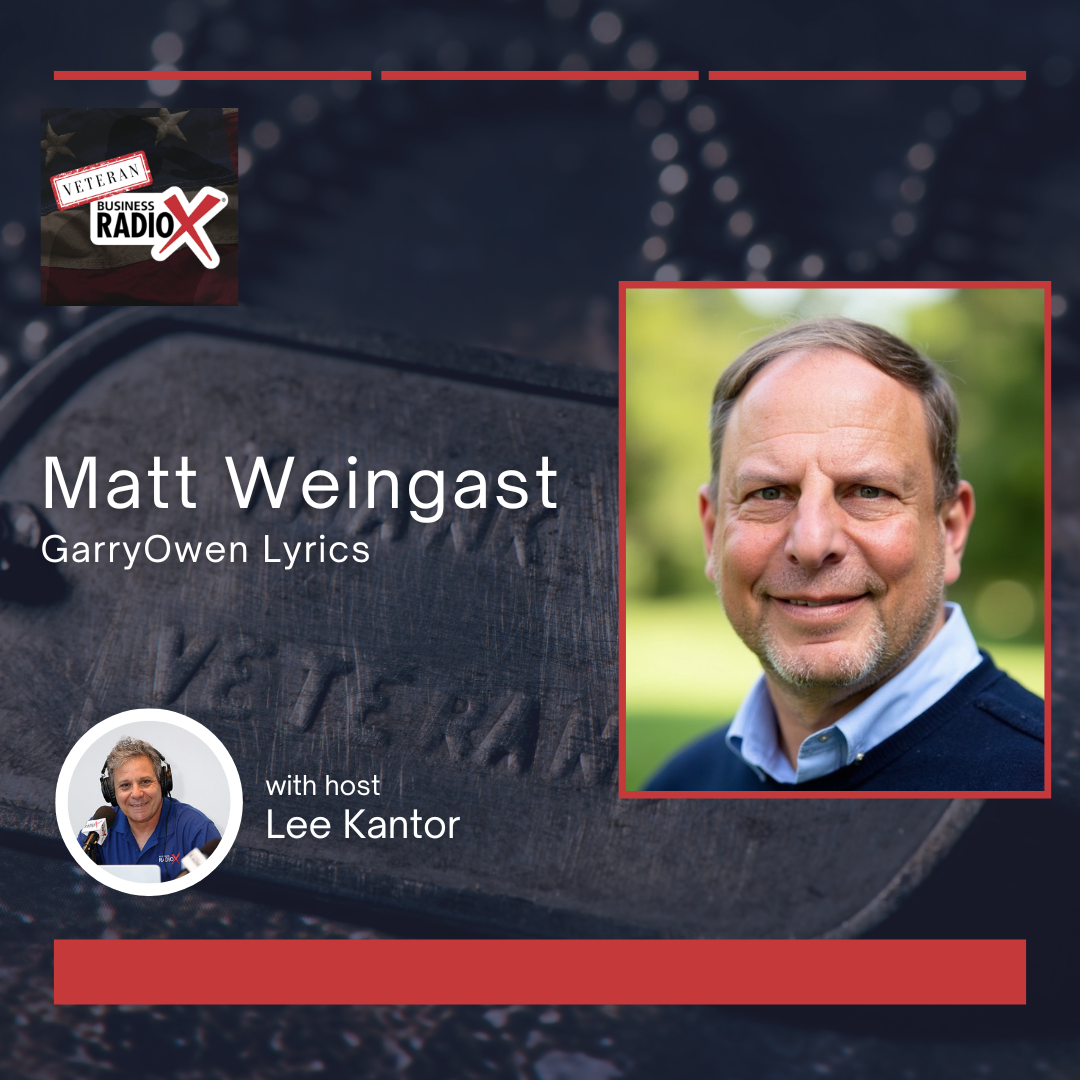

In this episode of Veterans Business Radio, Lee Kantor interviews Matt Weingast, founder of GarryOwen Lyrics, a songwriting project that transforms personal experiences and military memories into emotionally powerful songs. Matt shares how writing became a path toward self-healing after his military service and how he collaborates with professional musicians and vocalists to bring his lyrics to life. He also discusses the opportunities and challenges of songwriting, music licensing for film and documentaries, and the importance of authenticity in storytelling. His journey highlights how veterans can turn their experiences into meaningful creative pursuits that connect with and inspire others.
 Matt Weingast is a U.S. Army combat veteran, songwriter and the creator of GarryOwen Lyrics. During 24 years of military service, he served as a cavalry and reconnaissance officer and military intelligence officer, with three combat deployments, including service in Iraq and Afghanistan. After leaving active duty, he built a second career as an attorney and senior corporate executive in the defense and aerospace industry.
Throughout his life—and particularly during and after his military service—he privately wrote poems and lyrics as a way of processing experiences he often found difficult to express in other ways.
For years, much of that writing remained packed away in literal and figurative “boxes” while he focused on family and career. Later in life, he returned to those writings and began turning them into professionally produced songs, creating GarryOwen Lyrics.
Drawing from themes of service, survival, loss, resilience, gratitude, love and coming home, songs such as Bonus Time, Once You Have Been There, Good at Getting Up and Both Are True reflect what he calls “the long road home”—the often complicated journey of making sense of what we carry forward from difficult experiences.
Although rooted in his own story, he hopes the songs leave enough space for veterans and others to hear something of their own lives in them.
 For Matt, GarryOwen Lyrics is less about becoming a recording artist—he is a songwriter, not a performer—and more about storytelling, connection and perhaps “soothing a few souls along the way.”
Connect with Matt on LinkedIn and Facebook.
Episode Highlights
- The role of songwriting and creative expression in processing military experiences and supporting personal healing.
- The journey of transforming personal poems, memories, and emotions into professionally produced songs.
- The importance of authenticity and emotional connection in creating music that resonates with listeners.
- The value of collaborating with professional musicians and vocalists to bring written lyrics to life.
- The opportunities and challenges of pursuing songwriting and securing music placements for films, documentaries, and veteran-focused projects.
- The importance of continuous learning, networking, and constructive feedback when building a creative venture.
- How veterans can turn their personal experiences into meaningful stories that connect with others and create new opportunities.
 This transcript is machine transcribed by Sonix.
TRANSCRIPT
Intro: Broadcasting live from the Business RadioX Studios in Atlanta, Georgia. It’s time for Veterans Business Radio, brought to you by ATL Vets, providing the tools and support that help veteran owned businesses thrive. For more information, go to atlvets.org. Now, here’s your host.
Lee Kantor: Lee Kantor. Hear another episode of Veterans Business Radio. And this is going to be a good one. But before we get started, it’s important to recognize our sponsor, ATL Vets. Inspiring veterans to build their foundation of success and empowering them to become the backbone of society after the uniform. For more information, go to atlvets.org. Today on the show we have Matt Weingast with GarryOwen Lyrics. Welcome.
Matt Weingast: Well, great. Thank you very much for having me today.
Lee Kantor: Well, I am so excited to be talking to you. You are the first person I’ve ever interviewed in the lyric business. So tell us a little bit about GarryOwen Lyrics.
Matt Weingast: Sure. Well, GaryOwen Lyrics is my songwriting project. I’m a songwriter. I’m not a performer. I work with professional musicians and vocalists to turn things that I’ve written some rather recently and some literally decades ago, into finished songs. The name Gary Owen comes from my military service. Gary Owen, as some of the some of the listeners may know, is the traditional tune associated with the seventh cavalry, the seventh U.S. cavalry, and the Seventh Cavalry Unit is the unit that I served in during my first combat deployment. And the story is that the tune that was played by a member of the cavalry unit as they rode into battle, helped to settle the horses and the men. So when I was looking for a name for what I was doing, Garryowen meant something to me very personally. And over time I’ve come to think of the purpose of Garryowen lyrics is in a very similar way. Similar way. Certainly not trying to become a recording artist at this point in my life. I’m trying to tell some stories, honestly, put them into music and maybe, you know, soothe a few souls along the way. So if somebody hears one of these songs and says, hey, yeah, I understand that feeling, then the song has done its work and it’s been worthwhile.
Lee Kantor: Now, can you talk a little bit about how somebody gets into the songwriting business? Like a lot of folks are out there, you know, like you mentioned that, you know, maybe they come up with a song and they throw it on TikTok or they put it on SoundCloud. How do you kind of attack the business of songwriting?
Matt Weingast: Yeah, well, for me, it was never about the business, so I’m not sure I’m the best person to ask about that. You know, for me, it was about the journey of self healing that I felt like I needed to readdress many of these songs and poems that I’ve written. They were always songs in my head, but I never took the time to really put them to music fully. And I wrote these these lyrics or these poems, the songs while I was deployed and I’m what I call my long journey home. Um, and it wasn’t until much later in life, fairly recently when, you know, I kind of ended up having something I never really had before, which was time. I left my job several years back and I had time on my hands. And I think for a lot of veterans, sometimes times can time on your hands is, uh, can be difficult, right? You start thinking about things that maybe you hadn’t fully processed. And that’s what happened with me. And a lot of these stories and these poems were kind of up on boxes in the shelves, both figuratively and literally. And it wasn’t, um, it wasn’t until that point in time that I decided, you know, maybe I need to relook at some of the experiences that I went through and the poems and lyrics, the words, the songs, uh, were a good place to start. And as I was doing that, I always wanted to put these to music. So I started doing that and I did it all on my own. And I didn’t know, you know, I’ve loved music, but I was I’m all self-taught.
Matt Weingast: Uh, I didn’t major in music. I never took any music classes. Um, and so for me, that journey into the business of songwriting came after I realized that, you know, I shared some of these songs with some, some fellow veterans and so friends and they thought they were really good. And, and, and they had that connection with them. And it wasn’t until I started to realize that, gee, this project helped me a lot. Maybe it could help others and other veterans in particular, particular. So, uh, for me, I just started writing the songs I learned, learned for myself how to put them on Spotify and what to do with them and how to register them. And, you know, as an artist, what do I need to do? Um, and I just learned all that on my own. I took, I did take a few courses recently on, uh, writing songs for sink, uh, for sink, which is music that like they played at the beginning of your show there. You know, that would be considered sink music, but music for movies and films and documentaries because several people said to me, hey, that song would be perfect in this film or that project. And, and that got me thinking. And so that’s really how I got into the business of it. And, um, for me, it’s more of a, of a journey into my passion of music. And at the same time, self-healing, which opened the door to a business. And now it is something that there is some business to it, which is, I think, really exciting, some potential to it. So I hope that answers your question.
Lee Kantor: Well, let’s get to the beginning of the writing part. So were you always writing even a pre-military?
Matt Weingast: Yeah. So, you know, I would write for me, it was a way to process my emotions and my thoughts. Uh, I wasn’t really a big journaler in other words, like it was I know other people who wrote journals of everything they did that day. I wouldn’t do that. I would write about certain emotions. And I don’t even know. I really thought much about it. It was just something I did. Um, yeah, I got into some trouble in the younger years in high school because sometimes I would share some of the poems about girls that I was interested in with, uh, with them. And you know, that, that, that would, that would sometimes go sideways. But for the most part, I never shared it with anybody, uh, even. And then I started writing when I was in the military, uh, and deployed and, and all, and I never shared it really with anybody. It’s funny how some people have come back to me who I’ve shared this with or heard about what I’m doing. Um, several people have reached out and said, hey, I remember you’d be sitting there writing and I never you know, we always thought you were writing a letter home or something. And sometimes I do recall there were conversations where people would ask, are you writing a letter home? No, I’m just I’m just writing poems or writing, you know, whatever words. And, uh, yeah.
Lee Kantor: Like, like what’s an example? Like, let’s go pre military first. So you’re in, in school and you’re writing. So is this on a sheet of paper? Did you have a notebook that was just for your writing? Like, like, walk me through what a writing kind of session would look like.
Matt Weingast: Yeah. I mean, back then it would just be on my notepad, you know, my notebook, my, my school notebook. And I would just take out a page and whatever was going through my, my head, I would just start writing down phrases or, or words. And I developed that further.
Lee Kantor: And so what would be an example of something you would have written at that age?
Matt Weingast: Oh, at that age, gosh, it’s so hard to remember. I don’t have, you know, one of my songs, Good at Getting Up tells the story and all the stuff that I wrote in those early years were in boxes and my parents and my parents house. And, uh, it, you know, my, my relationship with my mother was a little complicated. And, um, many, many, many years later, she called me up and she said, you got to come get these boxes. And of course, we get in a fight. And that’s, that’s really how it went with my mom. And I was busy with kids and stuff and couldn’t deal with it on her timeline. And, and I knew what was in those boxes. But for me, emotionally, I was in one of those periods where I was not wanting to revisit anything in those boxes and put my writing away because for some years after I came home from my deployments, I really struggled and thought that that writing was getting in the way of my integrating back, you know, productively and all that. So, so I threw him off. So I told him, throw them all away. And she did, you know, she threw them all away. So I can’t really go back that far to the high school stuff that I wrote. But, you know, I, I kind of have vague memories still of, of writing, you know, notes about feelings about girls, uh, feelings about sports, you know, things that where I was feeling at the time. I really can’t say I can pull any of those out and relive or remember them any more than that at this point.
Lee Kantor: Now, were they, were they kind of in, in kind of poem form where they were, were there rhymes or were they just kind of random thoughts or turns of a phrase?
Matt Weingast: Yeah, I think what I kind of did early on was I really wasn’t ever too concerned about rhymes or, or how it would sound when I put it to music. I was more concerned about just, you know, getting it out there.
Lee Kantor: So getting kind of the emotion out in word form.
Matt Weingast: Correct? Correct.
Lee Kantor: So it was like stream of consciousness, you were just kind of ramble all the kind of random thoughts in your head. So it may not make sense, but there would be chunks that would kind of make sense.
Matt Weingast: Yeah. Sometimes it would be that for sure. Like looking at the stuff that I did end up finding and going back through and later years, you know, sometimes it would just be like, you know, we have these battle books that we’d carry around when we were deployed and stuff. And I had in the margins, you know, I went back through and I found like, there’s different just thoughts where it would just be like two sentences and, you know, about something that happened and it was just a way of explaining it. You know, like, you know, um, one that I remember each in our own lanes, you know, was, is one that a phrase that still lives in one of my songs now. So, you know, it’s things like that, that, that, um, I would jot down, but oftentimes they were stories, um, to each of them and, and little, little bits and pieces, if that makes sense to you.
Lee Kantor: Yeah. And then so you never, or you primarily looked at the writings as poems and songs not. Oh, this is a short story or this is a novel.
Matt Weingast: Yeah. So it’s funny because, um, I at some point I did try and write a book. You know a about some of my experiences. I had the opportunity to do an incredible variety of different things. It’s like an amazing journey. Sometimes my wife jokes that I’m like Forrest Gump in that way. I happen to have appeared, you know, I was involved in the search for bin laden. We were I was involved in one of the most, uh, the most costly, unfortunately, battles in U.S. military history during the Gulf War, you know, in the seventh Cav in the desert, you know, there, there there’s different points in time that that where I was where, you know, pretty critical. And, and for me, um, you know, those stories, you know, it provides a different set of perspective. So it for me, that’s, that’s kind of what I was always telling stories is just kind of recanting those memories and events into stories.
Lee Kantor: But were you doing it in a kind of literal fashion where you were like, okay, this happened A, B, C, D, or was it more of kind of the emotional, um, kind of this is what it felt like, or this is how I’m feeling.
Matt Weingast: Yeah, I didn’t really answer that very well. But yeah, the latter, it’s the it was the latter. Like these were just at the time these works that I was referring to. And then later in life, after, you know, after one of my deployments or I forget exactly when it was I wanted to actually, it was after my second deployment before my third. And I, I wanted to write a kids book like not kids, but young adult book about, you know, that was after Afghanistan. So I went on the search for bin laden. And I wanted to write it because I knew I really couldn’t write about the real stuff because of the classification level and all that. And, you know, sources and methods and everything that, you know, you don’t ever want. I don’t, I don’t agree with writing about that, but changed it a little bit. But something about for young people to understand what a war or terrorism was really about. So I took that down as a task and I started writing, and it got to a point where where I did have a book and I never got it published. I never published it. I never tried to self-publish it, but, um, it wasn’t until later that I realized, well, go back to these writings because that’s more like, I just never thought a book of poems, right? I just never thought that I would ever want to put out there a book of poems. But I thought maybe a short story. And really, it was much later in life when I realized, Matt, you know, your book of poems, really, there are songs, you know, just put them into music and that, and that’s kind of where the journey went. I hope that answers better.
Lee Kantor: Yeah. So then when you said, okay, let’s put it into music, you, you were kind of a, a figure. You were a self-taught musician or you.
Matt Weingast: Yeah, I was self-taught and I could never put make up, make a production. So I, I’ve, I work with live musicians, um, to put out the songs because I could never do that. I don’t have that type of skill. I mean, or excuse me, talent and skill. Uh, that’s just not what I can do. I could play a little guitar, but at this, you know, my hands aren’t what they. It’s not something that I would claim to be a, um, an expert or even even a, um, what’s the word, a quality, um particularly good at thing that I’m good at. Um, did you.
Lee Kantor: Did you dabble with like some of the AI music tools where you just throw it in there and it’ll do different genres?
Matt Weingast: I, I did that with some of them and to try and see what could be done. Um, I used it for vocals, especially like, like that, but for, not for any of my produced music, but just to kind of play around with, to see if maybe I could create something even without, you know, my terrible voice, you know? Um, but, but ultimately the, the conclusion that I came to was that to me, these are authentic stories, uh, in order, in order to. They are my authentic stories. And I’m not using AI for the stories. And I kind of wanted to keep them purely authentic. Um, and so I started working with musicians to, to do that.
Lee Kantor: So now.
Matt Weingast: Their expertise.
Lee Kantor: Were you kind of recruiting musicians or you had friends or people that knew people that said that, oh, why don’t you two kind of collaborate?
Matt Weingast: It’s a little bit of both. It’s a little bit of all of the above. Like some of them are pure just business deals where, um, I paid a studio and musicians on work for hire basis. Uh, some of them are musicians who I met through, like, I did put like messages out on various different social media platforms saying, I’m looking to collaborate with people. Um, it’s been a little bit of a little bit of it all, you know, and, and some of the stuff that I’ve worked on where, you know, early demos and then I’m like, hey, that could be really good. And I found some really good vocalists. You know, I think for my music, it’s, it’s, it’s a lot about the vocalist trying to find a vocalist who’s, who’s really good at being emotional. Uh, I’ve found I’ve been fortunate to have a few, uh, a guy named Ethan Cronin. Cronin, a guy named Rudiger who, who are, who are really phenomenal, uh, vocalists and musicians. And they can kind of bring out that emotion. I think it’s important as a songwriter. And again, I’m, I’m a self-taught, I don’t claim to be the expert, but I really think it’s important to have a connection with that vocalist and the musicians to, to kind of have them feel what you feel. And so those, the ones that I tend to have worked with the most are the ones who kind of have gotten to know me a little bit. Um, you know, the good and bad, if you will, but, um, they’ve gotten to know me and they’ve more importantly gotten to know some of the stories and and behind the music and, and you can really see that emotion coming out.
Lee Kantor: So now do you just give them kind of the page with words and then they go back and do you know, they just make it their own, like kind of Elton John, Bernie Taupin, where he would just give him the words and then Elton John would go and turn it into a song.
Matt Weingast: Yeah, it’s been a little bit different for each one, I would say. Um, each one has been, it has been a different method. Um, and I’m still learning. I’m still kind of learning what’s best. Um, but for me, um, yeah, I, I definitely am looking for more opportunities, uh, to work with people. So if anybody’s hearing this, I mean, I, I’m, I’m still in the kind of infancy of my songwriting, uh, exploration here. Um, but I do think that, you know, several of the songs I’ve gotten really good feedback from people in the industry, people, people who have heard the songs. And my current effort really is trying to get some sync sync placements. And I’ve had some really I’m in discussions with a few different projects. So for me, it’s probably not a question of when anymore, but I mean if, but more a matter of when. And that’s really exciting. And the ones that are exciting me the most. I’ve had a few veteran projects who want to use my music for, uh, sync, you know, for sync music in their project. The story about, you know, people in Afghanistan. Another one is a different it’s not about veterans, about, uh, you know, I don’t want to share too much about the stories because, uh, the projects have not been released yet. Sure.
Lee Kantor: But the process. So I’m just trying to take what you’re doing and kind of expand it to anybody who might be interested in pursuing songwriting as something as a career or just something they want to explore is. How, how do you you go from. I wrote something to getting it into somebody’s hands. Was that just like, how did you network? Like how did you begin kind of meeting the folks you had to meet, uh, in order to make that happen?
Matt Weingast: That’s a great question. And so for me, the way that I, a big jump in my learning curve was when I in because I was struggling with that, because, you know, there’s so many artists out there, you know, independent artists who are trying to write their own material. And especially in today’s world where the production costs, if you want to, you know, take this microphone that I’m using right now and sit down with a guitar and make a song, you can do it. The production quality has now been proliferated by technology to the point where anybody could do it in their bedroom, you know, in their office and anywhere, you know, so it’s, it’s, it’s definitely difficult. Um, and at first I had a challenge with that because I put these posts out and you just, you know, everybody, some people would respond and, and you’d really have to kind of go through it. And it wasn’t until I took a course online, it wasn’t like an official college course or anything, but it was something I saw. Of course, I was a little skeptical at times, but it was a songwriting course for Sync Music. Um, and I took that course online and that’s really what, you know, kind of opened my eyes to a lot of stuff that anybody would have been able to find if you just knew what to look for and use these, um, people, musicians who specifically do exactly that. They work with people like me who, who don’t have, don’t want to be the, the, uh, the musician on the recording, the final recording or the vocalist on the recording and, and do it for them. And, and that’s, that’s really when it kind of all fell into place for me, if you will, when I had that realization and got connected with the few and trial and error as to who you work with.
Matt Weingast: Um, it’s you have to have a passion for it and you have to have, I would say the passion alone is just not enough because I’ve always loved music, but you’ve, you’ve got to have a, a sense for me, it was the sense of what it was doing for me at the time, my journey of self healing, if you will, at the time, my long road home. And for me, that was what was motivating me. And so, um, to put time into it and energy and explore and fail and all that was, uh, it wasn’t even a business at that point in time, if you follow what I’m saying, because if it was, perhaps you’d look at it and say the ROI on that is not particularly good. So, you know, some people might say that and it might be true. We’ll see. Um, you know, I’ve made I it’s not as if as though there’s no money to be made. But um, clearly if you’re not a performer as I am not and I’m not looking to become a star or a performer. It’s a very different end game from a business perspective. That being said, I do believe there is. There is a business if that’s, you know, for those people listening, if you’re if you’ve got that passion and you’ve got that interest and you have kind of a, a reason to be spending time on this anyway, then it’s, it’s a, it’s definitely has a business opportunity to it.
Lee Kantor: Right. Because so many people. Right. You know, in, like you mentioned, like journaling and write poems, but they never try to commercialize any of it. It’s just always like, for me or this is private or I’m not sharing it. And then there’s obviously a bunch of people that want to share their talents and, and, um, it just how do you find the opportunity? It seems like if you’re a performer, it seems easy. You just, you know, turn on your phone and you could do a song and put on TikTok, you know, in five minutes. But if you’re the writer of a song, I got to get it in front of somebody who wants to now be that person that sings the song and puts it out.
Matt Weingast: That’s exactly right. And I would give all the, you know, kudos in the world to the people who have that talent to be able to whip out the phone and do it. Um, and that’s, you know, that’s a talent that I don’t have. Um, and I think that’s remarkable. And that’s, that’s great. And, and that’s really my challenge is that most of those people are still there writing their own music or they’re, they’re, they’re using their own stories. And, and that’s fine. But what I have learned from the feedback that I’ve gotten on the materials and the works that I have written, and I’ve have done that, you know, the authenticity I mentioned, all the great depth and variety of different experiences that I had. You know, we all have our different voice, right? We all have something different that we offer. And it wasn’t. I didn’t really realize this until very late that that that is really one of my, you know, unique attributes, if you will. And it makes my writings different, you know, and, and I really, maybe I didn’t really feel that way when I tried writing a book because for a lot of different reasons. But, um, somehow this is, this is working for me. And, uh, you know, I’m getting some really good feedback.
Matt Weingast: You know, the song bonus time was, was probably the first, you know, really high production version of a song that I’d done, uh, with and it, it’s, um, it’s one that’s got a doing quite well and it’s, it’s, you know, got a great deal of appeal. It has a story, an authentic story. You can’t fake the emotion of what you know, even somebody who has a talent to write and to perform can’t really fake the emotion and the unique events and circumstances. The song Bonus Time really is about, um, two different stories coming together. But, you know, a group of us sitting around in Afghanistan talking about, uh, near misses and close calls, uh, and then also the experiences of, of, of watching others, you know, pass from this earth, you know, being, being either the last person or one of the last people or among the last people to spend time with somebody. And, and that that is, and they, and they, you know, those unique experiences come out in song. And what I found was I spent a career admiring people who could put things into very succinct, short, brief sentences. Um, and that’s something that I admired because I worked at it my whole career, military officer, lawyer, you know, uh, executive business executive.
Matt Weingast: And I, you know, I, I worked at it, I always tried to get better at it, but I never achieved that level of, uh, competency of expertise that I admired in others maybe. And what I found was in songwriting, I could do that. You only have 3 to 4 minutes to write a song, and then, you know, every word has to have its place. And frankly, uh, it has to connect. It has to have a message that others can, you know, can, can understand and feel. And that’s, that’s kind of the, the excitement that I have before my music. And I think the great thing is that when I get feedback and sometimes it’s harsh criticism, constructive feedback, if you will, from people in the industry, I seek that out. It’s one of the reasons why I put my songs on Spotify. You get incredible feedback by doing that. Um, and, and that feedback is amazing to me because the things that I will be criticized for, you know, are things that I’m improving on. But everybody comments about the authenticity of the, of the, the words and the meaning and the purpose purposefulness of the, the, the words and the emotional impact. And that’s, that’s really what I’m after. So I’m doing something right.
Lee Kantor: Now when you’re actually going and doing the writing and and pet, do you write pen and paper or do you write on a computer typing.
Matt Weingast: I, well, I started off doing pen and paper. Um, most of my old works are pen and paper. I actually now I use my phone a lot.
Lee Kantor: So you just talk, you talk.
Matt Weingast: And, and, um, if I all of a sudden feel some because I go through periods where I’m being creative and then I go through periods where I’m just not creative at all. I guess I’m not that truly creative person that is creative all the time. And I’ve kind of learned in the last couple of years, especially, I kind of know when I’m in the the creative moods or not. And, uh, sometimes it’ll come on me, you know, uh, I’ll be riding in my motorcycle and I see something and I’ve literally just at times pulled off and sat in the side of the road with my phone and just type it into my phone, um, for sometimes a couple hours just sitting there getting that thought out and then I’ll revisit it. You know, a few days later or a few weeks later or never at all, depending upon, uh, the new stuff. But the older stuff that I’ve been working with, that’s still a project in process and I just pull them out and, and kind of try and work on them. And again, sometimes it’s just a few words, sometimes it’s just a couple of notes. And then sometimes I actually have, you know, some older, older poems and lyrics that I, that I’ve written.
Lee Kantor: Now when you’re writing, does after you’ve written and you look at it, is it cathartic? Is there a release? Do you cry? Like, is there an emotional kind of thing that happens to you from doing the exercise of writing?
Matt Weingast: Yeah for sure. You know, it’s it’s all over the place of what you just said. I think that ties into what I was talking about before. I think even if I had the talent, I don’t think that I’m built for performing my own songs. Um, I was in a song pitch the other day and I was, uh, it’s on a Zoom conference and I almost teared up myself, just thinking about the stories and the song because they were listening to the song and we’re on, on, um, on Zoom and, and it was playing and, and it’s hard to do that. I could never perform my own song. Like there’s just no way. It’s just too emotional. Um, I just don’t know how artists do that. And, and maybe that’s part of why sometimes artists use works written by somebody else, but, um, all of the above and, and, and really what drove my journey is that when I first started doing it, like I said, the first song I wrote was Good at Getting Up, which is about the story of my reentrance into it because it all came from my mom. Um, you know, she threw away that box years earlier. And then, you know, this is fairly recently now, about five years ago, my mother was, uh, had Parkinson’s and she called me and it was pretty much the, you know, I knew she was calling to say goodbye and she asked me to go back to my writing. And, you know, I, the only way she knew about it was from those boxes. Right. Because it’s not something I talked about. And, and, um, I told her I would.
Matt Weingast: And of course she passed away a couple of weeks later. And when I had that time a couple of years later, when I left my company and I had that time and I started reopening these, these boxes literally and figuratively. Um, it was extremely emotional. And I would cry pretty much every one of the poems and the, the songs that I did. And when you first start putting it to music, maybe not the early versions of the demos because, you know, they were kind of not that great, but but when you actually hear it professionally produced, um, and somebody else seeing it who’s got really good voice, and they’re also doing a good job of bringing out their emotion on it, it’s really hard not to get emotional. Um, there’s a song called Letters Never Sent, which are basically songs taken about the experience of writing letters that, you know, early days, we’d carry them around in our pockets, right up here in our left pocket as veterans, most of us. And and you know, it’s a letter saying goodbye that you hope is never sent. And and that song to this day, that was the song that somebody was listening to on a pitch that I was doing. And I could barely keep it together. Right. Just because it’s very, very emotional. It’s unpacking those emotions of what it felt like. And of course, I’m so grateful, which is what bonus time is about that I’m still here and that I’m coming home, uh, each time. But when you’re writing those letters, you know, how do you say goodbye in a letter? That’s what that song is about. So.
Lee Kantor: So what do you need more of? How can we help you?
Matt Weingast: Oh, well, um, yeah. Any, any veterans out there involved in media or entertainment projects? Um, please consider my music for sync music because I keep getting it’s very hard to get your foot in the door, um, in this, in this type of thing. But everybody I speak to, you know, even not just military related work, but programs about veterans or where a character is a veteran and they’re remembering a scene, you know, I’m thinking like Marshalls or in some of the work. Um, um, I’m forgetting, I’m forgetting the, the project, uh, the name of the project that I’m um, but, but all those types of works and then even just documentaries, I’m working with somebody who’s doing a documentary and my songs I think are really, really good, I think. And for that, for that purpose, you know, for bringing out the emotion and for helping to tie a visual, uh, in media so that that’s the message that I would really love to get out there. So please consider GarryOwen Lyrics. We’re at garyowenlyrics.com and the name GaryOwen lyrics on Spotify and Apple. Um, most of my songs now of course if you do a search Gary Owen the song, it kind of does some difficult things. I don’t do any advertising. So my, my, my, my, um, my site doesn’t necessarily always show up at the top, if you will, but, uh, that’s how you can get Ahold of me. Uh, Matt at Garryowen ventures.com. And yeah, that’s what I’m would be really grateful for. Any opportunities that veterans or people in the industry might have about veterans or for veterans that would need some good, safe music.
Lee Kantor: And the website is garryowenlyrics.com. GarryOwen lyrics. Matt, thank you so much for sharing your story today. You’re doing such important work and we appreciate you.
Matt Weingast: Well, thank you very much. And thank you to all the other veterans out there and and have a great day. Thank you for what you’re doing on this program. Thank you very much. It was a pleasure to be here.
Lee Kantor: All right. This Lee Kantor we’ll see you all next time on Veterans Business Radio.