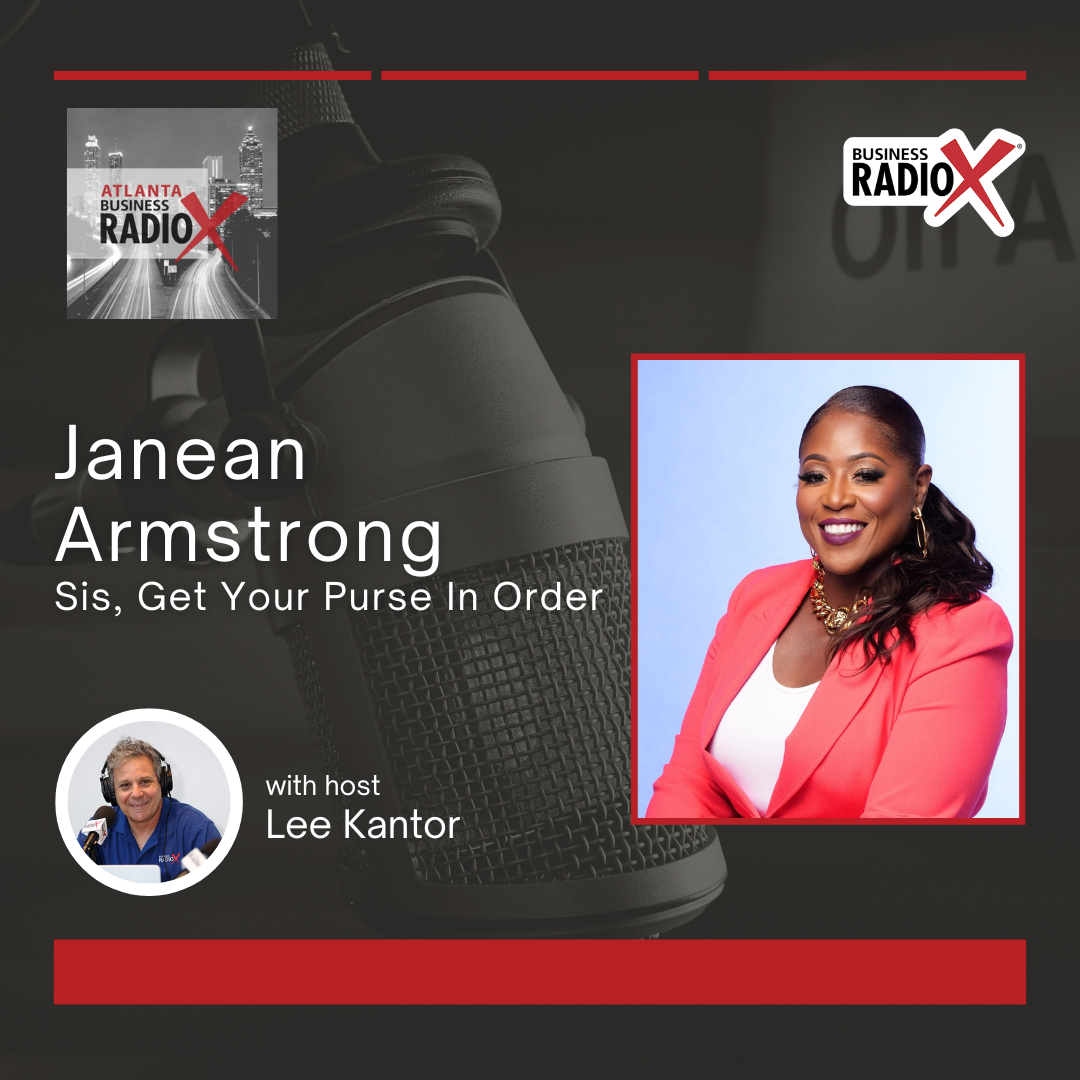

 In this episode of Atlanta Business Radio, Lee Kantor interviews Janean Armstrong, author of Sis, Get Your Purse in Order. Janean shares her mission to improve financial literacy and empower individuals—especially women and young people—to take control of their financial future. Drawing from nearly three decades in the financial industry, she discusses the importance of developing healthy money habits, understanding credit, building savings, and creating a positive relationship with money. The conversation highlights practical strategies for achieving financial confidence, reducing financial stress, and building long-term wealth.

 Janean C. Armstrong is a seasoned financial executive, author, and strategic leader with nearly 30 years of experience in the financial services industry.
She specializes in wealth strategy, financial literacy, and long-term asset development, with a strong commitment to helping women build financial independence and generational wealth.
Known for simplifying complex financial concepts, Janean equips clients with practical strategies that drive accountability, sustainable wealth building, and measurable outcomes.
Her leadership blends deep financial expertise with a passion for education, empowering individuals to take control of their financial futures.
Connect with Janean on LinkedIn.
What You’ll Learn In This Episode
- The importance of financial literacy at an early age.
- How money mindset influences financial success.
- Practical strategies for saving and building wealth over time.
- Ways to teach children healthy financial habits.
- Understanding credit scores and credit utilization.
- Steps to reduce debt and improve financial health.
- The connection between finances, mental health, and relationships.
- Why consistency and discipline are key to long-term financial freedom.
- How small financial decisions can create significant future opportunities.
- The role of accountability in achieving financial goals.
 This transcript is machine transcribed by Sonix.
TRANSCRIPT
Intro: Broadcasting live from the Business RadioX Studio in Atlanta, Georgia. It’s time for Atlanta Business Radio, brought to you by My Global Presence. The award winning Atlanta public relations agency that elevates brands and non-profits through authentic storytelling and national media campaigns. Find them at myglobalpresence.com. Now, here’s your host.
Lee Kantor: Lee Kantor here, another episode of Atlanta Business Radio. And this is gonna be a good one. But before we get started, it’s important to recognize our sponsor, my Global Presence. If you want global visibility and meaningful impact, go to my global presence.com. Today on Atlanta Business Radio, we have the author of the new book, Sis, Get Your Purse In Order. Janean Armstrong. Welcome.
Janean Armstrong: Hello. Good afternoon everyone.
Lee Kantor: Well, I am so excited to learn about this book. Can you tell us a little bit about it?
Janean Armstrong: Absolutely. Thank you, Lee, first for having me on your show. I’m so super excited since get your post in order. It’s a movement. It’s really about helping women be empowered of their finances. I’m trying to empower women to go from chaos, to become confident around their money so they can be financially free. Lee. I’ve been in the financial game for almost 28 years. See C-suite executive. I’ve been in the boardrooms. I have had seats at the table, and I’ve learned so much. But what I also identify that a lot of women are not in control of their finances. And I made a decision back in 2024 to make sure my stylist wasn’t selfish and to go out and empower women. But I will tell you, Lee is for everyone. But I really made this dedication to all our daughters out there our sisters, our aunties, our mothers to ensure they are financially free and empowered.
Lee Kantor: So now is your work today helping folks with their finances, or are you still involved in big corporations?
Janean Armstrong: Well, yes. Both. So I’m still involved in big corporations, but I, I’m also at a point of transitioning. And what I mean by that, again, I’ve been doing it for 28 years. And now it’s time for me to truly do purpose work. So I created this book as well as a movement. And I’m going. I’m gonna tell you full scale because there’s a need, there’s a need and financial Education. The one thing. When creating this book, I identified that we still don’t teach financial literacy in schools. We have all things. We still teach in trigonometry, calculus, chemistry, which they are important, but we’re not teaching the basic needs of writing a check. Do you know our children today don’t know how to write a check, but we still need to know how to write a check. But outside of that, just the basic paying and receiving, understanding their credit scores and the importance of investment. So I made a decision. Let me be that advocate and share the news with everyone.
Lee Kantor: Now, there’s a lot of folks out there that are talking about some of these same issues, but there may be targeting people with a lot of money or have steady income. And it’s how to kind of manage that is this is that the same crowd you’re going after? Are you going after people may be at the start of their financial journey.
Janean Armstrong: My goal is for the start, so I want us to think about our 12 year old children, um, all the way up to going through college. When do we really start talking about our finances with our children? I have a daughter and I start talking with my daughter when she turned 12, and at 13, I had her go to the bank with me. I was a banker and I had another banker had the conversation with her and opened her account. Because that behavior and those tools and resources I empowered her with at 12 and 13. She’s 26 now, and when I tell you she has her purse in order and her mindset, and that’s the important, um, if we start early in educating our children, they’re going to create healthy habits as an adult. And so the, well, you mentioned About who I’m targeting the wealthy. Well, they cannot be wealthy if they didn’t have the formal education to become wealthy. They were educated early on, or they learned it on their own. My goal is to help them now at 12 and 13, all the way up through college and after school, so they could be empowered. So by the time they’re 25, 30 years old, they’re having that conversation with a financial planner on how to continue to be wealthy.
Lee Kantor: So now what are some of the kind of foundational elements of your program?
Janean Armstrong: So one thing I definitely talk with a lot of people. I get real, let’s get real where you are. So again, we can start at an early age. We can start in the middle, but we also can start at retirement. Here’s the deal, Lee. I’m making sure no matter where you are in life, we are here to help. We. I want everyone to understand you need to learn a new thing every week. But what. We don’t do well at Lee that I hope my book will empower everyone around. Talk about your money out loud. We have a stigma that we gotta keep everything private so everyone won’t know what we have or what we don’t have. But this is not the time, especially today, of being quiet. We need to speak out loud. And that could be with friends, a trusted advisor, whoever. And as I mentioned before, let’s talk to our children. Um, and just be true and honest with yourself where you are financially.
Lee Kantor: So let’s, um, we’re talking a lot about, uh, younger folks, so let’s stay there for a minute. Um, if you were just at the beginning of maybe starting to make some money in your life, whether it’s your, um, your allowance or it’s a job or you’re at the beginning of your career, what are some of the dos and don’ts that people at that stage should be doing. So they are setting themselves up well for success.
Janean Armstrong: Oh great question. And I love this question because, you know, you mentioned um allowances. Um, let’s talk about allowances. Let’s talk about birthday monies, Christmas monies, uh, when Grandma and grandpa come visit and they slide you $20 their mommy and daddy don’t know about that is not just the time to go buy that new fancy shiny toy. Yes. I want you to have a good time. I want you to go get something you really like. But I really also want all our children to understand when you get your allowances, let’s take 20% of whatever that is to pay yourself and place it in a savings account. Most financial institutions offer minor savings account. Very young, as young as 1011 years old. They are even younger because the parent has to be on the account, but that is an opportunity to take 20% of whatever that allowance is and put it in a savings account. You will see how quickly that grows when you get that Christmas money, that birthday money, those grandparents favorite grandchildren’s money. Let’s talk to our children about saving. But we also want to give them an opportunity to buy things that they enjoy because they are children. But if we start teaching them healthy habits about saving and also giving, and what I mean by that, we also need to teach our children not only to say also to indulge in some things that they like, but also giving back. So find a special charity that you and your son or daughter are passionate about, and maybe give 10% to that. If we start teaching those healthy habits now, imagine what type of adult that you’re creating.
Lee Kantor: Now, one of the things for me when I was young. That really left a mark was when I started to understand the power of compounding. And if you’re kind of relentlessly putting a little bit to your point away, then over time that money’s going to start working for you and you don’t have to work as much or if anything, later on if you do this correctly. The challenge with that kind of that I don’t know if it’s a theory at this point, but Einstein called it the eighth wonder of the world. But the the challenge with it is it takes a very long time to see kind of the fruits of your effort. Um, how do you help people kind of understand that this is about delayed gratification. This isn’t something that if I do, if I start saving tomorrow, all of a sudden I’m not going to have a big pile of money. This is something that’s going to take, you know, decades in order to really pay off.
Janean Armstrong: I agree, you know, the example I give people, and we can say this for Adults, teenagers and all. I used this example all the time about us indulging in maybe a Starbucks or a Dunkin Donuts. Now, Lee, we know prices have went up and we will spend 7 to $8 every day on our way to work or on our way to school to get that caramel macchiato. Right. So you got 7 to $8. So here’s what I tell people all the time. You can still stop by there twice a week. You just don’t have to stop by there every day. So let’s take $8 as $24 because the other three days we’re going to put those $8 up. So let’s just round it up to $25. If you put that $25 in a savings account every week, by the end of the month, you have $100. By the end of the year, you have $1,200. And as you stated, compound interest in a savings account. Or if you hit the 1200 mark, you could put in a CD will earn you a higher yield. Then we need to start talking about Let money.
Janean Armstrong: Let money grow while you’re sleeping. So now you’re making money while you sleep. You’re not out there working. It’s working for you. So now you have $1,200. Compound interest. Now just say you didn’t grow the account to $1,400. Now you could take that, move it to the following year and keep it growing and growing by ten years. A decade later, you’re in a position that you have such. And you may be only 20 when you started. By 30, you’re in a position you didn’t got a sound emergency savings. You may have a down payment for your very first home. You have an investment vehicle. It may not seem like earth shattering in those ten years, but I ask you to do is put $25 in the bank every week. And now, ten years later, you’re in a position where you can purchase your first home. You’re in a position for investing for longer term when you think about retirement. We gotta change our mindset and our habits. So if you want to retire at 50 and not like our parents at 65 or 70, this is the way to go.
Lee Kantor: And now how do you help the folks that maybe are a little bit off track, that maybe they’ve accumulated some debt and now, you know, they’re struggling to find that extra money to put aside for saving because the debt is kind of piling up and that’s causing a lot of anxiety and stress in their life.
Janean Armstrong: Oh my goodness. I just had a phenomenal conversation with a good friend of mine just the other day about this situation. The first thing I asked my friend, what are you purchasing? Or what are you doing weekly or daily that you really don’t need? Because here’s where I have identified a lot. We we splurge a lot on want and not really focus just on the need. So this particular person already had a vehicle paid for, but still had another vehicle that was already years in and a loan still had three years my ass. Why do you need that second car? Just help me understand. Um, you’re the only one there. Do you need two vehicles? Why pay $500 a month for an additional three years when you already have a vehicle that’s paid off? That’s more of a want and not a need. Get rid of it. Take that extra $500, put it in a savings account. Or if you have other debt, start using that $500 to pay down that high interest credit card monthly. Zero it out and then do a snowball effect. Take that extra money from the other credit card. You’re paying the $500 on that car note and add it to the next credit card until you zero it out. Once you zeroed out. Now you may have 7 to 800 extra dollars a month, and now you can put that in your emergency savings account. You just need to do a financial checkup. And what that looks like. Sit down, create your budget, do a want and need synopsis, and make that decision of where you want your life to look like in the next 1 or 2 years.
Lee Kantor: Now, you know when we’re talking about this in some regards, it sounds easy. It’s, you know, allocating and reallocating money. It’s prioritizing what’s a want, what’s a need and, and, and didn’t literally just putting money towards whatever that priority is. Is there any actionable tip you can give a listener today who is struggling when it comes to money? Is there some kind of things that you found over the years that help them, you know, make a savings today, whether it’s in negotiating or, um, finding good prices somewhere. Like, are there some do’s and don’ts that you found that people can take action right now?
Janean Armstrong: Yes. The first thing I would say though, Lee, before we even dive into where to go to find those great interest rates or savings accounts and things of that nature, the first thing you have to change your mindset and your relationship with money. I share with everyone I coach around money. Before I go into, um, your vision for your life type budget, how you manage your credit score. I have to find out your habits, your mindset, and maybe sometimes the healing you may need to have around what traumatic experience you had a child. A lot of us have grown up in a survival type technique, where we saw our parents robbing Peter to pay Paul, leave it living paycheck to paycheck. I have to help them change that mindset from that. Then I can sit with you and help them understand. You could start as little as $5 a week. $10 a week. A lot of people think you have to start with such a big number just to get ahead, but you don’t. So once I get to the root cause of your relationship with your money, then I can share with you how to start saving and how to research because you’ve got bank rate.com, you got all these financial institutions and credit unions that can really help you navigate where to put your money.
Lee Kantor: Yeah. So you have to get kind of your mind right before you can really take, take out, start making moves. You can’t just do this, um, and hope because you’re gonna, you, if you don’t get your mind right, then you’re not going to be able to have the discipline to do this because this requires discipline to do this relentlessly, you know, kind of for the rest of your life, if you want the success that’s correct.
Janean Armstrong: That’s exactly what I do. I help, and that’s what I did with the book, was just get your personal. Because at every chapter I have a. After every chapter, you have an accountability worksheet. So when you start reading your first chapter, now I have a workbook right behind it, a couple of pages. So you can write down and jot down what your next steps are to hold your own self accountable. That was my way of getting to the root cause of why this is happening to you. And a lot of people are ashamed, and they have a stigma or embarrassment on why they have let their money out of control, but they shouldn’t be. They just didn’t know. And I’m giving them a safe place, um, to they can hold their own self accountable and get them confident enough to, when they’re strong enough to go talk to a financial advisor, they will be in a good mindset and headspace to have those conversations, to take away the embarrassment and the shame and the stigma about not knowing.
Lee Kantor: And this is one of those things if you can get this right, your life becomes a lot easier down the road. Yes.
Janean Armstrong: Yes, absolutely, sir. I have realized, um, going through this journey that a lot of people don’t understand when your finances is not in order, it mess with your mental health and your physical health. You know, financial stress is a real thing and it does internalize and cause health issues. It can cause high blood pressure. It could even cause a heart attack or stroke, whatever it is. Because we’re so stressed out about our finances, we start to internalize it. We be very silent about it, and it eats away with you. And that’s when different illness start occurring. You don’t realize when you’re financially stressed it does affect your physical health. And let’s not talk about how it affects your mental health and leave you here. Everyone that shares that. If you are not financially sound in your marriage, it can break up your marriage. So finances is not just about paying and receiving and saving and earning money. It’s about your mental health, your physical health. And really, to be honest, any type of relationship you have that is affected about your money.
Lee Kantor: Now, since you’ve been working with and coaching a lot of people, is there a story you can share about how maybe somebody came to you and you were able to help them get through this and get to a new place? Don’t name their name, but maybe just the challenge they had and how you were able to help them.
Janean Armstrong: Oh my gosh, I have many. But I tell you about a success story I just had. So you know us Lee, us women, we love to go to the hair salon and the beauty of, uh, places to get ready for the world. And, um, I have a biweekly appointment that I go to and my beautician, um, when I shared with her that I was writing this book and I do financial coaching on the side, she said, Miss Janean, I need you. So this young lady is 32 years old. And I said, well, let’s talk about it. So the first step we took is we had to look at her credit score because she didn’t really understand what that looked like, especially if I’m not mistaken. She really didn’t know what a Bible score was. And so which I was surprised but not alarmed because there’s a lot of people that truly don’t understand how that works. So I did something very simple. I had her download real quickly while I was in the chair Credit Karma. Um, it’s a free app that that helps you kind of manage and look at your credit daily. So it was very easy. She downloaded right there while I was there. Yeah. I was able to identify her credit score. Definitely had some areas of opportunity. So what I was able to see with her, she had five small credit cards with very small limits. I think her highest limit on five of those credit cards was $1,000. Now let’s take a quick synopsis on credit. When your credit utilization is over 30%, it will definitely hurt your credit score. So if your credit limit is only $1,000, you’re really strategically don’t have a $300 to really utilize. Because what she did. 301 that would start going over the 30% utilization and it would cause your credit score to start going down.
Janean Armstrong: Well, Lee, all five of the credit card was at at the max of the limit, which made her credit score very low. So the first thing I had to talk to her specifically about mindset. Why have you met Scott? All the cards? Well, it was just easier, I said. But did you pay them off? She liked having that liquid cash so she could look at it in her bank account, but she didn’t ran up every credit card and she was just paying the minimum payment and it was tanking her credit. So I had to coach her through going under her limit, get under the 30% utilization, use the savings because it’s not benefiting you when your credit is at a very low score. So we went through this for the next three months. And I have to say, even though her, her, her savings account may be lower than it was, but she still had it. But her credit have changed in the last four months now. Um, because when I was there, we just reviewed it and she has hit 700 and we celebrated because I had to teach her what that looks like. And she’s so excited because now she was educated. So now she’s watching it every day carefully. But now I had her get one credit card with a higher limit so she can manage it better instead of five. And now she can take those $2,530 minimum payments and throw it back in her savings account. So now she still have a little savings, but she has a phenomenal score. And guess what? I was able to educate her on what true good looks like when it comes to money, have a healthy relationship with it.
Lee Kantor: Yeah, you can see how quickly somebody can just slide into a bad habit. And then it all of a sudden another credit card comes and like, hey, we’ll give you another credit card. And they’re like, wow, that’s great. I’ll get another one. Oh, get another one. And all of a sudden you got five and you’re maxing them all out. You can see how quickly that could happen and how it would be really damaging if you’re not kind of using that properly.
Janean Armstrong: Properly. It’s educationally, it’s a lot of people that don’t understand how this stuff works. I had to learn the hard way myself. I was that girl that graduated college with ten credit cards, didn’t understand her Fico score, and I had to learn the hard way. And when I went to go purchase, I just graduated Grambling State University. I’m super excited. Got my big Bachelor of Science in Business Management, and now I want to go buy my very first car, walk into the finance department to get my car. And the young man gave me this look of horror because I guess my credit score was 400. I’m just going there. But I believe it was very, very low. And he asked me at that time, did I know my credit score? Well, guess what, Lee? I didn’t even know what that was when he asked me about my. Did I know my final score again? I’m like, what are you talking about? So he realized I had no clue. So he shared with me my credit score and was asking me, why wasn’t you paying your credit card? I said I was a broke college student. I didn’t have the money to pay it, but I got caught in the trap that when I would go to the student union, they would offer me a t shirt or a backpack to fill out the credit app.
Janean Armstrong: And then next thing you know, I go to my mailbox and in my mind I’m thinking, I got free money, I got a credit card, I got a $500 limit, and I just went to town. So that was a very hard lesson for me to find out now, because I did have my degree. He went to talk to the owner. They didn’t allow me to purchase a car, but I look back at it now. I probably had a 20% interest rate and I probably paid that for ten times, but I had to learn at that time that if you’re not educated, you don’t know and you shouldn’t be ashamed of it. Now is the time just to learn it, no matter where you are. And that’s another reason, Lee, I wrote this book because there’s a lot of little young girls out there, uh, that don’t understand it, and I don’t want them to be like me ten years later, because it took me ten years to get out of that nest. And I said to myself, when I had my only daughter, I would make sure that would never happen to her. And that was one of the reasons I started educating her at 12 years old, so she could be equipped as she goes into life in a better way and understanding.
Lee Kantor: Yeah, I was talking to a young person recently and they’re they graduated college and they got a good job. And then I asked them if they were taking advantage of the company match on the four one K and they looked at me like I. They never heard what this was like a new language. And I’m like, the company’s giving you 3%. Just at least put in 3% to match. So you can get double your money. Like you’re not going to get an investment.
Janean Armstrong: I said, get that free money, right. Money to me.
Lee Kantor: And it’s people are always looking for free money. And a lot of times your company that you work for is trying to give it to you and you’re not taking it.
Janean Armstrong: You don’t take advantage of it and they won’t miss it. They really look at the 3% like, oh my God, 3% of my my, uh, bi weekly wage. But people now I’m not a tax accountant or anything like that. Definitely talk to your accountant about this, but the money is taken before you even tax. So it’s going to help you in so many ways. So is post tax right. The money goes out. Go into your four one K and then after that your other taxes your taxes come out. And that’s what I try to tell people. You don’t even feel it. You will not feel that 3% coming out of your check every pay period. You don’t feel it.
Lee Kantor: Right? Yeah. And it’s a shame that I, I mean, I would imagine the majority of people don’t take advantage of that. And like you said, it’s free money.
Janean Armstrong: I that’s how I look at it. I say get that free money. And that’s why Lee being in the financial industry leading billion dollar organization, we still are missing where it all began. And it begins at home with education and as we educate our children into adulthood. But even if you miss the mark when you didn’t get the education as a child, this is the reason why I wrote sis, get your purse in order so you can start now, no matter where you are.
Lee Kantor: So if somebody wants to get Ahold of the book or connect with you, is there a website? What’s the best way to get the book?
Janean Armstrong: Absolutely. It’s a couple of ways. So first you could go to w w w dot get your order.com. You can order your books from my website as well. If you need one on one coaching with me. Please sign up. I am there to work with you. I offer a 15 minute free consultation so I can see where you are, and then we will go from there. You also can go to amazon.com and Google or Search get your person order. And I am there on Amazon, Barnes and Noble and Books-a-million.
Lee Kantor: Well, Janean, thank you so much for sharing your story today. You’re doing such important work and we appreciate you.
Janean Armstrong: Thank you. Lee. I appreciate your time today. Thank you for having me.
Lee Kantor: All right. This is Lee Kantor. We’ll see you all next time on Atlanta Business Radio.















