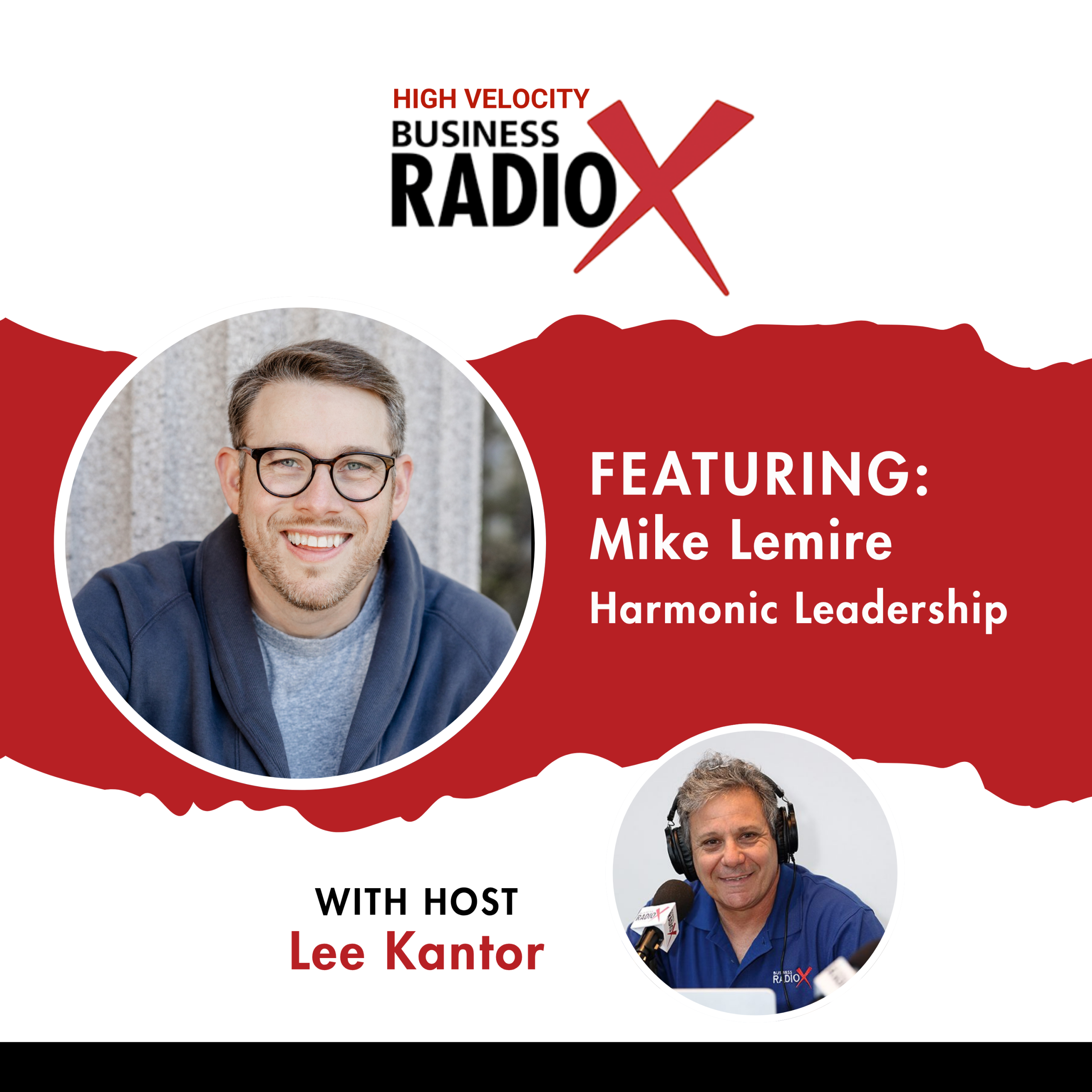

In this episode of High Velocity Radio, Lee Kantor interviews Mike Lemire, founder of Harmonic Leadership, about helping executives transition from tactical operators to strategic leaders, with a focus on customer success. Mike shares how organizations can strengthen customer retention, turn existing customers into referral sources, optimize customer success systems through data, and develop leaders who can adapt their leadership style to different people and situations.

 Mike Lemire is the CEO and Founder of Harmonic Leadership, a coaching and consulting practice that helps B2B SaaS companies build and scale their customer success functions.
He currently serves as Fractional Chief Customer Officer at STOC, and previously held customer facing leadership roles at HubSpot, Toast, Notarize, and Overjet.
He is an ICF ACC certified coach, a DiSC certified facilitator, and a LEGO Serious Play facilitator trained through the Center for Executive Coaching.
Mike works with companies at the point where customer success needs to evolve from a support function into a strategic growth engine, typically between $5M and $200M in ARR. He’s known for staying through implementation rather than handing off a strategy and walking away.
Outside client work, he facilitates peer groups for Hampton and facilitates the CS Festival in New York and teaches as part of Pavilion’s CCO School.
Connect with Mike on LinkedIn.
What You’ll Learn In This Episode
- Moving from tactical execution to strategic leadership
- Building a customer success strategy around clear and actionable data
- Turning satisfied customers into valuable referral sources
- Optimizing existing customer success systems for growth
- Developing executive presence and strategic thinking
- Understanding and overcoming imposter syndrome in leadership
- Applying situational leadership to different team members and tasks
- Using effective questions and coaching to improve leadership decisions
- Measuring leadership development through clear goals and outcomes
 This transcript is machine transcribed by Sonix.
TRANSCRIPT
Intro: Broadcasting live from the Business RadioX Studios in Atlanta, Georgia. It’s time for High Velocity Radio.
Lee Kantor: Lee Kantor here another episode of High Velocity Radio, and this is gonna be a good one. But before we get started, it’s important to recognize our sponsor, Business RadioX. If you’re a business coach or consultant who’s tired of being a best kept secret, set up a call with Stone Payton at bookstonephone.com to unlock your perpetual prospect pipeline. Today on the show, we have Mike Lemire with Harmonic Leadership. Welcome.
Mike Lemire: Thanks, Lee. Happy to be here.
Lee Kantor: Well, I am excited to learn what you’re up to. Tell us about Harmonic Leadership. How are you serving folks?
Mike Lemire: Sure. So Harmonic Leadership is an executive coaching firm started in 2024. And we focus on helping executives grow from the tactical to the strategic, with a specialization in customer success.
Lee Kantor: Customer success. One of my favorite topics, I would love to kind of get a little deep into what that means for folks and why you decided to specialize in that. So can you first, by kind of defining some of the terms, what are you defining as customer success?
Mike Lemire: Yeah. So customer success is the discipline within, usually within SaaS or software companies. In the old days, when you’d release a software, have an account manager who would come back and sell you the next version of that software. Once it became a software as a service and sort of a subscription model, they realized just going back and selling wasn’t as valuable anymore, but was more valuable as having someone work with the customer to make sure they were ultimately seeing the, the value from the product itself and such birthed the discipline of the customer Success Manager. That’s how I grew up within the tech industry, was leading customer success teams, building customer success teams. And that’s why I specialize my coaching within that discipline today.
Lee Kantor: Now, why do you think so many organizations just don’t value their existing customer base? And they’re always looking for new customers. And that’s where a lot of their investment and resources and time go into finding the next person, rather than just making sure their existing person is served well and refers them to their next client.
Mike Lemire: Twofold. I think one, a lot of more successful CEOs that I’ve worked with and around have a background in sales themselves, so they just understand that discipline quite well of what it is to go out and fill the top of the funnel, move a prospect through that funnel and close them. So just the practice of generating net new revenue as opposed to retaining it is more deeply understood. The second is sort of a belief in the product itself and the software and what it can and should do. So if I’m coming on board as a new chief customer officer, or partnering with a company as sort of an advisor within customer success, I will say to the product leader, it’s my job to put work with you so that you put this team out of work, right? If the product is smart enough, it shouldn’t have to. You shouldn’t have to have customer support. You shouldn’t have to have onboarding, shouldn’t have to have customer success managers helping the customers. The product should be able to do that. And it’s. You could argue that having a customer success team is therefore a deficiency with the value of the product itself. If you have to have someone calling the customer to help them use it better, the product isn’t fully, um, actualized. Um, and so I think there’s some discomfort in that and there’s a lot of confusion around what exactly the Customer Success manager is doing all day. Um, and so that’s part of what I’ll do within my coaching is work with customer success leaders to better communicate that to an executive team that may be more familiar with the go to market process than with the post live process.
Lee Kantor: Now, is there a research or any evidence that kind of backs up the importance of investing in existing customers and making sure there is customer success? Because, I mean, just it makes sense to me that if you have happy customers that are using whatever it is, your product or service, that they are the first place you should look for your next client, not a stranger and a Facebook ad.
Mike Lemire: Yeah, exactly. It’s not only the value. There’s data backing up the value of it, but also, um, the cost effectiveness of it. Um, I don’t have all the stats off the top of my head. I I actually teach a course, um, through an organization called Pavilion, and I have a slide in my class that shows five different stats from different organizations from Forrester to Salesforce, um, to Harvard Business School that articulate essentially, it is significantly less expensive to invest in retaining the dollars you have in the door for a customer today than it is to go out and get a new one. Um, so the math is there for customer for investing in customer retention. Um, I think the tricky part comes with great, what exactly should or do I invest in? Um, it’s one of the first areas where I’ll typically start with is data. And most of the time organizations just haven’t structured their data in a way that will give them the clarity as to how to best use that investment to retain or grow those customers to your point, your next best customer should come from your customer base as well. So, um, what I’ll see a lot of the time is, is a focus on just maintaining, uh, the customer base, keeping them copacetic. Um, they’re not at risk of churning. Great. We’re in good shape. Um, I’d argue not only do you want to make sure that they’re satisfied, but they’re promoters of your company as well. Um, I’ve seen in organizations, um, that I’ve been a part of about a quarter of net new business comes from referrals from the existing customer base. The cost to acquire a customer from a referral is significantly less than going out. To your point, buying ads on meta or buying ads on LinkedIn for them. Um, so running a healthy referral business from your customer base and having people who know how to get a customer successful and then help preach the gospel of your organization can be really, really valuable.
Lee Kantor: So what advice would you give the leader who has been under investing in this area, and to your point, would want to turn that that faucet on? What are some of the dos and don’ts in having kind of a thriving, healthy customer success environment in your organization?
Mike Lemire: Yeah. So as I mentioned, I think starting with the data, right, and making sure your product and engineering team are instrumenting all the data points that could be possible in validating what a healthy customer, what a successful customer would a not successful customer looks like. Um, I’ll then go through it’s a bit dry, but some vocabulary work with them, um, defining what it is to be activated, um, in certain features within your product or versus adopting certain features of your product. To me the separation is activation is binary. You have done it or you haven’t done it. Adoption is more of a rolling perspective of ongoing utilization if you have a foundation of that data as a starting point, you could be really dangerous with what to do there. Um, following that, it’s somewhat dependent on are you a business to business product, a business to consumer product? Um, are you more heavily focused on enterprise versus SMB? And within that, there are sort of standard playbooks that emerge. Um, for me, the separation between SMB investment and an enterprise investment is SMB is much more of a science. Um, you would produce repeatable outputs and get repeatable, um, results from your customers. So if we show them how to do this, if we instruct them at this point how to do this, we tend to see similar behaviors and responses. Um, so you can launch a one to many um, style program there on the enterprise side, I view it as much more of an art than a science. Um, it’s about investing in the right type of CSM or account owner to manage the personalities or human beings on the other side of that who are making the enterprise level decisions. Um, so maybe more of a classical music versus jazz or a science versus art, um, methodology there, but really that, that foundation of healthy and clear data giving you the signals on how to operate is where I would encourage everyone to invest in. No questions asked.
Lee Kantor: Now in your work, do you spend more time fixing, fixing broken systems or building? Uh, kind of the first system.
Mike Lemire: Um, I’ve done both. Um, and, you know, even building systems from, from scratch, um, would require optimization down the stream. Um, and I wouldn’t say fixing broken systems. It’s just optimizing existing systems. Um, so is what I’ll focus on specifically though, where I’ve spent most of my time, uh, over the last few years is in the optimization. Um, so I’ll come in when a company has maybe reached a, uh, just closed their series B round of funding, starting to think about hitting hypergrowth. Uh, the unit economics are where they need to be. They just need to grow like crazy. Um, what they’ve been doing isn’t going to get them to where they need to go. So how can they rethink or reset on their, their systems as it is today? Um, so that’s what I’ll come in, I’ll assess what’s going on with them. Um, develop an audit, uh, understand what their needs are, make their recommendations on how to build from there, um, both strategically and tactically with the team. And then the other area that I’ll focus on with them is building up the leader. Um, at that point in, in company maturity, oftentimes I’ll hear, you know, we’ve got a head of customer success. She’s grown up with the company. We love her. We’re just not sure she’s the right fit to bring us up all the way through an IPO. Um, can you help develop her executive presence so that she can start reporting out in the board meetings and developing some of this longer term strategy that you’re helping us develop? So that’s typically how I’ll operate, um, with fixing the existing systems.
Lee Kantor: So is that the problem your clients are having, uh, right before they hire you that they want to upskill somebody or they have something in place and they want you to work with the leader that’s running it to make sure that it’s optimized.
Mike Lemire: That’s correct. And that’s, that’s part of what separates me from other CS. Um, consulting firms is they are, you know, my, my colleagues in the industry or my peers are very skilled at delivering. Here’s the strategy you should, um, go forward with. I usually take it a step further to say, here is the strategy and let me help the people you have in house change the way that they work, change the way that they think about their work so that they can continue on with this process. Once your engagement with me comes to an end. Um, I, I hear so often from leaders that I work with, like I’m being told I need to be more strategic. I don’t know what that means. I don’t actually know, like what it means to be more strategic. And that’s kind of the hard work that I work on with them is developing that muscle, uh, clarifying that point to them and then showing them how to do it so that they can go, um, and continue to do that work. Uh, once I’m, uh, on to the next.
Lee Kantor: So what do you say that gives them that aha moment when you’re working, uh, moving from tactical to strategic, like what is the advice that you’re giving or counsel to help them kind of make that leap?
Mike Lemire: Typically starting with what is a tangible artifact of strategy, like this is what a strategic artifact or document looks like. Um, here’s a few different flavors of that in terms of strategic planning. Um, and then working, starting with the finished product of we need to create this, this is your strategic plan. This then gets translated into your project plan for your team. Um, and let’s work backwards from how we get to this finished product to all the things we need to collect, create, understand, brainstorm along the way to get to that. So once I show them an example of, um, strategic output, that’s usually when it’s more clear of, okay, this is my job now as the company is growing around me and I’ve got more lieutenants to rely on and focusing on the tactical day to day, it’s my job to clarify the direction my ship is is going, um, and give the marching orders to those underneath me. So once they have that, it’s a little bit easier for them to conceptualize it and go along with the development of it.
Lee Kantor: Now, do you find folks that, um, maybe they were placed in their position like the person you described, maybe just because they were there and now they’re still here. So now they’re in charge and, um, versus the, and they feel maybe, I don’t know, some imposter syndrome that maybe I haven’t really earned this or I don’t deserve this, but I’m in it now, so I gotta figure it out.
Mike Lemire: Yeah. Yeah. Almost universally, um, I would say imposter syndrome is present. And I’ve seen it from, you know, heads of customer success all the way to CEO founders and CEOs of publicly traded companies. I think that is, uh, almost a universal feeling, um, for people, um, in the workplace. Um, so that does tend to, to be one of the challenges, um, for people showing up, uh, when I’m working with them. Um, also just a sense of what it is. There’s this sense that a term that comes up as well with around imposter syndrome is I need to work on my executive presence. Um, and there’s almost this belief that they need to be really polished and learn the secrets of what happens behind closed doors when executives meet. Um, it is not, it may surprise some of them. It’s kind of the same type of meetings that they would be exposed to otherwise. Um, there’s no secret language they need to learn. Um, I think most of the time it’s just about saying what’s most important to executives and then moving on quickly, as opposed to giving a lot of background and a lot of explanation on what they did and what they tried when they get to that level, a lot of that anecdotal evidence no longer matters. And what matters are here are the numbers. Here’s what we’re doing going forward. Um, so working with them to shift that and get them to be much more comfortable, um, when they’re in that executive, um, space, then the space that they sort of grew up in. Um, I think it’s really common though for people to, who’ve done really well as an individual contributor within their discipline to be elevated to a leadership role. And when companies are growing really quickly, the opportunity to shift how they operate in that leadership role, there’s not always a lot of instruction for them. So partnering with an executive coach who can guide them in that, especially one who’s native to their discipline, um, can be really, really valuable.
Lee Kantor: I recently interviewed, I do a show where we interview veteran entrepreneurs and this person, um, who came from the military was telling me about how in the military it was very directive, uh, the leadership and he was more collaborative and, um, and he found a way to make that work for him. Um, how do you help folks that aren’t like you said, maybe they’re the Michael Jordan of their whatever tactic they were doing, and now they’re in charge of, you know, they’re over other people and managing other people. How do you help them kind of choose the leadership style that works for them, that is authentic to them, but also is effective in what they’re trying to accomplish?
Mike Lemire: Yeah, that’s a great question. And I think it’s sort of, um, there are these stages of leadership development, you see in sort of stage one is I was really successful doing it this way. This is how I became the Michael Jordan. Let me tell all my direct reports to do it exactly like me so that they can be Michael Jordan’s too. Uh, and that rarely works. Um, applying your strengths, um, and assuming your team or your organization will have those same strengths as you, um, is kind of the first mistake in the, um, stages of leadership development that I see made, um, in terms of divining or deciding or developing their own, um, leadership methodology. Um, I’ll usually introduce them to one that I was introduced to in one of my first leadership trainings 15 years ago, um, when I was at HubSpot called situational leadership. And what I liked about the example you gave to the entrepreneur you were talking about is sort of originally grew up in a very directive, um, style of management. He preferred a more collaborative style of management. What I like about the concept of situational leadership is it allows for both, um, and most importantly, it gives the leader the opportunity to adjust their leadership style to what the needs of that individual is that they’re working with. Ah, it also breaks out the requirement or not requirement, but it breaks out, um, an individual into their specific tasks that they’re working on, or skills versus bucketing them as a whole person into one category. So, um, with situational leadership does in a brief explanation is it’s a four box model. Um, and the axes are essentially skill versus will. Um, and the first box is low skill high will. Um, so the example that I give is if I was working as a head of customer success and my CEO said to me, Mike, we need new office space in Boston, I’d say that sounds cool.
Mike Lemire: Great. Happy to help. No idea how to go find us office space, but let me know what I can do. Um, so in that instance, her style of leadership with me would need to be very prescriptive. Here’s who did this last time. Here’s what they did. Well, here were the mistakes they made. Why don’t you go take a run at having some of these conversations? Check back with me, share with me the feedback, um, that you’re getting and what you’re thinking about for next steps. I’ll validate that before you move forward. Right? She’s very collaborative or very directive rather in that point, telling me exactly how to move. Very prescriptive. I feel very supportive as an individual at that point. If she were to take that same style with me as Mike, I want you to go run this team meeting. Let me show you a good template for it. Let me give you the examples of how other people have run this team meeting. I would feel offended. Right? Like this is I can do this quite well. Thank you very much. You don’t need to be that prescriptive. So that’s an example where even as the same person, two different skills that I’m being asked to focus on need different styles of, of management and situational leadership takes you all the way through different, um, uh, high skill, high will, low skill, low will and everything in between. And it allows the manager to change their style, um, accordingly. Um, so that’s typically what I’ll work on with folks to help them adapt their leadership style to be more effective with the people who report up to them.
Lee Kantor: Now, how do you help the individual kind of read the room and understand, um, when they’re on the right track, when they’re not, when to kind of lean into it and when to pull back. Because a lot of that, I mean, what you said requires, um, either some knowledge about that individual or you better be paying attention to some body language about what they’re telling you or what they’re showing you, maybe not telling you.
Mike Lemire: Yeah. So I think the, the most important part of my job is asking good questions. Um, I guess it’s arguably it’s the same for your job. Um, is asking good questions, right. Um, and so that is how I’ll do it is I will ask them sort of probing questions. How do you know that? Why do you believe that and also challenge them. Um, that’s a part of coaching is not to just accept what people are saying is if I’m not buying what they’re saying or I don’t follow it or believe it, I’ll challenge them accordingly. Um, and if they’re coming around and saying, uh, okay, that’s fair. I maybe don’t know what motivates this person or what might inspire them to take action differently. Um, I’ll then provide them with options or examples of questions they can ask, um, to better understand that. Um, so a lot of it is just, it’s challenging and question asking.
Lee Kantor: Now, is there a story you can share that maybe illustrates what it’s like to work with you and your team? Um, don’t name the individual or the company, but maybe share the challenge they came to you with and how you were able to help them get to a new level.
Mike Lemire: Sure. Um. I want to think of a good example here. Yes. So I was this is a favorite of mine. Um, so I came on board with a head of customer success and was asked to help elevate them to someone who can lead a large team. To that point, they’ve only let a team of four. And for them, what large meant was a team of 50 or greater. Um, someone who can develop strategy, um, for that organization and ultimately get that strategy and execution against that strategy across the finish line to have a net positive impact on the business. Um, and so I worked with this individual for a six months to begin with. That’s usually how we start. Um, and what the process is, is I will meet with them and better understand their goals. I’d already had that from the stakeholder. I want to make sure that the individual’s goals align with what the stakeholder, um, wanted to see. Once we had that clearly defined, we would talk about how we were going to measure, um, the progress against those goals. And I will communicate with the stakeholder. Here’s what I’m seeing in terms of their progress being made? Are you seeing progress being made in similar areas? Make adjustments or tweaks because we were so clear on exactly what they needed and what good looked like against those goals? Um, not only was I able to help this person with those areas, I was also able to articulate very clearly the changes being made to their CEO, such that at the end of the six month engagement, they said, um, this is great.
Mike Lemire: We’re going to move forward and promote them to VP. I knew before the individual did, um, the individual found out and called me before they even called their wife. Um, which was a very cool moment for me, um, to have them sort of value the partnership so deeply that before they even told their family, they called their coach with that. Um, and then the outcome for, for the business for me was also that they said, you know, we’d like you to work with the rest of the executive team here at the company because we were so pleased with the transformation you made with this this one individual. Um, so for me, it comes down to it’s probably my background in customer success, just being really clear on what the goals are, how we’re going to measure that, and then updating progress towards those goals throughout the engagement.
Lee Kantor: Now you mentioned kind of your expertise in technology SaaS. Um, do you have do you have a preference, a sweet spot when it comes to working with organizations? Do you prefer B to B, b to C? Does it matter?
Mike Lemire: It, it doesn’t matter. Um, on the coaching side, I would say my background personally is in B2B. Um, and so the playbooks, the, um, here’s what I’ve seen work. The pattern recognition. I have a lot more of that on the B2B side, um, than B2C. I have some experience working in B2C. Um, and a lot of the foundational elements of good customer success Is there, but if I had to say, my sweet spot would be B2B SaaS company seed round up through series D.
Lee Kantor: And if somebody wants to learn more, have a more substantive conversation with you or somebody on the team, what’s the website? What’s the best way to connect?
Mike Lemire: Yeah, um, harmonicleadership.com is the website. And on there there’s a contact us form. You can schedule a call directly with me or a member of the team right there. Um, or you could just reach out mike@harmonicleadership.com. Happy to connect with you.
Lee Kantor: All right. Well, Mike, thank you so much for sharing your story today. You’re doing such important work and we appreciate you.
Mike Lemire: We a pleasure to be on the show. Thank you.
Lee Kantor: All right. This is Lee Kantor. We’ll see you all next time on High Velocity Radio















