Business RadioX ®

  • Home
  • Business RadioX ® Communities
    • Southeast
      • Alabama
        • Birmingham
      • Florida
        • Orlando
        • Pensacola
        • South Florida
        • Tampa
        • Tallahassee
      • Georgia
        • Atlanta
        • Cherokee
        • Forsyth
        • Greater Perimeter
        • Gwinnett
        • North Fulton
        • North Georgia
        • Northeast Georgia
        • Rome
        • Savannah
      • Louisiana
        • New Orleans
      • North Carolina
        • Charlotte
        • Raleigh
      • Tennessee
        • Chattanooga
        • Nashville
      • Virginia
        • Richmond
    • South Central
      • Arkansas
        • Northwest Arkansas
    • Midwest
      • Illinois
        • Chicago
      • Michigan
        • Detroit
      • Minnesota
        • Minneapolis St. Paul
      • Missouri
        • St. Louis
      • Ohio
        • Cleveland
        • Columbus
        • Dayton
    • Southwest
      • Arizona
        • Phoenix
        • Tucson
        • Valley
      • Texas
        • Austin
        • Dallas
        • Houston
    • West
      • California
        • Bay Area
        • LA
        • Pasadena
      • Colorado
        • Denver
      • Hawaii
        • Oahu
  • FAQs
  • About Us
    • Our Mission
    • Our Audience
    • Why It Works
    • What People Are Saying
    • BRX in the News
  • Resources
    • BRX Pro Tips
    • B2B Marketing: The 4Rs
    • High Velocity Selling Habits
    • Why Most B2B Media Strategies Fail
    • 9 Reasons To Sponsor A Business RadioX ® Show
  • Partner With Us
  • Veteran Business RadioX ®

LIVE from SOAHR 2022: Stephanie Cantillo, ThreePoint Consulting and SHRM-Atlanta

August 5, 2022 by John Ray

Stephanie Cantillo
North Fulton Business Radio
LIVE from SOAHR 2022: Stephanie Cantillo, ThreePoint Consulting and SHRM-Atlanta
Loading
00:00 /
RSS Feed
Share
Link
Embed

Download file

Stephanie Cantillo

LIVE from SOAHR 2022: Stephanie Cantillo, ThreePoint Consulting and SHRM-Atlanta (North Fulton Business Radio, Episode 486)

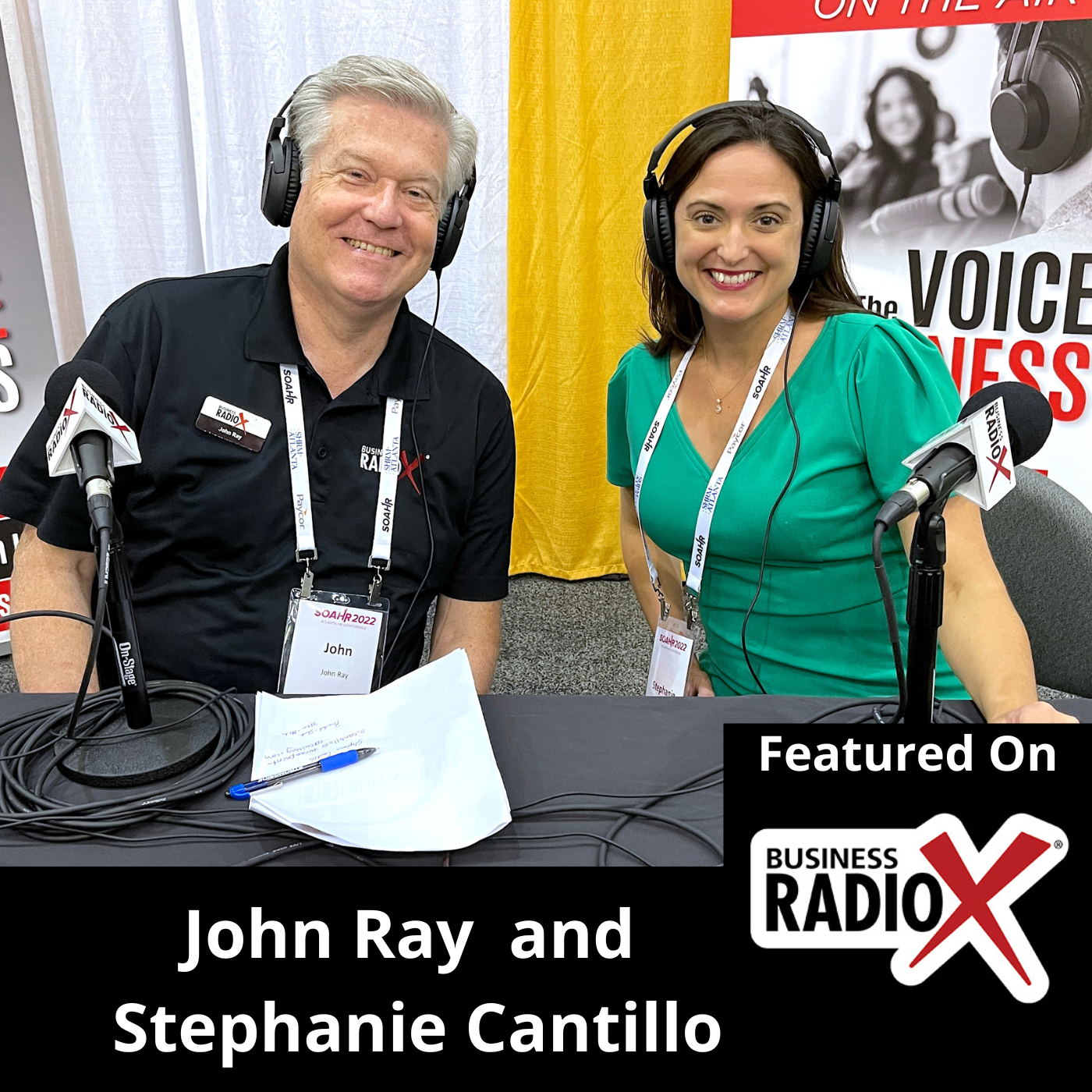
Stephanie Cantillo, an HR Professional and consultant at ThreePoint Consulting, is the 2023 President-Elect for SHRM-Atlanta. She joined host John Ray during SOAHR 2022 to discuss her history with SHRM-Atlanta, her work at ThreePoint Consulting, highlights of SOAHR 2022, looking ahead to 2023, and much more.

This show was originally broadcast live from SOAHR 2022, the annual conference of SHRM-Atlanta, held at the Cobb Galleria Centre in Atlanta, Georgia on July 27th and 28th, 2022.

North Fulton Business Radio is broadcast from the North Fulton studio of Business RadioX® inside Renasant Bank in Alpharetta.

Stephanie Cantillo, President-Elect, SHRM-Atlanta, and Consultant, ThreePoint Consulting

Stephanie Cantillo, President-Elect, SHRM-Atlanta, and Consultant, ThreePoint Consulting

Stephanie is a collaborative and solutions-focused HR leader with sixteen years of experience in Hospitality, Education, and the Non-Profit sector. With a strong background in Operational Excellence, she is recognized for her ability to streamline and improve processes while driving positive organizational change. Stephanie strives to influence, lead, and deliver exceptional results in Talent Management, Leadership Development, and Continuous Improvement.

Stephanie has held roles including Chief Human Resources Officer, and Human Resources Manager in Education, and Non-Profit organizations. In her most recent role as CHRO at Pace Academy, she provided leadership in developing and executing human resource strategy that supported a progressive K-12 independent school with approximately 300 full and part-time employees. In addition to compensation, Stephanie spent much of her time focusing on issues of Diversity, Equity, and Inclusion within her school communities.

Stephanie is very involved with the HR and Atlanta business communities at large, with over seven years of volunteer leadership experience with SHRM’s Atlanta Chapter. Her leadership roles have included New Member Orientation Chair, EVP of Special Programs, and now President-Elect for 2022. She loves giving back and received the chapter’s Exemplary Volunteer Award in 2018, 2020, and 2021.

Stephanie served on the NBOA HR Council and has spoken at several conferences including SAIS and MISBO, as well as Teacher of Color Recruiting Fair. In addition, she has led HR training for the National Guard and Volunteer Leadership training for Junior League of Atlanta.

Born in Colombia, South America and raised in New England, Stephanie has lived in Atlanta since 2006. She is a graduate from Florida State University, where she double majored in Multinational Business Operations and Hospitality Administration. Stephanie earned her PHR certification in 2019 and her areas of expertise include: employee relations, recruiting, compensation, benefits administration, compliance, and payroll. Her professional experience also includes time at The Atlanta Opera and Four Seasons Hotels.

Others describe Stephanie as friendly, curious, and outgoing. Stephanie builds meaningful relationships through credibility, energy, and trust. In her free time, Stephanie enjoys spending time with her family, horseback riding, and being in nature. Stephanie’s son, Sebastian, is entering his last year of middle school, and her husband, Thomas, is a private chef, pastry chef, and chocolatier.

ThreePoint Consulting website | LinkedIn

SHRM-Atlanta

SHRM-Atlanta is one of the largest chapters of SHRM and shares its purpose of elevating the HR profession. As a leader in the Atlanta metro business community, SHRM-Atlanta strives to be the premier resource for those working in and supporting the human resource function. SHRM-Atlanta’s predominant goal is to be the voice of HR in metro Atlanta and be the first contact for those seeking information and solutions.

This will be achieved through the growth and diversity of members, education, and delivery of content, and by strengthening partnerships with organizations that share its vision.

Website | LinkedIn | Facebook | Instagram 

Questions and Topics in this Interview:

  • Stephanie’s history with SHRM-Atlanta and role as President-Elect
  • Her work at ThreePoint Consulting
  • SOAHR and benefits of SHRM-Atlanta
  • Her term at SHRM-Atlanta for 2023

North Fulton Business Radio is hosted by John Ray and broadcast and produced from the North Fulton studio of Business RadioX® inside Renasant Bank in Alpharetta. You can find the full archive of shows by following this link. The show is available on all the major podcast apps, including Apple Podcasts, Spotify, Google, Amazon, iHeart Radio, Stitcher, TuneIn, and others.
RenasantBank


Renasant Bank has humble roots, starting in 1904 as a $100,000 bank in a Lee County, Mississippi, bakery. Since then, Renasant has grown to become one of the Southeast’s strongest financial institutions with over $13 billion in assets and more than 190 banking, lending, wealth management and financial services offices in Mississippi, Alabama, Tennessee, Georgia and Florida. All of Renasant’s success stems from each of their banker’s commitment to investing in their communities as a way of better understanding the people they serve. At Renasant Bank, they understand you because they work and live alongside you every day.
 

Special thanks to A&S Culinary Concepts for their support of this edition of North Fulton Business Radio. A&S Culinary Concepts, based in Johns Creek, is an award-winning culinary studio, celebrated for corporate catering, corporate team building, Big Green Egg Boot Camps, and private group events. They also provide oven-ready, cooked-from-scratch meals to go they call “Let Us Cook for You.” To see their menus and events, go to their website or call 678-336-9196.
Tagged With: compensation, HR, North Fulton Business Radio, renasant bank, SHRM Atlanta, SOAHR 2022, Stephanie Cantillo, ThreePoint Consulting

LIVE from SOAHR 2022: Akilah Charlemagne, Cox Communications and SHRM-Atlanta

August 3, 2022 by John Ray

Akilah Charlemagne
North Fulton Business Radio
LIVE from SOAHR 2022: Akilah Charlemagne, Cox Communications and SHRM-Atlanta
Loading
00:00 /
RSS Feed
Share
Link
Embed

Download file

Akilah Charlemagne

LIVE from SOAHR 2022: Akilah Charlemagne, Cox Communications and SHRM-Atlanta (North Fulton Business Radio, Episode 483)

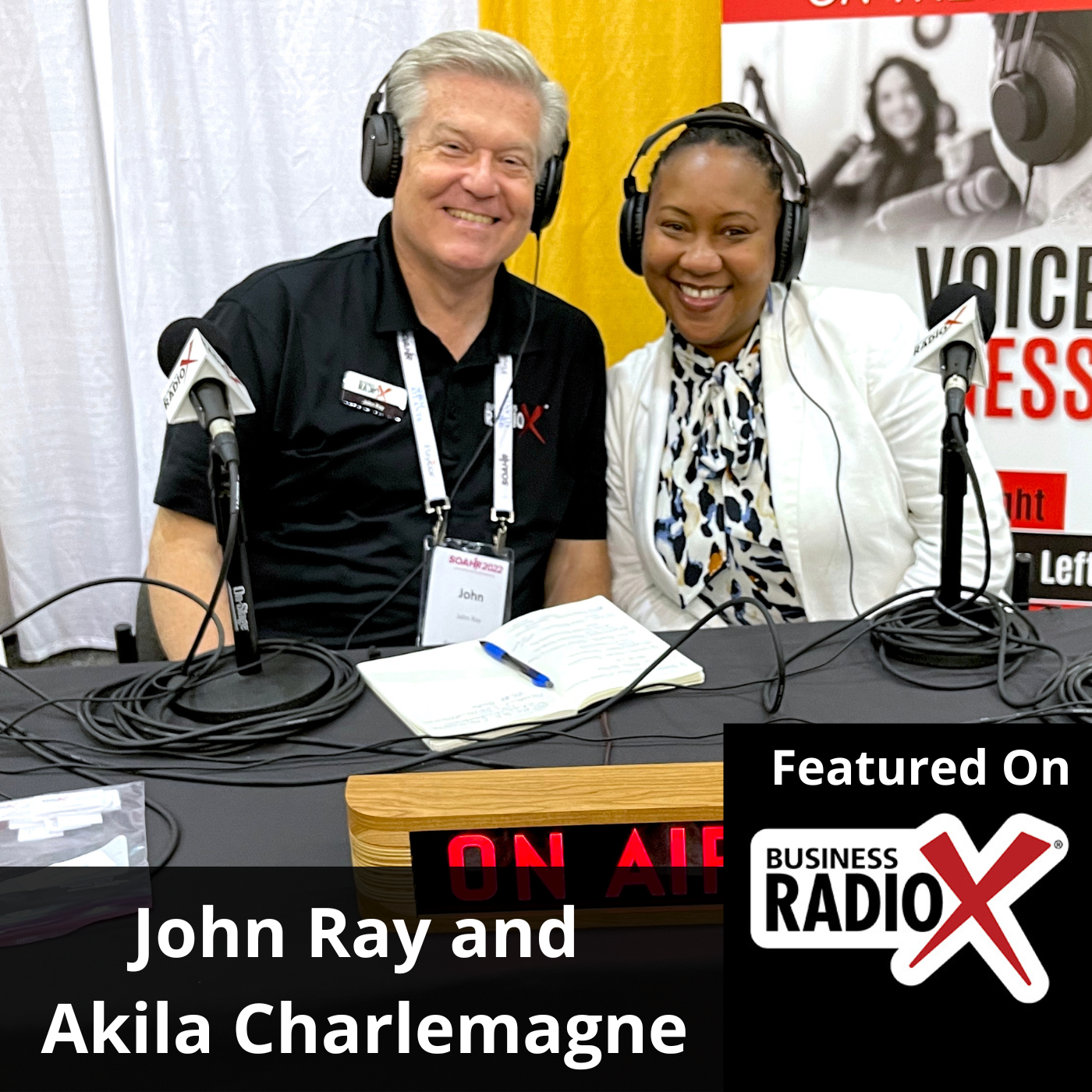
Akilah Charlemagne, HR Business Partner Director at Cox Communications and President of SHRM-Atlanta, chatted with host John Ray LIVE during the SOAHR 2022 conference for SHRM-Atlanta. She shared that she is celebrating her third anniversary with Cox and talked about her passion for career development and leadership coaching, her career path, her decision to invest in SHRM-Atlanta and her certification, the connections she has cultivated, her tenure as president, and much more.

This show was originally broadcast live from SOAHR 2022, the annual conference of SHRM-Atlanta, held at the Cobb Galleria Centre in Atlanta, Georgia on July 27th and 28th, 2022.

North Fulton Business Radio is broadcast from the North Fulton studio of Business RadioX® inside Renasant Bank in Alpharetta.

Akilah Charlemagne, SHRM-SCP, SPHR, HCS, FPC, President, SHRM-Atlanta

Akilah Charlemagne, SHRM-SCP, SPHR, HCS, FPC, President, SHRM-Atlanta

Akilah Charlemagne is an influential Human Resources Business Partner and Relationship Builder with 22 years of experience working with Technology, Higher Education, Healthcare and Non-Profit organizations. Akilah’s passion and purpose is to create remarkable experiences where professionals feel safe, energized, and empowered to take risks and propel their careers!

Akilah founded Career Lemonade in 2019, where she partners with professionals and entrepreneurs who are looking to make a shift while increasing their confidence and supporting them in making better Career & Business decisions.

She earned her BA in International Relations with a minor in Spanish from Mount Holyoke College. Akilah serves as the President for SHRM-Atlanta and is the Co-Founder of ATL HR CREW.

Akilah was born in St. Vincent & the Grenadines, grew up in New York City, and has lived in Atlanta (off and on) since 2001. Her LIFE and WORK principles include “Be Positive. . .Be Authentic. . .Be Resourceful. . .Be BOLD and Pay it Forward!”

Website | LinkedIn | Twitter | Instagram

SHRM-Atlanta

SHRM-Atlanta is one of the largest chapters of SHRM and shares its purpose of elevating the HR profession. As a leader in the Atlanta metro business community, SHRM-Atlanta strives to be the premier resource for those working in and supporting the human resource function. SHRM-Atlanta’s predominant goal is to be the voice of HR in metro Atlanta and be the first contact for those seeking information and solutions.

This will be achieved through the growth and diversity of members, education, and delivery of content, and by strengthening partnerships with organizations that share its vision.

Website | LinkedIn | Facebook | Instagram 

Questions and Topics in this Interview:

  • Akilah’s work at Cox
  • Her HR Journey
  • Her experience with SHRM-Atlanta
  • SOAHR 2022

North Fulton Business Radio is hosted by John Ray and broadcast and produced from the North Fulton studio of Business RadioX® inside Renasant Bank in Alpharetta. You can find the full archive of shows by following this link. The show is available on all the major podcast apps, including Apple Podcasts, Spotify, Google, Amazon, iHeart Radio, Stitcher, TuneIn, and others.

RenasantBank


Renasant Bank has humble roots, starting in 1904 as a $100,000 bank in a Lee County, Mississippi, bakery. Since then, Renasant has grown to become one of the Southeast’s strongest financial institutions with over $13 billion in assets and more than 190 banking, lending, wealth management and financial services offices in Mississippi, Alabama, Tennessee, Georgia and Florida. All of Renasant’s success stems from each of their banker’s commitment to investing in their communities as a way of better understanding the people they serve. At Renasant Bank, they understand you because they work and live alongside you every day.


Special thanks to A&S Culinary Concepts for their support of this edition of North Fulton Business Radio. A&S Culinary Concepts, based in Johns Creek, is an award-winning culinary studio, celebrated for corporate catering, corporate team building, Big Green Egg Boot Camps, and private group events. They also provide oven-ready, cooked-from-scratch meals to go they call “Let Us Cook for You.” To see their menus and events, go to their website or call 678-336-9196.

Tagged With: Akilah Charlemagne, collaboration, Cox Communications, HR, networking, North Fulton Business Radio, renasant bank, SHRM Atlanta

Workplace MVP LIVE from SHRM 2022: Greg Hawks, Hawks Agency

August 2, 2022 by John Ray

Greg Hawks
Minneapolis St. Paul Studio
Workplace MVP LIVE from SHRM 2022: Greg Hawks, Hawks Agency
Loading
00:00 /
RSS Feed
Share
Link
Embed

Download file

Greg Hawks

Workplace MVP LIVE from SHRM 2022: Greg Hawks, Hawks Agency

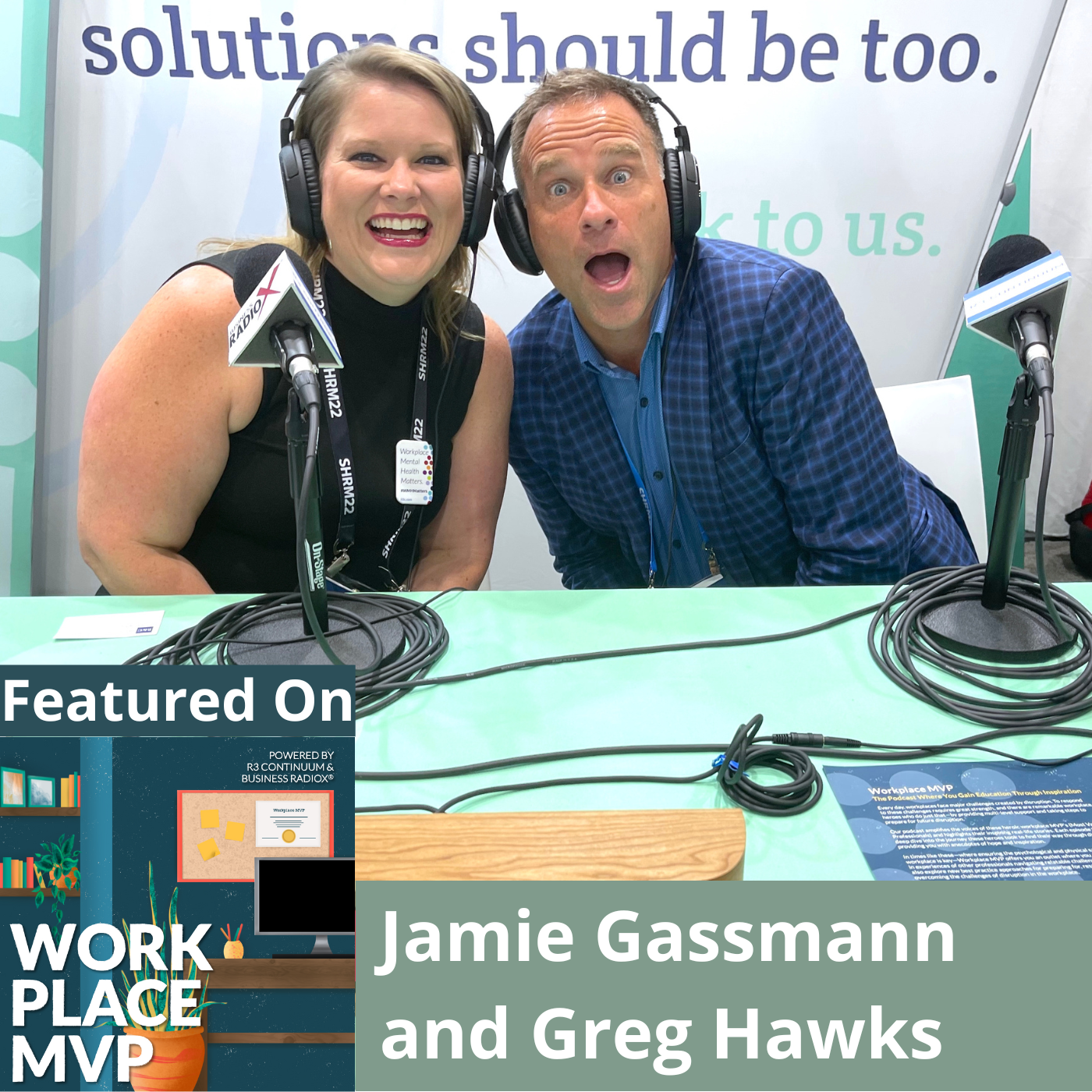
Speaker and culture specialist Greg Hawks of the Hawks Agency joined Jamie Gassmann live from SHRM 2022. He shared the mission of his firm, his impressions on the culture shifts from the pandemic, the key points of his presentation at SHRM, and much more.

Workplace MVP is underwritten and presented by R3 Continuum and produced by the Minneapolis-St.Paul Studio of Business RadioX®.

This show was originally broadcast live from the 2022 SHRM Annual Conference held at the New Orleans Convention Center in New Orleans, Louisiana.

Greg Hawks, Hawks Agency

Greg Hawks, Hawks Agency

Greg is on a mission to shape environments where everyone gets to contribute their best daily! For two decades he has mentored leaders, developed teams, crafted culture, and empowered employees. His approachable personality and vibrant demeanor are useful attributes for attacking mediocrity. Motivated to grow high-capacity performers who serve, sell and lead with excellence, Greg is relentless in discovering ways for individuals, teams, leaders, and organizations to grow.

LinkedIn | Instagram | Twitter

Hawks Agency

Hawks Agency values a relentless spirit, retaining an amusing attitude while creating distinct experiences that provide consistent excellence in every encounter.

They create content that sticks in the mind and hearts of audiences, compelling them towards action! Whether consuming online or in-person, they fashion experiences that move individuals and organizations forward.

They are here at this time in history to impact humanity in a significant way. They believe words, ideas, beliefs, and the spaces they occur in matter. They know partnership and collaboration is the best way to make an impact!

Company website | LinkedIn | Facebook 

About Workplace MVP

Every day, around the world, organizations of all sizes face disruptive events and situations. Within those workplaces are everyday heroes in human resources, risk management, security, business continuity, and the C-suite. They don’t call themselves heroes though. On the contrary, they simply show up every day, laboring for the well-being of employees in their care, readying the workplace for and planning responses to disruption. This show, Workplace MVP, confers on these heroes the designation they deserve, Workplace MVP (Most Valuable Professionals), and gives them the forum to tell their story. As you hear their experiences, you will learn first-hand, real-life approaches to readying the workplace, responses to crisis situations, and overcoming challenges of disruption. Visit our show archive here.

Workplace MVP Host Jamie Gassmann

Jamie Gassmann, Host, “Workplace MVP”

In addition to serving as the host to the Workplace MVP podcast, Jamie Gassmann is the Director of Marketing at R3 Continuum (R3c). Collectively, she has more than fourteen years of marketing experience. Across her tenure, she has experience working in and with various industries including banking, real estate, retail, crisis management, insurance, business continuity, and more. She holds a Bachelor of Science Degree in Mass Communications with special interest in Advertising and Public Relations and a Master of Business Administration from Paseka School of Business, Minnesota State University.

R3 Continuum

R3 Continuum is a global leader in workplace behavioral health and security solutions. R3c helps ensure the psychological and physical safety of organizations and their people in today’s ever-changing and often unpredictable world. Through their continuum of tailored solutions, including evaluations, crisis response, executive optimization, protective services, and more, they help organizations maintain and cultivate a workplace of wellbeing so that their people can thrive. Learn more about R3c at www.r3c.com.

Company website | LinkedIn | Facebook | Twitter

TRANSCRIPT

Intro: [00:00:02] Broadcasting live from SHRM 2022 at the New Orleans Convention Center, it’s time for Workplace MVP. Brought to you by R3 Continuum, a global leader in helping workplaces thrive during disruptive times. Now, here’s your host.

Jamie Gassmann: [00:00:19] Hey, everyone. You’re host, Jamie Gassmann here, at the SHRM 2022 Exhibit Hall. And I am in our show sponsor, R3 Continuum’s booth. And joining me is Greg Hawks.

Greg Hawks: [00:00:31] Yes, I am.

Jamie Gassmann: [00:00:32] Welcome, Greg.

Greg Hawks: [00:00:32] It is a pleasure to be here. I love your booth set up. The colors are fabulous. Location is delightful. People are all over the place. Thanks for letting me sit down.

Jamie Gassmann: [00:00:40] Yeah. Well, I’m glad you sat down. And I love your energy.

Greg Hawks: [00:00:44] Thank you so much.

Jamie Gassmann: [00:00:44] And thank you for the compliment on the booth. You worked so hard to design those, so I appreciate that.

Greg Hawks: [00:00:49] Absolutely. It’s a great color. It really is.

Jamie Gassmann: [00:00:50] Yes. Yes. It’s inviting.

Greg Hawks: [00:00:52] It’s distinct. And I love green, but it’s like a teal but it’s a little minty. It’s a lovely minty flavor. Yes, indeed.

Jamie Gassmann: [00:01:02] So, I’m really excited you sat down. So, I know you own your own agency.

Greg Hawks: [00:01:06] I do.

Jamie Gassmann: [00:01:06] So, tell us a little bit about what your agency does and what you do for HR Leaders.

Greg Hawks: [00:01:11] Well, for HR Leaders, we work in culture. That’s what we do. So, we have three, I’ve got myself and two other folks, on our team that are culture specialists. So, we do a lot of speaking. So, I do a lot of keynote speaking at organization events, at HR conferences, state conferences around the nation. And then, we serve some consultancy around how they’re shaping an ownership culture.

Greg Hawks: [00:01:31] So, our mission is shaping environments where everyone gets to contribute their best daily. So, we’re really focused on this idea of how do we cause people to get better every day. And so, that’s the way kind of metrics are best, how are you the best version of you. That’s what people talk about. I’m like, “Today is it, baby.” You don’t get any better than this because today is last year’s future. And so, everybody’s like, “I’ve got this idea of what I’m going to be.” And so, we really work with leaders and teams on really shaping the environments where people can bring their best daily.

Jamie Gassmann: [00:02:00] Yeah. And I got to imagine, with the change in work environments across the country, where you’ve got a hybrid or you’ve got full remote work or they’re bringing people back and there’s that hesitation, talk to me about how has culture evolved in organizations?

Greg Hawks: [00:02:18] Here’s what I have found with culture and organizations that immediately shifted to the remote workforce that didn’t have it before, is that, in that initial season, it magnified who they already were. So, the organization had cultures that were literally people first. You know, the language that people use about we respect our people, we care for our people, COVID magnified it.

Greg Hawks: [00:02:41] So, I’ve got a client in Atlanta, they sent everybody home, and immediately they replicated their desk environment at home, in both places, and they said, “Whenever we come back, you’ll have your stuff here, and you’ll have your stuff there, and we’ll just work, whatever.” They just immediately. Whereas, other people were, like, stingy or they just didn’t care. They just didn’t have it in their culture that they really did respond to challenges that kept their people first, if you will.

Greg Hawks: [00:03:10] And so, in the initial season, I’d say the first year or so, it really magnified it. Now, we’ve been through the transformation of it, what we see is people who really value innovation and the thoughtfulness of always keeping their people first is how they’re structuring their conversations.

Greg Hawks: [00:03:26] Because culture isn’t within a building anyhow. When people think of culture not in a workplace, they think of Paris, they think of New York City, they think of Minneapolis. Every location has a culture and it’s not based on what happens inside of a building. It’s based on the traditions, and the communication, and the look. There’s so many elements that create culture for a people group. And so, just because people are distributed, it doesn’t make it more difficult if those values are entrenched in the hearts and minds of people.

Greg Hawks: [00:03:58] And so, the challenge leaders are having is they’re so used to having a physical structure to fashion that in. That now being mindful of, whether we’re Zooming or we’re just having phone calls more or everybody’s just distributed and we’re no longer hiring in a geographical location, all over the nation is now our place, and people don’t have to move, it’s how do we instill our heart, how do we instill our way of thinking, how do we instill the way we communicate. Because those things aren’t contained in a building, but they really reflect a lot about who we are as an organization. I mean, really the values that we have.

Greg Hawks: [00:04:36] So, for me, the remote world has really magnified if people really align with their values. It’s really exposed what the culture is because you can’t lie about it. We see how people are as a collective in our teams or organizations in these companies. And it’s just not as well hidden when everybody comes together and they got the words on the wall and this is what we’re about, but didn’t really have to play it out every day.

Jamie Gassmann: [00:05:02] So, with that, exposure to the true identity or the true culture of the organization, do you think that for some that’s contributed to that Great Resignation or that great reshuffle that we’ve experienced over the last year?

Greg Hawks: [00:05:15] I’ve got a friend, Ben, who calls it the great reprioritization. He’s like, “It doesn’t flow well,” but it is that.

Jamie Gassmann: [00:05:21] Yeah. I keep hearing different names.

Greg Hawks: [00:05:22] I know. I mean, resignation is the one that got it because that was the actual activity. I absolutely think so, you know, there’s a combination because people recognized that they weren’t as cared for as maybe they thought they were. And they also recognized, “I want to give my life every day in an organization and a place with people that my own personal values align with.” And so, I would definitely say it’s exposure. People don’t talk about it in that language, but that what was exposed on who the company really is, what values really mattered.

Greg Hawks: [00:05:56] Because as people and as teams, because we’re made of people, we act out of our beliefs. Like, however anybody is acting, it’s because there’s a belief structure within their own internal value system. And so, that plays out true in an organization. And so, when that was revealed and keeps being revealed, honestly, it was a collective courageousness that was like, “I just don’t want to do this anymore in life.”

Greg Hawks: [00:06:17] So, that’s my thought on it. The exposure definitely did give people a sense of at least the playing field level on how people really think about me here. And then, What do I want to do with that? What’s acceptable to me? What’s not acceptable to me?

Jamie Gassmann: [00:06:31] Yeah. And I know you presented here at SHRM. I heard your presentation was amazing.

Greg Hawks: [00:06:36] It was fabulous this morning. So much fun. Thanks for saying that.

Jamie Gassmann: [00:06:38] You know, they got me chained in the booth here talking about work culture, right? I’ve got lots of things to do. But, no, I heard your presentation went really, really well. Talk to us about what you presented on.

Greg Hawks: [00:06:50] I did my ownership culture message because I’ve owned single family properties, so I do this idea of kind of a comparison. Because people, as you know, they’re like, “We need people to buy in around here. We just need you to own it.” And it’s a very subjective idea. And I own single family properties, and so I talk about how renters perceive living in a home and how owners perceive it differently. And so, I’ve got these five attributes what an ownership spirit looks like, whether it’s around commitment, or increasing value, or reach for responsibilities, or being inclusive, and then valuing the whole house.

Greg Hawks: [00:07:24] And so, I give HR professionals, and really leaders and organizations, some clarity on if you want people to buy in, then be very specific about what that entails. And if you create a place, you shape the culture, you shape this environment where people can bring their best daily around what commitment looks like. Because here’s what you find, people want to do a good job at work. People are fulfilled when they feel like they’re succeeding. And when they don’t feel like that, it’s as much to do with the environment that they’re doing it in, the leadership that’s leading, and then their own sense of ability to do it.

Greg Hawks: [00:08:00] And, oftentimes, it seems to reflect so much on the individual instead of the culture that they’re in. And so, I’ll talk about contribution, because one of the characteristics is people who have an ownership spirit want to contribute. And yet, oftentimes, we create an environment where we say, “We don’t want to hear that. No, no, no.” You know want to say they’ll crush your spirit. Then, you go in, start out really eager and really excited, and then they just, like, squash your spirit. And they’re like, “Fine. I’m not going to share anything more.”

Greg Hawks: [00:08:26] And so, all of a sudden, they want people to give their best, but their environment actually produces renters in the workplace instead of people with the spirit of ownership. And so, that was a little bit where I talked about. I love this message. It’s a good language for people. Everybody who’s owned or rented understands that. And it just really gives a construct for organizations to think about what they’re inviting their employees to bring and what that can look like in an organization.

Jamie Gassmann: [00:08:51] Yeah. It sounds like there’s some interesting kind of new approaches of thinking about that environment.

Greg Hawks: [00:08:56] Absolutely.

Jamie Gassmann: [00:08:57] So, if there was one or two key takeaways that you wanted that audience to leave with, what would they be?

Greg Hawks: [00:09:04] There are several key takeaways, but one of my favorite things, because I talk about increasing value, and oftentimes people will say, “Well, I don’t have access to a budget. I’m not in charge of anybody.” And so, the offering is, the way you increase value is through encouragement that you can use free words to become more valuable and to cause others to feel valuable.

Greg Hawks: [00:09:26] And so, I’ll interact with somebody in the audience and I’ll say really positive, specific things to them, and appreciate them in a way. And I don’t know them, but I can assume I get to know them a little bit what they’re doing, and I’ll just say to them. And one of the takeaways is, people like people who like them. So, I’ll say it again because some people don’t understand that, people like people who like them. So, I’m always an advantage. Jamie, I like you. I start out liking you before I know you, not based on who you are, but based on who I am.

Greg Hawks: [00:09:54] And most leaders, most people go, “I’m going to get to know you. I’m going to see what you’re like. I’m gonna figure you out. And then, I don’t know if I’ll like you or not.” And what that does is, you’re going to be more different than me than like me. And differences create distance.

Greg Hawks: [00:10:05] But if I start out saying, “I like you.” I’ll start from the place of I already give that to us in a relationship, it creates this reciprocity that really engages people. And it’s not so that you have people like each other. It’s so that trust is accelerated. Because once we trust each other, then we can have really meaningful conversations and we get right to the heart of things that oftentimes people dance around, even because they just have personality differences and they don’t have the capacity within themselves to go, “I choose to like you based on me, not based on you. Because of that, we’re going to grow a better relationship.” So, that’s one that increase my value and your value in an organization.

Jamie Gassmann: [00:10:41] Yeah. I love that. I actually felt that. And you’re like, “I like you.” I’m like, “Oh. I like you too.”

Greg Hawks: [00:10:46] That’s exactly what happens.

Jamie Gassmann: [00:10:48] You instantly feel that.

Greg Hawks: [00:10:50] You instantly feel that. And it’s transformational. And, literally, just those words, when you say that to somebody, all the guard drops. It’s this weird connection thing that happens. Just what happened here.

Jamie Gassmann: [00:11:01] It’s like a human connection.

Greg Hawks: [00:11:02] It’s, literally, the best of the human connection.

Jamie Gassmann: [00:11:04] It’s like you have been accepted. It’s different.

Greg Hawks: [00:11:05] Yes. And you can start that out. Because most people are like, “Let me get a feel for you. Let me get to know you a little bit.”

Jamie Gassmann: [00:11:11] You have one opportunity.

Greg Hawks: [00:11:12] And it’s all a defensive position. And when I start out liking you, I’m on the offense. I’m intentionally going to build rapport with you so we can really deal with things that need to be dealt with. And so many leaders don’t do that.

Jamie Gassmann: [00:11:24] I love that. You’re setting them up to bring their best selves to work because they can bring themselves to work.

Greg Hawks: [00:11:28] Yes. Exactly.

Jamie Gassmann: [00:11:30] That’s so cool. How powerful.

Greg Hawks: [00:11:31] It’s potent. Yeah, it really is.

Jamie Gassmann: [00:11:33] So, if anybody wanted to learn more from you, or just kind of get a little bit more information, or explore your agency –

Greg Hawks: [00:11:40] Come on. That would be just fabulous. I wish they would do that.

Jamie Gassmann: [00:11:43] … how do they get a hold of you?

Greg Hawks: [00:11:44] They can go to hawksagency.com, H-A-W-K-Sagency.com. It has all the information. It has our little team on there. It has video. All kinds of great resources on there. It’s just a great website. So, hawksagency.com. Thank you.

Jamie Gassmann: [00:11:58] Fascinating. Well, thank you so much for joining us.

Greg Hawks: [00:12:00] My pleasure.

Jamie Gassmann: [00:12:00] It’s been an absolute pleasure to have you on the show.

Greg Hawks: [00:12:03] Good, good, good. I hope people benefit from it. Let me know how I can help you guys.

Jamie Gassmann: [00:12:07] Perfect. Thank you.

Greg Hawks: [00:12:07] Okay. Thank you.

Outro: [00:12:12] Thank you for joining us on Workplace MVP. R3 Continuum is a proud sponsor of this show, and is delighted to celebrate most valuable professionals who work diligently to secure safe workplaces where employees can thrive.


Tagged With: company culture, Greg Hawks, Hawks Agency, HR, Jamie Gassmann, R3 Continuum, Workplace MVP

Dental Law Radio Rebrands and Relaunches as Advisory Insights Podcast

August 1, 2022 by John Ray

Dental Law Radio Rebrands and Relaunches as the Advisory Insights Podcast
Dental Law Radio
Dental Law Radio Rebrands and Relaunches as Advisory Insights Podcast
Loading
00:00 /
RSS Feed
Share
Link
Embed

Download file

Dental Law Radio Rebrands and Relaunches as the Advisory Insights Podcast

Dental Law Radio Rebrands and Relaunches as Advisory Insights Podcast (Dental Law Radio, Episode 32)

Over the past year, Oberman Law Firm has grown significantly, adding attorneys with various areas of expertise which extend well beyond the firm’s highly regarded and well-known work with dental practices. Consequently, the firm is rebranding and relaunching Dental Law Radio as Advisory Insights Podcast. Advisory Insights will cover the same legal, business, HR, and other topics addressed in Dental Law Radio, and will do so aimed at other healthcare practices and business owners as well.

Advisory Insights is underwritten and presented by Oberman Law Firm and produced by the North Fulton studio of Business RadioX®. The show series can be found here as well as on all the major podcast apps.


Stuart Oberman, Oberman Law Firm

Oberman Law Firm
Stuart Oberman, host of “Dental Law Radio”

Stuart Oberman is the founder and President of Oberman Law Firm. Mr. Oberman graduated from Urbana University and received his law degree from John Marshall Law School. Mr. Oberman has been practicing law for over 25 years, and before going into private practice, Mr. Oberman was in-house counsel for a Fortune 500 Company. Mr. Oberman is widely regarded as the go-to attorney in the area of Dental Law, which includes DSO formation, corporate business structures, mergers and acquisitions, regulatory compliance, advertising regulations, HIPAA, Compliance, and employment law regulations that affect dental practices.

In addition, Mr. Oberman’s expertise in the health care industry includes advising clients in the complex regulatory landscape as it relates to telehealth and telemedicine, including compliance of corporate structures, third-party reimbursement, contract negotiations, technology, health care fraud and abuse law (Anti-Kickback Statute and the State Law), professional liability risk management, federal and state regulations.

As the long-term care industry evolves, Mr. Oberman has the knowledge and experience to guide clients in the long-term care sector with respect to corporate and regulatory matters, assisted living facilities, continuing care retirement communities (CCRCs). In addition, Mr. Oberman’s practice also focuses on health care facility acquisitions and other changes of ownership, as well as related licensure and Medicare/Medicaid certification matters, CCRC registrations, long-term care/skilled nursing facility management, operating agreements, assisted living licensure matters, and health care joint ventures.

In addition to his expertise in the health care industry, Mr. Oberman has a nationwide practice that focuses on all facets of contractual disputes, including corporate governance, fiduciary duty, trade secrets, unfair competition, covenants not to compete, trademark and copyright infringement, fraud, and deceptive trade practices, and other business-related matters. Mr. Oberman also represents clients throughout the United States in a wide range of practice areas, including mergers & acquisitions, partnership agreements, commercial real estate, entity formation, employment law, commercial leasing, intellectual property, and HIPAA/OSHA compliance.

Mr. Oberman is a national lecturer and has published articles in the U.S. and Canada.

LinkedIn

Oberman Law Firm

Oberman Law Firm has a long history of civic service, noted national, regional, and local clients, and stands among the Southeast’s eminent and fast-growing full-service law firms. Oberman Law Firm’s areas of practice include Business Planning, Commercial & Technology Transactions, Corporate, Employment & Labor, Estate Planning, Health Care, Intellectual Property, Litigation, Privacy & Data Security, and Real Estate.

By meeting their client’s goals and becoming a trusted partner and advocate for our clients, their attorneys are recognized as legal go-getters who provide value-added service. Their attorneys understand that in a rapidly changing legal market, clients have new expectations, constantly evolving choices, and operate in an environment of heightened reputational and commercial risk.

Oberman Law Firm’s strength is its ability to solve complex legal problems by collaborating across borders and practice areas.

Connect with Oberman Law Firm:

Company website | LinkedIn | Twitter


Tagged With: Advisory Insights, Advisory Insights Podcast, dental, Dental Law Radio, dental practices, healthcare practices, HR, Oberman Law Firm, Stuart Oberman

Introduction to the Advisory Insights Podcast

July 29, 2022 by John Ray

Advisory Insights
Advisory Insights Podcast
Introduction to the Advisory Insights Podcast
Loading
00:00 /
RSS Feed
Share
Link
Embed

Download file

Advisory Insights

Introduction to the Advisory Insights Podcast

In this introductory episode of the Advisory Insights Podcast, Stuart Oberman welcomed listeners to this new podcast featuring legal, business, HR, and other topics of vital concern to healthcare practices and other business owners. (Advisory Insights is the successor show to Dental Law Radio.) He went on to cover an extensive list of essential topics to be included in employee manuals and guidelines and more.

TRANSCRIPT

Intro: [00:00:01] Broadcasting from the studios of Business RadioX, it’s time for Advisory Insights. Brought to you by Oberman Law Firm, serving clients nationwide with tailored service and exceptional results. Now, here’s your host.

Stuart Oberman : [00:00:19] Hello everyone, and welcome to Advisory Insights Podcast. Well, first, I’d like to welcome our dental clients who followed us over to dentallawradio.com, and also our new listeners. I could not be more excited about what we’re doing with Advisory Insights Podcast.

Stuart Oberman : [00:00:36] We had a platform previously, and we discovered that we are getting national exposure on our platforms, what we said before. So, we took a little bit of a break and we decided, You know what? We’re going to take what you can use, no matter whether you are a health care practice or global company. We’re going to keep things simple. We’re going to keep it basic. And what our clients need to know on a day-to-day basis on how to stay, hopefully, out of trouble.

Stuart Oberman : [00:01:04] And we’d like to thank North Fulton Business Radio and Business RadioX for hosting us. But we’re going to start gearing this thing up pretty hard.

Stuart Oberman : [00:01:13] So, what are we going to talk about today? Well, let me just tell you this. In this great world that we live in of the Great Resignation, H.R. is a headache, there’s no doubt about it. So, I’ve been talking for a while on employee manuals and guidelines. I want to start off on a couple of things that, again, no matter what size you are, you need to take a look at this.

Stuart Oberman : [00:01:31] First and foremost, I don’t care if you have $1,000,000 a year on revenue or $50 billion, you need to look at your H.R. annually. You have to take a look at what the company culture is, what the headcount is, what are your benefits, are your renewals up. And in today’s world, I’ve been stressing for a long, long time, look, employee manuals will either make you or break you, and are just no longer an option.

Stuart Oberman : [00:01:56] And we had a really, really great podcast with SHRM Atlanta. For those of you that don’t know what SHRM Atlanta is, it’s an unbelievable organization. And we get a lot of information from those guys on a regular basis. And it’s employee manuals. It’s H.R. It’s a lot of internal information.

Stuart Oberman : [00:02:21] But I want to tell you something, what is no longer an option, you’ve got to know State and Federal law. You’ve got to know about EEOC. You’ve got to know about National Labor Relations Board. You have to know the Age Discrimination and Employment Act of 1967. You’ve got to know Title VII of the Civil Rights Act 1964. You have to know the Equal Pay Act of 1963. You got to know the Worker’s Adjustment and Retraining Notification Act. You’ve got to know Sections 1981 and 1983 of the Civil Rights Act. You’ve got to know the American Disabilities Act. You’ve got to know the Family for Medical Leave Act. You’ve got to know the Employees Retirement Income Security Act. You have to know the Old Benefits Protection Act. You have to know the Age Discrimination Act of 1967.

Stuart Oberman : [00:03:04] How in the world are you going to run a business if you don’t know what those things are? Those have got to be in your manual. There’s no longer an option. If you don’t know any of those, if you don’t know a lot of those, or you don’t know really all of those, you need to figure out what you’re doing. You need to look internally at what you’re doing.

Stuart Oberman : [00:03:20] And failure to plan, I can’t tell you how many clients we have that are global, local, regional, and national that have no idea what I’m talking about. And that’s extremely dangerous. Not only is it costly, it’s a nightmare. So, a couple of provisions are really no longer an option. Really, again, drilling it down, What do you need? What do you need?

Stuart Oberman : [00:03:45] You know, first and foremost, in your employee manuals, you’ve got to have the at-will statements, you have the disclaimers, you’ve got to have the EEOC statement, you’ve got to have the anti-harassment issues. You’ve got to have the wage and salary, leave of absence, drug testing, social media policies. You’ve got to have the non-solicitation employment acknowledgment manual. How many employers out there have given their employee manuals to people, documents, and have no signatures acknowledging if it’s not in writing, it never happened. I’ll just telling you that right now.

Stuart Oberman : [00:04:15] You know, do you have your Family and Medical Leave Act policies? Do you have a non-gender discrimination salary ranges? When is the last time you’ve thoroughly evaluated your salaries ranges gender neutral. If they are not gender neutral, you are in a world of hurt. Are we looking at nondiscrimination in dress codes now? Are we looking at tattoo issues? Are we looking at age inquiries of prospective employees? Age inquiries, that’s a no, no. We’re going to cover that in probably our future podcasts. Holiday pay, voting time, Education Assistance Program.

Stuart Oberman : [00:04:58] Look, I know I ran through this so, so fast. I could probably spend 40 minutes on each topic that I ran through on the employee manual requirements, on employee guideline requirements. Here’s the key, again, what we’ve done on a local level, regional, national level, global level, again, whether you are a small health care provider or whether you’re a building company, these are the basics you’ve got to know. We have clients that have no H.R. client, but they’re doing a half-a-billion dollars a year. I don’t really understand that.

Stuart Oberman : [00:05:33] So, look, if you just took one thing away, it is you’ve got to know these things. If you have any questions, let us know. Hopefully, by listening to the podcast, again, we ran through a lot of information. I could talk, you know, an hour on each topic that we talked about. The key is evaluate, evaluate, evaluate.

Stuart Oberman : [00:05:50] And these are the kind of things we want to bring to you on a very, very scaled down basis on advisorypodcast.com. And we’re going to continue to do this and we’re going to continue to broadcast to our constituents, to our clients, to our friends in the industry, whether it’s health care, whether it’s general business that these are things you have to know.

Stuart Oberman : [00:06:11] Well, that is going to be our first episode of advisoryinsightspodcast.com Thank you everyone for joining us. If you have any questions, please feel free to reach out to us at 770-886-2400 or visit us at obermanlaw.com, or, in this great world that we live in, email. Please feel free to email at stuart, S-T-U-A-R-T, @obermanlaw.com.

Stuart Oberman : [00:06:37] Thank you, everyone, and we appreciate your attendance in today’s podcast. And we look forward to jumping on some more hot topics. Have a great day, everyone. Thank you.

Outro: [00:06:49] Thank you for joining us on Advisory Insights. This show is brought to you by Oberman Law Firm, a business-centric law firm representing local, regional, and national clients in a wide range of practice areas, including health care, mergers and acquisitions, corporate transactions, and regulatory compliance.

About Advisory Insights

Advisory Insights is presented by Oberman Law Firm and produced by the North Fulton studio of Business RadioX®. The series can be found on all the major podcast apps. You can find the complete show archive here.

Stuart Oberman, Oberman Law Firm

Oberman Law Firm
Stuart Oberman, Founder, Oberman Law Firm

Stuart Oberman is the founder and President of Oberman Law Firm. Mr. Oberman graduated from Urbana University and received his law degree from John Marshall Law School. Mr. Oberman has been practicing law for over 25 years, and before going into private practice, Mr. Oberman was in-house counsel for a Fortune 500 Company. Mr. Oberman is widely regarded as the go-to attorney in the area of Dental Law, which includes DSO formation, corporate business structures, mergers and acquisitions, regulatory compliance, advertising regulations, HIPAA, Compliance, and employment law regulations that affect dental practices.

In addition, Mr. Oberman’s expertise in the healthcare industry includes advising clients in the complex regulatory landscape as it relates to telehealth and telemedicine, including compliance of corporate structures, third-party reimbursement, contract negotiations, technology, health care fraud, and abuse law (Anti-Kickback Statute and the State Law), professional liability risk management, federal and state regulations.

As the long-term care industry evolves, Mr. Oberman has the knowledge and experience to guide clients in the long-term care sector with respect to corporate and regulatory matters, assisted living facilities, continuing care retirement communities (CCRCs). In addition, Mr. Oberman’s practice also focuses on health care facility acquisitions and other changes of ownership, as well as related licensure and Medicare/Medicaid certification matters, CCRC registrations, long-term care/skilled nursing facility management, operating agreements, assisted living licensure matters, and health care joint ventures.

In addition to his expertise in the health care industry, Mr. Oberman has a nationwide practice that focuses on all facets of contractual disputes, including corporate governance, fiduciary duty, trade secrets, unfair competition, covenants not to compete, trademark and copyright infringement, fraud, and deceptive trade practices, and other business-related matters. Mr. Oberman also represents clients throughout the United States in a wide range of practice areas, including mergers & acquisitions, partnership agreements, commercial real estate, entity formation, employment law, commercial leasing, intellectual property, and HIPAA/OSHA compliance.

Mr. Oberman is a national lecturer and has published articles in the U.S. and Canada.

LinkedIn

Oberman Law Firm

Oberman Law Firm has a long history of civic service, noted national, regional, and local clients, and stands among the Southeast’s eminent and fast-growing full-service law firms. Oberman Law Firm’s areas of practice include Business Planning, Commercial & Technology Transactions, Corporate, Employment & Labor, Estate Planning, Health Care, Intellectual Property, Litigation, Privacy & Data Security, and Real Estate.

By meeting their client’s goals and becoming a trusted partner and advocate for our clients, their attorneys are recognized as legal go-getters who provide value-added service. Their attorneys understand that in a rapidly changing legal market, clients have new expectations, constantly evolving choices, and operate in an environment of heightened reputational and commercial risk.

Oberman Law Firm’s strength is its ability to solve complex legal problems by collaborating across borders and practice areas.

Connect with Oberman Law Firm:

Company website | LinkedIn | Twitter

Tagged With: Advisory Insights Podcast, Dental Law Radio, employee law, Employee Manual, HR, Oberman Law Firm, SHRM Atlanta, Stuart Oberman

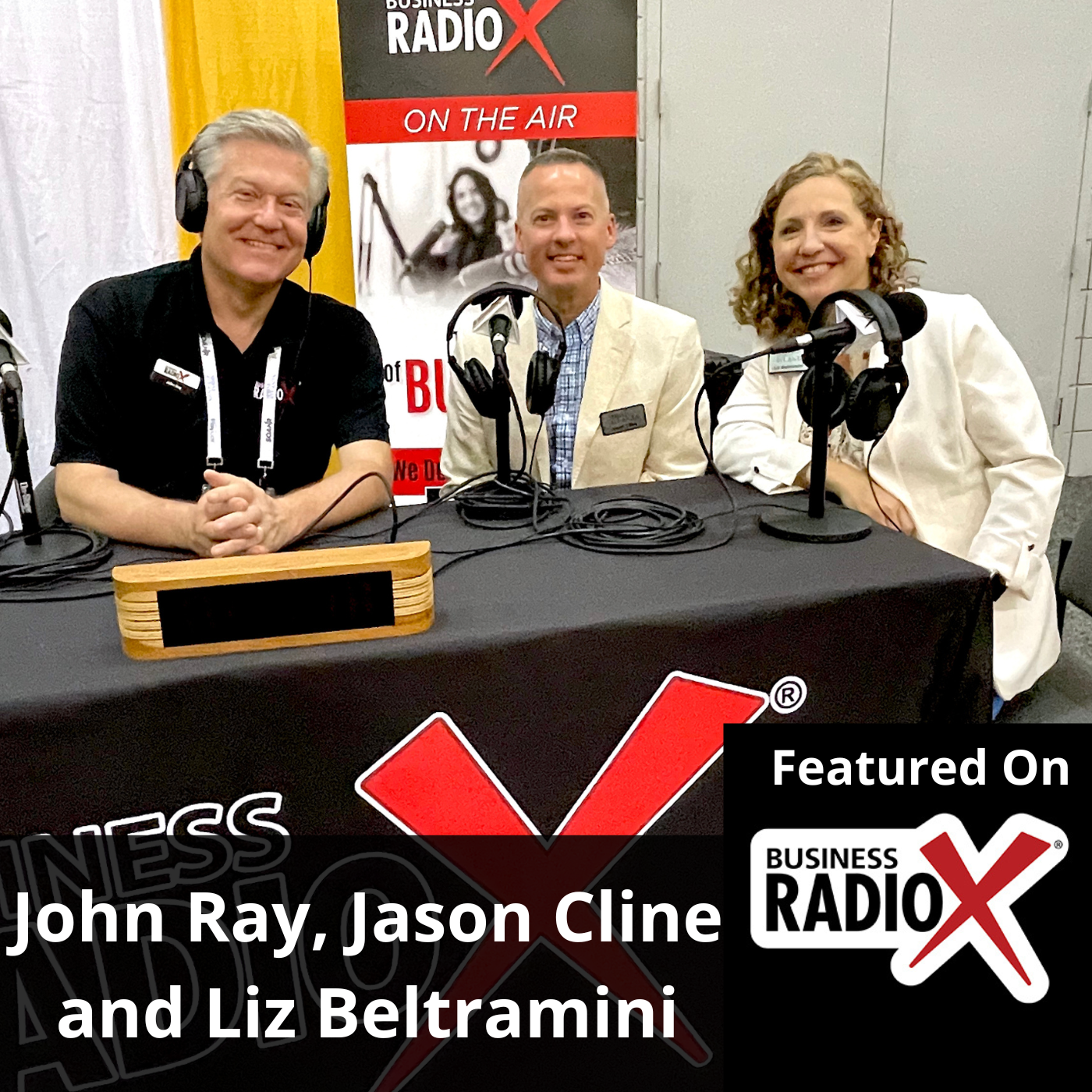
LIVE from SOAHR 2022: Jason Cline and Liz Beltramini, SHRM-Atlanta

July 28, 2022 by John Ray

SOAHR
North Fulton Business Radio
LIVE from SOAHR 2022: Jason Cline and Liz Beltramini, SHRM-Atlanta
Loading
00:00 /
RSS Feed
Share
Link
Embed

Download file

SOAHR

LIVE from SOAHR 2022: Jason Cline and Liz Beltramini, SHRM-Atlanta (North Fulton Business Radio, Episode 478)

SHRM-Atlanta’s Jason Cline and Liz Beltramini joined host John Ray live from SOAHR 2022 to sum up what proved to be a fantastic conference. Jason and Liz shared conference highlights, the enthusiasm of attendees, the collaboration and helpfulness SHRM-Atlanta chapter members offer each other, and more. They also announced that SOAHR 2023 will be held at the Gas South District in Duluth on March 28th-29th. Save the date!

This show was originally broadcast live from SOAHR 2022, the annual conference of SHRM-Atlanta, held at the Cobb Galleria Centre in Atlanta, Georgia on July 27th and 28th, 2022.

North Fulton Business Radio is broadcast from the North Fulton studio of Business RadioX® inside Renasant Bank in Alpharetta.

SHRM-Atlanta

SHRM-Atlanta is one of the largest chapters of SHRM and shares its purpose of elevating the HR profession. As a leader in the Atlanta metro business community, SHRM-Atlanta strives to be the premier resource for those working in and supporting the human resource function. SHRM-Atlanta’s predominant goal is to be the voice of HR in metro Atlanta and be the first contact for those seeking information and solutions.

This will be achieved through the growth and diversity of members, education, and delivery of content, and by strengthening partnerships with organizations that share its vision.

Website | LinkedIn | Facebook | Instagram 

Jason Cline, CAE, Chief Executive Director, SHRM-Atlanta

Jason Cline, CAE, Chief Executive Director, SHRM-Atlanta

Jason Cline brings over 18 years of association management and leadership experience to SHRM-Atlanta. Previously, Jason was the President & CEO of the Printing & Imaging Association of Georgia. There, Jason spearheaded the development and execution of a strategic plan and led a highly profitable insurance arm of the organization. Prior to that role, he was the Strategic Initiatives Executive at the Association of College Unions International, the Section Membership Development Manager at the American Bar Association, and he began his association career as the Director of Membership at the Roller Skating Association International.

Jason earned both his undergraduate degree in Elementary Education and a graduate certificate in Nonprofit Management from Indiana University. He also holds the Certified Association Executive (CAE) credential from ASAE: The Center for Association Leadership. Jason has called Atlanta home since 2016 when he moved here from Indianapolis.

LinkedIn

Liz Beltramini, Chief Content Officer & DEI Advisor, SHRM-Atlanta

Liz Beltramini, Chief Content Officer & DEI Advisor, SHRM-Atlanta

Elizabeth Beltramini leads SHRM-Atlanta in providing members with content they need to advance as HR professionals. In joining the team, Liz hopes to grow the Association’s efforts related to equity and inclusion. Previously, Liz was a director and senior diversity officer for the Association of College Unions International. She also served as a consultant and project manager for Atria association management services. During her 20 years working with associations, Liz has overseen conferences and events, publications, websites, assessment and research, marketing, and membership.

Liz has a bachelor’s degree in journalism from Indiana University, a certificate in diversity and inclusion management from Cornell University, and is a qualified administrator of the Intercultural Development Inventory.

LinkedIn

Questions and Topics in this Interview:

  • Highlights of SOAHR 2022
  • Remaining events for SHRM-Atlanta 2022
  • Looking ahead to SOAHR 2023

North Fulton Business Radio is hosted by John Ray and broadcast and produced from the North Fulton studio of Business RadioX® inside Renasant Bank in Alpharetta. You can find the full archive of shows by following this link. The show is available on all the major podcast apps, including Apple Podcasts, Spotify, Google, Amazon, iHeart Radio, Stitcher, TuneIn, and others.

RenasantBank


Renasant Bank has humble roots, starting in 1904 as a $100,000 bank in a Lee County, Mississippi, bakery. Since then, Renasant has grown to become one of the Southeast’s strongest financial institutions with over $13 billion in assets and more than 190 banking, lending, wealth management and financial services offices in Mississippi, Alabama, Tennessee, Georgia and Florida. All of Renasant’s success stems from each of their banker’s commitment to investing in their communities as a way of better understanding the people they serve. At Renasant Bank, they understand you because they work and live alongside you every day.


Special thanks to A&S Culinary Concepts for their support of this edition of North Fulton Business Radio. A&S Culinary Concepts, based in Johns Creek, is an award-winning culinary studio, celebrated for corporate catering, corporate team building, Big Green Egg Boot Camps, and private group events. They also provide oven-ready, cooked-from-scratch meals to go they call “Let Us Cook for You.” To see their menus and events, go to their website or call 678-336-9196.
Tagged With: HR, Human Resources, Jason Cline, Liz Beltramini, North Fulton Business Radio, renasant bank, SHRM Atlanta, SOAHR, SOAHR 2022

Workplace MVP LIVE from SHRM 2022: CJ Gross, Ascension Worldwide

July 7, 2022 by John Ray

CJ Gross
Minneapolis St. Paul Studio

Workplace MVP LIVE from SHRM 2022: CJ Gross, Ascension Worldwide
Loading
00:00 /
RSS Feed
Share
Link
Embed

Download file

CJ Gross

Workplace MVP LIVE from SHRM 2022: CJ Gross, Ascension Worldwide

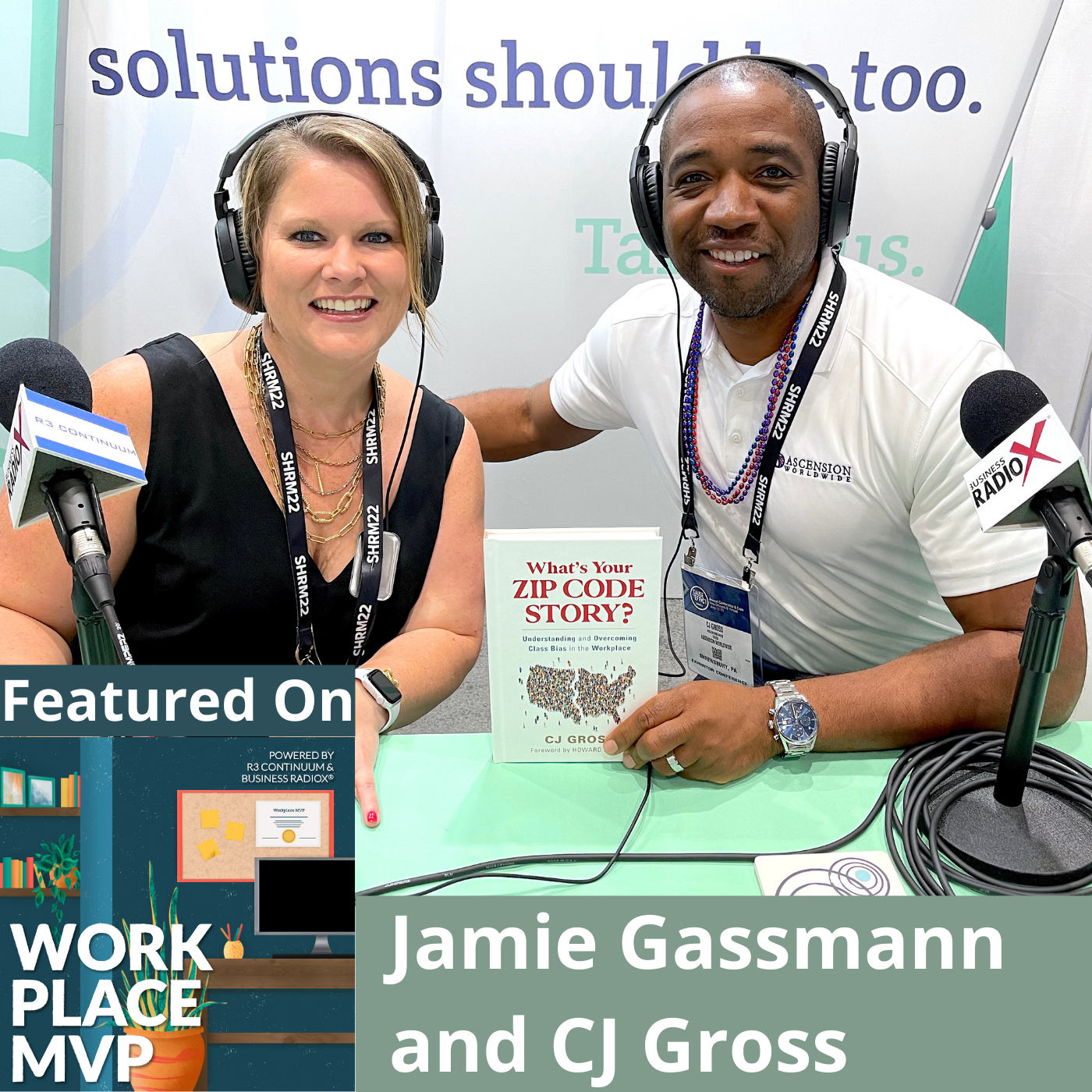
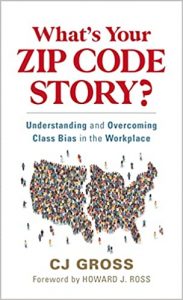
CJ Gross, Founder and CEO of Ascension Worldwide, is the author of the newly released book, What’s Your Zip Code Story? CJ joined host Jamie Gassmann live from SHRM 2022 and discussed the book’s focus on our own personal upbringing and the class biases that unfold from our individual experiences. They also covered his career journey, his presentation at SHRM in 2019, understanding others’ stories, the new sport he’s taken up, and much more.

Workplace MVP is underwritten and presented by R3 Continuum and produced by the Minneapolis-St.Paul Studio of Business RadioX®.

This show was originally broadcast live from the 2022 SHRM Annual Conference held at the New Orleans Convention Center in New Orleans, Louisiana.

Ascension Worldwide

Ascension Worldwide is a full-service minority-owned consulting firm committed to helping clients achieve workplace inclusion, employee and client diversity, and innovative growth opportunities beyond their imagination. We are a global company that utilizes Blue Ocean strategies, quantitative and qualitative analysis, internal analysis, master-minding, and other innovative techniques to support exponential growth in companies while providing specialized target business consulting services that bridge the gap in technology and human capital development.

​Ascension Worldwide provides an array of services, including talent management, leadership development, diversity, inclusion & equity consulting, strategic planning, process improvement, and other business management services.

Ascension Worldwide services clients from local and national non-profits, government agencies, as well as fortune 100 and 500 companies. We have experience in several industries including manufacturing, healthcare, construction management, engineering, law-enforcement, finance, education, insurance, retail, IT, and the military.

Company website | LinkedIn | Facebook |Twitter

CJ Gross, Founder and CEO, Ascension Worldwide

CJ Gross, Founder, Ascension Worldwide

Christopher “CJ” Gross is an international organizational development consultant specializing in leadership development and Diversity and Inclusion. CJ has 17 years of experience as a certified Social + Emotional Intelligence coach, trainer, Keirsey Temperament professional, and executive coach, with additional expertise in organizational mediation. He also serves as a Business Management, Adjunct Faculty for the Community College of Baltimore County. CJ possesses the unique ability to uncover and resolve social issues that hinder employee performance and efficiency.

CJ’s book, What’s Your Zip Code Story?, is now available and was born out of a Ted Talk you can find here.

CJ started his career as a mechanical designer at General Electric (GE) where he learned to lay out mechanical designs and run calculations. At GE, he learned how effective companies run and the importance of employee relationships to a company’s success. After receiving multiple corrective preventive idea awards for employee development, CJ merged his engineering skills with his innate understanding of people, offering professional coaching and staff development to companies in need of improved performance and effectiveness.

CJ cultivated his diversity and Inclusion acumen through an intense training and coaching program from Cook Ross, an internationally known diversity and Inclusion consulting firm. The program included key concepts from Daniel Kahneman’s book, Thinking Fast and Thinking Slow, brain science theory, and life-changing deep-dive identity coaching. In addition, CJ has worked with domestic and international leaders from fortune 500 companies, nonprofits, and government agencies on their diversity and Inclusion strategies and initiatives. This training and experience enable CJ to help clients explore impactful strategies for identity, diversity, inclusion, equity and access from a unique vantage point.

CJ received a B. A. degree in organizational management from Ashford University through the Forbes Entrepreneurship Scholarship.

CJ has consulted with domestic and international companies including the United States Postal Service, Toyota, Turner Construction Company, Oracle, Arent Fox D.C, Washington Post, D.C. Child and Family Services, Morgan Stanley, Loyola University, Howard University: School of Social Work, Maryland Association of Community Service, Primerica, Delta Sigma Theta Sorority, Inc., Maryland-National Capital Parks and Planning Commission, Maryland Department of Juvenile Services, the District of Columbia-Metropolitan Police Department, Penn State and others.
CJ has been featured in the Washington Post, the Washington Informer Newspaper, East of the River Newspaper, Diamonds Xcel Magazine, the Baltimore Examiner, and on the Tom Joyner Show, the Audrey Chapman Show, DCTV Cable, WPGC 95.5 FM, WOL 1450 AM, WUSA 9, WBAL-TV, and FOX45.

He has published three other books including How to Get a Job in 90 Days, Seeds of Greatness, and The Parent Connection. Most recently, he has co-written an article titled, Design Thinking + D&I=Innovation.

LinkedIn

About Workplace MVP

Every day, around the world, organizations of all sizes face disruptive events and situations. Within those workplaces are everyday heroes in human resources, risk management, security, business continuity, and the C-suite. They don’t call themselves heroes though. On the contrary, they simply show up every day, laboring for the well-being of employees in their care, readying the workplace for and planning responses to disruption. This show, Workplace MVP, confers on these heroes the designation they deserve, Workplace MVP (Most Valuable Professionals), and gives them the forum to tell their story. As you hear their experiences, you will learn first-hand, real-life approaches to readying the workplace, responses to crisis situations, and overcoming challenges of disruption. Visit our show archive here.

Workplace MVP Host Jamie Gassmann

Jamie Gassmann, Host, “Workplace MVP”

In addition to serving as the host to the Workplace MVP podcast, Jamie Gassmann is the Director of Marketing at R3 Continuum (R3c). Collectively, she has more than fourteen years of marketing experience. Across her tenure, she has experience working in and with various industries including banking, real estate, retail, crisis management, insurance, business continuity, and more. She holds a Bachelor of Science Degree in Mass Communications with special interest in Advertising and Public Relations and a Master of Business Administration from Paseka School of Business, Minnesota State University.

R3 Continuum

R3 Continuum is a global leader in workplace behavioral health and security solutions. R3c helps ensure the psychological and physical safety of organizations and their people in today’s ever-changing and often unpredictable world. Through their continuum of tailored solutions, including evaluations, crisis response, executive optimization, protective services, and more, they help organizations maintain and cultivate a workplace of wellbeing so that their people can thrive. Learn more about R3c at www.r3c.com.

Company website | LinkedIn | Facebook | Twitter

TRANSCRIPT

Intro: [00:00:03] Broadcasting live from SHRM 2022 at the New Orleans Convention Center, it’s time for Workplace MVP. Brought to you by R3 Continuum, a global leader in helping workplaces thrive during disruptive times. Now, here’s your host.

Jamie Gassmann: [00:00:20] Hi, everyone. Coming to you from SHRM 2022 Exhibit Hall, I am your host, Jamie Gassmann. And we are in our show sponsor’s booth, R3 Continuum. And joining me is CJ Gross from Ascension Worldwide. Welcome to the show, CJ.

CJ Gross: [00:00:35] Hey, Jamie. Thank you so much for having me. I’m very excited about today, really, at SHRM. It’s awesome kickoff here and I’m really excited about the book.

Jamie Gassmann: [00:00:44] Yeah. And I know you’ve got your book here. But before we dive into that, tell me a little bit about your background. Tell me a little bit about your journey so far in your HR career that led to you writing the book.

CJ Gross: [00:00:54] Yeah. Absolutely. So, I’m actually not in HR. My background is in engineering. And I worked for General Electric for about eight years, and I learned lots of information about how leadership happens in a healthy and productive way by things that didn’t happen and things that did happen while I was at General Electric.

CJ Gross: [00:01:17] From there, I moved into consulting work. I did leadership development for the last 20 years. And after a lot of work in diversity, equity, inclusion, I realized that it needed to be done differently. So, I actually brought my background in engineering as a different approach to talk about diversity, equity, and inclusion. Because people, really honestly, they’re tired of talking about it in the way that we’ve been talking about it. In some cases it’s very polarized and in other cases it’s exclusive to certain groups. And things don’t always change in organizations as we talk about these topics.

Jamie Gassmann: [00:01:54] Yeah. And so, you wrote a book and I know you have this book. It’s sold out of the SHRM Store.

CJ Gross: [00:02:01] Yeah. It sold out.

Jamie Gassmann: [00:02:01] What’s Your Zip Code Story?

CJ Gross: [00:02:03] In a few hours, it’s sold out.

Jamie Gassmann: [00:02:03] I know. You got to be absolutely so proud of that. That’s amazing. And I want to dive into hearing about the book. Because when we’re talking before we got on the microphone, it was just so interesting when you said you were covering some of the biases that this book kind of talks about. Let’s dive into it. Tell me a little bit about what is your book about. And what does an HR leader learn from this or a business leader? Because I think it could be really anybody that’s leading an organization. Let’s talk a little bit about what’s inside there.

CJ Gross: [00:02:32] Sure. So, the book is called What’s Your Zip Code Story? And that concept is about not just where you grew up, but how you grew up, the sights and sounds outside of your door, the conversations around the dinner table, the conversations with your parents. All those things influence and flavor the way you see the world and, ultimately, the way you build relationships in the workplace, mentorship, build teams, hire people, and really shapes the lens in which you see the world and how you connect to other people.

CJ Gross: [00:03:04] The second part of it is about class bias. So, they’re really connected there, the two components. Now, the class bias piece is something that we’re really not diving into in the diversity, equity, and inclusion conversation. So, that component came out of a presentation I did for SHRM 2019 Inclusion Conference. They put me on the very last day, the very last hour when people are leaving the conference. I was like, “No one’s going to show up.” And to my surprise, one person walked through the door. So, I was like, “Okay, I’m not alone.” And then, 60 other people walked through the door.

Jamie Gassmann: [00:03:40] Nice.

CJ Gross: [00:03:41] And not only did they stay, they wouldn’t leave. The tech person had to pull the microphone because people were staying in there, they were crying. They were weeping because they not experienced a place where they can share their own – what we call – your zip code story. And that’s really about your uniqueness and it goes beyond just your identity that we can see.

CJ Gross: [00:04:07] And so, this book really touches on those two components, your zip code story – what your background is, where you’re from – and also the eight class biases that we just talked about. And how does one expand their zip code story to mitigate those biases in the workplace.

Jamie Gassmann: [00:04:26] Yeah. So, fascinating. Because, really, we all have so many different experiences across our life from childhood on up. You know, I’m an army brat. When you look at me, you don’t know that I’m an army brat. You would never know that. But I tell you it – honestly, just sharing this as a conversation – one of the things that I hear is, “Was it hard to grow up moving a lot? That’s awful.” I’m like, “Really? That shaped who I am. That’s change management right there.”

CJ Gross: [00:04:53] It’s like a super power. It’s like a super power.

Jamie Gassmann: [00:04:53] Right. Yes. I’m like, “I actually thrive in that.” It’s actually a powerful thing. You know, you could look at it is a negative, but we never did. And so, it’s just interesting because when you think about that, everybody grows up a little different and you automatically draw an assumption about the person when you hear it.

CJ Gross: [00:05:12] The story.

Jamie Gassmann: [00:05:12] That’s so fascinating. So, how do you embrace those stories? How do you pull those stories out of your employees? Because, you know, as a leader, that can be challenging, right?

CJ Gross: [00:05:23] It is challenging across the board for all diversity conversations, not for every single person, but for many people. Because the first thing they think about is diversity, “If I’m not a part of a certain diverse culture or identity, then is this for me?” So, the first thing I tell the leaders is, “First, know your own zip code story.” It’s the first thing. Understanding your background and how that shapes the way you see the world, it’s the first thing.

CJ Gross: [00:05:49] The second thing is to share your background story, share your upbringing, share your experiences, and things that have made you who you are. And through that, you are then the leader which opens up the door for other people in different backgrounds to share their story. And then, you can lean into that story.

CJ Gross: [00:06:08] Honestly, you don’t even have to go down the road of talking about all the diversity conversations that we know. Not to say those aren’t important. But if you really want to create psychological safety, then you share your story. And you can also share the story about something about yourself that people wouldn’t know just by looking at you.

CJ Gross: [00:06:27] Because you may now be the leader sitting up high in the organization and people think, “Oh. They’ve been there. They had it easy. They’re privileged.” It’s what we hear a lot. It’s not to say that people are not privileged. But when people really know your story, you come down to earth, it’s more authentic. There is a bridge of connection there that allows people to connect with you in a different way.

CJ Gross: [00:06:49] And when you share your zip code story as a leader, you create this psychological safety which allows other people to lean in and share theirs. And it leads to better performance, lowers turnover, and you get more creativity out of those individuals, which ultimately lead to increased market share, which every company wants.

Jamie Gassmann: [00:07:12] Absolutely. Well, when I hear you talking, it makes me think you humanize yourself.

CJ Gross: [00:07:19] Yes.

Jamie Gassmann: [00:07:19] You’re a human just like your people. You give them an opportunity to relate with you at that human level.

CJ Gross: [00:07:25] It makes you relatable.

Jamie Gassmann: [00:07:27] And it allows you that opportunity, really, to be an authentic person, authentic leader. You know, at different episodes, we talk a lot about how do you create that opportunity of being vulnerable in front of your team or bringing your true self to work, that’s what I think about when I think about your book in this whole What is Your Zip Code Story? That’s amazing. Fascinating. So, if somebody wanted to get a copy of your book – I understand it’s on Amazon.

CJ Gross: [00:07:56] It’s on Amazon.

Jamie Gassmann: [00:07:57] But how do they get a copy of it now that it’s sold out at SHRM? You’ve got to let the rest of those that didn’t get to the bookstore fast enough know.

CJ Gross: [00:08:04] Well, don’t tell anyone, just between you and I, I had a private stash that I had in my book bag that I just took over there earlier before I came here. So, there’s probably about 20 books left now. So, we already sold out the first hundred in less than two hours. And now, we have, like, 20 something left, so that’s not going to last.

Jamie Gassmann: [00:08:27] So, anybody not getting it at SHRM who missed out –

CJ Gross: [00:08:32] They can go and find it on Amazon and everywhere else books are sold. And also the book, before we came a book – I was a about to say a Broadway play. But it wasn’t.

Jamie Gassmann: [00:08:40] It was a great play.

CJ Gross: [00:08:41] I know, right? It was an awesome play. What is Your Zip Code Story?

Jamie Gassmann: [00:08:43] I can see it. I think we could write the script right now.

CJ Gross: [00:08:46] But it was a TED Talk.

Jamie Gassmann: [00:08:46] So, you’re singing part to it?

CJ Gross: [00:08:48] Yeah. I wouldn’t do it. You wouldn’t want me to do it.

Jamie Gassmann: [00:08:50] You wouldn’t want me either. But a TED Talk, that’s really cool.

CJ Gross: [00:08:53] It turned into a TED Talk. And from the TED Talk, it turned into a book, and it just came out. And, actually, this is the third week that it’s been out. And next month, I’m actually doing a book talk and some work around this concept in England, London.

Jamie Gassmann: [00:09:13] Great. So, if they want to see the schedule for that book tour, so if we have any international listeners, where could they find all this great information?

CJ Gross: [00:09:20] So, the information for the UK is not on the website as of yet. It’s a good idea. I’ve been moving so fast. But they can go to either one of my websites which is, cjgrosstalks.com or ascensionworldwide.com.

Jamie Gassmann: [00:09:36] Wonderful. They’ll find you.

CJ Gross: [00:09:37] Type in CJ Gross, and I will pop up, you’ll find my LinkedIn. One of the things that I do that I want to mention about – well, it’s on LinkedIn – what makes this work for me unique is, as you look at me, I’m a person of color, I’m a male. But the zip code story, what people wouldn’t know, is that I do motocross.

Jamie Gassmann: [00:10:02] I love that. I should have asked you, what’s your zip code story?

CJ Gross: [00:10:06] It’s too much to talk about.

Jamie Gassmann: [00:10:07] I kept sitting here going, “What’s my zip code story?” Like, I’m listening to you going, “Gosh. You know, what would mine look like?” So, you do motocross?

CJ Gross: [00:10:14] I do motocross. I am learning Spanish, [Foreign language]. I am learning to surf. So, there’s so many things that I’m doing to expand my zip code. That’s what the book is also about, is expanding your zip code story around people, places, and things. I’ve taken up golf. I’ve joined the Rotary Club, I did a presentation there – was it last week or yesterday? I couldn’t remember. I’m so busy.

CJ Gross: [00:10:37] But the point is, when people read the book, yes, you should understand your zip code story. You should understand other people’s zip code story. But you should also expand your zip code story. Because from there, two things happen. One, you get to see what another person experiences. The other thing is you get to learn new cool things about yourself.

CJ Gross: [00:10:56] Like, I would have never thought I would have been into motocross. I do skeet shooting. I started swimming, so I scuba dive now. Like, all of this is within the last five years, though, and I won’t tell you how old I am. But most people would not expand their zip code because they think, “I’m too old. I’m too young.”

Jamie Gassmann: [00:11:13] You’re never too told.

CJ Gross: [00:11:15] “I’m this. I’m that.” But what this does is allows you a doorway to expand who you are. And, really, this is a new competency for the future of leadership. So, you can look diverse, but if you don’t have a mindset for diversity – traveling does that as well – you’re going to be out of a job. And it may not be today, but it will be tomorrow. And so, the goal is to expand your zip code story by doing different things and different experiences.

Jamie Gassmann: [00:11:44] I love that. And, honestly, travel can do that for you. And don’t just go to Senor Frogs. Like, seriously, go off the beaten path.

CJ Gross: [00:11:50] Go where?

Jamie Gassmann: [00:11:51] Don’t just go to Senor Frog’s if you’re in Mexico. Go to Napa, just the tourist traps. But really, really experience the culture of where you’re at and embrace it.

CJ Gross: [00:12:01] I want to tell you a quick story if we have time.

Jamie Gassmann: [00:12:03] We do. Absolutely. As much time as you want. We can talk here all day.

CJ Gross: [00:12:08] So, I went to Nicaragua. And in order to get to Nicaragua, I had to fly into Costa Rica. We’re at Costa Rica, we took a cab to the border. And from the border of Costa Rica, we had to walk – I don’t know – a-quarter-of-a-mile to Nicaragua. And on that passage, I had to show my passport, like, six or seven different times. And I remember coming back home and complaining. I was like, “You know I had to show my passport?” And then, we had to take a cab to the port. And at the port, we took a water taxi to an island. And then, I took another taxi.

CJ Gross: [00:12:54] So, not to mention all of those things, when people talk about, you know, inclusion or a privilege, you might say, “Oh. This is a person, a person of color, they don’t have privilege like other people.” But just having a U.S. passport is a privilege that people don’t think about. And when I gained that experience by actually putting myself in that situation and not really speaking the language – I only speak, like, 12 words of Spanish – but I was able to get around and get fed.

CJ Gross: [00:13:22] But the thing is, when I came back to the States and for my friends or colleagues who English is their second language, I had a whole nother appreciation for their experience. And it doesn’t mean I agree with everything that’s set out there in politics and all that, but what it means is that I can now have empathy.

CJ Gross: [00:13:41] You know, Brene Brown talks a lot about that, having empathy. I can now have empathy from someone who has a different culture and has a different passport. The same thing with women’s rights. You know, there’s lots of things that I learned about women that I had to be made aware of. For example, we asked people, “What’s the number one bias you have flying on an airplane?” And a lot of people say different things, we won’t go into that.

Jamie Gassmann: [00:14:07] I had to think about that.

CJ Gross: [00:14:10] Babies, number one.

Jamie Gassmann: [00:14:13] Sitting next to a crying baby?

CJ Gross: [00:14:15] Yes.

Jamie Gassmann: [00:14:15] Oh. See, I’m a mother. I get it.

CJ Gross: [00:14:18] Yeah. They have biases against other kids, but not theirs because they left their kids at home. But 25 percent of women said, “I want to sit next to someone who is the same gender.” And I made a comment that showed my awareness at the time. I said, “Whoa. What’s wrong with guys?” And they said, “Well, you’ve probably never been a woman on an airplane.” I was like, “You know I haven’t, right?” But women are assaulted at times on the airplane when they go to sleep or people bother. And I was like, “That’s never happened to me in that way because I’m not a woman.”

CJ Gross: [00:14:50] But hearing from women in that way created a greater empathy for their experience. So then, when you look at engineering, where I come from, where there are not a lot of women or people of color, when a woman says something, a person of color says something, I can relate with that. But, now, what it means to be the only woman in a male dominated environment opens my eyes because I’ve heard something. Or if I reverse engineer it, and I am the only.

CJ Gross: [00:15:17] So, being the only for a leader is important because if you’re trying to support someone – we always say this in our organization – you can’t take someone where you’re not willing to go yourself or you have never been yourself. So, if you’ve never been the only, if you haven’t interviewed people and understand what that’s like, it’s hard to empathize. And, although, we want to create pay equity and all those other initiatives, it’s going to fall short because people don’t have that experience.

Jamie Gassmann: [00:15:45] That’s so interesting. I would have never thought that on the airplane, and I travel quite a bit for work.

CJ Gross: [00:15:53] When you get on an airplane –

Jamie Gassmann: [00:15:54] I’m never going to get that thought out of my head now, CJ.

CJ Gross: [00:15:56] … you automatically assess people up and down and you create a story and you’re like, “Mm-hm. Not that guy. Not that woman.”

Jamie Gassmann: [00:16:03] You do. What they’re wearing. It might be what they’re looking like. I mean, if they look like they just rolled out of bed, and grabbed their pillow and their blankie, and brought it to the airport with them, I’m going, “Oh, boy.”

CJ Gross: [00:16:14] “I’m not going to sit next to them, they smell funny.”

Jamie Gassmann: [00:16:18] “They didn’t shower this morning, obviously. Like, I hope they’re not next to me.” And it was next to you, right? That’s so interesting. But we all do it. And you do it everywhere you go and everywhere you’re at, and you don’t even realize sometimes that you’re even doing it. That’s so interesting. Now, I’m going to be walking around going, “I wonder what their story is. What’s their zip code story?”

CJ Gross: [00:16:40] And that’s the hope for this book, is, it catches on and people go, “well, what’s their zip code story?” And they won’t just think about their brain is creating a story about them, but they actually lean in and lean past that bias conversation and say, “You know what? That person would never be good for this job because of this.”

CJ Gross: [00:17:02] Or here’s another one for women we hear is that, if you look like you’re of childbearing age – how does someone know? – people will not give you assignments that require travel. Because they’re thinking that, one, if you have kids, they’re thinking you may want to stay home with your kids. They didn’t ask.

Jamie Gassmann: [00:17:25] Do they do that to men?

CJ Gross: [00:17:30] No. That’s the zip code for it, because you don’t know that there are a lot of men that are actually playing the role. And so, just judging people in that way is exclusive. But, again, when we’re just talking about the normal topics of diversity, we’re missing out on a whole different conversation.

Jamie Gassmann: [00:17:50] So fascinating. Oh, my goodness. I think we’ll have to have another follow up on this. I think we could talk for hours on that.

CJ Gross: [00:17:56] Yeah. Maybe I’ll come back tomorrow or something.

Jamie Gassmann: [00:17:57] There we go. We’ll do two. Why not? It was a piggyback. We’ll talk about interviewing. Like, how do you use the zip code story in interview?

CJ Gross: [00:18:06] Stay tuned. We’ll talk tomorrow about it.

Jamie Gassmann: [00:18:07] Stay tuned. There we go. So, if you are interested in checking out CJ’s book, which I highly recommend because it sounds super interesting and I think it’d be very beneficial to any business leader or HR leader out there, What’s Your Zip Code Story?, definitely check out amazon.com. Very cool. Thanks so much, C.J. It’s been great talking with you.

CJ Gross: [00:18:31] Thank you. This has been awesome.

Outro: [00:18:31] Thank you for joining us on Workplace MVP. R3 Continuum is a proud sponsor of this show, and is delighted to celebrate most valuable professionals who work diligently to secure safe workplaces where employees can thrive.


Tagged With: Ascension Worldwide, CJ Gross, DEI, Diversity Equity and Inclusion, HR, Jamie Gassmann, R3 Continuum, SHRM 2022, What's Your Zip Code Story?, Workplace MVP

Workplace MVP LIVE from SHRM 2022: Brad Harper, Bambee

June 23, 2022 by John Ray

Bambee
Minneapolis St. Paul Studio
Workplace MVP LIVE from SHRM 2022: Brad Harper, Bambee
Loading
00:00 /
RSS Feed
Share
Link
Embed

Download file

Bambee

Workplace MVP LIVE from SHRM 2022: Brad Harper, Bambee

Brad Harper, an HR Business Partner with Bambee, joined host Jamie Gassmann in the R3 Continuum booth.  Brad shared how Bambee helps smaller companies manage their HR functions, what’s he is seeing from his clients, what he learned about empathy and accountability, and more.

Workplace MVP is underwritten and presented by R3 Continuum and produced by the Minneapolis-St.Paul Studio of Business RadioX®.

This show was originally broadcast live from the 2022 SHRM Annual Conference held at the New Orleans Convention Center in New Orleans, Louisiana.

Brad Harper, HR Business Partner, Bambee

Brad Harper, HR Business Partner, Bambee

With the help of your dedicated HR Manager, Bambee puts your HR on autopilot to streamline your HR, and automate your onboarding, policies, and even employee training.

Today, Bambee’s HR Autopilot keeps over 10,000 American Businesses HR compliant all year long, with up-to-date HR policies, mandatory training, and regular, two-way feedback between you and your employees.

  • HR rules change. Audits let you identify any HR gaps, and then we help you with an action plan to get your internal practices up-to-date to keep protecting your company and employees.
  • HR Autopilot makes sure all core, protective policies are current, signed by your employees, and reaffirmed semi-annually. Then, your dedicated HR Manager crafts any custom HR policies your business needs.
  • Bambee takes care of important and often-mandatory training like sexual harassment, workplace safety, and business ethics – and reports back to you on everyone’s progress.
  • Bambee’s Report Cards help you track your staff against their goals, and open up a regular dialogue to give praise, constructive feedback, or take corrective action.
  • Employee Voices lets your employees share concerns and alert you to potential problems. But it doesn’t have to be bad news – it’s also a great way for your staff to express gratitude, anonymously or publicly.
  • Comply with EEOC Document Retention Standards. Federal & state laws mandate that certain company files be held for a certain period of time. Plus, never guess who signed what – or where your important HR documents are. They’re all gathered safely in your Smart Cabinet.

Company website | LinkedIn


About Workplace MVP

Every day, around the world, organizations of all sizes face disruptive events and situations. Within those workplaces are everyday heroes in human resources, risk management, security, business continuity, and the C-suite. They don’t call themselves heroes though. On the contrary, they simply show up every day, laboring for the well-being of employees in their care, readying the workplace for and planning responses to disruption. This show, Workplace MVP, confers on these heroes the designation they deserve, Workplace MVP (Most Valuable Professionals), and gives them the forum to tell their story. As you hear their experiences, you will learn first-hand, real-life approaches to readying the workplace, responses to crisis situations, and overcoming challenges of disruption. Visit our show archive here.

Workplace MVP Host Jamie Gassmann

Jamie Gassmann, Host, “Workplace MVP”

In addition to serving as the host to the Workplace MVP podcast, Jamie Gassmann is the Director of Marketing at R3 Continuum (R3c). Collectively, she has more than fourteen years of marketing experience. Across her tenure, she has experience working in and with various industries including banking, real estate, retail, crisis management, insurance, business continuity, and more. She holds a Bachelor of Science Degree in Mass Communications with special interest in Advertising and Public Relations and a Master of Business Administration from Paseka School of Business, Minnesota State University.

R3 Continuum

R3 Continuum is a global leader in workplace behavioral health and security solutions. R3c helps ensure the psychological and physical safety of organizations and their people in today’s ever-changing and often unpredictable world. Through their continuum of tailored solutions, including evaluations, crisis response, executive optimization, protective services, and more, they help organizations maintain and cultivate a workplace of wellbeing so that their people can thrive. Learn more about R3c at www.r3c.com.

Company website | LinkedIn | Facebook | Twitter

TRANSCRIPT

Intro: [00:00:03] Broadcasting live from SHRM 2022 at the New Orleans Convention Center, it’s time for Workplace MVP. Brought to you by R3 Continuum, a global leader in helping workplaces thrive during disruptive times. Now, here’s your host.

Jamie Gassmann: [00:00:20] Hey, everyone. Your host, Jamie Gassmann. And I am coming to you from the SHRM 2022 Exhibit Hall in our show sponsor’s booth, R3 Continuum. And joining me is Brad Harper from Bambee.com. Welcome to the show, Brad.

Brad Harper: [00:00:35] Hey, Jamie. Thanks so much for having me.

Jamie Gassmann: [00:00:37] Yeah. It’s great to have you. I’m glad you stopped by. So, tell me a little bit about your background. I know you’re not an HR leader, but you do support a bunch of them. So, share with me a little bit about how you got into that industry and just kind of your career journey to this point.

Brad Harper: [00:00:50] Yeah. Sure. So, I’ve been in human resources for about 14 years, and I’ve recently joined on with a company named Bambee. They are a company headquartered out of downtown Los Angeles. And what they do is, is they support small businesses throughout the United States.

Brad Harper: [00:01:07] We saw a need for small businesses in the U.S. that can’t afford a dedicated HR manager. You know, on average a dedicated HR manager or internal, $80,000, $90,000 a year. And what we realized was, for those small businesses that had less than 100 employees, a lot of times those businesses don’t have a dedicated HR point person. But they still need to follow State and Federal Laws. They still need to provide a support system for employees.

Brad Harper: [00:01:42] And so, what we’ve done is, is we have designed a product. Bambee.com is a website. It’s a digital infrastructure for a lot of the HR policies, supplemental trainings, a lot of the things that a small business needs to succeed, all the tools and the resources. But in addition to that, on top of it, they get a dedicated HR manager.

Brad Harper: [00:02:06] And that dedicated HR manager provides risk mitigation. They provide guidance on how to navigate some of the very complex issues that come up. You know, when it comes to equal opportunity employment, when it comes to sexual harassment, a lot of those compliance areas that can be very sticky points that a lot of times small business owners, they don’t know how to navigate and handle that with their employees. So, that is what Bambee provides. It’s been a great learning opportunity for me and I’m thrilled to be with the company.

Jamie Gassmann: [00:02:43] Yeah, no. I think it sounds like a great site and a great product because, to your point, they all have to still follow the same guidelines. But not only that, employees are still looking for the same things from their employer, whether they’re small or they’re large.

Jamie Gassmann: [00:02:58] So, talk to me a little bit about some of the areas. I know you mentioned that mental health is a really important area for you. What are some of the support areas that you cover within a mental health space?

Brad Harper: [00:03:07] Sure. So, what I’ve noticed recently is, you know, we’re kind of coming out of COVID. There’s a feeling that a lot of people have this post-pandemic fatigue. And so, morale continues to be, like, such a big conversation starter for a lot of the clients that we serve at Bambee. You know, there’s a lot of areas where employees have fatigue. They need to kind of be reignited from a passion standpoint, from a standpoint of getting them back up and going again.

Brad Harper: [00:03:44] So, what we’re noticing is clients, a lot of employers, feeling fatigue. Fatigue is something that comes up quite often and they’re struggling with that. And we certainly do provide a lot of services, not only from a policy standpoint when it comes to compliance, but also from a training.

Brad Harper: [00:04:04] Our company has a database of over 700 different trainings that are catalogued, so a lot of them are very specific kind of compliance or hard skills. But we’ve also got a lot of soft skills, a lot of things that, you know, you learn over your career over time on how to be a better communicator, how to engage. So, that’s something that we are noticing a common thread with right now kind of coming out of post-pandemic.

Jamie Gassmann: [00:04:34] Yeah. Absolutely. I’ve heard that in other areas, too, and kind of that ongoing stress and burnout that employees are facing still trying to balance some of the impacts from the COVID pandemic.

Jamie Gassmann: [00:04:46] Now, I understand this is your first time at SHRM, so what are you excited about here to take away with you? You know, what is kind of one of your main motivators for coming to the show this year?

Brad Harper: [00:04:56] Yes. So, I would say that one of the things that has always solidified me as an HR professional is empathy. You know, people are exhausted. People are tired. People are drained. In HR, and even outside of HR, it’s a common thread. It’s something that regardless of where I’m at, if I’m on an airplane, if I’m at Starbucks standing in line waiting to grab an Americano, a constant thing that I’m discussing with strangers is people are just exhausted. And the one thing that I’m looking for out of SHRM is I’m looking how to reignite the area that I’ve always deemed as my strength, and that is empathy.

Brad Harper: [00:05:49] You know, I’ve been officing from home for the past two, two-and-a-half years, so I’ve been doing a lot of remote work. But we have integrated back into our downtown corporate headquarters. And I think a lot of people are feeling sluggish. I think there’s burnout. I think it’s real. I think it’s valid. And I think unless companies can truly say that it’s real, you’re never going to be able to move past the problem.

Brad Harper: [00:06:23] I’m one of those HR managers that I want to get to the root cause. I want to really identify what is the main issue, what is the problem. Because, you know, in order to kind of move forward in identifying what kind of solutions are you going to create, unless you’re being really honest about the problems that lie ahead of you, you will never create the correct solutions. And so, that’s really something I’m looking forward to.

Brad Harper: [00:06:46] I can tell you, today I attended my first session and it was around empathy and accountability, and how do you balance the two of those things, how do you do a dance. You know, accountability is this, like, hard line measurable where you’re trying to achieve results and you’ve really got to get in there and deliver numbers. But empathy is this soft skill, this soft piece that you really do need in order to balance the two of those things.

Brad Harper: [00:07:19] And I think that a lot of companies can really learn from taking a more empathetic approach in the next six months, even to the next year, on how do you attract talent, how do you retain talent, how do you keep talent, how do you promote talent, how do you promote internally. I believe that the companies in the United States that are going to use empathy as the core of everything that they do in the next 12 months are going to be the most successful companies moving forward.

Jamie Gassmann: [00:07:52] Yeah. That is such a powerful thought. I love that. And, you know, it’s kind of a new normal in this workplace. Employees, they’re needing things a little differently than what they’ve gotten before. So, that’s amazing. Great information. I love it.

Jamie Gassmann: [00:08:07] So, thank you so much for joining us. Again, if you’re interested in learning a little bit more, go to bambee.com, B-A-M-B-E-E.com. And the lucky ones will get Brad Harper as their HR manager. I love it. Thank you so much for joining us.

Brad Harper: [00:08:22] That’s so nice of you to say. I really appreciate it. I’ve really enjoyed my time with you today. Thank you.

Jamie Gassmann: [00:08:25] You’re very welcome. Thank you again.

Outro: [00:08:31] Thank you for joining us on Workplace MVP. R3 Continuum is a proud sponsor of this show, and is delighted to celebrate most valuable professionals who work diligently to secure safe workplaces where employees can thrive.


Tagged With: Bambee, Brad Harper, HR, HR Autopilot, HR services, Jamie Gassmann, New Orleans, R3 Continuum, SHRM 2022, Workplace MVP

Workplace MVP: Amy Zimmerman, Relay Payments

March 17, 2022 by John Ray

Amy Zimmerman
Minneapolis St. Paul Studio
Workplace MVP: Amy Zimmerman, Relay Payments
Loading
00:00 /
RSS Feed
Share
Link
Embed

Download file

Amy Zimmerman

Workplace MVP: Amy Zimmerman, Relay Payments

In a wide-ranging conversation, Amy Zimmerman, Chief People Officer at Relay Payments, and host Jamie Gassmann discussed best practices for retaining talent. They covered incentives, rewards, and recognition, the need for companies to keep abreast of market conditions, the value of stay interviews and what happens when they go wrong, talent retention methods which go beyond compensation, and much more.

During the show, Amy referenced a recent interview she gave on stay interviews. You can find that interview by following this link.

Workplace MVP is underwritten and presented by R3 Continuum and produced by the Minneapolis-St.Paul Studio of Business RadioX®.

Relay Payments

After years of gaining a profound understanding of the ingrained payment problems in the logistics industry, co-founders Ryan Droege (CEO) and Spencer Barkoff (President) ultimately shared the vision of building the supply chain and logistics digital payment network of the future.

Now, Relay is a fast-growing, venture-backed fintech company, which raised $100 million in investment funding to fully support the goal of spearheading the industry transformation to digital, contactless payments, ensuring America continues to run during COVID-19 and well beyond.

As a result of the immense expansion, Relay has grown exponentially, boasting a workforce of 100+ across 12 states; all focused on building a customer experience unlike any other while modernizing age-old payment processes in the supply chain industry.

Relay’s customer-centric approach has entrusted the company to process more than 250,000 transactions every month, working with the largest carriers, freight brokers, and 3PLs across 50 US states and Canada, ensuring their products get to shelves quickly for consumer consumption.

Company website | LinkedIn | Facebook | YouTube

Amy Zimmerman, Chief People Officer, Relay Payments

Amy Zimmerman, Chief People Officer, Relay Payments

Amy joined Relay Payments in 2020 to support their explosive growth plans. She was hired to establish their people function and build it from the ground up. During this time, they have grown from fewer than 10 team members to over 120 globally. Relay Payments is a mission-driven, Series C, venture-backed start-up in the fintech space, headquartered in Atlanta, GA. They are building a contactless payment network in the transportation and logistics industry.

Amy co-founded PeopleCo. to be a strategic partner for founders and a growth catalyst for companies on the rise. Central to her work, of course, is the development and nurturing of a company’s culture. Whether the focus is on foundational elements, like defining core values and communication practices or developing more mature programs to support organizational effectiveness like performance development and engagement initiatives, it’s all in service to ensure that the culture is intentional and aligned with the company’s growth objectives and financial goals.

In her previous life, as chief people officer for Kabbage (recently acquired by American Express), Amy was responsible for building the company’s award-winning culture, driving engagement, and guiding all people strategy initiatives. She oversaw the integration of M+A teams to build and grow capabilities across a diversity of cultures and geographies. Before that, she worked for VSI as a recruiter, people leader, and culture ambassador prior to their acquisition by TransUnion.

She graduated from the University of South Florida with a completely irrelevant degree in Criminology.

LinkedIn

About Workplace MVP

Every day, around the world, organizations of all sizes face disruptive events and situations. Within those workplaces are everyday heroes in human resources, risk management, security, business continuity, and the C-suite. They don’t call themselves heroes though. On the contrary, they simply show up every day, laboring for the well-being of employees in their care, readying the workplace for and planning responses to disruption. This show, Workplace MVP, confers on these heroes the designation they deserve, Workplace MVP (Most Valuable Professionals), and gives them the forum to tell their story. As you hear their experiences, you will learn first-hand, real-life approaches to readying the workplace, responses to crisis situations, and overcoming challenges of disruption. Visit our show archive here.

Workplace MVP Host Jamie Gassmann

Jamie Gassmann, Host, “Workplace MVP”

In addition to serving as the host to the Workplace MVP podcast, Jamie Gassmann is the Director of Marketing at R3 Continuum (R3c). Collectively, she has more than fourteen years of marketing experience. Across her tenure, she has experience working in and with various industries including banking, real estate, retail, crisis management, insurance, business continuity, and more. She holds a Bachelor of Science Degree in Mass Communications with special interest in Advertising and Public Relations and a Master of Business Administration from Paseka School of Business, Minnesota State University.

TRANSCRIPT

Intro: [00:00:03] Broadcasting from the Business RadioX Studios, it’s time for Workplace MVP. Workplace MVP is brought to you by R3 Continuum, a global leader in workplace behavioral health and security solutions. Now, here’s your host, Jamie Gassmann.

Jamie Gassmann: [00:00:25] Hi, everyone. Your host, Jamie Gassmann here, and welcome to this episode of Workplace MVP. This last year brought on an additional challenge for workplace leadership with what some experts are referring to as The Great Resignation or The Great Reshuffle.

Jamie Gassmann: [00:00:41] Turnover in 2021 was 12.2 percent higher than pre-pandemic turnover rates across all industries in the U.S., according to the U.S. Bureau of Labor Statistics. There are varying opinions as to why employees were leaving their current employers over this last year and what some believe will continue into this year. Some feel it was as a result of employees realizing a need for better work-life balance and improved work environment or culture.

Jamie Gassmann: [00:01:11] Employees seeking a remote or hybrid work option, better pay. And some feel it may have just been as a result of people who were already looking to make a change but held off during the volatile times in 2020. And there are, of course, others from both a professional and personal reasoning that drive employees to make career changes.

Jamie Gassmann: [00:01:33] The concern for employers with the increase in resignations and employee movement to other organizations is the cost that turnover can have on the organization. At an average, for every salaried employee who leaves an organization, it can cost the company six to nine months of the employee salary to replace them.

Jamie Gassmann: [00:01:52] But not all turnover is bad. Sometimes it is better for the organization and the individual. But for those employees you want to keep, how do you create an environment that aids in your ability to retain them?

Jamie Gassmann: [00:02:04] Well, joining us today to share her best practice approaches to retaining talent is Workplace MVP and Chief People Officer at Relay Payments, Amy Zimmerman. Welcome to the show, Amy.

Amy Zimmerman: [00:02:15] Thanks, Jamie. I’m glad to be here.

Jamie Gassmann: [00:02:17] So, share with us your career journey to becoming the Chief Police – Chief People Officer at Relay Payments.

Amy Zimmerman: [00:02:25] Thankfully, I actually don’t feel like the Chief Police Officer at Relay. Long story short, I started my career post-college as a substance abuse counselor, which is probably a bizarre journey to where I landed. But as a social worker at heart, I think it shaped in every way the type of people leader that I’ve become.

Amy Zimmerman: [00:02:58] Ultimately, early on, I was a recruiter, and would still say that I identify as a recruiter in so many different ways. But started with a tech company in Atlanta in 1999. I probably just aged myself a lot. The company was eventually acquired by TransUnion. And I stayed on with TransUnion for a couple years as part of the agreement. But certainly learned very quickly that I’m a startup person through and through, and so left and did some consulting after my oldest daughter was born.

Amy Zimmerman: [00:03:35] And then, wound up connecting with Kabbage as a client of mine for quite a while. I actually helped them hire their first team member after they were funded. And eventually joined them full time and was with them pretty much the entire ten year journey to acquisition by American Express in October of 2020.

Amy Zimmerman: [00:03:58] I started consulting again and was introduced to the founders at Relay. And despite not being interested initially in being a full-time team member again, I quickly realized that it was a no-brainer our values aligned in every possible way. And if I was going to do this one more time, I’ve been part of two acquisitions at this point, I figured the third one, I’d go out with a bang.

Amy Zimmerman: [00:04:27] So, I’m at Relay Payments now and started with the founders when they were single digit team member numbers about a-year-and-a-half ago, fractionally. And we’re over 140 team members now and will likely be somewhere around 300 by end of year. So, giant growth plans and an exciting kind of road ahead with these guys.

Jamie Gassmann: [00:04:51] Wow. Very exciting. Can you tell us a little bit more about what Relay Payments does?

Amy Zimmerman: [00:04:57] I can. Imagine, we’re basically like the Venmo in the logistics industry. So, we’re modernizing payments for an industry that’s been ignored for a good while. I would say many of the ways payments is done in logistics and trucking, specifically, is very archaic. There’s lots of paper involved, which certainly leads to fraud, and leads to lost receipts, and lots of wasted time. And so, we’re creating solutions that modernize a very old practice. And as a result, save money in time for the really, really important people who are moving goods throughout the country.

Jamie Gassmann: [00:05:44] Wow. So, from your perspective, why do you think we’ve seen so much turnover in the last year across various industries with having employees leaving their employers?

Amy Zimmerman: [00:05:57] You know, I think a couple of things. You touched on some of them, certainly, and that’s, I think, there was a buildup. I think 2020 was so uncertain that some of the natural attrition that would have happened was delayed. And so, I think the uptick in 2021, for a lot of reasons, made sense. I think the complexity or the piece that probably was a little different or not COVID related necessarily was the fact that people realized that some companies were offering an enormous amount of flexibility and also care.

Amy Zimmerman: [00:06:40] You know, people were burning out. There was this confusion between work-life balance and work-life integration. When does work start? When does it stop? Does it stop? Is it fully integrated? Is there this expectation now that I work all day and all night? Maybe not even imposed by the employer, but self-imposed, because there was some confusion as individual team members about kind of boundaries, et cetera. And so, I think there were a lot of things, but I think a lot of companies got it right and a lot of companies got it wrong.

Amy Zimmerman: [00:07:13] And so, people were sharing stories with friends. I think there was more opportunity. A lot of companies decided that they weren’t confined by their geography, and so they were opening opportunities up to people in other states and other locations. And so, I think the opportunistic reasons that people left probably increased dramatically, in addition to the fact that people from 2020 that hadn’t already started contemplating a move decided to.

Amy Zimmerman: [00:07:49] And the part about companies not getting it right was some companies just didn’t do a good job of investing in their people and staying connected to their people while they were gone. Rewards and recognition, I think, is a giant way you do that, and we can talk more about that. But I don’t think a lot of the companies got that right. And so, there were just a number of reasons why people decided it was time to consider something new.

Jamie Gassmann: [00:08:16] Yeah. So, we’re going to talk a little bit this kind of first part of the show just discussing a little bit of the impact that this has on organizations when you’re having that turnover. So, looking at retention and turnover, what is that impact on the organization from your perspective of both of those?

Amy Zimmerman: [00:08:38] I think aside from the financial cost, which you referenced as potentially six to nine months of somebody’s salary, which is huge, there’s a loss of knowledge that walks out the door that can be hugely impactful, not only on the organization from an expertise and bench strength perspective, but also on the team members.

Amy Zimmerman: [00:09:01] You know, if the person that knows the most is leaving, then (A) We all have to step up in a way that maybe we didn’t have to before. (B) There’s a learning curve that we now need to navigate or figure out. And (C) If I’m the person who knew as much as the person leaving or say the second most, now, suddenly, there’s a burden. I’m feeling all of the pressure to be the subject matter expert on the team or at the company in a way that is imposing. Because I already had a full-time job, potentially, and now, suddenly, everybody’s looking to me to lean on and leverage because some of the other expertise walked out the door.

Amy Zimmerman: [00:09:42] And so, I think there’s obvious impact financially to the bottom line. But I think there’s more subtle impacts to morale and to people that are affected and caught up in some of that, that is harder to quantify, but super damaging, potentially nonetheless.

Jamie Gassmann: [00:10:01] Yeah. And that definitely leads into my next question in regards to, obviously, you can quantify those hard costs. You can put dollar signs to it. But what you can’t put dollar signs to is the soft costs around what happens to your people. And so, let’s kind of dive into that a little bit in terms of, like, the mental health impact or, to your point, the pressure, particularly in situations where maybe that person is trying to step up and maybe not getting noticed. Like, some of that impact that kind of ripple effects that happens from those situations. Can you share a little bit of your thoughts around that?

Amy Zimmerman: [00:10:37] Yeah. I think that’s probably one of the biggest opportunities for an employer to really double down. And when you think about losing somebody that could be material to the business for a number of reasons, sometimes that has a ripple effect. And people start thinking, “Ay yay yay. If that person left, what do they know that I either don’t know? Or they know something I also know, they had the nerve to leave, maybe I should do the same.”

Amy Zimmerman: [00:11:07] And so, in my mind, what an employer should do at that point is really, really double down. First of all, you can start doing stay interviews with some of the more key folks that you’d be in really big trouble if you lost. And, essentially, that’s a conversation where you get vulnerable. You ask, What do you love about this place? What should we do more of? And where are the gaps? What are our opportunities? If you were to leave, help me understand why so that I can try and solve some of those issues, or address some of those issues ahead of it getting you to a point where you’re potentially going to walk out as a result?

Amy Zimmerman: [00:11:50] The other thing is rewards and recognition. If people are working really hard, they want to be recognized for it. I think, you know, a lot of times people think, “Well, that’s what we’re paying them for.” They are being recognized for it. They get a paycheck every two weeks. I would say that’s pretty old school thinking. Companies that are doing the best work at retaining their folks show an enormous amount of appreciation.

Amy Zimmerman: [00:12:16] And so, one of the ways that you show appreciation is through rewards and recognition. And, certainly, there’s a cost associated, but the cost is small. I mean, $100 gift card or a dinner. Public recognition, it really goes a long way. And in many ways, it’s actually more impactful, in my experience, than giving somebody a raise. But giving somebody a raise can be a lot more expensive, but it’s typically private. That’s between you and the team member, and so there’s no public recognition.

Amy Zimmerman: [00:12:47] But when you celebrate somebody’s success, whether it’s a product launch, or whether it’s a customer win, or whether it’s some sort of accomplish toward the company’s goals, the entire company or department or team is actually celebrating. And so, that recognition has a ripple effect well beyond the moment of the discussion or the moment of the acknowledgement. And so, it’s really, really crucial that managers, and owners, and founders recognize the value and the impact of their team members and that they show appreciation for that, and that shows up in any number of ways.

Jamie Gassmann: [00:13:26] They can get really creative in some of those rewards and recognitions as well. So, where do employers go wrong when they’re trying to retain their employees? What are some of the taboo, if you will, things that employers do where you go, “No, no, no. Don’t do that”?

Amy Zimmerman: [00:13:44] So, there’s a couple of things. I will never discourage giving somebody a raise because, you know, money talks. No doubt, at the end of the day, everybody shows up at their job and, ultimately, they’re looking to earn a living to support their lifestyle, their family, et cetera. But it’s not all about money, and there’s a lot of research and a lot of data that proves it.

Amy Zimmerman: [00:14:06] But what a lot of times people do because they don’t know really how to do the softer stuff is they say, “All right. I’m going to throw some money at the person and I’m going to assume that’s going to solve all the problems.” And I can tell you that’s only a Band-Aid. And that is probably the biggest – I was going to say misconception or how much of a misconception it is. But if you think throwing money at somebody is the only way to solve a problem, I think you’re going to be really disappointed in three months when they leave anyway.

Amy Zimmerman: [00:14:38] Because what ultimately will happen is they’ll find somebody else willing to pay them what you’re paying them or more, and they’ll have a clean slate. So, they won’t have the baggage. They won’t have the burdens. They won’t have, potentially, the drama. Whatever it is that has created a negative experience, they’ll literally get to walk away from with a clean slate, in many instances, for more money. Minimally for the same money. And most people aren’t leaving for the same money. They’re leaving for more.

Amy Zimmerman: [00:15:08] But it really isn’t just about the money. It’s really to escape whatever the root cause is that’s creating the issue for the person in the first place.

Jamie Gassmann: [00:15:19] Like, when you think of an employee putting in their notice, is that the time that you offer the money? Or do you be a little bit more proactive prior to that? So, share with me a little bit of your thoughts on that because I’ve heard that throughout my career, and it’s awful. Somebody, when we’re trying to get them to stay, we threw a promotion their way or an extra money their way. You know, it sounds, to me, from some of your comments that that’s just kind of putting, to your point, a Band-Aid on it. And it’s probably not a waterproof Band-Aid, which means it’s going to fall off in a little bit.

Amy Zimmerman: [00:15:54] For sure. And the truth is, it’s too late. Most people understand that accepting a counter is a big mistake because the problems are never resolved. If you were so dissatisfied that you went through an interview process, got another job, and actually resigned, it’s too late.

Amy Zimmerman: [00:16:16] My advice to team members is, if you really want to stay, don’t stick around for a counter. Try and solve the problem before you start interviewing elsewhere. As the employer, if you want to keep somebody, make sure you understand market, make sure you’re paying your team members competitively. You’re not waiting for them to get a competitive offer. You’re actually paying them competitively because it’s the right thing to do for their skills, for their contributions compared to market, et cetera.

Amy Zimmerman: [00:16:43] We do market assessments a couple of times a year. It’s easy to get out of whack when somebody who’s been at the company for a while because, typically, people get raises when they leave. And so, if you’re somebody that’s been at a company for three or four or five years, you’ve potentially missed out on opportunities to get bumps to your salary unless your company is staying on top of how the shift in your comp should be happening.

Amy Zimmerman: [00:17:08] And it’s not three to four percent a year, which might be a fine raise in a customary situation or a traditional situation. But it’s not going to keep you up to market standards if that’s all you’re getting. And so, as the team member, as the consumer, you should also be aware of your value and your worth and having conversations proactively with your manager. Like, “Hey, I’m in this role, this is the value that I add. Market says I should be making X, but I’m only actually making Y. Can we talk about the disconnect?” Because that’s one way you can ensure that you’re going to retain strong contributors, but it’s got to be fair on both sides.

Jamie Gassmann: [00:17:53] And employees should be, you know, comfortable making some of those conversations. It’s okay to bring that up. You may not get what you’re looking for, but being comfortable in having a transparent kind of relationship where you can share that information openly. So, thinking of that, if they’ve got this employee who’s feeling undervalued or isn’t getting something – because I agree, it’s not always about money – how can an employer get that understanding from their employees before it gets to that point where they’re seeking other options?

Amy Zimmerman: [00:18:30] I’ve actually talked a good bit lately about this concept of stay interviews, and it’s essentially the opposite. If you think about when somebody resigns and they’re leaving, it’s pretty customary that companies run an exit interview. You know, what could we have done differently? And what was the ultimate decision that drove your exit, et cetera?

Amy Zimmerman: [00:18:52] So, turn that around. Have that conversation a couple of times a year. If you’re an effective leader anyway, you’re having regular one on ones with your people, you’ve got a relationship, you’ve established a rapport, throw in. And you can Google good questions for stay interview. I mean, there’s just a ton of writing. I’ve written some stuff on it. A lot of people have. And get a list of questions so that you’re not going at it blind.

Amy Zimmerman: [00:19:18] But, ultimately, you’re asking people, what is it that makes them tick? What is it that they need in their career, or in their role, or with the company that brings them joy? How do they feel excited about waking up on Monday?

Amy Zimmerman: [00:19:34] You want your team members to wake up on Monday excited to tackle a new week. Not dreading a new week. If they wake up on Monday and they dread going to work, they’re only going to do that so many times before they decide it’s time to look for something new. And so, if you conduct a stay interview with them ahead of a departure decision, you potentially will retain them. And in the process, you might even retain others, because a lot of times they’re raising issues that other people are feeling and, potentially, just not as brave to bring up.

Jamie Gassmann: [00:20:08] And the stay interview is kind of a newer concept that I’ve heard the terminology for, but there’s been other types with the Traction 555 meetings is a similar concept to that. What’s so powerful about those is, you learn so much about what drives your employee when you’re doing those types of meetings. I mean, you really can get to, kind of what you’re mentioning, what makes them tick, what their career aspirations are, what do they enjoy doing, what would they like to do more of.

Jamie Gassmann: [00:20:42] And it’s really fun, especially if you have new projects that come up, you know who you can assign it to because you’ve got somebody who’s already expressed that interest and you know them better. And I think through that, you just get to know each other better. So, it’s really kind of just a great leadership technique and approach to do as well.

Jamie Gassmann: [00:21:01] But what are some other ways that an employer can help to improve retention? Is there cultural things? What are some other ways that an employer can look to improve retention that maybe is broader, not just with the individual employee, but maybe the employee group?

Amy Zimmerman: [00:21:19] For sure. So, a couple of things. I think really building a strong community where people feel like they belong is a huge thing. If you wake up every day and you’re going to work and you’re part of this really awesome community, and you understand the mission of the company, and you’re excited, and you’re inspired by the mission, that’s a huge way to keep people excited about the work they’re doing and, ultimately, staying on the team.

Amy Zimmerman: [00:21:46] I touched on the idea of rewards and recognition, but people want public recognition, most people do. That’s not to say everybody does. But most people want shout outs. It doesn’t cost anything to give people a shout out when they just knock it out of the park. “Oh, you were instrumental in this new product release. I also noticed you worked round the clock for four days or four weeks to get something out the door, what an amazing, heroic contribution. Also, you missed dinner with your spouse or your kids, how about a $100 gift card so that you can make up that dinner on the company, since the company was responsible for the dinners that you missed while you were in the critical path on this project?”

Amy Zimmerman: [00:22:33] So, there’s free ways to recognize people. There’s inexpensive ways to recognize people. There’s so many different things that you can do from a culture perspective to create a community that people are excited to be a part of, and that will, ultimately, keep people at the company rather than contemplating the grass being greener somewhere else.

Jamie Gassmann: [00:22:55] Great points. Love that. So, we’re going to take a quick moment to hear from our sponsor. So, Workplace MVP is sponsored by R3 Continuum. R3 Continuum is a global leader in empowering leaders to effectively support and help their employees thrive during disruptive times. Through their tailored workplace, behavioral health support, disruption, response and recovery, and violence mitigation solutions, they can help you create a work environment where your employees can feel psychologically and physically safe. To learn more, visit our r3c.com today.

Jamie Gassmann: [00:23:29] So, we’ve talked a little bit about the stay interviews, so I’m going to keep moving here. So, quick question, and we talked about the positive sides of the stay interviews. How can they go wrong? How can they fall apart on the employer? How can, like, what was really well-intended, just go wah-wah?

Amy Zimmerman: [00:23:53] It’s a really great point. And they absolutely can. And I’ll tell you how and that’s, don’t ask people for feedback if you’re not willing to act on it. And that doesn’t mean you have to act on everything. You should acknowledge it. And if you’re not going to act on something, have a dialogue, be transparent about what it is that you’re doing and why, and why what they’re asking for may not make sense for the company or for the team.

Amy Zimmerman: [00:24:20] But if you ask, call it, eight questions, and you have an excuse for why you’re not willing to do anything, it will likely go wrong. Because now I’m a team member who felt supported and cared for. You engaged in an hour long conversation or a 45 minute long conversation. You seemed like you cared about my input. You ultimately acted on none of it. And so, what message did you send to me as a team member? You really don’t care. It was lip service.

Amy Zimmerman: [00:24:52] You know, it’s similar to an engagement survey. When you ask a series of questions, whether it be in a survey or whether it be in person, to your company or to your department or to your team, and, ultimately, take no action, I think you’re sending the wrong message and you would have been better served to not even put yourself out there and pretended to care about the feedback or to care about making any changes.

Jamie Gassmann: [00:25:17] Yeah. I mean, even if you just acknowledge like, “I heard what you were referencing, I will see what I can do to get you more training in that area.” Or just something to show that you’re going to take action with it, even if it’s just, “I’ve looked into that. I’m not able to do that, but here’s why. But here’s what I can do.” So, just kind of having something to fall back on, I could definitely see where that could go sideways.

Jamie Gassmann: [00:25:41] So, something you shared with me previously, and this kind of relates back to where those stay interviews could go wrong as it comes down to the management, and having good leaders that know how to navigate those kind of conversations effectively, or how to model some of that transparency and vulnerability within your organization. So, talk to me about what’s so important about this need for good management? How can an employer ensure that they have that? And what needs to be considered when you’re bringing a new leader on to your team?

Amy Zimmerman: [00:26:16] Great question. And, ultimately – gosh – so many things. I think there’s a lot there to unpack. But, ultimately, if you’re a company who operates from a set of values, which is a shared language between a team member, a shared commitment, a shared language between the team member and the company, your managers should all be bought in, and your managers should all be operating within that framework.

Amy Zimmerman: [00:26:43] And so, if there’s a disconnect between what you as the company, the founder, the CEO, whomever, believes you’re doing and you’re committed to, and you’ve got a manager who isn’t onboard or isn’t aligned or, frankly, isn’t qualified and isn’t operating in the capacity that you expect, they could absolutely be damaging your reputation as an employer, certainly internally and potentially externally.

Amy Zimmerman: [00:27:12] And so, I think it’s important that companies invest in making sure that their managers understand how management happens at the company. And so, developing those managers, developing those leaders, creating a shared sense of language and commitments. At Relay, we talk about continuous compassionate feedback. We talk about saying the last ten percent. We talk about being super transparent. These are all things that we’re committed to as a company and that our leaders absolutely align with and they understand.

Amy Zimmerman: [00:27:52] We’re actually in the process of building out a leadership development program that will run six months. And, ultimately, all of our leaders will go through the programming. It’s not a super heavy lift. It’ll be a 75 minute monthly commitment. And so, if you think about it, that’s not a lot of time for the amount of impact and access they have to your team members who are, ultimately, doing the work and driving the outcomes of the company. And so, there is an investment, I think, required of the company. But if you care about the team and you care about how your leaders show up, it’s probably an investment that’s worthwhile.

Jamie Gassmann: [00:28:32] Yeah. Absolutely. And I’m sure it contributes to this next question of mine for you is that, hearing that term creating a culture of safety. I think your leaders play a big impact on that. But in your opinion, what does that culture of safety look like and feel like in your opinion? And how does that help with retention?

Amy Zimmerman: [00:28:57] Oh, it’s huge. I think that’s part of the hierarchy of needs for humans. You’ve got to feel safe before you can do anything else. And so, I think the same concept applies professionally. If somebody doesn’t feel safe, they probably aren’t taking risks. If they aren’t taking risks, they absolutely aren’t innovating. Which means, they’re doing things the way they’ve always been done before.

Amy Zimmerman: [00:29:22] And if your company is trying to innovate, and trying to stand out, and trying to do something different, how is it possible with people that aren’t willing or able or feel safe taking risks and potentially failing? Because if they fear their job and they think that getting something wrong could ultimately lead to their termination, then they’re probably going to do everything really safe. And that’s not, in my opinion, going to move the business forward.

Amy Zimmerman: [00:29:53] And so, really, really important that you create a culture where people feel safe, and they feel like they can take risks, and they feel like they can actually learn and grow and impact the company in a positive way, which sometimes means you fail first and, hopefully, you fail fast, but only if you feel safe.

Jamie Gassmann: [00:30:12] Yeah. Absolutely. And sometimes that’s a big hurdle to get over, especially for newer employees that maybe are fresh in their careers and not really quite sure what they can or cannot do. So, I love that feedback and that thought process around helping them to feel safe about their role, even if they fail.

Amy Zimmerman: [00:30:36] So, looking at regular feedback, and this kind of ties into that, too, in creating that safety net for employees. That constant feedback, and giving regular feedback, and having that commitment to no surprises, can you share a little bit about that? Because, obviously, a lot of organizations right now are going through their annual review process, and the number one rule of a review is there shouldn’t be a surprise in it. So, talk a little bit about how organizations really need to focus on that feedback, how that plays into that culture of safety, how that plays in kind of this overall concept of retention?

Amy Zimmerman: [00:31:13] Absolutely. If you’re meeting regularly and, as a manager, you should be meeting with your team member if not weekly, biweekly at the very least. And those conversations should be super transparent. I think they should be compassionate, but they should be direct. And continuous feedback is a two way conversation. It’s not happening to me. It’s something that I’m participating in.

Amy Zimmerman: [00:31:38] And so, if you’re committed to continuous feedback and no surprises, it means you’re having conversations about opportunities. “Here’s some feedback. Here’s some things that didn’t really go well this week or last week. And here are some gaps. Here are some opportunities.”

Amy Zimmerman: [00:31:56] If you’re compassionate in your approach and you have a decent relationship with the person, it should be a conversation that’s received well. And if it’s received well, there’s a potential that the person will actually act on the feedback and do better. And you’ll create a situation where you’re turning an average employee into potentially a high performer. If not, and ultimately you wind up having to manage them out of the organization, they weren’t surprised.

Amy Zimmerman: [00:32:27] I mean, it’s one of the things that is absolutely most important to me. I am supportive of firing fast when somebody isn’t getting it. Look, we all make hiring mistakes. We’re human. Sometimes we miss something. And sometimes somebody is just a really good interviewer and then they just don’t show up for the work, whether they oversold themselves or they have other reasons why they just couldn’t show up. But it happens.

Amy Zimmerman: [00:32:57] And being transparent about the gaps, and being transparent about what the needs are, and how the needs of the organization aren’t being met means that if you do ultimately have to have a conversation where you’re parting ways, the person may not be happy with it, but they’re not surprised. And when you blindside somebody and surprise them in that way, it feels like something happened to them and it doesn’t feel fair.

Amy Zimmerman: [00:33:21] And so, in order to create a level playing field where somebody doesn’t feel like something is happening to me and that the company was being unfair, make sure that they’re not blindsided. Make sure that they know and that they have the opportunity to step up or to make changes where they needed to make changes. Ultimately, they could be an amazing employee. It could be that there was just a misunderstanding because the manager wasn’t effectively communicating the expectations. Or the team member wasn’t effectively hearing it. But the more the conversation happens, the more likely it is that you find common ground, alignment, and people really understand how to best work with one another.

Jamie Gassmann: [00:34:04] I think it also goes to, if there is that opportunity for growth and providing that feedback, sometimes you learn a little bit about your employee and how you need to manage them. That’s kind of been what I have found through the years of leading teams. So, looking at pay, you can see the research that sometimes or, actually, is usually the most common reason that an employee leaves an organization.

Jamie Gassmann: [00:34:31] But you have organizations out there that might be smaller or a midsize that they may not be in that financial position to be able to give the size of raise that an employee is expecting. What are other ways that an organization that maybe can’t give a pay raise can show value to an employee that would be enough to help keep them retained?

Amy Zimmerman: [00:34:54] I think there’s quite a few ways. I think showing the impact that the employees work has on the organization’s progress is big. I think one of the biggest ways is sharing equity. I’m a huge fan, and when I do advisory work with startups, I’m always a huge advocate for share equity with the company. If you create a situation where everybody at the company is an owner, everybody is incented and motivated to making that company successful. And sometimes you can get away with being under market on comp because people see the giant opportunity, if indeed it is a giant opportunity, from an upside perspective.

Amy Zimmerman: [00:35:38] And so, I’ve been lucky enough, fortunate enough, to be at companies that did have successful exits. And in each case, every single team member on the company made some money. And in some cases it was life changing. But, ultimately, it was the fruits of the labors paying off, and you don’t always have to be as competitive on cash if you’ve got other ways to incent people and motivate people to contribute.

Jamie Gassmann: [00:36:05] Sometimes it could be in skill growth too. Some of the opportunities that are presented within the organization that you could go and chase a bigger paycheck, but you may not get the opportunity to do something more than what you’re doing now. Can you talk a little bit about that?

Amy Zimmerman: [00:36:22] For sure. Especially in smaller environments. In larger environments, roles are typically better defined and they’re more structured and they’re more siloed. But in a smaller company, you usually have a lot more breadth, and depth, and access, and ability to have an impact. And so, if you’re in a smaller environment and you’ve got a lot of access, you’re going to learn probably at an accelerated pace than any other environment.

Amy Zimmerman: [00:36:49] I tell people all the time, you’re going to get promoted every six months, whether you’re ready or not. So, if you’re working in a high growth, fast moving company, you’ve got to buckle your seatbelt because it’s literally an accelerated MBA that you’re not paying for. What it winds up yielding, of course, especially if you’re in a situation where you’re not making as much money as maybe market or some of the competitive companies can pay, is, now you’ve got two years or three years or five years under your belt and talk about what that does for your value.

Amy Zimmerman: [00:37:24] You know, having a pedigreed company that exited that was well-known from a reputation perspective for hiring good people, putting out good quality products, and, ultimately, having an excellent outcome, you can pretty much pick your next opportunity and the money will be exponential. I’ve seen it a thousand times.

Jamie Gassmann: [00:37:43] Awesome. And, obviously, some of this firm play retention comes down to how do you properly hire the right employees. So, share a little bit about that. I know you talked a little bit about some of the ways you’ve hired in the L&D space and with coaching, share a little bit about some strategic approaches to employee hiring that helps.

Amy Zimmerman: [00:38:05] It’s huge. So, first of all, know your values. Know your company. Know what success looks like. And so, we’ve created this concept called Success Criteria. And, essentially, what Success Criteria is, it’s traits and characteristics that we believe the most successful people at the company possess. And so, we were able to create a scorecard.

Amy Zimmerman: [00:38:30] You hear people talk all the time, “Oh, that person is a great culture fit” or “That person is not a good culture fit,” what’s the barometer? I always ask people, “What does that mean to your organization?” And for a lot of companies it still applies. I think what people think about when they think about culture fit is people’s personalities. Are they going to fit in? Are they somebody I’m going to want to have a beer with? Are they somebody I’m going to want to sit across a room from at a meeting and spend a lot of time with and work with?

Amy Zimmerman: [00:39:02] But how do you quantify that? You know, when you think about D&I, I think about how do you create a more objective interview process to really determine whether somebody’s a culture fit or not. It should have nothing to do with whether or not you want to have a beer with that person. It should have everything to do with their capabilities. It should have everything to do with how likely they are to succeed in your environment.

Amy Zimmerman: [00:39:29] And so, by creating this notion of Success Criteria, you’ve at least objectively identified the traits and characteristics that will drive success. Now, you have to figure out how to evaluate candidates against your success criteria, no doubt. But if you create behavioral-based or competency-based interview questions, you can really zero in on the candidates that actually possess those traits. And so, that’s what we’ve done at Relay.

Amy Zimmerman: [00:39:58] The truth is, everybody, any company, can do a better job. I think we’ve done a pretty outstanding job. Our team is insanely high performing. And it’s very, very intentional on our part in terms of how we set it up, how we’ve recruited, how we’ve onboarded, how we’ve organized. I mean, you name it, we’ve been very, very deliberate and very intentional in all of those structures and all of those processes because I believe culture is a very intentional journey. And if you just leave it to chance, you’re going to have a culture, all right, it’s just probably not going to be the one you wanted.

Jamie Gassmann: [00:40:38] Absolutely. And it starts at the top and it starts, to your point, with an intentional this is what I want for my organization. So, I love that feedback and that advice to our listeners.

Jamie Gassmann: [00:40:49] So, you’ve given so much great advice over this conversation. It’s been such a great conversation. So, if our listeners wanted to get a hold of you to get more information or ask questions around how you’ve structured your hiring process or your retention efforts, how could they do that?

Amy Zimmerman: [00:41:06] I’m on LinkedIn, and that’s probably the best. But I’ve got quite a few advisory clients that I work with in addition to my full-time commitment to Relay in building an amazing team and an amazing culture. But I’m super responsive on LinkedIn, so if anybody wanted to reach out, I’d be happy to respond and be as supportive as I possibly could, given some of the other dependencies and commitments that I have.

Jamie Gassmann: [00:41:39] Absolutely. Oh, it’s been such a pleasure to talk with you and learn from you. And thank you so much for being a part of our show and for letting us celebrate you on our show today.

Amy Zimmerman: [00:41:50] I appreciate that, Jamie. It was a lot of fun.

Jamie Gassmann: [00:41:53] We truly appreciate you being here. And we also want to thank our show sponsor, R3 Continuum, for supporting the Workplace MVP podcast. And to our listeners, thank you for tuning in. If you’ve not already done so, make sure to subscribe so you get our most recent episodes and other resources. You can also follow our show on LinkedIn, Facebook, and Twitter at Workplace MVP. If you are a workplace MVP or know someone who is, we want to hear from you. Email us at info@workplace-mvp.com. Thank you so much for joining us today and have a great rest of your day.


Tagged With: Amy Zimmerman, employee retention, HR, Human Resources, Jamie Gassmann, R3 Continuum, Relay Payments, retaining talent, stay interviews, talent retention, Workplace MVP

  • « Previous Page
  • 1
  • 2
  • 3
  • 4
  • 5
  • …
  • 7
  • Next Page »

Business RadioX ® Network


Our Most Recent Episode

CONNECT WITH US

  • Email
  • Facebook
  • LinkedIn
  • Twitter
  • YouTube

Our Mission

We help local business leaders get the word out about the important work they’re doing to serve their market, their community, and their profession.

We support and celebrate business by sharing positive business stories that traditional media ignores. Some media leans left. Some media leans right. We lean business.

Sponsor a Show

Build Relationships and Grow Your Business. Click here for more details.

Partner With Us

Discover More Here

Terms and Conditions
Privacy Policy

Connect with us

Want to keep up with the latest in pro-business news across the network? Follow us on social media for the latest stories!
  • Email
  • Facebook
  • Google+
  • LinkedIn
  • Twitter
  • YouTube

Business RadioX® Headquarters
1000 Abernathy Rd. NE
Building 400, Suite L-10
Sandy Springs, GA 30328

© 2025 Business RadioX ® · Rainmaker Platform

BRXStudioCoversLA

Wait! Don’t Miss an Episode of LA Business Radio

BRXStudioCoversDENVER

Wait! Don’t Miss an Episode of Denver Business Radio

BRXStudioCoversPENSACOLA

Wait! Don’t Miss an Episode of Pensacola Business Radio

BRXStudioCoversBIRMINGHAM

Wait! Don’t Miss an Episode of Birmingham Business Radio

BRXStudioCoversTALLAHASSEE

Wait! Don’t Miss an Episode of Tallahassee Business Radio

BRXStudioCoversRALEIGH

Wait! Don’t Miss an Episode of Raleigh Business Radio

BRXStudioCoversRICHMONDNoWhite

Wait! Don’t Miss an Episode of Richmond Business Radio

BRXStudioCoversNASHVILLENoWhite

Wait! Don’t Miss an Episode of Nashville Business Radio

BRXStudioCoversDETROIT

Wait! Don’t Miss an Episode of Detroit Business Radio

BRXStudioCoversSTLOUIS

Wait! Don’t Miss an Episode of St. Louis Business Radio

BRXStudioCoversCOLUMBUS-small

Wait! Don’t Miss an Episode of Columbus Business Radio

Coachthecoach-08-08

Wait! Don’t Miss an Episode of Coach the Coach

BRXStudioCoversBAYAREA

Wait! Don’t Miss an Episode of Bay Area Business Radio

BRXStudioCoversCHICAGO

Wait! Don’t Miss an Episode of Chicago Business Radio

Wait! Don’t Miss an Episode of Atlanta Business Radio