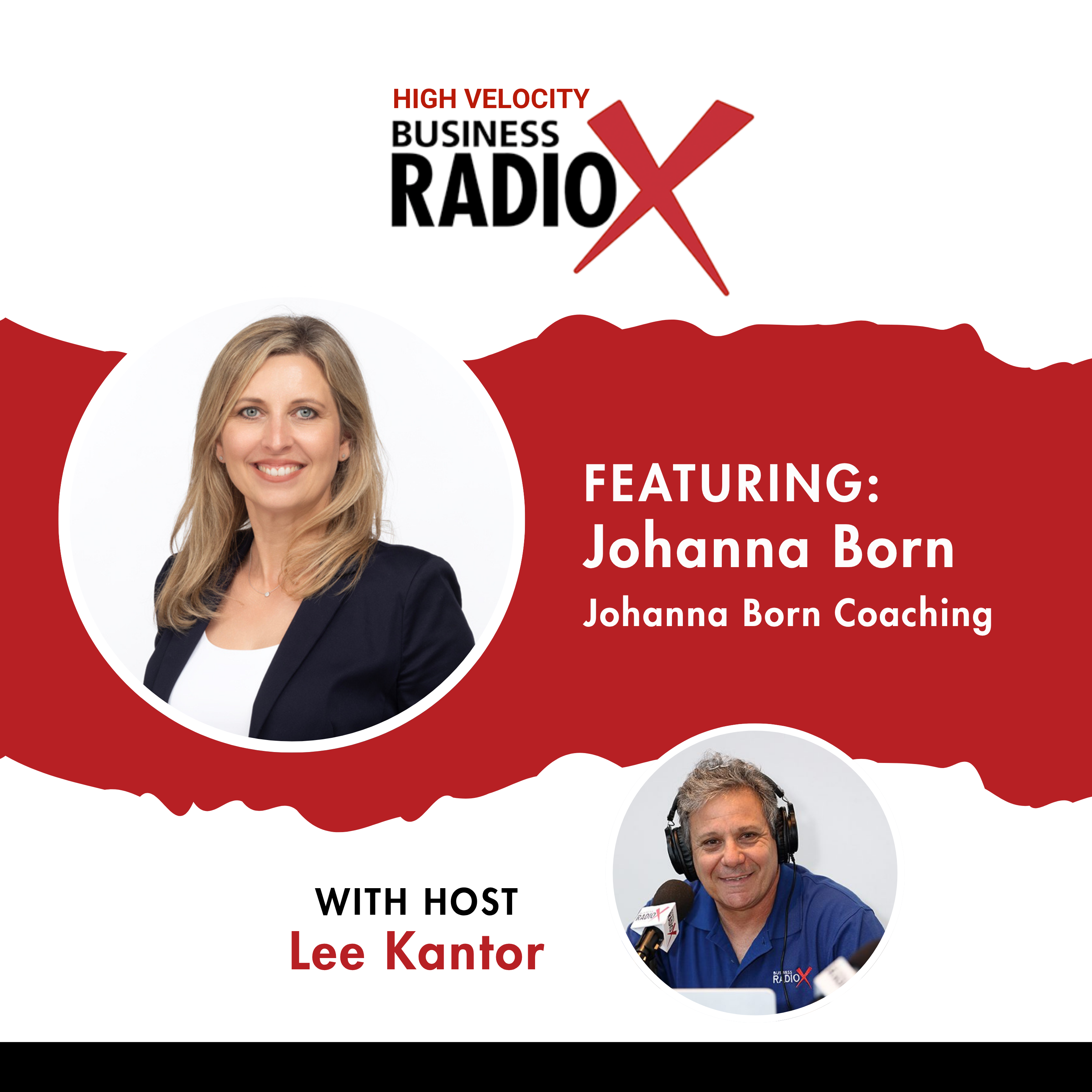

In this episode of High Velocity Radio, Lee Kantor interviews Johanna Born, an ADHD and life coach based in Houston, Texas. Johanna shares how her transition from a corporate management career in Germany led her to ADHD coaching after her child was diagnosed. She explains ADHD as a lifelong neurological condition, discusses how it presents differently across ages and genders, and describes her personalized coaching approach. Johanna highlights the importance of understanding the ADHD brain’s interest-driven motivation, shares a client success story, and addresses the connection between ADHD and addiction, including online gambling.
 Johanna Born is a certified ADHD and Life coach, trained through ADDCA and MentorCoach®, two of the most respected coach training institutions in the field. She is based in Houston, Texas, working with clients across the globe in English and German. After almost two decades in corporate management across Germany and Asia, most recently at Germany’s largest tech company, Johanna made a life-changing decision to follow her husband to Houston and start over.
She never planned to become a coach. She started ADHD coach training to become a better mom to her own child with ADHD. The progress she witnessed in her child, in herself, and across her whole family turned a personal journey into a professional mission.
Today Johanna works with kids, teens, and adults — formally diagnosed or not — who have spent their lives wondering why everything feels so much harder for them than for everyone else, being told they are lazy, unreliable, or difficult. These are not character flaws. They are differences in how their brains function. Drawing on neurobiology, positive psychology, and a strengths-based approach, that distinction becomes the starting point for coaching.
She meets each person where they are, figures out how their brain actually works, uncovers the strengths that were always there, and builds strategies that fit their real life and circumstances so that managing daily life, school, work, and relationships feels less like a constant battle and more like something they are genuinely in control of.
Because when people truly understand how their brain operates, they stop fighting themselves and start rewriting their story on their own terms.
Connect with Johanna on LinkedIn.
What You’ll Learn In This Episode
- Johanna Bourne’s transition from corporate management to ADHD coaching.
- The impact of ADHD on individuals across different ages and genders.
- Challenges in diagnosing ADHD and the importance of awareness.
- Differences between true ADHD and attention deficit traits.
- Coaching strategies tailored to the unique neurobiology of individuals with ADHD.
- The significance of motivation and activation in ADHD coaching.
- Common issues faced by adults with ADHD, including procrastination and feelings of being overwhelmed.
- The relationship between ADHD and addiction, particularly in the context of gambling.
- The importance of personalized coaching approaches and recognizing individual strengths.
- Resources for finding ADHD coaching and support.
 This transcript is machine transcribed by Sonix.
TRANSCRIPT
Intro: Broadcasting live from the Business RadioX Studios in Atlanta, Georgia. It’s time for High Velocity Radio.
Lee Kantor: Lee Kantor here. Another episode of High Velocity Radio and this is gonna be a good one. Today on the show, we have Johanna Born with Johanna Born Coaching. Welcome.
Johanna Born: Thank you. Thanks for the invite.
Lee Kantor: Well, I am so excited to learn about your practice. How are you serving folks?
Johanna Born: Yeah. So I would give you a short introduction. So I’m, um, based in Houston, Texas. And as you might hear from my accent, I’m not a native Houstonian. So I moved to Houston three years ago. And yeah, I left a career of almost 20 years in the corporate management in Germany because my husband received an offer here in Houston. And so deliberately I decided to start something new and try out what life has to offer. And one day I came across an opportunity that was never part of any plan. I was researching ways to better understand and support my child with ADHD. And something caught my attention. It was nothing about professionalism or, you know, it was simply being a mom. And I wanted to support my child with this diagnosis. And I came across ADHD coaching. So I researched further. I signed up for a workshop to just get a glimpse of what it was, because I was not aware that something like that existed. And by then I attended the workshop. I won a fellowship. And what followed actually was completely unexpected. So I’m now in my second year, um, being an ADHD and life coach here in Texas. I, um, work with multiple ADHD diagnosed and undiagnosed folks starting at an age of eight, and I support teens, adolescents, adults, and I deliberately choose to not focus on a single age group. And here is why. Adhd is a lifelong condition, and it can show up very differently at every single life stage, with different challenges and different complexity. But the underlying reasons are always the same and the priority it brings to my business or my practice. It’s so nice. And I yeah, that’s the beauty of my work, actually.
Lee Kantor: So when you were, when you were in corporate, what was your role in corporate?
Johanna Born: I was having different managerial roles. So I was working in Germany, in Hong Kong for a couple of years later. I was a global travel manager and in the largest tech company in Germany that were my role to be.
Lee Kantor: So were you. Had you been a coach in your corporate, or had you gotten coaching at all in your corporate?
Johanna Born: Not at all. I had no interaction with coaching, and it was never on my plan to become a coach. So it was really, by coincidence, coming from the angle of young parents and supporting a child.
Lee Kantor: Right? So your your kid has an issue and you’re like, okay, let me learn about it. And in the process of learning about it, you found out about coaching and then you saw, wow, I could, I’m interested in this obviously to help my child, but also this is something that’s impacting other people and I want to help them as well.
Johanna Born: Yes. So I think, um, you know, at the very beginning, it was really simple to, to become knowledgeable, to become educated. And, um, during the training, I witnessed so much changed with how I approached my child and the family dynamics changed and shifted. And so at one point I simply decided I would like to give that back, because there are so many people who are struggling with this condition and the life circumstances they are facing. And I believe there is really true benefit in having coaching in their life.
Lee Kantor: So let’s educate our listeners about ADHD. It’s a term that is thrown around a lot. A lot of people say they have it or they self-diagnose themselves. Can you share a little bit, just from a macro standpoint about what is ADHD and how does it present itself?
Johanna Born: Sure. And I think the conversation about ADHD has become ubiquitous in the past years. Um, so now even being here back in Texas, I see that there is such a surge of ADHD everywhere you go and what you see online. Um, I would say the pandemic accelerated definitely the diagnosis. I would, you know, routines collapsed. Home schooling, work life, and other stressors impacted daily life. So people were not really able to mask maybe some of the symptoms. They had no routines to follow. And then it increased. And, um, social media supported, um, let’s say the awareness about this condition and as well, the recognition so many people self-diagnosed by then. And, um, in parallel, we see an increase in women being diagnosed, um, because this group was previously dismissed from any um, criteria of ADHD symptoms. So there is those two factors. We are where we really see an increase. And uh, since the pandemic, the demand in ADHD care really spiked. So, um, what I would like to, um, differentiate though, and give a further perspective to that, um, is if you consider ADHD like symptoms on a continuum, we see two, two things which are currently happening. So every every person in a lifetime can at some point experience symptoms of inattention or forgetfulness or impulsivity, um, which result from stress from sleep deprivation, constant exposure to technology.
Johanna Born: And those symptoms look like ADHD, but they are not ADHD. We call them attention deficit trait. Those are temporary symptoms which are the reaction to environmental stress and your lifestyle. So it’s like multitasking, constant digital digital demands. And again, it looks like ADHD. And so many people identify with that. But it’s not ADHD because if you remove the stressors, it it is reversible so it can go away. The true and real ADHD does not work that way because it does not go away. So ADHD itself. Um, again, on the continuum Is a lifelong neurological condition, which begins with birth, with childhood, and it affects every dimension in life. So it starting with relationships, social, social skills, professional or academic success, physical and mental health and ADHD is highly heritable. So it really runs in families and is strongly influenced by genetics. So what I see in my practice and from my observations is that although we have the perception in society that ADHD is everywhere, um, and there might be still some overdiagnosed folks, um, I believe that ADHD is still very much underdiagnosed. Um, and there are cultural barriers, there are marginalized groups and systematic gaps which contribute to this, um, gap, um, where people still don’t understand what ADHD is and don’t have access to the necessary support.
Lee Kantor: So now what are some things that maybe you saw with your child or that parents can be on the lookout for? That might give them a clue that maybe this is something that’s impacting their child.
Johanna Born: Yeah. So I think there are very typical symptoms how ADHD, um, is visible. So I think one very typical symptom is, and I think that’s, you know, history brought that up. Um, since decades is the small boy jumping around the classroom, not being able to concentrate hyperactive, but, um, ADHD symptoms as such are much more complex. And in particular, when you talk about women and girls, they present so differently. Um, they present as masking, as internalizing hyperactivity as um, verbal processing, which means that um, many people with ADHD speak fast and a lot Those are the symptoms where you can really take care of and see. And now with children having ADHD, again, we have to differentiate is it an ADHD attention deficit trait which results from maybe even early exposure to technology? Or is this really the true ADHD? I was talking about.
Lee Kantor: Now when you’re working with adults, um, how is that different? Like what, what precipitates them kind of raising their hand to you and saying, Johanna, uh, I think I need some help in this area.
Johanna Born: That’s a good question. Lee. So first of all, I think many people still don’t really recognize they, they have ADHD and they come to coaching. Um, oftentimes not really because of the diagnosis, but because of, um, you know, not getting further in their life. They are feeling stuck, they are feeling overwhelmed. They do not know where to start. Um, they, they lost control and so they end up in coaching being, um, coaching the last round they can try out because maybe they are coming from therapy already or tribe nation. And so oftentimes people, um, yeah, search for coaching services as um, out of despair. Um, just checking it out first and then seeing, uh, you know, how it can support them further.
Lee Kantor: And how do you get clients because individuals, um, find you directly or do you get clients because maybe you have partnerships with other types of therapists or other types of, um, organizations that might send them to you.
Johanna Born: Yeah. Um, that’s both. Um, Lee I’m, um, getting requests via my website. I’m listed in at least two directories for ADHD coaches being the, um, PAC, which is the professional ADHD coach, um, association and then a co, which is the um, association of ADHD coaches where you can find me and I’m growing constantly my network here in Houston, um, working with mental health, um, practitioners, um, approaching now even schools, um, to, to get acquainted and as well leave my business cards and see if there is any need. Um, and yeah, support these folks with at least having access to coaching.
Lee Kantor: Now, what is it like to work with you as a coach? Are there some exercises you can share with our listeners right now that might be struggling? Is there some things, activities they could be doing or some things they can do right now after listening to you? Uh, that could maybe help them a little bit.
Johanna Born: Yeah. You know, I think what I would like to share briefly is really the, um, ADHD lens because I believe many people are lacking, um, an entry point into ADHD. And that was as well where I started as a mom having, you know, difficulties in supporting my child. So we approach ADHD folks or neurodivergent folks always from the lens of a neurotypical world. And that’s our, um, standard. That’s the standard. We believe it’s the right. But those standards does not work for an ADHD brain. And, um, I think I would like to illustrate a bit, um, how this really boils down. What is the reasons here? So we now know from clinical research and clinical data that neurotypical folks work on an in importance driven nervous system. What does it mean? So for neurotypical person, if something is important, they prioritize it. Um, they do it and it’s done. It’s simple, but the ADHD brain runs completely different. It’s not an important nervous system which is underlying there. It’s an interest driven nervous system. So which means even important things still don’t get done unless they are as well. Interesting, novel, urgent, challenging or fun. For those folks, and I believe the mindset shift has to happen, um, to see that this is not their choice. So it’s, they’re not intentionally choosing the way of living and making their lives difficult. It’s their neurobiology. So again, ADHD is a biology, a biological difference in their brains.
Johanna Born: They don’t have control over it. And for all of us who are neurotypical, it’s invisible. And for many people who are even diagnosed is invisible too. So they apply a system which doesn’t really align with, you know, how their brain operates. And the root cause of it is that it’s a dysregulation of the neurotransmitters which drive motivation and activation. And it’s a dysregulated prefrontal cortex responsible for executive functions like planning, initiating, and sustaining actions. And so when parents or even adults self-diagnosed recognize that they have to apply a different methodology in order to get going or get, um, their brain working and activated, that changes a lot because then it makes total sense why they were struggling in the years before maybe the diagnosis. Um, and maybe one element as well, which is critical is everything. What is mundane for them? It’s considered boring. And boring is the Kryptonite for an ADHD brain. And so of course we can say that life is not always, you know, exciting and fun and everything. We still need to pay our bills and fold our laundry. Um, and there I come in as a coach saying, okay, so if the normal typical approach does not work, what can we do about it so that we find a way which activates your brain and you start becoming, you know, more active and have momentum in the things you would like to work on.
Lee Kantor: So that’s an important component of the coaching is actually because this sounds like it’s your coaching is bespoke to each individual because each individual will have a different kind of motivation and, um, and a way to prioritize what really is important to that individual.
Johanna Born: Exactly, exactly. And there are many, um, you know, elements you find now online, um, which are methods, tools, what to do, you know, with ADHD, which methods you can apply. But I feel I still see that even those methods which are, um, which were created for an ADHD brain do not really work with ADHD folks. So we have to sit down and procreate with the a client and work towards maybe even experimenting with things what works for them. And we often draw in coaching from their past, so they oftentimes don’t see their strengths. They don’t see what is really working and how much they have already accomplished with this condition. And oftentimes it’s an aha moment for them to see, oh, look, I have managed quite many things which I don’t have yet seen. And then we build up on that and create, let’s say, tools and systems where they go back home and experiment if this is working for them.
Lee Kantor: Right? So once they’re aware that they have this condition and they can see, hey, I’ve been using this for my advantage in these areas, and it’s just a matter of kind of transferring that to other areas.
Johanna Born: Correct. Absolutely. Yeah.
Lee Kantor: Now, do you have a story you can share? Um, maybe after working with someone, don’t name the individual, but maybe share the challenge they came to you with and how you were able to help them get to a new level.
Johanna Born: Sure. Um, so I would like to use a very simple example, because I think it illustrates something important about how ADHD coaching works in maybe even in comparison to other coaching realms. Um, so I was working with an adult ADHD client who came to coaching to specifically address her procrastination, um, problem. And she came to finally get things done, get organized and feel in control of her life. And in one session, she arrived completely frustrated, super angry, full of shame, felt that she could never get her life together, no matter how hard she did and tried. And she was so upset about herself. And that was all very typical to ADHD. It’s the emotional dysregulation and outbursts because they want and they try hard, but it’s never yeah, somehow translating into results. And so I asked her during the session what you would like to focus on. And she pointed back into her room and saying, you know, I have three piles of papers here sitting in my space for months or maybe even years, I don’t even know. And there are important documents I can’t get rid of, I can’t throw away. And I don’t have a system, but they are a symbol of, um, everything she believed was wrong about her.
Johanna Born: And she was so desperate and hopeless and it was really bothering her. And so what we did in that session is we really went into the weeds. Um, the, and it was not like telling her or, you know, her going home saying, okay, go home and sort your papers. We looked at every tiny element of this task. So what was holding her back? What did she need to establish in order to get my day started? Which system does she need to have? Does she need to have folders? Anything. Which obstacles she might encounter doing that? How would she feel if this is really finally done and out of her, you know, scope and um, we know with ADHD there is a challenge of motivation for specific tasks, but oftentimes as, as well the activation. So getting started, it’s the very hard part. A part of it too. So instead her of leaving, you know, with a plan to solve all those papers and I don’t know, have a neurotypical advice. She left with a specific experiment, which was turn on her favorite song and just sit down, look at the papers, and maybe take a look the first 2 or 3 papers pages and look at them and yeah, check that out.
Johanna Born: There was no pressure to finish anything. There was just this one song, and the next session she arrived. It was so nice to see because she arrived smiling. So I was asking her, so what has happened? And she was so happy to explain and share with me that she made such a progress because she got started, got started with a song and she just continued and she finished half of those paths. And I think this type of, um, work represents really that coaching does not fix your ADHD. Adhd will remain and it does not change who you are. But we create micro shifts, tiny moments of progress, um, which build momentum. And that small thing gave her back energy because she was not constantly ruminating about those papers. And it gave her evidence that progress is possible. And what is nice about having a partner, um, she could come back and report those small wins to me. Um, and we were celebrating this without any judgment, um, although it looked very small from the outside, but she knew she was safe and um, I would really celebrate that small process progress for her. And that’s maybe. Yeah. Giving you a glimpse how ADHD coaching works. Very individual and very bespoke.
Lee Kantor: Right? And it’s also leveraging kind of something that’s important to them. And then kind of habit stacking it around a behavior they’d like to change and maybe improve on. Right now I can see how, um, when the brain is an ADHD brain, and you mentioned some of the challenges that, that brain, um, gives an individual that doesn’t have a coach on their side to help them. I, how has kind of this advent of gambling impacted the ADHD population? Because I would imagine that just falls right in line with a potential negative aspect of the ADHD brain.
Johanna Born: Um, may I ask, so in terms of gambling, are you referring to video games and stuff?
Lee Kantor: Well, there’s, there’s so much, um, there’s so much, uh, you know, sports gambling and there’s so much it’s, it’s on your phone now. You can gamble in so many different ways. And, and I would imagine if you have that kind of an ADHD brain where, you know, your impulse impulsivity is impacted and, and quick, uh, attention span and I got to have a new, you know, something new, something new, that type of interaction could quickly spiral out of control for somebody who has that type of brain type.
Johanna Born: Yeah. And it does very often. So we know, um, as ADHD is a dysregulation of the neurotransmitters, in particular, dopamine. Folks with ADHD are typically drawn into activities where there is a dopamine hit and where they receive an instant reward. And that happens with games and gaming, as you say. And so it’s like, you know, creating an addiction to feel the lack you are having in dopamine through an externalized system and, um, addiction and ADHD, they go hand in hand. So it’s very often that people with ADHD have different addictions. It’s not only video games. Um, and this is as well. Yeah, a neurological and biological reason why this happens and it’s explainable. But if people don’t understand how their system works, they literally have no efficacy or nothing in hand. How to maybe even, you know, shift towards a more, um, healthy, um, system about, you know, getting their dopamine hit.
Lee Kantor: Right. And I think that this is an area where I don’t know if you pursued this, but if, if you can help a parent who has a kid that is, you know, just gaming 24 over seven or is on their phone doing online gambling, maybe behind the back of the parent, like somebody with your background and expertise can really help change that behavior before it really spirals out of control because those kind of behaviors can quickly, um, you know, negatively impact that individual. Yeah.
Johanna Born: That’s right.
Lee Kantor: So if somebody wants to learn more about your practice or get on your calendar, do you have a website? What’s the best way to connect with you?
Johanna Born: Yeah, it’s via my website, johanna.bond.com. Um, or any directory, um, which lists ADHD coaches.
Lee Kantor: And that’s johannaborn.com.
Johanna Born: That’s correct. Thank you.
Lee Kantor: Well, Johanna, thank you so much for sharing your story today. You’re doing such important work and we appreciate you.
Johanna Born: Thank you so much for having me.
Lee Kantor: All right. This is Lee Kantor. We’ll see you all next time on High Velocity Radio.















