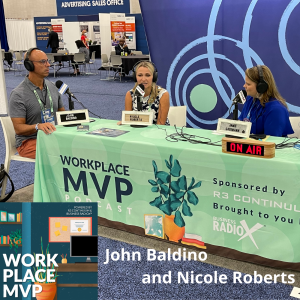

Business RadioX ®

  • Home
  • Business RadioX ® Communities
    • Southeast
      • Alabama
        • Birmingham
      • Florida
        • Orlando
        • Pensacola
        • South Florida
        • Tampa
        • Tallahassee
      • Georgia
        • Atlanta
        • Cherokee
        • Forsyth
        • Greater Perimeter
        • Gwinnett
        • North Fulton
        • North Georgia
        • Northeast Georgia
        • Rome
        • Savannah
      • Louisiana
        • New Orleans
      • North Carolina
        • Charlotte
        • Raleigh
      • Tennessee
        • Chattanooga
        • Nashville
      • Virginia
        • Richmond
    • South Central
      • Arkansas
        • Northwest Arkansas
    • Midwest
      • Illinois
        • Chicago
      • Michigan
        • Detroit
      • Minnesota
        • Minneapolis St. Paul
      • Missouri
        • St. Louis
      • Ohio
        • Cleveland
        • Columbus
        • Dayton
    • Southwest
      • Arizona
        • Phoenix
        • Tucson
        • Valley
      • Texas
        • Austin
        • Dallas
        • Houston
    • West
      • California
        • Bay Area
        • LA
        • Pasadena
      • Colorado
        • Denver
      • Hawaii
        • Oahu
  • FAQs
  • About Us
    • Our Mission
    • Our Audience
    • Why It Works
    • What People Are Saying
    • BRX in the News
  • Resources
    • BRX Pro Tips
    • B2B Marketing: The 4Rs
    • High Velocity Selling Habits
    • Why Most B2B Media Strategies Fail
    • 9 Reasons To Sponsor A Business RadioX ® Show
  • Partner With Us
  • Veteran Business RadioX ®

Workplace MVP: John Baldino, Humareso

July 19, 2022 by John Ray

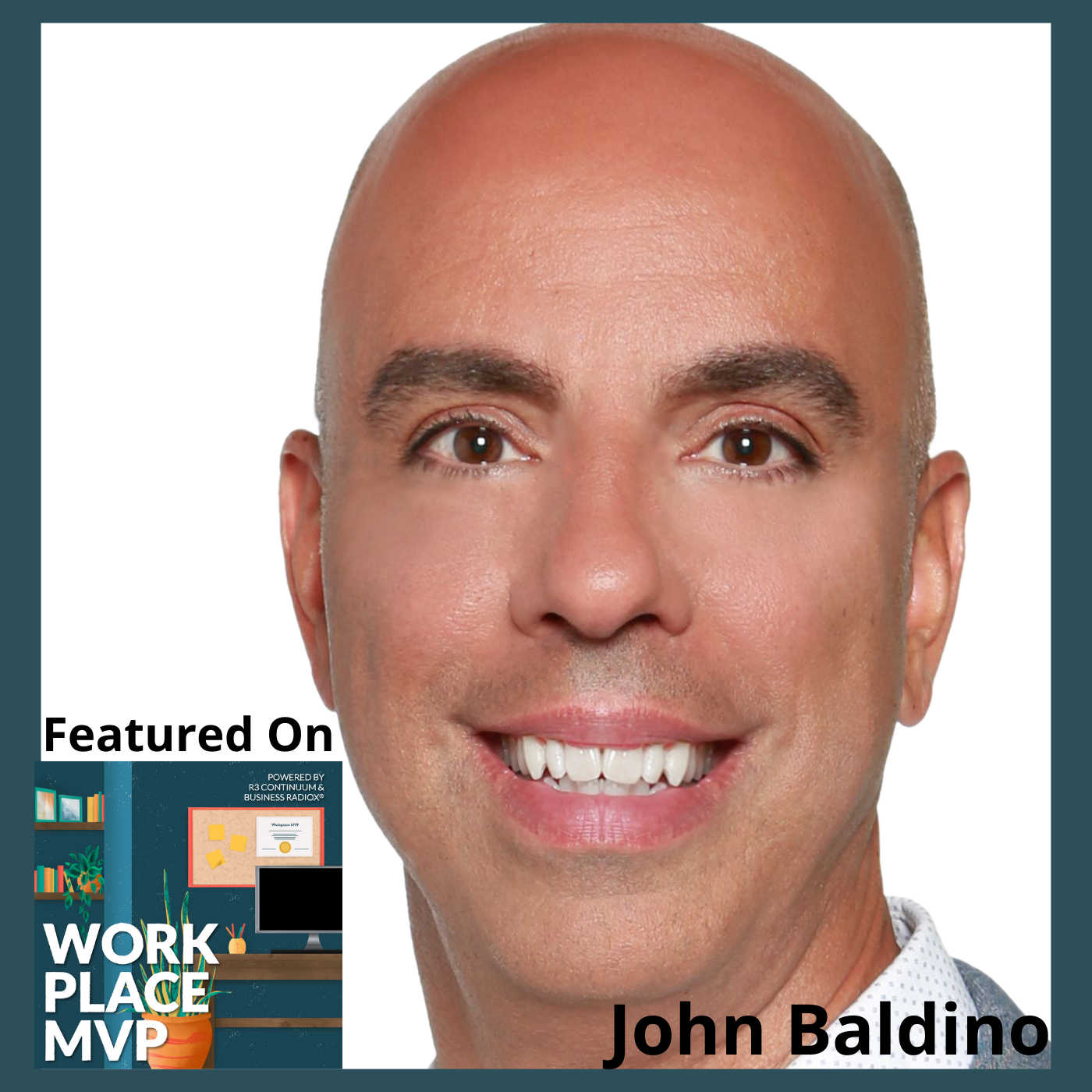
John Baldino
Minneapolis St. Paul Studio
Workplace MVP: John Baldino, Humareso
Loading
00:00 /
RSS Feed
Share
Link
Embed

Download file

John Baldino

Workplace MVP: John Baldino, Humareso

John Baldino, President of Humareso, joined the show again after his December 2021 appearance to review his predictions for 2022.  He and host Jamie Gassmann noted how he was right on the mark about trends such as meeting the holistic needs of employees, supporting their well-being, the shift towards more flexibility, companies rethinking their approach to disruption, the wave of resignations and layoffs, and many other timely topics.

Workplace MVP is underwritten and presented by R3 Continuum and produced by the Minneapolis-St.Paul Studio of Business RadioX®.

Humareso

Humareso is able to strategize with your company and develop plans to manage talent, recruit for skill gaps based on employee inventories, assess markets for growth, develop long-range succession plans and influence a culture of enthusiastic buy-in. Humareso handles all facets of employee engagement and business development. Humareso provides HR solutions and administration for small businesses trying to manage budget and growth.

Humareso sits strategically to support an organization’s vital talent needs. Talent is what they believe in cultivating. They look to drive organizational health through true employee engagement, strategic workforce planning, and invested management training. Having a culture that values people, policy, and performance in the right measures is the differential needed to stand apart from other organizations. Whether your organization has 10 or 100,000 employees, dynamic human resources will build corporate strength and recognize talent contribution.

Company website | LinkedIn

John Baldino, MSHRD SPHR SHRM-SCP, Founder and President, Humareso

John Baldino, MSHRD SPHR SHRM-SCP, Founder and President, Humareso

With 30 years of human resources experience, John’s passion of setting contributors and companies up for success is still going strong.  John is a keynote for US and International Conferences where he shares content and thoughts on leadership, collaboration, and innovation, employee success, organizational design and development as well as inclusion and diversity.

He is the winner of the 2020 Greater Philadelphia HR Consultant of the Year award. John is currently the President of Humareso, a global human resources consulting firm, and the proud dad of 3 amazing young adults.

LinkedIn | Twitter

About Workplace MVP

Every day, around the world, organizations of all sizes face disruptive events and situations. Within those workplaces are everyday heroes in human resources, risk management, security, business continuity, and the C-suite. They don’t call themselves heroes though. On the contrary, they simply show up every day, laboring for the well-being of employees in their care, readying the workplace for and planning responses to disruption. This show, Workplace MVP, confers on these heroes the designation they deserve, Workplace MVP (Most Valuable Professionals), and gives them the forum to tell their story. As you hear their experiences, you will learn first-hand, real-life approaches to readying the workplace, responses to crisis situations, and overcoming challenges of disruption. Visit our show archive here.

Workplace MVP Host Jamie Gassmann

Jamie Gassmann, Host, “Workplace MVP”

In addition to serving as the host to the Workplace MVP podcast, Jamie Gassmann is the Director of Marketing at R3 Continuum (R3c). Collectively, she has more than fourteen years of marketing experience. Across her tenure, she has experience working in and with various industries including banking, real estate, retail, crisis management, insurance, business continuity, and more. She holds a Bachelor of Science Degree in Mass Communications with special interest in Advertising and Public Relations and a Master of Business Administration from Paseka School of Business, Minnesota State University.

R3 Continuum

R3 Continuum is a global leader in workplace behavioral health and security solutions. R3c helps ensure the psychological and physical safety of organizations and their people in today’s ever-changing and often unpredictable world. Through their continuum of tailored solutions, including evaluations, crisis response, executive optimization, protective services, and more, they help organizations maintain and cultivate a workplace of wellbeing so that their people can thrive. Learn more about R3c at www.r3c.com.

Company website | LinkedIn | Facebook | Twitter

TRANSCRIPT

Intro: [00:00:04] Broadcasting from the Business RadioX Studios, it’s time for Workplace MVP. Workplace MVP is brought to you by R3 Continuum, a global leader in workplace behavioral health and security solutions. Now, here’s your host, Jamie Gassmann.

Jamie Gassmann: [00:00:25] Hey, everyone. Your host, Jamie Gassmann here, and welcome to this episode of Workplace MVP. So, last December 2021, I had the pleasure of interviewing John Baldino, President of Humareso, on our show, and we did a year-end review talking about what challenges or nuances HR and other business leaders navigated over the last year.

Jamie Gassmann: [00:00:48] And during that interview, I asked John what his 2022 predictions were for what would be the areas of challenge or need for change in the workplace this year. So, today, a little over halfway through 2022, we are following up with John to get his update if his predictions came true, and what other challenges is he seeing that we didn’t predict, but that we want to talk about today. So, help me in welcoming Workplace MVP John Baldino, President of Humareso. Welcome to the show, John.

John Baldino: [00:01:23] Thanks, Jamie. Great to be back.

Jamie Gassmann: [00:01:25] Yes, it’s always such a pleasure to have you on the show.

John Baldino: [00:01:28] I appreciate that.

Jamie Gassmann: [00:01:29] So, I did want to start out for any new listeners that might be catching this episode that didn’t have an opportunity to listen in in December, tell us a little bit about your background and your career journey in growing your business.

John Baldino: [00:01:43] Sure. So, I am, you know, 30 years still in human resources and in the veins of leadership development, and organizational development and structure, and all the employee lifecycle components. And so, I started Humareso, it will actually be ten years in a few weeks for Humareso and so that’s really fun. And Humareso is a full-service HR consulting firm. And we just have a great time working with companies across the country at various sizes from startup to enterprise level clients. I’ve got a great staff that’s across the country and just doing some phenomenal work. And it’s really, really been a good time.

John Baldino: [00:02:34] And I’ll just mention, though, my journey, as you said, I started in personnel. Before there was human resources, it was personnel. And I say that because I don’t know that we’ve really kind of given enough props to the fact that in this discipline of human resources, we have had opportunity to evolve out of completely transactional work and mixing it now a bit with some transformational work. Like, helping to look at organizations more holistically.

John Baldino: [00:03:10] And so, those who are practicing HR in various organizations across the country, my colleagues in the profession, there’s been a lot of movement over the last 30 years that I’ve been involved, and probably more movement from a pace standpoint over the last three than any of the 27 before in many ways.

Jamie Gassmann: [00:03:32] Well, they spent so many changes, especially over the last couple of years. And even before then, I think, there were changes especially in that HR arena. So, wow, you’ve definitely come through a lot of that. And congratulations on your upcoming anniversary. That’s exciting.

John Baldino: [00:03:49] It is. It is very exciting. Thank you for that.

Jamie Gassmann: [00:03:52] Absolutely. So, now the moment I’m sure our listeners are looking for. How did you fare in your predictions for this this last year? So, I’m going to start with the first one, overall health of your employees, including religion, emotional, mental, and physical. We kind of talked about how employers need to really be looking at that whole person, as opposed to just the one component, like physical, which a lot of them probably maybe have focused more on over the years. So, tell me a little bit about what are you seeing? Has that come true?

John Baldino: [00:04:29] It has. There’s going to be a theme, I think.

Jamie Gassmann: [00:04:34] You’re like, “I was right.”

John Baldino: [00:04:39] I would say that for sure we certainly not arrived. But I think that what we see over the last six months is a continued deepening of organizations looking at the overall person that works for them, not merely, “How do I keep them healthy? So, I keep my health insurance premiums lower.” Which, that’s unfortunately kind of what some of the attention had been previously. And certainly we’re not going to, like, talk down about the fact that we want our staff to be physically healthy. Of course, if we can provide opportunities for that, please continue to do so.

John Baldino: [00:05:18] But I think that what you and I spoke about, really, was the holistic view, that there is an emotional component to what people are bringing into the workplace. If we didn’t learn anything from COVID and from that pandemic and, honestly, what we’re still going through in certain parts of the country, for sure, it took an emotional toll on people. It was really difficult.

John Baldino: [00:05:42] Like, it was really difficult to stay in your house under mandates from cities and/or state. It was difficult for people to say you cannot come into the office and see these people you’ve worked with for the last four, five, six, seven, ten years. Stay away from each other.

John Baldino: [00:06:05] People are really dealing with some emotional and mental health challenges as a result of that. And I think that the wiser companies today are looking at that saying we’re seeing the residue of that and we’re really needing to be wise about how we provide an outlet for care, for communication, and consideration.

John Baldino: [00:06:30] And so, we’re watching organizations do things that they weren’t doing before, even things like open chat channels on platforms, like Slack or Teams or whatever you might be using, to say we want to work in a spirit of transparency a little differently than we were previously. It wasn’t that we weren’t transparent at all before, perhaps, but now we’ve got to do it with a bit more intention. And we’re going to be proactive in our approach to those things.

John Baldino: [00:07:03] Because if you’re struggling today, we need to know. We’re not going to judge you. We’re really going to help provide some areas of support. And if, for nothing else, just so that people on your team can say, we’re with you, we want to take a minute and not just look at what our production numbers are like for today. It matters, I get it. But we’re also going to take a couple minutes and say, let’s just do a pulse check. How’s everybody feeling today? Green for great, yellow for I’m not so sure, red for I’m really struggling. You know, there’s organizations that are kind of doing that stoplight poster, and that’s great.

John Baldino: [00:07:39] You know, you don’t have to have everybody tell you every bit of their deep, dark secrets or what they’re really struggling with because there is some protection there as well that needs to be understood. But is there an outlet for people to say, I’m going to talk to HR and I’m going to talk to whatever support structures we have within the organization.

John Baldino: [00:08:00] And it needs to be – what we’re also seeing very deliberately – is it’s got to be more than just your immediate manager. It doesn’t mean that it has to exclude the immediate manager, but it has to be more than just that. Because it might be uncomfortable for me to go to my direct supervisor and say, “I’m not feeling great today. My body physically is fine, but I feel just overwhelmed and maybe even depressed. I’m not really sure, but I’m feeling it today.” Because bias is real, that may affect the way a manager could look at that employee.

John Baldino: [00:08:37] So, companies are being wiser about if you’re feeling that way, here’s some other places to go to talk about that, to report that, to ask for resources and support. And so, we’re seeing that happen more and more. So, that’s exciting, I would say, even though it doesn’t sound like the reason for it is exciting, and I appreciate that. But it’s wonderful that we’re being much more deliberate about giving these kinds of resources and outlets.

Jamie Gassmann: [00:09:02] Yeah. Just more mindful of that whole person at work. And they might just need something, you know, that person, an outlet to talk to. And I would agree, sometimes the manager is not going to be the right person they want to have that conversation with. But I think a leader being able to show their own vulnerability and transparency to how they’re feeling can make a huge difference in how that employee shows up too.

John Baldino: [00:09:29] For sure. And, you know, I like to have data and some statistics behind some of what I share because I just want to make sure people know this isn’t Baldino just waxing philosophical because he’s bored. There’s real numbers behind a lot of these things.

John Baldino: [00:09:43] And so, even I would say since the start of the pandemic, and many of you who are listening may remember, maybe the first 6 to 12 months of what we went through, organizations were doing happy hours, “Let’s just get together on Zoom or Teams,” or what have you, and everybody just let’s have a happy hour together. And what we’re seeing statistically is that, there’s been – it depends on the survey – 60 to 65 percent drop off in the happy hour offering at organizations. And that is predominantly pushed because of a healthier outlet.

John Baldino: [00:10:21] What we found is that individuals at organizations who are struggling with emotional or mental health issues to then push them towards happy hour, towards alcohol, became a bit uncomfortable for some organizations. And they thought that’s probably not a great outlet to offer to someone. The intention is great, we get it. The intention is great. Let’s change the dynamic of it a little bit. Let’s not push alcohol as the release in that, but rather the relational communication, rather the let me feel like I belong with some people. That’s the better way to push things.

Jamie Gassmann: [00:11:01] Yeah. Definitely. And kind of hanging out in that overall health, same vein, something that I’m hearing and I heard in some of the interviews I was doing at SHRM recently, where we ran into each other again, was part of your DE&I structure is looking at that whole person and looking at kind of how do you support maybe that religion that that person wants to have shown up at work, and how do you make them feel welcome as that whole individual when you’re looking at it spiritually.

Jamie Gassmann: [00:11:35] I mean, mental health, absolutely. Stigma is reducing everywhere. It’s very exciting to see. Physical, we’ve kind of got that one down. But looking at that religion component, what are you seeing with some of the changes? And what are you hearing within work environments in how they’re starting to embrace different religions that individuals are coming to work with?

John Baldino: [00:11:56] Yeah. That’s a great question. And I would say, out of all of the areas of consideration for individuals that are coming to work, the spiritual vein is probably the one that’s still the weakest in terms of comfort because most business owners, senior leaders, managers don’t know what to do with it. They’re nervous that they may have some sort of compliance infraction by having a conversation with someone or being open to having a conversation with someone.

John Baldino: [00:12:29] And I think that the ones that are doing it really well, what we’re seeing is that, they are just providing a forum for communication and conversation around it. So, for instance, there are some organizations that are being more thoughtful around spiritual and/or religious diversity. I know that there are people who wear, for instance, particular pieces of clothing that represent some of the spirituality that they’re starting to pursue more. Also, for those individuals, who maybe during the remote time of the pandemic, who are now coming back to work, are coming back different as far as an expression of faith is concerned.

John Baldino: [00:13:12] And so, people don’t know how to manage that relationship. “Oh, my goodness. You’re wearing something or your routine is very changed now, and I don’t know if I can say certain things to you. Am I allowed to curse in front of you anymore? Could I split my ham sandwich with you anymore? I don’t know what to do anymore.” And I think that the ones that are doing it really well are creating a place for there to be safe conversation.

John Baldino: [00:13:43] Not everyone is an expert in every area of spirituality. There has to be a place to be able to say, “I’m so sorry. I’m predominantly ignorant about this vein of spirituality that you’re talking about. Can you enlighten me? Can you tell me what it’s been like for you? I don’t have a frame of reference, but I’m really interested in understanding.”

John Baldino: [00:14:03] I think that if you can provide that place for it to be safe, it doesn’t mean it’s the responsibility of the employer to have people pursue spirituality. That is not what we’re saying. But rather when there is an outlet – remember, religious accommodation is still a very real federal allowance within the law – it should be comfortably discussed as anything else where there’s an accommodation or a consideration at play.

John Baldino: [00:14:33] We’re seeing, again, not as high of a percentage as in the other veins of support, but it’s starting to make a way. We actually even know a couple of organizations that have before work, there are some employees who are getting together to pray or to meditate. And they may meditate towards or with a frame of reference towards their own spirituality, but they’re doing it collectively in quiet in a room with others. There are some organizations that we know that actually have a Bible study going on before work.

John Baldino: [00:15:04] Whatever your people are bringing up to say that it might be helpful for them if they can start their day or end their day in a certain way, be open to that. It doesn’t mean that you’re giving acceptance to everything, but just be open to that dialogue.

Jamie Gassmann: [00:15:17] Yeah. Absolutely. It sounds very familiar too. I did another interview with a gal by the name of Soumaya Khalifa, and she talked about even just, you know, being curious or wanting to know more is refreshing. And being able to say have a blessed Ramadan, where normally you wouldn’t hear that, but even just being aware of the fact that she’s celebrating that and that she’s fasting, and maybe asking questions about what that looks like can go a long way with an employee.

John Baldino: [00:15:50] Absolutely. And wouldn’t it be nice to be able to have a conversation with an employee that you know to understand rather than being scared and telling someone, “We’ll just Google it.” Should we really be Googling how to understand everybody else’s spiritual? I’d be terrified to do that. Like, talk to somebody else and just ask them. “I see that you’re taking some extra time during the day, how exciting. What’s that like for you? It seems like you’re much more centered. I’m jealous of that, even. I love the fact that you do.” Have an honest conversation. Be safe in that.

Jamie Gassmann: [00:16:23] Absolutely. Great advice. Love that. So, looking at your second prediction, creative health options. So, that need to think creatively and kind of a little bit out of the box on how you might accommodate somebody’s overall health. So, kind of expanding out of some of the traditional modes, like an EAP, obviously, all employers usually have an EAP for the most part. You know, and that’s always usually a standard kind of offering. But looking at what are some other ways that you can help those employees to promote self-care and taking care of themselves. So, talk to me a little bit about what some of the things that you’re seeing with that.

John Baldino: [00:17:01] Yeah. And, again, I’m so excited to say this has gone in the right direction coming into this year.

Jamie Gassmann: [00:17:07] You were right again is what you’re saying.

John Baldino: [00:17:08] I mean, thank you for saying that. First of all, just to make sure everybody has a frame of reference, so, the EAP, the Employee Assistance Program, those of you that are involved with a smaller business, say, under 100 employees, there’s a good chance that your current medical benefit offering does not include an EAP. So, your frame of reference may be very left of center in that, and that’s okay. Please don’t think that you’ve done something wrong or that your employer is not providing at a level that you need them to. Quite frankly, it’s a product of the volume that goes behind the way health insurance is put together, and that’s why the EAP isn’t thrown in.

John Baldino: [00:17:59] But there are things, so one of the areas that I’ve seen an uptick is at the state level. And for most states, there is an opportunity to connect, you can pick up the phone and dial 211. Just like you can dial 911 for an emergency, 211 can get you to a variety of support resources that, for some things, mimic what an EAP would offer. So, there’s opportunities for counseling, for issues around physical health, all of that health veins that we just spoke about and beyond.

John Baldino: [00:18:37] And so, what we’re seeing is that there’s more organizations pushing out that 211 as part of sort of their resource list within their organizations to say, “Don’t be ashamed, please use this.” Even if we have an EAP, there’s more stuff at the county level that, quite honestly, your taxes are paying for. So, tap into those things. Look for that help there.

John Baldino: [00:19:02] But one of the things that’s become, I think, a growing consideration coming into this year is a step back and looking at the ways in which, from a creative standpoint, wellbeing – not wellness but wellbeing – is looked at. And so, we’re seeing products and service out there now that are marketing to businesses to say, “How’s that health savings account going for you that you were so keen on five years ago? Are people using that?” “There’s money left over at the end of every year. They never use all the benefit that they have that they’re entitled to.” Or December 20th, everybody’s running to CVS to buy Q-tips and cotton balls and contact lens solution, even when they don’t wear contact lenses, just because they want to spend this HSA money that they have.

John Baldino: [00:19:59] And is that really the goal? Like, the goal is not let me stock my medicine cabinet with this stuff that’s not really, really helping me. And so, this wellbeing offering is really, I think, more on a vein that we’re going to see more and more of. We’re already seeing a consideration in a different way to this where employers are saying, “I want to split what I’ve been giving to this HSA between, yeah, I’m going to keep money in a health savings account for you, totally. But I’m not going to put as much. And instead I’m going to put some of that money over to a wellbeing app cafeteria consideration.”

John Baldino: [00:20:39] Again, I’m using cafeteria in a broader sense, meaning pick what works for you. Maybe you want to do things that are physically related for you. Great. You want to take yoga classes, you want to get some equipment to use, whatever, but this wellbeing is also going to give you opportunities for your soul, for your spirit, for your mental health.

John Baldino: [00:21:02] TherapyNotes does a great job with journals covering all kinds of mental health considerations that now an employee can use employer funded components to buy these notebooks and start a journey of moving through anxiety or depression, and keep themselves accountable in a comfortable way. Not to say that it can’t be counseling as well, but this is sort of the upkeep in between visits.

John Baldino: [00:21:29] So, to have these resources where, well, my employer is not going to get involved with my therapy directly because I want to keep that boundary there. But my employer is providing me an opportunity for wellbeing to continue my therapy journey every day. And they don’t even realize it because they’re just providing me with some funds that can be used towards these kinds of resources. Maybe I care a lot about my environment, social issues that affects my wellbeing. Here, I can use some of these set aside funds for this.

John Baldino: [00:22:01] So, we’re seeing creativity in probably the broadest way that I’ve ever seen in the marketplace right now. And those companies that are trying to do things to be thoughtful about their current staff, but also to attract new staff from a talent acquisition standpoint, they’re bragging about having this accessibility for their teams, and that is drawing potential candidates to their organizations who are looking to make a change. And that’s a set apart that, honestly, organizations need today to capture talent.

Jamie Gassmann: [00:22:35] Yeah. Being a little innovative, kind of looking outside of the box, not the standard. That’s great. And I know the next one was more flexibility, which I think has an absolute key in today’s working environment for employers to be looking at. So, talk to me a little bit about what are you seeing from the flexibility side of it in terms of how long the working day should look like. What are those hours look like? Where are you working? You know, tell me a little bit about some of the things you’re seeing that didn’t go away after COVID. And in fact, if not anything, it increased.

John Baldino: [00:23:09] Totally. Isn’t that amazing? Like, it didn’t go away. And, you know, you had some people, some I’m going to say well-meaning, but you may be missing it a little bit, who were saying it’s all going to go back to normal. No. No. And so, part of that is not because the workforce has become lazy. They just don’t want to get on a subway and travel into New York City. They don’t want to get in a car and fight LA traffic. Well, first of all, who does? Let’s be honest.

John Baldino: [00:23:43] But the other part of it is, “Oh, my goodness. People have been as productive at home or even on a hybrid schedule as they were when they were in five days a week, maybe even more productive. Oh, no. Now, what do we do? This is terrible.”

John Baldino: [00:23:59] And I think that we’ve got to be able to say, somebody else’s predictions may have been wrong – not mine – about how that was going to change back. And I think that what we’re seeing today is there are a lot more candidates in the first, I’ll say, phone screen or consideration of a new role, this is one of their first questions, and sometimes even more than how much does the roll pay, “Can I work from home? Can I work from home part time and come into an office? What does hybrid look like? Does remote work mean I have to be at my house all the time? Or can I take my laptop anywhere I want to go to do the work?”

John Baldino: [00:24:48] Now, look, that’s an IT thing. I know there’s some security protocols for some organizations. If you’re looking to get a job in finance, they’re not going to love that you want to be on a cruise, you know, nine months of the year with picking up WiFi signals from all different countries, that’s going to cause an IT professional to have some issues. I get that.

John Baldino: [00:25:08] But by and large, individuals are looking for that kind of flexibility. And I think the smarter companies have said yes. Yeah, it can. It does not mean that you can’t, though, still ask for some level of balance, if you’re an organization that does need to have people come in, if you’re an organization that exclusively has to have people come in. You and I spoke last time about making pizzas. You can’t do that remotely. You’re going to have to come in somewhere, right? So, depending on the industry, don’t apologize for it. Continue.

John Baldino: [00:25:50] And what we’re seeing is organizations that are unapologetic – and I don’t mean obnoxious – but sure of who they are, what kind of work they do, and not having to apologize for it. If you work for a manufacturing company and you build things, you make things, that’s really hard to do remotely, you’re going to have to be together. Engineers will have to get together. Those that are working the manufacturing line have to be there to facilitate that production. Don’t apologize for that.

John Baldino: [00:26:19] And we’re seeing more companies be braver in that, which is healthy. You and I talked last time, we were starting to see a little bit of a caste system, where there was, like, it’s better to have a remote role and terrible if you have to come into work. No. We’re seeing that come back to, I’d say, center. But it doesn’t mean that we’re no longer offering remote work or hybrid work. Smarter companies that are looking to provide that kind of flexibility are doing so, I would say, with some flexibility of hours when possible. They are doing it with some longer gaps in between for some companies.

John Baldino: [00:26:58] So, someone who is still a caretaker for, say, parents or having some child care concerns that they have to take care of, that person saying, “I’m going to need two hours. From 2:00 to 4:00 p.m., I can’t work because I’ve got to go do these things. But I’m going to come back and stay on until 7:00 p.m. to do my eight hour day,” or whatever it might be. You’re seeing some companies saying, “I’m okay with that. I wouldn’t have been two years ago.”

John Baldino: [00:27:27] But we’re so much better now. And as long as your productivity is not hampered, as long as your performance continues to be at the level we need it to be – and this third part is a smart question for organizations to always ask of each individual – as long as your team is aware of what that schedule is and can work with it, not around it, but work with it, I think it’s respectful all the way around.

John Baldino: [00:27:57] Because we have seen some companies not do this well and create friction amongst teammates because there’s the impression that a few people feel like they are covering for this person constantly. It isn’t true necessarily, but it feels like it because for two hours of the day they’re not around, I’m here working, but they’re not. Have that conversation. We’re seeing the smarter companies talking through that with their teams.

Jamie Gassmann: [00:28:22] Yeah. And I know there’s a question I have that I want to dive into is some of the cultural divides that are happening. And I want to cover that here in just a little bit so I can get through showing off your smart predictions here and how they came through. But, yeah, no, there’s that internal perceptions that are happening that I’m excited to dive into a little bit with you to see what you are seeing.

John Baldino: [00:28:49] But changes in sick time was the last one that you predicted in terms of that more workers being okay in coming into the office sick is not okay anymore. If you’re sick, stay home. And if you’re sick, go home. But if you you really can’t work, be sick. And so, I think you said in your interview, if you’re sick, go home and be sick. Don’t bring it here. Just stay where you need to be to get yourself back on track. I think that the super hero in all of us that says, “I’m good, I can make it,” we have to rethink that now in terms of what we might have been doing before COVID. So, tell me a little bit about what you’re seeing with that one.

John Baldino: [00:29:31] Absolutely. I think that what we’re seeing is that there are more organizations championing that sentiment. That they are not going to be able to be okay with people just showing up being sick and putting other people at risk. Even if, look, we get colds. I understand that that they still exist. But why cause tension? Why cause nervousness? Why cause there to be some stress between people for unnecessary reasons? It’s just silly.

John Baldino: [00:30:14] Plus, we have people who have to be really thoughtful about how sickness affects their own wellbeing. To continue to push through those things does create, statistically, resentment with an organization. Even if the organization is not directly asking you to plow through, they’re telling you to be sick, but you keep showing up, you can still develop resentment towards that organization. And so, that residue is unnecessary. You are creating a self-fulfilling prophecy of this company doesn’t appreciate me. That’s a bad thing. You don’t want that.

John Baldino: [00:30:54] And I think that organizations, what we’re seeing in terms of the sick time is, we’d rather you take the extra time. And, yes, you have so many hours. But we’ve seen so much flexibility the past couple of years whether it’s COVID sickness or not, but there’s an accommodation consideration to this that I think there’s wisdom in. And we’re seeing more companies say, “I don’t want to penny pinch about the hours. I really want to be thoughtful.”

John Baldino: [00:31:22] Now, there’s always the exception. Yes, I already see people shaking their heads while I’m saying this. Yes, I know there are people that take advantage. I know. I get to talk to them and say, why are you taking advantage of the company? I get it. But they are the exception. Believe me when I tell you, they are the exception, not the rule. And we have to stop legislating to the exception and start being considerate of those that are the majority.

Jamie Gassmann: [00:31:48] Very great advice. And a job well done on your predictions.

John Baldino: [00:31:53] Thank you so much. I appreciate that.

Jamie Gassmann: [00:31:56] Great job. So, we’re going to dive into a quick commercial from our sponsor, and then we’re going to look into what we’re seeing in 2022 that we didn’t talk about in that prediction show.

Jamie Gassmann: [00:32:07] Workplace MVP is sponsored by R3 Continuum. R3 Continuum is a leading expert in providing behavioral health support to people and organizations facing disruption and critical incidents. Through our evidence-based interventions, specialized evaluations, and tailored behavioral health programs, we promote individual and collective psychological safety and thriving to learn how we can help your workplace make tomorrow better than today by helping your people thrive. Visit r3c.com today.

John Baldino: [00:32:40] So, now looking at what we’re seeing in workplaces today, you know, kind of looking at that cultural divide, so we kind of stay in the same vein of some of the things we’ve been talking about, some of the things I’m hearing from HR leaders in the conversations that I’ve been having is that, even though they might have made that hybrid work environment or the remote work versus working in the office options for the entire team, when you start actually getting kind of settled into that, some people are remote, some are in the office, some are kind of a combination of, they’re seeing that resentment you mentioned and they’re seeing conflict. And, basically, culture breaking down between these employees because of the choices that each person made, even though they were both given that option. What are you seeing and what is some advice that you’ve been giving to leaders in terms of how they can navigate that unexpected kind of challenge?

John Baldino: [00:33:43] Yeah. I think, first of all, it’s a conversation. You’ve got to kind of bring the parties that are involved in this into a room and chat. And a room means like Zoom. Just look at one another. I think that if you’re only doing these things via email, you’re missing it. And, certainly, we foster levels of resentment – to come back to that word – or stress, because we’re letting people fill in the blanks with our tone. And we’ve got to stop, whether that is email, whether it’s a Slack channel, Teams channel, stop just typing everything. Talk to someone.

John Baldino: [00:34:34] I know that sounds silly. And for some people they might think it’s old fashioned. “John, it’s not efficient.” I’m going to tell you something, it is more efficient. Here’s why. Because now I don’t have to run back and have two more conversations to sort of fix an implied tone that someone heard, as opposed to just having the initial conversation. And, yes, yes, that conversation may take ten minutes longer than the chat that I did on Teams. But that chat on Teams now led to 20 more minutes of conversation that I wound up having to have. I’m still net better ten minutes if I had done the communicative right way in the beginning.

John Baldino: [00:35:15] So, when people hear tone and they hear me say, “I’m so sorry that you have not been feeling well. Is there anything that we can do?” There’s a big difference than me just saying what they hear, “I’m sorry you’ve not been feeling well. What can we do?” That sounds cold. You don’t really care. I could mean it with all my heart, but they’re not hearing my tone. They’re not picking up on those things. So, I would say that, honestly, is the basic that should be done by organizations.

John Baldino: [00:35:49] I have to tell you, I challenge even my own team often about getting on the phone or being in a video chat with people. And that’s not even because we’re having tension with anyone. But just to remind them of the familiarity that talking to someone, even virtually, face to face, what that does, what that means, how it affects the dynamic of the conversation. To do that intentionally is, honestly, a very smart strategy. It does not mean that you still can’t use Slack or whatever you’re using. Just mix it up.

John Baldino: [00:36:28] And I think you’re going to watch that issue, for instance, that you just were mentioning, dissipate. Even if someone thinks for a minute, maybe there’s tension here, maybe I should feel a certain sort of way. Because of the deposits you’ve made into the rapport development, they’re going to tip the scales towards giving you the benefit of the doubt, the measure of grace, as opposed to there’s nothing in that bank. I’m just going to think the worst right away.

Jamie Gassmann: [00:36:55] And talking in person is so much more powerful, I’m with you. I mean, email can’t capture it.

John Baldino: [00:37:04] And how many emojis can you do, right? Like, how many punctuation marks? Stop. That start to becomes silly, right?

Jamie Gassmann: [00:37:11] Or then you use the wrong one and you’re like, “Oops, that didn’t send the right message.”

John Baldino: [00:37:14] Oh, my gosh. Or you’re my mom who just sends random things emoji-wise to my kids. And they’re always like, “Should we understand something here that my mom is trying to tell us?” No. No. They were at the beach, she thought she sent them a crab. She sent them a scorpion. My son’s like, “Do you want me dead? Like, what does this mean?” And we can laugh, because if my mom listens, I’m in big trouble. But the idea of I can laugh about that with my kids and my mom because we have more in our relationship bank than just text messages. It matters.

Jamie Gassmann: [00:37:51] It does. Yeah. That’s a great analogy to use in kind of comparison where you’re not going to take it the wrong way because you understand the person behind it, where with a coworker you’re going to only know them as far as you’ve allowed that relationship to build with them. So, it does kind of change that.

Jamie Gassmann: [00:38:09] And then, kind of looking at this and this is something, too, that we’re seeing quite frequently – you know, not really quite frequently, but really a common challenge that primarily in health care space they’re experiencing, but I would say this is in probably a lot of other areas as well, the systemic disruption that workplaces are facing. Discontinued large scale events happening within the country. The pandemic started and then the waves of the pandemic where, “Nope, the cases are down.” “Nope, they’re back up.” And there’s a surge.

Jamie Gassmann: [00:38:42] And then, it’s racial tensions, civil unrest, political divide. We continue to see these things happening within the world that is tipping into the work environments. And what it’s creating is a lot of stress, some burnout. So, what are some of the things that you’re hearing from customers? And when you have a customer experience this, where are you navigating them to get support for that?

John Baldino: [00:39:10] Yeah. I mean, it’s a really great question. And I think that, typically, what we do is take a step back with some clients to say, “Let’s just talk about a general category to start with.” And that general category is disruption. What is it that you would like to be known for when it comes to disruption? It’s an interesting question to ask an organization because it’s like, “Well, John, we want to be a leading disruption. We’re innovative. We’re creative, we want to be at the forefront of disruption in a healthy way to bring our technology forward or process forward or product forward,” whatever it might be.

John Baldino: [00:39:54] And so, I’ll say, “Okay, I believe you. I don’t have a reason to not believe you. I’ll believe you that that’s your intention around disruption.” So, when disruption comes to you, why do you revert back to a non-innovative response? Where does that come from and why is that the default trigger? What that tells me is that there’s some behavioral modification that has to occur. We want to get to good old fashioned psychology and say, “I mean for X to be my response, but I keep defaulting to Y.” Where is that coming from? Stop and take stock of that.

John Baldino: [00:40:41] What we have found some organizations realizing is, “Darn it. We say we’re innovative. But we’re kind of scared of innovation.” Or, “We say we’re really creative, but if I really sit and think about it, I don’t know when we’ve had a really robust creative idea.” We found maybe another product or piece of software that helped us do things better, but is that creativity or is that efficiency? “Oh, man. We’ve overlapped those words and we shouldn’t have.” Efficiency is something different.

John Baldino: [00:41:16] And so, what we try to do is help organizations to say, let’s talk about disruption itself. Don’t worry about it being a social issue, a pandemic, or something else. First, talk about disruption. Now, let’s align your response or what you desire your response to be in disruption to your value system. What is the organization about? Why do you say it’s about that? What does that mean to you and for you? And as a result, how might it impact the way in which disruption is then perceived?

John Baldino: [00:41:55] Because you may think that I’m doing it this way, but your value system is running counter to some of your approach. And people don’t know what to do with it. They don’t know how to perceive what it is that they see. How do we help that? I’m just giving you a couple of steps to start with. Certainly, there’s a lot more to it.

John Baldino: [00:42:14] But working with organizations to say, “let’s just take it in pieces,” because what we’re seeing – and I’ll be very practical – in sort of a recent social disruption is in the Supreme Court change for Roe v. Wade. And whatever side that you fall on, that’s not what I’m getting at. But it is certainly a disruption. It has certainly changed for 50 years what people had grown accustomed to.

John Baldino: [00:42:44] And so, if you chose as an organization to say, “Down with the Supreme Court. We are now going to support every individual in our organization up to $4,000 each time that they seek a procedure like this if they work and live in a state that no longer supports it, because the federal mandate is gone.” That’s fine. If that’s what you’re response is from a disruption standpoint. But are you looking at it just for today or are you looking at it long term?

John Baldino: [00:43:21] One of the things – again, this is practical and philosophical where the roads meet – I have said to people, do you know what kind of utilization those services have been leaned on for your employee population to date? Do you have any sense of that? “No, I don’t.”

John Baldino: [00:43:43] You may. Your finance person is in a corner with a box of tissues sobbing because they’re worried that in your 400,000 person organization, there could be 10,000 people who use this benefit even just once this year. That’s a hit to the budget that was not planned for. And it isn’t only about the social issue, it is also about the financial impact. Be thoughtful about that. There’s no magic in $4,000 and there has to be consideration for that.

John Baldino: [00:44:17] I’m saying those social issues are worthy of your consideration, but approach it the way that you would approach disruption as a whole. How do we put all of our options in front of us? How do we talk through it? How do we collaborate on it with our teams? How do we get there? Because what that would tell us is, not everybody is going to get their way. Someone might want $10,000 a year. Someone might say don’t give them a nickel because of how they might feel about the issue.

John Baldino: [00:44:45] That isn’t the way you make a decision. It can’t just be how people feel. That’s a piece, but it’s not all. How do you approach disruption and then apply it to social issues? Apply it to doing “the right thing” based on your value system of your organization? Don’t lose sight of those things.

Jamie Gassmann: [00:45:02] Yeah. That’s great advice too. And I think that’s important is looking at the value system. Because at the end of the day, when you go off, especially public, on some of those things, it can affect your brand, so, it’s being mindful. And then, ultimately, it can affect those employees too. So, great advice.

John Baldino: [00:45:26] Absolutely. And listen, I want to make sure I say this, companies that are giving $4,000, great. That’s not the issue, at all the issue. But what happens in two years when the issue isn’t as much of a hot button? Let’s say, you decide to kind of wind down that benefit a bit, take it from $4,000 to 2,000 or and take it away completely because the budget is struggling. That may actually be a harder conversation now to have with your people because you were not thoughtful about it in all the ways you should be to start with. And I don’t want to make it just about the money, but for the sake of our conversation, that’s just an easy example to give.

Jamie Gassmann: [00:46:03] Yeah. Absolutely. And it’s in either direction that you lean. Absolutely. So, the other thing that we’re kind of seeing, and from what I’ve heard and what we see, and, obviously we see a lot of it in the media as well, staffing shortages and mass exodus out of certain industries.

Jamie Gassmann: [00:46:20] You know, I have a sister who’s a teacher and she’s like, “Teachers are leaving left and right.” You know, you hear it in health care, nurses, doctors leaving left and right. But then, on top of that, we’ve also got staffing shortages across the board. So, what are some of the things you’re seeing? And how are you helping leaders to navigate that?

John Baldino: [00:46:40] Well, and the other piece that is much more rampant in some ways, in some industries is layoff. We are seeing the layoffs that we’ve talked about that were going to come, and whether that’s because of compensation reasons that they have to sort of right size what we’ve been paying people. And so, organizations are now like, “Oh, my gosh. We can’t afford this long term.” Or the amount of startups that are laying off people, just do a little research alone on tech startups, you’re talking thousands of Americans have been laid off this year so far from tech startup companies or series E, series B funded companies that it’s like, “Oh. We raised 30 million. We’ll be fine.”

John Baldino: [00:47:32] I’m going to tell you something which is scary for me to say out loud, that goes quickly. You hire a whole lot of people, it’ll go quickly. So, you have companies laying off that might not sound like a lot, so-and-so laid off 400 people. Well, when they had 700 people, when they lay off 400, it’s more than 50 percent of their workforce. Don’t be fooled to think it’s only 400. Think about it as a percentage of the organization. That’s a huge impact. Let alone the huge organizations, like Wells Fargo, that are laying off a ton of people in mortgage lending and other divisions of lending as a whole because of the interest rate increase.

John Baldino: [00:48:13] So, now you have people still wanting to find the job that they really want to work in. They’re looking for something better than where they’re currently working. They don’t believe in the organization that they’re a part of anymore, if they ever did quite honestly. Or they are still entertaining and being wooed by some really high paying possible roles. But these same people now are sort of looking at the news and seeing, “Oh, my gosh. Such and such just laid off 2,800 people and so-and-so just laid off 4,000 people. And Netflix is laying off people.” And some of these companies are like, “Oh, shoot. I watch Netflix all day long. How can they not have enough business? What’s happening?”

John Baldino: [00:48:59] Now, you have people taking a moment – which I’m so grateful for – they’re taking a breath to say, “Do I want to self-select out of the company I’m a part of for what I perceive to be the grasping, greener, knowing that there may not be a guarantee I might be on the chopping block in three months of these layoff swing continues across the country?” It’s happening. We talked about a lesson. The Verizon were laying people off. Amazon is laying off people. It’s happening. So, they have to be thoughtful about that.

John Baldino: [00:49:31] Now, that does not mean that the business owner or the manager now can be a jerk once again and say, “Yeah. Go ahead. See if you can find something.” No, no, no. No. No. That’s the wrong response. The answer is, “Why, employee, are you looking elsewhere?” Let’s talk about this a little bit more, because it really may not be about the money at this point, because now there may be nervousness. The right sizing may be happening with some industries to bring down some salary ranges. What else is inspiring you to want to leave?

John Baldino: [00:50:07] And to hear from somebody to say, “It’s a thankless job. No one shows appreciation in this place. You get an offhanded thank you. Or the only way we show thank you is we have pizza the last Friday of every month for lunch. It’s just not enough anymore. It’s just not enough. And by the way, I’m on Atkins. I can’t eat the pizza. Like, nobody knows. Ask people.” But there are so many people who are like, “I don’t eat the pizza. I don’t eat the tacos. I don’t drink the alcohol. But nobody asks me. They assume I should be an assimilate like everybody else. And I live individually. I don’t live corporately. Nobody’s asking me.” That is still where we’re finding organizations struggling.

Jamie Gassmann: [00:51:01] Yeah. And that can make a big difference in an employee, just even that if somebody needs something different than what we’re going to serve today. “Can I get you a salad?”

John Baldino: [00:51:13] Right. And listen, it’s not about taking everybody’s order. I understand that. But if you just have one way to show appreciation, and I’m picking on the pizza thing. Pizza Friday is the last Friday of the month, if that’s it, that is not going to meet everyone. It’s just not. Even the people who like pizza, they want something different or they want to hear appreciation differently.

John Baldino: [00:51:38] And I want to make sure I say this, because I think this is another dynamic that’s really interesting because of what’s been happening in the economy. This year alone, 1.7 million people who retired in the past year are returning to the workforce.

Jamie Gassmann: [00:51:54] Interesting. Wow. The early retirement didn’t stick.

John Baldino: [00:52:01] It did not stick. Because you look at your stocks, you look at your 401K, and you’re like, “Oh, no.” I mean, you see the hit that the 401Ks have taken the past 6 to 12 months. Those that retired last year are saying, “No. I’m not going to make it. What I thought I was going to draw from has shrunk quite a bit.” And they’re coming back. Now, it doesn’t mean that they’re coming back to the same exact role or even full time, but it does mean that they’re coming back into the workforce.

John Baldino: [00:52:38] Now, I sound like an old man, the young upstarts that are like, “Whoever’s got the best offer for me, that’s who I’ll talk to.” And you have retirees saying, “I don’t need the best offer. This is all I really need to make. And I only want to work 25 hours a week. So, if you could give me that for the 25 hours a week, I’ll get the same work done. For some roles, I can get almost fulltime work done in that 25 hours.” And so, then the person who’s thinking, “Make me an offer, you might hear from the employer. I don’t have an offer to make you. We’re covered.”

Jamie Gassmann: [00:53:09] And you get that retiree that’s got how many years of experience that they can bring to the table. That’s fantastic. So, it sounds like there’s some pendulum shifting there, swinging going on in that, which is probably refreshing to hear for some employers who maybe have been experiencing challenges in that area.

Jamie Gassmann: [00:53:31] So, if you could give any advice – just wrapping up our show today – to our listeners of what they should be focused on and what you would advise them to to kind of do in the next five months we have left of the year, what would you leave them with?

John Baldino: [00:53:52] I mean, there’s so many things you could say. But if I’m going to just come down to really, really one core piece, it’s talk to your teams, talk to them. Not talk at them. Not just listen to them. But communicate. Converse with them. And I don’t need it to be some formalized system where you’re like, “Well, I conducted 17 stand up meetings with people this week.” Take a minute. I’m not asking for it to be so categorized. Just make sure that there’s a regular cadence of communication and real conversation. I think you’re going to do really well as you run towards the end of the year. I think you’ll do really, really well.

Jamie Gassmann: [00:54:44] Yeah. Absolutely. And, you know, as normal of any conversation I have with you, we take up that full hour because it’s such a great conversation, great insights and information. So, if our listeners want to get a hold of you, learn more about your organization or just get more advice from you, how can they get a hold of you?

John Baldino: [00:55:03] Thank you. I mean, certainly feel free to go to our website, humareso.com. I am super active on LinkedIn and Twitter, so look me up on both. On Twitter, I’m jbalive. Please feel free to follow, lots of resources and information that gets pushed out there as well, so happy to connect.

Jamie Gassmann: [00:55:25] Wonderful. And thank you so much again for being on our show, John, and sharing your great wisdom, your predictions, your expertise, and kind of filling us in on how leaders can help navigate the current world that we’re in with staffing and employees and other things. So, thank you so much. It’s been an absolute pleasure.

John Baldino: [00:55:45] Always awesome to be with you, Jamie. Thank you.

Jamie Gassmann: [00:55:47] Yes. And we also want to thank our show sponsor, R3 Continuum, for supporting the Workplace MVP podcast. And to our listeners, thank you for tuning in. If you have not already done so, make sure to subscribe so you get our most recent episodes and other resources. You can also follow our show on LinkedIn, Facebook, and Twitter at Workplace MVP. And if you are a workplace MVP or know someone who is, we want to know or hear from you, so email us at info@workplace-mvp.com. Thank you all for joining us and have a great rest of your day.


Tagged With: Business Development, Employee Engagement, HR Solutions, Human Resources, Humareso, Jamie Gassmann, John Baldino, layoffs, R3 Continuum, systemic disruption, Workplace MVP

Workplace MVP: John Baldino, Humareso

December 2, 2021 by John Ray

Humareso
Minneapolis St. Paul Studio
Workplace MVP: John Baldino, Humareso
Loading
00:00 /
RSS Feed
Share
Link
Embed

Download file

Humareso

Workplace MVP: John Baldino, Humareso

In an engaging conversation, John Baldino, President of Humareso, and host Jamie Gassmann review changes in the HR landscape changes over the last two years, important trends, and look ahead to 2022. They discuss flexibility in work arrangements, compensation and inflation, cultural fabric, diversity, equity and inclusion, and much more. Workplace MVP is underwritten and presented by R3 Continuum and produced by the Minneapolis-St.Paul Studio of Business RadioX®.

Humareso

Humareso is able to strategize with your company and develop plans to manage talent, recruit for skill gaps based on employee inventories, assess markets for growth, develop long-range succession plans and influence a culture of enthusiastic buy-in. Humareso handles all facets of employee engagement and business development. Humareso provides HR solutions and administration for small businesses trying to manage budget and growth.

Humareso sits strategically to support an organization’s vital talent needs. Talent is what they believe in cultivating. They look to drive organizational health through true employee engagement, strategic workforce planning and invested management training. Having a culture that values people, policy, and performance in the right measures is the differential needed to stand apart from other organizations. Whether your organization has 10 or 100,000 employees, dynamic human resources will build corporate strength and recognize talent contribution.

Company website | LinkedIn

John Baldino, MSHRD SPHR SHRM-SCP, Founder and President, Humareso

John Baldino, MSHRD SPHR SHRM-SCP, Founder and President, Humareso

With 30 years of human resources experience, John’s passion of setting contributors and companies up for success is still going strong.  John is a keynote for US and International Conferences where he shares content and thoughts on leadership, collaboration, and innovation, employee success, organizational design and development as well as inclusion and diversity.

He is the winner of the 2020 Greater Philadelphia HR Consultant of the Year award. John is currently the President of Humareso, a global human resources consulting firm, and the proud dad of 3 amazing young adults.

LinkedIn

R3 Continuum

R3 Continuum is a global leader in workplace behavioral health and security solutions. R3c helps ensure the psychological and physical safety of organizations and their people in today’s ever-changing and often unpredictable world. Through their continuum of tailored solutions, including evaluations, crisis response, executive optimization, protective services, and more, they help organizations maintain and cultivate a workplace of wellbeing so that their people can thrive. Learn more about R3c at www.r3c.com.

Company website | LinkedIn | Facebook | Twitter

About Workplace MVP

Every day, around the world, organizations of all sizes face disruptive events and situations. Within those workplaces are everyday heroes in human resources, risk management, security, business continuity, and the C-suite. They don’t call themselves heroes though. On the contrary, they simply show up every day, laboring for the well-being of employees in their care, readying the workplace for and planning responses to disruption. This show, Workplace MVP, confers on these heroes the designation they deserve, Workplace MVP (Most Valuable Professionals), and gives them the forum to tell their story. As you hear their experiences, you will learn first-hand, real-life approaches to readying the workplace, responses to crisis situations, and overcoming challenges of disruption. Visit our show archive here.

Workplace MVP Host Jamie Gassmann

Jamie Gassmann, Host, “Workplace MVP”

In addition to serving as the host to the Workplace MVP podcast, Jamie Gassmann is the Director of Marketing at R3 Continuum (R3c). Collectively, she has more than fourteen years of marketing experience. Across her tenure, she has experience working in and with various industries including banking, real estate, retail, crisis management, insurance, business continuity, and more. She holds a Bachelor of Science Degree in Mass Communications with special interest in Advertising and Public Relations and a Master of Business Administration from Paseka School of Business, Minnesota State University.

TRANSCRIPT

Intro: [00:00:04] Broadcasting from the Business RadioX Studios, it’s time for Workplace MVP. Workplace MVP is brought to you by R3 Continuum, a global leader in workplace behavioral health, crisis, and security solutions. Now, here’s your host, Jamie Gassmann.

Jamie Gassmann: [00:00:30] Hi, everyone. Your host, Jamie Gassmann, here, and welcome to this episode of Workplace MVP. As we near the end of 2021 and gear up for 2022, I thought it would be a great time to reflect on what we, as business and H.R. leaders, have navigated over this last year. Some of the challenges and complexities experienced in 2020 followed us into 2021 and really never left. But just like with any year, 2021 brought focus and importance in areas of our business that needed to be focused on.

Jamie Gassmann: [00:01:03] And today, we will be talking with Workplace MVP John Baldino, President of Humareso, to share from his perspective when looking at the human side of business, what are the key areas of focus for H.R. and business leaders in 2021, and what does he see as areas of importance going into 2022. So, with that, welcome to the show, John.

John Baldino: [00:01:28] Hey, Jamie. Thanks so much for having me.

Jamie Gassmann: [00:01:30] Absolutely. I’m looking forward to connecting with you on this topic. I think you bring some great perspective. So, with that, let’s start out with learning a little bit about your career journey to being President of Humareso.

John Baldino: [00:01:45] So, yeah, thank you. It is one of the things that you alluded to, looking back on 2021, it’s 30 years for me involved this year with H.R., leadership development, organizational design and development. It’s frightening for that 30 years. I can’t believe it. But I’ve had a really great journey in terms of the kinds of organizations I’ve been able to be a part of. And so, through retail and restaurant, nonprofit, education, banking and finance, distribution and manufacturing, just so many areas of industry.

John Baldino: [00:02:26] And I got the privilege of starting Humareso in 2012, so it’s been a little over nine years, and it’s been a great time. Really, I’m thankful to say, a smart move to start the H.R. consulting firm that I did. And we’re just having a blast, honestly, with the work that we get to do with companies across the country, also in a variety of industries. So, it’s really fun.

Jamie Gassmann: [00:02:50] Yeah. And probably a great time right now, obviously. I’m sure your services are called upon even more as people are navigating different complexities and challenges that maybe they haven’t thought that they would experience. So, with that, tell us a little bit about Humareso, and what your organization does, and some of the services that you provide.

John Baldino: [00:03:13] Yeah. I try to tell people, we are as much of an all-in-one for everything H.R. as possible. And the way that we can do that is because we have some wonderful people on staff who are just phenomenal and they represent disciplined areas of H.R. And so, we support companies with a lot of, say, blocking and tackling, compliance administration, direct hire, recruiting, things that they need to get done day in, day out for that employee experience and life cycle.

John Baldino: [00:03:49] But we’re also involved with things that are a little beyond. So, technology, really an interesting path to constantly travel because technology changes so much. And what makes sense for a company at its particular genesis. So, you might use something today that when you double in size, you might not use next year. And so, helping navigate through that. But then, areas of mergers and acquisition, organizational development, learning management, executive coaching, just things where sometimes we overlook those components and think that they are nice to have.

John Baldino: [00:04:24] But, really, in the competitive marketplace today, they’re a must-have. You can’t just kind of put things aside anymore. You can’t ignore compensation. You can’t ignore employee sentiment. What’s happening with our people? Are they engaged? It’s not just how do you feel. It’s how are you productive. And so, I think organizations are much smarter about that than ever before. And so, we get a lot of opportunity to support companies doing a lot of that work.

Jamie Gassmann: [00:04:55] Yeah. Absolutely. It’s like the human side of business has become even more of a focal point and level of importance for businesses, particularly over this last year.

John Baldino: [00:05:06] For sure. For sure. And it’s funny, I mean, you and I have talked about this before, right? When people first connect with Humareso, they’re like, “I’m not sure how to say the name.” And I’m like, “It’s Humareso. It’s Italian for human resources.” And people are always like, “That’s fantastic.” That’s a total lie.

John Baldino: [00:05:27] But the focus for me is to get people to be thoughtful about that idea of human resources. It’s actually a global consideration. I appreciate the fact that in the U.S., we think of it as sort of a department. But, really, it’s a functional relational component of how organizations exist and thrive across the globe.

John Baldino: [00:05:49] So, you’re right, that human-centered perspective is not merely emotional. And I hate to say it, I still get to talk to some CEOs who, “This is all kind of fluff, blah, blah, blah.” And usually, they’re the CEOs that are struggling the most. And I want to just say to them, “Listen. Relax. It doesn’t mean that you have to get a warm blanket and sit in front of a fireplace and just get in touch with your feelings. That’s not what this means. It means you have real people with real concerns and real desires to contribute in their work and in the organization. So, don’t overlook that. Pay attention.”

Jamie Gassmann: [00:06:27] Absolutely. And they want to do good work for you, especially if you show that care and compassion and value that they’re seeking.

John Baldino: [00:06:35] Absolutely.

Jamie Gassmann: [00:06:36] And, obviously, you kind of already mentioned, we’re going to be talking about trending over the last year. So, from your perspective, just to level set as we kind of get into this dialogue, if you were going to look at over this last year, what were some of the key trends that you feel were most impactful to the human side of business?

John Baldino: [00:06:58] I mean, listen, we can be buzzword and trendy for at least an hour, right? Certainly, I think from a new term, we saw this year that the phrase The Great Resignation being used, and people struggling to find talent to fill open roles, and all of the perspective that went along with that. It’s because of unemployment. It’s because people are lazy. And everybody is an armchair coach to tell you exactly what’s wrong with the world.

John Baldino: [00:07:33] In many ways, though, I think that I’ve also heard probably a better phrase, instead of The Great Resignation, I look back and see it as a great reshuffle. And I think what talent has chosen to do this past year is say, “Where can I best thrive? Where can I best invest? Who’s going to like the fact that I’m bringing what I bring to the table? Who will like it the most?” And that may mean that I take my toys and go to another company in order to do that. And so, the talent is still in the marketplace. It’s just reshuffled. It’s out of where it was and onto someplace else.

John Baldino: [00:08:13] And if your organization winds up being one of the organizations whose bench has cleared, you may need to look in the mirror long and hard as to why your organization is the one reshuffled out of as opposed to into. And so, I think for sure that’s something that organizations have had to pay attention to this past year differently.

John Baldino: [00:08:39] And let me just add this, too, I want to be respectful of data. There’s absolutely data that would say this past year – and I’ll try to do this. I might say it twice – there’s jobs that people are filling right now and open jobs where we need people. If you add that number together, it’s more than the number of people available to work. That there’s less people available for all the jobs that are possible, both currently filled and opened. Our birthrate is down. For every two adults, we’re trending at about 1.7. So, we’re not regenerating the same number and haven’t for years. And so, we’re seeing a little bit of that catching up with us, for sure. I’m not ignoring the data.

John Baldino: [00:09:27] But I would also say, there are companies that are able to hire and they have hundreds of people this past year, hundreds of people this past year. Well, where are they coming from? They may be coming from your company if you haven’t paid attention to what’s happening with your team.

Jamie Gassmann: [00:09:43] Yeah. Absolutely. And there were a couple of other areas, too, you mentioned, like from an entrepreneurial spirit with that next generation of workforce.

John Baldino: [00:09:53] I mean, you and I know, we have this spirit even within us. And I’ll speak for myself, I’m not a young person anymore. I pretend I am. I think like I am probably to the chagrin of my spouse. But I’m not really a young person.

John Baldino: [00:10:11] We’ve encouraged a very entrepreneurial approach to commerce. There are so many younger – and I do mean younger by age – who are coming out of school, who very much feel like I don’t ever want to work in-house for someone. I want to start my own company,” whether that’s a product or a service, whether it’s tech based or not. There are just opportunities all over the place. You can start your own website and have product delivered to somebody for $199. I mean, this dropship stuff is just like easy peasy now.

John Baldino: [00:10:49] And so, there’s people who are like, “The heck with that. I’m not working for Baldino. I’m going to work for myself.” And that entrepreneurial spirit you can’t ignore. And so, what has that done this past year? It’s actually taking people out of the workforce as well who don’t desire a W-2 relationship with a company. They don’t want it.

Jamie Gassmann: [00:11:09] So interesting. And I’ve seen that. And I think you and I will talk about it a little bit later about that shift to consulting work. And that we’ve seen some of the writing on the wall for that years before, even pre-COVID. And I’m always kind of looking at, “Well, pre-COVID that was already happening. It just expedited it.” Which we’ve seen across a lot of different other areas.

Jamie Gassmann: [00:11:35] And another area, too, that we’re going to talk about a little bit later is that diversity, equity, and inclusion focus in workplaces. And I think you have some really exciting things to share on that different perspectives of how a workplace can be looking at that within their own space as well.

John Baldino: [00:11:53] Absolutely. We’ll talk more about that. But for sure to at least whet the appetite, honestly, we’re watching verbal responses followed by physical movement from people who are saying, “You say you’re about these things -” organization “- but you’re not. And so, I’m calling you out on it. And if you don’t change it, I’m leaving because I can go somewhere where the value around equity and fostering a sense of belonging is real. It’s active. We can talk about it. I can point to it. And you just want me to know we hired diverse talent.”

John Baldino: [00:12:35] Well, first of all, what does that mean? And second of all, how long are they staying? Because you can hire diverse talent, let’s say, in certain buckets. But in six months, there’s a good chance they won’t be there if your organization isn’t prepped for it. And other people are now going out the door with those folks who’ve been brought in just because they represent some sort of diverse group. That’s not the way to do it.

Jamie Gassmann: [00:12:57] Yeah. No, it’s so exciting to talk about that with you in terms of some of your perspective of how you helped workplaces to really embrace that in a way that’s helpful and really demonstrating what it’s meant to demonstrate. So, that’ll be really exciting.

Jamie Gassmann: [00:13:15] So, diving into The Great Resignations, and we’ve all heard about that and the impact of that. And I think in some ways we probably saw that, but maybe differently than, you know, just hearing some of the data that you shared, probably maybe differently than what we maybe anticipated. I think maybe some retired earlier than they anticipated. And with that, we had people leaving the job market that would have maybe stayed, like, five years longer. But then, to your point, just having less amount of that employee candidate pool based on just there aren’t as many workers out there. So, talk to me a little bit about that trend of the great reshuffle and share kind of some of your perspective a little bit deeper on that.

John Baldino: [00:14:01] For sure. It’s really interesting, honestly, even with what you just shared, that, certainly, there were people who COVID amplified their desire to get out of the workforce. There are definitely people who took early retirement. There are people who were furloughed or laid off from their organization.

John Baldino: [00:14:22] And when the opportunity presented itself to return, they self-selected out and said, “This whole pandemic thing isn’t done yet. I’m not interested in trying to navigate what this means, masks, no masks, vaccines, no vaccine. I just don’t want to be involved with it. And so, I’m not coming back or certainly I’m not coming back to the degree that I used to work. I’ll come back part time -” which we’re seeing that as well “- not full time. I only want to take a role where I can work from home completely because perhaps I’m immunocompromised or I’m a caretaker and I’m concerned about being a carrier for some of these things.”

John Baldino: [00:15:05] So, from a health perspective, absolutely, that’s impacted some of that reshuffle. I’d also say from an opportunity standpoint. So, what do I mean? There are plenty of professionals pre-pandemic who were involved in the – I’m going to use the big industry title – hospitality industry, so that would be things like hotel, restaurants, concierge-based services, spas, all of those areas, who were laid off and laid off for months. And when they were able to come back, came back at a very constrained schedule because it just wasn’t busy enough. People were not getting massages. I mean, think about some of that. You might be worried about health issues. Who wants to come and have a massage? Not as many as once did, let’s say, or other kinds of treatments.

John Baldino: [00:16:01] So, those folks decided, “I got to shuffle myself out of hospitality and into something that is not going to be as influenced by what’s potentially happening in the world, mandates that may yet come down the pike. I’m going to get into something else.” And so, right now, for sure, I’m seeing hospitality-based organizations struggling to find talent, struggling to find talent.

John Baldino: [00:16:26] Add to that the way in which some organizations – think about cities like New York, where so much hospitality happens in New York City. I mean, my goodness, so much of the economy is based on it – people are saying, “You want me to to not only do the work that I’m supposed to do, but now also be a representative of the city’s health mandates, and help to tell people what it’s supposed to be, and don’t sit here, and put your mask on.”

John Baldino: [00:16:54] People have chosen to say, “I am not interested in any of that. I don’t get paid enough for that. I’m not a professional in that degree. I want to use my professional expertise in a different way.” And so, they’ve reshuffled themselves, again, out of that vein of work.

John Baldino: [00:17:09] And lastly, you know, I also want to make sure I give a shoutout to some of the reshuffle as well, for those roles where you have to be in-person. You can’t do it remotely. And I think that we have to be really careful in the business community – because I think we’ve done this – to not make people feel badly for having work that they have to do physically. Just because your organization cannot give you a fully remote job doesn’t mean your organization is barbaric. That is not what it means.

John Baldino: [00:17:46] And we know that there’s going to be a lot of people listening to this while they’re having a meal and maybe you ordered that meal from somewhere. Well, who in the world cooked it and delivered it to you? People. Real people. And so, they couldn’t do it through Zoom. That sandwich would not taste as good if it was only through Zoom. It had to be physically done. So, let’s stop giving people a hard time because I do think that’s influenced the reshuffle as well. We’ve made some of our own employees feel badly as if they had some substandard job. That’s ridiculous.

Jamie Gassmann: [00:18:23] That’s such an interesting point. I mean, when you think about that, it’s like the people going in to make your coffee. Yeah, I could have made a pot of coffee at home, but there’s something about that Starbucks cup that just gives me a little satisfaction for the day.

John Baldino: [00:18:45] And hopefully you’re not going up to that drive-thru window saying, “Thank you so much for this coffee.” Isn’t it terrible that you had to come into work? Wouldn’t you rather have a job where you can work at home? I mean, again, I know that sounds ridiculous, but I think that we have unintentionally sort of made sort of a caste system between what it means to work from home and not being better than having to go in and work somewhere.

Jamie Gassmann: [00:19:08] Yeah. I mean, because there are some employees who they like to work in the office and they want to get back in the office. And, yes, there’s going to be some who are like, “I really prefer to work at home.” But that’s the beauty of our employees, is that difference and what their likes and dislikes and those types of things. So, yeah, interesting points all around.

Jamie Gassmann: [00:19:32] And so, when we talked previously, you indicated there is also another kind of business trend with larger organizations where they’re paying substantial salaries for some entry level or just above entry level positions, that is increasing some of the pay structure that’s having an impact on some of the smaller businesses that might be trying to hire. Can you talk a little bit to some of that trend that you’re seeing?

John Baldino: [00:19:57] Yeah, for sure. I mean, that is absolutely a trend. And I would say, I get asked about compensation a ton this year. Compensation from an external competitive standpoint and then pay equity from an internal standpoint. What are we doing with our own people? Forget about what’s happening externally. Are we paying people equitably for similar work within our company? Well, there’s a good chance that if you are bringing people in at this point, you’re bringing them in higher because you’re trying to compete.

John Baldino: [00:20:31] And all of a sudden, those legacy employees who’ve been there are trending downward because you’re starting people so much higher. So, what are we doing about that? That then becomes now your legacy employees start to feel some sort of way about your company and may think about exiting the company because of that. So, compensation on both sides has been really difficult.

John Baldino: [00:20:51] What we’re seeing is, you know, a large organization could easily say, “We’re just going to throw a bunch of money at this problem. And so, we need people at this particular level -” and I’ll make up something just for the sake of it being easy “- customer service rep. And we’re going to pay this much per hour.” And you’ve got a smaller organization that has a few customer service reps and they can’t compete at that hourly rate the way that Amazon or Verizon or Aramark or just pick whatever large, large enterprise level organization you would like to. And so, they price themselves out of the competition, those smaller companies. They can’t compete at that level.

John Baldino: [00:21:33] And if you are a job seeker, whether active or passive, and somebody calls you and says, “Hey, I got a job for you and you’re going to make $6 more an hour, $10 more an hour than you’re making right now.” Honestly, I see people leave for 50 cents, let alone the numbers that I just mentioned. Holy cow. You think that employee is going to come back to you and say, “Hey, John. I love working for you. They’re going to pay me $6 more an hour. Can you match that?” If I’m a small business, there’s a great chance I’m going to say, “No, I can’t. I can’t do it.” And so, now I’m losing talent because I can’t afford to compete at that compensation level.

John Baldino: [00:22:16] But the risk on the other side, as I see it, is at some point, this compensation thing is going to level out. We’re going to have to right size it a bit because it’s unsustainable. It can’t go on forever. It’s very much, in my opinion, like the housing crisis going back to ’07, ’08, ’09. Things are going to just eventually kind of crash. You just can’t keep saying this is worth more, worth more, worth more, worth more.

John Baldino: [00:22:41] So, what will happen for those people who went to those large companies? They’re likely going to do a riff. They’re going to do a reduction in force. You’re going to get your pink slip, whatever phrase you’re used to. And Verizon will right size. I’m not saying anything out of turn, we’ve seen Verizon, as an example, do this in years past, lay off a number of people, wait a few months, and start to rehire people. And they’ll rehire them at the new lower readjusted rates of pay. And, now, we’ve got all kinds of people on unemployment waiting for that readjustment to happen. And we watch that take its toll on our system.

John Baldino: [00:23:24] And I think organizations need to be wise to kind of wait for that. Take your time. I know it’s going to be stressful right now, but take your time that’s coming sooner than you think.

Jamie Gassmann: [00:23:35] So interesting. I’m guessing that’s contributing to some of the reshuffle, too, is just the opportunities out there for other workers. And, you know, being in the crisis response arena – that our sponsor is part of – some of the things I’ve heard spoken about is just when a situation like the pandemic happens, people start to rethink their situation. And so, some of that pricing that you’re saying probably are more in tune to what’s going on because they’re starting to look at what’s better for me and what should I do for myself, and it becomes enticing.

John Baldino: [00:24:14] Yeah. I mean, it’s hard to say no. Let’s be honest, you’re 26 years old and you’ve got a couple of years under your belt, maybe, of some professional work, and someone wants to pay you 20 percent, 25 percent, 30 percent more than you’re making right now, how are you saying no to that? That would be really hard. You’ve got student loans that you know you’re going to have to pay for. I mean, you just have things that are just realistic.

John Baldino: [00:24:39] And if my grandfather were still here, he’d say, “Get what’s yours as fast as you can get it.” That’s kind of the perspective that some people, for sure, are hearing. And it’s hard to talk them out of that.

Jamie Gassmann: [00:24:53] Yeah. Especially when you’re younger in your career, too, a lot of people say, “Now is your time.” You’ve got a whole 40 years left to work kind of mentality. So, looking at that and talking 40 years out, what is the long term impact that maybe some of that pricing for salaries impact is on, maybe the individual, but also on the organizations?

John Baldino: [00:25:20] Well, I mean, it’s such a great question. You know, I wish I knew in full. So, obviously, I’m anecdotal a little bit with some of the answer. But I would say, I mean, first of all, we have to realign expectations.

John Baldino: [00:25:37] I spoke to somebody about a-week-and-a-half ago, literally, 27 years old, and has a job making $150,000 a year. I’m like, “Are they hiring?” I mean, I have my own company, but I don’t even know what I would have done at 27 years old with $150,000 a year, nothing good. Let me just actually say that, I could at least say nothing good.

John Baldino: [00:26:05] Now, let’s say that the market readjusts, as I just shared. Like, what do you want that person at 29 years old to expect now? They’re going have a hard time going back into the job market and take even 90,000 as a salary, because it’s just going to seem so low compared to what they got used to quickly. That’s where I think we’re going to see a longer term impact because there’s a better chance of those individuals saying, “The heck with this. You’re not paying me what I’m worth. I’m going to go do my own thing. I’m going to go start my own thing. I’m going to go partner up with somebody and try to get something done differently.”

John Baldino: [00:26:44] Some of that may work. As an entrepreneur, obviously, I believe in that, because I started a business as well. But not everybody is going to be able to do that. And, certainly, the reality is, especially for those who’ve started companies, you don’t start making $150,000 your first year. I mean, you don’t. So, if you think starting your business is a guarantee to get you that kind of money right away to match where you’ve been, you’re going to be disappointed.

John Baldino: [00:27:14] And even now, I see entrepreneurs with those who are trying to be entrepreneurial get out of it because the expectation hasn’t been aligned correctly. So, I think long term, we’re going to struggle with that individually.

John Baldino: [00:27:28] As far as organizations are concerned, I think organizations are going to have to be honest about budgets. Because one of two things is going to happen, you’re going to have that huge reduction in force that I mentioned or we’re going to continue to see past the long pricing to cover for these things. I mean, we all go into that grocery store. Holy cow. Holy cow. Who’s paying for that? Or the gas line or whatever, we see what the prices are right now. That’s not sustainable, either. I mean, when you start looking at chicken as being expensive, don’t even bother putting the steaks out. Just don’t bother, because how could I afford it? And that’s where I think that markets are going to have to readjust as well. It’s just not sustainable.

Jamie Gassmann: [00:28:18] Yeah. Because that additional cost to cover those salaries, it’s got to get passed on to somebody.

John Baldino: [00:28:26] Somebody and it’s just you and me, right? It’s when we start saying 6.99 a pound is cheap. And you’re like, “Wait. What am I saying? What am I saying?”

Jamie Gassmann: [00:28:36] Years ago I said, “If they ever moved the coffees to over $5, I’m not buying them.” Well, they’re over $5 and I’m still buying them.

John Baldino: [00:28:44] I just got one this morning.

Jamie Gassmann: [00:28:49] I just got one this morning. So, you bring up a really good kind of points, so segueing into that next trend that we talked about, that entrepreneurial spirit and just seeing this next generation of workforce, you know, having more of that spirit and wanting to look at moving into more kind of consultancy or starting their own businesses. You had indicated when we talked before that this has been taught in us, and it makes me think about my 11-year-old at home who’s like, “I’m going to be a YouTube star someday, mom. They make good money.” And I’m going, “Oh, boy. Yes, they do.” But to get to that, how did they do that? So, what changes are you seeing with this shift of that entrepreneurial spirit? I mean, there’s got to be some pros and cons to that.

John Baldino: [00:29:38] Sure. I mean, look, we’re in the Shark Tank generation. I mean, we’ve encouraged people in this. And listen, I, for one, am not pooh-poohing it. I’m glad we have. Like, there have been some phenomenal inventions and ideas that have come forward as a result of people taking risks. One of my favorite shows to watch, honestly, is The Profit with Marcus Lemonis, and he’s just so smart in his approach to the entrepreneurial game. It’s right on the money.

John Baldino: [00:30:09] And so, I’m not badmouthing it. But what I’m saying is, we watch those people come forward on Shark Tank. And I know you sit on your couch and think, “What the heck is this? Who would buy this? Why do they think this is a great idea?” And we’re right, The Sharks, nobody invests in that company, right? But what we forget is, for that one person who’s standing there, that person represents another hundred who are doing the same thing, trying to put together service or product in an entrepreneurial way that they think the world wants. And they won’t. There are lots of products and services that are by the wayside or the distribution of those things that didn’t happen the way that it was meant to.

John Baldino: [00:30:54] So, disappointment has to be put together in a way to help people learn from it and encourage people back into the job market. Once again, as opposed to just thinking I’ve got to always go back to what could be the next product, the next product, the next product. Not everyone should do that. And I know that might be hard to hear as people listen to this. You know, “John, you can’t crush people’s dreams.” I’m not here to be a dream smasher. That’s not what I’m saying.

John Baldino: [00:31:27] But we need people to work in the disciplines that are functional components of how our economy is put together. We need medical professionals. We need hospitality professionals. We need retail professionals. We need food professionals. We need distribution professionals. We need folks that are understanding logistics and supply chain. And we need people who are going to understand technology in different ways. We need all of that. That has to be encouraged right now in our high schools, in our colleges.

John Baldino: [00:32:03] One of the saddest things for me – and this is a true story. So, this is a couple of years ago – someone who was actually working for my organization in marketing, and he was a recent college grad. He was a marketing associate. And I had him sign up for a digital marketing course. Humareso will take care of it. We paid for it. Just go learn a bunch of stuff. The deal was he had to present back on it to a few of us. And he came back after six weeks and presented on it.

John Baldino: [00:32:35] And he started by saying, “Thanks for letting me take this class. I just want to tell you, I’m so angry.” And I was like, “Oh, my gosh. This isn’t going to go well. Why are you angry?” He said, “Oh, no. I’m not angry at you. I’m grateful that you had me take this course. But I’m angry because I recently finished a four year degree in marketing and I learned nothing that I just learned in six weeks in this marketing course. Not one thing that I learned in these six weeks in practical marketing that I learned in my four year program that I’m now still paying for in my student loans. For that, I’m angry.”

John Baldino: [00:33:17] And I found that to be obviously sad. I was not happy for him. But what does that tell us? It tells us that we also have to realign better what’s happening in our educational system with what’s happening in our entrepreneurial outlets and in the business community. Because there’s a misalignment. It’s not where it needs to be.

Jamie Gassmann: [00:33:36] Oh, that’s such really good points. A lot of what people learn is on the job, in that hands-on, tangible, kind of real-world atmosphere. And you brought up a really interesting point with the entrepreneurs that, I think, too, maybe an employer could reframe it a little bit. I mean, that entrepreneurial spirit I could see as like an absolute benefit to a business, especially if you’re working for a smaller business. Because you want your employees thinking entrepreneurially because that helps to drive a smaller business to even more success when they treat it like it’s their own business.

John Baldino: [00:34:17] So, reframing it, maybe, for the workforce, how could an employer do that in a way that kind of attracts some of those individuals that have that spirit within them that maybe you can kind of bring them over to a company as opposed to trying to start their own gig?

John Baldino: [00:34:39] And as a small business owner or, honestly, even a mid-market company, you have to be willing to put in a little bit of the effort into that to help people have that bridge. You know, I get to talk to business owners all the time of various-sized organizations, and they will sometimes be intimidated by entrepreneurs coming back into the workforce. Or think that, “They’re only going to stay with me a year to make some money and then leave.”

John Baldino: [00:35:07] First of all, you don’t have anybody right now. Take 12 months from somebody, let’s see what happens. You have no idea what’s going to happen in 12 months. Take the 12 months. Relax. The other thing is, if you can reform that drive towards something, as you’re saying, Jamie, that benefits the organization as well without categorizing somebody in a negative way.

John Baldino: [00:35:31] I try to tell people, “Listen, you’re talking to me as I started a consulting firm. Let me paint a picture for you. I was one of those – what you would term – a corporate H.R. person for years, and I’m entrepreneurial. I don’t make sense. There shouldn’t be people like me. But guess what? There are.” And so, you can be entrepreneurial in any kind of industry, in any discipline. It’s about how to encourage it and how to define it.

John Baldino: [00:36:03] When I started Humareso, people – besides making fun of the name – were saying, “Why would you make a name? You should call it John Baldino Consulting, because everyone knows you. That’s what’s going to drive business to you.” And my response was, “If I make it about me, it will be seen smaller than I intend it to be. And so, I want to make sure I highlight the talent that I know will come.” For the first year, I was the only employee of Humareso – for the first year. But, now, all this time later and all these employees that I’m privileged enough to have be a part of the team, I’m glad I knew better than to call it Baldino Consulting, because it is much grander and larger than just me.

John Baldino: [00:36:53] So, if you can keep that long-term perspective in play as a business owner, look at your talent similarly, how can they be a part of the process for as long as they’re part of the process? And how do I encourage that? And, honestly, give them an opportunity to give me the very best that they can give me. That’s what we need to do.

Jamie Gassmann: [00:37:10] Yeah. That is such a good point. Even if it’s just for the 12 months and giving them a stepping stone, they may stay way longer than what they originally anticipated, especially if you give someone with an entrepreneurial spirit some flexibility to be able to work that spirit within the organization. It’s amazing what you can get out of it.

Jamie Gassmann: [00:37:32] And kind of touching on our last trend here in terms of over the last year, the diversity, equity, and inclusion focus that business and H.R. leaders had, you shared the term cultural fabric with me on our last conversation. I just thought that was such a great way to think about this topic. And so, can you elaborate a little bit more on what that means and how a leader can leverage that within their organization?

John Baldino: [00:38:00] Yeah. Thank you. I would say, it’s something that’s going to fight up against, I think, what some people have sort of adopted into their brains for a lot of years. We talk about cultural fit, right? And so, “I didn’t hire that person. They weren’t really a fit. The way that we are, this person isn’t really going to be able to succeed. I’m thinking of that person when I say this,” things like that.

John Baldino: [00:38:28] And what I think we know now is, there’s a bit of bias baked into cultural fit. What we’re saying is, there’s something about that person that isn’t like us. And the like me bias has been around forever. Instead, I think that what we’re smarter to do is look at the individual and say, “What would they add to what we already have?”

John Baldino: [00:38:54] And the picture that I try to give people who want to fight for cultural fit, this is what we need to be about, I try to encourage cultural fabric. Look at your organization like a tapestry. What is it that’s been woven to date? And it could be a beautiful picture on this tapestry, for sure, but where it is today? Couldn’t we be ready for a new thread to be added to this picture on the tapestry? Couldn’t we be ready for that? And we ought to be. And maybe we think it’s too scary. It might mess up the picture overall. It might. It might. It might.

John Baldino: [00:39:34] But, really, we don’t have much of a choice these days. Because if you think you’re just going to find a whole lot of people like you to do what you do the way that you do it, you’re going to be disappointed. So, this isn’t about, “Well, I guess I have to have substandard qualifications.” No. This is about how do we get work done better, wider, differently, with more innovation and creativity, and add a different colored thread to this tapestry of what we’ve built. Oh, my goodness. Now, in a couple of years when I step back, I see the picture more vibrantly. It’s even more beautiful than it was two years previous.

John Baldino: [00:40:15] And I think when we think about inclusion and equity, as for sure, areas that we have to pay attention to, that needs to be a bit more of our attention, is, what kind of fabric are we weaving? What are we ready for? What might we not be ready for but need to get ready for? And to take the risks associated with that.

John Baldino: [00:40:38] I find it really disconcerting when I’m talking to business owners who want to tell me, “John, we’re committed to diversity.” And I believe them. But you have to be committed to a much more holistic view of that word you’re using. Diversity, what does that mean for you? Is it just about persons of color or ethnicity? Is it about a particular gender? Diversity is even more than that. I’m not ignoring those often visible, diverse characteristics. Yes. Yes. You have to be open to that.

John Baldino: [00:41:12] But even beyond that. Even areas of like hiring veterans or disability. Or here’s a couple we don’t talk about enough, socioeconomics, educational backgrounds. Why on earth is it a bachelor’s degree required? Tell me why. When I look at your department and you have five people in that role, and the best one out of the five has an associate’s, does not have a bachelor’s, tell me why it’s required. Tell me why it’s required. “Well, that person is an exception.” How do you know that? You won’t hire anybody who’s like that person according to your standards. Be wider in the way in which you approach people. It’s possible. There are so many talented people out there who just haven’t had the chances that you may have had. So, don’t limit that.

Jamie Gassmann: [00:42:02] Like, most opening it up so that you can attract more of an audience with different backgrounds, different perspectives. Because keeping an open mind about the value that they can bring to that team could be really eye opening.

John Baldino: [00:42:20] For sure. One of my favorites – and when they listen to this, they will crack up laughing – there’s a pair that work at Humareso. And I’m saying a pair. And I won’t say the names. But there is one of the pair who is a 60 something black woman and the other pair is a 20 something white male. They are two peas in a pod. They are for each other like nobody’s business. You cannot get between them.

John Baldino: [00:42:54] And I’m going to tell you, they would not have a reason for their paths to intersect were it not for the opportunity of an open organization who looks at individuals with the skills or competencies, whatever you want to categorize those, with skills, knowledge, abilities, aptitudes, all of that. If we didn’t just look at that, their paths would not have crossed. And, now, they love each other, love each other, and that’s how it should be.

Jamie Gassmann: [00:43:26] Yeah. Absolutely. That’s such a great, great story. I love that. So, we’re going to just take a moment to hear from our show sponsor.

Jamie Gassmann: [00:43:35] Workplace MVP is sponsored by R3 Continuum. R3 Continuum is a global leader in providing expert, reliable, responsive, and tailored behavioral health disruption and violent solutions to promote workplace well-being and performance in the face of an ever changing and often unpredictable world. You can learn more about how R3 Continuum can tailor a solution for your organization’s unique challenges by visiting r3c.com today.

Jamie Gassmann: [00:44:03] So, now, we’re going to shift gears a little bit, John, and we’re going to talk about 2022. And I’m going to ask you to look into your crystal ball and give us some of your future predictions of what you think 2022 is going to look like. So, if we were going to identify and kind of narrow in to, like, some key areas that H.R. and business leaders need to watch for or even, to your point, focus on as they move into this new year, what would those areas be?

John Baldino: [00:44:35] This is so funny, because these are the moments where in the back of my mind, I’m like, “Six months from now, someone’s going to play this for me and tell me you were so wrong.”

Jamie Gassmann: [00:44:46] Isn’t that the risk of any predictive show, right? Or I could just do a follow up show to show how right you were.

John Baldino: [00:44:55] I like that one. Let’s prep for that. I think for sure, one of the things that has been very evident over the last couple of years is the need to be an encouragement towards overall health for our individuals who support our organizations. And I mean, overall health. More than just offering medical benefits, although that’s important. More than just offering ancillary benefits, again, that’s important. But all areas of health, so that’s physical, mental, emotional, spiritual.

John Baldino: [00:45:32] What are the ways in which we can foster opportunities for individuals to latch on to any and all of these areas and be supported? I want to make sure I paint both sides of this. We do know that if those individual contributors are healthier, they’re going to be better employees. That’s just how it is. I know that might not seem as altruistic as some may want. But it is a benefit on both sides of the equation. And that’s okay.

John Baldino: [00:46:03] So, I think that organizations coming into next year, how can they better give people opportunities and start spending money a little differently instead of maybe throwing it all into an HSA or an FSA? Can you use some of that money to go towards – I’ll call it – like a cafeteria type opportunity for people to choose areas of health that they want to focus on? Again, in those areas that I just mentioned, it’s got to be more than just here’s 150 bucks toward your gym membership. I mean, that’s great and all, but not everybody goes to the gym. Not everybody consistently goes to the gym.

John Baldino: [00:46:40] And what we sometimes do for people is if that’s really the primary benefit that we offer as an ancillary, and then they sign up and never go, then they feel guilty because they’re not going. So, we’ve we’ve actually made another problem. And so, what I would say is there are opportunities to be more customized. Let people choose how they can spend that money every month towards areas of mental health. Maybe they can chat with somebody for a few sessions over Zoom, a mental health professional. Maybe they can do a yoga class. Maybe they can do some sort of walk through the spiritual religions of the world.

John Baldino: [00:47:24] I mean, all kinds of things where people are like, “I’ve never been exposed to this kind of information. I’m really interested to know. It’s making me more centered, more aware, more compassionate, and considerate of others.” Again, how is that not going to help your organization? So, I think that that’s an area, for sure, that people who are in positions of authority or influence could encourage their organizations in, in providing that to their people. So, whole health consideration, for sure.

John Baldino: [00:47:55] I’d also say that we talked about flexibility. You mentioned it, Jaime, too, just a little while ago as well. Well, what does flexibility mean? And, again, when I talked about this before, I have staff even that are like, “I don’t want to work from home. Can I work in the office every day? I know you tell me I can work hybrid. Can I work in there every day? Because I bore a bunch of children that I love, but I’d rather not be with them 24/7 all the time. I think it’s healthy for me to have a little bit of a break, be with some adults.”

John Baldino: [00:48:28] My wife, we have three awesome young adults. They are in college and older and they’re great. My kids are all two years apart, so it was a little crazy in the early years. And my wife, we were fortunate enough that she wanted to stay home, especially with the third one, to stay home with all three. But she took two days a week to go work at Ann Taylor. She’s been there almost 18 years, I think at this point. Because she said to me, “I just want to talk to some other adults. I don’t want to be in the house.” That’s fair.

John Baldino: [00:49:06] So, how do we have some flexibility in the way in which we give people opportunities, either hybrid work, work from home, those considerations? How do we give people flexibility even in hours? Could they be full time? Does it have to be 9:00 to 5:00? Oh, my goodness. What if we did 12:00 to 8:00? Oh, no. That’s crazy. No. Actually, it’s not. For some of our organizations that are listening, your global or at the very least, your coast to coast. 8:00 p.m. on the East Coast is 5:00 p.m. on the West Coast. So, why? Let them work 12:00 to 8:00 and cover West Coast shift. Who cares? Give people opportunity and flexibility in that way. You’d be surprised how well that gets responded to.

Jamie Gassmann: [00:49:50] Yeah. Well, some people aren’t morning people. They don’t want to get up early.

John Baldino: [00:49:54] I’ve heard of them. And I will tell you the truth, I’m actually on the other side of that. I’m absolutely a morning person. I mean, I’m up at 4:30 to get to the gym. And people will look at me and say, “You’ve got something wrong with you to do that.” But I’m wired as a morning person. But come, you know, late afternoon, I got to really push myself forward because I’m crashing a bit.

Jamie Gassmann: [00:50:21] I’m a morning person too. I totally support that.

John Baldino: [00:50:25] We stand together. We’re going to stand together.

Jamie Gassmann: [00:50:27] Yes. We’re partners at the morning crew. I love it. But on the flip side, I have a husband who is a total night owl, so I totally get it. And I think creating that flexibility for employees, you know, you brought up an interesting point on our call about some people don’t want to be in that remote setting because they might be embarrassed about what comes across via their Zoom screens. And just having some kind of appreciation where the employee and understanding where that employee might be coming from because there might be something they don’t want to say in terms of why they don’t want to be in that remote world.

John Baldino: [00:51:05] And we have to remember that people didn’t buy their home or rent the apartment that they’re in thinking that they were going to have to now be on display for everybody in the office. I mean, try to remember that.

Jamie Gassmann: [00:51:18] Yeah. Absolutely. So, a couple of other areas I know we were talking about – I know we’re probably running out of time because you and I could talk for probably hours on various topics – we covered kind of the whole health of the organization and the individual and the flexibility. And then, we also talked about some tolerance for people coming into work sick. And we’re all probably starting to see that.

Jamie Gassmann: [00:51:40] You know, if you’re out shopping at the grocery store and somebody next to you starts coughing, I think we all are kind of like, “Why are you out?” But the reality is, is that, everybody has different things that they’re working through. So, how, in your opinion, is that being at work sick going to look going into this new year?

John Baldino: [00:52:03] I mean, I’ve been somebody who, even pre-pandemic, would always say to someone, “If you are sick, stay home.” There are plenty of companies that are offering personal time, sick time, that you’ve accrued or can take, so take it. That’s why it’s there. There’s nothing wonderful about you hacking up a lung in order just to be there and help to take care of it. There’s nothing wonderful about that. Go home, rest, get better, so you can be back here 100 percent. I’d rather have one day of 100 percent than two days of 50 percent. Get home and get better.

John Baldino: [00:52:38] I would also say, we also have to be thoughtful about how we force people to feel a certain way about using sick time. And I think sometimes managers are the worst when it comes to that. They make you feel badly for being sick, as if you planned on it. And always, I’ll have a manager who wants to tell me the story about someone who said they were sick and then they saw their Facebook pictures of them on the beach. And I’m like, “Listen, that’s one example. Do you want me to tell you about a hundred where people actually were really sick and needed to stay home and feel better? Let’s not make it be about the one example that you want to give me.”

John Baldino: [00:53:15] Give people the opportunity to have the freedom to use the time that they’ve earned and accrued. Be sick. Don’t work. Do you want to tell me it’s okay, “I’ll go home and I’ll log in right away.” No. Be sick and get better. Logging in at home is the same thing. You’re going to work at 50 percent. It doesn’t help me.

Jamie Gassmann: [00:53:33] Yeah. And I think your coworkers would appreciate you going home. They don’t want to catch it, even if it’s not COVID, please. So, great conversation overall. I mean, obviously, you have lots of great advice to share, lots of interesting trends that we discussed over this last year, and things that we’re looking at potentially being on the radar for 2022. If listeners wanted to get a little bit more information out of you or kind of learn more about your services, how can they get a hold of you?

John Baldino: [00:54:06] Yeah. Thank you, Jamie. Obviously, they can go to humareso.co, H-U-M-A-R-E-S-O.com. And that’ll take them right to, I would say, the bible of everything we do. I’m pretty active on social media, so please feel free to connect with me on LinkedIn. Just look for John Baldino, H.R. Or Twitter, actually, is pretty active, and that is @jbalive. As in not dead but alive, @jbalive.

Jamie Gassmann: [00:54:33] Wonderful. Well, thank you so much, John, for being on our show, and for letting us celebrate you, and for sharing your great advice and information, and your predictions for 2022. We really do appreciate you as a guest and thank you so much for your time today.

John Baldino: [00:54:47] Thank you, Jamie. I appreciate it as well.

Jamie Gassmann: [00:54:50] And we also want to thank our show sponsor, R3 Continuum, for supporting the Workplace MVP podcast. And to our listeners, thank you for tuning in. If you’ve not already done so, make sure to subscribe so you get our most recent episodes and other great resources. You can also follow our show on LinkedIn, Facebook, and Twitter at Workplace MVP. And if you are a workplace MVP or if you know someone who is, we want to hear from you. Email us at info@workplace-mvp.com. Thank you all for joining us and have a great rest of your day.
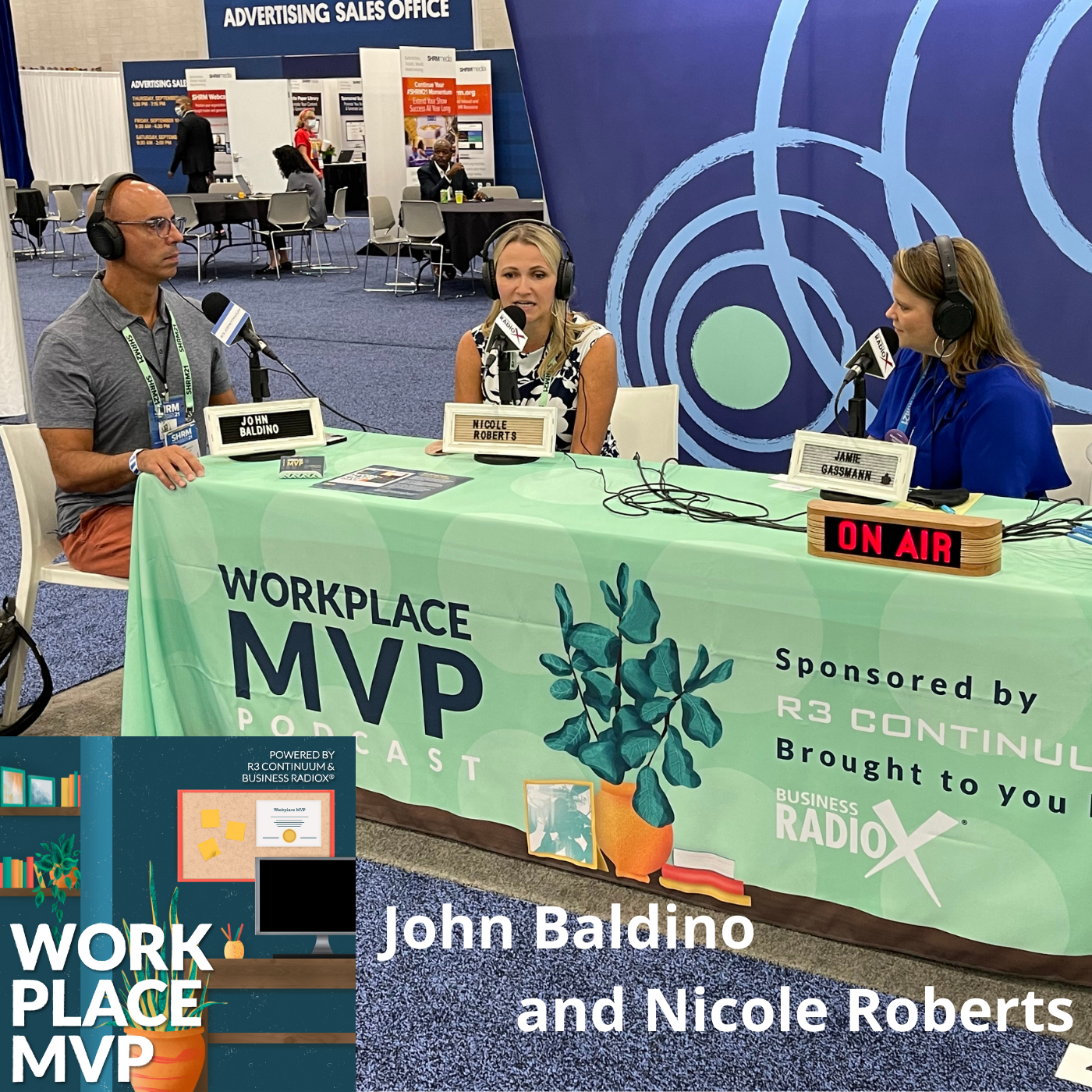


Tagged With: diversity, Diversity Equity and Inclusion, Employee Engagement, HR, Human Resources, Humareso, Jamie Gassmann, John Baldino, R3 Continuum, The Great Reshuffling, workers compensation, Workplace MVP

Workplace MVP LIVE from SHRM 2021: Nicole Roberts, MVAH Partners and John Baldino, Humareso

September 22, 2021 by John Ray

Humareso
Minneapolis St. Paul Studio
Workplace MVP LIVE from SHRM 2021: Nicole Roberts, MVAH Partners and John Baldino, Humareso
Loading
00:00 /
RSS Feed
Share
Link
Embed

Download file

Humareso

Workplace MVP LIVE from SHRM 2021: Nicole Roberts, MVAH Partners and John Baldino, Humareso

Nicole Roberts with MVAH Partners and John Baldino with Humareso joined host Jamie Gassmann on this live edition of Workplace MVP. Nicole spoke to the steps her company took to support their workforce, employee, and HR burnout, and how to be there for each other. John Baldino shared his work at Humareso, the HR consulting firm he founded, the unprecedented pace of change in compensation, and much more. Workplace MVP is underwritten and presented by R3 Continuum and produced by the Minneapolis-St.Paul Studio of Business RadioX®.

This show was originally broadcast live from the 2021 SHRM Annual Conference held at the Las Vegas Convention Center in Las Vegas, Nevada.

Nicole Roberts, SHRM-CP, PHR, Vice President of People & Culture, MVAH Partners

Nicole Roberts, VP of People & Culture, MVAH Partners

Nicole Roberts is Vice President of People & Culture for MVAH Partners. She started in March, 2020, three days before the pandemic affected their business. She went right to work figuring out how to help employees feel supported and finding solutions such as Support Link, a 14 touch point EAP service to employees.

Nicole started in human resources in 2004.

LinkedIn

MVAH Partners

MVAH began developing affordable housing in 1993. Since then they have developed more than 7,000 affordable housing units ranging across a broad spectrum of housing types: multi-story apartment properties for families and seniors, villas, single-family developments, rehabs, adaptive reuse of existing buildings in large and small communities. MVAH has a singular focus on developing quality affordable housing for those who need it most. This includes over 100 affordable housing properties in 15 states.

MVAH provides development services for their own long-term ownership as well as for other companies. MVAH values long-term partnerships and relationships with non-profits and public agencies and will continue to try to build relationships like those with others.

Company website

John Baldino, MSHRD SPHR SHRM-SCP, President, Humareso

John Baldino, MSHRD SPHR SHRM-SCP, President, Humareso

John is an SPHR, SHRM-SCP certified professional with 25+ years of HR experience in strategic planning, organizational development, coaching, leadership development, training, curriculum development, compensation analyses, employee relations, policies & procedures, business development, payroll & benefits administration.

He delivers keynote addresses across the US and in the international community. John was the 2012 Delaware Valley (Philadelphia Metropolitan Area) HR Person of the Year.

John started Humareso in 2012. He has a Master’s in Human Resource Development from Villanova.

LinkedIn

Humareso

Humareso is able to strategize with your company and develop plans to manage talent, recruit for skill gaps based on employee inventories, assess markets for growth, develop long-range succession plans and influence a culture of enthusiastic buy-in. Humareso handles all facets of employee engagement and business development. Humareso provides HR solutions and administration for small businesses trying to manage budget and growth.

Humareso sits strategically to support an organization’s vital talent needs. Talent is what they believe in cultivating. They look to drive organizational health through true employee engagement, strategic workforce planning and invested management training. Having a culture that values people, policy, and performance in the right measures is the differential needed to stand apart from other organizations. Whether your organization has 10 or 100,000 employees, dynamic human resources will build corporate strength and recognize talent contribution.

Company website | LinkedIn


About Workplace MVP

Every day, around the world, organizations of all sizes face disruptive events and situations. Within those workplaces are everyday heroes in human resources, risk management, security, business continuity, and the C-suite. They don’t call themselves heroes though. On the contrary, they simply show up every day, laboring for the well-being of employees in their care, readying the workplace for and planning responses to disruption. This show, Workplace MVP, confers on these heroes the designation they deserve, Workplace MVP (Most Valuable Professionals), and gives them the forum to tell their story. As you hear their experiences, you will learn first-hand, real-life approaches to readying the workplace, responses to crisis situations, and overcoming challenges of disruption. Visit our show archive here.

Workplace MVP Host Jamie Gassmann

Jamie Gassmann, Host, “Workplace MVP”

In addition to serving as the host to the Workplace MVP podcast, Jamie Gassmann is the Director of Marketing at R3 Continuum (R3c). Collectively, she has more than fourteen years of marketing experience. Across her tenure, she has experience working in and with various industries including banking, real estate, retail, crisis management, insurance, business continuity, and more. She holds a Bachelor of Science Degree in Mass Communications with special interest in Advertising and Public Relations and a Master of Business Administration from Paseka School of Business, Minnesota State University.

R3 Continuum

R3 Continuum is a global leader in workplace behavioral health and security solutions. R3c helps ensure the psychological and physical safety of organizations and their people in today’s ever-changing and often unpredictable world. Through their continuum of tailored solutions, including evaluations, crisis response, executive optimization, protective services, and more, they help organizations maintain and cultivate a workplace of wellbeing so that their people can thrive. Learn more about R3c at www.r3c.com.

Company website | LinkedIn | Facebook | Twitter

TRANSCRIPT

Jamie Gassmann: [00:00:07] Well, I think you hire veterans. I’m going to totally play off of that. So, I watch for my little clues of good convo.

Nicole Roberts: [00:00:17] I love it.

Jamie Gassmann: [00:00:17] Awesome.

Male Speaker: [00:00:18] So, let’s do a real quick soundcheck. I want to make sure we’re good. Nicole, pull that mic in, if you will, just a little bit. Awesome. And, these are directional mics, meaning if you’re back here or off to the side, you can hear the difference. So, we want you in there loud and proud. So, Nicole, just give your name and company affiliation.

Nicole Roberts: [00:00:36] Nicole Roberts.

Male Speaker: [00:00:38] Perfect. John?

John Baldino: [00:00:39] John Baldino.

Male Speaker: [00:00:42] Awesome. Okay. I think we’re ready to go.

Jamie Gassmann: [00:00:45] I think we are.

Male Speaker: [00:00:45] Okay.

Jamie Gassmann: [00:00:46] Awesome.

Male Speaker: [00:00:46] Here we go. You all have fun.

Intro: [00:00:53] Broadcasting live from the SHRM 2021 Conference at the Las Vegas Convention Center, it’s time for Workplace MVP. Brought to you by R3 Continuum, a global leader in workplace behavioral health, crisis, and security solutions. Now, here’s your host.

Jamie Gassmann: [00:01:12] Hello, everyone. Jamie Gassmann, your host here for Workplace MVP. And I am broadcasting from SHRM 2021 in Las Vegas, Nevada. And really exciting. I have three guests for this episode. So, I’m going to start out with our first guest, Nicole Roberts, who’s Vice President of People & Culture from MVAH Partners. Welcome to the show, Nicole.

Nicole Roberts: [00:01:34] Thank you very much.

Jamie Gassmann: [00:01:35] So, why don’t we start out with you telling us a little bit about your H.R. background, how you came into H.R., and a little bit about MVAH partners?

Nicole Roberts: [00:01:45] Sure. So, I started in H.R. in 2004 and started out in benefits and then moved into employee relations and was a department of one a couple of times and really just moved into more amplified roles throughout my career until I got into, you know, executive leadership and building and developing teams. And, currently, my role as vice president at People & Culture, I am able to set the strategy and be really intentional in how we want to show up and how we want to take the best care of our people and to really be intentional with our culture.

Jamie Gassmann: [00:02:24] Awesome. So, over the last year and looking at going now into 2021 and I know it’s hard to not talk about over the last year because H.R. has been impacted so much. And, from a cultural perspective, what have been some of the challenges that you’ve seen that you’ve had to get really strategic and kind of overcome over that last year?

Nicole Roberts: [00:02:42] So, when I started with MVAH partners, my first day was March 9 and as we know the kind of beginning, so to speak, of the impact of the pandemic on our cultures and on our workplaces was March 11. So, the traditional aspect and the traditional approach of, you know, get in, learn the culture, learn the people, all that, like all of that went out the window. And it was, what is most important to the business? How can we best support our people?

Nicole Roberts: [00:03:12] We are in 15 states and we have 100 locations. And, because we’re affordable housing, it’s essential that people have a place to live. So, we have not stopped through the entire pandemic. And so, our major focuses were making sure that our people who were working, you know, at front lines, so to speak, really felt supported and that we see you and we understand and we acknowledge that you are right there public-facing.

Nicole Roberts: [00:03:40] And, one of the things that we’ve done recently is we implemented Core Links…. It’s called SupportLink. And, what it is is it is what I would call an EAP on steroids. And, it is a 14-touchpoint EAP program. So, it really just meets people where they are if it’s an app, a phone number, a website. And, it really just was one of those benefits where we looked at it and we said we really can’t afford not to do this.

Jamie Gassmann: [00:04:13] Yeah. It’s almost like giving them access to something in the way that they want to receive that information. And, what kind of difference have you seen within the employees, maybe from a utilization perspective, by implementing something different like that?

Nicole Roberts: [00:04:25] So, one of the main things is during the pandemic, there were so many people that were reaching out and saying, “Hey, does our benefit program cover mental health? Do we have tech support? Do we have phone calls? How many visits is it?” And all of that.

Nicole Roberts: [00:04:41] And so, even before our renewal of 10/1, I started to talk to our broker and, like, what can we do? What solutions are out there? And so, we looked at four or five different companies and we decided that SupportLlink was perfect for us because it met people where they were and we’ve gotten so much positive feedback from that that not only do you have access to the care, but it is a licensed professional that you speak to the first time that you call.

Jamie Gassmann: [00:05:09] Right. So, they’re more accessible. Fantastic. So, you know, as you kind of look at it towards the end of this year, are there any things that you’re seeing now that we’ve kind of seen this increase in cases again? You know, are there challenges that are resurfacing that you’re having to navigate? And, what is that looking like for your organization?

Nicole Roberts: [00:05:27] Well, for us, so we went through, you know, state-by-state, and in some states, it was municipality-by-municipality, where the guidance was different. The regulations were different. And, there was kind of this feeling like, okay now we can breathe and then right back into it. So, for us, it’s really just making sure that, you know, the compassion fatigue doesn’t get to a point of complete burnout and exhaustion, and that people, you know, feel supported and that there’s – our biggest thing really is making sure that they have as much information as possible so that there’s not that additional stress of the uncertainty to go with it.

Jamie Gassmann: [00:06:13] Right. Well, and isn’t compassion fatigue and burnout becoming some of the most common things we’re hearing across multiple industries but particularly that frontline, kind of, essential worker, like here we go again kind of environments.

Jamie Gassmann: [00:06:28] So, when how – and I know you’ve got this program. But are there other things that you’re seeing with that compassion fatigue and burnout? And, are there ways that employers or H.R. people can be looking at and doing things to help out?

Nicole Roberts: [00:06:41] I think one thing that we really need to pay attention to as well is it’s not just our employees, it’s H.R. I mean, part of how you build resilience is you have that period of rebuilding and we just aren’t having that in this case. I mean, some of us have been, you know, just full steam ahead for so long that we haven’t even stopped to feel authentically how this actually is for us.

Nicole Roberts: [00:07:10] And so, I think from that aspect, we just need to really grant each other a lot of grace and we need to make sure that we’re caring for one another coming into situations with that positive intent, that benefit of the doubt, and asking, how are you? Not just what do you need and what can I get for you? And, you know, from a benefit perspective or anything like that. But really at the personal level, how are you? How are you dealing with this? Do you have kids that all of a sudden have been sent back home? Or, you know, what’s going on with you? And, I think that the biggest thing that we can do as H.R. is to not only be there for our employees but for each other.

Jamie Gassmann: [00:07:51] Oh, that’s a fantastic way, and SHRM is a great place to be able to do that. Reconnect with colleagues you probably haven’t seen for a while. Well, thanks, Nicole.

Jamie Gassmann: [00:08:00] We’re going to go into our next guest here, John Baldino from Humareso.

John Baldino: [00:08:06] Excellent.

Jamie Gassmann: [00:08:06] Did I say it right?

John Baldino: [00:08:08] Yes. Humareso.

Jamie Gassmann: [00:08:09] I tried really hard to punch that up for you.

John Baldino: [00:08:12] You did a great job. Fantastic.

Jamie Gassmann: [00:08:13] So, John, why don’t we start out with you introducing yourself, telling us a little bit about your background, tell us a little bit about Humareso, and kind of give us a little bit of background on you.

John Baldino: [00:08:22] Sure. So, I’m one of the old ones here at SHRM. Yes, I’m getting head nods. This month actually is my 30th year in human resources. And, I started out in personnel because that’s kind of what we used to be known as. And, I started out in the retail world and my career just, you know, evolved from there and leadership development and organizational design and development and H.R. stuff right over the past 30 years.

John Baldino: [00:08:51] And so, Humareso is my H.R. consulting firm that I began a little over nine years ago. And, it’s been a great ride. I mean, really, it’s been a lot of fun because we do a lot of great work with organizations of various sizes across the country, a little bit international. And so, from startups, which is really exciting, right, to watch all the startups trying to get things going, but also to organizations that are enterprise, multistate, multilevel organizations that have some of the same problems that startups have and trying to figure out a way to be customized in the approach to handle those problems because of their specific details. But there’s a lot of similar applications, right. So, it’s fun for our team to get to be a part of those things.

Jamie Gassmann: [00:09:32] Yeah. And, I imagine as a consulting firm, you see everything.

John Baldino: [00:09:34] I mean, unfortunately.

Jamie Gassmann: [00:09:37] Like everything.

John Baldino: [00:09:37] Everything. And videos. Yes.

Jamie Gassmann: [00:09:40] Okay, so everything.

John Baldino: [00:09:41] Thank you. Yes.

Jamie Gassmann: [00:09:41] Have to add that, right. So, talk to me. What are some of the, you know, kind of, you know, from the – I’m looking at the last year because I think that that’s really top of mind for a lot of people. But, you know, what are some of the things that you’ve seen in the consulting world that have been growing, kind of trending concerns or challenges that H.R. teams or employers have faced?

John Baldino: [00:10:01] Yeah. I mean, obviously, and then Nicole just did a great job talking about COVID response and you can’t ignore that. But there’s some residual in that as well. And so, we’re seeing some difficulty when it comes to talent management and talent acquisition. And, we’re also seeing difficulty when it comes to compensation management. How much do we pay people now? You know, the rate of pay is changing so quickly. I just was sharing this with somebody else.

John Baldino: [00:10:25] You know, again, I’ve been doing this a long time. There’s some great data that’s done from a compensation analytics standpoint that for the first time with some of the large providers of compensation data, they’re putting their hands up and saying, “We are so sorry. We’ve never experienced this kind of turnover in comp data. We can’t keep up.”

Jamie Gassmann: [00:10:46] Wow.

John Baldino: [00:10:47] And, that’s absolutely unusual. Like, never have I seen this before.

John Baldino: [00:10:52] Yeah. Well, in the rate of change, just in the worlds, I mean, you know, constant in terms of what people are needing.

John Baldino: [00:10:59] Yes.

Jamie Gassmann: [00:11:00] So, it’s very interesting. Have you seen, you know, obviously, from your experience, in nine years of doing consulting, are there some trends that might have been starting prior to COVID? So, you already saw the writing on the wall, but due to COVID just completely sped up the rate of the change.

John Baldino: [00:11:18] Yeah. You know, I know that we’ve talked a lot about work from home obviously over the past year. And, what I would say is, pre-pandemic there already were organizations trying to figure out how to be a bit more nimble and flexible. And so, this concept, I mean, even in my own organization in Humareso, not everyone came into the office every day, not every – and they weren’t hired in the city where the corporate offices are.

John Baldino: [00:11:41] So, we already had a sense of that. But, obviously, when COVID hit and that became much more of the conversation, for some organizations, it was, you know, a little too late. They could have been planned a bit better when it came to flexibility. But for some, they really saw this as the push to make things cleaner when it comes to employee experience and to finding talent. I mean, we’re seeing organizations that are – so, our corporate offices are in the Philadelphia area and we’re seeing companies, for example in Philadelphia, that are hiring their first employees this past year in San Francisco, in Chicago, in Austin, Texas, and, you know, Topeka, Kansas, because they can.

Jamie Gassmann: [00:12:28] Yeah.

John Baldino: [00:12:29] Right? And that’s kind of exciting.

Jamie Gassmann: [00:12:30] Right. Your candidate pool just expanded across the globe, basically.

John Baldino: [00:12:33] And, it needed to.

Jamie Gassmann: [00:12:34] Yeah. Absolutely.

John Baldino: [00:12:34] We needed it, too.

Jamie Gassmann: [00:12:35] But on top of that, though, how does that impact compensation? I know you mentioned the compensation numbers are off the charts. But when you live like, let’s say you have, you know, your offices are in somewhere remote Nebraska, but you’re trying to hire somebody in San Francisco. I mean, that rate of pay is like a night and day. How how does an employer navigate that?

John Baldino: [00:12:54] It’s a great question. I’m going to say they navigate it not very well and usually –

Jamie Gassmann: [00:13:00] And they need to hire you, right? Yeah. They need to call John.

John Baldino: [00:13:05] And, you know, then you get into – there’s a couple of different ways to approach it. There is a philosophy around the job is worth what the job is worth. Because that’s what you’re paying for is the skill sets and knowledge to be applied to get that work done. And that is worth X, whatever that is.

John Baldino: [00:13:21] Some organizations will do that as sort of a baseline, but then you have sort of cost of living add-ons put onto it to say, you know, living in San Francisco, as an example, or San Diego, it’s a lot different than living in Lincoln, Nebraska, right? It’s a little different for a variety of reasons. But compensation being one. And so, we can do the offset from a cost of living adjustment if we needed to. This way you’re not committing yourself to something beyond.

John Baldino: [00:13:46] But I will say there are employers that are, I hope, listening, right, who have put themselves in a corner to say we will never hire anybody from California because we don’t want to pay X, Y, or Z, we don’t want to do this and that. And I get that. But I would also say we’re in a time where talent is at a premium. So, you can’t afford to be that snotty about where you’ll take people, right. It’s not someone’s fault that they grew up in California. That’s where they are.

Jamie Gassmann: [00:14:14] It’s where they live. And then, the question comes to is with the shortage of employers or employees, right, that strain on employers trying to find that talent, you know, to your point, you know, sometimes they can’t really be overly picky, but, you know, how – they got to get into a certain mindset. So, if you were going to coach somebody and can kind of consult on how they should be approaching that, especially in today’s hiring world, what would be some of those key things you would remind them to do?

John Baldino: [00:14:42] Yeah. That’s really a good question. So, one of the things that I like to do and our team does is the hiring manager or executive who is having these thoughts. We try to say to them, okay, we’re going to take out a piece of paper, right old school, grab a pen, old school, and write down the top 10 tasks that you have in your job. Your job.

John Baldino: [00:15:05] And, you know, we’ll watch them write these 10. And, I’ll say, “When you started here, could you do these 10?” And, really have a heart-to-heart about – right. Well, I could do six out of 10 of these. I couldn’t do all six as well as I do them now, but I had an understanding. Okay. If I had your resume today, you wouldn’t let me hire you for that job. Right?

Jamie Gassmann: [00:15:28] That just got deep.

John Baldino: [00:15:29] Right.

Jamie Gassmann: [00:15:30] That’s awesome.

John Baldino: [00:15:31] You’re welcome. But you caused them to have a reality check. Like, you’ve been in your role, maybe for six years. You’re very comfortable. You know what you’re doing. You’ve had job enlargement and enrichment and have grown with it. You are not looking at it with those same eyes anymore to remember. You need to do that for this person who is bringing – you know, one of the things, and I know that this is going to come up probably a little bit later, too. But when you put out these job postings with these qualifications or what’s there, we have some people in our country who will look at these qualifications and self-select out.

John Baldino: [00:16:04] The statistics are off the chart about that. Look, if there are 10 bullet points of what you need and you’re a dude, you’ll do, too. If I have two out of 10, I’m 100% qualified for this job. That’s what you think. Women will be somewhere between seven and eight bullet points, and so they’ll self-select out of. And, if you’re in the military, the statistics are almost 10 out of 10.

John Baldino: [00:16:23] Come on, right. So, what are we doing that’s precluding people from thinking that they can be a part of it? Take a look at what you’re advertising, which you’re asking for a little bit deeper. And, remember, you can grow into some things. It’s not a day one.

Jamie Gassmann: [00:16:37] Right. And I love that perspective because that’s so true. And, I’ve heard that before, where men, you know, sometimes are, “Yeah, I’m fully qualified. I’m applying for it.” And, women tend to kind of take a step back.

John Baldino: [00:16:48] Yes.

Jamie Gassmann: [00:16:48] And so, if you were going to give advice to a candidate, you know, what – you know, who is looking at those job descriptions and going, “Oh my gosh, can I do this? Can I not do this?” What would be some of the advice you would give to them that helps them to identify that “No, you can do that.” You know, you may need to grow into some of these skills. But how should they present themselves or how should they kind of build up maybe some of that confidence?

John Baldino: [00:17:10] I think that when you look at it from a talent sourcing standpoint, finding people and connecting with someone to exactly your point, and saying and listening to someone say, “You know, I can’t do this. I see what you sent me. I can’t do this,” I’ll often say, “Oh, this is just, you know, a barometer of some of what’s needed. Let me ask you a question.” And then, I’ll ask something that seems disconnected and I’ll listen to someone share success that they’ve had and how they’ve been rewarded for that success. And, I’ll say fascinating. By doing whatever that is, X, the skills you demonstrated were a B and C. Funny how that will likely apply to these couple of areas that you’re saying I don’t have that. You have it all over the place, especially, I mean, again, something that might be common to some people listening is returning. If you’ve made a choice as a woman to take some time off to raise kids and you want to come back into the workforce and you say, “Well, I haven’t been working.” “Well, what have you been doing at home? I’d like to know?” Right? Because I have three kids and I know, right?

Jamie Gassmann: [00:18:18] I am a mom. I know.

John Baldino: [00:18:20] But you know what I mean?

Jamie Gassmann: [00:18:21] Yes. Absolutely. And to be able to say to you, “Did you manage the household? How about a budget?” Right? “Did you plan menus? Like, did you get your kids where they needed to be on time?” You know, maybe they weren’t dressed, but they were there on time. Like, whatever it is to just sort of laugh with it, be a little tongue in cheek about it, but remind them you demonstrated skill sets just in a different arena.

Jamie Gassmann: [00:18:42] Yeah, but they’re transferable.

John Baldino: [00:18:43] And, they are totally transferable.

Jamie Gassmann: [00:18:45] Yeah. Yeah. And so, one additional question because I am just kind of thinking about it. You know, in today’s candidate market and to some of the points you made about when people are reading those job descriptions and kind of self-selecting out, you know, do you think some of that comes down to how employers are writing that job description and how can they write them better that helps the candidates understand, “No, I can do that job,” or that may not be required on day one but we’re going to be looking for you to expand into that. I mean, is there’s something that they can be doing to maybe kind of get a little bit more innovative so candidates understand?

John Baldino: [00:19:20] Absolutely. I mean, I think there are a couple of things that come to mind. Number one, stop going to Google and, you know, downloading a job description, for Pete’s sake. I mean, I appreciate the accessibility but it’s the wrong way to approach it, right. Should I go on Google for your job description? You know, CEO, CFO, because you may not make it. Because it depends on the one that I’ll download.

Jamie Gassmann: [00:19:44] Right, right.

John Baldino: [00:19:45] The other thing I would say is, be creative in the way in which you can vet for qualifications. Use video. Use Facetime, right? You can do pre-records. You can do lives. We should be a lot more comfortable with those things as a result of this past year, right, to your point, earlier, like what has changed. Be creative in that way, too.

John Baldino: [00:20:05] I recently was working on a marketing specialist at our organization and the key to entry was, where’s your link to your portfolio, your online portfolio? Just send the link. I don’t – well, I have to get my resume together. No, thank you.

Jamie Gassmann: [00:20:21] Yeah. I want to see actual work.

John Baldino: [00:20:23] Right. No thank you. I’ll get the resume later. I need your name and email address. Can I just have the link to your – are you sure? Yeah. Actually, I know, I run the company. I’m pretty sure. Just sent it to me. It’s okay.

Jamie Gassmann: [00:20:36] Are you questioning me? Are you questioning me? Really?

John Baldino: [00:20:40] And, you do that and someone is – the interesting thing about that in that particular role is that’s their bread and butter.

Jamie Gassmann: [00:20:47] Yeah.

John Baldino: [00:20:48] The creative, innovative approach to design and development. So, start with the best foot forward. Why wouldn’t you want to?

Jamie Gassmann: [00:20:55] Yeah. What is your LinkedIn look like and is you have a picture on it? I mean, that’s –

John Baldino: [00:20:59] Right.

Jamie Gassmann: [00:20:59] Honestly, I mean, that’s going to be – you’re going to be expected to do that and so –

John Baldino: [00:21:03] Right.

Jamie Gassmann: [00:21:03] Fantastic. Yeah.

John Baldino: [00:21:03] So, to have that kind of different approach, I would say for employers, look at the job, and I know we’re going to hear some more about that from a talent acquisition standpoint. But what does this job ask for? Is there are different ways that you can find out that information than just a sheet of paper?

Jamie Gassmann: [00:21:15] Yeah. Fantastic. Well, thanks so much for joining us, John.

John Baldino: [00:21:18] Thank you.

Jamie Gassmann: [00:21:21] So, yeah, thank you for joining us. Sorry, I just got a little bit distracted from the show floor here. Lots of people coming by. Very exciting. But we’re going to – if anybody needs to get a hold of you, John, how would they do that if they wanted to get in touch with you and reach out for more information?

John Baldino: [00:21:37] So, certainly the website @humareso.com, H-U-M-A-R-E-S-O .com. And you can connect with me there, or I’m on Twitter all over the place @bjalive, like not dead, but alive, jbalive.

Jamie Gassmann: [00:21:51] Fascinating. Well, it’s been great to have you on the show. Thank you so much. And, thanks to Nicole as well who did have to step away because obviously, these are working, you know, H.R. folks trying to get all their education here at the show. And, if you are in the area, stop by Booth 4076 and check out R3 Continuum’s booth, our show sponsor. And, thank you again. Have a great day.


Tagged With: Affordable housing, HR Consultant, Human Resources, Humareso, Jamie Gassmann, John Baldino, MVAH Partners, Nicole Roberts, R3 Continuum, SHRM 2021, Workplace MVP

Business RadioX ® Network


Our Most Recent Episode

CONNECT WITH US

  • Email
  • Facebook
  • LinkedIn
  • Twitter
  • YouTube

Our Mission

We help local business leaders get the word out about the important work they’re doing to serve their market, their community, and their profession.

We support and celebrate business by sharing positive business stories that traditional media ignores. Some media leans left. Some media leans right. We lean business.

Sponsor a Show

Build Relationships and Grow Your Business. Click here for more details.

Partner With Us

Discover More Here

Terms and Conditions
Privacy Policy

Connect with us

Want to keep up with the latest in pro-business news across the network? Follow us on social media for the latest stories!
  • Email
  • Facebook
  • Google+
  • LinkedIn
  • Twitter
  • YouTube

Business RadioX® Headquarters
1000 Abernathy Rd. NE
Building 400, Suite L-10
Sandy Springs, GA 30328

© 2025 Business RadioX ® · Rainmaker Platform

BRXStudioCoversLA

Wait! Don’t Miss an Episode of LA Business Radio

BRXStudioCoversDENVER

Wait! Don’t Miss an Episode of Denver Business Radio

BRXStudioCoversPENSACOLA

Wait! Don’t Miss an Episode of Pensacola Business Radio

BRXStudioCoversBIRMINGHAM

Wait! Don’t Miss an Episode of Birmingham Business Radio

BRXStudioCoversTALLAHASSEE

Wait! Don’t Miss an Episode of Tallahassee Business Radio

BRXStudioCoversRALEIGH

Wait! Don’t Miss an Episode of Raleigh Business Radio

BRXStudioCoversRICHMONDNoWhite

Wait! Don’t Miss an Episode of Richmond Business Radio

BRXStudioCoversNASHVILLENoWhite

Wait! Don’t Miss an Episode of Nashville Business Radio

BRXStudioCoversDETROIT

Wait! Don’t Miss an Episode of Detroit Business Radio

BRXStudioCoversSTLOUIS

Wait! Don’t Miss an Episode of St. Louis Business Radio

BRXStudioCoversCOLUMBUS-small

Wait! Don’t Miss an Episode of Columbus Business Radio

Coachthecoach-08-08

Wait! Don’t Miss an Episode of Coach the Coach

BRXStudioCoversBAYAREA

Wait! Don’t Miss an Episode of Bay Area Business Radio

BRXStudioCoversCHICAGO

Wait! Don’t Miss an Episode of Chicago Business Radio

Wait! Don’t Miss an Episode of Atlanta Business Radio