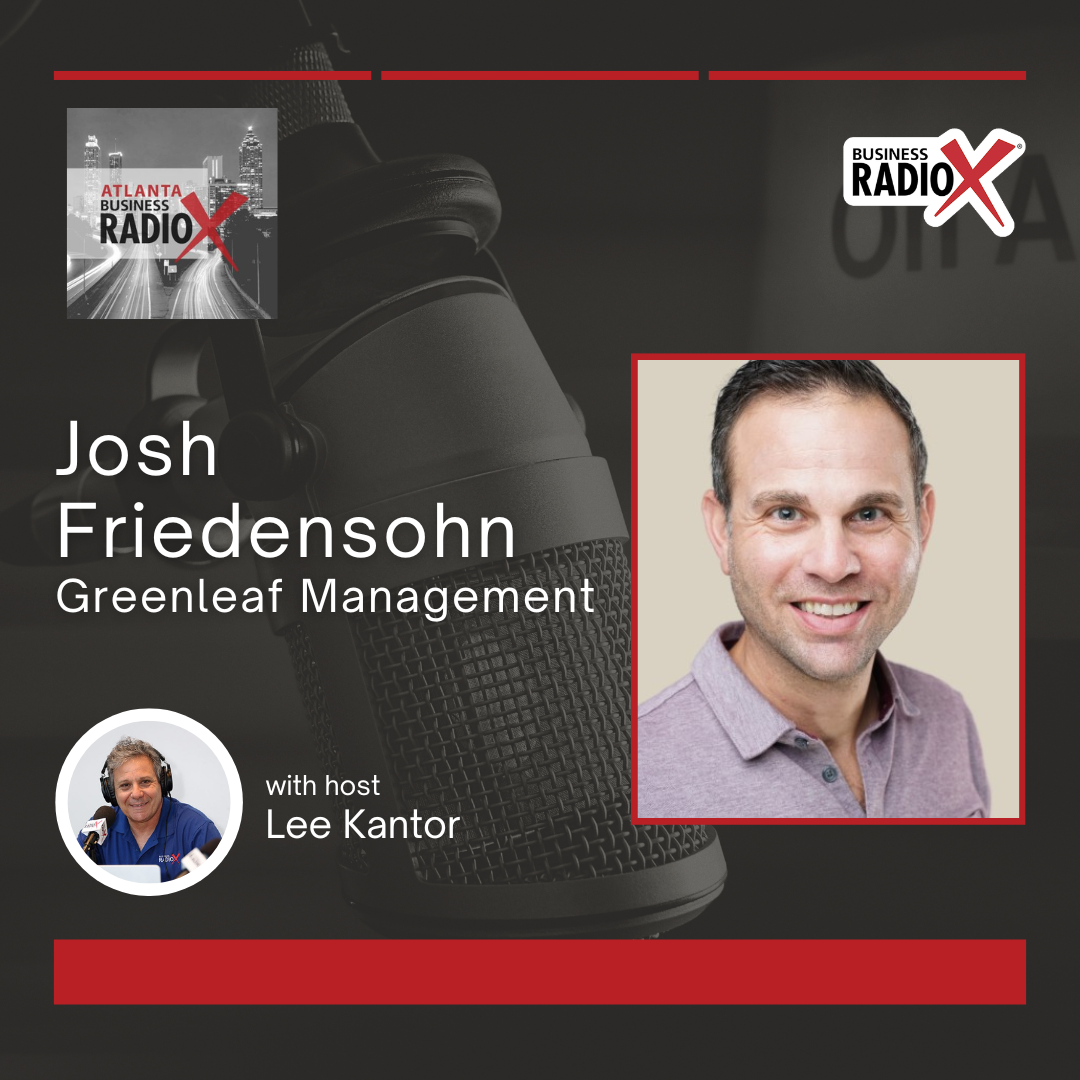

In this episode of Atlanta Business Radio, host Lee Kantor interviews Josh Friedensohn, co-owner of Greenleaf Management. Josh shares how he and partner Dave Codrea built a real estate investment company focused on acquiring and revitalizing distressed properties across Atlanta and the Southeast. Starting during the Great Recession, they capitalized on undervalued properties, renovating them to benefit tenants and communities. Their portfolio has evolved from multifamily housing to office, industrial, and retail spaces. Josh also discusses their investor-focused model, naturally occurring affordable housing, and their long-term stewardship philosophy of creating community value rather than maximizing short-term profits.

 Josh Friedensohn is co-founder of Greenleaf Management and directs acquisitions, fundraising, and lending relationships throughout each asset’s life cycle. An adaptive and strategic leader, he has guided Greenleaf through multiple shifts in the real estate market and into new asset classes.
Greenleaf began with single-family and student housing investments before expanding into low-income multifamily housing. After eight years, the company grew its multifamily portfolio to 4,000 units and expanded into mobile home communities, NNN leased properties, and commercial office investments. Over the past 18 years, he has helped lead more than 150 acquisitions.
The relationships Josh has built with brokers, bankers, and investors continue to serve as catalysts for Greenleaf’s growth. He leads the company’s Capital team, which he has expanded to support new partnerships and investment opportunities.
He is also passionate about community impact. He supports nonprofit initiatives that create opportunities for underprivileged youth, including Camp Impact (20 years) and the Crazy Science Extravaganza (13 years). Greenleaf has also launched its own nonprofit focused on reducing everyday costs such as food, utilities, transportation, and education in the communities where it operates.
He graduated from the University of Texas with a degree in Chemical Engineering and lives in Peachtree Corners, Georgia with his wife and four boys.
Connect with Josh on LinkedIn.
What You’ll Learn In This Episode
- Origins and founding of Greenleaf Management
- Focus on buying and renovating distressed properties
- Impact of the Great Recession on real estate opportunities
- Challenges faced by undercapitalized property owners
- Evolution of the company’s portfolio and investment strategy
- Definition and distinction between affordable housing and naturally occurring affordable housing
- Community benefits of revitalizing distressed properties
- Investment approach and engagement with investors
- Current market opportunities and property types of interest
- Philosophy of long-term stewardship and community impact in real estate investment
 This transcript is machine transcribed by Sonix.
TRANSCRIPT
Intro: Broadcasting live from the Business RadioX Studio in Atlanta, Georgia. It’s time for Atlanta Business Radio, brought to you by Kennesaw State University’s Executive MBA program, the Accelerated Degree program for working professionals looking to advance their career and enhance their leadership skills. And now, here’s your host.
Lee Kantor: Lee Kantor here, another episode of Atlanta Business Radio. And this is going to be a good one. But before we get started, it’s important to recognize our sponsor CSU’s executive MBA program. Without them, we couldn’t be sharing these important stories. Today on the show, we have the co-owner with Greenleaf Management, Josh Friedensohn. Welcome.
Josh Friedensohn: Thank you. Thanks for having me.
Lee Kantor: Well, I’m excited to learn what you’re up to. Tell us about Greenleaf. How are you serving folks?
Josh Friedensohn: So my business partner, my business partner is Dave Coudray. Him and I started the business, uh, really right out of college. But while we were still working our day jobs. But we’ve, we’ve built a business of community and service. So we buy buildings that are distressed using investor money. So we pull together investors, buy distressed properties, and then make them better for the community and the people around us. And that also brings tenants into them. We’ve done that with everything from single family housing to multifamily housing to office buildings to industrial properties. And all the while, as we do this, it really brings up and lifts the area around us because typically a vacant building is a blight on the area and we’re looking to make it better.
Lee Kantor: So what was the genesis of that idea? Where did you see the opportunity?
Josh Friedensohn: Dave and I met through my college roommate and we were working at our day job. So my day job, I studied chemical engineering and I was I was a chemical engineer for Kimberly-Clark for seven years. Dave was a real estate finance guy, a consultant at Deloitte in D.C. and we were I was down here in Atlanta, and we were were looking for investment opportunities in a way to start a business. And Dave had a really strong background in real estate. And at the time, the great financial crisis was really, uh, was really under underway. So this is call it 2007, 2008, 2009. And Atlanta became one of the best buying opportunities for single family homes in the country. And so homes that were selling for 4 or $500,000 in 2006 were now selling for 80 to $120,000 throughout metro Atlanta and some even less. And so we saw an opportunity to buy a couple of these homes and renovate them and get and lease them. But also what we did was we saw that people were stuck in their houses and they couldn’t sell them, and they were greatly upside down. And so we started knocking on doors and saying, hey, we can help you solve this problem. We know you want to move. We know you want to sell your house, but you can’t right now. How about this? We’ll take over property management of your house. We’ll renovate, we’ll do the minimum renovation because we know you don’t have excess cash, get a tenant to move in, and that revenue for the rental revenue will help fix your debt to coverage ratio when you go buy your next house.
Josh Friedensohn: And so we went knocking on real estate offices, doors, and we started incentivizing real estate brokers to refer their clients that couldn’t move to us and enable them to move. And then the real estate broker got a commission for helping them by their next house. So we really started there. And that kind of led us into this, this thesis of how do we help solve problems? How do we fix, how do we fix issues? Led us into a low income apartments predominantly along in Atlanta, along Buford Highway is where we probably bought our first 20 properties and they were boarded up. Uh, the the water wasn’t running to them because the, the previous owner didn’t pay the water bill. Uh, gas lines were broken. People didn’t have heat. And we were able to buy these directly from the lender, renovate them, and make a better community for the people that live there. They fell in love with our commitment to them and the property, our management style, and they would bring their friends and family, and the whole place would lease up in a matter of weeks. So we really have just copied that model over the years and kind of led into other different building types.
Lee Kantor: So before you or when you’re not around the typical, like, why do those, um, areas get kind of distressed?
Josh Friedensohn: Yeah. So it’s a great question. Um, you know, the great financial, you know, the, the great Recession, you know, that that hit and give or take 2008 really just wiped out a lot of people’s pocketbooks. So real estate requires constant capital investment. And over, you know, if you’re let’s talk about a multifamily property, it doesn’t have to be big. You can talk about a ten unit property. When the Hvac goes out, you don’t really have the option to keep kicking it down the road. It’s gone. Especially on a 1960s, 1970s property. It’s probably on its fourth one, and you need to put the fifth one in. Well, if you don’t have three, four, or $5,000 sitting around to make that investment. Because of what? Because of your your the recession that’s happening, you couldn’t keep investing in those properties. And that led to a faces are out. Well, if a tenant’s Hvac is out, the landlord is now in violation of the lease and the tenant moves out to another property that has Hvac. So properties went vacant and things just got worse and worse and worse and really compounded in that direction.
Lee Kantor: So that, um, is it so it’s an undercapitalized kind of management company that is at the heart of the problem.
Josh Friedensohn: I would say undercapitalized owner is probably the is probably the answer. Um, and lack of liquidity in the market that, you know, if, if you, if you don’t have the liquidity, a lot of times if the property is performing well, you can go to a bank and get a renovation loan or get an improvement loan. Well, banks were totally wiped out during the recession. So there was not a lending option. People didn’t have the liquidity. So taking care of these properties, honestly, it just required a fresh set of capital to come in and recapitalize the deal. So a lot of the properties we were buying, the former owner had had bought them for, say, $50,000 a unit and they had $30,000 a unit of debt on them. Well, we were buying them for 25 to right below the debt amount, and we were only putting 10,000 a unit of debt on it. And the rest we were raising money for. And so we were, it was just a different capital stack that was able to improve the properties and fix the problem.
Lee Kantor: Now, um, we’re not in that financial situation right now. Are there still opportunities?
Josh Friedensohn: Correct. We’re not in a financial situation right now. Um, opportunities are fewer and further between. We’re in a very challenging market to find buying opportunities, distressed buying opportunities because the market has been so liquid, meaning that owners have free cash flow that they’re putting in their pocket and investing in their properties. Banks are lending decently healthy. Um, so you can get improvement loans. You can get new loans to buy properties and properties are selling at a really high value. So most owners of commercial properties or apartment buildings, they own more than one. And at times if they own five properties, they’ll sell one of them. And that will and that knew that all that new money that comes in will help improve the other ones. So it’s a, it’s a, it’s a much better, healthier market than it is now, so it’s harder to find deals. Um, we are still finding opportunities where like where we’re buying heavily right now is in industrial space. And industrial space has moved very quickly. So we can find opportunities that tenants are paying half of the market rent, and we can go in and renovate the place and get them to all the way to market rent. Or we can find properties that tenants leases are coming up and they’re not renewing. And it really just requires a fresh set of capital to renovate the place and bring a new tenant in. So yes, there’s still are opportunities, but they’re fewer and further between.
Lee Kantor: And your portfolio has evolved based on these kind of new market demands.
Josh Friedensohn: Absolutely. Yeah. So we, um, at our peak, we had about 4000 something apartment units and about 1500 mobile homes. So all residential. Now we’re down to about 20% of that. And we redeploy that capital into office buildings, retail properties and industrial buildings.
Lee Kantor: So that’s where you see the greatest opportunity in this market climate.
Josh Friedensohn: Exactly. That’s where we’re really finding that we can still buy, uh, really in any market. We can still buy in distressed pricing and bring improvement dollars. Because if a tenant’s been in a building for 20 years and they leave and the owner is, is basically stuck with a vacant building needing millions of dollars, and a lot of times they’re better, they feel that they’re better off selling that property so we can buy it as basically distressed, meaning that it’s vacant and put a bunch of money into it. Uh, one of one of those recent, I would say value add purchases was last fall we bought a vacant film studio. So as most people know, Atlanta was a hotbed for filming, uh, movies and, and TV shows, etc., etc. and still is, but a lot of that industry has moved overseas because of the complexity of using us domestic, uh, film crews here. There’s strikes. They cost a lot of money. Um, there’s a lot of red tape. So a lot of the film industry has moved abroad. And Atlanta built out all this infrastructure for the film industry. And it’s not being used as much anymore. And they’re perfectly built industrial buildings that the film industry doesn’t have use for. So we’re buying them vacant and repurposing the buildings.
Lee Kantor: Right. So that sounds like that’s kind of the model, right? Is look for distressed opportunities where you can come in and infuse it with new capital and maybe repurpose it. And then.
Josh Friedensohn: Exactly.
Lee Kantor: Do what you do in terms of providing that high quality management and that really caring for the end user.
Josh Friedensohn: Exactly. Yes.
Lee Kantor: Now, you mentioned starting in this kind of multifamily environment, is that do you call that affordable housing? Is that what when people refer to affordable housing, is that affordable housing?
Josh Friedensohn: So there’s two kind of definitions of affordable housing. One is, kind of the industry term, affordable housing, which would be a restricted rent based unit. So, um, the government will incentivize owners to limit the amount of rent that they’ll charge to potential tenants to make housing more affordable. That’s the technical term. The, the less technical term is what we do, which is, um, what we call it, uh, naturally occurring affordable housing, which means we have older buildings that are in good condition, but they’re still older buildings and they naturally attract a lower income tenant to live there versus a brand new building with elevators and pools and all that. We don’t have any of that in our buildings. Um, and so in a, it’s, it’s, it’s more, it’s a more natural way that we’re not restricted by the government on what we can charge. We can charge whatever we want, but our, but the market dynamics is we’re generally in the lower end of the, of the rental spectrum because of the age and condition of our properties. Does that make sense?
Lee Kantor: Yeah. I mean, I was always confused with the term affordable housing because if if there’s a subsidized housing for an individual, are they just getting lower rent to afford to live in a desirable area without any opportunity to build wealth for themselves? Are they just basically renting a nice place, a nice area at a lower price? I never understood kind of the logic there because any even an area that’s distressed, if it becomes more desirable, then the value will go higher. And if the person who’s paying the rent isn’t getting any upside, then, you know, it just didn’t make any sense. I didn’t understand conceptually the logic behind it.
Josh Friedensohn: So and then the other component that I didn’t really mention was on the kind of government side of things is, is the subsidy, the true subsidy, meaning that the tenant is getting a monthly check from the government and the government is and then they’re using that to pay their rent to us. So that’s the, I would say the additional layer, um, that that comes into play. We have a little, we have maybe 10% of that in our portfolio. Not much. Um, but we’re very familiar with and we’re familiar with the way it works. But to your point, um, these are in the most part, these, these tenants in these conditions are, are they don’t really have the luxury of looking ahead and saying, how do I build myself out of this situation? They’re more looking from a day to day survival mode on how do they pay their daily bills and how do they get their hourly paycheck? And, um, we, our, our goal is to provide them housing that a comfortable place for their family to raise a family with enough space in a, in a safe environment that they can afford to do that.
Lee Kantor: Right. Well, that makes sense to me. Like that the, that logic makes sense. I didn’t understand when the government’s involved in subsidizing people in an area that is appreciating in value and then somebody is getting the upside, but it’s not them.
Josh Friedensohn: Right, right. Well, there, there, I, I would, I would somewhat disagree with that because I do believe that that so we have a, we have an affordable, it’s actually expiring affordable housing. So affordable housing has a time limit when you have these restrictions. Um, going back to the government restrictions on the property, they’re usually a 30 year contract with the government. And then after 30 years that goes away. So we have a property like this in Alpharetta. Um, and it’s the only one in North Fulton. It’s the only one in Alpharetta. And the benefit is, is that the tenants that are paying the subsidized rent get to use these top tier schools and get to use the top tier amenities that an Alpharetta provides, versus if they have to live in a low income area in a low income property, the schools are usually catered to more low income, meaning that they’re a little bit rougher and the community around them is usually a little bit rougher as well and not really taking care of as much. So I, you know, I do think there are some, I would say, less tangible benefits of being in a, a nicer community to raise your family that you can’t necessarily afford on your own, that the government is helping you be in that community.
Lee Kantor: But I mean, in that case of Alpharetta, I mean, that happened probably towards the tail end of the 30 years rather than the first part of the 30 years.
Josh Friedensohn: In terms of being kind of.
Lee Kantor: The the quality of schools.
Josh Friedensohn: Right? I’ve been in Atlanta for 20 years. Alpharetta has always been a pretty, pretty gem to be in. Um, we’ve had this property for about ten years and Alpharetta has been top tier schools for a long time. So yes, yes, but I mean, Alpharetta has always been a.
Lee Kantor: And there’s one affordable housing place in Alpharetta, like compared to other parts of the city of Atlanta.
Josh Friedensohn: Correct. Yeah. Other parts of the city of Atlanta.
Lee Kantor: Do you want to compare the school systems and all the affordable housing? How do you think they’d fare?
Josh Friedensohn: Exactly. No, I agree with you on that front.
Lee Kantor: So, um, now has your companies evolved? Is it now a place where people can make investments into these properties? And, and this is now an investment vehicle? Like what, how would talk about the evolution of, you know, at one point you were doing this for yourself, or was this always a place for people to invest in, in your kind of vision?
Josh Friedensohn: Yeah. I didn’t really have any, uh, any money to invest, uh, for a long time. Um, so we’ve always raised money and pulled together investors. So, and the way we do it is we find the property, we evaluate the property for give or take about 30 days is our evaluation process. Once we determine that we want to go proceed and buy this property is when we offer it out to our investor community and show them, hey, this is the opportunity that we see. Here’s the physical nuts and bolts. Here’s how we plan to improve the property management of it. And here’s the dollars and cents of what an investment looks like and what we plan to turn it into. And a potential, you know, call it a five year hold horizon, what that means for your money. Um, we kind of look at investors two ways. One is the primary way is we want you to be part of our community. We want you to, to be involved with our company. Uh, we offer a lot of investor engagement into our, our operations, our property management tours. And also we do speaker series. We have a, we have a, every quarter, we do a growth day where we invite all our investors. We actually invite the whole community. You’re welcome to come to our growth day. It’s next Thursday. Um, and we have speakers come in and we talk about big goals that we have set and how we accomplish those goals. We have speakers from all different walks of life that will tell their story. Um, and so that’s, that’s the, uh, I would say nontraditional investor involvement. The traditional investor involvement is you write a check, you’re involved with one of our properties. We report to you every quarter. We pay distributions as they’re available by the property performance, and eventually we sell it. And we show you more and more opportunities to invest in now.
Lee Kantor: So the investors are buying one property at a time. There’s no way to buy kind of the portfolio.
Josh Friedensohn: No, we’ve always been, I would say a little bit grittier than the portfolio. What we found is like doing the fund or the portfolio approach. It’s, it’s less tangible. So like I’m like, hey, Lee, I have this great fund that has 50 properties in all over the country. You want to make an investment, you’ll make 10% a year. You’re like, well, where are the properties? What are they? Oh, they’re in the fund. I’ll send you, I’ll send you paperwork versus Haley. We just bought a film studio in Hiram, Georgia. Do you want to go on a drive with me? We can go look at it together. We can tour it together. We can touch it together. In three months from now, we can go look at it again and show you all the improvements. It’s just a lot more. It’s a lot grittier and more tangible. And that’s kind of our approach to business.
Lee Kantor: And then so you’re doing this in markets outside of Georgia as well.
Josh Friedensohn: So we’re probably pretty close to 70% North Atlanta. Um, we are in Chattanooga and Nashville, Raleigh, Durham, Columbia and Greenville and Charlotte as well. Uh, we kind of called the 85 and 75 corridors north of Atlanta. And, um, we’re looking at some, you know, we’re looking at some, some industrial development in, uh, north of Austin, Texas as well. Uh, so we, we generally like to operate everything we own and kind of be and have hands on people where we go. So that’s, that’s the only way the markets we’re looking at.
Lee Kantor: So you have partners in all those communities outside of Atlanta?
Josh Friedensohn: Yeah. I mean, outside of Atlanta, it’s my staff that operates them. Um, and in Austin, we have, we have an operating partner that we be working with.
Lee Kantor: And then, so what do you need more of? How can we help you?
Josh Friedensohn: Yeah. So we’re always looking for.
Josh Friedensohn: I would say, an opportunistic real estate deal. So, um, you know, if you drive a property, it looks boarded up, it looks vacant. It looks like it could use some love. We’re always looking at that, whether it’s retail, whether it’s industrial, whether office building. I mean, we haven’t bought multifamily in 7 or 8 years because there’s just so much competition in that space. Um, so yeah, my, my weekend when I’m driving my, I have four kids when I’m driving them between soccer practice and gymnastics and all that other crap. I’m looking at buildings everywhere I go. So, uh, if anyone, you know, I would say for the general audience, we’re always looking, we’re always looking for a buying opportunity and to make improvements. And, but we like the value add story. Like I’m not the group that’s we’re not the group that’s going to buy a Starbucks and just lease it to Starbucks and just kind of go to sleep at the wheel. We’re, we’re always looking to how do we make an improvement at this place.
Lee Kantor: So just for people, if they’re driving around, what are signals that maybe there’s a distressed property? Is it like when there’s a a fast food restaurant that’s closed and it’s empty? Like, is that a signal for you?
Josh Friedensohn: Yeah, that’s absolutely a signal. Um, I would say the obvious, which would be there’s a for sale for lease sign in the yard. Uh, the grass is overgrown. The windows are boarded up. Any one of these are signals that there’s something going on here that the person that the owner needs to get out, the owner might be a bank. They don’t want to own the property anymore. They want to get out. Um, also, you know, we’re always looking for expanding companies, expanding brands that want more space. So we, um, we’ve done partnerships with an operator at Zaxby’s where he came to us and say, hey, listen, um, I’m looking to expand stores. Will you guys help me buy a store and provide me renovation dollars? Right. Absolutely. And he signed a ten year lease with us when we did that. So, um, every, every of that. And then the other part of it is, you know, we, we have a podcast where we talk about our deals on a regular basis. Uh, we, we have an additional podcast where we interview government officials. So we interview mayors right now. We’re interviewing government governor, governor, candidates, um, on both the Republican and Democratic side because we have a big race coming up in the fall in Georgia. And, um, so we’re always looking kind of, you know, to tell the story of, um, of, of people that, that want to hustle.
Lee Kantor: And then, um, is there an investment you made that you’re most proud of or most rewarding? You can share.
Josh Friedensohn: Investment? I mean, oh man, that’s a, that’s a loaded question. Um, you know.
Lee Kantor: I mean, you don’t, it doesn’t have to be about the, maybe it’s not the financial gain, but it’s about the impact it made in the community.
Josh Friedensohn: Yeah, absolutely. I mean, I, I like talking about kind of more. I mean, we’ve done a lot of I have lots of stories from the apartment days, but it’s been a while since we’ve done that. So I want to talk about something more recent. Uh, the, over the last three years, we’ve bought about 1,000,000ft² of single story office buildings that were vacant. And these were grasses, overgrown dirty buildings. You know what vacancy you have people that do stuff in the parking lot that you don’t want them doing. Um, and they become an issue for the city and the owner. And it’s just a problem. We bought these single story office buildings and we ripped out all the old office. We put a roll up door in them and storage in the back by the roll up door and put a small office in the front and we lease it to, we call them office flex users, and they’re everything under the sun. They’re pest control companies, they’re Hvac, they’re plumbing. Um, and like, I have a pharmacy in the building in the unit next to me that I’m sitting in right now.
Josh Friedensohn: Um, um, I have car storage. We have, um, I, we have a um, a car parts distributor. So everything we have a pet crematorium in one of our buildings. Um, I, I’m very excited about that opportunity. I think that opportunity still exists that we buy single story office and convert it into this flexi, um, investment. And it does so much not only for obviously the tenants that come in there, but so much for the surrounding community. The building that I’m in right now, I live in Peachtree Corners. This building is in Peachtree Corners. My kid, I, I have to pass it every single day. I’m dropping my kids off at school, picking them up, driving them activities. And it was really just a, a pain in the butt looking building. Um, before we bought it and, and made this investment. And now it’s one of the, it’s just, it’s just one of the, the pretty shiny buildings in Peachtree Corners. It has a beautiful car lounge in it. Um, and it has just active use that just adds to the whole community around us.
Lee Kantor: And that’s really at the heart of this, right? You want to be a force for good and not just kind of squeeze every dollar out of what’s happening there. You’re trying to really positively impact the communities you’re in.
Josh Friedensohn: Well, what we found is that squeezing, squeezing every dollar out is not actually a good investment approach. There’s no long term commitment to squeezing every dollar out. That’s a very short term minded thing. And I think eventually everything just falls. If you’re squeezing every dollar, eventually there’s no dollars left and you’re giving that property back to the bank for someone like me to buy and actually love on it. So, um, a wise investor of ours said to me, um, that if you hold real estate, it will hold you. And it’s one of my favorite phrases and beliefs in real estate that if you make the right investments, if you take care of it and you do the things for the long, the long run, it will hold you back and take care of you back. And that’s just a general philosophy of our company.
Lee Kantor: And it sounds like that’s just the part of the culture of your organization is trying to positively impact the communities.
Josh Friedensohn: Absolutely.
Lee Kantor: Well, Josh, if somebody wants to learn more, um, where should they go? What’s the website? What’s the best way to connect?
Josh Friedensohn: Yeah. So our website.
Josh Friedensohn: Is Greenleaf mgmt.com. Um, we’re, you know, we’re on YouTube with our podcast. So you can look up Greenleaf, uh, you can look up my name. My business partners name is Dave Cordray. Um, and, uh, we, we just like, uh, we like building community. We like, uh, spreading the word about, uh, how to operate real estate. And we love hearing about other people’s operational stories, so we’d love to connect.
Lee Kantor: Good stuff. Well, Josh, thank you so much for sharing your story, doing important work. And we appreciate you.
Josh Friedensohn: Of course. Anytime.
Lee Kantor: All right. This is Lee Kantor. We’ll see you all next time on Atlanta Business Radio.















