

In this episode of High Velocity Radio, Lee Kantor interviews author and Ironman athlete Jim Logan, who shares his remarkable journey after being diagnosed with stage four metastatic colorectal cancer. Jim discusses how endurance sports, unwavering faith, and a mindset of focusing on the present helped him transform a terminal diagnosis into a mission of resilience, service, and hope. He also talks about his book, Just Keep Tri-ing, his preparation for the Ironman World Championship, and his commitment to inspiring others facing life’s greatest challenges.

Jim Logan is a lifelong endurance athlete and proud member of Team IRONMAN Foundation (Team IMF), a select group of athletes committed to creating positive, lasting change in race communities around the world.
Guided by the belief that faith creates hope—and that with hope, anything is possible—Jim was honored to be selected to compete with Team IMF at the 2026 IRONMAN World Championship in Kona, Hawaii.
Over the past four decades, Jim has completed approximately 300 endurance races and has been pursuing IRONMAN competitions since 2018. In April 2024, his life changed dramatically when he was diagnosed with stage 4 metastatic colorectal cancer that had spread to his liver.
Despite receiving a terminal diagnosis and undergoing more than 20 chemotherapy sessions, radiation treatments, and multiple major surgeries—including the removal of 40% of his colon, 60% of his liver, his gallbladder, and his rectum, resulting in a permanent ostomy—Jim has continued to defy expectations.
More than two years after his diagnosis, he remains determined, resilient, and committed to living life with purpose while continuing treatment for new liver tumors.
Alongside his medical journey, Jim continues to train for the IRONMAN World Championship and authored the book Just Keep TRI-ING, which was written to inspire faith in the discouraged, offer hope to those facing life’s greatest challenges, and raise funds for the IRONMAN Foundation. All profits from the book are dedicated to supporting the Foundation until its fundraising goals are achieved.
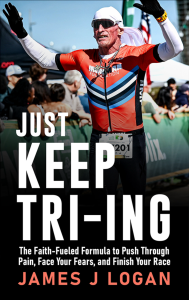 In 2026, Jim simplified his life around three meaningful goals: arriving in Kona healthy and prepared to complete the IRONMAN World Championship, sharing the message of Just Keep TRI-ING with as many people as possible, and raising significant funds for the IRONMAN Foundation.
Through his journey, Jim continues to inspire others by demonstrating that resilience, faith, and purpose can overcome even life’s most difficult challenges.
Follow Jim on Facebook.
What You’ll Learn In This Episode
- Transforming adversity into purpose through resilience and perseverance.
- Building a mindset that focuses on living fully rather than fearing the future.
- Using endurance sports to strengthen mental and physical resilience.
- Recognizing the importance of early colorectal cancer screening and prevention.
- Embracing each day with gratitude and intentional action.
- Finding hope and healing through faith, service, and helping others.
- Turning personal struggles into opportunities to inspire and encourage others.
 This transcript is machine transcribed by Sonix.
TRANSCRIPT
Intro: Broadcasting live from the Business RadioX Studios in Atlanta, Georgia. It’s time for High Velocity Radio.
Lee Kantor: Lee Kantor here another episode of High Velocity Radio and this is going to be a good one. But before we get started, it’s important to recognize our sponsor, Business RadioX. If you’re a business coach who’s tired of being a best kept secret, set up a call with Stone Payton at bookstonephone.com to unlock your perpetual prospect pipeline. Today on the show we have author Iron Man, Jim Logan. Welcome.
Jim Logan: Thank you Lee, pleasure to be here.
Lee Kantor: Well, I am so excited to learn what you’re up to. Your book Just Keep Tri-ing is out. Tell us all about it.
Jim Logan: Well, you know, up until a few years ago, I was a home inspector and at age 59.5, I was diagnosed out of the blue with stage four metastatic colorectal cancer that had advanced into my liver, which pretty much turned my life upside down. In the midst of coming to terms with that, I decided to write a book and hopefully help people in a similar situation deal with a terminal disease or any other life life changing condition. So writing the book was something I had never planned on doing, but came from the cancer. So, uh, and triathlon. So the book Just Keep Tri-ing published just in April. Uh, the spelling and trying is TRININGA little play on words for triathlon. But that’s been my, my mentality toward dealing with stage four terminal diagnosis is to just keep trying. And I think it applies to pretty much everything in life. I think it has a universal appeal.
Lee Kantor: So had you been, uh, triathlon triathlete prior to the diagnosis?
Jim Logan: Yeah. I’ve been I’ve been into athletics, uh, for four decades. I’ve probably done over 300 races over over that time period. Originally inspired by my father, who was a marathon runner. But but fitness has always been something I did kind of as a hobby. Triathlon went from a hobby to an addiction to a full time lifestyle. And so once I was diagnosed, uh, I decided to just, just keep trying, keep doing what I was doing. So that’s, that’s kind of how I got to the title. And, and, uh, I think it’s really helped me deal with the diagnosis and deal with the rigors of chemo and surgery and recovery.
Lee Kantor: Now, um, having a diagnosis like that obviously is just, you know, everybody’s worst nightmare. Were you feeling fine? Like, is this something that just came out of the blue or were you not feeling.
Jim Logan: Colorectal cancer is one of the cancers that flies under the radar. I had regular checkups, fitness, you know, physicals, things like that, blood tests. And it just doesn’t show up. And, and, um, when it’s in the rectum, which mine was, it can travel quickly to the liver, which is why it goes stage four immediately without much warning. I was experiencing some fatigue. You know, if I look back on it, I probably could have picked up on a few symptoms. But at the time, you know, you’re a little tired. I’m training for Iron Man. That’s kind of normal. And some of the symptoms that now I would recognize I didn’t attribute to cancer at the time because, you know, I’m perfectly healthy my whole life. So when I had a few symptoms, I didn’t automatically think I had a stage four terminal disease. I figured, oh, you’re old, you know, you’re training hard and that’s kind of normal.
Lee Kantor: So now, um, was there any tests you could have done prior that would have revealed this?
Jim Logan: And there is, and I hope anyone who’s listening, and especially it’s getting younger and younger now, the only way to really know what’s going on in your colon is to do a colonoscopy. It’s uncomfortable and it’s not a fun thing to do, but it’s really the only way. They have some other tests out there now. Um, cologuard stuff like that, but it’s not nearly as effective. Um, most insurance companies cover it without deductible. It’s free. Um, and I would encourage anyone who hasn’t done one to do one, they used to say over 50, but I’d say over 40 now, uh, younger and younger people are being affected by cancer in general, but colorectal cancer right now is the number two killer.
Lee Kantor: Yeah. I’ve, uh, I’m old, so I’ve had that, uh, the, the colonoscopy. And it really isn’t as bad as I think people make it out in their head.
Jim Logan: Yeah. The prep’s worse than the, than the procedure, right?
Lee Kantor: Like you just go to sleep and then you wake up. It’s over. There’s no discomfort or pain or. And you just go about your day like it’s not. I think people build it up, uh, in their head a lot worse than it actually is.
Jim Logan: Well, if you catch it early, they can really, they can treat it. Um, in my case, I’m straight to stage four. So since April of 24, which is when I was diagnosed, I’ve, I’ve had to do 26 chemotherapy sessions, five radiation treatments, and then numerous surgeries to include the removal of 40% of my colon, 60% of my liver, all of my gallbladder, all of my rectum, resulting in the ileostomy that I’ll have today. So, um, that’s all been over the last 27 months. At the same time, I continue to train for the Ironman triathlon. I’m competing in the Ironman World Championship in Kona, Hawaii, October 10th, 2026. I’m also raising money for the Ironman Foundation, which is the charitable wing of Ironman. Uh, I’ve attempted to try to raise $100,000 for them, and the profit from the book is dedicated to that goal until we reach it. So, uh, this is how I keep my mind off a terminal disease. I focus on, uh, you know, doing positive things and trying to help other people in a similar situation.
Lee Kantor: So now, so has your training changed at all since the diagnosis, or are you just the same as it ever was?
Jim Logan: The training plan remains the same. My ability to do it has changed. Uh, so, so the best way to describe it is, uh, I think the biggest symptom that I deal with is fatigue. Just super tired all the time so I can do a long workout. For instance, I did a five hour bike ride over the weekend and then a two hour ride, a two hour run on Sunday. But then Monday, I’m completely devastated. So I can do a long effort. But recovery is where the difficulty is now.
Lee Kantor: Do you have a coach that’s helping you kind of manage this or Bartholomew?
Jim Logan: Yeah. Jill Bartholomew be fierce multi-sport, high level, professional level coach, uh, is guiding me through the process. She’s in touch with my doctors. Doctors are in touch with her. They’re all in touch with my wife. So everybody kind of monitors me to make sure I don’t do too much or go too far.
Lee Kantor: Now, do you are you just kind of, um, paying attention to your body or do you use kind of fitness trackers and those kind of things to help kind of gauge how hard you should push on a given day?
Jim Logan: Yeah, obviously these days there’s an enormous amount of technology. So I have $1,000 watch on my wrist. I’ve got a $1,000 computer on my bike. I’ve got heart rate monitors. And, you know, I’m we’re checking everything on every level. We’re doing blood tests every week. And the interesting thing is my oncologist, my doctors were not very, uh, supportive of the long distance Ironman efforts, you know, especially with chemo and so on. But I’ve won them over over the last couple of years because in the infusion room and with all the people that she treats, my blood work is better than everybody else’s. You know, they gave me six months, maybe two years to live. It’s 27 months later. I’m alive and thriving. I’ve achieved no evidence of disease for the second time in two years, and I’m back to my normal weight. About 180 pounds, 10% body fat. So it’s hard to tell. I have cancer by looking at me, but apparently I do.
Lee Kantor: So when it shows up as it’s not there, how does that like, do they just keep treating it as if it is there? Is that how.
Jim Logan: Unfortunately stage four. I guess that’s why they call it terminal. Uh, it doesn’t go away. So even though it’s no evidence of disease, uh, you know, it still has a great chance of coming back. So I’m on chemo right now, but it’s chemo light. So they do about half the drugs we used to do when the tumors were, were more prevalent. And, uh, so, you know, we every 3 or 4 months, we do some more scans and we see what’s up. The last time, 1st of January, we did a scan, they found three golf ball sized tumors on my liver. I did six months of chemo. We got rid of those. And now, you know, here I am again.
Lee Kantor: And then so it’s even after this race, you’ll just keep racing. Like that’s now the game plan from.
Jim Logan: Well, I wrote a book called Just Keep Tri-ing. So I don’t think I can stop trying.
Lee Kantor: You’re in now. Fully committed.
Jim Logan: Yeah. My wife said to me the other day when we got the tumors in January. So maybe we’re going to have to postpone. I said, Kelly, there’s no chapter in the book postpone or postpone. So no, I can’t do that. Uh, no. I think the best way to take your mind off of, uh, you know, it took me six months to get my head straight after the diagnosis because it really knocked me off my foundation. But once I stopped worrying about dying and really focused on living and what I wanted to do with whatever amount of time I have left, I was able to live a really more meaningful, purposeful life than I have in the first 59 years. I’m happier doing what I’m doing now than I’ve ever been.
Lee Kantor: So now kind of having this in front of you and, and having to deal with it on a day to day basis, it just makes kind of every second more.
Jim Logan: More valuable without, without a doubt. So I really look at things in a way of, um, there’s a Bible verse that I kind of repeat to myself on a daily basis. Very simple. Uh, you don’t, don’t worry about tomorrow. Tomorrow will take care of itself. Just focus on the problems in the day ahead. And I think we all know that each day presents enough difficulties you don’t need to worry about tomorrow. And what I’ve come to learn is if you take care of what you need to today, tomorrow will take care of itself. So I just focus on the day. If I wake up and I’m feeling good, I’m happy for that. And I try to make the best of the day.
Lee Kantor: And then when you’re not feeling good, is there some days where you’re like, okay, I’m not even gonna get out of bed? Or is this something that every day, every day, you’re kind of moving in and doing something physical?
Jim Logan: There’s no doubt some days are better than others. Most days I’m going to get my, my, my training in, uh, Monday. You know, for example, after a long, hard weekend, I couldn’t get out of bed. I was just completely devastated. So on a day like that, you got to listen to your body. I’ll take the rest. Um, but I’m definitely pushing myself to, to the limit. And you know, the Iron Man motto is anything is possible. So, uh, we’re going to see if that’s if that holds true. So I know if I do what I need to do each day, whether it’s training or, or the medical stuff that, uh, you know, tomorrow’s if you have good today’s tomorrow’s will take care of themselves. So I just really live in the moment. It’s easier said than done, you know? But all you really get is, is one day in your life, you’re born, one day you die one day. And it’s always today. So, um, you know, there’s no way to change that. So if you really learn to live in the moment and enjoy the day that you have, make the best of it. You put a bunch of good days together, you’ll have a good life.
Lee Kantor: Now look, you mentioned once you got the diagnosis, it was kind of like you were kind of floored. Um, can you talk about that time when you were kind of trying to process this? What did you kind of spiral like what? Why me? Like all the kind of stuff you.
Jim Logan: Yeah, I would say that I did all the normal things that people do. You know, I was 60 years old. I was in the peak of health. I was the healthiest person. Anybody I know knows. And for me to get struck like this was shocking to not only me, but everyone else. Um, you know, uh, the doctor said terminal and, uh, you know, I believed him. I, I thought I was going to die and I was planning on dying and I was doing things like closing bank accounts and, you know, very morbid stuff, you know, kind of canceling out, terminating your own life. Six months in, I got a diagnosis, uh, a test that came back and said that all the tumors had disappeared, or most of them had disappeared in my liver. And it was at that point, uh, you know, I’d shortly previously to that, I mean, I was really close to dying, so I pretty much surrendered everything to God and just left it in his hands. And a week later, tumors disappeared, surgical options opened up that weren’t there before.
Jim Logan: And then I had the revelation. The doctors don’t know what they’re talking about. Nobody can predict what tomorrow will bring, and nobody knows how long I’m going to live or how long you’re going to live. When I came out of the doctor’s office, uh, I realized that I was terminal before I was diagnosed. We’re all terminal. We’re all going to die someday. We all have an expiration date. So there was no new no new news there, uh, uh, as far as that goes. But you know what? It seemed like the end in the beginning really was just the beginning of so many other great things in my life. So I think that’s the key to life is to take a tragic situation and turn it into triumph. If you can learn and grow from the difficulties in your life and then go share it with other people, that’s the true joy and that’s what I’m doing now with whatever time I have left. I retired from my home inspection business, and I’ve dedicated my life to a life of service and charity.
Lee Kantor: Now when? So you get the diagnosis, you go through the normal stages of grief, you come out on the other side and say, okay, today is my day and I’m going to do what I want to do with today. And then you just go boldly forward. When did the the book, like, how did the kind of at some point you were like, I should write about this? Like, what was the thinking behind the book part of this?
Jim Logan: Well, uh, you know, entering into the cancer centers and, and into the infusion rooms, these are places I was unfamiliar with. And the, the feeling in the room, the hopelessness, the despair, uh, the look in people’s eyes of, uh, you know, despair and just hopelessness just caused me to think as an optimistic guy, this is not the way I approach things. And I thought maybe I could write a book that would help some other people deal with this a little better than what I was witnessing. And you know, I originally wrote the book to help other people, but it turned out to be therapeutic for me. It was really good for me. And now the book’s been out for a while. A lot of people have read it and are reviewing it very, very nicely, so I’m proud of the work I did. It took me over a year to write, and I did it, you know, in real time. So there’s points that I’m in and out of surgery. I’m in and out of chemo. I’m, you know, dealing with it, uh, as I write the book. So and then just sharing my life’s philosophies and hopefully some, some things that will help some people going through similar situations. And I think that’s been the case based on the reviews. People seem to really enjoy it. So that’s been great. And again, the profit from the book goes to the Ironman Foundation. So I’m dedicating the profits to the charity. Until that fundraising goal of $100,000 is met. Um, around 27 or $28,000 now. So good, good ways to go. But I’m out there doing my best and we’ll see how it turns out.
Lee Kantor: Now, did you have help writing the book or is this are you a writer? Is there something you felt comfortable doing, kind of organizing your thoughts and getting it down on paper?
Jim Logan: I had the thoughts, I had the ideas. I wasn’t comfortable with putting together a professional, you know, the way a, you know, a professional writer would do it. So I had some help in the form of an editor. And, uh, you know, I would write down my ideas and thoughts and then we would organize it. And, you know, you start with an outline and, uh, we worked on one chapter at a time and just went back and forth. There was no timeline, no deadline. Just kept working on it and fine tuning it until it was, uh, something that, uh, I approved of.
Lee Kantor: And then, so then was it, uh, did you self publish or was it picked up by a publisher?
Jim Logan: I used, uh, who did I use? Um, Peaceful profits helped me publish it. And then, uh, the editor helps you obviously edit it. And the biggest thing for me was just to organize it in a fashion where you have a beginning, a middle and end, you know, something that makes sense and isn’t just all over the place. So I wanted it to be, you know, a quality product. And I think that’s exactly how it turned out. So it’s on Amazon and it’s, uh, e-book, Kindle, audio, paperback, and hardcover.
Lee Kantor: And if somebody wants to support your work, get Ahold of the book. Obviously they can go to Amazon, but is there other ways to connect with you and, um, support what you’re doing?
Jim Logan: Yeah. The, I have an Iron Man foundation link. Uh, you can go to the Iron Man foundation page and just put my name in Logan. It’ll take you to that page. I provided the link, uh, to stone as well. And then, um, uh, you can follow me on on Instagram stage 42025, the number 42025, so STAGE42025. And I keep people up to date with what I’m doing and how things are going. So, uh, things look pretty good right now. I’m less than 90 days away from Kona and, uh, you know, right now I’m doing pretty well. So if things just stay status quo, you know, fingers crossed I should be okay.
Lee Kantor: And that and that race in October, right?
Jim Logan: The race is October 10th, 2026. It’s at in the birthplace of Iron Man. Iron man was invented in 1978 in Kona, Hawaii. I think there were 15 guys that did it at first, and now it’s a worldwide phenomenon. So not an easy race to get into. And I’m really honored to be a part of the Ironman Foundation and help them raise money for the charities that they support around the world.
Lee Kantor: And the book, again, Just Keep Tri-ing. Tri hyphen ing Jim Logan, thank you so much for sharing your story today. You’re doing such important work and we appreciate you.
Jim Logan: Thank you so much, Lee. I appreciate your time.
Lee Kantor: All right. This is Lee Kantor. We’ll see you all next time on High Velocity Radio.















