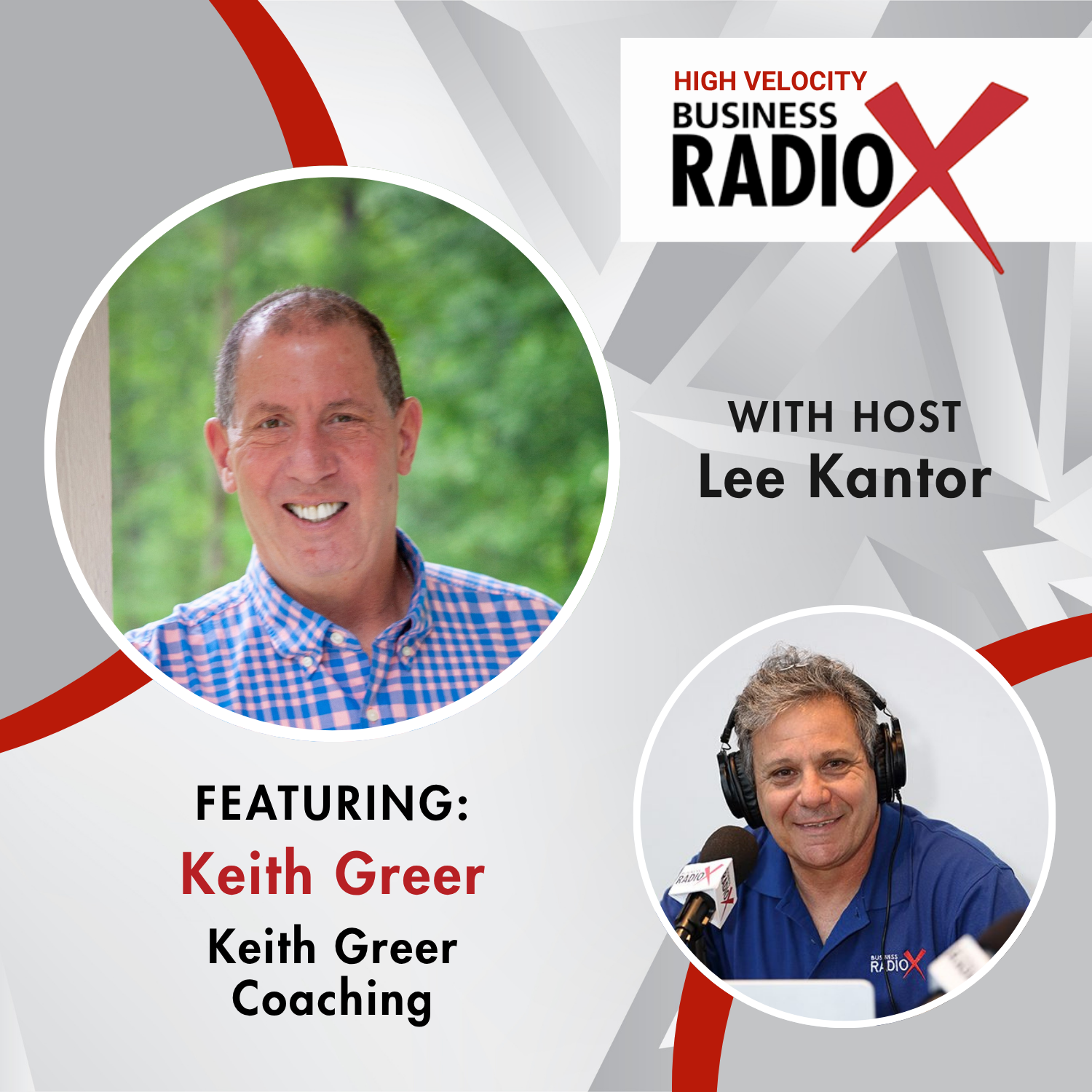

In this episode of High Velocity Radio, Lee Kantor interviews Keith Greer, executive coach and founder of Keith Greer Coaching, about the power of conversational intelligence in leadership. Keith explains how trust, empathy, curiosity, authenticity, and vulnerability can transform workplace relationships and help leaders create more productive conversations. He also explores the unique challenges of family-owned businesses, the growing importance of relationship-building in the age of AI, and practical ways leaders can build psychologically safe, high-performing teams.

 Keith Greer, LCSW, PCC, leverages over 4 decades of experience as an Executive Coach, Family Therapist, and Trainer toward his compassionate, creative and influential work with individuals, families, and organizations.
Passionate about the practice, art science and utilization of neuroscience based conversational strategies that result in deep and authentic human connection and co-creation, he is the creator of the “Conversationally Intelligent Leadership Process, “a Leadership Training Program that brings together concepts, practices and skills from several evidence-based modalities including Conversational Intelligence®, Psychological Safety, Family Systems, Motivational Interviewing and Positive Psychology.
His clients, whether they are an emerging leader or a seasoned leadership professional, are empowered to utilize this comprehensive and robust methodology toward the development of their own unique leadership style that is fully authentic, highly valuable to their organization and inspires deep passion, loyalty and massive productivity in their team.
Hiss clients are comprised of individuals, teams and organizations within the corporate, non-profit and family-owned business sectors. Keith enjoys a reputation as a highly effective, passionate and enthusiastic Speaker and Trainer.
He is the Producer and Host of the podcast, “The Helping Conversation”.
Connect with Keith on LinkedIn and Facebook.
What You’ll Learn in This Episode
- The role of conversational intelligence in building trust and stronger relationships.
- How neuroscience influences the way people perceive trust and threat.
- Navigating the unique communication challenges of family-owned businesses.
- Creating clarity before important conversations through a “conversation about the conversation.”
- Why effective leadership is a distinct skill set that can be learned and coached.
- How AI is increasing the importance of human connection and relationship-building.
- Recognizing workplace signs of low trust, disengagement, and ineffective communication.
- Conversation habits that damage trust, including judgment, criticism, interruption, and gossip.
- Using curiosity, authentic questions, empathy, and vulnerability to strengthen leadership.
- Creating win-win conversations that encourage people to speak openly and contribute.
 This transcript is machine transcribed by Sonix.
TRANSCRIPT
Intro: Broadcasting live from the Business RadioX Studios in Atlanta, Georgia. It’s time for High Velocity Radio.
Lee Kantor: Lee Kantor here another episode of High Velocity Radio and this is gonna be a good one. But before we get started, it’s important to recognize our sponsor, Business RadioX. If you’re a business coach who’s tired of being a best kept secret, set up a call with Stone Payton at bookstonephone.com to unlock your perpetual prospect pipeline. Today on the show, we have executive coach Keith Greer with Keith Greer Coaching. Welcome.
Keith Greer: Good morning Lee, how are you?
Lee Kantor: I am doing well. I am so excited to learn what you’re up to. Tell us about your practice. How are you serving folks?
Keith Greer: Sure. So I have I’ve had this really blessed career for over four decades. I say in the helping world and started in the more traditional therapy world. Family therapists for many years transitioned about 15 years or so ago to coaching and the last 1213 executive coaching. So I work with with all different levels of leadership in the corporate world, not for profit. And given that family therapy background, I’ve developed a bit of a niche working with family owned businesses. Uh, and the foundation of my work is built on a modality called conversational intelligence, which is this amazing mechanism that looks at the neurochemical underpinnings of how certain conversational strategies and patterns like right now, just even in our conversation, you and I, when they’re going on, when we use them, words cross the room, land in other people’s ears. And does it cause people’s brains to say, I trust you Or does it result in people’s brains perceiving you as a threat? And they can’t get far enough away from you. So in the world of leadership, which is really, at the end of the day, just another version of a relationship, it really allows me with my clients to, to deconstruct all their conversational patterns and look at very specific ways that they can ensure that they will engender trust with those on their team.
Lee Kantor: Now is conversational intelligence. Is this something you developed or is this something that you learned?
Keith Greer: This is something I learned. It was developed by a brilliant woman by the name of Judith Glazier, who sadly passed. I want to say about eight years ago, I had the privilege ten, 11 years ago to train with her for about a year. Um. Judith walked in the executive coaching space and put together this modality that has some, you know, pretty traditional social sciency components to it. But that neuroscience piece is, is what, when, when at times when, when clients of mine say, well, this all sounds good, but it’s kind of touchy feely social work stuff. Uh, this modality allows me to say, no, this is, this is like hard science. This is neuroscience. Our, our brain looks for really concrete evidence, looks for, listens for, feels for concrete evidence when we interact with others that we can trust this person.
Lee Kantor: So what kind of why is that component so important to you? Why was the touchy feely, soft, uh, skills about this not enough that you needed kind of a science blessing in order to kind of lean into this?
Keith Greer: So great question. So there’s a couple of answers to that for me. What it. So when I did this training with Judith, now again, I have. I have worked in this world for, for at that time, you know, 30 plus years. I’m, I’m skilled at creating relationship at connecting with people. I’m intuitive. You know, I like to say, Lee, it’s not a coincidence that I found myself on the career path that I found myself on. This is this is inherently who I have been for as long as I can remember. That being said, when I did this training with Judith, I had an oh wow experience. Um, and the experience was okay. I trust that I have been the, the feedback through the years, the data through the years is I’m good at this. I’m good at connecting with human beings. But this took it to a whole nother level. It was just a level I was not aware of, um, of, of exactly what goes on in the brain and where and how that results in trust being created or distrust threat being perceived. So for me, it was just, okay, I can take this set of skills that I already have and take it to the next level in my work in the leadership world.
Keith Greer: Um, it does add it, it shouldn’t in the perfect world, but it does add a level, a level of credibility that, that I can sit with somebody and I, you know, I can think of one company I do a lot of work for, and there are a bunch of brilliant engineers and technicians. And so they tend to be really focused on science. And when I can sit and have conversation with them and share very specific strategies that that I can back up and say, here is the science behind it that says it works. Um, that, that resonates with, with a certain group of, of clients, you know, maybe a little bit. I can think of, you know, some of my not for profit clients who they appreciate it, but, but they have kind of grown up quotes around that, um, in the world of more, you know, trusting the social science that’s out there, but the, the hard neuroscience, it, it lands for people.
Lee Kantor: So how does it kind of, um, how does it appear in your work now? So you, like you said, you worked previously for decades under a different, uh, or I mean, to me, it’s adjacent. Um, this is just another tool in your toolkit, not a, you’re not abandoning the past. You’re, this is just enhancing what you’ve already been doing, in my opinion. Um, so how does it show up now in your work? So what, what changes now when you’re working with clients, how do you kind of leverage this conversational intelligence to help them get better results in less time. Easier.
Keith Greer: So let me, let me, let me answer that. In the world of family owned businesses, um, working with family owned businesses is, uh, it is an amazing and absolutely amazing complex experience because think about this. So, you know, we have 4 or 5 family members sitting around a table who at the same time that they are family with all of the history and legacy and issues that sometimes come with just being family members, they also have to engage in good business practices. And the intersection of those two experiences, uh, is, is, as I said, pretty complex, pretty nuanced. So to be able to, and so I get hired often in that world because people have been told I can help this family, this family business have more productive, effective, trusting conversations that will both honor that we are family and honor good business practices. So for a more specific example, I have this family I am working with. They’re in the agriculture industry, and around the table is a father who is kind of mid 60s, his son, his daughter and the daughter’s husband. So they are the four business partners. Well, some of what we have been working on is how challenging it is for the son and the daughter. When they are around the table talking business, they are becoming more and more aware of how much they are impacted by the fact that they hear dad, right? This is the dad voice who has been in their life for as long as they can remember the the ultimate authority.
Keith Greer: That’s a very different voice than business partner voice. And so this modality allows me to do some work in the world of, of, even of boundaries of how do we hear different voices be very specific about which voice we want to be in, or just even specific about what conversation we want to be in it. Sitting around the boardroom table, we’re looking for a very different type of conversation than around the Thanksgiving dinner table when we’re all there as family members. So from conversational intelligence, I have this concept I created that I call the conversation about the conversation. Conversations are guided by some effective conversations. Win win conversations are guided by some very specific rules that allow them to be effective. We tend to never talk about any of that. So when conversations go south, most people walk away from that and just have some level of assumption that the explanation for that is the other person’s fault. So what I can do with folks is we can, before we have the conversation, so this family, before they sit down and have a conversation about needing to make some business decision, specific business decision, we will have a conversation about the conversation. How does everybody want to show up? What does everybody need from each other? What does trust even look like, sound like, and feel like in the room? How will we know when the conversation is moving towards not productive? Um, how? What does everybody need in the room to feel listened to? Um, big one because we know, you know, if you, if you Google the top reasons why anyone ever leaves a company or a job, usually somewhere in the top five is some version of didn’t feel valued and appreciated.
Keith Greer: How do we have this conversation as a as business Partners and as family members where no matter how heated it may get or there’s disagreement in the room or strong emotion in the room. How do we do this in a way that ensures that everyone will always feel fully valued and appreciated? Because Lee, if people don’t feel valued and appreciated, then they assign malicious intent. So and so is interacting with me in a negative way. Because if we can bring in the conversational intelligence world, we all often talk about making the invisible visible. If we can take these aspects of conversation that for most people are invisible because we’ve just never been taught to talk about it or identify it and identify it, we have a greater chance that conversations will be win win and feel much more productive.
Lee Kantor: Now, in your work, do you find that that this is kind of the heart of pretty much everything? I think this is foundational is being able to have productive conversations with clarity so that both people understand, you know, the intent and the why and the that we’re all working together. Like all of this stuff is at the heart of good leadership and the heart of healthy organizations. Like if you, if you can’t get communication and clarity right, you’re really setting yourself up for failure down the road.
Keith Greer: I agree wholeheartedly. And you would think that it would be that simple, but that’s not how it’s I think a couple of things historically result in that not happening where it should, because it makes just intuitive sense. Again, if we think of leadership as nothing more than a relationship, and relationships need to be filled with trust for these relationships to move forward. Um, you know, I think of a team coming together to, to innovate the level of trust that is needs to be in the room for people to share ideas, to disagree, to be open to listening to somebody else’s perspective. Yes, it should be foundational. But I would argue historically in the leadership world, it hasn’t been. It’s not how leadership has been taught. Uh, IT leadership for many, many, many generations has been some level of kind of tell, sell, yell, convince, coerce, control, um, leader knows best and, and because I deal with this all the time, leaders who find themselves feeling they don’t know best often are scared to admit that have been have been led to believe that if I admit that that is some level of weakness or it’s not great leadership or, you know, another narrative in the leadership world is leaders are supposed to motivate their team. Lee, there’s no evidence in the psychological world, when you look at the research, that anyone can motivate another human being, because motivation is an internal experience. We can inspire. There’s some some things we can do in that world, but we can’t motivate. So and then the other thing that that I believe has gotten in the way that doesn’t allow what you shared to happen, and I see this across industries to this day is companies do not view and value leadership as a distinct skill set. And so they assume anyone can do leadership.
Keith Greer: So again, a company I work for kind of very high tech, um, again, really, really, really smart engineers and optic, you know, PhDs in optics and and they have a long history. And again, they are not alone because I see this, I see this in the not for profit world. Someone is a phenomenally skilled technician and someone comes along and says, oh, they’re a great technician. Well, they can lead a team of ten technicians. And nothing could be further from the truth because leadership, really effective leadership, the practice of leadership is a very distinct skill set. Does it come a little bit more naturally to some than others? Sure. But it can be taught. The skills can be taught, the skills can be coached and supported. And to this day, too often it’s not. So. People wind up in leadership, in leadership roles. Without the skills in leadership roles, they don’t get the support they were hoping they would get. They’re afraid to voice. I’m not quite sure I know what I’m doing, or I feel incompetent or inadequate in what I do, so they just move on. Or Are there in a leadership role and they don’t like it. They really find they don’t like it. And but they they’re afraid to say they’re afraid to say that. So they stay in it. And so we end up everyone, everyone I know has stories of somewhere in their professional career, working for someone who wasn’t very skilled at leadership. And yet, back to your point, yes, creating trust, developing a sense of safety, helping this team that we are of ten people know what conversation we’re all in at whatever time the you know what, what do we want the outcome of any specific conversation to be? It is absolutely foundational.
Lee Kantor: Now, do you find that, um, especially with the advent of AI nowadays and that it’s as a tool to help, um, us connect dots and help us, um, individually kind of have more knowledge that this is a time when. You would think that this, the skills that you’re trying to teach in the knowledge you’re trying to share has to be prioritized because no longer is the person maybe on the org chart, the smartest person in the room anymore. Like now that’s kind of been democratized and that anybody can be the smartest person in the room with these tools that we have at our disposal. And that in order to get the outcome you desire, you have to learn how to work with people and inspire them and get the most out of them and give them the, the safety and the space to be vulnerable so that we all can get to the place we’re all trying to go to. Um, and it’s just, I feel like we’re at a point of inflection here where things have shifted and that you have to kind of get on board on this or else you’re going to be left behind.
Keith Greer: I agree wholeheartedly, 100%. I was just a part of a panel presentation, um, a week and a half ago or so on, on this exact topic of, you know, in this world of AI where we have access to the data, to the information, um, AI, AI is not going to replace relationship building. Uh, and so in the world of leadership, as you said, where, where democracy has come home and everybody has the data and has it at their fingertips in an instant, I believe, I want to believe that it is it is those people who walk into the workplace with these kinds of skills that will that will move forward and will move organizations forward. I, I to this day, you know, my I have a brother and sister I’m very close with and they both have been in more of the financial, um, world. And we have this conversation all the time about a certain level of amazement that, that companies, uh, are as sometimes as successful as they are at least financially. When you look at, uh, at the, at the dearth of leadership talent that somehow they’re still moving forward, um, the value of the company or market share or whatever that is. But this piece is, is going to continue to be even more paramount of paramount importance. I’ll also add to that, Lee. And because I think this is another piece and it’s, it kind of walks alongside your point about AI and that is. The the, the shift in attitude about work and a person’s relationship with work, with with each succeeding generation.
Keith Greer: So, you know, I’m 67. I’m a baby boomer. The message I got was you go to work somewhere, you stay, you don’t leave. You should just be thankful you have it. Hopefully you have benefits. Stay for 30, 40 years. Don’t take a risk. Right? Just just you. You have this gig. Enjoy it and be thankful for it. I’m in conversation all the time with folks in leadership who are scratching their heads with kind of, you know, the 35 and down who have a very different take. They are looking for greater balance in, in, in the work component of life. Um, they, they are much more courageous if they are not happy about picking up and leaving and and I’ll figure it out. And and I laughed when I talked to some folks of my generation who, who look at that with a, with a certain level of judgment, because it’s, it’s a very different way of coming at, at work than, than we were raised to. I happen to think it’s pretty awesome because it won. I think it’s a whole lot more healthy. And two, it is challenging the workplace to up their game around who they’re going to put into leadership, because that’s a group of people. You can’t just say my way or the highway, they’ll take the highway, they’ll leave. And what walks out the door often is a whole lot of skill and experience that that if leadership was maybe different, more relationship focused, those people would stay.
Lee Kantor: Now, what is the challenge that your clients are having right before they hire you? How does this kind of show itself to an organization, you know. What are some of the symptoms or signals that say, you know what, maybe I ought to get Keith in here.
Keith Greer: I read some research a number of years ago. This was done before Covid, and it and it asked a whole bunch of like CEO folk, you know, do they believe a lack of trust impacts their, their company? And the majority of the people they interviewed said, yes, it does. But then and then they asked a really interesting follow up question, what are you doing about it? And almost all of those people said, we’re not doing anything because we don’t know what to do. And so what I am seeing, or what I’m being invited into, are conversations within companies where people within that company can say, we can see what a lack of trust looks like. Um, meetings feel like a waste of time where we have people trying to work together and conversations are going nowhere, often because people struggle. Coming to a conversation with a win win mentality. I want both of us to get what we need. Um, there’s a whole lot of, again, in the conversational intelligence world, we call it the addiction of being right. You know, that’s that person sitting at the, at the table when they’re meeting with their team, banging on the table. I’m right, I’m right. And we know what’s the other side of that message. You’re wrong.
Keith Greer: Right. So people are seeing that kind of behavior. They’re seeing people walk out the door, right? Because they’re not feeling valued and appreciated. Um, they’re seeing it. They just don’t know. All right. What, what do I do? And so, you know, I’m, I’m lucky. I’m, you know, I’m, I’m a part of that group of folks that, that have this knowledge base and this skill base. And I can come in and say, here’s some really concrete things we can do. So like for one company, I created a 15 hour leadership training that that is totally built around conversational intelligence. You know, it brings in some psychological safety, some motivational interviewing, some some positive psychology, you know, for leaders how to be really strength based with people. There’s not any evidence that if you keep pointing out what isn’t working for people, that that causes them to feel motivated, it’s the opposite. Help people see strength in them that they might not see yet. And you’ll have, you know, someone who looks pretty motivated and really wants to work with you. And so people I, I think I’ve gotten much better at either better at identifying it or more courageous about. Okay. Yeah, we see it now let’s figure out what we want to do.
Lee Kantor: Now, usually I ask my guests for a piece of advice, but I’m going to ask you a piece of advice in two separate. In two separate ways. What’s a piece of advice that will help people have more productive, meaningful conversations like some some good conversational strategies? And what are some some conversational strategies that might be negative and might be not going to help you achieve what you want to achieve. So if you can illustrate kind of what what good looks like and what not so good looks like.
Keith Greer: Okay, let’s, let’s start with the not so good, right? So, so that you know, I’m right, you’re wrong. Um, mindset goes nowhere. As soon as you enter a conversation and you give any message that somebody is wrong, that person’s brain perceives you as threat and nothing good is going to happen. And here’s just another really quick piece to think about of why this all happens. This isn’t a perfect metaphor. It’s a little bit more complex than this, but it it works for description sake and that I talk with people about back of the brain, front of the brain. So back of the brain is home of emotion. Your amygdala, home of fight flight. Freeze a piece, right? So when a person perceives threat, that part of their brain is, is screaming front part of the brain, prefrontal cortex, home of reasoning, rational thinking, weighing, pros and cons, engaging in strategies. Uh, the act of aspiring, the act of envisioning possibilities. It’s good thinking, right? Front of the brain. So one of the things we know Neurochemically is when somebody is perceives threat, they’re, they’re a bit stuck in the back of their brain. They do horrible thinking, right? So these couple of strategies, I call them that I say suck the trust out of the room. Part of the reason that happens is because they leave somebody in a brain space where they do horrible thinking. So if you’re telling me I’m wrong. Right. I’m, I’m in fight flight.
Keith Greer: If I perceive you as you do not value and appreciate me, and not necessarily just for what I do, but because just because I exist as a human being. Right. Uh, if you one of the things we know for us human beings is if there is a discrepancy between verbal and non-verbal. Humans will always 100% go with the non-verbal. So if you tell me you’re listening to me, you’re interested in me. You want to know what I’m thinking, and you have your face in your phone. My brain goes with you. Of your face and your phone. You’re not listening to me. I don’t trust you. Um. Interrupting me. Uh, that person in a room, maybe when, you know, a group of people are meeting and they’re, like, inching up towards the table, you can tell they’re waiting for the person who’s speaking to just take a breath and they’re going to jump in. People’s brains in that room perceive that as as, as interrupting, as not listening, as not respectful. Um, so those are some things that we know. Any kind of judging, criticizing, threatening. Um, it just, it doesn’t work. And the last one I’ll throw out Lee because, you know, we’re human beings. So this happens. Gossip, gossip in the workplace is its Kryptonite. It, it is horrible for trust, uh, creation. Now the flip side, right. If you, um, practice curiosity, what’s curiosity? Curiosity would be. Lee, if you and I were having, we, you know, we were colleagues and we were having a conversation.
Keith Greer: Curiosity would be me walking into the room. And I want to know everything about how you see this situation so connected to curiosity. Another strategy in the conversational intelligence world is something called asking questions for which you have no answer. So we’ve all been in conversations with people where they were asking us questions. It seemed like they were interesting, but they were leading questions. This is very different. This is asking questions that I don’t have answers for because I want to I legitimately, sincerely, authentically am curious about how Lee sees this situation. So a strategy I often find myself talking about with folks in leadership who, you know, sometimes just based on strength of personality and a level of a certain level of confidence in their skill and their experience. While I do know Keith and I, I’ve had conversations with leaders where I have challenged them. Can you walk into this conversation you’re about to have with someone on your team, and your only goal is to walk out of the conversation with a deeper understanding of this other person’s perspective, even if that means in that conversation, you don’t voice your perspective, like just listen and take it in other people’s brains. Love that you will be perceived as trusting and the other ones that are their authenticity. We all have a really good BS meter. We know when we’re in front of someone who’s not real, being authentic, which is really important for leaders.
Keith Greer: You know, people sometimes ask, tell me, you know, a good leadership book to read, and I might make a recommendation, but I’ll also say, and your charge is to have whatever you read in that leadership book that that resonates with you, have that come out of you sounding like you, not like the author. It has to be authentic. Empathy is a phenomenal leadership skill to be able to put yourself in somebody else’s feeling place, right and go there with them. And the last one, which flies in the face of how especially my generation of men were taught to be leaders, is vulnerability. I don’t know. I don’t know everything I messed up. I apologize, you tell me what you think. Um, in the conversational intelligence world, Lee, one of the things, one of the neurochemicals we focus on is the neurochemical of oxytocin, right? Oxytocin is the neurochemical that when good stuff happens between two people and they feel connected, that’s, that’s the, you know, that’s the miracle. Um, neuropeptide sometimes they call it that helps to create that when a leader, the research shows us that when a leader demonstrates vulnerability in front of their, the people they lead. Again, I don’t know, I messed up, I apologize. You tell me, guys, you know, you take the lead in real time. That actually increases the production of oxytocin in the brains of people who witness that moment of vulnerability.
Lee Kantor: Now, in group settings, the examples on both sides of the ledger, there are really kind of expand, right? So if the leader is, I don’t want to say bullying, but is not showing empathy to one person in the room that’s affecting everybody in the room. They all of a sudden may not, you know, share their opinion if they feel that this one person is kind of, you know, getting told to us, right? This is something that if the leader thinks they’re only addressing one person, they’re really addressing all the people in the room. So if they’re being vulnerable to one person in the room, the whole room is going to get that, that benefit. And if they’re being, you know, negative to that one person in the room, the whole room’s going to feel that. And note that going forward.
Keith Greer: No question. You know, the example I give sometimes is, you know, um, you know, let’s say I’m, you know, I’m the leader of of my team and I invite my team into a conference room and I’m telling them about some new initiative that’s about to come down the pike. And it’s and it’s going to be great for us. And it’s going to, you know, it’s good for the company. And yeah, it’s going to mean a whole lot of work and maybe extra hours. But man, it’s good, it’s good, it’s good. And, you know, and maybe around the room as I’m talking, you know, you hear a and feel a bit of a, you know, upbeat murmur and wow. Okay. Yeah. Keith. Yeah. This sounds good. Meeting ends. Well, what meetings? Meetings take place in the days following that meeting. It’s those water cooler conversations. And the tenor of the conversation around the water cooler is not nearly as positive as it was in the big room, because around the water cooler, in groups of 2 or 3, you hear, you know, nobody asked me about this. I wish Keith had said something about it, you know. Don’t they know I have more than enough on my plate? And so I always ask folks, what’s your best explanation for what creates those meetings after the meeting or the water cooler conversations.
Keith Greer: And it is there was something going on in that main room that did not engender the required level of trust. Um, and it doesn’t even have to be something like malicious, like you interrupted me or you put me down. It could simply be maybe we needed to have a conversation about the conversation before we talked about this new initiative so that people knew, knew in their bones that there was space in this room for people to be incredibly honest about their reaction to things. Now your your example even more so. Yes, if, if I exhibit any of those, you know, trust busting, uh, behaviors, I interrupt people, I put people down. Um, I know best, uh, I’m only, you know, I point out things that people messed up on. You are right on, right. Every single brain in that room makes a determination in that moment. Can I trust or not? And if they don’t, they are not going to speak up. They will sit quietly. They won’t take a risk. They won’t. They won’t engage in the kinds of conversations teams need to to be at their best.
Lee Kantor: Now, are some tactics for leaders or aspiring leaders, like kind of go in with that end in mind in terms of, okay, I want those water cooler conversations to be positive and excited. And, and I, and I’m going to, you know, kind of keep that in mind as I begin and, and, and when I’m interacting with folks, I want, you know, that as part of the outcome, not just I’m going to just share what I know, but I, I want it to kind of reverberate beyond the the meeting. Like, is that something that if someone’s preparing to do a presentation or share with the group that that they should at least acknowledge that that is part of the outcome that they desire. And I have to kind of create the right environment for that to occur.
Keith Greer: Yes. Right. So so yes, what do I what do I want the outcome to be? I, you know, I always use the, you know, the win win concept. I don’t know, for me, I don’t want to be in a conversation with somebody where, where it’s win lose. I just don’t want that. What that seems like such a waste of time and so many conversations in the workplace, whether one on one or group conversations, I would argue are an absolute waste of time because because people aren’t doing some of this work up front. So yes, what would win win look like if I, you know, back to my example, if I’m going to get up in front of my team and share with them, you know, this this new level of work that’s coming our way, how do I engage them in this conversation that ensures that everyone in the room can voice what they need to invoice, including, you know, total ambivalence about what’s coming. Okay, Keith, sounds kind of good, but again, I’m already really busy. What does this really mean for me? People need to know that they can voice that because if they don’t voice it, the thoughts and the feelings and the related behaviors that go with, um.
Keith Greer: Oh, you know, I don’t even know if I can take this on. They become greater when you’re not allowed to shine a light on it. So, you know, one of the, one of the things I sometimes get curious about with folks who especially who run meetings is, can we even just shine a light on. What do you want the outcome to be for this specific conversation? There is a world of difference in the conversational world and in the meeting world between a meeting that is a meeting simply to share information, a meeting where we’re going to brainstorm, a meeting where we’re going to problem solve, a meeting where we have to make a decision about something by the end of that meeting. Right? I find sometimes that that meetings go south because there isn’t any clarity even about that. And so people come with different motivations, different thoughts about what we’re supposed to, you know, quote, supposed to walk away with at when this meeting, this conversation ends. It goes back to this, this concept of the conversation about the conversation. Can we bring clarity, as much clarity as possible as to what win win looks like, what the outcome of this specific conversation, what we want this to be Now.
Lee Kantor: Um, if somebody wants to learn more about your practice or get on your calendar, what’s the website? What’s the best way to connect.
Keith Greer: So they can find me at keithgreercoaching.com. Uh, my email is Keith at keithgreercoaching.com. And yeah, you know, feel free to reach out. I love talking about this. I, um, you know, back to what you had said earlier about how foundational this conversation is and needs to be, uh, in, in the working world. And, and I’ll go one step further. I know we’re here to talk about business, but, you know, all we have to do, Lee, is especially in the States, all we have to do is look around at the at the tenor of conversation taking place societally. And it’s not good. Um, we, we, we yell at each other. We try and convince, we push. If you see things differently, we demonize. There is not anything going on in that world that is going to result in people connecting, in people agreeing, you know, agreeing to disagree. Um, it’s just not going to happen. And so, boy, we, we’ve got work to do in this area.
Lee Kantor: Well, we appreciate you, uh, doing your best to, to help people with the tools to do this in a more healthy manner. I agree with you 100%. I mean, it’s so funny that we give, um, so the people around us and we know and like and trust the benefit of the doubt, and we just don’t give that same grace to people we don’t know. And, you know, I just think we have to do a better job in treating everybody like we treat the people we know, like, and trust. I mean, grace is, is an important component to this and empathy. And it’s hard when you think you know all the answers.
Keith Greer: Yeah, I’d argue it’s probably pretty impossible if you’re really if you think you know all the answers because, you know, the last thing I’d say I, this is a bit provocative. So I don’t pull this out of my coaching toolbox unless I’m working with someone, you know, that I have a really good relationship with, and I trust they will get it. But when I’m in front of that person who maybe has a tendency to I have all the answers, I will sometimes ask them, you know this your sense of right here, this thing you believe you’re right about. Is there any evidence in the known universe that your right is the only right? Because the answer to that is always no, and no one feels their opinions deeper than I do, Lee. I mean, you know, I’ve got my opinions about things, but I know it’s mine and I know it feel it resonates in me because it is mine. But that’s not evidence that it’s the only right. So how can I be open to listening to other people’s sense of right? And oh, maybe I’ll be surprised. Maybe I’ll even shift my perspective a little bit.
Lee Kantor: Yeah. And I think that some of the challenges of today is that we’ve gone beyond right and wrong to good and evil, and that the stakes, the stakes are higher, are much higher in a lot of people’s minds than just right or wrong or right in, in any other possible answer.
Keith Greer: Yeah, yeah, I’m with you.
Lee Kantor: Well, Keith, thank you so much for sharing your story, doing such important work. And we appreciate you.
Keith Greer: Thanks, Lee. Thanks for inviting me in.
Lee Kantor: All right. This is Lee Kantor. We’ll see you all next time on High Velocity Radio.















