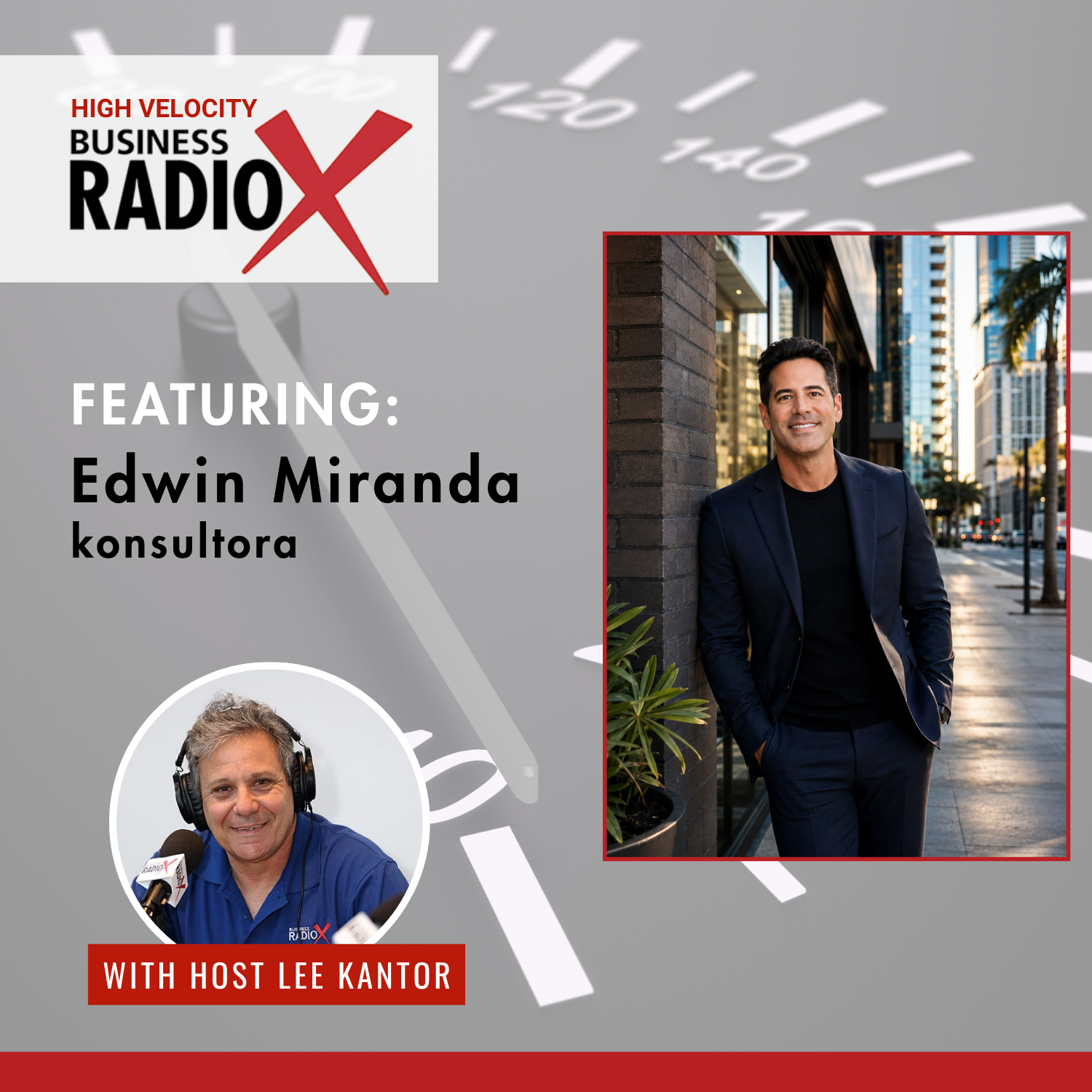

In this episode of High Velocity Radio, Lee Kantor interviews Edwin Miranda, founder of konsultora, about helping businesses adapt their operating models to the rapidly changing world of AI. Edwin explains why companies should focus on clarity before choosing AI tools, rethink workflows and organizational structures, and use AI to eliminate repetitive work while freeing employees to focus on strategy, creativity, and growth. He also shares real-world examples of AI-driven solutions in law and real estate, and why continuous evolution—not one-time transformation—is essential for staying competitive.

 Edwin Miranda is a business strategist, entrepreneur, and transformation leader whose career has spanned advertising, communications, political strategy, consulting, technology, customer experience, and organizational innovation.
Over the course of more than two decades, he has worked at the intersection of creativity, influence, business, government, and emerging technology, helping build brands, campaigns, growth systems, and transformation initiatives across Puerto Rico, the United States, and Latin America.
Throughout his career, Miranda recognized a fundamental shift taking place across industries. Traditional agency models were becoming fragmented and execution-focused, consultancies were growing increasingly complex and slow-moving, and enterprise systems were creating dependency rather than adaptability.
At the same time, advances in AI, automation, data, software, and customer behavior were rapidly redefining how organizations operate, make decisions, engage customers, and scale.
That realization led to the creation of konsultora, a post-legacy firm designed for the AI era. Built around the belief that the future belongs to organizations capable of continuous evolution, konsultora integrates strategy, intelligent systems, customer experience, AI, automation, and adaptive operational frameworks to help businesses navigate rapid transformation and long-term growth.
Over the years, Miranda has worked with Fortune 500 brands, government leaders, political campaigns, tourism organizations, fintech companies, healthcare businesses, franchise systems, real estate developers, and organizations undergoing complex transformation initiatives across multiple sectors.
Today, his work focuses on helping companies build AI-native operational models, intelligent workflows, adaptive systems, and real-time decision-making capabilities that position organizations for the future economy. His interests include customer experience transformation, intelligent automation, future software models, operational design, and the evolving relationship between human judgment and artificial intelligence.
Miranda believes that while automation is permanently changing execution, human creativity, strategic thinking, and judgment are becoming more valuable than ever. His work is centered on helping organizations build what comes next in one of the most significant technological and operational transformations in modern history.
Connect with Edwin on LinkedIn.
What You’ll Learn in This Episode
- The importance of gaining clarity before implementing AI.
- How to rethink organizational structures and workflows for AI adoption.
- Ways AI can eliminate repetitive tasks and free teams for higher-value work.
- Building a culture that embraces AI while keeping human judgment at the center.
- Recognizing when growing customer expectations signal the need for change.
- Using AI to create faster, smoother, and more connected customer experiences.
- How AI can support business growth instead of simply reducing costs.
- The value of continuous improvement in a rapidly evolving AI landscape.
- Real-world applications of AI in law, real estate, and other industries.
- Practical steps businesses can take to begin testing AI this month.
 This transcript is machine transcribed by Sonix.
TRANSCRIPT
Intro: Broadcasting live from the Business RadioX Studios in Atlanta, Georgia. It’s time for High Velocity Radio.
Lee Kantor: Lee Kantor here. Another episode of High Velocity Radio and this is gonna be a good one. But before we get started, it’s important to recognize our sponsor, Business RadioX. If you’re a business coach who’s tired of being a best kept secret, set up a call with Stone Payton at bookstonephone.com to unlock your perpetual prospect pipeline. Today on the show, we have the founder of konsultora, Edwin Miranda. Welcome.
Edwin Miranda: How are you doing? Welcome, Lee. Thank you for having me. And hello to all your listeners.
Lee Kantor: Well, I am very excited about learning what you’re up to. Tell us about your firm. How are you serving folks?
Edwin Miranda: So I started a firm, it’s called called konsultora. I did that after 25 years working on operating companies, mostly consulting for startups, enterprise government with also business experience in real estate. And I came to the realization after, at that time that the world was changing faster than companies were changing and adapting to it. And one thing that I learned quickly, uh, was that usually technology is not the constraint for companies to move forward and advance. It’s usually the operating model, right? And I believe that with AI, with all this anxiety in today’s world, companies need clarity, right? An assessment. What to do first, how can I pilot it? How can I include it into my organization? And I believe there’s a huge need for that. And we created konsultora for that specifically.
Lee Kantor: Now, when you say the words AI, artificial intelligence. How are you kind of defining that? Because AI holistically in an organization, I think, is it an opportunity that really hasn’t been pursued. But within individual teams or departments, AI are tools that those folks are using, you know, maybe some more than others. So when you say AI, how are you kind of defining it from an organizational standpoint?
Edwin Miranda: Well, first, people think AI is something that you add to your business, and it’s actually, you think to come to it in a different perspective. The thing that I, I hear the most from owners right now in today’s world regarding AI is the same sentence, right? Everyone else is doing something with AI and we’re behind, you know, I understand the feeling. I do not think it is accurate. What I see is not a competence gap. I think a lot of noise, a new tool every week. A new claim every day. And almost no honest reporting on what actually worked inside a real company. So you can learn from it and use it, right? So there’s a lot of pressure, a lot of noise, and, you know, pressure with no direction turns into random activity. A pilot here, a subscription there. Um, but here’s the part that no one says about being late to a tool, to implementing a tool that is costing every day less. You probably heard of it. The models are getting faster, they’re getting cheaper, they’re getting easier to implement. Um, the tools keep getting better while you wait. So there shouldn’t be any anxiety. You know, it’s about being, being unclear about your own work cost you every quarter. The world did not start moving faster than most companies did. The gap is real. You close it with clarity, not with panic. So what I tell to to my clients is you’re not behind on AI. You might be unclear and about your work and how to implement it.
Lee Kantor: But when you say how to implement it, doesn’t each team within the organization implement AI differently? Like if you’re in the accounting department, an AI solution for you is going to be different than the AI solution in the customer service department or in the C-suite or in the, um, you know, operations or marketing or, you know, everybody is using AI differently. How does an organization kind of have a holistic, um, methodology in order to, um, deploy it?
Edwin Miranda: That’s a great question. The first thing that you need to understand is your operational models, all of those departments that you just mentioned have a way that they operate. They have a specific workflow. So before deciding on what AI to adapt and whether you can have a holistic view of the whole company, you first need to see your organizational chart. So let’s start with that. Right. What are your key positions? Where are your key departments? What’s the role of every department in everything that you do? Right. And then rethink that workflow and that operational model before you implement AI. One of the common mistakes that people do is they start to add AI to different departments and areas, but you never get a holistic view of the whole company, right? Uh, if something is slow and a department is slow to implementing it, you can have AI running in one place, but the handoff or the decision making in another place stop the process. So we’re not all evolving at the same time. So what I always say is evaluate. Start with something simple. You can start in one department, determine a workflow, determine things that are repetitive, determine tasks that take time from people that don’t add value, and try to eliminate that friction in the process and then add AI to those repetitive tasks to that friction. See how it works. Have a clear understanding of what you’re trying to achieve and what you’re trying to improve in that department, and then measure that and understand whether it improved or not. Sometimes it’s not the AI that fails in the process. Is that your your organizational chart and your operational model was not rethink and redesign around AI.
Lee Kantor: Now, isn’t this when you start trying to deploy it, even in a pilot program within one group within your organization, uh, the humanity of it is really where things can go off the rails. Because some people look at AI as this is the, the best thing ever. And then other people look at it as, why am I training this to replace me? Um, so how do you kind of build a culture that leans into this? Because to me it seems pretty inevitable at this point. Um, how do you kind of help your your people embrace this rather than fear it?
Edwin Miranda: That’s an amazing question. And that’s a key topic that everyone talks about. When you take away repetitive, redundant tasks. Away from people, it leaves and you can make, uh, information more accessible, decisions, more actionable. You free time in your organization to do more. So some people think, well, I’m going to get AI and I’m going to lower, uh, my headcount, right? Um, and that’s good. And you can decide to do that. But what’s happening is that’s not the use of AI. What AI can help you is help you accelerate your process, become better free time for the people that you have working to think on better process, on better workflows, on better organizations and better products. I like to say that, um, if you’re a business, right, and you’re an expert in a specific vertical, let’s say healthcare, AI and bringing AI knowledge and, and, and systems into your organization and new workflows could help you expand into other categories. So the decision that you really need to make, it’s, if I’m using AI and I’m freeing up people, can I let that people invest their time less on repetitive tasks, less on execution, and more on a strategy and improving. So if before I’m a business and I used to do one vertical, one type of client, now I can probably do or three verticals of business.
Edwin Miranda: If I am in the development side of it, let’s say I’m developing a product before I could add a product once a year. Now you could add three, four, five products. So the decision because you have the technology to fast forward that process to make it better, more intelligent, right, a more adaptive. So the decision that you need to make as a business is, you know, you can go low. You can decide and say, I want to, I want to do cost cutting, but you’re going to get smaller while at the same time other people are going to take the advantage of AI and say, I want to think bigger. And I think that’s the that’s the difference that an organization needs to do. I’m not saying that, you know, um, work and some, some employment is going to be lost along the way, but everything normalizes because at the end of the day, everyone has access to the same technology. So it’s all about competing and getting better and growing your company. It’s about doing more. It’s not about doing less and evolving the capacity of the people that are within your organization to stop executing and start thinking and making decisions to better the company.
Lee Kantor: So what is, um, kind of the issues or the problems your next client is having right before they call you? What how is this showing up in their world? What are the, the symptoms or signals that they should be looking out for that maybe you are a good solution for them.
Edwin Miranda: I think one of the, the, the main concerns that, that they have is that, um, they are. They have a process in line. They, they, and they need to first decide how are they going to, how are they going to improve their, their work and what they’re doing? They have the resources, they have the data, they have the systems. They probably have bought software and technology before, but they’re very concerned in terms of how do I implement this? Right? So so the first thing that we tell to them is we need to rethink. Just like I said before your organizational chart, you need to rethink your operational model. You need to rethink your workflow. And once you do that, then the answer is automatic, right? It’s where the the apps or the models or the AI are going to rise up. And it’s going to be natural in terms of for you deciding, uh, you want to make this better, you want to eliminate this repetitive task. Ai could do a Y and Z, and that is going to free up time for your people to act on information and, and, and be more dynamic in the way that, that, that they work and get the results right.
Lee Kantor: So I understand how, how, how you intend to implement it, but what is showing up if, if what are the problems I’m having today where I, I, it’s kind of obvious that’s becoming obvious to me that I need help, that that something has to change or move. What, how does it show up in your clients, uh, live so that they know that, hey, I should be calling Edwin and his team because this is getting out of hand here. Like, what are some of the ways it shows up in a business that they need to make a move and, and kind of evolve like you’re recommending?
Edwin Miranda: Well, things expectations for customers are growing rapidly. And when you cannot move as fast as your customers expectations are, that creates a lot of anxiety for them. So now customers expect turnarounds, decision making, uh, the delivery of your product or your server or your service in a, in a faster way. They’re expecting for you to add more value and spending less time on presentations, on updating charts, on just doing dashboards. So when, when your work is, it starts to pile up and pile up and you cannot execute as fast as your customers are demanding. Because customers expectations are changing. Think about it. Now we have a chat that we can ask anything and get information back, right? So not only customers, but companies themselves are also demanding faster and better execution from their vendors and from their partners and for from, from their suppliers. So when you start getting that pressure from your customer, right, to add more value, to think more, to make decisions faster, to turn around your product, you need to redefine and rethink the way that you’re currently working in order, in order for you to be faster to that delivery of product, give a more complete product, um, or give additional services to your customers that really add value.
Edwin Miranda: Because if your customers can do many of the things that you’re actually doing, uh, then what will they need to, right? Uh, so, so the pressure starts when you’re rethinking your own business or your own service or your own product and thinking it’s it meeting the client demands. And what people are finding is that those demands and those expectations from customers or clients are growing every day. So your expectations are faster. Think about a, a. Call center right. You call to a call center. You’re with an operator. The operator needs to go into a CRM, into various departments of the company to understand your case. What’s going on, what’s the status of your account, what’s the status of your billing or of your delivery, etc.. So if you think about it, a human being has to go in through each of those softwares to go in and, and give you an answer. I don’t know if it has happened to you. Right. You’re online, you’re waiting. The person is telling you, let me go in here. I’m going to put you in. Wait, let me get into this information. I’m going to put you in wait.
Edwin Miranda: Now I’m going to check into this department. I’m going to put you in wait or I’m going to transfer or forward your call. Well, with AI, If you have, let’s say, a teammate with you that is with you, don’t think about it. Technology. Think about a teammate that is with you in the process is a software that is a companion, right? If that companion is looking up for information on a more instant way, if it’s understanding what the customer is asking and it can retrieve information more quickly from all those those department, the time that you’re spending with your customer is less right? Because you have easier, faster access to that information, right? So that’s an example where you see that in today’s world, because people now have the expectations of getting things quickly, right? Um, and, and some, some companies are not, um, they either don’t have access to that technology. They, they have, oh, they have a whole bunch of apps that they need to move around and they cannot get, give a unified solutions to customers. So AI can come in there, be a companion in the process and help that, uh, experience for the customer to be smoother and faster.
Lee Kantor: So you’re recommending that leaders have to be, they have to move a lot faster to keep up with the customer’s expectations. And AI is a technology that can help them do that, but it’s going to require them to change their mindset, right? Because a lot of folks, especially, uh, certain generation folks are very kind of slow and steady. You know, let’s not, uh, move too quickly. In this case, it sounds like you’re going to have to at least adjust your mindset and that clock in your heads got to be moving a lot faster than it did maybe 5 or 10 years ago.
Edwin Miranda: Exactly. 100%. But but it doesn’t it doesn’t leave out the human aspect and the human judgment of it, right? An AI tool can be fast in terms of, um, analyzing data, compiling information, but it doesn’t have accountability. The accountability and the decisions and the judgment and the creativity still sits with the human right. So so there’s some things that AI can help you do, but there are other things that AI cannot replace within your company. So it is a a balanced combination of both of them. But human is always at the center and the human judgment is always at the center of it.
Lee Kantor: So now is there an industry or, um, part of the do you have a sweet spot in terms of ideal client, or is this something that’s industry agnostic?
Edwin Miranda: So we focus at konsultora on small medium sized business from 50 employees to 500 employees. Um, this these are usually owner operator, uh, companies or small branches of companies on a specific, states or countries. Um, and, and you’ll be amazed in terms of, of the, the, the impact that AI can do in almost any company out there, regardless of what you do. But definitely there’s, there’s a lot of, of growing usage on healthcare, that’s for sure. Uh, transportation and logistics and also in government operations and in customer experience. I think those are the key areas that are driving more of the people that are calling us to help them to improve a, a processes or workflows using AI.
Lee Kantor: Now, do you work with like private equity firms or VCs in terms of a merger or acquisition that to help them kind of put the right foundation in place to handle that type of a transition?
Edwin Miranda: Yes. So, so one of the things that we actually do with a private equity firm that we work with is we we go into the companies and we analyze what we call clarity. So we, we go into the company that they are actually going to buy and make an assessment of what’s the organizational chart, what’s their workflow and what technology they’re currently using. Right. And how are those technologies? The second step is connection. What’s, what’s the handoff between those processes and how those handoff can be connected in a way that they, uh, feed themselves and learn from each other? And how can you improve the whole experience? So when you have the technology, you have the operational model and you have data, live data, right? Then you can make actionable decisions. And in terms of improving the whole business structure. So, so with AI, uh, there is a lot of learning that you can do into a business before a private equity goes into it. Uh, understanding the business, understanding the nuances of the business. What are the trends of the business? What are the customer expectations of the business and whether the technology they have now, the operational model they have now, their workflows they have now can meet that demand, right? Or if or if or if it can be done and rethink on a better way. So it can accelerate the investment that they’re doing. The private equity in these companies.
Lee Kantor: Now, is there a story that you can share that maybe illustrates how you work with a client? Don’t name the name of the organization, but maybe share the challenge they came to you with and how you were able to help them get to a new level.
Edwin Miranda: Are there a lot of our work? It’s, um, it’s, um, it’s confidential. Um, but, but I, I can talk to you a bit about the process that we go, uh, with them. Right. So, so number one it’s, it’s, it’s, we have a process and a methodology, which we call first we start with clarity, which is identifying the challenges in the organization that they, they were having. Two is connection, uh, establishing, uh, where are the missing pieces in the, in the process that they’re experimenting. Then, then we establish what we call continuity, which is a continuous loop for them to continue to, to continue to improve on their business and improve the cycle. And then changing the culture about how people see, uh, AI. So we had a customer that, um, uh, gives us advice, uh, a, a law firm write to customers and clients and they do, uh, legislative work well with AI. Uh, we establish a system for them that can monitor everything that was going on, on the, the house of representative of a specific state. It would alert the, the client on any move that one of their clients were having, or if there was a a piece of bill or something that will affect their company. So the system monitors constantly the movement of bills. It will alert the the law firm on things that could affect one of their clients. And it will automatically inform that client that there has been a move within a specific bill.
Edwin Miranda: And what are the exposure that that customer might have either good, bad, or neutral to a specific bill. So the system not only analyzes what’s been moved, uh, within the House of representative, right. Or, or the Senate, if you want to call it that. Uh, but it also makes a brief of, of the bill, right? It identifies customers that might be affected for with that bill, customers of the law firm. Right. And it will alert and it will also include immediate actions for the company to take or immediate recommendations that the law firm will recommend. So the AI will not only monitor that, identify the clients, make a brief of the of the law, make a recommendation based on on, on the client knowledge because everything sits with the knowledge. So an AI agent know what effects or benefits and specific client. So it will determine what effects or benefits a client. And then it will draw a recommendation. So the human in the loop and the human judgment is that the person that used to do all of that before has a free time. Just to see the analysis of the AI, analyze it, revise it, and approve it. If it’s not, if it does not agree, it can edit it, but then it goes to the client. But think about it. It would have taken the person right, probably 2 hours or 3 hours to analyze, read the bill, read the exposure, develop the memo to the client, put the recommendations.
Edwin Miranda: Now, the AI with knowledge in in the center of it, brings all of that together, brings us that ready. So it’s as easy as an email that it’s already kind of like read and write an alert and you just need to confirm it. Click send and it goes to your client. So something that used to take you 2 or 3 hours, you could do in a matter of five minutes, literally. That’s, that’s one of the things or one of the use cases that we have identified. That’s a law firm, for example, we also have a real estate development company that manages warranties for customers, right? So when, when, when a customer bought a house and they wanted to, uh, claim a warranty, um, it was a whole process of writing emails, making phone calls, uh, informing the real estate company, the real estate company, uh, informing their subcontractors in order to go and do the service. So now all of this happened automatically. So we develop an I, an app for them that is based in AI. So the customer in his own phone determined what’s going on. What’s the claim on the warranty of the house they want to put in the warranty goes the claim goes directly into their systems. The system routes, whether that house, whether that issue specifically is, is, is in within warranty, right.
Edwin Miranda: And then it routes it to the specific supplier. It has it has access to the calendar of that supplier. So it can automatically schedule the visit. It writes back to the customer through a text or an email saying, we received your concern. Um, these are the immediate days that we can go and fix the problem. The customer, the owner of the house, right, approves it. And then the system confirms with the supplier and, and, and gives the notifications. And the whole process is run with agents and with AI. Um, and then the subcontractor, the only thing they have to do is confirm the visit, confirm that he’s on this way, confirm once the service, once, once the, the thing that that was under warranty that was fixed was, fixed. And all of this while all this is happening, the developer. Right. Uh, that is offering the warranty doesn’t have to do anything because the system is moving automatically. So when the job gets finished, there is an affidavit or a confirmation of visit and service that were done, and it goes automatically into the system. They don’t need to do filing, they don’t need to do emails, they don’t need to touch that project. So the human involvement in that is minimal because all of those things, if you think about it, where repetitive tasks, right? Evaluating whether someone is under warranty, that’s something a system will tell you, uh, because the system has, when you bought the house and what you’re asking, determine who is the supplier where.
Edwin Miranda: That’s already you can set, you already know that. Who’s the subcontractor that’s going to fix your bathtub or your tiles or a roof leaking that you have. Um, and then coordinating with the human. And now humans are accustomed to dealing with texts and emails. So they want everything faster. They don’t even want to call. Uh, so everything that was repetitive, everything that the system had information on how to act on, uh, the system can do with minimum. And then the other thing, the good thing about this is that everything sits on a dashboard. So now the developer, instead of managing information between the customer that bought the house and the contractor or subcontractors that need to fix X, Y, or Z within that house, what the only thing that they’re seeing is amount of claims. What, uh, what developments are creating more problems, what subcontractors are developing the more claims, what areas. So they understand how subcontractors are working. Where, where do they have um, places to improve with a specific supplier. So now instead of dealing with getting phone calls, emails, making calendars, contacting subcontractors, put things in a calendar, confirming with the customer, the visit, etc. now they can spend their time on just seeing patterns, right? Amount of claims.
Edwin Miranda: What project are developing or model of house is developing more problems. Uh what problem is usually more um repetitive right. Let’s say plumbing. Electrical. Who is the supplier? Right. That is fixing that for them and who built that for them. So they understand whether maybe I need to change my suppliers or I need to sit down with them to improve this service. So they’re using their time in a more productive way. And guess what? Now the person that was doing that in the developer side that doesn’t have to do that anymore. It’s just adding value and improving the process. And maybe the person can add more tasks to what whatever they were doing. Probably they were handling a, a warranty, the warranty services for one specific development of this development company. Now they can probably handle two or 3 or 4, uh, different developments for the same company just because they have this AI in the middle of everything. They now have a new operating workflow, a new operating model. I would like to call it that. I don’t like calling it an app or AI. I like to to, to think of it as a new operating model with new teammates in the loop that could do work that you used to do repetitive, that didn’t add value. So you can free your time to analyze and improve your work and improve the company and make your company better.
Lee Kantor: Now, when you’re working with folks, and especially at the speed in which AI is changing and evolving, how often do you go in to solve a problem, maybe help them solve the problem, and then by the time you’re done, um, there’s now a better way to do things like this isn’t something you just kind of set and forget, right? This takes kind of constant maintenance in terms of, uh, staying on top of things because it’s evolving continuously.
Edwin Miranda: You’re 100% right. You’re 100% right. Um the issue with, with, with, with some companies is that um we issue with traditional, like I did not start konsultora to build another consulting firm. I started because I thought companies needed a different kind of partner. Like traditional consulting is good at analyzing and recommendation and giving you a deck. Uh, the problem is the shape of the deck, right? A project starts, a project ends, and the company is on its own. After the document is done, right, there’s no time to implement or they start implementing it. And by the time they’re finished, maybe the solution that they brought to the problem is obsolete. Or maybe the customers demands have changed, right? Um, so that shape of transformation, what, what, what, what, what legacy consulting firms call transformation. Um, it does not have one anymore, right? The shape assumes change has a finish line transformation. Assumes the change has a finish line. It does not have one anymore. Markets do not pause while you finish your transformation. So we work differently. We build the ability to keep improving into the operation itself so it keeps going after we leave. So we like to call it a an operational system, an operational, uh, model that, that and that’s what, what, what we define as a, as an evolution consultancy, right? Um, it’s not that transformation is wrong.
Edwin Miranda: It created value. It’s just that there is an end date to a transformation. And they shouldn’t be, they should not be an end date, an end date to, uh, a transformation. It is, it is something that is going to continually evolve just because you said the other thing that’s wrong with the, with the legacy consulting model is that, uh, sometimes, uh, budgets and timelines get extended from the original budget. So it doesn’t give any visibility. And just like you said, uh, once you finish the, the product, you’re implementing it, um, it doesn’t work anymore. So, um, in that sense, I can tell you one of the main problems is software, right? You used to hire a consultant to implement a software in your company, right? In your small business, guess what? That software, it’s, it’s a, it’s a square box and your business is a circle and you need to adapt that square box into your circle. You need to adapt the software to your organization. So just doing that and the process of implementing that takes a lot of work, a lot of time, sometimes too much time, sometimes too much budget. And you need to get your people retrained on this new software, if you want to call it that way. Well, in today’s world and using AI, you do not need to change the way you want. You want your organization to work.
Edwin Miranda: You do not need to change the way you people are used to working. You are just installing and on top of it, right? Using AI, maybe using apps, um, a better way of working and doing things in a, in a faster way that is more natural to your own organization. And also with AI and, and large language models, prompting software is something that any company can do. So in today’s world, you don’t need to go out there necessarily. I’m not saying you don’t need to, but you don’t necessarily need to go out there and get, uh, Salesforce or get Oracle. Um, what you need to do is understand your business, your organizational chart, your operational workflow, and build a system and sometimes a software that could fit your organization and not the other way around. And because the cost of computing is compounding and, and the prompting that is being done to, to do software development, you could easily and very cheaply sometimes depending on the size of the business. Develop your own software in today’s world. In today’s world. Um, and that’s faster, quicker, cheaper. It keeps the culture of your organization. You can spend more time on how you’re going to make your workflow better versus how am I going to adapt this software into my organization. So you start asking better and bigger questions.
Lee Kantor: And that’s something that your team can help with, right? You’re going to help us, um, get that right solution for our specific challenge.
Edwin Miranda: Exactly, exactly.
Lee Kantor: So what do you, what do you need? What do you need more of? How can we help you?
Edwin Miranda: Well, I think the, the, the, the thing that that customers, you know, could do more, um, today, it’s, uh, if you want to start to implement AI, if you want to, um, start testing how your organization can get better. Um, three things that, that I believe you can do to start this month, you know, uh, pick one workflow that is clearly slow and that you’re actually allowed to change two, pick one number that tells you whether it improve, get better or worse and write down where it stands today. Three put a date on the calendar to decide whether to continue to expand or stop. Right. Um. Start implementing, start working towards a solution and determine whether your processes are getting better or not. And if you need help with that, uh, we are at konsultora, uh, are ready to, uh, um, go into organization, make an initial assessment, which we, which we call clarity, understanding where your business is and giving you a, a solution in terms of what, how do we see the operating system or your company looking like, in which ways it can improve your business and how soon you can start seeing results.
Lee Kantor: So if somebody wants to learn more, have that substantive conversation with you or somebody on the team, what’s the website? What’s the best way to connect.
Edwin Miranda: So they can reach us at konsultora.ai. And we’re also on LinkedIn, Facebook, Instagram X. And they can also write me an email at miranda@konsultora.ai.
Lee Kantor: Well, thank you so much for sharing your story today doing such important work, and we appreciate you.
Edwin Miranda: Thank you very much.
Lee Kantor: All right. This is Lee Kantor. We’ll see you all next time on High Velocity Radio.















