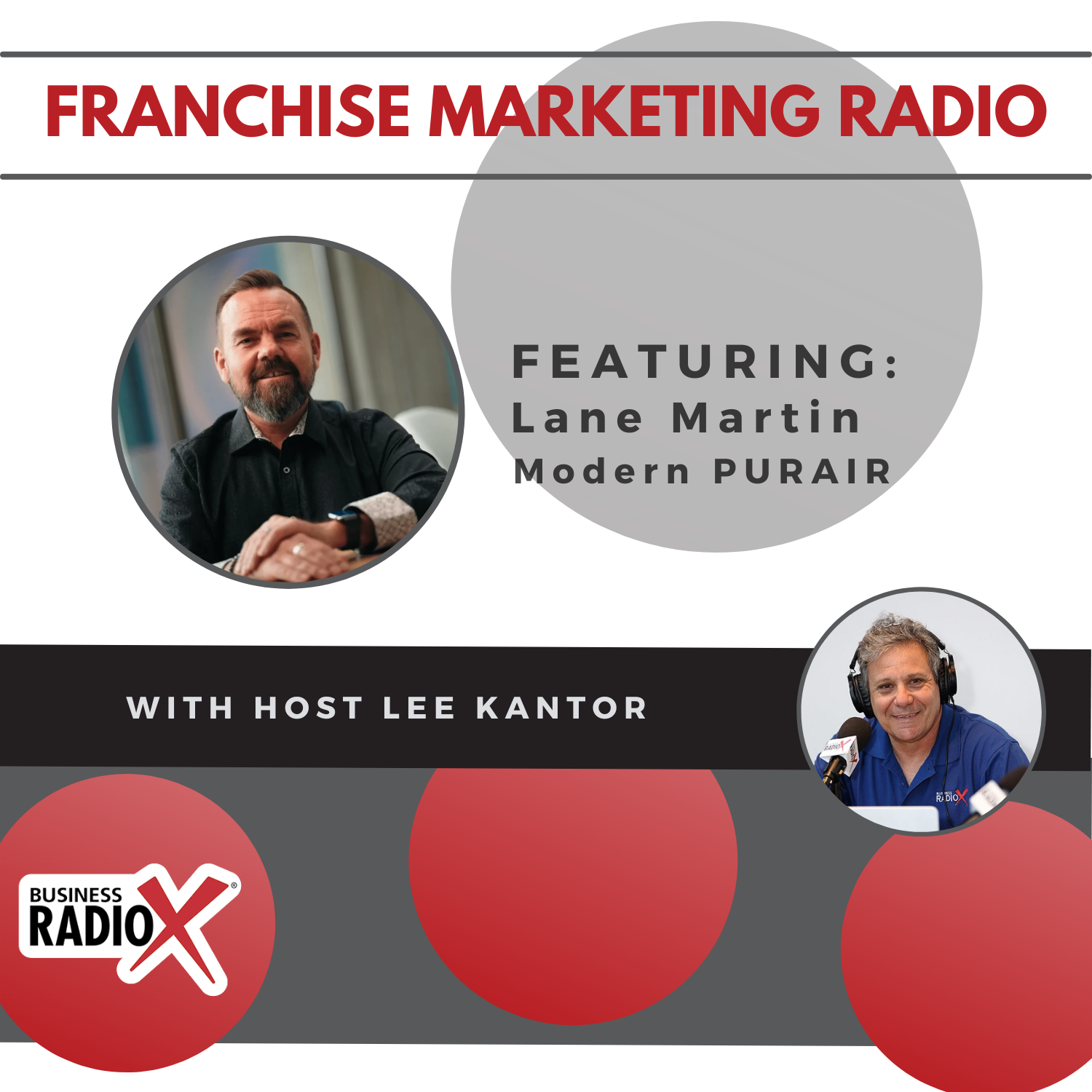

In this episode of Franchise Marketing Radio, Lee Kantor interviews Lane Martin, Founder of Modern PURAIR. Lane shares how the company grew from a family-owned duct cleaning business into Canada’s largest indoor air quality franchise and discusses its expansion into the United States. He explains the growing demand for indoor air quality services, the advantages of a recurring-revenue business model, and the key traits that make successful franchise owners. Lane also provides insights into franchise development, scaling service businesses, and building a national brand in an emerging industry.

 Lane Martin is the Co-founder of Modern PURAIR®, North America’s fastest-growing Indoor Air Quality (IAQ) franchise system. Headquartered at The Ventbox in scenic Kelowna, BC, Canada, Lane has been instrumental in expanding Modern PURAIR® into the largest IAQ franchise in Canada, with 20+ locations nationwide and U.S. expansion underway in 2026.
A passionate entrepreneur and visionary leader, he was named Honorary Mama of the Year (2021) by Mamas for Mamas in recognition of his philanthropic work supporting children in poverty through the PURKIDS® Foundation, a registered national charity. He has also been named to the Over Forty list, highlighting his ongoing impact in business and community service.
Under Lane’s leadership, Modern PURAIR® has earned numerous accolades, including
- Chamber of Commerce Business of the Year (2009)
- Small Business of the Year (2021)
- Finalist for Medium Business of the Year (2022)
He is an active business coach, regularly mentoring entrepreneurs on brand-building and business growth. He is a proud member of EO Okanagan (Entrepreneurs’ Organization) and serves on the board of the PURKIDS® Foundation, working to improve the lives of children across Canada.
He lives in Kelowna with his wife April Martin and their children, embracing the Okanagan Valley lifestyle and its outdoor pursuits whenever possible.
Follow Modern PURAIR® on Facebook.
What You’ll Learn In This Episode
- The business opportunity behind indoor air quality services.
- Strategies for scaling a service-based franchise across multiple markets.
- The importance of recurring revenue in franchise growth.
- Key characteristics of successful franchise owners.
- How commercial and residential customers drive business growth.
- The role of B2B sales in building a sustainable franchise.
- Best practices for franchise development and expansion.
- The value of transparency and alignment in franchise partnerships.
- Differences between Canadian and U.S. franchise markets.
- Building a long-term vision for national franchise growth.
 This transcript is machine transcribed by Sonix.
TRANSCRIPT
Intro: Coming to you live from the Business RadioX studio. It’s Franchise Marketing Radio.
Lee Kantor: Lee Kantor here. Another episode of Franchise Marketing Radio and this is going to be a good one. Today on the show we have the founder of Modern PURAIR, Lane Martin. Welcome.
Lane Martin: Thanks, Lee. Happy to be on. Thanks for having me.
Lee Kantor: Well, I’m excited to learn what you’re up to. Tell us about Modern PURAIR. How are you serving folks?
Lane Martin: How are we serving folks? Well, we clean the air in commercial, residential and industrial facilities. So anything that air touches, we clean in any environment that you’re in.
Lee Kantor: So what was the genesis of the idea had this thing get started?
Lane Martin: It’s a great question. My dad started in duct cleaning in Calgary, Alberta. Have you ever heard of Calgary?
Lee Kantor: Yes I have.
Lane Martin: Yeah. There you go. Way back in 1969. So literally, I’ve grown up in this industry in diapers and stayed in the business, grew it and scaled it. Sold one of those businesses way back in 1996, had a five year non-compete, got back into the business in 2001, and then we started franchising it in Canada in 2008. We grew that across Canada. So we’re the largest indoor air quality service provider in Canada. And we started franchising in the United States 18 months ago and now have three locations awarded. So we’re starting our U.S. expansion now.
Lee Kantor: So what is the actual service? How does it work?
Lane Martin: Yeah, we do duct cleaning, dryer vent cleaning, coil cleaning, indoor air quality testing, furnace and air duct cleaning and sell an award franchises across the country. So that’s what we do.
Lee Kantor: So then what is kind of a symptom that a person in a home would notice that, hey, maybe my air quality isn’t what it should be.
Lane Martin: Yeah. What we find a lot of times it’s a great question, Lee. A lot of times it’s people move into a house, whether it’s old or new, but new to them, and they’ll be like, I’m not sleeping well or I am waking up with a really dry cough or a stuffy nose, or my kid’s asthma has gone through the roof, or they just find the house is extremely dusty. But those are some of the main triggers for residential homes, for sure.
Lee Kantor: So if they’re not hiring you, how are they trying to how do they kind of like what to do with yourself? Way to even deal with this.
Lane Martin: Google and ChatGPT ask the questions. But yeah, that’s a lot of people just type in in ChatGPT. Well, you know, my, my daughter’s asthma is through the roof and we’ve moved into a new home. What do I do? Chatgpt might help them be like, have you thought about air purification? So then they’ll type in air purification and whatever city they live in. And, you know, if we have a franchise there, somebody looks into that and then they look down into, oh, okay, well, maybe we should get the ductwork cleaned because the ducts are the lungs of the home. Or maybe we need better air purification, or maybe we just need to open a window and have fresh air in the home, whatever that might be. But those are some of the different ways.
Lee Kantor: But what are what about all those things you see in like big box stores that sell like air purifiers that, you know, look like heaters or something like that.
Lane Martin: Yeah, those standalone air purifiers. Same idea. Yeah, there’s some good ones. And there’s some bad ones like vacuums, there’s good vacuums, bad vacuums, whatever it might be. Right. Normally you get what you pay for. So do your research on those types of things. But at the end of the day, air purifiers will only clean the air. They don’t get rid of the source. And so that’s the key. If you have a furnace or a heat pump or ductwork in a home or a commercial building, those are the lungs of the building and or the home. And so what you want to do is make sure that those are clean as well, because that’s the source. That’s what’s going to actually, once that’s cleaned in the home, then you can focus on keeping the air clean. Does that make sense?
Lee Kantor: Sure. Now how do how often do you have to do it once you’re you’re in on this.
Lane Martin: Yeah. Environmental. Uh, so if you have, you know, you know, ten cats, 15 chickens and dogs, and, you know, maybe, maybe quite more frequently, but we recommend an average residential home is every 2 to 3 years when it’s done properly getting the ductwork cleaned.
Lee Kantor: Now, um, what percentage of a franchisee’s business is residential versus commercial?
Lane Martin: 50% commercial. 50% residential.
Lee Kantor: So when it’s commercial, how that sale seems, I would imagine it’s a bigger sale, but it seems trickier because, you know, the the workers there aren’t there, the, the building owners kind of problem really.
Lane Martin: Correct. Yeah. So it depends on the vertical or the industry. So let’s take healthcare. For instance. Healthcare facilities have to be inspected every 12 months, um, to see if cleaning is required. So that would be hospitals, private home care facilities, seniors care homes, those types of things. So longer sales cycle for sure. Um, but once you are in with that decision maker, um, and you build the loyalty and do the work the right way, it certainly creates that recurring revenue stream for every 12 months and or 24 months, whatever is requiring cleaning, dryer vent cleaning is large in the commercial space as well for us. So anytime there’s, you know, a know, a commercial high rise or any, um, multi-unit facility that has dryers in it. The dryer vents have to be inspected annually for fire prevention to see if cleaning is required. And so all of our inspections, we do those and part of the PRR brand for free, which shows a if proof of cleaning is required and if proof of cleaning is required, we attach a quote. So we do, you know, thousands of dryer events annually for clients that same way. And then when you’re in there, it’s that repeat business, getting that for a franchise partner. Um, that really helps them grow that business into being a great business that they can grow and sell and, and exit from. Right.
Lee Kantor: So now how is it, uh, kind of breaking into the US market for you coming from Canada, because there’s a lot of players in this space right now and a lot of pretty strong ones, I would imagine in certain regions already.
Lane Martin: Yeah, that’s a great question. Um, you know, Canada is a large country and, and a very rural country compared to the United States. So population density isn’t nearly the same as it is in the United States, here in Canada. So, you know, we built the brand being in this for 20 plus years in franchising in Canada and going coast to coast, some of our markets take our franchise markets, take a franchisee, literally three hours to drive from one end to the other, and the population is 150, 000 ish people. And there’s still, you know, putting up great numbers and great EBITDA and building solid businesses. So as we continued to build in Canada and looked into the US, we realized that in the United States, funny enough, there isn’t a national player yet in this business. In the United States, there’s region specific ones that are doing well, multi locations that might have 30, 40, up to 50 franchisees, but there isn’t a national player yet in the United States. So we believe the opportunity is significant based upon the population and the density and us, you know, of course, finding the right franchisees because that’s that’s the magic in franchising is, you know. Right.
Lee Kantor: So now are you looking for franchisees to kind of be market makers in their state or community? Or are you selling kind of one one at a time?
Lane Martin: Yeah, no market makers. We’re looking for those empire builders. We’re looking for those people that want to build a significant business, be top of mind in their communities and their cities, be the mayor of their own town, you know, be in the trenches, grow it for those hard first one, one and two years. We say, scale the business out and then build it to something that is, you know, a sellable asset so that they can build it into that empire level and have a great work life culture balance. That’s exactly the goal. Yeah.
Lee Kantor: Now, you mentioned you grew up in this industry. What does that franchisee background look like typically.
Lane Martin: Um, what for a successful franchisee or me growing up?
Lee Kantor: Well, you grew up in it, so I’m sure there’s not a lot of people like you out there. Um, so what does a franchisees background look like that they’d make a good fit for modern.
Lane Martin: Yeah, our top, our top franchise partners in the brand right now, um, normally come from an entrepreneurial, an entrepreneurial home. They understand what it’s like to be in business or have seen business. That’s what we see. But most importantly, the top three performers in the brand came to us with great B2B experience. So somebody that has either handled a large portfolio of selling business to business, one of them was selling truck parts across the country. They had never been self-employed, but that was their large account manager. So they understood the cadences and the importance of B2B and driving the B2B and how to have those conversations. The rest can easily be taught. You mean ductwork is either clean or dirty? It’s the playbook and the systems itself. Um, that if somebody has experience and understands the challenging of getting out and having five decision maker conversations a day with commercial clients, they’ll knock it out of the park. So it’s finding that type of an avatar.
Lee Kantor: So the rhythm of your day is primarily dealing with commercial. And then the residential kind of is handled through digital marketing or other channels.
Lane Martin: Correct. You got it. Yeah, you got it. And then teaching your residential technician team that when you get one conversion, you know, a home’s there, you know, doing the proper residential guerrilla marketing. So lawn signs, door hanging, so converting that one to 2 to 3 conversions. But yeah, an owner brand new years one and two, it’s them. They are the chief revenue officer. They’re out there being the mayor of their own town building, building that sales funnel and getting those inspections booked and building that commercial sales portfolio out for sure.
Lee Kantor: So they can pretty quickly, um, not have to be the ones cleaning the ducts.
Lane Martin: Yeah. We recommend at longest 60 days. That’s it.
Lee Kantor: So you want to put somebody in place, um, pretty quickly.
Lane Martin: Totally. Like right away. Normally when our new franchisees launch, they already have a technician. The owner will be on that truck and learning the business for about 45 to 60 days at longest. But after that, boom, they’re out into the field and driving that B2B because they need to know the business for sure. Um, but they don’t want to stay in there. We don’t want glorified owners as technicians and trucks running around by any means.
Lee Kantor: And then, um, how are you selling it right now? What does the territory look like?
Lane Martin: Yeah, a territory minimum territory is 250, 000 people. That’s the minimum. Um, most of our people or franchisees coming in is taking, you know, 2 to 3 territories. So Multi-pack and our, um, FSO group, we’re using an FSO group in the states called Front Street Equity. So they’re handling the entire front dev side for us.
Lee Kantor: And was that difficult to find someone to do that role?
Lane Martin: Um, yeah. I mean, a lot of diligence. It was, it was difficult to find somebody, an FSO group that aligned with us and values and beliefs for sure. Yeah.
Lee Kantor: And now any advice for other franchisors out there looking for an FSO group? How do you you know what we’re kind of the dos and don’ts and things. Red flags and green flags you were looking for.
Lane Martin: Yeah, that’s a great question. Um, I think the red flags are, you know, as you being the franchisor, it’s your brand and wanting to make sure that the brand that is helping you grow in skill and representing you to potential franchisees, has the same values and beliefs that you do and understanding franchising. You know, what are the good things that they should be doing in franchising? What are the, you know, like our item 19 is 35 pages deep, which is a really clear, granular look at our financials. And I think that’s really, really important is leading with that transparency. Um, making sure that the FSO group, our FSO group is also involved with the end part. So, you know, when, when at some point I grow this business to a degree where I look at selling and exiting it, which is the whole game as a franchisor. Um, my FSO group is tied to that as well. So they’re not just looking at selling franchises and planting flags for us. They’re actually looking at going, how can we help build and ensure that we’re helping the franchisor bring in the right franchise partners, because this continues to build the enterprise value so that we all win at the end. And I think those are important. A lot of fsos and or brokers, um, seem to just be out there wanting to plant seeds or plant flags for the franchise partner. And that’s all good, but that’s not the way that we wanted to do it.
Lee Kantor: Right? I mean, you have to have values aligned, things like that. I mean those are creating that strong foundation is critical.
Lane Martin: Totally trust transparency. You know, being a franchisor. I mean, I, we, I have a weekly leadership call every week with new franchise candidates coming in. And, you know, we get a good snippet of how people are. And I lead with black eyes. Um, and I mean that respectfully. We’ve been doing franchising in Canada for 20 years as a franchisor. There’s black eyes that you get along the way. If you’re a brand new franchisor, you’re going to learn a few things, of course, in years one through five. Um, if you’ve gone from, you know, me running a duct cleaning indoor air quality business to selling an awarding duct cleaning businesses is a whole different career path. So you learn these things and you understand and learn from those mistakes. And I think that’s really important, especially for somebody looking into franchising and buying a franchise, there’s so many great opportunities out there. Um, just make sure that, you know, you’re dealing with validation of a franchise system that actually works and makes sense. And, and that your gut radar tells you is a good thing.
Lee Kantor: Now, have you noticed a difference in what a franchisee looks like in America versus Canada?
Lane Martin: Yeah, we have we’ve noticed, and that’s one of the exciting parts for us is the United States overall. And I Canadian, I would love, you know, maybe some Canadians will hold this against me, but I believe entrepreneurs in the United States work at a whole different level of speed and execution in business than Canadians do. I think Canadians are much more risk averse in many ways, even as entrepreneurs. And that’s exciting. Like we love that about the United States. Um, people are all in, in, in, in a much faster way. And they want to do business in that empire business mode faster and quicker. And I think that’s because of competition. And I think that’s because of population and all of those things that come into it. But that’s the big one that we see is execution and decision making. And the speed work much faster than the average Canadian entrepreneur.
Lee Kantor: That’s interesting. Do you I mean, you’re Canadian. What is the is there a cultural a reason why that is your opinion?
Lane Martin: Yeah, I think I think part of it is yeah. I mean, you know, I don’t want to get into politics by any means, but I think it’s like, you know, Canada has three, you know, political parties for that reason. We don’t have just a right and a left. We also have down the middle. And that’s kind of the way Canadians are. And so when it comes to business, that’s kind of the way Canadians are. We we don’t. Don’t get me wrong, there’s some great Canadian brands that grow and scale and do things fast and quick. But overall, the the tone. If I took 100 Canadian entrepreneurs in a room compared to 100 American entrepreneurs, it would be a different narrative on the speed to lead and the speed of execution and the commitment, for sure. It’s, it’s different and it’s a good thing. That’s what we’re excited for the US for.
Lee Kantor: Now in Canada. Is there, um, kind of that, uh, drive to kind of be your own boss as much as it is in America?
Lane Martin: I yeah, there is, and I think it’s, it’s, I mean, the American dream for sure is prevalent in Canada. I think in the last ten years, um, we’re seeing with how hard business is in Canada and how taxing it, the tax system has become on Canadian entrepreneurs and what our tax rates are now as Canadian entrepreneurs, that a lot of great Canadian entrepreneurs are moving their businesses to the United States and or are themselves moving to the United States just because it’s becoming really difficult in Canada to continue to invest in growing your business here without getting taxed to death? Literally. Does that make sense?
Lee Kantor: Yeah. I mean, that’s the incentives have to make sense. I mean, people will figure out a way the government can do what they want, but the the people that it affects will do what they got to do.
Lane Martin: Totally. Yeah. So, you know, I’m in EO entrepreneurs organization and EO is a great, you know, global network, peer to peer for entrepreneurs. And it’s been amazing. But we have a chapter here where I live in Canada, in the Okanagan Valley. And, you know, pre Covid, there was probably 35, 40 members in that chapter. And Covid changed a lot of things. But post Covid, there’s probably 8 or 10. They’re all still in EO, but they’re no longer in this Canadian chapter because they’ve gone to other countries. So that’s just one of the things that we’re seeing is taxation has become so high here in Canada that, yeah, it, it makes it difficult to want to continue to grow and scale your business. Whereas the American opportunity just seems much more entrepreneurial, focused for, for business owners.
Lee Kantor: Now, you mentioned earlier that there’s no national brand in America in this space. Is that the dream for modern prayer is to become that national brand?
Lane Martin: Yeah. We want to become national brand. A three year or three year vivid vision is to become North America’s only national brand in the United States coast to coast only indoor air quality service providers. So that was our goal in 2006 here in Canada. And we successfully did that in Canada in 2018. So hoping to emulate that and do the same for sure.
Lee Kantor: So if somebody wants to learn more, have a more substantive conversation with you or somebody on the team, what is the website? What’s the best way to connect?
Lane Martin: Yeah, I love that. Just go to modernpurair.com. So that’s Modern PURAIR, no E in pure perair.com. And just click on franchise opportunities and we’ll be more than happy to help you out.
Lee Kantor: Well, Lane, thank you so much for sharing your story today. You’re doing such important work and we appreciate you.
Lane Martin: Thanks, Lee. Appreciate it. Thanks so much for having me on.
Lee Kantor: All right. This is Lee Kantor. We’ll see you all next time on Franchise Marketing Radio.















