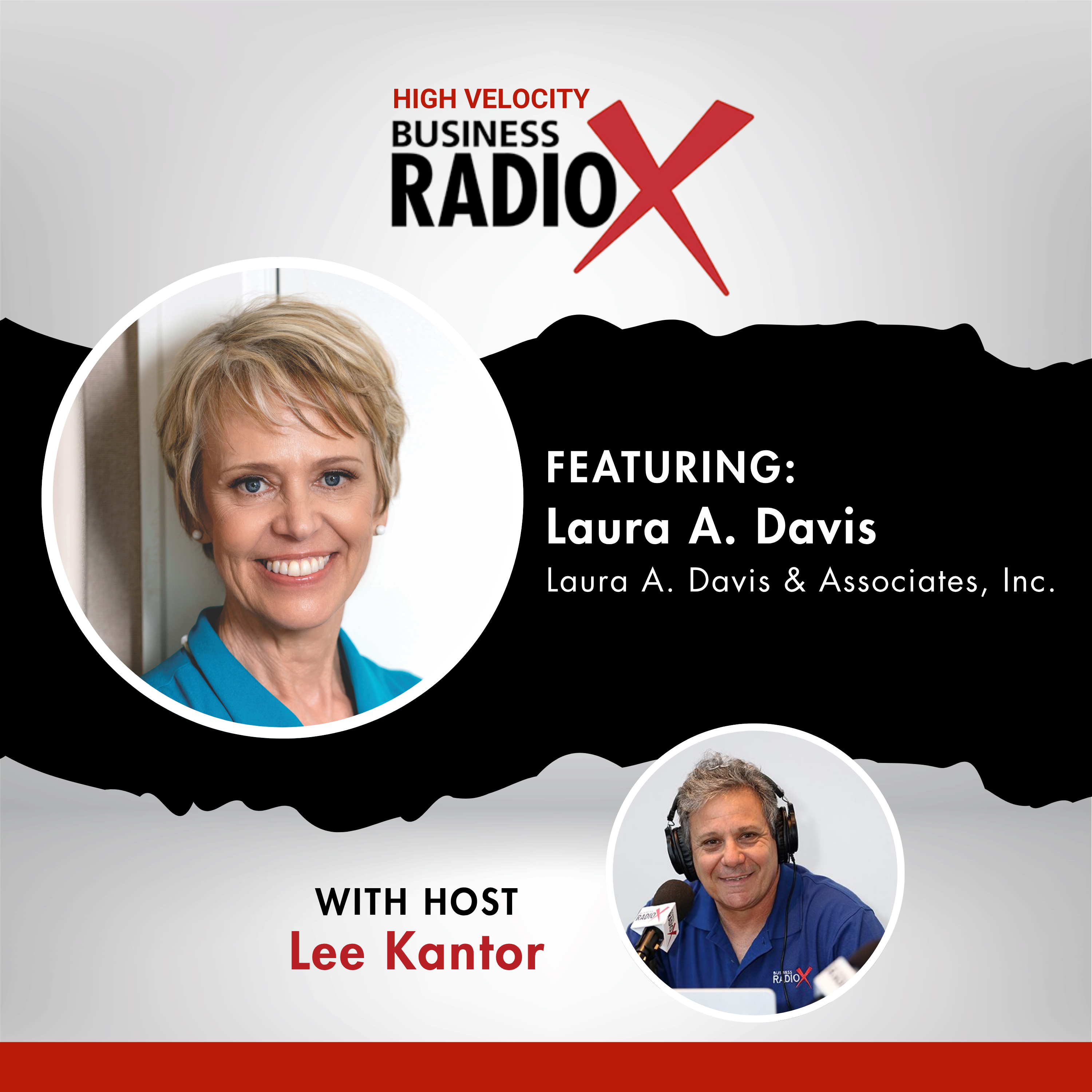

In this episode of High Velocity Radio, Lee Kantor interviews Laura Davis, founder of Laura Davis and Associates, celebrating 31 years in business. Laura shares her journey from corporate marketing to leadership development, specializing in emotionally intelligent leaders and high-performance teams. She discusses using the Everything DiSC assessment to help organizations understand behavioral diversity, build trust, and improve team dynamics. Laura highlights the importance of self-awareness, growth mindset, and coaching cultures in driving employee engagement, retention, and profitability. She advises leaders to seek feedback, appreciate their teams, and adapt their leadership styles to bring out the best in others.
 Laura Davis is the CEO and Founder of Laura A. Davis & Associates, Inc., an Atlanta-based transformational executive coaching, leadership and team development, and DiSC assessment training firm. Since 1998, she and her associates have been coaching leaders at all levels of Fortune 500 and mid-sized companies as well as major non-profits to become more emotionally intelligent and aware of their role in creating a healthy, engaged corporate culture.
She and her associates focus on assisting teams within organizations to become more cohesive by building cultures of high trust, productivity, accountability, and results. She coaches and trains individuals, teams, and organizations in the midst of transformational change on the mindsets, skillsets, and toolsets needed to create high performance and inspired success.
Prior to starting her business, she held both line and staff marketing management positions at Exxon, Equifax, and UPS. She was also an Adjunct Professor of Business Studies at Mercer University and holds an MBA in Marketing from Emory University.
She earned the coveted Master Certified Coaching designation through the ICF in 1998 and has maintained that credential through ongoing training & development in the fields of emotional intelligence, neuroscience in coaching, accelerated learning, team dynamics and more.
Her ongoing thought leadership is demonstrated in the talks she gives at professional industry conferences around the country. She is a contributing author to the book “A Guide to Getting It Self-Esteem” and has published articles in leading industry publications such as Choice magazine, ATD newsletters, and more.
Connect with Laura on LinkedIn, Facebook and X.
What You’ll Learn In This Episode
- Leadership development and coaching
- Emotional intelligence in leadership
- Building cohesive, high-trust, high-performance teams
- Importance of self-awareness for leaders
- Use of personality assessment tools like Everything DiSC
- Evolution of the coaching profession and coaching culture
- Challenges faced by leaders in modern organizations
- Benefits of behavioral diversity within teams
- Strategies for improving team dynamics and communication
- The role of feedback and appreciation in employee engagement
 This transcript is machine transcribed by Sonix.
TRANSCRIPT
Intro: Broadcasting live from the Business RadioX Studios in Atlanta, Georgia. It’s time for High Velocity Radio.
Lee Kantor: Lee Kantor here. Another episode of High Velocity Radio in. This is going to be a good one. Today on the show we have Laura A Davis with Laura A Davis and Associates. Welcome.
Laura A Davis: Thank you Lee. I’m delighted to be here.
Lee Kantor: Well, I’m excited to learn about your practice. Tell us about your practice. How are you serving folks?
Laura A Davis: Yes. So this is our 31st year, I’m proud to say. And we work with three populations basically, or in three areas. The first is to help organizations of all sizes, primarily fortune 500 companies, to develop emotionally intelligent leaders. And that starts with self-awareness. And we have lots of tools that we help people with the mindset and skill set and tools to become more self-aware. And then that extends into building cohesive, high trust, high performance teams. And the outcome of that is a culture where people actually want to come to work and give their best, and that results in more profit, more engagement, more retention, and all the things that organizations are seeking to do in this very volatile, ever changing environment right now.
Lee Kantor: So what’s your backstory? How did you get involved in this line of work?
Laura A Davis: Yes, well, I was a marketing director for Exxon, for Equifax and for UPS. And I actually had a wonderful manager at Equifax in my late 20s who noticed some of my strengths that I didn’t see for myself. For example, I really liked to teach people and coach people and train. And at the time, coaching wasn’t even a profession. So I had a master’s in business from Emory, which is how I came to Atlanta. And I taught at Mercer as an adjunct professor while I was working full time. And I really became interested in this whole organizational development field. And so I networked my way into it by going to professional associations, getting my coaching certification. I’m a master certified coach with the ICF and have been since 1998. That makes me sound really old, doesn’t it? I got it when I was really young. No. At any rate, I, um, just really became passionate about how some leaders were effective in some weren’t, and how some teams were just a delight to work on. And we got a lot of accomplished, even though we worked hard and others were a drain. And there was a lot that leaders and teams and organizations can do to create the kind of conditions where people really thrive and where the company then does well. And so many people are not aware of that. So that’s been our, our mission and our passion. All these all these years.
Lee Kantor: Now, how have you seen the coaching profession evolve over those years? You mentioned that when you were started, it wasn’t that prevalent, and maybe it was prevalent only to a certain group of people. How have you seen it evolve into now? It’s more kind of company wide, and there is such a thing as maybe a coaching culture within organizations. Mhm.
Laura A Davis: That’s the ideally and unfortunately, we still have a lot of opportunity for growth in just that mindset. Many companies are still somewhat command and control driven. And there’s a place for decisive get it done yesterday, leadership in certain situations. That said, what we encourage people to become is a multi-dimensional leader. In other words, I think there’s a a feeling in the general public that someone with charisma and a take charge Attitude and get it done. Sort of, uh, sparkling personality is the only kind of leader that’s effective, and that’s just not the case. And often a humble leader can be very powerful and a leader who’s more analytical and a leader who’s more, uh, affirming. And you need all of those things. So to have a true coach and culture, there needs to be a recognition of the, the need for all of those kind of behavioral styles. And we use the everything disc assessment with Wiley, the original disc, the small eye disc. And we have for many, many years, we’re fortunate to be Diamond award winning partners, meaning we use it a lot in all the coaching and training that we do. And we empower talent development departments and so forth to use the tools so they will buy the assessments from us or buy the training materials from us, and we support them in doing that. I think we’ve made progress. It really depends on the leadership. And I wish I had a, a, a way to really assess whether it’s size or industry, who’s most receptive to a coaching culture. And I think it really depends on, on the leader and the leadership team, whether they understand the real value and they’re willing to invest and take the time to create that kind of culture, because there’s tons of research to show that, in fact, that is more profitable. People want to work in that kind of environment. They want to stay. But we still are not there yet.
Lee Kantor: Now, what in your clients or prospective clients, what is kind of the pain that they’re having where they said, you know what, maybe we should be calling Laura and her team. Like, is there something or are there signals or they’re clues for a leader to say, hey, you know what? This seems a little out of whack here. Maybe we need some fresh eyes on this.
Laura A Davis: Yes. Well, that can take many forms and often it can be a team, usually a senior team. There’s some kind of disconnect. Either people are duplicating efforts, they’re withholding information. They’re not necessarily working with other teams well in the organization or there are silos. There are all kinds of changes in today’s environment now. So just trying to adjust to the magnitude and the rate of change is a signal, uh, why people call us in, how do we get people to adapt to change? And again, I go back to self-awareness and encourage a leader who might call me to self-reflect first. What might be the impact of your behavior on this team and how can you adjust and really model more mature, emotionally intelligent behavior. So I’ll give you some examples of what that might look like. Um, you know, and instead of sending a sharp text or reacting when someone gives you bad news, you know, taking a moment, hit the pause button and reflect and maybe send a clear text or, you know, some people have the tendency to say yes out of guilt or to appease people. Sometimes it might be stepping back and saying, let me think about that, or I can’t do that right now. Let’s discuss this at a time where we both really have the time to, to analyze all the facts and, and so on, rather than just react or, you know, when someone asks a team member something uncomfortable, there are certain styles that might tend to withdraw and not speak up.
Laura A Davis: And so taking the time to step out of your comfort zone and perhaps ask the difficult question or to reply in a way that really helps move things forward. And you know, what I see too, is people are under so much stress today that it’s important to understand that you as the leader or even as a team member, you set the mood. You make a huge difference in terms of how other people show up. You know, there’s sort of an emotional contagion that I think people aren’t necessarily aware of. So I help leaders and teams understand how to regulate some of those moods and focus on what is working and, uh, really work together in alignment and, and develop a trusting environment where they can discuss problems openly. So that’s a long answer to your question. But, um, those teams, uh, that, that do that, that really, uh, take the time to focus on interpersonal relationships are so much more successful and can deal with all of the changes coming at them much more skillfully than those who don’t.
Lee Kantor: Now, early on, you mentioned disk. Can you explain to our listeners why you’ve kind of leaned into disk and what benefits you see from folks who, uh, also lean into it and, and take the assessments and, and take action based on what they learn.
Laura A Davis: Absolutely. So there are many assessment tools out there. And I really am a big proponent of everything disk, which is the Wiley brand for several reasons. And some people might not be familiar who are listening. So Disc is an acronym for dominance, influence, steadiness and conscientiousness. And it’s certainly not to label or pigeonhole people at all. We’re all a combination of all four styles, but most of us for sure we have a primary style. We may have a secondary style, and I really love this because it is scientifically validated. It’s a proven tool. It’s been around for decades and many, many people have taken it. And while he has done a wonderful job of investing in an online portal platform that really allows people to compare themselves to someone else, has nothing to do with your competencies or your intelligence. It’s really your personality, style, tendencies and preferences. So it’s a wonderful, validating tool to help people move from judging other people because there’s a tendency to, as human beings, we think our way is the right way. And sometimes people are unaware that people really do see the world completely differently. They’re motivated by different things. They’re stressed by different things. They have different needs and disk is a needs based model. So the D really is results focused. Someone who’s direct and get it done and fast paced. The I and I’m giving you of course the high level overview stands for influence. That’s the person who’s more of the connector, more enthusiastic, usually a little bit more sociable. Um, really likes to keep people energized. The S stands for steadiness and the steady um, personality style is someone who is a great listener, is generally patient, a calm influence, uh, often process oriented.
Laura A Davis: And the C stands for conscientiousness, which is someone who’s more analytical, more challenging, often a little bit more skeptical, sort of your quality control eyes, uh, and the combination of those different behavioral preferences and personality style traits, um, are really valuable to understand because then you can move from judging someone who’s not like you, particularly at the diagonal, we tend to have the least in common with, uh, the style at the diagonal. It’s a circle. Uh, so the D’s and the S’s and the eyes and the C’s sometimes misunderstand one another. If you can appreciate the strengths that everyone brings to the table, then you can move from judging someone else’s behavior to accepting it, to really valuing it. And sometimes we just judge it or we tolerate it, you know, that’s just the way Lee is, you know? But if you understand where they’re coming from and the value their perspective brings to the table, then you have the advantage of, of looking at any kind of problem in, in the business environment from those different perspectives, you’re going to get a much richer, more comprehensive solution. And the problem we I see is many times in organizations, a leader will hire people like themselves or with a similar style because that’s comfortable. And you want to, of course, hire someone who’s the most qualified for the role. But how they show up in the interview process makes a difference. And so you want to make sure that you’re, um, not biased by just the likability factor of someone who’s like you.
Lee Kantor: Now when you’re working with your clients and using this model, does it help them kind of under give them more empathy and maybe more grace for folks that maybe they were had friction with, but this allows them to kind of reframe that friction to, oh, okay, now I understand where they’re coming from. I can give them maybe more benefit of the doubt. I can give, I can understand a little bit more about their why of their, they’re not doing this to sabotage me necessarily. This is just their lens on the world, which is different than mine.
Laura A Davis: Exactly. That’s very well said. And that’s exactly the benefit. It’s very validating. And you see that to extend your your point. Most people don’t get up in the morning to try and make other people’s lives difficult. Some people do, but very few. And often what happens is everyone brings strengths to the table. And by virtue of being human and also having these personality style preferences, we have blind spots. And so if you have a team that has a little bit more behavioral diversity, then you can make sure that you’ve got all of your bases covered. And yes, exactly what we want to encourage people to do is be curious about the other person’s perspective. And just because it’s not like yours, doesn’t mean it’s not inherently valuable. And what we do a lot is help people communicate more effectively and use coaching skills to to draw that out rather than what most people tend to do in stressful situations or where there’s some kind of miscommunication or someone is frustrating you is you tend to overuse your strengths. So I’ll give you an example. If you’re a strong, dominant style and you want things done quickly and you’re trying to move a project forward, you might bulldoze over people or railroad people who are asking questions, or being more thoughtful, or wanting to really understand how all of the steps might connect.
Laura A Davis: Right? And that might be the steadiness style. So if you’re that that person who’s driving forward, you want to pause, you want to take a breath, you want to ask a question of the person who might be questioning the approach and really give it credence. Maybe they don’t have a valid concern, but even if they don’t, you want to get buy in from them. You want to involve them in the process. And most people, if they’ve been involved in, in a change or an initiative or a process, and they understand the rationale, even if they don’t agree, but they’ve weighed in, they’re going to buy in, right? And I see too often people moving forward quickly and not bring other people on the team or in the organization along, because they haven’t slowed down enough to communicate why we’re doing something. Now, that’s a common scenario.
Lee Kantor: Now when you’re working with the leaders, um, is that a lot of your work is to kind of give them the tools on how to navigate, uh, the, the personalities of their team so they can get the most out of them. They, like you’re saying they might, you know, when you have a hammer, everything’s a nail. So you’re giving them kind of a wider array of tools to use to help get the most out of their team, which. Ultimately, that is their objective, right? They want the whole. They want the organization to succeed. And in order to do that, they have to have their team, you know, running optimally. And this is giving them just more tools in their tool kit to help that outcome get achieved.
Laura A Davis: Yes, that’s very well said. I think people underestimate how important the interpersonal dynamics are, and the leaders that I’ve worked with are more attuned to that, or they wouldn’t be hiring us. That said, it’s a spectrum. You know, some people really get it and others don’t. And it’s not, uh, it’s easy intuitively to understand, but to actually practice can be very challenging because it requires people to look at themselves and what am I doing? How am I positively impacting this person, this person, and so on. And what else could I do to be more effective? So some of that might be just asking for feedback. You know, what am I doing that is helping this situation? And what am I doing that might be getting in the way and really understanding the impact of, of your behavior on others. Because if I’m not aware that people do come to the table with very different worldviews, they’re motivated and stressed by different things and they have different priorities in the, in the disc language, then I am just not seeing how I can bring out their, their strengths. And so that is a critical piece. We also, of course, are teaching people things like how to coach or how, you know, there’s a skills component, how to delegate, how to prioritize or do some kind of strategic planning. All of those tools are important In order to implement, though, what you need to understand is how to get that done through people. And that’s where the personality style understanding can come in. So useful because it’s the core, it’s the foundation around which people will either do what they need to do or not, to put it very simply.
Lee Kantor: And it gives everybody kind of a common language. So now we’re all saying the same thing and we all understand what these things are. So now we can speak freely and I can have more empathy. I understand what you’re trying to do. You understand what I’m trying to do. It kind of. We’re all kind of reading from the same playbook now, instead of each having our own kind of lens in the world.
Laura A Davis: Yes, it’s very useful. And again, you want to use it properly as a tool, you know, tendencies and, uh, you know, traits are not set in stone, and hopefully people have learned to act out of the positive side of what’s natural for them. And I often talk about it sort of being your home base, but we all have to do some stretching and adapting into areas that might not necessarily be comfortable for us. So, you know, understanding that really helps us, as you say, have more empathy and compassion for the others, but it also helps us work together more effectively. There are some things that some people just are not going to be skilled at and don’t want to do. Why make yourself do that? Why not? You know, really, um, leverage the gifts that somebody else on a team might have where they really enjoy that. And that way you really have an orchestra, right? You have people playing their parts, you’re all in harmony and you can accomplish a tremendous amount in that way. But too often I find somehow people have gotten the idea that they have to be all things to all people, and that’s really not possible either. And I loved what you said about this gives a shared language, which it does. Then everyone is much more understanding not only of others, but of themselves. And I think that’s really a critical piece of this kind of work as well.
Lee Kantor: Now, is there a story you can share about an organization that came to you and how maybe share don’t name the organization, but share the challenge that they had and how you were able to help them get to a new level?
Laura A Davis: Yes. I’m fortunate to say we have many of those. And on our website, we have a document called, um, Success Case Studies. And there are three of those. So I’ll pick one of those as they’re relatively recent. In fact, one is a team I’m currently working with. So I started to coach the CEO of this healthcare organization, and it happens to be a nonprofit. And the reason was this particular individual was newly promoted to CEO and wanted to change the culture of the organization of about three, 400 people. And, uh, we began that process for a year. And I was very thrilled to see that this person had a growth mindset. And I think many people might be familiar with that, but really open to learning. Open, open to understanding their strengths and where they might have some blind spots. And so we worked on that. And then we started working with her leadership team of seven people. And we went through everything disc, and we did a number of other trainings around conflict and team development. We use also the five behaviors of a cohesive team, which uses Pat Lencioni model some people might be familiar with The Five Dysfunctions of a team, which is a wonderful business fable of a team in Silicon Valley that had the best people, the smartest, best and brightest players on the team. But they weren’t making any progress. Even though they had money, they had a great product because of the interpersonal dynamics.
Laura A Davis: So this particular healthcare organization I’m still working with has undergone some major challenges in terms of the geopolitical environment. I’ll put it mildly, in terms of funding and just some challenges in the external environment. And they gave me a nice compliment. And of course, I would say it’s it’s their work, but I helped facilitate the work that they did because they worked on becoming a cohesive team and understanding one another’s strengths and talents and blind spots. And they’re all working together, uh, as a leadership team. They have come through and, and changed their delivery model, their care delivery, uh, model in record time with record effectiveness because they were much more, uh, cohesive in terms of not only understanding their mission, but how they needed to communicate with one another. And that’s not to say that, you know, disconnects or mistakes don’t happen. They do because we’re all human, but they would apologize or would recognize the problem and take action to, uh, do whatever repair work needed to be done, whether that was interpersonally or strategically or, you know, legislatively, whatever. And they’re, they are really thriving. And it’s not to say that we hope the environment doesn’t change again, but they’re doing really well given the circumstances. And. And I think that’s because they did so much work to. Become more cohesive and more, um, emotionally intelligent. And we’re now. Cascading that, oh, excuse me, I’m gonna take a sip of water here. Throughout the organization.
Lee Kantor: Now, you mentioned, um, healthcare and nonprofits as people you work with in this case. Do you have a niche or is this kind of industry agnostic your work?
Laura A Davis: Yes. When I first started, I thought I would focus on a particular industry vertical or perhaps marketing people, since that was my background and it’s really industry agnostic. And the great benefit for me and my associates is we get to learn a lot about a lot of different businesses. And if you understand what the strategic drivers are and you go through a discovery process, which which we always do at the beginning of any engagement, ask some questions about what’s going on in the business and really do some discovery before we get into any kind of, um, team or leadership development. You can see that there are similarities. You know what, how does the company make money? What are the drivers? What are the values? And, uh, it’s very interesting. And I think the fact that we are not focused in a particular vertical or niche, uh, helps because you can have that beginner’s mind. Like, why do you do that? You know, why, why is it organized this way? And that can help, um, people really question, is there a better way that they might be doing what they’re doing a more innovative way? And certainly in today’s world, with so many technological changes and the geopolitical changes and AI and many trends and headwinds that we haven’t necessarily dealt with all at once before. That’s really valuable to bring an outside perspective to the table.
Lee Kantor: Now, is there any, um, characteristic of a leader that is kind of a knockout for you in terms of a good fit? Like if what something we talked a lot about what makes a good fit, but is there something that is a okay, this is not going to work. And I can tell pretty quickly.
Laura A Davis: Yes, yes. And that would be really having a very fixed mindset my way or the highway. Uh, can you come in and fix this person or this team? And I will graciously say, no, that’s not how it works. And it really does begin with the leader. What kind of environment are you, uh, modeling, setting the stage for? And that doesn’t mean that leader has to be perfect, but they need to be willing to learn and grow, have a growth mindset again. And that that’s the real differentiating factor. And, you know, sometimes someone wants a particular, uh, approach that may not be our, uh, in our wheelhouse. And I would would say that, uh, freely, uh, you know, if somebody wanted coaching, uh, in a technical arena, I mean, we’re really doing what I call essential power skills, which used to be called soft skills, but they’re not soft. They’re essential for success. And so we call them power skills. But, uh, yeah, I think if the person is really closed to learning and growth, then they won’t benefit.
Lee Kantor: Now, is there any advice you can give a listener that that’s actionable right now? Is there some low hanging fruit that an individual or a team could be doing right now that might make some change?
Laura A Davis: Yes, I think again, Going back to the basics of self-awareness. Uh, using a tool like everything, disc is always a great start. Understanding what your strengths and blind spots might be and asking for feedback. Really thinking through, uh, how your team might help you improve and asking that really sincerely. So it doesn’t sound like I did a great job in that meeting, didn’t I? Or don’t you agree with this approach? You know, that’s obviously a leading question, but really sincerely asking, what can I do to facilitate your growth? Or how would you like to be managed if it’s a manager and a direct report? I remember the the man I mentioned earlier, Jeff Folmsbee at Equifax would ask me that. And I remember being sort of surprised by that and just really understanding that each person on your team might have different needs and different motivators and stressors or things that really light them up, you know, ask them about that. And, and I think the other thing that people overlook is sincerely giving people what I call developmental feedback. People would call that positive feedback or praise. I don’t like to say positive or negative, but developmental is, you know, I am seeking to improve people’s behavior, but reinforcing feedback, really recognizing people and the contribution and, and what they bring to the table. People are moving so fast today that they forget to do that. And it makes such a big difference. If you genuinely appreciate people, get to know people, understand the people that you work with, whether you’re a leader or just a, you know, or not, just if you’re a team member. Uh, just really appreciating the contributions of others can go can go a long, long way towards making everyone more successful and happier at work.
Lee Kantor: Now, if somebody wants to learn more about you or your practice, is there a website? What’s the best way to connect?
Laura A Davis: Yes. Thank you. So our website is Laura a davis.com. Someone got Laura davis.com a month before I did. So it’s Laura a Davis. Or you could email us and someone on my team will definitely get that to me. And we will be happy to have a conversation and do a discovery. See if your team or your organization would be interested in some of the things that we offer and the benefits that we might be able to contribute, uh, or not. And so my email is Laura at Laura davis.com, LAURA at That you are aadavas.com. So that would probably be the best way. And we’re on LinkedIn. Laura, a Davis and Facebook and all of the social media outlets. So we. It would be great if someone would link in with us too, because we post a lot of. We hope is helpful information about tools, not just disk, but, you know, how do you have difficult conversations or how do you have a performance conversation? Many things that many leaders and teams would be wanting to know more about.
Lee Kantor: Well, Laura, thank you so much for sharing your story today. You’re doing such important work and we appreciate you.
Laura A Davis: Thank you so much. Lee. It was a pleasure to talk to you.
Lee Kantor: All right, this is Lee Kantor. We’ll see you all next time on High Velocity Radio.















