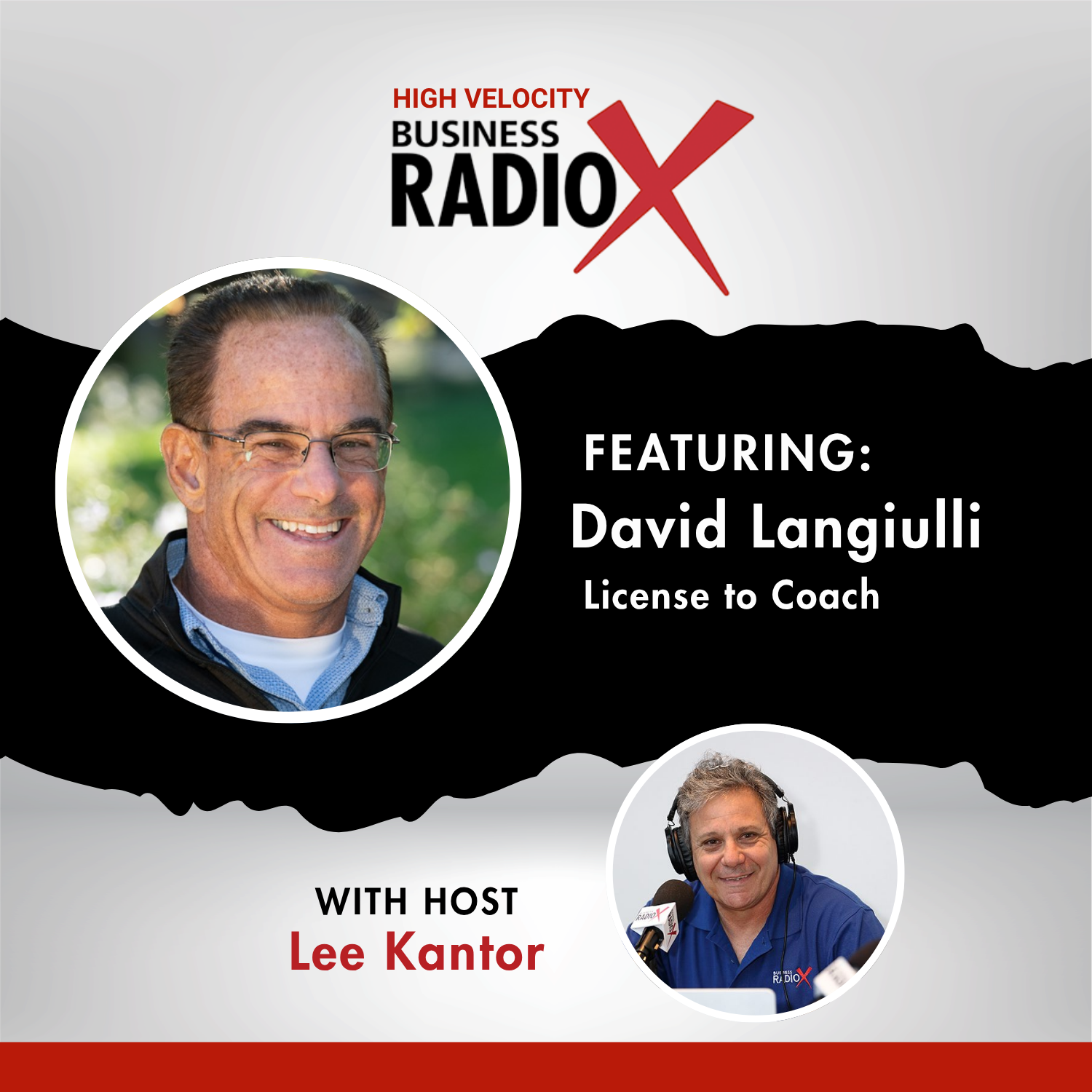

In this episode of High Velocity Radio, Lee Kantor speaks with executive coach and leadership trainer David Langiulli of License to Coach. David shares his journey into professional coaching and his work helping leaders develop beyond technical expertise. He emphasizes that great leadership is not simply about what a person does, but who they choose to be—cultivating qualities such as curiosity, intuition, courage, compassion, humility, authenticity, and integrity.
 David Langiulli is a transformational Executive Coach and leadership trainer known for his “gently fierce” approach—combining courage, compassion, and wisdom to guide change.
A world champion Jiu-Jitsu black belt and Positive Intelligence expert, he helps leaders reduce stress, build trust, and improve performance.
 With a diverse background in entrepreneurship, fundraising, and strategic leadership across sectors, he brings unique depth to his coaching.
He is a published author, a trusted advisor to boards and teams, and holds advanced degrees and certifications.
Connect with David on LinkedIn.
What You’ll Learn In This Episode
- Leadership is rooted in who you are, not just what you do.
- Curiosity and humility can be more valuable than relying solely on expertise.
- Intuition, courage, and compassion remain essential human qualities in an increasingly AI-driven world.
- Vulnerability and authenticity can strengthen trust and organizational culture.
- Self-awareness helps leaders recognize behaviors that may be limiting their impact.
- Perseverance and integrity are built by consistently honoring commitments to oneself.
- Great leaders create environments where people feel safe, valued, and inspired to contribute.
 This transcript is machine transcribed by Sonix.
TRANSCRIPT
Intro: Broadcasting live from the Business RadioX Studios in Atlanta, Georgia. It’s time for High Velocity Radio.
Lee Kantor: Lee Kantor here another episode of High Velocity Radio and this is going to be a good one. But before we get started, it’s important to recognize our sponsor, Business RadioX. If you’re a business coach who’s tired of being a best kept secret, set up a call with Stone Payton at bookstonephone.com to unlock your perpetual prospect pipeline. Today on the show, we have executive coach and leadership trainer with License to Coach David Langiulli, welcome.
David Langiulli: Hey, Lee.
Lee Kantor: Hey. I am excited to learn about your practice. Tell us about License to Coach.
David Langiulli: Well, I’ve been around for, oh, 11 plus years working with leaders and teams across North America. Hundreds of folks now. Dozens and dozens of teams. And yeah, focus on leadership development and nonprofit organizations and corporations. That’s what I’m up to in the world.
Lee Kantor: So what’s your backstory? How’d you get involved in coaching?
David Langiulli: It’s a good question. I was leading a fundraising team at Princeton University, and I read a book. Uh, this is probably like 2013 ish. I read a book with a title, Positive Intelligence by Shirzad Shameem recommended to the audience. It was a New York Times business bestseller. Back in the day, and somewhere I read his bio that he was the CEO of an organization called at that time called the Coaches Training Institute look them up. They, at that time, and probably to this day have trained more coaches worldwide than any other single organization. Basically, it’s the organization that started the coaching industry back in the 80s. And so I took their fundamentals course in New York City and got hooked. You know, I was really interested in in integrating coaching skills into my management and leadership repertoire. And five courses later and over a six month period and a six month practicum with tens and tens of clients, uh, and being reviewed by two master coaches. Here I am with, uh, my certification and launched in the world as a professional coach. Anyway, that was like 11 years ago. So yeah, I got hooked on Coaching others and left step step down from my role at Princeton. Moved to Florida to take care of my parents and launch my leadership development practice.
Lee Kantor: So had you been coached prior to reading that book? Like, did you have any experience with coaching prior to that?
David Langiulli: I had not been coached formally, no. And yeah, you know, there’s a lot of misconceptions about what coaching is and isn’t. And so some would say, you know, some would look at advising and mentoring and call it coaching, except that’s not coaching. And a lot of people hang their shingles out there as coaches. I’m sure you have a lot on the show. Some of them are trained the way I was and some of them aren’t. So it’s, um, I hadn’t been coached, but I got lots of coaching and lots of practice coaching others in and my coach training over the course of a year.
Lee Kantor: So when.
David Langiulli: Did working?
Lee Kantor: When did you have kind of the aha moment of coaching? For me, I can see the power of this thing, the impact this could have.
David Langiulli: Yeah, I saw it in the, um, in the six month, um, certification, the second six month part of the certification process where you had to build a roster of roughly ten clients to get the hours that you needed to get certified. And so, you know, I saw I had a lot of the business development skills that are required to build a coaching practice. I subsequently went through, um, Ctis, uh, leadership development program, which is another year of training and, and got really good at facilitation. So I integrated, uh, my leadership training created a whole bunch of on site workshops. We had to do that as part of the program. You know, uh, online courses, uh, retreats. So I’ve integrated leadership training with my one on one coaching practice. So yeah, I knew, um, in that second six months of coach training that I could build a coach, a coaching practice. And, um, at that time, you know, my parents were living with me. We were taking care of my father who had had a couple of strokes and he stabilized and they decided to move to Florida. And my children were of an age, um, where if we were gonna continue, my wife and I, if we were going to continue to, uh, to provide support for my parents, we had to relocate at that time. Otherwise, you know, my kids were going to be into high school and we would not have wanted to, uh, move. So, um, you know, I took the leap of faith and, uh, moved to Florida and, uh, best decision of my life. And here I am 11 years later and help both my parents cross over to the other side, which I’m pretty proud about.
Lee Kantor: Now, in your practice, do you, do you still follow the positive intelligence kind of model and protocol, or is it come to the point where now you’ve you’ve kind of evolved into.
David Langiulli: Yeah, I was initially trained in the Co-active coaching model, which is a great model. Uh, Shirzad didn’t launch positive intelligence until 2020. So that was about five years after I launched my practice. But that book had a huge impact on me, and I was in his first cohort of positive Intelligence coaches to be trained back in 2020. So continues. I am trained in that methodology. I use that methodology with a lot of my clients where it’s appropriate. It’s a very robust and rigorous, um, um, coaching paradigm. Um, and I use it frequently and obviously I, uh, was coached using that methodology, uh, when I was going through that training. So I consider myself one of the early experts in positive intelligence. Yeah.
Lee Kantor: So now, um, what is your practice look like now? Who, who is kind of that ideal client profile for you at this time?
David Langiulli: Work with a lot of leaders in the nonprofit world who, um, don’t necessarily have the resources available to them that you might get on the corporate side. Also work. So these are tend to be mid to senior level. Uh, mid could be mostly mid-career to uh, I’d say mid-career. Many of them are. Medium sized to large organizations. I really like the midsize organizations because I feel like I can have a greater impact there. And, you know, these cut across a whole bunch of different industries. It doesn’t really matter, uh, in my opinion, but a lot of people care about that. It’s just that, um, if you’re well grounded in coaching the industry that your clients working in is relatively, um, not as important as the person in front of you.
Lee Kantor: Right? The work should be kind of industry agnostic. It shouldn’t be dependent on.
David Langiulli: It is, generally speaking, right? You have a human being in front of you, or you have a team in front of you. And the the coaching context and the leadership context are, are, um, can be applied to, uh, a lot of different situations.
Lee Kantor: And that goes back to your earlier point about really, uh, kind of crisply defining coaching. You’re not a consultant.
David Langiulli: I’m definitely not a consultant. Um, every now and then people will ask me for advice and I’ll usually say, well, opinions are like bellybuttons, everybody’s got one and here’s mine.
Lee Kantor: Right. But they’re not hiring you to solve something like that. They’re trying to get out of their own way a lot of times.
David Langiulli: Yeah. Especially if they’re, um, have some self-awareness and they realize that they’re sabotaging themselves and their team. That’s a very good case for working with a coach, especially a positive intelligence coach. Some people have that much self-awareness and or they have some sense that, uh, something’s not working that don’t quite know what, but they have enough self-awareness that and, and responsibility to realize that what’s not working is them, not that they’re broken. It’s just that whatever behaviors they’re, um, embracing, uh, are not working some, maybe some of the things that got them to where they are not going to get them to where they’re headed or they’re in a transition and they just want some, you know, they just been promoted or they just started in a new organization and they just want a little confidential source to help support them. Yeah.
Lee Kantor: Is that typically the trigger? There is some sort of an event that occurs that they’re like, oh, I better get some eyes on this.
David Langiulli: Yeah. So it could be that they feel stagnated in their current role. Could be that they’re in a new role in the existing organization with added responsibilities and more stress. Um, could be that they, uh, have been recruited away to a new organization and having new people, new responsibilities, maybe reporting directly to the board, which is a whole nother set of challenges. Um, and, um, so those would be some very common scenarios.
Lee Kantor: So if you, if you were giving advice to somebody who is maybe has a new role, like maybe they’ve just been hired to be an executive director somewhere or they have a new position. What are some of the do’s and don’ts for someone new to the job.
David Langiulli: I’m not in the business of giving advice, Lee. We already established that.
Lee Kantor: Right. But there are some common things that when people go through this mentally, they have to prepare for this new, uh, situation.
David Langiulli: Right. So, um. I tend to focus on ways of being a leader, not so much what you do as a leader. So one way of being is being curious. So when you go into a new role in an organization, instead of coming in with expert itis, um, which is probably one of the reasons why they hired you, except being curious is the better way of being than being an expert. You you have the expertise. No one’s. That’s not the stumbling block. Can you be curious? Can you be curious about the people without, you know, immediately making judgments? You know, even though you’ve been told, oh, you got to watch out for this person. You got to watch out for that person. You know? Um, can you be genuinely curious about what the dynamics are on the board? Can you be genuinely curious about? All of the services, products that you’re offering and, um, like be non-judgmental about it and like really take a cold, hard look at whether the organization should be continuing with those things.
Lee Kantor: So is it when you get into a new role, like you said, you’ve come already with the experience. They already know you’re an expert in what you do, or they believe you’re an expert in what you do. And is it just a matter of just trusting your gut here and just saying, look, I’m here now and I’m in charge, so just let me pay attention and just trust my gut into seeing what what should be done.
David Langiulli: Well, I do work with a lot of clients on trusting their gut. We also known as using your intuition. Um, it is an innate quality of being human tends to reside in the right brain as opposed to the rational analytical mind which lives for the most part in the left brain. So what happens to leaders is that and most of us, as we get conditioned in the educational industrial complex and go to work in organizations, is we use our rational, analytical mind, which gets us to where we are and the intuitive mind, for many leaders atrophies. And so recapturing that intuition is something I support leaders in doing. Yeah, it’s it’s tricky because you get all your goodies in the modern organizational life through rational, analytical thinking. Except, you know, uh, Steve Jobs wasn’t Steve Jobs because of his rational, analytical mind. Steve Jobs was Steve Jobs because of intuitive mind and the most rational, analytical thinker of the 20th century, one of the most, if not the most rational analytical thinker. Albert Einstein said, the rational, analytical mind is a faithful servant, but the intuitive mind is a sacred gift.
Lee Kantor: But do you find a lot of organizations, um, they don’t encourage intuition, uh, but they encourage, uh, the analytics because the analytics are easier to measure.
David Langiulli: Of course. And yes, they don’t encourage it, but you don’t get to be a leader. I mean, anybody, not anybody, most folks who come up the corporate or nonprofit ladder are pretty well tuned into their rational, analytical capabilities. So that’s not why you get, you know, promoted to run an organization or run a big division of an organization, you know, you’re being even though they may say that’s why they’re hiring you in reality, they want your intuition along with your rational, analytical mind. Except most people, that part of their brain has literally atrophied. Their own pathways have not fired in many, many years. And so part of what I do in with the positive intelligence work is help to fire up that that right brain things like empathy. Empathy. Imagine that having, you know, a rational, analytical person, like having empathy and compassion for another person is completely irrational. Any psychologist will tell you that. Except it makes us. It makes us human.
Lee Kantor: But aren’t some of these issues at the forefront of this transition we’re going through right now? Like with AI, for example, AI basically can eliminate all of the junior members of an organization because it’s smarter than them in a lot of areas. But if you get rid of all of that layer without empathy and just look at the math of it, um, you’re kind of destroying who your next generation of leaders are going to be because they’re not going to be equipped to have the wisdom needed to lead, because they’re going to be lacking some of the scar tissue that got the leaders to become the leaders.
David Langiulli: Amen, brother. I mean, um, the thing is about rational, analytical thinking is that a computer with vast access to data can do it faster than you can. So those sorts of roles will be eliminated. So unless you are I mean, I will who’s to say where this, um, type of intelligence is heading. I would, it’s possible, although I think highly unlikely, that an AI system will develop intuitive capability. But who knows? Uh, as of right now, um, that we’re still quite a ways away from that. Um, so being able to, um, know a thing without deductive reasoning is a innately human quality and trusting your intuition and acting on your intuition is where many leaders fall down because the rational, analytical mind will give you all the reasons why you shouldn’t take the action you want to take. Uh, on the intuitive information you’ve received.
Lee Kantor: Now, it’s.
David Langiulli: The best leaders, but the best leaders have the courage to do that. Courage is another thing, is another quality of leaders that an AI system doesn’t possess. Also, compassion is a quality of human beings that AI systems don’t possess. So in other words, compassion is the ability to, as Bill Clinton would say, feel your pain with the aspiration to actually alleviate that suffering. Ai systems don’t do that currently.
Lee Kantor: Now, it sounds.
David Langiulli: Like leaders, great leaders do. And by the way, you need to have courage to have compassion for another human being. It’s a whole topic, a whole nother topic we could talk about. But again, combining courage and compassion, uh, that’s something an AI system can’t do, but it’s something that a great human leader can do.
Lee Kantor: It sounds like you spend your time focusing on the humanity of the individual and try to help the humanity kind of integrate into the organization. Um, that’s.
David Langiulli: All I, that’s all I work on.
Lee Kantor: Right. Exactly. And then, but those are the things, like I said earlier, that are difficult to measure in terms of, um, hey, high fives, you did a good job with your courage today. Um, you know, how do you, um, how does the, the leader kind of know it’s working?
David Langiulli: Um. It, this is something that’s, that’s counter intuitive. Um, when you’re focused on who you be as a leader, you’re, you know, these qualities of, of intuition and, and, and courage and compassion and humility and authenticity, the doing of leadership flows from that. But the impact that that doing has, is, has tangibly different. And so people just, you’re still getting the work done, you’re still growing the enterprise, but the people in the organization notice a tangible difference and they want to be there. They want to be part of that. That’s how, you know, your, your, um, your turnover rate goes way down when people want to work with you.
Lee Kantor: So the the leader that goes that works with you has a noticeable improvement in the culture of the organization.
David Langiulli: Absolutely. They have a huge they they expand their impact on the human side of the business. Right.
Lee Kantor: And do you have an example you can share? Don’t name the individual, but maybe share the challenge they came to you with and how you were able to help them get to a new level.
David Langiulli: Yeah. I worked with a recently with a, um, the CFO of a large corporation who, you know, had mastered all of the. Left brain activity of his quite large set of responsibilities. Um, but there, you know, what happens with many leaders, uh, in, in who have come up that route is many of them will sabotage their relationships with people in their, in their reporting structure, uh, through things like perfectionism, hyper rationalism, uh, being very critical, kind of harsh and, um, or very, very direct, which is not necessarily a bad thing. By the way, I had happen to be a very direct person, if you haven’t noticed. Um, but coming from a place of compassion, you can be very direct. It’s where you’re coming from. And so, um, we did work on those aspects of, um, the leadership and, um. You know, one of the things is he was thinking about, uh, potentially, um, he didn’t know what was next for him, but in the end, at least, um, for our time together, he found that he could have a great impact, a greater impact, right where he was.
Lee Kantor: And so that was kind of the epiphany.
David Langiulli: Absolutely. Right.
Lee Kantor: Uh.
David Langiulli: You know, I, I talk with clients about all aspects of their lives, not just their work life, because we are not, Uh, we are not. Um. How could I describe it? Like you can’t carve up parts of yourself and leave them home. Right. Um, um, so if you have. Your, you know, daughter going through a very serious. I just was with a leader today who’s, uh, very successful and, uh, but his daughter is in the hospital going a young, you know, young girl, beautiful, uh, but going through a very difficult situation. And, um, you know, that’s going to impact you as a leader. And, um, a lot of people want to just stuff that down, not reveal it, not let people know what’s going on. Maybe they think it would be a sign of weakness. And all of that is inauthentic. So I do a lot of work with leaders about being authentic and sharing what’s going on in their lives, and their people love them for it.
Lee Kantor: Now, in your background, you’re in addition to your coaching. You’re also a champion jiu jitsu black belt. Can you talk about, um, how that impacts your work? Like what do you learn from that and how does it show up in your work?
David Langiulli: That’s a good, good question. So many, so many, uh, qualities of leadership. So just for the audience, it, it took me nine years and approximately here for the, for the, uh, rational, analytical folks in the, in the audience. It took me nine years and about 9000 sparring rounds to get a black belt. Just so you know what’s involved and that’s you. You know, you’re taking a lot of beatings along the way. So toughness, resilience, um, sticktoitiveness, perseverance, um, all kinds of character qualities, like not giving up, um, helping others. Coaching others. Uh, I could just go on and on, but I would say one of the things that a huge amount of humility comes with that kind of training and I’ve worked with, you know, prior to launching my leadership development practice, you know, I worked with a lot of leaders who, um. Um, I found had very little humility. And so jiu jitsu teaches you humility. And every day you go into the dojo on the mat. Having a beginner’s mind is a dose of humility. Humility. Except most, you know, get back to the word we used at the top of the show. Most leaders are, you know, caught up in their ego and their expertise, and they’re not very humble. They don’t have any humility. They don’t have a beginner’s mind. How can you how can you be curious? We talked about that. If you don’t have a beginner’s mind, if you think you know everything.
Lee Kantor: Is it a fear of being vulnerable? Is that. Is their ego that fragile fear?
David Langiulli: Huge fear of being. Ego wants to protect itself at all costs. Except on the in on the jiu jitsu mat. You are going to get the living shit kicked out of you when you start, no matter what. Bigger guys, stronger guys, better guys. You’re gonna get your butt handed to you. There’s just no way of getting through it other than through it. So you ask me, you know, most leaders, uh, when they achieve a certain level of success, have a huge. Yeah. Um, Brene Brown calls it the, you know, whatever the 30 ton shield of in, you know, vulnerability, they don’t want to seem vulnerable. They don’t want to ever show weakness or vulnerability. So I’m not going to tell you about my daughter that’s in the hospital right now. That would be the strong ego type leader.
Lee Kantor: And when you work with that person, how do you kind of disarm them.
David Langiulli: How’s that? How’s that? Uh, 30. First of all, if they’ve come to me, they already know they’ve got a they’ve got an issue. There’s something. All right. So I might ask a question like, well, how’s that, uh, withholding and that, uh, inauthenticity working for you right now?
Lee Kantor: And but they have to be self-aware enough to. Well, they wouldn’t be. They have to be self-aware enough to hire you. But they also, if if they hire you, like when you walk in the dojo, you’re already kind of committing to the process a bit at least.
David Langiulli: Yes. Right. Yeah, exactly. Um. You know, there’s quite a bit of work now, uh, from other people on this topic of, of, um, psychological safety on teams and, um, you know, leaders who are willing to admit mistakes, be vulnerable, create the most safety and the most innovative teams out there. I mean, this is just like, this was somebody from Google who did this research and wrote a book. I can’t remember the name of it, but this is well established now, except, you know, the ego is, uh, literally a hard nut to crack because it, it’s very protective early in life, except when you get to a stage of, of a stage in age of leadership where that 30 ton shield is no longer serving you well. So you have to put it down. It’s not easy. This is not easy. So you come into coaching, you know, you’re not coming into coaching for like a cotton candy party. It’s not what it’s about. This is like hard work. This is like, you know, pounding sand, you know, or driving railroad stakes.
Lee Kantor: Right. It’s not a quick fix. This isn’t. There is no kind of magic wand. You’re going to wave and then they’re going to leave and they’re like, oh, I got it now.
David Langiulli: Right. Um, no, it’s just week in, week out, like going into the dojo. You come in with your coach, talk about what’s on your mind this week, have a conversation. Um, you know, I can be pretty provocative. I’m a very challenging type of person. I might challenge a client to do something or stop doing something. And then we come back next week and we talk about it without judgment.
Lee Kantor: Now, when you went into the dojo for the first time, did you know that it was going to take nine years and 9000 sparring rounds. Was that. Did you go in that that eyes wide open or were you like, just being curious and saying, let me see what this is and see if it’s for me?
David Langiulli: It’s a good question. I didn’t know, but so something else was prompting me. So I grew up, you know, in, uh, in the 70s and, and in Brooklyn, New York, when, you know, this is the age of the Vietnam War. And Bruce Lee and my father had some friends who, you know, came back from, from the war and he’d have them over. And I was getting into fights as young boys. Do you know, street fights, kids in the neighborhood? Um, and he showed me some things I could do to defend myself. And, you know, I watched some Bruce Lee movies when I was younger and I had this dream of being a model martial artist, it only took me like 50 years to get on the mat to manifest that dream. I was probably 12 when I had that dream for 40 years. Anyway, so yeah, I had that was in me. And, um, I looked around and said, okay, what can I do at my age that, uh, doesn’t involve being concussed all the time because I had my fair share of that in life and where I could still learn some, some self-defense. And the black belt was not on my mind at that time. I just wanted to fellowship, fitness, learn some self-defense. And, um, you know, uh, as I, I started as a white belt and, and, uh, sort of, uh, fell in love with with the the sport aspect also. So there’s a self-defense aspect to jiu jitsu. There’s a sport aspect to it. So it was checking a lot of boxes for me. And um, and then yes, I became aware that it does take upwards of ten years to get a, to get a black belt in jiu jitsu, which is probably the longest timeline of any martial art. And, uh, most people quit.
Lee Kantor: But that that’s not the only thing that most people quit, but it seems to be. That’s true.
David Langiulli: That’s true.
Lee Kantor: A lot of people.
David Langiulli: Did set my mind. I did set my mind. Um, early on, I, I, and I, I work with some leaders on doing this. I set what I call a leader quest. And my quest was black belt by 62. That was my quest, my leadership quest. I declared it, I put a stake in the ground and said, you know, some would call that a goal, but this is way bigger than a goal. It’s a quest because you don’t know how you’re going to get there. All you do is say, this is my quest. It involves other people. It involves resources, time and money. Uh, you can’t do it alone. So I actually, you know, work with clients, helping them set their own leadership quests in life. And, you know, you said a quest like that was like ten years into the future, like black belt by 62. Now, are you going to honor yourself? You know, you have to ask, look, I wanted to quit many times, Li many times, many, many times. But I, uh, I declared a quest and I’m going to honor my word to myself who can have a big conversation about integrity and honoring your word. This is something else I work with leaders on, but the most important person to honor your word to is yourself.
Lee Kantor: Absolutely. People break promises to themselves all the time, but they do keep appointments. So that’s an advantage for coaches.
David Langiulli: Well, the people who break their words to themselves are some of the people who don’t honor a appointments we have. We have rampant. They don’t respond to emails. They don’t show up for appointments. I mean, we have a we have a huge breakdown in integrity in our society. It’s a topic for another day, but I do some work with leaders around integrity also. Again, it’s a quality of leadership. You don’t you don’t do integrity. You are a person of integrity. It’s a way of being. You don’t do integrity. You might do some things that are that are integral, but you are. It’s a way of being. So this is the kind of work I do with leaders, people who want to be be persons of integrity and bring that look. I look at corporate mission statements all the time, and I see the word integrity, and I see how out of integrity those organizations are. It’s just it’s just a bunch of BS.
Lee Kantor: Yeah. Um, they all could have, most of them could just have one mission statement that just applies to all of them that they’re not going to pay attention to.
David Langiulli: So that’s what I see. But that’s not the people I work with. Those people, they don’t want to work with me because like what? Integrity. You want us to have integrity? We’re not hiring you.
Lee Kantor: That sounds like hard work. Um, yeah. That’s. It is. We don’t want any of that.
David Langiulli: Yeah. No, I don’t like work with, like, when I am very suspicious. If somebody’s the leader of a team or the leader of, of an organization says sends somebody to me to get fixed through coaching. Yeah. That’s a big.
Lee Kantor: That’s a red flag when you. Fixing Bob isn’t a good way to interact with.
David Langiulli: You know. Right. I never I never hold people that way that they need to be fixed. Never. You know, we’ll talk about some of the behaviors that are, are, um, sabotaging them and their teams and behavior, something you can correct, you know, um, so that’s a, that’s just a bit of a nuance. Um, so yes, we, we learn certain behaviors. A lot of these behaviors early in life are protective. And as you mature into adulthood, they become less helpful, especially when you’re a leader in an organization. So things like perfectionism and hyper achieving. And I work with a lot of people who are controlled, you know, you come up to management route, right? Your job is to control everything except the different role. As a leader, your job is, you know, not necessarily to control everything. If you controlled everything, you never create anything new.
Lee Kantor: Yeah. It’s, um, it’s just must be so rewarding your work. I mean, because the impact you’re making are real.
David Langiulli: Well, that’s what drew me to it. And, um, I do, you know, I am more fulfilled these days than I’ve ever been in my work life, so I feel blessed.
Lee Kantor: So if somebody wants to learn more, get on your calendar, have a more substantive conversation about you, uh, working together, possibly what is the website? What’s the best way to connect?
David Langiulli: Best way is davidlangiulli.com. LANGIULLI, can take a look at what I’m up to in the world who I work with, the impact I’ve had. There’s a, there’s a, there’s a forum there you can fill out. You know, I respond to emails, uh, almost always within 24 hours unless I’m dealing with some kind of emergency. Again, that’s just a promise I made to myself and people who reach out to me. It may be like, oh, sorry, not interested in working with you, but thanks for reaching out. But I will respond.
Lee Kantor: Well, David, thank you so much for sharing your story today. You’re doing such important work and we appreciate you.
David Langiulli: I appreciate you, Lee. Thanks for having me on the show.
Lee Kantor: All right. This Lee Kantor, we’ll see you all next time on High Velocity Radio.















