Business RadioX ®

  • Home
  • Business RadioX ® Communities
    • Southeast
      • Alabama
        • Birmingham
      • Florida
        • Orlando
        • Pensacola
        • South Florida
        • Tampa
        • Tallahassee
      • Georgia
        • Atlanta
        • Cherokee
        • Forsyth
        • Greater Perimeter
        • Gwinnett
        • North Fulton
        • North Georgia
        • Northeast Georgia
        • Rome
        • Savannah
      • Louisiana
        • New Orleans
      • North Carolina
        • Charlotte
        • Raleigh
      • Tennessee
        • Chattanooga
        • Nashville
      • Virginia
        • Richmond
    • South Central
      • Arkansas
        • Northwest Arkansas
    • Midwest
      • Illinois
        • Chicago
      • Michigan
        • Detroit
      • Minnesota
        • Minneapolis St. Paul
      • Missouri
        • St. Louis
      • Ohio
        • Cleveland
        • Columbus
        • Dayton
    • Southwest
      • Arizona
        • Phoenix
        • Tucson
        • Valley
      • Texas
        • Austin
        • Dallas
        • Houston
    • West
      • California
        • Bay Area
        • LA
        • Pasadena
      • Colorado
        • Denver
      • Hawaii
        • Oahu
  • FAQs
  • About Us
    • Our Mission
    • Our Audience
    • Why It Works
    • What People Are Saying
    • BRX in the News
  • Resources
    • BRX Pro Tips
    • B2B Marketing: The 4Rs
    • High Velocity Selling Habits
    • Why Most B2B Media Strategies Fail
    • 9 Reasons To Sponsor A Business RadioX ® Show
  • Partner With Us
  • Veteran Business RadioX ®

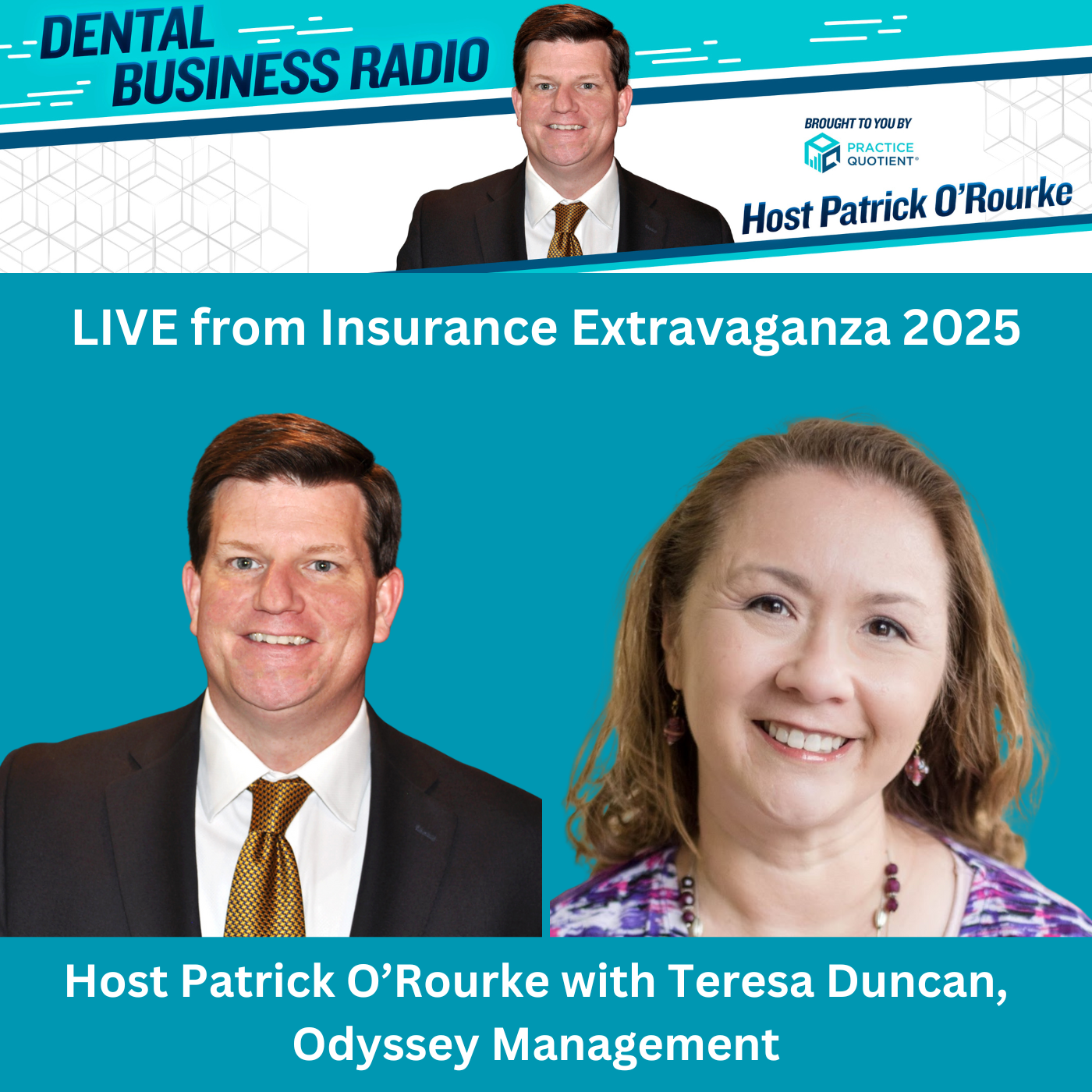
Live from Insurance Extravaganza 2025: Teresa Duncan, Odyssey Management

April 28, 2025 by John Ray

Live from Insurance Extravaganza 2025: Teresa Duncan, Odyssey Management, on Dental Business Radio with Host Patrick O'Rourke
Dental Business Radio
Live from Insurance Extravaganza 2025: Teresa Duncan, Odyssey Management
Loading
00:00 /
RSS Feed
Share
Link
Embed

Download file

Live from Insurance Extravaganza 2025: Teresa Duncan, Odyssey Management, on Dental Business Radio with Host Patrick O'Rourke

Live from Insurance Extravaganza 2025: Teresa Duncan, Odyssey Management (Dental Business Radio, Episode 58)

In this episode of Dental Business Radio, host Patrick O’Rourke talks with Teresa Duncan at the Insurance Extravaganza in Orlando, Florida. Teresa shares insights from her presentation on the importance of understanding the behind-the-scenes aspects of dental insurance, such as the Certificate of Coverage and premium pricing. They discuss common misconceptions about insurance, the complexities of customizing plans for employers, and the importance of detailed documentation to prevent issues with state boards and malpractice claims. Teresa emphasizes the need for dental managers and billing professionals to attend malpractice seminars and engage in continuing education to ensure compliance and protect their practices.

Dental Business Radio is underwritten and presented by Practice Quotient: PPO Negotiations & Analysis and produced by John Ray and the North Fulton affiliate of Business RadioX®.

Teresa Duncan, Odyssey Management

Teresa Duncan, Odyssey Management

Teresa Duncan is a distinguished speaker and writer with over 20 years of experience in healthcare, specializing in revenue protection, accounts receivable, insurance methods, and practice management systems. She has been honored with the Lifetime Achievement Award from the American Association of Dental Office Management, underscoring her commitment to continuing education and professional development in the dental industry.

As the author of “Moving Your Patients to Yes: Easy Insurance Conversations” and a regular contributor to the ADA’s CDT Companion Guide™, Teresa is a frequent voice in dental publications. She played a key role as a founding Trustee for the DALE Foundation, which focuses on auxiliary learning, and is actively involved in organizations such as Women in DSO and the National Association of Dental Plans. Her expertise is further recognized through her consulting work on the American Dental Association’s Guidelines for Practice Success™, and she is the host of two podcasts, “Nobody Told Me That!” and “Chew On This!”, which address coding and management topics for dental professionals.

Teresa’s leadership has been acknowledged by her inclusion as one of the Top 25 Women in Dentistry by Dental Products Report Magazine and her annual recognition as a Leader in Consulting by Dentistry Today. She holds a Master’s Degree in Healthcare Management from Marymount University, reflecting her deep academic and practical knowledge in the field

Website | LinkedIn | Instagram | Facebook

Topics Discussed in this Episode

00:00 Introduction and Welcome to Dental Business Radio
00:12 Introduction to Teresa Duncan and Initial Impressions
00:31 Behind the Scenes of Insurance
01:12 Understanding Employer Group Coverage
02:08 The Importance of Certificate of Coverage
03:08 Customizing Insurance Plans
06:40 Malpractice Policies and Their Importance
11:23 Managing Risk and Compliance
13:06 Conclusion and Final Thoughts

About Dental Business Radio
Patrick O'Rourke
Patrick O’Rourke, Host of “Dental Business Radio”

Dental Business Radio covers the business side of dentistry. Host Patrick O’Rourke and his guests cover industry trends, insights, success stories, and more in this wide-ranging show. The show’s guests include successful doctors across the spectrum of dental practice providers, as well as trusted advisors and noted industry participants.

Dental Business Radio is underwritten and presented by Practice Quotient and produced by the North Fulton studio of Business RadioX®. The show can be found on all the major podcast apps and a complete show archive is here.

Practice Quotient

Practice QuotientPractice Quotient is the sponsor of Dental Business Radio. Practice Quotient, Inc. serves as a bridge between the payor and provider communities. Their clients include general dentists and dental specialty practices across the nation of all sizes, from completely fee-for-service-only to active network participation with every dental plan possible. They work with independent practices, emerging multi-practice entities, and various large ownership entities in the dental space. Their PPO negotiations and analysis projects evaluate the merits of the various in-network participation contract options specific to your practice’s patient acquisition strategy. There is no one-size-fits-all solution.

Connect with Practice Quotient

Website | LinkedIn | Facebook | X (Twitter)
Tagged With: dental, Dental Business Radio, dental insurance, dental insurance contracts, dental insurance industry, malpractice, malpractice policies, Odyssey Management, Patrick O'Rourke, PPO Negotiations & Analysis, Practice Quotient, Teresa Duncan

Dental Board Complaints

November 19, 2021 by John Ray

DentalBoardComplaintsDLREpisode26Album
Dental Law Radio
Dental Board Complaints
Loading
00:00 /
RSS Feed
Share
Link
Embed

Download file

DentalBoardComplaintsDLREpisode26Album

Dental Board Complaints (Dental Law Radio, Episode 26)

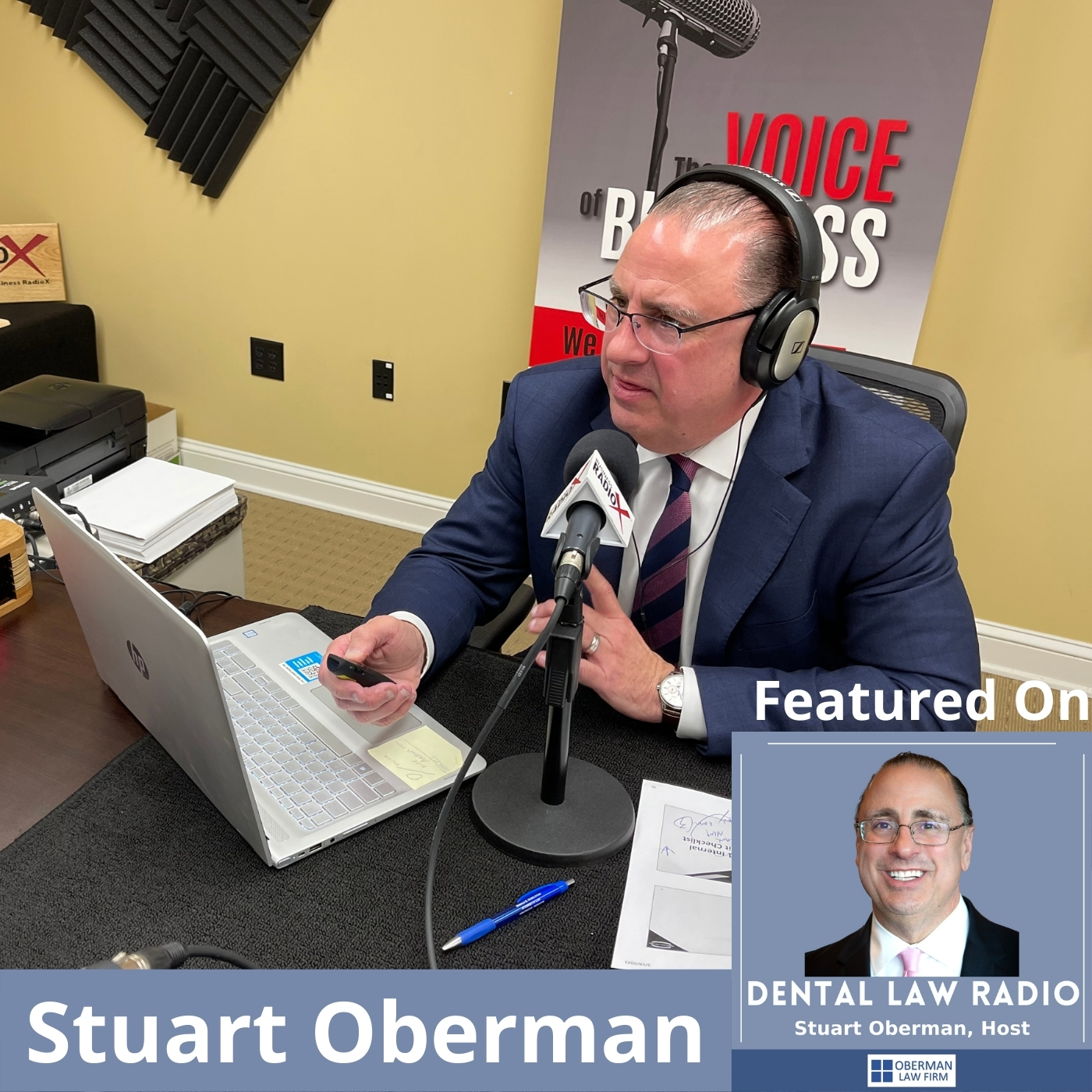
Patients can file dental board complaints for reasons which are spurious or even sinister. How do you lessen the likelihood of such complaints? As Stuart Oberman explains in this episode of Dental Law Radio, there are some basic “know your patient” and patient experience practices you can implement to lessen the livelihood of these complaints, and if they are filed, mitigate their risk to your practice. Dental Law Radio is underwritten and presented by Oberman Law Firm and produced by the North Fulton studio of Business RadioX®.

TRANSCRIPT

Intro: [00:00:02] Broadcasting from the Business RadioX Studios in Atlanta, it’s time for Dental Law Radio. Dental Law Radio is brought to you by Oberman Law Firm, a leading dental-centric law firm, serving dental clients on a local, regional and national basis. Now, here’s your host, Stuart Oberman.

Stuart Oberman: [00:00:25] Welcome everyone to Dental Law Radio. I always say that it’s a great profession, except for the patients. The patients will drive you nuts. And, I always say in the meetings that I’m a pleasure speaking at, online, tell our clients, it is not if you’re going to get a board complaint, it is when because what happens is that it is so easy nowadays to file a board complaint.

Stuart Oberman: [00:01:01] Many things are done online in many states. In some states, I can literally go out of your office after I just had a cavity filled, go to QT, grab a Diet Coke, and I can sit in the parking lot and file a board complaint because I didn’t like you, I didn’t like your staff, I didn’t like how much you charged me. It is too easy.

Stuart Oberman: [00:01:28] So, what happens is you get this letter notice from the board. You’re shocked, you’re angry. What are you going to do? Well, the question is how do you prevent that. Going forward is a whole different scenario than prevention. So, you know, a couple of things to think about on the prevention side. Okay.

Stuart Oberman: [00:01:50] So, a patient you do not know is more likely to file a complaint than Aunt Betty who you’ve seen for the last 30 years. Patients who do not pay their bills are a huge problem. You’ve got to look at that. Is it risky? Is it risky to file or send him over to collections than it is to let $100, $200 go? Look, at the end of the day, it’s a board’s responsibility to make sure that you are doing your job correctly.

Stuart Oberman: [00:02:18] However, a couple of things. Preventive. Before that patient leaves your practice, you better make sure they understand what’s expected, what’s not expected. There’s no way possible that you can have an inkling as to what that patient is thinking. If there is a concern, then you need to make an additional appointment with that patient because an extra five, 10, 15 minutes will save you a world of headaches down the road. If you have a problem patient, again preventative, you have your assistant in there with you telling the patient what is good, the bad, the ugly, and straightforward.

Stuart Oberman: [00:03:03] One thing I always say is you need to look your patient in the eye. That’s a lost art in today’s world. When you’re looking at your patient and you’re telling the patient what’s going on, that’s a whole different ballgame. You’re going to pick up a lot of things you’re not going to pick up by talking on telephone. Always, always, always give the patient extra time if they need it, and, let me say this if you’ve got a problem patient, we had doctors that will not talk to patients.

Stuart Oberman: [00:03:40] If I get a patient that is a problem patient and communicates with my office manager, whomever is not working, gosh, pick up the phone, call these patients. I say guys plural ’cause I’m from the North. So, pick up the phone. Call the patient, get the problem solved. Now, for 10 minutes, they’re going to vent and they’re going to blow your ear off, which is fine, let them vent. [inaudible] could this problem matters and I call the patient and I’ll say, “Hey, look, I represent Dr. Jones. Tell me what’s going on.” For 15 minutes, I’m lambasted about everything that the doctor didn’t do, the price, the staff, everything. Great. I’m a venting board. Now, let’s get to the problem-solving matter. Okay.

Stuart Oberman: [00:04:28] So, when a board matter, when you get a board letter, you got to make sure you understand what the complaint is, the timeframe within which this client filed that complaint. And, let me tell you this. You don’t always have to give a complaint to your malpractice carrier. It is up to you and the facts and circumstances. But let me make this statement very clear. If you have someone from your malpractice carrier that’s representing you at a board hearing, they better know what they’re doing.

Stuart Oberman: [00:05:02] We’ve had cases that I have handled and I’ve made it very clear to the malpractice lawyer, “Look, we do this time and time and time again. This is your second hearing. It’s my 700th hearing. Sit back, relax. If you want to join the meeting, fine. Let us take the lead. We know what we’re doing. We know the boards. We know what’s going on, and you can report back to the insurance company at a later date.” So, you better know the experience of that lawyer, how to respond. And, if that lawyer is just showing up without responding or sending down different documents or what be required to be proactive, you need to find someone else.

Stuart Oberman: [00:05:42] So, the board’s going to request, you got to be ready for this, an updated CV, copies of your license, continuing CE education requirements. It’s amazing how many of our doctors can’t find their CE and wait until after the board hearing, [inaudible] if it’s informal to gather it up. These are things you need to gather up beforehand. Give a complete copy of all the records. The last thing you want in the world is the board to discover that you’re not being forthcoming with records. That is a huge, huge problem.

Stuart Oberman: [00:06:16] So, then let’s talk about defenses, defenses. Document your instructions to the patient [inaudible]. Document every complaint, every concern. Put it in the file. Our previous podcast, we discussed the certain things you can’t put in the file, certain things you do not want to put in a file. Derogatory comments, comments regarding race, color, [inaudible], sexual origin. Those are inappropriate. It should never be in a file. Keep copies of all your correspondence. Keep records of all incidences. Look, things are going to happen. Document him, keep him, keep him in the chart. Update your CV. Update your attendance. Keep your resume up to date. And, note, note, note extensively all problems with that particular patient. Document it, document it, document it.

Stuart Oberman: [00:07:17] So, what are the most common complaints that we receive? And, we receive a lot of complaints from our dental offices. A lot of them are garbage, but some of them are very realistic and we’ve got to deal with them. So, what’s the number one complaint? It’s hard to say.

Stuart Oberman: [00:07:34] Let me go through some of these things, but it’s hard to say what’s number one and number 10. But what we consider unprofessional conduct is a failure to release records. You want to get an OSHA complaint, you withhold records. You want to get a board complaint, you withhold records.

Stuart Oberman: [00:07:52] Substandard practice. License expires when you’re hygienist and you’re associate doctors.

Stuart Oberman: [00:07:59] Malpractice claims. Be thorough.

Stuart Oberman: [00:08:04] Sexual misconduct on both sides of the fence, male and female. There are things that are absolutely inappropriate.

Stuart Oberman: [00:08:15] Now, board complaints will also come from your staff. So, you’ve got to be careful also with patient relations.

Stuart Oberman: [00:08:25] Financial issues. Billing for services that are not rendered, multiple billing and billing discrepancies. Look, there’s times we’ve been in board complaints and we thought it was clinical. Clinicals was fine and we got absolutely hammered on the financial side because it wasn’t documented. There’s double entries. Lab referrals were incomplete. So, those are things that you’ve got to take a look at on a broad scale that may go wrong.

Stuart Oberman: [00:08:53] So, what I would do is, on the complaint side, figure out what the problem is with your patients. Figure out what needs, how the problem needs to be rectified. Take a look at these proactive matters that we’ve discussed. Review them internally with how your procedures are going. And, I will tell you, the longer a problem goes on, the bigger the fire, the more expensive it gets. A problem matter is happy when it’s closed. Get it done, get it closed, get it released.

Stuart Oberman: [00:09:32] That is a very, very, very quick update on dental board complaints. Again, I could talk a whole day on this. Just take a look at a couple of things. Take a look at your procedures and everything should work out okay.

Stuart Oberman: [00:09:46] Thank you for joining us on Dental Law Radio. My name is Stuart Oberman. If you have any questions, please feel free to give us a call, 770-886-2400. My email is stuart, S-T-U-A-R-T, @obermanlaw.com. Thanks for joining us and have a fantastic day.


About Dental Law Radio

Hosted by Stuart Oberman, a nationally recognized authority in dental law, Dental Law Radio covers legal, business, and other operating issues and topics of vital concern to dentists and dental practice owners. The show is produced by the North Fulton studio of Business RadioX® and can be found on all the major podcast apps. The complete show archive is here.

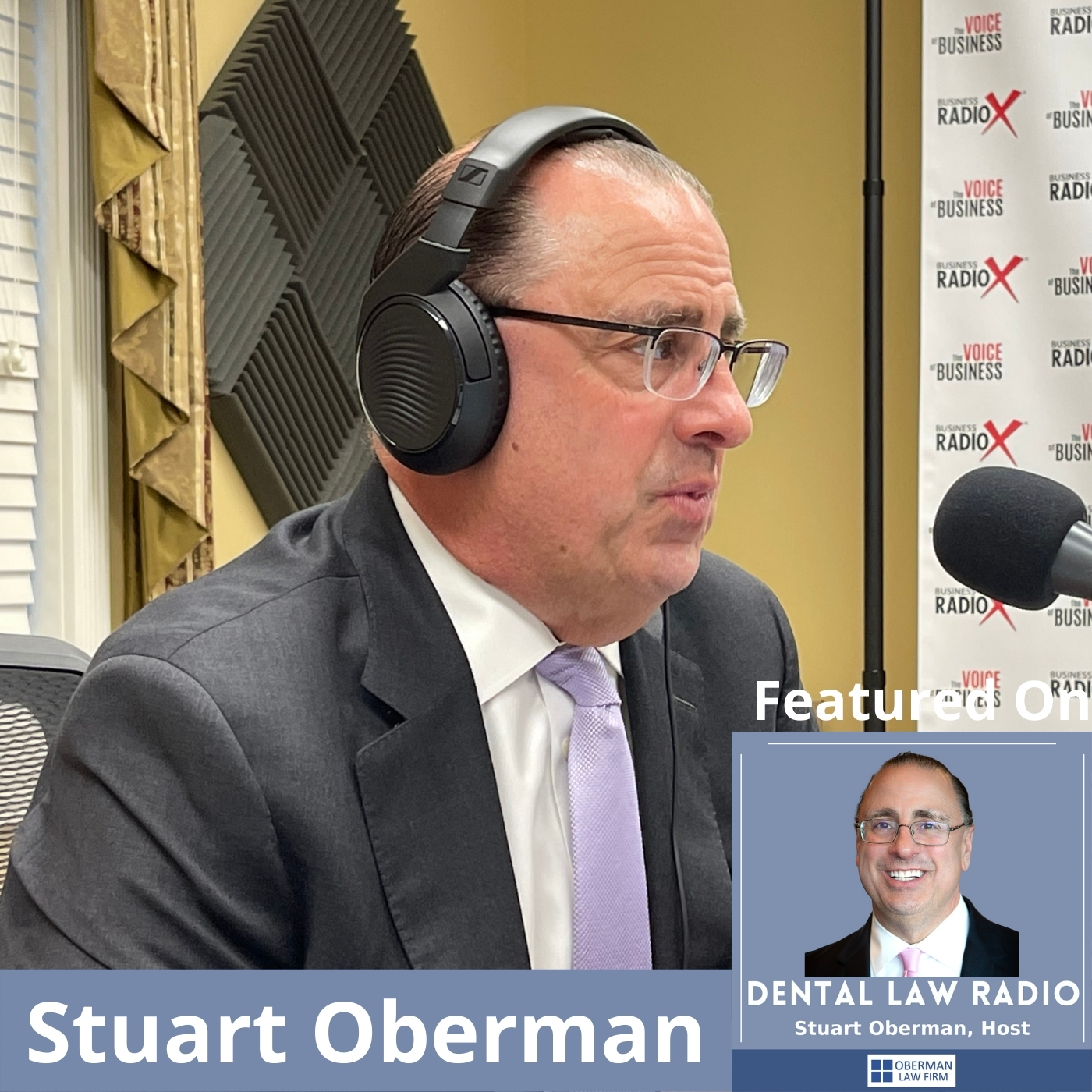
Stuart Oberman, Oberman Law Firm

Oberman Law Firm
Stuart Oberman, host of “Dental Law Radio”

Stuart Oberman is the founder and President of Oberman Law Firm. Mr. Oberman graduated from Urbana University and received his law degree from John Marshall Law School. Mr. Oberman has been practicing law for over 25 years, and before going into private practice, Mr. Oberman was in-house counsel for a Fortune 500 Company. Mr. Oberman is widely regarded as the go-to attorney in the area of Dental Law, which includes DSO formation, corporate business structures, mergers and acquisitions, regulatory compliance, advertising regulations, HIPAA, Compliance, and employment law regulations that affect dental practices.

In addition, Mr. Oberman’s expertise in the health care industry includes advising clients in the complex regulatory landscape as it relates to telehealth and telemedicine, including compliance of corporate structures, third-party reimbursement, contract negotiations, technology, health care fraud and abuse law (Anti-Kickback Statute and the State Law), professional liability risk management, federal and state regulations.

As the long-term care industry evolves, Mr. Oberman has the knowledge and experience to guide clients in the long-term care sector with respect to corporate and regulatory matters, assisted living facilities, continuing care retirement communities (CCRCs). In addition, Mr. Oberman’s practice also focuses on health care facility acquisitions and other changes of ownership, as well as related licensure and Medicare/Medicaid certification matters, CCRC registrations, long-term care/skilled nursing facility management, operating agreements, assisted living licensure matters, and health care joint ventures.

In addition to his expertise in the health care industry, Mr. Oberman has a nationwide practice that focuses on all facets of contractual disputes, including corporate governance, fiduciary duty, trade secrets, unfair competition, covenants not to compete, trademark and copyright infringement, fraud, and deceptive trade practices, and other business-related matters. Mr. Oberman also represents clients throughout the United States in a wide range of practice areas, including mergers & acquisitions, partnership agreements, commercial real estate, entity formation, employment law, commercial leasing, intellectual property, and HIPAA/OSHA compliance.

Mr. Oberman is a national lecturer and has published articles in the U.S. and Canada.

LinkedIn

Oberman Law Firm

Oberman Law Firm has a long history of civic service, noted national, regional, and local clients, and stands among the Southeast’s eminent and fast-growing full-service law firms. Oberman Law Firm’s areas of practice include Business Planning, Commercial & Technology Transactions, Corporate, Employment & Labor, Estate Planning, Health Care, Intellectual Property, Litigation, Privacy & Data Security, and Real Estate.

By meeting their client’s goals and becoming a trusted partner and advocate for our clients, their attorneys are recognized as legal go-getters who provide value-added service. Their attorneys understand that in a rapidly changing legal market, clients have new expectations, constantly evolving choices, and operate in an environment of heightened reputational and commercial risk.

Oberman Law Firm’s strength is its ability to solve complex legal problems by collaborating across borders and practice areas.

Connect with Oberman Law Firm:

Company website | LinkedIn | Twitter

Tagged With: Dental Board Complaints, Dental Law Radio, dental-centric, malpractice, malpractice claims, Oberman Law Firm, patient experience, patient experience/satisfaction, Stuart Oberman

Informed Consent

November 12, 2021 by John Ray

InformedConsentDLREpisode25Album
Dental Law Radio
Informed Consent
Loading
00:00 /
RSS Feed
Share
Link
Embed

Download file

InformedConsentDLREpisode25Album

Informed Consent (Dental Law Radio, Episode 25)

Do you seek to avoid malpractice claims and board complaints in your dental practice? Who doesn’t, right? Informed consent is an essential ingredient of that goal. If you don’t know much about informed consent, or you wonder whether the informed consent form you’re using is adequate, then Stuart Oberman offers critical advice on this episode of Dental Law Radio which might save you thousands of dollars. Dental Law Radio is underwritten and presented by Oberman Law Firm and produced by the North Fulton studio of Business RadioX®.

TRANSCRIPT

Intro: [00:00:02] Broadcasting from the Business RadioX Studios in Atlanta, it’s time for Dental Law Radio. Dental Law Radio is brought to you by Oberman Law Firm, a leading dental-centric law firm, serving dental clients on a local, regional and national basis. Now, here’s your host, Stuart Oberman.

Stuart Oberman: [00:00:26] Hello, everyone, and welcome to Dental Law Radio. Today’s topic, risk management. I want to talk about malpractice claims and the board complaints. And, one of the biggest defenses that you could have, and we’re going to talk about informed consent, avoiding malpractice claims, and board complaints.

Stuart Oberman: [00:00:48] First and foremost, I think there’s a misconception from our dental practice owners and associates as to what exactly the informed consent process is. And, it’s very simple. It is a very, very effective tool for malpractice claims and board complaints. And, I will tell you, we are extremely fortunate as a law firm that does a substantial amount of dental work throughout the country. And, by and large, the finest practices that we work with, the finest doctors, the informed consent process is almost nonexistent, which leaves them wide open for a malpractice claim or a dental board complaint.

Stuart Oberman: [00:01:38] So, let’s take a look at some basic things regarding informed consent form. And, I know what you’re thinking, well, you know, well, we don’t really need consent forms. You know, Mary’s been our client for 30 years and she’s never had a problem. That’s great. So, the other 99% of the problems are just waiting to happen.

Stuart Oberman: [00:01:58] So, what is informed consent? I want to make this, you know, our podcast brief. I want to go through a couple of things, but basics. So, the informed consent is nothing more than an educational process to tell the patient in writing and verbally what the benefits are, the risks, the alternative treatments, and to assess the patient’s understanding. You know, the decision regarding process, are you giving your patients and documenting your process and choices to the patient? Most of the time, it’s no. Most of the time it is, well, I don’t really think so. So, it’s basically an open dialogue, written and oral, if you will, so the patient can ask questions.

Stuart Oberman: [00:02:51] So, what should happen is you as a dentist should assess the patient’s understanding of the procedure in place. I don’t care if it’s a drill and fill, whether it’s a graph after an implant. Whether it’s an extraction of a molar, I don’t care. But it’s got to be documented. There has to be a process.

Stuart Oberman: [00:03:22] So, what is the process for the informed consent? First and foremost, it’s initial diagnosis. Are you diagnosing the problem? What is the problem? What is the recommended treatment plan? Now, I’m going to tell you right now. Your treatment plan is not the bill you give your patients. That is not a treatment plan. If you’re going to do a full-mouth restoration, if you’re going to do a multiple tooth implant, if you’re going to do wisdom extractions, what is the plan? Are you doing bridge, whatever maybe? Are you giving your patient ultimate treatment options? Are you allowing them to choose? Or are you telling them what they need to do? You’re going to have to evaluate this on every patient.

Stuart Oberman: [00:04:22] Now, our doctors do not know when to get out of trouble. And, many times they can’t get out of their own way. Are you giving the patient the option to refer to a specialist? I’m going to tell you now. Folks, if it’s not in your wheelhouse, get out of it. If you don’t do it every day, get out of it. We’ve run into multiple problems where our doctors will go to a weekend course and all of a sudden they’re an absolute expert in the area of implants. They’re now an expert in finding the B2 canal. Let me tell you, some of the best and Adonis that I know have trouble finding the B2 canal. If you don’t do root canals, stay out of the arena. Refer it out. It’ll be much easier on your life and your checkbook if you do that.

Stuart Oberman: [00:05:27] Outline the potential risks. All this has to be in writing. Okay. You can’t just say, “Well, here it is. Here’s your options I told you,” or, “You know, I made a note and you said, no.” You’ve got to have this documented to the T. What are the risks for not treating? Now, you’re probably thinking to yourself, “Look, Stuart, man, I’m seeing 30 patients a day. How in the world can I do this on every patient?” The question is how can you not do this because it’s going to have one that’s going to blow up on you. So, how you schedule is up to you. How you get this information is up to you. How you delegate this is up to you.

Stuart Oberman: [00:06:10] But you’ve got to do that. Give the patient the opportunity to ask questions. Pros and cons. What are the options? And, I will tell you, all this has to be documented in your charts. If it is not in your charts, I don’t care if you write on a sticky. I don’t care if you have the most complex digital system or your still charts. If it’s not in your notes, it never happened. Options. Again, things go wrong in an operatory. Things break.

Stuart Oberman: [00:06:52] Client of mine sent me a text and wanted to know can a dog come into the operatory and sit on a patient’s lap. How do you make that question up? How do you make that question? You don’t make it up because it happens. And, the next question is, well, it’s, you know, it’s a companion dog.

Stuart Oberman: [00:07:20] I’m going to go out on a broad limb here. Folks, I’m going to tell you right now. You cannot have dogs in your operatory. You cannot have dogs on your patient’s lap when you got high-speed drills at one wrong move is going through someone’s mouth, tongue, eye.

Stuart Oberman: [00:07:37] So, those are the things that you’ve got to take a look at. And, those are things you’ve got to have a risk assessment on.

Stuart Oberman: [00:07:47] So, again, documentation is critical, so in informed consents. Okay. Now, I’ve seen some really bad informed consents. I’ve seen informed consents that are so basic they will never cover anything complex like an extraction, root canal, bridge. They’re too, too basic. So, what should they include? Again, I’m talking to a separate document risk-benefit analysis. One included a doctor’s name, procedure. Do I need an informed consent for every treatment that I do? I think you do. If I’m going to my dentist, who’s fantastic by the way, hope he’s listening, and I’m getting a root canal and then a month later, I’m getting an extraction. I will guarantee you my informed consent will not cover that and it needs to be a new one.

Stuart Oberman: [00:08:47] What are the alternative treatments? What are the risks for not treating? What are the questions? How much time is involved? The date? Witness the informed consent. Place a copy in the patient’s file. “Well, you know, Stuart, I don’t have hard files anymore.” Great. Get a hard file. I have clients that have an amazing digital system, but yet they will still have a hard copy of an informed consent. What are you going to do?

Stuart Oberman: [00:09:26] Regarding the call I got yesterday, client’s buying a practice. Failure on the server. X-rays, charts wiped out. They can’t recover everything. What are you going to do? And, you got a board complaint or malpractice claim, and all of a sudden you’ve got a failure and you can’t find that consent form. What are you going to do? You’re going to be in a bad place. That’s what’s going to be.

Stuart Oberman: [00:09:58] I’m very serious about informed consent form because I see what they can do, I see what they can’t do and I see in the problems. What happens is when you don’t have them, it’s basically damage control.

Stuart Oberman: [00:10:10] Now, for informed consent, it’s going to get a little tricky. But if you have minors and special needs individuals, you’ve got to take the extra steps to getting those done correctly. You know, with special needs patients, we do work guardianships for special needs patients, and that’s a whole different area. But who’s the guardian? Is the guardian signing the informed consent? Have you documented who the guardian is?

Stuart Oberman: [00:10:35] Divorce cases. Can you imagine what it’s like dealing with a divorce case with a minor child in your office? Who’s in charge? Who’s signing the informed consent? Dad, mom don’t even have visitation. Who’s going to sign? Does grandma have the authority to bring the child in the authorized treatment? No, they do not, most of the time.

Stuart Oberman: [00:11:00] So, also in our diverse world that we live in where English may not be our first language and you have a cultural base. Are you drafting these documents to your base, or are you saying I know your English is not good, I know it’s not our first language? Are you curtailing this so they understand? Chances are probably not. You have an obligation to do so.

Stuart Oberman: [00:11:39] What if your patient is blind? How are you doing – how are you working with that? What are you doing if your patient is hard of hearing? It’s elderly and can’t hear. How are you doing it? What are you doing for this? Well, you explain to them. Well, how do you relate that into a board complaint? Where’s the proof?

Stuart Oberman: [00:12:03] So, now you get into this situation where, you know, my patient is refusing x-rays. Let me tell you this. So, if your patient is refusing x-rays because of cost, you have two choices. One, run quickly away from that patient, or, two, absorb the cost, document the file. My thought is run quickly. A patient should never dictate the standard of care because they’re going to be the first ones to say to you, “Oh, you messed up, doc.”

Stuart Oberman: [00:12:41] So, then you got to document the refusal and I mean get them to sign something. “Well, you know, they refused. They told me they refused.” Not good enough. Got to be documented. I don’t care how you document it. I don’t care whether it’s on an iPad, whether they sign a document, get it documented. You should have a process for refusal, and I’m gonna tell you right now, if your patients are refusing treatment, you need to find another patient because that is a problem waiting to happen.

Stuart Oberman: [00:13:11] So, these are just a couple of things on informed consent. I can’t really stress how important informed consents are from a legal standpoint, malpractice, and board complaint wise and how simple they are. If you have a patient that refuses to sign a consent form, you need to move on down the road and not treat them. Because as soon as you treat them, you bought that patient, and then you bought the problems that go with it. So, it’s the little things to avoid problems on the informed consent side.

Stuart Oberman: [00:13:41] Again, the whole topic for another day. You know, I could talk three hours on consent forms, the laws, and what we look at, but it’s critical. It’s critical. It’s critical.

Stuart Oberman: [00:13:49] So, [inaudible], thank you, everyone, for joining us today. Informed consents. Please make sure every patient has one. If you don’t have them, please get them.

Stuart Oberman: [00:14:02] I want to wish everyone a fantastic day. Thank you for joining Dental Law Radio. My name is Stuart Oberman. If you have any questions, please feel free to give us a call at 770-886-2400 or stuart, S-T-U-A-R-T, @obermanlaw.com. Thank you, folks. And, we will see you soon.


About Dental Law Radio

Hosted by Stuart Oberman, a nationally recognized authority in dental law, Dental Law Radio covers legal, business, and other operating issues and topics of vital concern to dentists and dental practice owners. The show is produced by the North Fulton studio of Business RadioX® and can be found on all the major podcast apps. The complete show archive is here.

Stuart Oberman, Oberman Law Firm

Oberman Law Firm
Stuart Oberman, host of “Dental Law Radio”

Stuart Oberman is the founder and President of Oberman Law Firm. Mr. Oberman graduated from Urbana University and received his law degree from John Marshall Law School. Mr. Oberman has been practicing law for over 25 years, and before going into private practice, Mr. Oberman was in-house counsel for a Fortune 500 Company. Mr. Oberman is widely regarded as the go-to attorney in the area of Dental Law, which includes DSO formation, corporate business structures, mergers and acquisitions, regulatory compliance, advertising regulations, HIPAA, Compliance, and employment law regulations that affect dental practices.

In addition, Mr. Oberman’s expertise in the health care industry includes advising clients in the complex regulatory landscape as it relates to telehealth and telemedicine, including compliance of corporate structures, third-party reimbursement, contract negotiations, technology, health care fraud and abuse law (Anti-Kickback Statute and the State Law), professional liability risk management, federal and state regulations.

As the long-term care industry evolves, Mr. Oberman has the knowledge and experience to guide clients in the long-term care sector with respect to corporate and regulatory matters, assisted living facilities, continuing care retirement communities (CCRCs). In addition, Mr. Oberman’s practice also focuses on health care facility acquisitions and other changes of ownership, as well as related licensure and Medicare/Medicaid certification matters, CCRC registrations, long-term care/skilled nursing facility management, operating agreements, assisted living licensure matters, and health care joint ventures.

In addition to his expertise in the health care industry, Mr. Oberman has a nationwide practice that focuses on all facets of contractual disputes, including corporate governance, fiduciary duty, trade secrets, unfair competition, covenants not to compete, trademark and copyright infringement, fraud, and deceptive trade practices, and other business-related matters. Mr. Oberman also represents clients throughout the United States in a wide range of practice areas, including mergers & acquisitions, partnership agreements, commercial real estate, entity formation, employment law, commercial leasing, intellectual property, and HIPAA/OSHA compliance.

Mr. Oberman is a national lecturer and has published articles in the U.S. and Canada.

LinkedIn

Oberman Law Firm

Oberman Law Firm has a long history of civic service, noted national, regional, and local clients, and stands among the Southeast’s eminent and fast-growing full-service law firms. Oberman Law Firm’s areas of practice include Business Planning, Commercial & Technology Transactions, Corporate, Employment & Labor, Estate Planning, Health Care, Intellectual Property, Litigation, Privacy & Data Security, and Real Estate.

By meeting their client’s goals and becoming a trusted partner and advocate for our clients, their attorneys are recognized as legal go-getters who provide value-added service. Their attorneys understand that in a rapidly changing legal market, clients have new expectations, constantly evolving choices, and operate in an environment of heightened reputational and commercial risk.

Oberman Law Firm’s strength is its ability to solve complex legal problems by collaborating across borders and practice areas.

Connect with Oberman Law Firm:

Company website | LinkedIn | Twitter

Tagged With: Dental Board Complaints, Dental Law Radio, Informed Consent, malpractice, malpractice claims, malpractice lawsuit, Oberman Law Firm, Stuart Oberman

Medical Malpractice Lawsuits – Top Docs Radio

August 15, 2015 by angishields

Huff Powell & Bailey
Top Docs Radio
Medical Malpractice Lawsuits - Top Docs Radio
Loading
00:00 /
RSS Feed
Share
Link
Embed

Download file

Huff Powell & Bailey
Dan Huff talks medical malpractice

Medical Malpractice Lawsuits

The phrase medical malpractice causes most people’s pulse to quicken. For a physician being named in a medical malpractice case is one of the worst events in their life. This week we discussed medical malpractice in Georgia and how physicians can avoid it.

For the past 23 years, Dan has specialized in representing physicians and hospitals in medical malpractice lawsuits.  As one of the founding partners in the Atlanta law firm of Huff, Powell & Bailey, LLC, he has represented defendants in more than 90 jury trials.

Dan has defended and successfully tried cases for every specialty of medicine and numerous hospitals throughout Georgia. His trial record would be a proud career for any defense lawyer and is remarkable because Dan has tried and won this many cases before turning 50.  Many of those cases have been against the best plaintiffs’ attorneys in the state. Dan is also a regular contributor to MAG’s quarterly Journal.

Huff shared what malpractice is, and why he chose this area of focus for his legal career.  He offered some advice on how healthcare practitioners can avoid a malpractice lawsuit.  We discussed his professional advice for how to handle conversations with patient and/or family after a sentinel event has occurred.  And we talked about how health professionals need to handle patient records and what to do if served with a lawsuit.

Dan explained how defendants in a suit should behave during the proceedings of the case to reduce the likelihood a jury will rule against them.

Special Guest:

Dan Huff, JD, and co-founder, Huff, Powell, and Bailey

Huff, Powell, & Bailey

MAG LOGO

Tagged With: CW Hall, Dan Huff, Health Care Radio, health radio, Healthcare, healthcare radio, Law, malpractice, malpractice lawsuit, Medical Association of Georgia, medical malpractice, sentinal event, Top Docs Radio

Business RadioX ® Network


Our Most Recent Episode

CONNECT WITH US

  • Email
  • Facebook
  • LinkedIn
  • Twitter
  • YouTube

Our Mission

We help local business leaders get the word out about the important work they’re doing to serve their market, their community, and their profession.

We support and celebrate business by sharing positive business stories that traditional media ignores. Some media leans left. Some media leans right. We lean business.

Sponsor a Show

Build Relationships and Grow Your Business. Click here for more details.

Partner With Us

Discover More Here

Terms and Conditions
Privacy Policy

Connect with us

Want to keep up with the latest in pro-business news across the network? Follow us on social media for the latest stories!
  • Email
  • Facebook
  • Google+
  • LinkedIn
  • Twitter
  • YouTube

Business RadioX® Headquarters
1000 Abernathy Rd. NE
Building 400, Suite L-10
Sandy Springs, GA 30328

© 2025 Business RadioX ® · Rainmaker Platform

BRXStudioCoversLA

Wait! Don’t Miss an Episode of LA Business Radio

BRXStudioCoversDENVER

Wait! Don’t Miss an Episode of Denver Business Radio

BRXStudioCoversPENSACOLA

Wait! Don’t Miss an Episode of Pensacola Business Radio

BRXStudioCoversBIRMINGHAM

Wait! Don’t Miss an Episode of Birmingham Business Radio

BRXStudioCoversTALLAHASSEE

Wait! Don’t Miss an Episode of Tallahassee Business Radio

BRXStudioCoversRALEIGH

Wait! Don’t Miss an Episode of Raleigh Business Radio

BRXStudioCoversRICHMONDNoWhite

Wait! Don’t Miss an Episode of Richmond Business Radio

BRXStudioCoversNASHVILLENoWhite

Wait! Don’t Miss an Episode of Nashville Business Radio

BRXStudioCoversDETROIT

Wait! Don’t Miss an Episode of Detroit Business Radio

BRXStudioCoversSTLOUIS

Wait! Don’t Miss an Episode of St. Louis Business Radio

BRXStudioCoversCOLUMBUS-small

Wait! Don’t Miss an Episode of Columbus Business Radio

Coachthecoach-08-08

Wait! Don’t Miss an Episode of Coach the Coach

BRXStudioCoversBAYAREA

Wait! Don’t Miss an Episode of Bay Area Business Radio

BRXStudioCoversCHICAGO

Wait! Don’t Miss an Episode of Chicago Business Radio

Wait! Don’t Miss an Episode of Atlanta Business Radio