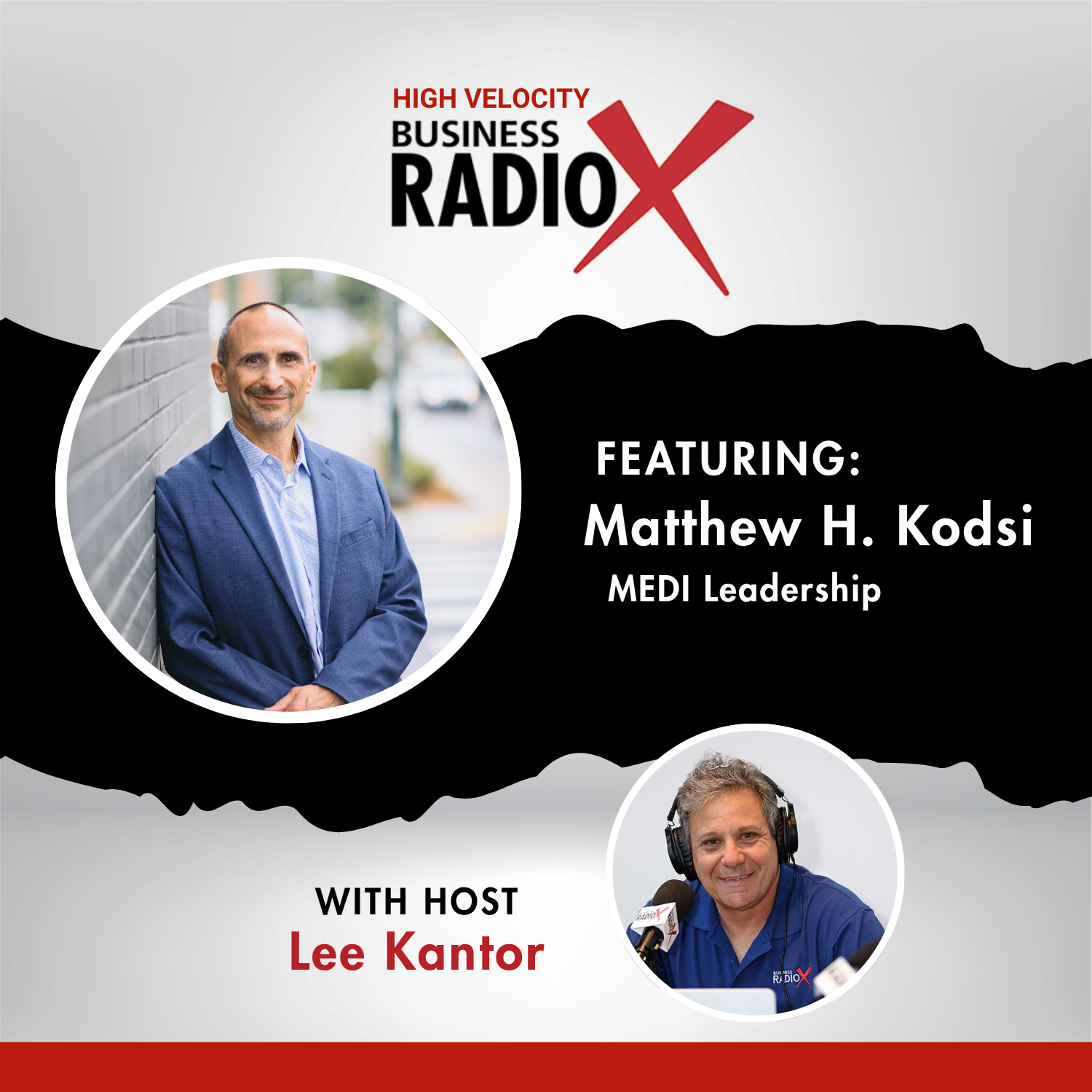

In this episode of High Velocity Radio, Lee Kantor speaks with Matthew Kodsi, VP and Executive Coach at MEDI Leadership, about the growing role of executive coaching in healthcare. Matthew shares his journey from neurology and hospital administration to coaching, highlighting how coaching helps healthcare leaders discover their potential, develop stronger leadership skills, and navigate major career transitions.

 Matt Kodsi has an M.D. and a Ph.D. in Neuroscience from the University of California San Diego. After completing a Neurology Residency at Emory University and a Fellowship in Behavioral Neurology at the University of Florida Gainesville, he moved to Chattanooga, TN where he cared for Alzheimer’s patients and their families for 17 years.
During that time, he also served as Medical Director of Neurology, Chief of Staff, and Physician Advisor at CHI Memorial Hospital in Chattanooga. He transitioned from clinical practice to hospital administration and served as VPMA/CMO at CHI Memorial from 2019 to 2024.
His passion for well-being and leader development led him to the Hudson Institute of Coaching, where he enrolled in their coaching certification program.
He now works as a full-time coach for MEDI Leadership and continues to strive for a better and more mutually supportive work environment for clinicians and the executives who collaborate with them.
Connect with Matt on LinkedIn.
What You’ll Learn In This Episode
- The value of coaching as a development tool, not just a solution for problems.
- How coaching helps leaders recognize their strengths, potential, and opportunities.
- The difference between coaching and consulting and how each supports organizations differently.
- Why self-care is essential for preventing burnout and sustaining effective leadership.
- How healthcare leaders can adapt when transitioning from clinical practice to executive roles.
- The importance of challenging self-imposed limitations and becoming more present, self-aware, and intentional.
- How investing in coaching can strengthen leaders, improve retention, and benefit healthcare organizations.
 This transcript is machine transcribed by Sonix.
TRANSCRIPT
Intro: Broadcasting live from the Business RadioX Studios in Atlanta, Georgia. It’s time for High Velocity Radio.
Lee Kantor: Lee Kantor here another episode of High Velocity Radio and this is going to be a good one. But before we get started, it’s important to recognize our sponsor, Business RadioX. If you’re a business coach who’s tired of being a best kept secret, set up a call with Stone Payton at bookstonephone.com to unlock your perpetual prospect pipeline. Today on the show we have VP and Executive Coach with MEDI Leadership, Matthew Kodsi. Welcome.
Matthew Kodsi: Good morning Lee. Thank you so much for having me on the show.
Lee Kantor: Well, I am excited to learn what you’re up to. Tell us about your coaching practice.
Matthew Kodsi: Sure. So currently I’m working with MEDI Leadership, as you mentioned. And MEDI provides coaches to both executives and other leaders in health care systems around the country.
Lee Kantor: And then have you always been a coach? Like what? What’s your backstory?
Matthew Kodsi: Oh, goodness. How far back do you want to go?
Lee Kantor: Let’s start in, uh, junior high.
Matthew Kodsi: Uh, well, ironically, it does sort of start there. I’ll give you the abbreviated version. You know, people ask me about my journey to coaching and I tell people it’s really a bit of a rediscovery for me rather than a novel discovery. And I think it’s that way for a lot of coaches. I did a lot of theater work when I was in junior high. Ironically, you nailed it. And, and that worked really came from a fascination with why people make the decisions they do, how they think, and analyzing the characters and understanding how to present them on stage. I really wanted to delve deep to better understand their motivations, and that led me. Actually, I decided when I told my parents that I was thinking of theater, They. They were a little scared. So fortunately for them, I also liked math and science. So that led me to medical school. And there I picked a specialty that focused on some of the same things. I went into neurology, which also, of course focuses on the brain, how it works, how people think. I spent 17 years treating patients suffering from Alzheimer’s disease because that, of course, is a disease that unfortunately robs people of their ability to think independently.
Matthew Kodsi: And then from there, I made a switch after 17 years of practice to enter into hospital administration. So I was chief medical officer and vice president of medical affairs for our local hospital for five years. I picked the perfect time to do that. I started that right before we went live with an electronic medical record, and that was in late 2019. And of course, that ended around February of 2020. And it was out of the frying pan into the fire. So gained a lot of experience through the pandemic, through the electronic medical record, through we actually had a cyber attack in our system, just really working with leaders and other leaders in the system. And I realized that the work that I loved was the development and helping people reach their goals and seeing them develop and grow in the organization. And so I actually had an executive coach from medi during that time and realized that was a path I wanted to follow. So I went to the Hudson Institute, got my certification as a trained coach, and then my ATC from the ICF, uh, and, uh, have not looked back. I’ve really enjoyed the work as a coach and just love what I do.
Lee Kantor: Now, in your work, are you focused primarily in coaching people in healthcare?
Matthew Kodsi: Yes, yes, I specifically coaching healthcare.
Lee Kantor: So how is healthcare as an industry, are they receptive to coaching? Is this something that’s a common practice that a lot of healthcare institutions just incorporate coaching as part of the way that they do business?
Matthew Kodsi: It is an interesting question, Lee, because healthcare has has been a little bit behind general business in terms of coaching. They have not adopted coaching as widely as some other organizations or other areas, but it is growing and they’re seeing the benefit and they’re seeing the value. It is a challenging time right now, as I think probably everyone knows in healthcare, uh, diminishing profit margins, struggles with increasing wages, struggles with decreasing resources and labor and other areas. But the systems are still seeing that there is significant value in coaching. I bet I could go off here for quite a while, but I don’t want to take up the whole half hour. So I would just say that, yes, they are seeing the value. We can dig deeper into that if you’d like.
Lee Kantor: Now, is the coaching typically at the administrative level, or does it go down to the caregivers?
Matthew Kodsi: So it varies. It’s an administrative and leadership level. So from an administrative perspective, I’m going to take that to mean the executives such as the C-suite leaders. The coaching has definitely used there. They’re also using it with medical leaders. So heads of committees, heads of departments, be they physicians, nurses, others. So we’re we’re stretched outside of the C-suite as well.
Lee Kantor: So but is it trickling down to the people, the boots on the ground that are dealing with patients?
Matthew Kodsi: So that’s also an interesting question. The. Again, as I mentioned, there are financial challenges for healthcare organizations. So they do not tend, in general, to extend coaching to people with boots on the ground at that level. There are some who are involved, and I say even some of the leaders or department leaders also often have boots on the ground. So you may see someone who heads, uh, let’s say the Department of Surgery or, or neurology looking at my specialty. And they’re still taking care of patients. But because they’re a leader, they are fortunate to have coaching extended to them. There are currently avenues for getting coaching for people who are more boots on the ground. Uh, but that also that’s a more extended conversation as well. But, but that’s being looked at.
Lee Kantor: So now in your practice, what is it like to work with you? Are they typically one on one coaching or do you do group coaching or cohorts? Like what is your, uh, the way that you interact with your clients?
Matthew Kodsi: It’s a yes and yes and yes, definitely. So there are certainly individual engagements. We’re working with a single member of the C-suite or Theater leader in the hospital. There are cohorts where you have anywhere from 10 to 20 or more individuals who are working in the organization, usually in a leadership capacity. There’s team coaching, whether that’s, again, the C-suite team, a team working in a specific area in the hospital, a departmental team, a team working on a floor in the hospital. And then there’s also group coaching. So it’s yes, on all those fronts.
Lee Kantor: Now, what’s kind of the pain they’re having right before they call you? Like, is there something that happens or their symptoms or signals that, hey, maybe a coach would help me get through whatever it is I’m dealing with?
Matthew Kodsi: So that is incredibly variable. Looking at that question, really thinking about it. We really hope that they’re reaching out to us before a pain point. I think unfortunately, coaching in healthcare and still in some other organizations is looked at as a solution to a problem or a way to remediate someone who’s having issues in the system, whereas really the best use is, as you know, and others who are out there and coaching is that coaching is, is a development tool. It is a way of saying, hey, we see someone who is entering leadership or who’s already in leadership and has potential and we want to help them grow. It’s not, hey, this leader has a problem that we want to help fix for them. It’s let’s give this person an opportunity to become the best leader they can. So there’s no specific thing that triggers coaching in a sense, to answer your question there, Lee. But really what we hope is what triggers it is someone’s insight to say, hey, here’s someone with potential. Here’s someone we’d like to develop and help grow.
Lee Kantor: So then you’re typically not hired by the individual. You’re hired by the organization.
Matthew Kodsi: Usually it’s by the organization. We have had some individuals who reach out, who work for organizations where the organization may not have coaching in their budget or coaching in their program yet. And an individual says, you know, I’ve entered this new role. I’d really like to work with the coach directly. And it’s just not an opportunity in the organization. So they do it on their own.
Lee Kantor: And was that the case when you were kind of full time in the hospital? Like, was that the way it was there as well, that it was some individuals were being proactive and then, but mostly it was organizations that were saying, hey, let’s deploy this for our team.
Matthew Kodsi: So now you’re asking about me personally.
Lee Kantor: Yeah. Well, I just want to know if it’s changed over the years, if this is a, I’m just trying to get kind of the lay of the land of what coaching and healthcare looks like.
Matthew Kodsi: Sure. It’s it’s incredibly variable even today. But I would say when, when I had my coach, it was through the organization. So coaching through healthcare organizations has been going on for years. I mean, that was for me. I have to think, 7 or 8 years ago. But there are still health care organizations that don’t have coaching as part of their developmental plan.
Lee Kantor: It’s just interesting. I must have my background primarily is in business. So in business, a lot of leaders individually are saying, hey, I need a coach because I want to get to a new level. But it doesn’t sound like that same thing is happening in health care, that it’s the organization that is saying, hey, we need to help our leaders, so let’s get a coach in for them to help them. It isn’t the individual raising their hand and saying, for me to grow and to do what I want to do, I am going to proactively do this on my own.
Matthew Kodsi: It is a bit of both. I mean, the majority that I’ve seen is through the organizations, but there are lots of individuals who do reach out.
Lee Kantor: Why? Why do you think that? I mean, in my world, it’s primarily the individual that’s doing it, not the organization. Why do you think it’s a little different in healthcare. Is that just the makeup of the leaders of healthcare?
Matthew Kodsi: And I’m not sure. I mean, I’ve heard of several organizations outside of healthcare that have coaching for them.
Lee Kantor: Yeah. I’m not saying that it’s all or nothing. I’m just saying that primarily the people that I’ve interacted with the individual is the driver, not the organization. Of course, there’s organizations that, you know, kind of get it and want to deploy it more throughout the system, but more times than not, it’s the individual that’s saying, hey, I want to coach because I want to get here and I’m not there, or I didn’t get this job, so I want to get that next job. So what do I have to do to. Like it’s an individual driven thing. And in healthcare, it sounds it’s more organizationally driven. And I don’t know if that’s a doctor personality type. You know, that’s saying I don’t need help. Um, but the organization saying maybe you need help. So I’m just trying to understand a little better, you know, kind of the motivation behind, uh, what it is that’s driving someone to choose, you know, to, to get a coach.
Matthew Kodsi: Sure. It may well be an awareness thing in that sense too, because as health care lags behind a little bit, other organizations that employ coaching, whether it’s in an organization or in an individual level, I’m not sure the same awareness and understanding is there in health care. So if you ask, if you just pull a health care leader off the street and ask them about coaching, I wouldn’t be surprised if a significant number of them aren’t really familiar with what coaching is. I mean, I’ll tell you, for example, when I had my coach and I was entering the chief medical officer role at our health care system, my first thought was, oh, this is great. I’m gonna have someone who’s going to come and teach me how to do my job. Because as as many of us who go from the clinical world to the administrative world, there’s unfortunately very little, if any, preparation. So they find someone and they say, oh, well, you know, this physician, they get along with everybody. They seem to have good relationships. They’d make a great leader, but there’s no prep for what it means to make that transition. So bringing in a coach, I thought, great, I’m going to have basically what amounts to a mentor. But of course, we both know, and everyone listening who is a coach knows that that is not what a coach does. So I think there’s a significant awareness awareness gap.
Lee Kantor: Now. When you were deciding to go into coaching, were you also looking at going into consulting and helping from that through that lens, or was it always coaching and maybe explain the difference in healthcare, how you see coaching versus consulting?
Matthew Kodsi: Sure. Let me start with that. So a consultant really is someone who, to your point, when you asked earlier, there may be a specific problem in the system or a specific need, and the system reaches out to a consultant and says, hey, you have expertise in this because you have expertise. Please come help analyze our system. Tell us where the gaps are from your experience, and tell us what you’ve seen that solve these issues. Whereas that is very different from a coach who may or may not have expertise in the system or in the area in which they’re coaching, but they are someone who helps the individual explore their approach to things. We ask questions, we challenge, we explore the way that they think about things and why they make the decisions they do. And, and one of the key beliefs as a coach is that the client themselves is resourceful and they have their own answers. Our answer we have answers. We have ways that we might approach the situation, but those aren’t necessarily the client’s answers and aren’t the ones that may work best for them. So whereas the consultant offers solutions, a coach works with the client, so they discover their own solutions because those are the ones that most often stick right now.
Lee Kantor: And you mentioned that that usually coaching is kind of industry agnostic. The coaching questions you’re asking can be in any industry. They’re not unique to health care. In your case. Right. But you’ve chosen even your background’s in healthcare, but you’ve chosen to stay within that industry. Why is that?
Matthew Kodsi: Let me answer your other question quickly first, and then I’ll come back to this one. So when I made the decision, it was pure coaching. Consulting was not something I had considered. I did a lot of work with wellbeing in our health care system, and going along those lines is what really got me thinking about the coaching, because coaching also really helps to support an individual’s well-being as they work to find their solutions. Now, why did I focus on healthcare? That also answers that question. In a sense. It’s it’s it’s in my heart. I have an empathy for those who really are still working in that system and struggling in that environment. So that’s why I sought to seek out coaching in healthcare.
Lee Kantor: Because you were in it and you understand kind of some of the The issues they might be going through because you’ve lived them yourself.
Matthew Kodsi: Yes, very much so. I’ve seen the struggles and lived the struggles.
Lee Kantor: And then as part of building your practice, you decided to write some books. Can you talk about why that happened?
Matthew Kodsi: Sure. Actually, the books were more sort of a a catharsis for me. They’re a bit, uh, a release of some of the things that I’ve been learning and thinking about through coaching. When I look back, people who know me now. Uh, it’s interesting to see their perspective when they didn’t see what I was like before I was, man, I had three monitors up on my desk. I was doing email on a Zoom meeting, writing up proposals for the next meeting. I was the very definition of multitasking. And now, as we know in coaching, coaching is about presence and it’s about focusing on one individual and really, really being involved in that conversation at that time. So I had some significant changes in my coaching, training and and thought, boy, I’d love to write about those. And I thought I sat down and thought, I just I’m not I don’t have the endurance, I think to write a 3 or 400 page book. And at the same time, I love with my theatrical background to create stories. So I thought, boy, look at some of the amazing books that have been written in the past Five Dysfunctions of a Team Who Moved My Cheese. These are all written a parable format, and I thought maybe, maybe that would be fun to write stories about coaching topics like presence and to write a parable, a story. And so. So that’s what I’ve done. I’ve taken several coaching related self-development self-awareness topics and created stories around them. There are two that are out now. The first one is called A Story Tale. It’s the A, B, C’s of stories we tell ourselves. And it’s about the fact that when we don’t have all the information, our mind fills in the gaps by creating stories, creating things that we believe are happening, whether or not those are accurate.
Matthew Kodsi: And of course, as many of us know, the stories we create are more often on the negative side than the positive side. The second book is called never They’re Always Here. The A, B, C’s of presence. And it is about just that. And it is a bit autobiographical in a sense. My own journey in exploring and developing presence are very reflected in the story in the book. There’s a third one coming out at the end of the month. It’s called You Can’t Tread Quicksand. It is the A, B, C’s of life strategies. And the fact that the strategies that we have early on in life that many of us hold on to, and I know I certainly did, may no longer be the strategies that serve us. And too often we don’t allow ourselves the time to step back and think about that and evaluate whether we continue to hold on to those strategies or we develop new ones. The series is going to be six books in total. They’ll come out about every three months. They’re short. They’re about 70 or 80 pages. You can read them in an hour, an hour and a half. They’re on paperback, Kindle, and I’ve done audibles. So for those who like to listen. But it was a lot of fun. It provided me an outlet from that creative side. And really, as I said, they’re a bit cathartic, really allowing me to explore what I’ve learned through this process.
Lee Kantor: Now, what was the process for folks out there who might be considering writing their own book? Were these traditionally published or did you self-publish?
Matthew Kodsi: So I self-published, uh, I actually, to the point of your question, that was probably one of the most daunting things. I had no idea how to publish, but Kindle, uh, Amazon makes it very easy. Uh, Kindle direct publishing, they have software you can download on your computer. You upload your manuscript into that, it formats it for Kindle. I had to adjust a few things here and there. It does the same for paperback. And then today, as far as the audible goes, the microphone that I’m using right now on this interview, on this podcast I bought because I was having trouble with my Bluetooth headset and I thought, you know, I wonder what it would take to make an audible. And it is not that hard. I used my own microphone, some software online that cleans up the sound, gets rid of the background noise, and submitted that into audible. And there were of acceptable quality. And people have told me they sound just fine. So it is. It is not as scary or intimidating as one might think.
Lee Kantor: So did you have a process of the actual writing? Did you say, okay, every morning I’m going to wake up and this is dedicating time. Like what was kind of the process of writing?
Matthew Kodsi: I like to take a few hours, at least at a time. I really tried to say okay, and it was mainly on weekends or on a day when I might have an open schedule. I’m going to sit down for 2 or 3 hours and think about it and write things as they come to my mind. And of course, there’s the editing process after that. But a lot of thought, a lot of Google searching topics because, uh, for example, the let’s see, I won’t talk about the books that aren’t out yet, but, uh, the book about life strategies that you can’t tread quicksand. It, it has to do with hiking a bit. And I am not a hiker. So I had to do my research and learn a lot of things in order to make the book realistic from that sense. So yes, I dedicated time.
Lee Kantor: And um, as part of your, uh, going from your practice, the medical practice and transitioning, uh, into a administrative C-suite level, something that I think you said you went through, but also you help your clients with. Is there any kind of advice or any things that somebody who’s going through that transition themselves that they should be thinking, is there low hanging fruit, maybe something that you wish you knew then that you know now to help someone go through that transition? Um, from kind of the practice to the C-suite.
Matthew Kodsi: There are a few things that come to mind. I mean, one is generally applicable, but definitely when you make that switch is self-care. We talk about it. We say, we’ll get there. We put it off, but too often we don’t take that step. And one of the things we talk about in medi is that is what we call the first work, because so many people say there’s work in life and they lump the self-care into the life part, and I’ll get to that when I have time. But what they don’t realize is that it really is on the work side. Because if you’re not taking care of yourself if you’re not giving yourself the time to rest, to play, to sleep, to explore, to reflect. Then you’re not able to do the other work that you want to do well. So if you lump it into the into the life part rather than the work part, you’re doing a disservice to the other work that you’re wanting to do. So self-care is number one. I think the other thing is realizing that the worlds are incredibly different. Now I’m speaking specifically from clinical to administrative. I’m sure this may apply to other switches into administrative, but when you’re sitting there in front of a patient, you, you make a decision relatively quickly about what needs to be done because that patient needs a quick decision so you can start treatment in the executive world. Things move slowly. There are certainly times when you need to make quick decisions, but there are so many other factors involved that decisions are a process that is very complex in administration and taking a step back and realizing that there are a number of pieces to that decision and a number of things. And people that need to be involved is a different process. Things can take months to change, years to change at the administrative level, whereas at the clinical level, you don’t have that sort of time.
Lee Kantor: Now, you mentioned that you spent a big chunk of your career, um, caring for Alzheimer’s patients and their families. Is there any advice you can give a caregiver in that situation? I know that, um, a lot of our listeners have struggle with this caregiving of a parent or a grandparent in some form or fashion. Is there any kind of advice you can give in that area?
Matthew Kodsi: So ironically, it’s very similar to something I just said. They need to take care of themselves. You know, it’s the old example of put the mask on yourself first on an airplane. Too many times, whether it’s Alzheimer’s or another disease, we see the caregiver burn out because they’re so focused on providing care that they don’t care for themselves. And part of that care for themselves is reaching out to resources in the community. You can’t do it all alone. Whether there’s resources or friends, family, the Alzheimer’s Association, there are people out there who can help you through the process. And too many people put it all on themselves.
Lee Kantor: And that’s a good lesson for anybody that’s kind of suffering from burnout or the symptoms of burnout, right, is to just kind of start getting back to the basics for your own self-care.
Matthew Kodsi: Absolutely.
Lee Kantor: Now, in your work as a coach, is there a story you can share about somebody you’ve worked with that you were able to help them and maybe, um, get them to a new level? Don’t name the name of the person, obviously, but maybe share the challenge they came to you with and how you were able to help them grow.
Matthew Kodsi: I think the example that comes to mind is very generally applicable. We often have clients who don’t see their own potential. You know that people talk about imposter syndrome and whether that’s something people, uh, look to or think about in terms of themselves. They often don’t see where they can take themselves and they set up limits and they set up barriers for themselves because of self-imposed beliefs. So the coaching process allows them. One of the things we talk about is you help the client see, see the unseen, see things they didn’t see before, whether that’s opportunities, whether that’s things about their own potential, whether that’s strengths they didn’t realize that they had. Once you open that door, once they open their eyes and they start seeing what they can do and what they’re capable of, and how they can interact with others in ways that are constructive for them. It’s, it’s game changing for them, whether that’s game changing because they acquire more joy in their work, because they see the things that they can do that they enjoy doing, or whether that’s game changing because now they get opportunities they didn’t have before, such as a promotion, and they take on responsibilities that allow them to make changes that they’ve wanted to be involved in.
Lee Kantor: So can you share maybe some of the questions or exercises you do to help a person kind of have that aha moment about themselves?
Matthew Kodsi: Oh boy, that’s an interesting question because the list is endless. Uh, it depends on the individual. What’s interesting of what comes to mind often is one of the things that we commonly do is we have a client start by listing the, the things that they’ve let’s see that they’ve experienced in their lives, the ups and the downs that have led them to where they are. And that’s often a very good launching point because that experience allows them to really stop and see the what has motivated their decisions and why they made the choices along their path, what was most impactful, what was most influential on them. And then they take a step back and we can talk about things like values. So based on those experiences, what are the things they really value? What are the things that are important to them? And when they really stop and define those and not just put words to them and say, for example, family, what does family mean to them? Or, uh, success at work? Well, what does, what does success mean to them? When they start analyzing those things and defining them for themselves, it opens up those doors of possibilities. And I think to, to, I guess in that sense, to answer your question to the whole process of coaching, which asks the client to explore the words they use. So many times we talk about success, achievement, decisiveness. What does that mean for them? And when they stop and really think about it, then it allows them to make change and to head in the direction that they’re desiring.
Lee Kantor: So what do you need more of? How can we help you?
Matthew Kodsi: You know, I think in the end, it’s not so much what I need. I’m incredibly fortunate. I work for a great organization, fantastic coaches, very supportive colleagues. I think what what the community needs with healthcare needs, what some organizations out there need is a realization and understanding of what coaching can offer. Too often, as we sort of started off talking about coaching being used as a remediation, too often people look and say, well, yeah, they’re doing fine, but oh, now there’s a problem. They need a coach. Really, it’s the other way around. I think it’s, hey, this is someone who has potential. How can we help them reach their greatest potential? How can we help them reach their goals and their desired end? Coaching is is a a great opportunity there. And if people start to see that and realize that the possibilities are endless, I’ll throw an example out to you just from a financial perspective. When people talk about, well, how do you get people in healthcare to see the value of coaching? Well, if you if you nail it down to financial, which is one of the main things looked at in, in healthcare now in a number of organizations, the cost of replacing, let’s say a physician leader is huge and it is significantly disproportional to the cost that would be involved in an investment in coaching. So not only do you save yourself the financial loss and the time, you’d have to invest in replacing someone who burned out, but you gain an even better leader. You get to keep someone and you get to benefit from their leadership potential. That develops through coaching.
Lee Kantor: And you also benefit from them being a better leader within the organization that isn’t leading to more turnover down the line because people don’t quit jobs. They quit. Uh, leaders.
Matthew Kodsi: Yes, sir.
Lee Kantor: So if somebody wants to learn more about you and connect with you and somebody on your team, what is the best way to connect?
Matthew Kodsi: They can google MEDI Leadership. It’s all caps M E D I and then leadership or it’s medileadership.org is the website. So we would be happy to hear from people in healthcare.
Lee Kantor: And then you’re on LinkedIn.
Matthew Kodsi: I am I am also on LinkedIn.
Lee Kantor: Good stuff. Well, Matthew, thank you so much for sharing your story today. You’re doing such important work and we appreciate you.
Matthew Kodsi: Thank you. And I appreciate you having me. It’s been a pleasure.
Lee Kantor: All right. This is Lee Kantor. We’ll see you all next time on High Velocity Radio.















