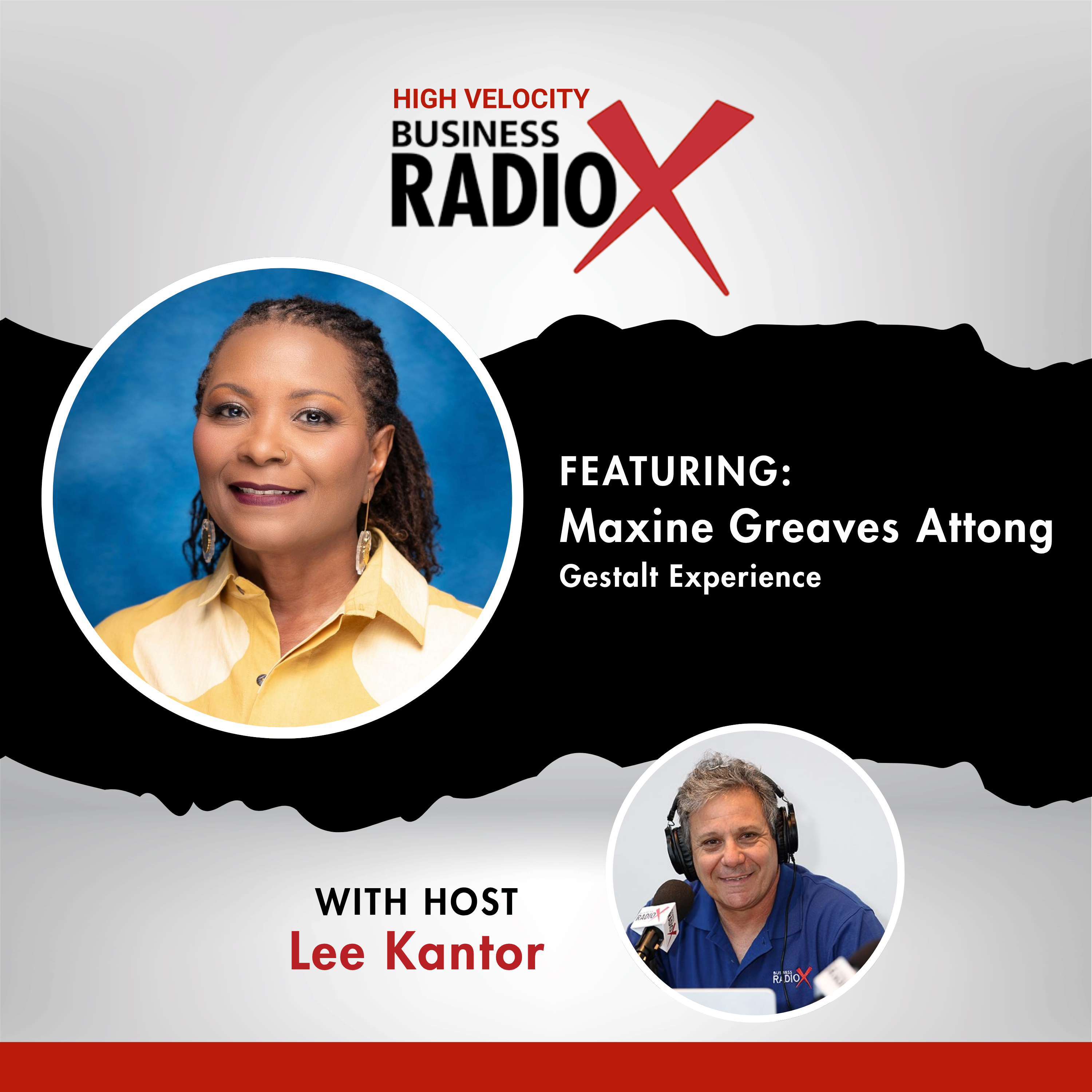

In this episode of High Velocity Radio, Lee Kantor interviews Maxine Attong, founder of the Gestalt Experience, about helping leaders uncover hidden team dynamics that affect performance. Maxine explains that many organizations focus on processes and technology but overlook the human side—emotions, trust, and relationships. She emphasizes that psychological safety is a strategic necessity, starting with leadership alignment and self-awareness. Without it, teams hold back ideas, avoid honest communication, and underperform. She shares how leaders can spot issues—like lack of discussion, delayed information, or disengagement—and address them through reflection, feedback, and open conversations. Through coaching, Maxine helps leaders become more authentic and intentional, leading to stronger engagement, better collaboration, and improved results.

 Maxine Attong is a Gestalt Organizational Development strategist, executive coach, and former COO who helps leaders and teams perform in high-pressure, high-uncertainty environments. With over 25 years of experience across corporate and international sectors, including the United Nations, she specializes in aligning leadership, strengthening accountability, and embedding psychological safety as a driver of performance.
A Certified Professional Facilitator and Professional Certified Coach (ICF-PCC), Maxine is known for her ability to “make the invisible visible”—surfacing the unspoken dynamics that shape decision-making, trust, and execution. She has worked with senior leaders and multicultural teams across North America, Europe, Africa, Latin America, and the Caribbean
Maxine is also a Certified Management Accountant (CMA), bringing financial and operational rigor to her leadership work. She is the author of Lead Your Team to Win, which captures her work on embedding psychological safety in teams, and Change or Die: The Business Process Improvement Manual.
Through her work, Maxine helps leaders move from awareness to decisive action—so they can build aligned, accountable, and high-performing teams.
Connect with Maxine on LinkedIn.
What You’ll Learn In This Episode
- How leaders can identify and address hidden tensions that impact team performance.
- Why psychological safety is a strategic driver of productivity—not just an HR concept.
- Common signs of low trust in teams, such as lack of open discussion and incomplete information.
- The role of leadership behavior in shaping team culture and engagement.
- How emotional awareness and human connection influence creativity and accountability.
- Practical ways to build trust, including open conversations and consistent check-ins.
- The difference between vulnerability and oversharing in leadership.
- How disengagement often mirrors the relationship leaders create with their teams.
- Measurable impacts of strong team culture, including higher engagement and more innovation.
- Key challenges executives face, such as confidence, identity, and leading authentically after promotion.
 This transcript is machine transcribed by Sonix.
TRANSCRIPT
Intro: Broadcasting live from the Business RadioX Studios in Atlanta, Georgia. It’s time for High Velocity Radio.
Lee Kantor: Lee Kantor here another episode of High Velocity Radio and this is going to be a good one. Today on the show, we have the founder of the Gestalt Experience, Maxine Attong. Welcome.
Maxine Attong: Hi. Thanks for having us.
Lee Kantor: Well, Maxine, before we get too far into things, tell us about your practice. How are you serving folks?
Maxine Attong: I really help leaders and team leaders make the invisible visible very often in teams. There’s some a little bit of tension that we can’t quite name, and it does affect productivity. So it could be interpersonal relationships. It could be seen as, you know, high absenteeism, high turnover in the team or the leader just doesn’t feel settled. Everything looks fine, but the leader just feels instinctively that something is wrong. That’s why I step in and really help teams to come to the moment where they can move. Beyond that. They could name what’s happening. They could come up with suitable actions for it and sort of get over that hump.
Lee Kantor: Now, do you primarily work with organizations or individuals?
Maxine Attong: I work individuals. I’m an executive coach and I work with organizations, a lot of NGOs and international organizations as well, as well as some people.
Lee Kantor: So what’s your backstory? How’d you get involved in this line of work?
Maxine Attong: Well, I started off way back when as an accountant and leading teams in finance and strategy. And I think my own experience of being frustrated, um, seeing people’s potential, but not really understanding how to tap into it. I became very curious about human behavior and how I, as a leader, despite my technical skills and my search for excellence, why it White is that I wasn’t really meeting people. So I started doing facilitation as a way to help groups make decisions and became a certified professional facilitator. And then I started to realize, I asked myself the question, if I could help groups make decisions, what would it be like if I were to work with the individuals and get them ready for decisions? So that led me into coaching. So I’m a PCC level executive coach with the with ICF. And because of that, I became just really more and more curious about what makes humans tick. So I went back and did a master’s in organizational development, really understanding the theories that take human behavior from normal to high performance. So it really was because of my own failures as a leader. And that feeling I had of, I am not saving these people enough. I am not feeling happy even though the work looks good. It was really from that curiosity that I started this entire journey.
Lee Kantor: So now, having worked with a variety of organizations, do you see some common threads about why certain organizations are maybe more functional than others? Like, are there some mistakes that companies are making that, you know, when you insert yourself and your and your process into them, that you can really make an impact?
Maxine Attong: Yeah. I think, you know, now with, of course, there’s a lot of technology, there’s AI and we talk about replacing workers. And I think sometimes we forget that humans will always be humans. Um, and what I mean by that is that we have a lot of emotions and we need to deal with those emotions before we do anything else. So there’s a way in which a lot of people show up in the organization, sort of not as who they are, but who their profession says they should be. And in everybody’s life there becomes an aha moment where it is that we have to reconcile many parts of us. We have to reconcile what happened to us as children. We have to reconcile what happened to us when we were married. If we went through a divorce, it comes in different forms. And so in organizations, we we deal with people, whether they are in hybrid, whether they’re face to face. We’re dealing with those people and we’re trying to extract the most valuable thing from them, i.e. their productivity, their creativity, and their intelligence. And if it is that we are pretending that those clouds don’t exist around them, we’re not going to be able to get what we really want from them.
Maxine Attong: I mean, it just does not work. And so how does that show up in organizations? A lot of organizations talk about people not being accountable or the basis of of high functioning team is trust. So before you talk about the accountability, what is it that you are doing as a leader to inculcate trust in your teams? A A lot of times people are complaining that, you know, because team members are not bringing new ideas, they’re just doing enough work. Well, what is your relationship like with them that will encourage them to bring a lot of ideas? So a lot of it, we think about, you know, processes. We make sure we have efficient processes. We bring in all this fancy technology, we train the technical capabilities of our team members. And what are we doing in terms of what makes them human, what makes them creative. And that will redound to productivity. We need to deal with it.
Lee Kantor: Now, a lot of organizations at least give lip service to how their people or their most important asset, and that their culture is important. But is there some advice or tactics that an organization can do to really live into those words? When it comes to psychological safety, where in order to create that environment of trust there, the employee has to feel safe in order to share and be vulnerable, and to be as productive as the organization would like them to be.
Maxine Attong: Is that I think the first thing for.
Maxine Attong: For organizations who really want to embed psychological safety is to understand that this is strategic. I think the word psychological safety, people think it’s like a fluffy word. It’s the realm of the human resources team. And they don’t realize that it is something tactical and it is a strategic differentiator. Why is it strategic? Because we have to be intentional and deliberate in inculcating it in our teams on a daily basis. And so fish rots from the head. So leaders, the leadership team, we need to make the assumption. We need to make the assumption or ask the question, do the leaders feel safe? Because if leaders don’t feel safe, they cannot create psychological safety. And a lot of leaders right now, you know, have high anxiety. Will I keep my job? Will there be another cost cutting exercise? All that’s happening in the world, you know, they are in pressure situations. So if the leadership team does not feel safe, they are not going to create psychological safety for the rest of the organization. If the leadership team does not agree on what psychological safety looks like here and what behaviors promote or don’t promote it, it’s not going to be safe. So very, very often, you know, leaders want to bring in an initiative and the leadership team is not aligned or not in agreement with the initiative. And what happens? Somebody pushes it ahead and eventually it trickle down. And it feels so first and foremost, if you really want to put psychological safety into your organization, realize that one, it’s a strategic move that will redound to productivity. And two, the leadership team needs to be aligned and in agreement to what it means and how it will be effected.
Lee Kantor: Now, are there some symptoms or signals that an organization can look at to tell if there is a culture of psychological safety within their organizations? Are there signs that maybe there isn’t and something’s amiss?
Maxine Attong: Yeah. So I think the first sign a lot of organizations do their pulse surveys or their satisfaction surveys, the employee engagement surveys, if those if those give you high marks, especially in the more in the less in the ones that are not about, you know, the physical conditions, but really about the leadership. If those marks are high and people are engaged, then you know that you’re on to something great. Keep pressing. If those engagement scores are low, I would suggest that maybe people don’t feel safe. If you go to meetings and yours is the only voice or everything that you everything that you say people are in high agreement with without any discussion. That’s a sign that probably people aren’t safe. If you’re making decisions and you’re not getting full data. That’s a that’s another sign. Or you realize three months down the road, oh, this is what is really happening. I made a decision based on incomplete data. That’s a sign that people are not telling you the truth. So if you are a leader, everything people are agreeing with no discussions. You’re getting data late. You’re realizing things after the after the fact. Maybe people aren’t feeling safe enough to speak up and tell you the truth.
Lee Kantor: Now, in your work, have you been able to kind of quantify the ramifications of, um, not having a psychologically safe environment in an organization?
Maxine Attong: So what I’ve seen is engagement scores go up like 15, at least 15 points in one year. And that is really because of leaders being very deliberate and intentional about their behavior. Um, that will take 6 to 1 year to change according to. Of course, the leaders, I guess their ability or their willingness to accept the feedback, um, to. I have seen teams go from the leader alone carrying the weight of it to people actually holding each other accountable, which for leaders is a great thing because it frees you up a lot to not carry the burden of the team alone. What else I’ve seen is, uh, more, more ideation. So in teams that would have been, you know, where the leader says everything, the leader comes up on one idea. They move from like two ideas a month to maybe like six ideas a month. So those are the things that I’ve seen. And in terms of the bottom line, there always is an uptick on it. And so, you know, people talk about customer experience and everybody wants customer experience. And that’s the new buzzword. How are you going to create customer experience. If your front line people do not feel safe enough to make a decision, that will give the customer a different experience. So all of those buzzwords that we come up with, at the end of the day, it’s a human given to service. And if that human does not feel safe to question or to put their voice into the room, the organization is going to miss the mark.
Lee Kantor: Yeah, I agree with you 100% when it comes to it seems like there was such an emphasis on kind of leaning into all these digital technical, um, ways to measure things. And we’ve lost some of the humanity and the human to human interaction and the, you know, the way that that can’t just snugly fit into boxes. There has to be grace. There has to be a little more, uh, give and take when a deal, when you’re dealing with humans. And if you just ignore that, I think you There’s got to be a price. You pay for it.
Maxine Attong: Yeah yeah, yeah. You know, I think there’s no there’s no measurement for the heart. Right. We don’t we don’t go around taking measurements of the half of the heart and we can’t see people shrink. You know, people often wonder, like leaders will say, you know, when I had this person, they were so brilliant when I promoted them, they were so promising. And what happened? And that’s a great question to ask what happened? And I would often ask leaders, do you really want the truth of what happened? Because we could have that discussion. So you’re absolutely right. There’s something that we we do that erodes that human in so many very sad ways.
Lee Kantor: Now, when you have a case where like you’re describing this human is kind of, uh, shrinking back, is there anything an organization can do to bring them back so they can blossom again?
Maxine Attong: Yeah, I think this is where conversations matter the most. So can you have a conversation with that person? I would I would look at two things. If I were a leader of a person who I saw shrinking, I would really have a come to Jesus moment with myself. What did I do to help this individual shrink? Was it something that I said? Was it something that I did? Did. And so I could look at my own, my own behavior with that individual and really take a helicopter view? You know, what was my body language like? What words did I say? Um, when did I create some tension about individual? And of course, feedback is great. You can get feedback from the individual. You know, what’s happening with you. It could be something that’s personal that they’re going through. It could be something that maybe you did to offend them and how, how safe do they feel that, that you could, um, that they could actually share that with you. So this is where anonymous feedback is golden. You can do anonymous feedback with your team. It doesn’t have to be anything like a, an expensive feedback. You could do a simple Google document, a simple MailChimp document, or any survey.
Maxine Attong: Don’t let people put in their names and get feedback on your behavior as the leader. Because very often as leaders, our teams mirror what we do. We got to take responsibility. The second thing I would do is if it is that I get feedback and there’s nothing that I could make an assumption that maybe this person is going through something personal and have that discussion. And of course, if if it goes beyond that, then you need to look at things like, are they technically capable? Did I give them too much, too much work at one time? Do they need some special other intervention? And so if you come to other invention, that’s where you get, you know, if you need a coach, if it is, you need to go to an employee assistance program. If you need to get the human resources team involved. So it is a matter of finding out, you know, doing evaluations, assessing the situation before you actually move to action, because we want to make sure that we as leader, understand what’s going on with our team member, and only when we understand, we will know what is the right thing to do.
Lee Kantor: Now, is there a story you can share about your work where you were able to help an organization or an individual get to a new level? Obviously don’t name the name, but maybe share the challenge they came to you with and how you were able to help them.
Maxine Attong: So I had a leader who came to me, um, it was one on one coaching and she was complaining about exactly this. Um, her teams are not getting engaged. They’re doing the work and the work is fine, but nothing more than that. And she was really frustrated and very tired, and she did all the things that we usually say to do, you know, be very clear in your communication, give specific instructions, um, you know, do the one on one check ins. And still she was saying her team is not engaged. So in coaching, she mentioned a conversation where her team member members said to her, wow, I never knew you. Had you. I never knew you had two children and I’ve been working with you for five years. So I said to the team leader, it seems that your team was mirroring the relationship that you have with them. And she understood that. She said, wow. Yes, I have always had a professional distance. I always focus on work and I keep it moving. And so she had to make some decisions about how she wanted to be. And I think a lot of leaders sometimes confuse being vulnerable with oversharing. You know, they kind of like want to tell their teams everything. And that’s not what is required. In fact, that’s probably not safe to do. And some leaders like this one, when she thought about being vulnerable with her team, it was something that she definitely wanted to avoid.
Maxine Attong: So we had to work out, you know, how do you be yourself? How do you share information that is safe? What topics is it okay to talk about? And for her, she wanted to talk about like her leadership journey to share it with them. Some of the technical stuff that she did, some things about her children. And so it wasn’t overnight because of course, when we leaders change behavior, our teams look at us and say, is she for real? Let’s see how long it will last. So we have to be consistent. And so eventually what she did as well is what we decided is at the beginning of meetings, do a 15 minute check in, don’t rush to work. Let people talk about what’s top of their mind, what their anxieties are, what they might be concerned about, whether professionally or personally. And so eventually, her team actually began to move a little closer to her and to begin to build that relationship. And so they started to bring ideas to the table. They started to discuss things freely, because what she didn’t realize is that her team was mirroring the relationship she set up with them. And so if you were to scale that to an organization, you would begin to realize if it is. If we just focus on work, our people will come and do as they are contracted to do their work. They’ll do it well and nothing more.
Lee Kantor: Now, how do you deliver your coaching to organizations? Is it primarily one on one? Is it group? Do you do online work? Um, how do you deliver what you do?
Maxine Attong: So I do it in whatever way the client wants because that’s best if it’s one on one coaching. I’m definitely online because, you know, time, time is a factor in that. So we get online, we do our coaching, we go our way. If it’s a team, I do it online as well. But if it’s like a one day engagement or a half day engagement, those are face to face. So with teams we usually do with teams, if I’m going to work with a team, I prefer to work with a team over 3 to 6 months for the team to really get what it looks like. Usually we’ll start with a 1 or 2 day, um, team retreat where it is, they could really surface the problems and decide on how they want to move forward. And then we do monthly check ins, you know, it could be twice a month, two hours a month, 2 hours or 2 hours a session online where it is, if we really start working on what, what it is that we all agreed is happening in the room. So that’s kind of like what it looks like. And sometimes the intervention could be different because sometimes it’s, um, a team needs to learn how to communicate. You know, a team needs to trust what to communicate. So we may be dealing with that. A team may want to say, okay, we have a work plan, we want to run a test on it. We could do that. A team might say, we want to work on our processes. I’ve done a lot of work in business process improvement. That’s what my first book is on. So so I work with a team. I say that I bring solutions to teams and I help leaders to deal with their teams. So that’s kind of like the range of what I do now.
Lee Kantor: When you’re working with an individual, what’s the kind of the typical challenge they’re having right before that they start working with you. What, what, what’s your kind of sweet spot in terms of working with executives?
Maxine Attong: So I think for executives, a lot of them say they want to work on their executive presence. You know, how they are received because they they are technically capable. They’ve they’ve reached the height of their career and they really want to be more whatever they think executive presence is. And with women, especially with female leaders, they want to work on their assertiveness and their confidence. So that’s kind of like the the range that I see coming to me. And it’s interesting because the, the core of it is. Am I good enough for this role that I have? Um, am I all that I could be for this role that I have? Sometimes the question is I’ve gotten this role. So I with Fred, do I still want this role or what can I do to make this role mine? So those are some of the questions that executive leaders really have in their mind because they’ve they’ve done it. They have a high level of confidence. And they really begin now to look at themselves differently and say, this is who I am and how do I express this in this role without losing myself? Or how do I do my role well, without losing who I am? Or can I take a risk now that I’ve reached the top of my ladder to really show who I am and lead from what I think I should be leading at? Like so those are some of the questions that those leaders come with. And I love those questions because it really is about their innate, who they are at their core and how they know themselves or don’t know themselves, or how they want to rediscover themselves and reclaim themselves in a way that makes their leadership so much more powerful.
Lee Kantor: Now, are they coming to you after they got the promotion, or are they coming to you if they didn’t get the promotion?
Maxine Attong: Most times it’s when they got a promotion or when they’re preparing and readying themselves for promotion. I think what most people miss about promotions is that at a certain level, you’re capabilities are almost assumed. So some people who didn’t get promoted for a while, they come to me to say, okay, how do I get promoted? Because it is about what are your networks like? How strategic are you being? Who’s champion? Champion? Champion in you in rooms that you are not present in? So it’s really about rebuilding a lot of the assumptions about work as a meritocracy. So those are the people who don’t get promoted, who come to me to get promoted. Yeah.
Lee Kantor: So if somebody wants to learn more, have a more substantive conversation with you, what’s the website? What’s the best way to connect?
Maxine Attong: So I have.
Maxine Attong: Just experience.com and you can contact me through there. I think my phone number is on there as well. You can also link with me on LinkedIn. I do accept all, all connections, except I guess people who are just marketing or where it is that they just joined LinkedIn because some of those are fake profiles. But once you have a profile, I will definitely connect with you. I’m not. Yeah, it’s all good. And so connect with me. Send me a message on LinkedIn that all of the above is fine.
Lee Kantor: Well, Maxine, thank you so much for sharing your story today. You’re doing such important work and we appreciate you.
Maxine Attong: Thank you for having me. And for, of course, asking me those great questions.
Lee Kantor: All right. This is Lee Kantor. We’ll see you all next time on High Velocity Radio.















