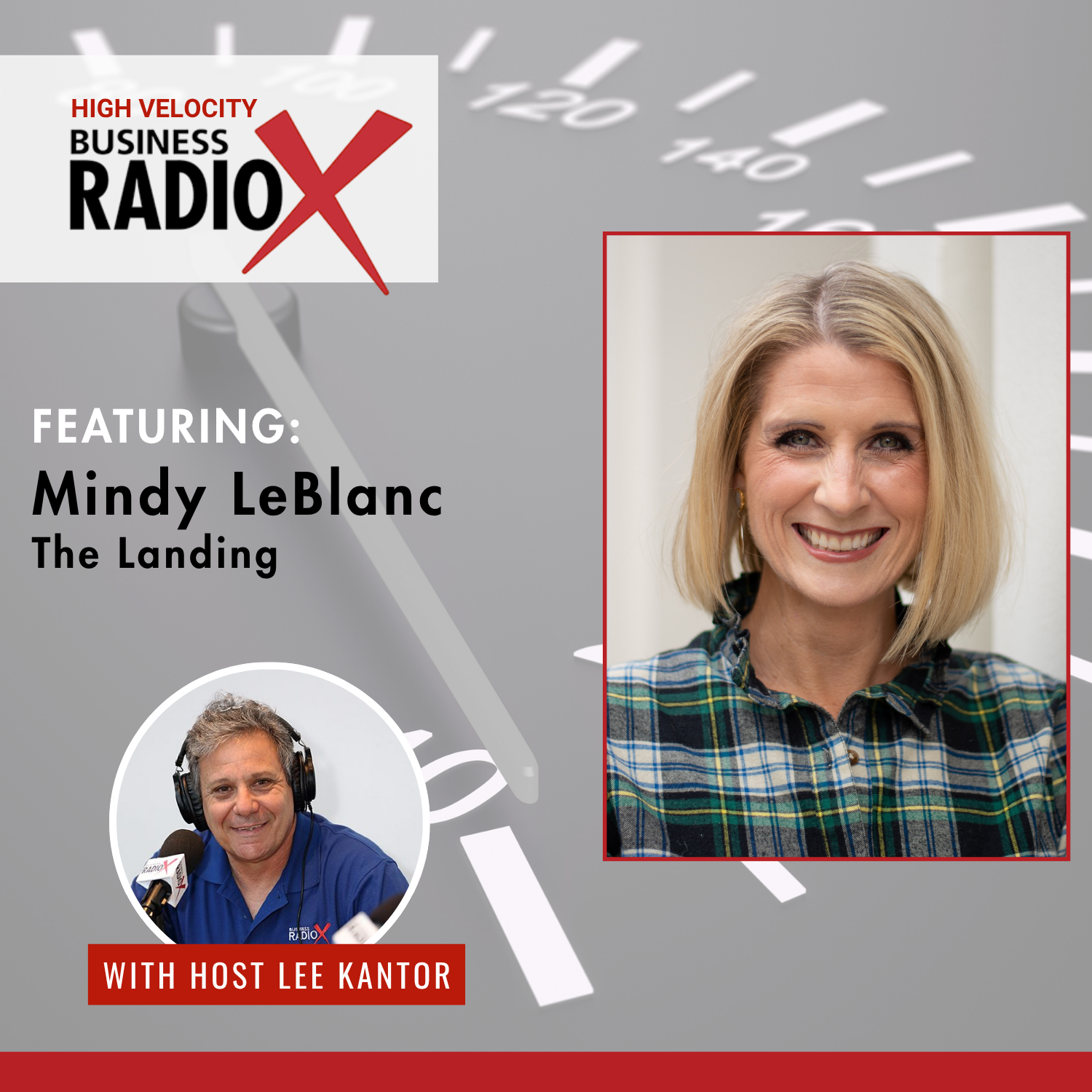

In this episode of High Velocity Radio, Lee interviews Mindy LeBlanc, Chief Development Officer at The Landing, shares how the Houston-based nonprofit supports survivors of human trafficking and commercial sexual exploitation. Celebrating its 10th anniversary, The Landing provides trauma-informed care, resources, and community support to help survivors find stability, healing, and independence. Mindy discusses the realities and misconceptions surrounding human trafficking, the growing need for survivor services, and how organizations, businesses, and community members can get involved to make a meaningful impact in the fight against exploitation.

 Mindy LeBlanc brings over 20 years of fundraising leadership to The Landing, where she plays a critical role in advancing the organization’s mission to serve survivors of human trafficking and commercial sexual exploitation.
As the Chief Development Officer, she leads strategic fundraising initiatives, fosters meaningful donor relationships, and builds partnerships that help sustain and grow The Landing’s impact.
Prior to joining The Landing, she served as Director of Development at KIPP Texas Public Schools, where she led a successful $1 million fundraising gala and provided strategic direction for regional development efforts.
Before that, she served as Executive Director of Pathways for Little Feet, a Christian nonprofit supporting adoptive and foster families through financial assistance. In that role, she led all fundraising efforts and expanded the organization’s reach and impact.
She spent the first 15 years of her career with the National Multiple Sclerosis Society, where she was instrumental in the growth of the BP MS 150 Bike Ride. Her leadership contributed to raising over $20 million in several years to support individuals living with MS, and she developed innovative fundraising strategies that engaged and retained major supporters.
She holds a degree in Exercise Science from Texas Tech University and earned a teaching certificate, later teaching kindergarten for four years in Humble I.S.D.
She and her husband, Mark, enjoy spending time outdoors with their daughter, Adeline. As an avid runner, hiker, and tennis enthusiast, she finds renewal in nature and enjoys traveling to the Texas Hill Country and Colorado. Mindy and her daughter are members of National Charity League and understand the importance in serving and giving back.
Her family is actively involved at Sugar Creek Baptist Church, and her favorite verse, Proverbs 3:5-6, reflects her approach to life and leadership: “Trust in the Lord with all your heart and lean not on your own understanding; in all your ways acknowledge Him, and He will direct your paths.”
Connect with Mindy on LinkedIn.
What You’ll Learn In This Episode
- Understanding the scope of human trafficking globally and in the U.S., including sex and labor exploitation.
- Recognizing the vulnerabilities that lead to trafficking, such as poverty, homelessness, and abuse.
- Exploring The Landing’s trauma-informed approach to support survivors, including day centers, counseling, and empowerment programs.
- Identifying common myths and misconceptions about trafficking, including who it affects and how it happens.
- Learning the role of community, businesses, and donors in providing resources and support.
- Highlighting practical ways to get involved, including volunteering, corporate partnerships, and advocacy.
- Appreciating the impact of survivor programs, from stabilization to long-term empowerment and breaking generational cycles.
- Understanding the importance of education and awareness, especially around major events that may increase trafficking risks.
 This transcript is machine transcribed by Sonix.
TRANSCRIPT
Intro: Broadcasting live from the Business RadioX Studios in Atlanta, Georgia. It’s time for High Velocity Radio.
Lee Kantor: Lee Kantor here. Another episode of High Velocity Radio and this is going to be a good one. Today’s episode is brought to you by Baumeyer Coaching, multiply profits magnify impact executive coaching to elevate individual and team performance. To learn more, go to baumeyercoaching.com, b a u m e y e r coaching.com. Today on the show we have the Chief development officer with The Landing, Mindy LeBlanc. Welcome.
Mindy LeBlanc: Hello. Thank you. Good morning.
Lee Kantor: Well, I am so excited to learn what you’re up to. Tell us about The Landing, how you serving folks?
Mindy LeBlanc: Yes. So we’re super excited. We have we are celebrating our 10th anniversary this year. So just starting out. We walk alongside survivors of human trafficking and commercial sexual exploitation with a trauma filled approach fueled by the love of Christ. And so we have, like I said, been around for ten years. You know, the first year we hoped people would come through our doors and we saw 60 survivors. Now that we are in our 10th year, we’re anticipating seven. We’re anticipating 700 people coming through our doors this year. So, you know, it’s one of those things that it’s unfortunate that we’re seeing that many people, but they know where to find us. And that’s the wonderful thing.
Lee Kantor: Now, for folks who aren’t familiar, can you kind of paint the landscape of human trafficking and why it’s such an important issue for people in America to know about?
Mindy LeBlanc: Absolutely. I would say we can we could even start globally first. I mean, there’s an estimated 50 million people worldwide that have been trafficked that we have recorded approximate numbers. Some of that is 22 million is forced marriage, and then 27 million is human trafficking. So break that down to the United States. And we know that trafficking is happening in all 50 states and primarily in the United States. It is sex trafficking that is reported. 75% of that would be adults and 25% are minors. So we break that down. I’m here in Texas, Houston, Texas, and we know that it’s the second largest reported cases of human trafficking in the United States. Where you are is also high reported cases in Atlanta and in the South as well. So we want to be there so people have hope, healing and a path toward stability. So this is our community and this is our. This is where we live. And we really want to be there to do something and better our community and better their lives and break generational brokenness.
Lee Kantor: So what is kind of the impetus about this? You mentioned a lot of it is sexual exploitation. Is it? People are like, why does it exist?
Mindy LeBlanc: So there’s people that have come from situations that it may be poverty. Uh, it might be that their parents, um, you know, domestic violence, um, homelessness, uh, mental health, uh, human trafficking and, um, homelessness and mental health go hand in hand. So people are vulnerable and people are looking for, um, maybe it’s, you know, that next meal or they don’t have a place to live and someone promises that, oh, I’ll take care of you. And, um, I can, I can help you with this, and it turns out to be not what they were expecting. So it could either be in the form of that sexual exploitation, or it could be the labor exploitation and where someone is working for unfair wages or for or for no wages at that, for that matter.
Lee Kantor: So now in at The Landing, this is primarily for the survivors. Uh, you run across people who were trafficked and that somehow they get to you and you’re able to help them, you know, stabilize their situation.
Mindy LeBlanc: Yes. So in Houston, um, they had done a little bit of research. Our founders ten years ago, or probably more than that and determined that Bissonnette Trackit that’s a street, a long street that goes through Houston. Um, but they determined this was one of the highest prevalence. You you’ve heard about it in our city. Um, our mayor, the cleanup. Um, I’m trying to help clean up the area we’re in, but this is a high traffic area. There were even barriers put up to try to the physical. It was like a mile plus track that cars would line up and pick up. Um, people who were being trafficked in this area. So they put these barriers up. But what we know about this is that people just go underground, and it doesn’t mean that it necessarily is solving the issue, but it’s just moving it. And there’s different ways that people are still being trafficked. Um, and so that’s why we situated ourself in the Bissonette track track, so people could get to us easily. And one of the things is it’s, you know, we, we have scrubbed sex ads and this sort of thing, but it’s primarily word of mouth, other survivors that have been in the life and that say, hey, they told their friend, you need to go to The Landing, they’ll help you out. And so the other thing is we actually have a very low barrier model at The Landing. And so you come as you are. You don’t have to do X, Y, z to qualify. We just when you come in, we do an intake with our case management workers. And to identify that you have been trafficked. A lot of these women do not have that definition in that word trafficked.
Mindy LeBlanc: They you know, we do we do the assessment. And when we do that, we identify the factors and that, yes, indeed, they have been trafficked. And so they come into our center. Um, after that assessment. And we really want to make it feel like a community. It’s their home. It’s their some, some of them own only home that they have. And so they can come in and they, there’s always food for them to get. And we are a daytime drop in center. And in Houston we’re the greater Houston area. We are the only daytime drop in center. And so they can come in and we also work with churches and businesses and organizations, and they can bring in a hot meal. And that interaction is one of the most meaningful, um, times of the week where someone is serving them, they give them choices of what to eat, but there’s nothing um, required or asked in exchange, but just kindness being shown. They can come in and rest, they can come in and, um, we have a boutique that is volunteer led and get, um, clothes hygiene items and just be served by a volunteer. And then there’s other um levels and other phases of our program where they may be ready for counseling. And we have a full time counselor that was hired in April. And so he is busy all day long. So it’s actually one of our prayers and needs is we do need a second counselor, um, to help out not only with the population who come into the drop in center, but our youth as well. Our youth do not come in to our drop in center for their safety.
Lee Kantor: So what was your backstory? How did you get involved in this work?
Mindy LeBlanc: Um, I like to say it was God. So, um, quite simply, um, I’ve been in development in Houston for more than 20 years. And funny enough, my daughter in middle school bought her theater teacher asked her to do a, um, an essay on trafficking and with another co-laborer, another organization that works on trafficking. And so I mentioned it to my daughter. She did the, the project and she was like, hey, mom, read this. I want you to, I’m going to submit it. And I’m like, wow, I didn’t know you did this. Well, the prize was for her to get to go to their gala. And then there was a cash prize as well. So then the next year, she did her GT project on trafficking. Learned a little bit more, expanded that. And then about, um, let’s call it six months later, um, I was looking for a new job and The Landing came up. I had two friends that knew about The Landing. One knew my founder, one knew the new chief development officer, Lisa Burgoyne. And gosh, two weeks later, here I am working at The Landing. So it really couldn’t be any anything else other than God’s placement.
Lee Kantor: And then your role there is to help them, uh, kind of find partners and, and build community support with donors and things like that.
Mindy LeBlanc: That is absolutely right. Um, we do receive money from United Way, the office of the governor. Um, and it’s crucial there’s a, in Texas, there’s a lot of trafficking efforts and the governor has supported, um, those. And so we’ve been very fortunate to receive money from them. We’re expanding our reach into local foundations, family foundations in the Houston area, as well as just our partners anytime we go anywhere. I mentioned The Landing. I start talking about the impact because every day I walk 20ft out of my office and you know, I’m talking to survivors. I’m talking to people. Hey, can I hug you? What’s going on? And so it’s really beautiful, but you can’t help but be surrounded by it. So it’s very easy to tell the stories. Um, you know, either from our program, um, staff that are, that are telling us what they’ve seen that day or just to witness it yourself.
Lee Kantor: So if you were talking to a business leader in your area, like what’s kind of your pitch to them of why it’s important for them to get involved and support The Landing?
Mindy LeBlanc: Absolutely. Well, this is our community. This is where we live. And if we want to truly help people, this is what you know, God’s called us to do is help the vulnerable. But if we want to make our city, our state, our country, a better place to live than it’s going to take all of us joining hands together to do this work. And so I think it’s very important for people to have the education around it. And I think a lot of times we see misconceptions of what trafficking is. Um, you know, the media has, there’s a lot of movies out there that have shown it as kidnaping and it’s really like less than zero point, like 1 or 0.2% of, of that. And it’s a lot different from what, what the movies. And so I’m constantly talking to moms and, and correcting those misconceptions as well, how it happens, where it happens, that sort of thing.
Lee Kantor: So, um, that’s funny that you mentioned kidnaping as how people picture this is what’s going on. There’s a bunch of kidnapers. Um, what is the reality of that? What are some of the other myths you want to bust about that.
Mindy LeBlanc: And that it doesn’t happen to men. I think a lot of men and men and boys, a lot of times their shame masculinity comes into play. And and it’s happening now online. And so that that the, the guy and I would say teenage boys and girls are not immune to it, but they are more likely to do the gaming. And so they get on these games and, and they start chatting with someone and it’s innocent at first and they say some nice things to them, and then they try to lure them offline or lure them off of the game, and they start building their trust and they start like, hey, if you’ll do this, um, promising gifts and then trying to get them to meet. And so I think that right there, the whole where it happens, how it happens, it doesn’t happen to men. The grooming is something as a teenager, as a mom that has a teenager that I would absolutely want people to understand that this is a process where a predator gradually gains the person’s trust and then with the intent to exploit them.
Lee Kantor: You mentioned that. So those are, um, big misconceptions. Are they from a do you have any idea from a numbers standpoint, how many like what percentage of trafficking is sexual exploitation and how much is kind of labor exploitation?
Mindy LeBlanc: Yes. Well, in the United States, most of it is sex trafficking. But this is a kind of a good segue. And it may take us off into another place, but we have this major sporting event coming up and in the summer, the World Cup. And I know in Houston, I know that I’ve heard conversations does Atlanta everywhere that, um, all the major sites are going to, um, the 16 host cities, um, are going to, um, you know, need to be aware of this. And so things have been put in place. Preventative measures. And so one of the things though, that we geared up here in Houston, um, back in 2017 for the Super Bowl is that we thought it was going to be more sexual exploitation because that’s what we do see more often in the United States. However, it tends to be labor trafficking. And let me give you an example of what that looks like, because I could sit here and, you know, tell you it’s people, um, working for unfair wages, but we had someone come into our center and this, we heard about this. Um, and it was shortly after we started, um, back last summer and a lady was, hey, we’re going to take you to these NFL football games. You’re going to get on a bus and you’re going to get to see the games. We’re taking you to Dallas and then New Orleans and then back to Houston. But what was happening is they were working concessions in the parking lots and they were working, um, you know, 15, 18 hour days with little food, water, no pay. But they were getting to stay somewhere really, really nice. And so that was like, well, it’s better than being on the streets.
Mindy LeBlanc: So that is not something people would think of as trafficking. But we do see an increase, um, when these sporting events come. We have people coming from different countries. Um, in there are 8 billion people worldwide, uh, 5 billion watched the 2022 World Cup in Qatar. So you can see that there’s, there’s economic reason Houston alone is expecting half a million people to come, um, come to our city. And that looks like about $1 billion of economic impact. So take those other cities to Dallas is the same thing. They’re expecting more like 1.5 to 2 million people to visit their city, with about 11. $5 million of economic economic impact. So this is like a big business as well. And so educating people as to what this looks like is very important. I’m so proud of all the different organizations that here in Houston, across the country have been collaborating. Um, one that um, is well known is A21. They’ve put out an excellent video to just educate people on trafficking. But what also is happening, um, in terms of the World Cup, Atlanta is, has eight matches that will be featured in mid-June to early July. Um, as we build up to that, that final. So I think it’s super important that anytime that there are these big sporting events that we’re, um, hyper vigilant and that I know when you go into our stadium, they have signs on the back of the, um, bathroom stalls. And so where to call, who detects what to do if you think you’re being trafficked or you think you may have seen someone as well.
Lee Kantor: Now, when, when you look back over your work there at The Landing, is there any story you can share. Um, well, let’s take it in a few different ways. Like first, the impact that, you know, The Landing has made with some of these survivors that you that come into the center for help. Can you talk about don’t obviously don’t name them, but maybe share how, um, they came in and you were able to help them get maybe on their feet or get to a new level?
Mindy LeBlanc: Absolutely. So like I was saying earlier, we have like different levels. Some people come in right where they are. They’re, they’re experiencing homelessness still, uh, food insecurity, mental health, um, crisis. Um, and many of them may still be, you know, using different substances. And so, um, when we see people, the goal is to, um, have someone become stable, to have a stable place to live. Um, and we have a program, it’s kind of our phase three. So people who have been coming to us that are really trying to get on their feet and establish independence, and we want to empower them to do that. So there is a program that people enter interview for, and we have three cohorts a year. And so it’s called empowerment. And they go through this ten week, two day a week program and they get financial literacy, job readiness. Um, you know, just how, how to interact in a job interview, all of this. And when they graduate from that program, we hold a big graduation ceremony. We’ve actually got one a week from tomorrow, um, at our office and their families come. And so this is what makes it so real is these are real people that are walking through really hard places, but we celebrate them. And some of these people, it’s the biggest thing they’ve ever accomplished in their entire life is coming somewhere for ten weeks, two days a week and completing this program.
Mindy LeBlanc: They wear cap and gowns. They have. We have a valedictorian. They get to make a speech. But then we want to also stand in that gap and and say, hey, you can come back to The Landing. Like, and we do our graduates come back because this is their community. This is where their family and this is their, their second home. And so the graduation program is one of the most successful. And we’re continuing to try to think of ways how we can support them. So it’s not, you know, you graduate and okay, now what’s next to really keep them on the right track? Um, we do, if you look at our logo, we’ve got this, this circle and it’s the stages of change model. And this is true of anything, but with trafficking, sometimes it takes people seven times of going back before they’re able to break that cycle. And so we want to be there for them. And these these women are fantastic. They just need the chance. They need someone to believe in them and to get those job skills. I mean, some of them come in without IDs. And what we don’t think about is when you don’t have an ID, you can’t get an apartment, you can’t get a job, you can’t.
Mindy LeBlanc: There’s so many what you can’t do and it’s not because, um, they didn’t have one. It’s been taken by their trafficker. So we get their, um, records and their official documents in order to help them, uh, be able to break down that barrier as well. So I just in my head right now, I’m talking about graduation and empowerment. And I am, I’m seeing women’s faces in my mind and I’m, I’m experiencing the smiles. There’s tears because it’s so emotional. Um, but these, you know, I just think about my daily life. I think I was a teacher many, many years ago. And I think about what, what if one of my parents had been going through this and I didn’t know. And I see, well, we don’t have youth in our center. Our youth advocates staff go out to meet the youth. Sometimes small children, because the moms are not going to leave their children. Um, on the street or by themselves. So we’ll have small children. And I go, my goodness. You know, just sometimes we don’t know what someone else is experiencing until we walked in their shoes or at least seen their shoes.
Lee Kantor: Now we talked about the impact for the the survivors. Can you talk about the impact for the donors or the business community that you work with that are funding some of this? Have you gotten a chance to kind of talk to them to, um, see what they’re getting out of it and why it’s important for them to be part of The Landing and to help the community in this manner. Um.
Mindy LeBlanc: Well, I think one of the things is we have, um, one of the things I think about is we have so many donors who are volunteers as well, and they come in and they work alongside of survivors, whether it’s the boutique and maybe it’s the church partners who come in and get to see firsthand, um, and serve them, serve them the meals. We have, uh, companies throughout Houston. Um, you know, the big five accounting firms. I’m thinking of one right now. We’ve got law firms that make snack packs. And so when they go back out on the street, they’ve got something to eat. So they’re getting to do something that directly impacts. Maybe it’s the Thanksgiving meal boxes, um, that we provide. And perhaps it’s the gifts at Christmas time, um, not just for the survivors, but for their children that we’re able to do, but we’re seeing direct impact. And I think I heard several months ago that the, the term human trafficking has only been around since 2004. So when people really start to learn what is going on and understand, um, how this affects people, It totally changes your view. But this is this is what we’re called to do is, is to to give back when when people start to hear, when we get to tell the stories, those donors they want to give, they want to be able to do something. We have one donor. We’re, um, we’re packed. We’re busting at the seams in our office right now. And it’s not our, our physical staff spaces. We’ve got 3 to 4 to an office, but it’s the client spaces. So we’re about to expand. And this is, this could be a band aid expansion.
Mindy LeBlanc: And then we’re looking for ten years down the line, but we’re talking about real life change. Um, already in ten years, we’ve been able to serve 2700 survivors. That’s 154 moments of care. So those are real people that are it’s breaking generations. So hopefully and that’s all we have. This youth program as well, is that we see the high risk. And we can help them Before we get that upstream of the river, we can get to them before they have to experience this and we can break the cycles for them. But people love to hear what we’re doing at The Landing, and we have some of the most committed people, but that’s that’s what we need. We really need more of these corporations. We’ve got, you know, we’re like oil and gas company, uh, capital of, of, uh, the United States. And we’ve got so many opportunities for people to partner. Um, there’s one organization that, um, called truckers against trafficking. So these oil and gas companies, um, have these trucks that go, you know, along I-10 or whatnot. But there’s ways for these companies to make a huge difference because the oil rig workers, the people who come back in from the port and, and they’re like, well, you know, I’ve got money. Um, what can I go do? Oh, I could go to a, you know, one of these massage parlors, one of these different, clubs or whatnot. And so we really want to educate and, and show dignity to the survivors and that they’re, they’re people and, um, just let people understand what trafficking truly is and change our whole community.
Lee Kantor: So if somebody wants to get involved, uh, what can they do? Um, is there a website? What’s the best way to connect?
Mindy LeBlanc: Yes, absolutely. The Landings, we have a give button at the very top. Um, there’s also, um, opportunities that talk about ways you can volunteer. I would love to have a personal conversation because I think there’s different opportunities that are meaningful to different people. We go out into the community, whether it’s churches, its businesses, schools, colleges and do h t 101. So we train people and educate people, um, as well, but we would love to have that conversation. We have tours when our center isn’t open either first thing in the morning or late in the afternoon. And on Fridays we give tours. And it’s one of the best ways to understand what is happening at The Landing. Um, between the to see the physical spaces and to see how people can get involved. And that right there. Um, it’s so fun. It’s, it’s amazing to get to have that opportunity to share, um, our community, our home with them. But yes, we need money. We’re growing, we’re expanding and we just can’t wait to see where God takes us. But it does take money to keep the lights on and, um, to, to have more, another counselor to help the youth, to help families and to, um, just expand our services. Um, because mental health is real, homelessness is real. There’s not enough beds in the city. And so that’s something that we’re constantly working with our partner organizations to, um, to try to find places for people to stay.
Lee Kantor: If you were giving advice to a business in order to show them, okay, this is here’s a tangible way that you can partner with The Landing. How would you help them? Kind of, how would you explain to them how they could build a team building up opportunity with The Landing or a way that they can kind of walk the walk? You know, a lot of companies say that, hey, we support the community, we’re here in town and we want to support the town that’s serving us so much. How would you explain to them a way that tangibly they can say to their employees, hey, look, this is what we’re doing to show that we are part of the community. This is the activity, this this is talking about our why, why we’re here and why we do the work we do is to serve the community, and we work with The Landing in this way that actually demonstrates that it’s not just lip service.
Mindy LeBlanc: Absolutely. Well, I would be more than thrilled to come out and speak to any of these corporations, any of these companies, and educate them. And then at the same time, we could do this service project where we’re making snack packs or hygiene bags to give to our clients. So they get to do that, that volunteerism is so important to, to companies, you know, having the opportunity to wear their company shirt. Sure. So, um, you know, take pictures and be able to see, look at what we’re doing, educate and then also bring, bring people into our center for tours. It is the absolute. When someone comes in for a tour, they are hooked. But then the other thing that we really do need is that corporate support. And so, um, we know these companies have the money to attend our events. Um, we have a spring event on April 19th, for example, and that’s a fundraiser. We also have our gala in September, Um, at a major hotel hotel Zaza. And it is going to be fantastic, but they’re the ones who can really make a difference and help us accomplish the goals we need to. So we can really provide hope, healing, restoration and stability for survivors.
Lee Kantor: Well, Mindy, thank you so much for sharing your story today. You’re doing such important work and we appreciate you.
Mindy LeBlanc: Thank you, Lee, for having me. I really appreciate it.
Lee Kantor: And the website one more time is The Landing t h e l a n d i n g.org to learn more.
Mindy LeBlanc: Yes. Thank you.
Lee Kantor: All right. This is Lee Kantor. We’ll see you all next time on High Velocity Radio.















