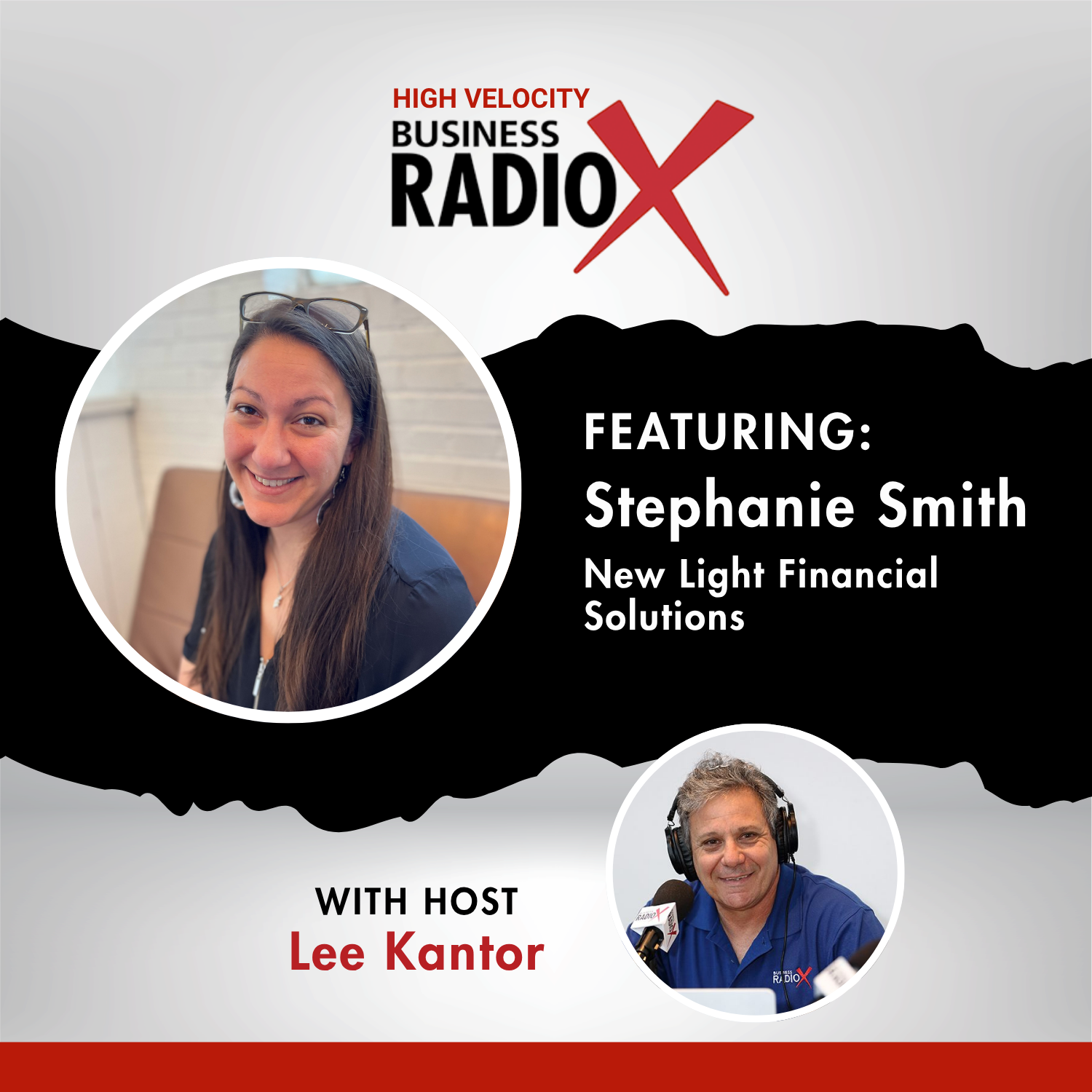

In this episode of High Velocity Radio, Lee Kantor interviews Stephanie Smith of New Light Financial Solutions about helping business owners move beyond basic bookkeeping and gain true financial clarity. Stephanie shares how businesses can use their numbers to make smarter decisions, improve profitability, manage cash flow, forecast for the future, and create actionable strategies for sustainable growth.

 Stephanie Smith is the co-founder of a bookkeeping and outsourced CFO firm that helps skilled business owners finally understand their numbers.
A former math teacher turned financial strategist, she believes every business owner deserves a clear financial picture without needing a finance degree to understand it.
Connect with Stephanie on LinkedIn.
What You’ll Learn in This Episode
- The difference between bookkeeping, tax services, and outsourced CFO support
- Why revenue alone does not tell the full story of business performance
- The importance of tracking profit and cash flow
- How clean financial records create a foundation for better business decisions
- Common reasons business owners avoid looking at their finances
- How financial data can uncover trends, weaknesses, and growth opportunities
- The value of forecasting and planning for future business needs
- How financial scorecards and KPIs can simplify complex numbers
- The role of an outsourced CFO in strategic planning and accountability
 This transcript is machine transcribed by Sonix.
TRANSCRIPT
Intro: Broadcasting live from the Business RadioX Studios in Atlanta, Georgia. It’s time for High Velocity Radio.
Lee Kantor: Lee Kantor here another episode of High Velocity Radio and this is gonna be a good one. But before we get started, it’s important to recognize our sponsor, collect the cash. Empowering small businesses with cash flow protection. For more information, go to collectthecash.biz. Today on the show, we have Stephanie Smith who is with New Light Financial Solutions. Welcome.
Stephanie Smith: Thank you so much for having me.
Lee Kantor: Well, I am excited to learn what you’re up to. Tell us about New Light. How are you helping folks?
Stephanie Smith: Yeah. So my husband and I run our business together, New Light Financial Solutions. We help business owners gain clarity around their finances, whether that’s through bookkeeping, um, advisory services or even just having someone in their corner to answer questions.
Lee Kantor: Now, are you like a CPA or an accountant or is this something in addition to that work?
Stephanie Smith: We are not CPAs, so we don’t do taxes. So it’s, um, more just reviewing the numbers and, um, giving strategic financial advice that way. So we don’t, we will, um, outsource the CPA and tax stuff to a tax professional.
Lee Kantor: So, um, for most businesses have a CPA or accountant or bookkeeper, right. Um, so where do you fit into that mix? You’re, you’re in addition to that service?
Stephanie Smith: Yeah. So a lot of businesses will have a CPA to file their taxes every year. Um, in addition to that, their CPA might also do their bookkeeping. We, we do bookkeeping. So we might be, um, in addition to just their CPA doing their taxes. And then, uh, in addition to that, you can have a third person like a CFO. That’s what we call ourselves outsource CFOs as well for the advisory side. You can have that person as an additional partner as well. So we feel two of those three roles.
Lee Kantor: And then a lot of CPAs, though at least make a promise. I’ve had several CPAs in my career. Um, they make a promise to offer this kind of financial insight, but in reality, that rarely happens. And they do tend to focus primarily on taxes. Is that what you find as well?
Stephanie Smith: I think every tax company is a little different, but we do find with our clients that their tax professionals tend to be that more transactional, one time a year person. Um, if you’re not really looking for and intentionally searching for maybe a tax strategist, I think that happens a lot. And one of the biggest complaints we get from our clients is that they’re just, um, they’re CPAs aren’t quick to respond. You know, it’s a, it’s a once a year engagement. They’re not really in tune to what’s going on in their business.
Lee Kantor: Right? They tend to be like kind of backwards looking more than forward looking.
Stephanie Smith: Correct.
Lee Kantor: So now what’s it like working with your firm? Like you say, some of your work is bookkeeping. So you’re actually seeing the numbers. You’re seeing what’s happening within the organization. So that would give you at least some data to make informed kind of recommendations.
Stephanie Smith: Yes. So when we first started the business, we did just bookkeeping, which is very backward looking. Um, we transactions come in, we use the software like QuickBooks or we actually have a lot of our clients use Zoho Books and we’ll help categorize those into the appropriate areas on people’s books so they know what’s going on. And then we can run financial reports and review those with our clients. Um, it is very helpful to expand beyond that. So, uh, after we had done that for a few years, people started asking us more questions like, why is this happening? Right? What, why do I feel like I’m making sales, but there’s no money in the bank. And that that at that point where you start asking those why questions and want to know more about what’s actually happening is, is when the advisory services come in beyond the well, this is what happened. And I documented it to this is how you can use those numbers to make better decisions in your business.
Lee Kantor: So then was that kind of an aha moment for you to say, okay, we have to expand our service offering to be able to help them answer those questions and to help them grow. Really?
Stephanie Smith: Yes. And we actually had a huge transition period. We we changed the name of our business and everything because we didn’t want to focus just primarily on bookkeeping. We really wanted to help people have that forward looking, um, partnership with us where we can help people grow and, and meet the goals that they have for their business.
Lee Kantor: Now, did it require you to get more training or, or was this kind of you already knew what you needed to know just by doing the work you were doing.
Stephanie Smith: The majority of it was we were doing it anyway, right? You had mentioned like, we’re in the in the books, we see the numbers. It’s just really taking that and expanding on it. So, um, we did take more courses on, on good, good practices and, and we adopted a, a process and everything for ourselves. But in the grand scheme of things, your bookkeeper should have all of that information because they’re in your numbers every day.
Lee Kantor: And then, um, when you say that you’re in the numbers every day, are you by being in the numbers every day, do you see some things that maybe even the business owner isn’t working and they’re just, you know, kind of just doing what they do and then you’re able to kind of maybe have a bird’s eye view and see some trends or some opportunities that that business owner might have missed.
Stephanie Smith: Oh yeah. All the time. Um, and I feel like, especially when, when you get to the point of hiring a bookkeeper, a lot of businesses tend to become very hands off. They don’t. And that’s normally why they hire a bookkeeper. They don’t want to do it. They don’t want to look at their numbers. Um, so we do see things that will come across and be like, this doesn’t really make sense. Or did you know that this was happening? Um, it will really depend on the engagement that we have with the client of what level that we go into those details with them.
Lee Kantor: So what are some of the common kind of mistakes that you see business owners make that may that’s probably obvious to you and probably you see it at a glance, but the business owner is just, you know, they’re in the grind so they don’t know what’s happening.
Stephanie Smith: Yeah. The number one thing I feel like is businesses tend often tend to just not even bother look at their finances. I’ve had lots of conversations with different businesses, business owners, and it can be different reasons. So I actually had one person tell me, well, my business is going really well. I don’t feel like I need to look at it so I don’t look at it. Um, I think that can be pretty detrimental, but I think on the other side, it’s a lot of shame and guilt around people just not understanding the numbers, the financial jargon, the reports. It’s it’s hard. It’s not written for the everyday person. And so I think people just, you know, breeze past it because they don’t want to, they don’t want to admit they don’t know. And then there’s shame and guilt around that. And then they just ignore it altogether. So I think it’s really important to dive into your numbers. And if you don’t know, um, try to get the help that you, you need from someone else to help explain what’s going on in your business. But I think that is the, the biggest mistake.
Lee Kantor: Now if there’s, um, since you’re in the numbers all the time and you see all this stuff, are there, is there a way to kind of simplify it for a business owner, like a listener right now, or are there just a handful of numbers they should be paying attention to? Um, even if they don’t want to kind of get in the minutia of all the numbers because it’s overwhelming. There’s a million categories, transactions, there’s all kinds of things and putting different buckets and piles, but are there some key kind of metrics that a business owner should be should know off the top of their head all the time?
Stephanie Smith: Yes, I do believe that. I will say from a bookkeeping perspective, I think, um, businesses can go one of two directions, like oversimplify or overcomplicate. So it’s nice that you can really customize what you’re looking at to yourself. But when it comes to what, what metrics you should look at, I think most people know their revenue because that’s the number they’re chasing. I need a certain amount of dollars to make my money. Um, and then they just stop right there and they make all their decisions based on revenue. But I really think we all need to go beyond that to what would be next would be profit. So while it may is great and you need that, you need to also, um, understand after you’ve paid everything, all of those expenses, when you paid your payroll and your rent and your software. At this point, we have so much software, especially with AI, what’s left over? That’s your profit. And if you’re not profitable, then your business isn’t doing well. So I think we should look at that number especially. But there’s one more even beyond that, that I do believe everyone should be tracking. And it’s their cash flow. A lot of business owners will, um, look at the bank balance, like how much money do I have in the bank? I’ve got money in there so I can go spend it. Um, but cash flow actually goes beyond that. Um, because while profit looks at your, those expenses that I was talking about cash flow, there’s other things beyond that, like I need to, um, pay my mortgage or I need to pay off a loan or I’m going to take money out to pay myself. All those impact your cash flow. So you should be really watching the money go in and out of your business. Um, and how that’s impacting your cash flow.
Lee Kantor: Now, um, does that is cash flow something you can see right when you start. Or do you have to kind of have some history to know kind of the ebbs and flows of how money comes in and out of a business before you can really advise them. When it comes to monitoring and paying attention to their cash flow.
Stephanie Smith: History is definitely helpful, especially for trends, right? If you want to see what trends are happening in the business, you need more than one month to see the trend. But you can do you could see it every month. Where, where did my money go this month? Did I get money? Where did it come from and where did it go? Is there any left over for me to pay my expenses and pay my bills and those kind of things? But if you have the longer term data, you can you can find trends like seasonality, like, am I not making the same amount of money over the summer as I do over the winter? And that can really help you plan for the future. So you can survive those months where your cash is lower than you would want it to be.
Lee Kantor: So what’s kind of the pain that that your new clients are having right before they contact you and, um, and get your help. Like what, what are some of the signs or signals that maybe it’s time for me to kind of level up in this area?
Stephanie Smith: Yeah. So, um, beyond bookkeeping, a lot of people reach out to us from a bookkeeping perspective and my books are a mess. Um, and that’s usually true. And we will help clean it up. And you really have to have good bookkeeping and good records to go beyond that. So when you want to start, um, looking into the future and people are asking about forecasting or planning or I want to hire someone, do I have enough money for that? Or, you know, which one of my services is making the most money? Am I spending my time in the right places? Um, those are the questions that people will, will come to us with. And that’s where we can get more involved on that advisory side. And you have to have good books to be able to answer those questions. Because if you’re not tracking where the money is coming and going correctly to begin with, it’s it’s really hard to predict into the future if the numbers are wrong.
Lee Kantor: And that’s one of those things. So that’s kind of a logical starting point. When people work with your firm, they start at bookkeeping because without that, that’s foundational.
Stephanie Smith: It is. Well, some people already have a bookkeeper in place, and they just want the support to better understand their numbers. I think that’s another big one. I just don’t know what’s going on. I want more clarity as a is a term we use a lot around what’s happening in my business. So if if they don’t have the bookkeeper in place and their bookkeeping in place, then we, we will start there because that’s, you know, a foundation that we provide. But if they already have that, then we can help beyond that to go what to see what the numbers are actually telling them.
Lee Kantor: And then you can help get all of the. So you can give some analysis and recommendations based on the numbers that you see. And also you can help make sure that all of the books are ready for the CPA to do whatever tax stuff they do.
Stephanie Smith: Correct? Yes. It’s definitely what we what we usually do on the advisory side is every month we look at what’s going on in the books, and then we’ll see the areas of weakness, and we’ll be able to see the areas of strength. And we’ll be able to see if your books are are accurate or not, just part of that process. Um, and if needed, and if they have a bookkeeper already, we’ll work with the bookkeeper to make sure things are getting correctly categorized to the books. Um, but from there, we will forecast into the future. This is what we think is going to happen this year. And then what we like to make things really simple for our clients. So we create a scoreboard, red, yellow, green for the KPIs that we track. And we will identify the one or the two that if you can work on this one and change it by even 1%, you’ll see more cash in your business. And, um, we can help them grow in the way that they want to. Because not every business owner has the same goals.
Lee Kantor: Now, you mentioned that you’re not CPAs or tax professionals. Do you make kind of recommendations of, hey, you know what? Maybe I see how much you’re paying for your CPA. There might be a better way because I’m handling a lot of the advisory stuff now, and it seems like you’re paying kind of an inflated price for just tax.
Stephanie Smith: We, we will leave all the tax conversations to the tax specialists. So if we, we will say, you know, we would recommend that you talk to your tax professional about this, um, ask for how much people are spending with their tax person. I think that’s really personal. You know, everybody values different things and they spend different amounts based on the services that they’re having. But if they felt like they were spending too much and we had a conversation about it, you know, we would certainly, uh, give them some recommendations if they wanted something different.
Lee Kantor: So you have kind of a network of CPAs, I would imagine.
Stephanie Smith: Oh, absolutely. Yes.
Lee Kantor: Right. That’s part of the value you provide. You’re trying to be you’re trying to solve all the financial problems for the client, right?
Stephanie Smith: Correct. Yes. Well, we don’t do taxes. Yeah. We, we, I’ve, I’ve met with many tax professionals over the years and we will make recommendations for, for people. And, you know, I try to give people more than one person because every personality is different and everybody’s area of expertise is different. So, um, we will do as best as we can to help them find a good fit for themselves.
Lee Kantor: Now, do you work in certain industries? I would imagine your work is kind of industry agnostic, but do you have a sweet spot when it comes to a depth of expertise?
Stephanie Smith: We are pretty, um, industry agnostic at this point. We have, um, people in all different types of industries. However, we have um, a couple of pockets that we’ve picked up multiple clients with. We have a few in the home services industry, um, a couple garage door companies. And, um, we also have a couple of telecom companies. So we’ve been helping with that too. So, uh, of all of our clients, those are the big buckets, but what we do, we could help anybody in any industry with.
Lee Kantor: Now, when you work in, like you mentioned, home services, if you start having several clients in that area, does that really help you kind of make better recommendations? And all of a sudden you start kind of learning, okay, there, there’s a lot of opportunity over here. I’ve seen this person in this other market do well here. Like, does that just help you serve your clients better when you get a little more depth in certain industries.
Stephanie Smith: It is helpful to be able to say, you know, my, my other client that’s like you, this is what they’re doing. Um, and have those kind of conversations. But I also feel like a lot of businesses want to compare to the benchmarks and the industries, and I think we should really be comparing to ourselves and what our goals are. So while I think it is helpful to know what else is going on with other people in the same business, I think it’s also really good to focus on what you want in your business and your success. But yes, it does help to have that frame of reference.
Lee Kantor: Now, is there a story you can share that maybe illustrates how you work with a client that don’t name their name or even their industry? If that’s if you don’t want to kind of give that away, but maybe share the challenge they came to you with and how you were able to help them get to a new level.
Stephanie Smith: Yeah, absolutely. Um, so we had one client reach out to us. Um, I actually have a YouTube channel where I create tutorials on how to use Zoho Books. And that’s where they found us and their books needed help, um, being cleaned up. So that’s where we began. Uh, but they were really looking to sell their business and they needed their finances to be organized and correct, and they needed someone to answer questions because they just didn’t understand their numbers. So, um, that we started with them by cleaning up their books. We did a multi-year cleanup, got everything in order. And then, uh, we went through the process as they sold their books to help them better understand what was going in or sold their company to help them better understand what was going on in their business. Um, we had conversations with, uh, they sold to an Esop, which is, um, they still run the business, but it’s a tax thing. And we, we worked with the Esop company to answer the questions and be that CFO for our client. And then now that they’ve made that sale, we’ve transitioned into the way we want to be good stewards of our business. How can we do that better? So we meet with them every month. And like I mentioned before, we have our scorecard. We’ll identify the areas that that they’re doing really well in and then a couple of areas that they need to improve on or focus on. And this year that has really been their cost of goods sold, trying to reduce their expenses so they can keep more of their cash. And every month we meet with them and talk about what they can do to accomplish that goal. And so, so they can have more cash at the end of the year. So we’ve been working with them over the course of year, over a course of a couple years, doing a few different things just based on the engagement.
Lee Kantor: Now, you mentioned Zoho. Can you, uh, for the listener out there who maybe is using a different platform than Zoho, can you share the trade offs of why maybe making the switch would be a good idea?
Stephanie Smith: Yes. So we, we started in QuickBooks, which everyone is familiar with. Quickbooks. Quickbooks, I feel like these days. Um, but we decided to focus on Zoho because it was a little different. Zoho is unique in the sense that it is part of the Zoho One Platform. So Zoho one has a multiple apps, um, technology that integrate more or less together. Uh, so you can have a CRM, they have, um, social media, you can do landing pages, you can have your website, like it’s all integrated into one platform and it’s, I want to say it’s a, it’s a cost effective way. And then your bookkeeping is just embedded within that. So, um, a lot of our clients use Zoho Books because they are using Zoho one. Um, and I will say QuickBooks has been doing a lot of updates with AI and everything like that. And not that Zoho isn’t making updates, but their platform is honestly just a little simpler, um, and easier to use and navigate, in my opinion.
Lee Kantor: Now, um, in your work is kind of the ultimate goal to become kind of the CFO for the organization. Is that where you feel like you can have the most impact in an organization?
Stephanie Smith: Oh, absolutely. Um, we definitely the goal is to, to help clients, um, be that, you know, we want to be that financial strategist for them and, and give them that support beyond just bookkeeping. It’s, it’s a little challenging because a lot of our clients are smaller and, um, our CFO clients tend tend to need to be in business longer and have a little more revenue before they get to the point where they’re having even the conversations about growth and, um, maybe opening locations and those kind of things. But, um, we can help people along the whole journey where they’re at.
Lee Kantor: So what is kind of that? Is there a number of employees or an annual revenue that is kind of a signal to you that they might be a good CFO client?
Stephanie Smith: Yeah. We we like to say around the 500,000 to 1 million mark in the revenue, they would make a really good CFO, a CFO client.
Lee Kantor: And then the amount of services does that like now because you’re doing the books either way, at any level when they’re a CFO client, now you’re meeting with them more often. You’re doing more analysis, like how does the services changes as they kind of, uh, you know, get more and more services from you?
Stephanie Smith: Yes. So the book on the bookkeeping side, um, it’s not that we don’t meet with our clients. We meet with them when, when it is needed, but we are in the day to day doing the books. And that really changes. The engagement changes when we move to the CFO side. So it is we meet with them monthly or bi monthly, and we have more strategic conversations. Our role changes from just categorizing transactions to forecasting into the future, really identifying what’s going on in the business, being more strategic. Um, I have created a nice dashboard that will visually show what’s going on in the business because it’s, it’s hard sometimes to understand the numbers, so we try to do our best to make things as simple as possible. And then we really focus on the one area that will make the biggest impact. And we work with our clients to create an action plan. And then we become that accountability partner so they can stay on track to meet their goals. Because we all know it’s easy to say you want to do something, but if you don’t have someone pushing you along, sometimes you get a little lost.
Lee Kantor: So what do you need more of? How can we help you?
Stephanie Smith: Um, you know, I would I’d love to just put the word out there that we’re here to help people get financial clarity. Um, whether that is someone doing their own bookkeeping. We just actually launched earlier this year as a membership support, a support membership for people doing their own bookkeeping where they can get help if they need to, um, or the bookkeeping itself. And then really, we, we want to help people grow beyond that. So if someone’s looking for, um, help better understanding their numbers, they want to make business decisions based on data and not just, you know, throwing spaghetti at the wall, like I like to say. Um, we would love to have a conversation.
Lee Kantor: So if somebody wants to learn more about your offerings or get on your calendar, is there a website? What’s the best way to connect?
Stephanie Smith: Yes, our website is newlightfs.com and you can book a free consultation with us if you want to have a conversation. But everything’s there on the website. You can connect with me on LinkedIn. I’m a little harder to find because I’m a smith. Um, but the website has everything new light.com.
Lee Kantor: Well, Stephanie, thank you so much for sharing your story today. You’re doing such important work and we appreciate you.
Stephanie Smith: Thank you for having me.
Lee Kantor: All right. This is Lee Kantor. We’ll see you all next time on High Velocity Radio.















