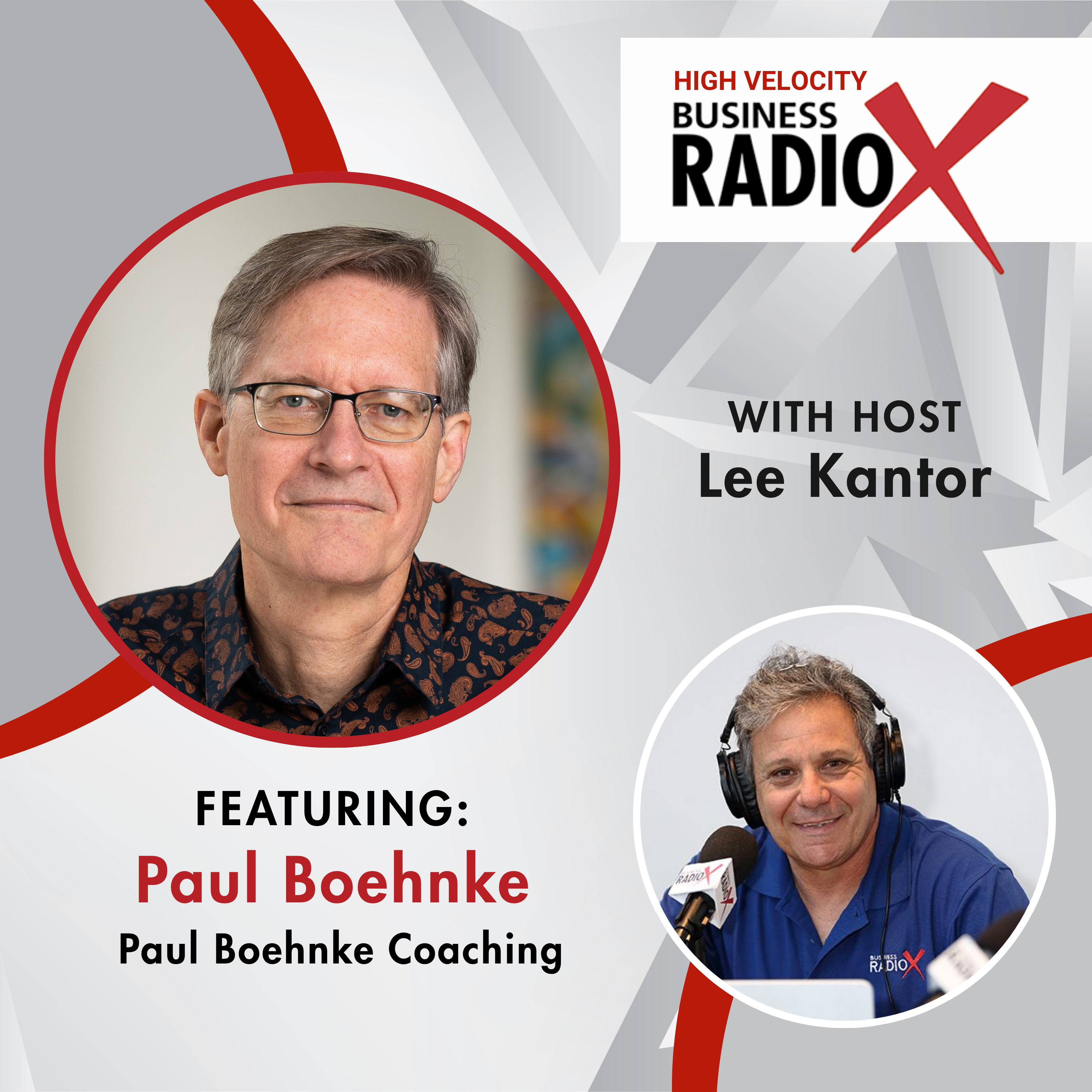

In this episode of High Velocity Radio, Lee interviews Paul Boehnke, a coach specializing in helping individuals overcome negative self-talk and build aligned businesses. He explains how the “inner critic” — rooted in fear and habit — can limit growth, but can be reframed into a supportive voice through awareness and intentional thought habits. Drawing from his background as a classical musician, He emphasizes self-discipline, mindset, and alignment with personal values as keys to success, especially for solo entrepreneurs. He highlights that business struggles often stem not from lack of knowledge, but from internal misalignment. He also distinguishes coaching from therapy and consulting, noting that coaching focuses on forward movement, clarity, and accountability. Through practical strategies and mindset shifts, he helps clients transition careers, overcome perfectionism, and create more fulfilling, effective paths forward.

 As a classical musician, Paul Boehnke stumbled on a unique process that not only helped his performances but could easily be applied to taming his inner critic. Then he realized this process not only works for him but works for everyone, musician or not.
As a speaker, author, and coach, Paul helps coaches and entrepreneurs find energetic alignment with their business so they have greater impact, make more money, and have more fun.
In his book, “Thoughts On Demand: Turn Negative Self-Talk into Unstoppable Confidence” he shares a process that transforms the voice in your head from an adversary into an ally.
Connect with Paul on LinkedIn.
What You’ll Learn In This Episode
- Overview of Paul Boehnke’s coaching practice focused on inner critic work and solo entrepreneurs
- Exploration of negative self-talk and how it impacts personal and professional growth
- Insights into how the inner critic forms and why it persists as a protective mechanism
- Techniques for identifying hidden beliefs behind behaviors like procrastination and perfectionism
- Introduction to reframing and replacing limiting thought patterns with supportive ones
- Discussion on career transitions and managing fear, uncertainty, and identity shifts
- Importance of aligning business strategies with personal values and energy
- Differences between coaching, therapy, and consulting in personal development
- Real client example showing how overcoming perfectionism improved business performance
- Overview of coaching formats offered, including one-on-one sessions, group programs, and online resources
 This transcript is machine transcribed by Sonix.
TRANSCRIPT
Intro: Broadcasting live from the Business RadioX Studios in Atlanta, Georgia. It’s time for High Velocity Radio.
Lee Kantor: Lee Kantor here another episode of High Velocity Radio and this is gonna be a good one. Today on the show, we have Paul Boehnke with Paul Boehnke Coaching. Welcome.
Paul Boehnke: Thank you Lee. It’s a pleasure to be here.
Lee Kantor: Well, I’m excited to learn about your practice. Uh, tell us about your coaching practice. How are you serving folks?
Paul Boehnke: Well, um, yeah, there are a couple of different focuses that I seem to have in my business. The first is, um, I love doing work around the inner critic. That negative self-talk, the little voice in our head, which is always telling us what we can or cannot do. And it seems to be in the way of so many things that we want. And I love helping people sort of uncover what’s really going on with that voice and figuring out how we can reprogram that voice, change it so that it’s supportive and encouraging. So that’s sort of one of the major parts of what I do. I also do a bit of business coaching with mostly solo entrepreneurs. And sometimes that inner critic work, of course, comes in to that business building as well. So those two areas fit together pretty nicely.
Lee Kantor: Can you share a little bit about your backstory? How’d you get involved in this line of work?
Paul Boehnke: Well, of course, I got into coaching because I was a classical musician for 30 years.
Lee Kantor: It was a logical next step.
Paul Boehnke: Then of course, yes, actually. Well, actually it was for me on the inside. You know, I think, uh, being an artist, uh, it is about so much more than, uh, just mastering the tools of your art. I think being an artist is really becoming a master of yourself, really sort of getting a hold of what are all those hidden fears, motivations, worries that get in the way of creativity. And an artist’s job, I think, is to clear away all of those hidden things so that creativity has a place to be. And it turned out that was a great preparation for coaching, helping other people do that same sort of thing. So on what looked like on the outside, I’m sure what looked like a rather drastic shift to my friends and colleagues on the inside, it felt like just a little minor shift in the focus of what I was doing.
Lee Kantor: Now, do you still work as a classical musician?
Paul Boehnke: Actually I do. Not nearly as much. I played a concert yesterday, as a matter of fact. So it is still in my life. And my family were all musicians, and so I can’t quite get away from it even if I wanted.
Lee Kantor: And then now the focus though, like career wise, is more along coaching.
Paul Boehnke: Yes, yes, that’s that’s what I do full time and, you know, play a couple, three concerts a year maybe.
Lee Kantor: Now for yourself, was that a difficult transition to make to, you know, having kind of the image of yourself as I am a musician to. Now I am a coach who also does music.
Paul Boehnke: Well, if I’m going to be honest, during that switch, of course I had my own little voice in my head saying, you’re doing what? What do you think you’re doing? Who’s who’s who’s going to trust you for this? But you know, once, once I realized that taking that step is what I needed to do, you take the first baby step and you realize, well, I didn’t die. So I guess maybe I could take the second baby step, and then pretty soon you’re off and running. So yeah, making a shift like that can be, oh, what’s the word can be a little intimidating, but also felt so strongly in my mind that I knew, although I loved being a musician, I could tell that time was sort of coming to an end and there was going to need to be something else. And so I just needed to step into it. And the more you step into something, the more comfortable and easy it becomes for you.
Lee Kantor: Now, how do you work with your clients who are in a similar state of their career may be where one chapter of their career is ending, and then now they have to take that leap into something else. How do you help them? Number one, to come to terms with that maybe reality and number two, to help, you know, have the inner confidence to launch into this new kind of world?
Paul Boehnke: Yeah. Well, it’s a great question. And I think, you know, you kind of highlighted the two parts. How do you help people, um, come to the realization that something needs to change? And usually they can come to that realization fairly easily on their own, mostly. But what gets them stuck is the fear of, okay, if I’m letting all of this go, then what? Um, there’s this void that feels. And for some people, there might be grief of sort of letting something go. So you work through that process like you would any process. Um, but then stepping into what, what is needed. Um, you know, I think when, when we are able to help people find things that are inspiring to them, that move them, that really resonate with their values, then they have the sense of clear purpose of what’s going on for them themselves and their lives. Um, it almost feels bigger than them and they’re drawn to it. Um, so then we just sort of help get that clear for them and help them feel supported as they take those baby steps into the next thing.
Lee Kantor: Now, when a person is struggling, a lot of times they part of the struggle is kind of the way that they’re talking to themselves. Um, is that kind of negative self-talk? Is that something that is just a human behavioral way to protect us, you know, as a species? Or is this or some people just able to not have negative self-talk?
Paul Boehnke: Well, I have yet to meet anyone who doesn’t have some now. Um, we all have our unique varieties or unique amounts of it, but I think it is very naturally part of our humanity. Um, you know, the fear center of our brain, the amygdala, it’s job is to look out for everything dangerous and point it out to us so that we can stay safe. And it’s done a great job of that over the millennia because, well, here we are. Um, but, uh, most of what goes on in our lives now is not life threatening, even though our amygdala still thinks it is. So we have developed these, shall we say, habits of thought that, um, encourage us to find all the bad things that could possibly go wrong, rather than the good habits of thought that try to keep us safe by saying, oh no, you’re not really quite good enough for this. Uh, you know, stay away from that because then you won’t be humiliated, be shamed, be whatever it is And it turns out that those are just habits of thought. They are not who we are. They don’t define us. It’s just who we are. These are habits of thought that don’t define us unless we say that they do, of course. Um, and when we can first of all realize that the grip that those thoughts have on us seems to lessen. Um, in my work, I’ve also not come in, not encountered any sort of inner critic message that isn’t ultimately based on some sort of a lie.
Paul Boehnke: And when we can really get to the bottom of what’s the lie underneath this, then that helps us even more to release it. Um, and then what we want to do is, uh, find a new belief, a new thing that we want to hear from our mind. Um, and that isn’t going to be just the opposite of some old message because that just creates an argument which will keep the old message alive. But when we can do a little end run around that argument, address the issues that that lie brings up, but do it in a way that supports and encourages us. Then all we have to do is turn that thought into a habit, which is actually one of the skills that’s most useful to me that I learned as a musician. How do you get your brain to do what you want it to do and to do it on cue? This is actually a whole process or framework that I use with my clients called Thoughts on Demand. Um, I’ve actually written a book which goes into detail of that whole process by the same title, but that’s kind of how we do that. We sort of pick apart what’s really going on with this negative self-talk, and then we find out what do we want to replace it with. And then it’s just a matter of creating a habit, which is not a difficult thing to do.
Lee Kantor: Now, do you have any advice for the listener right now? Is there something they can be doing to number one, to just maybe increase their awareness of, oh, I am doing that thing. I am, um, using negative self-talk. Like I’m sure there has to be an awareness element where they, the person, you know, maybe instinctively says, I don’t, I don’t do that. And then maybe there’s a way to show them that they do do that. And then once you do that, how, what’s kind of a baby step you can do to stop doing that a little bit?
Paul Boehnke: Yeah, great. So one of the interesting things about this inner critic is it is a very wily shapeshifter. It can look and behave in all sorts of ways. Um, you know, some of the ways that it disguises itself are through procrastination or perfectionism or worry or imposter syndrome or being particularly shy or particularly, um, gregarious, shall we say. And it will hide behind all sorts of different behaviors. But when we really get to the bottom of why am I procrastinating? Or why am I, um, a perfectionist? What’s really going on in my mind underneath those things, that’s when we begin to sort of uncover what those lies are and what’s really going on for us. And we come to realize that we have a whole lot of options to stay safe and to move forward in ways that are really encouraging to us without having to rely on those other habits which aren’t serving us very well. And then, as I mentioned, just sort of this process of creating new habits about the way you think. So in a nutshell, it’s about as simple as that. It’s, um, uh, what I want to say in some ways, it can take a little time to sort of begin to recognize that.
Paul Boehnke: But if you see, oh, yes, I’m finding I procrastinate a lot. Oh, well, that’s, that’s pretty interesting. Why? What’s going on underneath that procrastination? What are you telling yourself? And it can be such a huge range of things, even for that one. One issue I can think of one client I had who loved procrastinating and then suddenly at the last second, you know, going full tilt and working all night long to get some sort of project done. And what we discovered was that he actually loved the feeling of that adrenaline fueled drama, shall we say. And the lie was that he thought he needed procrastination in order to feel alive that way. Well, when we uncovered that, all of a sudden he realized, oh, feeling alive is really what I’m trying to do. How do I be vital, engaged, productive? I don’t have to procrastinate to do that. So that’s the sort of thing that you start looking at. What are these habits that you have that somehow don’t quite seem to serve you, and then find out what’s really going on underneath it.
Lee Kantor: Now, as part of your, um, kind of business coaching, how much do you lean on your background as a as a musician and the discipline and the systems that it took to reach the levels that you were able to reach in that regard, because I would imagine there’s a lot of transferable skills, uh, from the processes that you were able to create in order to help you become the best you, you were in that realm that would easily transfer to the business sector.
Paul Boehnke: Yeah. Um, another great question. I think that, um. The self discipline you mentioned, that’s huge, I think for anything. And you can learn that whether you’re a musician or an athlete or whatever it is that you’re doing something that takes some practice and takes time. What a fabulous way to learn self discipline, to sort of keep focused on what’s important to you and to keep showing up, keep practicing, keep doing whatever it is you’re doing. And that was certainly handy. Um, I also say that I think one of the things which has helped me build my business successfully is my own self-awareness of my energies, how I feel, what inspires me, what drags me down. Um, because I think the biggest problem that most entrepreneurs have as they’re trying to build a new business is they tend to think that it’s all about the information. If I just know how to do this, if I know what to do and how to do it, then I will have a business. And the what and the how are definitely important. There are things that one needs to do to have a business that works. There are certain ways to go about it that make it more effective. The thing is, that kind of information is pretty easy to come by, particularly in this day of the internet. You can go to your computer and do a search. Sir, what do I need to do to start my XYZ business? And all of a sudden you’ve got pages and pages of information about how to do that.
Paul Boehnke: And you can say, okay, here’s my first step. How do I go about doing that? Yes, your computer and it will tell you how to go about doing that. And that’s all great, powerful information. But the reason I think people sometimes struggle is because there’s something out of alignment with what they’re who they are, how they’re being, how they want to show up in the world and what they are trying to do in their business. There’s a mismatch in there, and the energy, they end up fighting against themselves. They’re doing something, but they’re not engaged or inspired by it or not completely bought in. And so when that’s the case, you don’t do the job very well. And the focus I have with my business clients is, first, let’s find that energetic alignment. Let’s find out what really inspires you, why you want to have this business. What are your values that this honors? How do we then craft a business that fits that? Because that will help with that self-discipline. It will help with the follow through. It’ll help with the the quality of the work that you do. And there are a million ways to build a business. Um, but when we find the couple ways that are really in alignment with you, that’s what’s going to work for you.
Paul Boehnke: We don’t have to be everywhere. Um, just as an example, from my own experience, I remember when I started this business, um, I remember a lot of people telling me, oh, well, you have to be on social media and not only do you have to be on social media, you’ve got to be posting like all the time and well, not just posting a lot, but you have to really create content which is valuable to people so that they want to, you know, come back and engage. And well, when they do engage, then you have to go back in and engage with them and keep this. Well, it was feeling overwhelming for me. Social media never felt like a natural place for me to be. I didn’t quite get it. Um, and any time I would post or do anything on social media, No one would see it. It wouldn’t, uh, you know, uh, generate any interest, any conversation, any, anything. It was not effective for me because it was not in alignment with me. Now I’ve got another friend and colleague who loves social media, and he gets almost all of his coaching clients through Facebook. I couldn’t get anybody to see my posts. So the, the what and the how, the information of how to create a business is really important. But I think what’s even more crucial is finding ways to build your business, which are in alignment with you.
Lee Kantor: And isn’t that where having a coach really is an important, uh, piece of that puzzle? Because having somebody with fresh eyes and the ability to look at things, you know, kind of objectively and, and hold you accountable, those are all, uh, important traits that a business person needs to get to a new level, especially if they’re stuck or they’ve reached a plateau, or they’re frustrated to have somebody to come in and kind of hold them accountable, be a cheerleader and help them kind of work through the path that might take them to a new level. I would think that that’s can really be a game changer for a lot of folks.
Paul Boehnke: I think it can, um, you know, there are people who, of course, build a business all on their own and they do it really well. Yay. That’s great for them. Um, if, however, one finds themselves feeling isolated, which a lot of solo entrepreneurs do, um, wondering about things, how do I, how do I go about things? Now we’re also talking about the what and the how again, but also having the kind of support that gives you the confidence to go ahead and do things. Yes, coaching brings a lot of that. It helps. As a coach, I can listen to you watch what’s going on and just sort of reflect back what I see and ask questions about that, and often that will spark new insights in the the person said, oh man, I had no idea I was doing that or this is what was going on for my mind. No wonder I am struggling in this way. That is the real power of a coach because we can ask questions. A coach will ask questions that we don’t ask ourselves. Um, and so that is why it can be so powerful, so helpful. And yes, of course, the accountability and the encouragement, it also feels good. I know when I have worked with coaches, which I almost always have one. Um, it feels so good to know that there’s somebody else in my corner. It’s like there’s somebody in the next cube to me that I can turn to and ask for support and encouragement for fun, for whatever it is that needs to happen. So yes, working with a coach can really be a game changer for people. It can provide this sort of support and the momentum to get things done much more quickly than you would do on your own.
Lee Kantor: Now, for the listener out there that maybe has never had a coach, how would you How would you answer their question about kind of differentiating between should I get a coach? Should I get a therapist? Should I hire a consultant or should I just do this myself? You mentioned that there’s lots of information out there.
Paul Boehnke: Yes. Um, I think there’s nothing wrong with trying to do it yourself. Um, it has a tendency to be the slow way. I mean, there are people out there who are happy to support you, who can help move things along much more quickly, much more easily without all the mistakes. Um, so that would be a benefit for that, uh, difference between coaching and therapy. Therapy is in general about sort of healing old wounds from the past. And coaching is not, uh, trying to heal old wounds. We will sometimes ask questions about the past, but merely to gain enough information so that we know where we are and how to move forward from where we are. Uh, we don’t need to sort of rehash re practice, go over and over that past to try to heal things. We just sort of briefly look at it. So that’s kind of one of the major differences. Therapy is trying to heal something. And coaching is really trying to help you move forward from wherever you are at the moment. And consultants, um, they tend to sort of come in and answer the question, what do I need to do? And how do I do it to get my business going or whatever it is. And that’s really powerful, useful information. Um, that can be really helpful. But then their responsibility is normally done. Then it’s on the person to implement that and to follow it through, which of course, for all sorts of reasons gets a bit tricky sometimes, which is why coaching can be this really great, um, synergistic partnership between the coach and their client, um, where together they’re really sort of figuring out how to move forward, what to do. Um, the coach can help uncover those places of misalignment. Um, which then makes everything so much smoother, so much easier. The kind of growth that happens, um, can be quite astonishing. And unlike the consultant, the coach is there all the way along. As long as you would like their support, they’re happy to sort of support, encourage, ask the next question.
Lee Kantor: Now, is there a story you can share about a client? Uh, don’t name the name of the client, but maybe share the challenge they had when they came to you and how you were able to help them get to a new level.
Paul Boehnke: Sure. So, um, I had one client actually who is a brand new coach and he was, uh, beginning to start running his business. And he was, of course, doing things like, you know, setting up his website and figuring out his coaching practices and pricing and going to networking events and, you know, doing all of those different things that a business owner will do. Now, his negative self-talk for him showed up in the form of perfectionism. And so every time he would accomplish something, he’d get something done in his business. This little voice would say, oh, well, that really isn’t good enough. You. You think that’s enough? You know, there would be this nagging voice that was always raising the bar on whatever the expectation was. And by the time he came to me, um, he was feeling pretty exhausted, uh, discouraged, and kind of ready to quit. Well, together, we sort of dug into this process. He, of course, discovered that building a business is not a journey of perfection. In fact, many of the things that he were seeing as failures, it actually is what was spurring new growth and opening new opportunities for him that he hadn’t seen in the past. And he was able to sort of rewrite that script in his head so that the perfectionism wasn’t there.
Paul Boehnke: What he learned from perfectionism was doing things really well. That was a skill. Actually, I’ve never met a perfectionist who wants to give up that skill of doing things well. But when perfectionism becomes tricky is when it feels like you are compelled to do things perfectly rather than choosing to do things really, really well. Well, so he was through this work, he was able to sort of release that compulsion and choose to do work really well when it suited him. There’s a sense of peace that began to sort of come into his business working. Things were moving quicker, more easily. Clients were coming in, and when I saw him a few months later, um, he mentioned, you know, how things had changed and things were much more fun. And he wasn’t, uh, dragged down by these perfectionistic tendencies. And then he also said, but what surprised him the most was that the piece that he was beginning to find in his, um, business building. Well, that was beginning to spread to other parts of his life as well. And this is the sort of thing that happens when we can get our handle on negative self talk and turn that from, well, something that feels like an adversary into something that’s more of an ally.
Lee Kantor: So how do you deliver your coaching? Is it mainly one on ones? Do you do group coaching? Are there online courses? Like how do you deliver the coaching?
Paul Boehnke: Yeah. Great question. So I do a little bit of each. I do have an online program that walks people through this process that I’ve briefly discovered about reprograming negative self-talk. And, um, the one on one clients I have have access to that. And that’s something that we often work on. Um, so most of my work is through one on one clients. Um, I also do group programs. Both one on one of the groups tends to be focused on that negative self-talk. The other group tends to be focused on how to get your business up and running from an aligned point of view. Um, but I have online resources that are available on demand for my clients. And it’s that one on one or group work that really supports them through taking those steps.
Lee Kantor: So if somebody wants to learn more, have a more substantive conversation with you or somebody on your team when it, uh, is there a website, is there socials to get the book or to get information about the coaching or just kind of learn more about your resources and all the stuff you have going on?
Paul Boehnke: Yeah. So I will share actually three different things. Hope that’s not overwhelming or confusing. The easiest is probably my website, which is just my name, Paul benki.com. Um, last name is BOEHNKE. The book, which is called Thoughts on Demand. You can learn about that at thoughts on-demand dot ORG. Um, I also have a YouTube channel. Um, the handle at YouTube is at inner critic coach and I’ve got tons of videos there that sort of talk about all sorts of different topics that I work with in my coaching. That’s, that’s a way to sort of get to know me and how I think, um, but you can contact me certainly through my website. Um, and I’d be happy to offer a complimentary conversation. We can talk about sort of what’s going on for you, uh, if and how I might be able to help and if moving together, uh, working together looks like the thing to do. I’m happy to sort of share how that looks.
Lee Kantor: Well, Paul, thank you so much for sharing your story today, doing such important work. And we appreciate you.
Paul Boehnke: Well, thank you so much, Lee, has been my pleasure.
Lee Kantor: All right. This Lee Kantor we’ll see you all next time on High Velocity Radio.















