
Top 10 Human Resource Mistakes in Dental Practices (Dental Law Radio, Episode 23)
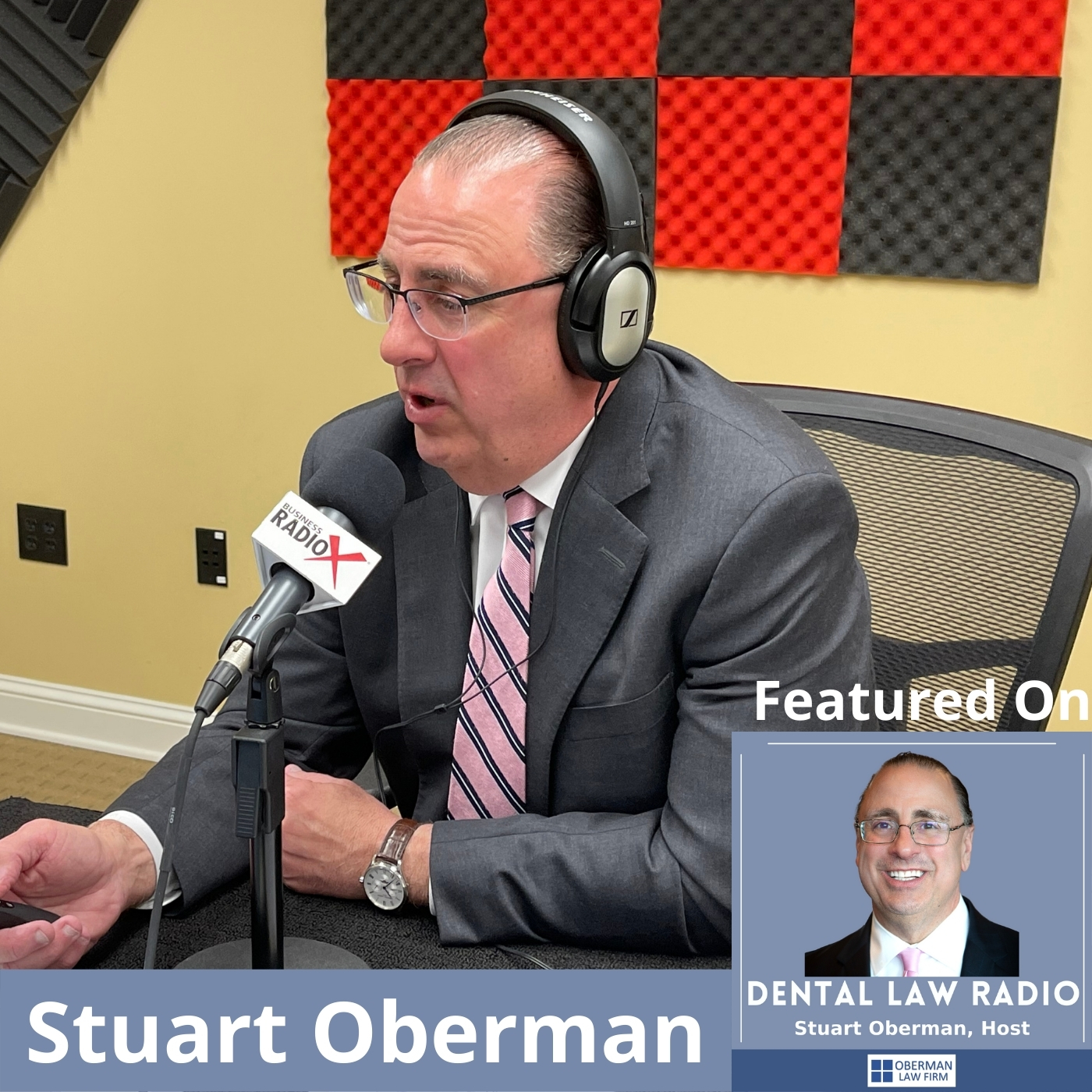
As a rule, Stuart Oberman observes, HR in the dental practices he works with is “non-existent,” and remediating those lapses and blunders can be quite costly. So what are the top ten mistakes he sees in his work, and how do those problems get fixed? Use this episode of Dental Law Radio to gauge some areas of improvement your practice may require. Dental Law Radio is underwritten and presented by Oberman Law Firm and produced by the North Fulton studio of Business RadioX®.
TRANSCRIPT
Intro: [00:00:01] Broadcasting from the Business RadioX Studios in Atlanta, it’s time for Dental Law Radio. Dental Law Radio is brought to you by Oberman Law Firm, a leading dental-centric law firm serving dental clients on a local, regional, and national basis. Now, here’s your host, Stuart Oberman.
Stuart Oberman: [00:00:25] Hello everyone and welcome to Dental Law Radio. Today’s topic, H.R. I’m going to start off by saying that, as a general rule, H.R. in our dental practices is nonexistent. We run into a lot of issues regarding H.R. in our dental practices. So, what’s the topic for today? Avoid the Top Ten Dental Human Resource Mistakes.
Stuart Oberman: [00:00:57] So, I talked about before that COVID-19 exposed a lot of issues regarding H.R. Mainly, it was nonexistent. So, going forward with that, we’re seeing a little bit of improvement, but not a lot, not enough that I feel comfortable, especially with statistics regarding the Department of Labor and the increased scrutiny of the Fair Labor Standards Act.
Stuart Oberman: [00:01:25] So, a recent survey came out from the Department of Labor that 70 percent of employers are violating the Fair Labor Standards Act. If you don’t know what that is, then you need to, honestly, listen closely. You need to join our email lists, because the Fair Labor Standards Act is under federal scrutiny right now to tighten that up from the employment side.
Stuart Oberman: [00:01:55] So, let’s take a look at what are the most common mistakes. I want to keep this simple, because, again, this can very easily go down a rabbit hole. Progress is short steps, especially on the H.R. Side. You don’t have to recreate and reinvent the wheel. Just take small steps. One of the biggest questions is, number one, failure to follow employment policies and procedures.
Stuart Oberman: [00:02:22] So, I’m talking to a doctor yesterday and he’s talking about a hygienist who is off of work. She was in an accident in a totally different state that I’m in, Georgia. And this is a doctor up north. And he was outlining how and what she was not doing, what he wanted done. Point blank question, “Doctor, does she sign a nondisclosure?” “Nope.” “Doctor, do you have an employee manual?” “Nope.” “Are there any internal documents that govern employee conduct?” “Nope.”
Stuart Oberman: [00:02:59] So, the first thing I thought to myself and I didn’t say this out loud was, you’re dead in the water. You’re just dead. I mean, it’s damage control as to what it’s going to look like. So, what do we do? You have to follow policies and procedures. You have to – I can’t even stress this enough. I feel like getting up on the table and screaming. You have to have a policy manual.
Stuart Oberman: [00:03:25] Now, I looked at one this morning, it’s 30 pages. It’s better than nothing. But we’re going to have to beef that up a little bit. They’re a little bit out of compliance with some issues, so it’s probably going to be 70 or 80 pages. By the time we get through the job descriptions and everything else, we’ll be about 100. That’s the first step, is, you’ve got an employee manual.
Stuart Oberman: [00:03:43] That doctor yesterday, dead in the water. Forget about it. It was a short conversation. He wasn’t happy with the answer that I gave him, which was to protect him going forward.
Stuart Oberman: [00:03:57] Number two, failure to keep good records. When you have a Department of Labor audit, State or Federal, if it is not in writing, if it is not in a file, it never happened and you never enforced it. One thing I would strongly recommend we do is that for each employee, you have two separate files. The professional file, which is the credentialing file and regular employment file. And I said this before on previous podcasts, never ever, ever in your life let your employees control their own personnel file. Never. Keep good records.
Stuart Oberman: [00:04:40] If you keep good employee records, then you are more likely to succeed in the Department of Labor audit, OSHA audit, and other State and Federal audits, because you’ve got the documentation. You know, as we say in the board complaints, if it wasn’t in writing, it never happened. So, writing is critical.
Stuart Oberman: [00:05:07] So, one thing our doctors do not do, number three, failure to conduct performance reviews. In today’s world where turnover is greater than ever – and I was reading a publication, it’s called Boomerang. The employees that left on the mass exodus are going to now want to start coming back – the question is, do you hire those employees back? That’s an individual question that you’ve got to answer for yourself. So, are you evaluating your employees? Do you have a valuation process on a monthly, quarterly, or yearly basis?
Stuart Oberman: [00:05:47] Because if you’re going to fire an employee and you have no performance reviews, you’re already behind the eight ball. You’ve got to provide constructive criticism. You have to jointly discuss problems and concerns. And then, you’ve got to document it. If you’re going to fire an employee, the next thing is you’re going to get slapped in the back of the head with the Americans with Disabilities Act allegation or EEOC, Equal Opportunity Employment Commission, lawsuit or complaint. And you have no documentation, you might as well open up your checkbook.
Stuart Oberman: [00:06:20] Number four is a growing concern among our dental practices, failure to follow harassment and discrimination policies. This is the fastest growing segment of problems in our dental practice across the board, small, large, large scale, doesn’t matter. Harassment and discrimination policies, in plain English, you better have a policy for that. It better be in your employee manual. And you better know how to deal with the complaint on either one of those fronts, harassment or discrimination policies.
Stuart Oberman: [00:06:57] So, in today’s world, you also probably should obtain discrimination harassment policy and contact your local insurance broker for those particular coverages. But you got to have a plan. It’s got to be written. And you’ve got to have a procedure in place to enforce it if you have complaints.
Stuart Oberman: [00:07:16] Number five is a growing area of concern as far as the Federal Fair Labor Standards Act goes. Number five, failure to pay overtime to nonexempt employees. So, the law is constantly changing, states are constantly changing. You have to keep up to date as to what exempt and nonexempt is in your state. If you do not have this documented, I will guarantee you, you will be slapped hard by the State or Federal Department of Labor. States are actually worse than the IRS, especially if your employees complain on their whistleblower statute, State or Federal.
Stuart Oberman: [00:07:59] So, again, you have to understand what the Fair Labor Standards Act is, how that applies. In January, what President Biden said as far as enforcement goes and regulatory concerns.
Stuart Oberman: [00:08:15] A gray area now in the news, creating a perception of retaliation. So, I’m not saying nothing is confidential. It’s all in the news. Whistleblower came forward on Facebook, that’s common knowledge. So, in your practice, you have to have specific policies in place that if an employee complains, they will not be retaliated against, especially if you are allegedly violating Federal Law, OSHA, HIPAA, Department of Labor, whatever it may be.
Stuart Oberman: [00:08:52] There are very specific whistleblower statutes out there that if you penalize an employee for complaining to the State or Federal agency, you can be amazingly sanctioned – and I know that’s not even a good sentence. But you will get slapped. And then, you got to come on the Federal Whistleblower Statute, which is never ever, ever a good thing.
Stuart Oberman: [00:09:18] So, as employees are quitting, as employees are being fired, laid off, one thing you have to consider, number seven, your failure to consider the impact of a layoff. The days are gone where you simply fire an employee and not worry about anything. In today’s world, you have to prepare for a layoff or a fire. One thing you have to do – and I say this all the time when I speak and I tell our clients this on our calls – you have to have a nondisclosure agreement. You have to have a cell phone, social media, and internet policy.
Stuart Oberman: [00:09:59] One thing your employees will do if you fire them, they will go straight to the internet and then you have absolutely no recourse to prevent that, unless you have these nondisclosure confidentiality agreements. Your employees are going to go to three places, OSHA, HIPAA, Department of Labor for complaints. How do you deal with that? How do you deal with an employee being fired in wanting money for severance? Are you prepared to sign a release?
Stuart Oberman: [00:10:31] A complaint that is filed by an employee never ends, it seems like, once a government gets involved. If you can resolve a case with your employee prior to any litigation complaints being filed – and that includes OSHA, HIPAA, and Department of Labor, where your employees are going to go if they have problems – get the case resolved, get a severance agreement in place, and get that employee to sign a release. If that employee goes under bad terms, there’s a pretty good chance you’re going to have an ongoing problem.
Stuart Oberman: [00:11:12] One of the biggest areas that we try to take a look at, under number eight, is the failure to manage or resolve conflicts before litigation. Get the problem resolved prior to the employee leaving or litigation. Because once you step into that arena, it is a long and expensive time consuming process that you will live with for a long, long time.
Stuart Oberman: [00:11:44] In today’s employment world, you have to consider, number nine, the Americans with Disabilities Act and the Family Medical Leave Act and, also, Employee Pregnancy Act. So, the Americans with Disabilities Act applies to a specific number of employees. Every decision that you make, hiring and firing, has to be with that in mind. And under the Family Medical Leave Act, FMLA, that is 50 employees or over.
Stuart Oberman: [00:12:22] Now, what happens is, our doctors say, “Well, you know, in three or four practices and I got them all sectioned out. And I got ten employees here. I got 20 here. I got ten here. So, all my practices, I don’t have 50, but combined I have 80.”
Stuart Oberman: [00:12:36] So then, you get a question as to whether or not they are closely connected, a nexus, and whether or not you’re going to come under that particular scenario. If you’re going to scale, you have to be concerned about that because that reflects a lot of what you’re going to do internally. So, every decision has to be made, hiring and firing, regarding those particular things in mind. If you do not know what they are, if you are not familiar with those, then I suggest you contact your legal counsel. And if they don’t know, please feel free to give us call. We deal with this every day. So, cybersecurity is first and foremost on everyone’s mind in today’s world.
Stuart Oberman: [00:13:19] So, number ten, problematic. Careless use of email and the internet. Most breaches, cybersecurity experts will tell you, comes internally from poor usage of your emails, stuff is open, viruses are spread. Every, every, every practice should have a written policy on computer usage.
Stuart Oberman: [00:13:49] And let me tell you folks, the spammers are good. The phishing – and I don’t mean at Lake Lanier – is good. It gets to the point where it is, at times, impossible to tell whether or not it’s spam. And we have actually had cases that we were working on where opposing counsel, we find out has actually been sending wire transfers to fraudulent email participants on the other end, because they were hacked and they didn’t even know it. We’re talking about billions of dollars being shifted on these particular transactions.
Stuart Oberman: [00:14:34] So, you’ve got to take a look at what the policy is. It’s got to be in writing. You’ve got to have internet guidelines. You have to monitor access to your employees. And I would urge you, urge you, to reach out to your IT company, if you have one. If not, let me know. We can, certainly, try to get you in the right direction on a lot of areas. But they should be running tests to determine your vulnerability internally and whether or not your employees will open up these emails randomly, because that’s the key.
Stuart Oberman: [00:15:09] Folks, that is a long segment, I believe, on Dental Human Resource Mistakes. It’s the little things you can do to avoid the big problems. Again, I can talk probably an hour on each topic. But just take away one thing, go through this list. Make sure you are in compliance. Make sure you have outlines. Make sure you’re taking the right steps to move forward in security and prevent problems with the employees.
Stuart Oberman: [00:15:42] Folks, thank you very much for joining us. My name is Stuart Oberman. Feel free to give us a call if you have any questions or concerns, 770-886-2400, Oberman Law Firm. Or please feel free to give me an email at stuart, S-T-U-A-R-T, @obermanlaw.com. Thank you, and we will see you on radio soon.
About Dental Law Radio
Hosted by Stuart Oberman, a nationally recognized authority in dental law, Dental Law Radio covers legal, business, and other operating issues and topics of vital concern to dentists and dental practice owners. The show is produced by the North Fulton studio of Business RadioX® and can be found on all the major podcast apps. The complete show archive is here.
Stuart Oberman, Oberman Law Firm

Stuart Oberman is the founder and President of Oberman Law Firm. Mr. Oberman graduated from Urbana University and received his law degree from John Marshall Law School. Mr. Oberman has been practicing law for over 25 years, and before going into private practice, Mr. Oberman was in-house counsel for a Fortune 500 Company. Mr. Oberman is widely regarded as the go-to attorney in the area of Dental Law, which includes DSO formation, corporate business structures, mergers and acquisitions, regulatory compliance, advertising regulations, HIPAA, Compliance, and employment law regulations that affect dental practices.
In addition, Mr. Oberman’s expertise in the health care industry includes advising clients in the complex regulatory landscape as it relates to telehealth and telemedicine, including compliance of corporate structures, third-party reimbursement, contract negotiations, technology, health care fraud and abuse law (Anti-Kickback Statute and the State Law), professional liability risk management, federal and state regulations.
As the long-term care industry evolves, Mr. Oberman has the knowledge and experience to guide clients in the long-term care sector with respect to corporate and regulatory matters, assisted living facilities, continuing care retirement communities (CCRCs). In addition, Mr. Oberman’s practice also focuses on health care facility acquisitions and other changes of ownership, as well as related licensure and Medicare/Medicaid certification matters, CCRC registrations, long-term care/skilled nursing facility management, operating agreements, assisted living licensure matters, and health care joint ventures.
In addition to his expertise in the health care industry, Mr. Oberman has a nationwide practice that focuses on all facets of contractual disputes, including corporate governance, fiduciary duty, trade secrets, unfair competition, covenants not to compete, trademark and copyright infringement, fraud, and deceptive trade practices, and other business-related matters. Mr. Oberman also represents clients throughout the United States in a wide range of practice areas, including mergers & acquisitions, partnership agreements, commercial real estate, entity formation, employment law, commercial leasing, intellectual property, and HIPAA/OSHA compliance.
Mr. Oberman is a national lecturer and has published articles in the U.S. and Canada.
Oberman Law Firm
Oberman Law Firm has a long history of civic service, noted national, regional, and local clients, and stands among the Southeast’s eminent and fast-growing full-service law firms. Oberman Law Firm’s areas of practice include Business Planning, Commercial & Technology Transactions, Corporate, Employment & Labor, Estate Planning, Health Care, Intellectual Property, Litigation, Privacy & Data Security, and Real Estate.
By meeting their client’s goals and becoming a trusted partner and advocate for our clients, their attorneys are recognized as legal go-getters who provide value-added service. Their attorneys understand that in a rapidly changing legal market, clients have new expectations, constantly evolving choices, and operate in an environment of heightened reputational and commercial risk.
Oberman Law Firm’s strength is its ability to solve complex legal problems by collaborating across borders and practice areas.
Connect with Oberman Law Firm:
Company website | LinkedIn | Twitter