Business RadioX ®

  • Home
  • Business RadioX ® Communities
    • Southeast
      • Alabama
        • Birmingham
      • Florida
        • Orlando
        • Pensacola
        • South Florida
        • Tampa
        • Tallahassee
      • Georgia
        • Atlanta
        • Cherokee
        • Forsyth
        • Greater Perimeter
        • Gwinnett
        • North Fulton
        • North Georgia
        • Northeast Georgia
        • Rome
        • Savannah
      • Louisiana
        • New Orleans
      • North Carolina
        • Charlotte
        • Raleigh
      • Tennessee
        • Chattanooga
        • Nashville
      • Virginia
        • Richmond
    • South Central
      • Arkansas
        • Northwest Arkansas
    • Midwest
      • Illinois
        • Chicago
      • Michigan
        • Detroit
      • Minnesota
        • Minneapolis St. Paul
      • Missouri
        • St. Louis
      • Ohio
        • Cleveland
        • Columbus
        • Dayton
    • Southwest
      • Arizona
        • Phoenix
        • Tucson
        • Valley
      • Texas
        • Austin
        • Dallas
        • Houston
    • West
      • California
        • Bay Area
        • LA
        • Pasadena
      • Colorado
        • Denver
      • Hawaii
        • Oahu
  • FAQs
  • About Us
    • Our Mission
    • Our Audience
    • Why It Works
    • What People Are Saying
    • BRX in the News
  • Resources
    • BRX Pro Tips
    • B2B Marketing: The 4Rs
    • High Velocity Selling Habits
    • Why Most B2B Media Strategies Fail
    • 9 Reasons To Sponsor A Business RadioX ® Show
  • Partner With Us
  • Veteran Business RadioX ®

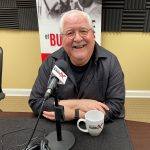
Lois Banta, Speaking Consulting Network

August 13, 2021 by John Ray

Speaking Consulting Network
Dental Business Radio
Lois Banta, Speaking Consulting Network
Loading
00:00 /
RSS Feed
Share
Link
Embed

Download file

Speaking Consulting Network

Lois Banta, Speaking Consulting Network (Dental Business Radio, Episode 23)

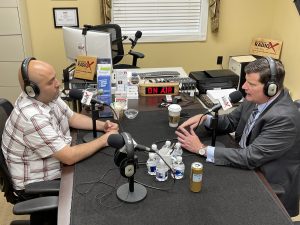
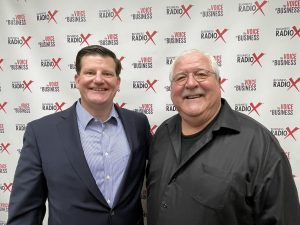
On this episode, host Patrick O’Rourke is joined by Lois Banta, CEO of Speaking Consulting Network. Lois shared the unique model of SCN that helps members learn to speak publicly and help other dental professionals.  She and Patrick also discussed dental best practices in billing and much more. Dental Business Radio is underwritten and presented by Practice Quotient: PPO Negotiations & Analysis and produced by the North Fulton studio of Business RadioX®.

Speaking Consulting Network

SCN (The Speaking Consulting Network) is the number one “learning lab” for speakers, consultants and writers who wish to enhance their own business and the business of the clients they serve.

Together through shared knowledge, a kindred spirit of helping others be the best they can e, and a passion for excellence in healthcare, SCN is reshaping the speaking, consulting and writing industry.

Company website | Facebook

Lois Banta, Owner and CEO, The Speaking Consulting Network

Speaking Consulting Network
Lois Banta, Owner and CEO, Speaking Consulting Network

Lois Banta is COO of eAssist Dental Billing. Lois has over 45 years of dental experience and speaks nationally and internationally. She is the owner and CEO of The Speaking Consulting Network and a member of The Academy of Dental Management Consultants (ADMC), The American Academy of Dental Office Managers (AADOM) and The American Academy of Dental Practice (AADP).

She received the prestigious Lifetime Achievement Award at the 2016 AADOM conference and was listed as one of the Top 25 Women in Dentistry. In 2021, Lois also received the prestigious Gordon J. Christensen Lecturer Recognition award, presented at the annual Chicago Dental Society 2021 Conference.

LinkedIn

About Dental Business Radio

Patrick O'Rourke
Patrick O’Rourke, Host of “Dental Business Radio”

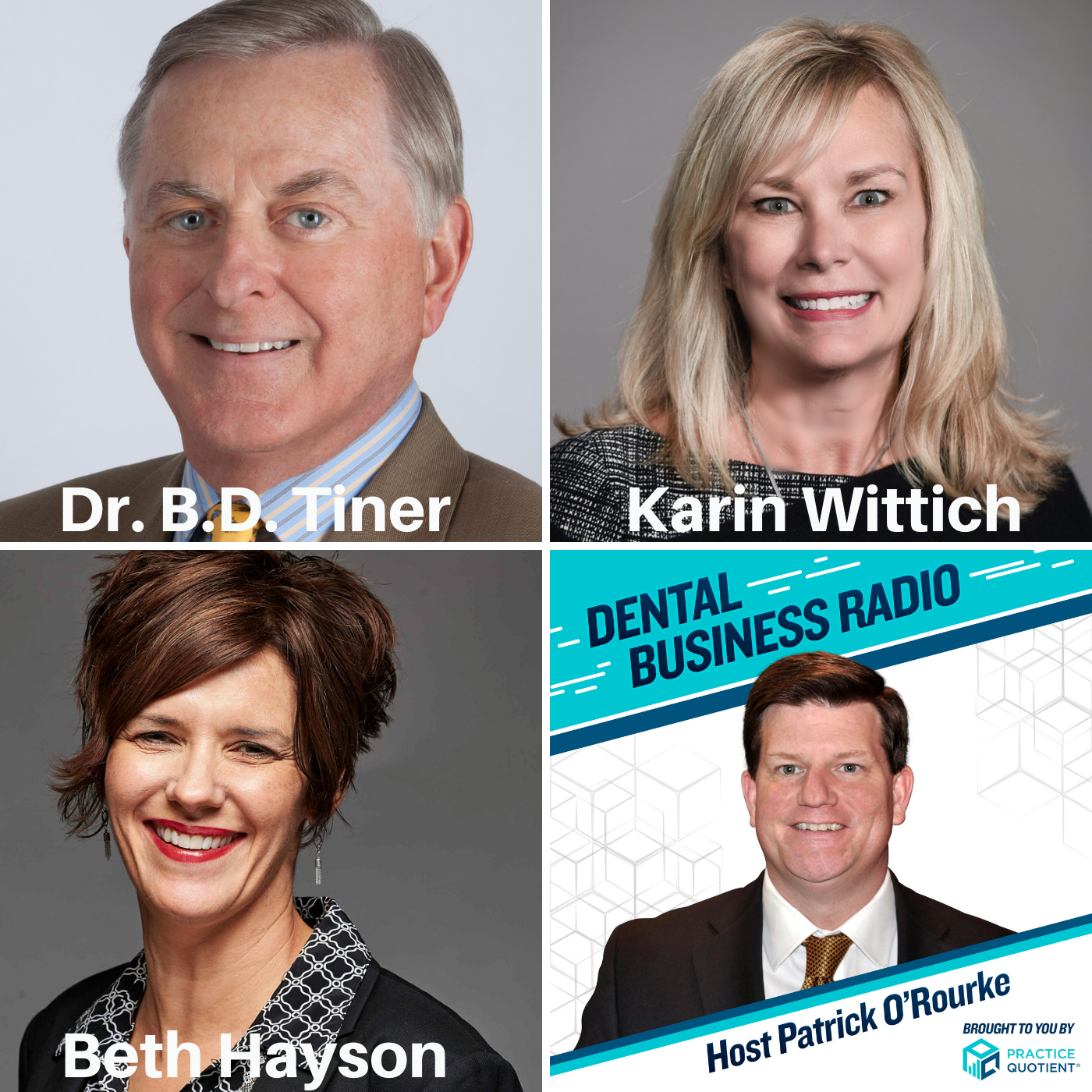
Dental Business Radio covers the business side of dentistry. Host Patrick O’Rourke and his guests cover industry trends, insights, success stories, and more in this wide-ranging show. The show’s guests include successful doctors across the spectrum of dental practice providers, as well as trusted advisors and noted industry participants. Dental Business Radio is underwritten and presented by Practice Quotient and produced by the North Fulton studio of Business RadioX®. The show can be found on all the major podcast apps and a complete show archive is here.


Practice Quotient

Dental Business Radio is sponsored by Practice Quotient. Practice Quotient, Inc. serves as a bridge between the payor and provider communities. Their clients include general dentist and dental specialty practices across the nation of all sizes, from completely fee-for-service-only to active network participation with every dental plan possible. They work with independent practices, emerging multi-practice entities, and various large ownership entities in the dental space. Their PPO negotiations and analysis projects evaluate the merits of the various in-network participation contract options specific to your Practice’s patient acquisition strategy. There is no one-size-fits-all solution.
Connect with Practice Quotient

Website | LinkedIn | Facebook | Twitter

TRANSCRIPT

Intro: [00:00:03] Live from the Business RadioX Studio in Atlanta, it’s time for Dental Business Radio. Brought to you by Practice Quotient. Practice Quotient bridges the gap between the provider and payer communities. Now, here’s your host, Patrick O’Rourke.

Patrick O’Rourke: [00:00:18] Hi there, fiends of the dental business community. This is your host, Patrick O’Rourke, on today’s edition of Dental Business Radio. First of all, I’d like to give a shoutout to our sponsor, Practice Quotient, PPO analysis and negotiation. If you’re a top tier provider – that means dentists, oral surgeon, periodontist, endodontist, et cetera – and you don’t feel that you are being paid or compensated adequately or fairly per your top tier status by your contractual labels on your fee schedules – i.e. insurance companies that are your business partners – then you should call the fine folks at Practice Quotient. Headquartered in Atlanta, Georgia, national clients from Anchorage, to L.A., to Miami, to New York.

Patrick O’Rourke: [00:01:04] Also, they have an article right now. If you contact them and ask for it and mention Dental Business Radio, they will give you top ten things to think about or top ten tips to know prior to negotiating your PPOs. Just mention Dental Business Radio Top Ten Tips. All right. So, with that, thank you to our sponsor. I’d also like to give a big thanks to our guest who came in all the way from Kansas City, Lois Banta. How are you, Lois?

Lois Banta: [00:01:36] I’m great. I couldn’t be happier to be here.

Patrick O’Rourke: [00:01:39] All right. Well, we’re thrilled to have you here. And, really, just kind of a continuation of our conversation that we were doing before. Also, with us as always, is the monsignor, John Ray, ESQ., first of his name, last of his kind. So, he’ll be here as well, although he doesn’t say much. He’s over there chewing some tobacco right now. So, we’ll let him be as long as the soundboard is working. So, welcome to Atlanta. I know that you were here recently.

Lois Banta: [00:02:10] I was. I was here recently to have our 25th Anniversary for our Speaking Consulting Network Conference at Chateau Elan. It was great.

Patrick O’Rourke: [00:02:18] Chateau Elan is a very fine property. So, fun fact on a personal level, that is where I proposed to my wife.

Lois Banta: [00:02:25] Nice. Yeah. We love that property. It’s my third visit to Chateau Elan.

Patrick O’Rourke: [00:02:30] Really? Yeah. So, shoutout to Chateau Elan and Braselton. Braselton? Braselton?

Lois Banta: [00:02:34] I called it Braselton.

Patrick O’Rourke: [00:02:38] All right. Neither one of us were actually born Georgia.

Lois Banta: [00:02:40] Tomato. Tomato.

Patrick O’Rourke: [00:02:40] Yeah. Well, we got the Chateau part down, so that’s what’s important. So, you were over there, 25th Anniversary of The Speaking Consulting Network. So, tell me, I’m very interested in The Speaking Consulting Network. So, describe the genesis or the origin of the organization and how it’s evolved.

Lois Banta: [00:03:03] So, The Speaking Consulting Network was founded by an international consultant speaker, Linda Miles, back in 1996. And she was being approached by several people in the industry to teach them what she knows about the profession of speaking, consulting, and writing. And she thought, “Hey, I think that might be a company.” So, the first meeting she had, I believe, was in Florida, she had 11 people. And I joined that organization one year later after its inception, and there were 14 of us. And, now, we have members upwards of 500, which we’ve grown organically and very slowly.

Lois Banta: [00:03:46] So, the essence of The Speaking Consulting Network is, it’s an organization, a network of entrepreneurs that are either beginning, fine tuning, or changing their ownership of their business. They’re an entrepreneur in the speaking, consulting, and/or writing world. So, The Speaking Consulting Network, when I joined, I was still working fulltime in a dental practice. But I had the thought that I wanted to teach people what I know. And my boss’s dental buddies were having me in their offices to teach their teams how to get the results I was getting, so that, “I think that’s a company.” So, I joined the organization. Two years later, I quit my job and jumped fulltime into speaking, consulting, and writing.

Lois Banta: [00:04:31] In 2010, Linda Miles was slowing down and she decided she wanted to semi- retire. So, I bought the Speaking Consulting Network in 2010. And so, now, we’ve grown the organization to be more about keeping that network of colleagues and entrepreneurs checked in for the entire year. So, we organized a New Member Day where you can come in and learn the trade secrets that I have established over my career. And then, we have two additional days of general session. We have guest speakers outside the dental industry.

Lois Banta: [00:05:07] Speaking Consulting Network was formed in dental, but it doesn’t limit itself to the dental industry. It’s entrepreneurs who are growing a successful business. It started in dentistry because that’s where Linda Miles was. And that’s where most of us land, is in the world of dentistry. From there, we grew it to a monthly live mastermind type session where we have a think tank for an hour, and it’s our members sharing information about how to grow their successful business every single month.

Lois Banta: [00:05:35] And then, three – four years ago now, we started SCN Unplugged at the request of our members, some place midyear that we could get together and really share ideas of how we could grow or maintain our successful businesses. So, we call it SCN Unplugged, and that’s in Napa Valley.

Patrick O’Rourke: [00:05:54] Really? Is there acoustic guitars?

Lois Banta: [00:05:57] No, but that’s a great idea. We did have a great band at our 25th Anniversary. It was rocking.

Patrick O’Rourke: [00:06:02] Yeah. And did you do any singing there?

Lois Banta: [00:06:06] I did do a little singing. I just knew you were going to ask me that. Yes, two of my consulting colleagues and I rewrote the lyrics to Mamma Mia! and we performed a little ditty on surviving COVID in the consulting, speaking, and writing profession.

Patrick O’Rourke: [00:06:23] Is that right?

Lois Banta: [00:06:25] Yeah.

Patrick O’Rourke: [00:06:25] So, John Ray has never heard of Mamma Mia! Except for the pizza joint that’s outside Lithonia. Could you give him a little sample?

Lois Banta: [00:06:34] Oh, you’re terrible. You’re just rotten, rotten to the core. Let’s see.

Patrick O’Rourke: [00:06:38] You can do it. You’re a superstar.

Lois Banta: [00:06:40] I have to remember it because, you know, the lyrics were on a little TV. So, let’s see. SCN, here we go again. My, my, oh, how much we’ve missed you. SCN here we go again. My, my, how can we resist you? Back when the COVID started, we were all broken hearted. SCN, here we go again.

Patrick O’Rourke: [00:07:07] I love it.

Lois Banta: [00:07:08] There you go.

Patrick O’Rourke: [00:07:09] Nice job.

Lois Banta: [00:07:11] Now, everybody knows I’m a singer. Thanks a lot.

Patrick O’Rourke: [00:07:12] All right. Well, now, you have a new career niche. It’s all about options. Look at John Ray, he has a little tear in his eye.

Lois Banta: [00:07:19] Yeah. If this is a consulting thing doesn’t work out, yeah.

Patrick O’Rourke: [00:07:22] Well, the thing about consultants is that, you know, some people think that they want help, but then they really don’t. And then, they don’t do it, they blame you. Singing or performing, like, if I had my druthers, if I had any talent at all, that’s probably the direction I’d go. The only thing I’m good at is what I do, that’s what I tell people all the time. But I thought I was going to play the guitar as well and I was going to be a rock star. But I don’t have any talent like you. Not like that.

Lois Banta: [00:07:53] There’s that.

Patrick O’Rourke: [00:07:54] Yeah. It turns out you need that.

Lois Banta: [00:07:55] You kind of do. Yeah.

Patrick O’Rourke: [00:07:56] Yeah. Or you need to be, like, really well-connected or super attractive, neither of which I don’t check those boxes.

Lois Banta: [00:08:02] Well, that singing thing has really worked out for me as a speaker because I’ve never lost my voice. I’m a trained singer. So, you use those techniques to be able to keep your energy up and not lose your voice.

Patrick O’Rourke: [00:08:14] That’s interesting. And especially, like, flying around because you’re going all over the place.

Lois Banta: [00:08:19] All over. And as far away as Indonesia and Australia.

Patrick O’Rourke: [00:08:22] Wow. God bless you. I’ve never been over there. One of the things that’s kind of perked my interest is, I talk about my stuff, which I can talk about at any point in time and it still puzzles my wife. She’s like, “People pay you thousands of dollars to get up and talk about that insurance stuff?” And I’m like, “Yeah.” And she’s like, “Here’s ten bucks, would you shut up, please?” But I don’t know how it started. I just like to educate and help people.

Lois Banta: [00:08:53] And there’s not too many folks out there who know what they’re talking about in this particular topic. And I found other thought leaders, not named Lois, but other ones that claim to be very knowledgeable about my subject. And I’m like, “Nah. That’s not exactly -” what’s a polite word? Shenanigans? Let’s just say that’s not 100 percent accurate. And so, I like to help educate my topic of insurance, especially to the people that are comp docs and practice managers. Let’s just say that their attention span is limited. I’m always impressed that, you know, a hundred people show up to listen.

Lois Banta: [00:09:36] Now, I try to make it as entertaining and I use as many analogies as possible. But explaining PPOs, EPOs, and the credentialing process to folks, sometimes I feel like I’m up there and, “Did I slip into Portuguese in midsentence? Why are your eyes all glazed over?” And so, how the folks find me though for it, I have no idea. I’ve never promoted it. It’s not really a profit vehicle. I just do it. I guess, call it, education is part of the mission of Practice Quotient. And so, I feel like we’re in the good guy business if we just go help people understand the environment. You don’t have to hire us, but understand –

Lois Banta: [00:10:19] Knowledge is a powerful tool.

Patrick O’Rourke: [00:10:20] Right. And so, that’s what we do. So, I was fascinated with the idea that there’s actually some speakers that get together and then they know a lot more than I do. And so, I was like, “That sounds good.” And I told John Ray to get us over there to Chateau Elan, and he’s sleeping as usual. I don’t know what he was doing that day. He’s probably at the dog track or something, but we could have play golf, got a massage, or Chateau Elan. John Ray, monsignor, I love him. I do sometimes.

Patrick O’Rourke: [00:10:51] So, at any rate, that’s what really kind of piqued my interest. And then, we have a mutual friend in common, Teresa Duncan. Shoutout to Teresa Duncan, you know, we got love for you.

Lois Banta: [00:11:00] Tons of love for Teresa Duncan. I love her.

Patrick O’Rourke: [00:11:02] And she’s like, “You got to talk to Lois.” And I said, “Okay. Well, we’ll bring her on the show.” Lois probably doesn’t know much about me and I don’t know much about her, and that’s okay. We have Speaking Consulting Network, when you think about it and it makes you smile – I’ll appropriate something you told me earlier – what are the three things that make you happiest about Speaking Consulting Network?

Lois Banta: [00:11:30] Oh, only three. Okay.

Patrick O’Rourke: [00:11:32] You can name more if you want.

Lois Banta: [00:11:33] Speaking Consulting Network, it’s the organization that prevented my profession from being a lonely profession. So, you make a lot of friends that are out there doing the same thing that you’re doing. We share a lot of ideas. I refer business to my SCN colleagues because I don’t want to be the expert in all areas. And so, Speaking Consulting Network is where I learned that it doesn’t have to be a lonely business and you can be around really smart people that know the things that you know and that know things that you don’t know that I can then refer to. So, I love the organization. We check the ego at the door.

Lois Banta: [00:12:12] So, there’s not another organization like it in the industry that I’m aware of, where, you can go, you can share ideas with each other, and nobody’s going to take your idea and say it was their own idea. We always give credit to everyone else. We’ve launched so many careers at the Speaking Consulting Network. We have meeting planners that come looking to hire speakers.

Lois Banta: [00:12:36] Consulting organizations, if you don’t want to be the lonely single entrepreneur out there, we have consulting organizations looking to hire consultants for their companies. We have dental journals from all across the United States, and Canada, and Australia looking to hire authors for the articles. We have podcasters looking to interview or be interviewed. So, it’s become an organization of like-minded professionals that want to grow or start their own speaking consulting business.

Patrick O’Rourke: [00:13:08] So, I love it.

Lois Banta: [00:13:12] We’re not for everybody, by the way.

Patrick O’Rourke: [00:13:14] Oh, nothing is, right?

Lois Banta: [00:13:15] Some people come once and don’t come back because they want to make it all about them, and SCN isn’t that. SCN is truly a networking organization where it’s all about each other.

Patrick O’Rourke: [00:13:27] Right. So, that sounds very awesome and welcoming for me, personally, because it is lonely when you’re an entrepreneur and you’re the one who’s making all the decisions. Everything run to you. You’re the butcher. You’re the baker. You’re the candlestick maker. You’re the H.R. person. You’re the website guy. Everything has to be decided. And all of that gets tiring after a while. And so, it’s nice to go into a situation where there’s no pressure on you and you’re actually able to learn from other folks. And it sounds like these consultants are all experts in their own realm, so an image expert or –

Lois Banta: [00:14:07] Janice Hurley, image expert. Judy Kay Mausolf, expert on culture and helping teams and dental practices get along so that they can get out of their own way and grow a successful business. Dr. Roy Shelburne, who is a colleague of both mine and Teresa, who talks about how to not make the mistakes in documentation and narratives that send you to jail.

Patrick O’Rourke: [00:14:29] I’ve heard you say that before.

Lois Banta: [00:14:29] So, we have a wide array of so many experts in the industry. Inspired hygiene, Rachel Wall. She built a successful hygiene consulting business. Hygiene is not in my wheelhouse. So, when I know someone who needs coaching in that arena, I call Rachel.

Patrick O’Rourke: [00:14:47] So, I think that’s a genius because that’s where I also struggle. And one of the reasons with this show, when I have these conversations, I was explaining to you earlier, like, I have these conversations with folks all the time because people ask me how. Like, “Listen. I’ve never ran a dental practice.” “Like, this needs to happen.” I’m like, “Listen, you just made $100,000, don’t go buy a boat. Invest the money back into your practice.” And they’re like, “How do I do that?” I’m like, “I have no idea.” I’ve never ran a dental practice.

Patrick O’Rourke: [00:15:14] But, usually, I would send them back to the person that referred them to me, but I would get questions. Like, “I don’t know anything about hygiene.” And like, “Well, what’s a good hygiene consultant.” I have no idea. And so, to have a place that are professionals, that are all in the good guy business – that’s kind of a thing of mine. I know it sounds a little corny, but it’s what I believe – that are trying to help people and also help each other. And I don’t have to be an expert in hygiene, I just need to know who the expert is.

Lois Banta: [00:15:49] Right. Exactly. And I think that what SCN has done for the consulting profession is, we haven’t made it all about being a “consultant”. We’ve made it about really helping the dental profession improve their bottom line, improve their wellbeing. And we know people who can help them with that in addition to who they’ve hired.

Patrick O’Rourke: [00:16:09] I love it. I do. And then, Janice, is she an expert on cone beams and panoramic X-rays?

Lois Banta: [00:16:21] No. Janice is an image expert on how you present yourself – whether it’s your professional appearance, whether it’s your Zoom broadcast – to make sure that you can impact in the most professional way. She’ll go into offices. I’ve had her go into offices and completely make over, so to speak, a whole entire team. And their productivity went up and tripled because of the perception. Image is all about perception, how someone perceives you to be an expert. If you’re going to show up in torn up jeans and a ponytail, you’re probably not going to be taken very seriously if you’re in the profession of building a business. So, she teaches people how to get out of their own way in that respect.

Lois Banta: [00:16:59] I’ve worked with her myself. Now, I love that professional appearance. But there were things, I’m four-foot-nine-and-a-quarter on a good day with high hair and shoes, so I have to choose my wardrobe a little more carefully than someone who’s tall because it can make me look shorter, or smaller, or bigger, or wider, or whatever. She teaches how to appreciate your own persona and make the best out of that. She doesn’t change you. She just teaches you how to be a better you, basically.

Patrick O’Rourke: [00:17:29] I love it. And so, if we brought her on the show, do you think that she could help John Ray or see a total lost cause?

Lois Banta: [00:17:37] I think John’s a total package.

Patrick O’Rourke: [00:17:39] I think that she’s going to have to. That’s very kind of you to say. I think that she is going to have to bring a whole lot of miracles with her.

Lois Banta: [00:17:48] I think she’d really like your jacket and your shirt with the cufflinks and the initials. She’d be very impressed with that.

Patrick O’Rourke: [00:17:55] Oh, well, thank you. Thank you, Janice. And it’s Janice that’s not here. We’ll just pretend that you’re here. But we said your name enough that I bet you’re going to listen to the show. So, I’m sure I’ll meet one day soon.

Lois Banta: [00:18:07] I’m going to have her listen to that show. And most importantly, I respect her. She’s a good person. She’s got great ethics and great integrity.

Patrick O’Rourke: [00:18:17] I like that. And so, not panoramic X-rays, but definitely image. And that’s interesting. I actually would like to speak with her. So, listeners, stay tuned. Maybe she will grace us with her presence, perhaps with a kind introduction if we don’t make Lois too mad today, which I don’t think we’ve done yet.

Lois Banta: [00:18:36] Not yet.

Patrick O’Rourke: [00:18:36] No. Well, it’s not really our goal.

Lois Banta: [00:18:38] Well, you did make me sing.

Patrick O’Rourke: [00:18:40] Yeah. You enjoyed it. I saw it. Your eyes were dancing. You loved it. So, those are the things that make you happy. What do you see as challenges with speaking, consulting? In fact, I’m going to share with you something that I have heard that troubles me a little bit. I mean, again, speaking is not my main thing, but it makes me a little sad is, you know, folks are saying conferences are just going away. And I’m like, “Really?”

Lois Banta: [00:19:15] No, they’re not.

Patrick O’Rourke: [00:19:16] I’m not sure I buy that. Like, what’s the deal? Why do people say that?

Lois Banta: [00:19:19] People say that because it’s the popular thing to say right now, that’s my opinion. They also said, you know, the private practice is going away. No, it’s not. It’s never going to go away because there’s the human element. So, speaking live, in-person speaking events are not going to go away because the humans want to see humans speaking.

Lois Banta: [00:19:39] Now, is video conferencing going to increase? Of course, because it’s the nature of the beast. But live presentations, that’s where people get their learning on, in my opinion. I’ve had my second one since COVID, live conference, sold out, completely packed, so happy to be there hearing live humans.

Patrick O’Rourke: [00:19:59] It was nice. I went to the Georgia Dental Association a couple of weeks ago, and just to get out and see people again and see some folks I haven’t seen in over a year or longer, it was really, really nice the human contact. Zoom and go to meeting is better than a phone call, because you can sort of read body language.

Lois Banta: [00:20:24] That’s why I flew here. You know, I want a live interaction. I don’t want to –

Patrick O’Rourke: [00:20:28] It’s much better, isn’t it?

Lois Banta: [00:20:29] It’s so much better and so much more impactful.

Patrick O’Rourke: [00:20:33] And so, also, all potential guests that come in, Lois has set the standard of no more are we doing Zoom. Do you want to talk on Dental Business Radio, you’ve got to go through John Ray, number one, and Mildred. But you’ve got to fly in because I also enjoy this. I get more out of it, I think the guests get more out of it. And I think the show –

Lois Banta: [00:20:53] Absolutely. And it’s a great studio.

Patrick O’Rourke: [00:20:55] It is. It’s a very nice studio. Thank you very much Renasant Bank for letting us in here, and John Ray, even though they have not given me any money even if I walk through the hall several times. And they’re like, “You got to sign this.” I don’t want to sign anything.

Lois Banta: [00:21:07] You got a good smile, so there you go.

Patrick O’Rourke: [00:21:09] Oh, thank you for saying that. Sometimes I feel like I need more work because my clients are all dentists, they’re always looking at my teeth. And I’m like, “Eyes up, buddy. Eyes up.”

Lois Banta: [00:21:18] My eyes are up here.

Patrick O’Rourke: [00:21:19] Yeah. “I’m not a piece of meat. Come on, man.” So, you don’t see that as a challenge. I think that I tend to agree with you. Also, the other boogeyman that’s been around for a while, “All is good. Corporate dentistry, blah, blah, blah.” I’m like, “Listen, all right, is it there? Has it been there?” “Yeah. It has been.” “Is it going to take over the world?” “Probably not.” So, it doesn’t really matter because you can’t do anything about it anyway business owner to business owner. Just do you. Be the best you that you can be. Surround yourself with the best people.

Patrick O’Rourke: [00:21:58] So, like, I’m really good at what I do, but I’m not an attorney, so I have to have the best attorney. I have to have the best I.T. people. That’s who I hire. I don’t have to be the smartest person at everything. I just need to go find the smart people and put them all on my team.

Lois Banta: [00:22:15] That’s right. That’s exactly how I do business. I’m not a corporate consultant. I am a private dentist consultant. But I know a lot of smart people who consult in the corporate industry. “Great. Awesome. I’m going to send you there. I’m not going to go.”

Patrick O’Rourke: [00:22:30] All right. It’s interesting because a lot of DSOs they call, and – I don’t know – I think they’re not used to me. So, I’m not going to kiss your ass, number one. And, also, I explained, I said, “Listen. This isn’t cotton balls, so in bulk is not good actually for this. This is very difficult more projects. And we do have some corporate clients, but we have to have very, very long conversations because, you know, we’re going to be friends for a while. Hopefully, we’re friends forever.” But what we need to do is, we need to understand what are your objectives. Do you even know where you’re at right now?

Patrick O’Rourke: [00:23:08] By the way, some of this is in the Top Ten Tips, listeners, if you want to get it in writing and you’re driving right now. So, I share the knowledge with everybody. But if you don’t know where you’re at right now, then how do you know where you want to go? “I just want to make more money.” So, the larger you are, the more money that’s on the table. The stakes are higher. It’s not just short term money. We’re talking about long term money. And we’re going up against some folks that are very, very good at this game.

Patrick O’Rourke: [00:23:37] And they are ready. They have their own competitive intelligence units. They have, you know, their own training. They’re very focused on this. They have their own consultants, lawyers, and guys like me. Right? Guys like me. And they’re sitting over there. And what do they do all day long? They come up with ways to keep their cost of care down. What’s the cost of care? That’s the providers. This doesn’t make them bad people, by the way. So, I don’t bash the insurance companies like somebody, Jordan.

Lois Banta: [00:24:07] I know who Jordan is.

Patrick O’Rourke: [00:24:10] Yeah. I like Jordan. I got a huge kick out of him personally and he makes me laugh. And I met him at Christine Taxin’s event, so I digress. Where am I going with this? Insurance companies have folks like me that are dedicated to bringing their cost of care down because that’s their number one expense. When I’m looking at a room full of docs, I go, “Hey, guys. How focused are you on whatever you’re paying to your dental supplies?” Henry Schein and Patterson, whatever, doesn’t matter to me, those are the big names. And they’re like, “Oh, we’re focused. We’ve gone from eight percent to seven percent.” I’m like, “Oh, is that good?” Seven percent sounds good. I don’t know. John Ray, does that sound good? John Ray is like, I can’t count that high. Don’t take off your shoes, man. Come on.

Patrick O’Rourke: [00:25:05] Anyway, so I’m like, “Seven percent. All right. Seven percent, that sounds good, I guess.” Is that good? I don’t know. “Now, everybody close your eyes for a second,” is what I tell them. And I go, “Now, imagine that instead of seven percent of your business, it was 75 percent. Seventy five percent of every dollar you ever took in was paid out to your dental supply company. How focused would you be now?” And then, there’s a little grrr in there, laser focused, laser focused. I’m like, “That’s you to the insurance industry.

Patrick O’Rourke: [00:25:41] And, now, imagine your Fortune 100 company or Fortune 500 company and you have an army of folks like me in resources to throw at this. That’s what you’re up against. So, the bigger you are and then the faster you’re growing, also, people don’t understand is that credentialing is a huge mess, right?

Lois Banta: [00:26:00] It is a big mess. And so, it’s misguided, misunderstood, misinformation, which is putting them in legal concerns, in my opinion.

Patrick O’Rourke: [00:26:12] I could not agree with you more. We could do a whole show on credentialling, but then I would want to jump off a bridge. Credentialling is awful. We don’t do credentialling, like, just so you know. We manage it. We try to help. But these are legal documents. These are contracts. You guys need to be aware of what’s in them.

Lois Banta: [00:26:28] And there really isn’t any legal way to skirt around it.

Patrick O’Rourke: [00:26:31] No. No.

Lois Banta: [00:26:32] There’s not.

Patrick O’Rourke: [00:26:34] There’s not. I get the questions all the time. And that’s a whole another show.

Lois Banta: [00:26:37] I just did an interview last week. And it’s like, you know, you can ask me that question 1,200 different ways, I’m going to give you the same exact answer.

Patrick O’Rourke: [00:26:45] Which question was it?

Lois Banta: [00:26:46] Can I just say that this dentist is working temporarily and then it could be like a locum tenens dentist? It’s like, “No.”

Patrick O’Rourke: [00:26:57] I get that question every day.

Lois Banta: [00:26:59] No. No. The locum tenens dentists, they have to be credentialed. Everybody that is in a network has to be legally credentialed. Please stop asking me that question. So, yeah, it drives me crazy. Credentialling is –

Patrick O’Rourke: [00:27:11] Peas in a pod.

Lois Banta: [00:27:13] Yeah.

Patrick O’Rourke: [00:27:15] But what’s never been associated with the word quick is now an absurdly and comical, abysmally, bad issue because it’s COVID. Everybody’s backed up. There’s nothing you can do. Back in the old days, I could walk down the hall and take the file, and take it from one desk and go do that one next. Nowadays, across the halls, across the sea, or across the ocean. And they’re not immune to COVID, by the way. And this has all been backed up and then they have to verify your credentials. So, they’re calling Ohio State or JRU or whoever. And guess what? There’s nobody there. And so, this is all gotten backed up and backed up.

Patrick O’Rourke: [00:27:55] And, now, there’s consolidation. And it’s not a good idea, in my professional opinion, you can’t say on one hand, “Hey, buddy. I really need high fees. Like, really, I need the credentialling and fast. Do me a favor, come on, Lois. Lois at the insurance company, get this done real fast. I love you so much. I’ll send you a Christmas card. Come on, please.” And then, right on the other hand, you go, “Hey, buddy. These fees are terrible. We’re not taking this crap.” It doesn’t make sense.

Lois Banta: [00:28:29] No. You know, I want good things for the dental profession. I want people to play nice in the sandbox. But I also am dedicated to making sure they don’t make the mistakes. That they’ve got to do it legally.

Patrick O’Rourke: [00:28:43] Right. Compliance.

Lois Banta: [00:28:43] There’s no easy way to do the right thing.

Patrick O’Rourke: [00:28:48] Right. And an ounce of legal prevention is worth a pound of legal cure.

Lois Banta: [00:28:53] Absolutely.

Patrick O’Rourke: [00:28:54] And so, it’s not worth the risk, in my opinion.

Lois Banta: [00:28:57] It’s not worth the risk. Nope.

Patrick O’Rourke: [00:28:58] Because that’s my background is risk management.

Lois Banta: [00:29:02] Is not worth the risk. And no good professional would ever advise a dentist otherwise.

Patrick O’Rourke: [00:29:10] Right. There’s some that they’re like, “Well, I’ve heard lots of people say that.” And I’m like, “Who told you that?” And they’re like, “I read it on Facebook.”

Lois Banta: [00:29:21] It was on Facebook, it must be true.

Patrick O’Rourke: [00:29:23] Well, what other news do you get off of Facebook? Is that the gospel? I don’t understand. And so, I just recently got on Facebook because the marketing people said I needed to. And every now and then I get on and I try to answer some questions for folks. But I feel like I lose three hours of my life every time I do that.

Lois Banta: [00:29:42] And you open up to perception. Perception drives truth until you prove otherwise. And I’ve taught that in my business forever, it’s like, you can’t write your company. You can’t grow your company based on someone’s perception. You just have to do the right thing, do your research, and make it legal.

Patrick O’Rourke: [00:30:00] All right. Amen. What other challenges do you see as an industry? So, if we’re looking at the dental industry.

Lois Banta: [00:30:07] Well, if I’m looking at the industry from a speaker’s point of view, speakers are severely undercompensated in dentistry. They bring a lot of knowledge to the table. And COVID has really affected that greatly in the honorariums being lowered and travel costs not being reimbursed. So, for a speaker, I see that in our industry that the profession has been affected financially. As far as in consulting, what I find the biggest challenge in consulting is the dental practices wanting to improve, having no idea how to run a business. Because when they went to dental school, they learned how to be a dentist. They didn’t learn how to run a business.

Lois Banta: [00:30:51] And so, in the consulting profession, simple things that can be identified to help them go in the right direction very quickly versus take 12 courses and learn how to improve your bottom line. If you don’t get to the nitty gritty in the dirt very quickly, you’re going to lose the dentist and their interest. So, that’s my opinion. So, when I speak and how that leads to consulting is, I point out small things that make a huge difference. An open hour on the schedule can translate to thousands of dollars in lost productivity. So, if you have nothing else but less than one opening per day, you’re going to increase your production by about $45,000.

Lois Banta: [00:31:36] Those are the kinds of things that, when you can cut to the chase and make your point known very quickly and you can impact their bottom line, improve it, that’s what’s going to make a good consultant. So, what’s suffering in consulting in our industry is that the knowledge base might not be there to be able to help them improve the bottom line. Just because you’re paying $80,000 for someone to show up on a conference call once a month and visit you twice a year, if you don’t have action and plans behind that expertise, you’re going to lose the client. So, you’ve got to make sure you can back up what you’re teaching.

Patrick O’Rourke: [00:32:10] Amen. I like that. So, the insurance companies call us the consultants. And I’m like, “We’re not consultants, guys.” So, the dental practice management consultants, we are not that. Like, we stay in our lane.

Patrick O’Rourke: [00:32:24] I see two things happening right now that I’d like to get your thoughts on. Number one, I see organizations and/or consultants or firms where they want to be all things to all people. And so, I’m like, I’m really good at my one thing. I do not know anything about treatment plan. What you just said about the schedule, I would have never had known that, nor am I ever going to point that out to somebody again in the future, because I don’t have any experience. I’d be like, “Well, Lois Banta told me that.” That’s the only backup I’ve got. And that’s good backup, don’t get me wrong. But that’s not my wheelhouse, so I stay in my swim lane.

Patrick O’Rourke: [00:33:03] But I see some other businesses and there’s a lot of them, especially kind of more almost fly by night so they just feel like everybody’s jumping out of the bushes and they’re like, “We’re building verification plus PPO negotiation and consultants, practice management, consultant scheduling, hygiene, blah, blah, blah.” And I’m like, “How do you fit that all on a business card? And how do you possibly have all of that knowledge in your head?”

Lois Banta: [00:33:26] So, I’ve never – well. No. Wait. I correct myself. The first couple of years I owned my consulting company, I tried to be all things to all people. And I failed miserably because you can know a little bit about a lot of things and you’re not going to get very far. So, I quickly found my lane. And that’s what we teach at SCN, is, we teach people how to find their lane, stay in that lane, and then surround yourself with really smart people who have areas of expertise in what you are not an expert in. So, you’ll fail if you try to be all things to all people. It’s just never a good idea. It’s not a good business decision.

Patrick O’Rourke: [00:34:03] Amen. Amen. So, I’m glad you agree with that.

Lois Banta: [00:34:05] I do agree with it.

Patrick O’Rourke: [00:34:06] Because I would like to debate that with some of them. Perhaps we should get them on the show.

Lois Banta: [00:34:10] You know, I love the consulting firms that are formed where they have areas of expertise built within the design of that company. So, if your specialty is on communication, then that’s where we’re going to send you is on communication training. If your specialty is leadership, if your specialty is hygiene, if your specialty is clinical so you’re the dentist or the assistant, we’re going to send someone in that area of expertise to your office who can teach that one thing.

Patrick O’Rourke: [00:34:39] So, what’s communication? What does that mean? I mean, I know what communication is. What is a communication consultant?

Lois Banta: [00:34:47] So, for me, define for me – 90 percent of my business is communication. And it’s teaching people how to say things the right way. So, not asking yes/no questions, really diving into what the patient’s true interest in that dentistry, teaching them to want it before you tell them they need it. So, that’s all about communication. It’s about communicating with each other to make sure that the handoff from the clinical team to the administrative team is the right way so that the patient understands and wants that needed dentistry. So, communication, for me, in a nutshell, saying things the right way, how to say what you say. I have been building my brand on that.

Patrick O’Rourke: [00:35:31] That’s fascinating.

Lois Banta: [00:35:33] It’s don’t ask a yes or no question. If you ask me, “Do you want a glass of water?” And I might say, “No. I don’t really want to.” “Do you want to pay your bill today?” “No. I really don’t want to.” Do you want to go and make your next appointment?” “No. I really don’t want to.” Or, “Let’s go ahead and make your next appointment. Let me share with you the different financial options you have in our practice for payment. You can pay by this, this, and this.”

Lois Banta: [00:35:56] So, I say don’t ask yes or no questions. Always offer at least two solutions. So, you lead the people down the path to make the decision that’s going to be in their best interest, but they feel in control. The actual in control person is the person who’s offering the options. But the person who’s making the decision is going to feel like they’re in control because they get to choose one of those options. But you’re only going to offer the options that are in the best interest of that patient.

Patrick O’Rourke: [00:36:23] So, you’re like a Jedi.

Lois Banta: [00:36:24] I like to think I’m a Jedi. That’ll be great. Although, I’ve never seen Star Wars. But I could be a Jedi.

Patrick O’Rourke: [00:36:31] I like it. I do. I like to be a Jedi too. But I think you need a scholarship or something. I don’t know. So, the other thing that I’ve talked with Teresa Duncan, and with Hootan Shahidi, and with several other people I respect nationally, you know, just like credentialling has always been a problem, this has always been kind of an issue, but it’s gotten worse, and that is, the lack of training, I guess, in really technical expertise when it comes to insurance and/or billing.

Patrick O’Rourke: [00:37:19] So, if I had a dollar for every time somebody is like, “Well, I’ve been doing insurance for 20 years.” And I’m like, “Yeah? I’m driving a car for 20 years, too. It doesn’t mean I can pull the transmission out and put it back in. So, I have an insurance license. Do you? No. I’m certified in Dental Benefits Administration and I can design plans. Can you? Nope.” And it’s not about me, but it’s because the docs and the owners of the business aren’t knowledgeable enough.

Patrick O’Rourke: [00:37:53] If somebody came in and said, “Hey, I’m an I.T. expert,” it’s not my wheelhouse, right? You know, I have to go find the smartest guy, (Minacozzi) and then I find somebody that I trust. But I know you have to vet that out. Now, don’t get me wrong, there’s some really, really, really good practice managers out there and there’s some really good insurance coordinators out there. But I think that, certainly, the clients sometimes they’re like, “Oh, this person knows what they’re doing.” So, that’s always been kind of an issue. And God bless all the all-star practice managers and I know everybody’s trying their best, so I’m not knocking you. There seems to be a turnover problem and an overall lack of ability. There’s just not enough people to work. Turnovers created this huge issue and it’s making my hair gray.

Lois Banta: [00:38:48] And COVID didn’t help and the stimulus money did not help. They made more money staying home than working in a dental office. And so, dentistry, especially for the administrative and hygiene department, is a very hard to find good teams right now, especially knowledgeable teams. You’re a dentist and you’re going to take the path of least resistance. You’re going to hire the warm body. And you need to have a little bit more in your tank than just being the face that someone sees when they walk through the door. So, there’s a serious shortage of knowledge and a shortage of training how to do it right.

Lois Banta: [00:39:29] And as a consultant, I see that every single time I go into a dental practice, is, “So, what is your role in this dental office? Front desk?” I’m sorry. Front desk is a thing. That’s not a person. “I’m a front desk.” “No, you’re not. You’re a person.” So, it starts with having respect for the job that you’ve been hired to do and then having the wherewithal and the desire to get training on how to do that job right.

Lois Banta: [00:39:58] So, on the insurance side, I teach people how to write a great narrative, how to use evidence based documentation methods to send the right documentation and images in order to get that claim processed the first time rather than 12 times later. So, that’s where I am on the insurance side in my profession, is, I teach people, dental professionals, how to send a clean claim first so that you don’t make all those mistakes and it costs a ton of money to have to research and redo a claim.

Patrick O’Rourke: [00:40:30] And it’s not any fun.

Lois Banta: [00:40:33] It’s no fun. And you have to know what are the rules about a buildup, what are the rules about a crown, why do some crowns get covered and some not. Well, if you’re not good at supplying evidence-based reasons why it was done, then your claims are going to get denied. To me, that’s logic.

Patrick O’Rourke: [00:40:51] All right. And, you know, to be fair to the insurance companies because a lot of times when I’m speaking, everybody gets all torch and pitchfork on me. I’m like, “Listen, they’re not bad people. They give you all the resources that are in the manual. Did you ever read the manual?”

Lois Banta: [00:41:04] They don’t wake up in the morning and say, “I think I’m not going to pay a dental claim today.” They wake up in the morning and they’re looking, they’re seeking. I’ve had two clients who have been consultant reviewers at an insurance company, and they say the number one reason a claim doesn’t get paid is because the dental professional didn’t supply detailed enough information why the dentistry was done. Dentists are great at documenting what. They’re not really good at documenting why. And that, to me, I’m on a mission to make sure that they code the claim correctly, document the claim correctly, write the right narrative, send the right documentation evidence, like an internal photo, and then you’re going to get the claim processed accurately.

Patrick O’Rourke: [00:41:46] All right. So, I like this gospel a lot. Documenting the what but not the why.

Lois Banta: [00:41:53] You got a document why. And the legal law supports that. I mean, you’re going to go to jail if you didn’t do the thing that you documented that you said you did or that you left something off the documentation. Like, we saw a patient on emergency, you got to document that you performed a problem focused exam in order to send a claim, in order to say it was a legal document. You’re required by law to document that you showed evidence that an exam took place before you rendered dentistry.

Lois Banta: [00:42:23] Don’t even get me started. I get my big legal soapbox about that.

Patrick O’Rourke: [00:42:29] Yeah. Let’s go.

Lois Banta: [00:42:29] Because the thing that ticks me off the most is thinking that it doesn’t matter. That makes me the most mad is thinking it doesn’t matter because it really does matter.

Patrick O’Rourke: [00:42:38] I’m with you. Right. So, in jail didn’t –

Lois Banta: [00:42:41] Nobody looks good in stripes and orange in jail.

Patrick O’Rourke: [00:42:44] I mean, listen, it doesn’t sound fun to me. John has been to jail a few times – John Ray. He seems to like it. He’s probably made some friends over there. He’s like, “They give me a ham sandwich or something.” They feed you three squares a meal or two squares a day? [Inaudible]. You all right? Two squares? Do you sell the other one for smokes or something? So, jail, that sounds bad.

Lois Banta: [00:43:10] It’s very bad.

Patrick O’Rourke: [00:43:11] If you go to jail, then you don’t have a license, right?

Lois Banta: [00:43:14] Yeah.

Patrick O’Rourke: [00:43:14] And so then, you don’t have a license, you can’t practice the profession. Now, you have all that –

Lois Banta: [00:43:18] Or both ever again. And make a difference there.

Patrick O’Rourke: [00:43:20] Right. And so then, you are a pariah and you have no ability to support yourself or your family. That not sound like a path. Is that worth taking a shortcut?

Lois Banta: [00:43:30] And that’s why I was talking about the misinformation that’s out there. Like, it doesn’t matter, you know, getting to write anything we want to on the claim. “It doesn’t really matter. We’re just going to write what we think will get claim paid.” No. You need to write what you actually did. That’s what’s going to get the claim paid.

Patrick O’Rourke: [00:43:42] Right. And speaking to somebody from the insurance industry like, “Uh huh,” right?

Lois Banta: [00:43:47] Yeah. It is the number one reason, in my opinion. And I’ve never worked at an insurance company that claims don’t get paid, that don’t get approved, or because it’s not enough supporting information in the why department.

Patrick O’Rourke: [00:43:59] It’s not because they’re trying to rip off everybody?

Lois Banta: [00:44:02] No.

Patrick O’Rourke: [00:44:02] No. Okay. Well, thanks. All of my insurance company colleagues that are listening to this show, hi. See, I’m neutral.

Lois Banta: [00:44:10] I’m not going to lie, the insurance industry has frustrated me for years, but not because the insurance companies are crooked. It’s usually because –

Patrick O’Rourke: [00:44:19] It’s usually because it’s a large bureaucracy.

Lois Banta: [00:44:21] It is. Corporation.

Lois Banta: [00:44:22] It’s more accidental ineptness than it is intentional.

Lois Banta: [00:44:27] Right. It’s doing the wrong thing, documenting the wrong thing, leaving important information off. I counsel a ton of dentists on, “Why don’t my buildups get covered?” “Well, if you do a buildup every single crown, you’re going to get red flagged.” But if you document that you showed evidence that more than 50 percent of the tooth structure was involved and you took photographic evidence, there’s your proof. Now, you’re not going to get a denial, most likely, because you’re documenting and showing evidence. That’s the secret, listeners, show evidence.

Patrick O’Rourke: [00:45:00] And they can pull your claims history, by the way. And so, if you put a crown buildup every single time –

Lois Banta: [00:45:07] That’s a red flag.

Patrick O’Rourke: [00:45:08] I still say we sometimes, you have to forgive me. We, the insurance companies, can pull that data just like that. And we can also tell what’s the ratio of simple to surgical extractions. And we can also tell all of the stuff and then we can compare it to empirical data and determine whether it’s outside the statistical norm or what the standard deviation is because that’s what we do.

Lois Banta: [00:45:28] Holy cow, you little statistic maniac.

Patrick O’Rourke: [00:45:30] Yeah. I’m a total dork.

Lois Banta: [00:45:33] You know, I’m a dork in that way as well because, you know, I’m a snoop when I go into a dental office. Just like Teresa Duncan probably does the same thing. We go into the chart records and we take a look at –

Patrick O’Rourke: [00:45:43] Are you telling me I need to be careful that I didn’t lock my phone with Teresa around? I got my eyeball on you, girl.

Lois Banta: [00:45:48] No. She’s very trustworthy. But we look at what you’re documenting. We actually care enough to look at what you’re documenting. And when we don’t see it – I mean, one of the last slides of my seminars is how to stay out of jail, how to get out of legal malpractice. And I quote the American Dental Association’s Code of Ethics Report Section 5.B.5, that lists all the things that will send your behind to jail.

Patrick O’Rourke: [00:46:16] We should link to that on the page. I like that.

Lois Banta: [00:46:18] For sure. And I talk about it in every single seminar I give that has anything to do with the financial end of running a business. Section 5.B.5 of the ADA’s Code of Ethics will scare you straight. It basically says what constitutes insurance fraud. The minute that claim gets sent, that’s not the FBI that’s going to come look. That’s the United States Postal Service’s Investigative Unit that’s going to come looking and knocking on your door.

Patrick O’Rourke: [00:46:48] I have to be honest, that sounds pretty scary to me.

Lois Banta: [00:46:52] It’s pretty scary.

Patrick O’Rourke: [00:46:53] The postal service SWAT team is going to come get me?

Lois Banta: [00:46:55] Pretty bad.

Patrick O’Rourke: [00:46:57] All due respect to you, guys. I’m sure you carry guns and stuff.

Lois Banta: [00:47:03] Yeah. You know, one of the best tips that I can ever give for documenting evidence of the why isn’t the written word. It’s a take a pre-prep and a post-prep photo, internal image. You take a pre-prep and a post-prep, photo, you’re showing evidence. And then, you take the little periodontal probe that has millimeters written right on the probe, and you measure that against the tooth, there’s your proof, there’s your why. Photographic evidence proves the why.

Patrick O’Rourke: [00:47:31] In perio, by the way, the most abused code from a fraud perspective.

Lois Banta: [00:47:36] For sure.

Patrick O’Rourke: [00:47:36] I explain this to clients all the time. So, you really need as much as you can do – and, again, they can pull up history. So, if everybody walks in your practice, everybody needs periodontal scaling and root planing. “Every single person, really?’

Lois Banta: [00:47:54] Yeah. You know, and the best defense there is to have a really good written periodontal protocol in your office. And that means that you’re classifying conditions in a periodontal way. So, you know, type one, they’re not going to need scaling and root planing. They might have a bunch of calculus and ANUG which is, like, code for really messy gums.

Patrick O’Rourke: [00:48:17] Yuck mouth? That’s what we call it.

Lois Banta: [00:48:17] Yeah. Yuck mouth. Pregnancy gingivitis, also an important thing to document.

Patrick O’Rourke: [00:48:23] We’ve never had that.

Lois Banta: [00:48:23] Thank goodness for that. Otherwise you’d be he/she. So, photographic evidence or measuring the gums. You can even do a proper comprehensive oral exam if somebody’s got a lot of calculus in the way because you’re not going to get good pocket measurements. So, it’s just that knowledge.

Patrick O’Rourke: [00:48:44] So, in case somebody hasn’t seen the dentist since, like, the Reagan administration. Somebody like John Ray over here.

Lois Banta: [00:48:48] And if you documented exactly the circumstances that caused you to code it as a gross debridement and you show evidence of that, that’s going to get that claim processed. But if you say, “Four quadrants of scaling and root planing,” and you haven’t done periodontal pocket measurements yet, well, then you’re not forming a legal claim yet.

Patrick O’Rourke: [00:49:09] Right. I’m not clinical, but I was on the grievance committee. And I can tell you, I’ve seen this come in more times than I could count.

Lois Banta: [00:49:18] So, that’s what we teach.

Patrick O’Rourke: [00:49:21] God bless you. That’s awesome.

Lois Banta: [00:49:21] Good consultants are going to teach them to recognize when it’s true periodontal condition. And there are perio codes that aren’t perio scaling and root planing codes. I don’t know why the Council on Dental Benefits coded them as a perio code. It’s not scaling and root planing. Maybe it’s gingival inflammation. So, I think it’s worthy of a really good written detailed narrative when you’re coding something that might get kicked out, make sure you know the why you did it. Make sure you’ve documented and shown all the evidence of why before you code that claim.

Patrick O’Rourke: [00:49:57] Is there any resources that you would like to share with the listeners here that are practice owners, docs, practice managers, et cetera? Go ahead.

Lois Banta: [00:50:08] Dr. Roy Shelburne, he’s my go-to resource. He and Teresa Duncan are my go-to resources for documenting and coding things correctly. Dr. Roy Shelburne, by his own admission, you can go to his website and look at his story. He went to prison for two years.

Patrick O’Rourke: [00:50:25] Do you know him, John Ray?

Lois Banta: [00:50:27] Yeah. And he turned that lemon and made lemonade. And he now lectures on the topic all over the country. Dr. Charles Blair wrote Coding with Confidence. I helped him write that very first one because I know a lot about codes, but I am not a dentist.

Patrick O’Rourke: [00:50:43] Right. And I’m not a clinician.

Lois Banta: [00:50:45] I’m not a clinician. But I know enough about coding and documenting, et cetera. Well, Dr. Roy Shelburne has written a lot of articles and helped Dr. Charles Blair many times with those coding and coding things legally the correct way. He’s my go-to resource when I have a question about, “Hey, is this the right code for this?” I mean, 500 different implant codes and there’s so many different ways to code that.

Patrick O’Rourke: [00:51:11] That’s where I point people to. So, shoutout to Charles Blair in North Carolina.

Lois Banta: [00:51:15] Yeah. Shoutout to Charles Blair.

Patrick O’Rourke: [00:51:16] I’ve told him, I’m like, “You probably have no idea, but I tell everybody -” because we’re not clinical. Nobody on my team. We’re all insurance, finance, scanning, we’re numbers geeks. That’s what we do. And they’re like, “Well, which code?” I’m like, “You’re the clinician, bud. Not me. If you don’t know, you should just go to Practice Booster.”

Lois Banta: [00:51:39] And it should never be the insurance company’s position to tell you what code to use. You have to look into your own chart record and your own patient’s diagnosis and treatment plan and code the right thing for the right procedure. There’s no trick. There’s no, “If you code this, if you code that.” And I hear that a lot with insurance companies. “Well, the insurance company changed the code.” “No. They gave you an alternate benefit based on the design of the plan that the employer wrote – oh, by the way – and paid money for that premium.”

Lois Banta: [00:52:08] The insurance company is doing what the employer instructed them to do in the design of the benefit. And then, they are required to follow legal guidelines in how to process a correct claim. So, they’re not the bad guys. Are they frustrating? Absolutely. Absolutely. But if you do the right thing, and you document it the right way, and you write the right narrative, and you use the right code, you’re not going to be as frustrated.

Patrick O’Rourke: [00:52:29] This is the one thing I explain probably every day, too, I go, “Look. Plan design is not like Baskin Robbins with 32 flavors.” That would be really easy. There is quite literally tens of thousands of plan designs within the same company, within the same company. Because when you’re selling larger benefits – which I’ve done. I’ve personally done this – and you go in there and you go, “What do you want?” So, I can design anything, any which way you want.

Lois Banta: [00:52:57] You can have a $10,000 maximum with no deductible. But your premium is going to be this. So, employers make business decisions just like insurance companies make business decisions. If the patient is going to be mad at the design of their plan, don’t be mad at the insurance company. Be mad at the employer who wrote the plan.

Patrick O’Rourke: [00:53:13] Right. Or their benefits consultant or the benefits broker. And so, that’s in the insurance companies, so that’s how things get designed. Actually, I used to love doing it, and I still dork out on it quite a bit with some of my old colleagues.

Patrick O’Rourke: [00:53:28] In fact, a quick plug selfishly, the Georgia Association of Health Underwriters is going to be in Gwinnett County at the Marriott. Go check out gahu.org. But I will be moderating a panel of experts from the payer world on what’s new and exciting in the world of dental insurance. If you’re a broker, don’t get B-O-R’ed over the dental buddy. Come to the session and check it out.

Lois Banta: [00:53:52] Oh, that’s cool.

Patrick O’Rourke: [00:53:53] Yeah. It’s fun. So, I walk in both worlds. And so, it’s an interesting dynamic for me because it’s like speaking two different languages.

Lois Banta: [00:54:03] Sure. But it really keeps you informed, for sure.

Patrick O’Rourke: [00:54:05] The way I see it, is that, you know, we’re purveyors of intellectual capital.

Lois Banta: [00:54:13] Yes. That’s really good. I might write that one down.

Patrick O’Rourke: [00:54:17] You can appropriate it if you want.

Lois Banta: [00:54:18] Purveyors of intellectual capital.

Patrick O’Rourke: [00:54:21] Right. And we’re just trying to spread the gospel and knowledge. And if we know the right way to do things, we need to do that. And then, we need to bring other smart people, like you, Lois, to help us understand. I’ve learned so much already today.

Lois Banta: [00:54:34] Fantastic.

Patrick O’Rourke: [00:54:34] This has been great. And so, Lois, is there anything else that you would like to share with our listeners who are quite varied all over the country? Thank you all for listening. If you like the show, please hit the like button and send me a note and tell me how much you like it. You can find me at porourke@practicequotient.com. If you want to be on the show, don’t call me, call John Ray at jray@businessradiox.com. Folks do call me, they’re public relations people calling me, I’m like, “You got to talk to John.” All right. John’s actually not a rube like I make him sound out to be. He’s an awesome dude. And he’s the unofficial mayor of North Fulton, so shoutout to John Ray. I love you, man. Ten feet tall and bulletproof, I like that about Lois Banta.

Lois Banta: [00:55:23] That’s true.

Patrick O’Rourke: [00:55:24] Yes. So, Lois, give us out with what you’ve learned lately, any shoutout, thoughts, anything you want to share with all the fine folks out there that are listening right now?

Lois Banta: [00:55:35] Well, just to have an awareness that if you’re thinking of getting into the profession of consulting, speaking, writing in your industry, know that there’s a village out there ready to support you, and that’s SCN.

Patrick O’Rourke: [00:55:49] When is the next meeting?

Lois Banta: [00:55:50] Our next meeting is June 11th through the 13th, 2022 in Tigard, Oregon, at an Embassy Suites out there. And then, you know, joining SCN gets you one-on-one access to me personally right up until the conference. So, I do one-on-one coaching. It’s included in our registration fee. We also have our midyear meeting coming up in Napa Valley at January 15th, if you want information about that, just email me at info@speakingconsultingnetwork.com.

Patrick O’Rourke: [00:56:28] Gotcha. So, that’s info@speakingconsultingnetwork.com. I would like to give a special thank you to all of the Speaking Consulting Network members and for allowing Lois to come on here and creating such a great organization that I think that I may make an appearance, time and God willing. Although, I would prefer the East Coast or Midwest.

Lois Banta: [00:56:48] You know, we’d love to see you there. Come on out and do a radio show at our conference. We’d love that.

Patrick O’Rourke: [00:56:53] John Ray? John Ray, it’s his game.

Lois Banta: [00:56:55] John, you’re in? Good.

Patrick O’Rourke: [00:56:57] He just wants to go because there’s wine out there.

Lois Banta: [00:56:58] We would love that. You’ll meet a lot of smart people.

Patrick O’Rourke: [00:57:01] I like smart people. That’s my deal. And I like people that are not necessarily in my space. I’ve learned a lot today. So, this has been really wonderful. This has been a great show to me.

Lois Banta: [00:57:14] Fantastic.

Patrick O’Rourke: [00:57:14] I would like to thank our sponsor, Practice Quotient, PPO analysis and negotiation. If you are a top tier provider and you are not getting top tier compensation from your business partners, i.e. insurance companies – yes, they are your business partners. And yes, you should be evaluating it on both sides. Insurance folks, you, too – and you need a go-between somebody to stand up for you and to translate, that’s what we do at Practice Quotient.

Patrick O’Rourke: [00:57:40] If you would like our CEO – who, occasionally, has something smart to say – who wrote Top Ten Tips to Know before you go and attempt negotiation whether you use Practice Quotient or you don’t, you can email info@practicequotient.com or you can go to the website at www.practicequotient.com, mention Dental Business Radio Top Ten Tips, and we will send that to you. Not if you’re an insurance company, though. Only if you’re from the provider community. I’m just kidding. I don’t care. Carriers, if you want something. But you need to just call me and ask and I’ll hook you up.

Patrick O’Rourke: [00:58:21] So, if you want me, find me. I’m at porourke@practicequotient.com. Our telephone number is 470-592-1680. I would like to, once again, thank Lois Banta for coming all the way from Kansas City and spending time and for such a great show. This is awesome.

Lois Banta: [00:58:36] It’s been great. Thank you.

Patrick O’Rourke: [00:58:38] Yeah. It is absolutely my pleasure. And with that, until next time.


Tagged With: Dental Business Radio, eAssist EDental Billing, Lois Banta, Patrick O'Rourke, Practice Quotient, public speaking, Speaking Consulting Network, The Academy of Dental Management Consultants

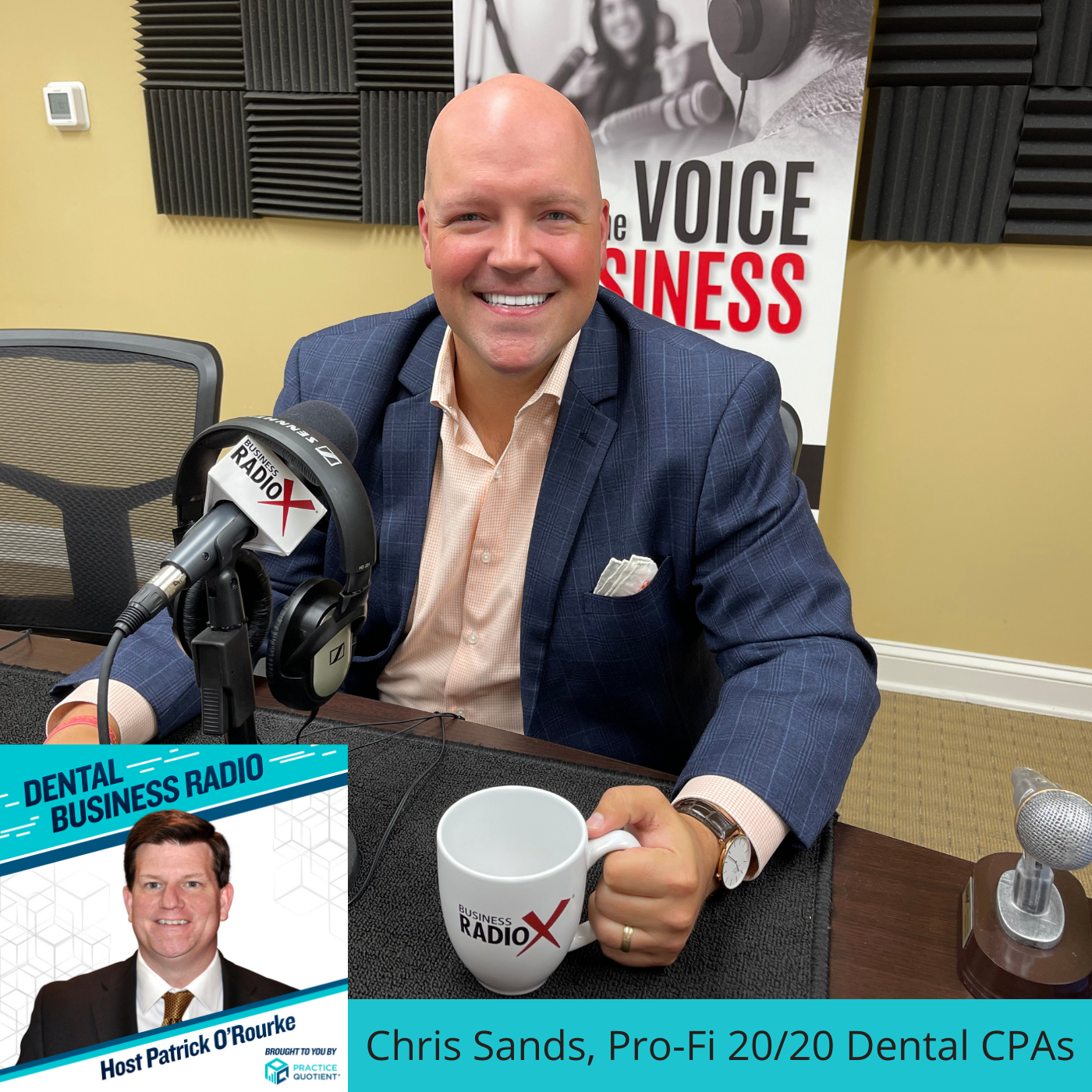
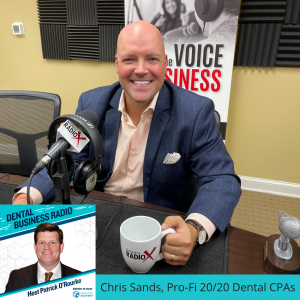
Chris Sands, Pro-Fi 20/20 Dental CPAs

July 8, 2021 by John Ray

Pro-Fi 20/20 Dental CPAs
Dental Business Radio
Chris Sands, Pro-Fi 20/20 Dental CPAs
Loading
00:00 /
RSS Feed
Share
Link
Embed

Download file

Pro-Fi 20/20 Dental CPAsChris Sands, Pro-Fi 20/20 Dental CPAs (Dental Business Radio, Episode 22)

Chris Sands, Co-Founder of Pro-Fi 20/20 Dental CPAs, joined host Patrick O’Rourke to discuss their model of a genuine advisory relationship between a practice and their CPA. Chris explained why his experience in a dental practice led to his starting Pro-Fi 20/20, why some dental practices are courting a regulatory nightmare by classifying employees as 1099 contractors, and much more. Dental Business Radio is underwritten and presented by Practice Quotient: PPO Negotiations & Analysis and produced by the North Fulton studio of Business RadioX®.

Special Note:  Here’s the resource Chris referenced during the show:  Download the Employee vs Contractor Resource

Pro-Fi 20/20 Dental CPAs

Pro-Fi 20/20, CPAs is a multi-disciplinary firm focused on helping growth-oriented dental business owners, from solo practitioners and partnerships to multi-location DSOs. Pro-Fi has an emphasis on profitability consulting to help doctors create more margin of time and money to positively impact their quality of life. They do this through the efficient and integrated management of practice finances with a single point of contact. Pro-Fi’s services include business consulting, comprehensive & proactive tax planning, accounting & bookkeeping, cash flow planning, business analytics, business valuations, bank loan assistance, and more.

Pro-Fi 20/20, CPAs was founded with dentists in mind. “Pro-Fi” is a play on words. Both a variation of the word “prophy” which means preventative cleaning, as well as short for Providing Financial. Their goal is to bring clarity, like the X-ray, to both companies’ and individuals’ financial pictures. It is said that hindsight is 20/20, but they want to bring the 20/20 clarity approach to being preventative, proactive, and protective in nature when it comes to managing finances.

Pro-Fi 20/20, CPAs was founded with the goal of providing financial clarity to dental businesses & their owners.

Company website | LinkedIn | Facebook | Instagram

Chris Sands, Co-Founder, Pro-Fi 20/20 Dental CPAs

Chris Sands, Co-Founder, Pro-Fi 20/20 Dental CPAs

Chris Sands focuses on counseling dental business owners as a result of his first-hand experience working in a dental practice. His goal is to help them grow and understand the importance of being fiscally responsible in their business.

Chris helps educate doctors about the importance of having accurate business accounting records and a proactive relationship with their CPA to develop tax strategies for both business and personal finances.

Chris is active in the dental industry where he regularly lectures at conferences, study clubs, professional association meetings, and workshops and publishes articles on business and finances in the dental industry.

“More than educating, it’s the empowering of doctors that gets me excited to go to work every day!  To own a business is no small task.  To own a business without any training of business or finances can be daunting.  Bringing doctors into the light when it comes to how things work such as cash flow, debt, interest, accounting metrics, taxes, risk management, etc. is extremely gratifying because I get to witness the lasting impact it has on the improvement of their business and themselves as better business owners and stewards of their finances.”

Connect with Chris on LinkedIn.

About Dental Business Radio

Patrick O'Rourke
Patrick O’Rourke, Host of “Dental Business Radio”

Dental Business Radio covers the business side of dentistry. Host Patrick O’Rourke and his guests cover industry trends, insights, success stories, and more in this wide-ranging show. The show’s guests include successful doctors across the spectrum of dental practice providers, as well as trusted advisors and noted industry participants. Dental Business Radio is underwritten and presented by Practice Quotient and produced by the North Fulton studio of Business RadioX®. The show can be found on all the major podcast apps and a complete show archive is here.


Practice Quotient

Dental Business Radio is sponsored by Practice Quotient. Practice Quotient, Inc. serves as a bridge between the payor and provider communities. Their clients include general dentist and dental specialty practices across the nation of all sizes, from completely fee-for-service-only to active network participation with every dental plan possible. They work with independent practices, emerging multi-practice entities, and various large ownership entities in the dental space. Their PPO negotiations and analysis projects evaluate the merits of the various in-network participation contract options specific to your Practice’s patient acquisition strategy. There is no one-size-fits-all solution.

Connect with Practice Quotient

Website | LinkedIn | Facebook | Twitter

Tagged With: Chris Sands, Dental Business Radio, Patrick O'Rourke, PPO Negotiations & Analysis, Practice Quotient, Pro-Fi 20/20 Dental CPAs

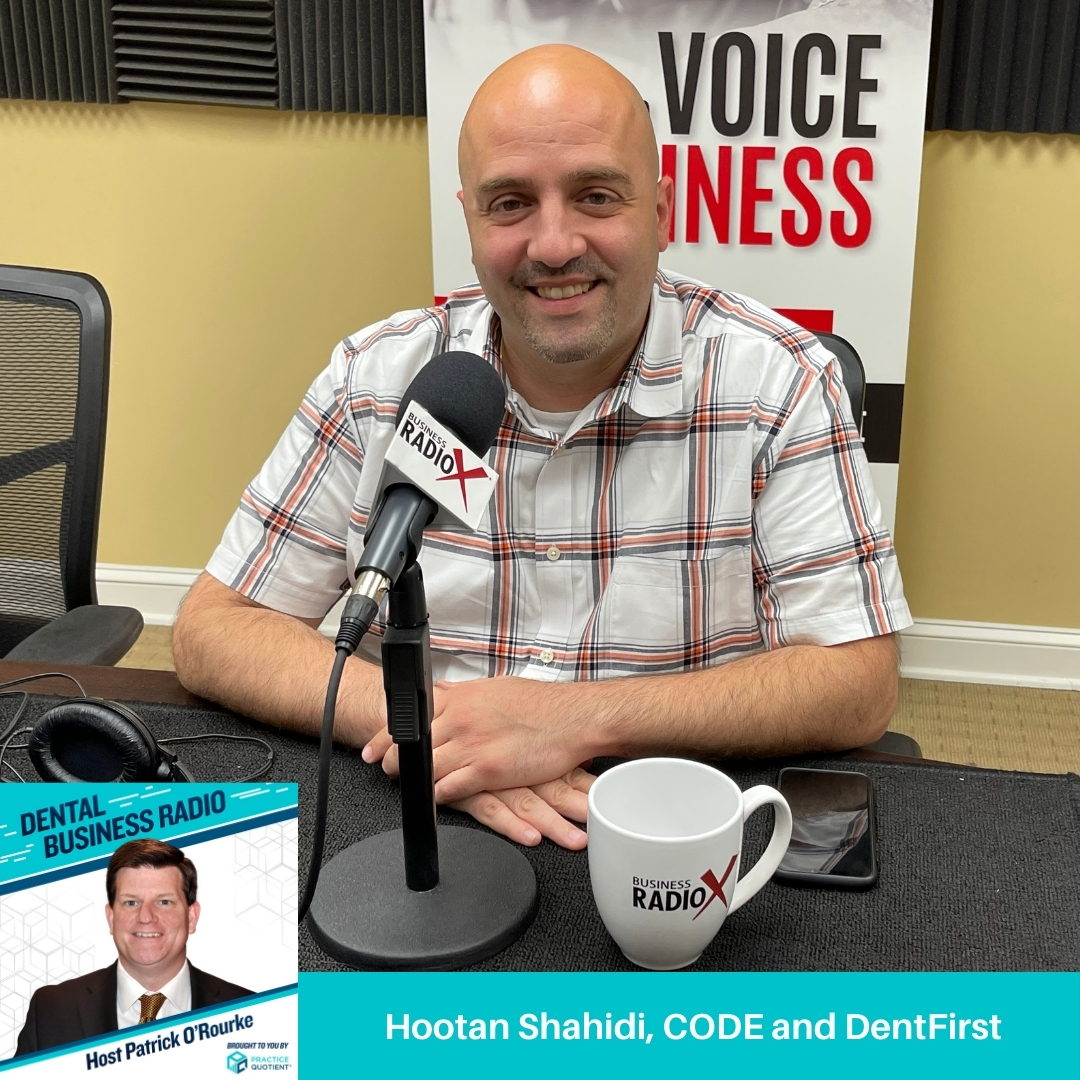
Hootan Shahidi, CODE and DentFirst

June 3, 2021 by John Ray

Hootan-Shahidi-DBR-Album
Dental Business Radio
Hootan Shahidi, CODE and DentFirst
Loading
00:00 /
RSS Feed
Share
Link
Embed

Download file

HootanandPatrickonDBR

Hootan Shahidi, CODE and DentFirst

Procedure coding, billing, and reimbursements are not a dentist’s favorite subjects, to say the least, yet successfully navigation of these issues is essential to the bottom-line health of the practice. Hootan Shahidi joins host Patrick O’Rourke on the show to discuss these issues and much more. Dental Business Radio is underwritten and presented by Practice Quotient: PPO Negotiations & Analysis and produced by the North Fulton studio of Business RadioX®.

CODE

Cross Over Dental Enterprises (CODE) specializes in billing medical insurance for dental professionals with unparalleled support and training. CODE’s work enables their dental practice clients to bill to medical insurance at a far greater rate than they are accustomed to.

DentFirst

DentFirst Dental Care has been proudly serving the Greater-Atlanta area for 35 years! What makes DentFirst so incredibly unique is their dedication to making dental care for metro-area residents easily accessible, affordable and dependable. Their patients are their number one priority! DentFirst does everything they can to accommodate their needs while ensuring that the care and customer service they receive is rivaled by none.

DentFirst has 13 convenient locations around Atlanta which are always welcoming new patients. They understand that our patients have busy schedules, but still value easy access to their healthcare providers which is why they offer extended evening hours during the week and Saturday appointments. In addition to this, they want our patients to be able to receive all of their treatment needs under one roof.

Hootan Shahidi, Owner, CODE and Director of Clinical Operations, DentFirst

Hootan-Shahlidi-CODE-DentFirstHootan Shahidi was an office manager and a dental consultant for over 10 years before starting CODE. He is well versed in all matters of the dental field, including medical and dental insurance billing.

Hootan is the owner of Cross Over Dental Enterprises (CODE), a medical billing company for dentists and dental specialists.

He is currently also the Director of Clinical Operations for DentFirst, a regional DSO in metro Atlanta.

Connect with Hootan on LinkedIn.

DBRAfterShow5.28.2021

About Dental Business Radio

Dental Business Radio covers the business side of dentistry. Host Patrick O’Rourke and his guests cover industry trends, insights, success stories, and more in this wide-ranging show.

The show’s guests include successful doctors across the spectrum of dental practice providers, as well as trusted advisors and noted industry participants. Dental Business Radio is underwritten and presented by Practice Quotient and produced by the North Fulton studio of Business RadioX®.

Practice Quotient

Dental Business Radio is sponsored by Practice Quotient. Practice Quotient, Inc. serves as a bridge between the payor and provider communities. Their clients include general dentist and dental specialty practices across the nation of all sizes, from completely fee-for-service-only to active network participation with every dental plan possible.

They work with independent practices, emerging multi-practice entities, and various large ownership entities in the dental space. Their PPO negotiations and analysis projects evaluate the merits of the various in-network participation contract options specific to your practice’s patient acquisition strategy. There is no one-size-fits-all solution.

Connect with Practice Quotient

Website | LinkedIn | Facebook | Twitter

Tagged With: CODE, Cross Over Dental Enterprises, dental practice billing, dental practices, DentFirst, Dentist, dentistry, medical billing, Patrick O'Rourke, PPO Negotiations & Analysis, PPO network contract analytics, Practice Quotient, procedure coding, reimbursement

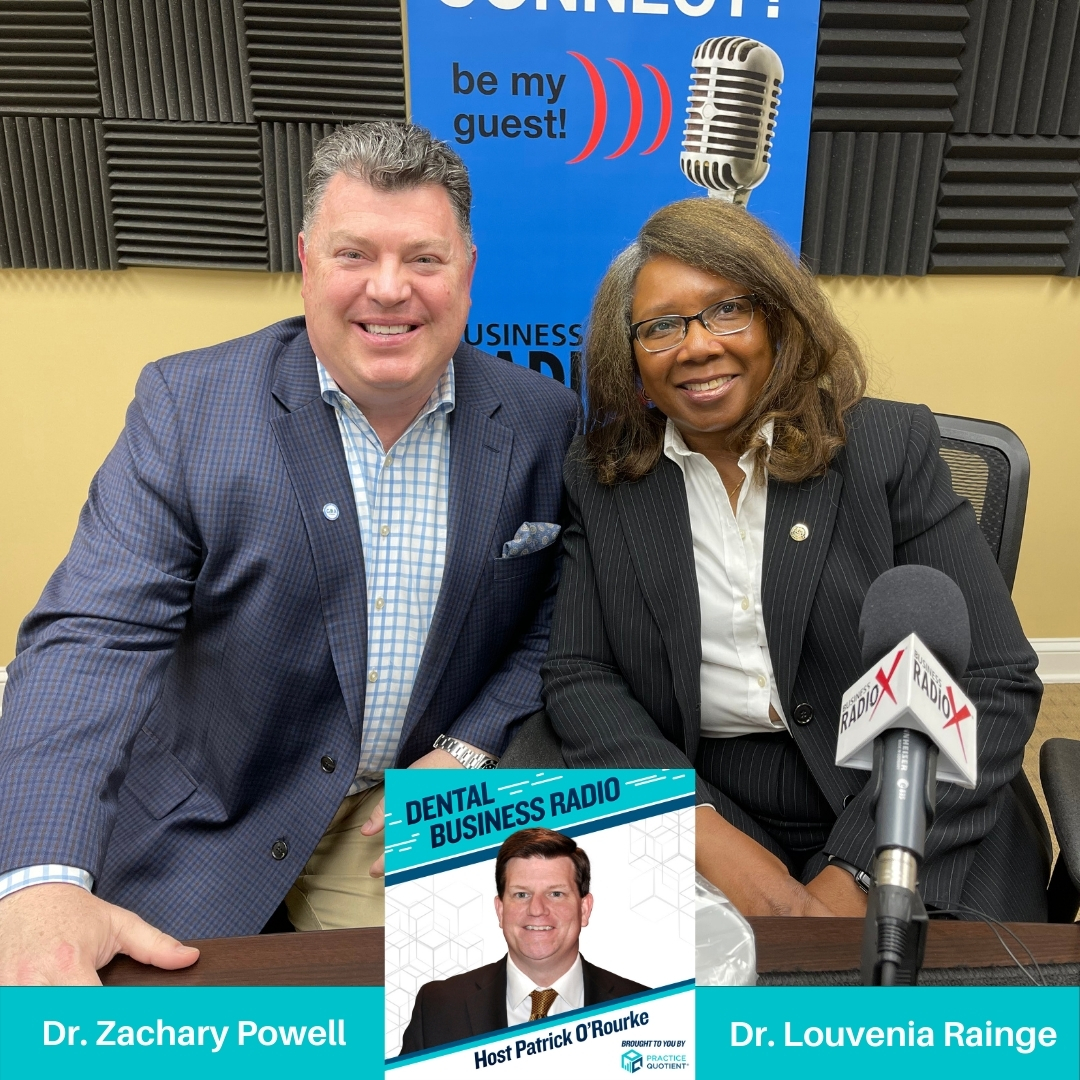
Georgia Dental Association: President Dr. Louvenia Annette Rainge, Rainge Family Dental, and President-Elect Dr. Zach Powell, Powell Dentistry Group

April 21, 2021 by John Ray

ZacharyPowellLouveniaRaingeDBRAlbum
Dental Business Radio
Georgia Dental Association: President Dr. Louvenia Annette Rainge, Rainge Family Dental, and President-Elect Dr. Zach Powell, Powell Dentistry Group
Loading
00:00 /
RSS Feed
Share
Link
Embed

Download file

Georgia-Dental-Association-Dental-Business-Radio

Georgia Dental Association: President Dr. Louvenia Annette Rainge, Rainge Family Dental, and President-Elect Dr. Zach Powell, Powell Dentistry Group (“Dental Business Radio” Episode 18)

Georgia Dental Association leaders joined host Patrick O’Rourke on this edition of “Dental Business Radio.” GDA President Dr. Louvenia Annette Rainge and President-Elect Dr. Zach Powell discussed the work of GDA during the pandemic, the organization’s advocacy work, encouraging a new generation of dentists in Middle and South Georgia, and much more. “Dental Business Radio” is underwritten and presented by Practice Quotient: PPO Negotiations & Analysis and produced by the North Fulton studio of Business RadioX®.

Special Note:  During the show, Drs. Rainge and Powell discussed the Dentists for Rural Areas Assistance Program administered by the State of Georgia. This program assists in paying any debt incurred for tuition, fees, and other expenses associated with the completion of degrees for dental practitioners who agree to practice full-time in an underserved, rural county in Georgia with a population of 50,000 or less. More information on that program can be found here.

Georgia Dental Association

The Georgia Dental Association is the premier professional organization of dentists in the state committed to improving oral health in Georgia and continuously promoting the highest standards of dentistry through education, advocacy, and professionalism.

Website | LinkedIn | Facebook | Twitter | Instagram

Rainge Family Dental PC

Rainge Family Dental PC is a privately owned dental practice that is family oriented. It provides dental care in a warm and friendly environment. Their motto is “We Care.”

Louvenia Rainge, Owner, Rainge Family Dental PC

GDA President Dr. Louvenia Annette Rainge

Dr. Louvenia Rainge is currently serving as the President of the Georgia Dental Association. She is a graduate of the Medical College of Georgia School of Dentistry. She also serves as an adjunct faculty member of the Dental College of Georgia at Augusta University. She is a general dentist and she has been practicing in Augusta for 31 years. She attended Georgia Southern University and was named Alumnus of the Year for the College of Science and Mathematics. She was also chosen as the Alumnus of the Year for the Dental College of Georgia.

Dr. Rainge is also a Fellow of the American College of Dentists, the International College of Dentists, and the Pierre Fauchard Academy. She is currently serving as the Section Chair of the Pierre Fauchard Academy.

Dr. Rainge is very active in the community and gives back through donations for back to school in the rural areas of the state. She also donates to needy families during Thanksgiving as well as providing free dental care through the Pampered Smiles Project for victims of domestic violence.

Powell Dentistry Group

The Powell Dentistry Group specializes in practice management, consultation, transitions, and acquisitions. Dr. Powell serves as the company’s CEO. PFD has owned and managed twelve dental offices in 20 years.

Currently it encompasses four practices throughout southeastern Georgia: Dentistry in Redfern, serving Saint Simons Island and Sea Island; Brunswick Smiles, serving Glynn and MacIntosh Counties including Brunswick and the Golden Isles; Blackshear Family Dentistry, serving Pierce, Wayne, and Ware Counties; and Alma Family Dentistry, serving Bacon and Douglas Counties.

Dr. Powell himself practices on Saint Simons Island in Redfern Village where his business offices are also headquartered. The Powell Dentistry Group employees 35 team members, including a CFO, COO, and five dentist associates.

Dr. Zachary Powell, DMD, Owner, Powell Dentistry Group

GDA President-Elect Dr. Zach Powell

Dr. Zachary Powell is a general dentist specializing in comprehensive, implant, and family dentistry. He is a Georgia native and graduated from both the University of Georgia and the Medical College of Georgia (now Augusta University). He has been in private practice for 23 years and owned multiple offices.

Dr. Powell is deeply dedicated to his profession and enjoys treating patients of all ages, from all walks of life, all over the great state of Georgia. Additionally, he works as a dental and business consultant throughout the state and has extensive experience in medical/dental office and real estate development. He possesses 25 years of leadership experience in both a professional and civic capacity.

His professional service experience includes positions held in local, state, and national levels and he currently serves as the President-Elect of the Georgia Dental Association. Dr. Powell is an honorary fellow with both the Pierre Fauchard Academy and the GDA and has been named to the University of Georgia’s Bulldog 100 twice. Dr. Powell serves on several boards including the Affinity Bank Dental Advisory Board. His commitment to ethics, patient advocacy, and grassroots organized dentistry are the hallmarks of his career.

Connect with Dr. Powell on LinkedIn and follow Powell Dentistry Group on Facebook.

About Dental Business Radio

Patrick O'Rourke
Patrick O’Rourke, Host of “Dental Business Radio”

“Dental Business Radio” covers the business side of dentistry. Host Patrick O’Rourke and his guests cover industry trends, insights, success stories, and more in this wide-ranging show. The show’s guests include successful doctors across the spectrum of dental practice providers, as well as trusted advisors and noted industry participants. “Dental Business Radio” is underwritten and presented by Practice Quotient and produced by the North Fulton studio of Business RadioX®. The show can be found on all the major podcast apps and a complete show archive is here.

Practice Quotient

“Dental Business Radio” is sponsored by Practice Quotient. Practice Quotient, Inc. serves as a bridge between the payor and provider communities. Their clients include general dentist and dental specialty practices across the nation of all sizes, from completely fee-for-service-only to active network participation with every dental plan possible. They work with independent practices, emerging multi-practice entities, and various large ownership entities in the dental space. Their PPO negotiations and analysis projects evaluate the merits of the various in-network participation contract options specific to your Practice’s patient acquisition strategy. There is no one-size-fits-all solution.

Connect with Practice Quotient

Website | LinkedIn | Facebook | Twitter

Tagged With: Dr. Louvenia Annette Rainge, Dr. Zach Powell, GDA, Georgia Dental Association, Patrick O'Rourke, Powell Dentristry Group, PPO Negotiations & Analysis, Practice Quotient, Rainge Family Dental PC

Dr. Richard Madow, The Madow Center for Dental Practice Success

April 5, 2021 by John Ray

Rich-Madow-DBR-Album
Dental Business Radio
Dr. Richard Madow, The Madow Center for Dental Practice Success
Loading
00:00 /
RSS Feed
Share
Link
Embed

Download file

Rich-Madow-DBR-Album

Dr. Richard Madow, The Madow Center for Dental Practice Success (“Dental Business Radio” Episode 17)

Dr. Richard Madow joined host Patrick O’Rourke to discuss his dental consulting practice, why dental practices should focus more on retaining existing patients instead of acquiring new ones, and much more. “Dental Business Radio” is underwritten and presented by Practice Quotient: PPO Negotiations & Analysis and produced by the North Fulton studio of Business RadioX®.

The Madow Center for Dental Practice Success

The Madow Center for Dental Practice Success works with practices from all across North America to help them increase revenues, provide better patient treatment, increase team communication, and make dentistry fun!

Dr. Rich Madow, Principal, The Madow Center for Dental Practice Success

In 1989, Dr. Richard Madow along with his brother Dr. David Madow, founded The Madow Center For Dental Practice Success with the goal of helping their fellow dentists achieve success and happiness in their practices. Having been named a “Leader In Dental Consulting” by Dentistry Today for many years running, his publications, articles and blogs are some of the most popular in the dental profession and have reached over 100,000 practices across the world!

Known for his hilarious and spontaneous style, Rich has lectured to standing room only crowds in practically every major city in The United States and Canada, teaching dentists and team members how to enjoy their careers, supercharge their practices, define and create their own personal success, increase profitability, and have more fun than ever before.

The Madow Center For Dental Practice Success has a unique approach to coaching – instead of modules and pre-written programs, each practice is individually guided to overcome their weaknesses and grow their strengths in order to obtain greater income levels and enjoy dentistry more. For more information, please check out www.madow.com.

On a personal level, Rich is a life-long and award-winning musician, having performed in many venues across North America. He is currently writing and recording new material, and his latest album, “Coming Through With Static,” can be found on Spotify, Apple Music, and all of the regular streaming sites. Among his other achievements, Rich’s book “Is Your Frog Boiling” was an amazon.com bestseller for two full days, and he has traveled to 56 countries.

Join The Madow Center in their Facebook group to hangout with like-minded Docs and team members.

About Dental Business Radio

“Dental Business Radio” covers the business side of dentistry. Host Patrick O’Rourke and his guests cover industry trends, insights, success stories, and more in this wide-ranging show. The show’s guests include successful doctors across the spectrum of dental practice providers, as well as trusted advisors and noted industry participants. “Dental Business Radio” is underwritten and presented by Practice Quotient and produced by the North Fulton studio of Business RadioX®.

Practice Quotient

“Dental Business Radio” is sponsored by Practice Quotient. Practice Quotient, Inc. serves as a bridge between the payor and provider communities. Their clients include general dentist and dental specialty practices across the nation of all sizes, from completely fee-for-service-only to active network participation with every dental plan possible. They work with independent practices, emerging multi-practice entities, and various large ownership entities in the dental space. Their PPO negotiations and analysis projects evaluate the merits of the various in-network participation contract options specific to your Practice’s patient acquisition strategy. There is no one-size-fits-all solution.
Connect with Practice Quotient

Website | LinkedIn | Facebook | Twitter

Tagged With: dental practice management, dental practices, Dr. Rich Madow, Dr. Richard Madow, Patrick O'Rourke, PPO Negotiations & Analysis, Practice Quotient, specialty dental practices, The Madow Center for Dental Practice Success

Josh Roland, OneDigital, and Stuart Oberman, Oberman Law Firm

March 22, 2021 by John Ray

StuartObermanJoshRolandDBRAlbum
Dental Business Radio
Josh Roland, OneDigital, and Stuart Oberman, Oberman Law Firm
Loading
00:00 /
RSS Feed
Share
Link
Embed

Download file

Josh-Roland-OneDigital-and-Stuart-Oberman-Oberman-Law-Firm

Josh Roland, OneDigital, and Stuart Oberman, Oberman Law Firm (“Dental Business Radio” Episode 16)

Josh Roland of OneDigital joined host Patrick O’Rourke to discuss trends in dental plans offered as an employee benefit, and the costs of those plans companies bear. Stuart Oberman of Oberman Law Firm also appeared on the show to discuss dental practice valuations, the importance of knowing your numbers, and much more. “Dental Business Radio” is underwritten and presented by Practice Quotient: PPO Negotiations & Analysis and produced by the North Fulton studio of Business RadioX®.

OneDigital

OneDigital is the nation’s leading strategic advisory firm focused on driving business growth for employers of all sizes. Combining people and technology, OneDigital offers employers a sophisticated combination of strategic benefit advisory services, analytics, compliance support, human resources management tools and comprehensive insurance offerings.

Headquartered in Atlanta, OneDigital’s more than 2,000 employee benefits and human resource strategists serve the needs of over 50,000 employers across the nation. OneDigital has been named to the Inc. 5000 List of America’s fastest-growing companies every year since 2007, one of only 12 companies to do so.

Currently listed as 18th on Business Insurance’s 2019 list of 100 Largest U.S. Brokers, OneDigital’s experience offers a fresh thinking and strategic perspective that will improve all aspects of plan design and performance.

Josh Roland, Principal, OneDigital

Josh Roland, OneDigital

Josh Roland is a principal at OneDigital, a national team of experienced, local employee benefits advisors who create greater value for employers and inspire individuals to become more engaged health care consumers. Josh also serves the role as the Georgia Practice Leader for Large Group Ancillary Benefits consulting.

Josh has over 15 years of experience in the insurance industry. Prior to joining OneDigital in 2017, he served as partner and ancillary benefits practice leader of a regional insurance brokerage, in addition to a wealth of expertise and experience in sales and account management.

Josh received a bachelor’s degree in business administration and finance from the University of Georgia. He is licensed to sell all group life and health in Alabama, Florida, Georgia, North Carolina, South Carolina, and Tennessee.

Connect with Josh on LinkedIn.

Oberman Law Firm

The Oberman Law Firm is dedicated to making positive, lasting change in our communities. We understand that the combination of community leadership, volunteerism and pro bono can create a significant ripple effect in the communities in which we work and live. Together, these elements allow us to produce positive changes in our communities.

Stuart Oberman, Founder and President, Oberman Law Firm

Stuart Oberman
Stuart Oberman, Oberman Law Firm

Stuart Oberman is the founder and President of Oberman Law Firm. Mr. Oberman graduated from Urbana University and received his law degree from John Marshall Law School. Mr. Oberman has been practicing law for over 25 years, and before going into private practice, Mr. Oberman was in-house counsel for a Fortune 500 Company. Mr. Oberman is widely regarded as the go-to attorney in the area of Dental Law, which includes DSO formation, corporate business structures, mergers and acquisitions, regulatory compliance, advertising regulations, HIPAA, Compliance, and employment law regulations that affect dental practices.

In addition, Mr. Oberman’s expertise in the health care industry includes advising clients in the complex regulatory landscape as it relates to telehealth and telemedicine, including compliance of corporate structures, third-party reimbursement, contract negotiations, technology, health care fraud and abuse law (Anti-Kickback Statute and the State Law), professional liability risk management, federal and state regulations.

As the long-term care industry evolves, Mr. Oberman has the knowledge and experience to guide clients in the long-term care sector with respect to corporate and regulatory matters, assisted living facilities, continuing care retirement communities (CCRCs). In addition, Mr. Oberman’s practice also focuses on health care facility acquisitions and other changes of ownership, as well as related licensure and Medicare/Medicaid certification matters, CCRC registrations, long-term care/skilled nursing facility management, operating agreements, assisted living licensure matters, and health care joint ventures.

In addition to his expertise in the health care industry, Mr. Oberman has a nationwide practice that focuses on all facets of contractual disputes, including corporate governance, fiduciary duty, trade secrets, unfair competition, covenants not to compete, trademark and copyright infringement, fraud, and deceptive trade practices, and other business-related matters. Mr. Oberman also represents clients throughout the United States in a wide range of practice areas, including mergers & acquisitions, partnership agreements, commercial real estate, entity formation, employment law, commercial leasing, intellectual property, and HIPAA/OSHA compliance.

Mr. Oberman is a national lecturer and has published articles in the U.S. and Canada. In addition, Mr. Oberman had been the recipient of the Martindale-Hubbell Client Distinction Award, which is based on client review ratings in the categories of communications ability, responsiveness, and quality of service. Less than 1% of the 900,000+ attorneys listed on martindale.com and lawyers.com have been accorded this honor of distinction.

Connect with Stuart Oberman on LinkedIn.

About Dental Business Radio

Patrick O’Rourke, Host, “Dental Business Radio”

“Dental Business Radio” covers the business side of dentistry. Host Patrick O’Rourke and his guests cover industry trends, insights, success stories, and more in this wide-ranging show. The show’s guests will include successful doctors across the spectrum of dental practice providers, as well as trusted advisors and noted industry participants. “Dental Business Radio” is underwritten and presented by Practice Quotient and produced by the North Fulton studio of Business RadioX®.


Practice Quotient

“Dental Business Radio” is sponsored by Practice Quotient. Practice Quotient, Inc. serves as a bridge between the payor and provider communities. Their clients include general dentist and dental specialty practices across the nation of all sizes, from completely fee-for-service-only to active network participation with every dental plan possible. They work with independent practices, emerging multi-practice entities, and various large ownership entities in the dental space. Their PPO negotiations and analysis projects evaluate the merits of the various in-network participation contract options specific to your Practice’s patient acquisition strategy. There is no one-size-fits-all solution.
Connect with Practice Quotient:

Website | LinkedIn | Facebook | Twitter

Tagged With: dental law, DSO, dso formation, Employee Benefit Consulting, employee benefits, healthcare law, Josh Roland, Oberman Law Firm, OneDigital, Patrick O'Rourke, PPO Negotiations & Analysis, Practice Quotient, Stuart Oberman

Dr. Nathan Kupperman, NAK Dental Group

March 8, 2021 by John Ray

Nathan-Kupperman-DBRAlbum
Dental Business Radio
Dr. Nathan Kupperman, NAK Dental Group
Loading
00:00 /
RSS Feed
Share
Link
Embed

Download file

Nathan-Kupperman-DBRAlbum

Dr. Nathan Kupperman, NAK Dental Group (“Dental Business Radio” Episode 15)

In a conversation with host Patrick O’Rourke, Dr. Nathan Kupperman of NAK Dental Group discusses the growth of his multi-office dental provider organization, why smaller cities and towns often offer better opportunities, and why he bought a coffee truck to help with his marketing. (Yes, you read that right.) “Dental Business Radio” is underwritten and presented by Practice Quotient: PPO Negotiations & Analysis and produced by the North Fulton studio of Business RadioX®.

NAK Dental Group

NAK Dental Group is a Dental Provider Organization founded in 2018 by Dr. Nathan Kupperman. NAK Dental currently supports 5 dental locations across Northwest Florida. We offer a variety of management services from their administrative headquarters in Tallahassee, Florida, in addition to Affiliation and Partner Ownership opportunities for Dentists across the United States.

Dr. Nathan Kupperman, Founder and CEO, NAK Dental Group

Dr. Nathan Kupperman decided to expand the reach and services of NAK Dental in order to fulfill his purpose of helping transition ownership of dental practices. This is accomplished by providing Dentists wanting to transition out of their ownership stakes with flexibility and options to do so, and by providing long-term associate positions and equity Partner opportunities to Doctors joining the NAK platform.

Connect with Dr. Kupperman on LinkedIn and follow NAK Dental Group on Facebook.

About Dental Business Radio

“Dental Business Radio” covers the business side of dentistry. Host Patrick O’Rourke and his guests cover industry trends, insights, success stories, and much more in this wide-ranging show. The show’s guests include successful doctors across the spectrum of dental practice providers, as well as trusted advisors and recognized industry participants. “Dental Business Radio” is underwritten and presented by Practice Quotient and produced by John Ray and the North Fulton studio of Business RadioX®.

Practice Quotient

“Dental Business Radio” is sponsored by Practice Quotient. Practice Quotient, Inc. serves as a bridge between the payor and provider communities. Their clients include general dentist and dental specialty practices across the nation of all sizes, from completely fee-for-service-only to active network participation with every dental plan possible. They work with independent practices, emerging multi-practice entities, and various large ownership entities in the dental space. Their PPO negotiations and analysis projects evaluate the merits of the various in-network participation contract options specific to your Practice’s patient acquisition strategy. There is no one-size-fits-all solution.
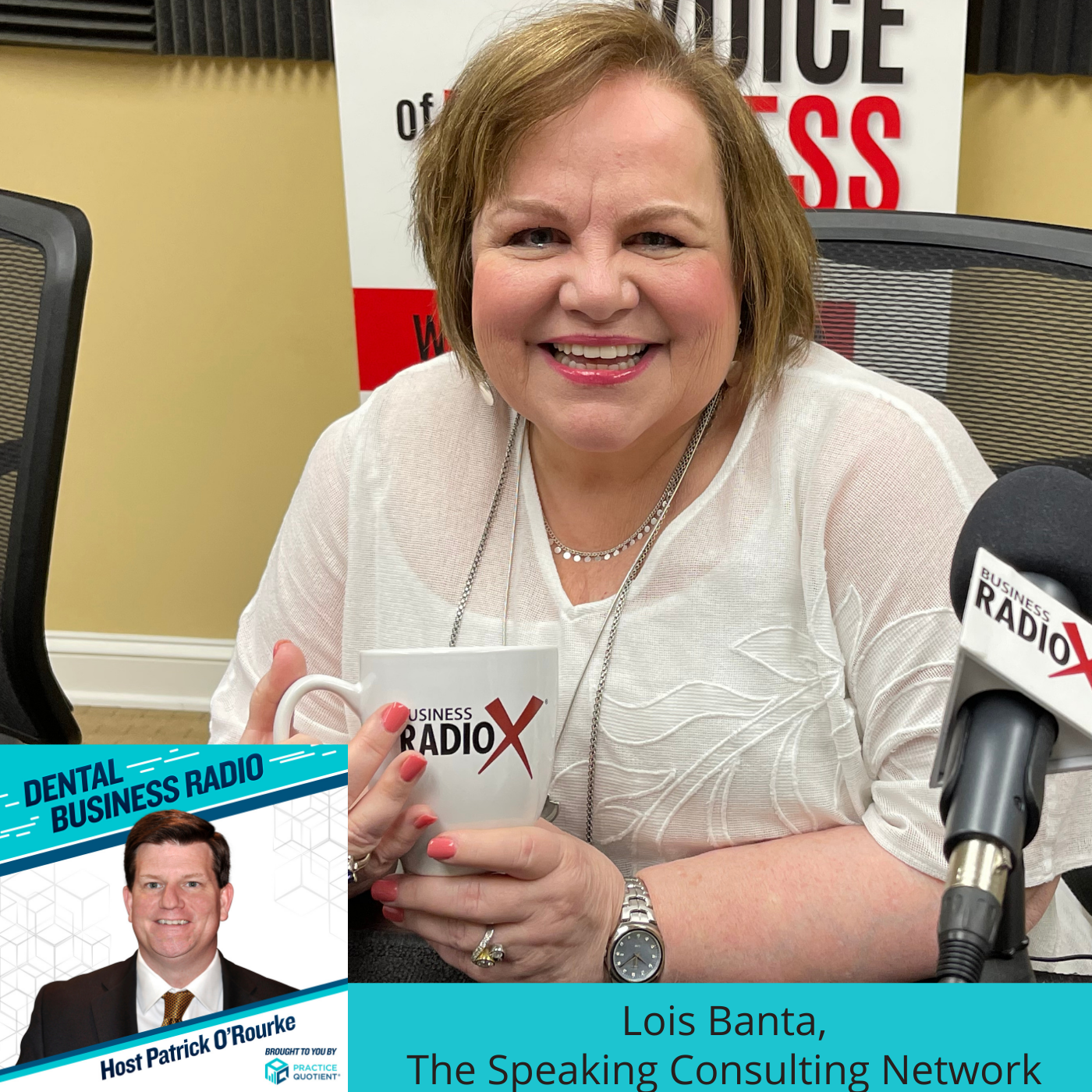
Connect with Practice Quotient:

Website

LinkedIn

Facebook

Twitter

Tagged With: dental practices, dental provider organization, Dr. Nathan Kupperman, NAK Dental Group, northwest florida, Patrick O'Rourke, PPO Negotiations & Analysis, Practice Quotient, Tallahassee

Amol Nirgudkar, Patient Prism

February 22, 2021 by John Ray

Patient Prism
Dental Business Radio
Amol Nirgudkar, Patient Prism
Loading
00:00 /
RSS Feed
Share
Link
Embed

Download file

Amol-Nirgudkar-Patient-Prism

Amol Nirgudkar, Patient Prism (“Dental Business Radio,” Episode 14)

Amol Nirgudkar, CEO of Patient Prism, joins host Patrick O’Rourke to discuss how his firm uses AI to train and inspire patient-facing practice personnel, reengage lost sales opportunities for their dental practice clients, increase their revenue and bottom lines, and much more. “Dental Business Radio” is underwritten and presented by Practice Quotient: PPO Negotiations & Analysis and produced by the North Fulton studio of Business RadioX®.

Patient Prism

Patient Prism’s software shows which marketing investments generate the highest-value phone calls from potential new patients. The use of AI technology enables busy practices to convert more of these callers into patients. Dental offices can increase their revenue growth without necessarily spending more on marketing. Dentists and practice managers can do so without spending hours listening to recordings of entire phone calls.

Patient Prism holds five utility patents issued by the USPTO and is the only call tracking company that leverages artificial intelligence and human call coaching validation to deliver patients directly to dental practices.

Follow Patient Prism on LinkedIn and Facebook.

Amol Nirgudkar, CEO, Patient Prism

Amol-NirdudkarAmol Nirgudkar helps dentists grow their practices and reach their goals.

He is in an unusual position to offer practical insights. As a certified public accountant, business consultant, author, entrepreneur, and former owner of several dental practices, he has 20 years of experience working with dental practices, both large and small.

Through the three companies he founded, Amol has served more than 1,000 dentists across the United States. Through his work, Amol saw firsthand a growth challenge that all dental practices face. No matter how successfully they may market their practice, almost 50% of new patient calls don’t end in a booked appointment.

To help solve that problem, he founded Patient Prism in 2015. The Patient Prism service uses both A.I. and American call coaches to evaluate the way dental offices handle phone calls, identify the callers that didn’t schedule, and teach the team how to win them back – all within 30 minutes of the failed call.

Amol co-invented the patented technologies used in Patient Prism. One eliminates the need to listen to recorded phone calls by providing the information visually. The other technology details specific words spoken by the patient during the call so dentists and managers know which services callers are requesting and the revenue opportunity associated with each call. Amol continues to PatandAmolonDBRwork with artificial intelligence and machine learning to empower dental teams to deliver a better patient experience and build even more successful practices.

Amol has also written several articles and e-books, and published a paperback book called Profitable Niches in General Dentistry (2014).

Connect with Amol on LinkedIn.

Questions/Topics Discussed Include:

  • How is AI affecting our life and why it matters
  • How Patient Prism uses AI to deliver new patients to dental offices
  • Why speed matters
  • What an average practice should expect when signing up with Patient Prism
  • Additional insights Patient Prism provides to dental offices besides scheduling percentage
  • The best way to learn more and sign up for Patient Prism
TRANSCRIPT

Intro: [00:00:03] Live from the Business RadioX Studio in Atlanta, it’s time for Dental Business Radio. Brought to you by Practice Quotient. Practice Quotient bridges the gap between the provider and payer communities. Now, here’s your host, Patrick O’Rourke.

Patrick O’Rourke: [00:00:20] Hi there, friends of Dental Business Radio. This is your host, Patrick O’Rourke, on a sunny day with my friend, Amol. Amol Nirgudkar.

Amol Nirgudkar: [00:00:32] You got it almost.

Patrick O’Rourke: [00:00:34] Well, we’ll try again later.

Amol Nirgudkar: [00:00:35] Yes, sir.

Patrick O’Rourke: [00:00:36] So, Amol, my friend that I met originally down in Tampa on Harbor Island one day for lunch, who is a generous and smart individual, a numbers guy with a CPA background. He’s also an author and the founder of Patient Prism. Patient Prism holds many different patents that we may or may not get into, I don’t know. But when somebody asks you on an elevator and they say, “What is Patient Prism?” What do you tell them?

Amol Nirgudkar: [00:01:07] Well, if it’s a short elevator ride then I’ll tell them, we taught a machine how to understand the nuance of dental conversations, so that we could understand what prevents a new patient from moving forward to schedule an appointment on the phone. And we help dental practices basically improve their sales ability to convert more of those leads into scheduled appointments. That’s a short elevator ride, depending what floor I’m coming from.

Patrick O’Rourke: [00:01:37] All right. So, now, we’re stuck on an elevator, our metaphorical elevator, and I go, “That is interesting. Tell me a little bit more.”

Amol Nirgudkar: [00:01:44] Yeah. I mean, what’s happening in dentistry is this, right? Over the last 10 to 15 years, dentistry has shifted from how dentists acquire new patients. In the past, in the 70s and 80s, even early 90s, patients used to show up from some referral source. There’s not a lot of advertising and marketing going on. In clear choice. dental implant centers came about in the early 2000s and they really changed the game, where, now, you are starting to advertise actively or became a B2C model where you’re actually actively advertising to get new patients.

Amol Nirgudkar: [00:02:20] Now, when you’re actively advertising to get new patients, one of the fundamental things that needs to happen, you get the phone to ring. You have to make sure that every time a phone rings, number one, you answer it – super important. You’re open for business.

Patrick O’Rourke: [00:02:37] Answering phone is important.

Amol Nirgudkar: [00:02:40] Answering the phone is important.

Patrick O’Rourke: [00:02:41] Okay. Hold on. I’m writing this down.

Amol Nirgudkar: [00:02:42] That’s right. Answer the damn phone. Number two, you’ve spent money driving that lead in, spending Google, Facebook, whatever, what not. You want to make sure that lead, that new patient – we call it prospect. They’re not a customer yet. They are prospect.

Patrick O’Rourke: [00:02:57] Sure. They’re thinking about it.

Amol Nirgudkar: [00:02:58] And they’re a pretty hot lead because they’ve called you. They’re not a warm lead or a cold lead. They’re a hot lead, because they called you. You want to make sure that patient feels comfortable booking that appointment on that first attempt. What was happening across dentistry since the 70s is that, that booking rate was around 60, 65 percent. So, we were missing so much of the opportunities right there on the phone because what happened in dentistry – we’re still in the elevator, probably in the 15th floor – was that, we hired people to work in dentistry, especially at the front office who are answering phones, to be order takers. We didn’t tell them to be salespeople. And sales, somehow, is considered a bad word. But it’s not as long as you’re moving people from a bad spot to a good spot. In most instances in dentistry, what we’re doing in dentistry is we’re taking patients with bad health, a suboptimal health and moving them to good health.

Amol Nirgudkar: [00:03:57] So, we have to really train our people to be salespeople at the front. And that is why Patient Prism was developed, is to enable better sales conversations between prospects that are coming from marketing – I mean, from all these different sources – and getting them scheduled by leveraging AI. AI, you know, is a buzzword these days.

Patrick O’Rourke: [00:04:20] Artificial intelligence is what that stands for, right?

Amol Nirgudkar: [00:04:24] It is. And so, we use this subset of our AI called Natural Language Processing, where we took spoken words and we analyze them really quickly. And if the patient decided not to move forward in that journey, on that phone call to schedule an appointment with you, we analyze that conversation really quickly and notify the office within 20 minutes now or 20 or 25 minutes saying that, “Hey, this is what went wrong.” You didn’t have to actually listen to the whole conversation. “This is what went wrong, you didn’t offer them financing.” Or, “You didn’t discuss the insurance options properly.” Or, “You diagnosed what the patient needed when you couldn’t have diagnosed it in the first place.” And so, here’s the information 20 minutes after a patient decides to hang up with you.

Amol Nirgudkar: [00:05:07] And, now, you have that second chance to make that first impression. You call the patient back and saying, “Sir, you called us earlier, you need a dental implant. You know what? I understand you had no insurance and we figured out to give you some important information about financing options we have available. So, come on back in. We’ll get you on our schedule. We have an appointment available for 9:30 tomorrow and we’ll get you free examine X-rays. Come on in. We love new patients. Our doctor is one of the best in the country, has placed over 5,000 implants.” Now, you’ve turned the conversation around. You’ve given that patient the ability to come back in your office. And what we’ve seen with Patient Prism is 25 percent of those patients actually come back on the second try.

Amol Nirgudkar: [00:05:53] So, Patient Prism basically leverages AI to understand the problem that occurred on the phone that prevented the patient from moving forward. Once you understand the problem, we communicate that problem within 20 minutes to the dental office. So, they can actually have that second chance of getting the patient back. And sometimes, you know, it’s one or two patients extra per month could make or break your office. Or it could make your office, right? I mean, you know after a certain point, you can make a big impact.

Patrick O’Rourke: [00:06:23] And it’s about the right kind of patients too. You know, anybody who’s a student of sales – which I think, you know, I would consider myself to be a student – follow up in sales is key. So, you have to follow up, follow up, follow up. One of the things that, frankly, my organization, I don’t have any sales people so we don’t do any follow up and we probably missed out on a lot of stuff. But we’re a little bit different type of business, we’re referral based. It’s 100 percent referral based. So, you’re only calling us if somebody said certain nice things.

Patrick O’Rourke: [00:07:02] And when you state, “Hey, this is sales and prospects,” I get that. But, to me, what you just described is an education process. And it’s a training process of helping the front lines or the face of these dental practices be more welcoming, use active listening techniques, and clearing the pathway making people comfortable and educating them, assuming that they are the best solution or they have the best solution, kind of like the implants we just described for that specific patient. Versus, being, “We don’t take Blue Cross.”

Patrick O’Rourke: [00:07:45] And then, you’re doing it – and I’m going to try to get into the numbers because I was kind of doing them in my head – in a way that’s quantifiable. And the dentist/ owners are not having to listen to phone calls or train people. It’s all done. It’s proven. And so, if, let’s say, we’re converting on a 65 percent ratio, that means we’re not converting on 35 percent. And so, you’re then able to get one quarter of that 35 percent back. I think that that’s really important to track, because in my conversations, still to this day, it seems to me that what’s tracked is how many new patients am I getting a month. Does that make sense?

Amol Nirgudkar: [00:08:36] And, you know, it’s easy to say, “I need to spend more money on marketing to drive new patients.” But sometimes, let’s understand, we might be getting enough leads in our offices. We just need to convert them. So, why spend more? The easy button to press is, let’s spend more money on marketing.

Patrick O’Rourke: [00:08:57] Well, I can tell you that outside of the larger groups, spending money on marketing is not something that’s high on the priority list of most dental practices and specialty practices. Let’s include in that category, you know, sometimes you talk to folks and you’re like, “Well, how much money do you spend on marketing?” They’re like, “Marketing? Nah. We did some mailers, like, back in 1994. It didn’t work.”

Amol Nirgudkar: [00:09:22] You know, as professional management comes into dental practices and private equity comes into DSOs, one of the things – and they’re super analytical, right? – that we talk about in our business, as well as any business you talk about, is, what does it cost to acquire a customer? It’s called a CAC, acquisition cost.

Patrick O’Rourke: [00:09:47] Client acquisition cost.

Amol Nirgudkar: [00:09:47] So, client acquisition cost or customer acquisition cost, whatever that is. And we have to really understand that concept really well if you want to run the practice of dentistry as a business – as we’re in Business Radio right now – we want to understand what does it cost to acquire a customer.

Amol Nirgudkar: [00:10:04] Now, you’re spending, let’s say, $2,000 in a Google Adwords campaign, let’s say, to attract Invisalign patients, and you want to do Invisalign. And, let’s say, from that Google AdWords, ten people actually call us. Now, if ten people call us and we only schedule five, that’s $400 cost of acquisition. But if we schedule all ten, that’s only $200 cost of acquisition. And that’s what Patient Prism really helps you understand and then compress that cost. Because if your $2,000 can get you, you know, five patients worth $4,000 a piece, that’s $20,000. Or if we can get you eight patients, that’s $32,000. That’s what we see the lift happen, right? Because we’re already spending the money to drive the leads in. We’re spending money upwards of a $100 a lead sometimes, some of them are $200 a lead – Google is expensive, Adwords are expensive – to drive those type of high value customers into your office.

Amol Nirgudkar: [00:11:07] And somehow our receptionist says, “By the way, we have nothing available for the next three weeks,” and the patient goes away. Or the receptionist says, “You know, it’s really going to cost you $5,000. But you might need a root canal before that, it’s going to cost you six grand.” And we’re driving people away from the offices to come in. Because at the end of the day – Patrick, you’ve been in dentistry for a very long time. And we’re not dentists. Both of us are not – but one thing we know for sure, nobody knows what you need inside your mouth unless you open your mouth and the dentist looks at it with their loops or whatever it is and examines the teeth. You can’t really diagnose that over the phone and tell the patient, “Oh, you might need this, that’s going to cost you a $1,000.” There’s two barriers – main barriers –

Patrick O’Rourke: [00:11:52] Does that happen a lot?

Amol Nirgudkar: [00:11:53] It happens a lot. It happens a lot. People start talking about, “Hey, what’s it going to cost me?” “Oh, well, the crown is $1,200 but the build up is going to be another $300. And then, we don’t know whether you might need a root canal, that can be another $1,000.” So, the patients here are looking at some special thinking that, you know, it’s maybe about a $1,000 and the insurance is going to cover whatever percentages is. And, now, they have this idea that, “Oh, my God. I have to spend another $1,500 on this?” You have no idea. How do you know the patient might need a build up or a root canal? But, somehow, our folks, they create all these barriers. Barriers for patients to make an appointment.

Patrick O’Rourke: [00:12:32] Right. And they think they’re trying to be helpful, probably, right? So, it’s sort of like you just said, we’re business folks. I’m from the insurance business, but I know more about – you know, I started in dental and the Lord knows this is where I’m still making my hay. So, I know more about it than I care to brag about. I know what an apicoectomy is and I know how to spell it. But can I do it? Now, sometimes, because people know that I do something in dentistry but they don’t know exactly what, then, they’re like, “Hey, Pat. Blah, blah, blah.” I’m like, “Look, I’m not a dentist. I don’t know. Don’t open your mouth over your dragon breath.”

Patrick O’Rourke: [00:13:13] And even though I probably do know more than, you know, most folks, well, I would never try to get out of my [indiscernible] much to diagnose. And it’s the same thing for the front desk, they know a lot about it. But you’re still not licensed to diagnose, right?

Amol Nirgudkar: [00:13:30] And it’s not physically possible to diagnose unless somebody opened their mouth and you’ve looked inside. Because somebody thinks they need a crown. How do you know they need a crown? And then, you’re quoting prices on that. And then, you’re not even – then on top of that, so there’s two barriers that patients face when they call a dental office. And nobody likes to call the dental office, we know that, right? There’s 40 percent of people actually only go to the dentist, 60 percent of America doesn’t even go to a dentist.

Patrick O’Rourke: [00:13:59] I like going to the dentist.

Amol Nirgudkar: [00:14:00] So, somebody who calls a dentist, they have overcome significant inertia to actually call the dental office. And they have called us. Now, they have two concerns, “How much is it going to hurt me physically?” Because there’s fear of dentistry, how much pain and all that stuff. And, “How much is it going to cost me?” So, fear and cost are two big barriers. And then, the third barrier also is that, “Have I called the right place? Are these the good people? Are they competent?”

Amol Nirgudkar: [00:14:30] And all we’ve got to do on the phone is, make them feel safe, make them feel that they have called the right place, make them feel that this is going to be an affordable treatment for them, and make them feel that it’s going to improve their life. And if we can communicate that, we don’t need to communicate a lot more. We have to actively listen, empathy. That’s just a couple of things we do at Patient Prism, we analyze things like active listening. Did you ask about discomfort? Did you mention financing? Did you discuss insurance options correctly? What if somebody was out of network? We look at that. How do you have the conversations around that?

Patrick O’Rourke: [00:15:05] So, have you ever seen the study? There’s multiple of them, actually, that said the number one reason why people don’t go to the dentist is because they don’t have dental insurance. Number two reason is, because they don’t know how much it’s going to cost, whether they have dental insurance or not. Because dental insurance is kind of a funky financial instrument, if you will.

Amol Nirgudkar: [00:15:26] Right. It is.

Patrick O’Rourke: [00:15:26] Right. Funky is a nice word.

Amol Nirgudkar: [00:15:28] But you’re right. Absolutely. And that all derives from the idea, how much is it going to cost? Can I afford it? And how much is it going to hurt me? And it’s simple things. It’s the soft skills. People do business with people, especially with doctors. And, obviously, we’re in health care. First and foremost, you’ve got to feel safe, that you’ve called the right play.

Patrick O’Rourke: [00:15:51] Especially these days.

Amol Nirgudkar: [00:15:52] Obviously. More so in COVID environment than ever before. But all of us desire safety. Any place we are in, we’re always looking for safety. And safety is a big part of what we need to impart to a prospective patient that, “Yes, you’re safe. You’ve called the right place. We care. We have empathy. We can make this affordable. It can change your life. We have an appointment available. You’re special.” So, those are some of the things.

Amol Nirgudkar: [00:16:24] Right now we’re so busy, right? Most dental offices you’ve been to, the front is super busy. They’re doing all sorts of things. They’re checking out patients. They’re doing insurance verifications. And sometimes they’re cleaning things. They’re doing all sorts of things. And sometimes what happens in that busy environment, we forget to talk. We forget to have time for the most important function, talking to our customer or our client, our patient. And if we forget that, no matter whether it’s an existing patient or new patient, you know, people don’t want to do business with you if you appear to be too busy and not caring about their concerns. Because people care what they care about. And you’ve got to care about what the patient’s care about. Your stuff can wait. Right. You’ve got to do stuff. I understand you got to do paperwork, you got to call the companies, all that stuff. That’s great. But the most important person in that dental office is the patient. And we’ve got to respect that, whether it’s on the phone, whether it’s in person, whether it’s anywhere else. Because that is what drives revenue, it’s the patient.

Patrick O’Rourke: [00:17:26] Right. It’s in my head. I like analogies and to use other things, it’s like walking into Macy’s or Nordstrom’s and you’re like, “I’m trying to buy a suit and, you know, I like to have help.” But when I buy a suit, I like to wear nice stuff. And then, somebody is like, “I’m too busy. I’m too busy folding the clothes over here. I can’t help you.” And I’m like, “Well, fine. I’ll find somebody who can help me then.”

Amol Nirgudkar: [00:17:50] That’s a great analogy. Actually, I’ve had situations, just two weeks ago, a patient called one of her clients – and sometimes we get these crazy alerts because if things go crazy wrong – and the patient called at 4:55 p.m. Eastern Time and said, “You know, I’ve been thinking about this for a long time. I really need a full mouth extraction and get those implants aborted dentures.” Pretty penny, $30,000 to 50,000 depending on where you go to. And at 4:55, the person at the front sounded very hurried and like, “Sir, we’re about to close in five minutes. Could you call back tomorrow?”

Amol Nirgudkar: [00:18:37] So, how do you do that? Like, how do you do that? And that call got elevated to my attention because, you know, it’s so egregious, right? You’re literally telling a patient who could potentially spend $40,000 in your office telling them, “Could you call me tomorrow because it’s 4:55?”

Patrick O’Rourke: [00:18:55] So, that brings an alarm on your phone?

Amol Nirgudkar: [00:18:59] It does brings the alarm on our side, we call it escalation call. Or somebody is really rude or racist or something like that, it escalates that because our AI listens too. Because we don’t think every human being needs to be treated with the utmost kindness and respect and compassion, regardless of what they sound like, regardless of how much money you think they have, or whatever their circumstance might be. But this was egregious because, obviously, $40,000 opportunity, 4:55, it’s not even 5:00. Even if it was 5:00 –

Patrick O’Rourke: [00:19:28] Is this almost like a drowning kid – though metaphorically, you know, not that serious – but this is where you go and save this drowning prospect that’s lost. It’s about to wash away with the tide. And you’re going to go in there and pull it right out. And this makes Patient Prism the hero that Patient Prism is.

Amol Nirgudkar: [00:19:49] And we got back. We sent that to the CEO of this group. They called the patient the next morning, offered them a free set of a CT scan and a free whitening kit. They just come in. And, you know, I’ve had situations where we have recommended to our DSO customers and dental customers that, “You know, if you have a case like that, send a Uber. Let them in. Let them in.” You know, there’s Uber Corporate, as long as you can figure out the insurance stuff.

Amol Nirgudkar: [00:20:21] We’ve got to figure out – and telling them, “We’re closed. Call tomorrow,” that’s not acceptable. And we had to have a conversation with the receptionist. I’m like, your number one job in dentistry is to improve people’s health. This procedure, yes, it would make us a lot of money. But at the end of the day, you’ve got to think about that patient has finally taken the step to call a dental office to get all their teeth removed and put nice shiny pearly whites in them. So, not only they will have a great smile, but they will have great health. And you’ve got to remember that’s a responsibility that we have in dentistry to improve, not only people’s oral health, but overall health, as we know that the connections obviously are established very well now.

Patrick O’Rourke: [00:21:09] Did you listen to the show with Marc Cooper, the dental business rating?

Amol Nirgudkar: [00:21:13] Marc’s amazing. It’s on my list to listen to. But the oral systemic connection is absolutely established. And so, one of the things we educate, as part of Patient Prism – and we’re a software company and people think, “Oh, my God. They just do AI and everything else.” But at the end of the day, we’re in the people business. We want to inspire our teams to be better. We want to inspire our teams in the front office to feel that they are making an impact on health care in America. We’re changing the lives of people by getting them in the office. It’s not about revenues. Revenues are a side effect of us treating people right. And so, our values are going to create value in our organization. Our value are, we care for patients. We know dentistry is going to change their life. We know dentistry, giving them the right teeth or whatever, fixing their stuff, a regular cleaning.

Amol Nirgudkar: [00:22:05] Today, there was a study done that I read that periodontal cleaning, periodontal disease, obviously, has a direct impact. But it has a direct impact, apparently, on people who got sick with COVID. People with high amounts of periodontal disease had a higher chance of dying from COVID-19.

Patrick O’Rourke: [00:22:27] Yeah. That’s true.

Amol Nirgudkar: [00:22:28] And so, we are in the business of changing and saving lives. And I think once we get that into the minds of the team members, whether they’re at the front or the middle of the back, it doesn’t matter, and once they believe that it’s a calling, dentistry as a calling. It’s a business, great. We’re in Business Radio, that’s great. At the end of the day –

Patrick O’Rourke: [00:22:47] Right. You serve their purpose. You know, I have to roll out of bed every day thinking I’m helping people. If I don’t think I’m actually helping people, I’m going to go fishing.

Amol Nirgudkar: [00:22:56] Correct. Correct. Or, you know, I’m going to do something else that I love to do. But I get up every morning and think about why I’m here working like a maniac and talking to people in dentistry. Because this is such a beautiful profession. It literally changes people’s lives in so many ways. And if we can improve access to care using this AI technology by allowing more patients to book an appointment, then we are getting America healthier. We’re getting more people to have this function and the aesthetics. It changes relationships too.

Patrick O’Rourke: [00:23:39] More confidence. At least, were more aesthetically pleasing. Please don’t tell me you’re trying to bring smiles to the universe though. That’s an insurance cover. They already got the trade. They already got that slogan, like, trademarked. And then, they told me that one time with a straight face. And I was like, “Really?”

Amol Nirgudkar: [00:23:57] Smiles to the universe.

Patrick O’Rourke: [00:23:57] “So, you want to bring golden small smiles to the entire country, is what you’re doing?” “Okay. Well, how about this? How about instead of dental insurance, here’s what we’ll do. We’ll have all the docs. We’ll work for free.” They’ll just go out there and they’ll do all the work and they’ll handle it and they’ll bring smiles to the whole country and the whole universe for free. And so, guess what we don’t need if that’s the case? A financial vehicle to pay for it. So, we don’t need insurance, so then you don’t have a job buddy. Is that going to make you happy? It’s not going to make you smile, is it? True story.

Amol Nirgudkar: [00:24:31] That comment sounds like one of those social media memes. They sound interesting, they sound funny, but they’re so simplistic. They don’t reflect reality. It sounds funny. You laugh at them, right?

Patrick O’Rourke: [00:24:46] Oh, yeah. You must never even ever worked in an insurance company before.

Amol Nirgudkar: [00:24:50] Yeah. I have not. I have not. I have not.

Patrick O’Rourke: [00:24:53] Yeah. The marketing department is very creative. They come up with all kinds of stuff and I’m like, “Listen guys, you can call it apple or bicycle all day long, but it’s still apple, you know.” You know, with all due respect to you guys, you have to get creative with the products that are not so creative. But, anyway, I digress into the insurance. But trust me, I bet you somebody has the copyright on, “We’re bringing smiles to the universe.”

Amol Nirgudkar: [00:25:18] Right. Bring smiles to the universe. Right.

Patrick O’Rourke: [00:25:20] If not trademarked.

Amol Nirgudkar: [00:25:22] We’re bringing smiles to Baby Yoda over there on – I don’t know what island he’s on right now. Tatooine? I don’t know. I’m not sure what planet is on. But Mandalorian, Star Wars –

Patrick O’Rourke: [00:25:34] I haven’t started that yet.

Amol Nirgudkar: [00:25:35] Mandalorian is good.

Patrick O’Rourke: [00:25:36] Yes?

Amol Nirgudkar: [00:25:36] You got to watch both.

Patrick O’Rourke: [00:25:38] So, are you Star Trek or Star Wars guy?

Patrick O’Rourke: [00:25:40] I’m a Star Wars guy. Star Wars guy. But Mandalorian is great. My son, who’s ten, got me into it.

Patrick O’Rourke: [00:25:47] My son’s ten.

Amol Nirgudkar: [00:25:48] And I’ve learned a lot about all the different galaxies and systems.

Patrick O’Rourke: [00:25:54] It seems like it’s gotten a lot more complicated than the first three.

Amol Nirgudkar: [00:25:59] Yeah. Absolutely, the side stories are interesting. This is right in between when Yoda is dead and, you know, it’s right in between before the other episodes that come out. But, anyway, that’s the –

Patrick O’Rourke: [00:26:13] Yeah. My son’s in Florida where it’s warm.

Amol Nirgudkar: [00:26:18] Mandalorian is excellent. But they’re bringing smiles to the –

Patrick O’Rourke: [00:26:23] So, Mandalorian, they’re not bringing smiles to the universe. But Amol and Patient Prism are bringing smiles to the universe. I’m not going to mention any names, I know you guys are listening to the show, so you know who you are. Hugs and kisses.

Patrick O’Rourke: [00:26:40] So, now, artificial intelligence, my wife says I have artificial intelligence because I think I’m smart, but I’m not. That’s what she says. But AI is a real thing that Patient Prism is moving. Now, how easy is it to plug this thing? The first time I met you, by the way, you were telling me about this, I’m like, “I’ve never heard of that. That sound pretty awesome. This sounds like it’s going to be hard to do. You got to do a bunch of stuff and plug in computers and, you know -” Walk me through the process.

Amol Nirgudkar: [00:27:11] It’s a simple thing. The process is, you’re a patient, you’re driving on I85.

Patrick O’Rourke: [00:27:17] No, no, I’m a doc. Let’s say, I’m a doc, you know, and I’m like, “Oh, that sounds interesting. All right. Go. Put that stuff in my system.”

Amol Nirgudkar: [00:27:27] Right. So, the process is simple. We insert ourselves directly in your phone system so that we are monitoring your phone calls. We record the phone calls, so what the AI does, it really understands who this person is. Is this a new patient?

Patrick O’Rourke: [00:27:46] So, like, if John Ray over here calls, it’s going to be like, John Ray, North Fulton. And it’s going to say everything about John. It’s going to have his age, his background. The fact that he likes purple Corvettes.

Amol Nirgudkar: [00:28:03] No. Not really. It’s not that creepy. It’s not that creepy. But John Ray, if John Ray calls and says, “You know, I’ve been thinking about getting some veneers and I’ve not been to a dentist in a long time, do you guys do veneers?” And they say, “Yes. We do the veneers and stuff.” So, the AI will actually listen to a transcript of John Ray’s recording and says, “You know, I think John Ray, the probability of him being a new patient in this office is about 95 percent.” Because John Ray said that, you know, I’m looking to get some veneers. He didn’t say I’m a brand new patient.

Amol Nirgudkar: [00:28:38] So, what AI does, really, is, it takes the audio conversation, transcribes it into text, and it looks at patterns in text. Not just in John Ray’s conversation, but it looks at millions of patterns and puts them together to understand, first, who John Ray is. John Ray worked for Henry Shine and says, “Hey, when can I deliver the cotton gauze or cotton balls?” And the AI is going to say, “You know what? John Ray, it looks like this is just a general call. This is not a patient.” And to be able to figure that out quickly, AI can do because it recognizes patterns. And it takes unstructured data, makes it structured data, and analyzes it. The first step is figuring out who John Ray is. And now we’ve determined he’s a new patient. Now, the conversation goes on and everything else. And if John reaches the end of the conversation, “I’m going to think about it. I’ll call you guys back.”

Amol Nirgudkar: [00:29:36] Based on those patterns, the AI has figured out that John Ray did not book that appointment. Now, we have identified very quickly, within ten minutes of him hanging up the phone, we’ve identified that John Ray wanted some veeners worth. $5,000, has decided not to schedule an appointment, and here’s what happens. That piece, AI sends it back to our Tampa call center, which they look, they confirm, where a human in the loop AI, which means the humans are there. And then, that information gets curated. Our human being sitting in Tampa says, “Okay. Let’s put some of the things in perspective of all the things that didn’t happen in that conversation.” And that information is packaged in a bow that, “Hey, maybe our receptionist did not give John Ray financing options to clear credit that could have made it cheaper for him. And they didn’t discuss that.”

Amol Nirgudkar: [00:30:32] And all that information goes to somebody’s phone and email within 20, 25 minutes to say that, “We just lost John Ray worth $5,000 of veneers or $10,000 of veneers. And let’s hear some training videos around it. Here’s how you talk when somebody calls and thinks it’s very expensive, and when somebody is really price shopping,” let’s say he was price shopping. So, AI has figured out that John Ray was a price shopper and he was concerned about cost. And there is a training video around that. So, all that goes back to the office, you look at it like, “Okay. Well, I should call John Ray back.” Now, the doctor’s office manager says, “All right. Well, let’s do this. So, we’ve understood Patient Prism has told us we’ve lost a $9,000 opportunity with John Ray. Let’s call them back and tell him, ‘John Ray, you called us earlier but we forgot to give you some important information. One, that we have an appointment available to see you tomorrow or the day after. We’ve got really creative financing available that can make this into, like, a couple hundred dollars a month.'”

Patrick O’Rourke: [00:31:40] You got to get creative with his finances, that’s for sure.

Amol Nirgudkar: [00:31:42] Exactly. “And why don’t you come in? We would love new patients. And, you know, we want to make sure that we’re treating this correctly and we want you to get the smile you deserve. Because our doctor is amazing at smile makeovers.”

Patrick O’Rourke: [00:31:59] At veneers.

Amol Nirgudkar: [00:32:00] Smile makeovers.

Patrick O’Rourke: [00:32:00] He is the Picasso of veneers. And so, if you want to veneer, you need to get in here.

Amol Nirgudkar: [00:32:07] Correct. Correct. And John Ray is like, “You know what? I am really pleasantly surprised that a health care practitioner provider cares enough to call me back.” And then, he’s like, “All right. I’m going to come in.” And that’s the process.

Patrick O’Rourke: [00:32:23] That’s it. That’s what I love about this. For the first time you explain it, because this is Dental Business Radio, I’m a numbers guy and you’re a numbers guy.

Amol Nirgudkar: [00:32:31] I’m a numbers guy.

Patrick O’Rourke: [00:32:32] I like numbers guys and girls. I like numbers people, data people. Because I’m always like, “All right. Well, how do you quantify that? Like, what does that mean and how much money?” And so, this seems like it’s very easy for you to go to any client and go, “Here’s what we just did. We just found you these – what? – ten, I don’t know, 20 different opportunities and they can easily run a report. Well, it’s $100,000 a year.”

Amol Nirgudkar: [00:33:01] At the minimum. At the minimum.

Patrick O’Rourke: [00:33:03] So, this is why you’re very popular.

Amol Nirgudkar: [00:33:06] We’re popular because we care, I think. We really believe that –

Patrick O’Rourke: [00:33:11] You can care all day, but if you don’t make me money –

Amol Nirgudkar: [00:33:14] Correct. Correct. Absolutely. Yeah. I mean, you don’t have to wait. That’s another reason, right? You don’t have to wait to find out. Within 30 days, you’re going to find out. We saved two patients and three patients, and those patients ended up spending 20 grand with us directly as a result of what Patient Prism did. If we had not found out, this patient, John Ray called and he needed $9,000 veneers, we had not known by the time – imagine we had to call a recording service and we had deployed people to listen to calls. Number one, who’s got the time? Number two, how do you figure out which calls to listen to? Let’s say you figured this out, it would take you hours and hours and hours of listening to find out. By that time, John Ray, his nimble fingers on the keyboard have already found five other doctors that he can call upon, so he’s already gone. The prospect is gone to one of your competitors who is going to, basically, treat them –

Patrick O’Rourke: [00:34:13] Right. Roll out the red carpet, right.

Amol Nirgudkar: [00:34:15] Correct. And that’s what we want to prevent, right? We want to prevent – you, you’ve driven that lead in. We want to make sure that that prospect, that patient, comes into your office and spends money with you guys and you get to impact his health.

Patrick O’Rourke: [00:34:29] Right. And you want to welcome them. You want to make them feel warm. And you want to give them the path of least resistance into the treatment that they are looking for and need. That’s pretty easy.

Amol Nirgudkar: [00:34:40] Correct. Absolutely.

Patrick O’Rourke: [00:34:42] The other cool thing about the platform is the education component. The education component in which, you know, as somebody who’s talked to – I don’t know – thousands of different owner doctors across this country, they don’t have the time and, certainly, they’ve never trained on a high level like Nordstrom training on how to answer calls appropriately. Maybe they took a weekend course or something, but maybe you know how to do it even. Maybe you know how to do it but how are you going to train it? I know I do a lot of stuff, but, you know, training, like, do I have time to train, I mean, personally? The answer is no.

Amol Nirgudkar: [00:35:24] It’s tough, right? It’s tough.

Patrick O’Rourke: [00:35:25] And so, the cool thing about it is that, you have this whole library of things that then pinpoint and go, “You need to do X.” And then, it’s like, what’s the average video?

Amol Nirgudkar: [00:35:37] Submitted? Two minutes long. It’s quick.

Patrick O’Rourke: [00:35:38] Right. Boom. Here you go. And so, it’s on the spot training. So, it’s like having a training team. And that’s how I got started my career in operations management, I’ve trained a lot of people in my time. It’s hard.

Amol Nirgudkar: [00:35:52] It is very hard. And you know what? Sometimes we’ve seen people learn better in chunks. You tell somebody who calls in – and let’s take an insurance example – and they’re like, “Well, we don’t take Blue Cross.” Well, you’re out of network. What kind of conversation do you need to have with the patient who’s out of network? We’ve got a video on that. And what happens to a patient who’s a price shopper? We have a video on that. What happens to somebody who is anxious, afraid, somebody who is really wanting all the details, somebody who wants all the information about what dental implants are like?

Amol Nirgudkar: [00:36:36] There’s all sorts of videos. We have almost 350 of them that relate to what questions patients may have in the phone that you can answer. And those are a minute or two minutes long recorded by some of the industry experts in the industry that we know of. And then, they get attached specifically to every problem that occurs. If a patient calls and doesn’t schedule an appointment because he was a price shopper, that alert that goes out will have the price shopper video right there, which is beautiful, right? Because now you’ve not only told these guys what they did wrong, but you’ve given them the tools to listen to that video before they called the patient back. And that’s powerful.

Amol Nirgudkar: [00:37:15] Now, You do that enough times over a period of 42 days – Charles Duhigg wrote the book The Power of Habit – what we’re doing is we’re changing habits one call at a time. And when you encounter these things and when you’re nudged in the right direction, we’re not Big Brother watching here. We’re not Big Brother watching. What we call ourselves are we’re coaches. Front office is a position. Hygienist is a position. Doctor is a position. The doctor is, let’s say, the quarterback. But there’s a position if you have the sports analogy. For an office position, every position has a coach. We are the front office coach, we want to make sure that we are going to facilitate your greatness by allowing you to understand the things that you’re doing that could make the patient experience better or the things that you’re doing that are making the patient experience worse. And we’re optimizing that journey for you.

Patrick O’Rourke: [00:38:08] I love that, actually. So, the front office coach –

Amol Nirgudkar: [00:38:12] It is a front office coach.

Patrick O’Rourke: [00:38:14] And as that they are the face of the franchise, so to speak. It’s pretty important. But I think that going back to our elevator thing, that’s what you guys do. You’re the front office coach, you know, if it’s a dental conference radio, right?

Amol Nirgudkar: [00:38:31] Although, we are accelerating your new patient acquisition rate. We’re accelerating your new patient growth. It’s important, right? It’s important. We’re accelerating a new patient growth without spending more money on marketing. It’s not about spending more money. It’s about really understanding, making sure that everybody who calls can get scheduled now after that happens. Sorry.

Patrick O’Rourke: [00:38:50] Yeah. You’re preserving your marketing investment.

Amol Nirgudkar: [00:38:54] Absolutely. We’re reducing your cost of customer acquisition. Your cost of customer acquisition and reducing that. And, obviously, by providing exceptional customer service on the phone. You know what happens, Patrick? It translates into the entire journey of the patient. If you feel good about somebody, when you go in, and that optimal Ritz-Carlton experience continues throughout the process. The front office gives you coffee, like John Ray offered me today. And then, the hygienist comes in, the system comes in, and everybody is delivering this exceptional care and compassionate service through communication. That, eventually, leads to higher case acceptance rates and then leads to higher referrals.

Amol Nirgudkar: [00:39:46] That’s what we want in dentistry to happen. We want that entire customer journey from the time they find you – when they have the need, they find you, they Google you, they find you on Google Maps, ads, whatever it is. The entire experience, we want to map that and make sure that every handoff that happens, every time a patient encounters your website or your people, the communication is so optimal that they feel that this is the right place. This is where I want to get my treatment done. This is who I want to refer my friends and family to. And we are just one of the pieces, which is on the phone, which is the first interaction with the doctor’s office is the phone.

Amol Nirgudkar: [00:40:28] And, now, people do it through chat and everything else, but on the phone. And if you can make them feel welcome, if you can make them feel safe, if you can empathize with them, you can alleviate their concerns about cost and fear, they are going to come in and you’re going to do, obviously –

Patrick O’Rourke: [00:40:48] So, it’s kind of a no brainer to me. So, you know, just frankly, I’m puzzled when people would say, “Why would somebody not do this?”

Amol Nirgudkar: [00:40:57] Well, for a variety of reasons. And I’ll tell you, I’m very open and candid about our failures as much as our successes.

Patrick O’Rourke: [00:41:05] I like candor.

Amol Nirgudkar: [00:41:06] And who does it fail with? If you’ve got a small office that just doesn’t receive any phone calls from new patients, it’s not going to work for you because you ain’t got nothing to analyze. Number two, if you have a reluctant team that, “Son, I have been doing dentistry since you’re wearing diapers. I don’t need any training.” Well, if you’ve got those kind of people, well, that’s not going to work for them. But, now more and more so, if you are a growth minded dentist who is actively looking for new patients, advertising, marketing through whatever means you’re doing, digital, non-digital, you’re driving leads in, it’s going to work for you. Or unless you have like Dale Carnegie’s at your front office that know exactly how to say everything perfectly, they never have a bad day, and every time they’re booking 100 percent, I haven’t seen yet. There are people who are great. So, it does work for those type of practices.

Patrick O’Rourke: [00:42:01] I don’t know if you remember what I told you the first time you told me about this, I was like, “Can I get that for my company?”

Amol Nirgudkar: [00:42:06] I wish we could.

Patrick O’Rourke: [00:42:07] Why would I not do that? That doesn’t make any sense. Because even me, even myself, I guess I’m the face of the franchise. I don’t know. I certainly talk to a lot of people. But, yeah, could I use coaching? Probably. My staff certainly won’t tell me anything. John Ray is over there chuckling. What are you chuckling about, Chucklehead?

Amol Nirgudkar: [00:42:29] You know, the new industry in Silicon Valley today is sales enablement. And sales enablement is, are we having the right conversation with our customers? And there’s lots of companies out there in other verticals that look at conversational intelligence. It’s what we’re talking about, conversational intelligence, right? At the end of the day, people don’t care about what you’re selling. People don’t care about how you’re selling it. People care about why you’re doing what you’re doing, as Simon Sinek says. People will buy stuff from you as long as they can trust you. And trust can be only established with optimal communication.

Patrick O’Rourke: [00:43:10] Right. You have to build rapport and you have to do so in a very short amount of time.

Amol Nirgudkar: [00:43:14] A very short amount of time. And you have, like, on the website, Google says you’ve got – what? – eight seconds to sometimes 12 seconds to impress somebody to make the next step, which is call you. And on the phone, a patient can tell if you’re having a bad day when you answer the phone. A patient can tell if you don’t care. One of the things, you know, a lot of these coaches advice, like, keep a mirror in front of you when you’re talking on the phone and make sure you’re smiling, because somebody can tell you’re smiling.

Patrick O’Rourke: [00:43:49] This is true actually. This is not just dentistry. This is corporate America. I tell my staff that and they’re like, “Why are you so corny?” And I’m like, “Look, I’m telling you, you can say, ‘Listen, you’re an effing a-hole.’ As long as you’re smiling, you know, then people are like, ‘Ah.'”

Amol Nirgudkar: [00:44:10] As human beings, we have an inherent tendency to relate. And you’ve got to be able to relate to the patient. Relating to the patient means you are putting yourself in their shoes. That’s the beautiful word in the English language, empathy. You’re putting yourself in their shoes and asking about, “Hey, did you watch the Super Bowl?” I don’t know if you’re in Tampa.

Patrick O’Rourke: [00:44:30] I did watch the Super Bowl, Tampa won. And you know what? Tampa, where your call center is, where they are doing the curating, Tampa, I’ve heard is a tiny little town, the championship city. Shoutout to everybody in Tampa.

Amol Nirgudkar: [00:44:43] That is correct. I mean, it’s been a wonderful year, a wonderful season, football, baseball, hockey. And even soccer, they went to the finals, the Rowdies. So, go, Tampa Bay.

Patrick O’Rourke: [00:44:55] That’s right. I recognized I might have to go down there, it’s a lot warmer right now. But I couldn’t walk out of this episode without giving a shoutout there. Now, going back, maybe I need more empathy. Maybe I need an empathy coach, because as you’re describing this and I’m like, well, if we have this filter, if we’re understanding that John Ray is a price shopper, and if we’re understanding that John Ray is maybe very fearful, he’s an anxious guy, he’s not comfortable with people putting fingers in his mouth, or John Ray wants to follow his insurance. We have all of this stuff. Is there something that can tell us that John Ray is an a-hole and we don’t want him in our office?

Amol Nirgudkar: [00:45:38] Well, in our view, every customer, regardless if they’re a-holes, you can unbook every single one of them. But 90 percent of people or 95 percent of people, you can absolutely. Even if they’re a-holes, it’s because it’s something going on in their life that’s making them be that way. You can absolutely get John Ray to calm down a little bit by talking about what’s important to John Ray.

Patrick O’Rourke: [00:46:04] I’ll just slap the bejesus out of them. That’s what I do.

Amol Nirgudkar: [00:46:07] Well, you cannot do that over the phone. You cannot do that over the phone. But you can. I mean, the thing is, there is situations where we have seen that very angry patient. We’ve seen the discourses that are really, really provocative. And you want to make sure that at the end of the day, we are a dental office, we’re a health care provider, we are doing everything in our power to make that patient feel welcome. If they disrespect us, obviously, it’s on them, it’s not on us. But to tell you the truth –

Patrick O’Rourke: [00:46:44] I’m only half kidding here, by the way.

Amol Nirgudkar: [00:46:47] I know you are. I know are.

Patrick O’Rourke: [00:46:49] Because the thing is, is that, my business a little bit different, but if you’re going to be difficult and challenging for me to deal with, and if I think you’re rude to me – and I think I’m fairly polite. You know, I’m a nice guy most of the time – then I know you’re going to be rude to my staff. And that’s not something I’m going to tolerate. And so, I’m half kidding. But because you probably don’t have something on there, because that’s really not what it’s geared to do. And then, internally, like, everybody has their own a-hole filter or they’re like, “Yeah. We don’t need that person in our office very likely.”

Amol Nirgudkar: [00:47:34] Absolutely not. I mean, but you know what? For the most part, people are nice. For the most part, people just are anxious. In our job, our job is to make sure that the patient who calls in is able to just come in. Come into the office and see the beautiful staff, and the hygienist, and assistants, and the doctor, and get the treatment they deserve. That’s it. We’re not trying to be anybody else.

Patrick O’Rourke: [00:48:02] Right. No, I get it. Why does speed matter?

Amol Nirgudkar: [00:48:06] Yeah.

Patrick O’Rourke: [00:48:07] Ricky Bobby.

Amol Nirgudkar: [00:48:08] Speed matters because, imagine knowing in real time what you did wrong and to be able to fix it, it’s like having the ability. And the quicker you know what you did wrong – and nobody wants to suck at anything. Nobody wants to suck at their job.

Patrick O’Rourke: [00:48:25] I agree with that. Right.

Amol Nirgudkar: [00:48:27] And imagine, like, you had a coach. Imagine some guy hovering over your head and watching everything you do, and kind of letting you know quickly that, “Hey, Patrick. That little proposal that you gave earlier, that presentation, I think you forgot to mention, like, two or three things that could have really sealed the deal.” And knowing that in 15 minutes, before you’ve even left that building, going back to the customer and saying, “By the way, I did forget to mention three other things that make me better than everybody else in the planet in the world of dental insurance. I forgot to give you about this. We’ve got a special deal with this. And we can negotiate this.” Imagine having that. Imagine how many deals could you close if you knew immediately. And somebody was actually looking at the stuff and figuring out what the best practices are.

Amol Nirgudkar: [00:49:19] So, speed matters, because now you have a second chance to make a first impression. You have a second chance. AI is giving you a second chance to revisit the customer, fix your mistakes, and try to get the deal back before it’s dead, before somebody else gets it who is less competent than you are. And you know what? You are one of the best and maybe the best in this business. So, that’s what it is. Speed matters because it allows us to fix what we just broke and do it again.

Patrick O’Rourke: [00:49:48] That’s critical.

Amol Nirgudkar: [00:49:49] And that’s what AI allows you to do. That’s why Patient Prism is the most innovative and powerful tool in dentistry, because the speed at which we get the information in an accurate way to the dental office, to be able to fix that problem that occurred 20 minutes ago or 25 minutes ago, allows us to bring back that customer and revive somebody that leave. They’ve already gone. And 25 percent of those people come back because of speed. All my competitors, I love them. I would never say anything bad about any of them. But they haven’t approached this as a sales problem. They’ve approached this as a marketing attribution problem. They just want where did their customer came from and let’s record the calls.

Amol Nirgudkar: [00:50:33] But at the end of the day, we have to know quickly why that patient didn’t move forward. And if we can know it and say, “Oh, my God. We forgot to offer them the financing option or we didn’t offer them the discount plan that we have.” And just quickly knowing that, “Yes, we should have offered that.” And that allows us to really, really optimize everything that we’re doing. That’s why speed matters. Speed matters. And the only thing, if AI didn’t exist, the way you would do this is, you would have a group of people listening to all these phone calls, it would take forever.

Patrick O’Rourke: [00:51:07] And they have to become subject matter experts and then they would have to do training sessions at least once a week over and over and over and over again with these folks.

Amol Nirgudkar: [00:51:17] By the time they get to it, they have listened to the calls, it’s too late.

Patrick O’Rourke: [00:51:21] Right. John Ray is in his purple Corvette, getting veneers in Mexico.

Amol Nirgudkar: [00:51:26] And gotten a speeding ticket already. He got a speeding ticket. He’s already driven past and he’s gone to San Diego and he’s gone into a Baha. And he’s getting the veneers right there on the corner – on the corner strip right there.

Patrick O’Rourke: [00:51:42] He just puts the top down or maybe his T-top. So, I like that. I think that it’s one of the coolest things I’ve heard about. And, you know, I get around. I know you get around too. You get around more than I do, actually. And I admire that about you. And you’re a numbers guy and you’re genuine. You know, I think people should use speed and call you guys up and, you know, access Patient Prism, assuming that you are open, to having your front office get new patients.

Patrick O’Rourke: [00:52:20] So, if somebody who’s listening to the show wanted to get a hold of Patient Prism and ask some questions, I’m sure that your front office is warm and welcoming and will guide them along the path that they need should this solution be in their interests. How would our listeners do that?

Amol Nirgudkar: [00:52:38] Well, all they would have to do is visit our website, www.patientprism.com. Go there and schedule a demo. There’s an orange button on the top right hand corner, it says Schedule a Demo. And somebody will call you that will give you a demo. And the one thing that I can guarantee you that they will do for you is, they will do an honest assessment whether you actually need us or not. If you don’t need us, we will tell you that maybe you need to fix something else. For example, “So, I get only three new patients a month.” “Well, Patient Prism is not the right solution for you. And we will be honest enough. One of the things I talk about is “people before profits”. I mean, you’ve seen my shirts everywhere. You’ve seen my hats and jacket.

Patrick O’Rourke: [00:53:15] Yeah. That’s why I like you.

Amol Nirgudkar: [00:53:17] We do believe that we’re not going to force the solution down your throat, but we can help most dental practices. Contact us, follow us on Facebook, LinkedIn, follow us on YouTube. We have lots of amazing content we’ve created with some of the best minds in dentistry. And schedule a demo. Our sales team will connect with you, schedule a demo. And diagnose, do you really need this? If you need it, then we can get you in and give you really immediate results within the first 30 days, sometimes within the first day.

Amol Nirgudkar: [00:53:53] We had a pediatric group last week came on board, first day on Patient Prism ,booked a family of four. First day, we recovered four patients day number one.

Patrick O’Rourke: [00:54:03] It feels good, doesn’t it?

Amol Nirgudkar: [00:54:05] It feels amazing. Amazing. And that guy sent us a video testimonial like, “Oh, my God. I got Patient Prism starting Monday, a family of four called. They couldn’t in the first time. We got the RELO alert.” We call it RELO, Reengage Lost Opportunity alerts. “We got the letter from Patient Prism. We called them back and got the whole family booked.”

Patrick O’Rourke: [00:54:22] That’s awesome.

Amol Nirgudkar: [00:54:23] And that was beautiful. And we have these stories, Patrick, every single day of the week. Every single day we found out, “Oh, this practice got this patient back. This practice got this all four case back. These practice got a whole family coming into this office because what of we did.” And it’s tremendously fulfilling to know that we’re adding patients to all our clients offices. New patients every single day by just by training people in how to become better communicators, and AI is helping us in that process.

Patrick O’Rourke: [00:54:57] That’s awesome. That’s fantastic. Amol, I want to thank you for being on the show. It’s always a pleasure to see you. I’m glad you came up here. We are broadcasting live out of Atlanta, more specifically, Innovation in downtown Woodstock, where all the cool kids are. With the producer, the unofficial mayor of North Fulton, John Ray, who I’d also like to thank. And I want to give a special thank you to the show’s sponsor, Practice Quotient, PPO analysis and negotiation. It’s a top tier compensation, top tier representation for top tier providers. And so, if you are a top tier provider and are not being compensated as such, you may want to speak with Practice Quotient. And you can reach them at www.practicequotient.com. Not to be confused with Patient Prism. It’s Patient Prism and Practice Quotient. It’s not Practice Prism and Patient Quotient. That would be wrong.

Amol Nirgudkar, Patient Prism: [00:55:56] That is correct.

Patrick O’Rourke: [00:55:58] Practice Quotient. You know, everybody calls it PQ. I thought the name was very clever. My wife thinks it’s silly. But whatever.

Amol Nirgudkar, Patient Prism: [00:56:07] I like the name a lot. And you’re doing great work in this business. You’re super analytical. And, you know, people are leaving money on the table. And just like we are in the business of like, “Oh, my God. Don’t leave all this money on the table.” And you’re doing the same exact thing, you’re not leaving money on the table.

Patrick O’Rourke: [00:56:23] I have to say I’m a little jealous, because you’re able to do it in 30 days. Ours takes a little longer. But thank you to Practice Quotient and all the people at Practice Quotient who makes the organization as stellar as it is. So, from Florida all the way to Georgia, thanks to Practice Quotient. Thank you to Amol. Thank you to John Ray. And thank you to you, dear listener. If you like the show, please be sure to give it a five star rating and thumbs up, nice Google review, all of that stuff. I promise you good karma will come from it. All right. That’s a guarantee from your friend and host, Patrick O’Rourke. Until next time.


About Dental Business Radio

“Dental Business Radio” covers the business side of dentistry. Host Patrick O’Rourke and his guests cover industry trends, insights, success stories, and more in this wide-ranging show. The show’s guests will include successful doctors across the spectrum of dental practice providers, as well as trusted advisors and noted industry participants. “Dental Business Radio” is underwritten and presented by Practice Quotient and produced by John Ray and the North Fulton studio of Business RadioX®.

Practice Quotient

“Dental Business Radio” is sponsored by Practice Quotient. Practice Quotient, Inc. serves as a bridge between the payor and provider communities. Their clients include general dentist and dental specialty practices across the nation of all sizes, from completely fee-for-service-only to active network participation with every dental plan possible. They work with independent practices, emerging multi-practice entities, and various large ownership entities in the dental space. Their PPO negotiations and analysis projects evaluate the merits of the various in-network participation contract options specific to your Practice’s patient acquisition strategy. There is no one-size-fits-all solution.
Connect with Practice Quotient:

Website

LinkedIn

Facebook

Twitter

Tagged With: AI, Amol Nirgudkar, dental offices, dental practices, Pat O'Rourke, Patient Prism, Patrick O'Rourke, PPO Negotiations & Analysis, Practice Quotient, Sales, sales enablement, sales opportunities

Dr. Ryan Vaughn, Kid’s Dentistry of North Georgia

February 4, 2021 by John Ray

Dental Business Radio
Dr. Ryan Vaughn, Kid's Dentistry of North Georgia
Loading
00:00 /
RSS Feed
Share
Link
Embed

Download file

Kid's Dentistry of North Georgia

Dr. Ryan Vaughn, Kid’s Dentistry of North Georgia (“Dental Business Radio,” Episode 13)

Dr. Ryan Vaughn, Kid’s Dentistry of North Georgia, joins host Patrick O’Rourke on “Dental Business Radio” to discuss how he built his practice, the unique mission of pediatric dentistry, his work with the Georgia Dental Association, and much more. “Dental Business Radio” is underwritten and presented by Practice Quotient: PPO Negotiations & Analysis and produced by the North Fulton studio of Business RadioX®.

Kids Dentistry of North Georgia

At Kid’s Dentistry of North Georgia, we understand that children have very different needs when it comes to dental visits and that a positive experience at the dentist sets the stage for a lifetime of healthy teeth and big smiles. That’s why our pediatric dental office is dedicated to treating children in an encouraging and fun-filled atmosphere where a trip to the dentist is worry-free. Come experience it for yourself and call us to set up your first appointment today.

Follow Kid’s Dentistry of North Georgia on Facebook and go to their website for further information and locations.

Dr. Ryan Vaughn, DMD

Kid's Dentistry of North Georgia
Dr. Ryan Vaughn, Kid’s Dentistry of North Georgia

Dr. Vaughn welcomes you to Kid’s Dentistry of North Georgia! For Dr. Ryan M. Vaughn, opening a pediatric dental practice is the fulfillment of a lifelong dream. He believes in focusing on the whole health of a child and puts that belief into practice in his offices by taking a reasoned and holistic approach with his patients, focusing as much on prevention as treatment.

With an Applied Mathematics degree from the Georgia Institute of Technology, Dr. Vaughn went on to pursue his dental education at the Medical College of Georgia (MCG) and performed his dental residency at MGC and Children’s Healthcare of Atlanta. Dr. Vaughn is a board- certified pediatric dentist and is a member of many professional organizations including the Georgia Dental Association, where he serves as district president, the Hinman Dental Society, Pierre Fauchard, the Academy of Pediatric Dentistry, and the American Board of Pediatric Dentistry.

He and his wife, Julie, live in Flowery Branch with their four children, Madeleine, Eli, Scarlett and Piper, and their two dogs Lily and Lola. Dr. Vaughn is an avid Georgia Tech fan attending football games whenever possible, an active member of Prince of Peace Catholic Church, and a collector of transformers.

Questions/Topics Discussed Include:

  • Children’s Dental Health MonthKid's Dentistry of North Georgia
  • Ryan’s work with the Georgia Dental Association
  • Corporate Dentistry
  • Being the “Chief Everything Officer” in your practice
  • How much business was taught in dental school
  • The book Patrick references in this episode is Flip Your Focus, by Bob Spiel
  • How Dr. Vaughn built his practice in Gainesville and Flowery Branch
  • The unique mission of pediatric dentists
  • Medicaid and pediatric dentistry
  • Suprise billing legislation
TRANSCRIPT

Intro: [00:00:03] Live from the Business RadioX Studio in Atlanta, it’s time for Dental Business Radio. Brought to you by Practice Quotient. Practice Quotient bridges the gap between the provider and payer communities. Now, here’s your host, Patrick O’Rourke.

Patrick O’Rourke: [00:00:18] Hi there, friends of the Dental Business Community. This is your host, Patrick O’Rourke. Thank you so much for joining us today on Dental Business Radio. Sponsored by Practice Quotient, PPO analysis and negotiation. If you’re a top tier doc and you’re not being compensated as such, you might want to give them a call. Another thing to think about sometimes is, who has signing authority in your practice for a $100,000 or more? Because if you’re getting counsel on that, you should be careful. So, consult the professionals at Practice Quotient, PPO analysis and negotiation, www.practicequotient.com or you can call their offices at 470-592-1680.

Patrick O’Rourke: [00:01:07] Now, onto the show. I am here with Dr. Ryan Vaughn of Gainesville, Georgia. How are you today, Ryan?

Ryan Vaughn: [00:01:14] I’m doing well, Patrick. And yourself?

Patrick O’Rourke: [00:01:16] I’m doing terrific. I am COVID-free and ambulatory at the time.

Ryan Vaughn: [00:01:21] Keep it that way.

Patrick O’Rourke: [00:01:22] Yeah. So, I got that going for me. It’s a streak. And I’d like to keep the streak alive for as long as possible, for sure. So, I appreciate you joining us today. Now, Ryan is a pediatric specialist from Gainesville, Georgia. And the name of his practice is Kid’s Dentistry of North Georgia. Ryan is also involved very intimately with the professional community here in Georgia, the Georgia Dental Association. Can you tell us a little bit – do you want to start with your practice or do you want to start with kind of your endeavors and your efforts in the professional circles?

Ryan Vaughn: [00:01:59] Well, I’ll start with the GDA stuff first, because that’s more high level. I’ve been pretty involved with the GDA now for about ten years. I started out doing special events like Give Kids a Smile and Children’s Dental Health Month, which is actually this month. Since 2010, the Give Kids a Smile – unfortunately, this year – it usually happens this coming Friday, so it’s the first Friday of every year in February. But this year it’s obviously been held off pretty much throughout the entire country because of COVID.

Ryan Vaughn: [00:02:40] But Children’s Dental Health Month is still continuing. That’s the month of February. A lot of times we go into schools and just teach kids and other people about dental hygiene and all that fun stuff. But even that’s been put a little bit of a damper on. So, we’re having to do it mostly through Zoom and stuff now –

Patrick O’Rourke: [00:02:58] That’s unfortunate.

Ryan Vaughn: [00:02:59] … because we usually just go into the schools and do assemblies and stuff like that, hand out supplies and stuff. But it is what it is. We just got to find different ways to get the message out there about making sure that people keep their hygiene up because it’s the entryway to the body for a lot of stuff.

Patrick O’Rourke: [00:03:17] Sure. I’ll tell you another thing about kids, so I think it’s really important – so I have two small children and daddy’s been telling them to brush their teeth every single day for their entire life. And then, all of a sudden, somebody comes into the school and hands them a little toothbrush and toothpaste – not that I didn’t give that to them before – and they’re like, “Daddy, brushing your teeth is important.” And I’m like, “Aha.”

Ryan Vaughn: [00:03:43] Well, children don’t listen to their parents. I mean, that’s par for the course. I have five of them, so I know full well on that.

Patrick O’Rourke: [00:03:50] You’re like the God of fertility.

Ryan Vaughn: [00:03:52] No, no, no.

Patrick O’Rourke: [00:03:52] Don’t stand too close.

Ryan Vaughn: [00:03:58] Oh, man. Sorry. There you go right there.

Patrick O’Rourke: [00:04:05] Yeah. So, do you get to your older kids and you say – do the older kids kind of then teach the younger kids there if you have – like, what’s the age distance between the oldest to the youngest in your household?

Ryan Vaughn: [00:04:17] Oh. Well, my oldest is about to be 13 and my youngest is one-and-a-half.

Patrick O’Rourke: [00:04:23] God bless you.

Ryan Vaughn: [00:04:23] We had four right in a row. We were 13, 11, 10, and almost eight. And then, we thought we were done and then we had a surprise, number five. I would tell you that it’s just kind of random in all families. I mean, from all my patient base that I can tell as well, children, they start off doing a fairly decent job brushing their teeth. And I think it goes with hygiene in general. Then, they get to be about tween years and then early teenage years, especially with boys, they don’t like to do it. Now, my son is the exact opposite. He’s way, way more hygienic than his sisters by far.

Patrick O’Rourke: [00:05:06] Really?

Ryan Vaughn: [00:05:06] Yeah. Which is kind of odd. And he’s number two. But, yeah, you see it a lot in practice that that’s when hygiene really falls off and you have to be really, really up on it. Because the parents, they’re like, “Well, they’re old enough now. They should be able to do it on their own.” And like, “Yeah. But you still need to encourage them and make sure that they do it.” And then, they start taking interest in other people and how their appearance is to other people. And then, that’s when things start to progress and start to get a lot better. So, usually about 15 or 16, then they start having a lot better hygiene and all around, especially toothbrushing as well.

Patrick O’Rourke: [00:05:44] Yeah. That makes sense. That makes total sense. I mean, my son is ten and, you know, certainly we have to explain, “You played soccer and basketball for the past few hours and you stink. Don’t go to bed like that.”

Ryan Vaughn: [00:06:00] Yeah. Oh, yeah. They can wash their sheets and maybe he’ll do that a little bit better.

Patrick O’Rourke: [00:06:05] This is one of the things I’ve been telling my wife, actually. I’m like, “Listen, they’re capable kids, you know, have them help you with the laundry.”

Ryan Vaughn: [00:06:15] Absolutely.

Patrick O’Rourke: [00:06:15] That will teach them not to leave everything, you know, inside out and not to put mud on it. I’m going to start making my son pay for his own shoes. He’s like, “I love these shoes. These shoes are great.” When I was growing up, I didn’t get Adidas. I didn’t get Nike, you know. And he’s like, “Look at these shoes. They’re so great.” And then, he runs in the mud, like, right straight into the mud. And I’m like, “Do you know how much those shoes cost, son?” “No.”

Ryan Vaughn: [00:06:42] Yeah. Yeah. I know that full well.

Patrick O’Rourke: [00:06:47] Yeah. So, are you guys doing the hand me downs? So, I’ve got a boy and a girl, so we can’t do that.

Ryan Vaughn: [00:06:51] Yeah. All the girls stuff is hand me down. The boy, obviously, it’s not – not at all. But he hands his stuff down to his cousins because he’s got some younger cousins, but he’s the oldest. So, all his stuff – and the girls kind of get a little ticked off about that, that he gets a lot of the new stuff. But I mean, it is what it is. I mean, you got three sisters because there’s four girls, it’s going to happen that way.

Patrick O’Rourke: [00:07:18] Right. I’m like, “Hey, listen. My job is to keep you alive. Are you alive?”

Ryan Vaughn: [00:07:23] That’s right.

Patrick O’Rourke: [00:07:25] Mission accomplished.

Ryan Vaughn: [00:07:27] I have this little saying in my basement, it’s from Alcatraz Prison and it says, “You’re entitled to food, clothing, and medical attention. That’s it. All the rest, you have to earn.”

Patrick O’Rourke: [00:07:39] Right. So, some of that stuff is on hold and we are trying to do some education, you know, in various ways. And so, outside of that, I did not know it’s February. So, February is Children’s Dental Health Awareness Month.

Ryan Vaughn: [00:08:00] Yeah. Yeah. Children’s Dental Health Month, CDHM.

Patrick O’Rourke: [00:08:04] Gotcha. Okay. So, hashtag. We’ll make sure to promote that. John Ray, the producer there, he’s on it. John Ray, the unofficial mayor of North Fulton County. He is with us today. So, outside of that, what are you working on with the GDA? So, you’re doing ten years, you did some volunteer work, then you started to get involved, get on the board. And that in itself is like a second job – speaking to somebody who’s spent some time on professional boards. So, just tell me about that journey, and what you’re proud of, and what you’re working on now.

Ryan Vaughn: [00:08:43] Well, I went through leadership within the northern district, and just whatever has been needed to be done, that’s what I do. I mean, if they ask me to do something, then I’ll get it done. And then, after that, I’ve been a delegate because we have our hierarchy structure that we have a House of Delegates and a Board of Trustees. And then, about three or four years ago, I became a board trustee member. And I’ve been one since then. And I’ve, also, in the past couple of years, become a delegate for the American Dental Association as a whole. So, we go out there every year to do their House of Delegates, because they only have one a year. And it’s usually in different places, obviously, around the country, because they rotate it so that many people get to them as possible.

Ryan Vaughn: [00:09:39] And I will tell you, the GDA, under the watch of the the executive director who came on in 2014, I believe, maybe 2013 – a little bit closer. Sorry – just done a tremendous 180 and the association has done more for us, especially in this past year with COVID than could have ever been expected. And I’m grateful for them and I’m glad to be part of it, to be honest with you.

Patrick O’Rourke: [00:10:10] So, who’s the director that you’re mentioning?

Ryan Vaughn: [00:10:14] The executive director is Frank Capaldo.

Patrick O’Rourke: [00:10:19] Frank. So, Frank, great job. Thank you very much. So, Ryan Vaughn wants to give you a shoutout. I met Frank as well before. Also, a scholar. Frank over there, I think, does a terrific job.

Ryan Vaughn: [00:10:31] Oh, yeah. He is our attorney – general counsel, I should say. And he does a lot of lobbying for us down at the Capitol.

Patrick O’Rourke: [00:10:41] Yeah. So, what’s been interesting to me, you know, from the insurance industry, when I talk to clients in other states and some shenanigans are going on, sometimes I ask them, I’m like, “Well, what is the -” and I don’t want to call anyone out specifically – but, “Well, what does your state dental association say about that?” And they’re like, “Well, they really haven’t said anything, you know.”

Patrick O’Rourke: [00:11:16] And one time there’s one certain company, that I’m not going to mention either, big insurance company who was doing something that was adverse to the interest of the provider community. And so, I said, “Well, what does your state dental association say about that?” And they’re like, “Well, you know, the board went to the carrier, and the carrier said did this. And so, that’s what we’re going to have to do.” And I’m like, “Why are you asking the carrier?” You know, that’s like asking the fox in the henhouse like, “Hey, are you warm? Would you like a blanket?” And would have a knife and a fork. “You know, you want some Ginsu knives, a barbecue set, what’s going on?” And I was like, “You really need to tell the board to get their head out of their hindquarters.” And one of the partners pipes up and he goes, “Pat, I’m on the board.” And I said, “Well, Bob, you need to get your head out of your hindquarters.”

Ryan Vaughn: [00:12:06] I bet that went over real well.

Patrick O’Rourke: [00:12:08] I couldn’t see his face, so I don’t know. But I mean, you’ve known me for a while, I don’t change much. And so, kind of what you see is what you get. I’m like, bye-bye. And if I feel a certain way, it’s not going to change just because that person is in the room. I think I’m polite, but I’m, you know, kind of firm in the way I feel about things. And I’m also open to folks changing my mind. And so, it’s just surprising to me that there’s – and I’ve had other clients describe their state associations as effectless, which is not a good word. Right? And as far as advocacy and protecting the interests of their members, for sure the Georgia Dental Association understands that and is proactive. They don’t just sit and wait.

Ryan Vaughn: [00:12:55] Yeah. We strive to do as much as we can for our profession and our members. Because, I mean, what else should we be doing? I mean, that’s what our charter is. And by doing that, then we protect the population of the state. And that’s what’s the most important thing is the patients. But we couldn’t do it without the profession. And so, that’s what we’re here to protect.

Patrick O’Rourke: [00:13:20] Do you think that access – just on a state basis, not in Gainesville, but do you think that there’s a struggle with access to oral health care in outstate? Is that something that you guys talk about?

Ryan Vaughn: [00:13:33] Yeah. We talk about it quite often. In the rural parts of the state, especially the very rural parts like northeast part of the state in the mountains and definitely in the southwest and the southeast, far south of Savannah, it can be a challenge. You know, we ran a study several years back and there were counties in this state that didn’t even have a dentist. Now, we’ve done our best to try and mitigate that as much as we can. But, even still with that study, we found that pretty much the entire population of the state within a 30 to 45-minute drive could get to a dentist.

Ryan Vaughn: [00:14:20] And so, a lot of the access issue, there is a – I guess the best way to describe it is, it falls on both ends. Because you’ve got the patients who just are unwilling to go to the dentist because of whether it’s fear, monetary, and other issues, they just won’t go. And then, you have some, where you’ve got dentists there, but they just can’t handle the caseload because it’s so overwhelming with the number of people that are there and the few dentists that are there. And so, it’s a balancing act.

Ryan Vaughn: [00:15:07] I don’t want to sound like people – I guess the best way to say it is, there’s a real big push within certain circles that say that access is just completely – the access problem is a huge, huge issue. Like, it’s the paramount number one issue. And I don’t think it’s as much of a provider issue as they make it out to be. There is a component to that. But I think there’s a lot of other factors in there as well.

Patrick O’Rourke: [00:15:45] I would completely agree with you. If you take a step back, you know, I like to push the argument sometimes to the complete and exaggerated other side. Was there more access 50 years ago?

Ryan Vaughn: [00:16:02] Well, I mean, there are more members of the GDA now, so I would imagine that there were fewer dentists. But the population was also less at the same time.

Patrick O’Rourke: [00:16:10] Fair point.

Ryan Vaughn: [00:16:10] So, it’s kind of hard to say one way or the other. But I would tell you that the number of single dentist offices has declined, but the number of dental offices as a whole has gone up.

Ryan Vaughn: [00:16:28] Because you’re counting the difference between single independent practices versus corporate.

Patrick O’Rourke: [00:16:32] Correct. Corporate dentistry, in my mind – I got to watch this stuff all the time in just full disclosure. We have, you know, corporate clients as well as independent. It just depends on the client, what their needs are. And so, corporate industry definitely does some good things. There’s no but, so corporate dentistry does do some good things. And just like any segment of any type of population, there’s some good ones and there’s some not so good ones. And you could say the same thing to be fair about independent practitioners.

Ryan Vaughn: [00:17:11] Absolutely.

Patrick O’Rourke: [00:17:12] But right now, I feel like there’s a crescendo of consolidation. I’ve been watching it ebb and flow for the past ten years. And right now, it is just like I’ve never seen anything like it. And so, what does that mean to organized industry, if anything?

Ryan Vaughn: [00:17:34] Well, you know, DSOs or the Dental Service Organizations, that are mostly a lot of the corporate practices, they tend to do their own advocacy. And they do participate within the ADA and its tripartite organization. But they do, do a lot of their own stuff as well. And so, you can look at it two ways. You can see that when they’re working in concert, it makes it even more imperative upon legislation and stuff within government circles. But there are some times where things run counter to the ADA or the GDA. And in those cases, we try to work together as much as we can to make sure that we find some type of common goal. Because the corporate model is here and it’s not going to go away. It’s just only going to get more and more involved in the profession itself. So, it’s one of those things where there’s no sense in trying to fight it. We should try to work together to just make our profession better and to help the patients in this country.

Patrick O’Rourke: [00:18:53] Yeah. I totally agree. And it’s something that I’ve talked about, you know, during my lectures. And so, I think it’s changed quite a bit. But there used to be sort of a theater like, “Oh, corporate dentistry.” Like, it’s some bogeyman. And I’m like, “Listen, here’s the deal -” And I would tell my clients, “- you’re a business owner. Handle your business. You can’t control what happens outside of your business. So, you do what you do and be the best that you can be, and all the chips will fall into place. But worrying about the bogeyman, that’s like worrying about whether Vladimir Putin is listening to my conversation right now.” So, Vlad. How are you doing, bud?

Ryan Vaughn: [00:19:35] Well, at least he’s not Vlad the Impaler.

Patrick O’Rourke: [00:19:40] That we know of.

Ryan Vaughn: [00:19:41] Sorry. I didn’t mean to –

Patrick O’Rourke: [00:19:47] That’s the problem with victims, they’re ashamed to speak out.

Ryan Vaughn: [00:19:52] Yeah. I will tell you, I do have an associate. But owning my own practice, the dentistry stuff, man, I love it. I absolutely love it. And it’s why I do what I do every day. But running a business, I was not built to do that. And that’s a very difficult struggle. And so, that’s what attracts a lot of the people to corporate models is that, you get to go in there, you get to practice your dentistry. You don’t have to worry about that other stuff. And so, that coupled with the increasing student debt that kids are coming out of school with, it’s very, very, very attractive to go into that type of practice coming out of school.

Patrick O’Rourke: [00:20:40] I’ve heard that. And I’ve seen some of them do a very good job, you know, on a track. And so, it’s difficult to own a business. Like, one of the reasons why I started the show, like, being an entrepreneur is not for the faint of heart. I was reading a book the other day – and I’ll give a shoutout in the show notes to the author – and in the first chapter, he’s like, “Well, so owning a business is the biggest challenge you’ve ever had.” It’s not like your marriage is hard. It is hard. Graduating from school is hard. Winning a fight, winning a championship, anything is hard. But owning a business, and running a business, and doing it successfully is the biggest challenge you’ll ever face in your life. You are now the chief everything officer. And I thought that that was awesome. And check out the show notes and I’m going to put a link to the book on that just for the audience, because I found that to be pretty powerful and I told him that.

Patrick O’Rourke: [00:21:47] So, you’re absolutely right. But, certainly, I feel like there’s two different types. I don’t want to say old school and new school, but that’s kind of how I formed it in my head. Is that, you have like an old school where you have the docs that are like you just hang your shingle out there and you’re like, “Hey, I’m the dentist in town,” and, you know, people come in, and that’s that. And then, you have the new school and maybe they’re going to go to corporate. I think that there’s certainly some people that are attracted to that or maybe they’ve tried it out and they realized, “Wow, I didn’t know any of this stuff. And so, I need to kind of learn about it first.” But then, there’s some that are definitely entrepreneurial mindset.

Ryan Vaughn: [00:22:26] Absolutely.

Patrick O’Rourke: [00:22:27] Like, they want to build their own game, then their own empire. And, you know, they’re working on it. They work on their craft. They have their mastermind alliance. And so, hats off to all of them. Like, I get a kick out of them, their energy and their enthusiasm.

Ryan Vaughn: [00:22:42] I mean, to be able to do both, my mind is not wired that way. But a lot of people are. And, I mean, they do a really, really good job with it.

Patrick O’Rourke: [00:22:51] And managing people would be easy if it wasn’t for the people.

Ryan Vaughn: [00:22:58] That’s true. Isn’t that the truth?

Patrick O’Rourke: [00:23:01] Yeah. That’s what I was told. And so, how much business talk or business subject matter is there in your insanely expensive dental school?

Ryan Vaughn: [00:23:15] We had, I think, one class. It was split up over two semesters. During that class, we had to learn how to set up a dental office, and write a business plan, present it, and try and get funding, and learn how to design an office for what you want to do, number of patients, and stuff like that. But at the end of the day, you’re in the middle of doing all of your other coursework and seeing patients for doing crowns and bridges and stuff like that to get stuff accomplished to graduate. And so, it’s almost like playing Monopoly. Like, you learn a little bit about real estate, but you really don’t know about real estate play Monopoly.

Ryan Vaughn: [00:24:03] And so, like I said, I had to present a business plan because I had to start my own practice and all that. And I didn’t have to design my own practice because I went and restarted an old dental office for pediatrics, which took that part away. But it was a stepping stone, like it was a start. But, in my opinion, it wasn’t enough for going out there. Because once you’re out there and you’re, like, sitting there waiting for the phone to ring and your only employee is your wife, you sit, and sit, and sit. And then, finally, once that ball started rolling, it went just fine. But that initial shock, it’s something else that you’re not prepared for. And I don’t even think that even if you had, like, a full-fledged class throughout all four years of dental school that it would still prepare you enough for that.

Patrick O’Rourke: [00:25:04] Yeah. Yeah. I wasn’t prepared. And, you know, I would [inaudible] for corporate America. And I had a lot of good mentors and still do. But, you know, everybody is like, “Pat takes five years.” I mean, “Five years? Let me show you something. I’m ready for that. Five years. That’s too long.” Five years goes by in a blink of an eye. And then, I’m like, “Oh. I see what they’re talking about.” Now, you’ve kind of finally found your groove. And sometimes I get calls, usually around July. I get calls from kids and they’re like, “Hey, I heard you’re real good. And so, I just closed on a practice or were about to open our doors -” and it’s like a Friday, you know, “- on Monday. And so, I need really high fee schedules and I want to be credentialed on Monday. All right. Make that happen. I only got ten minutes before my next patient.” And I’m like, “That’s not going to happen.

Patrick O’Rourke: [00:26:00] And so, “Nobody explained what credentialing is to you and, you know, how much leverage do you have, and how much access do you want to have to these various pools of discount insurance patients. Have you thought about any of that?” And he’s, “What are you talking about?” And so, I feel like part of what I like to do is educate. And, unfortunately, when I went to schools, I get in there and I spend a lot of time, you know. And I’m like, “So, nobody told you about any of this stuff?” I got my white board going. And they’re like, “No.” It makes me feel good because I feel like I’m educating them. But at the same time, I feel like I’m throwing a stone in the ocean.

Ryan Vaughn: [00:26:39] Yeah. Exactly.

Patrick O’Rourke: [00:26:40] And it’s like somebody has to tell you about all of this other stuff because the bullets are live. The meter is running. And it’s your money, baby, you know. Yeah. It’s a great business, because your market is people with teeth within three miles of you. That’s pretty awesome. But you have to be able to not just be confident and effective in your clinical skills. You need to be able to articulate that value out to the people with teeth that want to keep them. Right?

Ryan Vaughn: [00:27:11] Sure.

Patrick O’Rourke: [00:27:12] Tell me kind of how you’ve built the prestigious reputation that you have and enjoy in Gainesville.

Ryan Vaughn: [00:27:21] Okay. When we get a break, I want to come back to the insurance because I was going to say something to that effect. Because that was one of the more difficult things to deal with when starting a business is insurance. When I built my practice, I built it similar to the way I practice in residency. When I did residency, I had a very unique experience. We had a a clinical and didactic side with some really, really awesome professors. But then, it was also split half way with Children’s Healthcare of Atlanta. And so, we did a lot of hospital style dentistry with a lot of special needs patients and stuff like that. And so, I learned how to be both in a practice setting and also in a hospital setting. And so, I translated that to my own practice. And so, I try to treat children to the best that I can.

Ryan Vaughn: [00:28:22] And I have different levels of, obviously, treating children, whether or not we just do it with them just sitting in the chair, if they’re cooperative enough to do it that way. Or we do oral sedations in the office. And then, in some cases, we actually take kids to the hospital and treat them at the hospital with them completely under anesthesia. Usually, reserved for very, very young kids or kids with special needs. And we try to treat most of our patients in the office that we can. I try to spend as much time as I can with my patients. I don’t try to run it to see as many patients as I possibly can in any given time frame, because not only is it just not conducive for the patients, because, I mean, kids, they need as much attention as they can get. But it also wears me out. If I have to sit there and just see a patient and not make a personal connection with them, then I feel like I’m just going through the day and just knocking over dominoes and not getting anything out of it. And so, that’s how we’ve focused our practice.

Ryan Vaughn: [00:29:33] I would tell you in terms of treatment, we’re pretty conservative about how we do things. I don’t know if you guys are aware – this was, like, five or six years ago – there was a product that came out that’s called Silver Diamine Fluoride. We use that pretty religiously in our office. We’ve been using it since it came out. It’s helped tremendously with kids who had just tiny, tiny little spots in their teeth. Because it used to be before, if you had young kids that had tiny little spots in their teeth, I mean, you’d have to do fillings in them. Especially in the molars, they don’t usually fall out on boys or girls until they’re 10 or 11 years old. And if you got a three-year-old, that’s eight years, that cavity is going to bomb out and become something really bad very quickly.

Ryan Vaughn: [00:30:17] But with this, a lot of times we don’t have to do that anymore. We can try and put this stuff on there. And it’s just a little paint brush, really easy for the kids. Other than the taste, it tastes kind of funny. But we just do that a couple of times and then we just monitor it. And a lot of times, as long as we can get some hygiene change as well, we’ll stop the decay from getting any worse and then we just kind of leave it and watch it until it falls out, which is fantastic.

Patrick O’Rourke: [00:30:46] So, is this like a sealant?

Ryan Vaughn: [00:30:49] No. The best way to describe the consistency of it, it’s kind of like Orajel. It’s very, very thin. And so, you take it and you put it on a little brush and then you just kind of put it in between the teeth. Because most times – not always, but most times with kids – when they’re going to get cavities, they get them in between their teeth. Whereas adults, they’ll get them on the tops of their teeth and other areas. They usually get them in between teeth. And so, we use that to just kind of flow in between there – not the word, best word is staunch but it kind of is like doing that. If you’re trying to just arrest all of the bacteria that’s in that spot, that way it forms like a barrier from other bacteria getting in there and restarting the cavity, basically.

Patrick O’Rourke: [00:31:34] Gotcha. Yeah. That’s what I was going to say. I was going to say arrest. And I was going to be smart, I was going to say, arrest the corrosion.

Ryan Vaughn: [00:31:42] That’s a good way of putting it.

Patrick O’Rourke: [00:31:43] Yeah. Okay. Well, not to take the words out of your mouth, you know. Well, I said corrosion, not bacteria.

Ryan Vaughn: [00:31:48] It’s like Rust-Oleum for teeth.

Patrick O’Rourke: [00:31:50] There you go. I know what that is because of Toy Story – no. Not Toy Story. Cars.

Ryan Vaughn: [00:31:56] Rust-eze Medicated Bumper Ointment. We watch a lot of kids movies and TV shows in our office.

Patrick O’Rourke: [00:32:01] I love kids. They’re awesome. I really do. I watch a lot of that.

Ryan Vaughn: [00:32:01] I hope Disney doesn’t come down on me for that.

Patrick O’Rourke: [00:32:01] I don’t think so. Disney, listen. If you guys want to sponsor the show, you want to get the word out. You need to take Ryan and Patrick, and all of our families, to a wonderful Disney vacation. And we’ll give you the proper credit. I will say I love Disney World. You know, you go there. I don’t want to know how much it costs. At the end of it, they’re like, “All right. Here’s your bill.” I was like, “Don’t even show me. I had a nice time. I had a nice week. Don’t ruin it by telling me how much it costs.” But the level of service that they have and the whole experience there, wonderful. So, we’re looking at getting back to them.

Patrick O’Rourke: [00:32:46] I also a Disney planner. As a matter of fact, did you know that for Disney – this is totally sidetracked – they have Disney planners that work for free. Like, Disney pays them and they love Disney. And they’ll plan out your whole thing. So, Holly Ramey is ours, and she’s one of our neighbors, and she is terrific about it. So, big shoutout to Holly Ramey and her husband, Mark, too. Thanks for listening to the show, guys. So, Disney, listen. All ears. Please feel free to contact me if you want to be a sponsor. All right.

Patrick O’Rourke: [00:33:23] So, going back to that, so you’re kind of known in the community. And so, when was the practice originally established?

Ryan Vaughn: [00:33:33] It was opened August 1st, 2009.

Patrick O’Rourke: [00:33:37] 2009.

Ryan Vaughn: [00:33:37] It’s going to be 12 years at the end of July.

Patrick O’Rourke: [00:33:40] All right. And then, now, you have an office not just in Gainesville, but also in Flowery Branch.

Ryan Vaughn: [00:33:45] Correct.

Patrick O’Rourke: [00:33:45] All right. So, what was behind the decision behind expansion?

Ryan Vaughn: [00:33:49] A friend of mine, he’s an orthodontist up there. He had built a building because he was going to put his orthodontic practice in it, and he did so. And he had asked if I wanted to open a second office. Well, at the time, in the Gainesville office, where we were at, was really, really full. And I was like, “Well, why not try and start a second office?” And my wife was really, really instrumental in that decision. And then, they came to realize that running two offices is very, very difficult, so that took some time. And, also, I knew I wanted to get an associate because, like I was saying, the other office was very, very full. And that also took some time, too, was finding the right person that I really thought could practice dentistry the same way that I do. Because you don’t want to just pick somebody off the street and take them as a dentist because you want them to have the same mindset, the same compassion that you do. That way, there’s very, very little discrepancies between how the patients are treated in the office.

Patrick O’Rourke: [00:35:07] Sure. That makes total sense. And that’s really probably the second biggest, you know, concern I hear from clients is finding quality associates and keeping associates. And I think even in pediatric, it’s totally different, especially in the south. Not that it’s not like that everywhere, but it’s still Ryan Vaughn. And Ryan Vaughn, they know you. They know Kid’s Dentistry of North Georgia. But, you know, one of the things I love about Georgia is that, well, you know, they know who you are. And people do business with people that they want to be able to look in the eyeball and shake your hand and make sure you know what you’re talking about.

Patrick O’Rourke: [00:35:48] And so, when you have that going on, then it’s your reputation. So, they’re a representative of you and doing so with kids, too, in a clinical manner. I totally get that. So, how is Flowery Branch doing then? So, you start there from scratch then what?

Ryan Vaughn: [00:36:12] You know, I could only devote so much time to the office at first because I had the other office to attend to. And so, we’ve grown it slowly over time. But it’s doing really well. I mean, I can’t complain, especially with my associate. We’re running both offices pretty much full on for at least four days a week. And then, we also are in the hospital a day a week, one of us is. Because we also get a lot of patients coming from the health departments throughout the northeast part of the state. And the reason for that is that, the state Medicaid system, there’s very few pediatric dentists in the northeast part of the state who take Medicaid insurance.

Patrick O’Rourke: [00:37:01] So, like Blue Ridge, Toccoa?

Ryan Vaughn: [00:37:02] Correct. Blue Ridge, Toccoa, Habersham, White County, Franklin County, Union County, all of them. We get a lot of the patients that they see at the health departments there who when they need treatment, they come down to see us. And a lot of times it’s some really severe cases. And so, we actually see them in the hospital setting to get them taken care of. Like, two or three-year-olds that have 12 cavities, 15.

Patrick O’Rourke: [00:37:28] It’s awful.

Ryan Vaughn: [00:37:29] Yeah. But I see it more as this is what I’m doing for my community type of thing, because these patients need to be seen. And so, we pick up as much slack as we possibly can.

Patrick O’Rourke: [00:37:45] That’s one of the things about pedias, I think that all doctors really have this to some degree or another. But it’s more so to a higher degree, what I’m about to say. The pediatric specialists do the work because they love the work. And a lot of time, Medicaid is frequently part of that because they want to help the community.

Ryan Vaughn: [00:38:12] Sure.

Patrick O’Rourke: [00:38:12] And from an insurance, I’m going to circle back to that first from this standpoint, most of our pediatric specialist clients take Medicaid and then you’re looking at the commercial PPO contracts. And the theory or the school of thought – which is not totally wrong, I have to say, and sometimes I’ll subscribe to it – but what will happen is that, the commercial carriers will say, “Yeah. Your client is on Medicaid.” So, they’re taking $20 for an evaluation. We’re paying them 25. What’s the problem? And so, especially in a case like yours, it’s really just a time roadblock where we then have to articulate, “Ryan is not doing it because Ryan needs patients.” They’re like, “Oh, they must need patients.” Ryan is doing it because he wants to treat the kids in his community and that’s why he’s doing it. So, he’s losing money there. But we’re not going to lose money over here with you guys. You’re not going to be able to get to ride the, you know, 30 cents on the dollar train because you’re not poor. I’m you’re not singling out any carriers. Not today anyway.

Ryan Vaughn: [00:39:27] Yeah. No. I’m going to plug them as well. But when we started working with Practice Quotient about eight years ago, they were a godsend because they were able to help us do things that we were unable to do. Because we would contact the carriers and they’d be like, “Yeah. No. You’ve got what you got.” I mean, to be honest with you, it’s the same thing I say to my kids, you get what you get and you don’t pitch a fit. But when inflation hits and you’re still making the same thing, then it makes it a little bit more difficult because dental supply costs don’t go down. They only go up. So, it does make it difficult.

Patrick O’Rourke: [00:40:13] Yeah. It does. So, your experience with Practice Quotient, that was positive.

Ryan Vaughn: [00:40:20] Absolutely. We’ve used them twice now.

Patrick O’Rourke: [00:40:22] Yeah. Terrific. Terrific. Glad to hear that. I appreciate the kind words about the work. It’s one of the reasons why I do it too. It’s certainly not on the cover of fortune wearing mogul clothes. Not yet.

Ryan Vaughn: [00:40:36] Are you sure you’re not wearing them now, though?

Patrick O’Rourke: [00:40:38] I borrowed this jacket.

Ryan Vaughn: [00:40:39] Okay.

Patrick O’Rourke: [00:40:45] But that’s a drawback sometimes with Medicaid. So, now, you’re drawing from all over. So, now, the health departments know where to send their patients. You know, this is Business Radio and I’m really familiar with how it all works, right? So, That’s not a profit center. That’s not going to keep running five kids fed.

Ryan Vaughn: [00:41:06] Absolutely not.

Patrick O’Rourke: [00:41:07] And so, now, we’re also having to build the reputation as the kind of place to go. And you’ve done a terrific job doing that over, you know – 11 years, 12 years? -12 years now – so a dozen years. Now, you have an associate. Does having the associate allow Ryan Vaughn to take more vacations?

Ryan Vaughn: [00:41:27] You would think so.

Patrick O’Rourke: [00:41:29] I would think so.

Ryan Vaughn: [00:41:30] And I would tell you that I do take more time away from the practice. But most of that time is either spent with doing stuff for the GDA and helping them out. It also gives me some time to do some of the administrative stuff around the office that needs to get done without having to worry about patients and doing it after hours. So, that way I can spend more time with my family, which is the major key.

Patrick O’Rourke: [00:41:53] Right. Yeah. You know, I coach basketball now.

Ryan Vaughn: [00:41:57] Oh, yeah?

Patrick O’Rourke: [00:41:57] Yeah. You know, I’ve been doing it actually for – this is my fourth year. And probably one of the most satisfying things I’ve done in the past ten years. And I built my own business and I’ve done a lot of stuff that I’m pleased with. Like, that’s been cool. Like, I’m pretty excited we got a game this Saturday.

Ryan Vaughn: [00:42:16] Oh, so there is a season?

Patrick O’Rourke: [00:42:18] Yeah. We’ve had two games and we have two more games. We’re not going to do any makeup games. And so, you have to finish above 500 in order to make the playoffs. And so, my kids are fairly adept at math. Cherokee County Public School, thank you. I said, “So, if we have one loss and one win and two games left, how many games do we need to win in order to have a winning record?” And they’re like, “All of them, Coach.” I’m like, “That’s right.”

Ryan Vaughn: [00:42:52] Winning is everything.

Patrick O’Rourke: [00:42:53] Yes. Well, they don’t like to lose. I’ll tell you these kids, they don’t like to lose less than me. And I don’t really approach anything to come out not victorious, let’s just say that. I didn’t know anything about basketball four years ago. I didn’t play basketball.

Ryan Vaughn: [00:43:09] Oh, really?

Patrick O’Rourke: [00:43:10] Yeah. My wife is just like, “You need to get out of the house and stop working so much, blah, blah, blah.”

Ryan Vaughn: [00:43:16] Working with kids is satisfying, for sure.

Patrick O’Rourke: [00:43:18] It is. Yeah. I’ve learned a lot, too, about myself and also about patience. But it’s been very gratifying. So, you know, I can see how that work would be a lot better than just crunching numbers all day, you know, like some people do. And arguing with other grown adults about things that should be just put right. So, stop wasting my time, insurance companies. Thank you.

Ryan Vaughn: [00:43:48] I feel the same way. Like, I can relate to children maybe because I have the mentality of a child – I don’t know. But when discussions with adults tend to go sideways sometimes. Kids, they don’t normally do that. That’s why I like just kids.

Patrick O’Rourke: [00:44:02] Kids are typically easier. You know, they don’t always understand what I’m saying. And that’s why if I start losing an argument with the kid, I just start using really big words that they don’t know. And then, I’m like, “Yeah. How about that? You didn’t know about that, did you?” I use my – I can’t even say it. And if that doesn’t work, if they actually do know the words then I just start speaking a different language.

Ryan Vaughn: [00:44:30] Which one do you usually default to?

Patrick O’Rourke: [00:44:33] Portuguese or Spanish.

Ryan Vaughn: [00:44:34] But don’t a lot of kids know Spanish?

Patrick O’Rourke: [00:44:36] They do. So, I have Portuguese as back up.

Ryan Vaughn: [00:44:38] Gotcha.

Patrick O’Rourke: [00:44:39] Because I’m like, “[Foreign language]. What do you know about that? Well, if you don’t know about that, then you don’t have a leg to stand on, do you kid?”

Ryan Vaughn: [00:44:54] That’s right.

Patrick O’Rourke: [00:44:54] So, I have a question for you.

Ryan Vaughn: [00:44:58] Sure.

Patrick O’Rourke: [00:45:00] There was some recent legislation, 11, on the out of network surprise billing, which then the dentist got wrapped in on. Give me your interpretation of it.

Ryan Vaughn: [00:45:15] Well, the surprise billing is a really hot button issue, because what you have is, especially in the hospital settings, you’ll go in and the hospital – medicine itself is very, very segregated, and I don’t mean that in terms of a racial divide. I mean that in terms of, there’s a lot of different specialties. And so, you’ve got doctors who specialize in very, very small niches. And so, you go into the hospital and you have an ailment, and you don’t know what that is because you’re the patient. And then, you’ll go into the E.R. and then you’ll get shuttled somewhere else, and then somewhere else, and somewhere else. But you think that you’re fully contained within the hospital setting. So that every person who comes in there to see you for a different reason to try and figure out what’s wrong, they will fall under the umbrella policy of the hospital itself. That’s not necessarily the case.

Ryan Vaughn: [00:46:14] And so, suppose you’re in certain instances, you go in there and then you have to go under anesthesia. But the anesthesia group that is at this hospital is not under the same umbrella policy of the hospital. Then, you get a different bill from the anesthesiologist, which doesn’t fall under your in-network fees or coverage with your insurance, and so that’s what surprise billing is. And so, you get another bill that’s way outrageous because you weren’t aware of it. And at the time, I mean, you’re not mentally 100 percent there because you’re either in pain or something else is going on. And so, what the surprise billing was intended to do was to make it so that the patients are aware upfront if there’s any services that fall outside of the realm of the hospital fee structure for your insurance.

Ryan Vaughn: [00:47:10] Now, dentists got involved because there’s some nuances there because there are dentists, such as myself, who do go into the hospital setting. And so, it was one of those issues where we don’t want to – you’re kind of having to work both sides here. Because at the same time, you’re basically telling a group of people or professionals that you are not going to be allowed to do this. And they’re like, “Well, this is what the patient needs.” Because your fees or your –

Patrick O’Rourke: [00:47:55] Your plan doesn’t cover that, right?

Ryan Vaughn: [00:47:57] Correct. And so, you’re like, “Well, I can’t give the patient what they want because you’re telling me I can’t use my fees to do that with.” And so, there’s a fine line that you have to straddle. And, to be honest with you, I think the bill that has come out, I thought the legislature at the state capitol did a very good job with it, to be perfectly honest.

Patrick O’Rourke: [00:48:18] I thought it was fair. I mean, it’s fairly clear. And it is an issue, particularly in hospital settings.

Ryan Vaughn: [00:48:26] Absolutely.

Patrick O’Rourke: [00:48:29] On one hand, I’m like, you know, what does that have to do with the private practice? General dentists? You’re not talking about surprise bills, right? You’re out of network. At the same time, the docs that are fee for service only, there’s still plenty of them in the state and, really, all over the country, they don’t participate with any networks. But they already tell people they’re like, “I’m not in your network.”

Ryan Vaughn: [00:48:57] Yes. They tell them upfront. Correct.

Patrick O’Rourke: [00:49:00] And in the Great State of Georgia, in and out of network benefits have to be the same for all fully insured business, which not a lot of people know – which they really can thank the GDA. I hated that rule while I was still on the insurance company side, by the way. I embrace it now. So, good job GDA. And there’s only two states in the union that have it actually, so it’s Georgia and Texas. And so, I feel like it’s not that really big of a deal because I feel like the docs are doing it anyway. That was my take on it. And there’s also federal legislation, so when it mattered, what Georgia State did anyway, because very similar stuff was in the Federal COVID bill.

Ryan Vaughn: [00:49:44] Correct. And with that said, I’m very interested to see what becomes the repeal of the McCarran-Ferguson Act. I would like to see a lot more competition in the insurance industry. But I know insurance always tries to find a loophole.

Patrick O’Rourke: [00:50:01] Yeah. I mean, I’ll just give you my take on that for dental anyway. So, for dental insurance, you know, I feel like that there was a sort of school of thought that everybody in the insurance industry are all friends and we’re all getting together and, you know, smoking cigars, playing poker, and plotting out the world domination. That’s not the case. So, your competitor is your competitor. It wasn’t as open as I think that it was perceived. So, the impact of that, I don’t see it having anything profound. Now, I think it doesn’t hurt the provider community at all. Don’t get me wrong, it definitely does not. And it could have been used. It could definitely could have been used. That exception could have been used as a shield and maybe some things happened that I didn’t know about.

Patrick O’Rourke: [00:51:11] But I can tell you that, you know, intellectual capital is guarded very, very closely within each organization. And it’s not shared with those that wish to eat your lunch, which is your competitors, unless there is a very compelling reason to do so. Well, now, they can’t. So, dental insurance isn’t as complicated though. You know what I mean?

Ryan Vaughn: [00:51:35] Yeah. But there’s another side to that, at least in my opinion, that dental insurance has not changed much in the past 50 years. It’s a very archaic system. I mean, medicine, the insurance industry has evolved tremendously in that 50 years. Whereas, dental stayed pretty much the same. I mean, you have a thousand dollars maximum for most insurance policies. But, you know, as time goes by, 50 years of three percent inflation, that’s not going to get you as much as it used to.

Patrick O’Rourke: [00:52:07] Right. You’re absolutely right.

Ryan Vaughn: [00:52:08] I would like to see changes but, I mean, there’s only so much I can do.

Patrick O’Rourke: [00:52:16] There’s a lot of chatter going on – and it’s more than chatter. That’s not the appropriate word. There’s a lot of effort initiatives and mental and financial energy being put into medical dental integration. And so, I just did an interview with Marc Cooper – Dr. Marc Cooper out of Portland, and he’s doing a conference. In fact, that show will post right before your show. And so, I’m listening to it kind of see what happens. You know, have there been any medical and dental integration efforts that you’ve seen that have directly impacted your care and/or financing of the health care at your practice?

Ryan Vaughn: [00:53:01] Not yet. I know that the ADA is making a strong push to try and get dental more integrated in the medical side because, like I previously just mentioned in a fly by, there’s a lot that goes on with oral health that it continues on to the systemic health as well. And so, the ADA is really trying to push to have a lot stronger collaboration with our medical colleagues. And, you know, I got a lot of that. And I didn’t really think that was as much of an issue when I was in residency, because, I mean, I worked with the physicians down at Joe all the time. And I was like, “Okay. We’ll do this.” A kid got just diagnosed with cancer. We got to make sure that their oral health is completely fine before they undergo a bone marrow transplant or anything. Because if they don’t, anything that’s in their mouth – if they have a small cavity – it’s going to become an abscess in the cellulitis like that because they have no immune system.

Ryan Vaughn: [00:54:04] I mean, that’s just one example of the collaborations we did all the time down there. And I think that’s very, very important especially now with adults, especially older populations and all the systemic health problems that they have, that a lot of them don’t see dental care. And a lot of times, a lot of things can be caught if they go see their dentist along with their physician as well, and they talk and they collaborate together.

Patrick O’Rourke: [00:54:35] Sure. Absolutely. Coordination of care. Continuity of care. Well, I’d like to thank you. We’re going to have to wrap up today. One last question, though, who is your favorite Teenage Mutant Ninja Turtle?

Ryan Vaughn: [00:54:50] Oh, man. Really? That’s an easy one. That’s Donatello.

Patrick O’Rourke: [00:54:54] Donatello.

Ryan Vaughn: [00:54:54] I grew up a Donatello fan. I mean, absolutely. Because you had Leo and he led the group. And Rafael, he was a livewire. And Mikee, he didn’t really care about anything.

Patrick O’Rourke: [00:55:07] Kind of an airhead.

Ryan Vaughn: [00:55:07] Yeah. But Donny would always figure things out. That’s me, I’m just trying to figure things out. I thought you were going to ask me about the Super Bowl being as you’re a Bucs fan.

Patrick O’Rourke: [00:55:17] Unless you’re going to root for Tampa or say nice things about Tampa, then we’re not going to talk about that.

Ryan Vaughn: [00:55:21] Okay. All right. I’ll keep my mouth shut then.

Patrick O’Rourke: [00:55:27] Tampa Bay Buccaneers. I’ve been rooting for that team for as long as I’ve been alive.

Ryan Vaughn: [00:55:33] I don’t blame you. I’m the same way.

Patrick O’Rourke: [00:55:35] So, it’s tough because I live here in Atlanta. So, it’s not like people are walking like we’re in the same division. They’re not happy for me or anything, you know.

Ryan Vaughn: [00:55:43] But I think they appreciate that versus you being a Saints fan, because Atlanta really does not like New Orleans.

Patrick O’Rourke: [00:55:48] I learned that the hard way by going to New Orleans. And I went to a NOLA Atlanta game with somebody [inaudible] so we had a box and I wore Falcons – I bought a Falcons shirt and let’s just say that that environment was not hospitable. I had no idea. That was pretty much a brawl all day.

Patrick O’Rourke: [00:56:13] Well, with that, let me thank you, Dr. Ryan Vaughn. When people are trying to find you, if they want to find you, they want to talk about the northern district of the GDA and/or they have kids and they want quality of care in the Gainesville or Flowery Branch area of Georgia, how do they find Dr. Ryan Vaughn?

Ryan Vaughn: [00:56:29] You can just go on and search Kid’s Dentistry of North Georgia. The telephone number is 678-450-7011. And we have a website, it’s kidsdentistrynoga.com. And if you have any questions for me about the GDA or anything like that, you can reach me at the office or you can call the GDA direct and their number is listed on the website. I think it’s 404-636-7553, if I remember it correctly.

Patrick O’Rourke: [00:56:59] That’s pretty good memory.

Ryan Vaughn: [00:57:01] Well, I call them or they call me quite often because we talk a lot. But, yeah, if you’re ever in need of anything, I’ll be here.

Patrick O’Rourke: [00:57:11] All right. Very good. Well, I appreciate you coming by to chat with me and I’m sure our listeners appreciate you. I also appreciate John Ray, our producer for doing a terrific job, as always.

Ryan Vaughn: [00:57:20] Absolutely. Trying to keep my phone silent for whatever reason. I don’t know why it’s going off like that.

Patrick O’Rourke: [00:57:27] And I’d also like to thank our sponsor, Practice Quotient. Practice Quotient, PPO negotiations and analysis. They’re a national firm. They got clients from Anchorage, L.A. to Miami, to New York. We are headquartered right here in Atlanta, Georgia. Representing top tier providers, we’re a bridge between the provider and the payer community.

Ryan Vaughn: [00:57:48] They do an awesome job.

Patrick O’Rourke: [00:57:49] Thank you, Ryan. I appreciate that. I did not pay him either. All right. So, with that, until next time.

Ryan Vaughn: [00:57:55] All right. Thanks.


About Dental Business Radio

“Dental Business Radio” covers the business side of dentistry. Host Patrick O’Rourke and his guests cover industry trends, insights, success stories, and more in this wide-ranging show. The show’s guests will include successful doctors across the spectrum of dental practice providers, as well as trusted advisors and noted industry participants. “Dental Business Radio” is underwritten and presented by Practice Quotient and produced by John Ray and the North Fulton studio of Business RadioX®.

Practice Quotient

“Dental Business Radio” is sponsored by Practice Quotient. Practice Quotient, Inc. serves as a bridge between the payor and provider communities. Their clients include general dentist and dental specialty practices across the nation of all sizes, from completely fee-for-service-only to active network participation with every dental plan possible. They work with independent practices, emerging multi-practice entities, and various large ownership entities in the dental space. Their PPO negotiations and analysis projects evaluate the merits of the various in-network participation contract options specific to your Practice’s patient acquisition strategy. There is no one-size-fits-all solution.

Connect with Practice Quotient:

Website

LinkedIn

Facebook

Twitter

Tagged With: Children's Dental Health Month, Dr. Ryan Vaughn, Georgia Dental Association, Kid's Dentistry of North Georgia, pediatric dentist, pediatric dentistry, PPO Negotiations & Analysis, Practice Quotient

  • « Previous Page
  • 1
  • …
  • 3
  • 4
  • 5
  • 6
  • 7
  • Next Page »

Business RadioX ® Network


Our Most Recent Episode

CONNECT WITH US

  • Email
  • Facebook
  • LinkedIn
  • Twitter
  • YouTube

Our Mission

We help local business leaders get the word out about the important work they’re doing to serve their market, their community, and their profession.

We support and celebrate business by sharing positive business stories that traditional media ignores. Some media leans left. Some media leans right. We lean business.

Sponsor a Show

Build Relationships and Grow Your Business. Click here for more details.

Partner With Us

Discover More Here

Terms and Conditions
Privacy Policy

Connect with us

Want to keep up with the latest in pro-business news across the network? Follow us on social media for the latest stories!
  • Email
  • Facebook
  • Google+
  • LinkedIn
  • Twitter
  • YouTube

Business RadioX® Headquarters
1000 Abernathy Rd. NE
Building 400, Suite L-10
Sandy Springs, GA 30328

© 2025 Business RadioX ® · Rainmaker Platform

BRXStudioCoversLA

Wait! Don’t Miss an Episode of LA Business Radio

BRXStudioCoversDENVER

Wait! Don’t Miss an Episode of Denver Business Radio

BRXStudioCoversPENSACOLA

Wait! Don’t Miss an Episode of Pensacola Business Radio

BRXStudioCoversBIRMINGHAM

Wait! Don’t Miss an Episode of Birmingham Business Radio

BRXStudioCoversTALLAHASSEE

Wait! Don’t Miss an Episode of Tallahassee Business Radio

BRXStudioCoversRALEIGH

Wait! Don’t Miss an Episode of Raleigh Business Radio

BRXStudioCoversRICHMONDNoWhite

Wait! Don’t Miss an Episode of Richmond Business Radio

BRXStudioCoversNASHVILLENoWhite

Wait! Don’t Miss an Episode of Nashville Business Radio

BRXStudioCoversDETROIT

Wait! Don’t Miss an Episode of Detroit Business Radio

BRXStudioCoversSTLOUIS

Wait! Don’t Miss an Episode of St. Louis Business Radio

BRXStudioCoversCOLUMBUS-small

Wait! Don’t Miss an Episode of Columbus Business Radio

Coachthecoach-08-08

Wait! Don’t Miss an Episode of Coach the Coach

BRXStudioCoversBAYAREA

Wait! Don’t Miss an Episode of Bay Area Business Radio

BRXStudioCoversCHICAGO

Wait! Don’t Miss an Episode of Chicago Business Radio

Wait! Don’t Miss an Episode of Atlanta Business Radio