Business RadioX ®

  • Home
  • Business RadioX ® Communities
    • Southeast
      • Alabama
        • Birmingham
      • Florida
        • Orlando
        • Pensacola
        • South Florida
        • Tampa
        • Tallahassee
      • Georgia
        • Atlanta
        • Cherokee
        • Forsyth
        • Greater Perimeter
        • Gwinnett
        • North Fulton
        • North Georgia
        • Northeast Georgia
        • Rome
        • Savannah
      • Louisiana
        • New Orleans
      • North Carolina
        • Charlotte
        • Raleigh
      • Tennessee
        • Chattanooga
        • Nashville
      • Virginia
        • Richmond
    • South Central
      • Arkansas
        • Northwest Arkansas
    • Midwest
      • Illinois
        • Chicago
      • Michigan
        • Detroit
      • Minnesota
        • Minneapolis St. Paul
      • Missouri
        • St. Louis
      • Ohio
        • Cleveland
        • Columbus
        • Dayton
    • Southwest
      • Arizona
        • Phoenix
        • Tucson
        • Valley
      • Texas
        • Austin
        • Dallas
        • Houston
    • West
      • California
        • Bay Area
        • LA
        • Pasadena
      • Colorado
        • Denver
      • Hawaii
        • Oahu
  • FAQs
  • About Us
    • Our Mission
    • Our Audience
    • Why It Works
    • What People Are Saying
    • BRX in the News
  • Resources
    • BRX Pro Tips
    • B2B Marketing: The 4Rs
    • High Velocity Selling Habits
    • Why Most B2B Media Strategies Fail
    • 9 Reasons To Sponsor A Business RadioX ® Show
  • Partner With Us
  • Veteran Business RadioX ®

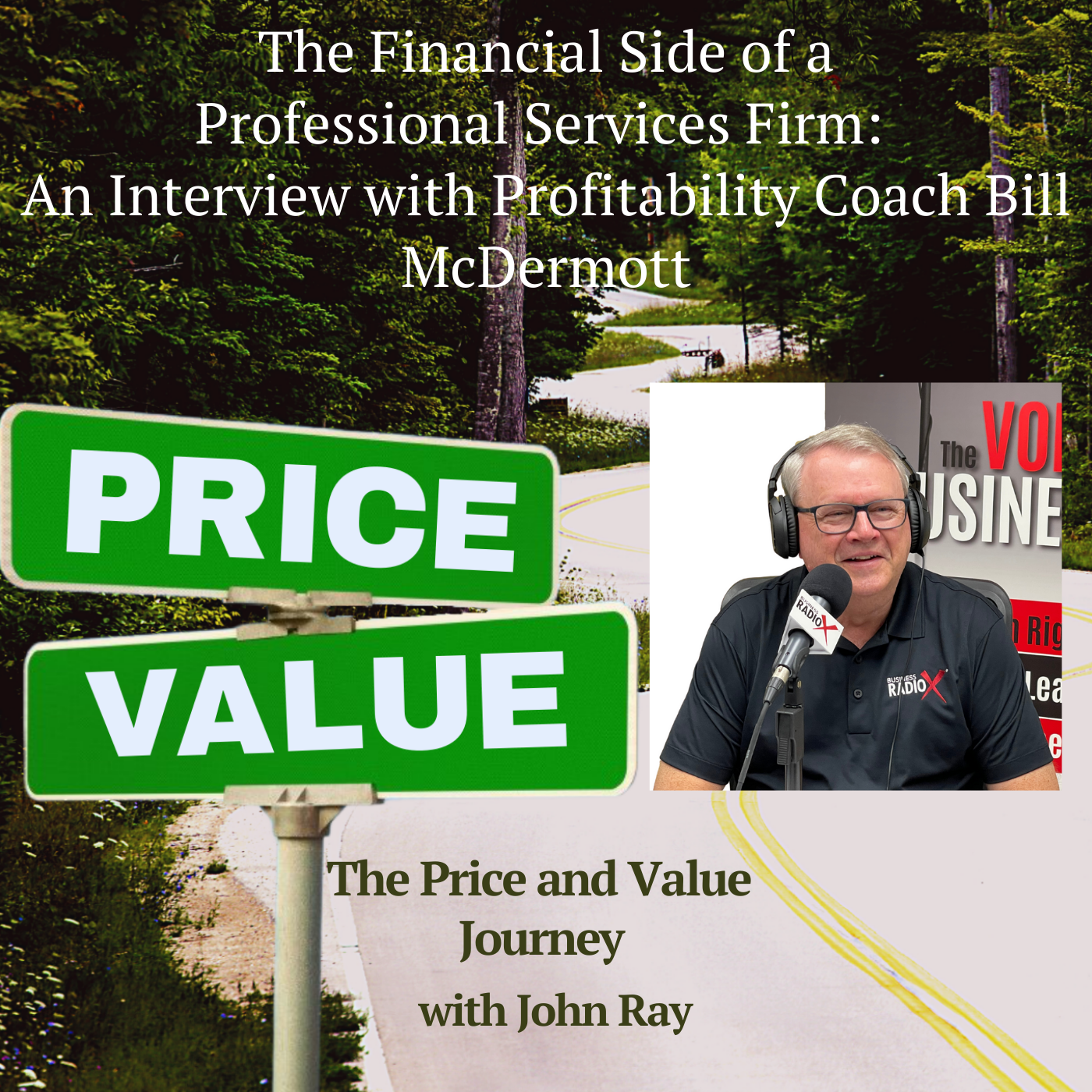
The Financial Side of a Professional Services Firm: An Interview with Profitability Coach Bill McDermott

June 7, 2022 by John Ray

Profitability Coach Bill McDermott
North Fulton Studio
The Financial Side of a Professional Services Firm: An Interview with Profitability Coach Bill McDermott
Loading
00:00 /
RSS Feed
Share
Link
Embed

Download file

The Profitability Coach

The Financial Side of a Professional Services Firm: An Interview with Profitability Coach Bill McDermott

Profitability Coach Bill McDermott, who works with law firms, engineering firms, consulting firms, and other professional services practices, joined host John Ray to discuss the financial side of a professional services firm. Bill discussed why he started his practice and how it has developed, when to take on debt, the biggest financial mistakes he sees, buying hard assets such as real estate, planning for an exit, and much more.

The Price and Value Journey is presented by John Ray and produced by the North Fulton studio of Business RadioX®.

 Bill McDermott, The Profitability Coach

Bill McDermott, The Profitability Coach

Bill has worked with hundreds of business owners. They are good people with their hearts in the right place. What they don’t have is the perspective to see the blind spots in their business. Knowing which levers to pull and when to pull them can lead to a thriving and profitable business.

He loves to help business owners have the business they want by becoming better financial managers.

Bill McDermott graduated from Wake Forest University and launched a career in banking that spanned 32 years. He first started out as the “repo man” as part of Wachovia Bank’s management training program before locating to Atlanta to work for Peachtree Bank, which later became SunTrust. There, he distinguished himself as a great producer of loans and deposits for the bank, climbing the ranks to ultimately become a Group Vice President in the Commercial Banking division. In 2001, Bill’s group won the SunTrust Cup for being the highest performing commercial banking group in the company.

Over the next 8 years, Bill worked in community banking, becoming a top producer for IronStone Bank and later helping to double Embassy National Bank’s initial capital in loan production within 15 months. However, in early 2009 as the Great Recession was rapidly altering the economy, Bill’s position as Chief Commercial Lender was eliminated.

As Bill searched for what was “next”, he realized that he had a desire to share the treasure trove of knowledge of banking and financial acumen he had built. Bill combined his sales success from his banking/insurance experience with his deep financial/analytical skills and launched McDermott Financial Solutions in April 2009. His purpose quickly became “making business owners better financial managers”. Over the past 11 years, he has served over 200 clients by delivering results-oriented insights, helping to take them from financial confusion to financial clarity.

Bill currently sits on the board of directors for Pinnacle Bank. He also hosts a monthly podcast, ProfitSense, which features stories of successful business owners and the professionals that advise them. When Bill is not working, you can find him on the golf course, gardening, spending time with his family, and leading a small group at his local church.

Website | LinkedIn | Instagram


TRANSCRIPT

John Ray: [00:00:00] And hello again. I’m John Ray on the Price and Value Journey. And I want to welcome Bill McDermott to the show. Bill is here to chat about the financial side of a professional services firm.

John Ray: [00:00:13] Just a little background on Bill. Bill is the founder and CEO of McDermott Financial Solutions. He serves as a profitability coach to his clients, which include a lot of professional services firms. When business owners want to increase their profitability and they don’t have the expertise to know where to start or what to do, Bill leverages his talents, his knowledge, and his relationships from 32 years as a banker – somehow he made 32 years. I’m going to have to ask him how he did that – to identify the hurdles that get in the way, and create a plan to deliver profitability that his clients never thought possible.

John Ray: [00:00:57] Bill also serves as a treasurer for the Atlanta Executive Forum. He’s previously held positions as a board member for the Kennesaw State University Entrepreneurship Center and the Gwinnett Habitat for Humanity Chapter. And he has been treasurer for CEO Netweavers. He’s a graduate of Wake Forest University – go, Demon Deacons. And he and his wife, Martha, are just about to celebrate anniversary number 45. Congratulations on that, Bill. And I have to plug his podcast, ProfitSense with Bill McDermott, coming up on three years, right, Bill?

Bill McDermott: [00:01:36] It is. And it’s a pleasure to be here, John. Thanks so much for having me.

John Ray: [00:01:40] Absolutely. So, I want to give a little background on you. You spent three decades as a banker, how –

Bill McDermott: [00:01:54] How did I survive?

John Ray: [00:01:55] Well, you could certainly answer that question. But, I guess, how did you come to the choice of the practice that you started?

Bill McDermott: [00:02:05] Yeah. That’s a great question. I’ll give you the short version of a longer story. So, it was April of 2009, we had just entered The Great Recession, we were in a banking crisis. And the CEO of the bank that I was working for at the time walked in my office – it was actually on my wife’s birthday – and he said, “Bill, you’re doing a great job, but we’ve got to cut cost. You were the last one in, so you’re the first one out. We’re eliminating your position.” And I was done.

Bill McDermott: [00:02:36] And so, we had two daughters in college. I had to figure out a way to earn an income. So, first thing I did was pray. And I said, “Okay. You’ve closed the door. Open a window, and would you mind putting a little neon around it for me so I can see it?” But all kidding aside, in 32 years of banking, I saw that business owners were usually great salespeople or great operations people. Where they struggled was in the area of financial management. They didn’t learn it in school. And when you’re the owner of the business, there’s no on-the-job training because the buck stops with you.

Bill McDermott: [00:03:16] So, part of my why is, because I saw business owners struggle with financial management, I said, “Can I launch a business leveraging my expertise and knowledge in banking and help business owners become better financial managers?” So, the business started with that in mind. And my goal is to really, hopefully, leave a legacy of making business owners better financial managers in their business.

John Ray: [00:03:41] And you just celebrated a business anniversary, speaking of anniversary.

Bill McDermott: [00:03:45] Yeah. So, April was 13 years, and still going strong.

John Ray: [00:03:51] Congratulations.

Bill McDermott: [00:03:53] Yeah. Thank you so much.

John Ray: [00:03:54] That’s awesome. I think a lot of professional services practitioners, they get into business and then they pivot along the way, not pandemic related pivot, but their business morphs naturally. Yours has morphed along the way. Why don’t you explain that and kind of the decision points around that.

Bill McDermott: [00:04:17] Yeah. So, when you’re in the middle of a banking crisis, a lot of businesses are losing money. And so, I actually started negotiating workout plans on behalf of the business owner with their bank. You know, who better to negotiate a problem loan? A banker with another banker.

Bill McDermott: [00:04:37] And so, I successfully did that for several years. I had one client that I actually worked with for three years. We started with $16 million in debt, worked that down to a million. And, actually, the bank drew a line in the sand and said we’re not renewing anymore. Forced us into bankruptcy. And the bank eventually settled for $0.10 on the dollar, so we got $1,000,000 for $100,000 and, basically, negotiated out. So, that’s really how I started.

Bill McDermott: [00:05:10] When you negotiate a problem for a business owner, you become on the team because you two have been through it together. And so, what then happened is I had business owners asking me to come out and sit with them and go through their monthly financials. Well, I’m not the sharpest tool in the shed, but pretty soon I figured out, you know, a monthly meeting going over financial performance with the business owner, I’m coaching them how to be better.

Bill McDermott: [00:05:45] And so, what morphed is, is doing workout loans, actually became a practice where I’m coaching business owners on how to be better financial managers. And then, probably sandwiched between that is I have some of my clients want to leverage my banking expertise, and so I would help them find financing if they were buying a building, if they were getting a large piece of equipment, maybe that business owner who thinks they need a line of credit.

Bill McDermott: [00:06:12] By the way, best time to borrow money from a bank is when you don’t need it. Anyway, that’s maybe even another podcast for another day. We’ll go there.

John Ray: [00:06:20] When you don’t need to hire Bill McDermott, right? I mean, you get the folks that really need that financing, right?

Bill McDermott: [00:06:28] Yeah, exactly. And so, from workouts to financing, and then to the profitability coach. And that’s kind of been my path.

John Ray: [00:06:38] Wow. So, let’s describe for folks that don’t know what does a profitability coach do. You say you look at financials every month, but there’s more to it than that.

Bill McDermott: [00:06:47] Yeah. There really is. So, I’m going to start by saying that a profitability coach, first, speaks the language of business. Warren Buffett was quoted as saying, “Accounting is the language of business. And you, as a business owner, not only need to learn how to speak it, but how to become fluent.” And that language actually comes out in the form of reports, balance sheet, profit and loss statement, cash flow statement.

Bill McDermott: [00:07:17] Where I help a business owner is, most business owners understand their profit and loss statement. They generally don’t look at their balance sheet. And they hardly ever look at their cash flow statement. And so, what a profitability coach does is analyzes the trends in the business, helping that business owner see those trends, asking questions about what might be driving those trends, and then helping them make decisions.

Bill McDermott: [00:07:43] But probably the biggest thing, John, is, if you own your own business, you’re not accountable to anybody. And so, part of what a profitability coach really does, or any business coach for that matter, is holds that business owner accountable for, not only the dreams that they have, because those dreams usually convert to goals and those goals convert to plans, but somewhere along the way – it’s kind of like, you know, all of us want to lose weight January 1. And so, the gyms and the exercise places fill up for about two weeks. But after about the first two weeks they’re done. Well, nobody’s holding them accountable – part of what a profitability coach does is, not only help them become better financial managers, but holds them accountable to what their dreams and their plans and their goals are.

John Ray: [00:08:31] So, really, it sounds like your knowledge of the financials, how to read the financials, and the business owners knowledge of the business, and what’s going on day-to-day meet, essentially, right?

Bill McDermott: [00:08:44] That’s exactly right. Because, you know, part of that three decades in banking, I literally looked at thousands of financial statements because I had to look at financial statements to determine whether that business owner could borrow money or not. And so, the ability to interpret those financials helped me become trained in helping that business owner.

Bill McDermott: [00:09:05] So, you’re absolutely right. Generally, if a business wants to improve, there are really about five things that they need to look at. There’s either a people aspect of their business, there’s a strategy aspect, there’s an execution issue, there’s a process issue, or there’s a money issue. And so, people, process, strategy, execution, and cash are usually things that business owners need to pay attention to in order to be successful.

John Ray: [00:09:37] So, for those that don’t know, what’s the difference between a profitability coach and a fractional CFO? And when do you bring these different roles in? Or are they different?

Bill McDermott: [00:09:51] They’re absolutely different. So, right now, I have a very successful client who has basically managed the financial aspect of their business for 30 years. He still wants to keep me as a coach, but he doesn’t want to do financial management anymore, so he has hired a part time CFO to come in and run the business.

Bill McDermott: [00:10:15] Because having someone fulltime, first, it’s not that big a job and he doesn’t want to pay $200,000 a year, whatever a CFO gets these days. So, you want to hire a part time CFO if you just don’t want to have to be involved in the financial management of the business. You want a part-time CFO. Or if you want to do that yourself, you can. But, again, you better be able to speak the language.

Bill McDermott: [00:10:45] Now, actually, I will tell you, I coach a lot of business owners that have a part-time CFO and, primarily, a lot of that CFO role is about accounting. They make sure that they have all the debits and credits entered into QuickBooks or whatever accounting software is used. They’re able to generate the reports. But, generally, everything that that part-time CFO does is really about the past, because accounting is accounting for the past. It doesn’t really have much to do with the present or the future.

Bill McDermott: [00:11:18] So, kind of where they leave off is where I pick up. And we start talking about what are your goals for this year or this quarter, and where are you in relation to getting those goals accomplished. And, basically, working together with them, holding them accountable to what they want to do for the future, not necessarily focusing on the past.

Bill McDermott: [00:11:42] So, you can have both, but there is a difference. Most of the time, the part-time CFO is directly responsible, involved with financial management. But that CFO doesn’t really hold the business owner accountable to what their goals and dreams are. And so, that’s really what I’ve been doing as a profitability coach, helping them achieve their goals and dreams and become more profitable.

John Ray: [00:12:04] Do you find you can be in those cases a little more, maybe direct is the word, with the business owner, more of their mother-in-law -maybe that’s a bad metaphor – but you can be a little tougher when needed?

Bill McDermott: [00:12:20] I think part of it. And you said direct. I’ve had a few clients call me blunt, which I can be more than direct at times, and I’m working on that. But, no. I think, yeah, if someone is paying you to give advice then, by golly, they should take it.

Bill McDermott: [00:12:45] And I did give a lot of free advice when I was in banking because as I was looking at the financial statement, especially if I had to decline someone, I said, “Look, you, as the business owner, made $100,000 in profit, but you took out 75,000 in distributions. So, you only have a fourth of what you made available to handle the growth of the firm and pay back a loan if you choose to borrow.” And so, just little things like that are the things that I’ve done. But, yeah, sometimes you do have to be direct. And, again, if I’m holding someone accountable by being nice, I’m not really helping them.

John Ray: [00:13:28] Yeah, for sure. So, this show is designed for solo, small firm, to some degree, medium sized firm professional services providers, let’s talk about the needs here. I mean, at what point do you think a solo firm, a solopreneur, needs to hire a profitability coach?

Bill McDermott: [00:13:56] That’s a great question. And I want to be respectful, there are a lot of people out there that believe in doing it themselves. That is a totally valid way. But it’s interesting, there’s a guy by the name of Doug Tatum, Tatum CFO, who wrote a book titled No Man’s Land. And that book was really about his experience as being a CFO where growing companies fail. And he talks about the five M’s.

Bill McDermott: [00:14:27] John, so to your question, when do you feel like you should hire a profitability coach, one of the M’s that he mentioned is momentum. If your business has lost momentum, if your rate of sales is either decreasing, flat, or not increasing in proportion to what you’re expecting, you might want to hire a coach.

Bill McDermott: [00:14:47] Another thing is marketing. Marketing is the number one weakness in a growing firm. And so, if you’re not properly identifying your brand, to your point, about value, if you’re not sure of your value in the marketplace, you might need some help there. So, momentum marketing, management. Growing firms, growth, it makes businesses more complex. And so, you may have management issues that you need to address.

Bill McDermott: [00:15:21] Fourth, M is money. You know, when you’re growing, as you know, growth always requires cash. And if you have this big crazy number in accounts receivable and you’re complaining about a low bank account, well, by golly, then get on the phone and collect some of those past dues.

Bill McDermott: [00:15:38] So, marketing, momentum, management, money – I’m trying to remember what the fifth one was and it escapes me right now. But, in essence, I would think that you would hire a coach if you find yourself not hitting on all cylinders in some of those things.

John Ray: [00:15:54] Right. Right. So, I’m curious, it sounds like – you just answered the question I was about to ask – the biggest mistake solopreneurs make is not hiring outside help fast enough.

Bill McDermott: [00:16:12] Yeah. And so, part of my questions, because I want to be sure that the particular person that I’m talking to is really interested, and so I might ask them, “Look, if you’re in your car and you’re lost, do you keep driving or do you stop and ask for directions?” And the people that are probably going to keep driving kind of identify themselves as “I’m kind of a do it yourself-er. By golly, I don’t really need to stop and ask for help.” But those that ask for help, I want to help them.

Bill McDermott: [00:16:51] So, I worked with a professional services practice for about three years. When I started with that practice, a lot of their receivables were reimbursements from insurance companies. And what I saw was a huge amount of accounts receivable, and a lot of them were 60 or 90 days outstanding. Insurance companies are horrible at paying claims. You know, they’re paid to hold on to their money, not pay it back to the service providers. And so, we were able to devise a plan where she had a person in her practice that was accountable for making sure those receivables were collected.

Bill McDermott: [00:17:34] Well, then this practice also had a scheduler, and this firm had three locations, had 27 professional providers, but they weren’t maximizing their schedule. And so, there was a lot of holes, a lot of time that was billable time that was lost. And so, together we kind of crafted a scheme that, not only helped collections, but also helped increase appointments.

Bill McDermott: [00:18:03] And by the way, also talking about can we increase rates for reimbursements to the insurance companies, and the answer is yes, because a one percent increase in your price is about an eight to a ten percent increase in your bottom line. So, talking about Price Value Journey, a lot of that is just learning that raising prices is an immediate direct hit to your bottom line.

Bill McDermott: [00:18:29] But long story short, we were able to increase the revenue over a two year period of time in this professional practice 64 percent, so it’s about 32 percent a year. And we took about $100,000 out of the accounts receivable, put that into cash. So, not only did they have more profit, but they also had more cash to boot. So, this firm had been limping along for a year. I was introduced to them by their CPA. We were able to come in and help them. And they’re continuing to thrive to this day.

John Ray: [00:19:05] So, you brought up pricing, so forgive me but I can’t help going down that road. Let’s do that. I mean, my contention is, is that the biggest problem financial or professional services providers have is their pricing. Do you agree with that?

Bill McDermott: [00:19:27] A hundred percent. And I’ll tell a personal story. When I started my business 13 years ago, I’m figuring what do I charge. And, of course, when you first start, you’re not even sure you know what your value proposition is. And so, I said, “Okay. I’m going to start at this rate.” And by the way, it was an hourly rate. And so, by setting an hourly rate, I unintentionally got to the point where I was perceived as a commodity because I’m paid by the hour. There’s no value there.

Bill McDermott: [00:20:04] And by the way, my experience is, I, actually, in the first three years, tripled my hourly rate because the first rate that I thought it was worth was woefully low. And so, I had to work to the point where I had to find somebody to tell me that my rates were too high before I knew that I was right where I should be to begin with.

Bill McDermott: [00:20:31] But the other thing is, I read a really good book that, basically, introduced me to the concept of value-based pricing. So, to kind of use that example of the professional services practice I talked about, I mean, the amount of money that that firm paid me was probably about, I’m going to say, half of the profit that I delivered. So, essentially, if you think about it, they covered their cost and I gave them 100 percent return on their investment.

Bill McDermott: [00:21:15] So, the whole concept of value-based pricing was a total shift for me, John. And believe me, I have not arrived on this journey. I’m still learning. But switching from an hourly rate to a fixed fee, and doing that pricing in relation to the value that you’re delivering to your client makes sense. I can think of another story.

John Ray: [00:21:44] Yeah. Please.

Bill McDermott: [00:21:45] So, early on, I was involved in a loan negotiation with the bank, and it was a big loan. And so, I want to say the loan was about $2 million. And so, I said, “Okay. If I can deliver a discount of 20 percent, $400,000, what amount would you be willing to pay?” “Five percent.” So, $20,000. So, we got into the negotiation with the bank, it took me an-hour-and-a-half. And I successfully negotiated $20,000 of fees for 90 minutes worth of work. So, I don’t know what that comes out to for an hourly rate. But I delivered the value and got paid a percentage.

Bill McDermott: [00:22:41] And so, the concept in my practice that I’ve implemented, but I’m still figuring out is, price based on the value that you’re creating for your client. Don’t price on an hourly rate, if you can. Now, there are some practices that are comfortable with hourly pricing, and I’m not saying they shouldn’t do that, but they might be leaving money on the table that could be theirs instead of someone else’s.

John Ray: [00:23:11] You said when you were talking about that first example that when you were pricing hourly, you were regarded as a commodity. Explain more on that. Say more on that.

Bill McDermott: [00:23:26] Yeah. So, I think I’m going to use an analogy and, hopefully, explain in the meantime. Everybody shops at Walmart. Walmart struggles with customer service because they’re so big. But you know that you can go into Walmart and you can get the lowest price. And if there’s no supply chain disruption, they’ll have it in stock. But, still, Walmart doesn’t really add value because there’s no one there to help you. And if you wait in the checkout line, you’re probably going to wait a long time.

Bill McDermott: [00:24:09] Versus Ace Hardware. I go into Ace Hardware. Ace Hardware has everything. And when you walk in the front door, there’s someone there at the door that’s going to greet you and says, “Sir, what can I help you with?” And I say, “I need a 20 pound bag of birdseed.” Takes me right to the aisle right where the birdseed is and say, “Look. You got three choices. These are the prices. Clients ask for this one the most.” And I get service. There’s value. Because I don’t want to wander the aisles of Ace Hardware trying to find it. I want to be created by someone who knows where it is, knows what they’re talking about. And I can get through the checkout line quickly. So, there’s value in going to Ace Hardware that I don’t think you get at Walmart, in my personal opinion.

Bill McDermott: [00:25:00] So, what I had to figure out is if I couldn’t describe my value to someone – and believe me, describing my value, that’s on me – if I can’t accurately describe the value that I’m delivering to my clients, I default to a commodity. Because if I’m not Ace Hardware, they’re going to see me as Walmart. And they’re going to say, “Well, this is his price. Is it worth it to me to pay that?” It’s the difference between looking at it as a cost versus an investment, too, John.

John Ray: [00:25:35] Yeah. No, that makes sense. And just to be clear – and I probably should have let folks know this at the top of the show – so the professional services can be a big category, but you work with engineering firms, architectural firms, psychiatric related firms.

Bill McDermott: [00:25:59] Marketing agencies.

John Ray: [00:26:03] Attorneys, legal practices, what are some of the others? Have I mentioned most of them there?

Bill McDermott: [00:26:08] Most of them. I’ve got, certainly, a different aspects. I have, actually, three engineering firms. One is mechanical engineering, one of them is civil engineering, and then I also have one that’s environmental engineering. Several different attorney firms, some that work in the employee benefits arena, some of that are litigators. I’ve worked with a few CPA practices. I’ve worked with a couple of marketing agencies. I’ve done work with one of the top interior designers in the southeast. And so, yeah, professional services, generally, those professional services providers are great technicians at their craft, but they really struggle with the business aspect.

Bill McDermott: [00:27:03] But my practice is I’ve worked with solopreneur. I’ve worked with firms that are anywhere from ten people to, I’d say, 50 people. Probably, the largest firm I’ve worked with is a large contracting firm in Northwest Atlanta that has about 400 people. But, yeah, I really love professional services firms because, generally, they’re great technicians, they’re great at their craft. But when they were going to school, nobody taught them business. You know, business is not an undergraduate requirement to get your degree. And, certainly, if you don’t learn it in school, then you either got to learn it somewhere along the way or have a coach to come in and help you learn it.

John Ray: [00:27:55] Now, you’ve talked quite extensively here about the importance of pricing. And we both know that professional services firms, they don’t have inventory, they don’t have a lot of the same kind of capital expenditures, maybe any, that a lot of other firms have. When you talk to your clients, are you focused mostly around pricing or are there other aspects of the income statement that you hone in on?

Bill McDermott: [00:28:29] So, we’re focusing almost entirely on revenue because revenue is the largest number. And so, any percentage increase in revenue creates the biggest change. And so, one of the things that I would say, if you’re a solopreneur out there or look at what I call a revenue multiplier, some people call it a labor multiplier – so an architectural practice that I’m working with right now, they have a bill rate but then they also have a pay rate for engineering work that needs to be done.

Bill McDermott: [00:29:07] And so, that bill rate, of course, incorporates that engineering cost associated with it. But the gross profit is basically what’s left. And so, the higher that you can charge your bill rate against that pay rate that you’re paying out the engineering costs, the higher your gross profit is going to be.

Bill McDermott: [00:29:28] So, what we focus on, if you have an engineering cost for an architect that’s maybe $100, and you can bill that client $150, then your revenue or your labor multiplier is 1.5, if I’m doing the math right, because 150 divided by 100 is 1.5. And so, can you drive that multiplier up? Can you get it to 1.6 or can you get it to 2?

Bill McDermott: [00:29:55] And so, for this particular architectural firm, we’ve actually gone from about a 2.3 revenue multiplier in two years. Right now, we’re north of 3. And so, what that means in terms of gross profit is their gross profit was running probably in the mid-60s. It’s now up into the mid-80s, John. So, the incremental gross profit is falling right down to their bottom line. They’re well on their way through April of making probably two-thirds of the profit that they made last year.

John Ray: [00:30:32] Wow. Now, there’s some value right there that you deliver. Wow. What a great story. So, we talked about solopreneurs, now let’s talk about small, medium-sized professional services firms. They get to a certain size, what are some of the financial mistakes that you see that firms like this make that are common?

Bill McDermott: [00:30:58] Gosh. Let me think about that a minute. I think, first, customer concentrations can be a little bit risky. I do have a particular firm that I work with that is heavily concentrated in one particular client, makes up about 30 percent of their business. My rule of thumb, going back to my banking days, is probably to the extent that you can, limit your concentrations to maybe 15 percent of your total revenue to any one client. So, certainly, revenue concentrations.

Bill McDermott: [00:31:37] Other mistakes would be probably some mindset issues. A lot of business owners are willing to accept mediocre performance. When in reality, they have some self-limiting beliefs that are holding them back. And so, I can certainly expand on that.

Bill McDermott: [00:32:04] But, you know, a quick story is I had a client that I worked with who was in the engineering practice business. He didn’t really feel that he could deliver the value that he really did. And we got through that to the point where he was willing to, first, educate himself on the benefits of value-based pricing, implement it, and then reap the results. So, probably some of it is self-inflicted.

Bill McDermott: [00:32:39] You know, when I started my business, I didn’t know how much to charge. I had some self-limiting beliefs about what I was worth. And so, I would say that would be an item.

Bill McDermott: [00:32:49] And then, I would say, growing a business is really all about people and processes. And so, where I think some solopreneurs or small to medium-sized firms make some mistakes is they either have the wrong people. And when I say wrong, I’m talking about people that don’t really share the company’s core values or core focus, or that person is in the wrong seat. They’re not playing to that person’s strength.

Bill McDermott: [00:33:21] Probably the other thing, in addition to that wrong people, is documented processes. If you want to be an effective and an efficient organization, you’ve got to have documented processes. Because if you have 15 people in your billing department and each of those 15 people has a different way that they do billing, you got problems. And so, documented processes. And if they are documented, you need to inspect what you expect, which means making sure that the processes are being followed. So, those would be the three things that really stick out.

John Ray: [00:34:01] Let’s talk about debt. I mean, when should a firm as they grow start to take on debt? You say it’s when they don’t need it. Say more on that and what you counsel business owners.

Bill McDermott: [00:34:17] So, get a line of credit. There are people who basically believe that I don’t want to have any personal debt in my consumer, in my personal household, the way they run their household. But running a business and running a household are two different things. So, for a line of credit, I would say one month’s revenue is a good rule of thumb. So, if you’ve got a $3 million company that’s a $250,000 line of credit. Don’t base it based on last year’s revenue. Base it on this year’s revenue. So, that would be one thing.

Bill McDermott: [00:35:00] And, generally, year-end financials are in by January or February. Most banks are going to want to see a full fiscal year and then the most recent interim in order to approve a line.

Bill McDermott: [00:35:16] But I would say that I have another business that I work with that does steel fabrication for construction. They have done a great job of purchasing equipment that has technology associated with it that reduces their overall labor costs. They still have people working in their plant, but they have invested in equipment and technology to improve their operating performance. And so, borrowing for a piece of equipment where you find that you can increase your profit margin because of efficiency doing that.

Bill McDermott: [00:35:58] Right now, I’ve got three clients that are either building a building or buying a building. Rent is pretty expensive. A lot of times, depending on the requirements that you have on your building, you might need special electrical requirements. You might have special ceiling requirements, zoning requirements, things like that. But, you know, borrowing money to buy your own building versus paying rent every month is valid.

Bill McDermott: [00:36:31] Probably the most interesting thing right now is us, baby boomers, we’re getting ready to retire. And I’ve got three clients that I’m working with right now that are in various stages of exiting. And, of course, on my last podcast, we had a gentleman who is in the process of ownership transition. We had a banker who came on and spoke about financing those transactions. So, finding a financing source for your business to sell it or buy it is something that is very much top of mind for business owners right now, especially if you’re a baby boomer.

John Ray: [00:37:13] Yeah, for sure. So, if you’re a professional services firm, does having hard assets, like real estate, owning your own building, the building you’re operating in, or any other building for that matter, that’s maybe an investment, I mean, is that a good way to use excess cash flow?

Bill McDermott: [00:37:34] So, that’s a great question. I’ll try to answer it in a concise way. So, I have a client who, just on the operating performance of his business alone, earns a 22 percent net income. I’m going to say that real estate on an annual basis does not increase 22 percent. So, does it make sense for him to invest in an asset that is maybe going to appreciate even though he’s building equity in it versus investing in his business?

Bill McDermott: [00:38:09] So, investing in real estate might be a good diversification play because that way he or she doesn’t have all of their eggs in their company basket. So, it’s a little bit personal choice in my view, John. And I’m a big believer in diversifying your assets. And, generally, the stock of the closely held business that that solopreneur or small to medium-sized business owner has is the 800 pound gorilla on their personal financial statement. So, diversifying away from that and buying a building certainly makes sense.

Bill McDermott: [00:38:49] But if you’re looking at it strictly from numbers, rates of return, providing cash flow, you know, we went through a real estate crisis in 2009, real estate values dropped 30 percent. But on the flip side, real estate has been a great asset to own for a long, long period of time.

John Ray: [00:39:09] So, as we wind down here – Bill, this has been great – I want to get to exit planning, because you’ve started to do some exit planning work for clients. And we could do a whole show on exit planning for professional services firms. But give us the CliffsNotes version, if you will. I mean, folks that are thinking about exiting their firm, what are some of the things that they need to do to prepare their professional services practice for a change, for an exit?

Bill McDermott: [00:39:44] Yeah. So, for the solopreneur, it is a challenge primarily because, generally, a business owner buyer is not willing to pay for what is between that solopreneur’s ears. And so, it is commonly said that in exit planning, the value of a business is the value minus the business owner’s contribution to that value. So, if I were a solopreneur and, basically, all of the intellectual property was in my head, it’s going to be very, very hard to transfer that value to a potential purchaser. It can be done but there are some challenges.

Bill McDermott: [00:40:31] But building transferable value is important. That transferable value is basically having a solid management team that can take the business after the business owner exits. Having reliable financial statements because they’re paying a multiple of what the value of the business is based on those financial statements. So, having reliable financial statements is important.

Bill McDermott: [00:40:58] Back to an earlier comment, making sure that your revenue is not concentrated in any one or two places. So, frankly, it’s all about building transferable value. It’s also about having a growth plan that a business owner purchaser could buy into. So, those would be the aspects, primarily.

John Ray: [00:41:19] Got it. Well, Bill, this has been great. And I can’t imagine there aren’t some folks listening to this conversation wouldn’t want to get in touch, so let’s tell them how they can do that.

Bill McDermott: [00:41:32] Yeah. Well, first, it’s been a delight to be with you. This has been a great opportunity for me as well. And so, thanks for having me. They can reach me at bill@theprofitabilitycoach.net. Or they can call me on my mobile number, which is 770-597-3136. And our website is theprofitabilitycoach.net.

John Ray: [00:41:55] That’s easy to remember, folks. Terrific. Bill McDermott, thanks so much again for coming on the show.

Bill McDermott: [00:42:01] Thanks for having me, John.

John Ray: [00:42:02] Absolutely. Hey, folks, just a quick reminder, if you want to see past episodes of this series or check them out, you can go to pricevaluejourney.com. We would be honored – I’d be honored – if you would subscribe to the show on your favorite podcast app and you won’t miss an episode that way. If you’d like to get in touch with me directly, ask questions, or give some suggestions on topics that we ought to cover here, feel free. My email is john@johnray.co. Thank you for joining us.


About The Price and Value Journey

The title of this show describes the journey all professional services providers are on:  building a services practice by seeking to convince the world of the value we offer, helping clients achieve the outcomes they desire, and trying to do all that at pricing which reflects the value we deliver.

If you feel like you’re working too hard for too little money in your solo or small firm practice, this show is for you. Even if you’re reasonably happy with your practice, you’ll hear ways to improve both your bottom line as well as the mindset you bring to your business.

The show is produced by the North Fulton studio of Business RadioX® and can be found on all the major podcast apps. The complete show archive is here.

John Ray, Host of The Price and Value Journey

John Ray The Price and Value Journey
John Ray, Host of “The Price and Value Journey”

John Ray is the host of The Price and Value Journey.

John owns Ray Business Advisors, a business advisory practice. John’s services include advising solopreneur and small professional services firms on their pricing. John is passionate about the power of pricing for business owners, as changing pricing is the fastest way to change the profitability of a business. His clients are professionals who are selling their “grey matter,” such as attorneys, CPAs, accountants and bookkeepers, consultants, marketing professionals, and other professional services practitioners.

In his other business, John a Studio Owner, Producer, and Show Host with Business RadioX®, and works with business owners who want to do their own podcast. As a veteran B2B services provider, John’s special sauce is coaching B2B professionals to use a podcast to build relationships in a non-salesy way which translate into revenue.

John is the host of North Fulton Business Radio, Minneapolis-St. Paul Business Radio, Nashville Business Radio, Alpharetta Tech Talk, and Business Leaders Radio. house shows that feature a wide range of business leaders and companies. John has hosted and/or produced over 1,100 podcast episodes.

Connect with John Ray:

Website | LinkedIn | Twitter

Business RadioX®:  LinkedIn | Twitter | Facebook | Instagram

Tagged With: banking, Bill McDermott, business coaching, John Ray, Price and Value Journey, pricing, professional services, professional services firm, professional services providers, solopreneurs, The Price and Value Journey, The Profitability Coach, value, value pricing

It’s Not a Sales Call, It’s a “Best Fit” Conversation

June 3, 2022 by John Ray

It's Not a Sales Call It's a "best fit" conversation
North Fulton Studio
It's Not a Sales Call, It's a "Best Fit" Conversation
Loading
00:00 /
RSS Feed
Share
Link
Embed

Download file

It's Not a Sales Call It's a "best fit" conversation

It’s Not a Sales Call, It’s a “Best Fit” Conversation

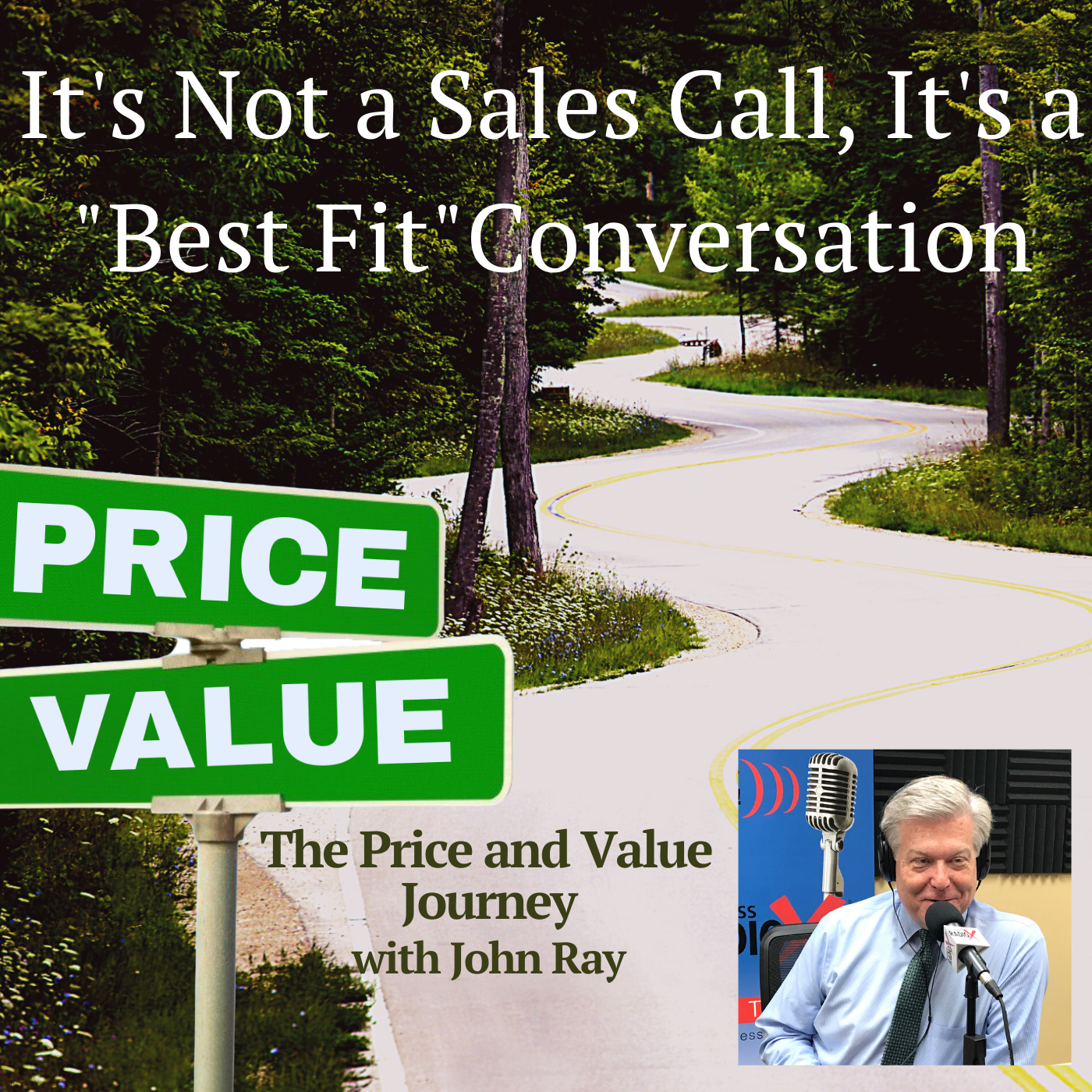
As professional services providers, we’ll serve more effectively if we view our time with prospects as a “best fit” conversation instead of a sales call.

The Price and Value Journey is presented by John Ray and produced by the North Fulton studio of Business RadioX®

TRANSCRIPT

John Ray: [00:00:00] Hello. I’m John Ray on The Price and Value Journey. Conversations with prospective clients should not be viewed as a sales call. Frankly, it took me a while to come to this realization and the use of this terminology.

John Ray: [00:00:19] These conversations that we have with prospects shouldn’t even start with a sale in mind. A better way to frame these conversations is to start out with something like, “Hey, let’s see if we’re a good fit. And to do that, I need to ask you some questions.” And then, ask those questions. Ask the individual in front of you, Why do you think you need X and Y? What outcomes are you trying to achieve? Why haven’t you tried fill in the blank? And so forth.

John Ray: [00:00:52] We are professional services providers. We serve. Our mission should be to help others find solutions to their problems. If we make that our focus, we will be seen as a person of value. And in turn, we will stand out from the crowd.

John Ray: [00:01:13] Earlier in this series, I was fortunate enough to interview Bob Burg, and he and John David Mann are the co-authors of a book called The Go-Givers Sell More. And here’s the way they put it in that book.

John Ray: [00:01:31] They say, Most of us look at sales backwards. We see it as convincing people to do something they don’t want to do. But it isn’t. It’s about learning what people do want to do and helping them do that. Or, we may think it’s about taking advantage of others. While, in fact, it’s about giving other people more advantage.

John Ray: [00:01:57] But the biggest inversion of all, the great upside down misconception about sales, is that it is an effort to get something from others. The truth is that sales at its best, that is at its most effective, is precisely the opposite. It is about giving. Selling is giving. Giving time, attention, counsel, education, empathy, and value. In fact, the word sell comes from the old English word sellan, which means – you guessed it – to give.

John Ray: [00:02:39] What a great passage. Try it. Instead of thinking of prospect meetings as sales calls, try thinking of them as best fit conversations. Maybe you call them giving conversations. You might have another way to frame it. But whatever we call it, we should do whatever’s necessary to put ourselves in the mindset of genuine service. That’s what makes us professional services providers.

John Ray: [00:03:11] I’m John Ray on The Price and Value Journey. Past episodes of this series can be found at pricevaluejourney.com or on your favorite podcast app. And if you have not subscribed, I’d be honored if you would. And if you’d like to connect with me directly, send me a note, john@johnray.co. I’d love to hear from you. Thank you for joining me.


About The Price and Value Journey

The title of this show describes the journey all professional services providers are on:  building a services practice by seeking to convince the world of the value we offer, helping clients achieve the outcomes they desire and trying to do all that at pricing which reflects the value we deliver.

If you feel like you’re working too hard for too little money in your solo or small firm practice, this show is for you. Even if you’re reasonably happy with your practice, you’ll hear ways to improve both your bottom line as well as the mindset you bring to your business.

The show is produced by the North Fulton studio of Business RadioX® and can be found on all the major podcast apps. The complete show archive is here.

John Ray, Host of The Price and Value Journey

John Ray The Price and Value Journey
John Ray, Host of “The Price and Value Journey”

John Ray is the host of The Price and Value Journey.

John owns Ray Business Advisors, a business advisory practice. John’s services include advising solopreneur and small professional services firms on their pricing. John is passionate about the power of pricing for business owners, as changing pricing is the fastest way to change the profitability of a business. His clients are professionals who are selling their “grey matter,” such as attorneys, CPAs, accountants and bookkeepers, consultants, marketing professionals, and other professional services practitioners.

In his other business, John is a Studio Owner, Producer, and Show Host with Business RadioX®, and works with business owners who want to do their own podcast. As a veteran B2B services provider, John’s special sauce is coaching B2B professionals to use a podcast to build relationships in a non-salesy way which translate into revenue.

John is the host of North Fulton Business Radio, Minneapolis-St. Paul Business Radio, Alpharetta Tech Talk, and Business Leaders Radio. house shows which feature a wide range of business leaders and companies. John has hosted and/or produced over 1,300 podcast episodes.

Connect with John Ray:

Website | LinkedIn | Twitter

Business RadioX®:  LinkedIn | Twitter | Facebook | Instagram

Tagged With: best fit conversation, ohn Ray, Price and Value Journey, pricing, professional services, professional services providers, Sales, sales call, solopreneurs, value, value pricing

The Only Three Ways to Increase Revenue

June 2, 2022 by John Ray

The Only Three Ways to Increase Revenue
North Fulton Studio
The Only Three Ways to Increase Revenue
Loading
00:00 /
RSS Feed
Share
Link
Embed

Download file

The Only Three Ways to Increase Revenue

The Only Three Ways to Increase Revenue

There are only three ways to increase revenue. Most professional services providers focus on just two of those ways, even though the returns on those methods are smaller and less certain.

The Price and Value Journey is presented by John Ray and produced by the North Fulton studio of Business RadioX®.

TRANSCRIPT

John Ray: [00:00:00] Hello. I’m John Ray on The Price and Value Journey. There are only three ways you can increase your revenue. Only three. You can sell more of your stuff to new clients, and that’s more volume. You can sell more of your stuff to existing clients, that’s also more volume. Or you can raise your prices.

John Ray: [00:00:23] Now, those are your choices if you want to increase your revenue. That’s it. So, how much of your time, money, resources, and mindshare are you giving to each of these three? Two of them have to do with more volume. One of them, of course, has to do with your price.

John Ray: [00:00:44] My experience with most solo and small professional services firms is that they spend a disproportionate amount of resources on the first two, the volume choices, but give extraordinarily little regular attention to what opportunity they might have to modify prices for the better.

John Ray: [00:01:06] This choice of resource allocation is illogical. Acquiring new clients requires expenditure of marketing and sales resources, and there’s a delay in the return received on that investment, and that’s assuming there is a return. Price changes, on the other hand, have a nearly instantaneous impact on the bottom line. The effort needed to implement them is invariably much less than a fresh marketing or sales initiative. Sometimes the cost of implementing a price increase is near zero.

John Ray: [00:01:44] So, think about your resource allocation around growing your revenue. What is your allocation? And is it too heavily weighted in one direction?

John Ray: [00:01:56] I’m John Ray on The Price and Value Journey. Past episodes of this series can be found at pricevaluejourney.com or on your favorite podcast app, where you can subscribe, if you’re not already subscribed. And I would be honored if you would subscribe. If you’d like to send me questions or comments, I’d love to hear from you, john@johnray.co is how you can reach me. Thank you for joining me.


About The Price and Value Journey

The title of this show describes the journey all professional services providers are on:  building a services practice by seeking to convince the world of the value we offer, helping clients achieve the outcomes they desire and trying to do all that at pricing which reflects the value we deliver.

If you feel like you’re working too hard for too little money in your solo or small firm practice, this show is for you. Even if you’re reasonably happy with your practice, you’ll hear ways to improve both your bottom line as well as the mindset you bring to your business.

The show is produced by the North Fulton studio of Business RadioX® and can be found on all the major podcast apps. The complete show archive is here.

John Ray, Host of The Price and Value Journey

John Ray The Price and Value Journey
John Ray, Host of “The Price and Value Journey”

John Ray is the host of The Price and Value Journey.

John owns Ray Business Advisors, a business advisory practice. John’s services include advising solopreneur and small professional services firms on their pricing. John is passionate about the power of pricing for business owners, as changing pricing is the fastest way to change the profitability of a business. His clients are professionals who are selling their “grey matter,” such as attorneys, CPAs, accountants and bookkeepers, consultants, marketing professionals, and other professional services practitioners.

In his other business, John is a Studio Owner, Producer, and Show Host with Business RadioX®, and works with business owners who want to do their own podcast. As a veteran B2B services provider, John’s special sauce is coaching B2B professionals to use a podcast to build relationships in a non-salesy way which translate into revenue.

John is the host of North Fulton Business Radio, Minneapolis-St. Paul Business Radio, Alpharetta Tech Talk, and Business Leaders Radio. house shows which feature a wide range of business leaders and companies. John has hosted and/or produced over 1,300 podcast episodes.

Connect with John Ray:

Website | LinkedIn | Twitter

Business RadioX®:  LinkedIn | Twitter | Facebook | Instagram

Tagged With: increase revenue, John Ray, Price and Value Journey, pricing, professional services, professional services providers, revenue, revenue growth, solopreneurs, value, value pricing

“Know, Like, Trust” Starts with Service

May 27, 2022 by John Ray

Know Like Trust Starts with Service
North Fulton Studio
"Know, Like, Trust" Starts with Service
Loading
00:00 /
RSS Feed
Share
Link
Embed

Download file

Know Like Trust Starts with Service

“Know, Like, Trust” Starts with Service

“People do business with people they know, like, and trust.” It’s a cliche for a reason, because it’s true. “Know, like, trust,” though, has a preamble: service. Serving with no agenda or precondition is fertilizer for trust to grow.

The Price and Value Journey is presented by John Ray and produced by the North Fulton studio of Business RadioX®.

TRANSCRIPT

John Ray: [00:00:00] Hello. I’m John Ray on The Price and Value Journey. Some clichés become platitudes when they’re repeated constantly because they are, in fact, true and time tested. And one of those clichés is that people do business with those that they know, like, and trust. Well, like many clichés, this one is repeated so often that the underlying truth of it gets blurred or even lost.

John Ray: [00:00:31] A few months ago, I received a LinkedIn connection request from someone who seemed like a good connection for me. Their profile was solid, so I accepted the invite. This person responded with a note about how he just loves connecting with other professionals in my state and how he is amazed by the relationships he’s cultivated from LinkedIn. Okay. So far so good. I agree with that. And I’m also struck by how you can develop relationships using LinkedIn.

John Ray: [00:01:06] But that was the high watermark of the encounter of our so-called relationship. His message quickly veered to his tax strategy service and how he was certain he could save me money. He didn’t ask one question about myself or my business. Not just a question which might reveal whether I needed his help, which I don’t, but even just an inquiry which might reveal a genuine interest in me and my work.

John Ray: [00:01:37] Finally, his sixth message in four days, literally, began with, “Hate to be that pest but wanted to follow up with you one last time.” “I can only hope so,” I thought. This gentleman’s professional brand is now pest. Yes, I know him now, but not in the way that involves likability and trust.

John Ray: [00:02:04] But it’s worse than that. He destroyed any sense in my mind that he might be an expert in his field. If I need some tax strategy help in the future, do you think I’m going to think of this guy as my go-to source? Hardly. As he’s branded himself more as a hawker of a service than an expert in his field.

John Ray: [00:02:28] Now, in contrast, here’s what serving looks like. I recently got a call from a lady who I do business with and she had a suggestion for a new client opportunity for me. Now, this was the entire reason for the call. She had no other agenda. She wasn’t trying to sell her service in any way or use the call as a pretext for something else, or a pivot to some other subject that benefited her. It was obvious from the nature of her call that she had been thinking about my business in a strategic, not a superficial way, one which revealed that her default operating system was rooted in serving.

John Ray: [00:03:18] Now, this behavior is typical with her, which is why her business has grown and prospered over the years. Now, yes, she’s known, liked, and trusted. But all of that is triggered by her practice of putting service first without an agenda. Yes, it’s counterintuitive and it’s hard to stay in a service first frame of mind, particularly if you are new in your practice or you’re struggling to make it go.

John Ray: [00:03:49] It’s easy to dismiss it and say that it works for this person, or some other person, but it won’t work for you because your circumstances are different. Yet, if you truly make it a practice to serve first in your business, you’ll not only stand out, but your business will blossom over time. Know I can trust starts with service.

John Ray: [00:04:18] I’m John Ray on The Price and Value Journey. Past episodes of this series can be found at pricevaluejourney.com. Or if you would like to subscribe on your favorite podcast app, you can do so, and we would be honored if you would do that. If you would like to connect with me or send me a question, my email is john@johnray.co. Thank you for joining me.


About The Price and Value Journey

The title of this show describes the journey all professional services providers are on:  building a services practice by seeking to convince the world of the value we offer, helping clients achieve the outcomes they desire and trying to do all that at pricing which reflects the value we deliver.

If you feel like you’re working too hard for too little money in your solo or small firm practice, this show is for you. Even if you’re reasonably happy with your practice, you’ll hear ways to improve both your bottom line as well as the mindset you bring to your business.

The show is produced by the North Fulton studio of Business RadioX® and can be found on all the major podcast apps. The complete show archive is here.

John Ray, Host of The Price and Value Journey

John Ray The Price and Value Journey
John Ray, Host of “The Price and Value Journey”

John Ray is the host of The Price and Value Journey.

John owns Ray Business Advisors, a business advisory practice. John’s services include advising solopreneur and small professional services firms on their pricing. John is passionate about the power of pricing for business owners, as changing pricing is the fastest way to change the profitability of a business. His clients are professionals who are selling their “grey matter,” such as attorneys, CPAs, accountants and bookkeepers, consultants, marketing professionals, and other professional services practitioners.

In his other business, John is a Studio Owner, Producer, and Show Host with Business RadioX®, and works with business owners who want to do their own podcast. As a veteran B2B services provider, John’s special sauce is coaching B2B professionals to use a podcast to build relationships in a non-salesy way which translate into revenue.

John is the host of North Fulton Business Radio, Minneapolis-St. Paul Business Radio, Alpharetta Tech Talk, and Business Leaders Radio. house shows which feature a wide range of business leaders and companies. John has hosted and/or produced over 1,300 podcast episodes.

Connect with John Ray:

Website | LinkedIn | Twitter

Business RadioX®:  LinkedIn | Twitter | Facebook | Instagram

Tagged With: John Ray, know like trust, Price and Value Journey, pricing, professional services, professional services providers, solopreneurs, trust, value, value pricing

Trading a Corporate Job for One in Your Own Business

May 23, 2022 by John Ray

Trading a Corporate Job for One in Your Own Business
North Fulton Studio
Trading a Corporate Job for One in Your Own Business
Loading
00:00 /
RSS Feed
Share
Link
Embed

Download file

Trading a Corporate Job for One in Your Own Business

Trading a Corporate Job for One in Your Own Business

As you’re building your professional services business, it can sometimes feel like all you’ve done is trade your corporate job for one in your own business. This episode addresses how and why this happens, and charts a way out of this terrible feeling.

The Price and Value Journey is presented by John Ray and produced by the North Fulton studio of Business RadioX®.

TRANSCRIPT

John Ray: [00:00:00] Hello again. I’m John Ray on The Price and Value Journey. I receive a lot of feedback from this podcast and from what I write, much of it is private which I understand, who wants to talk about their own frustrations, disappointments, stress, and failures which come from inadequate pricing. I know this firsthand.

John Ray: [00:00:23] Here’s a note I received from a consultant with her own practice in response to something I had posted on LinkedIn, and I’m using this with full permission. “Thank you for sharing that article about pricing. When I took on my first few clients, I was over delivering and under charging. I had learned that I shouldn’t do this because I was more stressed than when I had a job. Once I learned that I could walk away from a client and say no, I felt more confident. But as I learn more about selling contracts, et cetera, it is all about the solutions you provide to the client. It is about how you can make their business and emotional impact better. Thank you for sharing and offering your guidance with your content.”

John Ray: [00:01:17] There’s so much here that this person wrote that’s valuable. But the comment about being more stressed than when she had a job stood out for me. When I speak with a professional services provider about their practice, one of the red flags which indicates a pricing problem is working too hard for too little money. It’s a terrible feeling.

John Ray: [00:01:42] Maybe you’ve left a large professional services firm because you want independence and flexibility. Maybe you’ve left corporate because you are tired of their backstabbing rat race, which has no respect for your family and your personal life. You start your practice and everything is fresh and hopeful. You pull in a few clients and start to get some momentum. You may know that you’re under charging, but that’s part of the dues you think you have to pay to get going. Or maybe you think you have to start out with a lower fee in order to build your business.

John Ray: [00:02:19] After a while, you aren’t getting any sleep, you’re frazzled. You resent your clients who you are busting your butt for. And your significant other is telling you that you made a big mistake. That proud moment when you became a business owner, that euphoric feeling when you were holding the metaphoric glass trophy over your head, it’s now laying on the floor, shattered, because you don’t own a business. You own a job.

John Ray: [00:02:47] There’s a pronoun problem in what I just described. It’s all about I and me. There’s nothing here about the clients I’m working with, whose businesses I’m straightening out and whose lives I’m changing.

John Ray: [00:03:00] My friend who wrote this note points to one of the biggest problems services providers have with their practice. They haven’t spent nearly enough time developing a deep understanding of the needs, problems, hopes, and goals of the target tribe of clients they want to serve. Their description of a client need involves something functional, like filing a tax return or developing digital advertising. Those functions are just the means to a bigger and deeper end, which clients are looking for, solutions which permanently change their business and personal lives for the better.

John Ray: [00:03:42] It doesn’t matter whether they are bakery owners, farmers, attorneys, truck drivers, or programmers. When you’re able to get under the skin of the members of the tribe you want to serve, you end up having more substantial conversations with your clients. They feel like you understand them, and your confidence rises because of that. You’re prescribing remedies which meet long held needs and dreams, not just for the business, but for the business owner, their significant other, and their family. You’re making, as my friend indicates in her note, an emotional impact, not just a financial one.

John Ray: [00:04:22] And the door opens for your pricing to change for the better because you are pricing based on client outcomes, not some silly measure like your timesheet. And you’ve regained ownership of your business.

John Ray: [00:04:38] I’m John Ray on the Price and Value Journey. Past episodes of this series can be found at pricevaluejourney.com or on your favorite podcast app where you can subscribe, and we would be honored if you do that. If you would like to send me a note, john@johnray.co is my email address. Thank you for joining me.


About The Price and Value Journey

The title of this show describes the journey all professional services providers are on:  building a services practice by seeking to convince the world of the value we offer, helping clients achieve the outcomes they desire and trying to do all that at pricing which reflects the value we deliver.

If you feel like you’re working too hard for too little money in your solo or small firm practice, this show is for you. Even if you’re reasonably happy with your practice, you’ll hear ways to improve both your bottom line as well as the mindset you bring to your business.

The show is produced by the North Fulton studio of Business RadioX® and can be found on all the major podcast apps. The complete show archive is here.

John Ray, Host of The Price and Value Journey

John Ray The Price and Value Journey
John Ray, Host of “The Price and Value Journey”

John Ray is the host of The Price and Value Journey.

John owns Ray Business Advisors, a business advisory practice. John’s services include advising solopreneur and small professional services firms on their pricing. John is passionate about the power of pricing for business owners, as changing pricing is the fastest way to change the profitability of a business. His clients are professionals who are selling their “grey matter,” such as attorneys, CPAs, accountants and bookkeepers, consultants, marketing professionals, and other professional services practitioners.

In his other business, John is a Studio Owner, Producer, and Show Host with Business RadioX®, and works with business owners who want to do their own podcast. As a veteran B2B services provider, John’s special sauce is coaching B2B professionals to use a podcast to build relationships in a non-salesy way which translate into revenue.

John is the host of North Fulton Business Radio, Minneapolis-St. Paul Business Radio, Alpharetta Tech Talk, and Business Leaders Radio. house shows which feature a wide range of business leaders and companies. John has hosted and/or produced over 1,300 podcast episodes.

Connect with John Ray:

Website | LinkedIn | Twitter

Business RadioX®:  LinkedIn | Twitter | Facebook | Instagram

Tagged With: corporate job, John Ray, Price and Value Journey, pricing, professional services, professional services providers, solopreneurs, trading jobs, value, value pricing

Prospects Who Check References

May 20, 2022 by John Ray

Prospects Who Check References
North Fulton Studio
Prospects Who Check References
Loading
00:00 /
RSS Feed
Share
Link
Embed

Download file

Prospects Who Check References

Prospects Who Check References

What indication can you draw from prospects who check references? What does checking references reveal about a client’s price sensitivity or their orientation toward value? The episode explores those questions.

The Price and Value Journey is presented by John Ray and produced by the North Fulton studio of Business RadioX®.

TRANSCRIPT

John Ray: [00:00:00] Hello. I’m John Ray on the Price and Value Journey. I once spoke with a client about better discerning prospects whose sole concern is price. His experience led him to the belief that when a prospect doesn’t check with references, which have been provided, then that’s an indication that the prospect is exclusively focused on price.

Now, I hadn’t thought of this before, but the idea makes sense to me. If a prospect checks your references, they’re interested in the how of what you do, how you work with a client generally, your responsiveness, your ability to explain difficult concepts in plain English or other intangibles, which they value. They may sense you possess these intangibles they’re looking for because of the conversations that the two of you have had up until that point, but they want to confirm them.

Further checking with references takes time. The effort involved in emails, going back and forth with phone calls, all that can be tedious. And a client’s willingness to make this investment is probably a reliable indicator of a client who is not just serious but one more concerned with a decision to buy grounded and perceived value instead of price.

My client’s hypothesis, I think, rings particularly true in an extraordinarily complex service offering, where a client is particularly uncertain in deciding and where the cost of selecting the wrong provider is high. It could be, on the other hand, that a prospect doesn’t check your references because you’ve got stellar testimonials so thoroughly documented that there’s no need to make a phone call. Such a circumstance is probably rare, though, as most professional services providers really don’t spend that much time at all cultivating and documenting effective testimonials.

So, what’s the point? The point is that you’re better off in your practice spending time with prospects interested in making a value-oriented decision. Those are the clients willing to pay a price that’s reflective of the value that they perceive, and they’re the ones that are much easier for you to work with. So, how do these thoughts apply to your own business?

I’m John Ray on the Price and Value Journey. This series can be found at PriceValueJourney.com or on your favourite podcast app. And we’d be honored if you would subscribe to the series. If you’d like to connect directly, you can email John@JohnRay.co. Thank you for joining me.


About The Price and Value Journey

The title of this show describes the journey all professional services providers are on:  building a services practice by seeking to convince the world of the value we offer, helping clients achieve the outcomes they desire and trying to do all that at pricing which reflects the value we deliver.

If you feel like you’re working too hard for too little money in your solo or small firm practice, this show is for you. Even if you’re reasonably happy with your practice, you’ll hear ways to improve both your bottom line as well as the mindset you bring to your business.

The show is produced by the North Fulton studio of Business RadioX® and can be found on all the major podcast apps. The complete show archive is here.

John Ray, Host of The Price and Value Journey

John Ray The Price and Value Journey
John Ray, Host of “The Price and Value Journey”

John Ray is the host of The Price and Value Journey.

John owns Ray Business Advisors, a business advisory practice. John’s services include advising solopreneur and small professional services firms on their pricing. John is passionate about the power of pricing for business owners, as changing pricing is the fastest way to change the profitability of a business. His clients are professionals who are selling their “grey matter,” such as attorneys, CPAs, accountants and bookkeepers, consultants, marketing professionals, and other professional services practitioners.

In his other business, John is a Studio Owner, Producer, and Show Host with Business RadioX®, and works with business owners who want to do their own podcast. As a veteran B2B services provider, John’s special sauce is coaching B2B professionals to use a podcast to build relationships in a non-salesy way which translate into revenue.

John is the host of North Fulton Business Radio, Minneapolis-St. Paul Business Radio, Alpharetta Tech Talk, and Business Leaders Radio. house shows which feature a wide range of business leaders and companies. John has hosted and/or produced over 1,300 podcast episodes.

Connect with John Ray:

Website | LinkedIn | Twitter

Business RadioX®:  LinkedIn | Twitter | Facebook | Instagram

Tagged With: checking references, John Ray, Price and Value Journey, pricing, professional services, professional services providers, prospects, references, solopreneurs, value

The Most Essential Element of a Great Testimonial

May 18, 2022 by John Ray

The Most Essential Element of a Great Testimonial
North Fulton Studio
The Most Essential Element of a Great Testimonial
Loading
00:00 /
RSS Feed
Share
Link
Embed

Download file

The Most Essential Element of a Great Testimonial

The Most Essential Element of a Great Testimonial

While we are grateful for any client affirmation of our work, what makes for a great testimonial, one which is most effective? One word:  pain. Specifically, the client’s pain and dysfunction before our intervention.

The Price and Value Journey is presented by John Ray and produced by the North Fulton studio of Business RadioX®.

TRANSCRIPT

John Ray: [00:00:00] Hello. I’m John Ray on the Price and Value Journey. What’s the one essential element of a great testimonial? Every great testimonial involves pain. It’s the pain that you, as the professional services provider, freed your client from. I was reminded of this recently when I received a note from one of my North Fulton Business Radio guests, that’s one of the shows that I host. The note said, “I was so nervous wondering what I was going to say that I almost canceled. You made me forget I was on the show. We were just having a conversation, and it was so easy. Thank you so much for making my appearance so enjoyable.”

Now, imagine if the note had simply said, instead of what I just read, imagine if it had said the following, “You made me forget I was on the show. We were just having a conversation, and it was so easy. Thank you so much for making my appearance so enjoyable.” Now, the powerful testimonial that I read to begin with has been neutered somewhat. It’s now a nice compliment, nice to have, and these words feel good, but there’s something missing in the words that I read without referencing the pain. It’s the pain.

Let me read those original comments again. “I was so nervous wondering what I was going to say that I almost canceled. You made me forget I was on the show. We were just having a conversation, and it was so easy. Thank you so much for making my appearance so enjoyable.”

Stage fright is agonizing, and the nervousness of wondering whether you’ll say the right thing about your business involves a lot of angst and personal second guessing before that interview, speech or elevator pitch, whatever you’re delivering. This person lit up a fear many can identify with, and that gives that note a much greater impact.

Great testimonials are client-centered. They’re not centered on us as the services professional. Comments that I might receive about my show like, “John, you’re such a great host,” or “You’re so wonderful or a great guy,” well, they’re the skim milk, I’d call it, of testimonials. The skim milk version of testimonials. They might make me feel good, but the point of getting testimonials isn’t about me, unless the principal concern in my business is buffing up my own self-image instead of building the bottom line.

The reason you want testimonials is to help prospective clients who read them understand the pain you can deliver them from. You want others to read that testimonial and self-identify. Bottom line, it’s about them. Any endorsement you receive from a client is a precious gift you should be grateful for. And sometimes, it’s impossible to control what’s said when you are privileged to get a testimonial that’s unsolicited.

When you’re able to ask for an endorsement, though, ask your client to recall the pain they were in before you fix their problem and how their business and life has changed because of your involvement. The more specific the problem, ‘My sales were down 25%,” let’s say. And then the results, “My sales are now at an all time high and I’m not working 12-hour days,” the more those results are stated, the better.

The best testimonials are mostly about the client’s journey to a better business and life, and, yes, the role you played in that journey. But the emphasis is on the client. They’re the hero. It’s about them. And it starts with their pain. That’s the one essential element of a great testimonial.

I’m John Ray on the Price and Value Journey. Our show series can be found at PriceValueJourney.com or on your favorite podcast app. And we would be honored if you’d subscribe to the show and give us feedback along the way. You can email me at John@JohnRay.co. Thank you for joining me.


About The Price and Value Journey

The title of this show describes the journey all professional services providers are on:  building a services practice by seeking to convince the world of the value we offer, helping clients achieve the outcomes they desire and trying to do all that at pricing which reflects the value we deliver.

If you feel like you’re working too hard for too little money in your solo or small firm practice, this show is for you. Even if you’re reasonably happy with your practice, you’ll hear ways to improve both your bottom line as well as the mindset you bring to your business.

The show is produced by the North Fulton studio of Business RadioX® and can be found on all the major podcast apps. The complete show archive is here.

John Ray, Host of The Price and Value Journey

John Ray The Price and Value Journey
John Ray, Host of “The Price and Value Journey”

John Ray is the host of The Price and Value Journey.

John owns Ray Business Advisors, a business advisory practice. John’s services include advising solopreneur and small professional services firms on their pricing. John is passionate about the power of pricing for business owners, as changing pricing is the fastest way to change the profitability of a business. His clients are professionals who are selling their “grey matter,” such as attorneys, CPAs, accountants and bookkeepers, consultants, marketing professionals, and other professional services practitioners.

In his other business, John is a Studio Owner, Producer, and Show Host with Business RadioX®, and works with business owners who want to do their own podcast. As a veteran B2B services provider, John’s special sauce is coaching B2B professionals to use a podcast to build relationships in a non-salesy way which translate into revenue.

John is the host of North Fulton Business Radio, Minneapolis-St. Paul Business Radio, Alpharetta Tech Talk, and Business Leaders Radio. house shows which feature a wide range of business leaders and companies. John has hosted and/or produced over 1,300 podcast episodes.

Connect with John Ray:

Website | LinkedIn | Twitter

Business RadioX®:  LinkedIn | Twitter | Facebook | Instagram

Tagged With: John Ray, Price and Value Journey, pricing, professional services, professional services providers, solopreneurs, testimonials, value

Learning from a Martial Arts Studio

May 16, 2022 by John Ray

Learning from a Martial Arts Studio
North Fulton Studio
Learning from a Martial Arts Studio
Loading
00:00 /
RSS Feed
Share
Link
Embed

Download file

Learning from a Martial Arts Studio

Learning from a Martial Arts Studio

A flyer from a martial arts studio offers a lesson to professional services providers who want better results from their business development activities:  focus on client outcomes, not inputs such as certifications or experience.

The Price and Value Journey is presented by John Ray and produced by the North Fulton studio of Business RadioX®.

TRANSCRIPT

John Ray: [00:00:00] Hello. I’m John Ray on the Price and Value Journey. Recently, I ran across a flyer for a local martial arts studio. Now, here are the bullet points this flyer prominently displayed to attract parents who are interested in possibly enrolling their children. Better academic results. Now, to reinforce this point in the background of this flyer behind an image of smiling children was a report card with straight A’s. Improve self esteem, develop discipline, character development, respect for others, increased concentration and focus.

Now, what’s missing from this list? Well, there was nothing about the experience of the instructors. nothing about the belt level of the instructors, whether even the instructor uses deodorant or is pleasant to be around. There wasn’t anything about the instructor. The point is that this martial arts studio understands what parents are looking for as they buy for their children. Parents are looking to help their kids get ahead. They’re looking for transformation, for outcomes for their children. It’s not that the instructor isn’t important. It’s just that the experience and expertise of the instructor is assumed, as is, of course, the use of deodorant.

Clients of professional services firms are no different in the way they assess services providers. They are looking for improvement in and transformation of themselves and their business. It’s not that our certifications, degrees or even our experience don’t matter, but what gets us to the table with our best-fit clients is demonstrating an understanding of what they’re looking for. You see, clients buy outcomes, not inputs.

And what else was missing from that flyer? Well, there wasn’t any mention of price. No exclusive offer, no discounts, no freebies. If we understand the wants, dreams, problems and hang-ups of our clients, we don’t need to lead with price.

I’m John Ray on the Price and Value Journey. Past episodes of this series can be found at Price Value Journey or on your favorite podcast app. We’d be honored if you’d subscribe to the series, and we’d love to get your feedback. You can email me John@JohnRay.co. Thank you for joining me.


About The Price and Value Journey

The title of this show describes the journey all professional services providers are on:  building a services practice by seeking to convince the world of the value we offer, helping clients achieve the outcomes they desire and trying to do all that at pricing which reflects the value we deliver.

If you feel like you’re working too hard for too little money in your solo or small firm practice, this show is for you. Even if you’re reasonably happy with your practice, you’ll hear ways to improve both your bottom line as well as the mindset you bring to your business.

The show is produced by the North Fulton studio of Business RadioX® and can be found on all the major podcast apps. The complete show archive is here.

John Ray, Host of The Price and Value Journey

John Ray The Price and Value Journey
John Ray, Host of “The Price and Value Journey”

John Ray is the host of The Price and Value Journey.

John owns Ray Business Advisors, a business advisory practice. John’s services include advising solopreneur and small professional services firms on their pricing. John is passionate about the power of pricing for business owners, as changing pricing is the fastest way to change the profitability of a business. His clients are professionals who are selling their “grey matter,” such as attorneys, CPAs, accountants and bookkeepers, consultants, marketing professionals, and other professional services practitioners.

In his other business, John is a Studio Owner, Producer, and Show Host with Business RadioX®, and works with business owners who want to do their own podcast. As a veteran B2B services provider, John’s special sauce is coaching B2B professionals to use a podcast to build relationships in a non-salesy way which translate into revenue.

John is the host of North Fulton Business Radio, Minneapolis-St. Paul Business Radio, Alpharetta Tech Talk, and Business Leaders Radio. house shows which feature a wide range of business leaders and companies. John has hosted and/or produced over 1,300 podcast episodes.

Connect with John Ray:

Website | LinkedIn | Twitter

Business RadioX®:  LinkedIn | Twitter | Facebook | Instagram

Tagged With: Business Development, certifications, client outcomes, inputs, John Ray, martial arts, martial arts studio, outcomes, Price and Value Journey, pricing, professional services, professional services providers, solopreneurs, value

Your Price is Not the Client’s Cost

May 13, 2022 by John Ray

Your Price is Not the Client's Cost
North Fulton Studio
Your Price is Not the Client's Cost
Loading
00:00 /
RSS Feed
Share
Link
Embed

Download file

Your Price is Not the Client's Cost

Your Price is Not the Client’s Cost

Your price and what the client mentally weighs as their cost are two different figures, a vital concept for us as professional services providers to understand. (In this episode, I quote from Kevin Kelly’s post, 103 Bits of Advice I Wish I Had Known. You can find that post here, and there’s a ton of value in it, guaranteed.)

The Price and Value Journey is presented by John Ray and produced by the North Fulton studio of Business RadioX®.

TRANSCRIPT

John Ray: [00:00:00] Hello. I’m John Ray on the Price and Value Journey. Kevin Kelly is the Founding Executive Editor of Wired. He’s a prolific writer, and a wise observer, and commentator of all things technology. For his 70th birthday, Kelly offered 103 bits of advice I wish I had known. What he calls Bits of Unsolicited Advice he’s compiled and added to over time.

One of those bits of wisdom involves pricing. What you actually pay for something, he writes, is at least twice the listed price because of the energy, time, money needed to set it up, learn, maintain, repair, and dispose of it at the end. Not all prices appear on labels, he says. Actual costs are two times listed prices. Now, these wise words are written from a buyer’s point of view, of course. Whatever business you’re in, it’s important to apply this buyer’s perspective to your own product or service.

What’s the cost of purchasing, which a buyer may be considering? What are not only the hard dollar cost, but as Kelly references, the cost, which are intangible as well? As professional services providers, if we’re not considering the cost of change and addressing it up front in our conversations with prospects, we’re missing out. Most prospects haven’t thought it through enough to think of actual cost being twice the listed price, but that prospect sitting in front of us knows intuitively there’s a cost premium, which is more than the check they’re writing to us.

For example, small business owners thinking about making a change with accounting services providers are inevitably thinking about what they’ve got to do to pull the records together for their new provider. The intangible cost that they are mulling could include the time necessary to get a new services provider up to speed, the unknown. It’s the devil I know versus the devil I don’t syndrome. The aggravation and frustration of making a change. It could be embarrassment about how shoddy their books are. Maybe it’s the fear of telling the current accountant that they’re getting replaced. Some of these intangible costs can be actively lowered by any of us as the services provider.

Technology has made transfer records, for example, quite easy. We can lower fear of the unknown and a potential aggravation by covering the onboarding process we have for new clients. Even for the embarrassment-related intangible, we can lower the burden, the intangible cost the prospect might be feeling by discussing how there’s nothing they have that’s going to shock us. So, they need not feel shame or guilt.

If this thought exercise is brand new to you, then talk with your clients and ask them what their reservations were when they brought their business to you. The value you receive from these conversations, I assure you, will exceed the intangible cost of them.

I’m John Ray on the Price and Value Journey. Past episodes of this series can be found at PriceValueJourney.com or on your favorite app. And we’d be honored if you’d subscribe to our series. You can also contact me directly. John@JohnRay.co. Thank you for joining me.


About The Price and Value Journey

The title of this show describes the journey all professional services providers are on:  building a services practice by seeking to convince the world of the value we offer, helping clients achieve the outcomes they desire and trying to do all that at pricing which reflects the value we deliver.

If you feel like you’re working too hard for too little money in your solo or small firm practice, this show is for you. Even if you’re reasonably happy with your practice, you’ll hear ways to improve both your bottom line as well as the mindset you bring to your business.

The show is produced by the North Fulton studio of Business RadioX® and can be found on all the major podcast apps. The complete show archive is here.

John Ray, Host of The Price and Value Journey

John Ray The Price and Value Journey
John Ray, Host of “The Price and Value Journey”

John Ray is the host of The Price and Value Journey.

John owns Ray Business Advisors, a business advisory practice. John’s services include advising solopreneur and small professional services firms on their pricing. John is passionate about the power of pricing for business owners, as changing pricing is the fastest way to change the profitability of a business. His clients are professionals who are selling their “grey matter,” such as attorneys, CPAs, accountants and bookkeepers, consultants, marketing professionals, and other professional services practitioners.

In his other business, John is a Studio Owner, Producer, and Show Host with Business RadioX®, and works with business owners who want to do their own podcast. As a veteran B2B services provider, John’s special sauce is coaching B2B professionals to use a podcast to build relationships in a non-salesy way which translate into revenue.

John is the host of North Fulton Business Radio, Minneapolis-St. Paul Business Radio, Alpharetta Tech Talk, and Business Leaders Radio. house shows which feature a wide range of business leaders and companies. John has hosted and/or produced over 1,300 podcast episodes.

Connect with John Ray:

Website | LinkedIn | Twitter

Business RadioX®:  LinkedIn | Twitter | Facebook | Instagram

Tagged With: cost, John Ray, price, Price and Value Journey, pricing, professional services, professional services providers, solopreneurs, value

  • « Previous Page
  • 1
  • …
  • 6
  • 7
  • 8
  • 9
  • 10
  • …
  • 14
  • Next Page »

Business RadioX ® Network


Our Most Recent Episode

CONNECT WITH US

  • Email
  • Facebook
  • LinkedIn
  • Twitter
  • YouTube

Our Mission

We help local business leaders get the word out about the important work they’re doing to serve their market, their community, and their profession.

We support and celebrate business by sharing positive business stories that traditional media ignores. Some media leans left. Some media leans right. We lean business.

Sponsor a Show

Build Relationships and Grow Your Business. Click here for more details.

Partner With Us

Discover More Here

Terms and Conditions
Privacy Policy

Connect with us

Want to keep up with the latest in pro-business news across the network? Follow us on social media for the latest stories!
  • Email
  • Facebook
  • Google+
  • LinkedIn
  • Twitter
  • YouTube

Business RadioX® Headquarters
1000 Abernathy Rd. NE
Building 400, Suite L-10
Sandy Springs, GA 30328

© 2025 Business RadioX ® · Rainmaker Platform

BRXStudioCoversLA

Wait! Don’t Miss an Episode of LA Business Radio

BRXStudioCoversDENVER

Wait! Don’t Miss an Episode of Denver Business Radio

BRXStudioCoversPENSACOLA

Wait! Don’t Miss an Episode of Pensacola Business Radio

BRXStudioCoversBIRMINGHAM

Wait! Don’t Miss an Episode of Birmingham Business Radio

BRXStudioCoversTALLAHASSEE

Wait! Don’t Miss an Episode of Tallahassee Business Radio

BRXStudioCoversRALEIGH

Wait! Don’t Miss an Episode of Raleigh Business Radio

BRXStudioCoversRICHMONDNoWhite

Wait! Don’t Miss an Episode of Richmond Business Radio

BRXStudioCoversNASHVILLENoWhite

Wait! Don’t Miss an Episode of Nashville Business Radio

BRXStudioCoversDETROIT

Wait! Don’t Miss an Episode of Detroit Business Radio

BRXStudioCoversSTLOUIS

Wait! Don’t Miss an Episode of St. Louis Business Radio

BRXStudioCoversCOLUMBUS-small

Wait! Don’t Miss an Episode of Columbus Business Radio

Coachthecoach-08-08

Wait! Don’t Miss an Episode of Coach the Coach

BRXStudioCoversBAYAREA

Wait! Don’t Miss an Episode of Bay Area Business Radio

BRXStudioCoversCHICAGO

Wait! Don’t Miss an Episode of Chicago Business Radio

Wait! Don’t Miss an Episode of Atlanta Business Radio