Business RadioX ®

  • Home
  • Business RadioX ® Communities
    • Southeast
      • Alabama
        • Birmingham
      • Florida
        • Orlando
        • Pensacola
        • South Florida
        • Tampa
        • Tallahassee
      • Georgia
        • Atlanta
        • Cherokee
        • Forsyth
        • Greater Perimeter
        • Gwinnett
        • North Fulton
        • North Georgia
        • Northeast Georgia
        • Rome
        • Savannah
      • Louisiana
        • New Orleans
      • North Carolina
        • Charlotte
        • Raleigh
      • Tennessee
        • Chattanooga
        • Nashville
      • Virginia
        • Richmond
    • South Central
      • Arkansas
        • Northwest Arkansas
    • Midwest
      • Illinois
        • Chicago
      • Michigan
        • Detroit
      • Minnesota
        • Minneapolis St. Paul
      • Missouri
        • St. Louis
      • Ohio
        • Cleveland
        • Columbus
        • Dayton
    • Southwest
      • Arizona
        • Phoenix
        • Tucson
        • Valley
      • Texas
        • Austin
        • Dallas
        • Houston
    • West
      • California
        • Bay Area
        • LA
        • Pasadena
      • Colorado
        • Denver
      • Hawaii
        • Oahu
  • FAQs
  • About Us
    • Our Mission
    • Our Audience
    • Why It Works
    • What People Are Saying
    • BRX in the News
  • Resources
    • BRX Pro Tips
    • B2B Marketing: The 4Rs
    • High Velocity Selling Habits
    • Why Most B2B Media Strategies Fail
    • 9 Reasons To Sponsor A Business RadioX ® Show
  • Partner With Us
  • Veteran Business RadioX ®

How to Successfully Increase Your Prices: An Interview with Mark Peacock, PriceMaker Ltd.

March 23, 2022 by John Ray

How to Successfully Increase Your Prices
North Fulton Studio
How to Successfully Increase Your Prices: An Interview with Mark Peacock, PriceMaker Ltd.
Loading
00:00 /
RSS Feed
Share
Link
Embed

Download file

How to Successfully Increase Your Prices

How to Successfully Increase Your Prices: An Interview with Mark Peacock, PriceMaker Ltd.

Pricing expert Mark Peacock joined host John Ray to discuss how to successfully increase prices in your professional services practice. Mark covered the primary reason services providers don’t raise their prices (fear), the role of options in better pricing, the two-stage communication process he advocates for a successful price increase, mistakes to avoid, and much more.

The Price and Value Journey is presented by John Ray and produced by the North Fulton studio of Business RadioX®.

PriceMaker Limited

Pricing is one of the most powerful levers any business can use to increase profits and drive revenue growth. Yet all too often businesses are too scared to review their pricing and typically many business owners are leaving a lot of money on the table as a result.

PriceMaker is a leading UK pricing consultancy that has helped its clients increase net profits by an average of 20%. They use a simple 7 step process for designing a better pricing strategy that focuses on what customers value, and helps businesses implement new pricing without the fear of upsetting customers. PriceMaker helps with any of the following pricing services:

  • Pricing New Products or Services
  • Review of Existing Pricing Strategies
  • Digital Pricing Strategy
  • Implementing Price Increases
  • Customer Pricing Research
  • Competitor Pricing Assessment
  • Tender Response Pricing
  • Training for Management & Sales Teams

Company website

Mark Peacock, Managing Director, PriceMaker Ltd.

Mark Peacock, Managing Director, PriceMaker Ltd.

Mark Peacock is a leading UK pricing expert focusing on growth businesses in the Tech, Services, B2B and Product development sectors. He is the founder and M.D of PriceMaker Ltd, a specialist pricing consultancy and has helped his clients create new pricing solutions that add significant bottom-line value (+20% average increase in net profits). Mark spent 25 years working in the corporate world for brands such as DHL and The AA and was business unit director for two business units with £25M revenue and +100 staff where he grew profits by +250% over 5 years. His broad expertise covers pricing, product management, sales, marketing, commercial strategy and P&L management and he is a full member of the Chartered Institute of Marketing, the European Mentoring & Coaching Council, and the Institute of Directors.

LinkedIn | Twitter

TRANSCRIPT

John Ray: [00:00:00] And hello again, everyone. I’m John Ray on The Price and Value Journey. And I’m delighted today to welcome Mark Peacock. Mark is a leading pricing expert based in the UK, focusing on growth businesses in tech services, B2B, and product development sectors.

John Ray: [00:00:21] He’s the Founder and Managing Director of PriceMaker Limited, a specialist pricing consultancy who has helped his clients create new pricing solutions that add significant bottom line value, on average 20 percent increase in net profits. Do I have your attention, folks?

John Ray: [00:00:41] Mark spent about 25 years in the corporate world for brands such as DHL. He has been in charge of business units with over 25 million in revenue, that’s pounds, not dollars. So, folks, that’s more than what you think given the conversion. And over 100 of staff headcount where he grew profits by 250 percent over five years. His expertise, not only includes pricing, but product management, sales, marketing, commercial strategy, and PNL management. Mark Peacock, welcome to the show.

Mark Peacock: [00:01:21] Well, thank you, John. It’s a real pleasure to be here. And thanks for that lovely introduction. I’m looking forward to our chat.

John Ray: [00:01:27] Yeah. It’s an honor to have you here. And we’ve got you here to address the question of how to successfully increase prices. But before we get to that, just real quick, you’ve got all this experience in corporate that goes well beyond pricing. And I’m just curious, when you left corporate to start your own practice, why did you focus on pricing?

Mark Peacock: [00:01:54] Yeah. That’s a great question, John. And when I originally left, I wasn’t absolutely sure what I was going to do. As you say, I have all of this experience in product management, marketing, running sales teams, and running a business. And then, I have my eureka moment and I thought, “Pricing. Nobody talks about pricing, particularly in the small and medium sized business world.”

Mark Peacock: [00:02:18] You know, you’ve got the likes of McKinsey’s and the big consultancies helping large corporates with pricing, but nobody really talks about it in the SME world. And I just felt that there was a place and a gap for somebody to come in and talk about how pricing can make a big difference to your business, and show people that it doesn’t actually have to be scary or difficult. And, actually, that there are lots of simple tactics that anybody can use that can make a big difference. So, I saw that as my mission, if you like. So, that’s why I’m on the show today, I guess, to help spread the word about the power of pricing.

John Ray: [00:02:58] Absolutely. And I think as we covered in the introduction, your focus is on several different sectors. Ours here on this show is on professional services firms, which you also have a wide experience with. Talk about from your perspective how bad the problem of inadequate or poor pricing is for professional services firms.

Mark Peacock: [00:03:26] Yeah. I think it starts with the point that people running these businesses are generally brilliant at what they do, whether they’re a marketing consultant, a lawyer, an accountant, an advisor, a consultant, whatever it is. They’re brilliant at what they do. But more often than not, particularly when it comes to pricing, they are a bit scared about it and they just default to the same method of pricing that everybody else in their industry uses. So, hourly rates, and daily rates, and project fees and things like that.

Mark Peacock: [00:04:04] And they don’t really put the thought that they need to into what’s the best pricing strategy for me. And the extent of that thought process is really, What’s my hourly rate going to be? Is it $50? Is it $500? Or is it $50? You know, where do I sit on that scale? And there’s a lot of hand wringing and worry and consideration. And then, we eventually settle on a number, whatever it is, and then we stick with it. So, we’ve gone through that hard question of what’s my hourly rate? And we don’t want to go through it again. So, we don’t move on any further.

Mark Peacock: [00:04:49] And in terms of how prevalent, it is what I think it’s right. You know, show me a business in the sector that’s got an amazing pricing strategy. And I’ll be quite surprised, people might be doing quite well with their pricing, which is great. But then, the question is, well, how much better could it be? So, yeah, there’s a lot. That’s why I’m passionate about what I do, because I think there’s a lot of people in this space that need help with their pricing.

John Ray: [00:05:19] How does someone that’s not an expert like you are, who has their own practice, how do they know they need to raise their prices?

Mark Peacock: [00:05:34] For me, the biggest indicator is the answer to the question, When did you last put your prices up? If the answer to that is more than a year ago, then you’re going backwards in terms of where you should really be. Now, we’re all aware of the threat of inflation, rising costs, rising prices. I’m sure it’s just as bad in the U.S. as it is in the UK at the moment for all sorts of reasons.

Mark Peacock: [00:06:07] So, if you don’t really think about it, people are unaware of the damaging effect of inflation over time. So, if I give a very quick made up example basing it on UK figures, $100 from ten years ago is not worth $100 today. It’s probably worth only about $70 in equivalent buying power. So, if you haven’t put your prices up in ten years, you’ve lost up to $30 in value, in buying power, that you would have had ten years ago.

Mark Peacock: [00:06:45] And the longer it goes on, the worse it gets, because you might think that inflation is only two or three percent – I’m not sure what it is in the U.S. at the moment – but that erodes the power of your dollar every single year. So, if you don’t do anything about it, you might think that the way to overcome that is to grow your business, is to sell more. You can do that, but your net margin is still deteriorating.

Mark Peacock: [00:07:11] So, I think the first question I always ask people is, When did you last put your prices up? Normally, always more than a year. People often say, “Well, probably three years ago we last put our rates up.” And often you’ll hear people saying, “Well, we haven’t put our prices up in ten years.” And that’s a big red flag for me. So, if that’s the case, then you really need to think about doing something about it.

John Ray: [00:07:40] Yeah. And I’m going to come back to what you said about if it’s been less than a year, because I’m sure there’s some folks that are probably shrieking at horror thinking about raising their prices every year. But I want to come back to that. But I want to talk about the reasoning behind why price increases don’t occur. And I assume fear is the biggest reason. But do you agree with that? And if so, why? And if you see something else, please comment on that.

Mark Peacock: [00:08:13] Yeah. Totally. I totally agree that fear is the underlying reason why people do not put their prices up. They might think it’s something else. They might think it’s due to market situation, increased number of competitors, my business is growing so I don’t need to. But the underlying reason is fear.

Mark Peacock: [00:08:38] And that’s because when it comes to thinking about that awkward conversation that you’ve got to have with your customers, people are scared. We’re scared because we don’t want to upset our customers. And if we do put our prices up, we don’t know how our competitors might react. So, all of that is going to affect our ability to achieve our revenue targets. And we might also lose out on new sales in the future that we would have got at our old prices.

Mark Peacock: [00:09:10] So, the conclusion, the thought process is, it’s far too risky. I don’t want to rock the boat. You know what? I’m just not going to bother and I’m going to focus on other things to grow my business, if that’s important to me. So, better marketing campaign, new products, recruit more salespeople, invest in new systems, whatever it is. There’s a whole load of things people will do to grow their business before they look at pricing.

Mark Peacock: [00:09:40] The pricing is the most powerful lever, as you know, John. So, it’s a shame that the fear gets in the way. Ignorance, I think lack of awareness of how to do it is another big factor, because that doesn’t get taught in business school, does it? You don’t do a module on how to increase your prices. You might remember what you learn about supply and demand and microeconomics, but that’s of no use at all in this situation. So, yeah, fear and lack of awareness, I think, are big factors in stopping people putting their prices up.

John Ray: [00:10:15] And unlike those that are in manufacturing, let’s say, that produce a product, what’s being sold for a professional services provider is what’s between their ears. So, it’s highly personal, right? I mean, it’s like you’re putting a price on your forehead, if you will, for people to say no to. And I think as much as people don’t want to admit that’s what’s happening, that’s really the way they feel down deep, right?

Mark Peacock: [00:10:45] Totally. And I think that’s also what holds people back from reviewing their pricing, because they take it very personally. And if somebody says no to the price increase, that’s a personal rejection. What I try and teach my clients is to separate the person from the product. So, think of it, this is the service I provide, it’s a product, and it has a price. And the best strategy, of course, is to provide options on our product range at different price points.

Mark Peacock: [00:11:17] So, it changes the conversation from the seller from “Will you buy from me, yes or no? And my rate is $100 an hour” to “Well, here’s the range of options that I provide, which one of these best meets your needs or the price you’re willing to pay?” So, it depersonalizes that link between the amount they’re paying you and your own self-worth and self-value. So, you need to get into that mindset of separating the two things and thinking about your pricing more carefully will enable you to do that.

John Ray: [00:11:53] Yeah. I just love that. I mean, because it really turns the conversation into yes or no. It’s a binary kind of thing into let’s talk about what your options are and you make the decision. And I, as the service provider, in a way, I don’t care what selection they make. Because I’m giving them options and they’re picking the one that fits best for them.

Mark Peacock: [00:12:21] Exactly that. And the best way to achieve that is rather than selling an hourly rate – so, let’s say I’m a website designer and I design websites for a living, and my hourly rate is $500 a day. And I estimate the job is going to take ten days, so $5,000 in total. So, rather than me pitching to the client and say, “Well, look, I charge $500 a day and it’s ten days, do you want me to do it, yes or no? And it might take more than that” – far better to just turn that into a project fee.

Mark Peacock: [00:12:51] And say, “Well, look, I’ve estimated the requirements. These are your objectives. This is what I can do. This is how it will look. And the overall project costs to meet your requirements is £5,000. By the way, if you want an enhanced version of what I can do, here’s another option with a load of extra services and features, and that’s £7,500.”

Mark Peacock: [00:13:14] So, you’re immediately moving away from “I charge $500 an hour” to “Well, here are two options. Which one of these best meets your needs at the price you’re willing to pay?” And of course, we’re using a few psychological pricing tricks in there, John, by high price anchor, which I’m sure you’re aware of. And that’s highly useful in terms of positioning the quality of what you do and allowing people to reference that to make a choice.

John Ray: [00:13:42] Yeah. I want to get back to options here in a second, but before we leave, I guess, the psychology of the service provider, let’s talk about ignorance. And as you said so well, the folks we’re talking about, those that are listening to this conversation, are brilliant people in what they do. But could that ignorance be what we’re talking about is the lack of understanding of a client’s perception of value and that’s where that ignorance is based. Is that what you see?

Mark Peacock: [00:14:21] I think it’s both facts and the lack of awareness of other ways to price what you do. I mean, if you work in a marketing agency, you’ve been trained to estimate hours and you’ve got a ladder of hourly rates, depending on your seniority. And that’s just the way it is. It’s the same in legal firms, accountancy, it’s just the same approach. And nobody takes the time or effort to think, “Well, is there a different way to price out what we do?” And we just get so used to pricing using that methodology.

Mark Peacock: [00:14:59] But you’re absolutely right, in terms of understanding customer value, that’s another area that people really struggle with. And the best way to think about this is, let’s say, I’m that website designer again and I’m charging $500 an hour. And if I’m [inaudible] a very small business, [inaudible], but they really love my help. Well, their ability to pay is very low, but they might perceive high value. Whereas, at the other end of the scale, you might have a much larger business as a client who thinks, “Oh, yeah. £500 a day, that’s a bargain. Let’s crack on.”

Mark Peacock: [00:15:41] So, if that’s the case, if that’s what happens in your market, why on earth would anybody try and sell the same price to both types of customer? It makes no sense if you think about it like that. Because people do perceive value in very different ways, and we need to adapt and adjust our pricing response accordingly. That doesn’t mean just saying, “Well, I’m going to charge you $300. And I’m going to charge you $500.” It needs to be more intelligent than that.

Mark Peacock: [00:16:15] But, yeah, understanding customer value is where really it all starts. And I think that is hard for people in this space. But there are ways and means to go about doing that.

John Ray: [00:16:27] Yeah. And we may get to some of that, but we want to get focused on how to increase prices because a lot of folks are struggling with that, knowing they maybe need to. And I think we talked about competitors and how folks are really focused in on what their competitors are up to. And the competitors are afraid, too, so how can I increase my prices, Mark, if my competitors aren’t?

Mark Peacock: [00:17:00] Yeah. That’s a really good question. I think the problem starts with the assessment that we’re all charging roughly the same price in terms of an hourly rate, whatever the number is. So, if I’m charging $500 and my nearest competitor, let’s say, they’re exactly the same price, how on earth can I get away with putting that up to $550 or $600? That feels difficult. Why would I want to do that? That makes no sense businesswise, because I’m going to lose business to those guys down the road and I’m not going to win any new contracts.

Mark Peacock: [00:17:40] Well, this is the problem with selling on an hourly rate or a daily rate, because you’re allowing the buyer to make it very easy to compare your rate with somebody else’s rate. So, the first step is turning it into options, or packages, or bundles. And that immediately sidesteps the easy comparison for a buyer to say, “Well, they’re £500 an hour and you’re telling me you’re £600 an hour and you turn it into a bundle?” Well, it’s $5,000, it’s $10,000 or whatever the number is, that’s far better, I think.

Mark Peacock: [00:18:18] In terms of how we go about this, the best advice I can give is, if you can understand your customers in terms of [inaudible] you need to do that. But in terms of the competitors, my advice is people get too worried about what competitors might or might not do.

Mark Peacock: [00:18:44] And whilst it’s important to know where you sit versus your competition, and particularly in terms of your price positioning, then get hung up on it. And if you feel your product or service has a high value, you have a good reputation, you have a strong brand, and you have lots of referrals and recommendations, then focus on that, first and foremost. And work out a plan to improve your pricing, not necessarily increase, but improve your pricing across your mix and let the competitors worry about it for themselves.

Mark Peacock: [00:19:24] I think all too often people, they anchor their pricing to the competitors. But why would you let somebody else determine the most important value lever that you’ve got that you can control, which is your price. And then, if you’re not sure, try and work out ways to improve your value proposition. Do I need to invest more in my branding, in my marketing? Do I need better systems to offer a better service? Do I need more people to support what I do? And all of that enhances and justifies the product that you’re selling unique to the needs and the market that you serve, rather than worrying about the customers.

Mark Peacock: [00:20:06] So, I guess my best advice there, John, is just forget them for a second and just crack on and sort yourself out. And then, worry about them further down the line. What do you think to that?

John Ray: [00:20:18] I couldn’t agree more. And, to me, that you’re focused on the wrong crowd. But you said it, instead of worrying about your competitors, focus on your customers. Go ask them why they’re doing business with you and you’ll be amazed at what you’ll find out, right? You will find out reasons that you’re delivering value that you didn’t even think of, right?

Mark Peacock: [00:20:41] Yeah. Yeah. Absolutely. And the other reason to do it like that is, you might flush out some really important things that you need to know about. So, if you do everything that we suggest and you go out with a very thoughtful price increase campaign, and you get some feedback from people that say, “Well, look, we’re not happy.” Well, what does that tell you? But what it probably tells you that it’s not actually the price that’s the problem. It’s the underlying quality of service or the product offering that you’re selling. That’s the real problem because they’re unhappy with it.

Mark Peacock: [00:21:17] So, the price of value equation has now gone out of balance in the eyes of the customer. Before, they were okay with the price value ratio, but now it’s tilted in the direction they don’t like. So, you need to know that so far better to have those awkward conversations and find out these things, than just carry on regardless. And, eventually, you’ll lose customers and business because you don’t understand why people are leaving.

Mark Peacock: [00:21:48] So, yeah, another good reason I think to tackle your pricing at least annually, I would say, to make sure you know what your customers really value. That’s my observation on that I think, John.

John Ray: [00:22:00] And then, on the positive side, you may have value that you’re delivering in ways that you don’t even think about. I mean, I’ll give the example of the accountant, that people do business with that accountant, not because they’re technically at the top of their game, which they are, but because they can explain difficult concepts in a way that folks can understand. I mean, I hear that a lot. And so, that’s a highly valued skill that that particular practitioner might not think about.

Mark Peacock: [00:22:45] Absolutely. And that’s a great point. So, it’s the soft reason why people are actually, “I love working with John because he explains things really clearly.” So, if John, the accountant, could turn that into a positioning statement and be very clear about the market, the people that they serve, and why he is particularly good for them, that will justify a price premium. Because people would be willing to pay more for John, the accountant, who’s brilliant at explaining difficult technical problems than the other guy down the road who just completes the books and sends in your tax return and doesn’t really explain things.

Mark Peacock: [00:23:27] So, really understanding that and having then the confidence to take that back to your business and say, “Yeah. Look, we’re really good at this. We should be pricing in line with the value that we’re offering because our customers see that value and are willing to pay for it.”

John Ray: [00:23:48] So, in terms of introducing options as a way to increase your pricing, and it sounds like there’s a process here, Mark, in going from hourly to introducing options. So, should I increase my hourly rate in the meantime while I’m preparing to introduce options?

Mark Peacock: [00:24:18] I would say not. Because if you don’t know where you’re trying to get to, you might make a mistake. Pricing is a long term game. Every single decision you make on your price today, or tomorrow, or next year will affect your business for years to come.

Mark Peacock: [00:24:37] So, for example, if we say, my hourly rate is $100 an hour. That’s your core price positioning then set for the next three to five years. And it’s very hard to move up from there. If you accept a deal and you knock a few dollars off because you really want it, well then you’ve lost that revenue and it comes off your bottom line for the next one, two, three years. So, every decision price is a long term game.

Mark Peacock: [00:25:06] So, I wouldn’t just rush ahead and increase the hourly rate without having thought through where do I want to get to in terms of my pricing. I think it’s far better to do that detailed work. It doesn’t have to be onerous or difficult. And you can come up with some ideas around options fairly quickly, evaluate the pros and cons of each, and then think, Where are we going to go with this? When are we going to do it? And is that acceptable to us as a business? I think that’s what I’d say on jumping too soon on that, John.

John Ray: [00:25:43] Got it. And what are the characteristics of successfully segmenting your clients so that you can introduce options that fit? And how important is fit with your current clients versus the clients you hope to get?

Mark Peacock: [00:26:07] Yeah. So, the simplest method that I talk about is to think about your market in terms of three different levels of price segmentation, high, medium, and low. So, every market, all of your listeners, all of their markets, will always have three levels of price willingness to pay.

Mark Peacock: [00:26:27] So, in the low segment, you’ve got your customers who are price sensitive. So, they have a low willingness to pay either because they can’t afford what you do. Or they don’t see the value in it, which is a different question.

Mark Peacock: [00:26:41] And the high willingness to pay segment, you’ve got customers that are willing to pay more, relatively speaking, for what you do because they value things other than price. They value your brand, your expertise, your reputation, the level of service you provide, whatever it is.

Mark Peacock: [00:26:58] And then, in the middle, you’ve got the core of your market, which is those people who don’t want to play at the cheapest end of the range but can’t afford the more expensive end of the range. And if you can design three options that fits each of those segments, you’ll be in a very good place, and that could be based around a package of services.

Mark Peacock: [00:27:23] So, one digital marketing agency I worked with had three bundles. An entry bundle for start up businesses for digital and design services. A medium bundle for existing businesses who were happy with where they were at with their marketing but wanted to take it up a level. And then, a premium bundle for investors and high growth businesses who were like, “Look, we’re totally ambitious. We want to go for it, basically.” And there were increasing components to each of these bundles. And, obviously, the fee went up, whether it’s a project fee, or a monthly retainer fee, or whatever it is.

Mark Peacock: [00:28:11] And the beauty is, when you now go out to market and sell like this, whoever you meet, you can basically say, “Well, here are the three options we have or here are three typical options. Which one of those best meets your needs at a price you’re willing to pay?” And you really don’t mind if the really wealthy buyers buy the cheapest package or the guys in the startup buy the most expensive package. You don’t mind. You might be slightly surprised.

Mark Peacock: [00:28:38] But it’s entirely their decision because they feel in control of that buying decision, which option might I choose. And it moves the buying process on one stage from “Am I going to buy from you, yes or no?” to “If I do buy from you, which option might I buy?” And that’s why options are so powerful.

Mark Peacock: [00:29:00] I always say one of the most important parts of pricing is choice and freeing your customers well-designed choices of price will do far more for your business than anything else. And three is the magic number, as we know. Two is okay, because it’s more than one. Four might be okay, but you’re probably getting into the territory of that’s too many.

Mark Peacock: [00:29:29] So, you can come up with three options that meet a broad range of customer needs. You’ll be doing very well. And you’re hedging your bets. You’re presenting a range of prices to the broadest spectrum of your market in terms of what they might be willingness to pay. So, you’re going to increase your chances of success.

John Ray: [00:29:52] So, I can hear folks now saying, “This is lovely, this conversation you guys are having about options, but how do options fit with increasing prices?” I mean, why does introducing options help me increase my prices?

Mark Peacock: [00:30:09] Okay. So, you could either just increase your price and, let’s say, it’s an hourly or a daily rate. So, let’s say one approach is to say, “Well, I’m charging $100 an hour and I’m going to put that price up by 10 percent. So, for next year, the price is $110 an hour.” So, that’s the traditional approach.

Mark Peacock: [00:30:28] The alternative to that is to say, “Well, if we can turn that hourly rate into packages, we can now go out to all of our existing customers and say, ‘Previously, we’ve been working on an hourly rate, but would now like to present to you some different options that you can consider.'” And it’s entirely their decision. So, I’ll use hourly rates for the sake of comparison, but it’s not really the best way to do it.

Mark Peacock: [00:30:56] But what I mean by that is, say for example, you now go out to your customers and say, “Well, if you want to carry on buying the same service, exactly the same, it’s $100 an hour. Or you can have a slightly enhanced version of that, which is $110 an hour. Or you can have the premium version of that, which is $130 an hour. Which one of those best meets your needs at a price you’re willing to pay?”

Mark Peacock: [00:31:19] And then, what you’ll find is that, certainly, your customers will stick with $100 product. But a proportion will upgrade to the 110 product. And maybe a couple will take 130 product. Because until you present that option to them, they can’t choose it, they can’t buy it.

Mark Peacock: [00:31:39] And then, if you can do the math, you can work out the weighted average increase. And what you’ll find if, say, 50 percent stay on the current rate, 30 percent by the £110 product, and 20 percent or less by the premium $130 product, your net average prices will have increased by between five and ten percent without you having to enforce an actual price increase on any of your customers. And that’s the power of choice.

Mark Peacock: [00:32:13] It’s that little bit of mass that works out the net effective price increase overall across each of the options. So, you can achieve increased prices by being more customer friendly, more tailored, and more responsive, and not upsetting your customers, which sounds a good way to do it. Why wouldn’t you do it like that if you know that’s the best way to do it?

John Ray: [00:32:41] Yeah. I mean that’s the proverbial having your cake and eating it, too, right?

Mark Peacock: [00:32:46] Yeah. Exactly.

John Ray: [00:32:48] Right.

Mark Peacock: [00:32:49] Sorry. Go ahead.

John Ray: [00:32:49] No. Go ahead, please.

Mark Peacock: [00:32:51] So, I was just going to say I’d use the example there by illustrating hourly rates. But, of course, that’s not the best way to do it. It’s far better to turn it into packages of options, which could be a monthly retainer, a monthly fee, a project fee, et cetera, rather than three different hourly rates. Just to clarify, I don’t want people thinking, “Mark said have three different hourly rates.” I mean, you can but it’s not ideal. I just wanted to clarify.

John Ray: [00:33:22] Thank you for clarifying that because I can see somebody getting that mixed up there. And so, talking about hourly rates, is this the way that I should make the jump from hourly? And should I make that jump with new clients only, or all of my clients, or just a few? What do you counsel on that?

Mark Peacock: [00:33:54] Yeah. It’s a good question. I always say when thinking about new pricing models, always think about new customers first, and then existing customers second. Because if we start by thinking about how can we improve our prices with our existing customers, we get tied up in knots because we just think, “Well, my biggest client, it’s going to be a nightmare talking about price increases to him, so I don’t want to do that.”

Mark Peacock: [00:34:22] So, let’s just put that issue to one side for a second and just think about new business. And the advantage of that is you can start with a blank sheet of paper, because none of your prospects or potential customers at this stage will know what your pricing is. So, you can go to them with a totally new price proposition and try things out. So, you could say, “Well, I’m just going to try out this new pricing approach on new customers only for a couple of months until I get confident with it. And then, I’ll bring it back to my existing customers and work out how we could apply it to them.”

Mark Peacock: [00:35:00] So, yeah, I always encourage folks to think about pricing for new business first, and then come back to your existing customers, and then seeing how you can translate or migrate the existing customers on to the new pricing model. And it just makes life a lot easier as well. They can have more fun because they’re new customers. So, let’s design something that’s really going to float their boat and meet our commercial requirements in terms of revenue and profit.

John Ray: [00:35:34] Let’s shift gears here, Mark, and talk just in general about how to communicate a price increase. And you’ve written and spoken on this. Let’s talk about issues like notice period, how much notice should I give? And just the communication of that, how that should unfold.

Mark Peacock: [00:35:59] And this is just as important as working out what is my new price. How you communicate and articulate and justify your pricing is as important as how you set the number. And when it comes to price increases, I think there’s a number of elements of good practice that businesses should follow.

Mark Peacock: [00:36:19] So, talking about notice period, so what’s a good what’s a reasonable notice period? So, for me, anything less than 30 days notice of a price change is a bit unreasonable. If you’re on the receiving end of a price increase and said, “Hey, John. We’re going to put our rates up effective tomorrow.” You’d be like, “Okay. Well, I haven’t budgeted for that and I wasn’t expecting it, so I’m a bit I don’t like that.”

Mark Peacock: [00:36:48] So, my advice is always minimum 30 days, even better, two months notice. So, if you can put your prices up, let’s say in January, the start of the calendar year, you need to be writing to your customers or emailing them or communicating with them by the end of October. Now, this seems quite far out, doesn’t it? “Oh, my God. That’s quite a lot.” But what it does is it gets your mind, your brain, your business geared up properly to manage and handle that price change, that price increase. So, by October, you need to have done the thinking about how you’re going to implement and apply this price increase. So, that’s what I’d say on timing.

Mark Peacock: [00:37:35] And the second reason for doing it like that is, again, it flushes out any disgruntled customer. So, you’ve got more opportunity to rescue that client and either do something bespoke for them. Or if you find that the two parties, there isn’t a meeting or there isn’t a good fit, then maybe it is time to part ways. I would say it’s far better to have 97 customers paying a higher rate than 100 customers at a lower rate. You’ll be better off financially, and you won’t be working as hard. So, what’s not to love about that?

Mark Peacock: [00:38:19] In terms of communication, it depends how many customers you have. For example, if you have hundreds or thousands, then you need to be doing some kind of mass communication, email, or letter. If you only have a couple of dozen, you can probably pick them off one by one verbally on a phone call, if you’re comfortable doing that. But get your script ready. And I don’t mean a script in the specific sense of saying something word for word. I mean, a guideline script. So, get your reasons ready. And this applies whether it’s a verbal conversation or a written communication.

Mark Peacock: [00:38:58] So, the way I would always position a price increase is as follows. We start with an acknowledgement that costs have risen. Now, in the current climate, and I’m sure this is the same in the U.S. as it is in the UK, prices are rising, costs are rising significantly. So, that is to your advantage because businesses, your clients, your customers, are aware that this is a problem at the moment.

Mark Peacock: [00:39:29] So, we can say something like, “As I’m sure you know, costs are rising at the moment and we need to move our business forwards to keep pace with the growth of our business,” or something like that – I didn’t word that very well. But we need to acknowledge upfront that cost is an issue. But once we’ve done that, we then move on to what that means for the customer. So, we only dwell on it very briefly, but then we move on to what does that mean for you. So, we can talk about the proposed price increase at that stage. “So, from next January or next April or next September, the new pricing will look like this, blah, blah, blah.”

Mark Peacock: [00:40:16] And then, it becomes a sales task. A price increase is a sales job in the sense that you have to remind and reinforce and reconvince all of your customers why they should continue to buy from you. So, we remind them of all of our strengths, all of our USP, all of our qualities.

Mark Peacock: [00:40:37] For example, “We are still the number one accountancy in our area. We specialize in providing friendly, easy to understand advice that meets the needs of your kind of business.” Or, “We’re the most creative marketing agency and we’ve won loads of awards and we are delighted to work with X,Y,Z and look forward to coming up with more ideas for you next year.”

Mark Peacock: [00:41:04] So, you’ve got to sell hard on the reasons and the benefits that people chose you in the first place. And update them, if you can, and remind them that that’s why they chose you in the first place. And then, you let them decide. Don’t play the hard sell in terms of where you’ve got to switch to our new pricing from next January. Let them decide. Because they are in control, so let them decide. And give them an out. If they don’t want to carry on, then say that’s fine. You know, “It’s been great working with you, but if you don’t see the value in this, then fine.”

Mark Peacock: [00:41:46] So, I’d be very gentlemanly about it, very professional, and treat people courteously, basically. So, I hope I’ve talked through the key stages there clearly, John. So, acknowledge the reason for the price increase. Costs are rising, explain what impact that is going to mean for the client as quickly as possible. Get it upfront. And then, thirdly, resell benefits as to why they should continue to work with you. Does that make sense?

John Ray: [00:42:18] Yes. Absolutely. Now, one post you made that discussed this, you applauded the idea of, in that first communication, not disclosing what the price increase would be. And I’m sure that’s shocking people to hear that. “You mean I’m going to tell people I’m raising price, but I’m not going to tell them how much? And isn’t the client going to ask me how much?” So, talk through that for us.

Mark Peacock: [00:42:54] Yeah. So, this is an even better price increase strategy. I’ve used it with my clients. And in the LinkedIn post I did, I was referring to my mobile phone provider, Virgin Mobile. And it’s exactly the same approach. And it’s a two stage communication process.

Mark Peacock: [00:43:14] So, stage one is we give all of the explanation and all of the reasons why our prices need to go up. And remind people of all the benefits of why they should continue to work with us. But we don’t tell them what the actual price increase is. All we say is, “We’re going to write to you next month and confirm you new prices for next year.”

Mark Peacock: [00:43:39] So, let’s say we write that first stage communication in October, and then we write the second stage for implementation in January, and then we write a second communication in November, and say, “Dear Mr. Customer. Following our communication last month, we’re pleased to confirm your new prices for next year as follows.” And then, you list them on the page.

Mark Peacock: [00:44:01] And what that does is a number of things. So, it manages expectations because the client now knows, “Okay. I’ve got a price increase coming.” It will flush out some early objectives. So, if you have any people that are particularly unhappy or want more detail, they will get on the phone to you or they will reply via email so you can start to have conversations with them.

Mark Peacock: [00:44:27] But most importantly, by the time they actually receive the price increase letter, which hopefully has some options in, in their mind, they’ll be thinking, “Oh, god. Is John going to push his prices up by – oh, gosh – it could be between ten and twenty percent maybe? I’ve heard of other people doing that in similar areas.” And you come along and it’s only eight percent and they go, “Oh, okay. Well, it’s not so bad then.” They still might quibble at this point. This is real life. This is grown up stuff. They still might argue at that point once they know what the real number is.

Mark Peacock: [00:45:03] But it’s a far better process because you’re being courteous. You’re letting them know where you’re at with your business. You’re also demonstrating courtesy by using this two stage process. And helping them get to grips with their planning, their forecasting, because they’ve got to think about their budget for next year.

Mark Peacock: [00:45:25] So, if they spent $5,000 a month on marketing fees, they need to know it might go up to five-and-a-half thousand. So, let’s shove that in the budget. And then, when the agency comes along and says, “Well, it’s only $5,300.” “Okay. Fine. Well, we’ve made a little saving.”

Mark Peacock: [00:45:43] So, I love that two stage process. Virgin did it to me for my mobile phone. I could see exactly what they were doing. But, of course, by the time the actual price increase came along, it was only an extra $0.93 a month on my mobile plan. I did the same thing for a manufacturing company. They had 300 customers, and it worked really well for them. So, no reason it can’t work for anybody in the professional services industry as well.

John Ray: [00:46:14] Yeah. That’s a really important thing you just mentioned, the psychology of it is that people assume the worst. And the worst is probably always a whole lot higher than what you’ve got in mind as a service provider. So, I love that.

John Ray: [00:46:34] We’re kind of running down on time, but I want to ask you one quick question before we wrap. Back to this business of raising prices every year, so I can hear people saying, “I’m going to be writing letters all year long here if I’m raising prices every year.” Talk about why you think that’s important as opposed to just one big increase every few years.

Mark Peacock: [00:46:59] Okay. So, far better to raise your prices on a regular pattern of frequency. So, do it once a year, every year, even if it’s only a couple of dollars or a couple of percent. And part of the reason for doing that is (A) you get your business into the habit of doing that, but you also train your customers to expect it. Even better, in your standard terms of business, you should have a clause that says, “We will increase our prices every year by an amount linked to inflation,” so they know it’s coming.

Mark Peacock: [00:47:34] So, get into the habit of doing it regularly. Do it the same time every year, whether it’s January, or April, or whatever works for you. And if there is a common habit in your industry, follow that common habit. So, if your industry generally puts prices up in January, do it in January, not in June. Because you’ll stick out like a sore thumb if you do it in June and everybody else is doing it in January.

Mark Peacock: [00:48:02] So, far better that than waiting three years and saying, “Oh. Sorry, guys. Prices are going up by 20 percent next year. We haven’t done it in three years. I hope that’s okay.” Far better, regular, small, frequent changes rather than big changes that are going to disrupt your business cycle. So, that’s my advice on that, John.

John Ray: [00:48:24] Okay. Awesome. Wow. You have shelled out the value today, Mark. And, folks, I think listening to this, you’ve gotten thousands of dollars worth of value here from Mark at no charge. So, thank you for that. But for those that want to dig deeper, learn more about your services that you offer, and maybe ask some questions, can they get in touch? And if so, how can they do that?

Mark Peacock: [00:48:55] Yeah. Of course. So, they can find me on my website which is pricemaker.co.uk. And if you go on there, there’s a pricing challenge and you click on it. It’s a self-assessment and you get a scorecard on your pricing capability. So, fill that in and it will give you loads more value. And you’ll find my contact details on the website as well. So, that’s pricemaker.co.uk.

John Ray: [00:49:21] Terrific. Mark Peacock, folks. Mark, it’s been a pleasure and thank you again for coming on and delivering so much value.

Mark Peacock: [00:49:31] Yeah. It’s been a pleasure, John. I always love talking about pricing, so thank you for inviting me today.

John Ray: [00:49:36] Thank you. And friends, just a reminder, if you’d like to hear more of this series, go to pricevaluejouney.com. And to connect with me directly, just send an email, john@johnray.co. Thank you for joining us.


About The Price and Value Journey

The title of this show describes the journey all professional services providers are on:  building a services practice by seeking to convince the world of the value we offer, helping clients achieve the outcomes they desire, and trying to do all that at pricing which reflects the value we deliver.

If you feel like you’re working too hard for too little money in your solo or small firm practice, this show is for you. Even if you’re reasonably happy with your practice, you’ll hear ways to improve both your bottom line as well as the mindset you bring to your business.

The show is produced by the North Fulton studio of Business RadioX® and can be found on all the major podcast apps. The complete show archive is here.

John Ray, Host of The Price and Value Journey

John Ray The Price and Value Journey
John Ray, Host of “The Price and Value Journey”

John Ray is the host of The Price and Value Journey.

John owns Ray Business Advisors, a business advisory practice. John’s services include advising solopreneur and small professional services firms on their pricing. John is passionate about the power of pricing for business owners, as changing pricing is the fastest way to change the profitability of a business. His clients are professionals who are selling their “grey matter,” such as attorneys, CPAs, accountants and bookkeepers, consultants, marketing professionals, and other professional services practitioners.

In his other business, John a Studio Owner, Producer, and Show Host with Business RadioX®, and works with business owners who want to do their own podcast. As a veteran B2B services provider, John’s special sauce is coaching B2B professionals to use a podcast to build relationships in a non-salesy way which translate into revenue.

John is the host of North Fulton Business Radio, Minneapolis-St. Paul Business Radio, Nashville Business Radio, Alpharetta Tech Talk, and Business Leaders Radio. house shows that feature a wide range of business leaders and companies. John has hosted and/or produced over 1,100 podcast episodes.


Connect with John Ray:

Website | LinkedIn | Twitter

Business RadioX®:  LinkedIn | Twitter | Facebook | Instagram

Tagged With: increasing prices, John Ray, Mark Peacock, price increase, PriceMaker, PriceMaker Limited, pricing, professional services, professional services providers, solopreneurs, The Price and Value Journey

How to Get Great Referrals

March 21, 2022 by John Ray

How to Get Great Referrals
North Fulton Studio
How to Get Great Referrals
Loading
00:00 /
RSS Feed
Share
Link
Embed

Download file

How to Get Great Referrals

How to Get Great Referrals

For us as professional services providers, the answer to the question of how to get great referrals lies in the clients we already have. The Price and Value Journey is presented by John Ray and produced by the North Fulton studio of Business RadioX®.

TRANSCRIPT

John Ray: [00:00:00] Hello. I’m John Ray on The Price and Value Journey. How do you get great referrals? I don’t mean referrals which are average or marginal. I mean referrals to clients who are the best fit for your practice.

John Ray: [00:00:17] For professional services providers, there’s a simple answer. The answer starts with the clients you take on, to begin with. You only accept clients who are the best fit for you and your practice. Best fit clients are those clients whom you deliver stellar results for, who see the value in what you deliver, the transformation that you give them. They’re happy to pay for that value and they’re clients you enjoy working with.

John Ray: [00:00:47] Great clients know other great clients for you. And your best clients want you to succeed. And they’ll go out of their way to refer that kind of business to you. They do this in part because they feel invested in you. That’s the way great clients react to their services providers whose work they value. That’s part of what makes them great.

John Ray: [00:01:13] Your best fit clients are invariably grateful. They appreciate you and the substantial and positive changes you’ve brought about for them. It might even be years after the engagement, but your best fit clients still refer other superb clients to you because they’re still basking in the glow of the work you did, and they remember.

John Ray: [00:01:37] Now, conversely, how do you get poor quality referrals? Well, you guessed it, if you compromise or stretch and you accept clients who aren’t the best fit, then guess what profile of client they’ll send your way. A client that looks just like them. A client who is not an ideal fit for your practice.

John Ray: [00:02:02] Roses prefer roses and thorns refer thorns. That’s another reason why it’s vital that you take good care in the clients you take on. Focus on clients who are the best fit. Who you can do a great job for, who willingly write checks which are commensurate with the value that you deliver, and who you enjoy working with.

John Ray: [00:02:27] I’m John Ray on The Price and Value Journey. I’m honored that you’d spend time listening to this episode. If you’d like to hear more of the series, you can find it at pricevaluejourney.com. If you’d like to connect with me directly, you can email me, john@johnray.co. Thank you for joining me.


About The Price and Value Journey

The title of this show describes the journey all professional services providers are on:  building a services practice by seeking to convince the world of the value we offer, helping clients achieve the outcomes they desire and trying to do all that at pricing which reflects the value we deliver.

If you feel like you’re working too hard for too little money in your solo or small firm practice, this show is for you. Even if you’re reasonably happy with your practice, you’ll hear ways to improve both your bottom line as well as the mindset you bring to your business.

The show is produced by the North Fulton studio of Business RadioX® and can be found on all the major podcast apps. The complete show archive is here.

John Ray, Host of The Price and Value Journey

John Ray The Price and Value Journey
John Ray, Host of “The Price and Value Journey”

John Ray is the host of The Price and Value Journey.

John owns Ray Business Advisors, a business advisory practice. John’s services include advising solopreneur and small professional services firms on their pricing. John is passionate about the power of pricing for business owners, as changing pricing is the fastest way to change the profitability of a business. His clients are professionals who are selling their “grey matter,” such as attorneys, CPAs, accountants and bookkeepers, consultants, marketing professionals, and other professional services practitioners.

In his other business, John is a Studio Owner, Producer, and Show Host with Business RadioX®, and works with business owners who want to do their own podcast. As a veteran B2B services provider, John’s special sauce is coaching B2B professionals to use a podcast to build relationships in a non-salesy way which translate into revenue.

John is the host of North Fulton Business Radio, Minneapolis-St. Paul Business Radio, Nashville Business Radio, Alpharetta Tech Talk, and Business Leaders Radio. house shows which feature a wide range of business leaders and companies. John has hosted and/or produced over 1,100 podcast episodes.

Connect with John Ray:

Website | LinkedIn | Twitter

Business RadioX®:  LinkedIn | Twitter | Facebook | Instagram

Tagged With: clients, generating referrals, John Ray, Price and Value Journey, pricing, professional services, professional services providers, referrals, solopreneurs, The Price and Value Journey, value

A Business Lesson from an Epidural

March 11, 2022 by John Ray

A Business Lesson from an Epidural
North Fulton Studio
A Business Lesson from an Epidural
Loading
00:00 /
RSS Feed
Share
Link
Embed

Download file

A Business Lesson from an Epidural

A Business Lesson from an Epidural

Can you derive a business lesson from an epidural? Yes, says John Ray, and it involves small pinch points which cause dysfunction in an entirely different part of our business. The Price and Value Journey is presented by John Ray and produced by the North Fulton studio of Business RadioX®.

TRANSCRIPT

John Ray: [00:00:00] Hello again. I’m John Ray on The Price and Value Journey. Is there a business lesson from an epidural? Okay. Here’s fair warning. If my medical history is more than you want to hear, now’s the time to skip to another podcast episode.

John Ray: [00:00:19] I’d been having some numbness and pain in my arm from my shoulder all the way down to my fingertips. And it got to the point where it was fairly constant and I was losing sleep over it. I’ll spare you the whole story, but the medical experts decided that the problem wasn’t in my arm. It was in the cervical spine, specifically a nerve problem in the neck bones. They decided I needed an epidural, which would involve an injection of medication between the vertebrae into a very small area.

John Ray: [00:00:55] In other words, the source of a big problem was centered in a very small spot, and that spot was nowhere near where the symptoms were evident. What occurs to me is that this metaphor applies to our businesses as well. Often when we suffer from some sort of pain or dysfunction in our business, the source of that pain is not located anywhere near the dysfunction itself. So, we don’t really connect the two. We don’t connect the pinch point, if you will, with the dysfunction.

John Ray: [00:01:32] We’re focused on the pain and irritation in the arm or leg of our business, and we think that we need to focus there, fix the pain there. But all we’re really doing is playing around with symptoms instead of administering a cure.

John Ray: [00:01:49] So, let me give you an example. One of the changes I made some time ago was removing notifications from a lot of apps I have on my phone, particularly social media apps. You know, those little red dots that scream at you and say, “Open me. Open me.” So, you can satisfy that psychological curiosity you have of what do I need to see now?

John Ray: [00:02:16] So, now, instead of being lured into scrolling on social media, which is exactly what the social media companies want you to do, when I have a few extra minutes standing in line or what have you, I spend it in my Kindle app on a book I’m reading. It’s a much more edifying way to spend my time than on the scroll patrol.

John Ray: [00:02:44] Now, there are other examples of this as well that may apply for you in your practice. Maybe you’ve always been doing the bookkeeping for your practice because you know what you’re doing and you’re pretty good at it.

John Ray: [00:02:57] Maybe you handle the social media or some other marketing task. But that takes up time, even if you know those tasks quite well and you know how to do that work and it’s effective. The time that you’re taking up in those tasks takes away from something which is much more valuable to your clients and your practice. And that’s the use of what’s between your ears to create value for clients and solve their problems.

John Ray: [00:03:32] So, if you’re spending time on this back office business task because you’re saving money, what you’re really doing is creating a pinch point that may cause pain elsewhere in your business. So, where does your practice need an epidural? Where is that pain in your practice? And can you trace the source of that pain or at least some of the source of that pain back to something else?

John Ray: [00:04:03] I’m John Ray on the Price and Value Journey. Past episodes of this podcast series can be found at pricevaluejourney.com or on your favorite podcast app. And I’d be honored if you’d subscribe and share the show with those that you think would benefit from it. If you’d like to connect with me directly, just email me john@johnray.co. Thank you for joining me.


About The Price and Value Journey

The title of this show describes the journey all professional services providers are on:  building a services practice by seeking to convince the world of the value we offer, helping clients achieve the outcomes they desire and trying to do all that at pricing which reflects the value we deliver.

If you feel like you’re working too hard for too little money in your solo or small firm practice, this show is for you. Even if you’re reasonably happy with your practice, you’ll hear ways to improve both your bottom line as well as the mindset you bring to your business.

The show is produced by the North Fulton studio of Business RadioX® and can be found on all the major podcast apps. The complete show archive is here.

John Ray, Host of The Price and Value Journey

John Ray The Price and Value Journey
John Ray, Host of “The Price and Value Journey”

John Ray is the host of The Price and Value Journey.

John owns Ray Business Advisors, a business advisory practice. John’s services include advising solopreneur and small professional services firms on their pricing. John is passionate about the power of pricing for business owners, as changing pricing is the fastest way to change the profitability of a business. His clients are professionals who are selling their “grey matter,” such as attorneys, CPAs, accountants and bookkeepers, consultants, marketing professionals, and other professional services practitioners.

In his other business, John is a Studio Owner, Producer, and Show Host with Business RadioX®, and works with business owners who want to do their own podcast. As a veteran B2B services provider, John’s special sauce is coaching B2B professionals to use a podcast to build relationships in a non-salesy way which translate into revenue.

John is the host of North Fulton Business Radio, Minneapolis-St. Paul Business Radio, Nashville Business Radio, Alpharetta Tech Talk, and Business Leaders Radio. house shows which feature a wide range of business leaders and companies. John has hosted and/or produced over 1,100 podcast episodes.

Connect with John Ray:

Website | LinkedIn | Twitter

Business RadioX®:  LinkedIn | Twitter | Facebook | Instagram

Tagged With: business lesson, epidural, John Ray, Price and Value Journey, pricing, professional services, professional services providers, solopreneurs, The Price and Value Journey, value

Selling to Your Own Wallet

March 2, 2022 by John Ray

Selling to Your Own Wallet
North Fulton Studio
Selling to Your Own Wallet
Loading
00:00 /
RSS Feed
Share
Link
Embed

Download file

Selling to Your Own Wallet

Selling to Your Own Wallet

“They’ll never pay that much.” If you’ve had that thought as you think about how to price a client engagement or project, then you may be guilty of selling to your own wallet. John Ray discusses the phenomenon, why it happens, and how to address it. The Price and Value Journey is presented by John Ray and produced by the North Fulton studio of Business RadioX®.

TRANSCRIPT

John Ray: [00:00:00] And hello again. I’m John Ray on The Price and Value Journey. Once I was advising a professional services provider on engagement options that she was preparing to deliver to a prospect. We talked about the client’s needs, wants, and values, the three options that made sense in light of what it seemed the client valued, and the pricing of those options.

John Ray: [00:00:25] The pricing of all three of these options were significantly higher than what she had originally envisioned and well beyond what she’d ever received for any client engagement. “I’m not sure I would pay that much,” she said. “Who cares what you think?” I replied, “You’re not the one writing the check.”

John Ray: [00:00:48] The point I was making was that she was guilty of selling to her own wallet. As it turns out, she hadn’t had a deep enough value conversation with the prospect. Selling to your own wallet invariably occurs when you haven’t had that effective value conversation with the client. And as we went along, that’s what my client and I realized about her experience.

John Ray: [00:01:15] Your conversations have turned more on what the prospect has asked for, your service and how you do what you do. When it comes time to put together engagement options, then you find out that you don’t know that prospect as well as you’d like because you didn’t have the patience to ask friendly yet probing questions which reveal motivations, values, hopes, and fears of the client.

John Ray: [00:01:42] You haven’t discovered, for example, that if this guy doesn’t complete the project you’ve been discussing with him very soon, his wife may cause him to end up on a missing persons list. This situation actually happened with me, establishing value in the mind of that prospect and justifying my pricing was clear, but only because I’d had the patience enough to diagnose the domestic motivation, you might say, behind his desire for my services.

John Ray: [00:02:13] Selling to your own wallet often happens, as was also the case here, when you are proposing prices much higher than you’ve ever received for your services. It’s the professional services provider’s version of the high wire. And the higher the price points, the further off the ground that wire seems. You’re standing on the ledge about to walk out on the high wire and your legs are frozen. The wind is kicking up and your stomach is churning. You’re deathly afraid of that first step you’ll take when you slide those engagement options across the table to the prospect. You’re afraid the shock of their reaction to your pricing will blow you right off the wire.

John Ray: [00:03:00] Here’s the power of an effective value conversation. It arms you with confidence. That tight rope feels like it’s only a foot off the ground. A fruitful value conversation enables you to keep subsequent discussions around price aligned with the clearly perceived value that the client has already disclosed to you that you’ve diagnosed and the two of you have discussed. It takes away that queasy feeling in your stomach. It also taps down the notion that you’re gouging someone.

John Ray: [00:03:39] When you utilize value pricing, you’re establishing the value profit, if you will, the excess of value the client receives over the price paid that the client will receive from your involvement. It’s clear both to the client and in your own mind that there’s a rationale for your price, which is very clear. You feel confident in the value of the work you’re doing and the client profits as well. That’s what it’s all about, right?

John Ray: [00:04:11] I’m John Ray on The Price and Value Journey. You can find the episode archive of this series at pricevaluejourney.com You can connect with me by emailing john@johnray.co. Thank you for joining me.


About The Price and Value Journey

The title of this show describes the journey all professional services providers are on:  building a services practice by seeking to convince the world of the value we offer, helping clients achieve the outcomes they desire and trying to do all that at pricing which reflects the value we deliver.

If you feel like you’re working too hard for too little money in your solo or small firm practice, this show is for you. Even if you’re reasonably happy with your practice, you’ll hear ways to improve both your bottom line as well as the mindset you bring to your business.

The show is produced by the North Fulton studio of Business RadioX® and can be found on all the major podcast apps. The complete show archive is here.

John Ray, Host of The Price and Value Journey

John Ray The Price and Value Journey
John Ray, Host of “The Price and Value Journey”

John Ray is the host of The Price and Value Journey.

John owns Ray Business Advisors, a business advisory practice. John’s services include advising solopreneur and small professional services firms on their pricing. John is passionate about the power of pricing for business owners, as changing pricing is the fastest way to change the profitability of a business. His clients are professionals who are selling their “grey matter,” such as attorneys, CPAs, accountants and bookkeepers, consultants, marketing professionals, and other professional services practitioners.

In his other business, John is a Studio Owner, Producer, and Show Host with Business RadioX®, and works with business owners who want to do their own podcast. As a veteran B2B services provider, John’s special sauce is coaching B2B professionals to use a podcast to build relationships in a non-salesy way which translate into revenue.

John is the host of North Fulton Business Radio, Minneapolis-St. Paul Business Radio, Nashville Business Radio, Alpharetta Tech Talk, and Business Leaders Radio. house shows which feature a wide range of business leaders and companies. John has hosted and/or produced over 1,100 podcast episodes.
Connect with John Ray:

Website | LinkedIn | Twitter

Business RadioX®:  LinkedIn | Twitter | Facebook | Instagram


Tagged With: engagement options, John Ray, Price and Value Journey, pricing, professional services, professional services providers, proposals, selling to your own wallet, solopreneurs, value, value conversation

Choices Are Powerful

February 18, 2022 by John Ray

Choices are Powerful
North Fulton Studio
Choices Are Powerful
Loading
00:00 /
RSS Feed
Share
Link
Embed

Download file

Choices are Powerful

Choices Are Powerful

Human beings prefer choices, and therefore choices are powerful. When you offer choices in proposals to clients, you’re not only harnessing that power to your advantage, but it’s better for the client, too. The Price and Value Journey is presented by John Ray and produced by the North Fulton studio of Business RadioX®.

TRANSCRIPT

John Ray: [00:00:00] And hello, I’m John Ray on the Price and Value Journey.

John Ray: [00:00:04] Choices are powerful. Human beings prefer choices which offer a sense of control versus receiving an ultimatum. If you’ve ever had teenagers, you know that’s true. It’s just the way we’re wired. It’s really true for all of us.

John Ray: [00:00:25] Here’s one area that this fundamental aspect of human behavior is playing out right now. That’s getting employees back to work or back to the office or whatever you want to call it. I suspect that a big explanation of why some companies are challenged by getting their employees back into the office has to do with a take it or leave it mandate that’s delivered from on high, the old command and control way of managing a firm. Conversely, it looks like those companies who are successfully dealing with those return-to-office issues are those that are offering options to their employees.

John Ray: [00:01:10] Options are powerful because they invite engagement. They invite a dialogue that’s focused on problem-solving between two parties. If command and control CEOs, instead of issuing edicts, asked questions and fostered communication, they might find workable solutions which engage their workforce. It’s one example for you as a professional services provider of why offering options is so powerful. Your proposal, now I prefer the term engagement options, but I’ll call it a proposal. Your proposal should have different options, three ideally, which provide varying levels of engagement. When you offer engagement options, you invite a dialogue which leads to better outcomes for both the client and for you.

John Ray: [00:02:10] Choices are powerful. Offering options is essential to maximizing the value you offer to clients.

John Ray: [00:02:21] I’m John Ray on the Price and Value Journey. If you’d like to connect with me directly, you can go to my website, johnray.co. You can also send me an email, john@johnray.co. If you’d like to subscribe to this podcast, you can find it on your favorite podcast app, and you can also find a complete show archive at pricevaluejourney.com. Thank you for joining me.


About The Price and Value Journey

The title of this show describes the journey all professional services providers are on:  building a services practice by seeking to convince the world of the value we offer, helping clients achieve the outcomes they desire, and trying to do all that at pricing which reflects the value we deliver.

If you feel like you’re working too hard for too little money in your solo or small firm practice, this show is for you. Even if you’re reasonably happy with your practice, you’ll hear ways to improve both your bottom line as well as the mindset you bring to your business.

The show is produced by the North Fulton studio of Business RadioX® and can be found on all the major podcast apps. The complete show archive is here.

John Ray, Host of The Price and Value Journey

John Ray The Price and Value Journey
John Ray, Host of “The Price and Value Journey”

John Ray is the host of The Price and Value Journey.

John owns Ray Business Advisors, a business advisory practice. John’s services include advising solopreneur and small professional services firms on their pricing. John is passionate about the power of pricing for business owners, as changing pricing is the fastest way to change the profitability of a business. His clients are professionals who are selling their “grey matter,” such as attorneys, CPAs, accountants and bookkeepers, consultants, marketing professionals, and other professional services practitioners.

In his other business, John a Studio Owner, Producer, and Show Host with Business RadioX®, and works with business owners who want to do their own podcast. As a veteran B2B services provider, John’s special sauce is coaching B2B professionals to use a podcast to build relationships in a non-salesy way which translate into revenue.

John is the host of North Fulton Business Radio, Minneapolis-St. Paul Business Radio, Nashville Business Radio, Alpharetta Tech Talk, and Business Leaders Radio. house shows which feature a wide range of business leaders and companies. John has hosted and/or produced over 1,100 podcast episodes.
Connect with John Ray:

Website | LinkedIn | Twitter

Business RadioX®:  LinkedIn | Twitter | Facebook | Instagram

Tagged With: engagement, John Ray, options, Price and Value Journey, pricing, professional services, professional services providers, proposals, solopreneurs, value

Julie Keyes, Poised for Exit Podcast

February 17, 2022 by John Ray

Julie Keyes, Poised for Exit Podcast
North Fulton Studio
Julie Keyes, Poised for Exit Podcast
Loading
00:00 /
RSS Feed
Share
Link
Embed

Download file

Julie Keyes, Poised for Exit PodcastJulie Keyes, Poised for Exit Podcast

My friend Julie Keyes is an exit planning expert based in the Twin Cities area. In an episode titled “Your Price is Too Low,” Julie interviewed me on her Poised for Exit podcast about pricing for professional services providers. We chatted about why I use the word “journey,” imposter syndrome, conducting value conversations with clients, why it’s vital to offer options, and much more. The Price and Value Journey is presented by John Ray and produced by the North Fulton studio of Business RadioX®.

TRANSCRIPT

John Ray: [00:00:00] Hello, I’m John Ray on the Price and Value Journey. I was honored to be invited to join my friend, Julie Keyes, on her Poised for Exit Podcast to chat about pricing for professional services providers. We chatted about why I use the word journey in the Price and Value Journey. We talked about imposter syndrome, conducting value conversations with clients, why it’s vital to offer options and more. I’m grateful to Julie for inviting me on her show. Now, here’s our conversation.

Julie Keyes: [00:00:32] Ladies and gentlemen, we are here today with John Ray, who is a consultant, speaker and radio host of RadioX. John, welcome to Poised for Exit.

John Ray: [00:00:43] Hey, Julie. It’s great to be here and I’m just so honored to be on your show. I’ve listened to it a lot, and you’ve got great guests, and I’m delighted and humbled to be part of that pantheon you’ve had. So, congratulations on that.

Julie Keyes: [00:00:55] Well. Thank you. Well, I have to say likewise, you’ve had a lot of really great content on your show too, and I hope to get into some of that today because our listeners are really going to be interested in what you have to say because so many of us, of the people who are in our listening audience would want to know and hear a lot of the advice that you’re going to dispense for us today. So, thank you for being on the show. And it took us a while to get you here. You’re a busy guy, and I’m a busy gal, and oh my gosh. But thank you for your patience.

John Ray: [00:01:26] Absolutely.

Julie Keyes: [00:01:26] And yeah. So, I’m really looking forward to this interview. Thanks for joining us today. Let’s just jump right in. I’d like to talk with you about the work that you do in pricing and helping professionals price their services because I know that there are a lot of advisors out there who are not pricing properly regardless of their discipline. And I’m sure you see it all the time because it’s the work that you do. So, how did you get into that and why?

John Ray: [00:01:53] Well, because I wasn’t doing it right, right?

Julie Keyes: [00:01:57] I’m sure, yeah.

John Ray: [00:01:58] I mean, I’ve got a whole drawer full of t-shirts about mistakes in pricing. And you know, I did not learn pricing, and pricing strategies, and value and how to discern value. I didn’t learn any of that in business education and my career. You know, the last statistic I saw, it was like, I believe it was five percent of business schools in this country actually have a course, a course, any course on pricing.

Julie Keyes: [00:02:34] Wow.

John Ray: [00:02:34] So, if you’re educated, come out with your MBA, you don’t have great education on pricing or maybe any. So, you learn the wrong thing. You learn to do market surveys, or you just do it by the seat of your pants or what have you, and you went, “That’s wrong.” And so, I made a lot of those mistakes and I had to fix that. And so, I had to do a lot of this work on my own. And I saw this in my clients. And I was so passionate about it after a time. It’s like, “I see this over and over and over again. I want to help in this regard.”

Julie Keyes: [00:03:19] And that is — boy, you hit the nail on the head there. When I think about pricing and conversations that I’ve had – and it’s not my specialty right – but I have made some recommendations to clients that they need to adjust their pricing. And so many times you ask, “When was the last time you had a pricing adjustment?” and they’ll say, “Oh, three years ago. Four years ago.” Yeah.

John Ray: [00:03:42] Yeah.

Julie Keyes: [00:03:42] And I think, you know, with the way things are now, I think we really need to be cognizant of that. But it’s amazing to me that the schools aren’t actually teaching it. So, what are they teaching? Are they teaching people to just follow the competition around and price according to what they’re doing?

John Ray: [00:03:56] Well, to be fair, I mean, this is a relatively newer discipline, not how to price, but the philosophy behind it because so much of pricing is really tied up in behavioral economics. And that’s a relatively new field, just a few decades old. And so, you really have to get into behavioral economics to properly price, right. And so, I think that’s the issue of it all. But what’s at stake here is that pricing is the fastest way to change your bottomline. Now, this is an accounting fact. They teach you that in accounting. You know, it’s faster than improving your marketing or getting more clients or anything. This is an accounting fact. It’s not up for argument. So, if you can just work on your pricing, you will dramatically change the trajectory of your business.

Julie Keyes: [00:04:59] And probably have more fun and work fewer hours too, right?

John Ray: [00:05:03] Getting the whole idea

Julie Keyes: [00:05:05] And we’re going to get to a good story in a little bit about that. I know we are. So, I know that the name of your show is The Price and Value Journey, and I love that. But speak to me about journey. Why did you call it The Price and Value Journey?

John Ray: [00:05:20] Well, I guess there’s three elements to that. Price is obviously one. Value, let’s get to that real quick. So, this is about value that is perceived by our clients, right? This is not about value that we perceive. It’s not about what we think we’re worth, even though we’re worth a lot, right? You’re worth a lot, I’m worth a lot. Our listeners, the work they do is fantastic worth. It’s what our clients perceive, and how we get to that, and how we can price relative to the value that they perceive.

And then, journey is that we’re on a journey of trying to get this right. I mean, give yourself grace because the most common thing that happens when I work with a client on their practice and their pricing is, “Wow, I can’t believe I did that,” and as we talk and they learn, they just beat themselves up. “I don’t know how I’m going to do all this.” Well, here’s the point – it’s a journey, okay. You’re not going to fix all this today, or tomorrow, or next week or even next year. It takes some time to work these things through. And so, give yourself grace.

And pricing is an art; it’s not a science. So, that’s the other piece of it. You can’t look up in the book and find out all the answers. You have to do some trial and error and testing to get from here to there. And so, that’s a journey.

Julie Keyes: [00:06:54] And I love that you said you’ve got to give yourself permission because I think that we, as advisors, at least, when I first started exit planning six or seven years ago, I just thought that I had to get it right right out of the gate. And like you said, it takes a while. You have to figure out. I don’t know. It is definitely a journey. I guess that’s why I wanted to ask you about it because I don’t think that a lot of people who are pricing professional services view it that way. I think that they feel pressured to make sure that they get it right. And unfortunately, I think a lot of them are still charging by the hour. And I know you don’t believe in that, either. Neither do I. That could be another whole show, John, right?

John Ray: [00:07:34] How long is this show, Julie?

Julie Keyes: [00:07:38] Yeah, yeah.

John Ray: [00:07:39] Well, yeah. Well, I mean, you know, a couple of things there. I mean, yeah, pricing by the hour, I call it a red flag of poor pricing. You know, if you’re pricing by the hour, your price is too low. That’s just by definition. And again, there’s a whole explanation behind that, and we can address that some other time. But you know, the other thing is, is that to get from here to there – and by here, I mean struggling and stuck in your practice, and a lot of people are struggling and stuck, or they’re working too hard for too little money, and that’s kind of struggling and stuck to. And if any of those things describe you, pricing is probably a problem. But to get from here to there, it takes a shift in mindset. It takes a lot of deep perspective change about where value is, and how value is perceived, and how you look at your practice and how the clients look at your practice. And that takes some time. It takes some adjustment.

Julie Keyes: [00:08:47] It does. And self-awareness, I would think, would be a part of that conversation too, right? Figuring out like, why do I feel like I’m not worth a certain amount of money or why do I? And is that in line with what the client would really want or expect, right?

John Ray: [00:09:05] Oh boy. I think I heard the imposter syndrome get flopped up on the desk, yeah?

John Ray: [00:09:11] Yeah. That’s what we’re talking about, right?

Julie Keyes: [00:09:13] Yeah. Yeah, yeah, absolutely. Yeah. And I bet you deal with that all the time,

John Ray: [00:09:18] All the time. And you know, that’s a case where you’re spending with your own wallet. Nobody would pay that, right? Well, what you’re really saying is you don’t think you would because you don’t trust yourself. And I know that you, whoever you is, I know you do great work, but it’s not about you, it’s about what the client perceives.

Julie Keyes: [00:09:45] Yes.

John Ray: [00:09:45] So, let’s let the client decide how to spend the money instead of you.

Julie Keyes: [00:09:49] How do you figure that out?

John Ray: [00:09:50] Yeah.

Julie Keyes: [00:09:51] Sorry.

John Ray: [00:09:51] No, no. Instead of you selling to your own wallet is one way to put it.

Julie Keyes: [00:09:57] Yeah, that’s a cool concept. I mean, it’s a good way to look at it, [but how do you figure out what the client is actually perceiving? How do you determine that?

John Ray: [00:10:07] So, that’s a value conversation. And that’s not a term I came up with. It’s not a concept I came up with. You know, there’s some great work out there by people like Ron Baker who talk about having a value conversation with clients. And what that is is diving into their hopes, dreams, aspirations, all the intangibles that are behind the reason they picked up the phone to call you to begin with. See, when somebody calls Julie, lets say — can I use you as an example?

Julie Keyes: [00:10:42] Sure.

John Ray: [00:10:43] When when they call Julie to look for help with their exit planning, what are they looking for? There’s more to it than just the request, the tactic that they’re wanting help with, right? They’ve got a strategy. They want to exit their business in five years. Their spouse is all after them saying, “You’re spending way too much time in this business. You need to get out. It’s destroying your health,” or some other reason or set of reasons. Those are values. Those are client values. And so, what that means is it’s more what’s at stake when you counsel a client is more than just, “Oh, let’s do an exit plan,” right?

Julie Keyes: [00:11:32] Oh, yeah, yeah.

John Ray: [00:11:33] It’s about getting that person to a place where they’ve got a happier home life, their spouse, they can reconnect with their spouse, their health is better. Those are priceless values. And so, you price relative to just the plan, not just the things, the tactics that you help them with and the strategies you help them with, but the big picture intangibles that mean so much to them that are behind the request.

Julie Keyes: [00:12:03] Well, and don’t you also help your clients determine if and when pricing packages or levels make sense, so they’re not just quoting one price, but they’ve got different offerings at different levels. Let’s talk about that for a second.

John Ray: [00:12:19] Yeah, thank you. So, yeah. So, options are powerful. And there’s a reason why, you know, the car companies, for example, have a small compact car, they have a medium kind of offering, and then they have luxury offering. I mean, there’s a reason why there’s small, medium and large. The dominant one-

Julie Keyes: [00:12:46] Just like at the Dairy Queen, yeah.

John Ray: [00:12:48] Yeah, there are choices. Exactly, there are choices. And what that’s a nod to is the fact that we have different values for different products and services. So, let’s take coffee, for example. I mean, I’m a cheapskate when it comes to coffee, so I would prefer just to come to your office and drink your coffee. But if I have to, I’ll go get the dollar coffee at the gas station right? Then, there are some people that they want the Starbucks. They’re going to sit in line for the Starbucks. And then, the most expensive cup of coffee in the United States is $75. It’s served once a year in one sitting in one party, and it’s sold out. And these are people that highly value coffee. They think coffee is like wine.

Julie Keyes: [00:13:36] Wow.

Julie Keyes: [00:13:37] More power to them. I mean-

John Ray: [00:13:38] Sure, yeah,

Julie Keyes: [00:13:39] I’m not criticizing. It just shows different values. So-

John Ray: [00:13:42] Of course.

John Ray: [00:13:44] If you can offer different options for your services, then you’re more likely to hit people more how they might value you. And I promise you, your prices will go up by definition because most people are pricing based on the basic. Their price is not based on the dollar cup of coffee, and not on the premium.

Julie Keyes: [00:14:07] Right. And I think, like you said before, I think that people really do value the ability to make a choice, right?

John Ray: [00:14:19] Absolutely.

Julie Keyes: [00:14:19] And I saw on a show not too long ago where they were talking about how to place items on a menu at a restaurant, and the things that they want you to buy that are in the middle of the road, so to speak, is going to be right in the middle, right where your your line of vision is. So, beware the middle of the menu.

John Ray: [00:14:39] Yeah. Yeah, they’ve got a lot of little tricks on those restaurant menus, for sure.

Julie Keyes: [00:14:45] Well, we to have our own tactics, don’t we, John?

John Ray: [00:14:48] Absolutely. Absolutely.

Julie Keyes: [00:14:50] Yeah. So, let’s talk about a client or two. Could you share a story about not necessarily — well, you talked about struggling and stuck. So, you took them from struggling and stuck to happy and not working all the time.

John Ray: [00:15:08] Well, let’s talk about — I mean, a number I could point to, and some of them are humorous, some of them are sad actually, but let’s talk about some specific numbers because we were just talking about options. So, I worked with a consultant who I won’t mention what they do, but they had their thing, and it was kind of a one-time thing that they did for busy professionals, and they charged $800 for it. That was the only option. Well, you could look at it from the outside and see there was a lot more value than $800 to it. And once we got through talking through all that, what we decided was his base offering should be $1500, not $800. And we built on options from there. And it’s a good, better, best model.

Julie Keyes: [00:16:09] Of course.

John Ray: [00:16:10] Right?

Julie Keyes: [00:16:10] Got it.

John Ray: [00:16:11] So, better has a little bit more than good, and best has a little bit more than better, and best is you’re like premium velvet rope option. So, we got good to $1500, we got better at $3300 for his thing, and then best I can only get him to $5000. I told him it ought to be $10,000. But we could get him to $5000, and I figure we’ve done good enough job there.

Julie Keyes: [00:16:43] Wow.

John Ray: [00:16:43] Well, the first time he went and offered this, he called me back, and he was so excited. The client he offered those options to pick the middle option, which means that’s at $3300 versus $800. So, the better option. And that’s obviously about four times more revenue than he has received.

Julie Keyes: [00:17:12] He had to be cartwheeling then.

John Ray: [00:17:14] He was pretty happy, right?

Julie Keyes: [00:17:16] Right.

John Ray: [00:17:17] Think about this now[. There’s there’s a couple of things here. That’s three fewer leads he’s got to worry about converting.

Julie Keyes: [00:17:24] Oh, exactly. Yes.

John Ray: [00:17:26] So, suddenly, he’s got a lot more time on his hands to better serve that client. And here’s the most important part for me because I get this all the time from people about you’re just trying to ring people out, you know, ring clients out. That’s not the point here. The point is that’s serving clients better. The client picked what they wanted, so they received much more value than what he had been selling before.

Julie Keyes: [00:17:52] Exactly.

John Ray: [00:17:53] Yeah. So, they picked that because they saw value in it. And so, the client was better off. The consultant was better off.

Julie Keyes: [00:18:01] Everybody wins.

John Ray: [00:18:02] Everybody wins. That’s the whole idea here.

Julie Keyes: [00:18:04] Yeah. And that’s really the way things can be more sustainable, right, is if everybody is going to win. So, well, one thing I wanted to touch on really quick that you talked about in one of your recent shows was on consistency. And so, let’s briefly discuss consistency. Obviously, we could go on for that personal life, business life. We could go on for a long time about that. But as it relates to your work, let’s talk about that for a little bit.

John Ray: [00:18:35] Sure. So, consistency, I mean, everybody intellectually agrees that consistency is important. You know, it’s another thing to be consistent in a way that you’re building trust with clients. So, you know, there’s a lot of aspects to this. One is to be consistent about all the right things that clients care about. You know, not about maybe what you think is important, but what the client thinks is important. So, it’s about understanding what their values are, right? I mean, if you’re not delivering that report they’re looking for every month, but you haven’t asked about what report they’re looking for, you know, that’s kind of on you. You’ve got to figure that out, so you can be consistent about the things that are important to them in their minds.

You know, consistency is one of those things that sometimes I think we as professional services providers, particularly smaller firms, certainly solopreneurs have a problem delegating, right? So, if you don’t have a VA, go get a VA. Spend the money. I’m sorry. Go spend the money and get a VA that will help you be consistent, and you can download some of this too, right? They can help you with that.

Julie Keyes: [00:19:57] Yes.

John Ray: [00:19:57] Or if you’ve got a VA, and they’re not doing the job, get another one. Or maybe you need to reposition your people if you’ve got employees, but they can help the overall consistency of the firm and how it delivers what it delivers. So, this is where automation can help you. This is where systems can help you. This is where having a operations manual can help you. I dare say that most professional services practices that are small solopreneurs and medium or small firms do not have an operations manual.

Julie Keyes: [00:20:38] So, if something happened to them, there’s no way anybody could continue the business because they wouldn’t know what to do. Yeah, yeah.

John Ray: [00:20:45] Well, that is certainly true, but the fact that you haven’t done that means you haven’t sit and thought about your process very much. And just like how writing helps you clarify your thoughts about something, you know about this because you do a lot of writing, if you do an operations manual and a process flow, it helps you think more clearly about what’s going on in your practice and how things happen, right? And you can remove some of those frictions that make you inconsistent.

Julie Keyes: [00:21:17] Great advice. Great advice. I’m going to do that myself. I have some processes documented but some, I don’t. And much of that I was forced to do when I hired my first VA. And so, for those of you out there who don’t have a VA, this will force you to articulate your processes in writing, for sure.

John Ray: [00:21:38] There you go.

Julie Keyes: [00:21:38] So, give us a couple action items, John. We could keep going, but we got to wrap up. So, what are a couple of things that our listeners could do right away that would make a difference?

John Ray: [00:21:48] Go raise your price. So-

Julie Keyes: [00:21:48] Easy, raise your price.

John Ray: [00:21:53] Well, here’s how I’ll make it easy. I mean, if you haven’t raised your prices in — certainly, the person you described, the situation you described where they didn’t raise their prices in three or four years, I mean, look what’s happening with inflation. Raise your prices, please. So, you don’t have to go out and raise your price by 50 percent tomorrow, but raise your price. And in a one-percent price increase, nobody will even notice. I mean, they won’t care. But just go raise your price. And do it for new clients. Just do it for new clients that you get. You don’t have to worry even about your legacy book, necessarily, although you need to get into that, but raise your pricing for new clients. Start thinking about options. How can I deliver options? What’s my good, and better and best? And why am I delivering the best that I’ve got the velvet rope treatment for every client? Why am I doing that? Because if you’re doing that, you’ve got nice clients and good clients, but they’re not really paying you for the velvet rope treatment, but you’re giving it to them.

Julie Keyes: [00:23:13] Yes.

John Ray: [00:23:14] So, develop options in your practice.

Julie Keyes: [00:23:18] Wonderful advice. What’s the best way for our listeners to reach you? Because I’m sure they’re going to want to learn more?

John Ray: [00:23:24] Sure, folks can go to my website, johnray.co. You can email me John@JohnRay.co. If you want to listen to my show on The Price and Value Journey, you can go to priceandvaluejourney.com to see the show archive and of course, on your favorite podcast app, as the old saying goes.

Julie Keyes: [00:23:53] Fantastic. And we will have all of that in the show notes, John. Thank you so much for being on the show today. Wonderful advice. I can’t wait to hear what our listeners have to say about it. And for you, our listeners, you will be able to find this, of course, and all our other episodes on the Poised for Exit website available for download at any time. Thanks for joining us, and please join us again next time.

John Ray: [00:24:15] There you have it. I’d like to thank Julie Keyes so much for her kind invitation to join her as a guest on Poised for Exit. If your professional services practice has a bent toward assisting business owners with exit planning or you’re actually one of those business owners looking ahead to an exit, you need to know Julie and subscribe to her podcast. One thing I love about her is that she’s been a founder and operator of several companies, and she’s actually been through her own business exit. In other words, she’s got hands on expertise and experience to bring to the table for her exit planning clients.

I’m a subscriber and a regular listener to her show, and it’s terrific. You can find the show on your preferred podcast app, of course, but if you go to PoisedForExit.com, you’ll find not only past editions of the show, but a ton of great resources, including Julie’s book also titled Poised for Exit. There’s a ton of resources and information about Julie’s work at her website, KeyeStrategies.com. That’s KeyeStrategies.com. If you want to get in touch with Julie directly, email her at Julie@KeyeStrategies.com. Again, that’s KeyeStrategies.com. Thanks again to Julie for having me on her show. And thank you for listening to this edition of The Price and Value Journey.


Julie Keyes, Founder and President, KeyeStrategies, and Host of Poised for Exit

Julie Keyes
Julie Keyes, Founder and President, KeyeStrategies, and Host of Poised for Exit.

Julie Keyes is the founder and owner of KeyeStrategies, LLC in Minneapolis, MN, specializing in exit and transition consulting for business owners of lower middle-market companies. Julie has been an entrepreneur most of her life. As the founder and operator of several companies, she understands owner motivations and the balancing act they require to work both ‘in’ and ‘on’ the business.

Julie is a Certified Exit Planning Advisor and Value Growth Advisor. She works with business owners who seek to understand and maximize their exit and critical transition options. She founded the Exit Planning Institute Twin Cities Metro Area Chapter in 2016, serving as president until 2020, and is a faculty member for their CEPA program. In addition, Julie was awarded EPI’s 2017 “Leader of Year”.

Julie’s first book, Poised for Exit, helps owners of privately held companies navigate the process of business exit. Her weekly podcast, of the same name, provides content relevant to business owners and advisors alike and can be found on all major podcast platforms.

LinkedIn | Twitter | Poised for Exit


About The Price and Value Journey

The title of this show describes the journey all professional services providers are on:  building a services practice by seeking to convince the world of the value we offer, helping clients achieve the outcomes they desire, and trying to do all that at pricing which reflects the value we deliver.

If you feel like you’re working too hard for too little money in your solo or small firm practice, this show is for you. Even if you’re reasonably happy with your practice, you’ll hear ways to improve both your bottom line as well as the mindset you bring to your business.

The show is produced by the North Fulton studio of Business RadioX® and can be found on all the major podcast apps. The complete show archive is here.

John Ray, Host of The Price and Value Journey

John Ray The Price and Value Journey
John Ray, Host of “The Price and Value Journey”

John Ray is the host of The Price and Value Journey.

John owns Ray Business Advisors, a business advisory practice. John’s services include advising solopreneur and small professional services firms on their pricing. John is passionate about the power of pricing for business owners, as changing pricing is the fastest way to change the profitability of a business. His clients are professionals who are selling their “grey matter,” such as attorneys, CPAs, accountants and bookkeepers, consultants, marketing professionals, and other professional services practitioners.

In his other business, John is a Studio Owner, Producer, and Show Host with Business RadioX®, and works with business owners who want to do their own podcast. As a veteran B2B services provider, John’s special sauce is coaching B2B professionals to use a podcast to build relationships in a non-salesy way which translate into revenue.

John is the host of North Fulton Business Radio, Minneapolis-St. Paul Business Radio, Nashville Business Radio, Alpharetta Tech Talk, and Business Leaders Radio. house shows which feature a wide range of business leaders and companies. John has hosted and/or produced over 1,100 podcast episodes.

Connect with John Ray:

Website | LinkedIn | Twitter

Business RadioX®:  LinkedIn | Twitter | Facebook | Instagram

Tagged With: exit planning, imposter syndrome, John Ray, Julie Keyes, KeyeStrategies, offering options, options, Poised for Exit, Price and Value Journey, pricing, professional services, professional services providers, solopreneurs, value, value conversation

Golden Retrievers, the Need for Approval, and Pricing

February 16, 2022 by John Ray

Golden Retrievers, The Need for Approval, and Pricing
North Fulton Studio
Golden Retrievers, the Need for Approval, and Pricing
Loading
00:00 /
RSS Feed
Share
Link
Embed

Download file

Golden Retrivers, The Need for Approval, and PricingGolden Retrievers, the Need for Approval, and Pricing

The need for approval is hardwired in all of us as humans. You might call it a “golden retriever tendency,” and unless we’re always aware of it, it can get mixed up–to our detriment–with how we approach pricing and the clients we accept. The Price and Value Journey is presented by John Ray and produced by the North Fulton studio of Business RadioX®.

TRANSCRIPT

John Ray: [00:00:00] And hello again, everyone. I’m John Ray on The Price and Value Journey. My wife and I have a Golden Retriever who is in constant need of chest rubs. Yes, chest rubs. I’m convinced he’s got an alarm clock in his head, which measures intervals between pettings because he’ll appear seemingly out of nowhere ready for his fix.

John Ray: [00:00:24] I won’t even get into the Dachshund in our home who has an advanced case of separation anxiety. We’ve got a cat, on the other hand, who, while happy to be part of the tribe, is quick to go her own way. She’s okay to be petted and she likes to play, but only on her terms and in her good time. She receives enough contact from us to be a satisfied cat.

John Ray: [00:00:50] If you’re a professional services provider, one of your most vulnerable acts is to price your services. There are moments like when you slide that proposal across the table that it feels like you’ve got a price tag right on your forehead. Will this person with the shopping cart stop, pick you up, and take you home? Or will they just leave you laying there?

John Ray: [00:01:16] The need for approval is hardwired in us humans. We are all seeking validation for who we are and what we do. As professional services providers, we often let that need for approval overpower our good sense when it comes to pricing and the clients we take on. We’ll take on clients at a low price because the subconscious need we have to scratch the itch of affirmation can be overwhelming.

John Ray: [00:01:45] To be successful in professional services, you must become comfortable with the idea that you’re not the best fit for everyone who comes your way. You must almost thrive on a certain number of rejections because, you know, if you’re communicating your value well, that those rejections are a sign that your pricing is where it should be.

John Ray: [00:02:09] You must internalize the idea that sending a poor fit client on to someone else is better both for that client and for you. Their needs will be better handled by someone else, and you won’t have a piece of business which will exasperate you in time. You must be self-aware enough to know when your hardwired need for affirmation is getting in the way of running a successful practice.

John Ray: [00:02:36] If our Golden Retriever was a professional services provider with his own firm, he’d price his services so that none of his proposals ever got rejected. He’d have a lot of clients and would carry an aura of success, but he’d be pricing too low, working too hard for too little money, and probably wouldn’t even know it. If he did understand what he was doing, he would still be happy because his need for affirmation would be fulfilled.

John Ray: [00:03:04] Our cat, on the other hand, wouldn’t have as many clients. The clients she did have, however, would be great fits for her service capabilities. They’d be paying fees which reflect the value she delivers, and all concerned would be content. In practice, we’d all rather be the cat, right? But to get there, we must be cognizant of our innate Golden Retriever tendencies which constrain our professional services practice.

John Ray: [00:03:37] I’m John Ray on The Price and Value Journey. If you’d like to know more, go to johnray.co. Or get in touch with me directly, john@johnray.co.


About The Price and Value Journey

The title of this show describes the journey all professional services providers are on:  building a services practice by seeking to convince the world of the value we offer, helping clients achieve the outcomes they desire, and trying to do all that at pricing which reflects the value we deliver.

If you feel like you’re working too hard for too little money in your solo or small firm practice, this show is for you. Even if you’re reasonably happy with your practice, you’ll hear ways to improve both your bottom line as well as the mindset you bring to your business.

The show is produced by the North Fulton studio of Business RadioX® and can be found on all the major podcast apps. The complete show archive is here.

John Ray, Host of The Price and Value Journey

John Ray The Price and Value Journey
John Ray, Host of “The Price and Value Journey”

John Ray is the host of The Price and Value Journey.

John owns Ray Business Advisors, a business advisory practice. John’s services include advising solopreneur and small professional services firms on their pricing. John is passionate about the power of pricing for business owners, as changing pricing is the fastest way to change the profitability of a business. His clients are professionals who are selling their “grey matter,” such as attorneys, CPAs, accountants and bookkeepers, consultants, marketing professionals, and other professional services practitioners.

In his other business, John is a Studio Owner, Producer, and Show Host with Business RadioX®, and works with business owners who want to do their own podcast. As a veteran B2B services provider, John’s special sauce is coaching B2B professionals to use a podcast to build relationships in a non-salesy way which translate into revenue.

John is the host of North Fulton Business Radio, Minneapolis-St. Paul Business Radio, Nashville Business Radio, Alpharetta Tech Talk, and Business Leaders Radio. house shows which feature a wide range of business leaders and companies. John has hosted and/or produced over 1,100 podcast episodes.

Connect with John Ray:

Website | LinkedIn | Twitter

Business RadioX®:  LinkedIn | Twitter | Facebook | Instagram

Tagged With: approval, John Ray, Price and Value Journey, pricing, professional services, professional services providers, solopreneurs, value

There’s Value in Consistency

February 14, 2022 by John Ray

There's Value in Consistency
North Fulton Studio
There's Value in Consistency
Loading
00:00 /
RSS Feed
Share
Link
Embed

Download file

There's Value in Consistency

There’s Value in Consistency

Clients and prospects value consistency. There’s not much of a revelation in that statement. What’s interesting, though, is that clients and prospects value consistency so highly that it can show up in odd or even negative ways. Here’s a story to illustrate the point. The Price and Value Journey is presented by John Ray and produced by the North Fulton studio of Business RadioX®.

TRANSCRIPT

John Ray: [00:00:06] And hello again. I’m John Ray on the Price and Value Journey. Consistency is important, even when it’s negative. Consistency is a trait we must cultivate as professional services providers because it’s so important to our clients. It’s so important for us to be consistent, as consistent as we possibly can in the work that we do on their behalf and just showing up and doing so on a regular basis. Not only though, with our work, but in what we ask of our clients to help bring about their transformation.

John Ray: [00:01:02] I joke with some of my clients that when they hire me, I’m their mother, and I will bug them about what’s needed and what we need to have to keep everything moving along. Consistency is so important that even when the issues are negative, the client values that consistency.

John Ray: [00:01:38] Years and years ago, as it seems, I was a securities analyst with a major regional investment firm. My clients were institutional funds, and I regularly made trips to see them, to update them on the various bank stocks, because that’s the industry I covered, that they were owned and that they were interested in. I remember being in Boston visiting a fund manager, and we were in his office talking. And we were well into the meeting when his secretary opened the door, rushed in with a note, and someone was on the phone for him.

John Ray: [00:03:00] He looked at the note and he said, “Sorry, John. Just a minute. I really need to take this call.” He took the call and listened. He didn’t say much. He just said, “Yes. Yes. Okay. Yes. Thank you,” and concluded the call. And he looked at me, and apologized, and he said, “This is someone whose call I always take. So, thank you for allowing me to do that. It’s not that he’s always correct. In fact, he’s never right. He’s never right about any of the calls or predictions that he makes. Period. But there’s value in that. So, remember that, John, there’s value in consistency.”

John Ray: [00:04:19] So, even when the situation or the circumstances aren’t favorable, there’s value in consistency. Clients value consistency.


About The Price and Value Journey

The title of this show describes the journey all professional services providers are on:  building a services practice by seeking to convince the world of the value we offer, helping clients achieve the outcomes they desire, and trying to do all that at pricing which reflects the value we deliver.

If you feel like you’re working too hard for too little money in your solo or small firm practice, this show is for you. Even if you’re reasonably happy with your practice, you’ll hear ways to improve both your bottom line as well as the mindset you bring to your business.

The show is produced by the North Fulton studio of Business RadioX® and can be found on all the major podcast apps. The complete show archive is here.

John Ray, Host of The Price and Value Journey

John Ray The Price and Value Journey
John Ray, Host of “The Price and Value Journey”

John Ray is the host of The Price and Value Journey.

John owns Ray Business Advisors, a business advisory practice. John’s services include advising solopreneur and small professional services firms on their pricing. John is passionate about the power of pricing for business owners, as changing pricing is the fastest way to change the profitability of a business. His clients are professionals who are selling their “grey matter,” such as attorneys, CPAs, accountants and bookkeepers, consultants, marketing professionals, and other professional services practitioners.

In his other business, John is a Studio Owner, Producer, and Show Host with Business RadioX®, and works with business owners who want to do their own podcast. As a veteran B2B services provider, John’s special sauce is coaching B2B professionals to use a podcast to build relationships in a non-salesy way which translate into revenue.

John is the host of North Fulton Business Radio, Minneapolis-St. Paul Business Radio, Nashville Business Radio, Alpharetta Tech Talk, and Business Leaders Radio. house shows which feature a wide range of business leaders and companies. John has hosted and/or produced over 1,100 podcast episodes.
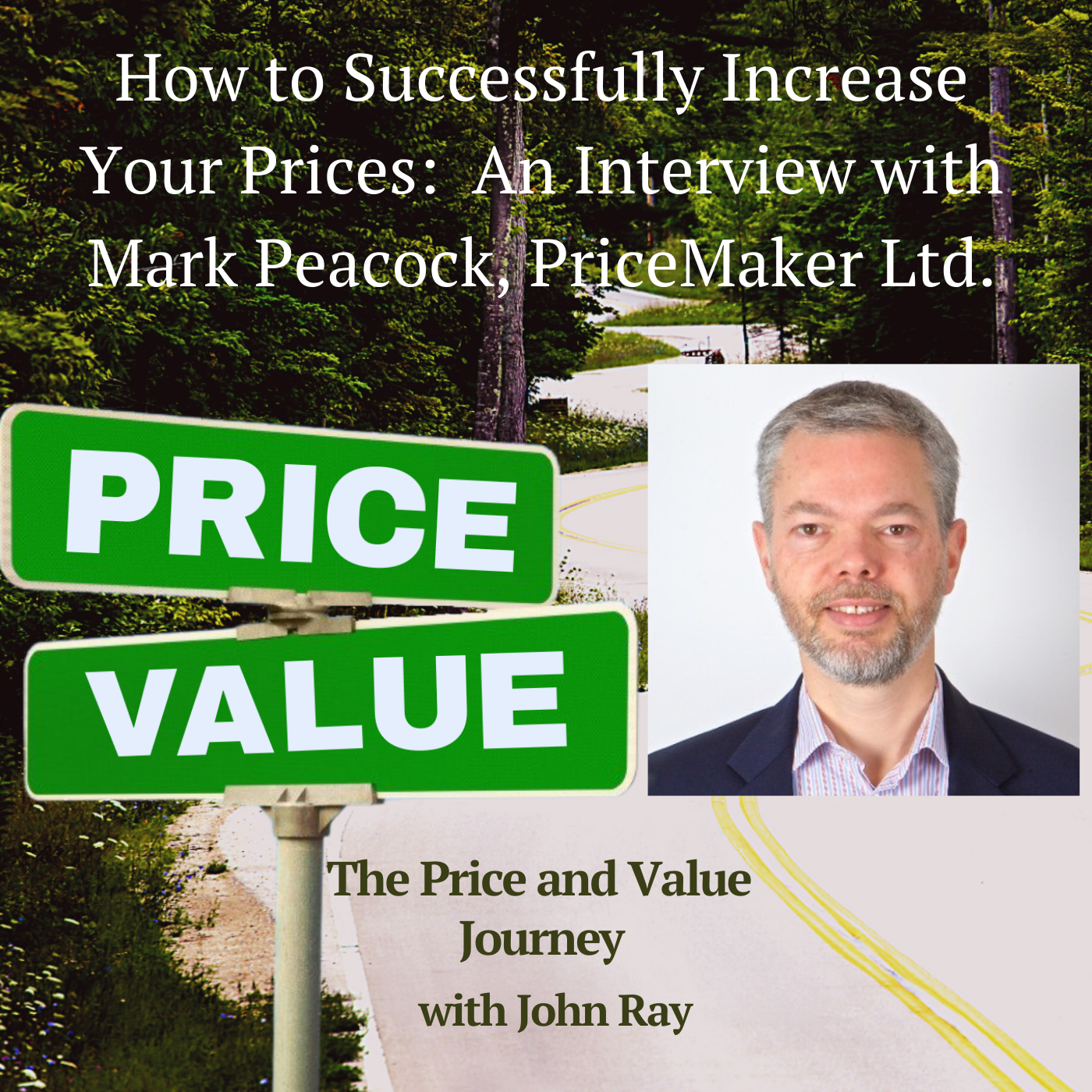
Connect with John Ray:

Website | LinkedIn | Twitter

Business RadioX®:  LinkedIn | Twitter | Facebook | Instagram

Tagged With: Consistency, John Ray, Price and Value Journey, professional services, professional services providers, reliability, solopreneurs, value

George Westinghouse and the Value Equation

February 11, 2022 by John Ray

George Westinghouse
North Fulton Studio
George Westinghouse and the Value Equation
Loading
00:00 /
RSS Feed
Share
Link
Embed

Download file

George Westinghouse

George Westinghouse and the Value Equation

The Current War is a movie based on the competition between Thomas Edison and George Westinghouse to determine whose vision of the electrical power delivery system in the United States would be implemented. In the movie, the character of George Westinghouse offers a compelling description of the value equation, which he used to his advantage. It’s a lesson for us as professional services providers. The Price and Value Journey is presented by John Ray and produced by the North Fulton studio of Business RadioX®.

TRANSCRIPT

John Ray: [00:00:00] I’m John Ray on the Price and Value Journey. I recently heard some words from George Westinghouse on the value equation. Well, it was probably not George Westinghouse himself, but actually the words put in his mouth. You see, I was watching a movie called The Current War, a movie which tells the story of the race between Thomas Edison and George Westinghouse to sell their competing visions of an electrical grid in the late 1800s. Edison pushed his original vision of direct current, while Westinghouse championed alternating current. Westinghouse’s vision won as alternating current was much more effective and less costly to distribute over long distances.

John Ray: [00:00:55] At one point in this movie, Westinghouse says, “The value of something isn’t what someone’s willing to pay, but the value of something is what it contributes.” This statement is the value equation at work. When a client assesses your service or product, they are judging the contribution your services will make to their business and their life. For them to buy, they must perceive that the benefits they will receive, whether in money earned, time saved, pleasure derived or something else is more than the price they pay. The only person who can determine this value is the client. It’s their perception, their determination of that contribution.

John Ray: [00:01:46] As depicted in the movie, Westinghouse used the value equation to his advantage. After Edison reneged on paying the talented inventor, Nikola Tesla, a promised $50,000, Tesla quit and Westinghouse pounced. He offered Tesla a royalty of $2.50 per AC horsepower, which would amount to much more than the flat $50,000. Tesla accepted and Westinghouse’ vision was on its way to realization.

John Ray: [00:02:22] The actual history is a bit more complicated, but the movie illustrates the point quite well. All Edison saw is that $50,000 was an immense amount of money. His ego kept him from seeing Tesla’s value. Tesla has no perceived value to Edison. Westinghouse, on the other hand, saw that the long-term contribution Tesla could make to his company dwarfed even a royalty payment like the one he proposed. The value which was at stake was immense. The opportunity to build the electrical grid for the entire United States.

John Ray: [00:03:06] That’s the value equation at work, Westinghouse and Hollywood style. It’s utilized by the buyer in every transaction. I’m John Ray on the Price and Value Journey. If you’d like to connect with me, go to Johnray.co or email me John@JohnRay.co.


About The Price and Value Journey

The title of this show describes the journey all professional services providers are on:  building a services practice by seeking to convince the world of the value we offer, helping clients achieve the outcomes they desire, and trying to do all that at pricing which reflects the value we deliver.

If you feel like you’re working too hard for too little money in your solo or small firm practice, this show is for you. Even if you’re reasonably happy with your practice, you’ll hear ways to improve both your bottom line as well as the mindset you bring to your business.

The show is produced by the North Fulton studio of Business RadioX® and can be found on all the major podcast apps. The complete show archive is here.

John Ray, Host of The Price and Value Journey

John Ray The Price and Value Journey
John Ray, Host of “The Price and Value Journey”

John Ray is the host of The Price and Value Journey.

John owns Ray Business Advisors, a business advisory practice. John’s services include advising solopreneur and small professional services firms on their pricing. John is passionate about the power of pricing for business owners, as changing pricing is the fastest way to change the profitability of a business. His clients are professionals who are selling their “grey matter,” such as attorneys, CPAs, accountants and bookkeepers, consultants, marketing professionals, and other professional services practitioners.

In his other business, John is a Studio Owner, Producer, and Show Host with Business RadioX®, and works with business owners who want to do their own podcast. As a veteran B2B services provider, John’s special sauce is coaching B2B professionals to use a podcast to build relationships in a non-salesy way which translate into revenue.

John is the host of North Fulton Business Radio, Minneapolis-St. Paul Business Radio, Nashville Business Radio, Alpharetta Tech Talk, and Business Leaders Radio. house shows which feature a wide range of business leaders and companies. John has hosted and/or produced over 1,100 podcast episodes.
Connect with John Ray:

Website | LinkedIn | Twitter

Business RadioX®:  LinkedIn | Twitter | Facebook | Instagram

Tagged With: George Westinghouse, John Ray, Price and Value Journey, pricing, professional services, professional services providers, solopreneurs, value, value equation

  • « Previous Page
  • 1
  • …
  • 9
  • 10
  • 11
  • 12
  • 13
  • 14
  • Next Page »

Business RadioX ® Network


Our Most Recent Episode

CONNECT WITH US

  • Email
  • Facebook
  • LinkedIn
  • Twitter
  • YouTube

Our Mission

We help local business leaders get the word out about the important work they’re doing to serve their market, their community, and their profession.

We support and celebrate business by sharing positive business stories that traditional media ignores. Some media leans left. Some media leans right. We lean business.

Sponsor a Show

Build Relationships and Grow Your Business. Click here for more details.

Partner With Us

Discover More Here

Terms and Conditions
Privacy Policy

Connect with us

Want to keep up with the latest in pro-business news across the network? Follow us on social media for the latest stories!
  • Email
  • Facebook
  • Google+
  • LinkedIn
  • Twitter
  • YouTube

Business RadioX® Headquarters
1000 Abernathy Rd. NE
Building 400, Suite L-10
Sandy Springs, GA 30328

© 2025 Business RadioX ® · Rainmaker Platform

BRXStudioCoversLA

Wait! Don’t Miss an Episode of LA Business Radio

BRXStudioCoversDENVER

Wait! Don’t Miss an Episode of Denver Business Radio

BRXStudioCoversPENSACOLA

Wait! Don’t Miss an Episode of Pensacola Business Radio

BRXStudioCoversBIRMINGHAM

Wait! Don’t Miss an Episode of Birmingham Business Radio

BRXStudioCoversTALLAHASSEE

Wait! Don’t Miss an Episode of Tallahassee Business Radio

BRXStudioCoversRALEIGH

Wait! Don’t Miss an Episode of Raleigh Business Radio

BRXStudioCoversRICHMONDNoWhite

Wait! Don’t Miss an Episode of Richmond Business Radio

BRXStudioCoversNASHVILLENoWhite

Wait! Don’t Miss an Episode of Nashville Business Radio

BRXStudioCoversDETROIT

Wait! Don’t Miss an Episode of Detroit Business Radio

BRXStudioCoversSTLOUIS

Wait! Don’t Miss an Episode of St. Louis Business Radio

BRXStudioCoversCOLUMBUS-small

Wait! Don’t Miss an Episode of Columbus Business Radio

Coachthecoach-08-08

Wait! Don’t Miss an Episode of Coach the Coach

BRXStudioCoversBAYAREA

Wait! Don’t Miss an Episode of Bay Area Business Radio

BRXStudioCoversCHICAGO

Wait! Don’t Miss an Episode of Chicago Business Radio

Wait! Don’t Miss an Episode of Atlanta Business Radio