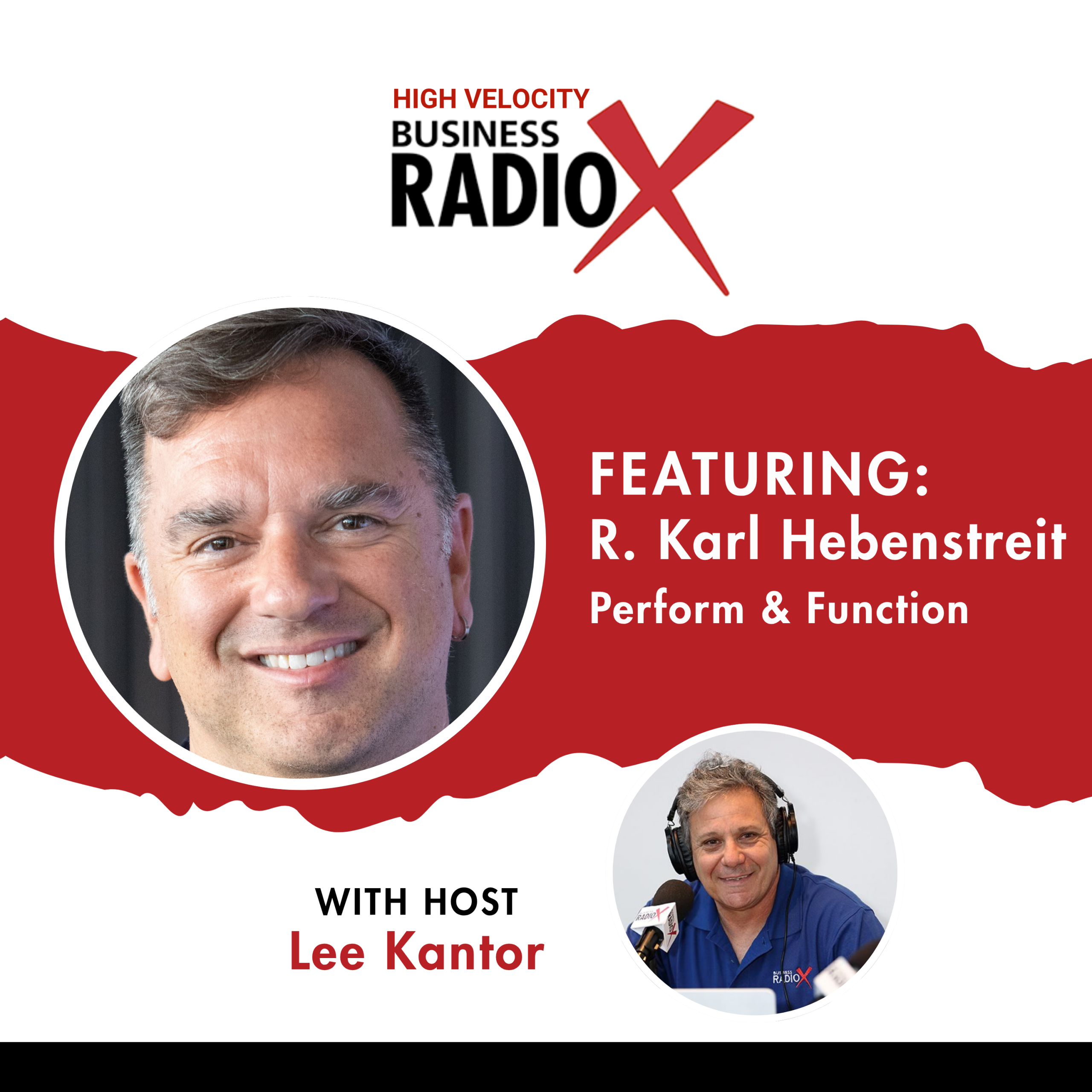

In this episode of High Velocity Radio, Lee Kantor interviews R. Karl Hebenstreit, Founder and CEO of Perform and Function LLC, about how the Enneagram can transform leadership, team dynamics, and organizational culture. Karl explains how understanding individual motivations—not just behaviors—helps leaders improve communication, strengthen collaboration, and build emotionally intelligent, inclusive workplaces that drive lasting business results.


R. Karl Hebenstreit, PhD, PCC, PHR is an international/TEDx speaker, author, certified executive coach, and leadership/team/Organization Development Consultant.
With 25+ years of experience helping leaders and teams exceed their goals, he brings human-centric, results-driven energy to every engagement. His PhD in Organizational Psychology studied the Enneagram and employee engagement, and led to him becoming an IEA Accredited Professional with Distinction, an IEA Accredited Professional Professional/Teacher, and iEQ9 Faculty member.
Driven to create a more emotionally intelligent world, he is the author of three award-winning books: The How & Why: Taking Care of Business with the Enneagram (PenCraft Award), Nina and the Really, Really Tough Decision (PenCraft/Readers’ Favorite, available in 6 languages), and Explicit Expectations (Axiom Award).
Karl’s fourth book, Enough, Already and Fully Functional, As You Are, is on the way. His mission is simple: inspiring audiences and organizations to activate their innate full functionality.
Connect with Karl on LinkedIn and Facebook.
What You’ll Learn in This Episode
- Understanding the Enneagram as a framework for leadership and personal growth
- Recognizing the difference between behaviors and underlying motivations
- Applying the Platinum Rule to improve communication and collaboration
- Building stronger, more inclusive, and emotionally intelligent teams
- Identifying individual strengths while developing untapped potential
- Using personality insights to enhance employee engagement and team performance
- Strengthening organizational culture through greater self-awareness and empathy
- Avoiding common misconceptions when implementing personality frameworks in the workplace
- Creating high-performing teams by aligning leadership with individual motivations
 This transcript is machine transcribed by Sonix.
TRANSCRIPT
Intro: Broadcasting live from the Business RadioX Studios in Atlanta, Georgia. It’s time for High Velocity Radio.
Lee Kantor: Lee Kantor here. Another episode of High Velocity Radio and this is gonna be a good one. But before we get started, it’s important to recognize our sponsor, Business RadioX. If you’re a business coach who’s tired of being a best kept secret, set up a call with Stone Payton at bookstonephone.com to unlock your perpetual prospect pipeline. Today on the show, we have the founder and CEO with Perform and Function LLC. Also known as that guy are R.Karl Hebenstreit. Welcome.
R. Karl Hebenstreit: Thank you Lee, great to be here.
Lee Kantor: Well, I am excited to learn what you’re up to. Tell us about your practice. How are you serving folks?
R. Karl Hebenstreit: So I am a certified executive coach and I do leadership development. I do team development, organization development consulting. But primarily I am working on doing speaking engagements. So I speak on cruise ships. I speak at conferences. I speak for organizations and companies that have events and all about emotional intelligence, building the Enneagram, using the Enneagram to become more inclusive and actually drive results in your organization. And that all is under the umbrella of performance function.
Lee Kantor: So let’s educate our listeners a little bit about Enneagrams. I’ve heard I watch the, um, Amy Poehler podcast, uh, big fan and she talks about it. I don’t want to say every episode, but probably every 4 or 5 episodes it gets mentioned. Can you, um, educate us a little bit about what it is and how it’s used?
R. Karl Hebenstreit: It is pretty life changing. And it’s funny that you say that because I think when people start to get introduced to it and see its power, they do try to bring it up as often as possible in conversations and in life. So yeah, the Enneagram is an ancient system. It’s not something that’s new, although it’s becoming widely acknowledged and, and, and used now more recently than ever before. It’s an ancient system that was originally used for spiritual development. And it maps the fact that we have nine different motivation styles or types. Each human being subscribes to one of these motivations for our entire life, and the goal is to understand that there are other ways of looking at the world, not just through that one lens that is our preferred are our strength, our area that we just come to rely on to help us survive. But there are these other eight as well that we need to learn from and integrate into our own perspective, expand our worldview, and be able to be more effective by invoking the strengths and lessons and insights that those other eight also have for us. And we all have all nine of them within us. It’s just that one of them is the dominant one.
Lee Kantor: So how did this come about? Like somebody noticed this a millennia ago. Like how did it get organized and written down and passed on?
R. Karl Hebenstreit: So no one will ever really know. What we do know is that the symbol is a Sufi symbol. And we’ve seen this in actually, if you travel to Egypt, you see some of the symbols and the symbolism in the in the, in the hieroglyphics and in the pyramids. And you see them etched in there. You actually see it in. I know Odysseus is a big movie right now. And so we have that in the in the Odyssey, you actually see all nine types, all nine lands visited in the journey. And it’s just you can see it play out throughout history and throughout time. And you’re right. I mean, people started seeing these patterns and seeing how there are nine of them and three of them really are aligned with heart types. Three of them with basically hard types means the way that we access our feelings, um, head types, the the way that we access our thinking style and action or gut or body types, the way that we take action. So three of them each and those, each one of these three centers, these body centers that we have. And obviously each one of us will think a certain way, feel a certain way and act a certain way. But it’s in accord with one of these three in each of the in each of those centers.
Lee Kantor: Now it’s how, how did it start getting used kind of in a business setting or in the leadership setting? When did that happen? Because, I mean, there’s other kind of things like, I don’t want to say that are like this, but, uh, oh yeah, they may not be exactly like it, but maybe they rhyme. Um, but, you know.
R. Karl Hebenstreit: So yeah, you’re absolutely right.
Lee Kantor: How did this kind of bubble up as, okay, this is the one that makes sense in a business setting.
R. Karl Hebenstreit: Right? So I think what you’re referring to is Myers-Briggs, maybe disc, maybe Hogan. Some of those systems that we were using in, I would say maybe the 60s and 70s, I think when they had their popularity. And those instruments are really interesting and they have their place because they describe behaviors, they describe how people will behave in an organizational setting or even in life. Where the Enneagram takes this deeper is that we’re looking at the motivation behind the behavior. Why is the person exhibiting this behavior? And when we work at that more fundamental level, that deeper level, we start to understand ourselves, first of all, and then other people better. And we have empathy for them to understand why it is that they’re exhibiting these behaviors that we may find baffling, or that we wouldn’t exhibit ourselves, or we may be exhibiting the same behaviors and thinking they’re doing it from the same reasoning, but they’re not. They’re applying different reasoning to have that same behavior that we’re doing. And then that may baffle us as well. So this became more useful or utilized in organizational settings in the 1980s. And I actually stumbled upon it in a PhD program where I was studying organizational psychology. And this was, I always like to say it’s the last century because it was it was 1999. And so that’s when I started my studies with it and ended up using it for my PhD thesis and using the Enneagram to help organizations attract, retain and motivate their employees.
Lee Kantor: So now when you kind of go deep in this, um, is it something that if you’re an individual contributor in an organization and I know I’m a number seven or whatever I am, um, okay, what do I do with that information? Like how is that useful?
R. Karl Hebenstreit: So it’s useful for yourself. And you also need to share that with your colleagues and your managers. Your manager would need to know this because the way that you motivate an Enneagram type seven is totally different from the way you motivate a type five. So the sevens are the epicures, the adventurers, the visionaries, and they always want exciting new things. They want to be involved in different things and visionary things and, and just big projects, and not necessarily get too mired down to the details, but they have that. Their strengths and their. Their their wheelhouse is in being visionary and really getting that excitement going for other people to follow them as well, which is totally different from maybe a type five or type six. The five is the observer or analyst that really wants to go deep into the details and plan and make sure that they don’t look foolish. Sevens are okay, looking foolish. There’s no issue with that. And the sixes would probably be more in the land of let’s make sure that we have all of our ducks in a row and plan for all the worst case scenarios that may happen. So they want to feel that sense of, I need to feel like I’m safe, I’m comfortable, I’m secure. So all these knowing where the person, your team member, your direct report, even your manager, what they lead from, what their motivation is, their core motivation will help you in working with them and motivating them accordingly. You may think that someone may be coming from the same motivation that you are, and you’re going to be treating them the way that you think that they’d want to be treated based on how you’d want to be treated. And that would be a fallacy, because that would be the golden rule. Treating others the way people, the way that you want to be treated. What we actually want to do is we want to go into the platinum rule and treat others the way that they want to be treated, what makes sense for them.
Lee Kantor: And then, um, when you have these kind of conversations with folks and you mentioned the Enneagram, this is kind of you are what you are, right? Like if I’m a seven, then like I’m not going to tomorrow be, I’m going to work hard and be an eight. Like it doesn’t work like that, right?
R. Karl Hebenstreit: Yes and no. Yes and no. So yes, you are what you are for life. You’re your core motivation stays with you for your entire life because that’s what helped you survive your childhood. And the goal is to tap into that eight to tap into the eight and say, okay, I know that my tendency is to dream big and have all these visionary ideas, and sometimes I don’t get to execute on them. So how can I lean in onto my eight wing there and get the learning from that, that, um, protector, the general, the, the, uh, the, the director, which, who actually gets things done, who actually is really good at executing. And you have that within you. You have access to that. It’s just that you have to focus on it more. It’s not automatic for you. It’s something that you need to focus in on more. So it’s expanding your, your capabilities and strengths into accessing and activating all those other eight energies that can help you be successful.
Lee Kantor: Now is there like, this is a strength. It can be kind of mapped to a strength or a core motivation. Is there also the opposite of this is how not to do. Like if you’re this, then you or is there kind of if you’re a number seven, is there an opposite or is it any individual could have an opposite that’s totally different from another one that has a strength of whatever number they are?
R. Karl Hebenstreit: Yeah. So you touch on a couple points here because any overused strength, every time that we rely on a strength and we use it in every single situation, that can become a weakness because that situation may not require us to use that strength there. We may it may be requiring us to use something else. So yes, so if you continue to rely only on your core motivation and the strengths that are associated with it, you’re not going to be successful all the time because you do need to tap into the others. Now, the other thing that you tapped into is what’s the opposite of, and I kind of I like to liken that to each one of the types, each one of these core motivations, these energies has a stress point. So the sevens happens to be type one. There’s a line when you look at the actual symbol, there’s a line that goes from 7 to 1, and one is the stress point of the seven, and the one is the perfectionist. The one is all about rules, about order, about details, about following these constraints and staying within constraints, which is the antithesis of the seven, seven hates constraints, right? The seven just wants to be able to, to choose and, and have options and opportunities and take advantage of them without having these constraints. So you can think of that as kind of an opposite of it, but it’s really it’s part of you. It’s still part of you. And the goal is, okay, how can I tap into the high side, the positive attributes of the type one, which is all about this focus on quality and this focus on the mission, what we’re trying to achieve so that I don’t feel like I’m pressured and get myself stressed out when the deadline comes so I can prepare in advance and not have this be a very stressful way of me getting to that type one energy. So it really is tapping into that.
Lee Kantor: So now earlier on, you mentioned there were all all of them, but some are more of strengths and some are more of lesser strengths. They’re all strengths.
R. Karl Hebenstreit: So some lesser known lesser accessed. Yeah.
Lee Kantor: Lesser accessed strengths. Um, but they’re all things that if we put energy to, we could improve the functionality of them.
R. Karl Hebenstreit: Absolutely. I like to use the metaphor of a Swiss army knife. Do you have a Swiss army knife?
Lee Kantor: Yes.
R. Karl Hebenstreit: Okay. And it probably has, what, about a dozen tools on it?
Lee Kantor: Sure.
R. Karl Hebenstreit: How many of those do you use?
Lee Kantor: Right. You use a couple?
R. Karl Hebenstreit: Exactly. That’s exactly the same thing as human beings. We have all these. I’m going to use the Enneagram as the analogy here. Let’s say nine tools at our disposal. However, we’re only focusing on that main blade, which is whatever our core type is for you, it’s type seven. And then maybe 1 or 2 other tools that we remember are there or we’ve accessed before. So they’re easier to swing out of the case and we can use them. Some of those other tools that are in there, you probably don’t even know that they’re there, and you probably don’t even know what they’re used for. Right?
Lee Kantor: Yeah. So, so that’s what it is with this as well. That is.
R. Karl Hebenstreit: Exactly.
Lee Kantor: So now when you’re working with an organization, do organization, like what’s the pain the organization is having? Is it a communication issue? Or maybe the culture is a little off? What is the kind of the reason they would bring an expert like you into the organization to kind of share this knowledge.
R. Karl Hebenstreit: Yeah. All of the above. It really is all above Lee. So normally there would be an engagement issue. We’re not engaging our employees. They’re not engaged. We don’t understand them. Or we have a brand new team. And we want to make sure that we are getting off on the right foot, that we’re understanding each person so that we can work well together and come up with rules of engagement or how we’re going to work together. So, or sometimes it’s we’ve been working with this team and there’s dysfunction and we don’t understand why we’re not working well together. So there are many different reasons why someone would want to bring in someone who knows the Enneagram to help them. And you can do it in a couple of different ways. One is executive coaching individuals. Each individual will get to understand about themselves better, but ultimately the, the, the power of it is when you bring the team together and you look at each of each individual team member’s Enneagram type, and also maybe we talked about the three different styles that they have the feeling style, the thinking style, the action style. So looking at all of their styles as well and then comparing them and understanding people individually that way first.
R. Karl Hebenstreit: But then when you aggregate them, when you bring them all together, something gets pulled out, something gets enhanced, something is bubbles to the top, and that is the culture of the team. Because as we said earlier, we have all of those nine styles and energies within us. And when you take the aggregate of all of the reports to see, okay, when we have all these different access to these nine styles within us, which is the one that bubbles up most when we put these 12, 20 people together, have however many people it is on this team. So then we have the culture of the team. And then we can also see, okay, how is the culture of this team when we’re coming together and working together, compare to the culture of the organization or the culture of these other teams that we have to work with? And where is the battle? Where is the challenge? Where are we getting into conflict with each other, and how can we resolve that? What kind of rules or understandings or expectations can we put in place to make sure that we have that really great relationship going forward?
Lee Kantor: Now, I find that in a lot of organizations, um, communication issues are really at the heart of a lot of the challenges that they’re going through that there isn’t clarity of messaging and the communication is a little wonky. And having kind of a common language, which this provides for people, I think is very helpful and useful in the sense that if I see that this person is motivated this way, and this is what kind of gets them kind of the joy or whatever the issue is, I know that now that’s a clear communication that gives me a different I’m not like thinking, oh, this person just hates me. Or this is like, there’s some. Exactly. And I think that that’s at the heart of a lot of the, these kind of damaged cultures is that people are kind of passive aggressive, or they have these resentments and they don’t know how to communicate effectively because they don’t know what the other person’s thinking, and they don’t.
R. Karl Hebenstreit: Exactly.
Lee Kantor: And they’re not empathetic enough to even think that that’s even part of it. They take it the way they take it because they know that’s why they’re doing that, you know?
R. Karl Hebenstreit: And exactly.
Lee Kantor: And this gives you kind of the same, uh, song sheet to sing off of that. We’re all kind of now we all understand things a little differently. And then that transparency and authenticity is there because now you know that this is what I like and this is what I don’t like, or this is what my strengths are, and this is what my strengths aren’t. And once we all know all of this, it allows us to work together better.
R. Karl Hebenstreit: Exactly. And understand not only other people, but ourselves better too. Once we start with self first and figure out what are our styles, our preferences in each of these different areas, and then starts understanding, as you said, and having the empathy for others who are not sharing those same styles. So we’re so used to that golden rule that other people will be doing things and thinking about things the way that we are, that we don’t span into or extend into the platinum rule to ask the questions and say, hold on a second, what is your preferred way of communication? How do how much time do you need to think about something before I ask you to give your opinion on it and make a decision on it? What. How do you make decisions like what’s important for you? What are your values in this area? Those are different than mine. And guess what? They’re complimentary. They’re not wrong. In fact, I need to integrate all this new perspective into my own so that I have an expanded mindset to understand things even better, rather than through that 40 degree sliver that I’ve been looking at life through.
Lee Kantor: Right. And then and everybody’s at a different point of their journey. I mean, some people are more self-aware than others. And to make some assumptions, just because you’re in a certain place that everybody else is in that exact same spot is it’s going to bite you. I mean, that is just not going to be a healthy environment over time.
R. Karl Hebenstreit: No, you’re absolutely right. And different people have their own pace of getting to that understanding as well. Their readiness level is different too. First of all, self-awareness and then taking that, that step towards empathy as well for others.
Lee Kantor: So now when they come into this and you give them this common language and you give people kind of a perspective of this person likes this, or they are motivated this way, do you get like kind of aha moments all the time? I would imagine the whole room is like, oh, that explains things. And you know, maybe that person’s not a jerk. He just doesn’t work the way I work. You know.
R. Karl Hebenstreit: It’s like you’ve been in every single one of my workshops and rooms that I’ve been in. Yes, that’s exactly what happens. And people start diving deeper and understanding people, sometimes even apologizing for challenges that they’ve created or not worked through. So it’s, it’s really amazing. And it’s also amazing to be called back to do deeper work or if the team changes to come back and let’s do this again, because now we have a couple new people that joined, or now there’s a new leader or now we’ve promoted someone. So the dynamics have changed. So yeah, absolutely. That’s exactly what happens.
Lee Kantor: Now is there um, I don’t want to say a danger, but maybe a kind of an unintended consequence by sharing this information with maybe a young person too early before, um, in my thinking is if you say, okay, this is your thing, then they may lock in and just kind of go all in on that. And then, uh, those other areas where they’re not strengths might kind of, um, uh, be less worked on.
R. Karl Hebenstreit: Yeah. That is the, and going back to the readiness concept that we discussed, it’s how ready is the person to develop and change. And, and when I say change, I don’t mean change who they are. Right. And I think that’s another challenge that we have when we say change, people think I need to be someone different, I need to be someone else. And the reality is it’s just another A version of who you already are, but you just haven’t accessed it yet. It’s another skill, another gift that you have not taken the time to focus in on and draw out of you and activate and engage with. So the danger that you’re identifying is correct because some people who are not ready to see that they need to be different and access these different elements of themselves. I’ve heard and I’ve heard this is, oh, well, that’s who I am. Everyone else has to deal with it. Everyone has to change and work around me or, you know, come up with a way of dealing and handling that. And that’s a person who’s not ready to change and grow. Let’s put it that way, and access the other parts of themselves. And ultimately, every single one of those people has been ineffective and driven out of the organization because no one can work with them.
Lee Kantor: Right. The old Popeye, I am what I am. It doesn’t fly. You know, and especially in an enterprise organization where you got to deal with lots of people.
R. Karl Hebenstreit: Exactly. And it’s stifling. It’s actually doing a disservice to themselves because they are not accessing their full humanity. They’re not accessing all the gifts that are within them, and they are less of a person that way.
Lee Kantor: Yeah, I mean, absolutely. But that I mean, everybody’s on their own journey, so they’re going to get there when they get there. Um, and you can’t save them all. Um, so how, um, is there a story you could share that maybe illustrates what it’s like to work with you and the, and the impact that it can have in an organization. You don’t have to name the organization, but maybe share what they came to you, what challenge they had when they came to you, and how you were able to help them get to a new level?
R. Karl Hebenstreit: Yeah, I’ve had the fortune of being an internal as well as an external consultant. And one of my favorite stories for case study is when I was in external, I was not in this organization, I was external, I was brought in to do leadership development for the CEO of the organization. And the funny thing is, his wife had found me through a podcast that I had done years and years and years before. And so this totally came out of the blue. And so he insisted. So the, the wife, his wife had found the podcast and said, this needs to be your coach. So he reached out to me and I was like, well, I’m not accepting clients right now because I’m an internal and, and he said, no, no, no, you have to be my coach. I’m like, okay, let’s yeah, we can make this happen. So four years later, five years later, I’m still working with the organization. And with while he was there, we saw an increase in the sales of the organization. That happened almost double every year, year over year over year. It doubled every year for three years while we were working together. And we did, uh, Enneagram coaching with him, with his direct reports were on the leadership team. And then we did it with, uh, as in team building as well and all of that knowledge and insights from the Enneagram were being rolled out by him and his leadership team, which not only resulted in that almost doubling of sales year over year over year for three years, but also resulted in them having the highest employee satisfaction and engagement scores in the entire overall organization. They were a division in the United States, but then this was an international company, but and they had the highest engagement based on all of the insights that they were putting into practice from the Enneagram.
Lee Kantor: Wow. I mean, the impact is real. It’s just one of those things where people don’t know what they don’t know. I mean, it just.
R. Karl Hebenstreit: Exactly.
Lee Kantor: I think that’s really at the heart of this. And now, is there any advice you can give somebody that’s in an organization that might be struggling with this type of knowledge, what with what this type of knowledge might be able to be helpful and useful? Is there kind of some baby steps or some some things they can do on their own. Yes.
R. Karl Hebenstreit: And I caution that by doing it on their own, they run the risk of heart harming the organization and harming the team. Because if it’s used to stereotype, that’s not going to work. Right. Because as you as you said, well, I am this type and this is the way I’m going to be. Right. So we don’t want that to happen. We want the, the understanding to be that we are all nine types. And I think that most people, when they when they approach it from the standpoint of, I am this type only, that’s where that stereotyping and that lack of growth happens. So having a partner to help you go through it, to help you do it the right way in a way that you know is going to be received appropriately and rolled out appropriately within the organization, I think is critical. If you engage with an executive coach just on your own development, that’s obviously a great first step. But when you’re actually looking to roll it out within your organization on your team, definitely engage with someone who is a practitioner that’s certified and accredited in using the appropriate tools. And there are some tools out there that are free and not valid and not reliable, and I would not recommend those. I am a big proponent. I use this one tool from a South African company called Integrative Enneagram Solutions. It is the most valid. And the really cool thing about it is it helps you with the team report too. It’s not just your own report for yourself, but you can then create the team reports that you can really get a lot of value from.
Lee Kantor: Now, for a leader that’s contemplating working with you or somebody that’s an expert in this area, is it? How useful is kind of watching your Ted talk or reading some of your books? Is that good foundation before beginning an engagement?
R. Karl Hebenstreit: I think the Ted talk is a great introduction and ability to see the power of it and, and help it land basically, uh, at least at an initial level. And I think the books are probably better after you’ve engaged with the Enneagram as next steps for sustainability, for sure. And of course, the children’s book is as an easy introduction to it as well. I mean, you don’t need to go through any programs and to get the children’s book, and that’s in six languages. So depending on what your your favorite language is, it’s probably in that language for you.
Lee Kantor: So what do you need more of? How can we help you?
R. Karl Hebenstreit: I’d love to work more with organizations. My goal is to help make the world more inclusive and emotionally intelligent. I think the Enneagram is the way to do that, and I’m happy to do that through corporate engagements with speaking at conferences, speaking with teams, doing workshops to help teams get more cohesive and understand each other better. And it’s all about that inclusivity and emotional intelligence building.
Lee Kantor: Now, do you have.
R. Karl Hebenstreit: To reach out to me?
Lee Kantor: Yeah. Do you have a niche or a sweet spot of types of industries that you like to work in, or do they have kind of any commonality that this type works well or is, is, um, they really get what I’m doing.
R. Karl Hebenstreit: When I was an internal, most of my history has been with biotech and healthcare, but also technology and real estate services. So, and I’ve done work with private and public sector. So it’s, I’m, it really applies across the board and I can make it be customized to whatever the needs are for the specific industry sector and company and culture.
Lee Kantor: Do, um, private equity firms or, um, you know, startup incubators or accelerators ever bring you in to help with kind of those high growth initial team building in organizations like to get the culture right?
R. Karl Hebenstreit: Not yet. And I’m totally open to that because I really do think that getting it right from the very, very beginning, actually, that’s not true. I did do some work with one company that was was stealth and in uh, yeah, definitely before they even, uh, went public. So, so I’ve have had one client like that and I’ve had some other smaller clients that were startups, but I’m definitely, I’d be very fascinated to work with incubators because I really do think, especially when these venture capital firms are working with multiple smaller companies to get them in the right mindset from the very beginning, I think is really going to help them be successful.
Lee Kantor: And I would think also, if a private equity firm is involved in a merger or acquisition to get those two disparate teams, you know, kind of on the same page, would, you know, that seems like a simple ROI benefit from something like this early on.
R. Karl Hebenstreit: You are absolutely correct. Because that’s where most of those fail, right? When the cultures don’t match, when they don’t understand each other and they don’t have that complementarity. So that would be a big help there too.
Lee Kantor: So if somebody wants to learn more. Have a more substantive conversation with you or the team. What is the website? What’s the best way to connect?
R. Karl Hebenstreit: So my website is perform and function. So it’s a play on form and function. So it’s performandfunction.com. I’m also on LinkedIn as R Karl Hebenstreit. Karl is with a K and I’m Karl, karl@performandfunction.com.
Lee Kantor: Well Carl, thank you so much for sharing your story today. You’re doing such important work and we appreciate you.
R. Karl Hebenstreit: Thank you. Lee. Thank you for allowing me to get my message out and hopefully make this world a better place.
Lee Kantor: Absolutely. We need more of that. Well, this is Lee Kantor. We’ll see you all next time on High Velocity Radio.















