Business RadioX ®

  • Home
  • Business RadioX ® Communities
    • Southeast
      • Alabama
        • Birmingham
      • Florida
        • Orlando
        • Pensacola
        • South Florida
        • Tampa
        • Tallahassee
      • Georgia
        • Atlanta
        • Cherokee
        • Forsyth
        • Greater Perimeter
        • Gwinnett
        • North Fulton
        • North Georgia
        • Northeast Georgia
        • Rome
        • Savannah
      • Louisiana
        • New Orleans
      • North Carolina
        • Charlotte
        • Raleigh
      • Tennessee
        • Chattanooga
        • Nashville
      • Virginia
        • Richmond
    • South Central
      • Arkansas
        • Northwest Arkansas
    • Midwest
      • Illinois
        • Chicago
      • Michigan
        • Detroit
      • Minnesota
        • Minneapolis St. Paul
      • Missouri
        • St. Louis
      • Ohio
        • Cleveland
        • Columbus
        • Dayton
    • Southwest
      • Arizona
        • Phoenix
        • Tucson
        • Valley
      • Texas
        • Austin
        • Dallas
        • Houston
    • West
      • California
        • Bay Area
        • LA
        • Pasadena
      • Colorado
        • Denver
      • Hawaii
        • Oahu
  • FAQs
  • About Us
    • Our Mission
    • Our Audience
    • Why It Works
    • What People Are Saying
    • BRX in the News
  • Resources
    • BRX Pro Tips
    • B2B Marketing: The 4Rs
    • High Velocity Selling Habits
    • Why Most B2B Media Strategies Fail
    • 9 Reasons To Sponsor A Business RadioX ® Show
  • Partner With Us
  • Veteran Business RadioX ®

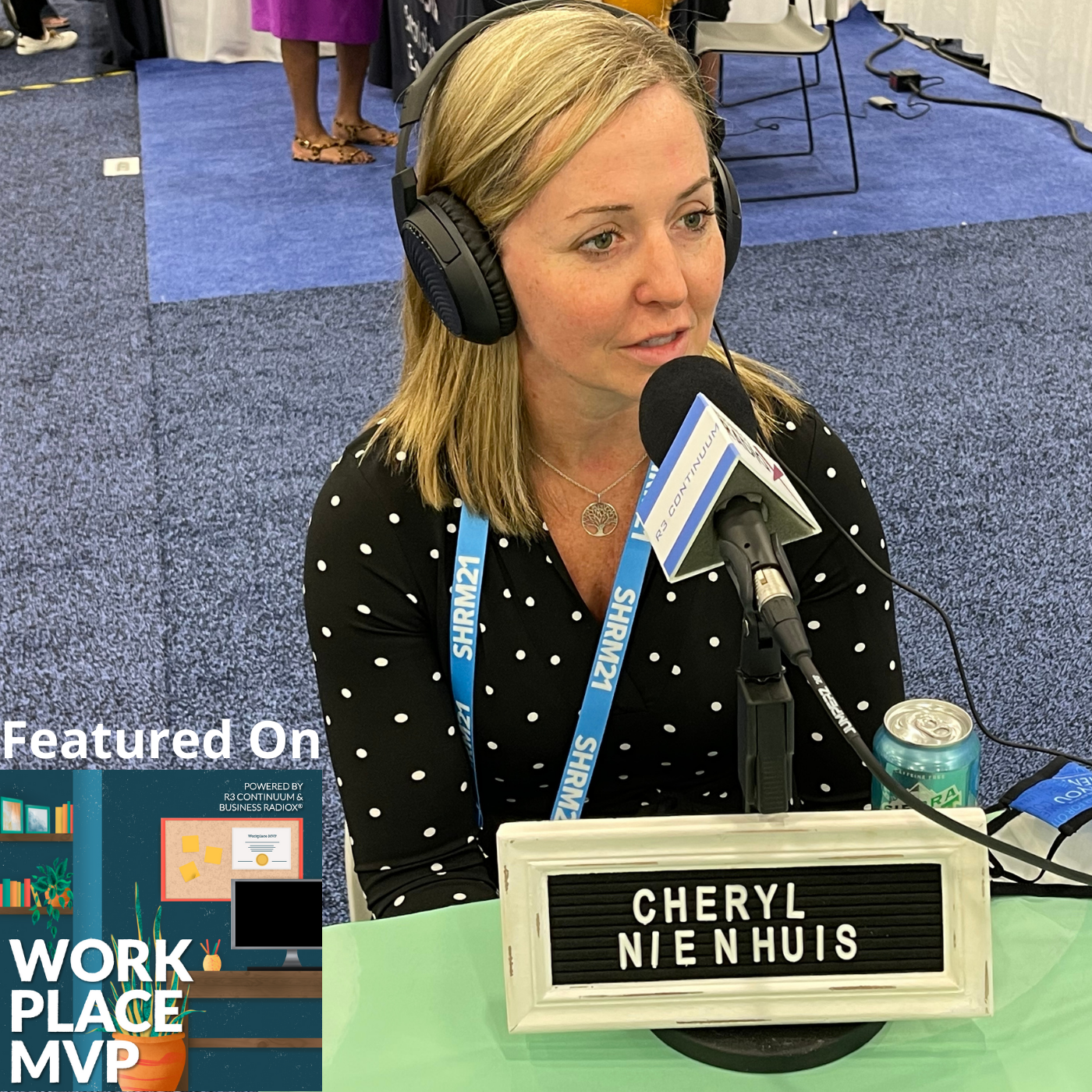
Workplace MVP LIVE from SHRM 2021: Cheryl Nienhuis, Mayo Clinic

September 20, 2021 by John Ray

Cheryl Nienhuis Mayo Clinic
Minneapolis St. Paul Studio
Workplace MVP LIVE from SHRM 2021: Cheryl Nienhuis, Mayo Clinic
Loading
00:00 /
RSS Feed
Share
Link
Embed

Download file

Cheryl Nienhuis Mayo Clinic

Workplace MVP LIVE from SHRM 2021:  Cheryl Nienhuis, Mayo Clinic

As Director of the Complex Care Program at the Mayo Clinic, Cheryl Nienhuis helps employers and their employees with access to specialized care for complex medical cases. She joined host Jamie Gassmann on this live edition of Workplace MVP to discuss her career journey and her work at the Mayo Clinic.  Workplace MVP is underwritten and presented by R3 Continuum and produced by the Minneapolis-St.Paul Studio of Business RadioX®.

This show was originally broadcast live from the 2021 SHRM Annual Conference held at the Las Vegas Convention Center in Las Vegas, Nevada.

Cheryl Nienhuis, Director – Complex Care Program, Mayo Clinic

Cheryl Nienhuis, Director, Complex Care Program, Mayo Clinic

Cheryl Nienhuis is the Director of the Complex Care Program at Mayo Clinic. She builds relationships with employers, payers, and third-party administrators to ensure that complex patients have access to Mayo Clinic’s destination medical centers in Arizona, Florida, and Rochester.

Cheryl has been with Mayo Clinic for about fifteen years starting in the Human Resources Department, and most recently joined the Complex Care Program Team. She works with employers helping them with benefits design of complex conditions and identification and referral to help manage costs.

LinkedIn

Complex Care Program, Mayo Clinic

When employees or members of an employer’s medical plan are experiencing fragmented care, ineffective treatments, potential misdiagnoses, or difficulty accessing specialized care for complex conditions, Mayo Clinic can help.

At their campuses in Arizona, Florida and Minnesota, teams of the world’s leading experts from every medical specialty and subspecialty work together to ensure the best possible outcome for each patient.

The Mayo Clinic Complex Care Program offers managed access (expedited scheduling and condensed appointment itineraries) to Mayo Clinic’s high-quality, cost-effective care for individuals with complex, rare, or undiagnosed medical conditions. In other words, Mayo Clinic helps minimize costs while getting patients exactly the care they need.

Company website

About Workplace MVP

Every day, around the world, organizations of all sizes face disruptive events and situations. Within those workplaces are everyday heroes in human resources, risk management, security, business continuity, and the C-suite. They don’t call themselves heroes though. On the contrary, they simply show up every day, laboring for the well-being of employees in their care, readying the workplace for and planning responses to disruption. This show, Workplace MVP, confers on these heroes the designation they deserve, Workplace MVP (Most Valuable Professionals), and gives them the forum to tell their story. As you hear their experiences, you will learn first-hand, real-life approaches to readying the workplace, responses to crisis situations, and overcoming challenges of disruption. Visit our show archive here.

Workplace MVP Host Jamie Gassmann
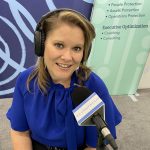
Jamie Gassmann, Host, “Workplace MVP”

In addition to serving as the host to the Workplace MVP podcast, Jamie Gassmann is the Director of Marketing at R3 Continuum (R3c). Collectively, she has more than fourteen years of marketing experience. Across her tenure, she has experience working in and with various industries including banking, real estate, retail, crisis management, insurance, business continuity, and more. She holds a Bachelor of Science Degree in Mass Communications with special interest in Advertising and Public Relations and a Master of Business Administration from Paseka School of Business, Minnesota State University.

R3 Continuum

R3 Continuum is a global leader in workplace behavioral health and security solutions. R3c helps ensure the psychological and physical safety of organizations and their people in today’s ever-changing and often unpredictable world. Through their continuum of tailored solutions, including evaluations, crisis response, executive optimization, protective services, and more, they help organizations maintain and cultivate a workplace of wellbeing so that their people can thrive. Learn more about R3c at www.r3c.com.

Company website | LinkedIn | Facebook | Twitter

TRANSCRIPT

Intro: [00:00:04] Broadcasting live from the SHRM 2021 Conference at the Las Vegas Convention Center, it’s time for Workplace MVP. Brought to you by R3 Continuum, a global leader in workplace behavioral health, crisis, and security solutions. Now, here’s your host.

Jamie Gassman: [00:00:23] Hello, everyone. Jamie Gassman here, your host of Workplace MVP, and we’re recording our episodes today from the Day 2 of SHRM 2021 here in Las Vegas, Nevada. And with me is Cheryl Nienhuis, who is the director of Complex Care from Mayo Clinic. Welcome to the show.

Cheryl Nienhuis: [00:00:44] Hi, Jamie. Thank you for having me.

Jamie Gassman: [00:00:46] So, share with us kind of your career background and what you do at Mayo Clinic.

Cheryl Nienhuis: [00:00:52] Great. I feel like I started my career in health care when I was about six years old. I won’t take you through all of the steps. But I remember pre-HIPAA, I’m sitting there and folding statements with my mom, from the doctor’s office that she worked for, and my career’s just kind of gone into the HR direction since then. And, I’ve spent the last 15 years almost at Mayo Clinic, most of that in our benefits department, making sure that we’re taking care of our employees so they can take care of our patients.

Cheryl Nienhuis: [00:01:22] And so, recently, I’ve joined the Complex Care Program team to really help employers make a positive difference in the lives of their employees by steering them to the right care for those individuals dealing with complex conditions and really working with them on a benefits design and identification and referral to help them manage their healthcare costs as well, as health care is continuing to be a very high cost for employers, which again they are having to share with their employee population. So, how can we help them get the right diagnosis early on and get the right treatment plan so they can get back to work and have the best outcomes possible?

Jamie Gassman: [00:01:57] And so, what are some of the, you know, kind of examples of how maybe a case scenario or something to that effect of, like, how an employer has used your program?

Cheryl Nienhuis: [00:02:05] Yeah. That’s a great question. So, a lot of employers deal with a lot of complex conditions with high spending cancer care or spine care. There’s a lot of overutilization with spine surgeries in the United States. And so, we really work with the employers to identify these individuals through their case management or their TPA or navigation service to steer care to Mayo Clinic for medical record review to see if they would benefit by coming to Mayo. And, if they would benefit by coming to Mayo, we ask the employers to pay for the travel and lodging. And, a lot of times these individuals are getting a change in their diagnosis and the right treatment path.

Cheryl Nienhuis: [00:02:47] So, in the instance of spine care, a lot of times they’re not needing spine surgery that was recommended locally, and a more conservative treatment is available for that individual. And so, it’s better outcomes for that individual to get the right treatment that they need and it’s better outcomes as well for the medical plan because they’re not having to pay for unnecessary procedures.

Jamie Gassman: [00:03:08] Absolutely. So, from an outcome perspective, would we be looking at, you know, maybe increasing the return to work duration so that it’s shorter in cycle than what would maybe have happened on a different – you know if they’ve gone through like the original diagnosis and treatments?

Jamie Gassman: [00:03:22] Absolutely. So, getting to work faster, you know also controlling the cost on short- and long-term disability, more presenteeism, because that individual is getting the right care. There are times when we see somebody come in for a spine surgery and they don’t have a spine issue. You know, it’s a hip condition or a shoulder, or sometimes even a heart condition, where if they went on with that surgery, they wouldn’t have gotten better and things would have still been costly for the employer.

Jamie Gassman: [00:03:52] Yeah. It would have almost, like, gotten worse potentially because they get done with that spine surgery and still having some issues.

Cheryl Nienhuis: [00:03:58] Absolutely.

Jamie Gassman: [00:03:58] Now, you had mentioned before we got, and when we started recording the episode, something about conflict resolution. Can you kind of dive into that a little bit about some of the work that you guys are doing in that aspect?

Cheryl Nienhuis: [00:04:10] Right. So, I think with the benefit design, all right, it’s a little hard to get employees to understand what their benefits are. I just read a recent study that said about 80% of employees don’t read their benefits, and out of that, 45% don’t understand what they’re reading. And so, they really go to their coworkers and everyone to understand their benefits. And so, really, there’s a misfit there in what we’re trying to do from an HR perspective in getting employees to understand their information.

Cheryl Nienhuis: [00:04:42] And so, we really work on proactively communicating the benefits and really streamlining the process for individuals so they’re not lost in the health care when they need it most, right. And so, really, removing the barriers and the confusion I think proactively has really helped a lot of people have more of a positive member patient experience. So, we’re trying to remove the conflict in the fragmented care or just health care in general to really remove the barriers there for a positive experience.

Jamie Gassman: [00:05:18] And I bet that’s like, you know, that’s probably some of the more common. Like, they don’t read it. And, you know, the terminology sometimes used in those materials is, like, I don’t know what that means, you know. So, I love that proactive approach [inaudible]. So, do you change the way that that’s communicated then? Do you modify, kind of, some of the approaches to how you’re informing those employees? And what does that look like if you do that?

Cheryl Nienhuis: [00:05:42] Yes, absolutely. So, we really work with the employers. We actually have a dedicated marketing communications manager that works with everyone that we work with to really identify how are they currently communicating and where all of their employees are located.

Cheryl Nienhuis: [00:05:58] You know, an example is working with a group that has truck drivers, right. How are the truck drivers going to be getting their information because they’re on the road? They don’t have the technology that they need. And if they do, they’re not using it to read benefits communications, right. And so, really working with an employer to create radio ads for their truck drivers, you know, because they’re going to be listening to the radio and they’re going to be hearing those types of things on the radio while they’re driving. So, really working with coming up with great ideas that may be out of the norm.

Cheryl Nienhuis: [00:06:29] We also encourage them to look at what their employees are saying. So many times we hear about, okay, do this, do that, from a communication perspective. But we’ve done surveys of where employees are actually listening and getting their information with employers to make sure that we’re addressing where they’re actually looking. And, a lot of times we find that they’re wanting or looking in places that the information is not available. So, we try and work and steer those employers to create a marketing and communication strategy that will benefit them and their employees.

Jamie Gassman: [00:07:03] Fantastic. Especially in today’s world of stress and burnout, reading another piece of, you know, literature in a long email isn’t going to be as effective as doing something that I can listen to it or I can watch it. So, that’s fantastic and kind of meeting that employee where they’re at is so powerful.

Cheryl Nienhuis: [00:07:20] Absolutely. Keeping that message simple, right. And, again, it’s not just – that message is how do you work and streamline your benefit strategy with the vendors that you work with. So, if a person happens to call the wrong vendor for something, which happens more than we’d like to admit, you know the vendors that are selected understand the programs overall that are being offered by their employer. And so, if they are calling the wrong place, that vendor is educated on where that employee should go. Again, so they’re giving the answer that they need, and then also really creating a strategy for the vendors that are working together to work together to create that positive patient experience.

Cheryl Nienhuis: [00:08:00] And so, we’ve seen a lot of groups going with wonderful, you know, telehealth. But with telehealth, making sure that they have a vendor that they can work with where if there is a complex condition, that telehealth group knows where to refer that complex condition or somebody that’s needing additional care from primary to specialty care. Again, that positive patient experience and member experience is the most important and the best outcome for the employer and the patient member.

Jamie Gassman: [00:08:28] Fantastic. Now, you’re an exhibitor here.

Cheryl Nienhuis: [00:08:30] Yes.

Jamie Gassman: [00:08:30] If there’s anyone listening, you know, from the SHRM attendees, which booth are you in and where can they find you?

Cheryl Nienhuis: [00:08:37] We are in Booth 5044 and I’m happy to talk to anybody. We’re also available if you just Google Mayo Clinic Complex Care and you can learn more about our program there.

Jamie Gassman: [00:08:48] And if they wanted to get in touch with you directly, Cheryl, how would they be able to do that?

Cheryl Nienhuis: [00:08:51] They can go ahead and find me on LinkedIn, or they could just give me a call at 507-422-6103. Happy to talk to anybody. Again, our goal is to really help employers and their employees and members and their employee loved ones that are dealing with complex conditions because our goal is to focus on the needs of the patient and to bring hope when there seems to be confusion and hopelessness.

Jamie Gassman: [00:09:15] Wonderful. Well, thank you so much for joining us today. And, again, if you are listening in from the SHRM Conference, stop by Booth 4076 as well and check out our Workplace MVP podcast being broadcasted from R3 Continuum’s booth. Thanks for listening!
 

Tagged With: Cheryl Nienhuis, complex care, Complex Care Program, employee benefits, Jamie Gassmann, mayo clinic, R3 Continuum, Workplace MVP

Workplace MVP: 9/11 Survivor Garland Williams, Ph.D, USA COL (ret)

September 20, 2021 by John Ray

Garland Williams
Minneapolis St. Paul Studio
Workplace MVP: 9/11 Survivor Garland Williams, Ph.D, USA COL (ret)
Loading
00:00 /
RSS Feed
Share
Link
Embed

Download file

Garland Williams

Workplace MVP:  9/11 Survivor Garland Williams, Ph.D., USA COL (ret)

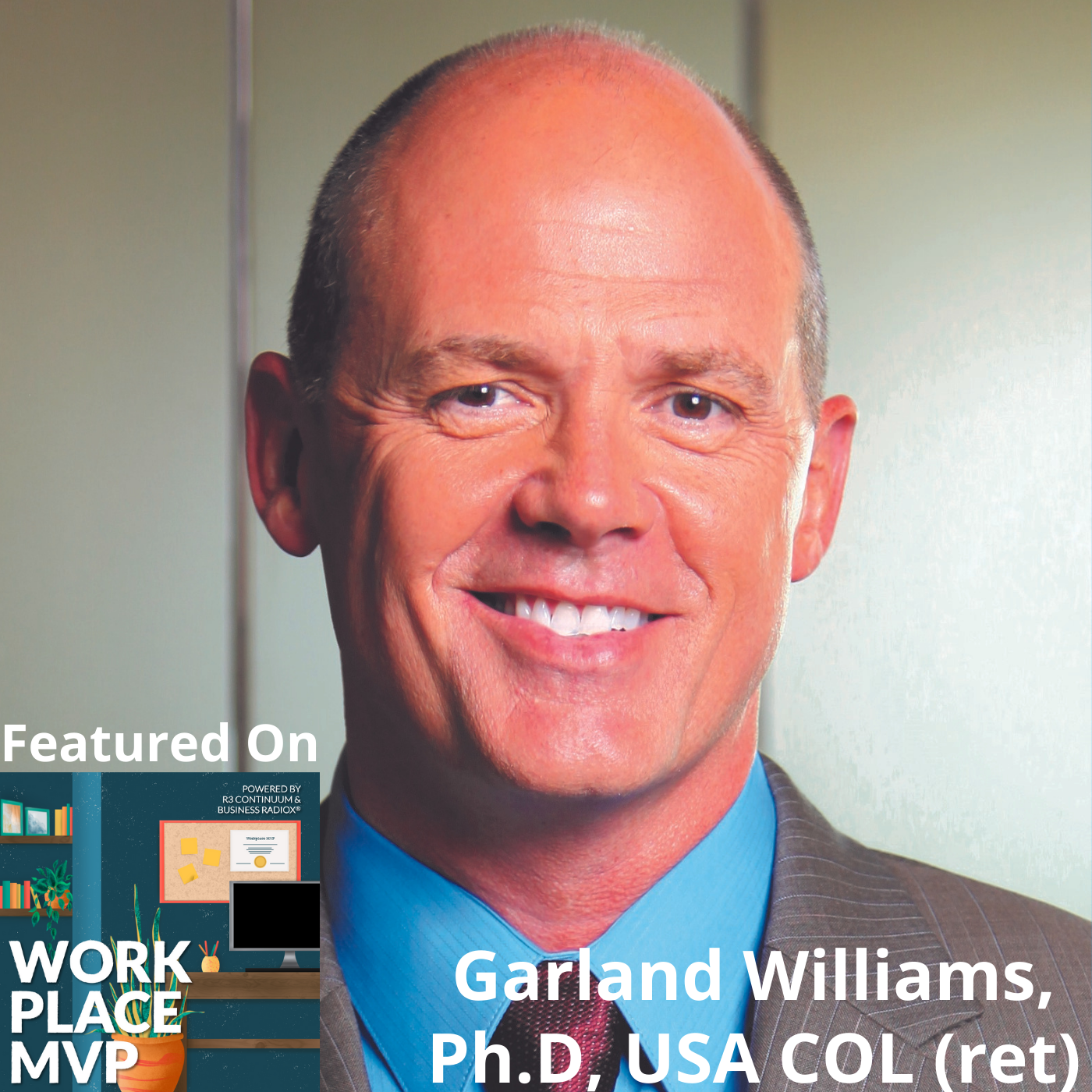
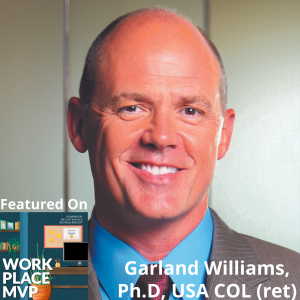
Then a Colonel in the United States Army, Garland Williams was working in the Pentagon on September 11, 2001, when American Airlines Flight 77 was hijacked by al-Qaeda terrorists and crashed into the west side of the building. In this compelling interview with host Jamie Gassmann, he discussed his experiences that day and afterward, the effect on his family, his advice for other leaders guiding employees through traumatic events, and much more. Workplace MVP is underwritten and presented by R3 Continuum and produced by the Minneapolis-St.Paul Studio of Business RadioX®.

Garland Williams, Ph.D., USA COL (ret), District Sales Coordinator, Aflac

Garland Williams, Ph.D, USA COL (ret)

Colonel (ret) Garland H. Williams, Ph.D., a native of Atlanta, GA, graduated from Auburn University as a Pre-Law/Journalism major and was commissioned a Second Lieutenant in the US Army Corps of Engineers.  As a company grade officer, Garland served in a variety of command and staff assignments both at Fort Stewart, Georgia, and in Bad Kissingen, Germany. He attended the Duke University Graduate School, attaining his Master of Arts and Doctorate of Philosophy degrees in Political Science.

As a field grade officer, his assignments included duty as an Assistant Professor in the Social Sciences Department at the United States Military Academy and staff officer positions in the 24th Infantry Division in the United States, and Allied Forces Southern Europe in Naples, Italy.  He commanded the 16th Armored Engineer Battalion in Giessen, Germany, and then served as the Military Advisor for the Assistant Secretary of the Army (Civil Works) in the Pentagon.  Following his Pentagon assignment, Garland completed a US Army War College fellowship at the United States Institute of Peace in Washington DC.

Garland’s Colonel-level commands included Garrison Commander of US Army Garrison – Japan, followed by Commandant of the Army Management Staff College until his retirement in 2009.  His operational deployments included Kuwait, Egypt, Bosnia, Kosovo, and Albania.

Transitioning from the Army, Garland worked at the University of Phoenix from 2010 until 2017, first as the Associate Regional Vice President for the Military Division and then as the Dean of Operations for the Colleges of Humanities and Social Sciences.  His last position at the university was the Dean of Academics for the College of Criminal Justice & Security simultaneously serving as the Vice President for Military Relations.  He was inducted into the International Adult and Continuing Education Hall of Fame in 2015, inducted into the Chamblee High School Hall of Fame in 2018, and has published two books – Engineering Peace and Perspectives On Leadership.  He moved back home to the Atlanta area in 2017 and now works as a District Sales Coordinator with AFLAC.

Garland has been married for 40 years to Kathy Perkins Williams of Dothan, Alabama, and has two married daughters, Rebecca, a 911 Dispatcher for the Sacramento, CA, SWAT team, and Leah, a Marriage and Family Therapist in Queens, NY.

LinkedIn

Aflac

Aflac is a Fortune 500 company, providing financial protection to more than 50 million people worldwide. When a policyholder or insured gets sick or hurt, Aflac pays cash benefits promptly, for eligible claims, directly to the insured (unless assigned otherwise). For more than six decades, Aflac voluntary insurance policies have given policyholders the opportunity to focus on recovery, not financial stress.

Company website

About Workplace MVP

Every day, around the world, organizations of all sizes face disruptive events and situations. Within those workplaces are everyday heroes in human resources, risk management, security, business continuity, and the C-suite. They don’t call themselves heroes though. On the contrary, they simply show up every day, laboring for the well-being of employees in their care, readying the workplace for and planning responses to disruption. This show, Workplace MVP, confers on these heroes the designation they deserve, Workplace MVP (Most Valuable Professionals), and gives them the forum to tell their story. As you hear their experiences, you will learn first-hand, real life approaches to readying the workplace, responses to crisis situations, and overcoming challenges of disruption. Visit our show archive here.

Workplace MVP Host Jamie Gassmann

In addition to serving as the host to the Workplace MVP podcast, Jamie Gassmann is the Director of Marketing at R3 Continuum (R3c). Collectively, she has more than fourteen years of marketing experience. Across her tenure, she has experience working in and with various industries including banking, real estate, retail, crisis management, insurance, business continuity, and more. She holds a Bachelor of Science Degree in Mass Communications with special interest in Advertising and Public Relations and a Master of Business Administration from Paseka School of Business, Minnesota State University.
R3 Continuum

R3 Continuum is a global leader in workplace behavioral health and security solutions. R3c helps ensure the psychological and physical safety of organizations and their people in today’s ever-changing and often unpredictable world. Through their continuum of tailored solutions, including evaluations, crisis response, executive optimization, protective services, and more, they help organizations maintain and cultivate a workplace of wellbeing so that their people can thrive. Learn more about R3c at www.r3c.com.

Company website | LinkedIn | Facebook | Twitter

TRANSCRIPT

Intro: [00:00:07] Broadcasting from the Business RadioX Studios, it’s time for Workplace MVP. Workplace MVP is brought to you by R3 Continuum, a global leader in workplace behavioral health, crisis, and security solutions. Now, here’s your host, Jamie Gassmann.

Jamie Gassmann: [00:00:30] Hi, everyone. Your host, Jamie Gassmann, here. And welcome to this episode of Workplace MVP. 9/11 is a day in our history that we will never forget, especially for those who were survivors or who had loved ones lost during the events of that day.

Jamie Gassmann: [00:00:47] Our guest today is one of those survivors. On the morning of 9/11, following the attacks on the Twin Towers in New York, the Pentagon was attacked when hijacked American Airlines Flight 77 was deliberately flown into the west side of the building by Al Qaeda terrorists. With us today to share his personal experience from being inside the Pentagon at the time of that attack is Workplace MVP, Army Colonel (Ret.) Garland Williams. Welcome to the show, Col. Williams.

Garland Williams: [00:01:15] Thanks, Jamie. I appreciate you all having me on.

Jamie Gassmann: [00:01:18] So, let’s start out with walking us through your Military career journey and give us a little bit kind of background of where you’re at today with your career.

Garland Williams: [00:01:28] Oh, sure. Yeah. I was fortunate to be able to spend 28 years in the Army. I retired in 2009 as a colonel. I was an engineer officer. And I playfully say that I blew stuff up for a living for 20 years, and did some institutional stuff at the end. But I retired in 2009 and then I went to work on my second career. I was a Dean and Associate Regional Vice President for University of Phoenix. My job there was to help military veterans and active duty achieve their higher education goals, you know, go back to college.

Garland Williams: [00:01:57] And then, now I work for Aflac. I’m a District Sales Coordinator for Aflac. And I call it my third helping career where we can help individuals if they have a medical emergency and they don’t have a financial emergency at the same time.

Jamie Gassmann: [00:02:08] Perfect. So, while you were working at the Pentagon, can you share with us a little bit about what was your role while you were stationed there? And, you know, give us kind of a sense about how long you were stationed there before the attacks occurred?

Garland Williams: [00:02:22] Sure. Yeah. So, I had been in the Pentagon about three-and-a-half months. I had just spent five years in Europe between Italy and Germany. I had just come out of Italian Command, and my boss had nominated me to be one of the aides to one of the assistant secretaries of the Army. So, my job title was actually Military Assistant to the Assistant Secretary of the Army for Civil Works. So, if you do a quick count, that’s a 12 word job title requiring a really big business card.

Garland Williams: [00:02:47] But, basically, I was the Military Aide to the Civilian Head of the Corps of Engineers. And so, I’ve been in the Pentagon about three-and-a-half months still trying to figure out what all that was and trying to figure out the building as well.

Jamie Gassmann: [00:02:58] Yeah. So, speaking of the building, you know, we see that building on T.V. They show it sometimes in shows and even on the news. Can you walk us through how that building is structured and what the office structure looks like? Give us a sense of how you were positioned within it.

Garland Williams: [00:03:16] Sure. Yeah. It’s a crazy building. It’s the largest office building in the world. It was built in 16 months during World War II. And, in fact, at about the 11th month mark of that, the General Marshall decides he wanted a third floor, so they added a third floor in the middle of construction. So, it has three floors above ground and a classified number of floors below ground. It has 17 miles of quarters and 23,000 of your closest friends work there.

Garland Williams: [00:03:42] So, it’s got five rings. The center ring is the A ring and goes out to the E ring. I was in the E ring, because I was, again, the aide to one of the assistant secretaries. And the army has five assistant secretaries, so it’s a pretty big deal, four star equivalent presidential appointee. And the great thing about being on the E ring is we had windows. You know, none of the other rings really had windows, so we actually could see the Sun occasionally. But it’s a big building.

Jamie Gassmann: [00:04:08] Yeah. So, in looking at, like, the day of the attacks, you know, you were working in the offices during that timeframe and the attacks started in New York. So, what was going through your mind or when did you first hear about those attacks happening while you were working?

Garland Williams: [00:04:28] Sure. Yeah. Well, my day started, I mean, it was a gorgeous day. It was a perfect fall day in D.C. I mean, it was one of those days when you have the first hint of fall. There was not a cloud in the sky. I’ve done my normal physical training in the morning. I went running my three-and-a-half, four miles, or whatever it was. I drove into the Pentagon.

Garland Williams: [00:04:45] And I was actually getting a travel voucher ready to take to the Army Budget Office. My boss and I had gone to Chicago the week prior to look at some core projects. And after every trip, you have to go into your settlement so you can get your travel documents. That’s what I was working on.

Garland Williams: [00:05:00] And my office number was 2Echo545. And the reason that’s important, the way you translate that, the two means I was on the second floor; echo means I was on the E ring; and 545 meant that my office was between the fifth and sixth quarters. There was ten quarters, those are like the spokes to the Pentagon. And I finished up the travel paperwork and I was going to take it to the Army Budget Office. But it was about two minutes to 9:00, and we had our normal weekly staff meeting at 9:00. So, I just kind of packed that up on my desk and said I’ll do it after the staff meeting. And I went to the staff meeting.

Garland Williams: [00:05:34] About three minutes into the staff meeting – our office is made up of 18 people, it had three Military and 15 civilians. And one of the civilians, Bruce, had a BlackBerry. You say, “BlackBerry, that’s old equipment.” Well, back then, it had just come out. I mean, I still had the old Gibbs NCIS flip phone – Bruce had a BlackBerry, and he got the first notice that a plane had hit one of the towers. And we didn’t know how bad it was.

Garland Williams: [00:06:00] And I actually told my boss, I said, “You know, you have a speech on Friday at the Millennium Hotel -” which is one of the seven hotels that rang the trade towers “- do you want me to change your reservations?” He said, “No. You know, they’ll have it all cleaned up by then. We’re good.” We’re thinking a Cessna like everybody else did. In about 20 minutes later, Bruce got the second notification that the second plane had hit the towers. And we quickly realized something’s going on. And then, that’s about when the Pentagon got hit.

Jamie Gassmann: [00:06:32] Almost immediately after you heard about the second tower, roughly.

Garland Williams: [00:06:36] It was. Yeah. I want to say that notification came in about 9:34-ish and the Pentagon got hit at 9:37.

Jamie Gassmann: [00:06:44] So, you really didn’t have time to process what was happening in New York before you, yourself, were under attack.

Garland Williams: [00:06:50] Right. Yeah. Our office was responsible for – we headed up the Corps of Engineers. So, we did water policy, we also did tribal policy, and we also oversaw Arlington Cemetery. So, the idea of terrorism and everything really didn’t sink in well. But we found out later that was going to really be a big part of our job just because of the oversight of things like locks and dams, things like ports, things like river flow, things that we never really had thought about needed to be hardened for terrorism. But, yeah, in those three minutes, it didn’t hit. It didn’t affect us.

Jamie Gassmann: [00:07:25] And when the plane hit, did you know it was a plane that was hitting the Pentagon?

Garland Williams: [00:07:29] No. Again, I was an engineer in the Army, and so I did a lot of explosives. I could do C-4, TNT, Bangalore torpedoes, mines. I could also do liquid explosives. And we also trained on if we didn’t have real explosives expedient, so I can go to Home Depot and grab some stuff if I need to. I’m not going to, but I can do that.

Garland Williams: [00:07:49] And so, when the plane hit, it felt like a bomb. A big bomb, but it didn’t feel like a plane. So, if something happens like that, you’re going to get up and go see what’s what. And I was the closest person to the door, so I got up and opened the door. I looked down the hallway toward the noise, and all I could see was a rolling cloud. If you ever think about Indiana Jones and Temple of Doom, and he’s running away from that big rock, replace that rock with a big rolling dust cloud and replace Indiana Jones with our admin staff running away from this cloud. And that’s what you saw.

Garland Williams: [00:08:25] And Military mind kicks in, if this is a bomb and if it’s terrorism, where can we be safe, at least temporarily, until we figure out what’s going on? We owned our conference room. It was always locked unless we were in there. So, I grabbed the admin staff and said, “Come on in. Let’s kind of figure out where we go from here.”

Jamie Gassmann: [00:08:44] Yeah. So, walk us through what happened next. Can you give us kind of the timeline of how you were able to get to safety out of the building as well as bring some of your staff with you out of the building.

Garland Williams: [00:08:57] So, again, I’ve been there about three-and-a-half months, and in the time that I had been there, we had never practiced a fire alarm. And I don’t know how long they had not done that before I arrived, but they’d been a while. And we got the alarm to evacuate the building. And as we opened up the door to go to the hallway, the first time I opened it up, it was clear, except for that cloud to my left. Now, that cloud had already gone past, so you see kind of this rolling cloud of dust. The lights didn’t go out yet, but all you can really see were, like, the exit signs.

Garland Williams: [00:09:29] And at that time, they did not have lights that would kind of lead you to the exit. That was a change they made to the Pentagon after this, so we could follow lights on the floor because that’s where you would see if you want to get low for smoke and things like that.

Garland Williams: [00:09:43] The sounds, you heard the alarm, you heard a lot of shuffling of feet. But what I thought was really interesting, there wasn’t panic. I mean, people were walking with a purpose, but they were walking with a purpose. They weren’t running. They weren’t knocking people down. I was pretty proud of the Pentagon for that, actually. You know, the Pentagon is made up of a mixture of civilians and Military. Military, you kind of sort of expect that because it’s hammered into us. Civilians kind of adopted that mindset and just, “We got to go this way. Everybody’s got to go this way. Let’s all go that way together.”

Garland Williams: [00:10:15] So, as we were going out, one of our senior civilians, she was an SES2, Senior Executive Service 2, and that’s like a two star equivalent military terms. She said, “Let’s go to the center courtyard. And I’m thinking to myself, “Okay. Ma’am, you might be expert on water policy, but you are not an expert on military. So, no, we’re not going to do that.” I’m thinking if we go to that center courtyard and it really is a terrorist attack, we’re putting ourselves in a vulnerable position with snipers on top. You’re in a cage.

Garland Williams: [00:10:45] Now, a sideline on that, the center courtyard for the Pentagon, when the Soviet Union was a Soviet Union, that center courtyard was on their nuclear target list. And the reason it was on the nuclear target list is because they kind of saw that a lot of people gathered there in the middle of the afternoon, so it must be a really important place. It’s got a really good café with really good hot dogs, that’s why people were there in the middle of the day. And, in fact, it was renamed the Ground Center Cafe.

Garland Williams: [00:11:13] Anyway, so the SPS said, “Got it. Makes sense. We’re going to go out.” So, we went to the river entrance, which was the closest entrance to us. And, now, I didn’t have my cell phone. I didn’t have my car keys. I didn’t have my hat. In the Pentagon, cell phones just don’t work. It’s too hard of a building. You can’t get connectivity. Keys in a Military uniform, especially in Class B’s or Class A’s, there’s really no good place to carry it and look Military. And the hat, you don’t need a hat in the Pentagon. Even in the center courtyard, it’s a no hat area. So, all that stuff was on my desk. So, I didn’t have a phone.

Garland Williams: [00:11:47] As we were coming out of the building, I did borrow a cell phone from one of our supply clerks to call my wife. And I got a call out, which is amazing because all that stuff crashed pretty soon afterwards. I called her and said, “Hey, there’s been a bomb. I’m okay. I’ll call you when I know more.” And she was oblivious. She had been out walking, again, it was a gorgeous fall morning. Then, she came in and she was chatting with a friend of hers in Australia. Had not turned on the T.V. And she says “A bomb? Are you okay? Whose phone is this? Are you coming home?” She had no idea.

Garland Williams: [00:12:23] As we went outside, nobody in our office got hurt from the blast. But we did have a lady that had an epileptic attack in the middle of this and we had to carry her out of the building. She was okay. We got outside. And, again, we have not practiced this evacuation, so we didn’t really know where our spot was to go, because everybody is designated a spot. But we found a spot. We counted noses to make sure that everybody was there.

Garland Williams: [00:12:48] And, again, my boss was one of the assistant secretaries, so I borrowed a phone. I called into the Army Operation Center – we call it the Tank – just to let them know where my boss was – kind of key. I hung up the phone. And then, we got the call from the MPs, Military Police, for all military to go forward and help out with casualty evac.

Jamie Gassmann: [00:13:08] Wow. And at that point, you still had no idea it was a plane that had hit? You’d still thought it was a bomb. At what point did you identify that it was a plane that had hit and that it had been terrorists that had caused that plane crash?

Garland Williams: [00:13:23] Yeah. So, as we came out of the building, I noticed parts on the ground that were sized like dinner plates. And I was thinking, “Okay. Maybe it wasn’t a bomb.” But there was a helipad just outside our office and I thought maybe a helicopter exploded. Because you can do what’s called a hot refueling of a helicopter. Basically, that means you’re filling up a helicopter while the rotors are still going. If you do it right, it’s perfectly safe. If you do it wrong, helicopters tend to go boom and blow up. And so, I thought maybe that’s what had happened.

Garland Williams: [00:13:50] But as we got called to the MP line, we ran forward, the three of us, there was a colonel, I was a lieutenant colonel at the time, and a sergeant. We ran forward, and as we came around the corner of the building, we saw a bright, bright, bright fire, kind of like what you would see for a welding torch. It was just really bright white. “Okay. That’s weird. Maybe it was a bomb. I don’t know.” When we got to the MP line, they stopped us, and they said, “There’s a fourth airliner in the air. Start running.” That’s the first time I knew it was an airline. And then, all the pieces with the World Trade Center and all that start to kind of come in play. And if there’s a fourth airliner, nobody knew where it was going. So, we started running toward Arlington about that time.

Jamie Gassmann: [00:14:31] Wow. And walk us through, so you’re running towards Arlington, about how far away is Arlington Cemetery from the Pentagon?

Garland Williams: [00:14:41] Yeah. In metro terms, it’s one stop. It’s probably maybe a-half-mile to three-quarters-a-mile. Now, that’s interesting. The lady that said let’s go to the center courtyard, she had had a hip replaced in that year, she ran faster than I did. We got about halfway to Arlington and kind of stopped. Let everybody sort of gather their breath a little bit and figured out what we’re going to do.

Garland Williams: [00:15:05] So, my boss had not been at the Pentagon very long himself. He had a townhouse in Georgetown, and so he said, “Okay. I’m going to walk to my house.” The colonel had his keys and could get to his car on the south parking lot. So, he took three of the staff with him. The rest of us kept on walking toward the Arlington Metro and we got to the metro station.

Garland Williams: [00:15:28] Now, you would think in a national disaster, they would just start piling people on the metro to get them out of the area. Well, nope. Still had to pay. I had a $20 bill to my name, so I had to buy $20 worth of metro tickets. We got on the train. People kind of fanned out because the way the metro works throughout D.C., you have the orange line, you have the green Line, you have the blue line. And so, wherever you had to go, that’s kind of where you could go. And most of those came into the Arlington Station.

Garland Williams: [00:15:56] So, me and another guy, Chip, in my office got on this because he lived near me. They took us out two stops and they made everybody get off. And then, they just started rotating the train back and forth to get people out of the immediate area.

Garland Williams: [00:16:09] So, as we’re waiting for the next train, I said, “I need to call my wife. Tell her what’s going on. Tell her that she needs to pick me up if she could.” And I didn’t have my cell phone, but I had a government travel phone card that we’re supposed to use on official only kind of thing. I was, “Okay. There’s nothing more official than this.” So, I went to the payphone, tried to use it. The call wouldn’t go through because the phone lines were all jammed. And as I hung up, I said something like, “Okay. I’ll try later.” And, like, four people handed me their cell phones. People I had no idea who they were.

Garland Williams: [00:16:42] I got into a call to Cathy, my wife, and I said, “Okay. Chip and I are coming out. Please get us at the Dunn Loring Station,” which is farther out in the orange line. I lived in Annandale, for those that know where that is. And so, that’s what happened. So, we went out to Dunn Loring. Cathy picked us up. We took Chip home first. That was Chip’s birthday, so happy birthday, Chip. And then, we went to our house. And then, we started trying to figure out what’s next.

Jamie Gassmann: [00:17:09] Yeah. And how did you navigate that? Because, obviously, at that point, you really just evacuated the area and got people to safety and got yourself to safety, and now you’re with your family. You know, how did it play out from there? Like, how did you talk with your family? And you’ve mentioned in a previous call that you had children at the time, how did they find out and how did you talk with them?

Garland Williams: [00:17:32] Yes. So, there was, like, two parts of my brain, I guess, kind of going through this. First, the professional piece, you know, “Oh, crud. I’m not at work. How do we kind of keep this going on?” And then, the family piece.

Garland Williams: [00:17:42] So, the work piece, I was actually part of the group that was part of the Pentagon alternate headquarters. So, if something happened to the headquarters, whether it be terrorism or hurricane or something, there was a small group of us that would go to an alternate location to have continuity of operations. Well, we couldn’t get there. Normally, we kind of pile up on a bus or some kind of mass transportation to get out there, but we couldn’t get out there. So, Pentagon really didn’t have a full load operation center going at the time.

Garland Williams: [00:18:13] The second piece was family. And so, I finally got home about 12:30. And I have two daughters. The two daughters at the time they were in school. One, she was almost 12 and sixth grade and one that was almost 16 in tenth grade. So, on Tuesdays in Fairfax County schools, in the elementary schools, they have what’s called teacher in-service day. So, the kids get off a little bit early so teachers can do their training.

Garland Williams: [00:18:37] And so, Leah, my youngest, comes bopping in with a ponytail swinging and saying, “Hey, mom. I got this homework. I got that homework, et cetera, et cetera.” And mom says, “Okay. That’s okay. You can do your homework later. And dad needs to talk to you.” And she went, “Wait a minute, what do you mean I could do my homework later? That’s not normal. And what’s dad doing home?” So, I brought her to the back of the house.

Garland Williams: [00:18:56] Now, they had not told any of the kids at the elementary school, which is a good thing. And so, I kind of walked her through what’s going on or what I knew, because I didn’t know the scope of it. You all probably knew more than I did at that point because you all have been watching T.V. I had not. And I kind of explained what I did. And she said in her 12 year old self, “Okay. Thanks. All right.” And kind of bebopping and went did her homework.

Garland Williams: [00:19:18] My other daughter was in tenth grade in public school in Fairfax County, and somebody came over the intercom and said, “America’s under attack. If you have a parent that works in the World Trade Center or the Pentagon, come to the counseling office.” And so, Becca, my oldest, ran to the counselor’s office, got a call into mom. And mom said, “I’ve heard from dad. He’s doing fine.” And she said okay. And she came home at the normal time. But if you were to look at the front of her school, all these limousines started coming through the front of the school because there were a lot of embassy kids from other countries. And all the embassy kids were starting to get picked up. So, that’s not normal. She came home.

Garland Williams: [00:19:59] My wife in the middle of this, like I said, she was oblivious to it all. Our house is a cell phone hole, the only place you could talk on your cell phone was at the mailbox. So, if you can picture her in her workout clothes with a cell phone in one hand and a cordless phone on the other trying to call family and all that, she did amazing things.

Garland Williams: [00:20:20] And then, she made a remarkable decision. She said, “I got to go to the grocery store because we don’t know what’s going to happen and I know we’re out of bread.” And the way she says it right now is, you know, you can’t have a natural disaster without bread. So, she went to the grocery store, because the grocery stores did shut down for a couple of days. And then, like the rest of everybody else, we started watching T.V.

Jamie Gassmann: [00:20:43] Yeah. And that’s probably where the full scope of what was going on you were able to actually see and kind of catch up to what everybody else had been watching. How did you feel at that moment?

Garland Williams: [00:21:01] Yeah. Interesting you ask. At that point, I did not know who I knew that were killed or hurt. And that’s one thing that my wife did really well, because I’ve been in the Pentagon three months, there’s 23,000 of your closest friends. Every day when I go down the hallway, I run into somebody else that I didn’t know worked there, that I had been stationed with before. And I come home at night and say, “Hey, guess who I saw today? Guess who I saw today?” And so, she probably had a list of 20 people that she could call them and say, “I heard from Garland. Have you heard from Bob? Have you heard from John? Have you heard from whatever?” Just kind of doing the Army family tree support thing.

Garland Williams: [00:21:41] And so, I didn’t know to be sad yet. I was mad. I was kind of mad. I did not know how close I was yet. We were watching it. And you know what was on T.V., they kept showing the Pentagon and that second plane flying in there. It was just, you know, “What are we getting into?” Now, as a soldier, I knew we were going to war. I just didn’t know with who. So, we watched and watched and watched.

Garland Williams: [00:22:07] The next morning, I thought I was around one of the points in the Pentagon. I thought it hit here and I was around one of the points over here. On the front page of The Washington Post, they had a diagram of the Pentagon and showed where that plane went in. And I finally realized the plane went here and I was 100 yards to the right of it. You kind of get a cold shudder like, “I just dodged something.”

Garland Williams: [00:22:33] Now, you asked me how I feel, Thursday night, my mother-in-law called and she was dancing around it trying to be nice, you know, nice to her son-in-law. And she went to be like a journalist, you know, how do you feel kind of thing. And I said, “Well, you know, some idiot with an airplane just tried to kill me and it kind of pissed me off.” I’m just trying to make light of it. And that became the quote that ended up in the Atlanta Journal the next year when I did a one year anniversary speech. So, it was like, be careful what you say in public because it might come back to haunt you. But I was mad.

Garland Williams: [00:23:04] And my wife and I, we always said at some point it’s going to hit us. At some point, we’ll be cutting onions and start crying or something. And it took about a year. And my wife was doing something and you start crying for no reason. So, I was mad.

Garland Williams: [00:23:23] But then, the operational piece kicked in. We got to go on. The family still got to go on. We’ve got to figure out how we can get back to normal. I mean, for parents, you always want your kids to get back to normal. You want to protect them. Every time we moved, the biggest thing we want to do is to get them settled and get them back to normal. I mean, Jamie, you’re a military kid. You know what that feels like?

Jamie Gassmann: [00:23:45] I do.

Garland Williams: [00:23:46] And normalcy, because we uproot our kids every two or three years, the faster we can get to normalcy, the better off they can be. And this is no different. But what was really weird is, when you go outside, it was silent. There were no airplanes in the air. And in the D.C. area, you always hear airplanes. I live in the Atlanta area, you always hear airplanes. The traffic was down because a lot of businesses were closed. You know, Wall Street was still trying to figure out what they were going to do.

Garland Williams: [00:24:14] And I just remember, you still got a workout, you still got to be in shape, and I went to ride my bike. And I was in a forest and just stopped. I could hear birds, but that’s about it. It was weird. Very, very weird. And then, we did find a place to go to work. We kind of piled in on top of the Corps of Engineers. And on that following Monday, I had to go on another business trip. We had to fly out to San Francisco. And as we got on the plane, the pilot came over and said, “I don’t know if anything’s going to happen, but if it does, we’ll take care of it. Let’s go.” “Okay. Let’s go.”

Jamie Gassmann: [00:24:47] Wow. And we’re going to talk a little bit about your recovery and things that you did as a family and for yourself in just a moment. But we just have a quick word from our show sponsor. Workplace MVP is sponsored by R3 Continuum. R3 Continuum is a global leader in workplace behavior health, crisis, and violence solutions. And would like to extend their gratitude to the 9/11 first responders, to Col. Garland Williams for his service to our country, and to all the service men and women who are currently serving, have served, and who gave the ultimate sacrifice for our country. To learn more about R3 Continuum, please r3c.com.

Jamie Gassmann: [00:25:26] So, you mentioned you had to get on another business trip, like, that following Monday. I’m sure that had to be really hard. But you also mentioned in previous conversation the days following 9/11, you began your recovery. And I know you talked about that effort to get back to normalcy. And I definitely know how that feels. I think I actually attribute that to my resiliency as an adult so there’s definitely some benefits to that.

Jamie Gassmann: [00:25:52] But talk to me through what did that recovery process look like for you. Because, obviously, you’ve shared kind of that journey that you went through going through it and then identifying kind of comrades and coworkers that you lost on that day. How did you work through that process for yourself?

Garland Williams: [00:26:14] Sure. Yeah. So, one thing I didn’t say is, that very first decision I made about not going to the Army Budget Office was probably the one that saved my life. If I had gone to the Army Budget Office, I would have been talking to a lady named Judy Rolet. Judy was one of the victims, because the Army Budget Office was the point of impact. And so, if I had been talking to her, I wouldn’t not be talking to you today. So, you asked me about survivor’s guilt or whatever, yeah, that’s a big one.

Garland Williams: [00:26:42] But to recover, a couple of pieces to recovery. Obviously, there’s the mental and physical individual recovery, which I’ll talk about in a second. But there’s also a recovery of the office functions in the office, because we just have been attacked and the headquarters of our response is going to be in the Pentagon. How do we get that back up?

Garland Williams: [00:27:04] There are three offices that got hit, the Army Budget Office, the Army G1 or Personnel Office, but also the Army Computer Center. And you don’t realize how much you rely on your computer files. We were literally in the dark. All my contacts, all that stuff, went away with that. Now, whoever recovered that stuff, they were able to recover 87 percent of the information that was in that computer center. So, it was amazing if they could pull that back together.

Garland Williams: [00:27:33] As far as the office, we relocated with the Corps of Engineers for about eight weeks. We did go back in our office about four weeks to see what we could recover. We got in the hazmat suits and everything. They said not to recover anything that was cloth or paper, and I violated that and I’ll tell them why in a minute. But we had to go through and see what was messed up. So, again, fire didn’t go through, but water did. I mean, it was an incredible amount of water damage.

Garland Williams: [00:28:00] Because we had a new assistant secretary, as they come in, they get to choose new furniture because their big deals are presidential appointees. All that furniture had whipped up water, all this kind of a nice, cheery wood furniture. So, we’re picking up furniture and throwing it out the second window.

Garland Williams: [00:28:15] I went to my office and I hit the keyboard on my computer and water would just shoot up. I did take a uniform, at that time it was called Army Class A Greens. It was a little more green than normal from the mold. I did take a flag that had flown over Congress that was in one of my drawers, I thought that’s kind of important. And I did grab my military personnel file, which is just soggy. And I didn’t know if I could recover it, so I took it and, eventually, just kind of laid out all those pages in my garage to dry out.

Garland Williams: [00:28:44] So, we had to figure out it was a long term. And about eight weeks later, the kind of key people in the office, my boss and myself and two others, came back in the Pentagon. Because you need to be close to the chief of staff. You need to be close to the army secretary. And then, everybody else came in about four weeks later.

Garland Williams: [00:29:02] The Pentagon was undergoing a renovation. Again, it had been built in 16 months, but is going through a ten year renovation called PENREN, Pentagon Renovation. And that wedge that was hit was the very first wedge that had been renovated. They hadn’t been occupied, like, 30 days before. And a little bit of precedence, but as part of that renovation, they wanted to see how they could harden the Pentagon to catch an airplane.

Garland Williams: [00:29:32] So, I mean, the terrorists weren’t all that smart. They could have picked nine other wedges, but they pick the one that they probably would have the hardest time to penetrate. So, the plane, it did go to the E ring, it did go to the D ring, and partially through the C. That hardening actually saved the life of a friend of mine, which I’ll talk about.

Garland Williams: [00:29:51] And then, we had to figure out, we have the Corps of Engineers, 37,000 primarily civilians stationed across the world, how do we get them involved in making sure that we won’t have another attack? So, we were going to places like the locks and dams on the Mississippi River, the dams out in Oregon, going to the Port of Long Beach, you know, because there’s hundred thousands of tons of stuff that come through every single day. We’re trying to figure out how do we harden our country but still maintain the openness that we enjoyed? And it’s not an easy problem to solve.

Garland Williams: [00:30:27] We were also trying to figure out how do we honor the victims? Because part of our job is we oversaw Arlington Cemetery. And so, my boss had changed in the middle of this. My new boss was a political appointee, former congressman, but he also owns some funeral homes before he went into Congress. And so, he and the head of Arlington got along really well. And the challenge was trying to figure out how we honor the victims with their remains in Arlington without being able to separate out the terrorists remains. There’s just no way to do it. And I think they came up with a pretty good way to do it. It’s a five sided monument in Arlington. And then, of course, we came up with the Pentagon memorial that truly honored the victims.

Garland Williams: [00:31:15] And then, there was the recovery of myself. We did go through one group counseling, it was an Army colonel doctor. And she came and did, basically, a group session with us and talked about our feelings. You know, Army officers don’t talk about their feelings, but they want us to do that. And we had the option to continue. I didn’t do that. And in retrospect, I probably should have. But I just didn’t do it. I just didn’t think I needed it. My life was going so fast trying to keep up with my boss and my family.

Garland Williams: [00:31:50] And we were just kind of coming out of the stigma of behavioral health. You know, it used to be that if you went to behavioral health on your own, you were admitting weakness and you didn’t want to admit weakness, especially as an officer or a non-commissioned officer. We were starting to come out of that. But in the last 20 years, we’ve come way out of that. Where, as people are redeploying from a combat zone, they go through questionnaires to see if they should probably get some help. And getting help is not a sign of weakness. It’s actually a sign of strength. So, I probably should have done that.

Garland Williams: [00:32:23] My family, they bounced back pretty well. But my kids, I think they know they almost lost their dad. And for me, it made me want to go and make sure every day counted. So, before, I was a normal Army officer where I’d planned out six months and I was living not for the moment, but down the road. Now, you got to wake up and see what can I do today that counts?

Jamie Gassmann: [00:32:50] Yeah. And that led to some of your career changes later in life, too, as well.

Garland Williams: [00:32:56] It did. It did. Yes. So, I was 20 years in the Army at that point. I was never going to make the Army as a career. That wasn’t my plan. I was going to do my five years to pay back my scholarship, get out, and make a million bucks. And I found out I like blowing stuff up and I found out I liked who I was doing it with. And so, my wife and I decided we would do a stateside assignment. For our first assignment, we do an overseas assignment, Germany, do company command, and then we make a decision.

Garland Williams: [00:33:23] And in the middle of the company command, I got the bright idea to apply to teach at West Point after I got turned down by the Army to go get a master’s degree in something else. And lo and behold, they accepted me and they sent me to a really good school. They sent me to Duke for a master’s degree. I was able to finish up my PhD there. But when I got my orders, it said for every one day in class, I owe the Army three more days. And so, that would take me up to, like, 13-1/2 years. I said, “Okay. It would be dumb to get out then.” I can do another six-and-a-half to go to retirement. And then, it kept snowballing and snowballing, and I ended up with 28. So, I missed my goal by 23 years.

Garland Williams: [00:34:00] And when I came out of the Army, I couldn’t stay for two more years. I had commanded twice as a colonel. I knew I wasn’t going to get promoted to brigadier general because I didn’t command a brigade in combat. My choices, I was either going to be sent downrange into Afghanistan or Iraq, which was fine. I don’t have a problem with that. Or I was going to get buried in the Pentagon for my last couple of years.

Garland Williams: [00:34:20] And my mom was sick at the time. I did not know how much longer she had. So, I opted to go ahead and leave a perfectly good paying job in 2009, which, if you look at the economics, was probably not the most smart thing. And then, I transitioned to the University of Phoenix to run the Military Division, so it wasn’t much of a change for me. And then, now, for four years, I’ve been working in Aflac, again, trying to help people if they have a medical emergency and not have a financial emergency at the same time.

Jamie Gassmann: [00:34:51] Fantastic. So, now, looking at, obviously, yourself and your family, what, from your perspective, are some of the long term effects that you’ve had over this last 20 years?

Garland Williams: [00:35:06] For me, as I said, it made me think about making an impact, being present in the family. Because, you know, a couple of times during my major and lieutenant colonel years, my wife really needed a cardboard cut out to prove that she was married – life in the Military. Make sure I was present with my kids, you know, to attend everything I could. And I did a pretty good job with them. I mean, I was still traveling a lot, but one thing that if my kids ever call, I take the call.

Garland Williams: [00:35:37] And that one came kind of funny. I was out at Fort Lewis in my last job in the Army. I was doing a presentation in front of about 4,000 people. I was talking about the Civilian Education System. And my phone rang, I forgot to silence it. And I looked at it, it’s my daughter. And they say, “Oh. Go ahead and answer it.” So, I answer it, it’s Leah. I said, “Okay. Leah, you’re on speaker in front of 4,000 people. Can I help you?” And she’s, “I’m okay, dad. You can call back later.” But the idea is I always take the call. And they know that any time I’ll take it.

Garland Williams: [00:36:13] My kids, I think at a very young age realized how resilient they can be and how precious life is. And my youngest, actually, partly because of this experience, partly because of another experience in high school, she is a marriage and family therapist. And so, she talks to people through this. My daughter-in-law is a behavioral analyst. She has her Ph.D. in psychology. She works with kids with autism and works through problems. And then, my oldest daughter is a 9/11 dispatcher, first responder. She works with the Sacramento County SWAT Team. So, I’m pretty proud of it, they all picked jobs at service.

Jamie Gassmann: [00:36:54] And so, as a leader and an employee – because, obviously, in your role within the Military, you would have been seen as an officer, so a leader of that group and an employee also – having gone through the events that you did that day, if you were going to be speaking to other leaders about how they can focus on the support of their employees, both in the immediate aftermath of that event but then also in years following, what would be some things that you would want them to take into consideration and do for their people?

Garland Williams: [00:37:30] Well, I mean, you say I was a leader in the Pentagon. I was a lieutenant colonel, and in the Pentagon that doesn’t really mean a lot. I mean, because, you got four, three, two and one stars. I’m pouring coffee for those guys. But I was an officer. And I don’t care what rank you are, civilian or military, you lead by example. You know, the lowest private can be the leader if he’s doing the right things.

Garland Williams: [00:37:54] And so, if I was to go through this again – I don’t know if force is the right word – I would probably highly encourage everybody to talk this out. Because things don’t get better with age. Bad news doesn’t get better with age. And, also, bottled up feelings don’t get better with age. It’s tough conversations. It’s still tough conversation, very emotional event, lost friends, have friends who got hurt.

Garland Williams: [00:38:24] Now, probably long term, I would tell people to make sure their priorities are in the right order. People always say, when somebody is on their last dying day, they probably don’t say, “I really wish I worked more.” That’s probably not the last wish. They’d probably say, “I probably wish I’d spent more time with my kids. I probably wish I had done this hobby a little bit more.” And you realize you don’t necessarily live to work. A lot of us do. That’s our identity. But, really, you need to work to live. And, also, live in the moment.

Garland Williams: [00:39:00] I mean, as an Army officer, we have a tendency to plan. I like to know what’s going to happen six months out. And have a plan that at least we can change a little bit as we meet the enemy. A plan never survives contact with the enemy, whatever that enemy is. But at least you have a way to go. But you can also overlook the great things that happened today. And that’s the one thing that I continue to struggle with, but I still try to enjoy what I’m doing today. It might be the last day. You never know.

Jamie Gassmann: [00:39:27] That’s such great advice. So, if any of our listeners listening want to get a hold of you, how can they do that?

Garland Williams: [00:39:34] They can call me or they can email me. I’ll give my phone number out, it’s 480-307-1929. And, yes, that’s a Phoenix Area phone number. But that was my first cell phone after the Army. But I live in the Atlanta area, so don’t worry, it’s not a telemarketer. Or you can send me an email, garlandwilliams@ymail.com. A lot of people dance around and say, “Are you willing to talk about 9/11?” Of course, I’m willing to talk about 9/11. I don’t do a lot of Facebook posts, but I always do one on 9/11. Because a lot of people have never met somebody that has been there and just make yourself available to talk through it.

Jamie Gassmann: [00:40:16] Yeah. Well, you’re certainly the first person that I’ve met firsthand that has been through it. And I thank you for letting us celebrate you, for letting you tell your story with our listeners and about the events of that day. And I really appreciate you being on the show. It truly was an honor for me to be able to interview you and a privilege, and I really thank you for that.

Garland Williams: [00:40:42] Well, I appreciate that. I don’t ask people to think about 9/11 every day. There’s a lot of other things that are on our mind. I do think about it in some way. Like I said, I want to make sure that every day counts. But I do ask people to think about it at least once a year on 9/11, on Patriot’s Day. And think about the people that were lost. Think about the people that are injured. But more importantly, think about the families, because the families really bore the brunt of this. And I know 2,977 victims of that day would appreciate it if you thought about the families.

Jamie Gassmann: [00:41:11] Yeah. Absolutely. So, just closing out the show here today, I want to thank our show sponsor, R3 Continuum, for supporting the Workplace MVP podcast. And to our listeners, thank you for tuning in for this special edition and episode featuring Col. Williams.

Jamie Gassmann: [00:41:30] If you’ve not already done so, make sure to subscribe to get our most recent episodes and our other resources. And you can also follow our show on LinkedIn, Facebook, and Twitter at Workplace MVP. Thank you all for joining us and have a great rest of your day.


Tagged With: 9/11, Aflac, Col. Garland WIlliams, Jamie Gassmann, Pentagon, R3 Continuum, September 11th, terrorist attack, Workplace MVP

Workplace MVP LIVE from SHRM 2021: Brandee Izquierdo, SAFE Project

September 16, 2021 by John Ray

Brandee Izquierdo SAFE Project
Minneapolis St. Paul Studio
Workplace MVP LIVE from SHRM 2021: Brandee Izquierdo, SAFE Project
Loading
00:00 /
RSS Feed
Share
Link
Embed

Download file

Brandee Izquierdo SAFE Project

Workplace MVP LIVE from SHRM 2021:  Brandee Izquierdo, SAFE Project

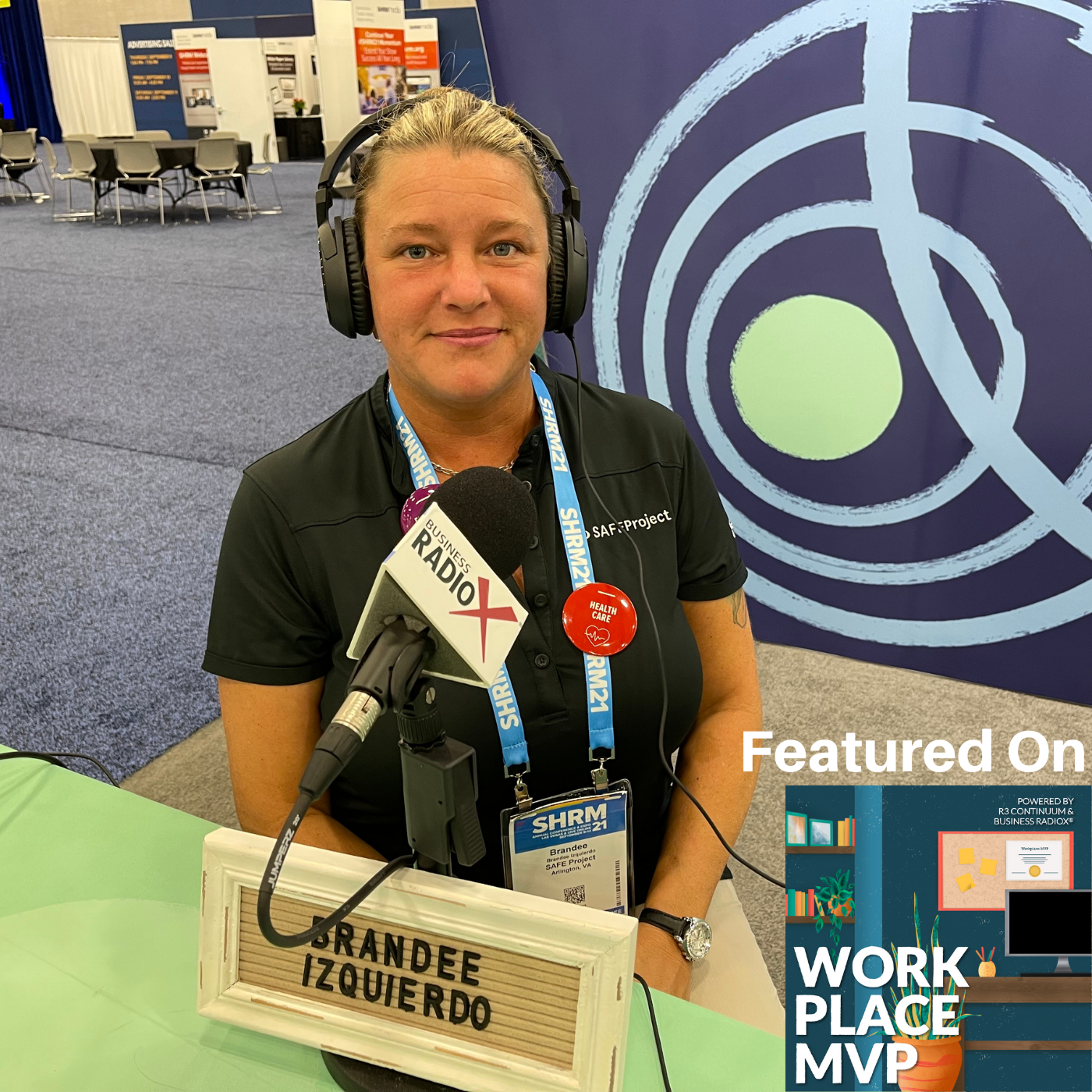
About 10 years ago, Brandee Izquierdo was sitting in a jail cell, struggling with a substance abuse disorder. Brandee joined Workplace MVP host Jamie Gassmann to talk about her long-term recovery, her work at SAFE Project, addiction in the workplace, and how her organization battles the U.S. addiction epidemic.  Workplace MVP is underwritten and presented by R3 Continuum and produced by the Minneapolis-St.Paul Studio of Business RadioX®.

This show was originally broadcast live from the 2021 SHRM Annual Conference held at the Las Vegas Convention Center in Las Vegas, Nevada.

Brandee Izquierdo, Executive Director, SAFE Project

Brandee Izquierdo SAFE Project
Brandee Izquierdo, Executive Director, SAFE Project

Brandee Izquierdo’s drive and determination are built on making an impact within behavioral health, promoting long-term recovery, and ensuring communities are educated and have the tools necessary to combat the addiction epidemic. Before leading the SAFE Project team, Brandee worked for Faces & Voices of Recovery as the Director of Advocacy and Outreach. In addition, she served as the Associate Director of Special Populations with Behavioral Health System Baltimore and as the Director of Consumer Affairs for the state of Maryland’s Behavioral Health Administration. In these leadership roles, Brandee has led advocacy efforts to expand access to behavioral health services and recovery support services while providing technical assistance both nationally and internationally, empowering others within the recovery movement. Her ability to build relationships and bridge gaps within behavioral health, community services, and criminal justice have been a catalyst for global peer expansion.

As a subject matter expert with Center for Social Innovation, Policy Research Associates, SAMHSA, and the International Certification and Reciprocity Consortium (IC&RC), Brandee has made vast contributions within behavioral health and within the recovery movement around public policy, outreach, and workforce development. Additionally, Brandee has made a significant impact within the judicial system, advocating for access to treatment and recovery and is the principal investigator of Maryland’s integrated-Forensic Peer Recovery Specialist curriculum.

Brandee’s passion for service work and knowledge of recovery support services extends beyond behavioral health. With a master’s degree in Public Administration and a bachelor’s degree in Government and Public Policy, Brandee is currently working on her Doctorate in Public Administration with a specialization in Administration Justice.

SAFE Project

SAFE Project was founded in November 2017 by Admiral James and Mary Winnefeld, following the loss of their 19-year old son Jonathan to an accidental opioid overdose. Read more about Jonathan Winnefeld.

The Winnefelds immediately channeled their grief into action, hoping to save more families from the pain of loss. Whether it was seeking treatment, getting answers, or understanding the nature of the disease – they knew there needed to be a different solution to help other families facing the same journey with substance use disorder.

They swiftly built our SAFE Project team of experts who strive for meaningful action through our programs, and lead efforts that are unifying, non-partisan and evidence-based. SAFE seeks meaningful metrics that strengthen our interdependent six lines of operation, and ultimately aim to achieve SAFE Communities, SAFE Campuses, SAFE Workplaces and SAFE Veterans across the nation.

About Workplace MVP

Every day, around the world, organizations of all sizes face disruptive events and situations. Within those workplaces are everyday heroes in human resources, risk management, security, business continuity, and the C-suite. They don’t call themselves heroes though. On the contrary, they simply show up every day, laboring for the well-being of employees in their care, readying the workplace for and planning responses to disruption. This show, Workplace MVP, confers on these heroes the designation they deserve, Workplace MVP (Most Valuable Professionals), and gives them the forum to tell their story. As you hear their experiences, you will learn first-hand, real life approaches to readying the workplace, responses to crisis situations, and overcoming challenges of disruption. Visit our show archive here.

Workplace MVP Host Jamie Gassmann

Jamie Gassmann, Host, “Workplace MVP”

In addition to serving as the host to the Workplace MVP podcast, Jamie Gassmann is the Director of Marketing at R3 Continuum (R3c). Collectively, she has more than fourteen years of marketing experience. Across her tenure, she has experience working in and with various industries including banking, real estate, retail, crisis management, insurance, business continuity, and more. She holds a Bachelor of Science Degree in Mass Communications with special interest in Advertising and Public Relations and a Master of Business Administration from Paseka School of Business, Minnesota State University.
R3 Continuum

R3 Continuum is a global leader in workplace behavioral health and security solutions. R3c helps ensure the psychological and physical safety of organizations and their people in today’s ever-changing and often unpredictable world. Through their continuum of tailored solutions, including evaluations, crisis response, executive optimization, protective services, and more, they help organizations maintain and cultivate a workplace of wellbeing so that their people can thrive. Learn more about R3c at www.r3c.com.

Company website | LinkedIn | Facebook | Twitter

TRANSCRIPT

Intro: [00:00:03] Broadcasting live from the SHRM 2021 Conference at the Las Vegas Convention Center, it’s time for Workplace MVP. Brought to you by R3 Continuum, a global leader in workplace behavioral health, crisis, and security solutions. Now, here’s your host.

Jamie Gassman: [00:00:21] Hey, everyone. Jamie Gassman here, your host of Workplace MVP, broadcasting again from our SHRM 2021 Conference in Las Vegas, Nevada. And with me today I have Brandee Izquierdo.

Brandee Izquierdo: [00:00:34] Very good.

Jamie Gassman: [00:00:35] Did I say that right? All right. And, she is the executive director for Safe Project. Welcome to the show.

Brandee Izquierdo: [00:00:40] Thanks, Jamie. I appreciate it.

Jamie Gassman: [00:00:42] So, tell me a little bit about your career journey and how you kind of came to be as part of Safe Project.

Brandee Izquierdo: [00:00:49] Wow. What a journey it’s been. I’d like to first start by saying I am the executive director of Safe Project. However, I’m also a person in long-term recovery. So, my journey has been, needless to say, it’s been very complex and I think right now, especially with this radio station and the behavioral health component of things, the conversation is extremely timely.

Brandee Izquierdo: [00:01:12] I will tell you from my own personal journey and my own personal perspective, I work in the behavioral health field now, but that is not the trajectory of my career or where I thought it was going to be. During my active addiction stages or days, for example, I worked in the corporate world and, you know, what a timely conversation to have because I found myself, you know, really faced with a lot of challenges in terms of mental health and substance use. And quite often in the workplace environment, we don’t have those conversations as candidly as we need to.

Jamie Gassman: [00:01:46] Yeah. Absolutely. So, from your perspective, those conversations, you know, and we can probably get into that. But, like, how does an employer open up those environments? So, from somebody who’s actually gone through that, what would you’ve wanted at that time from your employer?

Brandee Izquierdo: [00:02:02] Yeah. I think safety, safety first, a safe space to actually have those conversations. I think quite often, especially in the world of human resources, there’s a lot of fear around mental health conversation, substance use conversation. We’re afraid of legal issues, maybe overstepping our bounds. If I would have had some of those conversations early in my career when I was in the corporate world, I may have recognized that I had a problem.

Brandee Izquierdo: [00:02:33] You know, we talk about employee retention. We talk about job performance. We talk about all of that from a business standpoint. But we don’t talk about the why. Why are organizations having a hard time retaining employees? Why are organizations having a difficult time, you know, keeping employees or making sure their own time or their performances is up to par? And a lot of times, if you start to ask that why and create that safe space in a workplace environment, you’re more likely for individuals to come out and say, “Hey, I need help.”

Jamie Gassman: [00:03:10] Yeah. You got to make it comfortable for them to be able to – that they’re not going to be penalized or treated differently, right. Because when you talk a lot about stigma with mental health in the workplace, you know, from your perspective, was that some of what held you back, maybe from talking about it was just that fear as an individual?

Brandee Izquierdo: [00:03:28] Absolutely. I mean, even if you take a look at my family dynamic, for example, you know, there was a lot of substance use in my earlier years and my youth years and I didn’t want to be one of those people. And, it wasn’t until, you know, the disease of addiction is very cunning and baffling.

Brandee Izquierdo: [00:03:45] So, we don’t know what’s going to hit us. And, once it does, you’re in those grips and then you become those people and you perpetuate the stigma and the shame, both internally and externally. So, you’re not as free or feel as free or liberated to actually talk about that.

Brandee Izquierdo: [00:04:02] And, I think from an employer standpoint also, you know, quite often we don’t think it’s our problem. You always hear, especially with the addiction epidemic that’s going on now, we’re losing 93 American – 93,000 Americans, over 250 individuals a day, and we deem it as a public health crisis. But it’s more than that. It is definitely more than that. And, I think corporations and businesses need to invest in their people and in their communities, and this is one way to do it.

Jamie Gassman: [00:04:30] Yeah. Well, [inaudible] a corporate or business level, you know, really, that can be sometimes the first places that you see that. I mean, you hear it with, like, schools and children that’s their outlet and that’s usually where people can see that somebody needs help. You know, if an employer is more open to seeing some of that or has education around the signs, they might be able to help them in being able to give an extension to their employee of help and support that maybe they aren’t able to get that outside of the workplace.

Jamie Gassman: [00:04:59] Absolutely. I mean, we look at America and our work habits. You know, for me, for Safe Project, I really try to build a culture of safe space or a judgment-free zone. We’re with individuals in our workplace for more than eight hours a day. If we say that we typically work 40 hours, we’re probably lying. We’re probably working more than that. So, we’re around other individuals in terms of colleagues, professionals, vendors, you know, just to name a few. So, we really need to understand the signs and symptoms of addiction and invest in our employees rather than just doing away with them because, you know, perhaps that’s a liability. We talk a lot of stuff as far as, “Oh, I care about my employees.” But do you really care about your employees? And if you do, start talking the talk and walking the walk.

Jamie Gassman: [00:05:51] Absolutely. So, Safe Project, tell me a little bit about your nonprofit and the work that you do.

Jamie Gassman: [00:05:55] Sure. So, again, as I mentioned, Safe Project was founded by Admiral Winnefeld and his wife, Sandy, who lost their son to an accidental overdose in 2017, actually on a college campus. So, their heart is in the collegiate space, but more importantly the community space as well.

Brandee Izquierdo: [00:06:13] So, we work with different stakeholders whether it be college campuses, communities, safe workplaces, and safe veterans. So, in working with those different stakeholders, we know that we need to create collaborative partnerships to ensure that we are providing the best resources, education, and knowledge around substance use and mental health challenges that we possibly can throughout the nation.

Brandee Izquierdo: [00:06:38] And that’s what we do. We meet communities and our stakeholders where they are and start to move them in the right direction. I kind of call it the Monty Hall approach, kind of old school. You know, let’s pick door one, two, or three. Door number one, for example, may be something as simple as let’s provide some preventive measures. We’re here with Detarra, for example, as one of our partners in drug disposal bags, in-home drug disposal bags. Or, we may want to go a little bit deeper and say, hey, how can we start developing these initiatives in these programs in your workplaces, not only to encompass a holistic wellness approach but also tackle, you know, the stigma associated with addiction and mental health.

Jamie Gassman: [00:07:19] Yeah. And I’ve heard that from some statistics that, you know, with people being home over this last year, substance abuse, addictions are on the rise because they’re doing it at home and there’s nobody to be able to, kind of, catch some of that stuff. Has your work increased, or what kinds of things have you guys put into place in kind of response to that?

Brandee Izquierdo: [00:07:43] Absolutely. It has increased. We are really taking off. We launched our Safe Workplaces initiative not too long ago, probably about six months ago. It’s been in development for a little bit over a year. But when COVID hit, what we’ve realized is that we need to start communicating with individuals because you can’t compartmentalize. It’s not your daily routine where you go to work, you work in an environment, and then you come home. You can really, you know, move back and forth in the substance use arena as far as your use is concerned and hide it very well.

Brandee Izquierdo: [00:08:17] But there are also a lot of different aspects of mental health. You’re dealing with being a mom, perhaps a teacher, trying to keep your kids together, yourself together, and there’s no clear disconnect when it comes to work and your home environment.

Brandee Izquierdo: [00:08:34] So, we’re seeing a lot in terms of mental health on the rise – people – but I’m also seeing some good stuff too. I’m seeing telehealth coming into play. I’m seeing individual organizations and businesses, really, saying, “Hey, how do we maintain the health and well-being of our employees?” But it’s pretty interesting. We can lead quite often with the mental health side of things. People are a little more accepting of that. They’re not as accepting of the substance use side. So, I think we need to really shine some light on that and that it is happening and it affects everyone.

Jamie Gassman: [00:09:08] Yeah. So, we’re here at SHRM, obviously an HR-focused work conference. If you were going to give advice to these H.R. leaders that are here at this conference from your own personal perspective, what would you want to leave them with?

Brandee Izquierdo: [00:09:22] I think I’d want to leave them with invest in your employees, not only from a work performance perspective but also from a well-being perspective. Start having those conversations and start to build a culture that creates judgment-free safe zones. You know, again, we’re saying that we can’t retain employees. We need to start investing in them as people. We don’t stop at the door and drop our bags off when we’re talking about our problems or issues or challenges in our home life. So, we need to start recognizing that and really just invest in our people and kind of get back to old school, you know. Care.

Jamie Gassman: [00:10:03] Yeah. Just care. Awesome. And creating that environment of safety.

Brandee Izquierdo: [00:10:06] Right.

Jamie Gassman: [00:10:07] Very cool. Well, thank you so much for joining us. If somebody wanted to get in touch with you or get more information about Safe Project and the work that you’re doing, how would they go about doing that?

Brandee Izquierdo: [00:10:16] Sure. They can visit us on our website at www.safeproject.us and I’m all about emailing me directly, which is brandee, B-R-A-N-D-E-E, @safeproject.us.

Jamie Gassman: [00:10:29] Wonderful. Well, thanks again, Brandee, for joining us. Thanks for sharing your story. Thank you for providing an opportunity for H.R. leaders to kind of hear another perspective and also kind of be more aware of ways that they can help support their employees that maybe are dealing with some substance abuse. Thanks for joining us.

Brandee Izquierdo: [00:10:45] Thank you so much for having me. I appreciate it.


Tagged With: addiction, addiction epidemic, addiction in the workplace, addiction recovery, behavioral health, Brandee Izquierdo, employee behavioral health, Jamie Gassmann, Las Vegas, long-term recovery, R3 Continuum, SAFE Project, SHRM 2021, SHRM21

Workplace MVP: Broadcasting LIVE from the 2021 SHRM Conference

September 9, 2021 by John Ray

SHRM 2021
Minneapolis St. Paul Studio
Workplace MVP: Broadcasting LIVE from the 2021 SHRM Conference
Loading
00:00 /
RSS Feed
Share
Link
Embed

Download file

SHRM 2021

Workplace MVP: Broadcasting LIVE from the 2021 SHRM Conference

Broadcasting LIVE from the SHRM 2021 Annual Conference at the Las Vegas Convention Center, Workplace MVP  host Jamie Gassmann and R3 Continuum Marketing Specialist Shane McNally discuss R3 Continuum’s presence at this year’s conference. Workplace MVP will be broadcasting live interviews with conference speakers and attendees during the conference. If you’re at #SHRM21, come on over to Booth 4076 and see us! Workplace MVP is underwritten and presented by R3 Continuum and produced by the Minneapolis-St.Paul Studio of Business RadioX®.

R3 Continuum

R3 Continuum is a global leader in workplace behavioral health and security solutions. R3c helps ensure the psychological and physical safety of organizations and their people in today’s ever-changing and often unpredictable world. Through their continuum of tailored solutions, including evaluations, crisis response, executive optimization, protective services, and more, they help organizations maintain and cultivate a workplace of wellbeing so that their people can thrive. Learn more about R3c at www.r3c.com.

Company website | LinkedIn | Facebook | Twitter

About Workplace MVP

Every day, around the world, organizations of all sizes face disruptive events and situations. Within those workplaces are everyday heroes in human resources, risk management, security, business continuity, and the C-suite. They don’t call themselves heroes though. On the contrary, they simply show up every day, laboring for the well-being of employees in their care, readying the workplace for and planning responses to disruption. This show, Workplace MVP, confers on these heroes the designation they deserve, Workplace MVP (Most Valuable Professionals), and gives them the forum to tell their story. As you hear their experiences, you will learn first-hand, real life approaches to readying the workplace, responses to crisis situations, and overcoming challenges of disruption. Visit our show archive here.

Workplace MVP Host Jamie Gassmann

In addition to serving as the host to the Workplace MVP podcast, Jamie Gassmann is the Director of Marketing at R3 Continuum (R3c). Collectively, she has more than fourteen years of marketing experience. Across her tenure, she has experience working in and with various industries including banking, real estate, retail, crisis management, insurance, business continuity, and more. She holds a Bachelor of Science Degree in Mass Communications with special interest in Advertising and Public Relations and a Master of Business Administration from Paseka School of Business, Minnesota State University.Workplace MVP:
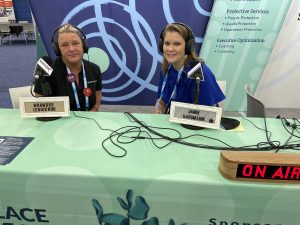
Tagged With: Jamie Gassmann, Las Vegas, R3 Continuum, Shane McNally, SHRM 2021, Workplace MVP

Workplace MVP: Jeff Gorter, R3 Continuum

September 9, 2021 by John Ray

Jeff Gorter
Minneapolis St. Paul Studio
Workplace MVP: Jeff Gorter, R3 Continuum
Loading
00:00 /
RSS Feed
Share
Link
Embed

Download file

Jeff Gorter

Workplace MVP:  Jeff Gorter, R3 Continuum

Critical incident response veteran Jeff Gorter contends that business and human responses to crisis events are not separate but interwoven. On the twentieth anniversary of the September 11th terrorist attacks, Jeff and host Jamie Gassman discussed the parallels of that event and the COVID-19 pandemic, and the importance of acknowledging 9/11 for your employees.  Workplace MVP is underwritten and presented by R3 Continuum and produced by the Minneapolis-St.Paul Studio of Business RadioX®.

Jeff Gorter, Vice President of Crisis Response Services, R3 Continuum

Jeff Gorter, Vice President of Crisis Response Services, R3 Continuum

Jeff Gorter, MSW, LCSW, is VP of Clinical Crisis Response at R3 Continuum. Mr. Gorter brings over 30 years of clinical experience including consultation and extensive on-site critical incident response to businesses and communities. He has responded directly to the Sept. 11 terrorist attacks, Hurricane Katrina, the Virginia Tech shootings, the Deepwater Horizon Oil spill, the 2011 earthquake/tsunami in Japan, the Newtown Tragedy, the Orlando Pulse Nightclub Shooting, the Las Vegas Shooting, and the breaching of the US Capitol on 1/6/21. He has conducted trainings and presented at the Employee Assistance Professionals Association Annual Conference, the American Psychological Association Annual Conference, the World Conference on Disaster Management, the International Society for Traumatic Stress Studies Annual Meeting, and at other state, national and international venues on a variety of topics.

LinkedIn

R3 Continuum

R3 Continuum is a global leader in workplace behavioral health and security solutions. R3c helps ensure the psychological and physical safety of organizations and their people in today’s ever-changing and often unpredictable world. Through their continuum of tailored solutions, including evaluations, crisis response, executive optimization, protective services, and more, they help organizations maintain and cultivate a workplace of wellbeing so that their people can thrive. Learn more about R3c at www.r3c.com.

Company website | LinkedIn | Facebook | Twitter

About Workplace MVP

Every day, around the world, organizations of all sizes face disruptive events and situations. Within those workplaces are everyday heroes in human resources, risk management, security, business continuity, and the C-suite. They don’t call themselves heroes though. On the contrary, they simply show up every day, laboring for the well-being of employees in their care, readying the workplace for and planning responses to disruption. This show, Workplace MVP, confers on these heroes the designation they deserve, Workplace MVP (Most Valuable Professionals), and gives them the forum to tell their story. As you hear their experiences, you will learn first-hand, real life approaches to readying the workplace, responses to crisis situations, and overcoming challenges of disruption. Visit our show archive here.

Workplace MVP Host Jamie Gassmann

In addition to serving as the host to the Workplace MVP podcast, Jamie Gassmann is the Director of Marketing at R3 Continuum (R3c). Collectively, she has more than fourteen years of marketing experience. Across her tenure, she has experience working in and with various industries including banking, real estate, retail, crisis management, insurance, business continuity, and more. She holds a Bachelor of Science Degree in Mass Communications with special interest in Advertising and Public Relations and a Master of Business Administration from Paseka School of Business, Minnesota State University.
TRANSCRIPT

Intro: [00:00:03] Broadcasting from the Business RadioX Studios, it’s time for Workplace MVP. Workplace MVP is brought to you by R3 Continuum, a global leader in workplace behavioral health and security solutions. Now, here’s your host, Jamie Gassmann.

Jamie Gassmann: [00:00:24] Hi, everyone. Your host, Jamie Gassmann, here. And welcome to this episode of Workplace MVP. This year marks the 20th anniversary for the 9/11 terrorist attacks. We are also halfway through the second year of the COVID-19 pandemic. Some are calling these two tragic bookends to the last two decades. Interestingly, though, while these two events are different in nature, the impact they made on businesses and employees are very similar.

Jamie Gassmann: [00:00:53] Is this a coincidence? Or is there something to be learned about the impact disruption can have on an organization and its people? What should an employer be focused on when an event like 9/11 or COVID-19 happens? Are there solutions or support options that can be leveraged to help them successfully navigate the troubled aftermath of the events?

Jamie Gassmann: [00:01:15] With us today to share his expertise and firsthand knowledge from responding to the psychological first aid needs of employers for both 9/11 and COVID-19, among other major events across our history, is Workplace MVP Jeff Gorter, Vice President of Crisis Response Services for our show sponsor, R3 Continuum. Welcome to the show, Jeff.

Jeff Gorter: [00:01:37] Thank you, Jamie. I appreciate the opportunity.

Jamie Gassmann: [00:01:40] So, we’re glad to have you here and really interested in hearing a little bit about yourself and your career journey that’s led you to R3 Continuum and to where you’re at today.

Jeff Gorter: [00:01:53] No. Thanks. And just by way of background, I am a clinical social worker, master’s level social worker. And so, I come from a clinical background and have been in the field providing services either in private practice or in a public setting for 35 years. But the last 20 years of that have been specifically focused on providing disaster response.

Jamie Gassmann: [00:02:20] And so, can you share with our audience the disaster response work that you did post-9/11? And how does that compare to the work that you’re doing today in response to the COVID-19 pandemic?

Jeff Gorter: [00:02:33] And if you caught the 20 year reference, I really look at 9/11 as sort of that was certainly my first experience in responding to a large scale event. Part of the backstory of that is that the former president of Crisis Care Network, which is now known as R3 Continuum, Bob VandePol and I were in private practice together. And he had left the practice I’d say six months before 9/11.

Jeff Gorter: [00:03:03] And when the attacks occurred on that day, I called Bob and I said, “Bob, from what I understand, based on the new position that you’re in, I guess your company is going to be involved in this. I just want to let you know I am trained in this, if there’s anything I can do to help.” To which he said, “Can you be on a plane in four hours?” And I was in New York City that evening able to provide and to begin providing response.

Jamie Gassmann: [00:03:34] And how does that compare to some of the response works? I know you’ve done some response work with the COVID-19 pandemic, a lot of that’s been done virtually. But are some of the sessions or some of the work that you’re doing with that, can you tell us a little bit about, you know, how they work and kind of what your role is that you play within that?

Jeff Gorter: [00:03:56] It’s an excellent question. Because I’ve really been wrestling with the fact that, you know, this being the 20th anniversary of 9/11, that was very much in the forefront of my mind, and yet COVID has such a dominating factor. And, as you said in your intro, it’s kind of no surprise that these two things are, you know, juxtaposed here at this moment.

Jeff Gorter: [00:04:19] So, specifically, when I went to New York City, I was deployed to assist businesses as employees were returning to work for the first time following the attacks. And that’s a key element in that, you know, businesses played a major role in helping employees feel like they were getting back to some sense of normalcy or something that they could control. And so, many of the things that they talked about were more tangible, if you will, in the sense that they talked about things like the smells, things like the grittiness of the dust that was everywhere, how a siren going off for a police or fire would create a startle response the first time. And many of us can remember that the first time we saw a plane flying again after all flights had been grounded.

Jeff Gorter: [00:05:19] And so, for many of them these were much more visceral kind of descriptions of what they were going through. And, yet, for many of them, their stories were also about how resilience, how going back to work was not just getting back to work, but was in for many of them, a patriotic act. A small but very tangible stand against the darkness, if you will. And their getting back to work meant this is something I can do in this national crisis.

Jeff Gorter: [00:05:52] Now, in juxtaposing it to COVID-19 that the swift recovery of business operations is and has been continues to be a central component to our nation’s recovery. But it’s different because 9/11 was confined to a day and we didn’t know that at the time. But it’s confined to 9/11. It was a specific point in our calendar that we can look back. And it was a moment of sharp human initiated attack.

Jeff Gorter: [00:06:24] Now, COVID has a different perspective in that it is a prolonged, ongoing, unfolding, still not done crisis, driven primarily by biology. And so, in that sense, you know, the fear and the emotions elicited are, in many ways, just as powerful. Whereas, you could point to it, you could feel it between your fingers in New York City what the attack was like. Here, it’s kind of a vague, shadowy fear creeping outside your door. It’s everywhere, and yet I can’t point to it. And so, the fear is the common factor, but it’s also different kind of fear. And so, I think that’s important to recognize.

Jamie Gassmann: [00:07:16] Absolutely. And, obviously, from a business perspective, there’s some similarities in some of the thinking. And so, looking at your perspective of business leaders – and I know we’ve talked about this and I know you’ve got an opinion and kind of some thoughts – around that balancing act between human and business and how employers need to be looking at that following a disruption in the workplace, can you share your perspective on that with us?

Jeff Gorter: [00:07:42] Yeah. Well, I begin with the assumption that many business makers or business leaders have that the human response and the business aspects are two different things. And I contend that they are not. That they are, in fact, inextricably woven. And that, typically, when a large scale disaster hits, business leaders will go to their business continuity plan. They’ll pull that three ring binder off the shelf or they’ll go to their files and they’ll look at that plan, as they should. And they’ll review that crisis plan, the policies, procedures, what the strategies were to contain the crisis and mitigate the impact. That’s a sound thinking.

Jeff Gorter: [00:08:25] The trouble is, most of those plans focused on issues like I.T. security, facilities management, supply chain integrity, things that undoubtedly are important elements in a business recovery. But these plans often forget the most essential aspect, the human element. It doesn’t matter how secure your firewalls are or how quickly you get the power restored and the computers working again, if the people aren’t reassured and ready to go back to work. So, taking care of your people is taking care of your business. And I know I think it’s a mistake when a business owner says, “Well, I’m going to do one over the other.” They have to be done simultaneously.

Jamie Gassmann: [00:09:10] And, you know, so focusing on that people side of it, when a major incident occurs such as 9/11, or when you’ve got a pandemic like COVID-19, or other types of disruptions that impact a workplace, typically, if you were going to provide recommendation, what’s that first thing that an employer should be focusing on when it comes to their people?

Jeff Gorter: [00:09:33] So, I look at it as two parts. The first part, first and foremost always is safety. I need to ensure the safety of the employees. And that means physical safety and emotional safety. I have to prepare or provide for both aspects of that. So, I need to make sure when a large-scale event happens, have all the appropriate authorities been called? Have the right people been notified? Is the site secure? Are all the employees accounted for? Have immediate steps been taken, even simple steps like providing food, water, or blankets? Have immediate steps been taken for the care and comfort of my team? And has leadership physically directly checked on the team? Have they been visible? Have they gone around? Have they checked on and ensured the safety of everybody, both physically and emotionally? So, safety is first, job one.

Jeff Gorter: [00:10:32] But then, followed up by that, there are three simple things that I would say that the leader needs to do, and that is communicate, communicate, communicate. That one safety is restored, it’s imperative that leadership starts communicating early and often. This establishes them as a credible source of verifiable information, and that is in short supply following a crisis.

Jeff Gorter: [00:11:01] And it’s a common mistake among leaders to say, “Well, you know what? I’ll send a message out.” Or, “I’ll do some communication once I know all the facts. Once I have a complete idea of what’s going on, once I know the whole ball of wax, then I’ll be able to send out a message that encompasses everything.” And then, as one hour goes by and two hours go by and four hours go by, employees in that absence are going to become increasingly anxious. And it’s human nature in the absence of real information to plug in our worst possible fears.

Jeff Gorter: [00:11:40] And so, you know, maybe they’re going to ask themselves, “Maybe leadership was hurt. I thought we would have heard by now. Maybe they’re part of the injured. Maybe they don’t know that this is going on. Maybe they’re unaware of this. Maybe they don’t care.” And you can see that in the absence of real information. By that point, a negative narrative has already begun to take root.

Jeff Gorter: [00:12:04] And it is so hard to play catch up after that and try and establish. Especially in the age of instantaneous communication through social media and other sources like that, it is absolutely essential that a leader is out there early with frequent brief updates sharing what you know, what is verifiable, and share what you don’t know, but promising to confirm it as soon as you can. Which is to say, “I’m going to be open about I don’t know. I don’t, as a leader, have to have all the answers right now.”

Jeff Gorter: [00:12:42] And doing that, sharing what you know, admitting what you don’t but saying I’ll get it as soon as I can, has an incredibly calming and reassuring effect. It will enhance a leader’s standing with their employees and lets them know, “Okay. The leaders have a plan. They know what they’re doing. They are on top of this. I can take a deep breath at this moment.”

Jeff Gorter: [00:13:08] So, again, as an example, saying something like, “Following this event, we can confirm that three employees were injured and have been transported to the hospital,” that’s verifiable. “We don’t know their status at this point, but we will share that info as soon as we get it.” That’s all you need, something as brief as that. So often, again, leaders will, “Well, until we know more, I’m not going to say anything.” Or they’ll make, “I’m sure everybody’s going to be okay.” Are you sure? Can you guarantee that? No? Don’t say it if you can’t.

Jeff Gorter: [00:13:45] Just simply say what you know, admit what you don’t know. But assure them that as soon as we can have verifiable information, we’ll get back to you. It’s amazing how comforting and calming that is for an employee group that is looking to you for leadership in the midst of this.

Jamie Gassmann: [00:14:06] Great. And, you know, as you continue to go through kind of that recovery process after these types of events, when an organization is starting to regain a sense of new normalcy, how, at that point, can business leaders help to support employees and, really, the organization as a whole in that recovery effort?

Jeff Gorter: [00:14:27] Yeah. Kind of building on what I was saying before, that the employee and organizational interplay is inextricably interwoven. The employee recovery depends on organizational recovery and vice versa. Employees are going to look to the workplace for stability, financial stability, as well as just something that I know is there, predictability, structure. They crave a return to something that feels normal, and where they feel in control, and where they know what they’re supposed to do.

Jeff Gorter: [00:15:03] When the crisis happened, I had no idea what I was supposed to do. I’d like to get back to something where I feel I am trained and where I have a sense of influence and agency. Likewise, organizations are only as strong as their employees. And they need engaged, motivated, healthy workers to weather the storm. There’s an old quote from Kipling in which he said, “The strength of the pack is the wolf. And the strength of the wolf is the pack.” Meaning, the interplay between the organization and the individual they support each other.

Jeff Gorter: [00:15:41] And so, business leaders set the tone of positive resilience and an expectation of recovery for everybody. And part of that is ensuring access to the resources that are supportive to their employees, like onsite or virtual behavioral health specialists who are able to provide immediate support, psychological first aid, and encouragement. Being able to offer 24-7 phone or text access, perhaps via their employee assistance program or through other strategic vendors who can provide that. Offering and making sure there is access to print or electronic resources for education, coping, guidance. Things like that are immediate steps that the employer can do to support the employee. And as the employees come back, they support the organization and it is a common effort.

Jamie Gassmann: [00:16:48] And so, for disruptions like with the COVID-19 pandemic where we’re kind of on this ever changing kind of evolution, if you will, for the last year-and-a-half, do some of those same initiatives apply in the context of a disruption that maybe continues to evolve as opposed to a one day event?

Jeff Gorter: [00:17:11] I think you’re absolutely right. And even more so, I think that because what we have come to realize, even though we’re 18 months into this – the words almost stick in my throat in saying that, but that’s where we are right now at this taping – almost every day, it is a changing, fluid, dynamic circumstance. Where we are now and where we were back in February 2020 are vastly different places. And we know so much more and yet we are incredibly aware of how much we don’t know.

Jeff Gorter: [00:17:48] And so, that same central concept that in the absence of real information – I’m going to plug in my fears – just highlights the need for leadership to have a constant, steady, reliable drumbeat of information, even if it’s little bits. Even if my update today is to say no new changes today, that’s worth doing. That is something that reassures them that leadership is on top of it.

Jeff Gorter: [00:18:20] Because, again, that’s one of the things that clearly has typified this prolonged, slow moving disaster is that, you know, almost no two days are the same. And yet there’s still this emotional sense of Groundhog Day of, “What? It’s still here? We’re still talking about this.” And so, yeah, for leadership to not fall into the trap of thinking, “Oh. They don’t want to hear any more updates.” No, keep doing it. It’s essential.

Jamie Gassmann: [00:18:52] Great. And, obviously, for 9/11 this is a milestone anniversary, so looking at milestone anniversaries, you know, some employees may have or may experience kind of a reaction or, like, a triggering effect to that. And just how an employee handles the disruption when it’s happening, it’s all different in terms of the different levels of resilience and how people kind of process trauma. From your experience, you know, what should an employer be looking at so that they can show support and care knowing that with an anniversary like the 20 year anniversary everyone’s going to kind of approach it differently?

Jeff Gorter: [00:19:37] Yeah. No, that’s a great question. I mean, there were some organizations, obviously those in the New York area or Pennsylvania or in D.C. that were directly impacted. But I think it would be a mistake for a business leader to assume that, “Well, I don’t think any of my people were involved. I don’t need to pay attention to that. I don’t need to mention that.” In the 20 years people have moved, people have relocated, people have taken different jobs. People who were children at that point, who may have lost a loved one at that time, have grown up, moved, taken on new jobs. Again, it would be a mistake to think, “Oh, it’s so far back, we don’t really need to worry about it.” This is a significant day.

Jeff Gorter: [00:20:21] And so, for an employer, I think it’s important for them to acknowledge the solemnity of this day, the power of this day itself, and to recognize that employees may have some challenges with it. Not everybody. Not that they have to. But some may. And so, as a leader, getting out ahead of that and simply recognizing and acknowledging that lets them know that you get it, that you understand that this day is different from other days. It has significance, which helps those employees to feel understood and validated, not isolated and alone as if something is broken or wrong with them.

Jeff Gorter: [00:21:02] And so, it’s important, too, one of the ways that an employer can do that is to remind their employee of the wide range of resources that they have. Again, the behavioral health support, either onsite or virtually, as we’ve talked about before, should they choose to use it. So, for them, again, highlighting what their EAP can do or other groups. In most cases, people just want to be able to share their experiences. And anniversaries are times where we talk about it, because that helps us when we talk about it. It helps us feel less alone. It feels connected. We feel like we’re part of something. They may or may not want to talk about it, but it’s important for a leader to create this safe space for people to do that, to be able to talk about it.

Jeff Gorter: [00:21:54] Because I think one of the things that I am sure once we get past COVID, we’re going to do this. But one of the things that happened during 9/11, if we look back on it, all of us constructed a narrative. A story of where we were when it happened. What happened next? How did it impact us? Where are we now? We developed a story. That’s human nature. It’s how we make peace with it. It’s how we wrap our minds around it. This narrative is where we begin to constrain it as a chapter in our lives. An important chapter, a significant chapter, but not the only chapter in our lives. Things happen to be for that. Things have happened since that.

Jeff Gorter: [00:22:39] And so, being able to talk about it in that narrative sense, as if it’s a chapter helps to, again, feel a sense of control. And I begin to view myself, not as a victim, as if it’s still going on today, but more as a survivor or perhaps even a thriver. Here’s how I grew from this. Here’s how I’m different because of that. Here’s where I learned some things that are important.

Jeff Gorter: [00:23:07] So, being at work on the day of an anniversary, I think is beneficial to employees impacted by any major disruptive event because, again, there’s surprising power in the mundane, comfort in the normal. I want to be around something that feels supportive and and constrained. And going about their everyday lives helps a sense of control, helps them get through that day, and it helps them to have a balanced perspective on the significance of the past. The reality of this present. And the hope for the future. We will move to the next chapter as it were.

Jamie Gassmann: [00:23:49] Great. So, if a leader were starting a conversation like that with their employees – you know, because I love that concept of creating kind of this, like, open area. This comforting, you know, feeling that it’s okay to be transparent in how you feel about that – if you were going to provide a conversation starter for how a leader could set that tone and set that stage for that conversation, how would you advise them to speak to kind of get that conversation moving?

Jeff Gorter: [00:24:25] So, I think, you know, a generalized statement to begin with saying, “As we approach this anniversary, we recognize the power it has for us as a nation, for many of us as individuals. We want to acknowledge that and here’s the things we’re going to do.” And maybe that, again, if they are aware of folks who were survivors or who had a closer context, or it is part of our organizational history that our company was impacted by that day, then I think it would be a very wise idea to have onsite or virtual counselors available to be able to provide immediate, tangible, I could point down the hall and I can see that person if I want to go talk to them, I know they’re there. That’s an immediate thing that they can do.

Jeff Gorter: [00:25:14] The other is to remind them of other resources that they may have. Their employee assistance program, 24-7 hotline that is offered. To simply say at the point of the towers collapsing, many organizations I’m aware of will have a moment of silence at the moment, perhaps, when the first plane struck the building. They will do that, and that is, again, a way of honoring the solemnity of it, a way of acknowledging the reality of it, and just simply let your employees know, “Okay. We get this. We’re taking it seriously. This means something to us. And we’re doing some things to acknowledge that.”

Jeff Gorter: [00:26:01] Other organizations may say, “You know what? Given this day -” maybe even something simple like saying “- we’re having lunch brought in as just a way to acknowledge and provide a communal opportunity for us to get together and share that experience.” You know, depending on the the structure of your work site, that is a pretty low cost way to affirm to your employee group because they will talk about that afterwards. “Wow. Our company got it and they did something substantial to help us.”

Jamie Gassmann: [00:26:44] Great advice. So, we’re going to take a quick break and hear a word from our sponsor. Workplace MVP is sponsored by R3 Continuum. R3 Continuum is a global leader in providing expert, reliable, responsive, and tailored behavioral health, crisis, and security solutions to promote workplace wellbeing and performance in the face of an ever changing and often unpredictable world. Learn more about how R3 Continuum can tailor a solution for your organization’s unique challenges by visiting r3c.com today.

Jamie Gassmann: [00:27:19] So, some feel, Jeff – and we kind of mentioned it in the introduction too – that 9/11 and COVID-19 pandemic are tragic bookend events and have various similarities in their impact on employees, you know, with mental health concerns, substance abuse, sleeping concerns. Can you share your perspective on this? You know, are there similarities? And if so, what would you say are the similarities? And do you have any context to why that might be the case?

Jeff Gorter: [00:27:56] I think that’s a great observation, because I think on the surface, it would be easy to say, “Well, my goodness. I can hardly think of two completely disparate type of events.” I mean, they are radically different and they’re separated by 20 years. But if we did that, we lose tapping into the accumulated wisdom and knowledge that we gained from how we adapted to 9/11, and how that has sustained us through so many other crises that have happened in between, and how that can inform and shape what we’re doing now in response to the current crisis.

Jeff Gorter: [00:28:35] So, some areas of similarities that occurred to me is that, you know, both 9/11 and COVID changed everything about how business is conducted. I mean, if we think back on it, I think one when cheap and easy example is – for those of us of a certain age – can you remember when you didn’t have to take your shoes off at the airport to get on a plane? You know, it changed how we travel. It changed what we define as safety. It changed what security protocols with baggage. It changed even the work environment itself, where we work, who we work with, how we work has been changed.

Jeff Gorter: [00:29:18] There was radical change after 9/11 and the same thing has been happening after COVID, that it’s created changes that are going to be likely permanent as a way of adaptations to that. And so, that’s one area of similarity in that everything’s changed.

Jeff Gorter: [00:29:38] Another is that both 9/11 and COVID-19 have required a massive expenditure of time, money, resources by companies to respond to it, to adapt to it, to restore some sense of functional operations and confidence. That happened after 9/11. The same thing happened after COVID-19. I defy you to find a company that says, “You know what? We are pretty much operating exactly the same way with exactly the same plans, policies, and procedures as we did before those events. You know, it really didn’t touch us. It didn’t change us.”

Jeff Gorter: [00:30:19] I mean, to the contrary and particularly in the midst of the pandemic, we had to initiate almost immediate changes. As I said earlier, things like we’re operating from home now where many of us who never envisioned ourselves as remote workers now find themselves with their library kingdom. And other things in which we’ve changed. We’ve made so many initiatives in response to this to try to enhance the safety while returning to operations. And we don’t know the effectiveness of many of these until later. You know, we have to make the change. We’re going to do it.

Jeff Gorter: [00:31:07] But many leaders and workers alike are saying, “Well, did we do the right thing? Did we make the right decision? Are we doing enough? Or did we do too much?” So, I mean, these questions were the same that’s an echo of 9/11. We said the same kinds of things. We wrestled with the same sort of initiatives then as we do now in determining what was the right calibration. It’s only in hindsight that we’ll know. But it did require massive amounts of time and energy.

Jeff Gorter: [00:31:41] And then, the third thing, and I think this is probably the one that is most pertinent to me as a behavioral health professional, is that, both of these events had a global emotional impact unlike any other event. And if we think back over the last 20 years, there have been many major events. We are only a few days away from the 16th anniversary of Hurricane Katrina. There have been multiple large scale mass shootings at schools or in other public locations. There has been a breach of the U.S. Capitol.

Jeff Gorter: [00:32:21] All of these things are major defining events, yet none of them had the emotional charge on a global scale. There’s almost no person on the planet that has not been aware of those events that was not emotionally moved by those events. There was a universal sense of shock, vulnerability, fear that defined 9/11 and was very similar to the pandemic. And I think, you know, those other tragedies that I said were huge and highly visible, but they were constrained to areas, regions, cities, location. Whereas, 9/11 led the whole world to know things are different and the same has happened with COVID-19.

Jamie Gassmann: [00:33:18] Interesting. And you you mentioned in a previous conversation with us and you may have have kind of touched on it a little bit here that events like 9/11 and COVID-19 pandemic are described as seminal moments that impact an individual’s view on life, which can lead to them re-evaluating what’s important. So, can you elaborate a little bit more on that?

Jeff Gorter: [00:33:45] Yeah. I think, the easiest way to understand, seminal moments are those milestones, those tragic milestones in the story of your life. As I talked about, they are unavoidable reference points in the story of our lives. You know, we will say, “Was that pre-COVID or post-COVID?” It’s the kind of thing that you immediately will recognize and you reference events as almost, you know, magnetically rotating around that.

Jeff Gorter: [00:34:19] But what I think is so important about that is that the events are the events. The events themselves are only the beginning. I think the way we responded to them is much more compelling and is much more reflective of that personal agency, that personal story that we construct, that narrative that we build following these events. So, the event happened, but the story of how we endured, what we had to let go of, where we grew, how we changed, how we adapted, how we found moments of happiness or lightness even in the midst, those kinds of things are lived experiences that I think hold tremendous value.

Jeff Gorter: [00:35:09] You know, I think that in older days that might have been called wisdom. That’s the kind of thing that you look back on and you say, “You know, I would never want to go through that again. But I learned some things about myself, about my company, about my community, or about my country.” And that is important knowledge to be able to have and to incorporate. I know that we all want to hurry by. We all want to get to the happy ending. Can I just flip through the book? Can I fast forward to the end of the show here and see the happy ending?

Jeff Gorter: [00:35:44] But the reality is, if we let this moment pass by without intentionally purposely reflecting on what this means to me as a person, what this means to me as a leader, what this means to my company, what it means to my team, I think we lose something of incredible value.

Jeff Gorter: [00:36:05] And so, again, especially with something that has been as prolonged as the pandemic, we’re just like, “Well, I just need to get through it. I just need to get through another day. I just need to keep rolling.” But I think savvy leaders have found that stepping back, intentionally reflecting on this, and what lessons I learned from it, it positions them for better success in the future when they get past this.

Jamie Gassmann: [00:36:38] Right. So, almost like attributing meaning to the event and how that is having an impact on your life, because it could be both in positive ways and negative ways. So, there could be a couple of different things that are learned from that, both professionally and personally when you’re looking at it, would you agree?

Jeff Gorter: [00:36:57] Exactly. I think, again, attributing meaning to it as part of that narrative making. It’s human nature that when we go through an event that has that kind of power that impacts us like a physical blow, we try and make sense of it. We try and reassert a sense of control. And we typically go – sorry. I’m going to go a little Psych 101 here for a moment – in one of two directions. Meaning, attribution means we either determine internal disposition, what does this say about me? About how I handle it? What does this reveal about me? Or external situation, what does this say about my context, my company, my community, my country? So, we’re going to assign a meaning to this.

Jeff Gorter: [00:37:51] And, again, the event is the event. So, the pain has occurred, the trauma has occurred, the tragedy has occurred. That doesn’t change. But my meaning will greatly influence my trajectory afterwards. And so, by that, there is a critical inflection point. There is a moment. A moment where almost all of us, whether we’re conscious of it or not, where we look at this and we say, “Wow. What I just went through, what does this say about me?”

Jeff Gorter: [00:38:24] Do I look at this and do I say, “You know what? I was in the wrong place at the wrong time. But, man, I’m just glad I got through that.” Or do I say, “You know what? This just proves once again that I am the unluckiest guy on the face of the Earth. You know, I am a soccer ball on the field of life. I just get kicked around all the time.” Do I view this as, “Wow. I am so happy to be alive following this. I am going to go home and kiss my partner and hug the kids. And I’m going to enjoy life in a different way. I’m going to value life.” Do I say that? Or do I say, “What’s the point? Why even try? Stuff like this happens. I told you it’s just one bad thing after another.”

Jeff Gorter: [00:39:13] And you know why? The event is the event. My interpretation is going to determine whether I move ahead with resilience and in a positive way. Or that I add on to the sense of negativity, the sense of pathology, something must be broken. And, you know, do I view this as, “Okay. These powerful emotions I’m experiencing are normal, understandable reactions to this really powerful event.” That makes sense. Or do I say, “I’m not handling it right. I must be doing it poorly. I think I’m not smart enough or strong enough. Maybe I’m broken. Maybe I’m losing it.” You know, the event is the event, but my interpretation is going to determine where I go from. And so, I think that how we attribute meaning is going to help us move forward.

Jamie Gassmann: [00:40:09] Interesting. And so, you know, looking at kind of moving forward and looking at leaders that might be listening in on this conversation, if you are going to give them a take away from this show, something that you wanted to leave them with that can help them to effectively support their employees when disruption occurs, what would you share with them? What would you want them to take with them?

Jeff Gorter: [00:40:35] So, I’m going to share not something that originates from me, but I want to share a quote from one of my favorite poets, Maya Angelou. She had a quote that I think I have reflected on and it has helped me in so many situations when responding to a large scale event. And the quote is, “They will never remember what you said. They will never remember what you did. But they will always remember how you made them feel.” And I find that so incredible.

Jeff Gorter: [00:41:09] Because as a leader, I urge you, I encourage you to help your team feel cared for, help them feel supported, help them feel valued. And when you do that, they will surprise you. They will inspire you. They will lift up your company in ways you can’t do alone. So, it’s not about having the magic words. It’s not about following exactly the ten point plan. It’s about keeping in mind that my goal is they will remember how I made them feel. Make them feel cared for and valued, and they will take care of the rest.

Jamie Gassmann: [00:41:49] Fantastic. So, looking out over your career, I’m always curious to ask my guests, what are you most proud of when you look out over your career?

Jeff Gorter: [00:42:01] Well, that is a challenging question. The things that are obvious particularly in the context of our conversation, being able to have responded directly to 9/11, having had an influence here during COVID, or responding to the Vegas shootings, or going to D.C., all of those events that I have done. But I don’t want to be distracted by, let’s say, the bright, shiny, big is the only thing that matters.

Jeff Gorter: [00:42:40] I think probably what I’m most proud of is that I consider it a humbling honor to be able to walk alongside somebody in what might have been one of the worst days of their lives. And it doesn’t matter whether it was a mass event that rocks the globe or whether it was the loss of a friend and co-worker who they had really come to depend on. Being able to be there and help take a little bit off their shoulders, it’s a day well spent. And so, it’s each one of those times that I’ve had an opportunity to speak into somebody’s life.

Jamie Gassmann: [00:43:20] Wonderful. So, with our listeners, if they wanted to get a hold of you, Jeff, how would they be able to do that?

Jeff Gorter: [00:43:28] Well, as I mentioned, I am with R3 Continuum, and so, certainly, being able to access that through our website. But also being able to respond to me directly, if you’d like to send an email to jeff.gorter@r3c.com, jeff.gorter@r3c.com. And I’d certainly be willing to respond to any questions.

Jamie Gassmann: [00:44:00] Fantastic. Well, thank you so much, Jeff. It was very moving, great information shared, very powerful stories, and advice. And we really do appreciate you. And thank you for letting us celebrate you on the show today. And hearing the experiences you had, the work you did in supporting workplaces at 9/11, and even with COVID, and other events within our history. So, thank you so much for being a part of our show.

Jeff Gorter: [00:44:31] Thank you so much, Jamie. And I urge all your listeners, be well, be safe.

Jamie Gassmann: [00:44:38] Great. And we also want to thank our show sponsor, R3 Continuum, for supporting the Workplace MVP podcast. And to our listeners, thank you for tuning in. If you’ve not already done so, make sure to subscribe so you get our most recent episodes and other resources. You can also follow our show on LinkedIn, Facebook, and Twitter at Workplace MVP. If you are a workplace MVP or know someone who is, we want to know. Email us at info@workplace-mvp.com. Thank you all for joining us. And have a great rest of your day.


Tagged With: COVID-19, covid-19 crisis management, Crisis Response, critical incident, Jamie Gassmann, Jeff Gorter, R3 Continuum, September 11th, workplace, Workplace MVP

The R3 Continuum Playbook: The Ripple Effect of Disruption

September 2, 2021 by John Ray

Jeff Gorter
Minneapolis St. Paul Studio
The R3 Continuum Playbook: The Ripple Effect of Disruption
Loading
00:00 /
RSS Feed
Share
Link
Embed

Download file

Disruption

The R3 Continuum Playbook: The Ripple Effect of Disruption

Marking twenty years since the tragic September 11th terrorist attacks, Jeff Gorder, Vice President of Clinical Crisis Response at R3 Continuum, discusses the ripple effects disruptive events have on individuals. Jeff recommends five essential elements as best practices to follow immediately following a disruptive or potentially traumatic event.  The R3 Continuum Playbook is presented by R3 Continuum and is produced by the Minneapolis-St.Paul Studio of Business RadioX®. R3 Continuum is the underwriter of Workplace MVP, the show which celebrates heroes in the workplace.

TRANSCRIPT

Intro: [00:00:00] Broadcasting from the Business RadioX studios, here is your R3 Continuum Playbook. Brought to you by Workplace MVP sponsor, R3 Continuum, a global leader in workplace behavioral health, crisis and security solutions.

Jeff Gorter: [00:00:14] Hello, my name is Jeff Gorter, Vice President of Clinical Crisis Response at R3 Continuum. Today, I would like to discuss the ripple effect of disruption and how employers can support employees, both immediately following a disruptive or traumatic event, as well as during the anniversary of the event later on in time. This information is particularly pertinent in relation to the 20th anniversary of the 9/11 terrorist attacks, which is upcoming this month in September 2021.

Jeff Gorter: [00:00:49] It’s common for employees to feel emotions such as grief, sadness, loneliness, fear and anger immediately following a disruptive event and, possibly, even for years to come. This can impact their ability to remain productive and thrive at work as there are certain triggers – some obvious, some unexpected – that may remind them of the trauma. The healing process for trauma is not necessarily linear, not a straight direct line. Meaning that the impact can be more of a ripple effect that comes in waves, a waxing-and-waning effect that can resurface in the future for some employees.

Jeff Gorter: [00:01:30] Let’s begin at the beginning. Immediately following an event, the trauma impact depends on the person’s proximity to the event itself. For example, did they see the event? Were they in direct danger themselves? Were they exposed to graphic visual scenes? Were they involved in efforts to take care of the victims perhaps? This kind of exposure is intuitively obvious, but it is only one determinant of their ultimate trajectory.

Jeff Gorter: [00:02:02] Something that’s interesting to note is that PTSD is not necessarily based on how powerful the event was, as if there’s an automatic threshold of trauma, and PTSD is somehow inevitable. This condition is often actually based more upon how well the person was doing emotionally before the event. So, if the impacted individual was not doing well prior to the event, if they were already stressed or wrestling with challenging dynamics unrelated to the event, they are more likely to develop PTSD or other related conditions.

Jeff Gorter: [00:02:40] It may also surprise some to discover, particularly when we’re thinking about the impact of 9/11, that PTSD was not the dominant trajectory for most New York residents following the terrorist attacks of 9/11. In a landmark study conducted by researchers at Columbia University specific to New York recipients, it was found that resilience was actually the dominant trajectory for the majority of people at six months and, again, at one year out, despite having experienced an unthinkable, horrible tragedy. Again, the vast majority did not meet the criteria for a PTSD diagnosis despite their exposure, contrary to what many people feared and even what some experts expected.

Jeff Gorter: [00:03:32] Now, to be clear, this is not to say that it was easy or that the journey wasn’t difficult; far from it, but it is worth noting that we are stronger than we give ourselves credit for. Now, while this is certainly encouraging, it’s still crucial that employees are adequately supported and supplied with targeted resources to process the difficult emotions following the disruption, particularly after a mass event like 9/11. Otherwise, the event can impact the employees’ behavioral health and impair their ability to do their job, or it may simply prolong the struggle needlessly.

Jeff Gorter: [00:04:15] So, let’s look at this a little more closely. International researchers and current best practice recommend focusing on five essential elements immediately following a disruptive or potentially traumatic event. These elements are critical to early intervention and to the overall resilience of the person as they cope with the event. First, the impacted individual needs to feel safe, both physically and emotionally. During a disruptive event, this feeling of safety was likely reduced or challenged in some way. So, in order to begin the recovery process, safety must be restored. Until safety has been assured and reasserted, it’s human nature to remain on high alert with a heightened sense of fear, anxiety and reactivity. Safety is job one from a physical and mental health perspective.

Jeff Gorter: [00:05:15] Once safety is being reasserted, the second element is that an individual must feel connected. It’s important to help an employee realize that they are part of a community, a group, a company of people who went through the same experience and are walking the same journey. Often, trauma can make someone feel isolated and that they are alone in the way they’re feeling as if they’re the only ones in the world who feel like this. It can help them to know even just the simple fact that they’re not alone, that their reactions are common and shared by other co-workers, and that they can draw and contribute to the strength of their collective work group. We are stronger together.

Jeff Gorter: [00:06:02] Third, an individual needs to feel a sense of calm, of being able to reassert control over their own body. With the adrenaline rush that usually comes with experiencing a survival threat or a disruptive event, it’s critical that the person is able to regain control over their body and be able to focus their thoughts, control their breathing again, to relax their muscles, and to come off the adrenaline-fueled high alert that I mentioned earlier. Regaining a sense of calm and control over their own body opens the door to making the next right decision, to taking the next right step, and the one after that, and the one after that and so on.

Jeff Gorter: [00:06:46] The fourth essential element is self-efficacy, a sense of confidence. It’s common to feel helpless or hopeless following a crisis event, a situation where I couldn’t control the outcome. It can help when the person is able to feel as if they can make good choices on their own behalf again or on behalf of their loved ones or their co-workers once again. If the person could not prevent the event, realizing where it goes from here is up to me is a powerful step forward. This taking back of control over their own power and their own decisions can help them to know they are not helpless in determining their future, and it restores their sense of personal agency following this event.

Jeff Gorter: [00:07:33] The fifth and final essential element that a person needs is hope. They need to feel hopeful for their future, able to envision this for themselves to know that this crisis is not how it’s always going to be, or that they’re not always going to feel like this and that a more positive future is possible. Without hope, there’s no moving forward. Workplaces have a tremendous power to help employees feel this kind of hope by providing predictability, purpose, stability, and by offering them skilled behavioral health support immediately following the event.

Jeff Gorter: [00:08:13] Now that we’ve covered some of the ways that employers can support employees immediately following disruption, it’s important to discuss how employees might feel on the anniversary of an event. Anniversaries can make employees feel anxious or jittery, in addition to making them feel less safe and less connected. And this makes sense as it’s part of our primitive built-in survival mechanism. See, that survival mechanism remembers the past threat, remembers this time, remembers the event, and it’s seeking to prepare you should a threat arise again. This may lead some employees to have an exaggerated response to certain triggers, certain memories, certain discussions around the event, and that can bring up complex emotions.

Jeff Gorter: [00:09:03] From an employer perspective, particularly one who has employees that may be struggling on an anniversary, it’s important to acknowledge the solemnity, the power of this day itself, and to recognize the difficult feelings employees may have on that day, letting them know that you get it, that you understand that this day is different from other days, and that it has significance to you helps them feel understood and validated.

Jeff Gorter: [00:09:33] It is also important to make sure employees know that they have access to a wide range of resources and behavioral health support should they choose it. In most cases, people want to be able to share their experiences about this anniversary because it helps them feel less alone, more connected, as we discussed earlier. They may or may not want to talk about it, but it’s important to give them the space to do so if they choose.

Jeff Gorter: [00:10:01] In the case of 9/11, many of us have constructed a narrative, a story of where we were, what happened next, where we are now. Many individuals have made some level of peace with their stories now that it’s 20 years following the event, but not all of us. It can be helpful for them to share their narratives, the ongoing story, because they’re able to see the event as an event that occurred in the past, as something in which they are able to exercise some control over. This helps the person to see themselves as a survivor, even perhaps a thriver, and no longer a victim, as if that tragedy is continuing to happen today in the present.

Jeff Gorter: [00:10:49] Being at work on the day of anniversaries can be beneficial to employees impacted by a disruptive event, as there is surprising power in the mundane and the ordinary, even some comfort in the normal, the predictable day-to-day that we look forward to and that structures our lives. Going about their everyday lives can provide them with a sense of control and helps them to get through the day, keeping a balanced perspective on the significance of the past, the reality of the present and the hope for the future.

Jeff Gorter: [00:11:26] Now, while the ripple effect of disruption can impact employees and their daily lives, employers have the power to support their employees through these feelings that may arise as impacted individuals continue their journey of healing from the trauma, both immediately after an event and in the years following. As the 20th anniversary of 9/11 approaches, R3 Continuum can help organizations to do this with consultation, educational resources, and with onsite and virtual behavioral health support. On our website at r3c.com, we provide resources under the Our Resources tab to learn more about how we can support your organization. Contact us today.


Show Underwriter

R3 Continuum (R3c) is a global leader in workplace behavioral health and security solutions. R3c helps ensure the psychological and physical safety of organizations and their people in today’s ever-changing and often unpredictable world. Through their continuum of tailored solutions, including evaluations, crisis response, executive optimization, protective services, and more, they help organizations maintain and cultivate a workplace of wellbeing so that their people can thrive. Learn more about R3c at www.r3c.com.

R3 Continuum is the underwriter of Workplace MVP, a show which celebrates the everyday heroes–Workplace Most Valuable Professionals–in human resources, risk management, security, business continuity, and the C-suite who resolutely labor for the well-being of employees in their care, readying the workplace for and planning responses to disruption.

Connect with R3 Continuum:  Website | LinkedIn | Facebook | Twitter

Tagged With: Crisis Response, Disruption, disruptive events, Jeff Gorter, post-traumatic stress disorder, R3 Continuum, trauma, Workplace MVP

Workplace MVP: Drew Sewell, CKS Packaging

August 26, 2021 by John Ray

CKS Packaging
Minneapolis St. Paul Studio
Workplace MVP: Drew Sewell, CKS Packaging
Loading
00:00 /
RSS Feed
Share
Link
Embed

Download file

CKS Packaging

Workplace MVP: Drew Sewell, CKS Packaging

Drew Sewell, COO of CKS Packaging, experienced a compelling call to confront the sources of the problems of drug dealing, prostitution, and crime affecting the area near his company’s Atlanta headquarters. That calling led to the successful development of second chance hiring program for formerly incarcerated individuals at CKS Packaging, and a non-profit which serves hunger and other needs in the community. Drew joined host Jamie Gassmann to share his inspiring story and offer advice to other companies contemplating their own second chance hiring program. Workplace MVP is underwritten and presented by R3 Continuum and produced by the Minneapolis-St.Paul Studio of Business RadioX®.

CKS Packaging

CKS Packaging is a privately owned manufacturer and supplier of rigid plastic packaging with 24 locations in the United States, headquartered in Atlanta.

CKS Packaging’s business is the marketing, sales, and manufacturing of quality plastic containers utilizing environmentally friendly raw materials, maintaining high ethical standards honoring the covenant to support Christian-based ministries from the profits generated through the business.

CKS provides containers for a variety of consumer goods and industrial products including: Food Beverage Health and Beauty Personal Care Automotive Medical Chemicals and Solutions With over 50 years of experience in the plastics manufacturing business, CKS Packaging has acquired the product design and technical expertise that has made us the industry leader for innovative and cost-effective solutions for most any packaging and branding solutions.

They have been chosen to provide products for: Beverage Companies, Food Packaging Companies, Dairies, Fast Food Chains, Food Service Industry, Grocery Stores, Home Improvement Stores, Automotive Supply Stores, and Cosmetics Companies.

CKS Packaging, Inc. is a family-owned plastic container manufacturing company with its home office headquartered in Atlanta Georgia. CKS stands for Charles K. Sewell, who has become a legend in the plastic container blow-molding arena. He began in the plastic business in the mid-1960s. He was honored to be named the first recipient of the Society of Plastic Engineers Lifetime Achievement Award. is an industry leader in custom bottle design.

CKS Packaging introduced the Second Chance Program in 2016 with the goal of hiring people who otherwise might struggle to find employment. Specifically, the program focuses on hiring previously incarcerated people, homeless individuals, and people recovering from drug addictions. To recruit candidates to this program, CKS Packaging partners with community organizations for referrals. Since the inception of the program, hundreds of people have been hired successfully. Employees have moved up in the company or found better positions elsewhere.

Additionally, many Second Chance employees have escaped the cycles of poverty, crime, and addiction. CKS Packaging has also been positively impacted since they now have a loyal, hard-working group of employees who otherwise would not have been found. Since people who previously were incarcerated or relied on social support programs now have employment and some financial independence, taxpayers also end up paying less to help these individuals.

Company website | LinkedIn

Drew Sewell, Chief Operations Officer, CKS Packaging

CKS Packaging
Drew Sewell, Chief Operations Officer, CKS Packaging

Drew Sewell is Chief Operations Officer for CKS Packaging, a family-owned plastic bottle manufacturer. His father founded the company in 1985. CKS Packaging is headquartered in southwest Atlanta, Georgia.

One day years ago, while on his way back from a customer visit, he was stopped by the traffic light at the intersection of Fulton Industrial and the westbound exit ramp of I-20.

Little did he know that a chance sighting of a young teenage girl about the same age as his own daughter, alone and bewildered on the streets of southwest Atlanta would have such an impact on his life over the next six years.

Drew didn’t know what to do or how he could help, but he did have an overwhelming calling directing him to take care of her. He immediately turned his truck around to seek her out. Unfortunately, she had gone on her way by the time he returned to the corner where she was standing. Drew searched for her asking if anyone knew her or where he could find her. He never found that young person, but he committed in his heart to do whatever he could to seek out those less fortunate in the community and give them the reassurance that they had not been forgotten, that they were children of God, and that God did care for them.

Today Drew Sewell serves not only as COO of CKS Packaging, but as the guiding light for Maximum Impact Love, a 501c3 ministry that has enriched the lives of more than 50,000 people over the past six years. Not only has Maximum Impact Love served the community, but CKS Packaging’s Second Chance Program draws from the community they serve as well as recently released former incarcerated individuals.

CKS Social Responsibility | LinkedIn

R3 Continuum

R3 Continuum is a global leader in workplace behavioral health and security solutions. R3c helps ensure the psychological and physical safety of organizations and their people in today’s ever-changing and often unpredictable world. Through their continuum of tailored solutions, including evaluations, crisis response, executive optimization, protective services, and more, they help organizations maintain and cultivate a workplace of wellbeing so that their people can thrive. Learn more about R3c at www.r3c.com.

Company website | LinkedIn | Facebook | Twitter

About Workplace MVP

Every day, around the world, organizations of all sizes face disruptive events and situations. Within those workplaces are everyday heroes in human resources, risk management, security, business continuity, and the C-suite. They don’t call themselves heroes though. On the contrary, they simply show up every day, laboring for the well-being of employees in their care, readying the workplace for and planning responses to disruption. This show, Workplace MVP, confers on these heroes the designation they deserve, Workplace MVP (Most Valuable Professionals), and gives them the forum to tell their story. As you hear their experiences, you will learn first-hand, real life approaches to readying the workplace, responses to crisis situations, and overcoming challenges of disruption. Visit our show archive here.

Workplace MVP Host Jamie Gassmann

In addition to serving as the host to the Workplace MVP podcast, Jamie Gassmann is the Director of Marketing at R3 Continuum (R3c). Collectively, she has more than fourteen years of marketing experience. Across her tenure, she has experience working in and with various industries including banking, real estate, retail, crisis management, insurance, business continuity, and more. She holds a Bachelor of Science Degree in Mass Communications with special interest in Advertising and Public Relations and a Master of Business Administration from Paseka School of Business, Minnesota State University.
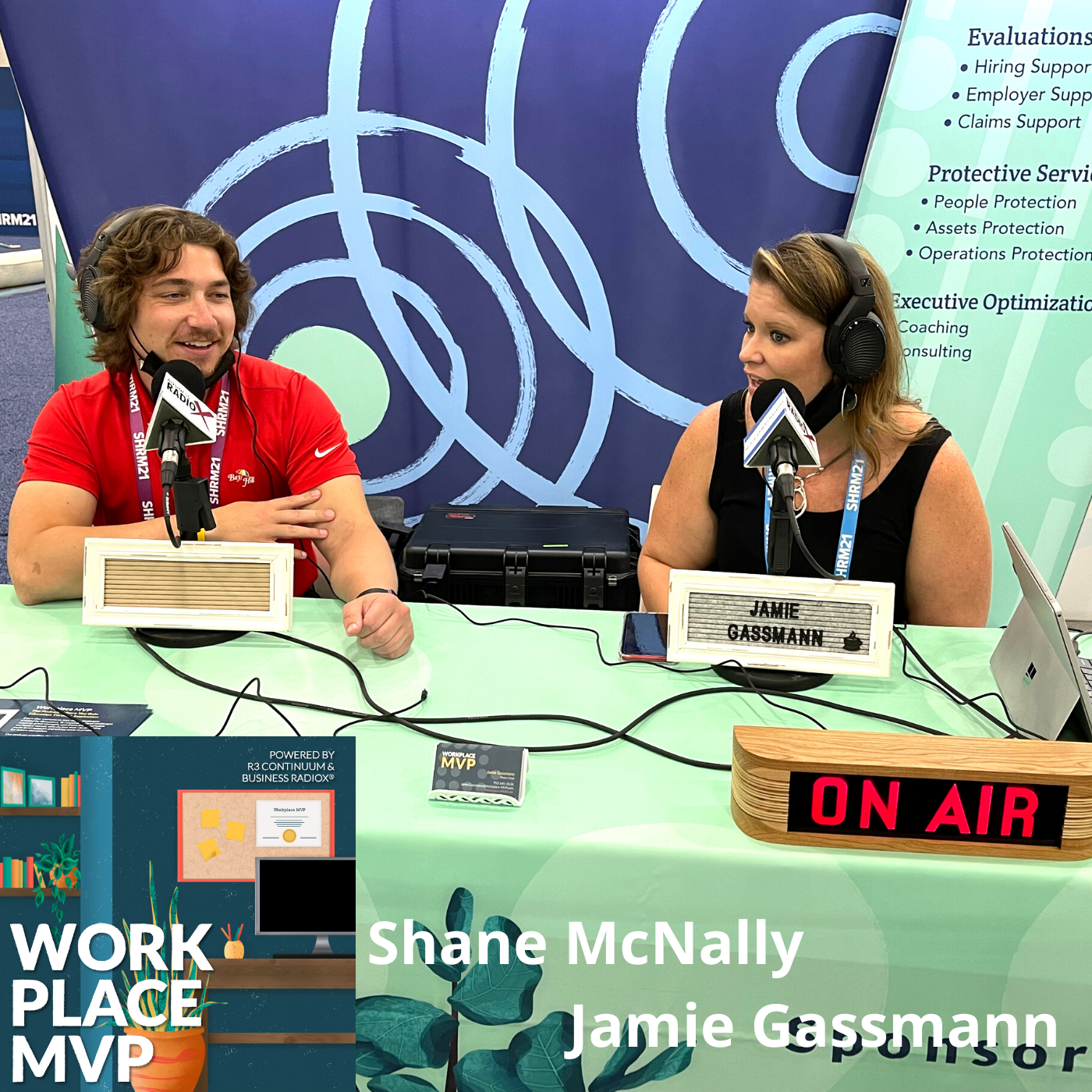
TRANSCRIPT

Intro: [00:00:04] Broadcasting from the Business RadioX studios, it’s time for Workplace MVP. Workplace MVP is brought to you by R3 Continuum, a global leader in workplace behavioral health crisis and security solutions. Now here’s your host, Jamie Gassman.

Jamie Gassman: [00:00:32] Hi, everyone. Your host, Jamie Gassman, here. And welcome to this episode of Workplace MVP. In a recent Sherm.org blog post, they shared that US prisons and jails released nearly 700,000 men and women into society every year. They also noted that approximately 70 million people have a criminal record, one third of working-age US adults. When these individuals are released into society, they are then tasked with finding work, so that they can support themselves, their families and start to live a new life post-incarceration. Additionally, there are a number of people out there who have lost their way and fallen into behavior that is damaging to themselves, their families and their community.

Jamie Gassman: [00:01:15] How did these individuals and those looking to have a second chance find an employer who is willing to accept an individual as a candidate regardless of their past? Looking at today’s job market struggles with a shortage of workers, is there a benefit to employers to consider implementing Second Chance Programs as a way to augment their hiring approach? How can giving back to these individuals help the organization, community, and the employee?

Jamie Gassman: [00:01:41] With us today to share how implementing a Second Chance Program has benefited their organization, its people and the community is Workplace MVP Drew Sewell, Chief Operations Officer for CKS packaging. Welcome to the show, Drew.

Drew Sewell: [00:01:58] Thank you, Jamie. It’s good to be here today.

Jamie Gassman: [00:02:01] We’re happy to have you. And so, let’s just start off with you telling me a little bit about yourself and your career journey. And then, we’ll get into talking about CKS Packaging in just a moment.

Drew Sewell: [00:02:12] Okay. So, CKS Packaging is my family business. My dad is Charles King Sewell. And King is his mother’s maiden name. But he founded the company in 1985. And once upon a time, back in the early days of 1963, he started Sewell Plastics. His company made the first plastic milk jug in the southeast United States, and then the first two-liter Coke bottle in the world, and it kind of put us on the map and put us all across the country, 25 locations. He sold that and started over with CKS Packaging. He wasn’t able to buy his name back. And so, he was looking to get in in a small way, just five days a week, one shift.

Drew Sewell: [00:03:07] But because so many people were loyal to us, the customers, and we were a good supplier, that scene went out the window, and we needed more and more people. But today, we’re $600 million in sales, and we have 3000 employees in 27 locations across the United States. But he made a commitment, and I don’t want to scare people away when they hear a religious commitment, but he made a faith-based adjustment and said, “I’m going to tithe the profits of the company.” And when he did, things just went crazy for us. You can’t outgive God. So, we’ve just exploded over the years.

Jamie Gassman: [00:03:51] Wonderful, and you’ve grown to be global supplier and you know all of your locations and various different states across the U.S. So it’s it’s amazing to see that growth that you guys have built up. So now looking at the Second Chance program for your organization, so there’s a different there’s a lot of different reasons why an employer decides to put a second chance program in place. Some it is a method for just expanding their candidate pool, and for others, it’s a way to give back to the community and help people for six packaging. What were some of the driving factors in creating the Second Chance program?

Drew Sewell: [00:04:28] Where we are, our company is our headquarters is about 10 miles from Atlanta. And in nineteen ninety six, when the Olympics came to Atlanta, we they tried to push prostitution and drugs and crime basically out of Atlanta, and they pushed it out 10, 15 miles. And so that’s where we encountered it on the boulevard where we are a mile from. Our office was a number one hotel for drug and prostitution in the United States. And that was led to do something about it, because it was, you know, here we are, a big successful company. But the neighborhood was run down and scary. I mean, they would carjack you steal things. You know, if you had a landlord that ran out of gas and you left it by the street to go get the gas can, the land more was stolen before you could even blink an eye. It was just terrible. So we decided that we would go into the neighborhood and do a day of outreach. And we were doing free food, clothes, health care, haircuts. We painted the ladies nails. We had moonwalks, ladd’s popcorn, cotton candy, snow cone, all that was just to draw the people in. And then we offered to pray with them and it changed hundreds of lives.

Drew Sewell: [00:05:50] But what I found out was when that day was over with you did the crime came back, everything was still still the same, even though twenty five prostitutes left the street the first time we ever did it. That was 15 years ago. So I went and I talked to the people that were there, homeless, etc. if you will, get off the streets and go into a drug drug rehab or some kind of rehab for whatever lifestyle you’re leading, after one year, I will hire you to come to work for me. And I had a lot of takers and it took a while, but it got going off the ground. And what I found out was those that are incarcerated, one of the ministry partners we support on a monthly basis from our tyre’s is Prison Fellowship Ministries. Prison Fellowship as a pipeline to seek is to help supply us with good workers. So these people have made a mistake in their lives. And they paid for that mistake, but they had that blemish that nobody wants to hire them. But in today’s environment, so hard to find somebody to go to work for you. And you really have some very talented people that have made that mistake pay for the mistake, and now they can’t get a job.

Drew Sewell: [00:07:09] So we decided, you know what, let’s give them a shot. And that was about six years ago. And today, you know, you go through the numbers just like hiring other people. But we’ve got one hundred and eighty nine, what we call second chance workers at six is and they have been with us, you know, two, three years, and they’re moving up the ranks. It’s it’s amazing. They have mechanical ability. When you make plastic bottles, you have a lot of production equipment that needs to be worked on, needs to be kept up. These big keep running so you can be profitable. And these guys and ladies are filling in the blanks for us. And they are so grateful to have a second chance that they will never leave us. And we’re a family business anyway. And we treat our people. They’re our greatest asset. We treat them like family. When I walk through the plant, I know it’s not the thing to say or do, but I hug them. You know, I love them except for the grace of God. There go where they would be. Me would be them. And I just have compassion for them. And in our whole company is a family oriented that way.

Jamie Gassman: [00:08:21] Amazing, so looking at that program now, you said you’ve had it for about six years now. How would you say, you know, obviously from an organizational perspective, this kind of giving you a pipeline to some really able and willing workers, but how has it impacted the community and some of those individuals? Have they benefited from the program?

Drew Sewell: [00:08:41] It’s it’s totally changed their lives. I mean, if you if you don’t have a job, what are you going to end up doing if you come out of the prison system? Are you going to go back on the street corner and hang out with your buddies? And the next thing you know, you’re doing drugs again and you don’t have money. So you have to support that habit. You steal or you break in, you rob whatever you have to do. And so by changing their lives, I mean, now they have homes, apartments, they have jobs, they have benefits. I mean, it’s just it’s a total life changer for them.

Jamie Gassman: [00:09:14] Wonderful. And, you know, when we talked earlier, you shared with me, you know, that you’ve had some success stories where somebody has come in on the Second Chance program and really risen into some leadership ranks and in some roles. Can you share with our listeners some of the success stories that you’ve you’ve experienced from this, where somebody climbed your corporate ladder, basically?

Drew Sewell: [00:09:35] Right. So we we have a couple of regional quality managers. We have shift supervisors at several plants that are second chances. And it’s you know, it’s it’s it’s no different from any other pool of applicants that would be coming to your company to fill out an application. They all have, you know, credentials that they bring. Some a lot of them have college degrees. You know, they just they they make bad choices, but they paid for it. And, you know, we give a second chance. I mean, I probably had 100 chances myself, so, you know, thank goodness.

Jamie Gassman: [00:10:16] Yeah. Wonderful. So obviously we’ve talked a little bit about the benefits, but were there any challenges that you experienced or have experienced in implementing a program like this?

Drew Sewell: [00:10:26] Yeah. You know, it’s everybody that I meet. I mean, if I go out on the street into a crowd of homeless, drug addicted, you know, prostitutes or whatever, the first thing is, is, you know, what do you pay? All that us in is breaking the habits that they’ve got without going through something. So it’s kind of a forced rehab when they go when they get locked up in the prison, because, you know, they just can’t get the drugs anymore or whatever their choice it is. And so. That’s the hardest part is just getting them off of that, so but me still. And if you go into a rehab for a year, even if they don’t go through the prison system is still the second chance for them. And, you know, it’s usually the programs or you pay it will. We’re not going to pay for somebody to go through it if they’re willing to apply themselves and go into one that doesn’t cost anything. But the the rehab program uses their labor, their job that they go to every day after they’ve been cleaned up as a money to to keep it rolling.

Drew Sewell: [00:11:39] So, you know, they have nothing to lose. And if they’ll do, it is great or they come straight out of prison and nobody’s going to hire. I mean, think about it. Have you committed a foul on these on everybody’s application? Yeah. You if you lie, they’re going to find out, you know, because you do the background check and you say that that guy, he’s not working for me or she’s not they’re not even honest on their application. You know, what else are they going to lie about? So, you know, we just take that one off and just say, look, we go to the local halfway houses, if you will. I mean, there’s there’s a lot of organizations out there that that that’s what they do. They specialize and they bring in the it’s a transitional home. Out of the prison, back to the, you know, the the the work force environment. And they had to have a job before they leave. And so we’re just that the person we were. Yeah, and it’s just they’re so loyal when they walk through a wall for you. They absolutely love us.

Jamie Gassman: [00:12:50] That’s amazing, and I imagine at that time, especially the ones that are coming straight out of prison in those halfway houses, you know, that might be their opportunity for reflecting on why, you know, that that time where they don’t want to go back, you know, they’re committed to themselves to not go back, and they’re not being influenced by anything else in their environments that might bring them down the path that they were on before they went into incarceration. So that’s got to be really good opportunity in a time that you can capture their attention to working at six packaging and getting them on the kind of that right path to take a little bit more of a successful life.

Drew Sewell: [00:13:29] Wonderful. They’re very grateful. Trust me. And they they won’t let you down. They don’t want to go back.

Jamie Gassman: [00:13:38] Yeah, I can imagine that that is, you know, they’re coming off of the, you know, depending on how long they were incarcerated for. You know, that’s got to be that great opportunity to just kind of they can see an opportunity from that. Maybe they didn’t have presented to them before. I can imagine there’s some anxiety that they feel, you know, when they come out of prison, like trying to figure out how am I going to, you know, fulfill the obligations that I’m expected to do, whether they’re on parole or if they’re on, you know, other kind of conditions that they need to adhere to as part of being released. Do you you tend to see that where you kind of almost like our that breath of fresh air for them or that relief to that tension that they might be having.

Drew Sewell: [00:14:18] If most people are just they want somebody to validate them. They want to find somebody that believes in them. And if you you know, I mean, every family I mean, think about it. You get somebody in your family. I’ve got some in my family that is going on the wrong way with drugs or some kind of crime that they committed. They were at the wrong place at the right time. And so they just need somebody to believe in them. And people have been telling them all their life that you’re worthless, you’ll never amount to anything. You’re no good, you don’t have an education, don’t have a college degree. You’ll never get ahead. And then they come see us and they find out that we’re just real people. You know, like I said earlier, except for the grace of God there. Go on. I mean, I’m a family member. I’m a CEO, but you know, very easily I could be the guy in jail back in the day before they had video cameras. You know, every time on everybody’s phone, you know, they’d have the phones. No. One, fortunately for me, when I was a youngster, because that was a hell, you know, I’ll be honest with you. And so that’s probably why I relate to them, except for the grace of God. I could be, you know, an inmate myself or doing some crazy stuff. But anyway, it’s neither here or there. But you just have to believe in them and get them believing in themselves and change your life.

Jamie Gassman: [00:15:44] They’re human, treating them like a human, giving them that opportunity. So how can other companies, you know, whose culture is a little bit more diffuse than a closely held business like a family business like your own, how could they integrate a similar initiative like this into their company?

Drew Sewell: [00:16:01] Well, I would I would say that they could go to the the halfway houses. There’s there’s big pools. I mean, there’s there’s places that that have hundreds of just release formerly incarcerated people that need to transition back into society. And they have a unique skill set. They could go to the it is it is hard to get people to really believe that you want to do this. Number one, they’re not used to that. So you have to go and sell yourself and your company. But at the same time, you can ask for a unique skill set. Maybe it’s somebody that’s got skills. You know, I was looking for mechanics. Anybody that could work on their card has changed their or changed their own sparkplugs. You don’t do that anymore. But people that can. Those are the kind of people you know to you change your tire if it’s flat or you go triple A, whatever. So we were looking for people that were mechanically inclined. But you can any skill set you’re looking for, you’ll find talent is amazing. But you could just say, look, filter out. You know, it’s like going on the computer and filter out this skill set that’s all out war in the war going on zip recruiter and saying, I want this person and they’ll they’ll look it over for you and they’ll and you can go and address the group of people that are inmate that are trying to get out. And you can tell them what you’re looking for and basically sell yourself and your company. Don’t matter if you’re privately held like or you’re a public company. You just have to have the desire to do it. And I promise you, they’ll be the best employees that you’ve ever had because they don’t want to let you down because you believed in them. You gave them that second chance and they’ll do anything for you if you treat them right. Give an honest day’s pay.

Jamie Gassman: [00:18:00] So we’re going to just take a moment to hear word from our sponsor, workplace MVP is sponsored by our three continuum. Aa3 Continuum is a global leader in providing expert, reliable, responsive and tailored behavioral health crisis and security solutions to promote workplace well-being and performance in the face of an ever changing and often unpredictable world. Learn more about how ar3 Continuum can tailor a solution for your organization’s unique challenges by visiting ar3 Secombe today. So now I’d like to talk a little bit about maximum impact love. That’s your mission that you’ve set up, which I think you touched on that a little bit when you talked about that event you helped in your community. So in addition to your Second Chance program, you also establish mission impacts, love or maximum impact Luxx. Sorry, and that’s a mission based nonprofit that’s helped to enrich the lives of and this is the number that I believe I wrote down from our previous conversation with 50000 people over the past six years. So can you walk us through the work that this nonprofit does with the community? And I believe from what you’ve talked about, that’s also a source for where you get some of the second chance. You know, program candidates as well. But can you share a little bit about what you’ve done? And I know this is more concentrated in the Atlanta area, but can you talk a little bit about it?

Drew Sewell: [00:19:26] Okay, so so first of all, I was arrested at a red light on Fulton Industrial Boulevard in Atlanta, Georgia. With a prostitute. Through my windshield by the Holy Spirit. So, as I said, at a red light and I watched a little girl go across the street in front of me, she was caught up in prostitution. And my daughters at the time this is 15 years ago, that that six but 15 years we’ve been doing this got maximum impact, because I watched her go across the street in front of me. That was really. Impressed upon my heart, except for the grace of God, there goes your daughters. If you have got two daughters and at the time they were 12 and 14 years old, and this girl could have been they could have been bookends for this little girl that was walking across the street in prostitution. And it really broke my heart. And I began to cry. And at the same time, I felt the Lord speaking to me saying, what are you going to do about it? In. You know, I don’t know what you do, but every day I get up and pray and say, Lord, here I am, send me let me be a man after your own heart and. Here I am. What am I going to do about it? I don’t know what I can possibly do about that. So the light turned green and I quickly took off from a spot and I got about a thousand yards away.

Drew Sewell: [00:20:57] And I felt the Lord, the Holy Spirit, the spiritual boy, saying to me, what are you going to do about it? And I knew I couldn’t outrun it. So I pulled off in the first parking lot, not looking where I was, but I was at Starship Enterprise, which is an adult toy and video store. There was a liquor store. There was two strip clubs. And I just had my head on my steering wheel and was crying and saying, what can I do about that? Because I was sugar. He said, There goes your daughters. Except for the grace of God to go to your daughter. So, I mean, it just it really impacted me. That’s why I at maximum impact, I had a maximum impact from the Lord. And we make a maximum impact. So I said, I don’t know what I can do. What do you want me to do? And I felt like you said, go find the girl. Well, I went back and looked for the next two hours and I never did find her. But what also turned out to be the number one hotel for drugs and prostitution in the United States, and it’s a mile and a quarter from my corporate office right at Six Flags. Twenty ten miles outside of Atlanta. And I just saw a prostitute come out, get in company vehicles and go on.

Drew Sewell: [00:22:12] I saw drug runners come over to the car beside me and get up and say, I’ll take the money, go get drugs, bring them back. And and as soon as the kids say kids, they were teenagers would pull out another mom and dad’s sedan or a minivan would pull in and they would get the same thing. So out of all of that, I’m convinced today that that girl did exist, that she was just an angel to get my attention to do something about the neighborhood. And as I said, there failed him prior to that. I want you to do a day of outreach and prayer. And I knew what prayer was, but I had no idea what outrage was. So I went back and said we were a you were a Kurbanov company. We tied our profit to the company ACOTA at the time. We had twenty five or so ministries that we supported, above all canned. One of them was prison fellowship. One of them is. Is Heggie Institute, there’s just a lot of them that we did, and I called them all together and said, hey, this is what happened. What I do, what is outreach? And they started shared with me. You need to go in and do a day of of of feeding and clothing. And I’m talking about the homeless population. There was pretty serious. There was 40 or 50 a day just standing around, sleeping in wherever, you know, you see it all over the country.

Drew Sewell: [00:23:40] So anyway, I want you to play live music. I want you to feed them a hot meal. Would you give them clean, fresh clothes and socks and underwear? Would you to give them a haircut or you’d you take a before and after picture of what they looked like before in the shower or trucks there and stuff. And we did. And they looked like all new people took a picture before and after and gave it to them. And they were just amazed. A lot of them never had a picture of themselves in their life. But what happened was all of these people, I said, look, if you go into a rehab, you can’t quit drinking. You’ve been out here on the streets for 15 years. Somehow you’ve been out prostituting your body for 10 years after I met them and got to know them. And they knew they could trust me. They shared everything with me. So how about you go into rehab? It doesn’t cost you anything, but you have to stay for a year if you’ll stay for one year. I’m confident that you’ll be changed. From your vices and no to that, you’ll be ready to come to work. And I’ll give you a job, I promise you I have to go on third shift. And we were twenty four, six. So six days a week, 24 hours a day.

Drew Sewell: [00:24:53] We’re off on Sundays to let them go to church or do whatever they want do with that day of rest. But the point is, is they went in, they started coming out, and then people then they would go with me back down to the street and say, look, you remember how you look, how good he’s doing. If you were to go on at the same time, you’d be working, you’d be as good as him. OK, I want to go now. I want to go now. I mean, there’s a whole lot of I can talk all I want to. But, you know, the example was somebody they knew there was that I’d lifted up and said, hey, look at this from the stage while we played out of loud music. They’d give a testimony was out here with you. I was curled up in prostitution. I’ve got a job. I’ve got benefits. I’ve been reunited with my family, blah, blah, blah, you know, and it’s all good. And these people, these real what he says he’ll do, he’ll back it up. And he’s he’s honored everything that he said he would do. If you’ll just do what he wants you to do. So there you go. That’s how we started it. And it turned into we needed more people and we thought, well, you know what? Why don’t we go see somebody that is, you know, one of these halfway houses and talk to them? And I did and said, we want anybody.

Drew Sewell: [00:26:13] I want I want a mechanically inclined person, because that’s what we were looking for. You can’t find enough people today that can that are really good with their hands and their mind. So if they haven’t committed capital murder, armed robbery, you know, rape, kidnapping, then I’ll take them. And we have and we’ve got 189 of those. And every one of them has the same opportunity. And we were you know, we make plastic bottles, so somebody has to pack them at the end of the line. Somebody has to uniti palletized. Somebody has to drive a forklift. Somebody has to put them in the warehouse. Somebody has to take them out of stock and load a truck. And there’s just a lot of opportunity. Somebody has to make the machines work. So it works out. There’s, you know, especially today’s environment with the government wanting to pay these stimulus checks, but make it more money to stay home. Where are you getting your people from? You know, we haven’t had the shirt. There were an essential business. And we have grown in the last two years from four hundred billion in sales to over 600 million in sales because we have it starved. And all these companies that did stuff. We got a lot of their business. And so anyway. Hope that answered your question.

Jamie Gassman: [00:27:30] Yeah. No, it just it’s you know, I asked I was sharing that with the listeners. I had to share that with the listeners, because it’s just amazing the you know, the community outreach that’s tied to that and that giving back to not just giving a second chance opportunity for somebody to work, but also giving try. Yeah. Yeah. It’s kind of today’s today’s work environment. But you’re also giving back to their families. You’re giving back to the community. And it’s also continuing to that you’ve got this opportunity for those who are willing to put in the effort to participate. So now I know that this you shared with me that this nonprofit has received some some pretty incredible awards. I know Fulton County declared it April 15th, Maximum Impact Loveday. And you also shared that you’re being honored with the humanitarian award. And I believe you said it was on September 11. So how how does that feel? And, you know, what was some of the premise behind this sonor?

Drew Sewell: [00:28:37] Well, so so out of the necessity I was doing or we were doing, I say, oh, there’s so many people that actually volunteer. A lot of people don’t know what they can do. So if your company is looking for a good cause, you know, go find something, go out in your community and see where the need is and then go volunteer. Maybe it’s to cut some people’s grass, clean up the trash, you know, whatever it happens to be here. But but anyway, out of that, that need you. I mean, there’s just so many people that want to want to pitch in and do something. But I lost my train of thought there for a second. So I apologize. But ask the question again for sure.

Jamie Gassman: [00:29:24] So just how it does it make you feel receiving or, you know, receiving these honors and some of the premise behind them honoring you with it?

Drew Sewell: [00:29:32] That’s where I was going. And, you know, I’m no I’m nobody I’m just a humble guy. Honestly, that has a lot of good people. Sometimes I feel like the Pied Piper because I turn around and people are following me because I lead from the front. I go out into the community and do it. I’ve had policemen say, are you crazy? You can’t do that. I don’t come out here unless I have my arm around. And he’s talking about his bulletproof vest, but I have the full armor of God only, so I don’t worry about that. But the main thing is, is you just find a good cause and people will take notice. So we have to have a a black gentleman that was it fell asleep at a Wendy’s drive in in Atlanta, downtown Atlanta, and he had been drinking. And you you probably know the story. They called the police. They got him out of his car. He overpowered the police, took on Taser shot, shouted at him, and they they killed him. And so the the the consensus was is back when people were burning everything down, they burned down the windows. And it was terrible. And I just couldn’t you know, I couldn’t sleep. What can I do to help? And I came up with this idea, and I know it was divine. But but because what we do have started to say earlier, we were doing three events a year, we found out that, hey, that’s great for those three days.

Drew Sewell: [00:31:09] But what about the rest of the year? So we started Maximum Impact Love and opened up of a warehouse where people can come and get groceries every day, Monday through Friday. And then we have people come in and volunteer and we pack the boxes, we go to the food bank and we buy the stuff and our profits of the company. We tied one of the recipients is me and maximum impact. So. We’ve got a 13000 square foot office. We were allowed people to come and get groceries every day of the week and then Covid here. And then so what are you going to do? How are we going to continue to do this? People still need the food, but they got Covid now. You don’t want to get your people infected. So how do you do it? We put a sign out front said don’t get out of your car call. We’ll bring the boxes out. You pop your trunk, we’ll put it in there. We’ll pray for you through the window if you need, and then you can be on your way into the same thing happened with the. With the Windies deal, the guy got killed there. What am I going to do? And I felt like the Lord told me to. Put the Atlanta Police and Fire Department out there up front.

Drew Sewell: [00:32:22] You said everything. So we did 10 different events where we gave away 400 boxes of groceries each. So over 4000 boxes of groceries and at ten different events around Atlanta, 10 different locations in people. And we put signs out free groceries today. And we did all the work, set it up, and the policemen in their uniforms and the firemen and their uniforms, put them into drugs, talk to them. Got all the credit. I don’t care about that. We just wanted to mend the community. And so it worked. And that’s where we got the proclamation and they got it. William Andrews flew all day, which is my full name. But the point is, is maximum impact. Love is not me. It’s the people behind the scenes that really make it happen. And so it’s been worthwhile. And that’s what’s going to happen with this. On 9/11, they’re going to give it a humanitarian award. And as is not me. So many people yesterday we had a big fundraising golf tournament. We had two hundred and twenty golfers in 27 holes, had to foursomes on each hole, and they can’t wait to give the money. And because they know what we do and it’s real and it works. And those are the kind of things you can do in your community, whether you’re a for profit or a, you know, a public company or a privately held company.

Jamie Gassman: [00:33:58] Wonderful. So now I if there were three things that if you that you wanted leaders to be aware of about the rewards that an organization and employer can get by giving back to the community and giving me a second chance, you know, opportunities for for people, what would be three things that you would want to leave these leaders with?

Drew Sewell: [00:34:22] Well, everybody wants to be somebody and they want somebody to believe in them. And these second chances really need somebody to believe in a rent. Imagine yourself in a six by six cell and you’ve got somebody in there every day with you to either negative or they’re they they have a distorted view of reality. And you just been fear negatives all day long. When you do get out, you get around more people like that. They need somebody that believes in them. They can say, look, I know you’ve made a mistake, but here I’ll give you a chance. There’s one, too, is. Be real. You know, you don’t have to have the pedigree, you don’t have to have the the MBA, the doctorate or all of that degree. But what are you really doing to make a difference? In the world period in other people’s lives. And just treat them like people. Except for the grace of God, there go use of. So those are three things.

Jamie Gassman: [00:35:35] Well, that so looking out over your career, if you were able to identify one thing that you’re most proud of. What would that be?

Drew Sewell: [00:35:46] Hmm. Well. I would that I would just say that, you know. They’re correct. Kerry, God, wherever I go. I mean, I’ve go out on the production floor and treat people like real people. Say hello to Garland by name. I made a in this deal goes on. I took a picture of every person that was that worked in any one of my plants. And at one time I had four plants and there were four hundred people that I knew, every one of them to name. How in the world could I ever know their names would take a picture of them? The thumbnail picture put it on to a board in in the front office. And before I went out on the floor, only any one shift, I would pick two or three people and I’d memorize their name and I’d go out there and purposely look for them and just tell them, hey, Jamie, it sure is good to see you today. Is there anything that I can pray for you about? And, you know, they just being hey, knows my name and yes or maybe not, but if they say it’s, you know, maybe you don’t feel like you can do this. But I got tired of people saying, well, you pray for me. And as soon as I and I say, yeah, as soon as I walk away and forget about it. But as I started, I felt convicted. So I started praying with them on the spot. It’s kind of uncomfortable at first. So you close your eyes and people are looking at you. They might not even be looking at you, but you feel like it is. And then if you pray for them, it really makes a difference. Then somebody will go out and say, hey, I saw him praying. Right? What was that all about? And then next time you go through, they’ll ask you to. And it’s it’s just a snowball effect. And it teaches people that you really care. They don’t care how much you know, until they know how much you care. You can’t really let them understand how much you really believe in them.

Jamie Gassman: [00:37:47] Oh, that’s amazing. So for our listeners, if they wanted to get a hold of you and be able to kind of seek additional information about how you you’ve been able to create your second, you know, you’re successful is the second chance program or have questions about the mission maximum impact love? How would they get a hold of you?

Drew Sewell: [00:38:07] Well, I would say go on our website at WW dot c k s packaging dot com. And then just click on there and you’ll see a little at the bottom of one of the pages, it’ll say Social Responsibility, click on that, it’ll have my story, it’ll have my email address, it’ll have my personal cell phone. I don’t you can call me on my cell phone and I’ll be glad to call you back. That’s how Ray called me. And we ended up doing this to begin with. But anyway, just be accessible if you’re real. I mean, it’s hard because you’ll get some calls from some people, but anyway, it’s worth every minute of it.

Jamie Gassman: [00:38:54] Wonderful. Well, I, I, I, I found your story inspiring and the work that you’re doing amazing. And I hope our listeners do, too. So thank you so much, Drew, for letting us celebrate you and all of your great accomplishments and for sharing your stories. The great advice for our listeners. We appreciate you and I’m sure your organization and staff do as well. We also want to thank our show sponsor, our three on for supporting the workplace MVP podcast. And to our listeners, thank you for tuning in. If you have not already done so, make sure to subscribe so you get our most recent episodes and other resources. You can also follow our show on LinkedIn, Facebook and Twitter at workplace MVP. If you are a workplace MVP or know someone who is, we want to know about them. Email us at info at Workplace Dasch MBP dot com. Thank you all for joining us and have a great rest of your day.


Tagged With: CKS Packaging, Drew Sewell, Jamie Gassmann, Maximum Impact Love, R3 Continuum, second chance hiring, Second Chance Program

The R3 Continuum Playbook: Understanding Your Employee’s Fears About a Return to the Workplace

August 19, 2021 by John Ray

return to the workplace
Minneapolis St. Paul Studio
The R3 Continuum Playbook: Understanding Your Employee's Fears About a Return to the Workplace
Loading
00:00 /
RSS Feed
Share
Link
Embed

Download file

return to the workplaceThe R3 Continuum Playbook: Understanding Your Employee’s Fears About a Return to the Workplace

As employers make decisions about requiring employees to return to the workplace and what form that takes, Dr. Tyler Arvig says they need to consider the concerns and fears employees are having about it as well.  He offers ways employers can approach this decision and support their employees’ wellbeing.  The R3 Continuum Playbook is presented by R3 Continuum and is produced by the Minneapolis-St.Paul Studio of Business RadioX®. R3 Continuum is the underwriter of Workplace MVP, the show which celebrates heroes in the workplace.

TRANSCRIPT

Intro: [00:00:00] Broadcasting from the Business RadioX studios, here is your R3 Continuum Playbook. Brought to you by Workplace MVP sponsor R3 Continuum, a global leader in workplace behavioral health, crisis and security solutions.

Dr. Tyler Arvig: [00:00:15] Hello. My name is Dr. Tyler Arvig, the Associate Medical Director at R3 Continuum. As many organizations are beginning to make decisions about going back into the workplace or even deciding if they should return to remote work, I want to provide some information on how to handle the fears that some employees might be feeling at this time. It’s been nearly two years since we heard of the COVID-19 outbreak across the world, and it’s continuing to impact the lives of all of us.

Dr. Tyler Arvig: [00:00:50] While it’s tough to think about now, certain aspects of pre-pandemic life that seemed unimaginable when the virus struck now seemed possible again. As the world continues to evolve and change, businesses are beginning to think about making decisions regarding return to work in the office, going for a hybrid approach or utilizing work-from-home environments. When pondering these decisions, leaders should take a step back and think from the mindset of your typical employee. How are they feeling about their current situation? Are they feeling anxious or distressed? Are they concerned for their safety? What can they expect when they return to the office? And ask yourself if you asked your employees any of these questions or heard their concerns.

Dr. Tyler Arvig: [00:01:49] Over the past 16 months or really more, everything has changed. Most people have transitioned to working from home; and if not, the workplace has drastically changed over that time with health and safety measures being put in place. Those who are parents have had to work through having kids at home and helping teach them in some capacity. As changes in your work, personal and likely financial situations have occurred, this has probably also led to increases in stress. A study done by the Centers for Disease Control in 2020 mentioned that the rate of depression in adults increased almost four times, and the rate of anxiety increased almost three times since the start of the pandemic. Therefore, the pandemic and everything that’s taken place in between has definitely taken its toll.

Dr. Tyler Arvig: [00:02:52] While this may change over time, we are currently seeing a new world or rather a new old world. In most places in the US, masks are no longer required. You might be walking into your convenience store not wearing a mask, while some folks still are. That’s the new old world. For a lot of people, wearing a mask has become part of their day-to-day life. On the topic of walking into a convenience store, we are beginning to see more organizations remaining open again, flights being fully booked, concerts are happening and more. While we are seeing things like this changing back, everyone continues to be hopeful, but also somewhat tentative. As we are getting near the end of summer and vaccination has become more widely available, many employees are starting to think about returning to the office; while, some have already made their decisions and are needing to reanalyze those decisions.

Dr. Tyler Arvig: [00:04:01] As an employee, there are a lot of questions that remain. From the personal side of things they may be asking themselves, how will going back into the office affect my children? What will need to be adjusted in order for me to take care of my family? How’s the commute going to be? And how will it impact my day-to-day life again? Will I be able to maintain a work-life balance. And from a work perspective, a lot of employees are wanting to know things like, will my employer care about my challenges? How will the transition back to work even go? And will it be successful after working from home for so long? Lastly, and not insignificantly, will I be safe at work?

Dr. Tyler Arvig: [00:04:56] As a leader, making this decision for your employees isn’t easy. Whether you decide to have employees returned to the office, go back to working remotely, or continue working remotely, here are some good tips to be sure that you’re providing to your people. To start, be sure to utilize the employee assistance program that you might have. A lot of employees are unaware that they have access to an EAP. Make sure you’re communicating to your employees how they can access your EAP and let them know more information about it. Explore some applications that could potentially help with mental health. There are numerous smartphone apps that can be used to help with things like stress management, anxiety and depression. Do some research and maybe provide some options to your employees. In fact, your EAP might even have something like this. This is something you can do over email, or with links or employees can really access this in whatever way meets their needs. It’s something that you may not have thought of that you can provide.

Dr. Tyler Arvig: [00:06:14] Provide employees with resources from your HR department. HR departments often have different resources they can provide to help employees to support their well-being. Utilize what you already have and be sure to communicate and reach out to your employees about those things. Communication is really key in all of this. While this might seem like a daunting task, I’m reminded of something that’s attributed to Dr. Martin Luther King, the saying that goes, “You don’t need to see the whole staircase. Just take the first step.” The quote is powerful in this day and age as we move forward to the next normal, one step at a time.

Dr. Tyler Arvig: [00:07:02] While there are likely a lot of questions about the future, it’s important for leaders to not only feel prepared to help your employees through these difficult times, but also to support yourself. R3 Continuum can help by providing proactive efforts to maintain the psychological and physical support for your organization. R3C’s tailored solutions can help your organization with crisis prevention and preparedness, crisis response and recovery, proactive employee wellbeing outreach and more. Learn more about our custom solutions and contact us at www.r3c.com or contact us directly by email at info@r3c.com Thank you very much.


Show Underwriter

R3 Continuum (R3c) is a global leader in workplace behavioral health and security solutions. R3c helps ensure the psychological and physical safety of organizations and their people in today’s ever-changing and often unpredictable world. Through their continuum of tailored solutions, including evaluations, crisis response, executive optimization, protective services, and more, they help organizations maintain and cultivate a workplace of wellbeing so that their people can thrive. Learn more about R3c at www.r3c.com.

R3 Continuum is the underwriter of Workplace MVP, a show which celebrates the everyday heroes–Workplace Most Valuable Professionals–in human resources, risk management, security, business continuity, and the C-suite who resolutely labor for the well-being of employees in their care, readying the workplace for and planning responses to disruption.

Connect with R3 Continuum:  Website | LinkedIn | Facebook | Twitter

Tagged With: COVID-19, covid-19 crisis management, Dr. Tyler Arvig, empathy in the workplace, playbook, R3 Continuum, workplace culture, Workplace MVP

Choosing Resources to Support Employee Behavioral Health, with Dr. Thomas Young, nView, Robyn Hussa Farrell, Sharpen, and Dr. George Vergolias, R3 Continuum

August 12, 2021 by John Ray

Nview
Minneapolis St. Paul Studio
Choosing Resources to Support Employee Behavioral Health, with Dr. Thomas Young, nView, Robyn Hussa Farrell, Sharpen, and Dr. George Vergolias, R3 Continuum
Loading
00:00 /
RSS Feed
Share
Link
Embed

Download file

Nview

Workplace MVP:  Choosing Resources to Support Employee Behavioral Health, with Dr. Thomas Young, nView, Robyn Hussa Farrell, Sharpen, and Dr. George Vergolias, R3 Continuum

With all the newly developed approaches, resources, and tools that employers can access to support employee behavioral health, how does one decide on which to use? It’s a high stakes question which many employers are struggling to solve. Host Jamie Gassmann explores answers with three outstanding professionals:  Dr. Thomas Young of nView, Robyn Hussa Farrell with Sharpen Minds, and Dr. George Vergolias, R3 Continuum. Workplace MVP is underwritten and presented by R3 Continuum and produced by the Minneapolis-St.Paul Studio of Business RadioX®.

nView

nView is a team of doctors, scientists, authors, technologists, parents, families, survivors – passionately focused on mental illness and how it’s perceived, assessed, diagnosed, and treated.  They are activists, advocates, business leaders, and disruptors who are determined to alter a status quo that is failing by any statistical measure.

They are realists who know change is difficult, and also dreamers who understand change is necessary.  They categorically refuse to go quietly into that good night, and they are hopeful for meaningful dialogue and change. They are committed to doing better, being better, driving big changes in the perceptions of and treatments for mental health.

Cited in thousands of FDA-approved studies and clinical trials, nView empowers healthcare professionals, educators and researchers with software solutions that allow them to more accurately and efficiently identify, diagnose, and monitor these individuals who need behavioral health assistance.

They uniquely do this through evidence-based solutions that have been referenced or validated in more than 17,000 studies and used by physicians all over the globe for the past 25+ years.

Thomas R. Young, MD is a board certified family physician with more than 35 years of medical experience. He is recognized as an innovator and thought leader in the fields of Consumer Directed Health Care and Population Healthcare Management.

Company website

Dr. Thomas Young, Chief Medical Officer & Founder, nView

nView
Dr. Thomas Young, Founder and CMO, nView

Dr. Young served for six years as the Medical Director of Idaho Medicaid and has remained active in the formation of medical and mental health policy for the state of Idaho. Dr. Young was also Chief Clinical / Medical Officer of Idaho Medicare QIO Qualis Health.

Previously, Dr. Young served as Executive Vice President and Chief Medical Officer at Connextions Health, a Florida-based healthcare technology company that was acquired by Optum Health, a division of United HealthGroup.

Dr. Young also served as President of Behavioral Imaging Solutions, a technology firm recognized for its application of video imaging for the treatment of children with autism. Most recently, he served as Chief Operating Officer at US Preventive Medicine, a health technology leader in Population Health Management.

He is also a successful entrepreneur. His businesses ventures include Diversified Franchises, LLC which owns a chain of specialty restaurants, a home health business, and Elite Sports Society, a successful sports marketing business where he serves as the business development officer.

LinkedIn

Robyn Hussa Farrell, MFA, E-RYT, Founder and CEO, Sharpen

Robyn Hussa Farrell, MFA, E-RYT, Founder and CEO, Sharpen

Robyn Hussa Farrell, MFA, E-RYT, Founder and Chief Executive Officer for Sharpen, extends knowledge in building large-scale initiatives to listen closely to the stakeholders, individuals with lived experience and clinicians to ensure all voices have been incorporated into prevention of mental illness and substance use disorders. For nearly two decades, Robyn has been building collaborative relationships between state agencies, educational systems, public health, and researchers across the U.S. to increase connectedness and primary prevention for communities.

Hussa’s tiered model for teaching mental health, population health, and prevention in schools has been published in peer-reviewed medical journals. She has built mindfulness-based stress reduction initiatives that incorporate trauma-informed Resilient Schools frameworks in the state of South Carolina. Robyn served as an advisory committee member for Way to Wellville/Rethink Health Community Engagement and Listening Campaign and served as SC Youth Suicide Prevention Spartanburg County coordinator through the SC Department of Mental Health Office of Suicide Prevention. She founded four companies, first an award-winning NYC theatre company, Transport Group, which earned the prestigious Drama Desk award its first 7 years of operation and celebrates its 20th anniversary.  Robyn and her husband Tim met as award-winning artists in NYC almost 30 years ago and have directed over 3,000 films, live events and educational programs through Sharpen and their production company, White Elephant Enterprises.

LinkedIn

Sharpen

Healthy communities are made up of healthy individuals. Sharpen provides a cost-effective and flexible platform that: Provides easy access to research-based, standards-aligned, and award-winning content for mental wellness, enhances, extends, and expands the reach of therapists or counselors. connects and coordinates local and regional community resources, provides data to improve resource utilization, and builds individual, family, and community capacity, competence, and confidence to navigate successfully in these uncertain times and in the future.

IMPACT:
– 15 years research
– Suicide prevention focus
– Trauma-informed
– Self-guided CBT available 24 hours a day
– Evidence-based
– Highly customizable
– 200+ experts in 450 modules

Company website| LinkedIn |Facebook | Twitter

Dr. George Vergolias, Vice President and Medical Director, R3 Continuum

Dr. George Vergolias, Medical Director, R3 Continuum

George Vergolias, PsyD, LP is a forensic psychologist and threat management expert serving as Vice President and Medical Director for the R3 Continuum. As part of his role of Vice President and Medical Director of R3 Continuum, he leads their Threat of violence and workplace violence programs. Dr. Vergolias is also the founder and President of TelePsych Supports, a tele-mental health company providing involuntary commitment and crisis risk evaluations for hospitals and emergency departments. He has over 20 years of forensic experience with expertise in the following areas: violence risk and threat management, psychological dynamics of stalking, sexual offending, emotional trauma, civil and involuntary commitment, suicide and self-harm, occupational disability, law enforcement consultation, expert witness testimony, and tele-mental health. Dr. Vergolias has directly assessed or managed over one thousand cases related to elevated risk for violence or self-harm, sexual assault, stalking, and communicated threats. He has consulted with regional, state, and federal law enforcement agencies, including the FBI, Secret Service, and Bureau of Prisons. He has worked for and consulted with Fortune 500 companies, major insurance carriers, government agencies, and large healthcare systems on issues related to work absence management, workplace violence, medical necessity reviews, and expert witness consultation.

LinkedIn

R3 Continuum

R3 Continuum is a global leader in workplace behavioral health and security solutions. R3c helps ensure the psychological and physical safety of organizations and their people in today’s ever-changing and often unpredictable world. Through their continuum of tailored solutions, including evaluations, crisis response, executive optimization, protective services, and more, they help organizations maintain and cultivate a workplace of wellbeing so that their people can thrive. Learn more about R3c at www.r3c.com.

Company website | LinkedIn | Facebook | Twitter

About Workplace MVP

Every day, around the world, organizations of all sizes face disruptive events and situations. Within those workplaces are everyday heroes in human resources, risk management, security, business continuity, and the C-suite. They don’t call themselves heroes though. On the contrary, they simply show up every day, laboring for the well-being of employees in their care, readying the workplace for and planning responses to disruption. This show, Workplace MVP, confers on these heroes the designation they deserve, Workplace MVP (Most Valuable Professionals), and gives them the forum to tell their story. As you hear their experiences, you will learn first-hand, real life approaches to readying the workplace, responses to crisis situations, and overcoming challenges of disruption. Visit our show archive here.

Workplace MVP Host Jamie Gassmann

In addition to serving as the host to the Workplace MVP podcast, Jamie Gassmann is the Director of Marketing at R3 Continuum (R3c). Collectively, she has more than fourteen years of marketing experience. Across her tenure, she has experience working in and with various industries including banking, real estate, retail, crisis management, insurance, business continuity, and more. She holds a Bachelor of Science Degree in Mass Communications with special interest in Advertising and Public Relations and a Master of Business Administration from Paseka School of Business, Minnesota State University.
TRANSCRIPT

Intro: [00:00:04] Broadcasting from the Business RadioX Studios, it’s time for Workplace MVP. Workplace MVP is brought to you by R3 Continuum, a global leader in workplace behavioral health and security solutions. Now, here’s your host, Jamie Gassmann.

Jamie Gassmann: [00:00:24] Hi, everyone. Your host, Jamie Gassmann here, and welcome to this episode of Workplace MVP. Employee behavioral health has been a growing focus for employers over the years. And looking at the last year-and-a-half with the global pandemic, this focus has become even clearer and the need to take action even more prominent. For years, employers have leaned on the support and resources made available through more traditional methods. Now, along with the increasing focus, comes a new set of approaches, resources, and tools that employers can leverage in expanding the support they offer to their employees.

Jamie Gassmann: [00:01:00] Knowing which to choose in offering additional support to employees can be overwhelming. Do I go with the new app? Do I go with the new service, resource? And the list goes on. How can one choose the most effective approach in offering support services for their employees?

Jamie Gassmann: [00:01:17] Well, today, to help shed some light on how employers can approach making a decision on choosing the most appropriate support tools and resources for their employee’s behavioral health are three amazing MVPs: Dr. Tom Young, Chief Medical Officer and Founder of nView; Robyn Hussa Farrell, CEO and Cofounder of SharpenMinds; and Dr. George Vergolias, Medical Director for R3 Continuum. Welcome, everyone, to the show. So, our first workplace MVP is Dr. Tom Young, Chief Medical Officer and Founder of nView. Welcome, Dr. Tom Young.

Tom Young: [00:01:55] Good morning. Glad to be here.

Jamie Gassmann: [00:01:58] So, let’s start off with you telling us a little bit about yourself and your company, nView.

Tom Young: [00:02:04] Sure. Thank you, Jamie. My background is in family medicine. I started out in family medicine many years ago. And have evolved my practice life over the years to behavioral health. The last 20 years, I’ve been in the behavioral health space seeing the need for improved tools and improved methodologies, particularly for primary care doctors. I practiced everywhere, from small rural towns where I was the only doctor for a thousand square miles, to city-based areas, and seeing the need.

Tom Young: [00:02:43] And so, that’s kind of how nView began to evolve, back in early 2016, running across some tools that were out there, but finding a better way to get those in the marketplace, to get those to primary care doctors. But, basically, to help and begin to help in the battle, if you will, that we have in this country and have had for years around mental health issues.

Jamie Gassmann: [00:03:12] So, your company, nView, has won several awards. Talk to me about how you’ve won those awards. What were some of them focused on?

Tom Young: [00:03:21] Yes, we have, and we’ve been very proud of that. We started out our sort of journey, if you will, in the mental health space, in the pure research space. Our tools have been used around the world over the past 25 plus years, particularly in pharmaceutical research trials, large clinical trials, multinational clinical trials. Our tools have become available in about 160 languages. So, from that pure research base, I started looking for more digitally acceptable ways to bring them into the common space, if you will, of health care. So, some of the awards have been just sort of about creativity and changing something that’s very staid and tried and true in the research space, and making it a little bit more usable in the digital health space for providers. Trying to take some of those things and then gradually move them into partnerships with other groups to be able to make them more patient friendly, if you will, more engaging.

Tom Young: [00:04:27] I think one of the keys for us in getting there is really finding a space in the world of behavioral health as it’s evolved to being the key to doing, what I call, opening the door. We’ve become the way you put your hand on the doorknob if you’re a patient, the way to open up something to begin to get some information, whether that’s information about children in your family. So, that’s some of the things that we’ve evolved to and that’s where some of the awards have come from is kind of fun ways to start to look at new ways to do things.

Jamie Gassmann: [00:05:05] And part of that is some of the screening and the assessment tools, you’ve mentioned them already, that your organization offers. Can you share with us a little bit information around what those assessment tools are that you have available and how are they different than other tools that might be out there?

Tom Young: [00:05:23] That’s a great question. Really, I think one of the things about our tools is the ease of use of most of them and the fact that they differ significantly. The big difference is, most screening tools that people are used to, both providers and patients, are tools that really screen for a specific set of symptoms. I’ll give you a tool that helps screen for depression. I’ll give you another tool that helps you screen if you’ve got anxiety. So, the trick is, if you’re the patient, all you have to know is what’s wrong with you and then you can pick the right screening tool, which is sort of a perverse way of getting in the system, if you will.

Tom Young: [00:06:02] So, our tools focus on generally helping people discover what type of disorder they might be involved with. If it’s your child, it’s the ability for a parent to understand is their son or daughter depressed or are they anxious. Are they showing tendencies towards bipolar disease? Do they have ADHD? Some of the things that concern parents. Rather than saying, “Okay. Yes. You have some of the symptoms of depression. Thank you.” So, our tools are based in that world, if you will, of being more specific. Providing the average physician, pediatrician, nurse practitioner, the ability to understand, not just that the patient has symptoms of depression, but that they may well have major depressive disorder or they may well be bipolar, and thereby speeding the process for getting the right diagnosis to people.

Jamie Gassmann: [00:06:59] Great. And so, talking about it from the hospital sense and maybe a practitioner using these tools, how would an employer be able to leverage these assessment tools in helping the overall wellbeing of their organization or their employees?

Tom Young: [00:07:13] Well, I think that’s where the employer uses my term called opening the door. If I’m an employer, what I want to offer my employees is the ability to get information, to get highly validated, quality information, to be able to make their own decisions. If I’m a parent – again, as a good example and I’m concerned about my child – and my employer has offered me some tools that I can go to, I can begin to understand where I need to go. And by offering a simple assessment tool, the employer is saying to the employee in one way, “I care about your mental health. Let’s talk about your mental health. Let’s get this on the table.” We, together, the employer and employee, understand that there are problems.

Tom Young: [00:08:05] So, it’s that door opening kind of technology, if you will. It doesn’t have to make all the diagnoses and do all the treatment. It has to get you started on that mental health journey, if you will, or behavioral health improvement journey. So, that’s, I think, what employers can do.

Jamie Gassmann: [00:08:23] It almost empowers their employee to be a little bit more kind of informed about what they might be feeling. Would that be a correct kind of assessment?

Tom Young: [00:08:33] Absolutely. I think that’s the key element, is, giving them opportunity to become more informed. And one of the terms I use, particularly with families, is that, often, a family will choose a child to be sort of the point person in the family. And so, one of the things I used when I was working actively in the pediatric space was telling parents that, “Well, children are very often explorers into the wonderful world of psychotherapy for their families.”

Tom Young: [00:09:05] So, very often, the first person through the door that brings the family with them is a child. So, employers then are empowering a family. And so, from the employer base, if I can make the family stronger, I have a stronger employee, I have a more valuable employee, I have a more focused employee. So, providing tools not just to the employee themselves, but to the family, I think, are really key items.

Jamie Gassmann: [00:09:35] And looking at society and you’ve mentioned this a couple of times already in some of your responses, there’s a lot of focus on depression and anxiety. But why is it important to screen employees for mental health disorders beyond depression and anxiety?

Tom Young: [00:09:49] Well, there are many other disorders which mimic anxiety and which mimic depression. But a perfect example if somebody is obsessed with a simple tool and says, “Well, you have depression, so let’s treat you for depression.” That’s fine if that’s what you have. But if what you have is bipolar disease, or what you have is PTSD with depressive symptomatology, or if you have some psychotic features to your depression, simple treatment is going to sometimes make it worse. So, the real key is getting a more specific diagnostic nomenclature to the discussion.

Tom Young: [00:10:27] So, if somebody, for example, an adolescent, may appear quite depressed, but the underlying disorder may be an eating disorder. A child or an adult may look anxious, but the underlying disorder may be a specific phobia. An adult may look anxious, but may have underlying OCD, which a certain portion of the population has. So, getting the correct diagnostic understanding at the beginning shortens the process and improves the outcome for the individual patient, as well as for the employer who gets back to their employee in a much more rapid fashion, if you will.

Jamie Gassmann: [00:11:14] Great. And I know we have more questions to kind of focus around this, but for right now, if somebody wanted to connect with you, how would they go about doing that?

Tom Young: [00:11:23] Well, nView has a website, nview.com, N-V-I-E-W.com, you can reach me that way. Through there, we have a phone number, you can call me. When the phone rings, I answer. I’m happy to talk to people. So, either by email or off the website is the phone number, and certainly happy to touch base with people at any point in time.

Jamie Gassmann: [00:11:48] Great. And so, we’ll be bringing you back in for the group conversation later. For right now, I want to move to our next Workplace MVP, who’s returning to our show for a second time, Robyn Hussa Farrell, CEO and Cofounder of SharpenMinds. Welcome back to the show, Robyn.

Robyn Hussa Farrell: [00:12:06] Thank you so much, Jamie. It’s great to be here.

Jamie Gassmann: [00:12:09] So, give our audience a quick refresher on your career journey and kind of some background around how you moved through your career and what led to creating SharpenMinds.

Robyn Hussa Farrell: [00:12:20] Yeah. My career began really bringing a live health education program into schools. So, I was really looking at disordered eating prevention and the comorbidities thereof. And the avenue into reaching a lot of individuals and families was through a high quality arts intervention. So, I looped all the clinicians and the researchers to that program and connected over 4,000 kids appropriately to care. During that process, we surveyed over 80,000 participants over the course of four years. And we kind of came up with 160 most commonly asked questions. So, that also led us to kind of developing the 50 risk factors that we’re seeing in schools.

Robyn Hussa Farrell: [00:13:10] And so, it was through that, a lot of learning, a lot of listening campaigns, that my husband and I picked up a camera and we started seeking out the answers to those questions. Really finding the top scientists around the country. And to date, we have captured over 3,000 videos and over 500 evidence based psycho educational modules that we deploy through Sharpen, which is our turnkey service.

Jamie Gassmann: [00:13:40] Great. And when you were on our show earlier this year, we discussed how things, like stress and anxiety, have been increasingly affecting employees mental health. So, since then, have you seen any major changes in overall employee mental health?

Robyn Hussa Farrell: [00:13:53] Oh, yeah, for sure. So, in fact, we have been doing a lot of listening with CHRO executives and what we know, they’ve said many different things to us that they’re seeing this year. But in particular, one quote that kind of stands out in my mind they’ve said, “If you’re just sending employees to a 1-800 number, that’s like Russian Roulette.” So, they’ve been requesting a lot of nonclinical on demand services. They’ve been telling us that employees need to be able to talk to someone immediately, and in a safe and identified environment. They’re desperate to learn how to normalize the conversation around mental health and decrease that stigma, like Dr. Young was just talking about. So, I think there’s a lot of worry in some that’s happening at the employee level and at the employer level. And we’re excited, actually, that we have all this research and data to be able to support them.

Jamie Gassmann: [00:14:53] And from your perspective, you know, I know you’ve kind of mentioned that they’re starting to look for more options to support those employees, but have you seen changes in how employers are responding to the growing need for behavioral health support?

Robyn Hussa Farrell: [00:15:12] Yeah, Jamie. So, I think what they’re finding, there’s a couple of things going on, and Dr. Young addressed it earlier. Number one, that traditional EAP model, they’re noticing that really isn’t working. It’s not enough. We know we need a comprehensive solution. They need more supplemental customizable services that sort of help with that destigmatization piece and normalizing the conversation around mental health.

Robyn Hussa Farrell: [00:15:39] I think, also, from what I’ve heard in the listening campaigns that CHROs really feel like they’re starting at the ground level having to figure out the mental health space. And so, what I always say is, there are so many experts who’ve been navigating this space for decades and established those best practices, like Dr. Vergolias and Dr. Young and the companies that they have founded, that it’s really essential that, I think, those employers and employer groups really start connecting with those best practice frameworks.

Jamie Gassmann: [00:16:15] And so, there’s many different ways to support the behavioral health of employees, from traditional methods to more nontraditional or even alternative approaches. In your opinion, how would you say they compare for an employer looking at all of these different approaches? What are the comparatives?

Robyn Hussa Farrell: [00:16:34] Yeah. So, what we know is the EAP service, I don’t think it was really designed as an ongoing feature. It was really kind of a supplement to the traditional health insurance model. So, I don’t think it was intended to have utilization on this large of a scale, which, of course, we’ve seen increase with COVID. Fewer than five percent of employees actually engage with their EAP service. What we learned through our listening campaigns is, often, employees don’t even know it exists or they don’t know what it is so why would I ever call it. So, I think that H.R. executives are finding that they are having to be that mental health navigator in the moment, either of a crisis or, like Dr. Young was talking about, when a family member is in crisis. And so, we just need to enhance the system pretty much all together.

Robyn Hussa Farrell: [00:17:25] And so, from my perspective, what is needed is ongoing mental health literacy training, the social emotional skills development, and the ongoing sort of resiliency builders, they meet every employee, every employer, but also every family member where they are. And it kind of helps normalize that conversation around mental health.

Jamie Gassmann: [00:17:47] So, can an employer have one versus the other? Or is there true power in more of a comprehensive, multifaceted offering to employees?

Robyn Hussa Farrell: [00:17:59] Yeah. I’m biased, obviously, because I offer a comprehensive solution with partners like nView and R3C. And so, why I say that is specifically because there are experts, specialists, and researchers who’ve been finding these outcomes over the course of four decades. What we want to do is plug in to those experts and make it a seamless one stop sort of experience. And so, that is what’s required right now. It’s fabulous to have a mindfulness app. It’s fabulous to just take a screening. It’s fabulous to have evidence-based crisis intervention or postvention. What you want is the whole wheel of support so that at any step along the way, you can identify someone who’s struggling, get them connected to care, help them in between visits, and keep that wheel going.

Jamie Gassmann: [00:18:56] Like, a full continuum of supports. Wonderful. If someone wanted to connect with you, how can they go about doing that?

Robyn Hussa Farrell: [00:19:04] Yeah. We’re sharpenminds.com. You can learn more all about our services and reach out to us directly there.

Jamie Gassmann: [00:19:10] Great. And so, moving to our next Workplace MVP, it’s another returning MVP to our show, is our guest, Dr. George Vergolias, Medical Director for our show sponsor, R3 Continuum. Good to have you back to the show, George.

George Vergolias: [00:19:26] Great to be here, Jamie. My pleasure.

Jamie Gassmann: [00:19:28] So, let’s start off with you giving our listeners a refresher on your career journey.

George Vergolias: [00:19:34] Certainly. So, I actually began in engineering in college, believe it or not. And then, went into philosophy and then realized I wouldn’t have a job other than working as a teacher. That led me into psychology. And then, I kind of pursued the ranks of clinical psychology and just kind of fell into a postdoc in forensic psychology. I won’t bore you with all the details there, but really just fell in love with it and fell in love with it after my doctoral degree. That’s when I kind of found my love for forensic work is after I got a concentration in neuropsychology. So, there’s hope for people that are in their doctoral programs and still don’t know what they want to be when they grow up. So, that’s good news for folks out there.

George Vergolias: [00:20:16] Early career, I did a lot of court based testimony, diminished capacity, not guilty, by reason of insanity. I did a lot of threat assessments for child and family services, the Department of Corrections, and so on. And that kind of led into kind of a general expertise in violence and violence risk assessment. And then, along the way, this was around just a year or two after Columbine, so I’m dating myself here. And what happened around that time is, if you were in forensic psychology and ever dealt with violence risk at all, you suddenly were the expert on school violence because there really wasn’t an expertise back then. And you just had to learn it quickly and dive in because there wasn’t anyone to fill that gap.

George Vergolias: [00:21:00] I happened to be working at a juvenile detention center and we did see a lot of would be school threateners and a lot of would be school shooters come through the system over a number of years. And so, I developed a proficiency and a specialty in that. And then, naturally, what happened a few years later is, local corporations – I live in Raleigh, North Carolina. We have a big kind of East Coast technology hub at Research Triangle Park – began to reach out to me and say, “Hey, we’ve got a guy or a woman -” usually, overwhelmingly men, but occasionally a woman “- who’s making a threat. And we don’t know what to do. And someone said to call you.”

George Vergolias: [00:21:36] And that kind of led me into the corporate space of understanding workplace violence and the impact of workplace culture and management and other variables that contribute to both effective workplace violence as well as, what we tend to hear about more often, predatory or targeted workplace violence. And I’ve been in that space now for 17 plus years.

George Vergolias: [00:22:00] In addition to that, I’ve continued to maintain a private practice going on 19 years now, where I have a group of doctors that work exclusively in emergency departments. And we do crisis evaluations and involuntary commitment evaluations that we deal with people at their most vulnerable coming into the emergency departments. And we try to figure out, do they need to be in the hospital? Can they be safely diverted home or to community resources?

George Vergolias: [00:22:26] So, those kind of bookended kind of my career in a way that provided me a really sound clinical basis around, not only the threat space and behaviors of concern, but the flip side of that – and this is relevant to what Tom and Robyn are talking about – resilience. Because what we know is people that are resilient and have high levels of emotional intelligence and are functioning well are almost immune – I’m never going to say it fully, 100 percent. I never say that in my field – but they’re almost fully immune to going on a shooting spree. The Dalai Lama is not going to go on a shooting spree. Why? Because he’s managing his emotional relationship life in a way that that is not a viable solution to his problems, among many other, more prosocial, proactive, appropriate ways of managing.

George Vergolias: [00:23:19] So, that led me into also needing to understand the world of resilience and the world of more adaptive functioning as a buffer to violence risk. And then, I joined R3 about ten years ago. And in that time, we have expanded our Disrupted Event Management program. We’ve expanded our Fitness for Duty program. I developed a specialized Fitness for Duty evaluation called the Fitness for Duty with the Violence Screen, which identifies people that are struggling at work with hostility and anger management issues. And that has kind of brought me to today.

Jamie Gassmann: [00:23:54] Great. And so, from the work that R3 Continuum does, and you mentioned a few of the different service outlets that they provide, I mean, you obviously see all varieties of workplace impact from either a death of a coworker, workplace violence, pandemic stress. Based on the cases that you’ve seen and worked, what is the common impact on employees that you’re seeing from the challenges and stressors faced over the last year-and-a-half?

George Vergolias: [00:24:22] Yeah. It’s a great question, Jamie. There’s a lot of individual variables, to be sure. But we’re clearly seeing patterns. And the patterns are consistent with what the data is coming out of CDC, Department of Health, Johns Hopkins, among other places. Clearly, we’re seeing an uptick in anxiety. We know that during the pandemic, anxiety has been up fourfold. We also know depression, depressive symptoms, has been up roughly threefold.

George Vergolias: [00:24:47] We are seeing an uptick in suicidal ideation. But, interestingly, we’re not necessarily seeing an uptick in suicide attempts. That’s kind of an interesting dynamic that I still think, across the field, we’re unpacking a little bit and trying to understand that. Typically, a suicidal ideation goes up, attempts go up. So, it’s kind of an interesting variable that we’re seeing there.

George Vergolias: [00:25:06] Stress in general is also going up. All of that, I think, is expected given the nature of the pandemic, how disruptive it has been in all of our lives. But there’s been this kind of bimodal or opposite effect I’ve seen where people are simultaneously – well, it’s changing a bit now. But you go back a year ago, many people, many workers were simultaneously disconnected and reconnected at the same time.

George Vergolias: [00:25:36] The disconnection was all the ancillary, more superficial, but still very meaningful connections we had in our day-to-day life. Bumping into that person at Starbucks every morning. Going to your kid’s little league and talking with the other parents. Bumping into people at the grocery store that you would actually stop and talk to you or give a hug to. Coworkers in the office, stopping at the water cooler, having a lunch at the breakroom, going out to lunch.

George Vergolias: [00:26:04] All of those things came to a pretty abrupt stop in early 2020. And we lost that immediately. And I think for most people, including myself, who’s been doing this almost all my adult life, I grossly underestimated the positive impact those small connections make. I call those emotional strokes. Those small emotional strokes every day when they’re ripped away from us.

Intro: [00:26:28] At the same time, for many of us – not all of us – what it did is, it forced us to go very, very local. So, after a couple of months of struggling in the soup, in the thickness of it, what started happening – at least in my neighborhood, and I heard this about others – as people started having fire pits, and they started getting together in the driveways, and they started reconnecting with neighbors in a way that the manic lifestyle previous to the pandemic just didn’t allow us to do. And so, it was kind of this weird thing of disconnecting with something that’s very powerful. But also for many – not all of us – reconnecting.

George Vergolias: [00:27:06] What we have found at R3, both internally and externally, with many workers is perhaps one of the hardest hit groups, were those groups that were typically younger, unmarried, and living in apartments. They didn’t have the neighborhoods necessarily where they could go to someone’s driveway and bring lawn chairs and socially distance. They were literally just stuck in their apartment and they didn’t necessarily have that kind of engagement. So, we saw it across the age span, but we tended to see that really negatively impacting those younger groups, the 20s and young 30s, a little more intensively. But I would say those were some of the big trends that we saw in our work and even internally amongst our own employees.

Jamie Gassmann: [00:27:53] So, for an employer, when they’re looking at supporting their employee mental health, particularly since there is so many different individual variables that can impact it, what is one thing that you would say they need to make sure they’re considering that someone might be missing right now as they’re looking at different programs or ways to support their employees?

George Vergolias: [00:28:14] So, there’s a lot of talk, Robyn made a great point, about understanding and awareness. There’s a lot of talk about communication. And these are the ones that are kind of out there. The one I don’t hear as much that I would pick – if you’re going to force me to be on an island, Jamie, and pick one, which is a great question. It really makes me think – I would say this, model strength in vulnerability. Everybody this last year has fallen.

George Vergolias: [00:28:41] And, again, get off social media, because, again, what we tend to do with social media is reviewing other people’s highlight reels when we have our behind the scenes reel that we’re comparing our behind the scenes reel to their highlight reel.

George Vergolias: [00:28:52] But model strength and vulnerability, as a leader do that as well. It doesn’t mean we break down totally. It doesn’t mean we lose control. But it does two things. It gives our people – I’m going to use that more generally term here – permission to feel whatever they need to feel during this process. And as we go into the upswing of the Delta variant and how they’re talking about a possible Lambda variant down the road, this continues to be a valid thing. But it gives people the permission, if you will, the validation to say, “Yeah. You can stumble. You could fall down. That’s okay.” Because we’re all going to do that at different times.

George Vergolias: [00:29:31] But what it also does by modeling that you have done that as a leader and then you’ve gotten back up, it also models what resilience is about. Resilience is about never faltering. Resilience is about when you falter, you’re able to work through that, learn from it, and grow better from it.

George Vergolias: [00:29:48] I always think of the image of a lobster. I saw a talk years ago where a rabbi was talking about how does a lobster grow. And a lobster grows by constantly pushing against its shell until it literally breaks out of its shell. And then, it grows bigger and it forms a new shell. And then, it grows bigger and breaks out of that shell. When you look at resilience through the lifespan – by the way, breaking of the shell isn’t easy. It’s a tough process. It’s painful. But when we do that through the life span, we’re not always getting better on a linear trajectory. But over the aggregate, we’re constantly improving and getting stronger in terms of our sense of emotional functioning and resilience. I would say model that in a way that gives your employees a sense of hope and motivation.

Jamie Gassmann: [00:30:35] So, are there support tools, or resources, or approaches aside from showing that vulnerability that they can use to help support their employees as they’re showing that vulnerability? Maybe it’s, “I use this service too.” Can they promote it? What are some approaches that they can use that help their employees to get that support that they need?

George Vergolias: [00:31:00] Sure. And I’m going to start with something that’s going to sound tremendously self-serving, but I mean it authentically, and that is, you need to understand the problem. If you don’t understand what’s going on with your people, you’re going to be just throwing things at the wall and some might stick, but many won’t. So, you need to screen the problem and understand the nature of it. And that’s where Tom and his group with nView are instrumental in terms of the kinds of surveys, and questionnaires, and tools that they have available to help understand that.

George Vergolias: [00:31:30] From there, you also need resources that can help deepen awareness, educate people, and guide them in the right direction towards either whatever self-help structures they need. Or, in some cases, if they need guidance to more formal clinical services. And, again, that’s where Robyn and SharpenMinds comes in. So, I know that sounds very self-serving, but again, we wouldn’t be partnering with these groups if we didn’t have that kind of fully-round full support that we all provide together in a way that enhances all that we’re bringing to the table.

George Vergolias: [00:32:02] In addition, I would say you need clear communication strategies. So, people feel able to come forward with the concerns that they have, but also feel able to give feedback to leadership about what’s working and what isn’t. And then, we all need a sense of humility. And leaders, it’s so hard when you roll out a big program. It’s really hard a year later to look in the mirror and say, “That isn’t working.” r “Parts of it aren’t working.” And we need to reshape it so that it works. And I think that’s where that humility comes in to constantly reassess our tools and redesign what is working and what isn’t working.

George Vergolias: [00:32:40] What I love about, in particular both these groups, SharpenMinds and nView, is – you know the old saying, if all you have is a hammer, every problem is a nail – both of these groups have a full toolbox of solutions that they bring to the table. I also think that – I think we’re going to get to this maybe later – leveraging apps in the right way can be very useful. I’ll leave that as a teaser because I think we might be touching on that later on.

Jamie Gassmann: [00:33:10] Awesome. And so, if somebody wanted to get in touch with you, how could they go about doing that?

George Vergolias: [00:33:15] The best way to reach me is if you go to our website, obviously, www.r3c -that’s the letter R-the number 3-the letter C.com, and you could just search under our profiles and about, George Vergolias, Medical Director. I’m quite easy to find. And both my number and my email are located in there.

Jamie Gassmann: [00:33:38] Perfect. So, now, we’re going to have a word from our sponsor. Workplace MVP is sponsored by R3 Continuum. R3 Continuum is a global leader in providing expert, reliable, responsive, and tailored behavioral health, crisis, and security solutions to promote workplace wellbeing and performance in the face of an ever changing and often unpredictable world. Learn more about how our R3 Continuum can tailor a solution for your organization’s unique challenges by visiting r3c.com today.

Jamie Gassmann: [00:34:10] So, now, we’re going to come to a group discussion and conversation. I have some questions here for our Workplace MVPs. The first one is, why should employers be concerned with the mental health of their employees today? And so, let’s start out with Dr. Young. From your perspective, why should employers be concerned?

Tom Young: [00:34:31] You need to understand your employees. You need to communicate with them. So, I think that’s the first thing. I think we just take the broader picture for just a moment. Healthy emotionally strong individuals also spend less money in the medical space. So, if you think about it from the employer’s standpoint, just a minute and step away from the behavioral health space and, say, talk about cost issues. If you’re self-employed, for example, you’re an employer who pays their own bills, healthy emotionally strong people don’t spend as much money on their health care. Their chronic diseases are not as bad, diabetes, hypertension, heart disease. So, from that standpoint, good mental health is associated with lower cost.

Tom Young: [00:35:23] And then, secondarily, we all know and I think it’s readily apparent, people who are resilient, as George and Robyn have talked about, as I often say to people, “Look, you know, there’s a choice between being happy and being right. Which one do you want?” So, those who choose happy often are more productive, they’re more creative. They’re less likely to be absent. They’re less likely to make mistakes. So, all of those things, I think, are reasons for employers to be involved in, and communicate with, and discuss, and make offerings into the wonderful world of wellbeing, if you will, on a mental health level.

Jamie Gassmann: [00:36:14] Robyn, do you want to add your thoughts around this conversation?

Robyn Hussa Farrell: [00:36:18] Sure. Of course, in addition to what Tom and George have shared, there’s a statistic that, I think as we all know, but the Kaiser Family Foundation found in particular 47 percent of women and 34 percent of men experienced increased anxiety or depression last year working remotely. So, as we’re looking at what could be, again, around the corner here in the pandemic, we want to just be really mindful of all of those resiliency builders that, both, George, Tom, and I have been kind of talking about. And know that the little steps that you take do matter.

Robyn Hussa Farrell: [00:37:00] And there’s been also an incredible impact on women in the workplace and in the workforce to be mindful of, in particular, what the sort of burden on women in the workspace has been like. We also know there’s just been a substantial increase. I know eating disorder treatment has increased almost double last year, the admissions. And we’re seeing that because of things like increased time on social media, lack of kind of that structured environment, irregular sleep schedules. So, all of these things speak to that loss in productivity that Tom was referencing. And it’s all a great reason to begin the conversation if you haven’t already.

Jamie Gassmann: [00:37:50] And, George, how about from your perspective?

George Vergolias: [00:37:54] Yeah. So, there’s two things I would highlight, and they’re not exactly related. I’m going to start by piggybacking off something that Robyn just said because I think it’s a great point. Related partly to the burden on women, but the impact of social media. And that is, as we re-enter the workforce, I think there’s going to be a tendency for leaders to be like, “All right, guys and women, we’re back.” And by the way, as a Chicago native, guys means all inclusive. “All right, guys, we’re back. Let’s make up ground. Everybody work, work, work, productive, productive, productive.” People need socialization. They need some water breaktime. They need that lunchbreak more than ever. They’ve been deprived of it for a-year-and-a-half plus.

George Vergolias: [00:38:38] And those emotional strokes are tremendously life affirming. We spend a third of our life at work, most of us that don’t work remotely. Even when we travel, a third of our life is spent with this cohort of peers. We’re going to need time to re-engage. So, keep that in mind as a leader.

George Vergolias: [00:38:57] So, another thing that I would highlight is, hostility is up. We have clearly seen an increase in incidents of mass attacks, which the FBI defines as four victims or more not including the assailant. What’s really interesting is, historically, for the past 30 years, those mass attacks have almost predominantly been targeted predatory violence, meaning non-emotional. An assailant would be attacking a group in a very cognitive, focused, predatory mindset. Most of the attacks we’ve seen throughout the pandemic, massive shootings, have been emotionally charged attacks, barbecues, parties, family get togethers where there’s an emotional dispute, neighbors, arguments at a grocery store over masks or whatever or vaccines or whatever. It’s a different dynamic than we’ve historically seen.

George Vergolias: [00:39:51] And what it clearly is telling us is, people are more and more on edge in general. We know this from depression and anxiety and stress levels. But they’re also on edge at a level where it’s boiling over more into emotional reactive anger and even violence. And so, I think companies have to be very mindful as they enter back that the role of workplace violence prevention and hostility management is going to be more important than ever. That’s an important thing to keep in mind.

Jamie Gassmann: [00:40:25] Great. And so, looking at mental health issues, the stigma, though, there’s been a lot of work to kind of break down the stigma of mental health, it’s still very real. So, when looking at an employer, what can be done, as Dr. Tom Young has mentioned, as open the door for employees to have a place to begin that journey easily? How can an employer create that comfortable environment where an employee knows what resources they have available to them and can feel comfortable to seek out those resources without that stigma being attached to it? And we’ll go ahead and start with you, Dr. Vergolias.

George Vergolias: [00:41:07] I heard something recently by a colleague that was quite brilliant. It was in response to the Olympics and it was in response to Simone Biles and Naomi Osaka pulling out of the games. And he said, “Wouldn’t it be interesting in a much better world if we were disappointed for them or with them versus in them for pulling out?” And that’s me kind of captured is, as we re-enter and if we want to destigmatize mental health – which I think is continually to be important – we have to change the dialogue from being disappointed in people and conveying messages both overt and covert, and understanding that we could still be disappointed for them.

George Vergolias: [00:41:48] When somebody that’s on a high career trajectory and skyrocketing in their career at a large firm suddenly has a mental health breakdown, and it kind of very well may derail that career trajectory, it’s not like they woke up one day and planned it and wrote out, “Dear Diary. I’m looking forward to my breakdown.” So, we could be disappointed for them and with them. And then, work on getting them the resources that are needed to help them get kind of back on track and reclaim their life. And I think just those subtle rewording kind of changes our orientation to the problem and it becomes less of a stigmatizing issue.

Jamie Gassmann: [00:42:24] How about you, Dr. Young?

Tom Young: [00:42:27] Well, interesting, I was saying the same thing George was, you know, how can we change the discussion, for example, around Simone and those folks. And so, I agree totally with George on that. I think the other thing is, I think, employers, leaders, and organizations need to be more humanized. I think one of the things that happens as we ascend to leadership, we tend to become a little bit less our own selves, our own humanness, if you will.

Tom Young: [00:42:59] And so, I think one of the things that is important is for leaders to understand and be able to voice their own personal struggles, not only with the pandemic, but to be able to own up to, if you will, their emotions, so that their employees understand, “Well, if he can talk about it or she can talk about it, then maybe I can talk about it. Then, maybe I can ask someone about it.” So, I think that process of self-humanization or re-humanizing, depending upon what the process has been, is critical at all stages of employee relationships. People need to understand that you have struggles, you’ve had problems.

Tom Young: [00:43:57] And I think, often, when employers can have those levels of discussions, when they can level the discussion playing field between the individuals in an organization, whether it’s a boss, an employee. But if everybody is on the same level emotional playing field, then good things happen.

Jamie Gassmann: [00:44:26] Robyn, do you have anything you want to add to that?

Robyn Hussa Farrell: [00:44:28] Yeah. I mean, I’m going to keep my talking points a little bit more examples of what I’ve seen deployed. Sharpen offers various components that are supportive to getting this conversation started. It’s kind of our specialty in terms of that pure engagement, that George is talking about, and the real focus on those human stories of not only the struggle piece, but the stories of strength. So, we know it’s extremely protective when we’re listening and hearing stories like Simone Biles and others who are coming out and talking about.

Robyn Hussa Farrell: [00:45:06] And it’s not just mental health disorders or substance use disorders. This is like life has been hard. We are talking real challenges. Like, how do I juggle all this? So, one of the things that I think has been really effective, we’ve seen a lot of employer groups and a lot of our clients leaning into kind of lunch and learns where, again, we have all of these video based stories that are resiliency focused. You can play those afterwards, sort of have a little dialogue, just literally leaning in and getting the conversation started right there in the workplace. People are very interested in that.

Robyn Hussa Farrell: [00:45:47] They’re also very interested, there’s really simple like poster campaigns, daily email, daily prompting that just, again, normalizes this conversation using content that is validated and has a strong evidence base. And then, through these CHRO groups, what we’ve heard – and I’ll tell you, it’s just so simple – they were like, wouldn’t it just be cool if we could have a place where different groups of employees and maybe the manager groups in a safe and identified way could just share with each other, either in text, maybe it’s just through another platform, conversations about, “Hey, how are you guys managing raising three kids and then getting to work on time?” Again, not necessarily about mental health disorders, but just life stress. So, those were some of the examples that we’ve heard, of course, especially in the last year.

Jamie Gassmann: [00:46:41] Great. So, looking at those various resources, apps is a big topic. So, there’s a lot of different consumer apps and business apps that are available to help people assess their own mental health and find a therapist to talk to, either online or in-person. So, how does what nView, Sharpen, and R3 Continuum offer differ from these other apps that are out in the space? And we’ll go ahead and start with you, Robyn, and get your perspective on that.

Robyn Hussa Farrell: [00:47:10] Yeah. So, aside from R3 and nView being, literally, the gold standard, so when you look under the hood of what’s there, the research validity, the number of clinically validated studies – I think Tom, nView, you guys are up to, what, 19,000 now? So, I mean, there’s nothing else like it. So, it’s truly the gold standard. And I think you want to know that when you are putting a mental health screening tool in front of an individual and also those best gold standard crisis response supports and intervention, that George has been discussing, I think, you want to make sure you’re obviously in the best care possible.

Robyn Hussa Farrell: [00:47:53] I think it’s the combination of the three with the high customization, the localization, so it’s really local when you’re talking about where do I go to get care, what kind of sliding scale, other supports are available for the family members that are involved. It’s that level of detail that I think, as a trio, we are laser focused on.

Jamie Gassmann: [00:48:17] Great. How about you, Dr. Tom Young?

Tom Young: [00:48:20] I agree with what Robyn said. I think it really is key. It’s hard for people, and always has been, to make decisions about quality in broad areas like health care. It is difficult. And I think the more straightforward and uncovered we can make that, we can make those statements with whatever we’re offering to people, I think that’s critical because people have a look into our world as much as others.

Tom Young: [00:48:54] And then, I think the other thing is the ability to respond to what they are asking. Here’s my product, respond to it. But that might not be what you’re asking and what your need is. So, helping people find the right spot, there’s sort of one I always use. There’s a old tribe of Apache Indians that used to live in the mountains of New Mexico. And their whole goal in life from a religious standpoint was to find the right spot. And that was the drive, that was the journey of life. And so, I think sometimes we need to help people find the right spot, even if it’s not our spot, it’s their spot.

Tom Young: [00:49:40] And so, I think having broad tools that are all quality allow people to have the right place to find themselves in that tool is the way to go. Not just, “You have to like my tool. You have to like what I’m saying. You have to believe what I’m saying.” But rather, “Here it is. Let us help you find your spot in this tool. Where does it fit for you?”

Jamie Gassmann: [00:50:04] Great. How about you, Dr. Vergolias?

George Vergolias: [00:50:07] Boy, you know, between Robyn and Dr. Young’s response, I don’t have a whole lot to add. Other than, I guess I’ll amplify that slightly by just saying, I remember one of the earliest things I learned in writing forensic reports. I had a mentor – it’s like my second mentor, actually. I wish my first told me this, it would have been better years earlier. But he said, “You know, the problem with your reports, George, is you’re writing for other psychologists. You’re not writing for your audience.” And at the time, my audience were lawyers and judges, and judges don’t think like psychologists.

George Vergolias: [00:50:37] And in this space – and this is what I love both what Dr. Young and Robyn are doing and our own app, R3 resiliency app, which is an app for employers and EAPs that give you a number of tools around stress management and so on – what I love about all of these is that they really are based on evidence-based approaches to these problems. That’s important. You can’t be making this stuff up. There needs to be an evidentiary base. But it’s written in a way that is very accessible. It’s written in a way that laypeople can understand the concepts and then apply them in a way that it quickly gets off psychobabble and gets on to what is the functional impact in your life. How is this going to help your life and help you help make your life better?

Jamie Gassmann: [00:51:24] Great. So, one last question for this group. You know, obviously, there is employers out there considering different resources, different tools. They’re making lots of decisions around how do they put that program together. If you could leave one advice or one thing that they should be considering or looking for when making these decisions for either the employees or supporting just the employment, the health, but also then expanding it to their families. From your experience, what would you advise employers to be thinking and doing as they’re making those important decisions for their employees? I’ll go ahead and start with you, George.

George Vergolias: [00:52:08] Again, these are good questions. It’s hard for me to pick one, but I will. You know, we all know the saying, hope floats, right? I love it. It’s a big saying that we’ve heard. It’s big in the south. But I like to say hope floats, but it don’t swim. Hope is great. And that elevates people. But they need tools. They need direction. And they need support to get from the middle of the river to the bank, if that’s the goal.

George Vergolias: [00:52:38] And related to that, I’ll just say that, one doesn’t drown by falling in the river. They drown by staying submerged in it. And so, if we keep these in mind as kind of our guiding mantra as leaders – I certainly try to, I don’t always succeed – I think we’re going to be in a really good place as we go forward. Because this next year – as we return, whatever that may mean for different organizations – as we return to work, it’s going to be different than what we’ve ever experienced. We’re not just going back to 2019. It’s not going to happen. So, we need to be thinking differently as we go forward.

Jamie Gassmann: [00:53:13] And how about you, Robyn?

Robyn Hussa Farrell: [00:53:15] Well, of course, I would agree with Dr. Vergolias and everything Dr. Young has conveyed thus far. I think I would encourage employers to have some self-compassion. This is big what you’re faced with, especially in the H.R. space. I’ve seen and I’ve heard directly the stress you guys are under. And so, just give yourself a little grace there and to know that there are really smart people who have got you and who can help you put this together. So, I would say don’t think you have to do this all on your own.

Jamie Gassmann: [00:54:01] How about you, Dr. Young?

Tom Young: [00:54:03] Well, I’m going to key on what George said about falling in the river and hope floats, being a guy from the south. I think, as an employer, what you have to understand is when your employee is in the river, what you need to throw them is what they need, which is a life vest, a lifebuoy, if you will. And not just any rock you pick up off the shore. And there’s an old Winnie the Pooh story about when Roo fell in the river. And everybody was standing on the bridge, so Eeyore decided that somebody had to do something. And what seemed like the most important thing at the time was he put his tail in the river so Roo would have something to grab on to.

Tom Young: [00:54:54] And I think there’s a certain truth to that, employers need to know that I’ve got to just be there to throw what I can that’s appropriate. And somebody may have had to tell me, “Here’s a lifebuoy.” But when they’re in that crisis, when they’re in that river, you have to do something. And, often, we need to just help employers understand what the most appropriate thing to do is at that moment. And the moments are always going to be different. They’re never going to be the same. No two people are the same. So, I think the real key for an employer is to be willing and open to themselves to ascertain the right thing to do at the moment and not be stuck in their own belief system.

Jamie Gassmann: [00:55:50] Great. Well, thank you all for letting us celebrate you and for sharing your expertise and advice with our listeners. We appreciate you and I’m sure your organizations and staff do as well. We also want to thank our show sponsor, R3 Continuum, for supporting the Workplace MVP podcast. And to our listeners, thank you for tuning in. If you have not already done so, make sure to subscribe so you get our most recent episodes and other resources. You can also follow our show on LinkedIn, Facebook, and Twitter at Workplace MVP. If you are a workplace MVP or know someone who is, we want to know. Email us at info@workplace-mvp.com. Thank you all for joining us and have a great rest of your day.


Tagged With: behavioral health, dr, Dr. George Vergolias, employee behavioral health, employee mental health, Jamie Gassmann, Nview, R3 Continuum, Robyn Hussa Farrell, Sharpen Minds, Thomas Young, workplace mental health, Workplace MVP

  • « Previous Page
  • 1
  • …
  • 8
  • 9
  • 10
  • 11
  • 12
  • Next Page »

Business RadioX ® Network


Our Most Recent Episode

CONNECT WITH US

  • Email
  • Facebook
  • LinkedIn
  • Twitter
  • YouTube

Our Mission

We help local business leaders get the word out about the important work they’re doing to serve their market, their community, and their profession.

We support and celebrate business by sharing positive business stories that traditional media ignores. Some media leans left. Some media leans right. We lean business.

Sponsor a Show

Build Relationships and Grow Your Business. Click here for more details.

Partner With Us

Discover More Here

Terms and Conditions
Privacy Policy

Connect with us

Want to keep up with the latest in pro-business news across the network? Follow us on social media for the latest stories!
  • Email
  • Facebook
  • Google+
  • LinkedIn
  • Twitter
  • YouTube

Business RadioX® Headquarters
1000 Abernathy Rd. NE
Building 400, Suite L-10
Sandy Springs, GA 30328

© 2025 Business RadioX ® · Rainmaker Platform

BRXStudioCoversLA

Wait! Don’t Miss an Episode of LA Business Radio

BRXStudioCoversDENVER

Wait! Don’t Miss an Episode of Denver Business Radio

BRXStudioCoversPENSACOLA

Wait! Don’t Miss an Episode of Pensacola Business Radio

BRXStudioCoversBIRMINGHAM

Wait! Don’t Miss an Episode of Birmingham Business Radio

BRXStudioCoversTALLAHASSEE

Wait! Don’t Miss an Episode of Tallahassee Business Radio

BRXStudioCoversRALEIGH

Wait! Don’t Miss an Episode of Raleigh Business Radio

BRXStudioCoversRICHMONDNoWhite

Wait! Don’t Miss an Episode of Richmond Business Radio

BRXStudioCoversNASHVILLENoWhite

Wait! Don’t Miss an Episode of Nashville Business Radio

BRXStudioCoversDETROIT

Wait! Don’t Miss an Episode of Detroit Business Radio

BRXStudioCoversSTLOUIS

Wait! Don’t Miss an Episode of St. Louis Business Radio

BRXStudioCoversCOLUMBUS-small

Wait! Don’t Miss an Episode of Columbus Business Radio

Coachthecoach-08-08

Wait! Don’t Miss an Episode of Coach the Coach

BRXStudioCoversBAYAREA

Wait! Don’t Miss an Episode of Bay Area Business Radio

BRXStudioCoversCHICAGO

Wait! Don’t Miss an Episode of Chicago Business Radio

Wait! Don’t Miss an Episode of Atlanta Business Radio