Business RadioX ®

  • Home
  • Business RadioX ® Communities
    • Southeast
      • Alabama
        • Birmingham
      • Florida
        • Orlando
        • Pensacola
        • South Florida
        • Tampa
        • Tallahassee
      • Georgia
        • Atlanta
        • Cherokee
        • Forsyth
        • Greater Perimeter
        • Gwinnett
        • North Fulton
        • North Georgia
        • Northeast Georgia
        • Rome
        • Savannah
      • Louisiana
        • New Orleans
      • North Carolina
        • Charlotte
        • Raleigh
      • Tennessee
        • Chattanooga
        • Nashville
      • Virginia
        • Richmond
    • South Central
      • Arkansas
        • Northwest Arkansas
    • Midwest
      • Illinois
        • Chicago
      • Michigan
        • Detroit
      • Minnesota
        • Minneapolis St. Paul
      • Missouri
        • St. Louis
      • Ohio
        • Cleveland
        • Columbus
        • Dayton
    • Southwest
      • Arizona
        • Phoenix
        • Tucson
        • Valley
      • Texas
        • Austin
        • Dallas
        • Houston
    • West
      • California
        • Bay Area
        • LA
        • Pasadena
      • Colorado
        • Denver
      • Hawaii
        • Oahu
  • FAQs
  • About Us
    • Our Mission
    • Our Audience
    • Why It Works
    • What People Are Saying
    • BRX in the News
  • Resources
    • BRX Pro Tips
    • B2B Marketing: The 4Rs
    • High Velocity Selling Habits
    • Why Most B2B Media Strategies Fail
    • 9 Reasons To Sponsor A Business RadioX ® Show
  • Partner With Us
  • Veteran Business RadioX ®

R3 Continuum Playbook: Proactively Preparing the Workplace for the Next Normal

July 29, 2021 by John Ray

Next Normal
Minneapolis St. Paul Studio
R3 Continuum Playbook: Proactively Preparing the Workplace for the Next Normal
Loading
00:00 /
RSS Feed
Share
Link
Embed

Download file

Next Normal

R3 Continuum Playbook: Proactively Preparing the Workplace for the Next Normal

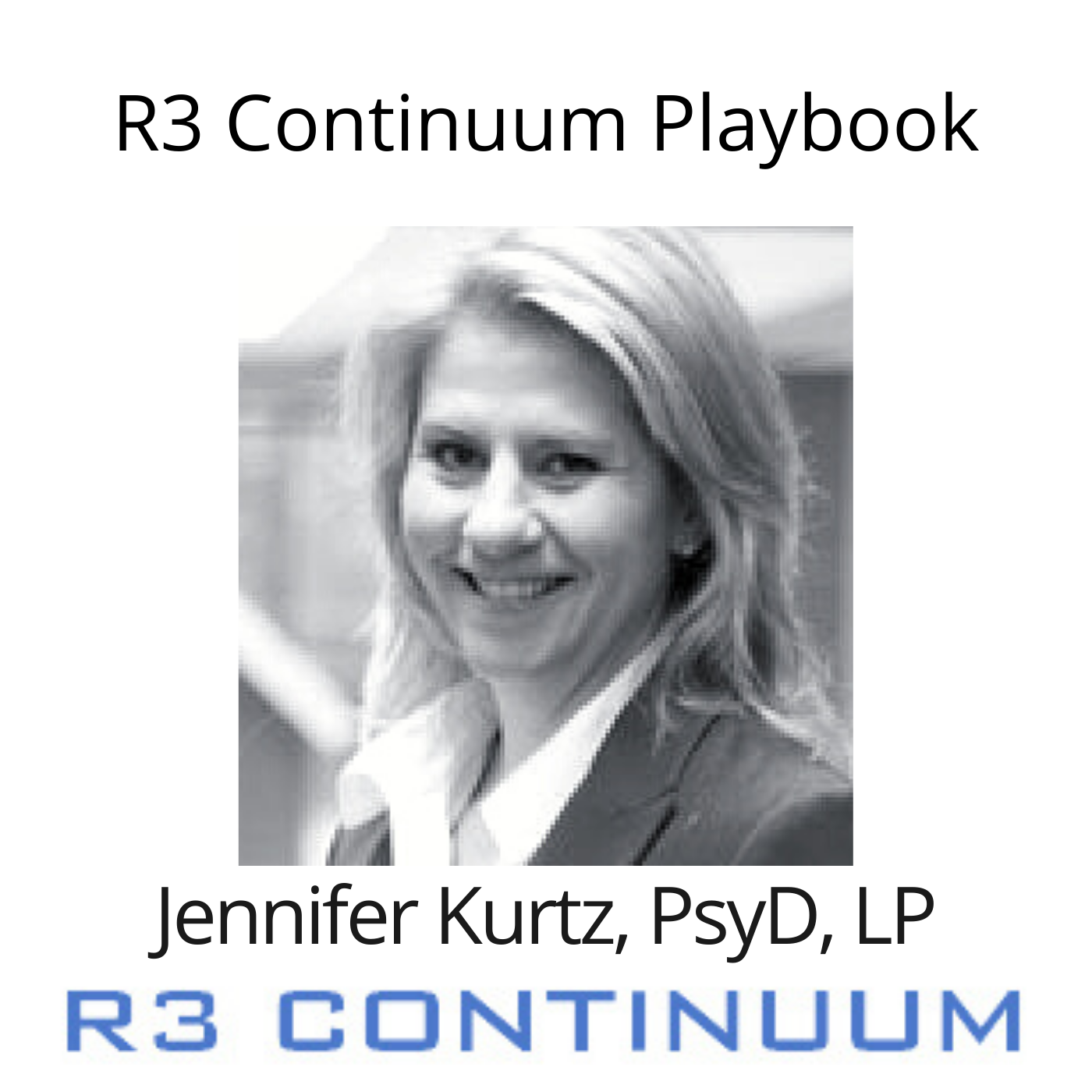
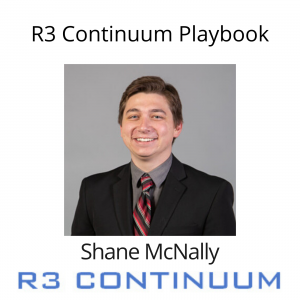
Shane McNally of R3 Continuum addresses the “next normal,” noting that while it might be different for everyone, normal is never static. Shane outlines key steps employers can take in preparing the workplace for employees to return to the physical workspace. The R3 Continuum Playbook is presented by R3 Continuum and is produced by the Minneapolis-St.Paul Studio of Business RadioX®. R3 Continuum is the underwriter of Workplace MVP, the show which celebrates heroes in the workplace.


TRANSCRIPT

Shane McNally: [00:00:00] Broadcasting from the Business RadioX Studios, here is your R3 Continuum Playbook. Brought to you by Workplace MVP sponsor R3 Continuum, a global leader in workplace behavioral health, crisis and security solutions.

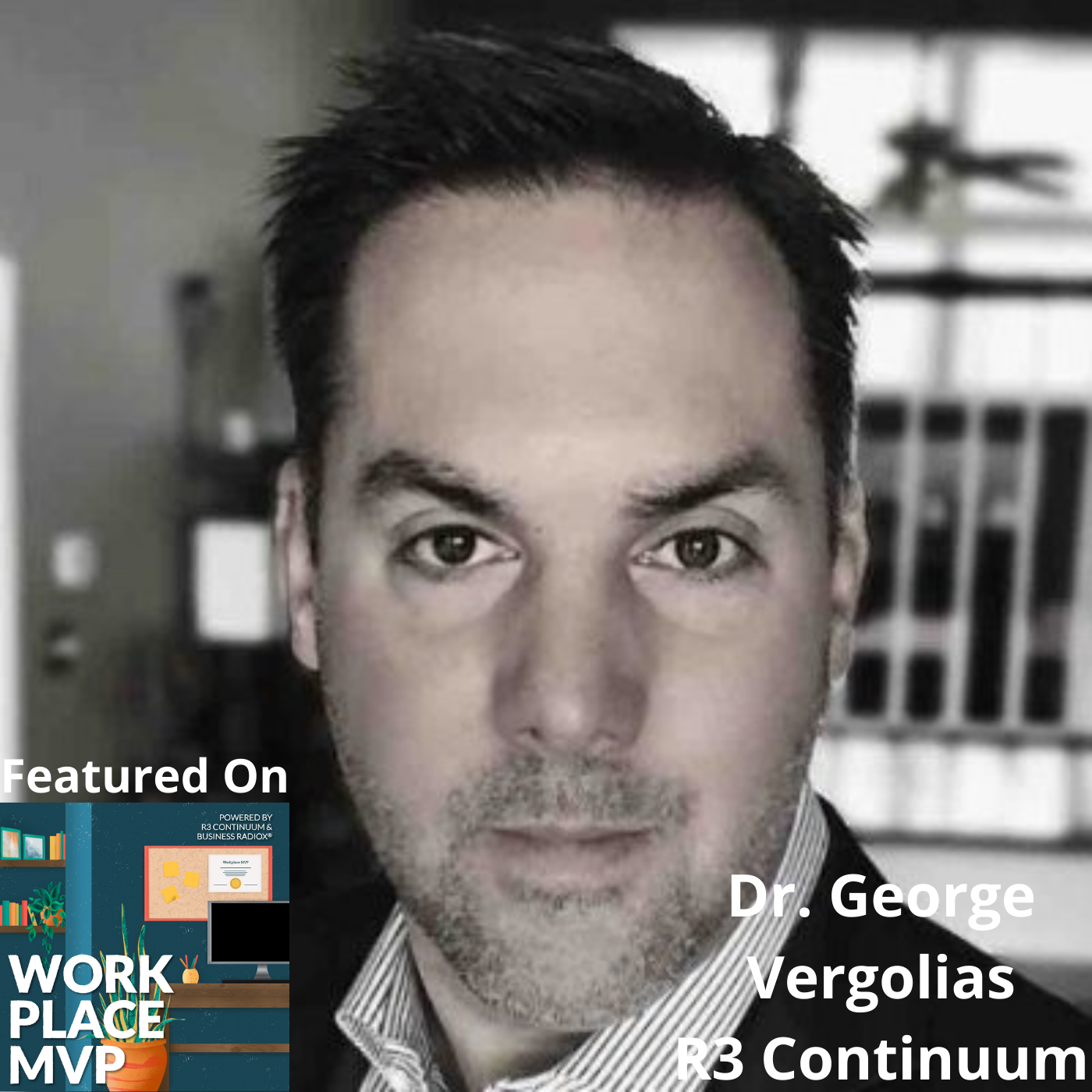
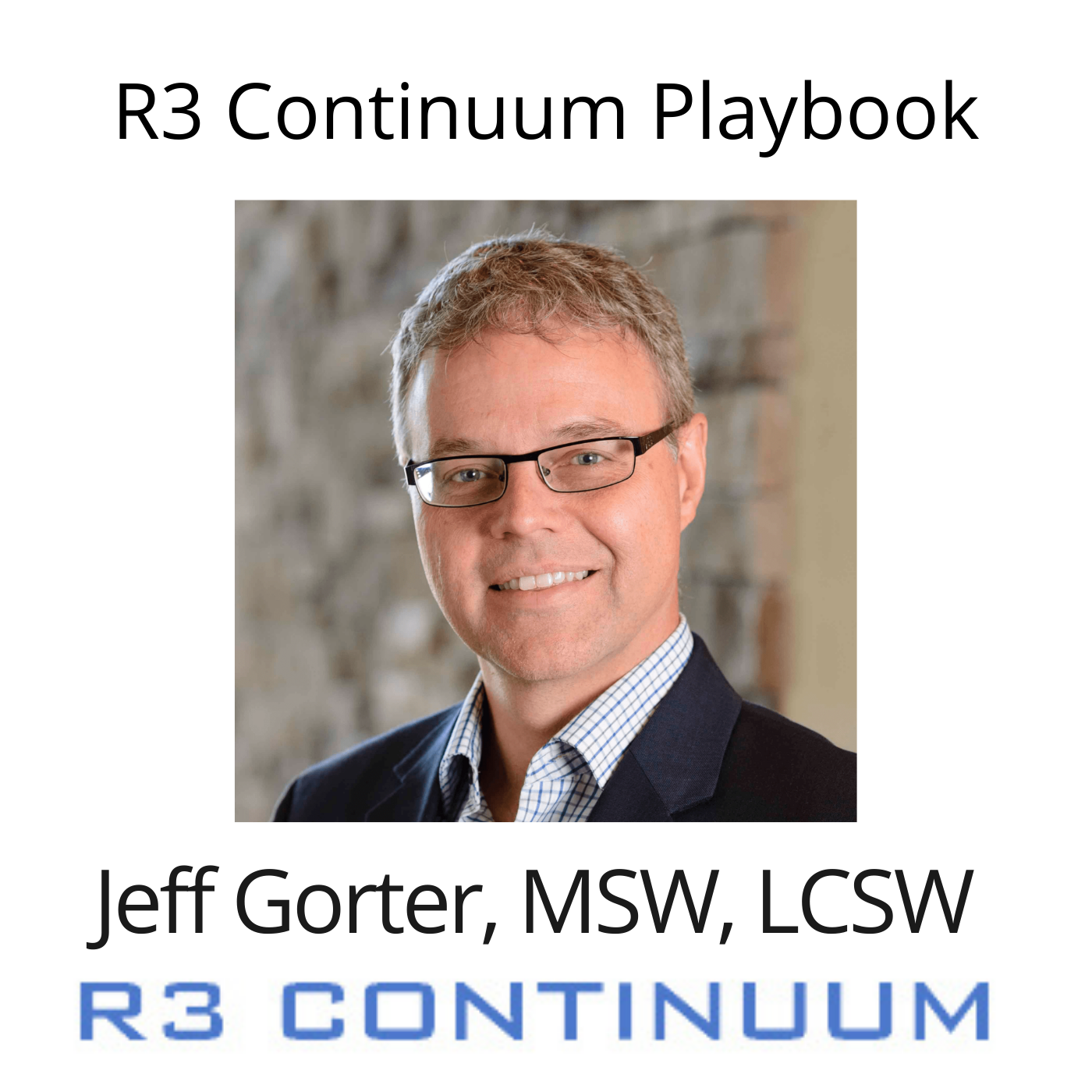
Shane McNally: [00:00:13] Hi there. My name is Shane McNally, Marketing Specialist at R3 Continuum. Today, I wanted to share some information on proactively preparing your workplace for the next normal. This information is provided by R3 Continuum’s Vice President of Crisis Response Clinical Services Jeff Gorter, as well as R3 Continuum’s Medical Director, Dr. George Vergolias, and Senior Vice President Hart Brown.

Shane McNally: [00:00:37] I remember when I was told that I’d be working from home for two weeks at the beginning of 2020. I never would have expected any of what we’ve all gone through over the course of the last year and a half. While nobody can tell the future, many organizations ran into the challenge of being unprepared for handling a crisis situation. With the vaccines being largely distributed throughout the United States, many employers are just excited to go back to some sense of normal in the coming months.

Shane McNally: [00:01:04] But what if there’s more to it than that? What if instead of having something return back to normal, organizations instead proactively prepared for the next normal? There’s a distinct difference between the terms new normal and next normal. The phrase ‘new normal’ is used often but has a very passive or reactive connotation. It’s taking a wait-and-see approach, waiting to see how everything settles, and then adjusting to it; while the phrase “next normal” is more proactive and recognizes that normal, whatever your definition for that is, is never a static or fixed point, meaning there’s always room for change and what was once considered normal will likely not be considered that in the future.

Shane McNally: [00:01:53] Wise leaders try to anticipate and shape the next change, looking for opportunities or market advantages. To put it bluntly, it’s the difference between riding the wave or getting caught in the tide. Here are some tips that can help leaders shape the next normal for their organizations. First, celebrate the victories, if your company is still standing after the pandemic, it means that you and your team have done thousands of things right to get to this point. Celebrate that. So many of us have been living one day at a time that we’ve forgotten what we had to do to survive and even thrive throughout the pandemic. Remember your first Zoom meeting with your newly remote team? Remember the production and operational experiments that you tried before landing on a workable adaptation? Remember how you got through the great toilet paper shortage of 2020? Take a second to honor those efforts and be generous in recognizing the efforts of others.

Shane McNally: [00:02:52] Next, resist complacency. While all of us are hoping for a moment to catch our breath and just enjoy whatever post-COVID stability emerges, the reality is that life probably won’t respect that desire. Leaders have to be thinking about the future and encouraging that same approach with their teams. Which leads to the third point, embrace your weakness. By embrace, I don’t mean accept or approve of it, I mean openly acknowledge and avoid avoiding it. This sounds simple, but many leaders, particularly after just coming off the crisis for the last 18 months, may have a natural tendency to want to steer clear of this kind of vulnerable exploration, at least for a little while. A thorough and clear eyed risk assessment is crucial at this stage.

Shane McNally: [00:03:42] Finally, adopt an all-hazards approach for your organization, if you haven’t already. For many of us, we’ve gotten pretty good at adapting and managing the demands of COVID on our business. Maybe, we even have a little justifiable swagger, if you will. The trouble is, everyone is an expert at the last crisis. But what about the next totally unexpected and utterly unique crisis? No one can anticipate every possible threat, but having an all-hazards approach leads an organization to invest in plans, policies and procedures that get them about 80 percent ready for anything, with the understanding that the other 20 percent has to be devised once the crisis is known.

Shane McNally: [00:04:26] One way of adopting an all-hazards approach is through your organization security and safety program. Security programs have been around for a while, and they’re often thought of as a means of protecting company assets. However, security programs are constantly evolving. They no longer only cover company assets, but they also help make employees safe, secure and comfortable. Through improving the overall well-being of employees, security programs help to boost productivity, and in turn, benefit both the employees and the organization.

Shane McNally: [00:05:02] Just like I mentioned with the all-hazards approach, the key to a good security program involves having proper procedures and policies in place, as well as the knowledge to recognize how the program is implemented throughout the company. The training, the company culture, the employees and how potential risks are conveyed all play a role in the success of a company’s security program. Security programs are also a good way to improve the relationship with other services that your organization may utilize, such as employee assistance programs, otherwise known as EAWs, risk management and insurance services to help protect your organization through any disruptions that occur, your company HR program, which can help in providing training, evaluations and policies for the organization, as well as the company’s security team.

Shane McNally: [00:05:53] Well, the stress and struggle over the last 18 months has been undeniably painful and gut wrenching for so many of us. There is a window of opportunity right now to begin to recognize and celebrate all that we collectively have done to survive and even thrive in the face of COVID-19. In no way is this dismissing or minimizing the grief caused by the pandemic. It’s more to reiterate the power of the human spirit to rise to the challenge of this moment and even rise above. Post-traumatic growth is a very real. And perhaps now, as we see signs of hope on the horizon, it’s a good time to take stock and reflect on those thousands of things we did, big and small, to exercise our resilience and cope through the chaos.

Shane McNally: [00:06:39] It’s no longer a question of if we can get through this. We are getting through this and we’ll continue to reclaim more of our lives as we move ahead together. And that is worth celebrating. As organizations begin to look to the future. Remember not to settle into the new normal, but rather prepare and plan for the next normal. Ensure you’re taking that proactive approach to maintaining the psychological and physical safety of your employees. R3 Continuum can help. Our tailored services can assist organizations with crisis prevention and preparedness, crisis response and recovery and more. You can learn more about our custom services and contact us at www.r3c.com or email us directly by emailing info@r3c.com.


Show Underwriter

R3 Continuum (R3c) is a global leader in workplace behavioral health and security solutions. R3c helps ensure the psychological and physical safety of organizations and their people in today’s ever-changing and often unpredictable world. Through their continuum of tailored solutions, including evaluations, crisis response, executive optimization, protective services, and more, they help organizations maintain and cultivate a workplace of wellbeing so that their people can thrive. Learn more about R3c at www.r3c.com.

R3 Continuum is the underwriter of Workplace MVP, a show which celebrates the everyday heroes–Workplace Most Valuable Professionals–in human resources, risk management, security, business continuity, and the C-suite who resolutely labor for the well-being of employees in their care, readying the workplace for and planning responses to disruption.

Connect with R3 Continuum:  Website | LinkedIn | Facebook | Twitter
Tagged With: all-hazards approach, Next Normal, R3 Continuum, Shane McNally, workplace mental health, Workplace MVP, workplace wellness

Workplace MVP: Erika Lance, Chief Human Resources Officer, KnowBe4

July 22, 2021 by John Ray

WMVPErikaLanceAlbum
Minneapolis St. Paul Studio
Workplace MVP: Erika Lance, Chief Human Resources Officer, KnowBe4
Loading
00:00 /
RSS Feed
Share
Link
Embed

Download file

KnowBe4

Workplace MVP: Erika Lance, Chief Human Resources Officer, KnowBe4

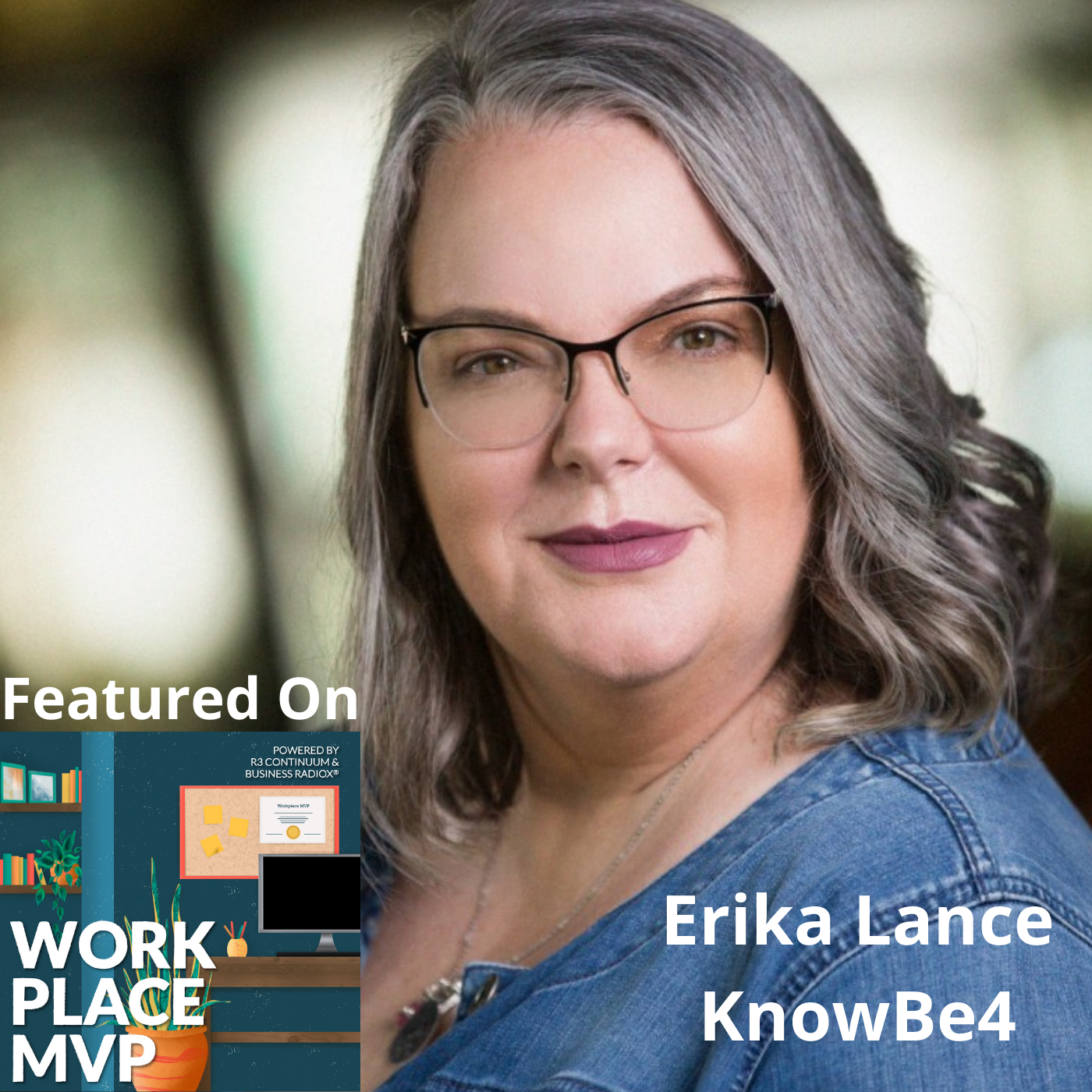
Recently named 2021 OnCon HR Professional of the Year, Erika Lane, Chief Human Resources Officer for KnowBe4, joined host Jamie Gassmann to discuss her career journey and share her experiences and ideas on hiring the right person for the job and the culture, holding the hiring individuals responsible for the quality and fit of that hire, and how KnowBe4 retains and supports their “Knowsters.” Erika also explains KnowBe4 initiatives like Project Restart, for workers stuck in careers they don’t enjoy, and Project New Start, for veterans and first responders who are changing careers. Workplace MVP is underwritten and presented by R3 Continuum and produced by the Minneapolis-St.Paul Studio of Business RadioX®.

KnowBe4

KnowBe4, the provider of the world’s largest security awareness training and simulated phishing platform, is used by more than 35,000 organizations around the globe. Founded by IT and data security specialist Stu Sjouwerman, KnowBe4 helps organizations address the human element of security by raising awareness about ransomware, CEO fraud and other social engineering tactics through a new-school approach to awareness training on security.

Kevin Mitnick, an internationally recognized cybersecurity specialist and KnowBe4’s Chief Hacking Officer, helped design the KnowBe4 training based on his well-documented social engineering tactics. Tens of thousands of organizations rely on KnowBe4 to mobilize their end users as the last line of defense.

Forrester Research has named KnowBe4 a Leader in the 2020 Forrester Wave for Security Awareness and Training Solutions. KnowBe4 received the highest scores possible in 17 of the 23 evaluation criteria, including learner content and go-to-market approach.

The KnowBe4 platform is user-friendly and intuitive. It was built to scale for busy IT pros that have 16 other fires to put out. Our goal was to design the most powerful, yet easy-to-use platform available.

Customers of all sizes can get the KnowBe4 platform deployed into production twice as fast as our competitors. Their Customer Success team gets you going in no time, without the need for consulting hours.

They are proud of the fact that more than 50% of their team are women, where the average in cybersecurity is just 20% of employees.

Company website | LinkedIn | Facebook | Twitter

Erika Lance, Chief Human Resources Officer, KnowBe4

Erika Lance, Chief Human Resources Officer, KnowBe4

With over 25 years of experience and prestigious awards such as the 2021 OnCon HR Professional of the Year Award and the 2018 Tampa Bay Business Journal’s People First Award, Lance is a distinguished leader in the Human Resources field. She has been promoted to chief human resources officer at KnowBe4 where she is responsible for leading the global HR team and developing new initiatives for recruiting, retention, company culture and diversity. Under her leadership throughout the last few years, the People Operations team has grown from 10 team members to over 50 team members in 11 countries across six continents. Lance is most well known for her radical transparency and her people-centric approach to Human Resources.

The OnCon Icon Awards recognize the top HR professionals and HR vendors in the entire world. Finalists were voted on by peers to determine the winners. Voting on finalists was open to the public and was based on the following criteria:

  • Made a considerable impact on their organization and/or previous organizations.
  • Made strong contributions to their professional community through thought leadership.
  • Innovate in their role/career.
  • Exhibit exceptional leadership.

“As HR leaders we’ve dealt with a lot of changes this year, and I’m sure there are still more to come,” said Lance. “The fact that we’re talking about and awarding the successes from this year just shows that we’re doing something right. We all adjusted to working from home. We all had to get used to this new way of life and hopefully we’ve all figured out ways to keep our employees happy, healthy and engaged while working remotely.”

Lance was recognized for spearheading new employee initiatives during COVID-19 pandemic to keep energy and morale high. Her leadership has directly positively influenced KnowBe4 and its employees.

LinkedIn

R3 Continuum

R3 Continuum is a global leader in workplace behavioral health and security solutions. R3c helps ensure the psychological and physical safety of organizations and their people in today’s ever-changing and often unpredictable world. Through their continuum of tailored solutions, including evaluations, crisis response, executive optimization, protective services, and more, they help organizations maintain and cultivate a workplace of wellbeing so that their people can thrive. Learn more about R3c at www.r3c.com.

Company website | LinkedIn | Facebook | Twitter

About Workplace MVP

Every day, around the world, organizations of all sizes face disruptive events and situations. Within those workplaces are everyday heroes in human resources, risk management, security, business continuity, and the C-suite. They don’t call themselves heroes though. On the contrary, they simply show up every day, laboring for the well-being of employees in their care, readying the workplace for and planning responses to disruption. This show, Workplace MVP, confers on these heroes the designation they deserve, Workplace MVP (Most Valuable Professionals), and gives them the forum to tell their story. As you hear their experiences, you will learn first-hand, real life approaches to readying the workplace, responses to crisis situations, and overcoming challenges of disruption. Visit our show archive here.

Workplace MVP Host Jamie Gassmann

In addition to serving as the host to the Workplace MVP podcast, Jamie Gassmann is the Director of Marketing at R3 Continuum (R3c). Collectively, she has more than fourteen years of marketing experience. Across her tenure, she has experience working in and with various industries including banking, real estate, retail, crisis management, insurance, business continuity, and more. She holds a Bachelor of Science Degree in Mass Communications with special interest in Advertising and Public Relations and a Master of Business Administration from Paseka School of Business, Minnesota State University

TRANSCRIPT

Intro: [00:00:03] Broadcasting from the Business RadioX Studios, it’s time for Workplace MVP. Workplace MVP is brought to you by R3 Continuum, a global leader in workplace behavioral health, crisis, and security solutions. Now, here’s your host, Jamie Gassmann.

Jamie Gassmann: [00:00:24] Hi, everyone. Your host, Jamie Gassmann, here and welcome to this episode of Workplace MVP. So, picture this, you have an open position, you’ve crafted what you believe to be the best written job description you could possibly write, and you’re now navigating the various candidates who have applied. As you comb through the numerous resumes, looking at the talent pool options who have expressed interest in your position, you identify some standout candidates that on paper seem to have most of the skills and experience you are seeking. The interview is scheduled and it’s time to meet the candidate in person.

Jamie Gassmann: [00:01:02] But how do you ensure you are asking the right questions to truly gauge if they are a cultural fit within, not just your organization, but the team they will be working with? Also, they may not have 100 percent of the skills and experience you are seeking. How much of the job description are you willing to accept as enough? Or which of the skills and experience are non-negotiables, they have to have them? These are questions that leaders likely face every time they venture into the hiring process. How can they create an approach to hiring or promoting within that not only ensures they make better hiring decisions, but that they are setting the employee and the organization up for a better chance at success.

Jamie Gassmann: [00:01:46] With us today to share her approaches that have delivered proven results to her organization is award winning Workplace MVP Erika Lance, Chief Human Resources Officer for KnowBe4. Welcome to the show, Erika.

Erika Lance: [00:02:00] Wow. Thank you for having me. That was an amazing intro. I appreciate it.

Jamie Gassmann: [00:02:05] And congratulations to you on your recent promotion to Chief Human Resources Officer. What an incredible honor. And I really like to have you walk me through your career journey and tell us a little bit about how you got to this role.

Erika Lance: [00:02:18] Well, I have a very interesting career journey. I will say it actually goes back to when I was very young. I’m not going to mention my age because of my fabulousness. But when I was younger, I had a job working in administration at a stock brokerage firm, and I had helped come through a couple resumes with them with no training. I do tell people this story that I actually got my GED. I didn’t finish high school. I just start working for my family when I was about 14 years old and didn’t go to college for this. So, I had an administrative job and did that.

Erika Lance: [00:02:54] So, when I was looking for my next job, I put on there that I did some recruitment. And that next job saw that and they’re like, “Oh, you know how to do hiring? You know how to do H.R.?” And, of course, I was like, “Yeah. Absolutely. I did all of those things,” which I had not. So, it was a little bit of trial by fire to do that. But I’m a firm believer that you can take on any challenge you want if you’re willing to do the learning and the research necessary to do that.

Erika Lance: [00:03:22] So, I’ve had a very interesting career that has then taken me from that moment of, maybe, overstating my resume a little bit to where I am today, which has been very, very fortunate. And I consider kind of an exception to the rule, generally, when you have that kind of background. But I was fortunate that they believed me and that I was able to rapidly compensate for that lack of knowledge to be able to move forward.

Jamie Gassmann: [00:03:51] It’s very impressive. And in addition to the promotion, you recently were awarded the 2021 OnCon HR Professional of the Year Award. So, tell me a little bit about receiving that honor.

Erika Lance: [00:04:02] That was super exciting. Why it was most exciting to me is, it’s voted on. People have to vote for you. Obviously, any award is voted on. But I mean, it’s not like a committee vote. Like, people sign in and vote for you. So, when I got nominated, I was super excited, so I let my Knowsters – that’s what we call our KnowBe4 employees – know that I was nominated, if they felt like they wanted to put in a vote. And then, I posted it on LinkedIn and also on Facebook.

Erika Lance: [00:04:35] And when it came time, they asked for us to have some speeches ready and I’m like, “Why are they asking me to have a speech ready?” So, I had a speech ready. And then, I went in there, like, they’re going through the categories, and I kept thinking I missed my name because they were listing a lot of people. And no, no, I received it. And, to me, it was just such an honor because it was voted on by people for me. And so, they think that I’m good enough to receive that award, which is really the difference you want to make as an H.R. person, is, you want to have that impact on employees, whether it’s current employees or former employees.

Erika Lance: [00:05:16] And a lot of the messages I got on LinkedIn and stuff when I had posted it was like, “I voted. You’re fantastic. Thank you for everything.” And there are people I don’t work with anymore, like they were at previous jobs and they were saying that. And as an H.R. professional, that’s the impact you want to have, is that, you’ve made enough of a difference in people’s lives. That something like this comes up and they’re like, “Absolutely. I’m putting your name in.” So, that was wonderful to me.

Jamie Gassmann: [00:05:43] Very amazing and validating that taking on that role so many years ago has really paid off and kind of created this incredible journey and opened doors and opportunities for you. That’s fantastic.

Erika Lance: [00:05:54] Absolutely.

Jamie Gassmann: [00:05:56] So, now, since you’ve been at KnowBe4, you’ve really grown your H.R. team quite a bit. And how have you supported your employees as you’ve gone through that growth? Because, obviously, growing departments and that change that can take place can kind of sometimes create challenging environments or challenging times. So, talk me through a little bit about how you navigated that.

Erika Lance: [00:06:21] Absolutely. One of the things that I’m a firm believer in is you have to build people to what they want to do when they decide what they want to be when they grow up again. Everybody talks about decide what you want to be when you grow up. I think we get to decide that a hundred times in our lives. We get to keep changing what we want to be when we grow up again.

Erika Lance: [00:06:41] And so, when I bring on people to the team – and I know we’re going to talk a little bit about this culture adds – is I find people that have backgrounds that can add to what the team already has, but really, really make sure my team is getting trained and certified, any mentoring or coaching that they need, so that I can grow people to grow up within the team. Because the institutional knowledge your team members get is so vital that they can just help with that.

Intro: [00:07:15] And I’ve been growing in 11 different countries, so we’re a global group. But that, along with radical honesty and radical transparency and making it super safe for employees to communicate. And when there are problems, if you make it safe for employees to communicate, they tell the problems instead of hoping nobody finds the problem. Which, unfortunately, some companies foster that, that you can’t put your arm up and say, “Hey, I created this problem and sometimes I don’t know how to solve it.” Because if they do that, they could get fired or something like that versus realizing everybody’s going to make mistakes. So, I really foster that environment.

Erika Lance: [00:07:59] And a lot of the people that worked for me, not only at KnowBe4, but in other jobs have been promoted up. And some have moved into other areas of the company to be successful there. I had one gentleman who moved from our employee relations and he’s now in our HRIS area because he loved the technology, love that, had all the H.R. experience. That worked out for me because, now, the person is working on our HRIS and IT knows H.R. instead of just an I.T. person who doesn’t know H.R. So, that’s what I do, is, I grow people because I want them to continue to expand and move up. But, yeah, we started with around eight, I think, and now I have over 60 in three-and-a-half years.

Jamie Gassmann: [00:08:46] That’s incredible growth. That’s a lot of hiring. And I’m going to touch on kind of your hiring process and kind of the approach that you use, but quick question on creating that culture of allowing people to own when they’ve made a mistake or create a problem. How do you approach that? How do you create that environment with your individuals? Do you do that by being transparent when you yourself make an error? Or is it through conversations you have with them to create that comfort level? How do you go about that?

Erika Lance: [00:09:24] Well, first of all, anything like that has to start at the very top of the organization. I’m very, very fortunate that Stu Sjouwerman, who’s the CEO of KnowBe4 and who I report to, does the same thing. If he makes a mistake, we have a morning meeting every morning with all employees, and he’ll own up right on the morning meeting if something happened and then it wasn’t correct. And we use the term extreme ownership.

Erika Lance: [00:09:50] We have a reading list of books for our company, and there’s one called Extreme Ownership that was written by two Navy SEALs. Amazing. And it talks about just taking ownership. If you’re over an area, you never throw your employees under the bus even if a mistake is made. It’s your area, you’re responsible for it. So, any mistake made beneath you, you have to own that mistake and resolve it correctly. So, we say extreme ownership there.

Erika Lance: [00:10:18] And the book, Powerful, by Patty McCord talks about radical honesty and radical transparency in your workplace. And so, we tell people that we start with that when they’re onboarding. We have a whole onboarding process that has a Welcome to KnowBe4. It used to be in-person. Obviously, COVID changed things. But we have a video now of all of us that they met in person giving our little tidbits of advice on things.

Erika Lance: [00:10:45] And I find the employees are waiting for another shoe to drop when they start at KnowBe4, because you say, “We have this. It’s safe. You can talk.” And their immediate thing is, “I’m not saying a word. I’m not going to say anything.” Because you’re so used to people going, “Oh, yeah. We have an open door.” But then, there’s another open door behind the person, and you go right out the open door, and you don’t have a job anymore. So, we show them by the actions that we take that it’s safe. We let it come up. We let it come up naturally.

Erika Lance: [00:11:16] Even if something happens and you go, “Hey, did this happen?” And they’re maybe a little skittish and going, “Yeah. But -” and they try to explain that. I always tell, “Stop. Stop defending. Just explain what happened. Okay. Cool. Do you have a solution for it or do you want some advice?” And then, the first time it happens, they aren’t fired and they aren’t on a disciplinary warning for something silly. Because we’re all going to make mistakes. I make mistakes. I started with, “Hi. I have a ton of major experience. I know what mistakes are.” But you have to be willing to go, “Okay. That happened. Let’s see if we can prevent it from happening again.” If it’s the same mistake over and over, that’s a different situation. But, you know, it’s Jurassic Park, we’ve got to make all new mistakes.

Jamie Gassmann: [00:12:02] Yeah. Absolutely. You learn from them is kind of some of the advice I give to my employees who are afraid to make that mistake. So, looking at your hiring practices, you have some best practice approaches that you use in navigating that process that helps you, especially within this level of expansion that you had. Can you share those with our listeners?

Erika Lance: [00:12:27] No. They’re top secret. Nobody can know anything. Just kidding. Of course. I believe in sharing knowledge. It’s a huge thing for me, because the more we share successful things in H.R., the more we can help each other expand an organization. So, how it works at KnowBe4 before is, we have, obviously, our expansion team, which are our recruiters. So, I’ll say the term recruiter, even though we call it something different, just so that everybody understands. And we also have the hiring managers.

Erika Lance: [00:12:53] The biggest thing is we created training for hiring managers that explain what their duties, what their role is in this. And one of the key components for both the recruiters and the hiring manager is that – I stated it and this is my firm belief – both of those people are 100 percent responsible for the human that they hire. So, if they hire them and something goes wrong or is off, we do a lot of look backs to go, “Was there something we missed in the hiring process? Was there something we missed in the onboarding? Was there something we missed in training? Like, how do we avoid not having that situation happen?” Obviously, if somebody had a family emergency and their mom was terribly sick and they had to leave, there’s no look back. Like, you can’t know that the mom was going to get sick. We’re not quite to that stage of Jedi mind powers yet.

Erika Lance: [00:13:44] But we could say that, if something goes wrong and the employee doesn’t work out, both of these guys are 100 percent responsible and they should be defending their choice to hire this. So, if either one of them don’t feel like this person is a good fit, they’re allowed to say no during the process. Either side, both the hiring manager and the recruiter, are both allowed to do that.

Erika Lance: [00:14:07] We also firmly believe in using – I call it – Spidey senses, because Spider-Man talks about it when his hair stands up on him. But if you get a gut feeling during the interview process, either in a positive way or a negative way, you can utilize that because sometimes that’s all you get. You can’t exactly pinpoint what the problem is, but you know there’s something wrong. The agreement is we stop the process and you just have to go, “I don’t feel like they’re the right candidate.” And it’s okay, we don’t have to justify the reason they don’t feel like it’s the right candidate.

Erika Lance: [00:14:41] But we go through a series of things, like, for a lot of the positions. First of all, we do not let our ATS filter for us. I think ATSs, which is Applicant Tracking System, is filtering your prospects based on 25 key words or phrases. You lose the humans in that. You completely lose the humans because a lot of people don’t know you have to write your resume to that. Or they go in and they write their resume to that, but they still might not be a qualified candidate. They just figured out the the glitch in the ATS matrix, so to speak.

Erika Lance: [00:15:17] So, we have them reviewed. We have sample questions – that’s usually the first step – about their experience in that particular kind of role to ask back. They have a phone interview with the recruiter to see how how they answer a series of questions and how the recruiter feels about them. And then, the recruiter will move them on to the hiring manager. And the next would be, potentially, a series of tests depending on the role. Like, our developers do a whiteboard test on some development skills just to see.

Erika Lance: [00:15:51] Because, obviously, resumes can say anything. I mean that evident by my resume previously. They can say anything, it’s just what is the actual experience that that person has. And maybe they’re not even saying enough about their experience on the resume because we’re not the greatest at teaching people how to write resumes in the world. I know there’s classes and people who write them for you, but this is an art form that isn’t always done correctly.

Erika Lance: [00:16:18] But they get a chance to do that, do a face-to-face, depending on the level of the employee. They might do a few more if they’re an executive and stuff. But we have key questions around being a manager. We have some trick questions about being a manager and stuff. But it allows the person to go through the process. And we also talk a lot about what the company culture is like.

Erika Lance: [00:16:41] One of the things at KnowBe4, for instance, is Halloween is a really big deal. Like, everybody almost dresses up for Halloween. We dress up areas. Like, this is a huge deal. So, we ask every applicant what their favorite Halloween costume is or what do they think of Halloween and stuff like that. And if somebody is like, “Oh, my gosh. It’s the worst holiday in the world. I think it’s so dumb, blah, blah, blah.” Regardless of anything else, they are probably not going to be a fit for KnowBe4. For them as well, because we do so many things that are like that, that are inspired by things and are fun and party like.

Erika Lance: [00:17:20] We used to do quarterly mingles before COVID, and we had a bowl, and a rock climb. Like, do you want to participate in these things if you seem to want to be very conservative or something? Maybe you won’t be a great fit for that or that team if that team is really playful. And I think it’s both the company and what is the culture of that team like? What do they like to do? We all have different managers. Some are, like, the very Care Bears kind of managers. And some are the very, like, let’s do a team sport kind of managers. And will they fit in with that as well?

Erika Lance: [00:18:00] So, I think you have to find people that our culture adds and culture fits, but you have to be very good at telling them this is what it’s actually like. Every one of our interviews, too, is, we’ll explain what the day-to-day is like for the person instead of very generalities. And the worst question I think you can say to an employee is, “We move really fast here. This is a fast-paced environment,” without defining what that means. Because if they go, “Oh, yeah, no. I’m really good in fast-paced environments.” And, say, you want them to do data entry and you go, “Well, you have to enter 200 files a day.” And to them, fast-paced is 50 files a day, you’re not going to have a fit for an employee. But you’re not going to know that because you didn’t ask them what that means, like what is it actually like.

Jamie Gassmann: [00:18:49] So, you’re kind of touching on it a little bit, that cultural fit. Can you define for the audience what you mean by that? Like, when you’re in that hiring process, what is culture fit?

Erika Lance: [00:19:03] For us, cultural fit is somebody who is looking for more than just a job. They’re looking for a place that they can grow and expand in, that they can be their own self in. And that they want to be a part of the team. And that’s a key part, does a person really want to be part of the team? Because all of our activity center are around a team.

Erika Lance: [00:19:30] Another thing is, we have metrics for every single position within the company. We do metrics on it, so we keep numbers. Are they fine with that? Are they fine with having the numbers thing? Are they fine with a very open work environment? Meaning, we have an open floor plan. Obviously, COVID, a lot of people have worked from home. But we have an open floor plan, are they comfortable with that? Are they comfortable with being held to a certain standard? Or how do they feel about, like, the fun part of the atmosphere? How do they feel about some of the activities? We do a ton of team building activities, whether it’s on a small team itself or on the larger sector area division of it.

Erika Lance: [00:20:17] And then, just kind of finding out where they feel they fit from a job standpoint or career standpoint within a company. Are they just there to punch a clock? They’re not going to be a very good Knowster. And some people can want to do that and it’s totally fine, but they’re not going to do well because the teams going to want to rally the teamness and they’re going to want to stand out, which can create in individuation for them.

Erika Lance: [00:20:43] And even if they don’t want the team thing, then the rest of the team goes, “Why does this person not want to be on the team?” And it can create a weirdness. And you avoid that by defining what that team is like and what are the fun things that you do and what is expected. And you’re expected to learn a lot. We’re constantly learning. We’re constantly reading books. Like, how do you feel about that sort of thing? Because if you’re going to be upset every time a new training course comes out, well, you’re not going to be a good cultural fit. This is going to be very stressful for you when these things come up. We have to do these courses.

Erika Lance: [00:21:20] “There’s another book to read? Waah.” Well, it sounds silly. I mentioned two books already. We have a reading list of about 20 books that are recommended. Not everybody has to read them, but some team do. Like, there’s a book called Never Split the Difference that was written by an FBI negotiator. And that’s something our sales team has to read. Well, if you’re like, “No, I hate reading. I’m not going to read.” You may have a problem when we have these books. So, it’s little things like that that can create great divides between areas.

Erika Lance: [00:21:57] And sales, we have goals every month. And you have to want to play that game of getting that goal. We have lots of fun things around that. But if you’re not into that, you’re going to not be a cultural fit or a cultural add.

Jamie Gassmann: [00:22:08] I love that you guys have very defined kind of cultural nuances that are important to the overall success of the organization. So, for other organizations, is there a way that they can train or empower their leaders to understand their own culture to be able to leverage cultural fit when they’re doing their interview process? If you were going to give recommendation for that, what would you give?

Erika Lance: [00:22:37] I would say get it defined from the top of the organization what the culture needs to be. Then, secondarily, train every single person in an executive or management capacity on what that is and how you do that. Meaning, if you have a process, like we have a process where our managers are responsible for their humans. H.R. does not do disciplinary actions. We assist and guide on how a warning needs to be written or said just because there are so many nuances, as we all know in H.R., about what is right versus what is correct for an area to be in.

Erika Lance: [00:23:15] But we have the managers for the discipline. They’re fully responsible. They get all the good and the bad with the people. But they have to understand how the overall management philosophy, aka culture, needs to run. How do we all agree and define those cultural points and then make sure everyone is adhering to them?

Erika Lance: [00:23:37] Like, we have a policy called Say It To Your Face. If you have a problem with somebody, you don’t get to go complain to somebody else. You have to say it to them. Now, if you don’t feel comfortable, you can ask for assistance to do that. But we really hold our employees responsible. We’re adults. And it’s very different, obviously, if you’re being sexually harassed or something like that, please report that correctly. But if somebody just said something to you the wrong way or sent an email that seemed snarky, go over to them and go, “Hey, Bob. Listen, I got your email and I don’t know if you’re upset or what, but can we talk about whatever this is?” If you don’t do that, it creates separation.

Erika Lance: [00:24:18] So, that’s like a philosophy we have. So, every manager, if somebody comes and goes, “I’m really mad. Sally said blah to me.” They’ll go, “Okay. Did you say it to Sally’s face?” That will come out of every single manager’s mouth because that’s how we operate. And if they don’t have the strength to do it themselves, we go, “If you want some help, we can help you. But if you just choose not to do it, then that’s on you.”

Erika Lance: [00:24:43] I think a lot of organizations have forgotten somehow that all of the people that work for them, besides when they’re certain, are adults. They’re adults and you should treat them like adults, but they should be responsible for themselves. And H.R. shouldn’t be this really scary thing that has to come thundering in to solve all these problems that can be solved with open communication. And so, we started at the top and then we filtered it all the way down through our training and everything, so that’s all the case. And it’s defined for the employees what’s expected. And if you treat them all the same way, you get sort of a lot.

Erika Lance: [00:25:20] I’m going to use the analogy of a beehive. If something tries to go into a beehive that will mess up the beehive, the rest of the bees will solve that problem. So, it’s not H.R. or manager that has to solve the problem. Because if somebody goes to somebody else and goes, “Sally said blah, blah, blah to me today.” They’ll go, “Well, did you tell it to her?” Because they know that that’s the Say It To Your Face mentality that the whole company has. So, you get less problems.

Erika Lance: [00:25:46] We have less than a one percent situation rate with employees at our company, which, to me, is unheard of to have that. A lot of companies have up to a 20 percent issue rate, whether it’s investigations or disciplinary actions and stuff like that. And I think it’s because they’re not putting the responsibility from the top of the organization down that everybody’s operating with a set of defined guidelines – not rules. People don’t like rules – and guidelines as to how the company is to operate. So, they can get in trouble even unknowingly because stuff can fester.

Jamie Gassmann: [00:26:23] Absolutely. Especially when you’ve got those conflicts that aren’t resolved directly with the parties that are involved in those conflicts. So, in looking at, you know, gauging somebody as a culture fit, why is that so important? You’ve kind of touched on this a little bit, but diving into it a little bit deeper, you know, what can happen to an organization when they aren’t hiring somebody who is a fit to that company? Productivity wise or financially, what might be some of the things that they may be experiencing now as challenges that they need to think about?

Erika Lance: [00:27:04] Well, I think the more a positions open, the more desperate a hiring manager or a manager of that area gets. I make the joke sometimes, it gets to the point where they’re like, “Can you breathe on a mirror? Okay. You’re qualified. Let’s go. Let’s do it. We just don’t want zombies.” The problem with that is that, if you bring somebody in to the company that is not a fit for the company, not a fit for that team, they’re not going to work out. So, depending on how long it takes us all to come to this realization or the great “I told you so they’re not going to work out,” you’re losing money. You’re not getting the correct fit for that position. So, you’re losing money with every second that person’s on the team.

Erika Lance: [00:27:45] Then, when they leave, with all the institutional knowledge or effort you put into them, you’ve literally just lost potentially tens of thousands to millions, depending on the position. Like, you take somebody who’s an enterprise level salesperson for your organization bringing in millions of dollars. And you’ve had that open and they’ve established relationships with consumers that somebody has to start again from scratch to do. That’s potentially millions of dollars out the door because you did not make sure that person was a fit for the team. Because a person who is not a fit for the team will eventually not want to be there.

Erika Lance: [00:28:23] They can also cause problems if there are personality conflicts. Because certain personalities – and not everybody has to be the same. This isn’t a lemming thing – will not work well with other personalities. It is just hello, human nature. And we all have that in even our family lives. As much as we all love family, there are certain family members that you’re like, “Do not sit next to Joe and talk about politics because it will end badly.” So, if you don’t find those personalities that it will go well and have the right view of how work should be, then, eventually, they won’t be there anymore. They won’t be happy.

Erika Lance: [00:29:08] You have to hope they do not create a huge problem on their way out in the form of investigations or whatever. Because if somebody feels slighted – and we’re talking a little bit about this earlier when we were talking about the conflicts with people – the moment somebody has a conflict with somebody or think somebody is bad, they put on a different color glasses and they’re not rose colored in the nice pretty way. They are different. Every communication then received by that person is in that vein.

Erika Lance: [00:29:34] So, even if it’s not intended to be snarky or mean or whatever they think, they’re going to be defensive and think it’s there and a problem can build and build and build. And if it builds in a certain way and the manager doesn’t realize what’s happening and all of this stuff, then you could potentially have a lawsuit on your hands because nobody knew that this cultural fit problem was occurring. And the person ends up saying they felt harassed or singled out or whatever. And by default they were because they weren’t part of the team to begin with.

Erika Lance: [00:30:11] So, it is so important that you have that piece, but that that piece is so defined for your organization. But you have to sort of put the rules. We have a policy we have in our handbook, which is the Welcome to KnowBe4. It was written by Stu on his whole, like, how KnowBe4 came into being, this is what it is. And then, I wrote one called The Common Sense Guide to KnowBe4. Like, here are the little things that you need to know to be a Knowster at KnowBe4 and to get you out of trouble. Those are the first steps to how to agree with things.

Jamie Gassmann: [00:30:45] Great. Great information. So, in talking about, like, they get desperate for hiring, as you’re probably aware, that some industries right now are really having difficulty in hiring employees for various types of roles, you know, trying to get that right level of experience, maybe that right of level of education based around how they’ve crafted that job description for who they feel is the ideal candidate. Are there things that they maybe should be looking at or considering maybe changing in that job description that might open up possibilities for a different channel of candidates or a different level of candidates that maybe they hadn’t originally thought would be the right fit, but maybe opens up opportunity for them to expand that candidate pool?

Erika Lance: [00:31:37] Yes. I feel a lot of times people write job descriptions like they write perfect dating apps, where you’re looking for this perfect person and they need to be X tall, and this built, and this kind of career, and you have chiseled jaw, and dark hair, and blue eyes. And like you’re writing a job description as if you’re looking for a unicorn. And fantastic for all the humans out there that write a job description or a dating profile and get that unicorn to show up.

Erika Lance: [00:32:06] But the problem is, you have candidates out there that are looking at this job description and go, “I don’t qualify.” Well, do you actually need all those things? Because if you don’t need the level of education, there are a lot of people that have experience that don’t have the education. And no offense to everybody who went to school, but sometimes those people are better than the people that have the education because they’ve been there, they’ve done it, and they have all the t-shirts from doing it. So, if you limit your pool to where you’re looking for only Pegasus’ and unicorns or whatever, dragons and unicorns – I can make a lot of fantasy analogies – if you’re only looking for that, then you’re going to have a hard time finding the person.

Erika Lance: [00:32:53] Also, you need to go look at hiring managers. You need to go on LinkedIn. You need to go out there and go to the different – like, there’s a lot of, for instance, developer meetups or salespeople meetups. There’s all these meet ups in the communities, H.R. meetups. Like, if you’re an H.R. professional, trust me, you can find eight million meet ups to go to, to be the H.R. professional. But you need to go as the hiring manager and find some people and look for your own humans. You know what you’re looking for, so go look for them as well. But you got to lower your expectations, not for what you genuinely need, but go what would lead to a good candidate.

Erika Lance: [00:33:32] And I’ll give an example. I have hired several people into H.R. that have done retail management experience. They’re not H.R. professionals at all. But guess what? When you do retail, like all of us who have been lucky enough to also do fast food and stuff, you get a level of patience and understanding with the weirdest things that can happen. And in your retail, especially if you’re a retail store manager – which they escalate a lot of people interior to the retail store managers – you have had experience dealing with pretty much anything an employee can do and come up with – you know what I mean? – to be a part of it. So, do you want to be an H.R.? Do you want to train? Because you’ve got the experience of being calm, cool, collective in dealing with some of the stuff that comes up from an employee relations standpoint.

Erika Lance: [00:34:24] It’s been wildly successful for me to have that because I was willing to go, “Let me look beyond what I’m looking for, for that person who does good customer relations, who does customer service.” What are other professions that do that where the person maybe didn’t have the chance, but you have this much experience dealing with customers. Are they a good fit? And here’s the thing, too, is you help somebody advance and change their career path. They are going to be some of the most loyal employees you ever have because of what the company has done for them to help them out. And it’s the right view. So, if you can take something different, do that.

Erika Lance: [00:35:09] And go look, part of your responsibility as an executive or manager is to go find your own people. Go find them, meet them, get them to apply, get them in the door because you’ll meet them and see if they’re qualified. You get to do a pre-screening with them.

Jamie Gassmann: [00:35:24] Right. Kind of looking for those transferable skills, maybe not necessarily the experience background, but experience around areas that could be applicable in that role. Very interesting.

Jamie Gassmann: [00:35:37] So, real quick, we’re going to just get a word from our sponsor. Workplace MVP is sponsored by R3 Continuum. R3 Continuum is a global leader in providing expert, reliable, responsive, and tailored behavioral health, crisis, and security solutions to promote workplace wellbeing and performance in the face of an ever changing and often unpredictable world. Learn more about how R3 Continuum can tailor a solution for your organization’s unique challenges by visiting r3c.com today.

Jamie Gassmann: [00:36:09] So, you had mentioned in a previous conversation that employers need to also look within the organization that there may be employees with strong institutional knowledge who might be afraid to speak up about movements and career advancement. So, what kind of tips or advice would you give to leaders to help them in identifying employees that are probably sitting there waiting to be asked to move up or waiting to be asked about their career and maybe aren’t quite as confident to bring that up in a conversation. What advice would you give?

Erika Lance: [00:36:44] I think it’s very important for managers to have one-on-ones around what the career path for the employees that are working for them is and what they want to do. And make it very safe that maybe they want to do something in another part of the organization. Another thing is, we have a dedicated career team. Team employee gets to interact with them. They get to meet the career person on onboarding. We have the career person has an entire part of our intranet that they talk about things. They have different seminars. They have also gotten with every leader and mapped out the career tracks for the person and where they end up needing to go and stuff like that.

Erika Lance: [00:37:22] So, like, what steps do they need to take? What knowledge base do they need to have in order to move up into roles? And we have a tuition reimbursement and a certification policy where we help pay for the certifications that the employees need. And we have training courses so they can train. And we believe employees should have about five hours a week to train, whether it’s on their own position or other things. And they can train so they can be ready to move into maybe the junior role in that area they want to move into. Or we have manager training. So, maybe they weren’t a manager before, but they want to move up into leadership, here’s a manager training and this is how you do it.

Erika Lance: [00:38:01] I think that we promote from within between 20 and 30 percent every year of people. We do that because those are Knowsters – that’s what we call them – that want to be a part of something bigger and help the organization. And because of all the knowledge they have, they just bring that to the next area. Like, my story in the beginning about the person who moved from my employee relations over to I.T, they took all that H.R. and KnowBe4 knowledge, so when it comes up to why does H.R. need this program this way? We don’t have to go through a back and forth. He is just going to go, “They need a program this way because A, B, and C, this is what they do with it.” That’s invaluable.

Erika Lance: [00:38:45] But guess what? I couldn’t hire that because nobody has done the H.R. in my H.R. area to know the answer to that question. And that happens over and over again. Plus, that loyalty thing, if you bring somebody up within your ranks of your organization, they know there’s a loyalty. Gone are the days where people are staying at companies to get the gold watch and the retirement fund and stuff like that. I say that all the time to younger people and they have no idea what I’m talking about when I say the gold watch thing, but it’s very funny to me. It was in the movie Speed. That’s gone.

Erika Lance: [00:39:20] We don’t have that anymore where people want to stay to retire at a company. If they want to continue to grow, they’re going to leave and then potentially leave and then apply back at your company. And they’re going to come back at a much higher rate and whatever, where you could have had them this whole time growing them up into that thing. It always makes me sad when I see somebody leave a company for another job that you have within the company. You’re just not willing to give them a shot and they’re super successful. It’s silly to me to lose that talent.

Erika Lance: [00:39:52] So, I think you have to remember to put those things in because every person who walks out the door, if you only even just lose their annual salary, that’s tens of thousands of dollars that walk out the door. Just pay somebody to help get them to a higher spot within your organization.

Jamie Gassmann: [00:40:11] Yeah. I imagine this approach that you’re describing about helping them with that career growth. It impacts retention in a very positive way within an organization. Well, in even just knowing that the support that you’re providing, even if they just want to have education but maybe are comfortable where they’re at, I can imagine that also can create some retention benefits, too.

Erika Lance: [00:40:38] Oh, absolutely. Yeah. You have to want to have those people be there, and it shows the employees. And then, they refer their friends that are very qualified. Like, they talk about it. How do you get a great place to work? Like, all the awards and everything like that, we’ve gotten a ton of awards. And I really love that we’ve gotten a ton of awards. But it’s because our employees were surveyed and they love working for us. We don’t get those awards just because anybody believes that. You can’t nominate yourself and somebody just look and go, “Oh, KnowBe4 is cool. We’re going to give them an award.” It’s based 100 percent on what your employees are saying and thinking about you. That’s how you create that part of the culture and that they want to work there. And then, you’re a best place to work and then you get more employees that want to work there.

Erika Lance: [00:41:29] You’re talking about earlier recruitment things, well, how about creating an environment that is so amazing that people are beating down the door to be a part of your company. That helps solve some of the recruitment things, not all of them. Trust me, there are still unicorns you got to find out there. But it makes a huge difference.

Jamie Gassmann: [00:41:49] Definitely. And so, you mentioned the advantages in creating a foundation that feeds future success of the organization. I think you’re probably touching on it a little bit. But can you share about how that works within the organization? And I think maybe you’ve already touched on that a little bit. But if there’s anything additional that you can provide around that foundation that you’ve created.

Erika Lance: [00:42:17] I think it’s, again, creating the foundation from the top. The very top of the organization has to have the same belief and understanding that the rest does. And then, define it and promote it, and promote it constantly. And constantly remind employees about the different parts. You can do word walls, you can do meetings, however you do that, letters from the CEO. I know at some points having an all company meeting is out of the question. You have one hundred thousand employees, you probably will have a hard time doing that. But you have it filtered through the managers. You make it so it’s scalable. But you keep it going and you do not change it. You enhance it.

Erika Lance: [00:43:02] Don’t change the rules on the employees unless you’re giving them a benefit. Because if you make it harder to do something, you’re going to lose some of that feeling that the company is on their side during the process. And, remember, it’s a team activity. I don’t care if you’re at the very top of an organization, you’re built on every single person that works for you and every single thing they’re doing.

Erika Lance: [00:43:28] I worked at a company previously that had a huge mailroom. And it was a document processing company for mortgages. And people would say derogatory things about the mail room. And I was like, “Hey, so the documents don’t go in or out of this organization without the mailroom doing their job correctly and on time. We don’t meet any deadlines without this part of the organization. So, before you berate or think less of this part of the organization, it doesn’t matter how many files you produce, if they don’t ship them, it means absolutely nothing.” And it was very eye opening when that actually got circulated what each of the areas do that contribute to the overall product.

Erika Lance: [00:44:19] And that’s true even in a company that, say, makes computers. If the place isn’t shipping them out correctly and the mailroom doesn’t want to do their job or they don’t care, well, it doesn’t work out. I mean, look, in the airline field, when all the mechanics go on strike, for instance, guess what? There is not a single plane flying because the pilots aren’t going to fly a plane that the mechanics haven’t done. Or if the baggage handlers say they’re not participating anymore, they’re going on strike. A baggage handler will stop the entire airline thing from going. It stops all flights from happening. And you can go, “Well, they just move the luggage around.” Well, guess what? Your plane is not taking off now because they just move the luggage around. So, it starts from the top, but has to filter to the bottom. And everybody has to understand that.

Jamie Gassmann: [00:45:07] I love that. Everybody plays a vital role. It might be a different role, but they are definitely key to the overall success of that organization.

Erika Lance: [00:45:15] Exactly.

Jamie Gassmann: [00:45:16] So, you mentioned in a previous conversation and I just wanted to share, it was just such a creative approach that for the diversity and inclusion, you have a program that you utilize where you are providing or creating opportunities for individuals. Where, maybe on paper they may not have the experience or the skills that are needed for the job. But through this program, you provide them with education and training that builds on those skills and experience. I think you mentioned something with kind of like a smart start or like a restart. Can you talk a little bit about that structure? Because I just thought it was so innovative and a great way to identify candidates that maybe would, typically, get overlooked or maybe not considered for a role.

Erika Lance: [00:46:04] Absolutely. So, I worked a lot with local high schools, helping with some of their career committees and stuff like that. And I found that a lot of times people coming out of high school, especially in underrepresented communities, they don’t always have an option. It’s not always an option to go to college. It’s not free. There’s not an option. And some don’t have the availability to do it. And they have to just start working. It’s the the snake eating its own tail. You want somebody to come into the area, but they can’t come into the area unless they have experience, but they can’t get experience until they’re let into the area.

Erika Lance: [00:46:44] And so, if you don’t go, “Okay. Wait. We have to break this cycle. This doesn’t work.” So, we have three programs that we’re doing, but the first one was called Jumpstart. And we’re taking kids that have either graduated from high school or gotten their GED that want to move into a technical type role but have no experience. And we didn’t expect them to have any work experience at all. Instead, we got references from teachers or volunteer groups they worked with or potentially religious leaders that they had that they maybe did some work with, that’s where we got our references.

Erika Lance: [00:47:23] And we’re starting from the beginning. It was supposed to be a program of six, we had seven because our recorder got very excited and hired more than six. But we were like, “Okay. Let’s do this.” So, they’re all doing really, really well. So, that’s our first program, where we’re bringing them in. They’re coming in at a slightly lower salary than our tier one tech support because we’re seeing if they can move up to that. But at the end of the program, which is within six months, is, they get to apply for one of our tech support positions. And they will get paid what our tier one tech support get paid, because we believe in pay banding for a position, not the person.

Erika Lance: [00:47:57] And the other thing they get is, if they stay with the program, we’re giving them a two year degree. They can get an AA or an AS. And we partnered with our local college to get that to happen. And it can be in whatever they want to be when they grow up. But we want to give them the opportunity to expand their life.

Erika Lance: [00:48:15] Similarly, we had a bunch of people that applied for this program that we’re doing things like trucking all their life or cashier or something. And I went, “We should have a project Restart,” which is people who have been stuck in careers that they don’t love, but they’ve just been stuck there because they don’t look like they can do anything else. And we’re going to bring them in similarly and move them through the system to give them a different type of career path if they want to. And that’s going to be in our technical area, our customer success area, or our sales area.

Erika Lance: [00:48:45] And we’re doing a project New Start, which is for people coming out of the military or first responders. Because the military – my daughter is a combat medic. She’s very fortunate. She got her degree in health care and a bachelor’s in science. But her husband, for instance, was an MP and he came out and he could go be a police officer or work in security. That’s all they trained him to do. They have friends that work in artillery. They can fire bombs and stuff like that, which is not a transferable skill, generally – unless you’re an action movie star – to the real life.

Erika Lance: [00:49:21] So, it’s an opportunity for them to, again, come into the workforce because they have valuable skills. They have a lot of stuff that they can present. They show that they can get education and they can meet with work requirements, but they walk out and go, “Okay. What do I do next?” And we feel that this is how you are able to increase diversity in your organization.

Erika Lance: [00:49:45] Because if you’re like, “I’m okay. I’ll hire a diverse college graduate,” that, unfortunately and very sadly, is not the biggest pool of diverse candidates that you’re going to get. It’s terrible that I can say that. I don’t like having to say that, but it’s true. So, we need to open it up and companies need to go, “How do I grow my talent? And how do I grow my diverse talent to move up within the organization?” Because you cannot effectively make a change in an organization unless you’re willing to go, “Where does the problem begin?”

Erika Lance: [00:50:21] And we’re also doing a lot of education initiatives in schools and partnering with schools, so that kids growing up know that there are alternative options to being a doctor, or a lawyer, or a nurse, or whatever you’re taught in school. Like, “Hi. This is cybersecurity. This is a whole field. Here are the options. This is what you can do to get into that field. Here are the steps.” Kind of like we talked about with the career path, give kids the steps so they know what to do. Because if you only go, “Well, you can go to college.” Well, if they can’t, you know, “Okay. What’s option B? Is there an option B for them?”

Jamie Gassmann: [00:51:01] Or go to college and not really quite know what to major in, and maybe get a degree in something that, when you get done, isn’t really what you want to do, which you see that happen too.

Erika Lance: [00:51:12] A lot. And a lot of people get degrees and things, that doesn’t mean you’re going to get hired. That’s a double edged sword. I had a lot of people that work for me in data entry that had business degrees and architect degrees and stuff. Because what do you do? Just because you have a business degree doesn’t mean you know how to do business stuff. Unfortunately, it doesn’t necessarily translate.

Erika Lance: [00:51:37] Some degrees are luckier, like medical. Like, you go to business school, they don’t have a practical application set like you do when you go to medical school. They make you go do the things they’re teaching you. But business doesn’t do that. They’re like, “Here’s the thing. You’ve learned the things. Now, go. Fly. Be a bird.” And, you know, there’s a lot of falling out of the nest kind of situations that happen there.

Jamie Gassmann: [00:52:03] Definitely. So, thanks for sharing that about that program, because it just sounds like such a great innovative way of kind of thinking about the hiring process from a different perspective. And taking a different approach to getting potentially some long standing employees that can grow within your organization based on just being given that opportunity.

Erika Lance: [00:52:23] Absolutely.

Jamie Gassmann: [00:52:24] So, if you were going to give one piece of advice or piece of information that you want the listeners to be left with today, what would that be?

Erika Lance: [00:52:35] I think my main piece of advice I like to tell anybody is, you need to take ten steps back and actually look at every situation from a panoramic view. Because if you’re stuck in it and you can’t really see out of it, you’re never going to find the right solution to it. And you need to encourage others to take steps back, really look at the situation, and look at how you solve it. Not on an immediate basis, but how you come up with a long term scalable solution for the problem. And you have to be willing to put the effort in to make whatever that solution you come up with occur. And that’s part of being in H.R. It’s part of being a manager. It’s part of being anything.

Erika Lance: [00:53:22] Like the Jumpstart program we talked about, for example, we had to dedicate resources to make that happen. Well then, you need to do that, and be willing to do that, and be willing to put the effort into the one side for the positivity on the other. But I think if you don’t take steps back from a situation and look at what the best results will be, and the best result for six months, a year, five years from now, you do yourself an injustice by trying to do a quick solve to a situation or saying it absolutely has to be this way or else, because very little in life has to be absolutely to a solid.

Jamie Gassmann: [00:54:01] Great advice. So, you’ve shared a lot of great information. If our listeners wanted to connect with you further, what would be the best way that you would want them to connect with you?

Erika Lance: [00:54:08] LinkedIn is a great way to connect with me. I respond to my things. Please link with me. I won’t say put a friend request, but that’s not right. Different app. But do link with me on LinkedIn, Erika Lance, E-R-I-K-A L-A-N-C-E. And I’m at KnowBe4, and you’ll see that in my profile. So, please feel free to connect with me. I love helping people. So, if you have questions or need advice on anything or want to share something successful you guys have done out there, please do that. Because I think we all learn from each other. I didn’t just think of all this stuff. A lot of it is stuff over years of seeing people do things has caused me to be able to go, “Oh, that’s how you do that correctly.”

Jamie Gassmann: [00:54:53] That’s wonderful advice and exactly why we have you on the show today, because that’s what Workplace MVP is all about, is showcasing Workplace MVPs like yourself and the great work that you do. And thank you so much for being a part of our show and letting us celebrate you and your successes that you’ve had, for sharing your stories, and all of your great advice with our listeners. We really do appreciate you. And I’m sure your organization does as well, as well as your staff. So, thank you. Thank you.

Erika Lance: [00:55:21] Thank you.

Jamie Gassmann: [00:55:21] And we also want to thank our show sponsor, R3 Continuum, for supporting the Workplace MVP podcast. And to our listeners, thank you for tuning in. If you have not already done so, make sure to subscribe so you get our most recent episodes and other resources. You can also follow our show on LinkedIn, Facebook, and Twitter at Workplace MVP. If you are a workplace MVP or know someone who is, we want to know. Email us at info@workplace-mvp.com. Thank you all for joining us and have a great rest of your day.


Tagged With: Erika Lance, Human Resources, Jamie Gassmann, KnowBe4, OnCon HR Professional of the Year 2021, Project New Start, Project Restart, R3 Continuum

Bipolar Disorder in the Workplace, with Jacqui Chew, iFusion, and Colton Mulligan, FoxFuel Creative

July 15, 2021 by John Ray

Mental Health
Minneapolis St. Paul Studio
Bipolar Disorder in the Workplace, with Jacqui Chew, iFusion, and Colton Mulligan, FoxFuel Creative
Loading
00:00 /
RSS Feed
Share
Link
Embed

Download file

Mental Health

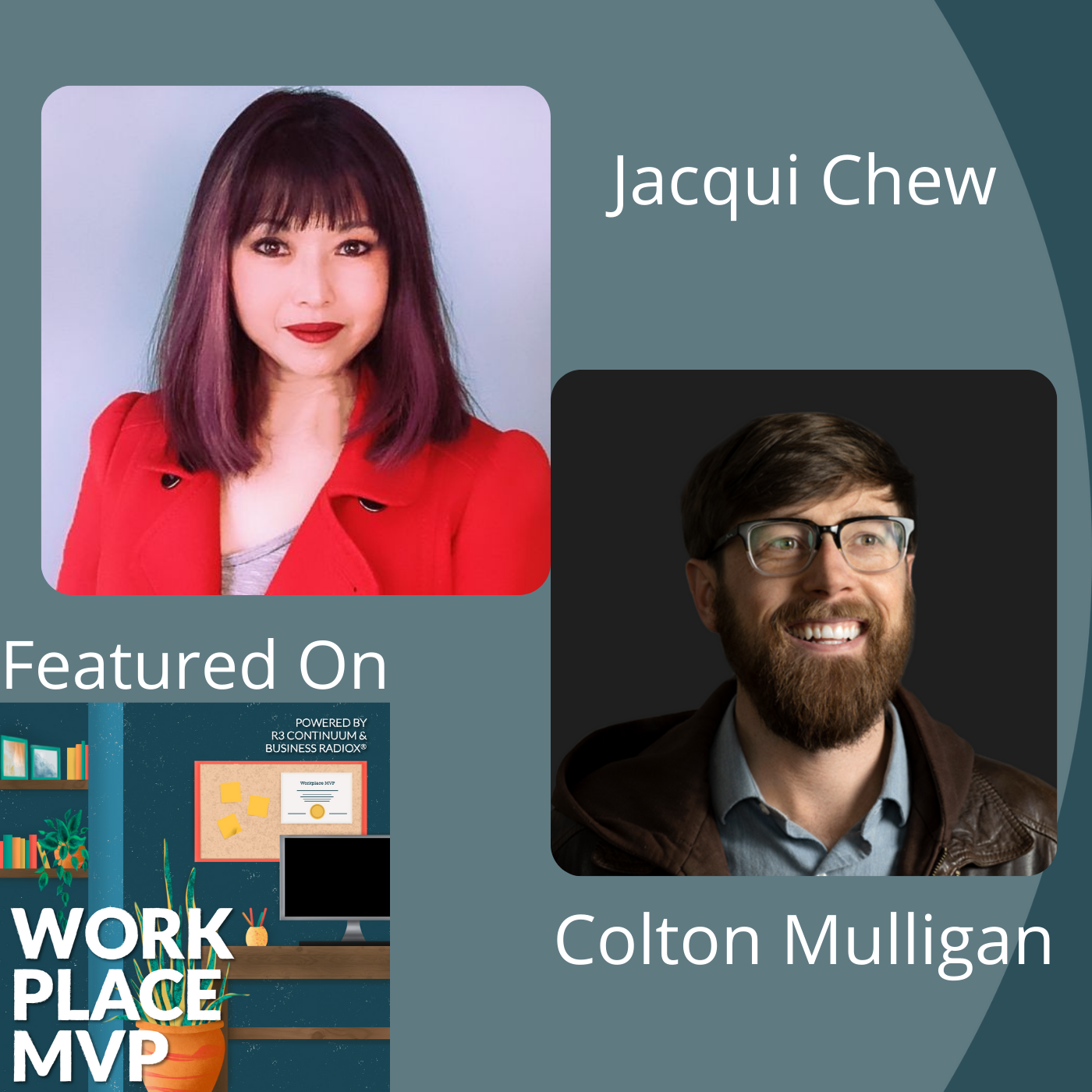
Workplace MVP:  Bipolar Disorder in the Workplace, with Jacqui Chew, iFusion, and Colton Mulligan, FoxFuel Creative

On this edition of Workplace MVP, Jacqui Chew, iFusion, and Colton Mulligan, FoxFuel Creative, each share their stories on working with a bipolar disorder with host Jamie Gassmann. Jacqui and Colton discuss how leaders can foster psychological safety in the workplace so that employees can be open about their mental health. It’s essential listening for HR and other workplace leaders. Workplace MVP is underwritten and presented by R3 Continuum and produced by the Minneapolis-St.Paul Studio of Business RadioX®.

Jacqui Chew, Managing Director, iFusion, and Licensee, Curator at TEDxAtlanta

Mental Health
Jackie Chew, Managing Partner, iFusion, TEDxAtlanta

iFusion is a storytelling consultancy that deploys the power of narrative design to create brand stories for companies and social impact initiatives that resonate and inspire action.

Jacqui works at the intersection of storytelling, innovation and business. She deploys the power of narrative design in reframing an organization’s brand story for resonance and to inspire action.

Described as a “Lara Croft of Problem-solving,” Jacqui is a seasoned business operator with a passion for building inclusive teams, and working cross-functionally to bring disparate groups together toward a common goal.

As the curator and licensee of TEDxAtlanta, Jacqui is always on the lookout for change-makers and innovations that are solving for the challenges of today and those just around the corner. Under her leadership, first of TEDxPeachtree from 2009 to 2018 and presently of TEDxAtlanta, Atlanta has grown in recognition within the global TEDx community as an innovation hub for technology, healthcare and social impact initiatives.

She is resourceful, tenacious and well networked in the Atlanta business, social impact and technology communities.

Website | LinkedIn | Jacqui’s TEDx video | Brain Babel

Colton Mulligan, CEO, FoxFuel Creative

Colton Mulligan, CEO, FoxFuel Creative

FoxFuel Creative produces effective outcomes for brands and people through design, content, and technology. The company helps consumer goods and products, healthcare, music and entertainment, finance, and real estate brands speak genuinely and effectively to their audience.

Their specialties include brand and marketing strategy, consumer insights, content development, creative ideation and execution, advertising concepts, and website development.

At FoxFuel, Colton Mulligan serves as CEO and is responsible for client relationships, guiding the discovery process through brand strategy into early creative concepting.

With 15+ years of branding and marketing experience, Colton has worked to develop brand and marketing strategies for TSA Pre-Check, Hilton Hotels/Home2Suites, Ben Folds, Fiesta Grande, Chip and Joanna Gaines, Pinnacle Bank, HarperCollins, Narus Health, Lifepoint, HCA, and Community Health Systems.

He also speaks at various events on Digital Marketing, Healthcare Marketing, Entrepreneurship, and the relationship between mental health and creativity. He lives in Nashville with his lovely wife Aly, and Goldendoodle JT.

Company website | LinkedIn

R3 Continuum

R3 Continuum is a global leader in workplace behavioral health and security solutions. R3c helps ensure the psychological and physical safety of organizations and their people in today’s ever-changing and often unpredictable world. Through their continuum of tailored solutions, including evaluations, crisis response, executive optimization, protective services, and more, they help organizations maintain and cultivate a workplace of wellbeing so that their people can thrive. Learn more about R3c at www.r3c.com.

Company website | LinkedIn | Facebook | Twitter

About Workplace MVP

Every day, around the world, organizations of all sizes face disruptive events and situations. Within those workplaces are everyday heroes in human resources, risk management, security, business continuity, and the C-suite. They don’t call themselves heroes though. On the contrary, they simply show up every day, laboring for the well-being of employees in their care, readying the workplace for and planning responses to disruption. This show, Workplace MVP, confers on these heroes the designation they deserve, Workplace MVP (Most Valuable Professionals), and gives them the forum to tell their story. As you hear their experiences, you will learn first-hand, real life approaches to readying the workplace, responses to crisis situations, and overcoming challenges of disruption. Visit our show archive here.

Workplace MVP Host Jamie Gassmann

In addition to serving as the host to the Workplace MVP podcast, Jamie Gassmann is the Director of Marketing at R3 Continuum (R3c). Collectively, she has more than fourteen years of marketing experience. Across her tenure, she has experience working in and with various industries including banking, real estate, retail, crisis management, insurance, business continuity, and more. She holds a Bachelor of Science Degree in Mass Communications with special interest in Advertising and Public Relations and a Master of Business Administration from Paseka School of Business, Minnesota State University.

TRANSCRIPT

Intro: [00:00:04] Broadcasting from the Business RadioX Studios, it’s time for Workplace MVP. Workplace MVP is brought to you by R3 Continuum, a global leader in workplace behavioral health and security solutions. Now, here’s your host, Jamie Gassmann.
Jamie Gassmann: [00:00:25] Hi, everyone. Your host, Jamie Gassmann, here. And welcome to this episode of Workplace MVP. According to a recent study performed by Mental Health America, only five percent of employees surveyed indicated that they strongly agree that their employer provides a safe environment for employees who live with mental illness.

Jamie Gassmann: [00:00:44] With the increased availability of workplace resources and tools for ensuring the psychological safety of their employees, along with the increase in conversations globally about reducing the stigma of mental health, particularly in the workplace, this stat seems to indicate that there’s still a level of discomfort with employees being open and honest with their employers about their mental health in a large majority of workplaces.

Jamie Gassmann: [00:01:08] Which leads to the question of how can leaders within organizations help their employees to feel psychologically safe and to create work environments that invite open dialogue about how employees are truly feeling. Are there ways to create an environment that invites vulnerability, creates a feeling of safety for being open and honest with leadership, breaking down those walls of fear that so many employees are likely still having?

Jamie Gassmann: [00:01:33] Well, today, we have two wonderful MVP’s that will share from their perspective, personal experiences and approaches for how organizational leadership can create a psychologically safe work environment. And with that, the benefits it can have on the employee, leader, and organization overall. With us is Colton Mulligan, CEO of FoxFuel Creative, and Jacqui Chew, Entrepreneur and Mental Health Advocate. Welcome to the show, Jacqui and Colton.

Jacqui Chew: [00:02:03] Thanks for having us.

Colton Mulligan: [00:02:04] Glad to be here.

Jamie Gassmann: [00:02:06] So, we’ll start off with our first Workplace MVP, who is Jacqui Chew, Entrepreneur and Mental Health Advocate. Share with us, Jacqui, a bit about your background and how you came to be a mental health advocate.

Jacqui Chew: [00:02:20] Thank you, Jamie, for having me. I have been on this journey since being diagnosed in 2005, it’s been a long time. And so, I was diagnosed at a time where mental health/mental illness was not discussed. There was still a heavy, heavy stigma around it. For the first few years, I’ve lived in silence, and in fear, and in shame with what I had. I was diagnosed with bipolar disorder in 2005.

Jacqui Chew: [00:03:03] And at the time, I owned my own business. I had a marketing consultancy. And my main clientele were and they still are high growth startups that are either angel backed or venture capital backed. And those cultures tend to have a very hard charging, high performance base type culture. And I didn’t realize it at the time, but those are definitely stressors. They are conditions that exacerbate my illness.

Jacqui Chew: [00:03:49] So, today, though, happily after years of psychotherapy and I continue my treatment protocol, I am managing my condition quite a bit better. And here I am.

Jamie Gassmann: [00:04:06] Great. Yeah. Great to hear kind of some personal experience that you’ve worked through. So, from your perspective, taking that personal experience into account, when you look at the stat that only five percent of employees strongly agree that their workplace is a safe environment for those with a mental illness. What are your thoughts on that?

Jacqui Chew: [00:04:27] You know, sadly, the stigma behind mental health and just the dialogue around it, I mean, there’s still such shame. I recently had a conversation, actually, just a-week-and-a-half ago with a young professional who was very concerning. She had an anxiety, she felt anxious, she had already been diagnosed with depression, and she was very, very afraid of losing her job. And there were so many stresses going on with her job that it sort of exacerbated her symptoms and she had no one to talk to.

Jacqui Chew: [00:05:16] And her situation is really very common. It’s still really difficult to talk about, say, your depression, or your bipolar disorder, or your recent manic episode, and how it’s affecting your job to your supervisors, your managers, because there’s this fear that, “Oh, my gosh. I don’t want to tell my manager about it, but yet I know I’m not performing to my usual level. And I know I’m going to be evaluated. My quarterly MBOs are coming up.” And all of this just builds and it’s a cumulative effect that just exacerbates all the symptoms of someone with bipolar disorder or depression.

Jacqui Chew: [00:06:09] And it is very common, unfortunately. And it’s quite unfortunate, with COVID and the isolation that we have all had to go through, of being alone, of being locked down, even for those of us who don’t have a chemical brain imbalance, there are many everyday folks who are being diagnosed with clinical depression. So, this sort of thing is more and more common.

Jacqui Chew: [00:06:46] But, unfortunately, the sense of safety that we can talk about it at work, just as we could talk about our blood pressure or our heart condition, or how we’re doing better now because our blood pressure is better, because we’re taking better care of ourselves, we’re exercising, and so on and so forth. We can talk about that but, yet, we still can’t talk about our mental wellness or the lack thereof. And that’s a real issue.

Jacqui Chew: [00:07:14] And that’s what that five percent statistic is all about, is, there is so much misinformation, disinformation, and misconception around mental illness. And workplaces, I don’t believe are doing enough to bring their managers and their supervisors to detect symptoms or signs of distress in an employee, which is unfortunate.

Jamie Gassmann: [00:07:49] Yeah. And, you know, you bring up a good point about kind of leaders doing enough. And when we connected previously, you mentioned that it was important that leaders educate themselves on mental illness. Can you talk a little bit about how that would be helpful in a work environment? And particularly on some of the things that you brought up, like with rising diagnoses from the COVID, working remote last year, how would that education be able to help these leaders to create more of an open environment for their employees?

Jacqui Chew: [00:08:27] That’s a really good question. I think, you know, this pandemic has really created an interesting dynamic, because depression or diagnosis of depression and anxiety is so widespread now that the managers themselves are being diagnosed. And so, not only are the folks who are individual contributors who may have been diagnosed prior to the pandemic, but the managers who may be fine prior to that, but because of the pandemic – depression being one of the effects or anxiety being one of the after effects of the lockdown – they’re being diagnosed.

Jacqui Chew: [00:09:13] I think that it has increased the sensitivity to want to understand. Because when you are a manager and you are all of a sudden diagnosed with something that you do not have to think about or not have to even be basically be educated on, you, all of a sudden, are faced with a whole range of symptoms yourself and you’re getting the treatment protocols and et cetera, et cetera. And I think that makes you more empathetic to folks at the workplace, to the people that you manage, the people on your team.

Jacqui Chew: [00:09:58] And, I mean, perhaps this is rather Pollyanna-ish of me, but I would hope that this would make leaders, managers, supervisors more empathetic and more sensitive to the signs and the symptoms because they themselves are going through treatment. They themselves are wrestling with the many challenges that come their way as someone who had been diagnosed with depression or bipolar disorder or anxiety disorder.

Jacqui Chew: [00:10:29] So, I truly believe that people in that power dynamic who are themselves going through treatment and are being educated because they have to be are going to be leading the way at work in creating a safer workplace, if you would, for these kinds of issues to be discussed. Just as you would discuss teamwork and team collaboration, you think about your work team is your support team for the project. Well, part of that support system could be key members that are understanding the person who is perhaps not having a good day, not having a good week, and being more empathetic and understanding about that.

Jamie Gassmann: [00:11:27] And I suppose with a leader who has their own diagnosis, they can be a lot more open with their team as well, which can create some of that breakdown, some of that vulnerability, or create that environment to be more vulnerable, and allow people to feel like they can be more open and bring things to their leader that maybe they wouldn’t have before because there’s a level of understanding. Would you agree with that?

Jacqui Chew: [00:11:54] Yes. Absolutely. There’s a heightened awareness, I believe, because more and more people are getting their diagnosis. They’re being diagnosed. And so, that is, certainly, I think, raising the level of conversation around mental illness.

Jamie Gassmann: [00:12:13] So, you also shared in that previous conversation that we had that it was important that a leader not assume that every person with a mood disorder is going to have the same cognitive disability. Can you talk through the impacts that that could have if an employer just assumed that it was like a one size fits all with the diagnosis and why they should be looking at it more kind of on an individual basis?

Jacqui Chew: [00:12:39] Certainly. So, it’s not a project, but we actually know more about space and getting into space or extra space than we know about the way the brain works, unfortunately. Two people could be diagnosed with bipolar disorder – there are two versions, bipolar 1 and bipolar 2. And they could both be diagnosed with bipolar disorder 2, but they could exhibit very, very different symptoms. And the severity could be very, very different as well.

Jacqui Chew: [00:13:29] So, for myself, I am the bipolar 1, that is my diagnosis. But, generally, I’m really high performing. I can perform at a very high level so long as I get my sleep and I am eating well and exercising, I am fine. But then, there are others who have a really tough time managing the symptoms, even with the exercise and the diet and the sleep. And so, it affects people very differently. And, once again, I’m not a doctor, but I do know that this is a chemical imbalance in the brain that causes at least bipolar disorder. And it affects people very differently because everyone’s physiology is just a little different.

Jacqui Chew: [00:14:31] And so, for a manager to assume that, say, if two people on their team have, say, anxiety disorders or depression, that they are going to be the same way, they’re going to have the same symptoms, and such, would just be, really, sort of a bad assumption. And it could lead to very inaccurate type of assessment of a person’s performance, or a person’s behavior, or attitude, or things like that.

Jamie Gassmann: [00:15:07] And we’re talking a lot about, you know, creating that open dialogue and showing that empathy to employees who may have a mental health diagnosis. There’s going to be probably some listeners going, “Yeah. But we can’t ask those questions. We’ve got regulations we have to follow. There’s certain H.R. rules that are applied here. We can’t discuss their medical condition.” So, from your perspective, how can a leader show support for their employee that has been open about their mental illness without violating those H.R. rules and regulations so that they can show that empathy, create that open environment, but do so in a way where they’re not putting that employer at risk?

Jacqui Chew: [00:15:53] Sure. That’s always a tricky scenario. As a manager, what I had done is, when someone is struggling, say, at work, just as a rule of thumb, regardless of their diagnosis, regardless of whether they’ve been diagnosed or they’ve disclosed, I basically say, “Hey, it seems like you’re really having a tough day. How about taking a long weekend?” So, sometimes just being human and being empathetic to someone who’s clearly having a tough day or a tough week, and we all have those regardless of whether we’ve been diagnosed or not. Just letting them know that they’re allowed, that they can take a day off, take a weekend, take a long weekend.

Jacqui Chew: [00:16:59] The other thing is, you know, most companies – the companies that I’ve been a part of – have as part of the healthcare benefits, employees have access to talk therapies as part of the package. And so, for instance, if someone has disclosed that they’ve just lost a close family member, it’s really, really common for someone with a traumatic life experience to experience clinical depression, I mean, that is a trigger or a known trigger. And so, for something like that, I mean, there’s no H.R. rule – you wouldn’t be violating any rule to say, “Hey, we have available this particular benefit. And I just want to make sure that you are aware that it’s available to you should you need it.” And that is a caring and a responsible thing for a leader or a manager to do.

Jamie Gassmann: [00:18:11] And that also is a great way to show that empathy and that support. And through education and understanding, what might be a trigger for that employee helps you to be able to spot that when you need to pull some of those other approaches that could be helpful in that moment without bringing up the actual diagnosis. That’s great feedback and approaches to use.

Jamie Gassmann: [00:18:37] So, looking at your career, what is something that you would say you were just most proud of within your career overall?

Jacqui Chew: [00:18:48] Gosh. Well, apart from the obvious, since I work with startups, it’s always fantastic when the startups that I work with thrive – more than survive but thrive – and they grow and they scale. But, actually, this might sound a little strange, but I am most proud of feeling empowered and strong enough to fire asshole clients. I have no asshole rule – and I’m not sure if I’m supposed to say that on a podcast, but I’m sure y’all can bleep that out.

Jacqui Chew: [00:19:32] But I think drawing boundaries, and having boundaries, and learning to identify as someone with a bipolar disorder diagnosis, working with all kinds of personalities is a trigger. Certain kinds of behaviors are triggers. And certain kinds of situations that these types of personalities tend to create are stressors. And over time, they can bring on some very, very severe episodes for me. And I had that happen. And so, I have essentially a no asshole rule. Whereby, there are certain types of personalities that I will not work with. And if a client exhibits those behaviors and continues to exhibit those behaviors, despite my conversation with them, I just won’t work with them anymore. And I see it as self-preservation.

Jamie Gassmann: [00:20:45] And it probably took you a little bit to get there, but I could see where that could be a really proud moment for yourself to have that empowerment and strength to be able to say what you’re willing to put up with or put yourself through. So, great example. So, if our listeners wanted to connect with you, what is the best way for them to do that?

Jacqui Chew: [00:21:10] So, you can reach me at jacquichew.com, that’s an easy way. And I have started a community driven organization called Brain Babel, B-A-B-E-L. It’s in its infancy. So, I’m on Instagram as Brain Babel, so that is where I’ll be sharing tips and I’ll be sharing the latest research and trends sort of demystified and in layman’s terms for caregivers as well as folks who are dealing with mental illness, and as well as parents who are taking care of children who’ve been diagnosed with a variety of mood disorders.

Jamie Gassmann: [00:22:04] Great. So, we’re now going to move to our next Workplace MVP, so joining us is Colton Mulligan. He’s the CEO of FoxFuel Creative. Colton, can you share a little background with us in how you came to be the CEO of FoxFuel?

Colton Mulligan: [00:22:22] Sure thing. In 2014, I was working at another agency with two people that had basically become my best friends. We looked around and realized there was an opportunity to leave the agency because we were the ones effectively managing half of the agency on the creative services marketing side. So, we went to the owners of the business and we want to buy out our non-compete contracts, start our own agency, and ask some clients to go with us. They said okay, and threw out a number that was way more than the three of us had. So, I took a second mortgage out of my house. I cleaned out my investments. I borrowed money from my grandmother, doctor friend, and dad, and the partners all scraped money together.

Colton Mulligan: [00:23:06] And so, we bought out our contracts, and on January 1st, 2015, we started FoxFuel Creative in my basement. And, yeah, that was the beginning of it. So, I was the CEO and I had two business partners that manage the digital side and then also the creative side of the business. And that same month, I was diagnosed with type 1 bipolar disorder.

Jamie Gassmann: [00:23:27] Was it difficult to get that diagnosis in that first month? Or did it answer questions? Or how did you feel in that moment?

Colton Mulligan: [00:23:41] I mean, it definitely answered a lot of questions. And kind of in my little story there, I skipped past a lot of the events of 2014 that led me to that point. But, yeah, I think it was relieving. Almost exactly one year prior, I’d been diagnosed with generalized anxiety disorder, ADHD, and major depressive disorder. Bipolar is commonly misdiagnosed in the first or second pass. So, it was definitely relieving.

Colton Mulligan: [00:24:06] It was a fun dinner with my two partners when I was like, “Hey, update. I know we just formed an LLC and bought a whole bunch of money and we’re starting this new thing. Update, I’ve got bipolar disorder.” I mean, my two business partners, unbelievably supportive, said, “Hey, you know, understanding the symptoms kind of tracks out with your manic energy and all that stuff.” I was pretty good at hiding the downside. But it’s damn near impossible to hide the upside, the energy, just all the passion that comes with that.

Jamie Gassmann: [00:24:36] And it’s great that they took it very much with open arms and probably helped to answer some questions that they had as well. And just love that support that they provided to you from the story that you’ve told me or that I have seen on some of the documentaries that you’ve done. So, from your perspective, why do so many employees still lack a feeling of psychological safety in their work environment?

Colton Mulligan: [00:25:03] I think it’s probably a couple of factors. Thing one, is probably, like, it’s just awkward for most people. And, you know, we’re not a super corporate environment. But thing two, I would assume that there’s all these gray areas within ADA compliance and H.R. regulations and, “Oh, no. Once they disclosed, is there a whole bunch of new protocols I have to have?” So, I would almost say there’s one, like, the lack of clarity for a lot of professionals in the H.R. space what you’re supposed to do.

Colton Mulligan: [00:25:33] And then, there’s also, like, the personal side of it. It’s just, you know, among just humans in general, it’s a weighty thing a lot of folks just aren’t prepared for. Like, how do I go through that conversation saying something beyond, “Oh, I’m so sorry. Let me know how I can help and I’ll pray for you.” Outside of those two things, most people are just like, “I don’t know what to say.”

Jamie Gassmann: [00:25:55] So, if you were in that situation, like, what would you have them say? From your perspective, like with your two partners, if you could have the ideal response from somebody, what would that sound like?

Colton Mulligan: [00:26:15] I mean, that’s an interesting question and it’s one that I get asked commonly. Like, I wind up doing a lot of coffees and meet ups with folks where they just ask, “Hey, my brother got diagnosed, or I have this employee, or whatever, what should I do?” And there’s an odd way to say it, which is like, if you don’t have a framework or sandbox or an ongoing conversation/relationship with that person where you have regular check ins on headspace or a depth in your relationship, you’re kind of behind the eight ball on that. So, you can start fostering that.

Colton Mulligan: [00:26:49] But like with our employees, I’m in a comfortable space, like, I’ve had employees disclose to me, “Hey, Colton. I want to let you know I’m trying a new antidepressant.” “Hey, I’m going back to my therapist. I haven’t seen him in three years, but I’m going through some stuff personally, et cetera.” Fortunately, we already have a regular cadence and rhythm where as part of our check ins on their career goals and stuff like that. There’s space where they go, “I just want to know, like as you enter this week -” it’s like Monday, Tuesday “- what’s your headspace? Are you a five? Are you an eight? What’s going on?” And that provides the employee the space where like I’m not saying, “Hey, do you have a recent mental health diagnosis? Quick question. Just wanted to throw that out there.”

Colton Mulligan: [00:27:26] But it gives them the opportunity to share what they want, and they don’t have to. I can read between the lines. But I know, hey, there are five this week and that gives me space to I don’t have to ask personal questions, but I can say, “Hey, what do you need from me?” Rather than saying, “Hey, let me know if you need anything.” That’s a really crap answer. A really great answer is, “What do you need from me? Can I be like a support and kind of a listening ear right now? Do you want to talk through some of your brain space? And maybe I can help sort priorities and share from my own experience. Hey, I know when I’m overwhelmed. Or if I feel anxious or if I do whatever, I know and I just speak from personal experience.”

Colton Mulligan: [00:28:04] Sometimes if I just talk through what I got to do the day or this week, I can kind of figure out what’s important and what I should focus on, you know. And, normally, I can try and share in that way. It’s not always perfect. But for me, personally, I love it when somebody gives me the options, “Do you need advice right now? I’m happy to help. But likewise, I can be a sounding board.” Or, “Let’s just sort through what you got going on.” I love that.

Jamie Gassmann: [00:28:26] Yeah. A little bit more, probably, natural feeling and kind of true response in that regard as opposed to just kind of, “Oh, can I help you with something or let me know?” I think it’s probably like a default maybe that they don’t know what to say, so they go to that.

Jamie Gassmann: [00:28:43] So, at FoxFuel – and you were kind of getting to this, too – you have a great approach to ensuring that your employees feel psychologically safe. Can you share how you have created a culture that welcomes vulnerability and openness? And I know you kind of touched on it a little bit, but you have, like, a specific meeting that you’re doing with your team and individuals each week and doing different approaches. So, can you kind of dive into that a little bit and share kind of some of those approaches that you’ve done?

Colton Mulligan: [00:29:13] One hundred percent. I just feel the need to disclose upfront, I am not an H.R. professional. And don’t get me wrong, there are probably past employees or people, like, “Colton was terrible at this. I can’t believe you’re talking about culture.” I like to think that over time we’ve cultivated, it’s by no means perfect.

Colton Mulligan: [00:29:29] But at least I feel better when I explain this by talking about the fact that we’ve been around seven years, and in year four, maybe five, our longest running employee that have been with us from the beginning, like, we were on a road trip and we were talking about something that came up. She was like, “You’re a really crap manager.” And she was great. She was just like, “I’ve been looking for a mentor and I had all the stuff. And you were clear that you don’t like to micromanage or manage. You just want to lead, which was great for a while, but like, we need more.”

Colton Mulligan: [00:29:57] And so, then from that, we went to StrengthsFinder conferences and I read The One Minute Manager and It’s The Manager from StrengthsFinder and Gallup and all them. And we went to emotional intelligence workshops and we had a consultant come through, so all of that. And then, I would find the threads that I noticed a lot of different areas picked up on. And one of those was a very personal check in that went hand in hand with the other times you check in with employees.

Colton Mulligan: [00:30:26] And so, as part of that, a regular cadence we have now that, at least, I think it bears fruit. Every Tuesday with my team, we manage accounts and we would normally say, “Hey, what are you looking at this week? What do you need to prioritize, like professional things?” And then, there’s always a question in there that said, “Hey, you know, how ever much you want to share with your headspace, what’s going on with you now?” And that has created a space that has helped me, I like to think, as a manager because someone can say, “I had a really rough conversation with my mom this weekend and I do not feel real confident just being honest going into this week.”

Colton Mulligan: [00:31:02] And that would let me take pause throughout the week if we left a client meeting, or there was feedback I had to share, or I realized, “Man, this person needs a win.” And I’m not always great about praising folks. And so, that would always give me a prompt, it’s like, “This week I’ve got to look for something to let a Cathy or a Lauren, you know, let them really feel accomplished and celebrated by the team.” I’m making up these names real quick because I want to scrub it. So, we’ve never employed a Cathy, but I’m just throwing these things out there.

Jamie Gassmann: [00:31:32] And I love your share of that, which is why I brought it up, because I think you touched on a little bit of what Jacqui was sharing earlier in the show about the human side of that employee leader relationship. You know, you’re really getting to know those employees at a level that they feel comfortable being able to come to you with what they might be going through and vice versa. You’re able to pick up on maybe some of those cues. I think it was just such a great example of just a tactic that’s clearly worked for you in your leadership style.

Jamie Gassmann: [00:32:06] And so, we talked a little bit about the focus internally on supporting employee wellbeing and trying to, you know, be aware of when they might need that when or when they might need that little bit of extra support. You also shared an example where FoxFuel helped its clients to do the same, I think it was regarding over the last year with COVID. Can you share that example with the audience about what you did and kind of some of the unique approaches that you took that kind of bared fruit for them?

Colton Mulligan: [00:32:43] We have a healthcare client across, basically, 22 counties. They’ve got 10,000 or 11,000 employees. They’ve got ten hospitals. And when COVID hit, you can imagine how slammed all these hospitals were. You’re terrified. You have no idea how deadly this disease is. Yet they’ve got to show up to work. They’ve got to wear all this new equipment. There are pieces of their facility that are locked down and taped over with plaster. It was terrifying. And on top of that, you have a staffing shortage, and those that are showing up are overworked, they’re working a long time. Like, you want to talk about an incredibly negative impact on culture. And then, you know, with the economy tanks and people are then worried about their jobs. And this company did so much to try and help.

Colton Mulligan: [00:33:36] So, during that time, what was great, we’d spun up a video series because a lot of these employees don’t check email, et cetera. But we tried to make a really accessible way where every week we would release one of two kinds of videos. One, a video from leadership. So, from the CEO that was looking and speaking directly to all of his employees, not with, like, platitudes, but just saying, “I appreciate you. I appreciate the effort that you’re putting in.” And we would get him on the video to name specific things, “I know at home, you’re dealing with kids trying to do, you know, virtual learning. And I know that it’s scary.” And I think he was just very honest in just saying, “I appreciate so much what you’re doing in the impact on patients.”

Colton Mulligan: [00:34:27] So, we did that and we would produce these videos, put them out via email, put them on Facebook, all that stuff. And then, likewise, just inspiring stories. So, we would come through and don all the PPE equipment. And I would interview folks off camera and we would try to highlight the inspiring stories of what was going on. So, folks of, like, excellent care that was happening, people that had best friends on their team that they still got to show up to work with. So, I don’t like to think that it was silver lining everything. It was just reminders of what you do matters and hearing from leadership that I appreciate what you’re doing and what you’re going through.

Jamie Gassmann: [00:35:03] Yeah. It’s a great example. And sometimes those little reminders can go such a long way. So, in your opinion, what are some ways that organizations can better connect with their employees? And are there some out of the box or alternative approaches you feel can make a difference in helping to better connect with employees? Because you mentioned email, that is tough, I think, in any organization. If you think of the mass amount of email that most employees get, you know, there’s got to be different approaches that a leader can consider when trying to get important communication. Like, “Here’s where support is accessible to you.” Or, you know, “Here’s a quick update on how this person did this really well.” But just that other ways of being able to connect.

Colton Mulligan: [00:35:49] People connect via story, that’s something true long before companies and technology and all the stuff, right? And that’s what FoxFuel tries to lean into with our clients or whatever. Hey, there’s email, but, now more than ever with our clients, I try to focus on the fact that story is your driver. And whether you are trying to get your employee to feel something or your prospect or client or whatever it is, I now don’t think of email or Facebook or anything as the solution. I think of it is like the medium or the conduit where you can take these stories. So, whether they’re written stories or whatever, and we’re pushing video just because it’s accessible. By and large in any community you’re in now, you got your phone, you’re surrounded by screens.

Colton Mulligan: [00:36:33] So, if you can move to video, you can tell someone a story that will actually move them with everything that you can do there in two to three minutes versus a five page blog. And it’s very accessible. And like what you guys are doing here with podcasts and stuff, making it accessible where it doesn’t interrupt their day. So, that’s thing one that I would say things that folks can do.

Colton Mulligan: [00:36:55] And then, the second thing is a much longer burn, but it’s just investing, I think, in the management styles of your folks. The leaders are the ones that really hold the power at signaling what is psychologically safe. And so, for me, I like to think that our team feels more comfortable when they hear me say, “It’s a five. And I’m not going to go into it, but, you know, I had this fight or this incident.” Or, “I had this thing.” Or, “I’m low energy this week.” And things like that signal that it’s A-OK for you to share the same, thing one, encouraging folks to do that.

Colton Mulligan: [00:37:33] And then, thing two, is just equipping everybody with common language, I think. So, we’ve used all kinds of stuff. But, you know, the common language that we’ve used is things like radical candor or letting people use an Enneagram or StrengthFinder or Myers-Briggs. All of that just gives people common language where they can admit, “Hey, one of my strengths is not presenting. One of my strengths is not working in data.” And then, it gives people some more psychological safety that they can own what they’re bad at and then share that with a manager, so they don’t have to pretend to be a jack of all trades without a weakness. And displaying and naming weakness is like the definition of vulnerability, which creates psychological safety.

Jamie Gassmann: [00:38:20] Great. And so, similar to what I asked Jacqui, what is something that when you look at your career, what are you most proud of?

Colton Mulligan: [00:38:34] I’ll try to rattle off because Jacqui gave a great answer and I loved it. And so, I didn’t want to, like, say, “Yeah. Me too.” But to go through some real quick because I’m trying to think about this, but we just had most recently a recent thing, like, we had an employee that just left because, you know, she’s ready for the next chapter in her career and we’re excited for her. And when she left, she cried in telling clients in meetings about it. She cried in her exit interview and all that stuff. Because what she wants to do professionally is great and managing teams like that. Like, FoxFuel kind of has an intentional angle to stay a small entrepreneurial group of 9, 10, 11 folks.

Colton Mulligan: [00:39:14] But what was great was in the exit interview and some words that we exchanged via email, et cetera, she talked about she went through a rough time in her life and she said, “I came in and I am leaving FoxFuel an entirely different person, how confident I am, my approach to life, my approach to relationships, standing up for myself.” To me, there’s a lot of stuff you can look back.

Colton Mulligan: [00:39:34] But when I think about the kinds of impact that we have on folks, I like the idea that people won’t say, “Oh, yeah. I was an AE at FoxFuel and then I did this.” But on the inside, I love to think that we have folks come through our doors that may be with us for a couple of years or however long – you know, don’t get me wrong, you got your ups and downs. And I’m far from a perfect manager. I’m probably a crap manager on some days – that someone that leaves overall and says, “Man, it was a time where I felt supported and I grew personally in that time,” that means the world to me.

Jamie Gassmann: [00:40:08] That’s a great example. It’s always great that you know that you had that positive mark on somebody’s life and career. So, if our listeners wanted to connect with you, what’s the best way for them to do that?

Colton Mulligan: [00:40:20] You can email me, colton@foxfuelcreative.com, or hit me up on LinkedIn, or whatever. Or if you go to our website, foxfuelcreative.com, there’s a thing that’s going to pop up and say, “Hey, quit snooping. Grab drinks with Colton,” or something like that. So, yeah, any of those.

Jamie Gassmann: [00:40:35] Great. So, now, we’re going to hear a word from our sponsor. Workplace MVP is sponsored by R3 Continuum. R3 Continuum is a global leader in providing expert, reliable, responsive, and tailored behavioral health crisis and security solutions to promote workplace wellbeing and performance in the face of an ever changing and often unpredictable world. Learn more about how R3 Continuum can tailor a solution for your organization’s unique challenges by visiting our r3c.com today.

Jamie Gassmann: [00:41:06] So, now, I’m going to bring both of our MVP’s together and ask some questions to the both of you. So, the first question is, how can leaders create a work environment that is psychologically safe? Now, I know you both have touched on a few different components of that. But if there was one particular way, what would you say? And let’s go ahead and start with you, Colton.

Colton Mulligan: [00:41:31] I’d go back to what I said before, hands down, leaders can find spaces to (A) make it clear that they can share their vulnerabilities and share their headspace. And then, (2) create the regular rhythm of an ongoing conversation. Not like, “Hey, can I check in on your mental health diagnosis.” But instead, “Hey, can you share with me, like, what’s your headspace like this week? How confident do you feel? I’d love to talk about that to see how I can support you.”

Jamie Gassmann: [00:41:58] Perfect. And how about you, Jacqui?

Jacqui Chew: [00:42:00] Sure. There are, believe it or not, H.R. modules now, where – and I’m forgetting the name of it, gosh – basically, it incorporates this sentiment aspect of performance of work, sort of a touch base, if you would. And so, I agree with Colton this idea of a cadence, so that if you’ve established a cadence of meetings where the discussion is around the work as well as sentiment, so, how are you feeling, how are you feeling about work, about your work, it’s more accessible than, to Colton’s point, “how’s your mental health”.

Jacqui Chew: [00:42:56] And so, there are actually sort of like – gosh, I forget. Gosh. I was actually a part of an organization that had this that was quite interesting because it was a weekly check in. And as a manager, we check in with each member of my team every week where, as part, they would complete a module or web module that basically says what their five priorities were or their four priorities were for the week, how they felt about themselves and their priorities. And then, we would talk about it.

Jacqui Chew: [00:43:37] So, there was this confluence of the work as well as the self. And I thought that was really helpful and useful to them because, say, if they had a bad week, they could talk about it from the perspective of these were things that I didn’t think that I felt that I did very well at all. I had a couple of nights where my baby was crying or kept me up all night or whatever. So, it just allowed for more human conversation to happen in a corporate environment.

Jacqui Chew: [00:44:19] Now, Colton, your wonderful because you have a workplace that is accessible, it’s friendly, it’s safe. In a large organization of even 50 or 100 people, when you start having department heads and when there is a talent organization, when there’s an employee handbook – that’s basically my litmus test. When a company has an employee handbook, then, I think, that managing and leading becomes a little less human and a little more robotic. But it doesn’t have to be so. And I think and I hope that we will, as a workplace, as businesses, be more like yours, Colton, than the large sort of thousand person corporations that are out there.

Colton Mulligan: [00:45:22] Thank you very much. That’s very sweet. I don’t know that all my employees would say that, but I like to think so. So, that’s great.

Jamie Gassmann: [00:45:31] So, looking at these employers and kind of to your point, it’s almost like what you’re saying, Jacqui, when the employer gets a little bit bigger, they almost have to be more intentional about making that a cultural priority with their organization. As opposed to, you know, like it has to be kind of embedded in their handbook of how they’re going to approach that.

Jamie Gassmann: [00:45:53] So, if you were looking at employers, what do you want them to know when it comes to mental health with their employees? Like, what would be kind of, you know, the message you would want them to be aware of? If they haven’t educated themselves, if they’re being told by an employee they have this diagnosis, what message would you send to them?

Jacqui Chew: [00:46:15] Gosh. Be less afraid of litigation and more concerned about the person. I didn’t mean to rhyme, that was not intentional. But large companies, they’re about risk mitigation. I mean, I hate to say this, but every H.R. department that I’ve come into contact with has been about risk mitigation, and liability, and managing liability. At the end of the day, we are people, we are humans. And if we led and managed by just being human with compassion and empathy, I truly believe that those activities, those behaviors will naturally fall into place. It’s the humane thing to do.

Jacqui Chew: [00:47:15] If you see someone in distress, what do you do? You want to help. What makes being at the workplace any different? Well, it’s the fear of a lawsuit. So, I truly believe that if corporations can slowly retreat from this fear of litigation mindset and more of a compassion mindset of a positive versus subtractive mindset, I think we we will see more healthy workplaces. We will see healthier employees all around.

Jamie Gassmann: [00:47:55] How about you, Colton?

Colton Mulligan: [00:47:58] I’d lean into one of the things that Jacqui said, I would say a very clear and intentional investment into emotional intelligence, that umbrella. She used the word empathy, which, to me, is the largest thing more than finding just the right curriculum or mental health check in, et cetera. Investing in that at the individual level is the ongoing effort to keep finding the resources and things and spot the small elements.

Colton Mulligan: [00:48:24] To give an example, I spun up a small group that I ran for seven years on mental health where folks would get together. And there were ridiculous things I realized now that H.R. was rolling out all these wellness programs and things. And I realized that for those with eating disorders, all of the wellness campaigns right now that healthcare companies push that do weight loss challenges and stuff, are ridiculously triggering. Where you manage as a team, and you’re losing weight and pounds, and the language, and the things that are celebrated, there’s no real clear curriculum that would do that. That’s a checklist.

Colton Mulligan: [00:48:56] The biggest thing is if you invest in emotional intelligence, your team and your folks, it’s the ability to dynamically look at things in an ongoing way and exercise a greater degree of empathy, which, to me, is the solve more so than a book everybody reads together, whatever. It’s a continual emotional intelligence improvement.

Jamie Gassmann: [00:49:16] Those are both great points. I hadn’t even thought about that with the weight loss challenge, and you see that quite often, especially after The Biggest Loser came out. The biggest loser challenge is everywhere. That’s very interesting.

Jacqui Chew: [00:49:27] Sorry, Jamie. I do want to add – I completely forgot and they’re so important – there’s another whole group of people or population, they would be Founders of Color. So, startup Founders of Color faced a whole new layer of stressors, especially when they are raising funds. There was trauma for Founders of Color when they’re raising funds. This may not be the case this year or the last, maybe, two years, but I can tell you, so we have a startup circle, sort of a wellness circle where founders – primarily Founders of Color – would come together to talk about more of their personal and health issues.

Jacqui Chew: [00:50:26] But what services often is, it’s the microaggressions that happen on a daily basis when they’re raising funds from primarily non-person-of-color venture capitalists. And the questions are different, the tone is different, the assumptions that these venture capitalists make are different.

Jacqui Chew: [00:51:03] I’ll give you an example. There is this now prominent African-American female founder of a startup that also has a social group, social good sort of mission. And one of her investors actually said to her thinking that he was being so nice, he said, “Wow. I’m really glad I listened to my wife who suggested that I invested in your startup to ensure that we were being inclusive. I’m so glad that your startup is doing so well and I just wasn’t expecting the return.” I’m paraphrasing. But that is the microaggression and it caused her to doubt herself. Like, “Did my startup get funded because it was a good idea and we have a strong team and there’s a business here? Or did we get funded because I’m Black?” And so, that’s the good story.

Jacqui Chew: [00:52:19] But the bad story, this happened at TechCrunch. TechCrunch, they used to have twice a year this huge confab where they would have a startup alley of sorts. And the founders, a whole bunch of Black founders that I know of who’s ever been to those wherein the investors were primarily non-African-American, non-persons-of-color would actually physically avoid the booths of this Founders of Color. And there’s no reason for this, except for it is pure discrimination and this is what they have to deal with.

Jacqui Chew: [00:53:08] So, we, in these conversations in the support circles – we call them – I mean, these are the additional stressors that Founders of Color go through that are quite different. And to exacerbate the issue there, the percentage of psychologists/psychiatrists who look like them, a very small percentage, which is difficult as well. So, that is one of those little known challenges and issues that still plague sort of the mental health specter and category.

Jamie Gassmann: [00:53:49] So, it sounds like there could be a lot of different kind of triggering events and different things that might lead to some of those mental health concerns in all varieties of different businesses, whether startup or – it’s a very interesting point.

Jamie Gassmann: [00:54:04] So, if you were going to leave one advice on the table for a leader who’s listened to this podcast that you want them to just take with them – and if they do something with it, fantastic – but if there’s just one thing that you could leave that would help to make a difference in their work environment – and we’ll start with Colton – what would that be? What would that one piece of advice that you want to leave to that leader?

Colton Mulligan: [00:54:30] No pressure, right? What’s the one way to improve mental health in your thousand person organization? I am torn between, like, the one that’s really tactical and easy is, just go create your cost center line item, whatever for emotional intelligence training, is thing one. The other thing that’s harder is, just the idea of encouraging vulnerability between your leaders and those that they’re supporting.

Jamie Gassmann: [00:55:02] Great. And how about you, Jacqui, if there was one piece of advice?

Jacqui Chew: [00:55:06] Sure. It was a thing that I had my husband do. So, I figured if it’s good enough for him, it’s good enough for the rest of us. Pick up Mental Health for Dummies, the book. Get educated.

Jamie Gassmann: [00:55:23] Yeah. Get educated. I love it. So, thank you both for being on the show, for sharing your personal experiences, sharing approaches you’ve used, your expertise around this topic, and for letting us celebrate you by being on the show. And we really appreciate the advice and suggestions you left the listeners. We appreciate you, and I’m sure your organizations, and staff, and co-workers, and friends, and everyone else involved into your lives do, too.

Jamie Gassmann: [00:55:55] We also want to thank our show sponsor, R3 Continuum, for supporting the Workplace MVP podcast. And to our listeners, thank you for tuning in. If you’ve not already done so, make sure to subscribe so you get our most recent episodes and other resources. You can also follow our show on LinkedIn, Facebook, and Twitter at Workplace MVP. If you are a workplace MVP or know someone who is, we want to know, email us at info@workplace-mvp.com. Thank you all for joining us and have a great rest of your day.


Tagged With: Bipolar disorder, Brain Babel, Colton Mulligan, FoxFuel Creative, iFusion, jacqui chew, Jamie Gassmann, mental health, Nashville, R3 Continuum, TEDxAtlanta, workplace mental health, Workplace MVP

R3 Continuum Playbook: Workplace Violence Prevention

July 8, 2021 by John Ray

Workplace Violence
Minneapolis St. Paul Studio
R3 Continuum Playbook: Workplace Violence Prevention
Loading
00:00 /
RSS Feed
Share
Link
Embed

Download file

Workplace Violence

R3 Continuum Playbook: Workplace Violence Prevention

Dr. Jennifer Kurtz, Clinical Director over Fitness for Duty and Threat Consultation Services at R3 Continuum, presented a snapshot of the challenge of workplace violence, the training needed to prevent workplace violence, and the need for threat management teams in the workplace. The R3 Continuum Playbook is presented by R3 Continuum and is produced by the Minneapolis-St.Paul Studio of Business RadioX®. R3 Continuum is the underwriter of Workplace MVP, the show which celebrates heroes in the workplace.

TRANSCRIPT

Intro: [00:00:00] Broadcasting from the Business RadioX Studios, here is your R3 Continuum Playbook. Brought to you by Workplace MVP sponsor, R3 Continuum, a global leader in workplace behavioral health, crisis, and security solutions.

Jennifer Kurtz: [00:00:14] Hello. I’m Dr. Jennifer Kurtz, and I am the Clinical Director over Fitness for Duty and Threat Consultation Services at R3 Continuum. Today, I want to talk about an issue that keeps some employers up at night, workplace violence and how to prevent it. There’s roughly two million victims of workplace violence every year in the United States. Just this year, just recently, on June 15th in Albertville, Alabama, Andreas Horton, a longtime employee of the Mueller Water Products factory, shot and killed two and injured another two. After, another Mueller company, the Henry Pratt facility in Aurora, Illinois, had an employee kill five just 28 months earlier.

Jennifer Kurtz: [00:01:04] On May 26th of this year in San Jose, California at the Santa Clara Valley Transit Authority, a transit worker named Samuel James Cassidy, who was an employee for over a decade, shot and killed nine. And on April 15th, at a FedEx warehouse in Indianapolis, Indiana, a former employee, Brandon Scott Hole, killed eight and wounded five. These are examples that have happened just in the past three months, and they don’t even include five mass shootings that occurred in just the last week of June alone in two parking lots, two nightclubs, and an American Legion that was hosting a party for teenagers. Those occurred just in one week in June.

Jennifer Kurtz: [00:02:00] According to the U.S. Department of Labor, in 2019, which is the most recent year for which we have this kind of data, there were 5,333 workplace fatalities, 16 percent of which were due to workplace violence. Contrary to popular opinion, people do not just snap. There are always warning signs that a violent act might be coming soon. You just have to know what to look for. And if you do know what to look for, many times these violent acts can be prevented.

Jennifer Kurtz: [00:02:36] You just don’t usually hear about all the mass violence plans that get prevented or that never take place. For example, Eric Lin in Miami, Florida. He was a man who had been stalking and harassing a restaurant employee. And he was ultimately prevented from kidnapping that employee. Or Rodolfo Montoya in Long Beach, California. He was a hotel cook who was unhappy with the decision H.R. had made, and he had planned to shoot people as they came into the hotel lobby. Or Paul Stieber in High Point, North Carolina. He had planned to kill people at High Point University by a deadline of Christmas 2019 because he was tired of feeling like an outcast.

Jennifer Kurtz: [00:03:30] These potential tragedies were averted because employees, and employers, students, and law enforcement were all trained in recognizing risk factors and warning signs. They knew how and when to report their concerns. There were systems by which to document the reports and monitor the cases. And law enforcement and the appropriate external resources were brought in at the right time so that nobody got hurt.

Jennifer Kurtz: [00:04:07] Now, despite how successful these comprehensive workplace violence prevention programs are, 70 percent of workplaces don’t have one. Now, having a workplace violence prevention program is critical in this day and age to keep your employees safe. Developing a comprehensive plan will include multiple steps.

Jennifer Kurtz: [00:04:37] And one key aspect of a successful program is education. And there’s multiple components to the education needed. Everyone in the company is going to need to receive education, every employee, every manager, every executive, and even the owner. Education in what exactly workplace violence is and how prevalent it is. Education about what the risk factors are for workplace violence. Education about what to look for, that would indicate violence might be coming soon, which are the warning signs of workplace violence.

Jennifer Kurtz: [00:05:19] Everyone’s also going to need to be taught what factors protect against violent behavior and lower the risk of violent behavior. They’ll need to learn how to intervene, if possible and safe. And how and when to report their concerns that someone might be dangerous or become violent. Education is also going to likely need to include training and special topics related to workplace violence, like hostility de-escalation, threat assessment and management, active shooter training, threat assessment team training, situational awareness. And special situational topics, like bullying and harassment, or stalking, and domestic violence, suicide prevention, or legal defensibility when related to managing these kinds of behaviors, lone actor terrorism, and other related subjects.

Jennifer Kurtz: [00:06:29] Managers and executives will also need additional customized education related to the development and functioning of a threat management team. There should be an internal threat management team whose job is going to be to investigate and monitor any reported concerns or potentially threatening individuals. This team would be made of staff from multiple disciplines and departments within the company. And, ideally, would also include external subject matter expert consultants when appropriate, such as law enforcement, executive protection agents, legal counsel, and forensic behavioral experts.

Jennifer Kurtz: [00:07:14] To be consistent with the industry’s best practice for workplace violence prevention, the threat management team would need to create clear corporate policies on workplace violence, what will and won’t be tolerated, the consequences for violating these policies. An anonymous reporting structure for employees to provide information when they have concerns about potential violence. The information reported must be kept in a fashion that allows the stakeholders access so that there’s no issues with some people having needed information and other people not having the needed information so something doesn’t get missed.

Jennifer Kurtz: [00:07:59] But at the same time, this method of data collection and storing the data needs to be kept confidential so that only members of the threat management team and the necessary external resources have access to it in order to protect the employee’s privacy. Management also is going to need to be aware of what barriers there are to successful programs like this and implement programs and policies to address those barriers.

Jennifer Kurtz: [00:08:34] So, for example, one barrier to education about workplace violence is stigma, stigma associated with mental health problems. Nobody wants to talk about it or a lot of people really don’t want to talk about it. So, management can look at promoting company activities to fight the stigma of mental health problems to try to counteract the barrier. That would be an example of a proactive strategy or preventive strategy to a successful workplace violence prevention program.

Jennifer Kurtz: [00:09:13] Another way is they could promote activities or even social activities to counter isolation and try to foster connectedness between employees, and the people, and the company. They should also encourage an environment of acceptance amongst employees and, above all, respectful treatment. These are all examples of activities that aim to reduce some of the known risk factors of workplace violence and attempt to encourage or cultivate known protective factors against workplace violence.

Jennifer Kurtz: [00:09:54] Additionally, best-practice programs to prevent violence at work include a concerted focus on identifying those who may be at risk and attempting to provide resources before a problem starts. So, accessibility to quality mental health resources is absolutely crucial to a successful program, such as round-the-clock EAP services and a health insurance plan with good mental health service coverage. They should also be providing other resources that reduce common sources of daily stress for employees, such as financial planning seminars, or resources for quality child care, or resiliency training are good examples. These kinds of additional life stressor resources are also invaluable to these kinds of programs.

Jennifer Kurtz: [00:10:57] And then, of course, these programs are going to need to have a worst case scenario plan. What is the plan if your worksite has an active shooter? What do you do? What do the employees do? Where do they go? What are the escape routes? How does the information get communicated to everybody that there’s a shooter? How are people going to be accounted for when everybody gets out of the building? Who’s responsible for that? Where are the meeting spots?

Jennifer Kurtz: [00:11:31] The point is to have a plan. You need to have a plan. And then, you have to train everybody to the plan. And then, you have to practice it, and practice it, and practice it, and then you practice it some more. You need to have everybody very, very comfortable with knowing exactly what they need to do and what their responsibilities are.

Jennifer Kurtz: [00:11:55] We just don’t work in the same world we did 30 years ago. Workplace violence is no longer something that employers can just hope doesn’t happen. It’s time to be prepared. If you want to be prepared with help from experts in the industry, R3 Continuum can help. We can provide a variety of customized services to provide you with tailored solutions to keep your employees and your worksite safe. For more information, contact us at info@r3c.com.


Show Underwriter

R3 Continuum (R3c) is a global leader in workplace behavioral health and security solutions. R3c helps ensure the psychological and physical safety of organizations and their people in today’s ever-changing and often unpredictable world. Through their continuum of tailored solutions, including evaluations, crisis response, executive optimization, protective services, and more, they help organizations maintain and cultivate a workplace of wellbeing so that their people can thrive. Learn more about R3c at www.r3c.com.

R3 Continuum is the underwriter of Workplace MVP, a show which celebrates the everyday heroes–Workplace Most Valuable Professionals–in human resources, risk management, security, business continuity, and the C-suite who resolutely labor for the well-being of employees in their care, readying the workplace for and planning responses to disruption.

Connect with R3 Continuum:  Website | LinkedIn | Facebook | Twitter
Tagged With: Dr. Jennifer Kurtz, R3 Continuum, Workplace violence prevention

Workplace MVP: Sheri Foster, Atlanta Community Food Bank

June 24, 2021 by John Ray

Atlanta Community Food Bank
Minneapolis St. Paul Studio
Workplace MVP: Sheri Foster, Atlanta Community Food Bank
Loading
00:00 /
RSS Feed
Share
Link
Embed

Download file

Atlanta Community Food Bank

Workplace MVP: Sheri Foster, Atlanta Community Food Bank

Sheri Foster, Vice President of Human Resources, joined host Jamie Gassmann to share why the Atlanta Community Food Bank created employee-led work teams, the recommendations they solicited from these teams, which included pay and vacation policies, and how these teams have engendered increased employee engagement and aided the organization in navigating momentous change. Workplace MVP is underwritten and presented by R3 Continuum and produced by the Minneapolis-St.Paul Studio of Business RadioX®.

Atlanta Community Food Bank

Atlanta Community Food Bank works with more than 700 nonprofit partners—including food pantries, community kitchens, childcare centers, shelters, and senior centers—to distribute over 67 million meals to more than 1 million people estimated to be food insecure due to COVID-19 in 29 counties across metro Atlanta and north Georgia.

They are a member of Feeding America, the nation’s leading domestic hunger-relief charity.

Atlanta Community Food Bank partners with food pantries, community kitchens, childcare centers, night shelters, and senior centers that receive food and goods from us. In turn, these partners provide food and other critical resources for the more than 1 million people estimated to be food insecure due to COVID-19 in their service area who suffer from hunger and food insecurity.

Atlanta Community Food Bank’s mission is to fight hunger by engaging, educating, and empowering their community. While their core work is food distribution, their efforts extend far beyond that. Their mission is lived out every day by engaging, educating, and empowering both people in need and those who want to help. From volunteering to assisting people in finding economic security, the Atlanta Community Food Bank covers a wide range of opportunities for people to learn and get involved.

Company website |Facebook | Twitter | Instagram

Sheri Foster, PHR, Vice President, Human Resources, Atlanta Community Food Bank

Atlanta Community Food Bank
Sheri Foster, VP, Human Resources, Atlanta Community Food Bank

Sheri Foster is Vice President of Human Resources with the Atlanta Community Food Bank. She is a high-energy, transformational leader with extensive experience developing and implementing human capital strategies.

Sheri brings extensive Talent Management experience and has spent more than 15 years advising executive leaders. She has extensive knowledge and experience leading change initiatives that improve the employee work experience and support the achievement of business results.

She has been with Atlanta Community Food Bank since 2016.

LinkedIn

R3 Continuum

R3 Continuum is a global leader in workplace behavioral health and security solutions. R3c helps ensure the psychological and physical safety of organizations and their people in today’s ever-changing and often unpredictable world. Through their continuum of tailored solutions, including evaluations, crisis response, executive optimization, protective services, and more, they help organizations maintain and cultivate a workplace of wellbeing so that their people can thrive. Learn more about R3c at www.r3c.com.

Company website | LinkedIn | Facebook | Twitter

About Workplace MVP

Every day, around the world, organizations of all sizes face disruptive events and situations. Within those workplaces are everyday heroes in human resources, risk management, security, business continuity, and the C-suite. They don’t call themselves heroes though. On the contrary, they simply show up every day, laboring for the well-being of employees in their care, readying the workplace for and planning responses to disruption. This show, Workplace MVP, confers on these heroes the designation they deserve, Workplace MVP (Most Valuable Professionals), and gives them the forum to tell their story. As you hear their experiences, you will learn first-hand, real life approaches to readying the workplace, responses to crisis situations, and overcoming challenges of disruption. Visit our show archive here.

Workplace MVP Host Jamie Gassmann

In addition to serving as the host to the Workplace MVP podcast, Jamie Gassmann is the Director of Marketing at R3 Continuum (R3c). Collectively, she has more than fourteen years of marketing experience. Across her tenure, she has experience working in and with various industries including banking, real estate, retail, crisis management, insurance, business continuity, and more. She holds a Bachelor of Science Degree in Mass Communications with special interest in Advertising and Public Relations and a Master of Business Administration from Paseka School of Business, Minnesota State University.

TRANSCRIPT

Intro: [00:00:05] Broadcasting from the Business RadioX Studios, it’s time for Workplace MVP. Workplace MVP is brought to you by R3 Continuum, a global leader in workplace behavioral health, crisis, and security solutions. Now, here’s your host, Jamie Gassmann.

Jamie Gassmann: [00:00:25] Hi, everyone. Your host, Jamie Gassmann here, and welcome to this edition of Workplace MVP. Throughout businesses across the globe, leaders are tasked daily with making decisions for the betterment of the organization. These decisions could be strategic in nature or are a part of the normal course of business. At times, there are leaders who feel they need to navigate these decisions alone and that it is their sole responsibility to carry the weight of the decision on their shoulders. But they don’t have to shoulder that process alone. In fact, by including their employees into the decision making process can actually hold various benefits to the organization, its people, and ultimately the leader.

Jamie Gassmann: [00:01:05] With us today is Workplace MVP Sheri Foster, Head of Human Resources at Atlanta Food Bank. Roughly four years ago, Sheri was a part of implementing a program at the Atlanta Food Bank that leveraged their employees in what they call Work Teams. As part of their overall decision making and change management process, she is with us today to talk about how the concept evolved, its impact on the organization, and overall benefits she has seen in leveraging employee insights into key decision making. Welcome to the show, Sheri.

Sheri Foster: [00:01:39] Good morning. Thank you for having me.

Jamie Gassmann: [00:01:42] So, before we get started today in talking about the topic, tell me a little bit about yourself and share with us your career journey.

Sheri Foster: [00:01:53] Great. Well, the Atlanta Community Food Bank is a great place and a great organization to work for, partly, because we have great employees. A little about me, I’ve been working in that field for about 20 years. I started off at a small consulting firm where we worked with companies who outsource their H.R. That was a really great place for me to start this work because I had the opportunity to support different types of organizations on a wide range of projects and initiatives. After that, and over the course of the next 18 or so years, I have been working in the nonprofit space and have been supporting mission driven organizations ever since.

Jamie Gassmann: [00:02:37] Wonderful. Wonderful. So, before we dive in a little bit further in kind of looking at these different work teams, prior to implementing them at the Atlanta Food Bank, what was the team morale and overall productivity like, you know, within the organization?

Sheri Foster: [00:02:56] So, I think the food bank has always been an employer that cares about its employees and has tried to implement programs to support and nurture them. The employee survey scores told us that we had employees that were absolutely committed to the mission of the organization. But like most organizations, there were opportunities for us to make improvements that would enhance the work experience for our employees.

Sheri Foster: [00:03:22] For us, it wasn’t necessarily that we had concerns about productivity. It was more that our organization was navigating a lot of change. So, at that time, we had a new president, we were embarking on a new strategic plan, and we were beginning to think about new ways of measuring our success, both at the organizational level and at the employee level. That is a lot of change for employees to process, and we knew that.

Jamie Gassmann: [00:03:49] Yeah. Definitely. I always say, the one thing in life that I know is always going to be constant and a given is change. So, definitely good for your organization to be able to pick up on that and try to be proactive in finding a way to help your team to navigate it. So, it sounds like that’s what led you in creating this work team concept. Were there other elements or how did that come to be? Or, that idea, how was it generated?

Sheri Foster: [00:04:23] So, part of what we understood as a leadership team was that we needed employee input. Again, like we talked about, we were navigating a lot of change and we needed employee help and involvement to sort of helping us to navigate that change. And then, also, to help us come up with ideas to create positive change to affect the areas of opportunity that we had identified in our survey.

Jamie Gassmann: [00:04:54] Great. And it’s always fun when those ideas are generated. So, talk me through, how did you create those Work Teams? What was kind of the design process conversation around how do we build this, how do we roll it out? How did you structure that?

Sheri Foster: [00:05:15] So, I can’t say that when we started this that we had a great, solid framework for what we were doing. I think what we understood was that we wanted employees involved in some various projects, particularly as it related to creating great work experience within the food bank. We formed our first employee work teams in 2016, and that was following our employee survey that year. We have identified three areas where we wanted to create actions to help move the organization forward. We wanted to create meaningful change for employees. So, in order to do that, we needed their help. So, we essentially solicited volunteers, and those volunteers formed our first set of work teams.

Jamie Gassmann: [00:06:08] Wonderful. And I’m sure you’ve probably built off of that from some of the key learnings. And I know we’re going to get at that in just a little bit. But what were some of those key projects that you’ve done so far where the Work Teams were incorporated into the process? And then, tell me about the role that the Work Teams played in those projects.

Sheri Foster: [00:06:29] So, one of the areas that our inaugural Work Team tackled from about 2016 employee survey was around employee pay, benefits, and training. So, as an organization, we laid out some parameters to help guide their work. And then, each team had a leadership team sponsor. From there, though, they operated as a self-direct Work Team. And this particular group conducted some very thorough research on vacation and pay, and ultimately made recommendations to change or modify our vacation policy. And they also wanted to increase the starting pay at Food Bank.

Sheri Foster: [00:07:12] So, they presented their recommendations to the executive leadership team. And long story short, we adopted their recommendations. And so, we made changes to our vacation policy. And early 2017, I think, was when we increased the starting minimum pay rate to $15 an hour. It was really incredible to see how thoughtful and thorough the team was in preparing and presenting their recommendations.

Jamie Gassmann: [00:07:43] Wonderful. And, now, I know when we talked previously, you spoke about how you used these Work Teams last year while you were navigating the COVID-19 pandemic. Talk to me a little bit about how the work groups worked in that capacity as well.

Sheri Foster: [00:07:58] So, we have an ongoing Work Team that we call Team Builders that is responsible for creating engagement activities for the organization. So, we have that team, Team Builders. And then, we have also sort of an Employee Engagement Work Team that sort of collaborated. And so, when COVID hit, those teams really worked together to help continue to create engagement opportunities. And it was challenging because, with COVID, about half of our employees moved to working remotely. So, they were working from home. But then, of course, we still had the other half of our employees who were onsite. And then, in the middle of that, we had some sort of hybrid people, some people who were sort of doing both coming into the office.

Sheri Foster: [00:08:52] And so, their charge was to keep us engaged when we didn’t have everybody in the building. So, they did lots of virtual events. They created virtual coffee breaks. And with those coffee breaks, they asked individuals, including the Leadership Team, to participate in those. We would also walk around with iPads so that our warehouse employees could see and engage with the people who had been working virtually. They did some virtual mixology, where they’re creating different drinks. I mean, so various virtual events. So, it was really great.

Sheri Foster: [00:09:32] And then, we’re just now starting to slowly returning employees back to the building. And so, that group of people has also created activities and have planned activities, really, for over the next 90 days to help us re-engage with each other. So, they have just done a really fantastic job of doing that.

Jamie Gassmann: [00:09:56] Wonderful. Wonderful. It’s probably great to watch how they work together as a team to pull those components together and build on that engagement level while people are in different parts of working environments. So, when looking at a project, some of these projects you’ve mentioned, when you’re looking where you leverage those Work Teams and then thinking back to before you had Work Teams, maybe a project that you had, what are some of the differences in the outcomes in terms of like, you know, change management?

Jamie Gassmann: [00:10:33] A lot of times, you know, from my experience, some of the concerns are the adoption of the change or how people respond to the change. And even in some of the way that they respond to decisions being made in the organization. So, when you look at these two project examples, what are some of the differences in the outcome in terms of employee response to it?

Sheri Foster: [00:10:58] So, I think with these Work Teams, there are a couple of things that are really important. The big thing about the Work Teams is the variety of perspectives. I’ve had the opportunity to work with many of these teams and they have great creative ideas. And they definitely see things from a different perspective than I do. So, there is an opportunity to be able to get ideas and to see things through a different lens, which is really important.

Sheri Foster: [00:11:30] I think that our leadership team is very accessible. And we all do get a lot of feedback from our employees. But employees also spend a lot of time talking to each other. And so, our Work Team members are able to bring that information and — to our discussions, and that has also made a difference.

Sheri Foster: [00:11:50] I have a really good example of that. I have referenced one of the Work Teams that we have is our Employee Development Work Team. And so, that team is charged with helping us to create a real robust employee development sort of career coaching framework. That, again, was feedback from our employee survey. And one of the things that they told me was we need to create a skills repository as part of our employee development effort framework.

Sheri Foster: [00:12:26] They said, we need managers employees to be able to have these really open candid conversations about knowledge, skills, and abilities. And to be able to track systematically the skills and proficiency levels, and that sort of thing. And use that to create development plans, but also for the leadership team to be able to have a view and to the development of these people so that they can consider them for next level assignments. And so, they have told me that probably a year ago.

Sheri Foster: [00:12:58] And then, we had our employee survey at the end of 2020, and one of our key outcomes from that survey related to employee development. And our survey tool, which automatically generates action recommendations, the recommendation from that survey tool was that we create a skills repository. So, I thought, “Well, you know, I could have saved money on the employee survey and just ask the employees.”

Jamie Gassmann: [00:13:34] Yeah. Awesome. Great example. So, we’re going to just take a moment to have a word from our show sponsor. So, Workplace MVP is sponsored by R3 Continuum. Ensuring the psychological and physical safety of your organization and your people is not only normal, but a necessity in today’s ever changing and often unpredictable world. R3 Continuum can help you do that and more with their continuum of behavioral health, crisis, and security solutions tailored to meet the unique challenges of your organization. Learn more at r3c.com.

Jamie Gassmann: [00:14:12] So, looking at your workplace now, and I know you’ve shared kind of that there’s this perspective that you’re getting when you don’t ask, you don’t receive that. And it definitely is different than what they bring – employees bring so much different perspective, which is great, and it can be so beneficial. But what are some of the other benefits that you have seen within the employees that you feel is a direct relation to the utilization of these Work Teams?

Sheri Foster: [00:14:44] Well, the first thing that I would say is that, employees who are involved are highly invested and engaged. So, the employees that are on these Work Teams are really invested. And they are very committed to the work that they’ve been charged to doing. I think employees are very supportive of their peers. So, recommendations made by Work Teams are likely to be accepted by the broader staff or at least the staff are willing to try new things.

Sheri Foster: [00:15:16] And then, Work Teams are helpful. Well, another example is one of the things I have been working on in my role in H.R. was our organizational approach to celebrating cultural heritage type events in a consistent way. So, how do we celebrate cultural events like Asian Pacific Islander Heritage Month, Hispanic Heritage Month, African-American Heritage Month, historical events like Juneteenth, and then things like LGBT Pride, et cetera, those sorts of things. So, we have been doing celebrations, but we wanted to have a real framework for doing it consistently and being able to communicate with the staff how we’re planning to do it.

Sheri Foster: [00:16:00] So, I engaged a subgroup. We have an Equity Steering Committee within our organization, which is one Work Team, and then Team Builders, who I referenced earlier. So, I engaged a subgroup from those two groups. And then, within a week, they had developed a plan, and approach, and a recommendation for how to handle that. So, I think the key is, at the end of the day, these groups are helpful and they have great ideas.

Jamie Gassmann: [00:16:31] Absolutely. Wonderful. And I got to imagine their respect and kind of appreciation to the leadership is probably grown from that. They see the decisions and the types of challenges that you’re navigating within that leadership role. So, talking about that, you know, how has the relationship between your organizational leadership and the staff changed as a result of giving them more of a voice in some of that decision making and change management?

Sheri Foster: [00:17:03] So, the Work Teams are not necessarily a silver bullet, but I do think that it starts to help us move towards trust. And so, I think that’s what we’re moving towards. So, the Food Bank still has opportunities, but I think the great thing about our organization is that we have a president, Kyle Waide, who is committed to employee engagement. He is a huge proponent of utilizing Work Teams to create positive change, and that makes a huge difference.

Sheri Foster: [00:17:36] And our leadership is also supportive. They have sponsored these Work Teams and have been really supportive of their work. One of the things that we are working on organizationally is communication and, specifically, getting people to talk openly and candidly up, down, and across the organization. And so, Work Teams is one of the ways that we are able to do that. Our Work Teams include employees across departments and across levels.

Jamie Gassmann: [00:18:05] Wonderful. So, we know that from research there are various benefits that come from creating more of a voice for employees in the decision making and change management process. But what, from your experience, were some of the challenges that you had to overcome with the rollout of this? Or just the management of the process in general that you’ve experienced?

Sheri Foster: [00:18:29] So, I think there are two big things, and those two big things are level setting expectations and gaining alignment. So, as an organization, we likely cannot implement every idea that an employee has. But I think the message that we’re trying to drive is that, we are willing to listen and to work to make change where we can and when we can.

Sheri Foster: [00:18:52] The other piece is that, we have a diverse organization, so it’s challenging to implement programs and initiatives that everyone loves. So, even within the team, sometimes it’s a negotiation to sort of align our priorities. But there is learning for the staff and for the leadership in that process. So, the big things that I would point to is, really, level setting expectations and, really, working to gain alignment.

Jamie Gassmann: [00:19:21] And if there are leaders that are listening to this episode that feel really good about this concept, feel like it’s going to work well within their organization, what would be your top three – if you were going to identify key best practice suggestions – for how they should approach putting something like this into place within their organization, what would be those key best practice suggestions?

Sheri Foster: [00:19:46] So, leadership buy in is essential. As I mentioned earlier, our president and our executive team, in particular, are supportive of utilizing Work Teams. And we have aligned on the areas where their work can be most impactful, and that’s critical. So, I would say that’s number one.

Sheri Foster: [00:20:05] Number two is, again, setting parameters and mitigating expectations for the staff, that is critical. We have been clear in saying that we are open to listening, but there are organizational constraints by way of policy, resources, and budget, but will also need to be considered in evaluating Work Team recommendations. So, I think level setting expectations is important. And then, the last is communication. So, the two way communication within the Leadership Team, within the Work Teams, and then good communication between the Leadership Team and the Work Teams is also important.

Jamie Gassmann: [00:20:44] Great. Great suggestions. So, when you look at your career, what would you say – if you were going to identify one moment in that career – as your proudest moment? What would that be?

Sheri Foster: [00:21:02] It’s hard to identify one proud moment. I think, the concept and this approach with respect to the Work Teams that we are utilizing at the Food Bank is something that I’m really proud of. I think that we are, right now, working on some really meaningful initiatives using the Work Teams. One of those is our Diversity, Equity, and Inclusion Initiative, and we have an Equity Steering Committee that is leading that initiative.

Sheri Foster: [00:21:34] And so, I actually think that my proudest moments may be yet to come, because I think that we’re going to have some great outcomes for the Food Bank and for the community that come out of our Diversity, Equity, and Inclusion Initiative, which is led by our Equity Steering Committee.

Jamie Gassmann: [00:21:53] Wonderful. And if our listeners wanted to connect with you to learn more about these work group programs, what is the best way for them to do that?

Sheri Foster: [00:22:04] Sure. I mean, they can connect with me on LinkedIn or just email me at sheri.foster@acfp.org.

Jamie Gassmann: [00:22:14] Wonderful. Well, thank you so much, Sheri, for letting us celebrate you today, and for sharing your knowledge and your insights into how these work groups have worked out so well for the Food Bank. It’s been great to listen to those. I was really excited about that concept because there’s just so much value in bringing in your employees into some of that change management and decision making that’s going on within the organization. And we appreciate you coming on the show. And I’m sure your organization and the employees appreciate you as well.

Jamie Gassmann: [00:22:46] We also want to thank our show sponsor, R3 Continuum, for supporting the Workplace MVP podcast. And to our listeners, thank you for tuning in. If you have not already done so, make sure to subscribe so you get our most recent episodes and other resources. You can also follow our show on LinkedIn, Facebook, and Twitter at Workplace MVP. And if you are a workplace MVP or know someone who is, we want to know, email us at info@workplace-mvp.com. Thank you all for joining us and have a great rest of your day.


Tagged With: Employee Engagement, employee engagement and productivity, Jamie Gassmann, R3 Continuum, Sheri Foster, The Atlanta Community Food Bank

R3 Continuum Playbook: Executive Wellbeing

June 17, 2021 by John Ray

Executive Wellbeing
Minneapolis St. Paul Studio
R3 Continuum Playbook: Executive Wellbeing
Loading
00:00 /
RSS Feed
Share
Link
Embed

Download file

Executive Wellbeing

R3 Continuum Playbook: Executive Wellbeing

Laurie Sigalos, Director of Strategic Solutions at R3 Continuum, outlines ten ways leaders can address individual and collective stress in the workplace and make executive wellbeing a priority. The R3 Continuum Playbook is presented by R3 Continuum and is produced by the Minneapolis-St.Paul Studio of Business RadioX®. R3 Continuum is the underwriter of Workplace MVP, the show which celebrates heroes in the workplace.

TRANSCRIPT

Intro: [00:00:00] Broadcasting from the Business RadioX studios, here is your R3 Continuum Playbook. Brought to you by Workplace MVP sponsor, R3 Continuum, a global leader in workplace behavioral health, crisis and security solutions.

Laurie Sigalos: [00:00:13] Hello. I’m Laurie Sigalos, Director of Strategic Solutions at R3 Continuum. Today, we’ll be talking about executive wellness and what organizations should be mindful of while professionally and personally supporting their executives and employees. This past year and a half has certainly been challenging, especially with the demands placed upon us in conjunction with work-life balance.

Laurie Sigalos: [00:00:39] As a result of the pandemic, executives and their employees have experienced the miasma of cumulative stress. Given the circumstances and necessity of a predominantly virtual world, we have witnessed increased professional and personal isolation, decreased socialization, and increasing concerns for the overall wellness and behavioral health of executives, as well as their highly valued workforce. We’ve also experienced heightened anxiety, depression and an increase in substance use. As we transition back to in person workplaces and educational settings, we must prepare for what comes next in the workplace and with our families. The importance of well-being and self-care should truly be a priority for everyone.

Laurie Sigalos: [00:01:23] Now, I would like to spend time to impart 10 strategic solutions and practical approaches to help resolve these challenges. Executive wellness has gained increased attention in recent years. Executives are more cognizant and mindful of their own well-being while arduously seeking out effective strategies to increase resilience and cultivate healthier lifestyles. With this in mind, here are some helpful tips for executives to consider on both the professional and personal level. This is not an exhaustive list; however, we have seen a variety of actionable methods, which have been very helpful in our extensive work with executives around COVID-19 and the unprecedented adversity during the past few years.

Laurie Sigalos: [00:02:09] Number one: Make a commitment to always begin with positive intent. Take actions to model and support good conduct. Challenge yourselves as executives and senior leaders to have ownership of a healthy, thriving organizational culture physically, cognitively, emotionally and behaviorally. Be accountable for the results. Be open. Genuinely address concerns from an empathic stance.

Laurie Sigalos: [00:02:36] Number two: Destigmatize behavioral health issues in the workplace. Make the connection between culture of empathy and acceptance. The bottom line here – companies with high engagement have increased employee retention, are more profitable, have higher customer loyalty and much lower attrition.

Laurie Sigalos: [00:02:55] Number three: Implement coaching programs to augment senior leadership skills as they foster integrity and accountability. Continue to be flexible with time-off for executives and their teams, allowing them to take time as needed, rather than adhering to set dates and amounts of days each year for self-care purposes.

Laurie Sigalos: [00:03:14] Number four: Have a mutual, respectful set of attitudes, norms and beliefs amongst the executives when it comes to well-being. Emphasize preventative well-being screening for executives and their employees. Encourage and endorse prevention programs that enhance individual health and well-being on a holistic level, addressing both physical and behavioral health.

Laurie Sigalos: [00:03:36] Number five: Pilot behavioral health solutions first in full subsets of your leadership, and use the benefits they experience to get buy-in from the C-suite. Proactively cultivate an environment of well-being with diversity, equity and inclusion. Talk openly about the importance of behavioral health and wellness. Encourage executive leadership to model self-care.

Laurie Sigalos: [00:03:59] Number six: Use a concierge approach with expert providers who are accustomed to accommodating executive schedules, little private access services. Ensure privacy and confidentiality. Continue to offer virtual support options, such as telephonic secure video conferencing and email or text support.

Laurie Sigalos: [00:04:19] Number seven: Make all behavioral health offerings, including those at the executive level, visible to the organization. They can certainly go a long way towards creating a culture of well-being and inclusion. Train executives on the link between well-being and individual business performance to obtain engagement. Proactively increase behavioral health literacy and awareness with training curated specifically to your culture.

Laurie Sigalos: [00:04:44] Number eight: Amplify utilization with innovative performance programming to support executives during the most challenging times. Have a comprehensive plan in place to facilitate linkage to top-gear resources for issues that arch.

Laurie Sigalos: [00:04:59] Number nine: Focus on awareness and early intervention to facilitate a connection to expert resources sooner. In an effort to mitigate potential behavioral health crises, select external partners willing to tailor solutions to your organization’s specific needs with providers who have extensive experience with diversity, equity and inclusion.

Laurie Sigalos: [00:05:20] Number ten: Finally, communicate. Research indicates a lack of communication often results in feeling undervalued, uninformed or out of the loop. Communicate often, showing appreciation for employees’ efforts, addressing challenges and celebrating successes. Employees who are engaged and feel part of the organization are much less likely to feel burnout. The well-being and supportive presence of executives has the potential to be a competitive advantage. Enhance executive well-being by implementing a trickle-down approach with the assistance of education, support and consultative resources. Remember, we must care for ourselves in order to care for others.

Laurie Sigalos: [00:06:03] I hope you have found these tips to be helpful as you move forward with the renewed determination to be more mindful of well-being, caring for yourself and others. If you’re interested in additional information for yourself or colleagues, please feel free to reach out to us at wwww.r3c.com or email us at info@r3c.com. As experts in behavioral health and workplace solutions, my colleagues and I would be happy to have discussions with you regarding any current or anticipated challenges you may encounter. Thank you so much for your time. I hope you have a great day.


Show Underwriter

R3 Continuum (R3c) is a global leader in workplace behavioral health and security solutions. R3c helps ensure the psychological and physical safety of organizations and their people in today’s ever-changing and often unpredictable world. Through their continuum of tailored solutions, including evaluations, crisis response, executive optimization, protective services, and more, they help organizations maintain and cultivate a workplace of wellbeing so that their people can thrive. Learn more about R3c at www.r3c.com.

R3 Continuum is the underwriter of Workplace MVP, a show which celebrates the everyday heroes–Workplace Most Valuable Professionals–in human resources, risk management, security, business continuity, and the C-suite who resolutely labor for the well-being of employees in their care, readying the workplace for and planning responses to disruption.

Connect with R3 Continuum:  Website | LinkedIn | Facebook | Twitter

Tagged With: Executive wellbeing, Laurie Sigalos, R3 Continuum

Workplace MVP: Dr. George Vergolias, R3 Continuum

June 10, 2021 by John Ray

Dr. George Vergolias
Minneapolis St. Paul Studio
Workplace MVP: Dr. George Vergolias, R3 Continuum
Loading
00:00 /
RSS Feed
Share
Link
Embed

Download file

Dr. George Vergolias

Workplace MVP: Dr. George Vergolias, Medical Director, R3 Continuum

Dr. George Vergolias joined host Jamie Gassmann on this edition of Workplace MVP to share his career journey, what he’s learned in working with hospital nurses, doctors, and other staff, pandemic-related behavioral shifts in other industries, the psychology of an active shooter, and much more. You’ll definitely want to listen to this episode if you’d like a better understanding of what healthcare professionals, especially those in emergency and urgent triage situations, have been dealing with over the past year and a half. Workplace MVP is underwritten and presented by R3 Continuum and produced by the Minneapolis-St.Paul Studio of Business RadioX®.

Dr. George Vergolias, Vice President and Medical Director, R3 Continuum

Dr. George Vergolias
Dr. George Vergolias, Medical Director, R3 Continuum

George Vergolias, PsyD, LP is a forensic psychologist and threat management expert serving as Vice President and Medical Director for the R3 Continuum. As part of his role of Vice President and Medical Director of R3 Continuum, he leads their Threat of violence and workplace violence programs. Dr. Vergolias is also the founder and President of TelePsych Supports, a tele-mental health company providing involuntary commitment and crisis risk evaluations for hospitals and emergency departments. He has over 20 years of forensic experience with expertise in the following areas: violence risk and threat management, psychological dynamics of stalking, sexual offending, emotional trauma, civil and involuntary commitment, suicide and self-harm, occupational disability, law enforcement consultation, expert witness testimony, and tele-mental health. Dr. Vergolias has directly assessed or managed over one thousand cases related to elevated risk for violence or self-harm, sexual assault, stalking, and communicated threats. He has consulted with regional, state, and federal law enforcement agencies, including the FBI, Secret Service, and Bureau of Prisons. He has worked for and consulted with Fortune 500 companies, major insurance carriers, government agencies, and large healthcare systems on issues related to work absence management, workplace violence, medical necessity reviews, and expert witness consultation.

LinkedIn

R3 Continuum

R3 Continuum is a global leader in workplace behavioral health and security solutions. R3c helps ensure the psychological and physical safety of organizations and their people in today’s ever-changing and often unpredictable world. Through their continuum of tailored solutions, including evaluations, crisis response, executive optimization, protective services, and more, they help organizations maintain and cultivate a workplace of wellbeing so that their people can thrive. Learn more about R3c at www.r3c.com.

Company website | LinkedIn | Facebook | Twitter

About Workplace MVP

Every day, around the world, organizations of all sizes face disruptive events and situations. Within those workplaces are everyday heroes in human resources, risk management, security, business continuity, and the C-suite. They don’t call themselves heroes though. On the contrary, they simply show up every day, laboring for the well-being of employees in their care, readying the workplace for and planning responses to disruption. This show, Workplace MVP, confers on these heroes the designation they deserve, Workplace MVP (Most Valuable Professionals), and gives them the forum to tell their story. As you hear their experiences, you will learn first-hand, real life approaches to readying the workplace, responses to crisis situations, and overcoming challenges of disruption. Visit our show archive here.

Workplace MVP Host Jamie Gassmann

In addition to serving as the host to the Workplace MVP podcast, Jamie Gassmann is the Director of Marketing at R3 Continuum (R3c). Collectively, she has more than fourteen years of marketing experience. Across her tenure, she has experience working in and with various industries including banking, real estate, retail, crisis management, insurance, business continuity, and more. She holds a Bachelor of Science Degree in Mass Communications with special interest in Advertising and Public Relations and a Master of Business Administration from Paseka School of Business, Minnesota State University.


TRANSCRIPT

Intro: [00:00:06] Broadcasting from the Business RadioX Studios, it’s time for Workplace MVP. Workplace MVP is brought to you by R3 Continuum, a global leader in workplace behavioral health, crisis, and security solutions. Now, here’s your host, Jamie Gassmann.

Jamie Gassmann: [00:00:27] Hello, everyone. Your host, Jamie Gassmann here. And welcome to this edition of Workplace MVP. Work environments are still experiencing residual shifts and turns as they continue to work towards the next normal. Some workplaces are in the process of bringing employees back to the office after a prolonged time working remote. Others are experiencing an increase in workplace violence. And, collectively, there is a heightened awareness and responsibility of employee mental health.

Jamie Gassmann: [00:00:59] There’s so much that organizational leadership needs to consider and be aware of in today’s current work environment. It begs the question, where do you begin with navigating this environment of constant change? And how do you make sure your people remain protected and supported through it all?

Jamie Gassmann: [00:01:16] With us today to help provide the answers to those questions and more is Workplace MVP, Dr. George Vergolias, Medical Director for our show sponsor, R3 Continuum, and Chief Clinical Officer for TelePsych Supports. Welcome to the show, Dr. Vergolias.

George Vergolias: [00:01:33] Thank you, Jamie. It’s a pleasure to be here.

Jamie Gassmann: [00:01:35] So, let’s just start off with you telling me a little bit about yourself and your career journey.

George Vergolias: [00:01:41] Certainly. My career journey was really a bit haphazard. I admire people that have a North Star in their career, and they pursue that, and they just hit those goals. Mine, I certainly had goals, but other opportunities came up that diverted. I actually went to undergrad at Marquette University for engineering. And about a year into it, I took a class called Differential Equations as well as Organic Chemistry, and it completely kicked my butt, and I decided that is not the route I wanted to go.

George Vergolias: [00:02:11] I then pivoted to philosophy for about a year, Eastern Philosophy, and then realized that I wouldn’t have a job when I get out of school. And that was a natural extension into psychology, understanding the human brain, what makes people think the way they do and act the way they do. And I continued on that trajectory, got into a doctoral program at the Chicago School, and actually had a neuropsych track, neuropsychology, and actually finished. And I did a neuropsychology and an inpatient rotation at Duke. And I graduated and I couldn’t find a job.

George Vergolias: [00:02:50] And I was a bit frustrated. And an old mentor of mine called and said, “Hey, would you be interested in doing a postdoc at Notre Dame in forensic psychology?” And I’ve taken one class before, but I was interested generally. And I jumped on it and I fell in love. I fell in love with it.

George Vergolias: [00:03:06] And so, what happened from there is I began working in the forensic field, both in a private practice setting, consulting with courts, jails, prisons, and working with county mental health systems. And I did that for about ten years. And in that process, I began consulting with law enforcement and emergency departments around imminent risk, suicide risk, homicide risk, people that were psychotic and paranoid. And that also, at one point, brought me into the workplace violence sector. Because when you’re a threat on violence in the community, you also have some expertise and a whole range of violence risks.

George Vergolias: [00:03:43] And so, at that point, my career took two trajectories. I started consulting with EAPs and, eventually, joined R3 Continuum about ten years ago. And at the same time, my work with the emergency departments as an individual ballooned into developing a practice and then a company that staffs emergency departments with doctoral psychologists and forensic psychologists to do imminent risk, involuntary commitment, and other types of crisis assessments. And some 20 years later, here I am. So, that’s a general view of that trajectory.

Jamie Gassmann: [00:04:17] Great. And so, through TelePsych Supports you work within regional emergency departments in hospitals. So, tell me what are some of the common challenges that you have seen surface over this last year?

George Vergolias: [00:04:31] That’s a great question, because there have been many. So, what happened is when COVID hit or the pandemic hit, and it really started gaining traction in terms of awareness of the seriousness of it, one of the biggest things that hospitals needed to do – and I live in Raleigh, North Carolina, so we were a little bit fortunate. And that New York State was well ahead, they were the early curve. So, we were able to learn for some of the difficulties that Europe and New York State encountered.

George Vergolias: [00:05:00] The biggest priority was we need to free up beds. And the way we needed to do that is that we needed to maximize getting every behavioral health patient out the door that was able to get out the door. So, unless they were absolutely needing to be in the hospital, we needed to get them out because we needed to free up hospital resources. And that put a lot of pressure on staff in the emergency department, on doctors, on nurses, on the psychologists to really tell a very fine line of deciding who stays and who do we think is safe enough to go out into the community.

George Vergolias: [00:05:34] And there were moments in many hospitals – for a short period of time in ours – where we had to go to what we almost called battle triage, where there would be – you know, in 2019 or in six months from now, even now, if you came into the hospital and said you were suicidal and you had some pretty severe intent and we believed you, there’s no way we would let you leave. There was some windows of time where we simply had nowhere to put you. So, unless you came in and you were literally having acted on it, or cut yourself, or made an attempt to hang yourself, or took pills, we couldn’t keep you.

George Vergolias: [00:06:12] And in a way, it’s analogous to what some of the Vegas hospitals dealt with after the Las Vegas mass shooting involving the Mandalay Bay. There were times where, normally, someone would easily be admitted and acted on quickly with a gunshot wound to the leg. That person became a third priority relative to all the other injuries. So, in behavioral healthy, we had to do that. We had to get into some of that very tough decision making.

George Vergolias: [00:06:41] The other thing that happened is, the community safety net for behavioral health – and what I mean by that is, public sector clinics that take Medicare and Medicaid, nonprofit organizations, both practices and clinics and even partial hospitalization programs, and even individual private practices that were seeing patients that were on the verge of breakdown, all of that markedly slowed down with COVID. People weren’t going into the office. We were all pivoting to telemental health, which for many was helpful. But that’s not helpful for the person that’s having rapid manic episodes every other day.

George Vergolias: [00:07:18] Going to their apartment, engaging them in person, talking them down is a critical component. And when that was all taken away in the early stages of the pandemic, that means that safety net eroded and more and more of those people were starting to come into the emergency departments because they were decompensating and they didn’t have anywhere else to go. So, those were the big things that kind of created a pressure vacuum in those settings.

Jamie Gassmann: [00:07:42] So, what kind of impact did that have on the staff? And has it lingered, you know, as we’ve come in 2021?

George Vergolias: [00:07:51] Yeah. I mean, it had a massive impact in that it was like a two-fold punch. On the one hand, you had medical staff in particular just dealing with COVID. And when you’re talking particularly about emergency department nurses and techs and physicians, that’s difficult because they live in the space where they save lives. That’s what they do for a living. They don’t necessarily bring somebody fully to recovery, but their goal is to stabilize the life, save it, and then move it upstairs to one of the other units.

George Vergolias: [00:08:27] And when COVID hit and they were overrun, and there were people literally sleeping in cots in the hallways – and in some hospital, sleeping on the floor and in the hallways – and putting people on ventilators, they reached the limit of what their medical expertise could do. And all you had to do is wait and see is their body able to fight through with the help of the ventilator, in many cases, and make it through.

George Vergolias: [00:08:51] So, what I found is a bit anecdotal, but what I found is there was a great deal of learned helplessness in emergency department staff, both nursing and physicians. Because they’re used to working in a high stress environment, but with a great deal of control and a great deal of ability within the limits of medical science and practice to save people. But COVID changed that. I mean, there were a lot of times where we’ve done what we can do. Now, we just got to wait for this person’s body to make it through the fight or not – make it through the fight. So, that was one thing that hit.

George Vergolias: [00:09:27] On top of that, what we saw is that influx of severe and persistent mentally ill people coming to the emergency department, which added another layer of difficulty. And it increased hostile interactions. Because you had patients – and I want to be clear, in general, people with mental illness are not more violent than the rest of the community. But people with severe and persistent mental illness, who have command hallucinations, who have paranoia, who have been living on the street, who have comorbid substance abuse disorders, they do have a tendency to be more violent, particularly amidst modes of crisis. And so, what we saw is a spike in those individuals coming in and being agitated, being hostile.

George Vergolias: [00:10:11] In fact, there’s a recent study of nurses and they reported a 20 percent increase of physical violence against them during the pandemic. And this is the group that was already at high risk for exposure to physical and verbal violence. So, those were some of the big things that we saw that was really tough to deal with when you’re working in those environments.

Jamie Gassmann: [00:10:34] Yeah. And looking at the different organizational levels within a hospital, doctors, nurses, maybe nurse managers, and there’s obviously the administration level, there’s this variance in how they handle and respond to certain things like compassion fatigue, burnout, or is there a variance in how they respond to those different areas? Because I can imagine after, you know, this full year of all the kind of emotional rollercoaster that health care staff has been on, you know, is there a variance in how they’re navigating compassion fatigue, burnout, stress, and overall PTSD?

George Vergolias: [00:11:08] I would say there is – I think some of the research supports this as well – certainly in my 20 years of experience in those settings. And what I’ve noticed – and, again, I’m speaking in generalities here because we’re talking in the aggregate. But what we have seen is, for those staff that work on the floors, internal medicine, post-surgery, cardiac, there’s a lot of stressors there, right? They see death. They see suffering. They see grief. For me, one of the toughest floors would be the NICU, the Neonatal Intensive Care Units.

George Vergolias: [00:11:45] But there is a certain amount of stability in those environments. People are admitted, they’re treated, the course of treatment is worked on, and then they’re discharged. The rapid turnaround you see in the ED, the function of an ED, is to get somebody in, stabilize them, and move them out because they need the next bed. Move them up to the floor or move them back into the community. And so, when COVID hit, people cannot easily be moved because there was nowhere to move them to.

George Vergolias: [00:12:14] On top of the fact that hospitals had to do their own self-quarantine. The ED was never a fully quarantined location. Many hospitals put up tents in the parking lot where they would screen people. But moving someone from the ED up to a floor that was COVID-safe or deemed, you know, not at risk, that was a big decision. So, there were often times when people just couldn’t be moved. And that was really tough for ED staff.

George Vergolias: [00:12:41] And so, that rapid turnaround, I think, really impacted ED staff in a way because that’s what they’re used to. That was a little less impactful. I’m not saying impactful. But less impactful for people that were working on floors. That doesn’t mean there weren’t stressors. Because one of the things that people working on floors is they tended to see a lot of death related to COVID, especially at high volume hospitals during the pandemic.

George Vergolias: [00:13:08] The other thing I find is, these roles are self-selective. You know, if I was a counselor that works with – I’m a therapist doing marital therapy – which, by the way, to me is very difficult. I used to do consulting with divorce attorneys. And I quit after, like, two years because that was worse than all the forensic work I’ve done. It’s just tough some of those situations and how ugly people can be. What’s interesting, though, is these roles are self-selective. People pick emergency medicine, forensic psychology, emergency nursing because they have a drive. To me, it’s almost a certain adrenaline. It’s a certain interest. I actually think there’s a predisposition to ADHD because that attention span of moving from one patient to the next, to the next is very well suited.

George Vergolias: [00:14:02] And these are the same people that, to me, are very much like sharks. And I kind of fit this category. We just don’t slow down. We’re always looking for the next challenge. And the problem with not slowing down is, it’s hard to take emotional inventory to how am I doing? How am I coping? Let me do an emotional check in. And I think that’s difficult. Again, I’m not saying that other physicians and nurses don’t experience that, but they select other areas of expertise that doesn’t demand that kind of mindset.

George Vergolias: [00:14:33] And so, when you enter kind of that heightened battle zone, if you will, it’s very hard for emergency physicians, EMS, other types of doctors and nurses in that setting to slow down and do a self-check in. Because there really is a sense of, “I don’t have time for this. Somebody is coding in the next bay, I got to get over there. And when I go home after a 12, or 16, or 20 hour shift, I just want to eat a quick meal and go to sleep, or watch Netflix for an hour and hug my kids. I don’t have time to emotionally process.” So, that is something I’ve noticed that was always there in medicine and psychology, but exacerbated by those stressors I already talked about that impact, particularly that point – what I call the point of the spear – that emergency department setting.

Jamie Gassmann: [00:15:20] Interesting. And you shared when we talked before the show about a scenario that kind of demonstrates that in a way, you know, with an active shooter training drill that you did at a hospital in terms of how the different, you know, maybe roles within the organization responded to that scenario. Can you share a little bit about that? Because it was just so interesting to really kind of have a demonstration of how their thinking is very much reactive. It’s just kind of staying in kind of that mode versus protecting themselves or taking care of themselves. Can you share a little bit about that scenario?

George Vergolias: [00:15:59] Yeah. I’m happy too. And this was fascinating for me as well because I didn’t expect it. I was at least 15 years into my career as a forensic psychologist, and this really surprised me, which it was a pleasant surprise, but very interesting. So, what we did is, we did a full simulation active shooter exercise for a hospital setting. This was about five, six years ago. And we were fortunate that the hospital had just built a new wing that was finished, but they had not moved in yet. So, we were able to run this simulation in a full hospital environment.

George Vergolias: [00:16:33] And we had law enforcement involved. They were using blanks. We did a pre-briefing and a debriefing with all the staff. We had a number of actors acting like assailants and we had a few other actors acting as victims. And then, we had the hospital staff in their normal roles. So, we had a small section of internal medicine, a small section of OBGYN delivering births. And then, certainly, we had an emergency department section and a few other makeshift units.

George Vergolias: [00:17:02] And what was fascinating is, once the exercise took off – by the way, and everyone was educated on the general protocol of the hospital, which was pull people into a room, barricade the room, and then treat them as best you can, or just barricade. Run, hide, fight, run if you can, hide if you can. We really didn’t talk much about fight for this particular organization. And what happened is, where the people came through, the assailants, is we found on all the medical units, that’s exactly what they did. They pulled people in, they barricaded rooms, they hid. And even if there were victims out in the hallway, they would try to triage them until the assailants came nearby, and then they would go hide as they were directed to do.

George Vergolias: [00:17:48] What’s interesting is what we found in the emergency department is those staff never hid. They stayed triaging people out in the open in harm’s way. Now, I’m not judging one physician or nurse against another. No one did. It wasn’t a judgment call. Because the truth is, if you are able to hide, you’re actually probably saving more lives because there’s some evidence to show that the more an assailant can find victims, the more they’re going to keep looking as opposed to turning the gun finally on himself or exiting. So, there is some real logic to run, then hide, then fight.

George Vergolias: [00:18:24] But what’s interesting is what we simply found was the emergency personnel, it just wasn’t in their DNA. It just wasn’t in their DNA to let somebody lie there and not try to treat them. And so, what that did is it allowed the hospital to have insights that, you know, it’s like you can’t teach a dog to meow and you can’t teach a cat to bark. So, what they actually did is, they had slightly different protocols and they actually rearranged some of the design of the emergency department unit that allowed them to shut down corridors in a way that you can still triage people out in the hallway, but you could actually shut down the corridor so an assailant can’t get through with barricaded kind of moving walls and shut down doors.

George Vergolias: [00:19:09] But it was a really interesting insight that allowed us to to get a better understanding of the behavioral side of how people respond. And that’s exactly why we go through these exercises, especially live simulations. So, it really was interesting.

Jamie Gassmann: [00:19:24] Yeah. What an interesting learning just to see how the variance in your staff is thinking and reacting. I’m sure military probably has similar – you know, when you talk about Medals of Valor and all of those where somebody has stepped in to help their fellow soldier even though there is active, you know, bullets or anything coming at them. So, very interesting. So, in talking workplace violence in the hospital setting, do you think that it has changed, or increased, or has it shown up in different ways over this last year? Or is it about the same but maybe just increased? What are your thoughts on that?

George Vergolias: [00:20:01] I think it has increased. In fact, again, I mentioned that one study, 20 percent of nurses reported an increase in physical violence during the pandemic. And, again, this is an already at risk workplace group, significantly at risk. In fact, what’s interesting, I saw another study from Forbes, I think, about two or three years ago, nursing is one of the most admired professions and it’s also one of the single biggest risk of workplace violence professions.

George Vergolias: [00:20:32] What I think based on some of the factors we’ve already discussed is that, yes, workplace violence risk has increased. I think it’s increased across the board in health care settings. But in particular, at that tip of the spear, at that emergency department, EMS, first contact kind of role, I think we’ve clearly seen an uptick. And most of that violence – and it might be helpful for me to go into just a couple of minutes describing this – is what we call effective or reactive violence.

George Vergolias: [00:21:03] So, a little quick primer on that. What we know from studies that go back now almost 80 years is that, there’s basically two biological modes or physiobiological modes of violence in the human brain. And, sadly, we know this because we used to study cats 90 years ago. They put electrodes inside cats and they expose them to different scenarios. And what they found is a cornered cat versus a cat who’s stalking maybe a bird in the backyard, they have very different neurochemical and neuroanatomical processes in the brain.

George Vergolias: [00:21:34] The corner cat, of course, is in a fight or flight environment. They’re hissing. Their claws are out. They’re showing their teeth. Their back is arched. And if you went to pick up a cornered cat, you’re probably going to get scratched or bit. And I would not recommend that.

George Vergolias: [00:21:50] A cat that stalking is the opposite. It’s very subdued. It’s very focused. It’s claws and its teeth are not out because it’s not ready to pounce yet. It’s in a very covert mode. And what’s interesting is, you could pick up a stalking cat and you could walk five feet before the cat even realizes it’s been picked up because it’s locked on that prey.

George Vergolias: [00:22:11] Well, they have since study that in humans. And what they have found is very similar correlates. So, effective reactive violence is emotional, it’s reactive, it’s often spurred on by substance abuse or intoxication. Most violence is effective. It’s emotional. It’s relationship-based. It’s crimes of passion or violence of passion.

George Vergolias: [00:22:32] And then, of course, you have predatory violence, which is your mass shooter, cold, calculated. When you hear about cases just like San Jose recently, Columbine, the Vegas shooter, these people aren’t agitated. They’re not worked up emotionally. They’re cold and calculated.

George Vergolias: [00:22:49] What’s interesting is we’ve seen a market uptick in emotional reactive or effective violence in workplace. People are coming in more agitated, more hostile. From a mental health perspective, they’re more decompensated. And just average normative people that don’t have mental illness are frustrated because they’re waiting much longer than they ever used to. And they’re waiting because of conditions that, a year prior, they would have been seen within 30 minutes or less. And, now, they’re waiting six hours. And on top of it, they’re stressed about the pandemic.

George Vergolias: [00:23:25] Just now we’re starting to reclaim our lives. Things are opening up. People are going out to dinner. There’s a little uptick in people returning back to work. So, hopefully, that emotionality will be alleviated a bit. But, certainly, up until a month or two ago, that was all heightened by all of those factors. That’s a great question.

Jamie Gassmann: [00:23:44] Interesting. So, looking at those factors, looking at the increase in workplace violence, obviously you’ve heard from other conversations, burnout and mental health concerns within that hospital industry. What are some of the suggestions that you have for a hospital administration and helping their people to continue with remaining resilient and start to thrive again?

George Vergolias: [00:24:10] One of the key things is, I think, it’s important to be aware of the problem. It starts with awareness, right? I think another key issue is communicate clearly with teams around what is the administration’s perspective of the problem, understanding of the problem, and what are they doing. I say this a lot in trainings and webinars, it’s important for leaders to know that employees and other stakeholders don’t expect us to all have the answers or to have all the answers. People are really gracious to knowing no one alive has been through this before. Or if they were alive, they’re 100 and some years old and they don’t remember it. Certainly, they weren’t leaders in any organization.

George Vergolias: [00:24:59] But what is important is that we are asking the right questions. And we’re conveying to our stakeholders and our employees that we’re asking the right questions. And we’re trying to get the right answers. So, I think that’s important as well. Back to my active shooter exercise example, understand that different groups within your organization may respond differently to different stress points.

George Vergolias: [00:25:25] If you go to the neonatal wellness group, or in some cases the post-operative group or the post-cardiac group or the recovery group, and you talk about meditation, and wellbeing, and the importance of eating well, and massage, that’s probably going to hit home. You talk about that to a group of hardened emergency department physicians, good luck. Now, I’m not saying that physicians aren’t going to meditate in the ED or who work in the ED. But this is more of a hardened group, so you need your metaphors, your images of growth to be different.

George Vergolias: [00:26:04] Almost, to me, what has worked well is I use the analogy of them being athletes. As an emergency physician, most of them would understand that Tiger Woods or Serena Williams or Lionel Messi, they don’t get a massage for wellbeing. They get a massage so they can perform at their peak. Physicians get those metaphors in those settings. And so, it’s important to understand what is going to work for these different groups in terms of getting buy-in to the programs and the resources that they’re trying to promote. So, I would say off the top of my head, those are the big things that are important to keep in mind.

Jamie Gassmann: [00:26:39] Right. Great. So, right now, we’re going to get a word from our sponsor. So, Workplace MVP is sponsored by R3 Continuum. R3 Continuum is a global leader in providing expert, reliable, responsive, and tailored behavioral health, crisis, and security solutions to promote workplace wellbeing and performance in the face of an ever changing and often unpredictable world. Learn more about how R3 Continuum can tailor a solution for your organization’s unique challenges by visiting www.r3c.com today.

Jamie Gassmann: [00:27:15] So, now, we’ve been discussing the health care industry and the work environment within that quite a bit in the first half of the show. So, I’m just curious, are there other industry work environments seeing some of the same challenges that the hospital industry has been seeing?

George Vergolias: [00:27:33] Yeah. Certainly. Now, they have different pain points from what we’ve been talking about, but certainly they’re seeing increased pressures to perform, reduced resources, and other kind of exacerbating stressors going on. A few is the trucking industry has been significantly impacted in terms of – I mean, as if Amazon and other shipping wasn’t big enough – we all went to that in a massive way. And for many of us, we’re not going back.

George Vergolias: [00:28:08] I was a big fan of going into grocery stores before the pandemic. I like to walk around. I like to pick my produce. Once we started using Instacart – which is not exactly trucking – but once we started moving to using Instacart, now we’re stuck – it’s not we’re stuck. We have a habit now and it’s convenient and now we use Instacart to deliver our groceries. I still will go in and pick certain things out if we’re having a big event.

George Vergolias: [00:28:33] So, there’s been a behavioral shift where trucking and shipping delivery services – again, like Amazon, FedEx, UPS – they’ve been significantly impacted. Railyards, again, we saw shooting at the San Jose railyard. And there’s a lot of indication that this individual, the assailant, had long standing anger and resentment and felt untreated fairly and whatnot. But, to me, there’s no doubt that the pandemic and the additional stressors that were probably on those staff further exacerbated him to a tipping point.

George Vergolias: [00:29:11] Now, I’m not blaming the workplace, I want to be clear here. But in that Psychgeist of stressors, those are the kind of things that move people from a pre-contemplative stage, to a stage of maybe I can do this, to a stage of I’m going to do this, I’m going to take a severe action like this.

George Vergolias: [00:29:29] Manufacturing is another one. A lot of pressure in that environment. First responders, police, EMS, even firefighters, all of these are situations that have increased stress. So, I think all of those are kind of heightened industries off the top of my head. But what I think we’re going to see as well is return to work is going to also heighten that for many people who are just going back to the workplace, and have various questions around safety related to COVID or second variance and so on.

Jamie Gassmann: [00:30:06] Definitely. And then, looking at those various environments and the organizational leadership trying to support the people within it, are there similar recommendations you would make for them that you did for the hospital industry or does it change based on that industry?

George Vergolias: [00:30:25] Yeah. Great question. I would say they are similar recommendations. I remember an old – I can’t remember the movie. It was a movie where Nick Nolte was a basketball coach and he was kind of a Bobby Knight type style, yelling at his players. And he basically said at halftime that he’s going to take their plan for the second half and he’s going to give it to the other team because it’s not what you do, it’s how you do it. You know, the movie was interesting, but I always love that statement.

George Vergolias: [00:30:55] Because in this case, what I’ve already said are the things that I would recommend. So, what you do are going to be pretty similar. Start with those high points that we’ve talked about. But the way in which you do it, you’ve got to cater the messaging to your culture and to your people. And that’s going to be very different for a trucking company as opposed to a yoga studio, as opposed to an Amazon warehouse, or some other location. So, it’s important as leaders to know what is kind of the culture that we’re working with, and what is the messaging, and the resources that are going to hit home to that culture.

Jamie Gassmann: [00:31:35] Great. So, with workplaces that have employees who have been in a remote environment that are now returning to the workplace, do you feel there will be an increase in these challenges that they need to consider?

George Vergolias: [00:31:48] I do. I do. Now, I’m not sure there will be an uptick in violence from the perspective of an average workplace. But I think there will be an uptick in emotionality. And with that comes an uptick in hostility. Hopefully, a lot of that will be on the verbal side and it will be able to be mitigated fairly quickly with good leadership. Some may, though, trip over into violence.

George Vergolias: [00:32:10] But I think what we’re going to see is a lot of people still have anxiety around return to work. Is it safe? The variance that we’re seeing in other countries such as India or other areas, certainly, eventually those will get here. They’re starting to get here. How is that going to impact us? How good are the current vaccines going to be? What’s the workplace policy in allowing non-vaccinated people to come back into the workplace?

George Vergolias: [00:32:38] Interestingly enough, my 13 year old just got her first shot for vaccination. My 11 year old isn’t eligible. So, it’s interesting, my wife is working at a hotel, she has some concern. She’s vaccinated. She’s probably very limited risk for getting sick. What if she brings it back to my son who can’t be vaccinated yet, because that hasn’t rolled out for the under 12 or 13 year olds.

George Vergolias: [00:32:59] These are all going to be concerns that different people will have to different degrees. And they’ll be exacerbated by the way different workplaces are laid out. Are you all going back to individual offices or are you all going back to cubicles or open floor planning type of workplaces? So, these are things that I think leaders have to be very proactive about and on top of ahead of time.

George Vergolias: [00:33:21] And, again, the goal isn’t to have all the answers. But to convey we’re asking the right questions and we’re open to your questions as employees. And we’re going to work with you to find the right solutions that help you feel safe and secure. So, I think that would be kind of the single biggest concern for us as we return to work.

Jamie Gassmann: [00:33:41] Right. So, thinking over some of the things you’ve discussed today and then just things from your expertise and trainings if you were going to be consulting with an employer, if there were three things that you wanted our listeners to be aware of and take away from this episode for how they should be supporting their work environment with these challenges, what would they be?

George Vergolias: [00:34:04] I’m going to answer this at a high level, because we talked about some details. And I think sometimes the high level can be useful. The first is, awareness and understanding are key. I mean, many of us probably have heard the saying, “Everyone is fighting a battle you know nothing about.” I think it’s important to understand that even the people that look strongest in our work forces may be struggling with things that they’re adjusting to, whether it’s home schooling, nervous about acclimating, maybe they feel safe coming back to work but they have a spouse that has an entirely different workplace scenario and they’re freaking out about it understandably. So, that’s the first.

George Vergolias: [00:34:46] The other is a saying I heard that I love and that is, “You don’t drown by falling in the river. You drown by staying submerged under the water.” And I love that saying because I use it to say, leadership needs to model strength through vulnerability. As leaders, if all we ever do is act strong and put a strong face up, we have two messages to our constituents, to our stakeholders, and to our employees. One is, it’s not okay to not be okay. And that’s not a good message. And two is, we don’t model for them the ability to say, you might fall down, but you have the ability to get back up. And when you get back up, you’re going to be stronger. So, yeah, things are tough, but you’re getting tougher. So, that’s another key message that I think is important.

George Vergolias: [00:35:36] Now, that doesn’t mean leaders need to be crying on a town hall meeting for an hour. But the ability to be a little vulnerable and demonstrate that as a leader, I can show vulnerability and I can still tap into my resilience, that is a very powerful message for employees to have.

George Vergolias: [00:35:54] And then, I would say the third is communication. I mentioned this before, communicating to them often, proactively, frequently, and bidirectionally. Don’t just communicate to them, but have a channel by which employees can communicate back and share what is working, what isn’t working, what concerns and anxieties do they have. And then, respond quickly back to them on those. And, again, with the idea that we may not have all the answers, but we’re asking the right questions. And we’re open to them bringing the questions to the table. So, those are the three things that I would say at a pretty high level, really, are going to drive effective leadership as we return to work.

Jamie Gassmann: [00:36:35] Great. So, now, back to you. Looking over your career, if you were going to pick one thing that you’re most proud of, what would that be?

George Vergolias: [00:36:48] That’s tough. It’s tough for two reasons, because I’m proud of a lot of things. But, again, back to that shark analogy, I don’t dwell on what I’ve accomplished. I finish it. And I go, “What’s my next challenge?” And this is going to sound self-serving. But my tenure with R3, you know, when we started, we were doing 800 or 900 crisis responses a month. We are now responding to 2,000 plus crises a month in the workplace across a range of industries and a range of problems. And each of those isn’t just an individual contact. That’s a life you’re helping. You’re contacting. You’re helping make better. You’re helping make more resilient.

George Vergolias: [00:37:35] Who then makes their coworkers, and their children, and their spouses, and their neighbors more resilient. And when you do the math, we have helped millions and millions of lives deepen their sense of resilience in the world. And that is a force multiplier that is absolutely amazing. So, I would say it’s that work that we do at R3 every day, every month, week in, week out, that probably is what I’m most proud of. Being at the clinical helm, if you will, of that is amazing.

Jamie Gassmann: [00:38:07] Great. And if our listeners wanted to get a hold of you, how can they do that?

George Vergolias: [00:38:12] So, the best way to contact me is through, probably, email at my R3. And that is george – G-E-O-R-G-E- -.vergolias – V as in Victor-E-R-G-O-L-I-A-S as in Sam – @R – capital R – the number 3C – as in cat or Charlie – .com would be the best way to reach me.

Jamie Gassmann: [00:38:37] Wonderful. Well, thank you so much for being on our show today, Dr. Vergolias, and for letting us celebrate you, for sharing your stories, and the wonderful advice that you have provided to our listeners. There’s no doubt that they were able to get something from your information and expertise today. We appreciate you. And I’m sure your organizations and staff that you work with do as well.

Jamie Gassmann: [00:39:00] And we also want to thank our show sponsor, R3 Continuum, for supporting the Workplace MVP podcast. And to our listeners, thank you for tuning in. If you have not already done so, make sure to subscribe so you get our most recent episodes and other resources. You can also follow our show on LinkedIn, Facebook, and Twitter @workplacemvp. If you are a workplace MVP or know someone who is, we want to know. Email us at info@workplace-mvp.com. And thank you all for joining us and have a great rest of your day.


Tagged With: Dr. George Vergolias, Jamie Gassmann, R3 Continuum, Workplace MVP

R3 Continuum Playbook: Organizational Culture

June 3, 2021 by John Ray

Organizational Culture
Minneapolis St. Paul Studio
R3 Continuum Playbook: Organizational Culture
Loading
00:00 /
RSS Feed
Share
Link
Embed

Download file

Organizational Culture

R3 Continuum Playbook:  Organizational Culture

Sarah Hathaway, Associate Director, Strategic Solutions draws parallels between employee well-being and organizational culture. She outlines three ways leaders can support a healthy culture and potentially create a competitive advantage.  The R3 Continuum Playbook is presented by R3 Continuum and is produced by the Minneapolis-St.Paul Studio of Business RadioX®. R3 Continuum is the underwriter of Workplace MVP, the show which celebrates heroes in the workplace.


TRANSCRIPT

Intro: [00:00:00] Broadcasting from the Business RadioX Studios, here is your R3 Continuum Playbook. Brought to you by Workplace MVP sponsor, R3 Continuum, a global leader in workplace behavioral health, crisis, and security solutions.

Sarah Hathaway: [00:00:16] Hi. I’m Sarah Hathaway, Associate Director of Strategic Solutions at R3 Continuum. Today, I want to talk about a topic that has received increasing focus in recent years, and that’s organizational culture. Take a moment to think about what words come to mind when you think about your company’s culture. You might be thinking about its purpose, its values, or maybe some of the daily norms. You might even be thinking about the diversity of the people, the experience and perspectives that each person brings to your organization.

Sarah Hathaway: [00:00:51] Discussions of organizational culture tend to focus on how individual’s team to accomplish a common goal. But if there is too strong a focus on this end goal, this output, we can lose sight of our greatest advantage, the employees themselves. There’s a symbiotic relationship that exists between wellbeing and culture. An inclusive and equitable company culture with diverse skills and perspectives promotes employee wellbeing. While employee wellbeing in turn enhances the culture of an organization.

Sarah Hathaway: [00:01:25] The last year or so has brought a great deal of stress upon many individuals and companies. Throughout the COVID-19 pandemic, organizations have had to adapt their practices and norms significantly for the health and safety of staff and clients. Communication methods have changed. Personal work routines have shifted. And for some, the feeling of connectedness has suffered. During the last year, diversity, equity, and inclusion initiatives have received increased priority for a good reason. Organizations are being influenced by the broader society, and the ongoing polarization and inequity in the community at large pose a risk of the similar issues in the workplace.

Sarah Hathaway: [00:02:08] While these circumstances present challenges to organizations everywhere, this time of transition creates a unique opportunity for growth. So, how do we support a healthy culture during a time of discord and uncertainty? It’s first important to understand that while employees at all levels contribute to the values, identity, and norms of a company, it’s the leaders that are the drivers of culture. And while changes to company policies are sometimes necessary to create an equitable workforce, it’s important that the change begins with the culture itself.

Sarah Hathaway: [00:02:44] As a leader, you can take a proactive approach to enhancing cultural wellbeing through three important approaches. The first step to a healthy culture is to promote learning opportunities for yourself and your organization. You can proactively increase cultural literacy and awareness through specialized trainings. The foundational knowledge offers opportunities to establish common inclusive language through which to discuss cultural issues and removes the ever common burden placed on marginalized individuals to educate others about their identity or life experience.

Sarah Hathaway: [00:03:21] Education forms the lens through which we view our interactions. With this new information, you can take the role of conscientious observer at work, looking at things like daily interactions and company communications to identify opportunities to be more inclusive. Openly look for and acknowledge areas of strength within the culture. Those things that contribute to the wellbeing of your company and staff. Also, seek out those areas in need of growth, instances in which a shift in behavior could better engage employees.

Sarah Hathaway: [00:03:55] When looking for these growth opportunities, the point isn’t to condemn yourself or your colleagues for missteps, but to identify opportunities for change. If you’re finding it difficult to identify these opportunities, which is common when focusing on your day-to-day responsibilities, it can be helpful to put yourself in the shoes of those around you and consider how their experience of the same interaction might be different than yours. Whether they have a different background, personal identity, education, or role, each of these things can color the way in which each person views the situation.

Sarah Hathaway: [00:04:32] Consider those not involved. Are there individuals who should be included? Are there any aspects of the interaction that might be unwelcoming to others? As you assume the role of conscientious observer, you might notice that some people participating in meetings rarely get a chance to give their perspective. Or the individuals in the break room typically past one another without even a hello.

Sarah Hathaway: [00:04:56] Second, enhance engagement by fostering inclusion and connectedness amongst your employees. In the workplace, this begins by ensuring that individuals understand the organization’s purpose, how their role connects to it, and how it connects to their individual values and goals. Incredibly well-written mission, vision, and value statements aren’t meaningful unless they mean something to each person who represents the company. But this is just one piece of the puzzle.

Sarah Hathaway: [00:05:27] While leaders often look at the big picture identity of a company, most frontline employees perceive their employers inclusivity and culture based upon everyday interactions, the chatter over coffee or the quick strategy call. You serve as a model for inclusion in every interaction you have with others. Often, a small step can go a long way to making others feel included, like being sure to say hello to each person as they join a meeting or making space for all voices. You can say things like, “I’d really like to hear Rose’s thoughts on this.” Or, “Can we look back? I’m not sure Sean was able to finish what he was saying.” While these statements might seem quite subtle, they empower staff to be more engaged, to take ownership in activities, and when done often, they can establish a new norm for others to follow.

Sarah Hathaway: [00:06:24] The third approach is to create space for safe open discussion. Often, we’re afraid to talk about things like culture, inclusion, and equity in the workplace because it forces conversations about things like exclusion and inequity. But what tends to happen when we provide this space is that it allows us to address critical issues and acknowledge concerns that may otherwise be overlooked for the purpose of getting the job done. It’s true that the need for job security can cause employees to withhold feedback that may be viewed as critical of their employer. When these concerns go unaddressed, it can lead to decreased employee morale, job satisfaction, and productivity, all of which contribute to turnover and inhibit company success.

Sarah Hathaway: [00:07:14] While this third step can sometimes appear daunting, it can provide a wonderful chance to build empathy, trust, and commitment. This type of progress rarely comes without discomfort or uncertainty, so it’s important to establish ground rules which allow individuals to share without fear of repercussions. Fear of saying the wrong thing sometimes keeps us from saying anything at all. As a leader, you can model open and honest sharing and remove the expectation to do things perfectly by acknowledging your own limitations and intention for development. Because conversations of this nature may involve sensitive topics, consider seeking objective resources for support in this endeavor, such as a trained facilitator or a mental health clinician to allow individuals a chance to debrief.

Sarah Hathaway: [00:08:05] As with any change, cultural shifts can take time and should not be approached with the intent to rush to a fix. By creating space for dialogue and processing, you allow your employees to evolve as individuals and as a whole. Your company’s culture has the potential to be your competitive advantage. Enhance your culture with the assistance of education, support, and consultative resources.

Sarah Hathaway: [00:08:32] You can find additional information about cultural wellbeing on our website, r3c.com. To learn more about our organizational culture training and consultation services, email us at info@r3c.com. We’d love to support your organization.


Show Underwriter

R3 Continuum (R3c) is a global leader in workplace behavioral health and security solutions. R3c helps ensure the psychological and physical safety of organizations and their people in today’s ever-changing and often unpredictable world. Through their continuum of tailored solutions, including evaluations, crisis response, executive optimization, protective services, and more, they help organizations maintain and cultivate a workplace of wellbeing so that their people can thrive. Learn more about R3c at www.r3c.com.

R3 Continuum is the underwriter of Workplace MVP, a show which celebrates the everyday heroes–Workplace Most Valuable Professionals–in human resources, risk management, security, business continuity, and the C-suite who resolutely labor for the well-being of employees in their care, readying the workplace for and planning responses to disruption.

Connect with R3 Continuum:  Website | LinkedIn | Facebook | Twitter

Tagged With: employee well-being, inclusion and equity, organizational culture, R3 Continuum, Sarah Hathaway

R3 Continuum Playbook: Managing Emotional Reactions to Reintegration

May 27, 2021 by John Ray

Reintegration
Minneapolis St. Paul Studio
R3 Continuum Playbook: Managing Emotional Reactions to Reintegration
Loading
00:00 /
RSS Feed
Share
Link
Embed

Download file

Reintegration

R3 Continuum Playbook:  Managing Emotional Reactions to Reintegration

The reintegration process to the workplace will be welcomed by many employees but could be full of emotional reactions. Jeff Gorter, R3 Continuum’s Vice President of Clinical Crisis Response, addressed the emotional challenges that may arise and offers helpful strategies for leaders.  The R3 Continuum Playbook is presented by R3 Continuum and is produced by the Minneapolis-St.Paul Studio of Business RadioX®. R3 Continuum is the underwriter of Workplace MVP, the show which celebrates heroes in the workplace.

TRANSCRIPT

Intro: [00:00:00] Broadcasting from the Business RadioX Studios, here is your R3 Continuum Playbook. Brought to you by Workplace MVP sponsor, R3 Continuum, a global leader in workplace behavioral health, crisis, and security solutions.

Jeff Gorter: [00:00:15] Hello. I’m Jeff Gorter, Vice President of Clinical Crisis Response at R3 Continuum. As the nation moves ever so slowly toward getting COVID-19 under control, many business leaders are looking ahead to the next stage of reintegration and return to work.

Jeff Gorter: [00:00:42] But as exciting as a return to some sense of normalcy is, it represents yet another change following a period of unprecedented and unexpected change. And change, as we all know, even positive change, can be stressful and presents with its own unique set of challenges. Here are three emotional reactions that business leaders should anticipate with their staff as well as themselves.

Jeff Gorter: [00:01:11] The first reaction is fatigue. So many of us have experienced a level of fatigue or weariness that is decidedly different from the type of fatigue we’ve experienced in the past following a full day of exertion at work. Zoom fatigue, which has become a common term, has been described by so many. But while virtual meetings have been literally a godsend and have allowed us to continue operations in ways we couldn’t have even imagined just a few years ago before this technology. But we all know it takes a different level of energy to make those kinds of meetings work.

Jeff Gorter: [00:01:51] In addition, many business leaders describe a type of decision fatigue. Feeling that their creative energies have been tapped out as they’ve had to make major business and personal challenges with very little reference and very little surety as to how they’ll work out in the future. Other leaders described compassion fatigue, knowing that their employees have experienced significant pain and loss over the course of this last year-and-a-half. And yet, as leaders, feeling ill-equipped to handle later how to respond to those particular needs.

Jeff Gorter: [00:02:29] The second expected emotional reaction is grief, not surprisingly. And grief tends to show up in two distinctly different ways. Tangible grief, which involves the direct loss of a family member, a friend, a co-worker, even a customer. This type of grief is the one most adults associate with a death or the end of a relationship. And in that regard, it’s completely understandable in the midst of a pandemic. The second variation, intangible grief is much more subtle, but in some ways is no less powerful for those who are experiencing it. Intangible grief involves the loss not of a person, but of a foundational concept, the sort of bedrock principles that held us up and made us feel secure.

Jeff Gorter: [00:03:22] For example, many of us have experienced a loss of the sense of safety that we had come to rely on and even take for granted prior to the advent of COVID-19. Many of us are grieving the familiar work patterns that used to structure our day and are now conducted virtually or in isolation. Many of us have experienced a grief surrounding increased financial challenges and pressures. A loss of connection to the community or to faith-based activities that formerly fed and sustained us. Many of us are grieving simply the way it was. And grief, whether tangible or intangible, takes time and emotional energy to heal and process.

Jeff Gorter: [00:04:11] Finally, the last emotional reaction business leaders can expect is anxiety, or to put it more precisely, anticipatory anxiety. Anxiety about what reintegration even looks like as that remains unclear and undefined at this point. Many experts expect a post-COVID ennui, that French term that describes a sense of listlessness, a lack of energy, and a proverbial asking, “Well, now what?” It stands to reason that as COVID has dominated our horizon for the last 16 months, it will not simply be a turning off of the switch and an immediate adjustment back to planning and motivating employees without COVID as the inescapable backdrop for everything we did.

Jeff Gorter: [00:05:02] Many employees are already reporting confusion along with the anxiety as to how unclear it is, what’s expected of me, what are the new roles, the new roles, the new interactions in my professional, my personal, and the social spheres in this brave new world that’s emerging.

Jeff Gorter: [00:05:25] Well, this is by no means an exhaustive list. These three emotional reactions, fatigue, grief, and anxiety can be expected during the reintegration and return to work period post-COVID-19. So, let’s look at some strategies that savvy business leaders have found helpful as they prepare themselves, their leadership teams, and their workforce for the next normal.

Jeff Gorter: [00:05:54] First, leaders need to entrench or foster connection once again. Encouraging work groups to re-establish some of the social and cultural norms, the little things which used to mark the workplace as best they can with reasonable adjustments. For example, is it safe to have a team lunch once again, face-to-face, all in a room? While we may not quite be there yet, it’s helpful to think about some adaptations we can do in the future to make that possible.

Jeff Gorter: [00:06:25] Such as, perhaps, having the lunch catered in rather than relying on the potluck that used to be a part of it. A catered in lunch is a safer alternative and it may enhance the comfort of those around. Now, while this example may sound simplistic or trivial, the little things can have an outsized power as your people are readjusting to this. Think about how much you’ve missed your work family over the last 16 months and how often you’ve longed for something, anything that involved other people and felt normal once again.

Jeff Gorter: [00:07:02] Second, it’s important for leaders to demonstrate and exercise patience as reintegration is a process, not a singular event. For many leaders, the phrase “Progress, not perfection” has become a guiding mantra. As in most things of life, your employees will return to work with a wide variety of attitudes and aptitudes with emotions and skills. And so, a leader wants to strike a balance between supportive understanding of where they are and what they’ve gone through and what they’re facing now. And performance expectations, because returning to work is an expression of functional resilience. Something that they want as well as the leader wants. So, we need to allow some time to readjust successfully.

Jeff Gorter: [00:07:54] Finally, effective leaders create space for the narrative to develop. That is, the story that will inevitably describe how we, as a company or as a work group, were impacted by COVID, how we managed through it, perhaps in spite of it, and where we are heading now as a group, as a collective. This sense of a story, a narrative with a beginning, middle, and end, is a natural and healthy way that all of us make sense of crisis events in our lives. The narrative allows us to begin to see this as an event in the past as a chapter in our lives that we’re able to close the book on as we once again look forward to the future.

Jeff Gorter: [00:08:42] Although this past year-and-a-half has been exhausting and painful, and while looking ahead may seem daunting to many business leaders, there are resources and consultation available to you. Our website, r3c.com, contains a number of articles that can be helpful in this process. And one particular service, our Telephonic Wellness Outreach, is an effective method to reconnect with your remote workforce ahead of time. Allowing you to gain an understanding of where they’re at and what their needs are, which allows you to provide resources in a strategic way that facilitates a return to work.

Jeff Gorter: [00:09:25] If you’d like to contact us, check out our website at www.r3c.com or email us at info@r3c.com. We’d be happy to have a discussion with you regarding any challenges that you may be facing. Thank you.


Show Underwriter

R3 Continuum (R3c) is a global leader in workplace behavioral health and security solutions. R3c helps ensure the psychological and physical safety of organizations and their people in today’s ever-changing and often unpredictable world. Through their continuum of tailored solutions, including evaluations, crisis response, executive optimization, protective services, and more, they help organizations maintain and cultivate a workplace of wellbeing so that their people can thrive. Learn more about R3c at www.r3c.com.

R3 Continuum is the underwriter of Workplace MVP, a show which celebrates the everyday heroes–Workplace Most Valuable Professionals–in human resources, risk management, security, business continuity, and the C-suite who resolutely labor for the well-being of employees in their care, readying the workplace for and planning responses to disruption.

Connect with R3 Continuum:  Website | LinkedIn | Facebook | Twitter

Tagged With: Jeff Gorter, R3 Continuum, return to office, Return to Work, workplace reintegration

  • « Previous Page
  • 1
  • …
  • 9
  • 10
  • 11
  • 12
  • Next Page »

Business RadioX ® Network


Our Most Recent Episode

CONNECT WITH US

  • Email
  • Facebook
  • LinkedIn
  • Twitter
  • YouTube

Our Mission

We help local business leaders get the word out about the important work they’re doing to serve their market, their community, and their profession.

We support and celebrate business by sharing positive business stories that traditional media ignores. Some media leans left. Some media leans right. We lean business.

Sponsor a Show

Build Relationships and Grow Your Business. Click here for more details.

Partner With Us

Discover More Here

Terms and Conditions
Privacy Policy

Connect with us

Want to keep up with the latest in pro-business news across the network? Follow us on social media for the latest stories!
  • Email
  • Facebook
  • Google+
  • LinkedIn
  • Twitter
  • YouTube

Business RadioX® Headquarters
1000 Abernathy Rd. NE
Building 400, Suite L-10
Sandy Springs, GA 30328

© 2025 Business RadioX ® · Rainmaker Platform

BRXStudioCoversLA

Wait! Don’t Miss an Episode of LA Business Radio

BRXStudioCoversDENVER

Wait! Don’t Miss an Episode of Denver Business Radio

BRXStudioCoversPENSACOLA

Wait! Don’t Miss an Episode of Pensacola Business Radio

BRXStudioCoversBIRMINGHAM

Wait! Don’t Miss an Episode of Birmingham Business Radio

BRXStudioCoversTALLAHASSEE

Wait! Don’t Miss an Episode of Tallahassee Business Radio

BRXStudioCoversRALEIGH

Wait! Don’t Miss an Episode of Raleigh Business Radio

BRXStudioCoversRICHMONDNoWhite

Wait! Don’t Miss an Episode of Richmond Business Radio

BRXStudioCoversNASHVILLENoWhite

Wait! Don’t Miss an Episode of Nashville Business Radio

BRXStudioCoversDETROIT

Wait! Don’t Miss an Episode of Detroit Business Radio

BRXStudioCoversSTLOUIS

Wait! Don’t Miss an Episode of St. Louis Business Radio

BRXStudioCoversCOLUMBUS-small

Wait! Don’t Miss an Episode of Columbus Business Radio

Coachthecoach-08-08

Wait! Don’t Miss an Episode of Coach the Coach

BRXStudioCoversBAYAREA

Wait! Don’t Miss an Episode of Bay Area Business Radio

BRXStudioCoversCHICAGO

Wait! Don’t Miss an Episode of Chicago Business Radio

Wait! Don’t Miss an Episode of Atlanta Business Radio