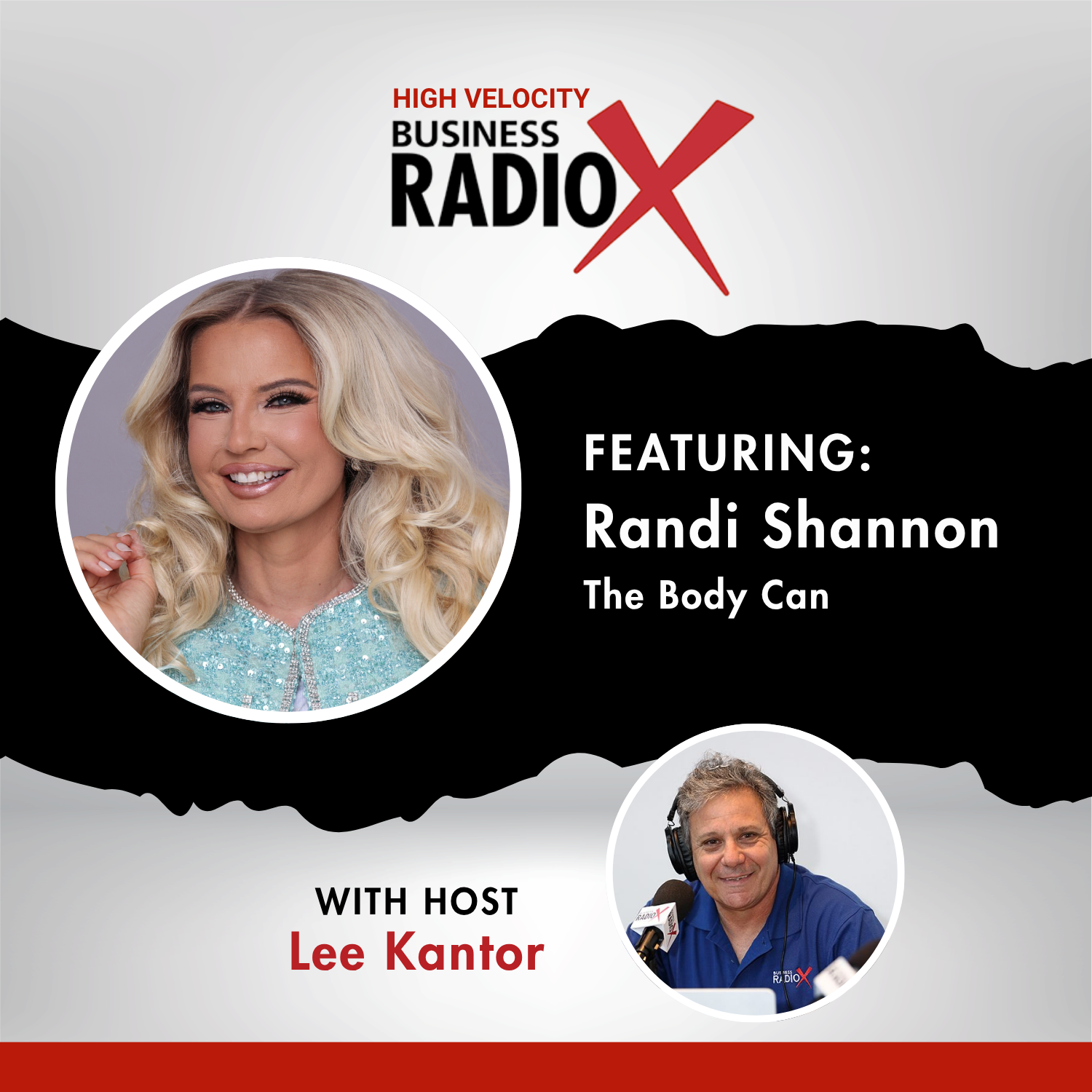

In this episode of High Velocity Radio, Lee Kantor interviews Randi Shannon, a traditional naturopathic doctor and founder of The Body Can, about her journey into natural health, traditional face, tongue, and fingernail analysis, and her approach to helping clients make informed wellness choices. Randi also shares lessons on building an authentic personal brand, growing an engaged social media audience, and her mission to establish Meli Preserve, a sanctuary dedicated to protecting pollinators and rescued animals.
 Randi Shannon, ND, is a Naturopathic Doctor, author, speaker, and media personality with nearly 30 years of experience in natural health and holistic wellness. She is the founder of TheBodyCAN.com and specializes in Face, Tongue, and Fingernail Analysis, using visible signs of the body to help identify areas that may need nutritional and lifestyle support.
She uses 5,000-year-old original medicine, bringing together ancient wisdom, traditional healing practices, nutrition, plant medicine, and modern science while recognizing that the body has an extraordinary ability to communicate what it needs.
Her media background includes eight years as a Fox-affiliate talk-show host, and she is a recurring guest on Coast to Coast AM with George Noory. She has also appeared on Sean Hannity Radio, The Power Hour, Mike Lindell TV, numerous podcasts and radio programs, and was featured in the Amazon Prime series Legacy Makers. She has had the privilege of speaking to audiences about natural health, nutrition, the body’s visible warning signs, and ancient knowledge that modern society has often forgotten.
She is the author of the Amazon bestselling children’s book Tongue Tales, and her newest book, The Language of Spices: The Complete Guide to Nature’s Most Powerful Medicines, is now available on Amazon. It explores 58 spices, bringing together their ancient history, traditional uses, biblical connections, culinary applications, and modern scientific research. The idea behind the book is one she strongly believes: There is a pharmacy in your kitchen.
Her newest work expands into another area she believes profoundly affects health—thoughts, words, attitudes, and emotional environment. The Physical Cost of Negative Thinking: How Your Thoughts, Words & Emotional Environment Affect Your Body, Health & Relationships explores the connection between chronic negativity and the physical body, while also looking at what happens when negativity becomes the emotional environment in which other people are forced to live.
She has also written Adapt and Overcome: The Physical Cost of Negativity—and Why a Man Cannot Afford to Live There, which speaks specifically to men about strength, resilience, discipline, responsibility, leadership, and the ability to face adversity without allowing it to define them. She believes men have always been called upon to protect, build, provide, endure, adapt, and overcome, and that this is a conversation worth having again.
She is currently working on her next book, Holy to the Lord: Bells of the Horses, inspired by the remarkable passage in Zechariah describing a day when even the bells of the horses will bear the words “HOLY TO THE LORD.” It continues her exploration of ancient Scripture, symbolism, forgotten knowledge, and the connections between the physical and spiritual worlds.
Another part of her life’s work is MeliPreserve.org, an effort devoted to preservation—protecting the knowledge, resources, and natural world that future generations deserve to inherit. For her, health isn’t only about what people do for themselves today. It is also about stewardship: what people protect, what they preserve, what they teach, and what they leave behind.
Although these subjects may appear very different—tongues and fingernails, spices, nutrition, thoughts and words, ancient Scripture, human resilience, and preservation—they all come back to the same questions that have driven her work for decades: What is the body trying to tell us? What did the ancient world understand that we have forgotten? And what are we going to preserve for the generations that come after us?
Connect with Randi on LinkedIn and follow The Body Can on Facebook and X.
What You’ll Learn In This Episode
- The principles behind traditional face, tongue, and fingernail analysis
- Randi’s journey from healthcare experience to naturopathic practice
- Practical approaches to making more conscious nutrition and lifestyle choices
- The importance of staying authentic and consistent when building a personal brand
- Strategies for growing an engaged social media audience organically
- Using short-form videos and live content to increase visibility
- The mission behind Meli Preserve and the importance of protecting pollinators
- Turning a personal passion into a purpose-driven business and community initiative
 This transcript is machine transcribed by Sonix.
TRANSCRIPT
Intro: Broadcasting live from the Business RadioX Studios in Atlanta, Georgia. It’s time for High Velocity Radio.
Lee Kantor: Lee Kantor here. Another episode of High Velocity Radio and this is going to be a good one. But before we get started, it’s important to recognize our sponsor, Business RadioX. If you’re a business coach or a consultant who’s tired of being a best kept secret, set up a call with Stone Payton at bookstonephone.com to unlock your perpetual prospect pipeline. Today on the show, we have Randi Shannon with The Body Can & Meli Preserve. Welcome.
Randi Shannon: Hey, such an honor to be here. What a great platform you guys have. I when I, when I saw this, I was like, I did a little bit of a deep dive and saw that you guys are all over the country and just super impressed with it. It’s needed.
Lee Kantor: Well, I appreciate that and I am so excited to learn about your practice. Tell us about The Body Can.
Randi Shannon: Well, I’m a traditional naturopathic doctor and what that means is I don’t prescribe drugs. I’m not doing any kind of minor surgeries. And I actually look at faces, fingernails and tongues. That’s 5000 year old original medicine. And that’s how they would look at somebody to try and figure out what was going on with the body. Why do they feel bad? And they would have them stick out their tongue, look at their fingernails, look at the face. I do it a little bit deeper than that, but every line, crack, crevice, spot, etc. means something. We’re either perfect or we got something going on. And that’s what I do is I check out what is the going on.
Lee Kantor: So what’s your backstory? How’d you get involved in this line of work? What got you interested in a 5000 year old A medicine practice rather than, you know, leaning into the newer things that are happening right now.
Randi Shannon: Well, you know, I was kind of a young mom. I’m 58 now, but when I was 21, I had my first son. So I literally had just turned 21. And I knew that I needed to be as healthy as I possibly could. I had one doctor in all of my years growing up that when he took the little popsicle stick, you know, the depressor holding down the tongue. Normally they’d always be looking at your tonsils or your throat. This one doctor that I was in there for an infection for this one doctor held it on the very tip of my tongue. He actually looked at my tongue. And then the series of questions he asked my mom in that were all very health related. He had me remove things out of the diet. My mom cut me off on certain things, and after that, I never had that kind of an infection ever again for the rest of my life. And, you know, like I mentioned, being a young mom, I knew I wanted everything to be healthy. And so that kind of took me down that road. And I had worked as a CNA certified nursing assistant when I was somewhere around 18. And of course, you get exposed to a lot there. And I saw the pills being pushed room after room after room. It literally never ended. And that’s all I saw. The RN’s do was go from room to room.
Randi Shannon: How are you? Have the pills ready and the little, little, uh, cup handed to them and off they went. Like I spent more time than the, than the registered nurses did. And I just got to speak to them and hear their hearts and hear their complaints and hear their joys and, um, see the diets and just see how they went downhill. So in my 40s, I went back to school and became a traditional naturopathic doctor. There is the licensed ones that go to the big schools like Bashir, etc. they do the surgeries, they take a year of pharmaceuticals. But I knew I never wanted that for my clients. And so, uh, the eastern medicine appealed far more to me. And I really didn’t find anybody that was that great at it. Um, but we did touch on it when I was in school and I found out that that was the place that I absolutely loved. And I just latched on to that and took it further, went and worked for, uh, various doctors around the country, one that did specialize in looking at the tongues. And then that was it. I just took it from there and went beyond. And so it’s been my career now, and I absolutely love it. My clients are in all 50 states, and now we just hit our 22nd country.
Lee Kantor: Now, you mentioned that, uh, some of this practices, um, I guess the insights have been around for thousands of years. What makes the face, tongue and fingernails, um, so useful for somebody like you that has the knowledge to understand them.
Randi Shannon: Yeah. Somebody years ago, obviously a long, long time ago, uh, figured out that every crack and and I don’t know what the magic was that that they were able to figure that out. But every crack, every line, you know, lines that appear up here, lines that appear here, uh, even things in the neck, in the ears, the back of the neck, um, on the body, all of those things were correlated with an organ or a system, whether it was circulatory, lymphatic, digestive, uh, cardiovascular, they all coordinate. Somebody figured it out. And what I have found is that it has been spot on. And I can look at somebody I’ve never met before, and I’ve done this many, many times. I can look at somebody that I don’t know any history, any background, and I can call out the organs in the systems that I see that are having issues. I don’t say you have cancer or you have an autoimmune or you have a heart disease. But what I do say is that I can see the heart has a few issues here. You know, I get a little bit more in depth with my clients, but I don’t call it out. And I do suggest, um, you know, when I see the signs, let’s say of a cancer or a heart disease, that they go get some blood work, that they get some testing done. So I do use the medical system, uh, that’s in place today. I just then help them combat whatever the issue is from a natural standpoint. And I’m always willing to work with their medical doctors. I’ve talked to plenty over the years that are happy to work with me because we’re doing it from the natural, whereas they’re doing it from the synthetic because every prescription is a synthetic.
Lee Kantor: So now, um, in today’s world, especially in America, what percentage of maybe health issues or challenges that an individual has is kind of self-inflicted because of poor nutrition or poor lifestyle.
Randi Shannon: Uh, pretty close to 100%, pretty close to 100%. Now, I will say we do have outside factors that we can’t help. Uh, for those that are aware of chemtrails, the planes fly, they dump, uh, enormous amounts of aluminum. Uh, the samples from the water and the soil have been, uh, tested positive for radium, barium, uh, things that are in nuclear weapons are getting dumped because they’re testing it. I don’t make this up. This is their test. Rfk is very well aware of it. He works with a group, uh, DeSantis, uh, Governor Ron DeSantis, uh, was very well aware of it. He banned it in Florida. Uh, but yet it’s still persists. And I really don’t understand why when something is banned, that it really isn’t banned, why it still happens. But they have tested this. So there’s a sector of society that’ll say, oh, it’s just air crap things coming off of planes. That’s normal. But then why do we have governors of Tennessee and Florida banning it? And we have a legislature that’s been introduced nationwide. So the naysayers that are out there debunking it, I mean, they they need to take it up with the government because it’s real. But, uh, water also very dirty. If I tested your zip code, for example, I’m probably going to find ten, 15, 25, sometimes 40 and 50 contaminants. And the result of all of those is cancer, thyroid problems, heart issues. So it’s, we have tons of contaminants. So people do have to fight to be healthy, there’s no doubt.
Lee Kantor: So what are.
Lee Kantor: Some low hanging fruit an individual can do? A listener can do right now? What are what are some things that a person that wants to take action can. Obviously. I mean, if things are in air and water, there’s. There’s only so much you can do. But what are some of the things that you can do to be proactive?
Randi Shannon: Um, I’m very clean on my water. If people want to know, like my systems that are more than welcome to reach out. But, uh, I’m very clear and clean on water. And by the way, I am with my four sons and their families as well. Uh, just making sure that everybody is on track, you know, stop going out and just getting random jabs in your arm that you don’t know what’s inside of them. Uh, you have to research every ingredient and see that there are side effects. Uh, and some of them are pretty detrimental. Um, stop sabotaging the diet. It’s not hard to do. Uh, I’m completely gluten free. Uh, I don’t eat any oils. I haven’t any oils in my diet for well over 30 years. Maybe. Yeah, probably 30, 30 plus years. No. And, and people will say, well, what about extra extra Virgin just got it from da da da. It’s all in the processing and that’s what makes the oils bad. So, um, in a nutshell, no wheat, barley, rye oatmeal, no buckwheat, uh, no fried foods, no foods cooked in any oils, no processed meats like lunch meats and salamis. Unless it’s very clear, uh, that it’s from a clean farmer and they are not putting nitrates or nitrites into that meat. They’ve got to stop doing, uh, buying that. If everybody would stop buying these things, then they would stop selling this garbage to the people.
Randi Shannon: Um, they mass produce, I would say support the local farmers that are doing it right. In Florida, we have, um, uh, uh, uh, I can’t think of his first name right now, but, uh, James Fishback running for governor, and he stated he will stop the madness on being able to drink raw milk. People just have to stop and pull back and realize they drank raw milk since the dawn of time. There’s nothing wrong with raw milk. There was a German study done on milk. They put cats, uh, in one room. These were all lab cats. They’d been raised, uh, there. So they were perfect. Nothing wrong with them. They had on one side. They fed them raw milk, and the other side they fed them pasteurized milk. And on the pasteurized side, they developed arthritis, arthritis. They stopped being playful. They became afraid of their own shadows. Um, they became lethargic from pasteurized milk. So hello, we need to listen to the studies and stop doing that to our families. And arthritis is a multi multibillion dollar operation just in America. And it’s, you know, it’s it’s meant to treat it the arthritis but not prevent it or cure it. Okay. So switching to raw helps you tremendously. And of course, you know, the farmers got to be clean and sanitary and all of that. But I would rather have that all day long over the pasteurized anything.
Lee Kantor: Now, how do you help your clients, um, when they’re just bombarded with so much information and it seems like, I don’t know, every few months there’s some new thing popping up. Like I think peptides is a hot, hot button right now. And, um, how do you help your clients kind of know what’s what and understand kind of the risk and reward for any of these new things that all of a sudden seem ubiquitous. You see them everywhere and you know you hadn’t heard of them, and all of a sudden now they’re everywhere.
Randi Shannon: Okay, so childhood jabs, all kinds of autism. You look at the Amish, they didn’t get the autism. Then you look at let’s just fast forward the lockdown time jabs, tons of side effects, cardiovascular issues, growths in the body, blocking the blood from even flowing. Uh, lots of things that were hidden from the public, which was very criminal. Uh, I was a Fox affiliate talk show host at the time that they did the lockdowns. The very month they did that, they removed my voice. And I’d been on radio for eight straight years, and they took my voice away. So they stopped people like me from actually being able to speak out. We were censored. So losing that platform and then the social media censored us. I mean, there should be lawsuits flying everywhere for that. Um, uh, then the I feel like the next fad was the ozempic. There’s over $2 billion in lawsuits going on right now. People have died. People barely on it, even for a matter of months, registered their bone density and it just went to their bones become porous and brittle. And I’m talking young people. So I have always said no to that, that it’s very experimental, that the people are the human guinea pigs. Um, you know, a lot of people, even in my field, jumped on that bandwagon because it was a big money train. You have to find people that aren’t motivated by the money. And I’m going to put my self to the test on your show regarding that today. Um, I have something I want to give away at the end of the show. And then the new fad is exactly what you said the peptides.
Randi Shannon: So again, it’s a fad FAD. If you’re the first one on the fad, you’re probably not going to do well. And I will tell you 64 people didn’t they died. And so, um, what they found is that when people started to get those, they were dying like three weeks later of cardiovascular issues. Okay. That’s how it appeared. So it wasn’t being, um, like all eyes weren’t on the peptides and ultimately down the road, what they ended up doing was taking 12 of those peptides. Anybody can search this. 12 of those peptides were removed off of the market because they found them to be deadly. So why do you want to be the first one racing in? So my take on the peptides, and I’m one of, I only know one other doctor, maybe two that are on, you know, the same side as me is no, do not race into that. There are no long term studies. You don’t know what all is in there. They say it’s a, you know, a copper peptide or whatever. I love copper, but I drink copper. Okay. So I have no side effect of that. I’m getting it in a mineral mix. They are injecting that, um, for, you know, beauty and this and that. You can drink it, you because you don’t have a mix of whatever else is in that concoction going into your body and into your bloodstream and every single organ in your body. I am completely against them completely for anything. Nobody can talk me into it at all at this point from the research that I have found.
Lee Kantor: Now, can we talk a little bit about your career? You mentioned, uh, kind of your journey a little bit, but if you were trying to help another, um, maybe somebody in medicine like you are grow a brand, are there some do’s and don’ts you’ve learned when it comes to growing a brand that you can share?
Randi Shannon: Yeah. I mean, mainly stay on track. Stay because I’ve learned that the hard way. Everything I talk about or teach, I’ve definitely gone down a wrong road or got it right, right out of the gate. But I would definitely stay on brand. Um, don’t sway to this or that. One of the tricks of social media is getting your page up to, let’s say on Instagram, about 3000 genuine followers do not pay any of these companies that, uh, say we’ll get you however many followers in a short amount of time, maybe a few months, whatever. Don’t buy into that. It’s all fake. All of it that I have found was totally fake. Um, you’re getting people from other countries. They’re never going to buy what you have. And they, they’re known to be fake. And so if you have 30,000 genuine followers, which means you need to engage your audience, you need to be putting out true content. Um, they love to see you. That’s what moves the fastest. They want to see you. They want to hear you talk and be real. That gets your followers up. And that’s what makes your videos go viral. And when you’re at 30,000 followers, you’ll have sponsors come out from all over the place. And so if you’re in the health field, for example, companies will come to you and ask you to do a little blurb on whatever their product is. And if you like it, then do it. If you don’t, don’t do it. We need to get back to being genuine and real.
Lee Kantor: So how do you how do you help somebody that’s just starting out build up to 30,000. If you’re saying that you can’t buy the help, how do you how do you grow from, you know, get that escape velocity to go from 0 to 30, 30 K?
Randi Shannon: Yeah. If you’re an expert in your field, whatever it is, in my particular case, face, tongue, fingernail analysis, uh, create videos, create reels, those move fast. And if you can do it in 15 seconds or less, those seem to move the fastest. Uh, it’s not that you can’t put longer form content in there, because I do think people will listen if you’re actually talking and, um, you know, sharing good information, but those quickie ones, people love to share them. They’ll send them to their friends. If it’s chock full of information, you do that enough and you can get your, your, your followers will go up naturally. And then from that, the sponsors come.
Lee Kantor: Now when a person is starting out and they don’t have it. So they. How often should they be posting these short, uh, reels? Is it.
Randi Shannon: There’s nothing wrong with a couple a day.
Lee Kantor: Oh, really? You can do just different content kind of relentlessly.
Randi Shannon: Yeah. And lives are good too. If, if they can actually hold an audience, uh, with whatever it is they’re saying, or maybe they’re showing something. Um, I’m constantly asked, hey, you know, Doctor Shannon, I’m coming to Miami. What’s the best restaurant? So I’ve heard it so many times because I’ve had, you know, Miami is such a great destination place. Uh, that I said the other day, I said, you know, I’m, I’m a foodie. I love to go to restaurants. I would maybe love to start taking, doing some video content at local restaurants and showing their menus and, um, showing the life here in Miami because it’s actually pretty fun. It’s pretty amazing. And some people have a, you know, bad connotation about it. So it’s just something that was talked about because I’m not, I’m not a one trick pony. Like I actually do have a lot of passions in life. Uh, and food is one of them. So that was just something that we talked about. So that’s a possibility where I could have longer content. Let’s say if I go to South Beach and I film South Beach as I’m walking through it and go to the go on the actual sand and show that that’s a little bit longer. I could do a live with that. And I think that, uh, people would engage and stick around. You know, I remember years ago that there was a, um, a live cam on some eagles that were in, I believe it was in Iowa and people all over the world would log in to see those eagles. And at any given time, they had 16, 17,000 people live even in the middle of the night. So live cams are also, uh, those were eagles. They, it was a pair that, uh, she laid the eggs and then they showed back and forth. You could see them bringing in rabbits and fish and stuff to feed the birds. One didn’t make it, one crowded out the other. And that kept the world engaged. And that was at a conservation, uh, center.
Lee Kantor: Now, I, I’d also like to talk a little bit about, um, a project that’s important to you and close to your heart, the Mary Preserve. Can you share why it’s so important for us to care about, um, honey bees and other pollinators?
Randi Shannon: Yes. Um, well, here in Miami, again, chemtrails were banned, but they still persist. And we don’t see honeybees down here. The bird population is woefully been depleted. Um, I did not see not one, not one firefly this year. Uh, we’ve barely seen any dragonflies, no ladybugs, nothing like our, our bug ecosystem. We as a population cannot live without that. They have so many jobs in the soil, on the trees and all the plants and so many preserve was something that has been on my mind for over 20 years. Uh, we actually started a little portion of it. We started, um, I’m going to say back in 2009 or 10, something called the food for Life Planting Foundation, we’ve just kind of rolled it into melee preserve. Melee means, uh, the honey in the Greek language. I looked at the top 4050 languages and melee was just the most beautiful word. I just felt like it really fit Florida, and I wanted something that had to do with the honey bee without actually saying honey bee. So it’s called Melee preserve. We are going to be opening up. The first location should be in Florida. We’re in the fundraising process for it right now. The website is Meli MELI preserve.org. Uh, you can see the site. It’s incredibly beautiful.
Randi Shannon: We are going to put in programs to help to save the pollinators. Number one, we’re going to grow tons and tons acres of wildflowers so that they actually have a food source that’s clean, heirloom, organic. And we’re also going to be a law enforcement holdover. And what that means is we always hear these stories about how an animal gets out on the highway, the interstate, uh, law enforcement. Nobody will come to get it. They have nothing that they can do. Uh, we just recently had a bull that got out, um, on our main interstate, the I-95 in Florida. It was hit in cars. It became a danger. Cars were now hitting cars because it was getting backed up over an hour. They had to take the bull down because they couldn’t get anybody to come get it. So we want to be a law enforcement holdover. We want to have rescued animals, abused animals, etc. we want to give them a sanctuary and, you know, hopefully rehabilitate them. And then, uh, you know, they find a good home if that’s possible. Otherwise we just and we’re going to basically, at the end of the day, my initial plan was to open this up in Florida and maybe one in Tennessee. I spoke with. I sat down a couple of months ago with a congressional award winner, and at the end of the conversation, she said, can I open one in Arizona? And that just made me think, we can do this everywhere.
Randi Shannon: We don’t have to just hold to these first two. So it’s a lot of funds that need to be raised. And we’re sitting down now with people that, you know, have bigger dollars that can donate to really help us. We don’t even have the land yet. So we are at square one and we’re looking for those people. And I’m willing to fly anywhere in this country where someone wants to put together a good size fundraiser and we’ll go. And we launched just this past weekend. I found an original artist. No, I don’t like all the AI stuff. We’ve, um, I hired her, she did the cover, the spine and the front cover of our new book, which is called The Language of Spices. It can be found on Amazon, The Language of spices and that book. When people buy that, a portion of those proceeds are going towards Mary Preserved. Now, this is a huge book, over 300 pages that I wrote myself. I started it over five years ago, and it is on medicinal spices, scripturally based, and it’s taking in my naturopathic point of view.
Randi Shannon: And I touch on animals as well, because there’s certain things that would kill an animal. And so we touched on that to, to make sure that they’re not feeding that to the animals. So that book, The Language of Spices, brand new on Amazon, helps to support Mary preserve.org. And, um, you know, I teach what I do as a naturopathic doctor. I teach the face, tongue and fingernail analysis. We have a master class for that. And all of that can be found at randishannon.com, RANDI shannon.com. Um, and also for your audience, excuse me, I need to grab a water here for your audience. I have what I call a tongue analysis. And that comes with three months of appointments where every month I relook at your tongue and it’s normally $695 and I am going to give it free completely. I am not charging my fee for that at all. For the first 100 people that call in to my toll free line. So I hope to be busy from that because that’s my heart in trying to get your population, your audience healthy, and hopefully it spreads far and wide so that 100 people do come to get that for free and we can help them get on track.
Lee Kantor: Um, so you want to share that 800 number?
Randi Shannon: Oh, yes. Uh, (844) 275-1056. And that is a $695 value for free.
Lee Kantor: And the website is thebodycam.com. And yeah, for the honeybees, it’s melipreserve.org.
Randi Shannon: Yes. Yep. That’s it.
Lee Kantor: Well, Randi, thank you so much for sharing your story today. You’re doing such important work and we appreciate you.
Randi Shannon: Thank you. Appreciate you and your platform and everybody that’s involved with it. And, and thank you and God bless you and God bless your listeners.
Lee Kantor: All right. This is Lee Kantor. We’ll see you all next time on High Velocity Radio.















