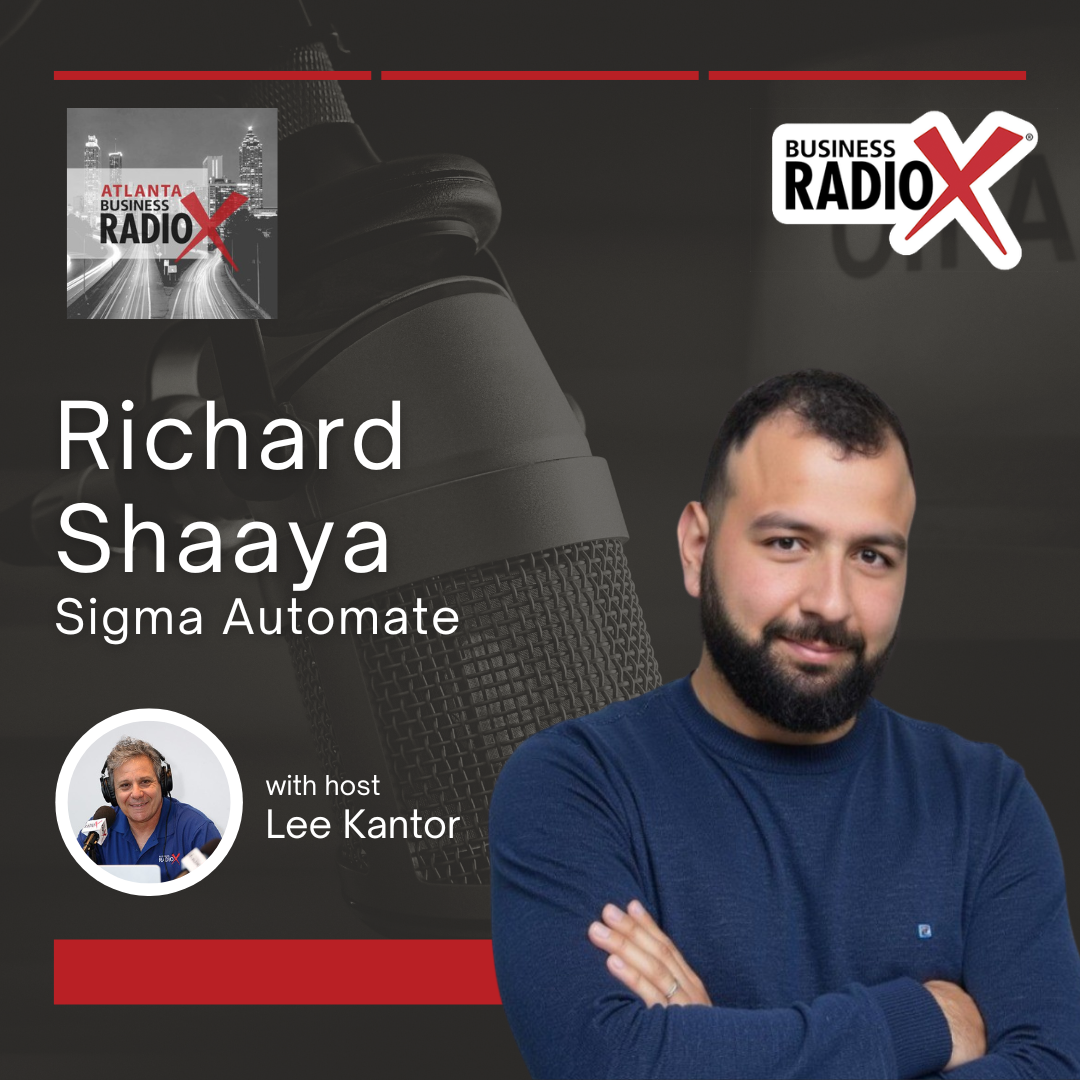

 In this episode of Atlanta Business Radio, Lee interviews Richard Shaaya, CEO of Sigma Automate. Richard discusses his IT infrastructure background and how it inspired him to create a no-code, AI-enabled automation platform designed for enterprise IT teams. Sigma Automate simplifies complex tasks like patch management, system migration, and VDI management, eliminating costly manual processes. Richard shares a success story involving a major landscaping company that fully automated patch management, freeing staff from overtime work. He emphasizes that Sigma Automate delivers fast ROI and scalability, making sophisticated IT automation accessible to organizations across multiple industries.

 Richard Shaaya, Co-Founder and CEO of Sigma Automate, led IT Operations and Cybersecurity across enterprises including The Home Depot, Wellstar Health System, Corning Inc., and Volkswagen.
Drawing from that experience, he founded Sigma to solve a critical gap in enterprise infrastructure, turning AI-driven insight into reliable, system-level execution.
Connect with Richard on LinkedIn.
What You’ll Learn In This Episode
- Overview of Sigma Automate’s mission and services
- Challenges faced by IT teams with current automation tools
- Importance of no-code, AI-enabled platforms in IT automation
- The role of AI in enhancing IT operations and automation
- Comparison of manual IT management versus automated solutions
- Customer feedback and success stories related to Sigma Automate
- Metrics for measuring success and ROI with automation tools
- The evolving role of IT administrators in the age of automation
- Insights from the CEO’s background in IT infrastructure management
- Current focus on expanding partnerships and market reach for Sigma Automate
 This transcript is machine transcribed by Sonix.
TRANSCRIPT
Intro: Broadcasting live from the Business RadioX Studio in Atlanta, Georgia. It’s time for Atlanta Business Radio, brought to you by Kennesaw State University’s Executive MBA program, the Accelerated Degree program for working professionals looking to advance their career and enhance their leadership skills. And now, here’s your host.
Lee Kantor: Lee Kantor here, another episode of Atlanta Business Radio. And this is going to be a good one. But before we get started, it’s important to recognize our sponsor, CSU’s executive MBA program. Without them, we couldn’t be sharing these important stories. Today on the show, we have the CEO with Sigma Automate, Richard Shaaya. Welcome.
Richard Shaaya: Thank you for having me. Good afternoon.
Lee Kantor: Well, I’m excited to learn what you’re up to. Tell us a little bit about Sigma automate how you serving folks?
Richard Shaaya: Absolutely. So I come from IT infrastructure. I used to manage large IT teams in the metro Atlanta area, both in healthcare and retail. And the problem we’re out to solve is to provide accessible and easy to use IT automation software to enable teams large, you know, sophisticated, complicated IT teams to be able to automate systems in a resilient way, right? Patch them consistently, migrate them in between all the different clouds. So in a world of complexity, we’re here to be the execution layer for Agentic AI to help serve it automation.
Lee Kantor: So what’s the backstory? What was kind of the genesis of the idea?
Richard Shaaya: Yeah, absolutely. So like I said, you know, I used to run IT teams and one thing was clear to me, uh, you know, most IT teams in the enterprise are too busy chasing their tail, right? Troubleshooting day to day issues that they never have the opportunity to really zoom out and re-architect their environment in a stable, consistent, automated way. And the big reason for that is not a lack of competency or a lack of will. The big reason for that is that the tools that are present and available out there are simply too complex, and time to value is too slow. So I used to run projects to get some automation workbooks off the ground, and it just simply took too long and cost the enterprise way too much money before we could access that automation. So I went off on my own and wanted to solve for this problem by providing an accessible, easy to use, no code automation platform that integrates with, you know, VMware technology, AWS, Azure, whatever the cloud provider is, and help the IT department access automation features without having to write code or install agents or worry about, you know, things like Yaml files or kind of the more sophisticated, slower time to value ways of doing this today.
Lee Kantor: So when you developed it, was it difficult to get kind of people to try it out?
Richard Shaaya: Honestly, not when we were talking to the right people. You know, I think I think executives, IT executives in the enterprise, I think we’ve disappointed them as, as you know, a software industry, we’ve promised easy troubleshooting, easy system build, easy patch management over the past 20 years, and we’ve simply not delivered on that. So there is a lot of hunger for this one. You know, once we’re talking with the right folks and that’s anywhere from the CIO, CTO, all the way to, you know, manager, senior manager of IT operations and IT infrastructure, they really have that wow factor, you know, on their face once they see how simple the platform is, and once they see how cool the AI enabled features we’ve got in there. So, um, speaking with the right audience, right, that really understand this pain and is living it day to day, um, has allowed us to get quick adoption in the first nine months.
Lee Kantor: So what? Um, when you’re talking to them, how do you answer the, the why now issue? Like why is now a good time to pull the trigger on something like this?
Richard Shaaya: Absolutely. In the age of AI intelligence and reasoning, you know, the large language models, the AI functionality itself has become a commodity. However, it is still stuck again, fighting fire fighting day to day problems. We’re here to bridge that gap, right. So we’re here to make use of AI for the IT enterprise.
Lee Kantor: So now um if they’re not using your service, how what are they doing instead? Is this manual at this point? Like what, what are they doing to kind of like you said, it was very, there’s a lot of complexity. So what are they doing to deal with this right now if they’re not using Sigma automate?
Richard Shaaya: Yeah. Great question. Um, the bulk of the Companies out there are doing things manually. Uh, the ones that are implementing some automation heavily rely on certain key players and individual contributors to continue supporting, maintaining, and developing that automation over time, which causes problems for, uh, retaining resources and making sure that we can support the technology that we’re deploying into, into the future. So there’s a little bit of DIY out there, but for the most part, it’s being done manually. It’s consuming, you know, uh, weekends and nights for systems engineers that really should be focused on delivering value to the business instead of firefighting and manually patching systems and repairing, you know, agents and dealing with very complex, um, automation code. Uh, that really should be solving an easy, simple, repeatable problem. So the bulk of it is, uh, is manual and then there’s a little bit of DIY, uh, kind of, you know, A house built, uh, processes that are just become, you know, brittle, fragile, and, uh, disparate.
Lee Kantor: Now, you mentioned having kind of deployed this already in the market a little bit. Um, when you go back to the leaders, uh, after you’ve deployed it, what is something they tell you when it comes to, I can’t believe that we were doing this manually before. Is there anything that they’re saying that’s the big, you know, uh, aha moment for them that this is kind of blowing them away?
Richard Shaaya: Yeah. It’s really enabling, uh, consistent IT operations. Uh, simply. Right. So, um, a set it and forget it button, right. A big troubleshoot button that will go out there and look at a lot of logs and different systems and all the moving parts, uh, with our AI agent and come back and tell you what might be going on in your environment. Right? Uh, a couple, you’re always a couple clicks away from building many systems at scale. So the ease of use and the power of executing in your environment at scale with such little upfront work. That’s really what’s wowing our customers.
Lee Kantor: And then, so how are you measuring this when it comes to the client? Like, what’s your kind of metrics for success when they’re judging? Is this a worthy investment?
Richard Shaaya: Yeah. You know, we have.
Richard Shaaya: Multiple modules in the in the platform. So I’ll give you a couple examples. One of them is patch management automation. So our customers use us to ensure that their systems are up to date and patched in an automated way. That means that, you know, the IT team is not up every Saturday night manually clicking buttons and fixing, you know, patch software that might be broken on the systems. They schedule it and they set it and forget it. And then they’re able to get compliance reports, right. That makes their security team happy to prove that these systems have been patched. If there is any problem with the patch installed and there is, you know, logic in the platform to resolve that problem. And that’s where our AI agent excels significantly there. So that’s that’s one of the use cases. Another one is VDI management. So that’s virtual desktop infrastructure. Things like Omnisphere and AVD out in the Azure space helping, uh, UC teams. That’s end user compute, helping end user compute teams. Again, automate simply the automatic, uh, uh, scaling of their VDI environments. So that’s building desktops every day and then shutting them down at night to save on cloud costs or on prem resources. Uh, that’s been a big aha moment for our end user compute teams.
Lee Kantor: Now, what about the rapidly scaling a company that’s growing, you know, from X number of servers to ten X servers? Does does your system help them when they’re growing that rapidly?
Richard Shaaya: Absolutely. So we’ve got a we have a theory of templatizing everything, right? So the idea is, if you’re going to do it once, you’re likely going to repeat it. And the platform’s ability to help you save a workflow, save an automation and then replay it at scale, that’s really what we’re here for. And again, that could be anything from deploying a system all the way to patching it or migrating it, or looking for configuration drift. Um, it’s all, you know, point and click. There’s no code required. There’s no training required. It’s very simple for, um, you know, the typical systems administrator to utilize this platform, uh, in a scalable way where it’s, you know, we call it a, um, DRI concept, right? And it just means that we’re not going to repeat work. Uh, so do it once, scale it and, you know, rinse and repeat. And once you enable access across your team, then you know, you’re not dependent on that one. Uh, system systems engineers that honestly today is not able to go on vacation, right. Or is not able to stop working every single weekend, uh, because they specialize in a certain system or a certain functionality in the environment. So enabling people to, you know, look out for each other and, um, having that force multiplier to do more with less, especially as organizations, um, you know, are under strict, uh, budgets and are generally struggling to keep up with the business. Uh, that’s been very powerful for us.
Lee Kantor: Now with the rise of AI, um, and more and more automation. How do you see kind of the role of the IT administrator or those leaders evolving?
Richard Shaaya: Right. So, um, you know, with how incredible AI is and it’s not going anywhere. Uh, you know, if you think about the current landscape, it is still struggling, right? And there’s always talk about AI is doing incredible things. And yet we are struggling to patch our systems. We’re still struggling to build systems, um, you know, in a timely way to support the business there. You know, there’s a missing layer and that missing layer is practical execution, right? So that means how do we use AI reasoning in AI intelligence practically in our environment, other than just manually asking the LLM to write a script for us and then go and apply it, right. That’s what we’re solving for. We are the execution layer and the, the automation layer to execute on intelligence for the IT enterprise.
Lee Kantor: So now do you think that your background of being a technologist and kind of working in the, in those huge systems that you had in the past, that you were kind of the perfect person to be doing this kind of work?
Richard Shaaya: You know, I’ve worked for.
Richard Shaaya: Multiple industries spanning, you know, retail, healthcare. I used to work up, up in Corning, New York for, for the glass manufacturer, right. So multiple industries and they, they’ve all had the same pattern of challenges, which really boils down to, um, you know, inaccessible or hard to access automation, and that’s consistently been the root cause of outages, the root cause of inefficiencies for the IT enterprise. So I bring a background of, um, you know, multi industry experience with, you know, with the same pattern of problems that we’re solving for now.
Lee Kantor: Um, has it been difficult for you to get funding?
Richard Shaaya: It, um, it has not. We closed, uh, we closed our, uh, incubation round and, uh, we were able to, uh, you know, honestly just find the right partner. I always tell folks I only pitched once, which is unheard of. You know, I think there’s a little bit of luck there potentially. But, you know, I think again, um, the enterprise and, uh, investors are hungry for a practical, useful, right? Not dreamy solution, but more of a practical, um, uh, you know, very short time to value, uh, platform that we can articulate our value prop to the enterprise.
Lee Kantor: So what’s that pain that your potential customers are having right now where, um, they should be calling you? What, what’s happening in their life that, um, that sigma automate is going to be able to just make their life easier.
Richard Shaaya: Yeah. You know, the biggest thing I would highlight is, uh, the current automation tools out there are so, um, you know, slow to get any ROI out of and also very costly to the point that it has just decided to do things manually, which really should not be an accepted answer. Right. But they don’t have a choice. Um, so if you’re in the IT enterprise and you’re doing things manually, and that could be anything from patching your systems to building new systems to managing your VDI environment. Um, that’s, you know, I know that you’re going through outages. I know that you’re going through delays that are affecting the business negatively. So we’re here to solve the problem of it. Automation is too complex and too expensive. And the the ROI today is currently just not there for the existing products. And the alternative is just do it manually or try to develop something in-house that’s brittle, that’s going to break very easily. We’re here to solve that problem now.
Lee Kantor: Um, is there a story you can share of maybe one of your users, um, share, don’t name who they are, but maybe share the challenge they had. And then after using Sigma, automate the, the new kind of, uh, experience that they’re having.
Richard Shaaya: Absolutely. So we work with, uh, the largest landscape company in the US. They’re a public company. Uh, they’ve got thousands of virtual machines in multiple data centers. Uh, patch management had been a huge pain point for them where it was a very manual process, even though they’ve invested in the right tech, right to patch their systems, you know, they still needed, uh, systems administrators to spend their weekends and their nights, you know, setting those batches up and then chasing after systems that refuse to patch because the agent is broken, you know, or you know, any, any combination of 100 different reasons. So they purchased a platform and we’ve enabled them to fully automate that process and have automated logic to look for those errors and properly resolve them before the patch window even hits. So, you know, now they’re in this set it and forget it. Um, architecture where, you know, their staff is not having to be up, you know, after Patch Tuesday for multiple nights in a row to patch their thousands of systems across multiple data centers. So that’s been one of our major use cases with a public company.
Lee Kantor: So what do you need more of? How can we help?
Richard Shaaya: You know, I’m looking to spread the word. We’ve been working on our product market fit across multiple industries. And we’re ready to expand our partnerships. And, um, you know, just start to clone, rinse and repeat what’s been working for us. Uh, we’ve got a presence in very large enterprise healthcare, uh, retail again, multiple industries. It’s more about, uh, you know, the IT environment and the landscape being sophisticated and being in this dire need of accessible automation. Uh, that’s who our ISPs are. And we’re looking to start spreading the word.
Lee Kantor: So if somebody wants to learn more, have a more substantive conversation with you or somebody on the team, what’s the website? What’s the best way to connect?
Richard Shaaya: Yeah, reach out to us on sigma-automate.com or reach out to me personally on LinkedIn. Richard Shaaya, SHAAYA.
Lee Kantor: All right. Richard, well, thank you so much for sharing your story. You’re doing such important work and we appreciate you.
Richard Shaaya: Thank you. I appreciate the time.
Lee Kantor: All right. This is Lee Kantor. We’ll see you all next time on Atlanta Business Radio.















