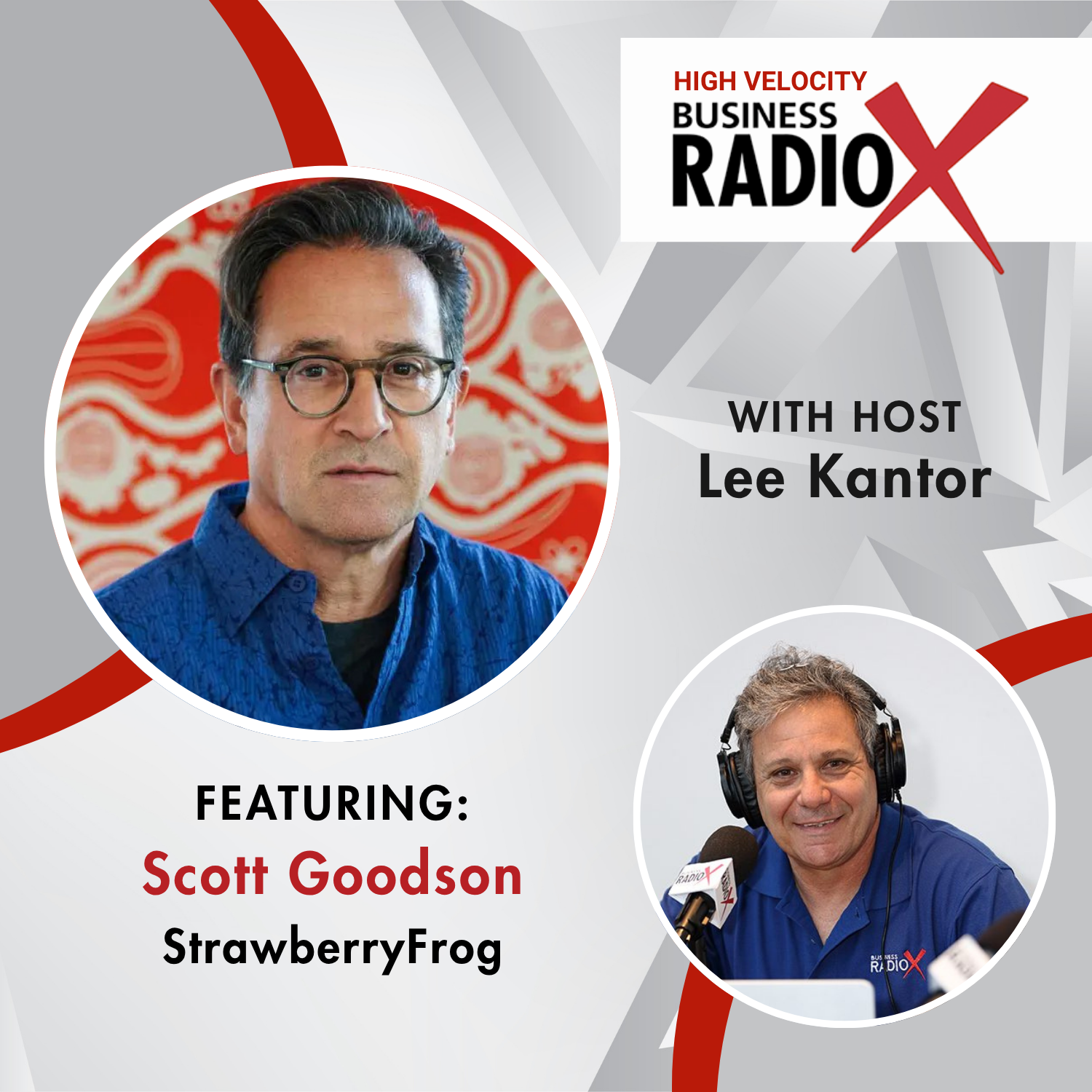

In this episode of High Velocity Radio, Lee Kantor interviews Scott Goodson, founder of StrawberryFrog, about movement marketing, brand purpose, and how businesses can stand out in an increasingly AI-driven world. Scott explains how companies can build genuine movements around ideas people care about, use AI to transform marketing and customer experiences, and embrace a distinctive “Peacock Mindset” to rise above commoditized content and capture attention.

 Scott Goodson is a titan of the global advertising industry. As the co-founder of StrawberryFrog with offices in Europe, Asia, South America, the Middle East and New York, he transformed the agency into a worldwide powerhouse through a philosophy of Movement Marketing.
He is the visionary behind some of the most enduring brand ideas in history, including Emirates Airline, Google, Heineken, Jim Beam, Bluetooth, Smart Car, Truist and Northwell. He has been awarded top awards at the Cannes festival and
D&AD awards.
He is the thought-leading expert, bestselling author, his foundational work in Movement Thinking, the idea that the most powerful brands don’t advertise at audiences but ignite shared purpose, has redefined how global companies approach culture, creativity, and growth. His seminal work, the best seller “Uprising” first defined Movement Thinking, the discipline of turning brands into cultural forces that build a community of passionate advocates.
His second book “Activate Brand Purpose” is a powerful, thought-provoking guide that redefines the way we think about leading a company in these times and how to motivate employees towards positive business outcomes by activating purpose with Movement Thinking.
His agency is ranked among the very best and continues to challenge conventional thinking, working with the world’s most ambitious companies to replace jargon and bureaucracy with breakthrough strategy, exceptional activation, and measurable outcomes.
Connect with Scott on LinkedIn.
What You’ll Learn in This Episode
- Turning brand purpose into meaningful action through movement marketing.
- The distinction between big-M societal movements and small-M community movements.
- Identifying cultural ideas that genuinely matter to audiences.
- Building trust through authentic purpose and avoiding purpose-washing.
- Using movements to help smaller companies and startups compete with larger brands.
- The impact of AI on marketing, consumer insights, content, and customer experience.
- Using the Peacock Mindset to stand out in an increasingly commoditized AI world.
- Creating a competitive edge through distinctive ideas, bold positioning, and human creativity.
 This transcript is machine transcribed by Sonix.
TRANSCRIPT
Intro: Broadcasting live from the Business RadioX Studios in Atlanta, Georgia. It’s time for High Velocity Radio.
Lee Kantor: Lee Kantor here another episode of High Velocity Radio and this is going to be a good one. But before we get started, it’s important to recognize our sponsor, Business RadioX. If you’re a business coach or consultant who’s tired of being a best kept secret, set up a call with Stone Payton at bookstonephone.com to unlock your perpetual prospect pipeline. Today on the show, we have the founder of StrawberryFrog, Scott Goodson. Welcome.
Scott Goodson: Hello. Thank you so much for having me.
Lee Kantor: Well, I am excited to learn what you’re up to. Tell us about StrawberryFrog. How are you serving folks?
Scott Goodson: We’re doing great. So StrawberryFrog was designed to be this agile, innovative marketing partner and media and marketing. And we’ve been in the business for about 28 years, and we work with some of the largest and most famous names in the world. We started with a very simple idea, which is you don’t have to be huge to be great. You just need to be highly technically advanced and be able to use the power of technology to help large companies grow and transform.
Lee Kantor: You’ve been around for 28 years. Was your focus always on enterprise level organizations, or was that something that just evolved over time?
Scott Goodson: No, I think our starting point was the launch of the smart car, which we did for Mercedes in Europe. Our first office was in Amsterdam, and that was a startup client, was the launch of this brand new two seater vehicle, which needed a very different marketing strategy, and we at the time realized that the most powerful human organizing frameworks was this idea of movements, which obviously going back 10,000 years has really shaped human behavior and mindsets. And we basically studied the principles of societal movements and distilled that into a formula that companies could use in order to build their own movements for their brands. So when we launched the smart car as our first client, it wasn’t an ad campaign. It was a movement to reinvent the urban environment. So I’m sure you can immediately imagine all the issues that people that live in cities face. Bad parking, traffic, etc. when you build a movement and launch a new brand, it allows you to not only engage with consumers who might be aligned with your idea of what the brand stands for and brand purpose. It also lets you bring in other strategic partners who otherwise would not be interested in helping a car launch, like, for example, mayor’s offices and parking organizations and rental car companies that have airport parking lots full of cars on weekends. Things like that, which have problems to solve, that are connected to the idea of reinventing the urban environment. So that was our first launch. We gave birth to this idea of movement marketing, and since then we’ve worked with Walmart. We did the launch of Truist, which is a very large financial institution in the country. We’ve worked with tech brands. We did the launch of Google. We’ve worked most recently with Afterpay. We work with Northwell Health, which is one of the largest health systems in the country. All sorts of industries, um, where we’ve applied this movement thinking.
Lee Kantor: So do you mind kind of like digging in a little deeper for this movement thinking kind of methodology? How would that become actionable with, for the listeners of this show and the, and the leaders of brands that are working or listening to this right now. How, how do you kind of begin the process of, uh, utilizing this type of movement thinking when launching, you know, any brand?
Scott Goodson: Well, um, there are two types of movements. Uh, the first I call a big M movement. And that is the type of societal movements that, you know, you’re, you, know, you can name when I say, you know, name a movement like the civil rights movement or suffrage movement or, you know, environmental movement, things like that. And, um, so when we launched, for example, Northwell Health, which is a relatively new health system in the most competitive health market in the world, which is New York state, where you have, you know, some of the largest and most famous venerable systems in the world, including New York Presbyterian that was founded by King George in 1777 in those, um, capital, those big movements, uh, you’re really tackling big societal issues. So for Northwell, the idea that the existing health system is broken and needs a new approach, uh, engaged people, um, and helped us establish a really strong and distinctive voice for Northwell in New York State. And as you can imagine, a lot of people would immediately say, yeah, that makes sense. I, I see the existing system as broken and I, I would be welcome. I would welcome a new system that, you know, had values that reflected my values. So we, we did that launch in New York State together with the leadership there. And today, Northwell is the number one brand in New York and Connecticut. That’s a big M movement. A small M movement would be ideas that are relevant to a specific community. So, for example, when we reimagined Pampers, when Pampers had fallen into second place behind Huggies, they hired us to help them reinvent the brand. And we came up with an idea for this really well engineered poop catcher, which was baby development. A baby development is something that all parents would agree with as a valuable goal.
Scott Goodson: We want our babies to develop. We want their minds, their emotion to develop. If they move, their brain stimulates their. Their curiosity increases their vital. All the positive things that happen because of movement is directly related to the growth of the baby and the baby’s development. So we did a movement for baby development, and that movement engaged millions of moms across the United States and then globally, and helped Pampers to regain its number one position against Huggies. So those two those are two examples of movements. And brands can’t create a movement, but they can identify a cultural idea that’s highly relevant to a massive amount of people and then crystallize it in a way that if you do it in the right way, you tie it back to the brand or the product in a smart way? If you don’t do that, then you do what’s called green, not green. Excuse me. You do. Purpose washing, which is basically you fake an idea like you try to pretend that you’re doing a movement, but people can see through that BS pretty fast. So for example, a couple of years ago, Planters Nuts came out and said that they thought women should be paid the same as men because pay equality, if you’re not paying women the same, it’s nuts. And then when you looked into the company behind planters, you saw that they actually don’t pay women the same as men. So it was not a real movement they were doing. So those are two examples, big movement where we’re challenging people’s Expectations of health care for Northwell and in the small end movement case, this idea of taking a stand for baby development was highly relevant.
Lee Kantor: So if you’re a small to midsize company, is it something? Is this just too big for you to approach, or is there a way that you can, uh, make this work for a smaller brand, a mom and pop or a startup or something that doesn’t have an established identity just yet? Can you just, is there an exercise you would recommend them? Uh, leader kind of doing so they can see where maybe there is an existing movement that they can participate in. So they get some of the, at least the halo effect of being part of the movement.
Scott Goodson: Every organization, regardless of how big or how small, should have a movement that they are trying to build. Uh, Jim Collins, the, uh, highly regarded author that wrote B. E. 2.0. Um, which is a terrific book about entrepreneurship, says that in today’s world, whether you’re a startup with one person or 100 people, you really only need four things. You need a vision, you need a purpose, and you need, uh, your core values and you need a B hug. Your big, hairy, audacious goal. I add to that this idea of movement because movement activates your purpose. Problem with purpose is, uh, when you have a purpose, a lot of entrepreneurs spend a lot of time trying to figure out what is my purpose, and they end up with a couple of Silly words on a page, and then they present it to some friends who kind of shrug and go, yeah, that could be good. Um, the problem with that is what do you do with it other than put it on a poster behind your desk? You’ve got to do something with it. And if you think about what a movement is, movement, a movement inspires people to do something, whether they’re your own employees or other stakeholders, whether they’re customers or consumers or partners or suppliers. You want people to be building something with you. And if you start with a very simple movement idea, you’d be surprised how inspiring it is for yourself, for the people that work in your company, for your family and your customers and all other people who you want to attract to your business.
Scott Goodson: And every company can have a movement. Not every company deserves a movement, but certainly everyone could find something in the world that they can help make better change. You know, it’s like watching, um, old Hollywood movies. The storylines of those movies are almost the storylines for what a movement could be. So, for example, old Frankenstein movie you ever saw Young Frankenstein? It’s not it’s not an old Frankenstein movie, but it’s relatively old. Gene Wilder’s movie Young Frankenstein. So there’s a village. One day the monster comes to the village and everybody runs home and gets their pitchfork. So that’s a classic movement strategy. Basically, you find a monster out in the world and you rally people to slay it. So I used exactly that strategy for a major pharmaceutical brand. Um, there’s other very simple movement storylines, like a wrong in society that needs to be righted. Something that shouldn’t be needs to change that simple idea. Those are the those are the basis of great movements. Taking a stand for something and taking a stand against something. And I’m not talking about your competitor or a product that you’re against. I’m talking about a higher idea. Like the example I gave you with Northwell Health, where they were against the status quo health system, and for a more responsible, better, uh, system, in keeping with what New Yorkers are looking for today. So those are examples of of movements.
Lee Kantor: So what is kind of the movement that StrawberryFrog is for or against that is your kind of true north that you aim your purpose at?
Scott Goodson: We are against big, established, expensive, bureaucratic, slow moving, corporate thinking corporate agencies. And we are for agility, for speed, for innovation, for freshness, for new ways of solving old problems. That’s what we’re about. We’re frog versus the dinosaur. In fact, when we started StrawberryFrog, we said our we are against the dinosaur. The dinosaur is the big, slow, bureaucratic, expensive. Not interested in new ideas. That type of mindset. And we are for exactly all the things that I mentioned to you. And we created a little children’s book about the frog versus the dinosaur, how this little frog, this little strawberry frog, a red body with blue legs looks like it’s wearing jeans. It’s kind of like a rebel with jeans. Um, was challenging these big established dinosaurs. And we proved that to be accurate. We, as I mentioned, have worked with some of the largest companies in the world in the United States and across the globe. Um, by bringing fresh perspective and a faster, smarter way to solve problems for huge clients. And we’ve also worked with some small startups that eventually became really big, like Afterpay, which was two guys from Australia that started the Afterpay company and sold it to square a couple of years ago for $29 billion. So brands that start small can grow rapidly. If they have a purpose and a movement that unlocks it.
Lee Kantor: So now when you’re since you’re working a lot with these larger enterprise organizations that probably already have relationships with many agencies, many more than one, usually what is kind of the, the problem they’re going to you for that their current stable of agencies aren’t, it’s not working for them in the manner that they’re doing what they do.
Scott Goodson: I think it’s basically so smart clients are always looking for edge. They’re looking for a smarter way to solve their business problems. And I’ll give you an example. We have a media company. And in today’s media world, let me ask you a question. Do you have cable TV or do you have internet that then allows you to download apps and watch.
Lee Kantor: Yeah, we’re streaming. We we have streaming.
Scott Goodson: Yeah. So when you look at the media buying world, the old world was there was a handful of very large media buying agencies. So clients would go to those big media buying agencies and they would buy and they would. And these media companies would say, hey, we buy so much bulk, we give you better prices. Well, in today’s world, everyone’s cut the cord and there are about 200 platforms out there that are massive buyers of very focused, very targeted, focused expertise. So for example, if you want to buy programmatic, there’s like 3 or 4 huge media buyers out there that are global. If you want to buy SEO, there are three or 4 or 5 companies out there that are top of the by the bulk of the SEO. If you want to do AI search, um, work so that your brand comes up in the AI space, there are a handful of those companies that do that. If you go to a traditional media company, they use those guys. They don’t tell you that, they just charge you for that. So we created a media company to take that advantage to our clients and say, you don’t need media companies. We have strategic media planners that can devise a very smart media strategy. We can then cherry pick the platforms, much like you do with apps. When you have your streaming internet service for your when you’re watching content on your television, we can choose those apps, those platforms, and we can do it 50, 60% cheaper than you can from working with a big media company, and we’ve proven that with very large clients.
Scott Goodson: We have the Reuters global media business. We have Cheesecake Factory, which is a huge QSR client and many others. So we’ve proven that to be true. Um, and then in terms of the services we provide, we can do what huge clients need and want. We just do it, as I said, faster, better and cheaper than the large corporate agencies. And we’ve been doing it for many years. So we have a process that works. Um, clients are constantly looking for an edge, as I said, at the top. And when we meet them, we show our case studies and we show them how we can accomplish, um, transformation. If a company is trying to reimagine themselves, or if they’re trying to launch a brand or a product in a, in a contested market, you know, they want that the challenger mindset. All those things, um, are relevant to a lot of clients these days. And then of course, clients are, um, frozen. A lot of them are with AI, a lot of not just clients, but companies are, are frozen and not sure what to do in this new world of AI. So some of those clients come to us and we’ve worked with them and developed, um, some highly innovative, um, consumer. Basically, we can use AI to pinpoint consumer tastes, behaviors. We can, uh, find insights with AI. We can even use synthetic focus groups. Now we don’t, you know, you don’t need real people to, uh, you know, test ideas. All those things are possible. Um, they’re not always recommended, but they’re certainly possible.
Lee Kantor: So now when you’re working with a client that is struggling with AI, um, holistically throughout their organization. How do you kind of, um, approach that when they’re looking to leverage AI for their marketing or advertising? Because so many firms right now, they don’t even know how to handle AI internally. How are they, uh, looking to you to solve it externally?
Scott Goodson: So I think what you just said is really valid, valuable. You know, the first starting point when we work with clients is, um, is to understand their own enterprise AI transformation. Like how is AI being used internally? Because AI can help bring a lot of disparate systems together, can help, you know, departments that aren’t talking to each other or people that aren’t talking to each other, become more unified and share, um, tools that let them work together more efficiently, etc. so that’s really a starting point. And a lot of the clients we work with, we start there. We have our AI team that are very experienced. And when I say very, I mean it’s, you know, a five year old technology, but they’re pretty advanced. They’ve done this for a lot of systems, a lot of clients. Now, um, then you can really bring, um, you know, when you, when you understand the, let’s say the, where that client is, that company is in terms of their own internal transformation with AI tools, right? Then you can start to talk about AI as a marketing tool. Um, a lot of clients we talk to are trying to bring, um, customer experience, product innovation and marketing together because that’s the holy grail.
Scott Goodson: Those three things like if you, you know, historically, companies have had product innovation separate from marketing and separate from customer experience. If you can bring all those three things together, it makes it much more have greater impact. Um, so I think, you know, the cross cutting implications of AI are significant and they really touch all aspects of the business. I think the other thing to realize is if you look at the marketing funnel, right, if you think about marketing funnel, that is something which can be positively affected across the entire funnel. You can use AI to do everything from which I said to you at the beginning, you can find insights, you can pinpoint consumer data. Uh, that really paints an incredible picture of your customer or your consumer and their needs and wants, um, all the way through to the actual content. You know, we did last year a worldwide AI campaign for visa where 20,000, um, individuals received, uh, individualized personalized advertising, which is one of the things that AI can do today, um, right through to, uh, measurement and tracking.
Lee Kantor: Now what is, um, an area with AI that you’ve been able to deploy for your clients that even surprised you because it is kind of, I guess we’re, we’re in the beginning of the beginning here when it comes to really rolling out AI throughout, uh, organizations. What, what is something you stumbled upon that surprised you, um, in your work with AI?
Scott Goodson: I think for me, I think the most interesting idea was something I called the Peacock mindset versus the duck mindset. I’ve seen that in today’s world. Competence and competent content, competent strategy, competent marketing is duck. And it’s not enough because with AI. Everything becomes commoditized and good performance is no longer a moat, a protective moat for your company. Everyone has access. Think about it. It is a complete. It’s a moment in time when the amount of content. If you thought there was a lot of content out there, just watch this space. There is so much. And not just content, but incredibly well done content. That’s all I. And that that content, I call it a duck is efficient. It’s functional, it’s competent, but ultimately it’s average. And in the age of average, where everything sounds and looks the same in this AI world of synthetic agents that can imitate, replicate, automate everything, then you’re a duck and your company, your brand is going to be neutralized by AI overnight. Your distinction will disappear. So against that, you need to have peacock thinking. And the peacock thinking is basically the idea of a peacock versus a duck. You know, the peacock’s tail is colorful, it’s heavy, It’s biologically unnecessary, but it helps the animal survive and thrive. It signals unshakable strength and resourcefulness. And in business, peacocking is about investing in uncommon human ideas content, bold stances, distinctive flair. That is what’s going to separate you from your competitors. It’s never been more important than now. When the world is flooded with AI generated content. Human attention is the ultimate scarcity, and you can’t win with volume or micro-optimizations against AI machines. So you need this Peacock mindset. You need to be able to really flaunt it to thrive. Boring is too expensive. Surprise is going to help you succeed.
Lee Kantor: Now with AI, everybody has at their fingertips. Now you know the smartest people, the smartest, a tool that allows you to have you know, we thought the internet had gave us access to all kinds of information. But now you have a tool that not only gives you access to all kinds of information, but it also gives you a way to connect the dots with some of this information in very creative ways. It’s become table stakes that you have to be good or great nowadays, and with AI, everybody can become good or great. And like you said, there has to be a way to now stand out. But how do you stand out in a way that still is true to your authenticity and your expertise and your superpowers, and not just be something that looks good from the outside but isn’t really, um, meaningful. Better once you dig a little deeper. So how do you kind of marry the, the expectation of high quality with that, um, need to kind of surprise and delight to be noticed in a world, like you said, is just flooded with exceptionally attractive information that at least seems true and worthwhile.
Scott Goodson: There’s a lot of crap out there and it’s only going to look better, right?
Lee Kantor: But it’s not crap, though. There’s there’s crap. The level of crap is better than than just regular information was a few years ago. So we can call it crap. But it’s, it’s, it’s maybe commoditized information, but like in New York City, you can’t have a crappy restaurant and survive. Like you have to be at least good there. And you, you, you. In today’s world, there’s just so much information that’s good. Um, it’s just difficult for folks to elevate. And now I, your metaphor of the peacock is. Yeah, that’s great. It looks good. It catches my eye. But is it really, you know, good.
Scott Goodson: So I think the, the example you used isn’t really the challenge. It’s not so much about, um, the restaurant. It’s about a really great new product that has no audience, a really great new innovation that’s trying to establish itself in this market right now, a new product, a new brand. That is the challenge. Now, what you said is 100% accurate. It has to be fantastic. It has to be great. If it sucks, it’ll disappear. But if it’s very good. There’s no guarantee that just because it’s great, it’s going to get attention. What I’m saying is in that world, and I’ve written this in two books in my bestseller uprising, which is this whole idea of movements. And in the second book called Activate Brand Purpose, both of those books detail exactly how, if you’re a startup, how you can take the basics that Jim Collins mentioned in be 2.0, but then activate that with a movement. Movements can’t be faked or they shouldn’t be because if they are, then they will fail because they’re opportunistic or greenwashing. The core requirement for a movement is to deliver genuine value, to catalyze change, or build a real community around a shared value system like baby development. That’s not bullshit. That’s real. There are people that are passionate about that. You need to build your community with your movement.
Scott Goodson: That will then be the perfect place for you to introduce your product. That’s how you get it out there. That’s how you build it. Traditional advertising is dead, but empathy isn’t the. The main. The main idea starts with a brand that is trying to engage people and consumers. Today. They just don’t want to. They’re not listening to product messages and pitches anymore. So how do you engage them other than waste a lot of money in advertising? Movements shifts the focus from the product to the people. It identifies an idea on the rise in culture, an idea people are passionate about, and then aligns the brand with that shared human motivation. That’s why people care. Like I’m sure you that you care about certain things. And I’m sure if a brand came to you and said, hey, uh, business podcasts are really important in today’s world. And this movement is about helping business podcasts thrive. You would be more likely to be open to what they were going to say next. Or maybe you would even join a Facebook group that that believed in that cause. Maybe you could learn a few things. That’s the basic premise. Align with what people care about. Don’t just shove a product in their face with some really good content.
Lee Kantor: Right? But is this a world we live in now that the only winners are going to be the ones that have enterprise level advertising budgets to get the word out? Like, is it possible for an up and comer to bootstrap in the manner, um, that we used to be able to. Or is this now a world of the haves and have nots when it comes about communicating a message?
Scott Goodson: The have nots have used movements to become the haves for centuries. When my, my wife and I moved into our village where we live in New York, and every single morning, every parent or almost every parent drove their SUVs to the school. We live in a town that’s one square mile, and they drove their kids to school every single day in their SUVs. And my wife was like, and they would line up for an hour, you know, with the cars pouring out fumes and little kids walking by all these SUVs. And my wife said, this is nuts. So she started a movement called Walk to School. And today that village, every single parent walks their kids to school. Almost every parent. Anyone can do it. It’s about just taking a moment and thinking a little differently. Being curious about what’s going on in your little community, or whatever the product or service is that you want to launch in this world. Instead of thinking just about the product, just about the service. Think for a moment about the people you want to reach. What is important to them in their lives, not just in terms of the product, but in their lives? How might your product connect to a bigger part of their lives than simply just use case, right? Like products for centuries have been more than just use cases.
Scott Goodson: You know, you don’t buy a rock. Uh, that is clear To give to your your fiance. You do it because you love her. You want to be engaged. You want to be wed. You know, products have use cases, but they also have higher values and ideas. Just take a moment and think about it. What are some ideas in society that you passionate about? And many, you know, if you talk to a lot of entrepreneurs, they’ll tell you, like, I started this company because I just think there’s an opportunity here. People are just fed up with this and that and the other thing. Okay. All right. We’ll distill that a little more, spend a little time on that and try to write it out into a very simple movement framework. What are you for? What are you against? And try to articulate it in one simple sentence that your child would understand. And if you can do that, you’re on your way to a movement. And if you need additional help, you can listen to activate brand purpose on audible.
Lee Kantor: Well, Scott, thank you so much for sharing your story today. You’re doing such important work and we appreciate you. What is the best way for someone to connect with you or somebody on the team and maybe get a hold of your books, uh, and learn more about the movement thinking.
Scott Goodson: I would go to, um, my LinkedIn, Scott Goodson on LinkedIn or Scott Goodson dot m e.
Lee Kantor: All right. Well, thank you so much. And then StrawberryFrog. The website.
Scott Goodson: strawberryfrog.com. Yes.
Lee Kantor: All right, all right. Scott. Well, thank you so much for sharing your story.
Scott Goodson: Thanks, Lee.
Lee Kantor: All right. This is Lee Kantor. We’ll see you all next time on High Velocity Radio.















