Business RadioX ®

  • Home
  • Business RadioX ® Communities
    • Southeast
      • Alabama
        • Birmingham
      • Florida
        • Orlando
        • Pensacola
        • South Florida
        • Tampa
        • Tallahassee
      • Georgia
        • Atlanta
        • Cherokee
        • Forsyth
        • Greater Perimeter
        • Gwinnett
        • North Fulton
        • North Georgia
        • Northeast Georgia
        • Rome
        • Savannah
      • Louisiana
        • New Orleans
      • North Carolina
        • Charlotte
        • Raleigh
      • Tennessee
        • Chattanooga
        • Nashville
      • Virginia
        • Richmond
    • South Central
      • Arkansas
        • Northwest Arkansas
    • Midwest
      • Illinois
        • Chicago
      • Michigan
        • Detroit
      • Minnesota
        • Minneapolis St. Paul
      • Missouri
        • St. Louis
      • Ohio
        • Cleveland
        • Columbus
        • Dayton
    • Southwest
      • Arizona
        • Phoenix
        • Tucson
        • Valley
      • Texas
        • Austin
        • Dallas
        • Houston
    • West
      • California
        • Bay Area
        • LA
        • Pasadena
      • Colorado
        • Denver
      • Hawaii
        • Oahu
  • FAQs
  • About Us
    • Our Mission
    • Our Audience
    • Why It Works
    • What People Are Saying
    • BRX in the News
  • Resources
    • BRX Pro Tips
    • B2B Marketing: The 4Rs
    • High Velocity Selling Habits
    • Why Most B2B Media Strategies Fail
    • 9 Reasons To Sponsor A Business RadioX ® Show
  • Partner With Us
  • Veteran Business RadioX ®

New Laws and Regulatory Changes

August 12, 2022 by John Ray

New Laws and Regulatory Changes
Advisory Insights Podcast
New Laws and Regulatory Changes
Loading
00:00 /
RSS Feed
Share
Link
Embed

Download file

New Laws and Regulatory Changes

New Laws and Regulatory Changes (Advisory Insights Podcast, Episode 4)

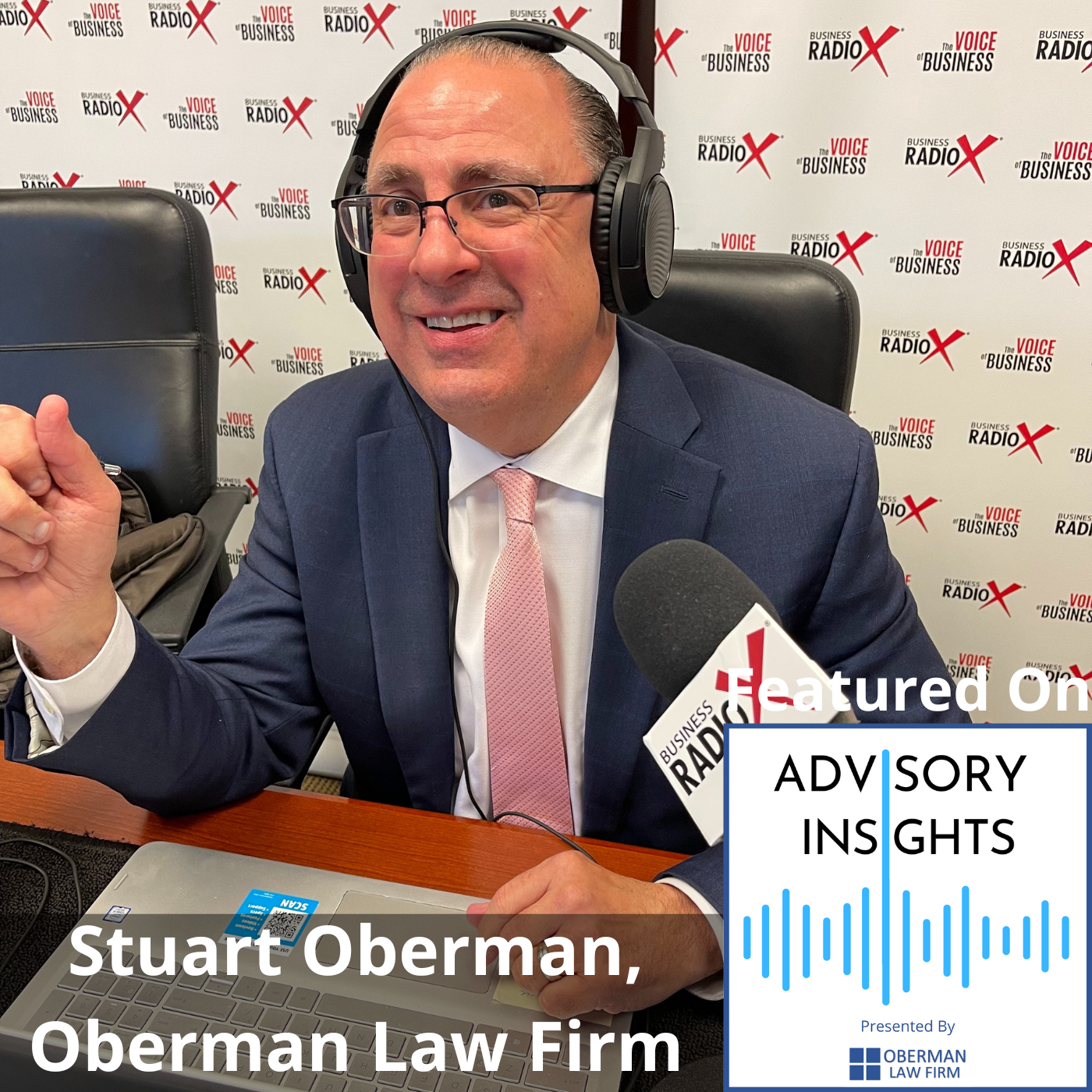
On this edition of “Advisory Insights,” Stuart Oberman discussed new laws and regulatory changes which could affect your employment practices. He covered the rise in prosecutions for not tracking and paying overtime wages due to employees, differences in state laws which can trip up multi-state employers, privacy breaches, and more.

Advisory Insights is presented by Oberman Law Firm and produced by the North Fulton studio of Business RadioX®. The series can be found on all the major podcast apps. You can find the complete show archive here.


About Advisory Insights Podcast

Presented by Oberman Law Firm, Advisory Insights Podcast covers legal, business, HR, and other topics of vital concern to healthcare practices and other business owners. This show series can be found here as well as on all the major podcast apps.

Stuart Oberman, Oberman Law Firm

Oberman Law Firm
Stuart Oberman, Founder, Oberman Law Firm

Stuart Oberman is the founder and President of Oberman Law Firm. Mr. Oberman graduated from Urbana University and received his law degree from John Marshall Law School. Mr. Oberman has been practicing law for over 25 years, and before going into private practice, Mr. Oberman was in-house counsel for a Fortune 500 Company. Mr. Oberman is widely regarded as the go-to attorney in the area of Dental Law, which includes DSO formation, corporate business structures, mergers and acquisitions, regulatory compliance, advertising regulations, HIPAA, Compliance, and employment law regulations that affect dental practices.

In addition, Mr. Oberman’s expertise in the healthcare industry includes advising clients in the complex regulatory landscape as it relates to telehealth and telemedicine, including compliance of corporate structures, third-party reimbursement, contract negotiations, technology, health care fraud, and abuse law (Anti-Kickback Statute and the State Law), professional liability risk management, federal and state regulations.

As the long-term care industry evolves, Mr. Oberman has the knowledge and experience to guide clients in the long-term care sector with respect to corporate and regulatory matters, assisted living facilities, continuing care retirement communities (CCRCs). In addition, Mr. Oberman’s practice also focuses on health care facility acquisitions and other changes of ownership, as well as related licensure and Medicare/Medicaid certification matters, CCRC registrations, long-term care/skilled nursing facility management, operating agreements, assisted living licensure matters, and health care joint ventures.

In addition to his expertise in the health care industry, Mr. Oberman has a nationwide practice that focuses on all facets of contractual disputes, including corporate governance, fiduciary duty, trade secrets, unfair competition, covenants not to compete, trademark and copyright infringement, fraud, and deceptive trade practices, and other business-related matters. Mr. Oberman also represents clients throughout the United States in a wide range of practice areas, including mergers & acquisitions, partnership agreements, commercial real estate, entity formation, employment law, commercial leasing, intellectual property, and HIPAA/OSHA compliance.

Mr. Oberman is a national lecturer and has published articles in the U.S. and Canada.

LinkedIn

Oberman Law Firm

Oberman Law Firm has a long history of civic service, noted national, regional, and local clients, and stands among the Southeast’s eminent and fast-growing full-service law firms. Oberman Law Firm’s areas of practice include Business Planning, Commercial & Technology Transactions, Corporate, Employment & Labor, Estate Planning, Health Care, Intellectual Property, Litigation, Privacy & Data Security, and Real Estate.

By meeting their client’s goals and becoming a trusted partner and advocate for our clients, their attorneys are recognized as legal go-getters who provide value-added service. Their attorneys understand that in a rapidly changing legal market, clients have new expectations, constantly evolving choices, and operate in an environment of heightened reputational and commercial risk.

Oberman Law Firm’s strength is its ability to solve complex legal problems by collaborating across borders and practice areas.

Connect with Oberman Law Firm:

Company website | LinkedIn | Twitter
 

Tagged With: dental law, employment practices, Oberman Law, Oberman Law Firm, overtime, privacy breaches, regulatory changes, Stuart Oberman

Harassment in the Workplace

August 5, 2022 by John Ray

Harassment in the Workplace
Advisory Insights Podcast
Harassment in the Workplace
Loading
00:00 /
RSS Feed
Share
Link
Embed

Download file

Harassment in the WorkplaceHarassment in the Workplace (Advisory Insights Podcast, Episode 3)

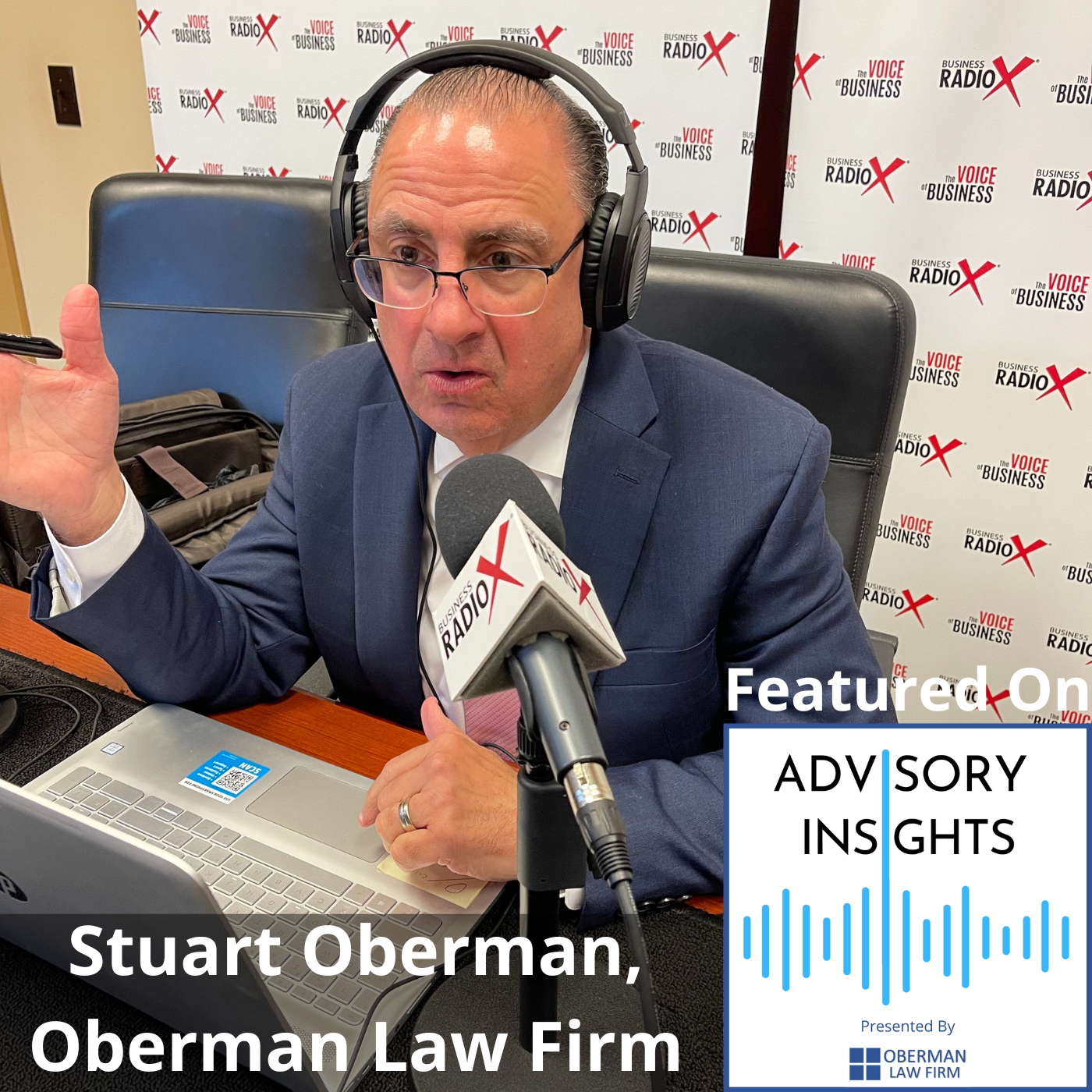
Harassment in the workplace, says Oberman Law Firm founder Stuart Oberman, is an enormous problem, from the largest to the smallest businesses. On this episode of Advisory Insights, Stuart discussed reporting of workplace harassment, prohibited conduct, romance in the workplace, and more.

Advisory Insights is presented by Oberman Law Firm and produced by the North Fulton studio of Business RadioX®. The series can be found on all the major podcast apps. You can find the complete show archive here.


About Advisory Insights Podcast

Presented by Oberman Law Firm, Advisory Insights Podcast covers legal, business, HR, and other topics of vital concern to healthcare practices and other business owners. This show series can be found here as well as on all the major podcast apps.

Stuart Oberman, Oberman Law Firm

Oberman Law Firm
Stuart Oberman, Founder, Oberman Law Firm

Stuart Oberman is the founder and President of Oberman Law Firm. Mr. Oberman graduated from Urbana University and received his law degree from John Marshall Law School. Mr. Oberman has been practicing law for over 25 years, and before going into private practice, Mr. Oberman was in-house counsel for a Fortune 500 Company. Mr. Oberman is widely regarded as the go-to attorney in the area of Dental Law, which includes DSO formation, corporate business structures, mergers and acquisitions, regulatory compliance, advertising regulations, HIPAA, Compliance, and employment law regulations that affect dental practices.

In addition, Mr. Oberman’s expertise in the healthcare industry includes advising clients in the complex regulatory landscape as it relates to telehealth and telemedicine, including compliance of corporate structures, third-party reimbursement, contract negotiations, technology, health care fraud, and abuse law (Anti-Kickback Statute and the State Law), professional liability risk management, federal and state regulations.

As the long-term care industry evolves, Mr. Oberman has the knowledge and experience to guide clients in the long-term care sector with respect to corporate and regulatory matters, assisted living facilities, continuing care retirement communities (CCRCs). In addition, Mr. Oberman’s practice also focuses on health care facility acquisitions and other changes of ownership, as well as related licensure and Medicare/Medicaid certification matters, CCRC registrations, long-term care/skilled nursing facility management, operating agreements, assisted living licensure matters, and health care joint ventures.

In addition to his expertise in the health care industry, Mr. Oberman has a nationwide practice that focuses on all facets of contractual disputes, including corporate governance, fiduciary duty, trade secrets, unfair competition, covenants not to compete, trademark and copyright infringement, fraud, and deceptive trade practices, and other business-related matters. Mr. Oberman also represents clients throughout the United States in a wide range of practice areas, including mergers & acquisitions, partnership agreements, commercial real estate, entity formation, employment law, commercial leasing, intellectual property, and HIPAA/OSHA compliance.

Mr. Oberman is a national lecturer and has published articles in the U.S. and Canada.

LinkedIn

Oberman Law Firm

Oberman Law Firm has a long history of civic service, noted national, regional, and local clients, and stands among the Southeast’s eminent and fast-growing full-service law firms. Oberman Law Firm’s areas of practice include Business Planning, Commercial & Technology Transactions, Corporate, Employment & Labor, Estate Planning, Health Care, Intellectual Property, Litigation, Privacy & Data Security, and Real Estate.

By meeting their client’s goals and becoming a trusted partner and advocate for our clients, their attorneys are recognized as legal go-getters who provide value-added service. Their attorneys understand that in a rapidly changing legal market, clients have new expectations, constantly evolving choices, and operate in an environment of heightened reputational and commercial risk.

Oberman Law Firm’s strength is its ability to solve complex legal problems by collaborating across borders and practice areas.

Connect with Oberman Law Firm:

Company website | LinkedIn | Twitter
Tagged With: harassment in the workplace, Oberman Law, Oberman Law Firm, prohibited conduct, sexual harassment, Stuart Oberman, workplace harassment

Dental Law Radio Rebrands and Relaunches as Advisory Insights Podcast

August 1, 2022 by John Ray

Dental Law Radio Rebrands and Relaunches as the Advisory Insights Podcast
Dental Law Radio
Dental Law Radio Rebrands and Relaunches as Advisory Insights Podcast
Loading
00:00 /
RSS Feed
Share
Link
Embed

Download file

Dental Law Radio Rebrands and Relaunches as the Advisory Insights Podcast

Dental Law Radio Rebrands and Relaunches as Advisory Insights Podcast (Dental Law Radio, Episode 32)

Over the past year, Oberman Law Firm has grown significantly, adding attorneys with various areas of expertise which extend well beyond the firm’s highly regarded and well-known work with dental practices. Consequently, the firm is rebranding and relaunching Dental Law Radio as Advisory Insights Podcast. Advisory Insights will cover the same legal, business, HR, and other topics addressed in Dental Law Radio, and will do so aimed at other healthcare practices and business owners as well.

Advisory Insights is underwritten and presented by Oberman Law Firm and produced by the North Fulton studio of Business RadioX®. The show series can be found here as well as on all the major podcast apps.


Stuart Oberman, Oberman Law Firm

Oberman Law Firm
Stuart Oberman, host of “Dental Law Radio”

Stuart Oberman is the founder and President of Oberman Law Firm. Mr. Oberman graduated from Urbana University and received his law degree from John Marshall Law School. Mr. Oberman has been practicing law for over 25 years, and before going into private practice, Mr. Oberman was in-house counsel for a Fortune 500 Company. Mr. Oberman is widely regarded as the go-to attorney in the area of Dental Law, which includes DSO formation, corporate business structures, mergers and acquisitions, regulatory compliance, advertising regulations, HIPAA, Compliance, and employment law regulations that affect dental practices.

In addition, Mr. Oberman’s expertise in the health care industry includes advising clients in the complex regulatory landscape as it relates to telehealth and telemedicine, including compliance of corporate structures, third-party reimbursement, contract negotiations, technology, health care fraud and abuse law (Anti-Kickback Statute and the State Law), professional liability risk management, federal and state regulations.

As the long-term care industry evolves, Mr. Oberman has the knowledge and experience to guide clients in the long-term care sector with respect to corporate and regulatory matters, assisted living facilities, continuing care retirement communities (CCRCs). In addition, Mr. Oberman’s practice also focuses on health care facility acquisitions and other changes of ownership, as well as related licensure and Medicare/Medicaid certification matters, CCRC registrations, long-term care/skilled nursing facility management, operating agreements, assisted living licensure matters, and health care joint ventures.

In addition to his expertise in the health care industry, Mr. Oberman has a nationwide practice that focuses on all facets of contractual disputes, including corporate governance, fiduciary duty, trade secrets, unfair competition, covenants not to compete, trademark and copyright infringement, fraud, and deceptive trade practices, and other business-related matters. Mr. Oberman also represents clients throughout the United States in a wide range of practice areas, including mergers & acquisitions, partnership agreements, commercial real estate, entity formation, employment law, commercial leasing, intellectual property, and HIPAA/OSHA compliance.

Mr. Oberman is a national lecturer and has published articles in the U.S. and Canada.

LinkedIn

Oberman Law Firm

Oberman Law Firm has a long history of civic service, noted national, regional, and local clients, and stands among the Southeast’s eminent and fast-growing full-service law firms. Oberman Law Firm’s areas of practice include Business Planning, Commercial & Technology Transactions, Corporate, Employment & Labor, Estate Planning, Health Care, Intellectual Property, Litigation, Privacy & Data Security, and Real Estate.

By meeting their client’s goals and becoming a trusted partner and advocate for our clients, their attorneys are recognized as legal go-getters who provide value-added service. Their attorneys understand that in a rapidly changing legal market, clients have new expectations, constantly evolving choices, and operate in an environment of heightened reputational and commercial risk.

Oberman Law Firm’s strength is its ability to solve complex legal problems by collaborating across borders and practice areas.

Connect with Oberman Law Firm:

Company website | LinkedIn | Twitter


Tagged With: Advisory Insights, Advisory Insights Podcast, dental, Dental Law Radio, dental practices, healthcare practices, HR, Oberman Law Firm, Stuart Oberman

Overview of Potential HR Employer Violations

July 29, 2022 by John Ray

HR Employer Violations
Advisory Insights Podcast
Overview of Potential HR Employer Violations
Loading
00:00 /
RSS Feed
Share
Link
Embed

Download file

Overview of Potential HR Employer Violations (Advisory Insights Podcast, Episode 2)

On this episode of Advisory Insights, Stuart Oberman gave an overview of potential HR employer violations he’s seeing with clients. Several of these violations can prove to be quite costly.

Advisory Insights is presented by Oberman Law Firm and produced by the North Fulton studio of Business RadioX®. The series can be found on all the major podcast apps. You can find the complete show archive here.

TRANSCRIPT

Intro: [00:00:01] Broadcasting from the studios of Business RadioX, it’s time for Advisory Insights. Brought to you by Oberman Law Firm, serving clients nationwide with tailored service and exceptional results. Now, here’s your host.

Stuart Oberman: [00:00:19] Welcome everyone to Advisory Insights Podcast. I am your host, Stuart Oberman.

Stuart Oberman: [00:00:25] Well, you know, for those that know me, I tell you, we do a lot of H.R. as a firm. We see a lot of problems locally, nationally, regionally, globally on H.R. violations. So, I want to talk a little bit about H.R. violations, really an overview of potential H.R. employer violations. That is such a wide area. I mean, we’re talking about employment law. We’re talking about State, Federal regulatory issues. We’re talking about EEOC. And we’re talking about audits. We’re talking about, you know, employee complaints.

Stuart Oberman: [00:00:57] So, what I want to do is to just talk about a couple of things top of mind that can really get you into trouble. And I’ll tell you, we see a lot of these areas of concern that can really, really be avoided. But it’s going to take some soul searching. It’s going to take some drilling down. It’s going to take some hard decisions. Look, you can’t turn a ship around overnight. You’ve got to make small steps.

Stuart Oberman: [00:01:23] And if you do anything on these podcast, it’s take a look at what we’re talking about and apply it to what you have, whether you’re a health care practice, whether you are a startup, whether you are a billion dollar construction company. It doesn’t matter, the same law applies. So, let’s take a look at some of the most common ways that we feel that employers violate the law.

Stuart Oberman: [00:01:47] It this Great Resignation world that we’re in, our employers use prohibited questions during job interviews. You have to be very, very careful. And we’re going to cover this in future podcasts. So, a lot of these areas we’re going to expand upon, but we’re just going to have top of mind issues. Job interviews, questions, are you prepared? The answer is probably not. Are your candidates recording your conversations? You bet they are.

Stuart Oberman: [00:02:21] So, one of the things that we take a look at also is not allowing employees, depending on the size of the business, a lot of ramifications of employees discuss their pay. Now, we’re looking at National Labor Relations Board issues. So, yeah, the National Labor Relations Board, you bet, will apply to small businesses.

Stuart Oberman: [00:02:42] Overtime, one of the biggest, biggest errors that our employers get in trouble with are overtime. And I say this all the time when I speak, when I talk, overtime is a lot of things. You’re working 40 hours a week, so you’re texting your employees after hours. Yeah, that’s overtime. Your emailing your staff, overtime, yeah. You’re calling your office manager, depending on where they’re located at, if they make $100,000 hours or more, they are still subject to overtime. You’ve got to be careful with this. We’re going to take a look at some of the issues coming forward also.

Stuart Oberman: [00:03:17] Huge issue, independent contractor versus employee. The IRS loves these kind of reviews. Key, are you controlling a time, place, and manner? That’s a whole topic for discussion on employee versus independent contractor. It is very tough to win that argument. It is very tough to win an audit on that.

Stuart Oberman: [00:03:37] So, one thing, this great, great social media world that we live in, are you disciplining your employees who are complaining about you – small, medium, large company – on social media? Do you have restrictions? Are you following them on social media? Are you looking for things that they’re saying about you?

Stuart Oberman: [00:04:07] How to prevent also a hostile work environment, and I’m talking about gender neutral. I’m talking about harassment. I’m talking about all forms of harassment, bullying. I can’t believe what some of our clients tell us happens in their employment situations. I’m talking about Title VII violations. I’m talking about sexual orientation issues. I’m talking about gender identity. I’m talking about religion. I’m talking about race, color, national origin. These are all the things that occur on a hostile work environment that are a violation of Federal Law.

Stuart Oberman: [00:04:45] Look, I could probably take any one of these topics and discuss an hour on them. Again, what do we do with Advisory Insights Podcast? What are we doing? We’re taking the high level topics with a 10,000 foot view and are you looking at these particular areas. Six, seven, eight areas, are you looking at them? Again, short, sweet bullet point topics that we could talk an hour on. That’s the goal on Advisory Insights Podcast. That’s what we want to do. We want to take things at a very high level, apply it to what you’re looking at, whether you’re, again, small, startup. Are you looking at these things?

Stuart Oberman: [00:05:24] We’re going to continue talking about these things in greater detail. We’re going to continue talking about what affects our employers on a regional, national, local basis – excuse me – global basis. I want to talk about also some of these things on future podcasts. And, also, don’t forget, we also cover these on our newsletter, Advisory Insights. If you want to get a copy of our newsletter, please let us know.

Stuart Oberman: [00:05:49] Folks, thank you very much for joining us on our Advisory Insights Podcast. Please visit us at advisoryinsightspodcast.com. If you want to reach me, please feel free to call the office, 770-886-2400 or visit Oberman Law Firm, obermanlawfirm.com, or send me an email, stuart, S-T-U-A-R-T, @obermanlaw.com.

Stuart Oberman: [00:06:14] Thank you, everyone for listening to us. Keep listening to our podcast. If you have any questions, let me know. Have a fantastic day, everyone. Thank you.

Outro: [00:06:24] Thank you for joining us on Advisory Insights. This show is brought to you by Oberman Law Firm, a business-centric law firm representing local, regional, and national clients in a wide range of practice areas, including health care, mergers and acquisitions, corporate transactions, and regulatory compliance.


About Advisory Insights Podcast

Presented by Oberman Law Firm, Advisory Insights Podcast covers legal, business, HR, and other topics of vital concern to healthcare practices and other business owners. This show series can be found here as well as on all the major podcast apps.

Stuart Oberman, Oberman Law Firm

Oberman Law Firm
Stuart Oberman, Founder, Oberman Law Firm

Stuart Oberman is the founder and President of Oberman Law Firm. Mr. Oberman graduated from Urbana University and received his law degree from John Marshall Law School. Mr. Oberman has been practicing law for over 25 years, and before going into private practice, Mr. Oberman was in-house counsel for a Fortune 500 Company. Mr. Oberman is widely regarded as the go-to attorney in the area of Dental Law, which includes DSO formation, corporate business structures, mergers and acquisitions, regulatory compliance, advertising regulations, HIPAA, Compliance, and employment law regulations that affect dental practices.

In addition, Mr. Oberman’s expertise in the healthcare industry includes advising clients in the complex regulatory landscape as it relates to telehealth and telemedicine, including compliance of corporate structures, third-party reimbursement, contract negotiations, technology, health care fraud, and abuse law (Anti-Kickback Statute and the State Law), professional liability risk management, federal and state regulations.

As the long-term care industry evolves, Mr. Oberman has the knowledge and experience to guide clients in the long-term care sector with respect to corporate and regulatory matters, assisted living facilities, continuing care retirement communities (CCRCs). In addition, Mr. Oberman’s practice also focuses on health care facility acquisitions and other changes of ownership, as well as related licensure and Medicare/Medicaid certification matters, CCRC registrations, long-term care/skilled nursing facility management, operating agreements, assisted living licensure matters, and health care joint ventures.

In addition to his expertise in the health care industry, Mr. Oberman has a nationwide practice that focuses on all facets of contractual disputes, including corporate governance, fiduciary duty, trade secrets, unfair competition, covenants not to compete, trademark and copyright infringement, fraud, and deceptive trade practices, and other business-related matters. Mr. Oberman also represents clients throughout the United States in a wide range of practice areas, including mergers & acquisitions, partnership agreements, commercial real estate, entity formation, employment law, commercial leasing, intellectual property, and HIPAA/OSHA compliance.

Mr. Oberman is a national lecturer and has published articles in the U.S. and Canada.

LinkedIn

Oberman Law Firm

Oberman Law Firm has a long history of civic service, noted national, regional, and local clients, and stands among the Southeast’s eminent and fast-growing full-service law firms. Oberman Law Firm’s areas of practice include Business Planning, Commercial & Technology Transactions, Corporate, Employment & Labor, Estate Planning, Health Care, Intellectual Property, Litigation, Privacy & Data Security, and Real Estate.

By meeting their client’s goals and becoming a trusted partner and advocate for our clients, their attorneys are recognized as legal go-getters who provide value-added service. Their attorneys understand that in a rapidly changing legal market, clients have new expectations, constantly evolving choices, and operate in an environment of heightened reputational and commercial risk.

Oberman Law Firm’s strength is its ability to solve complex legal problems by collaborating across borders and practice areas.

Connect with Oberman Law Firm:

Company website | LinkedIn | Twitter
Tagged With: Advisory Insights Podcast, employee, federal violations, HR employer violations, HR violations, Independent Contractor, Oberman Law Firm, overtime, Stuart Oberman

Introduction to the Advisory Insights Podcast

July 29, 2022 by John Ray

Advisory Insights
Advisory Insights Podcast
Introduction to the Advisory Insights Podcast
Loading
00:00 /
RSS Feed
Share
Link
Embed

Download file

Advisory Insights

Introduction to the Advisory Insights Podcast

In this introductory episode of the Advisory Insights Podcast, Stuart Oberman welcomed listeners to this new podcast featuring legal, business, HR, and other topics of vital concern to healthcare practices and other business owners. (Advisory Insights is the successor show to Dental Law Radio.) He went on to cover an extensive list of essential topics to be included in employee manuals and guidelines and more.

TRANSCRIPT

Intro: [00:00:01] Broadcasting from the studios of Business RadioX, it’s time for Advisory Insights. Brought to you by Oberman Law Firm, serving clients nationwide with tailored service and exceptional results. Now, here’s your host.

Stuart Oberman : [00:00:19] Hello everyone, and welcome to Advisory Insights Podcast. Well, first, I’d like to welcome our dental clients who followed us over to dentallawradio.com, and also our new listeners. I could not be more excited about what we’re doing with Advisory Insights Podcast.

Stuart Oberman : [00:00:36] We had a platform previously, and we discovered that we are getting national exposure on our platforms, what we said before. So, we took a little bit of a break and we decided, You know what? We’re going to take what you can use, no matter whether you are a health care practice or global company. We’re going to keep things simple. We’re going to keep it basic. And what our clients need to know on a day-to-day basis on how to stay, hopefully, out of trouble.

Stuart Oberman : [00:01:04] And we’d like to thank North Fulton Business Radio and Business RadioX for hosting us. But we’re going to start gearing this thing up pretty hard.

Stuart Oberman : [00:01:13] So, what are we going to talk about today? Well, let me just tell you this. In this great world that we live in of the Great Resignation, H.R. is a headache, there’s no doubt about it. So, I’ve been talking for a while on employee manuals and guidelines. I want to start off on a couple of things that, again, no matter what size you are, you need to take a look at this.

Stuart Oberman : [00:01:31] First and foremost, I don’t care if you have $1,000,000 a year on revenue or $50 billion, you need to look at your H.R. annually. You have to take a look at what the company culture is, what the headcount is, what are your benefits, are your renewals up. And in today’s world, I’ve been stressing for a long, long time, look, employee manuals will either make you or break you, and are just no longer an option.

Stuart Oberman : [00:01:56] And we had a really, really great podcast with SHRM Atlanta. For those of you that don’t know what SHRM Atlanta is, it’s an unbelievable organization. And we get a lot of information from those guys on a regular basis. And it’s employee manuals. It’s H.R. It’s a lot of internal information.

Stuart Oberman : [00:02:21] But I want to tell you something, what is no longer an option, you’ve got to know State and Federal law. You’ve got to know about EEOC. You’ve got to know about National Labor Relations Board. You have to know the Age Discrimination and Employment Act of 1967. You’ve got to know Title VII of the Civil Rights Act 1964. You have to know the Equal Pay Act of 1963. You got to know the Worker’s Adjustment and Retraining Notification Act. You’ve got to know Sections 1981 and 1983 of the Civil Rights Act. You’ve got to know the American Disabilities Act. You’ve got to know the Family for Medical Leave Act. You’ve got to know the Employees Retirement Income Security Act. You have to know the Old Benefits Protection Act. You have to know the Age Discrimination Act of 1967.

Stuart Oberman : [00:03:04] How in the world are you going to run a business if you don’t know what those things are? Those have got to be in your manual. There’s no longer an option. If you don’t know any of those, if you don’t know a lot of those, or you don’t know really all of those, you need to figure out what you’re doing. You need to look internally at what you’re doing.

Stuart Oberman : [00:03:20] And failure to plan, I can’t tell you how many clients we have that are global, local, regional, and national that have no idea what I’m talking about. And that’s extremely dangerous. Not only is it costly, it’s a nightmare. So, a couple of provisions are really no longer an option. Really, again, drilling it down, What do you need? What do you need?

Stuart Oberman : [00:03:45] You know, first and foremost, in your employee manuals, you’ve got to have the at-will statements, you have the disclaimers, you’ve got to have the EEOC statement, you’ve got to have the anti-harassment issues. You’ve got to have the wage and salary, leave of absence, drug testing, social media policies. You’ve got to have the non-solicitation employment acknowledgment manual. How many employers out there have given their employee manuals to people, documents, and have no signatures acknowledging if it’s not in writing, it never happened. I’ll just telling you that right now.

Stuart Oberman : [00:04:15] You know, do you have your Family and Medical Leave Act policies? Do you have a non-gender discrimination salary ranges? When is the last time you’ve thoroughly evaluated your salaries ranges gender neutral. If they are not gender neutral, you are in a world of hurt. Are we looking at nondiscrimination in dress codes now? Are we looking at tattoo issues? Are we looking at age inquiries of prospective employees? Age inquiries, that’s a no, no. We’re going to cover that in probably our future podcasts. Holiday pay, voting time, Education Assistance Program.

Stuart Oberman : [00:04:58] Look, I know I ran through this so, so fast. I could probably spend 40 minutes on each topic that I ran through on the employee manual requirements, on employee guideline requirements. Here’s the key, again, what we’ve done on a local level, regional, national level, global level, again, whether you are a small health care provider or whether you’re a building company, these are the basics you’ve got to know. We have clients that have no H.R. client, but they’re doing a half-a-billion dollars a year. I don’t really understand that.

Stuart Oberman : [00:05:33] So, look, if you just took one thing away, it is you’ve got to know these things. If you have any questions, let us know. Hopefully, by listening to the podcast, again, we ran through a lot of information. I could talk, you know, an hour on each topic that we talked about. The key is evaluate, evaluate, evaluate.

Stuart Oberman : [00:05:50] And these are the kind of things we want to bring to you on a very, very scaled down basis on advisorypodcast.com. And we’re going to continue to do this and we’re going to continue to broadcast to our constituents, to our clients, to our friends in the industry, whether it’s health care, whether it’s general business that these are things you have to know.

Stuart Oberman : [00:06:11] Well, that is going to be our first episode of advisoryinsightspodcast.com Thank you everyone for joining us. If you have any questions, please feel free to reach out to us at 770-886-2400 or visit us at obermanlaw.com, or, in this great world that we live in, email. Please feel free to email at stuart, S-T-U-A-R-T, @obermanlaw.com.

Stuart Oberman : [00:06:37] Thank you, everyone, and we appreciate your attendance in today’s podcast. And we look forward to jumping on some more hot topics. Have a great day, everyone. Thank you.

Outro: [00:06:49] Thank you for joining us on Advisory Insights. This show is brought to you by Oberman Law Firm, a business-centric law firm representing local, regional, and national clients in a wide range of practice areas, including health care, mergers and acquisitions, corporate transactions, and regulatory compliance.

About Advisory Insights

Advisory Insights is presented by Oberman Law Firm and produced by the North Fulton studio of Business RadioX®. The series can be found on all the major podcast apps. You can find the complete show archive here.

Stuart Oberman, Oberman Law Firm

Oberman Law Firm
Stuart Oberman, Founder, Oberman Law Firm

Stuart Oberman is the founder and President of Oberman Law Firm. Mr. Oberman graduated from Urbana University and received his law degree from John Marshall Law School. Mr. Oberman has been practicing law for over 25 years, and before going into private practice, Mr. Oberman was in-house counsel for a Fortune 500 Company. Mr. Oberman is widely regarded as the go-to attorney in the area of Dental Law, which includes DSO formation, corporate business structures, mergers and acquisitions, regulatory compliance, advertising regulations, HIPAA, Compliance, and employment law regulations that affect dental practices.

In addition, Mr. Oberman’s expertise in the healthcare industry includes advising clients in the complex regulatory landscape as it relates to telehealth and telemedicine, including compliance of corporate structures, third-party reimbursement, contract negotiations, technology, health care fraud, and abuse law (Anti-Kickback Statute and the State Law), professional liability risk management, federal and state regulations.

As the long-term care industry evolves, Mr. Oberman has the knowledge and experience to guide clients in the long-term care sector with respect to corporate and regulatory matters, assisted living facilities, continuing care retirement communities (CCRCs). In addition, Mr. Oberman’s practice also focuses on health care facility acquisitions and other changes of ownership, as well as related licensure and Medicare/Medicaid certification matters, CCRC registrations, long-term care/skilled nursing facility management, operating agreements, assisted living licensure matters, and health care joint ventures.

In addition to his expertise in the health care industry, Mr. Oberman has a nationwide practice that focuses on all facets of contractual disputes, including corporate governance, fiduciary duty, trade secrets, unfair competition, covenants not to compete, trademark and copyright infringement, fraud, and deceptive trade practices, and other business-related matters. Mr. Oberman also represents clients throughout the United States in a wide range of practice areas, including mergers & acquisitions, partnership agreements, commercial real estate, entity formation, employment law, commercial leasing, intellectual property, and HIPAA/OSHA compliance.

Mr. Oberman is a national lecturer and has published articles in the U.S. and Canada.

LinkedIn

Oberman Law Firm

Oberman Law Firm has a long history of civic service, noted national, regional, and local clients, and stands among the Southeast’s eminent and fast-growing full-service law firms. Oberman Law Firm’s areas of practice include Business Planning, Commercial & Technology Transactions, Corporate, Employment & Labor, Estate Planning, Health Care, Intellectual Property, Litigation, Privacy & Data Security, and Real Estate.

By meeting their client’s goals and becoming a trusted partner and advocate for our clients, their attorneys are recognized as legal go-getters who provide value-added service. Their attorneys understand that in a rapidly changing legal market, clients have new expectations, constantly evolving choices, and operate in an environment of heightened reputational and commercial risk.

Oberman Law Firm’s strength is its ability to solve complex legal problems by collaborating across borders and practice areas.

Connect with Oberman Law Firm:

Company website | LinkedIn | Twitter
Tagged With: Advisory Insights Podcast, Dental Law Radio, employee law, Employee Manual, HR, Oberman Law Firm, SHRM Atlanta, Stuart Oberman

Stuart Oberman, Oberman Law Firm and the Advisory Insights Podcast

July 26, 2022 by John Ray

Advisory Insights
Advisory Insights Podcast
Stuart Oberman, Oberman Law Firm and the Advisory Insights Podcast
Loading
00:00 /
RSS Feed
Share
Link
Embed

Download file

Advisory Insights

Stuart Oberman, Oberman Law Firm and the Advisory Insights Podcast (North Fulton Business Radio, Episode 477)

Over the past year, Oberman Law Firm has grown significantly, adding attorneys with various areas of expertise which extend well beyond the firm’s highly regarded and well-known work with dental practices. Stuart Oberman joined host John Ray to discuss this growth, the firm’s work with other healthcare practices and even international clients, and the rebranding and relaunch of Dental Law Radio into the Advisory Insights Podcast.

North Fulton Business Radio is broadcast from the North Fulton studio of Business RadioX® inside Renasant Bank in Alpharetta.

Oberman Law Firm

Oberman Law Firm has a long history of civic service, noted national, regional, and local clients, and stands among the Southeast’s eminent and fast-growing full-service law firms. Oberman Law Firm’s areas of practice include Business Planning, Commercial & Technology Transactions, Corporate, Employment & Labor, Estate Planning, Health Care, Intellectual Property, Litigation, Privacy & Data Security, and Real Estate.

By meeting their client’s goals and becoming a trusted partner and advocate for our clients, their attorneys are recognized as legal go-getters who provide value-added service. Their attorneys understand that in a rapidly changing legal market, clients have new expectations, constantly evolving choices, and operate in an environment of heightened reputational and commercial risk.

Oberman Law Firm’s strength is its ability to solve complex legal problems by collaborating across borders and practice areas.

Company website | LinkedIn | Facebook | Twitter

Stuart Oberman, Founder and President, Oberman Law Firm

Oberman Law Firm
Stuart Oberman, Founder and President, Oberman Law Firm

Stuart J. Oberman is the founder and President of Oberman Law Firm. Mr. Oberman graduated from Urbana University and received his law degree from John Marshall Law School. Mr. Oberman has been practicing law for over 25 years, and before going into private practice, Mr. Oberman was in-house counsel for a Fortune 500 Company.

Mr. Oberman is widely regarded as the go-to attorney in the area of Dental Law, which includes DSO formation, corporate business structures, mergers and acquisitions, regulatory compliance, advertising regulations, HIPAA, Compliance, and employment law regulations that affect dental practices.

In addition, Mr. Oberman’s expertise in the healthcare industry includes advising clients in the complex regulatory landscape as it relates to telehealth and telemedicine, including compliance of corporate structures, third-party reimbursement, contract negotiations, technology, health care fraud, and abuse law (Anti-Kickback Statute and the State Law), professional liability risk management, federal and state regulations.

As the long-term care industry evolves, Mr. Oberman has the knowledge and experience to guide clients in the long-term care sector with respect to corporate and regulatory matters, assisted living facilities, and continuing care retirement communities (CCRCs). In addition, Mr. Oberman’s practice also focuses on health care facility acquisitions and other changes of ownership, as well as related licensure and Medicare/Medicaid certification matters, CCRC registrations, long-term care/skilled nursing facility management, operating agreements, assisted living licensure matters, and health care joint ventures.

In addition to his expertise in the health care industry, Mr. Oberman has a nationwide practice that focuses on all facets of contractual disputes, including corporate governance, fiduciary duty, trade secrets, unfair competition, covenants not to compete, trademark and copyright infringement, fraud and deceptive trade practices, and other business-related matters.

Mr. Oberman also represents clients throughout the U.S. in a wide range of practice areas, including mergers & acquisitions, partnership agreements, commercial real estate, entity formation, employment law, commercial leasing, intellectual property, and HIPAA/OSHA compliance.

Mr. Oberman is a national lecturer and has published articles in the U.S. and Canada. In addition, Mr. Oberman has received the Martindale-Hubbell Client Distinction Award, which is based on client review ratings of communications ability, responsiveness, and quality of service.

LinkedIn

Questions and Topics in this Interview:

  • What is new at Oberman Law Firm?
  • How has the firm expanded?
  • Tell us about your new podcast, Advisory Insights Podcast
  • The Advisory Insights newsletter

North Fulton Business Radio is hosted by John Ray and broadcast and produced from the North Fulton studio of Business RadioX® inside Renasant Bank in Alpharetta. You can find the full archive of shows by following this link. The show is available on all the major podcast apps, including Apple Podcasts, Spotify, Google, Amazon, iHeart Radio, Stitcher, TuneIn, and others.

RenasantBank


Renasant Bank has humble roots, starting in 1904 as a $100,000 bank in a Lee County, Mississippi, bakery. Since then, Renasant has grown to become one of the Southeast’s strongest financial institutions with over $13 billion in assets and more than 190 banking, lending, wealth management and financial services offices in Mississippi, Alabama, Tennessee, Georgia and Florida. All of Renasant’s success stems from each of their banker’s commitment to investing in their communities as a way of better understanding the people they serve. At Renasant Bank, they understand you because they work and live alongside you every day.


Special thanks to A&S Culinary Concepts for their support of this edition of North Fulton Business Radio. A&S Culinary Concepts, based in Johns Creek, is an award-winning culinary studio, celebrated for corporate catering, corporate team building, Big Green Egg Boot Camps, and private group events. They also provide oven-ready, cooked-from-scratch meals to go they call “Let Us Cook for You.” To see their menus and events, go to their website or call 678-336-9196.

Tagged With: A&S Culinary Concepts, Advisory Insights, Dental Law Radio, healthcare law, North Fulton Business Radio, Oberman Law Firm, renasant bank, Stuart Oberman

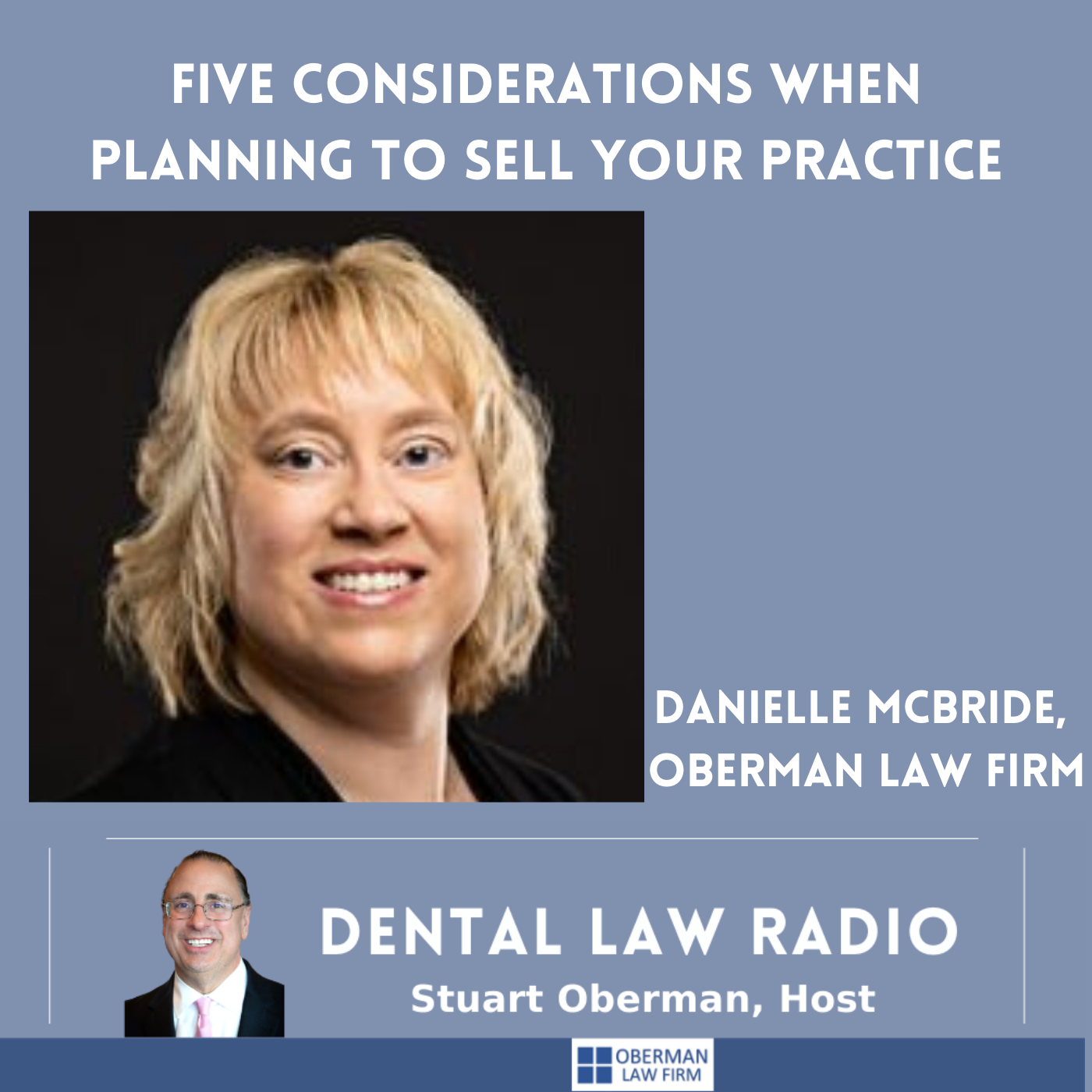
Five Considerations When Planning to Sell Your Practice, with Danielle McBride, Oberman Law Firm

January 21, 2022 by John Ray

Selling a Practice
Dental Law Radio
Five Considerations When Planning to Sell Your Practice, with Danielle McBride, Oberman Law Firm
Loading
00:00 /
RSS Feed
Share
Link
Embed

Download file

Sell a Practice

Five Considerations When Planning to Sell Your Practice, with Danielle McBride, Oberman Law Firm (Dental Law Radio, Episode 31)

Whether your exit plans are near term or down the road, this episode of Dental Law Radio is must listening. Danielle McBride joined host Stuart Oberman to discuss major considerations for any dental practice owner who plans to sell. Preparing for the due diligence a buyer will conduct is particularly vital. Danielle also discussed expenses which negatively impact profitability and therefore valuation, the lease, staffing, patient credits, and much more. Dental Law Radio is underwritten and presented by Oberman Law Firm and produced by the North Fulton studio of Business RadioX®.

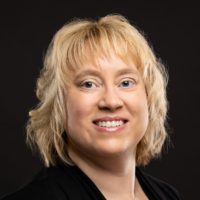
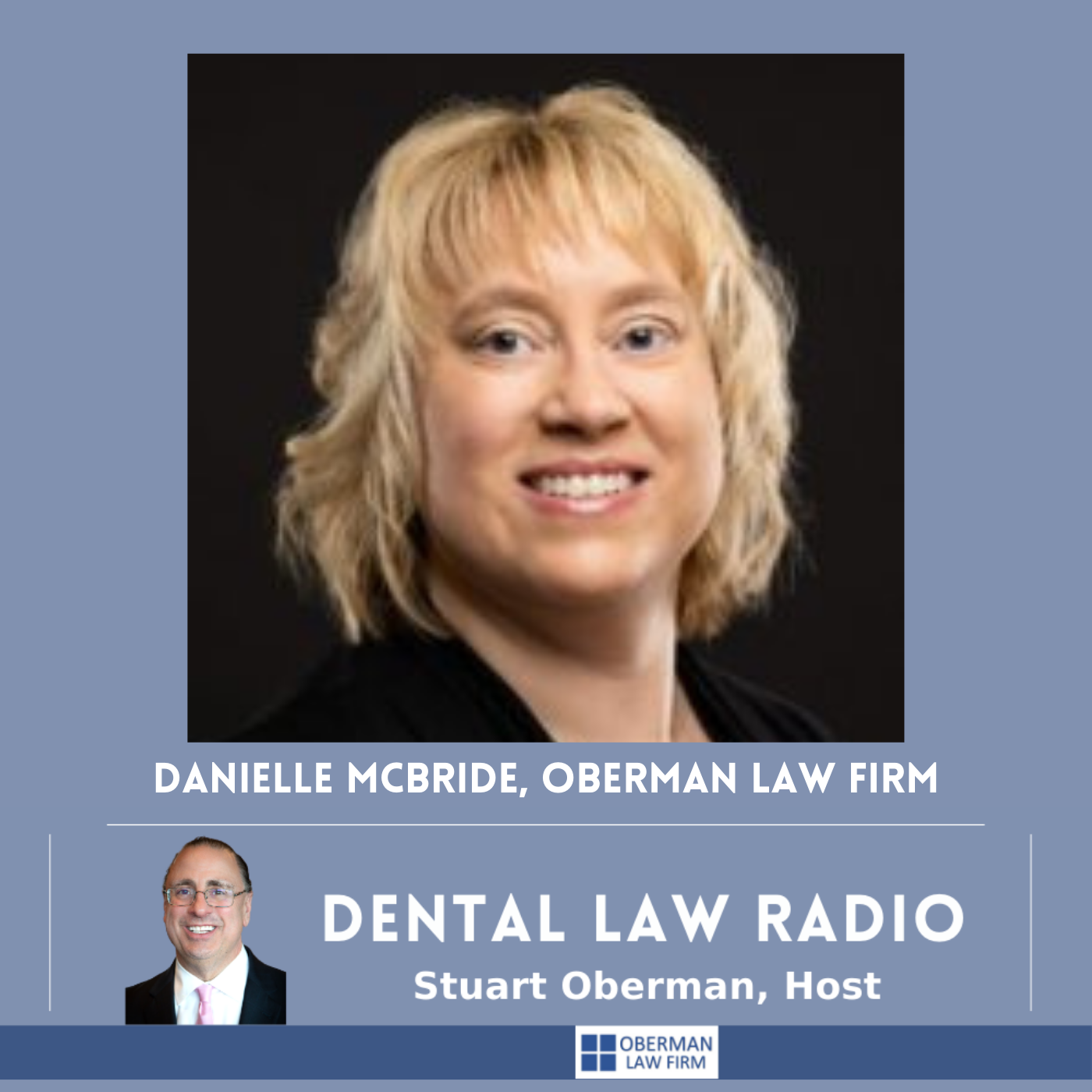
Danielle McBride, Partner, Oberman Law Firm

Danielle McBride
Danielle McBride, Partner, Oberman Law Firm

Danielle McBride has been practicing law for over 21 years, and her primary focus is representing healthcare clients on a local, regional, and national basis. Ms. McBride regularly consults with clients regarding simple to complex healthcare transitions, including mergers and acquisitions, employment law, governmental compliance, tax strategies, practice valuations, DSO formation and structures, employee compensation, associate and partnership contracts, joint ventures, and partnership buy-in/buy-outs.

In addition, Ms. McBride brings a wealth of knowledge and experience preparing practice valuations for clients, as well as formulating simple to complex tax strategies, and entity formations.

Ms. McBride holds a Bachelor of Arts in Sociology/Criminology from The Ohio State University, a Juris Doctor (J.D.) from Ohio Northern University Pettit College of Law, and a Master of Laws (LL.M.) in Taxation from Case Western Reserve University.

LinkedIn

TRANSCRIPT

Intro: [00:00:02] Broadcasting from the Business RadioX studios in Atlanta, it’s time for Dental Law Radio. Dental Law Radio is brought to you by Oberman Law Firm, a leading dental-centric law firm serving dental clients on a local, regional and national basis. Now, here’s your host Stuart Oberman.

Stuart Oberman: [00:00:26] Welcome, ladies and gentlemen, to Dental Law Radio. Unbelievable guest speaker today, unbelievable on the podcast, Danielle McBride, partner in Oberman Law Firm. And little brief background, Danielle’s been practicing for about 21 years. Specialty market is dental law, mergers, acquisitions, tax, compliance. And we’re going to drill down on a couple of things today. I know that Danielle has probably done a couple of hundred transactions, if not thousands, in her illustrious career. And I know she’s going to have a lot of insight into this.

Stuart Oberman: [00:01:00] But I get this question, what do I need to consider when preparing for sale? So, what I want to do is Danielle, I want to leverage some of your experience here and expertise, and I want to run through about five things to consider when preparing your practice, we’re talking to a dentist for sale. So, let’s run through a couple of things. It’s sort of reoccurring theme – our doctors get into trouble, they’re not prepared. Number one, give me a number one. What’s the number one issue we see in preparing for practice sales that are sometimes problematic?

Danielle McBride: [00:01:41] Sure. So, number one is the due diligence in getting that in order. And that means understanding the business and your numbers, cash flow or profitability for the practice, what you sometimes hear in DSO languages, EBITA. And that’s the key to practice valuation and practice transition. You need to know your numbers, your discretionary expenses, those add backs in the practice. You need to take a look at your biggest expenses like staff, supplies, laboratory expenses. Knowing fee increases. What’s your fee schedule? We get questions for fee schedule, and when’s the last time you increased fees on things? And that’s a key thing right now with inflation.

Danielle McBride: [00:02:33] You want to also make sure that you’re not letting those fee increases lapse and not doing something from year to year as well to kind of keep up with things. Marketing, website, social media stuff, patient numbers, active patients, new patients, PPOs and referring doctors if you’re a specialist. All of those are due diligence items that are going to be requested by buyers, whether they’re private parties, individual dentist buyers, or whether they’re DSO transactions. And the DSO transactions, they’re much heavier on the due diligence. They will ask for every piece of paper you could possibly come up with in this transaction.

Stuart Oberman: [00:03:13] Plus.

Danielle McBride: [00:03:14] So, you know. So, getting those things in order ahead is key.

Stuart Oberman: [00:03:20] I got a question. So, profitability and EBITDAs. So, look, our doctors run a lot of stuff through their practice that they shouldn’t, and they get into trouble and it affects their numbers. What are some of the things that you see? Before we jump to number two, what are some of the things that you see doctors running through practices that they really need to clean up to get their numbers in order?

Danielle McBride: [00:03:46] Sure. A lot of it is things like running office expenses and personal expenses through the practice. And so, it’s easy to see.

Stuart Oberman: [00:03:56] That never happens.

Danielle McBride: [00:03:57] Yeah, yeah, never happens. They don’t go to Home Depot and buy toilet paper and paper towels for the office and home. So, a lot of times, they’re running things like that through the practice, and they don’t separate the receipts out. And so, it’s getting lumped into categories like office expenses or promotional expenses, things like sponsoring some of your kids’ events, and you write it off through practice promotion. That’s greedy when a buyer-

Stuart Oberman: [00:04:24] Pay your children, right? How do they pay their children?

Danielle McBride: [00:04:25] What’s that?

Stuart Oberman: [00:04:25] How do they pay their children?

Danielle McBride: [00:04:29] A lot of them pay their children. Put your kids on the payroll. You should be putting them on the payroll as soon as they’re old enough, maybe six or seven years old. Have them reaching the lower filing cabinets or modeling for the website, have them mow the lawn for the practice, and get them IRA contributions.

Stuart Oberman: [00:04:49] That’s good. Wow.

Danielle McBride: [00:04:50] Yeah. So, kids on the payroll. There’s a lot of spouses on the payroll too. And sometimes, they’re paid. Sometimes, they’re underpaid. Sometimes, they’re overpaid. And those are things that go into profitability on the practice as well and you don’t necessarily. Those are the easy things to see. The harder things are when they’re running all this stuff through office expense, and they’re like, “Yeah, yeah, $50,000 of it is just me running personal expenses through.” Well, that’s hard for a buyer to accept that. Okay, well, the profitability is really $100,000 higher than what’s showing up when I’m looking at your typical add backs. Your practice promotion expense – auto, car, meals, travel, continuing ed, staff or family on the payroll, those sort of things, those are all pretty easy to see. It’s the other things that really need cleaned up sometimes because it’s going to be hard to explain to that buyer unless you start showing them all your credit card statements.

Stuart Oberman: [00:05:55] I know you made a best friend out of all of the underpaid spouse managers.

Danielle McBride: [00:06:01] Yeah.

Stuart Oberman: [00:06:02] You just became an absolute cult hero, I can tell you that. Well, that’s good. That’s definitely good stuff that affects the profitability. And we also have seen some audits from state and federal on expenditures that are never good like that. So, give me a number two. Give me a number two on things to consider.

Danielle McBride: [00:06:24] Number two-

Stuart Oberman: [00:06:24] Yeah.

Danielle McBride: [00:06:25] … is the lease. Everyone always forgets about the lease and waits till the last minute. So, if you’re preparing for a transaction, get your lease out. Look at what the terms are, find out if you’ve got to get consent from your landlord to sell, find out what happens if you have a personal guarantee on that lease. If you’re going to assign the lease, if it’s a third-party landlord, make sure that you’ve got under control your lease. You want to make sure that you know what the terms are. If you’re up for a renewal and you’re thinking about selling your practice, there are lots of things that you could try to work into that lease with the landlord to try and prepare for a practice sale. Perhaps even getting something into the lease saying that you don’t need their consent to sell to transition the lease to that buyer if you’re selling your practice. I’ve run across lots of leases over my years with third-party landlords and it can be a real headache. And that is the single biggest reason I get a transaction delayed is that, “Oh my god, we don’t have the lease assignment from the third-party landlord.”

Stuart Oberman: [00:07:40] Now, are you seeing — we’re seeing this a little bit coming west to east? Are you seeing that if – which a landlord does not have to do – end the lease early, that they want a percentage of the sale to do that. We’re seeing some interesting numbers coming through that.

Danielle McBride: [00:08:01] Yeah, I’ve seen some. It has been more of a West Coast issue that I’ve seen this in. Midwest and Northeast, I haven’t seen a lot of that with a percentage of the sales. In New York, I have had a few transactions where we’ve had to try and buy the landlord, and essentially pay them something in order to get a seller out of a lease. But I had a transaction like that.

Stuart Oberman: [00:08:24] That’s called legal bribery.

Danielle McBride: [00:08:25] Yeah. Yeah, it is. The New York leases, they’re a lot of fun, let me tell you.

Stuart Oberman: [00:08:33] Wow! I mean, what usually starts in the West comes East. So, I think we’ll be seeing that eventually. But well, number three. That was a great number two. We had cash flow number one, and lease number two. And what are we looking at, maybe the third issue?

Danielle McBride: [00:08:50] Number three is staffing, goodwill transition, patient retention issues. So, you want to be able to transition the practice well. And some of the key things are not just the doctor transitioning to the new doctor, but also staffing and patient retention. And so, a lot of times, the goodwill transition is a key component. And sometimes, that’s where you see negotiations kind of get a little stuck from time to time. Is it the buyer wants to make sure that the seller and the staff are going to contribute to the transition, and make sure that the patients can be retained, that there’s going to be an introductory letter, or a letter to referral sources if it’s a specialty practice? Introductions maybe with the top 5-10 referral sources. Making sure that the staff is going to stay in the transaction, and that you’re not going to lose, and have a bunch of staff turnover right at the transition date. And now, you’re trying to retain patients, but you’ve got all new faces in there.

Stuart Oberman: [00:09:58] What about associate issues?

Danielle McBride: [00:10:01] Associate issues as well. That’s another key thing in staffing is that if you’ve got an employment agreement or you have associates working in the practice, and you didn’t have an employment agreement with them, and there are no restrictive covenants, your buyers are going to be coming in, and they’re going to be asking for those associates to sign contracts. And if you didn’t have one before, you’ve got nothing to actually assign, which means a new negotiation with that associate and potentially with the buyer. And if they’re a key producer in the practice, especially in these big DSO transactions, they’re offering this money for the transaction based on key production numbers. And if you’ve got an associate that is not going to stay with the practice or that you can’t enforce a covenant not to compete for in order to prevent them from competing with the buyer, then you’re going to have some things you’re going to have to negotiate, and it could really create some problems.

Stuart Oberman: [00:10:57] Now, question for you, when you do your practice evaluations, and you do a great job on that, does the associate not staying affect the value of the practice when you’re asked to evaluate what that practice is worth?

Danielle McBride: [00:11:14] Sometimes. It depends on the circumstances.

Stuart Oberman: [00:11:17] That’s a great legal answer.

Danielle McBride: [00:11:19] Yeah.

Stuart Oberman: [00:11:21] That’s a typical answer, “Well, it depends.”

Danielle McBride: [00:11:23] It really depends on facts and circumstances.

Stuart Oberman: [00:11:24] Yeah.

Danielle McBride: [00:11:24] Yeah. And the key is going to be whether or not the practice can find a replacement and associate easily, or whether or not the practice owner or the other doctors working in the practice are able to pick up that profitability, or to pick up that production from that doctor who’s not going to stay.

Stuart Oberman: [00:11:40] Staff, staff, staff. Wow! Let’s look at the number four. Give me the number four.

Danielle McBride: [00:11:48] Number four, equipment, assets and curb appeal. And a little bit of this is about allocations as well. You’ve got goodwill, and you’ve got tangible assets in the practice. And so, one of the things, if you’re thinking about putting your practice on the market, there are some practices out there that maybe they haven’t updated with newer equipment, or they’ve thought about refreshing their waiting room, or adding a CERAC machine, or adding a major piece of equipment, and they haven’t done it yet.

Stuart Oberman: [00:12:21] Pick it up at 179 deduction, right?

Danielle McBride: [00:12:24] Yeah, you can get the 179 deduction, so you can buy it and you can write it off all in the same year. And in part, it’s a seller problem; in part, it’s a buyer problem. And so, there’s a little bit of a fine line you walk between whether or not you go ahead and make some of those improvements to make the practice more attractive to a buyer, or you say, “I don’t want to invest in a lot of super new technology and go into debt just to be able to make the practice. I’ll take that into account when I value the practice. I’m going to look at what the equipment is and how much it’s valued there. If the practice is not – say they don’t have electronic records, everything still on paper in boxes, and computer systems haven’t been upgraded, there are some minimum requirements for computer systems to be upgraded that most buyers are going to ask.

Danielle McBride: [00:13:21] And so, those are things that are going to go into negotiating the ultimate purchase price that a buyer is going to be willing to pay. Now, some of it, it’s a seller’s problem. Some of it, it’s a buyer’s problem. If you want to be super fancy and buy all the latest and greatest technology, buyer, go ahead. That doesn’t mean I don’t have a practice that’s fully capable of supporting you working in it, and you can make whatever changes you want to make on your dime, but there are some things that a seller might want to do just to make things a little more attractive for a buyer.

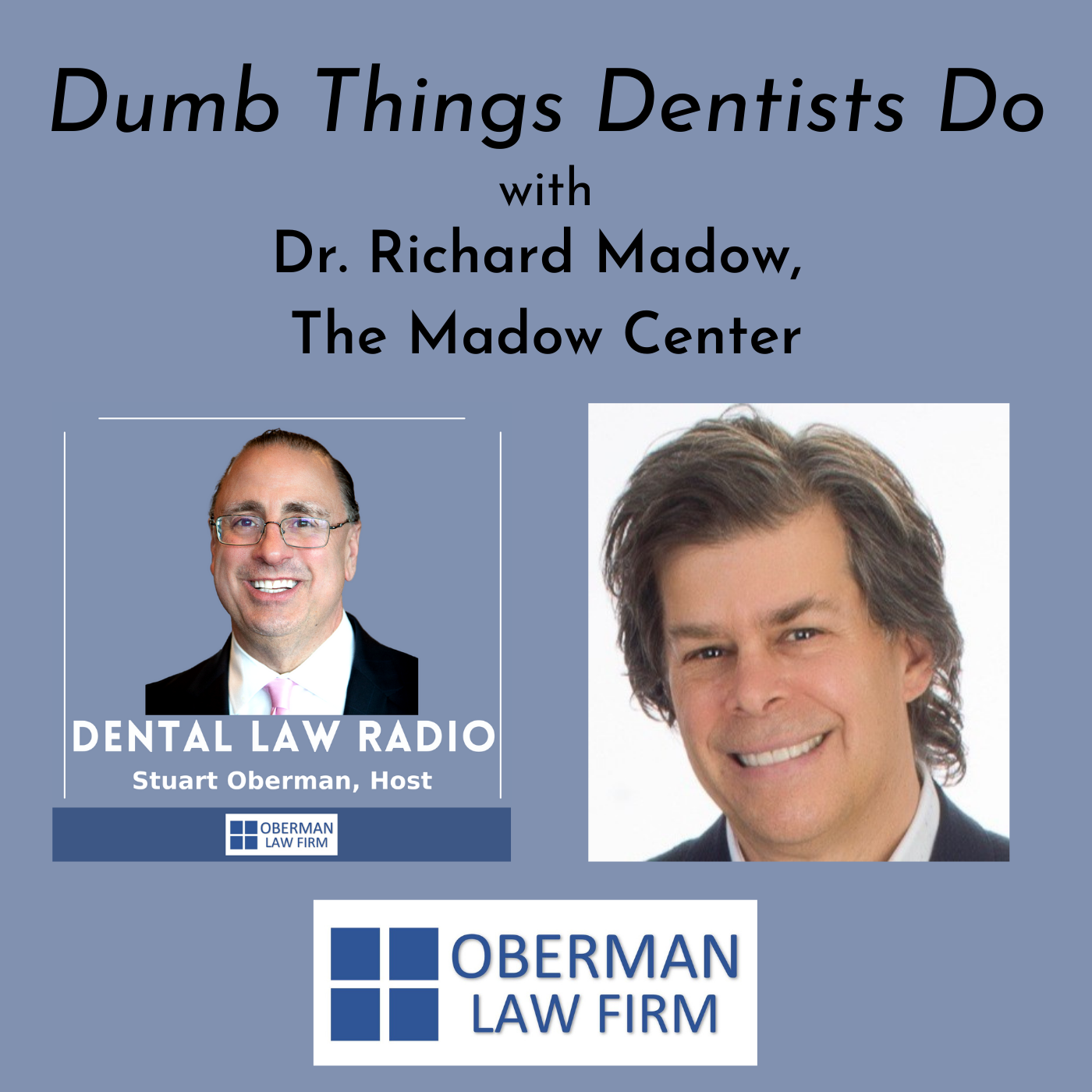
Stuart Oberman: [00:13:53] And then, it’s — yeah. I mean, we had Dr. Richard Madow on a couple of episodes ago. He had a good talk about doctors buying equipment and profitability and doesn’t need that. And that was interesting analogy, and how that just compared to what you said regarding [crosstalk].

Danielle McBride: [00:14:18] Sure. Don’t go into debt to make it-.

Stuart Oberman: [00:14:19] Yeah.

Danielle McBride: [00:14:19] Don’t go into debt to make it appealable-

Stuart Oberman: [00:14:21] That’s a good-

Danielle McBride: [00:14:21] … or attractive to a buyer, but there are some things that you could do, especially if you’re looking at a year or two out from a practice sale and making a few revisions here or there. You can write these things off, 179, depreciation, deductions, bonus depreciation, et cetera, so.

Stuart Oberman: [00:14:40] Yeah, I mean, that is practical, practical advice, which a lot of times, I think doctors are missing from the advisor standpoint. Let’s talk about the last, number five. And this get a little sticky in the contract areas also. It’s, you know-

Danielle McBride: [00:15:01] Yes.

Stuart Oberman: [00:15:01] This is where, sort of, the rubber hits the road. And talk about number five on some of these.

Danielle McBride: [00:15:08] So, number five is my accounts receivable, prepaid accounts, patient credits and treatment in progress.

Stuart Oberman: [00:15:17] Yeah.

Danielle McBride: [00:15:17] Now, there is no one size fits all on any of those. And often, they wait until the last minute to look at these, “Oh, I’ll get you this. Oh, I’ll get you this report. Oh, I’ll look and see,” or they run the report, and they don’t pay attention to it.

Stuart Oberman: [00:15:33] Famous last words.

Danielle McBride: [00:15:35] Yeah. I mean, patient credits, in particular, your accounts receivable aging, you may have things that are sitting on the report if you haven’t cleaned up your collections, if you haven’t cleaned up your patient credits, those are all things that can go into the ultimate purchase price if someone’s going to purchase your accounts receivable and take over the practice. And then, your prepaid accounts. And it can vary based on specialty. Obviously, in orthodontic practices, you’ve got long-term contracts with payments that may have been paid in full, contracts paid in full at the start of treatment but you’ve got a buyer that’s doing — say, you had a bunch of patients pay right before the closing, you got all the money, but the buyer is going to get — seller got all the money, but buyer’s now going to have to do all of the work to finish those patients.

Danielle McBride: [00:16:27] And so, there, oftentimes, has to be some sort of adjustment to price or proration on prepaid contracts. And there can be other specialties as well or even general practices that maybe do some particular restorative type work or something that will have treatment in progress and prepaid treatment that is long-term patient treatment planning, where you’ve got courses of treatment that lasts for multiple appointments over a longer period of time, with maybe episodes of healing required in between, and you’ve got someone who’s got a $10,000 case that’s being paid on a monthly basis because that’s the arrangement they entered into with the doctor there, and their treatment is maybe a quarter of the way done, you’ve got to actually think about those things. And oftentimes, we add exhibits to the contract that will list patient credits, patient refunds having to be made prior to closing, prepaid cases being prorated between buyer and seller.

Stuart Oberman: [00:17:36] Do you have to do-

Danielle McBride: [00:17:36] Thinking of progress list being done.

Stuart Oberman: [00:17:38] Do you have to give special consideration in contracts when you have that seller who’s leaving, and and you’ve got open cases, or what happens if you got a hundred patients come back from faulty work-

Danielle McBride: [00:17:53] Right.

Stuart Oberman: [00:17:53] … what happens with that?

Danielle McBride: [00:17:57] Right. And that’s where we have provisions in our contracts that usually deal with what happens if there’s defective work or rework, and can the buyer — as a seller, you don’t want the buyer to just say, “Well, I have to redo all of this work. And now, you owe me this money,” and it goes on indefinitely. There are time limitations that should be put in their requirements. There are parameters that should be set. And this is all based on the facts and circumstances of the practice. You may have some practices where this isn’t a problem because you don’t have patients that are not paying when they receive their treatment.

Stuart Oberman: [00:18:31] Danielle, great stuff about the patient credits. One thing in redos, one thing I want to do is I want you elaborate a little bit more on the contract side as far as what happens when you’ve got a doctor that maybe is selling sticking around for a year or two. I mean, you mentioned earlier about limits in contracts and redos. Elaborate just a little bit more on that contract provision, what should be on there to limit the seller’s liabilities going forward?

Danielle McBride: [00:19:03] Sure. I mean, the seller should limit the liability going forward based on some parameters for patients. You can’t just have patients who have not been seen in the practice for the last year coming in to have rework done or having the buyer not consult you about rework before they agree to retreat a patient and then charge you for the fee to redo the work on that patient. Sometimes, I see caps or limits set.

Danielle McBride: [00:19:34] I mean, generally speaking, accounts receivable, patient credits, they all should be reviewed and wrapped up in your records. Your accounts receivable and credit should be cleaned up prior to a sale. You want to make sure that you don’t have long outstanding credits there. Maybe there are patients that you don’t even have in the practice any longer. A lot of practices are in the habit of not cleaning those up on an annual basis. So, clean those patient credits up because you’re going to have to pay them off. Generally, a buyer will ask for them to be paid off prior to closing. The DSOs, also, take that into account when they’re factoring in expenses to be paid and credits if they’re going to be assumed. You don’t want to be giving the buyer money that’s never going to come in.

Stuart Oberman: [00:20:26] Yeah. Well, it’s interesting, for 50 DSOs, you’ll have 50 ways of calculating all of this. That’s amazing.

Danielle McBride: [00:20:32] Yes.

Stuart Oberman: [00:20:33] Well, that is five great things to consider when you’re preparing your practice for sale. And all these are, obviously, a moving target. As the transition takes place, I mean, these are just moving targets and just constant adjustments. Well. Danielle, amazing, amazing stuff as always. Just, again, five topics that our doctors just have to consider on any transaction.

Stuart Oberman: [00:21:00] Also, honestly, this can be applied to any business listeners also on what they’re looking at, whether it’s just AR or cash flows, profitability. So, really, everything you’ve talked about today and in previous podcasts, I mean, any business owner really could use. So, amazing stuff.

Stuart Oberman: [00:21:19] Well, great job, Danielle. Thank you very much. And as always, amazing knowledge. And we really enjoyed having you on the podcast today. And I know our listeners did, so. Well, with that, we will call it a day as s we say. If you have any questions, please feel free to give us a call, 770-886-2400. Danielle, how do they get in touch with you if they want to send you an email or request some information?

Danielle McBride: [00:21:47] They can send me an email. They can call the corporate number. They can also send me an email at danielle@obermanlaw.com.

Stuart Oberman: [00:21:55] Good, good. Yeah, number’s 770-886-2400. My name is Stuart Oberman. It is Stuart@obermanlaw.com. Thank you for listening, and we appreciate it, and have a fantastic day.


About Dental Law Radio

Hosted by Stuart Oberman, a nationally recognized authority in dental law, Dental Law Radio covers legal, business, and other operating issues and topics of vital concern to dentists and dental practice owners. The show is produced by the North Fulton studio of Business RadioX® and can be found on all the major podcast apps. The complete show archive is here.

Stuart Oberman, Oberman Law Firm

Stuart Oberman
Stuart Oberman, host of “Dental Law Radio”

Stuart Oberman is the founder and President of Oberman Law Firm. Mr. Oberman graduated from Urbana University and received his law degree from John Marshall Law School. Mr. Oberman has been practicing law for over 25 years, and before going into private practice, Mr. Oberman was in-house counsel for a Fortune 500 Company. Mr. Oberman is widely regarded as the go-to attorney in the area of Dental Law, which includes DSO formation, corporate business structures, mergers and acquisitions, regulatory compliance, advertising regulations, HIPAA, Compliance, and employment law regulations that affect dental practices.

In addition, Mr. Oberman’s expertise in the health care industry includes advising clients in the complex regulatory landscape as it relates to telehealth and telemedicine, including compliance of corporate structures, third-party reimbursement, contract negotiations, technology, health care fraud and abuse law (Anti-Kickback Statute and the State Law), professional liability risk management, federal and state regulations.

As the long-term care industry evolves, Mr. Oberman has the knowledge and experience to guide clients in the long-term care sector with respect to corporate and regulatory matters, assisted living facilities, continuing care retirement communities (CCRCs). In addition, Mr. Oberman’s practice also focuses on health care facility acquisitions and other changes of ownership, as well as related licensure and Medicare/Medicaid certification matters, CCRC registrations, long-term care/skilled nursing facility management, operating agreements, assisted living licensure matters, and health care joint ventures.

In addition to his expertise in the health care industry, Mr. Oberman has a nationwide practice that focuses on all facets of contractual disputes, including corporate governance, fiduciary duty, trade secrets, unfair competition, covenants not to compete, trademark and copyright infringement, fraud, and deceptive trade practices, and other business-related matters. Mr. Oberman also represents clients throughout the United States in a wide range of practice areas, including mergers & acquisitions, partnership agreements, commercial real estate, entity formation, employment law, commercial leasing, intellectual property, and HIPAA/OSHA compliance.

Mr. Oberman is a national lecturer and has published articles in the U.S. and Canada.

LinkedIn

Oberman Law Firm

Oberman Law Firm has a long history of civic service, noted national, regional, and local clients, and stands among the Southeast’s eminent and fast-growing full-service law firms. Oberman Law Firm’s areas of practice include Business Planning, Commercial & Technology Transactions, Corporate, Employment & Labor, Estate Planning, Health Care, Intellectual Property, Litigation, Privacy & Data Security, and Real Estate.

By meeting their client’s goals and becoming a trusted partner and advocate for our clients, their attorneys are recognized as legal go-getters who provide value-added service. Their attorneys understand that in a rapidly changing legal market, clients have new expectations, constantly evolving choices, and operate in an environment of heightened reputational and commercial risk.

Oberman Law Firm’s strength is its ability to solve complex legal problems by collaborating across borders and practice areas.

Connect with Oberman Law Firm:

Company website | LinkedIn | Twitter
Tagged With: Danielle McBride, Dental Practice, dental practices, DSO, Oberman Law Firm, selling a dental practice, Selling a Practice, Stuart Oberman

Keys to a Smooth Practice Transition, with Danielle McBride, Oberman Law Firm

January 7, 2022 by John Ray

Oberman Law Firm
Dental Law Radio
Keys to a Smooth Practice Transition, with Danielle McBride, Oberman Law Firm
Loading
00:00 /
RSS Feed
Share
Link
Embed

Download file

Oberman Law Firm

Keys to a Smooth Practice Transition, with Danielle McBride, Oberman Law Firm (Dental Law Radio, Episode 30)

Danielle McBride, Partner at Oberman Law Firm, talks with host Stuart Oberman about the elements needed for a successful and smooth sale of a dental practice. Danielle discusses ingredients like having the best advisors in the dental industry, detailed financials, quality of earnings, and much more. Dental Law Radio is underwritten and presented by Oberman Law Firm and produced by the North Fulton studio of Business RadioX®.


Danielle McBride, Partner, Oberman Law Firm

Danielle McBride
Danielle McBride, Partner, Oberman Law Firm

Danielle McBride has been practicing law for over 21 years, and her primary focus is representing healthcare clients on a local, regional, and national basis. Ms. McBride regularly consults with clients regarding simple to complex healthcare transitions, including mergers and acquisitions, employment law, governmental compliance, tax strategies, practice valuations, DSO formation and structures, employee compensation, associate and partnership contracts, joint ventures, and partnership buy-in/buy-outs.

In addition, Ms. McBride brings a wealth of knowledge and experience preparing practice valuations for clients, as well as formulating simple to complex tax strategies, and entity formations.

Ms. McBride holds a Bachelor of Arts in Sociology/Criminology from The Ohio State University, a Juris Doctor (J.D.) from Ohio Northern University Pettit College of Law, and a Master of Laws (LL.M.) in Taxation from Case Western Reserve University.

LinkedIn

TRANSCRIPT

Intro: [00:00:02] Broadcasting from the Business RadioX Studios in Atlanta, it’s time for Dental Law Radio. Dental Law Radio is brought to you by Oberman Law Firm, a leading dental-centric law firm serving dental clients on a local, regional, and national basis. Now, here’s your host, Stuart Oberman.

Stuart Oberman: [00:00:26] Welcome everyone to Dental Law Radio. We have a very, very special guest today, Danielle McBride, Partner in Oberman Law Firm. And a little background on Danielle – she’s very busy right now – Danielle has been practicing for 21 years and her primary focus is health care transactions, mergers, acquisitions on a local, regional, and national basis. Big, big in M&A transactions, employment law compliance, tax strategies – as you heard on a previous podcast. And we’re going to have some subsequent podcasts that Danielle is going to join us on – practice valuations, DSO formation. Lord, everything is DSO. Everything is scaling nowadays.

Stuart Oberman: [00:01:13] A little education background on Danielle, she graduated from Ohio Northern University with her law degree. And she has a Masters in Taxation from Case Western University. And we are absolutely delighted to have you in the studio, as we say, Danielle. And I know today you’re going to talk about keys to ensure a smooth practice transition, and you could maybe elaborate on this. It is an amazing market. It is a hot market like I’ve never seen in my years of practicing. Valuations are out the roof. Private equity is throwing money at transactions.

Stuart Oberman: [00:01:58] But there’s a lot of misconceptions about what it takes to have a smooth transition, and I really want to drill down on your expertise. You’ve been doing this for over 21 years, and I want to hear what you have to say and your thoughts all the way from due diligence to leveraging advisors. So, give me your thoughts on some matters regarding what it takes to have a smooth transition, as we say.

Danielle McBride: [00:02:29] Well, thanks, Stuart, for having me on the podcast. And, yeah, this is Keys to a Smooth Practice Transition. I kind of call this my ABCs. A is for advisors. One of the best things that you can do for yourself is to surround yourself with the best advisors you can. And they should be specialized, you know, professionals in this area, in the dental industry.

Danielle McBride: [00:02:57] Leverage your advisors that have the experience in these transactions. I mean, there are dental specific lawyers like us. There are dental accountants. There are dental finance lenders. There are dental brokers. All of these people, all of these advisors have a ton of experience. This may be your one and only transaction, buying a practice or selling a practice or merging going in with a DSO. We’ve done hundreds, if not thousands, of these transactions, these advisors have.

Danielle McBride: [00:03:29] So, you know, it’s important to get those specialized professionals to work with you. And they’re out there. And if you have at least one of those advisors, they can help you find others. If you’re in need of a dental specific lender, if you’re a buyer of a practice, if you’re in need of a dental specific accountant, there are lots of other financial business and consultants that have specialized knowledge in the dental field. And that’s my A, you know, my ABCs.

Danielle McBride: [00:04:04] The second is your business. You’ve got to know your business. And it’s important whether you’re looking to sell to a third party or to a DSO in these transactions. Knowing your business, knowing the numbers, having the data that’s going to be requested through all of the due diligence is going to be one of the most important things that you do in these transactions.

Stuart Oberman: [00:04:25] I got a question for you. I got a question for you. You do valuations. We hear –

Danielle McBride: [00:04:30] Yes. I do practice valuations. And so, one of the keys in those valuations is profitability in the practice transition.

Stuart Oberman: [00:04:37] We hear this all the time, “Know your numbers,” what does that mean? When someone says, “Well, I got to know my numbers.”

Danielle McBride: [00:04:47] Know your numbers.

Stuart Oberman: [00:04:48] What does that mean? I mean, our guys, it doesn’t seem like they understand that a lot of times.

Danielle McBride: [00:04:55] Yeah. So, knowing your numbers means a couple of different things. One is being able to get the data on new patients, and insurance plans, and how much of your practice is PPO plans versus fee for service. Those kind of numbers are important. But the key numbers are profitability.

Danielle McBride: [00:05:17] Or sometimes in these DSO transactions you hear being thrown around EBITDA, E-B-I-T-D-A, Earnings Before Income Taxes, Depreciation, and Amortization. It’s essentially, not just the net income, it’s profitability, it’s the cash flow in the practice. You got to look beyond W-2 compensation or net profit. It’s that plus add back. Discretionary expenses, I like to call them. The perks that the doctor runs through the practice.

Danielle McBride: [00:05:49] It can also be things like family on the payroll, if they’re being paid more or less than what would be fair salary for someone doing the work that they’re doing in the practice. It can also be rent. You know, looking at fair rent and whether you’re paying yourself above or below what fair market rent is on a piece of property or your office building that you also own along with the practice.

Stuart Oberman: [00:06:13] Is your specific profit margin? You hear like, “Well, you should be netting out 20 percent profit or 40 percent profit.” Is there a magic number that’s sort of advisable for those things?

Danielle McBride: [00:06:26] Well, it varies based on the specific type of practice. So, your general dental practice might be running an overhead of 60, 61 percent, 40 percent profitability. And that 40 percent of profitability is your W-2 income, your profit, your discretionary add backs, adjustments for paying yourself high rent on your building, non-recurring expenses, if you hired a consultant to come in one year, those sort of things. It’s going to vary if you’re an oral surgeon or if you’re an orthodontist or a pediatric dentist. There are different percentages for those different specialties.

Stuart Oberman: [00:07:11] Huh? Now, I know we do a lot of DSO transactions as a firm, so if they’re getting ready to sell their practice, how should they prepare due diligence? Should they say, “Hey, Danielle. I’m ready to sell my practice. I know there’s a lot of due diligence on the DSO side. Can you send me a due diligence checklist so I can start preparing for this?” How do they prepare for due diligence, which will wear them out a lot of times?

Danielle McBride: [00:07:42] Yeah. It’s going to wear them out and you’re going to get asked for stuff over and over again.

Stuart Oberman: [00:07:46] The same stuff.

Danielle McBride: [00:07:46] You’re going to send them all of your quarter one, quarter two, quarter three, quarter four financial statements and tax returns. And every insurance provider you take in the practice. Some of the banks even ask for monthly profit and loss statements for the year, especially after COVID.

Danielle McBride: [00:08:13] COVID kind of changed things from a financial perspective. From the lender’s perspective, it used to be that you could get away with sending them the years worth of financial statements and tax returns. And then, we had COVID and then they wanted to see month by month. So, we wanted to see every month of 2019, and every month of 2020, and every month of 2021 so far.

Danielle McBride: [00:08:36] So, having the ability to get at least quarterly financial statements is an important part of the due diligence. And then, they’re just going to ask you for every business insurance, every business license, every license for every staff member and doctor in the office. They’re going to ask for balance sheets.

Danielle McBride: [00:08:56] And if there are liens on the practice, which is often one thing that people forget. So, if you had an SBA loan, for instance – a lot of people had this. I just had this with a transaction – SBA EIDL Loans, you can pay those off. My client actually got an email from the SBA saying, “This is your authorization to file a UCC termination on the lien that we have on your practice.” And we needed to get that termination statement filed to clear it for the lender so that the buyer’s lender would actually fund the transaction. So, there are things like that.

Stuart Oberman: [00:09:36] Do you see a lot of PPP problems right now? Loans are not being authorized to pay back and items are being withheld on the transaction?

Danielle McBride: [00:09:48] I did earlier in the year. So many of the PPP loans have finally gotten forgiven. That that problem has started to get a little bit easier to deal with. Usually, it’s some document references on the PPP loans and that it’s been forgiven and some sort of proof to the lenders or the buyer that it’s actually been forgiven.

Danielle McBride: [00:10:12] But I did have to do a lot of escrows. And back in 2021, I first started doing transactions again after COVID opened back up and the lenders started lending again. I was having to escrow funds for PPP because the guidance came out from the IRS saying that you had to escrow the amount of the PPP loan with the bank. And the banks were like, “We don’t know how to do this.” So, you know, I was actually escrowing funds into attorney escrow accounts and holding it because the bank wasn’t prepared to do it.

Stuart Oberman: [00:10:44] Wow. So, do you recommend from an expedient standpoint smooth transaction that we have sort of a due diligence checklist, whether it’s us or whomever, provide that due diligence checklist information to whoever the adviser is and then put that information – we’ll call it a data room? And then, this way the seller or the buyer can get in there and start plucking that information. Is that something that you thought?

Danielle McBride: [00:11:16] A lot of times, if you’re working with these bigger DSOs, they will do exactly that. They’ll have some sort of service where you’re uploading your documents and they will have a checklist that they have to go through. Because a lot of the private equity lenders, they’ve got checklists and they want to see each and every one of those items checked off before they will give the green light to fund the transaction.

Stuart Oberman: [00:11:36] Now, some of these bigger deals, we hear the term quality of earnings. Quality of earnings, what does that mean? Because a lot of the buyers on the corporate side will spend a lot of money on quality of earnings. Our doctors, I don’t think, really understand what that means and how that affects their practice.

Danielle McBride: [00:11:58] Well, I think the quality of earnings is really going back to the profitability in the EBITDA of the practice and the better the cash flow is. It’s sort of like when you hear the old adage, “Okay. Well, what is my practice worth as a percentage of collections?” And everybody says, “Oh, it should be 75 percent of collections or 65 percent of collections.” Well, that’s great.

Danielle McBride: [00:12:19] But if you have two $1 million practices and one has a 65 percent overhead and the other one has a 50 percent overhead, they’re both not worth 65 percent of gross revenues. One has a better quality of earnings. One has a better cash flow. One has higher profitability. And the practice is going to support that buyer and provide a higher profit ratio for that buyer, that DSO, that corporate purchaser.

Danielle McBride: [00:12:53] And especially for a private party, too, I mean, that’s what you want to look for, a practice that has a better cash flow, higher profitability. And you can clearly see that in the tax returns. That’s another thing, too, that a lot of sellers have to think about this. A lot of them have been aggressive with their deductions, but they’ve also maybe been a little lax about putting the documentation together and being clear on that. And so, sometimes when you get a practice like that where they’re just running a ton of things through the practice, you got to sometimes do a little bit clean up because the buyer is going to ask those questions and they’re going to want to see, “Well, where is the cash flow?”

Stuart Oberman: [00:13:30] That never happens. You mean doctors are running their personal stuff through the practices? Are you kidding me?

Danielle McBride: [00:13:34] That never happens, right?

Stuart Oberman: [00:13:39] Are you saying the house payment, and the kids, and the trip – wow. Well, they call this add backs. Is that what they call those?

Danielle McBride: [00:13:51] Add backs. I like to refer to them as discretionary expenses.

Stuart Oberman: [00:13:55] Or having their six year old child, son or daughter, make $10,000 a year –

Danielle McBride: [00:14:02] Yeah. They model for the website. They got to pay them something.

Stuart Oberman: [00:14:05] Or the flyer for the office. Wow. That’s a lot of stuff. And this could be a conversation for hours and hours and hours. Well, I think that if our doctors take this information, figure out when they’re going to sell, how they’re going to sell, who their advisors are, what do they need to do to get prepared, I think this is great advice. How do they reach you if they have any questions on the sale, the due diligence?

Danielle McBride: [00:14:38] They can reach out to Oberman Law Firm at 770-886-2400. My email is danielle@obermanlaw.com. And you can go on our website, too, obermanlaw.com for information. There’s some blog posts and lots of information about the practice on there. And, yeah, reach out. Give us a call. We’ll help you. The other key to a smooth transition is not waiting until the last minute to plan for it.

Stuart Oberman: [00:15:11] Well, that never happens either, huh? Well, I know you’re a regular contributor to the firm’s newsletter, Advisor Insights. Great information coming in there. And I know in a previous podcasts, you had a great, great information on tax. I know you got some other podcasts that you’ll be on the air for. Amazing. Danielle, thank you. Thank you so much.

Stuart Oberman: [00:15:36] Ladies and gentlemen, thanks for joining us on Dental Law Radio. If you have any questions, please feel free to give us a call, 770-886-2400. And email me directly, stuart@obermanlaw.com.

Stuart Oberman: [00:15:49] Guys, ladies and gentlemen, thank you very, very much. Danielle, thank you again. Amazing job as always. We rely on you a lot on the acquisition, and tax side, and general guidance on compliance. So, thanks everyone and have a great day.


About Dental Law Radio

Hosted by Stuart Oberman, a nationally recognized authority in dental law, Dental Law Radio covers legal, business, and other operating issues and topics of vital concern to dentists and dental practice owners. The show is produced by the North Fulton studio of Business RadioX® and can be found on all the major podcast apps. The complete show archive is here.

Stuart Oberman, Oberman Law Firm

Stuart Oberman
Stuart Oberman, host of “Dental Law Radio”

Stuart Oberman is the founder and President of Oberman Law Firm. Mr. Oberman graduated from Urbana University and received his law degree from John Marshall Law School. Mr. Oberman has been practicing law for over 25 years, and before going into private practice, Mr. Oberman was in-house counsel for a Fortune 500 Company. Mr. Oberman is widely regarded as the go-to attorney in the area of Dental Law, which includes DSO formation, corporate business structures, mergers and acquisitions, regulatory compliance, advertising regulations, HIPAA, Compliance, and employment law regulations that affect dental practices.

In addition, Mr. Oberman’s expertise in the health care industry includes advising clients in the complex regulatory landscape as it relates to telehealth and telemedicine, including compliance of corporate structures, third-party reimbursement, contract negotiations, technology, health care fraud and abuse law (Anti-Kickback Statute and the State Law), professional liability risk management, federal and state regulations.

As the long-term care industry evolves, Mr. Oberman has the knowledge and experience to guide clients in the long-term care sector with respect to corporate and regulatory matters, assisted living facilities, continuing care retirement communities (CCRCs). In addition, Mr. Oberman’s practice also focuses on health care facility acquisitions and other changes of ownership, as well as related licensure and Medicare/Medicaid certification matters, CCRC registrations, long-term care/skilled nursing facility management, operating agreements, assisted living licensure matters, and health care joint ventures.

In addition to his expertise in the health care industry, Mr. Oberman has a nationwide practice that focuses on all facets of contractual disputes, including corporate governance, fiduciary duty, trade secrets, unfair competition, covenants not to compete, trademark and copyright infringement, fraud, and deceptive trade practices, and other business-related matters. Mr. Oberman also represents clients throughout the United States in a wide range of practice areas, including mergers & acquisitions, partnership agreements, commercial real estate, entity formation, employment law, commercial leasing, intellectual property, and HIPAA/OSHA compliance.

Mr. Oberman is a national lecturer and has published articles in the U.S. and Canada.

LinkedIn

Oberman Law Firm

Oberman Law Firm has a long history of civic service, noted national, regional, and local clients, and stands among the Southeast’s eminent and fast-growing full-service law firms. Oberman Law Firm’s areas of practice include Business Planning, Commercial & Technology Transactions, Corporate, Employment & Labor, Estate Planning, Health Care, Intellectual Property, Litigation, Privacy & Data Security, and Real Estate.

By meeting their client’s goals and becoming a trusted partner and advocate for our clients, their attorneys are recognized as legal go-getters who provide value-added service. Their attorneys understand that in a rapidly changing legal market, clients have new expectations, constantly evolving choices, and operate in an environment of heightened reputational and commercial risk.

Oberman Law Firm’s strength is its ability to solve complex legal problems by collaborating across borders and practice areas.

Connect with Oberman Law Firm:

Company website | LinkedIn | Twitter
Tagged With: Danielle McBride, Dental Practice, dental practice management, dental practices, DSO, due diligence, Oberman Law Firm, selling a dental practice, Stuart Oberman

Dumb Things Smart Dentists Do, with Dr. Richard Madow, The Madow Center for Dental Practice Success

December 31, 2021 by John Ray

The Madow Center
Dental Law Radio
Dumb Things Smart Dentists Do, with Dr. Richard Madow, The Madow Center for Dental Practice Success
Loading
00:00 /
RSS Feed
Share
Link
Embed

Download file

Madow Center

Dumb Things Smart Dentists Do, with Dr. Richard Madow, The Madow Center for Dental Practice Success (Dental Law Radio, Episode 29)

Dentists, how does the phone get answered in your practice? Is your fascination with innovative technology actually hindering your ability to serve patients? A dentist himself, Richard Madow of The Madow Center joined host Stuart Oberman to cover some of the things that otherwise smart dentists do or allow to happen which are harmful to the practice. Dental Law Radio is underwritten and presented by Oberman Law Firm and produced by the North Fulton studio of Business RadioX®.

Dr. Richard Madow, Co-Founder, The Madow Center for Dental Practice Success

Dr. Richard Madow, Co-Founder, The Madow Center for Dental Practice Success

In 1989, Dr. Richard Madow along with his brother Dr. David Madow founded The Madow Center For Dental Practice Success with the goal of helping their fellow dentists achieve success and happiness in their practices. Having been named a “Leader in Dental Consulting” by Dentistry Today for many years running, his publications, articles, and blogs are some of the most popular in the dental profession and have reached over 100,000 practices across the world!

Known for his hilarious and spontaneous style, Rich has lectured to standing room only crowds in practically every major city in The United States and Canada, teaching dentists and team members how to enjoy their careers, supercharge their practices, define and create their own personal success, increase profitability, and have more fun than ever before.

The Madow Center For Dental Practice Success has a unique approach to coaching – instead of modules and pre-written programs, each practice is individually guided to overcome their weaknesses and grow their strengths in order to obtain greater income levels and enjoy dentistry more. For more information, please check out www.madow.com

On a personal level, Rich is a life-long and award-winning musician, having performed in many venues across North America. He is currently writing and recording new material, and his latest album, “Coming Through With Static,” can be found on Spotify, Apple Music, and all of the regular streaming sites.

Among his other achievements, Rich’s book, Is Your Frog Boiling, was an Amazon bestseller for two full days, and he has traveled to 56 countries.

Company website | LinkedIn

TRANSCRIPT

Intro: [00:00:02] Broadcasting from the Business RadioX studios in Atlanta, it’s time for Dental Law Radio. Dental Law Radio is brought to you by Oberman Law Firm, a leading dental-centric law firm serving dental clients on a local, regional and national basis. Now, here’s your host, Stuart Oberman.

Stuart Oberman: [00:00:26] Welcome everyone to Dental Law Radio. We are back, back, back, back. We have an extraordinary guest today. I would say, one of the best practice consultants in the country that I’ve had the pleasure of meeting and consulting with in different areas. And our clients are happy when they use this particular guest. The one, the only Dr. Richard Madow today is going to join us and he’s going to embark on his experiences.

Stuart Oberman: [00:00:59] Now, a little background on Dr. Madow. So, he is the co-founder of the Madow Center for Dental Practice Success. And that is an extraordinary, extraordinary organization. And he will provide some information after our podcast today. And the interesting part is Richard has been labeled as the Leader in Dental Consulting by Dentistry Today, which I firmly believe. I’ve had the absolute pleasure of sponsoring some events that he’s been at. And I will tell you, the reception that he receives from his doctors is extraordinary. The presentation is spontaneous and hilarious. And I really am amazed that he has spoken and presented, probably, in just about every major city in the United States and Canada. And I know what he’s done for his doctors through the years, the careers, and they supercharged their practices, and they redefined who they are, and it creates success and and profitability, which is, sometimes, it’s very hard to do for our doctors.

Stuart Oberman: [00:02:14] And on a personal note, Richard is a lifelong award-winning musician. And for those that can see his guitar on the background there, I know he’s also talented. And I’ve actually have seen him play in his presentations, and I found that he was playing the piano this morning. So, not only is he a great consultant, but he is a published musician. And Richard, welcome. Welcome to the show today. Thank you so much for joining us. I know you are very busy.

Dr. Richard Madow: [00:02:45] Oh, well, thanks so much for that introduction. That was really, really nice. I appreciate it, Stuart. And without sounding too much like we’re rubbing each other’s backs here, I want to congratulate you in what you’ve done over the years. Dentists, there aren’t that many times in our careers where we need to consult with a good lawyer by purchasing a practice, partnership agreement, selling a practice, et cetera, et cetera. And so many dentists make the mistake of going to a lawyer who’s a good lawyer but isn’t involved strictly in dentistry. So, what you’ve done for dentist, building your firm like that, taking the time to learn all the nuances and special things about dentists and what makes us tick, and how we’re so weird and crazy, and all those things just has been so responsible for your great success in helping dentists across the country. So, thanks for doing that. Congratulations on doing that.

Stuart Oberman: [00:03:35] Well, thank you for that kind information there, and it’s always appreciated. And I know that you’ve been deep in the industry for many years. And I know we could probably talk for seven days on what you’ve run across. But I want to cover a really main topic, and I know that you’re an expert on this area. I want to know point blank, dumb things that smart dentists do. We all have those clients that are absolutely brilliant, the leaders, but I want to hear what you have discovered. What are some of the dumb things that these guys do on a daily basis? And I know you could talk seven days on this, but I know you got some great things. So, tell me a little bit about what you’re seeing now out there.

Dr. Richard Madow: [00:04:20] Yeah, it’s a great question. And look, I’ve done a lot of dumb things. Even though I’m no longer practicing, I had a practice for many, many years, built it up from actually a bankrupt practice that I purchased. So, it was below a scratch practice because the practice had debt when I took over and grew into a super successful practice, I’m proud to say, but I did so many dumb things along the way. And then, of course, I’ve been in, geez, hundreds and thousands of dental practices, spoken to tens of thousands of dentists and team members. And dentists are so smart. They’re so nice. They’re so cool. We really want to help people, but we’ve also done so many dumb things. So, since you asked, I thought of a few. And I’d love to share them with you and your listeners.

Stuart Oberman: [00:05:04] Yeah, tell me what you think? Give me five or six of the dumbest things that they’ve done.

Dr. Richard Madow: [00:05:10] Okay, here’s one. Every time — I wouldn’t say every time, maybe 85% of the time when a dentist contacts the Madow Center about consulting, or coaching, or whatever the heck you want to call it, how can we make their practice better? One of the things they always say to us is we need more new patients. We need more new patients. It’s like a mantra, like a fix. We need more new patients. And new patients are great. And let’s face it, without new patients, your practice will plateau or go downhill.

Dr. Richard Madow: [00:05:38] But invariably, every single time we’ll run a data analysis of their practice and find that sure, they can use some new patients, but they are losing patients more quickly than they could ever get new patients in the practice. These patients have been in. They, for some reason, responded to something you’ve done – a referral, a marketing piece, they drove by and saw your big, beautiful sign. They made the effort to recognize your practice – call, come in, have an examination. And then, they just drop off the face of the Earth. And practices have hundreds or thousands of these people who have fallen through the cracks, fallen into the black hole, walked out the back door, whatever you want to call them.

Dr. Richard Madow: [00:06:23] And these are people who already know about your practice. They probably like you. They’ve probably already had an examination, maybe even treatment proposed. And our systems are letting them drop off the face of the Earth. And it’s our fault as dentists, because we don’t have the proper systems and protocols to track people and know how to call them to get them back in. And I don’t just mean calling and saying, “You’re overdue for your recall. Do you want to schedule?” That doesn’t work. We’ve got to really know how to do this. But we’ve got these pools of existing patients that have become forgotten people. And instead, we always want to know about the new patients.

Dr. Richard Madow: [00:06:58] It’s so much easier and so much more cost effective to get these patients back in who have already come to our practice; yet, we tend to neglect them. Not as sexy maybe as getting a new patient in the door, but so much easier, so much more cost effective. That’s a dumb thing that smart dentists do.

Stuart Oberman: [00:07:14] Now, you have a whole program regarding this particular matter. The fixer, am I right? Well, you’ve got a whole program dedicated to this.

Dr. Richard Madow: [00:07:23] Well, we do. When we work with a practice, we teach them exactly what to do and how to. And let’s face it, sometimes, you look at the data and say, “Well, this patient, they were in, whatever, four years ago. For some reason, they dropped off the face of the Earth, and we don’t think we’re going to be able to bring them back.” But we help practices identify who to start working with first, who are the best. And it’s usually people who are more recent. I mean, once somebody has been gone for four or five years, they’re tougher; although, they do come back. It’s hard to believe, but some people go five years between dental appointments, as gross as that sounds.

Dr. Richard Madow: [00:07:56] But you need to have the systems, the protocols to get these people back in. And it’s usually treating them as a real person, not just sending some generic email or text, “You’re 18 months overdue, would you like-” But actually calling them, and chatting with them and saying, “Hey, we haven’t seen you for a while. Last time you were in, you were getting ready,” and I’m just winging this here, “But getting ready for knee replacement surgery. How’d that go? How are you feeling? It’s time you come back because when you saw Becky, our great hygienist, she noticed there were some areas of concern, and we really need to make sure that your teeth are healthy,” whatever. Just a personalized conversation with every single person, rather than some generic throw-spaghetti-against-the-wall-strategy. And that’s how we get people back into your practice.

Stuart Oberman: [00:08:40] Phones, phones, phones. Tell me about doctor not answering phones.

Dr. Richard Madow: [00:08:46] Dumb thing number two. What a great segue, Stuart. I really appreciate that. Dumb thing number two. We do so much, and this is kind of shifting from patients who have slipped through the cracks to new patients, or maybe patients who you’ve contacted, and you have been in trouble — I mean, you’re having trouble getting a hold of them. And then, what happens? You guys are in Metro Atlanta, right? Where’s there like a dentist every square foot there? I mean, it’s the same where I’m here in Baltimore.

Stuart Oberman: [00:09:14] Six feet.

Dr. Richard Madow: [00:09:14] Yeah, it’s unbelievable, isn’t it? And for some reason, somebody picks up the phone and decides to call your practice one day. It’s a great moment. And what happens? They call, and we don’t answer the phone. Now, in our live seminars, we used to do live secret shopper calls, and I’ve done tens of thousands of secret shopper calls personally. We would call dental offices live during our seminars from that area to see how they handled a potential new patient call. And we stopped doing them live, not because we embarrass somebody in front of a whole group of 200 people, and they started crying; not because we were sued for defamation because we embarrassed the dentist in front of their colleagues. Now, all of those things did actually happen, but that’s not why we stopped doing it. We stopped doing it live because 50% of the time, the phone wasn’t being answered during normal business hours.

Dr. Richard Madow: [00:10:07] I mean, this is ridiculous. A potential new patient or patient who has been — you tried to bring that patient back into the fold calls your office and they get a voicemail. If you’re hearing this voicemail during regular business hours, it means we’re busy seeing other patients. No, no, no. Unacceptable. Think about it. A patient, a new patient or a recall patient, they’re nervous, they’re tense, they probably don’t want to be there, they’re looking for any excuse not to come in. They finally make the effort to call your office and they’re going to get a voicemail during normal business hours; totally unacceptable. Totally unacceptable.

Stuart Oberman: [00:10:44] So, you say a lot of seminars, you actually teach these guys how to answer the phones?

Dr. Richard Madow: [00:10:48] Oh, I’ve spent a ton of time during our live seminars talking about proper phone technique, absolutely.

Stuart Oberman: [00:10:52] Are they that bad at it? They actually have a lot of setup. I mean, you said 50%, that’s amazing. I mean, that’s-

Dr. Richard Madow: [00:11:01] I never said, don’t answer the phone at all. And once they do answer the phone, I’d say 90% of the people that actually answer do not know the proper way to get a patient off the phone and into the appointment book. They know how to get them off the phone, but not into the appointment book. So, yeah, there’s a lot that goes into it, for sure.

Stuart Oberman: [00:11:19] Well, a lot of times – and I want you to talk about this, and this may be on your agenda, but I hear the expression all the time, “Buy it and they will come.” What does that mean in a dental practice? I never understood that.

Dr. Richard Madow: [00:11:35] Oh, well, that’s the third dumb thing that smart dentists do. But if you don’t mind, I just want to get back to the phone thing for one quick second. Then, we’ll talk about that because I care about this so much. Again, it’s probably an hour and a half to two-hour segment in our live seminars or webinars talking about proper phone technique, and this part of our discussion with this one thing. When a patient calls and says something that we don’t like, “How much is a cleaning? Do you take my insurance?” whatever, maybe we don’t like those particular questions, but they’re calling for a reason.

Dr. Richard Madow: [00:12:05] And the reason is out of all the dental practices in your area, whether it’s Metro Atlanta or a rural area in Kansas where there aren’t that many dentists, they called your office because they want to come in. So, every call needs to be ended asking the patient to come in and not just saying, “Would you like to make an appointment?” but offering too good times. “We’d love to see you as a new patient in our practice. We can see you tomorrow at 3:30 p.m. If that’s not convenient for you. We’ve got Tuesday at 11 30 a.m. Which works best?” Again, 90% of these calls end with the patient never being offered an appointment. So, I just want you to get that in there before we move on to buy it and they will come, which is another favorite dumb thing of mine.

Stuart Oberman: [00:12:48] I hear that all the time, and I don’t know what that means.

Dr. Richard Madow: [00:12:51] Buy and they will come. Well, when I say buy it and they will come, again, when a dentist contacts us at the Madow Center, it’s because they want to improve their practice. And also, dentists go to large dental conventions because they want to improve their practice. Down there in Atlanta, you’ve got to Hinman, one of the best meetings in the world. It could be the Chicago Midwinter, or the ADA, or maybe more than likely a smaller regional meeting. Every state has them and every state agency has them. And you go there to learn, and you go there to improve your practice. And one of the things we love doing as dentists because we love gadgets and we love touching things is we love going to that exhibit hall because all the latest and greatest equipment in tech is there, and it’s all shiny and fun. It’s also very costly.

Dr. Richard Madow: [00:13:37] And one of the mistakes dentists fall into is they’re looking for ways to improve their practice, and they wind up getting sucked into buying a piece of equipment that’s going to put them in $80,000 to $100,000 worth of debt with the promise from this salesperson, this highly commissioned salesperson, that if you buy this object, people will flock to your practice. It’s all you have to do. Just buy this. And I’m not a Luddite. I’m not saying tech is bad. Tech is great. Cone beam imaging is phenomenal. Being able to have a crown made in your office the same day, if you’re skilled enough to do it, that’s a big if, but if you are skilled enough to do, it is incredible. But patients won’t come into your practice because you bought the latest and greatest technology no matter what these salespeople say. They’re saying buy it and they will come, but it’s just not true. It’s back to basics of providing a memorable experience.

Dr. Richard Madow: [00:14:32] Phone tech, we were talking about. Treating every patient incredibly well. I mean, these are things we teach all the time. That’s what gets people to come into your office to stay, to get treatment accepted, to refer. It’s not because you’ve got the best cone beam technology. And again, I’m not saying you shouldn’t have this, it helps us practice better, but only if you can afford it, only if you’re not going to go into debt. Don’t think that this technology is going to bring you more patients because it just simply won’t. Now, you guys deal with — you see the down and dirty, you see people’s balance sheets. I’ll bet you’ve seen dentists who are in horrible debt. And it’s just so sad, isn’t it?

Stuart Oberman: [00:15:10] Well, you’ve seen this, and probably there’s only 10% of dentists out there that retire at 65. The rest of them have got to work, they’ve got to work, and they got to work, which is-

Dr. Richard Madow: [00:15:20] It’s scary, isn’t it?

Stuart Oberman: [00:15:22] It really is sad. It really, really, really. So, why do they buy this equipment? I mean, why do they buy that? Why do they buy a hundred-thousand piece of equipment? Why?

Dr. Richard Madow: [00:15:32] Well, first of all, it’s fun. Let’s face it, we’re dentists, we love doing fun things that are technologically advanced and that our patients will love. So, we buy because, in a way – and this is not a bad thing, I guess – it keeps our batteries charge. You’re a little burnt out, you’re sick of the mundane. Well, this is a cool thing. I can do more procedures. I can do my endo more accurately, whatever. That’s one of the reasons.

Dr. Richard Madow: [00:15:53] But again, ask them to buy and they will come philosophy, which is not true, a lot of times we buy dental technology because we think it will enhance our bottom line. Our patients are going to say yes to everything we proposed. I always say, you talk about CEREC, which if you’re not a dentist and you’re listening, it’s a technology where instead of having a crown be to a point – and so you prepare the crown, then you send the impression to a lab, then the crown comes back, it’s cemented in two weeks later – a CEREC technology will allow you to do the crown same day because you make the crown right in your office.

Dr. Richard Madow: [00:16:27] Well, this is fun, but it’s expensive. And as I always say, this is a patient talking, “I’ll only get that crown if you can do it in one day,” said no patient ever. Patients aren’t going to leave you or say no because you don’t have the latest technology. They’ll leave you and say no because you’re not making them feel special. You’re not providing a great patient experience. That’s why patients believe you’re running late all the time. You’re not getting the phone and it’s going to voicemail. That’s why patients leave, not because of the technology you have. So, again, nothing against outstanding equipment, and supplies and all those things in your office, but it’s not going to bring in more new patients. And as you said, Stu, only 10% of dentists is gonna retire at 65. Well, that’s sad. That’s pathetic. And a lot of times, it’s because of the tremendous amount of debt they’ve incurred. Let’s face it.

Stuart Oberman: [00:17:17] Yeah. Number four, give me your number four. Give me your number four.

Dr. Richard Madow: [00:17:21] Okay, good. Yeah, let’s keep rocking here. This is fun. Something the dentists do all the time is they try to sell dentistry. They try to sell dentistry. And we take these courses, and I’ve taken them myself – not proud to say – where it’s like a weekend workshop, and we’re going to teach you how to sell dentistry. And by the time you leave here, your patients are going to say yes to all their treatment.

Stuart Oberman: [00:17:46] My patient coordinator is not selling enough dentistry, right?

Dr. Richard Madow: [00:17:50] Right, exactly. Here’s the problem – if my patient care coordinator could just sell more dentistry, everything will be great. So, you take her or him to this course, and then you come out, and you become a used car salesman, and you’re using these high-pressure techniques to get your patients to say yes to dentistry. I mean, it’s essentially like — and think about it, patients that come into your dental practice as a new patient, typically, they’re calling your office because they’ll say, like, “I chipped a tooth, I’m overdue for a cleaning. I’m having a little discomfort. I noticed my gums are sensitive and bleeding a little bit,” whatever, “I got new insurance.” These are the reasons that patients come into our office.

Dr. Richard Madow: [00:18:28] And many times, they need a ton of treatment. They need $12,000 worth of treatment or $15,000 worth of treatment. And that’s great, and we can help them become healthy again. But these high-pressure treatment acceptance courses pretty much say, “Okay, you do the exam. You get the patient through your consultation room, and you tie them to the chair, and you browbeat them until they say yes.”

Stuart Oberman: [00:18:50] Yeah.

Dr. Richard Madow: [00:18:51] That’s going against human nature. That’s not the way it works, and we’re trying to sell them on this dentistry. And it’s not about selling. It’s about establishing the relationship. It’s about having the patient trust you, and bond with you, and kind of become your friend in a way and say, “Well, you know what? I trust this office. I know they’re telling me the truth. I know it’s not because the dentist has five kids in private school. So, it’s for my health, and I’m going to say yes.” But when we pressure our patients to try to sell dentistry, well, every now and then somebody says yes, and you feel like you’re the greatest patient presentation master in the world-

Stuart Oberman: [00:19:28] But don’t patients pick that up, though? I mean, they pick that up, don’t they?

Dr. Richard Madow: [00:19:32] I totally agree.

Stuart Oberman: [00:19:33] They know when they’re being sold.

Dr. Richard Madow: [00:19:35] I totally agree. The great thing about dentistry, or there are many great things about dentistry, but one of the great things about dentistry is that we profit the most when we get our patients in good dental health. It’s a true win-win. Other professions, they profit the most when they’re doing something that maybe isn’t so great for their customer or maybe isn’t so great for their client, but in dentistry, we make the most money when our patients are in the best state of dental health. So, that’s great. So, let’s use that to our advantage. We shouldn’t have to pressure people into saying yes to treatment. We should educate them about their dental health and get them to understand that, “Hey, if we do this, you’re going to be in better health.”

Dr. Richard Madow: [00:20:13] So, one of the things I always like to say is it’s not when the patient says yes, it’s where they say yes to getting their dentistry done. In other words, we shouldn’t feel like we have to get them to say yes in the first visit. What we should feel like is that we’re going to make them comfortable enough that when they finally do say yes, it’s in our office and not somebody else’s office because we scared the crap out of them. And it’s not about getting them to say yes to everything all at once. Some patients need a year, two years, three years or more to get all their treatment completed for financial reasons, for scheduling reasons, for whatever reason. So, we need to welcome that. We need to work with our patients to make things the most comfortable for them. And then, they’ll get their treatment done eventually, but they’ll get it done in your office and not someone else’s because we didn’t scare them away by selling, selling, selling.

Stuart Oberman: [00:21:04] That’s a great point. Almost too much selling can drive away patients. That’s a great point. I never thought about. That’s a great point.

Dr. Richard Madow: [00:21:11] Yeah. It’s funny, I took this this fancy schmancy treatment planning course many years ago, and the guy kept-

Stuart Oberman: [00:21:19] When you were a young kid, right?

Dr. Richard Madow: [00:21:21] What’s that?

Stuart Oberman: [00:21:22] When you were a young kid?

Dr. Richard Madow: [00:21:22] When I was a young kid. Right, when I was a young buck. And they kept saying, “Well-” And I’ll do it with my bad Texas accent, but this guy had a strong Texan accent. He would say, “You got to ask somebody 12 times until they say yes.” And I’d be like, “Well, what are you talking about?” “Is this a treatment you would like?” “No, no, no. I can’t afford that right now. I’m not ready.” “Well, that’s okay. I’ve got 11 more times. Is this the treatment you would like?” “No.” And like, it doesn’t work. It’s high pressure. It drives people nuts, and they run away screaming. So, yeah, we can’t sell it. It’s all about trust. It’s really all about trust.

Stuart Oberman: [00:21:54] Give me number five. Give me a number five.

Dr. Richard Madow: [00:21:56] Okay, number five. There’s an expression, I think it’s an expression in the South, and that is “Dance with who brung you.” And dentists tend to ignore this advice so many times. And I’ll give you maybe two main categories of what dentists do. Dentists will be frustrated or a little bored and burnt out, not really earning the amount of money they’d like, so they get distracted, like, “Oh, I’m going to invest in my cousin’s brewpub. That should be fun,” or “I’m going to sell this multilevel marketing lotion in my office. If I get five patients to do it, and they get five, they each get five, and then they each get five, and then they each get five,” despite the fact that mathematically this is impossible, “I’m going to be a millionaire selling overpriced hand lotion, and I can retire from dentistry.” And we get distracted.

Dr. Richard Madow: [00:22:43] But dentistry is who brung us. I mean, there are a few things that we could do better for our career and have a great dental practice, and we get distracted by these other things. And that’s one way of not dancing with who brung it. But my other way, I see this much more too, is the dentist thinks, “Well, my practice is doing okay, but I could do a lot better if I opened up a satellite practice.” And I can’t stand that term. Like what the heck is a satellite practice? One practice kind of revolves around the other practice, and if you can grab it on the right day, that’s 30 miles outside of town.

Stuart Oberman: [00:23:15] I wanna scale. I wanna scale. I want to scale. Meanwhile, your main practice is-

Dr. Richard Madow: [00:23:20] Exactly

Stuart Oberman: [00:23:20] … is in the tank. So, yeah.

Dr. Richard Madow: [00:23:22] Bingo! Bingo, Stuart! You’ve got it exactly. And then, what happens? The second you open your satellite practice, you’ve doubled your overhead, and you can’t be there to do all the production, so you’ve got to hire an associate. Now, you’ve tripled your overhead because you’ve got to pay this associate. And the associate’s not invested in it, they’re just biding time until they could do something better. And you’ve got more management headaches, much more overhead when you could be doing so much better if you just put all your efforts into making your one practice the absolute best it can be.

Dr. Richard Madow: [00:23:56] And another example I just thought of too of not dancing with who brung you, when we’re not doing as well as we would like, we get distracted by doing these esoteric procedures. “I’m going to take this weekend warrior course and learn how to do this procedure,” when meanwhile, let’s focus on what most patients need. Patients need endo core and crown, they need scaling and root planing, they need implants and implant restoration. Let’s focus on not these esoteric crazy treatments, but focus on what patients need, doing it in one office, one office where we’re utilizing our space and our team to the maximum. That’s how you make a profit in dentistry, and that’s how you treat your patients well.

Stuart Oberman: [00:24:35] Yeah. How about one more?

Dr. Richard Madow: [00:24:39] You want one more?

Stuart Oberman: [00:24:39] Yeah, give me one more. Give me one more, because there’s got to be one more. There’s got to be one.

Dr. Richard Madow: [00:24:47] I wouldn’t do this. Well, I had this in mind to do this the last one, because it’s something we started talking about in the beginning when I was talking about how Oberman Law Firm is such an incredible place because you specialize in working with dentists. And I’ll say dumb thing number six is not using specialized professionals. You’ve got to have what some people call their board of directors. Every dentist needs an accountant, an attorney, a financial advisor, a lease negotiator, a web designer-

Stuart Oberman: [00:25:15] A good consultant from Baltimore.

Dr. Richard Madow: [00:25:17] Exactly. A great dental coach for your practice.

Stuart Oberman: [00:25:20] From Baltimore.

Dr. Richard Madow: [00:25:21] I think the Madow Center the best. But yeah, you know, there are definitely times in our careers where we need to utilize the services of a dental coach or consultant. So, all those things. But so many times we make the mistake of not going to somebody who truly specializes in dentistry. “My best friend from college is an accountant. She’s a genius. I’ve never seen somebody to be able to recite the tax codes as well as her,” and she might be, but if her practice consists of 10 restaurant owners who are clients, and then somebody who does this, and somebody who does that, well, oh yeah, but it’s all the same. It’s all tax returns. It’s all P&L statements, right? No, it’s not. Dentistry has so many nuances that you’ve got to really be a specialist to understand,

Dr. Richard Madow: [00:26:07] “Oh, you know what? My nephew, he’s a whiz with computers. He’s going to do my website and SEO.” He might be a whiz with computers, but unless he knows all the dental terminology and all the things that are specific to dentists, he’s not going to do a good job for you. Accountants, geez, they need to know everything about dental practice – what your overhead should be, what your team should be earning, what different PPO plans can offer you, all these things. And unless your accountant, or your attorney or whatever specializes in dentistry, breaths it, works with a day in and day out, they’re not going to be as effective as somebody who truly specializes in working with us.

Dr. Richard Madow: [00:26:43] And might it be a little bit more expensive to use a financial planner or accountant, et cetera, who specializes in dentistry? Well, it might be, but who cares because you’re going to be the huge winner in the long run, both financially, fewer headaches, all those things that we treasure, less time, more time efficient, all those things are going to come into play when you truly use a specialized professional. So, I think a great way to do the final dumb things, since I’m talking to a truly specialized professional on your podcast.

Stuart Oberman: [00:27:14] Well, yeah. It’s amazing is that a doctor will say, “Well, I got a little bit of trouble doing a root canal.” I’m like, “Why didn’t you send that out to endo? I mean, half the endos can even find to B2 canal.” I mean, it’s amazing that we say this all the time, stay in your wheelhouse. All of a sudden, I paid $6000, went to implant course; and now, on Monday, I’m a specialist, and and I can graft anywhere, anything, any time, any place. Now, I’m good.”

Stuart Oberman: [00:27:51] Well, I’ll tell you what, and I’m sure you could probably name 70 things that our guys do on the dumb things, but this is amazing. I mean, I hope that when our doctors listen to this, they will one make note of each thing that you said because it is amazing, it is practical, it is everyday usage. You guys teach it every day. You’ve been in the trenches. You’ve been there. You’ve done that. So, this is not only from a quote consultant that has never put a hand in a mouth. You’ve actually been there and done that. It’s so I think you’ve got a whole different perspective, which a lot of the consultants and business advisors and so on have no clue about. So-

Dr. Richard Madow: [00:28:39] Yeah, I like to think, Stu, there’s kind of a fraternity/sorority of dentists that we just have done some — we’ve been kicked, we know what it’s like to prep the dismissal of tooth number two on a patient that’s squirming, salivating and bleeding, we fought with insurance companies, we’ve let our teams. And there are some consultants out there, most who have never had this experience. How can they relate to it like we could? Just like using a specialized professional to have on your board of directors, your attorney, your accountant, your financial planner? It’s good to work with people who have been there, done that.

Stuart Oberman: [00:29:15] Well, I know you’ve been there, done that. And your reputation far precedes you, what you guys do on a daily basis. Richard, it is amazing, as always. Again, we could talk for seven days on this. I can’t thank you enough for, one, joining us on the podcast; and two, for what you guys do for the industry. I’ve seen it, I’ve been there, I’ve done that, I’ve listened, and you guys do a fantastic job. So, my friend, thank you for joining us and enjoy Baltimore.

Dr. Richard Madow: [00:29:45] Thanks so much. It’s my pleasure. If anybody wants to send me an email, my personal email address is rich@madow.com. I love getting emails from dentists all across the world. If you want to see what we’re doing to help other dentists, just check out our website. It’s madow.com. I love to do a chat. We don’t charge for initial visit, so to speak. I’d love to speak with you and talk about what’s going on in your practice. It’s fun and we can always help. So, thanks so much for having me.

Stuart Oberman: [00:30:18] With that being said, you guys are putting on stuff all the time. What’s your next event? What’s your next podcast? When’s your next speaker?

Dr. Richard Madow: [00:30:26] Oh, geez. Well, thanks for asking. We do a podcast, it comes out two to three times a month. It’s called The Dental Practice Fixers. So, if you just go on wherever you get your podcasts – Apple, Spotify, YouTube. It’s on YouTube as well.

Stuart Oberman: [00:30:40] Where I can find your music too, right?

Dr. Richard Madow: [00:30:42] Exactly. Yeah, my music is on Spotify. You can look for Richard Madow. I got my stuff in there, but look for The Dental Practice Fixers. Or if you go to our website, there’s a little drop-down for dental podcast. You can check it out there. Speaking gigs are finally coming back after the pandemic, so I’ll be in a bunch of places, I think, in the next few months – Orlando, Long Island, Arizona, Montana. I hope I’m not forgetting anything but finally getting you out there and doing some speaking gigs again. So, if I come to your neck of the woods, that would be great. Also, I just got contacted by an office in New Jersey, a large group practice, and they want me to come in and do an in-service for their team. And I’m really excited about doing that. So, we do that too. Anything you want, we’re here to help.

Stuart Oberman: [00:31:25] I hear you, man. My friend, thank you, sir. Have a fantastic weekend. Happy holidays and we’ll be talking to you soon.

Dr. Richard Madow: [00:31:31] It’s great to be a guest on your podcast. Thanks so much, Stu.

Stuart Oberman: [00:31:34] Thank you, buddy.


About Dental Law Radio

Hosted by Stuart Oberman, a nationally recognized authority in dental law, Dental Law Radio covers legal, business, and other operating issues and topics of vital concern to dentists and dental practice owners. The show is produced by the North Fulton studio of Business RadioX® and can be found on all the major podcast apps. The complete show archive is here.

Stuart Oberman, Oberman Law Firm

Oberman Law Firm
Stuart Oberman, host of “Dental Law Radio”

Stuart Oberman is the founder and President of Oberman Law Firm. Mr. Oberman graduated from Urbana University and received his law degree from John Marshall Law School. Mr. Oberman has been practicing law for over 25 years, and before going into private practice, Mr. Oberman was in-house counsel for a Fortune 500 Company. Mr. Oberman is widely regarded as the go-to attorney in the area of Dental Law, which includes DSO formation, corporate business structures, mergers and acquisitions, regulatory compliance, advertising regulations, HIPAA, Compliance, and employment law regulations that affect dental practices.

In addition, Mr. Oberman’s expertise in the health care industry includes advising clients in the complex regulatory landscape as it relates to telehealth and telemedicine, including compliance of corporate structures, third-party reimbursement, contract negotiations, technology, health care fraud and abuse law (Anti-Kickback Statute and the State Law), professional liability risk management, federal and state regulations.

As the long-term care industry evolves, Mr. Oberman has the knowledge and experience to guide clients in the long-term care sector with respect to corporate and regulatory matters, assisted living facilities, continuing care retirement communities (CCRCs). In addition, Mr. Oberman’s practice also focuses on health care facility acquisitions and other changes of ownership, as well as related licensure and Medicare/Medicaid certification matters, CCRC registrations, long-term care/skilled nursing facility management, operating agreements, assisted living licensure matters, and health care joint ventures.

In addition to his expertise in the health care industry, Mr. Oberman has a nationwide practice that focuses on all facets of contractual disputes, including corporate governance, fiduciary duty, trade secrets, unfair competition, covenants not to compete, trademark and copyright infringement, fraud, and deceptive trade practices, and other business-related matters. Mr. Oberman also represents clients throughout the United States in a wide range of practice areas, including mergers & acquisitions, partnership agreements, commercial real estate, entity formation, employment law, commercial leasing, intellectual property, and HIPAA/OSHA compliance.

Mr. Oberman is a national lecturer and has published articles in the U.S. and Canada.

LinkedIn

Oberman Law Firm

Oberman Law Firm has a long history of civic service, noted national, regional, and local clients, and stands among the Southeast’s eminent and fast-growing full-service law firms. Oberman Law Firm’s areas of practice include Business Planning, Commercial & Technology Transactions, Corporate, Employment & Labor, Estate Planning, Health Care, Intellectual Property, Litigation, Privacy & Data Security, and Real Estate.

By meeting their client’s goals and becoming a trusted partner and advocate for our clients, their attorneys are recognized as legal go-getters who provide value-added service. Their attorneys understand that in a rapidly changing legal market, clients have new expectations, constantly evolving choices, and operate in an environment of heightened reputational and commercial risk.

Oberman Law Firm’s strength is its ability to solve complex legal problems by collaborating across borders and practice areas.

Connect with Oberman Law Firm:

Company website | LinkedIn | Twitter
Tagged With: client retention, Dental Law Radio, Oberman Law Firm, Richard Madow, Stuart Oberman, The Madow Center, The Madow Center for Dental Practice Success

  • « Previous Page
  • 1
  • …
  • 4
  • 5
  • 6
  • 7
  • 8
  • …
  • 10
  • Next Page »

Business RadioX ® Network


Our Most Recent Episode

CONNECT WITH US

  • Email
  • Facebook
  • LinkedIn
  • Twitter

  • YouTube

Our Mission

We help local business leaders get the word out about the important work they’re doing to serve their market, their community, and their profession.

We support and celebrate business by sharing positive business stories that traditional media ignores. Some media leans left. Some media leans right. We lean business.

Sponsor a Show

Build Relationships and Grow Your Business. Click here for more details.

Partner With Us

Discover More Here

Terms and Conditions
Privacy Policy

Connect with us

Want to keep up with the latest in pro-business news across the network? Follow us on social media for the latest stories!
  • Email
  • Facebook
  • Google+
  • LinkedIn
  • Twitter

  • YouTube

Business RadioX® Headquarters
1000 Abernathy Rd. NE
Building 400, Suite L-10
Sandy Springs, GA 30328

© 2025 Business RadioX ® · Rainmaker Platform

BRXStudioCoversLA

Wait! Don’t Miss an Episode of LA Business Radio

BRXStudioCoversDENVER

Wait! Don’t Miss an Episode of Denver Business Radio

BRXStudioCoversPENSACOLA

Wait! Don’t Miss an Episode of Pensacola Business Radio

BRXStudioCoversBIRMINGHAM

Wait! Don’t Miss an Episode of Birmingham Business Radio

BRXStudioCoversTALLAHASSEE

Wait! Don’t Miss an Episode of Tallahassee Business Radio

BRXStudioCoversRALEIGH

Wait! Don’t Miss an Episode of Raleigh Business Radio

BRXStudioCoversRICHMONDNoWhite

Wait! Don’t Miss an Episode of Richmond Business Radio

BRXStudioCoversNASHVILLENoWhite

Wait! Don’t Miss an Episode of Nashville Business Radio

BRXStudioCoversDETROIT

Wait! Don’t Miss an Episode of Detroit Business Radio

BRXStudioCoversSTLOUIS

Wait! Don’t Miss an Episode of St. Louis Business Radio

BRXStudioCoversCOLUMBUS-small

Wait! Don’t Miss an Episode of Columbus Business Radio

Coachthecoach-08-08

Wait! Don’t Miss an Episode of Coach the Coach

BRXStudioCoversBAYAREA

Wait! Don’t Miss an Episode of Bay Area Business Radio

BRXStudioCoversCHICAGO

Wait! Don’t Miss an Episode of Chicago Business Radio

Wait! Don’t Miss an Episode of Atlanta Business Radio