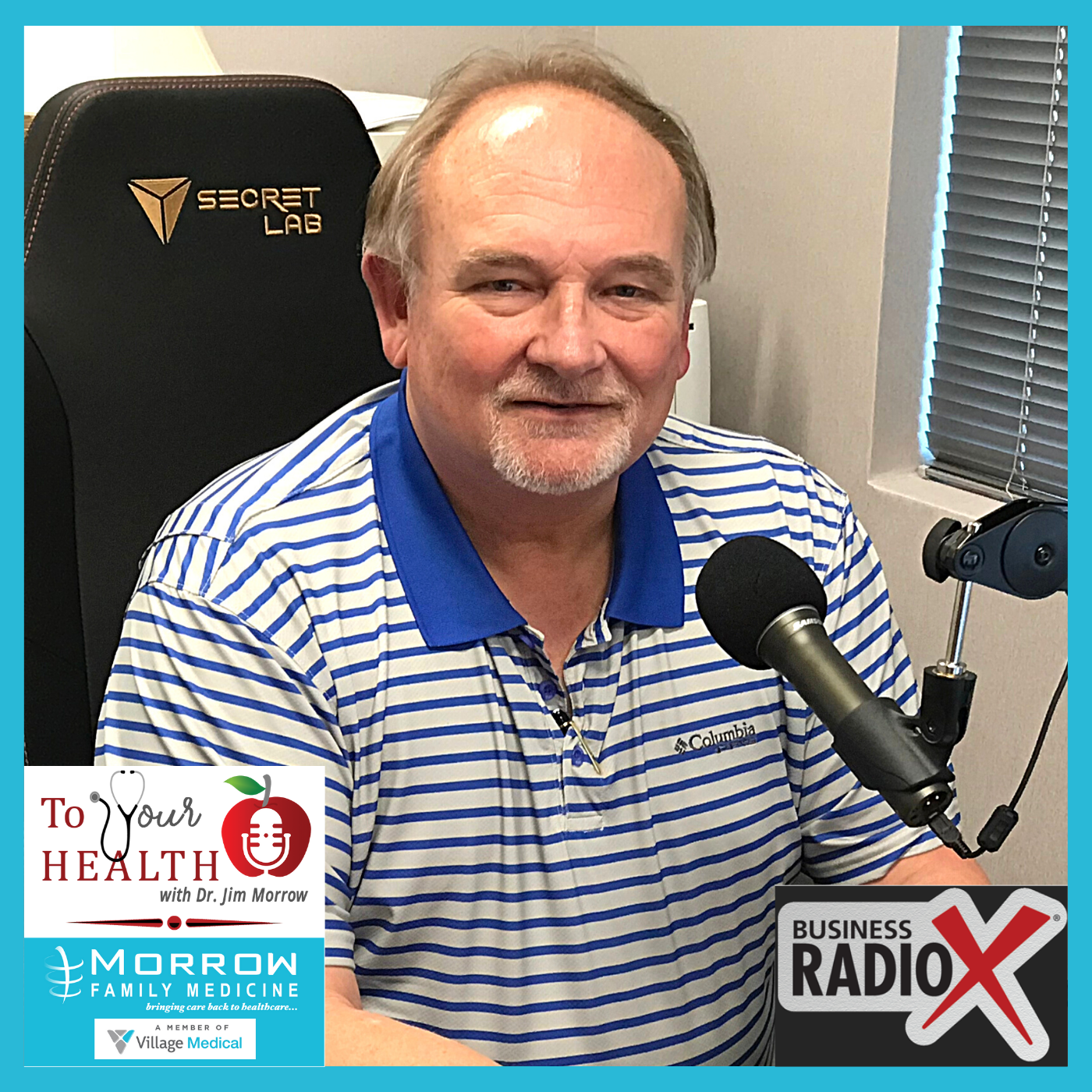

Revisiting Skin Cancer (Episode 56, To Your Health with Dr. Jim Morrow)
As the summer months approach, Dr. Jim Morrow revisited the topic of skin cancer, including visible signs in bumps and moles which should prompt a checkup by dermatologist, the dangers of tanning beds and sunlamps, and much more. He also answered listener-submitted questions. “To Your Health” is brought to you by Morrow Family Medicine, which brings the care back to healthcare.
About Morrow Family Medicine, A Member of Village Medical
Morrow Family Medicine, a Member of Village Medical, is an award-winning, state-of-the-art family practice with offices in Cumming and Milton, Georgia. The practice combines healthcare information technology with old-fashioned care to provide the type of care that many are in search of today. Two physicians, three physician assistants, and two nurse practitioners are supported by a knowledgeable and friendly staff to make your visit to Morrow Family Medicine, A Member of Village Medical one that will remind you of the way healthcare should be. At Morrow Family Medicine, a Member of Village Medical, we like to say we are “bringing the care back to healthcare!” The practice has been named the “Best of Forsyth” in Family Medicine in all five years of the award, is a three-time consecutive winner of the “Best of North Atlanta” by readers of Appen Media, and the 2019 winner of “Best of Life” in North Fulton County.
Village Medical offers a comprehensive suite of primary care services including preventative care, treatment for illness and injury, and management of chronic conditions such as diabetes, congestive heart failure, chronic obstructive pulmonary disease (COPD), and kidney disease. Atlanta-area patients can learn more about the practice here.
Dr. Jim Morrow, Morrow Family Medicine, and Host of “To Your Health with Dr. Jim Morrow”
 Dr. Jim Morrow is the founder and CEO of Morrow Family Medicine. He has been a trailblazer and evangelist in the area of healthcare information technology, was named Physician IT Leader of the Year by HIMSS, a HIMSS Davies Award Winner, the Cumming-Forsyth Chamber of Commerce Steve Bloom Award Winner as Entrepreneur of the Year and he received a Phoenix Award as Community Leader of the Year from the Metro Atlanta Chamber of Commerce. He is married to Peggie Morrow and together they founded the Forsyth BYOT Benefit, a charity in Forsyth County to support students in need of technology and devices. They have two Goldendoodles, a gaggle of grandchildren and enjoy life on and around Lake Lanier.
Facebook: https://www.facebook.com/MorrowFamMed/
LinkedIn: https://www.linkedin.com/company/7788088/admin/
Twitter: https://twitter.com/toyourhealthMD
The complete show archive of “To Your Health with Dr. Jim Morrow” addresses a wide range of health and wellness topics, and can be found at www.toyourhealthradio.com.
Dr. Morrow’s Show Notes
What is skin cancer?
- Skin cancer is the most common form of cancer in the United States.
- Almost all skin cancers are the result of too much exposure to ultraviolet light.
- This is found in sunlight,
- tanning booths,
- and sunlamps.
- Skin cancer is usually one of the most curable types of cancer.
- Basal cell carcinoma and squamous cell carcinoma are two of the most common forms of skin cancer.
- They are very curable.
- These cancers occur in the basal and squamous cell layers at the top of the skin.
- They are almost always slow-growing.
- If found early, they are easy to treat and do not spread.
- Melanoma is a less common
- but aggressive form of skin cancer.
- It occurs in skin cells that make a skin color pigment called melanin.
- If it is not found early, it will likely spread to other tissues.
- It can spread through the whole body and may cause death.
- Only 2% of skin cancer cases are melanoma.
- But it causes the most deaths from skin cancer.
- If it is not found early, it will likely spread to other tissues.
- Almost all skin cancers are the result of too much exposure to ultraviolet light.
Symptoms of skin cancer
- The main symptom of skin cancer is a new or changing
- bump,
- growth,
- lesion,
- mole,
- or rough patch of skin.
- Not all skin cancers look alike.
- A normal mole is solid tan, brown, dark brown, or flesh-colored.
- Its edges are well defined.
- It’s usually smaller than 1/4 inch in diameter.
- It has a round or oval shape.
- It is flat or dome-like.
- The ABCDE rule can help you remember what to look for when you’re checking for moles.
- If you notice any of these signs, talk to your doctor right away.
- A for asymmetry – Mole is not symmetrical.
- This means it’s not the same on both sides.
- If it was folded in half, the two halves wouldn’t match.
- B for border –
- Edges of the mole are blurry or jagged.
- C for color –
- Changes in the color of a mole.
- This could be darkening, loss of color, spreading color, or multiple colors.
- D for diameter –
- A mole more than ¼ inch in diameter.
- E for evolving –
- Mole looks different from others or is changing in shape, size, or color.
- Changes in the color of a mole.
- This means it’s not the same on both sides.
- Other signs of cancer could include:
- A mole that itches or bleeds.
- A fast-growing mole.
- A scaly or crusted growth on the skin.
- A sore that won’t heal.
- A patch of skin that has changed color.
- Most skin cancers occur on parts of the body that are repeatedly exposed to the sun.
- For men, these areas include the
- head,
- neck,
- face,
- tips of the ears,
- hands,
- forearms,
- shoulders,
- back,
- and chests.
- For women, they occur most commonly on the back and the lower legs.
- Melanomas can be anywhere on your body.
- In men, they are most often on the chest, stomach, or back. In women, they are most often on the lower legs.
- Moles also can grow in hidden areas of your body.
- This include between toes, on your scalp, or under a nail.
- If you notice a mole that has changed,
- or if you have a new mole that doesn’t look like your other moles, see your family doctor right away.
- If you notice a mole that has changed,
What causes skin cancer?
Most cases of skin cancer are caused by too much exposure to ultraviolet (UV) radiation.
This comes from the sun, tanning beds, and sunlamps.
- There are 2 types of UV rays:
- UVA rays (long-wave) –UVA rays penetrate clouds and glass.
- They penetrate the skin more deeply and damage the basal layer of the skin.
- UVB rays (short-wave) –
- UVB rays damage the upper layers of the skin. They are the main cause of tanning and sunburn.
- Researchers used to believe that only UVB rays led to cancer.
- But studies have shown that both UVA and UVB damage the skin and can cause cancer.
- A tan is the body’s attempt to protect itself from the sun’s harmful rays.
- Even if you don’t burn, being in the sun too often for too long can lead to skin cancer.
- Tanning booths are just as dangerous as long periods of sunlight.
- Some people are more at risk of developing skin cancer.
- Things that could increase your risk include:
- Having fair skin, blonde or red hair, and light-colored eyes.
- Long-term sun exposure, such as working outside.
- A history of bad sunburns, especially as a child or teenager.
- Using indoor tanning beds.
- Having a weakened immune system, including having an organ transplant.
- Melanoma can occur anywhere on your body.
- This includes places that aren’t exposed to the sun.
- So there could be other factors that can cause it.
- Risk factors for developing melanoma include:
- Someone in your family has had cancerous moles or a melanoma.
- You have many moles larger than a pencil eraser.
- You have more than 50 moles of any size.
- You got a bad sunburn that caused blisters when you were a child.
- Your skin usually burns but doesn’t tan.
How is skin cancer diagnosed?
- The first step to diagnosing skin cancer is usually through regular self-examination.
- Use a full-length mirror and a handheld mirror to check every inch of your skin.
- Learn where your birthmarks, moles, and blemishes are and what they usually look like.
- Check for anything new, such as a change in the
- size,
- texture,
- or color of a mole,
- or a sore that doesn’t heal.
- Look at the front and back of your body in the mirror.
- Raise your arms and look at your left and right sides.
- Bend your elbows and look carefully at your palms and forearms,
- including the undersides, and your upper arms.
- Check the back and front of your legs.
- Look between your buttocks and around your genital area.
- Sit and closely examine your feet,
- including the bottoms of your feet and the spaces between your toes.
- Look at your face, neck, and scalp.
- You may want to use a comb or a blow dryer to move hair so you can see better.
- Check for anything new, such as a change in the
- By checking yourself regularly, you are familiar with what’s normal for your skin.
- If you find anything unusual, see your family doctor.
- The earlier skin cancer is found, the better.
- Your doctor will examine your skin.
- He or she will look at the size, shape, color, and texture of any concerning areas.
- If you have skin changes that might be skin cancer, your doctor will do a biopsy.
- During a biopsy, a small piece of your skin is removed and sent to the lab for testing.
- If skin cancer is diagnosed, you may undergo more tests to see if the cancer cells have spread.
- These tests could include a CT scan, MRI, or lymph node biopsy.
- If you find anything unusual, see your family doctor.
Can skin cancer be prevented or avoided?
- The key to preventing skin cancer is to avoid being in the sun or using sunlamps.
- If you’re going to be in the sun for any length of time,
- follow safe-sun guidelines.
- These are ways to protect your skin and reduce your risk of skin cancer.
- For the best protection, follow all of these guidelines every time you’re outside.
- If you’re going to be in the sun for any length of time,
- Avoid the sun.
- Avoid being in the sun in the middle of the day, between 10 a.m. and 4 p.m.
- The sun is the strongest during these hours.
- That’s when the most damage to your skin occurs.
- Sunburns and suntans are signs that your skin is damaged.
- The more damage, the more likely you are to have complications.
- These include early wrinkles, skin cancer, or other skin problems.
- Use sunscreen.
- Use a broad-spectrum sunscreen with an SPF of at least 15.
- Use it on cloudy days, too.
- Check the expiration date.
- Some ingredients break down over time.
- Use plenty of sunscreen.
- Rub it in well.
- Apply sunscreen at least 15 minutes before you go into the sun.
- Apply the sunscreen everywhere your skin is exposed.
- This includes your ears, the back of your neck, and any bald areas on the top of the head.
- Apply more sunscreen at least every 2 hours and after swimming, sweating, or toweling off.
- Use a broad-spectrum sunscreen with an SPF of at least 15.
- Remember, you’re not completely safe just because you’re wearing sunscreen.
- Sunscreen cannot give you 100% protection against the sun’s harmful UV radiation.
- Wear a wide-brimmed hat, protective clothing, and sunglasses.
- If you have to be out in the sun, cover up your skin.
- A wide-brimmed hat will help protect your face, neck, and ears.
- A hat with a 6-inch brim all around is the best.
- Baseball caps don’t protect the back of your neck or the tops of your ears.
- Wear protective clothing, such as long-sleeved shirts and long pants made of tightly woven fabric.
- If the clothes fit loosely, you will feel cooler.
- Special sun-protective clothes are available from several companies.
- Wear sunglasses to protect your eyes.
- Sun exposure increases your risk of getting cataracts.
- Choose sunglasses that protect the sides of your eyes and block both UVA and UVB rays.
- Remember that you are exposed to the sun while driving, especially your hands and arms.
- Clouds and water don’t protect you.
- UV rays can reach swimmers at least 1 foot below the surface of the water,
- and 60% to 80% of the sun’s rays go through clouds.
- The sun’s rays also can reflect off water, snow, white sand, and concrete.
- If you have to be out in the sun, cover up your skin.
- Don’t try to get a tan.
- Don’t use tanning beds or sunlamps.
- They damage your skin just like natural sunlight does.
- Don’t use tanning beds or sunlamps.
- Protect your kids.
- Sunburns in childhood are the most damaging.
- Children younger than 6 months of age should never be outside in direct sunshine.
- Children 6 months of age or older should wear sunscreen every day.
- Getting numerous bad sunburns as a child increases your risk of developing skin cancer later in life.
- The American Academy of Family Physicians (AAFP) advises talking to children, teens, and young adults, who are 10 to 24 years of age, about the dangers of too much sun exposure.
- Teach them how to protect themselves and reduce their risk of skin cancer.
- Sunburns in childhood are the most damaging.
Skin cancer treatment
- Treatment for skin cancer depends on several factors.
- These include the
- type of cancer,
- where it is located,
- how big it is,
- how far it has spread,
- and your general health.
- Most cases of nonmelanoma cancers can be taken care of with surgical removal of the mole or lesion.
- Other options include freezing, medicated creams, or laser therapy.
- Treatment for melanoma is more complex.
- When caught early, the cancerous tissue can be removed with surgery.
- If it has spread beyond the skin, treatments could include:
- Radiation – High-energy rays like X-rays shrink or kill the cancerous cells.
- Chemotherapy – Powerful medicines, in pill form or injected into the veins, shrink or kill the cancer.
- Biological therapy – Uses substances produced by living organisms. These can be made in the body or in a lab. They are used to boost your immune system to help your body fight the cancer. Some may suppress your immune system. This means you could more easily get sick.
- Targeted therapy – Uses medicines that are designed to target specific weak spots in cancer cells.
- If it has spread beyond the skin, treatments could include:
- When caught early, the cancerous tissue can be removed with surgery.
- These include the
Living with skin cancer
- Skin cancer is treatable, especially when caught early.
- Cancerous tissue can be removed with a minor surgical procedure.
- In many cases, that is all the treatment needed.
- Future lesions may occur.
- You will need to continue checking your skin.
- Call your doctor if you see changes.
- For more advanced cases, living with cancer during treatment can be stressful.
- Each treatment can have different side effects on your body.
- Take good care of yourself.
- Eat a healthy diet, get plenty of sleep, and try to keep your energy up by staying active.
- Even after your cancer goes into remission, you are at higher risk of cancer returning to your body.
- You will need to get regular follow-up care and check-ups for years after your treatment.
- Cancerous tissue can be removed with a minor surgical procedure.
www.familydoctor.org